What changes a Conservative government might make to Canada’s immigration policies

My latest. Speculative but reasoned (IMO):

With the Conservatives leading the polls, it is worth speculating what changes a Conservative government might bring to immigration, citizenship, multiculturalism, and employment equity policies, and the degree to which Tories would be constrained in their policy and program ambitions. Despite talking about change and “common sense,” they will still be constrained by provincial responsibilities and interests, the needs and lobbying of the business community, and an overall limitation of not wanting to appear to be anti-immigration.

Constraints

One fundamental political constraint is that elections are won and lost in ridings with large numbers of visible minorities and immigrants, like in the Greater Toronto and Hamilton Area, British Columbia’s Lower Mainland, and other urban areas as shown in Figure 1. Arguably, the Conservatives learned this lesson in the 2015 election, where citizenship revocation provisions and the Barbaric Cultural Practices Act signalled to many new Canadians they were not welcome.
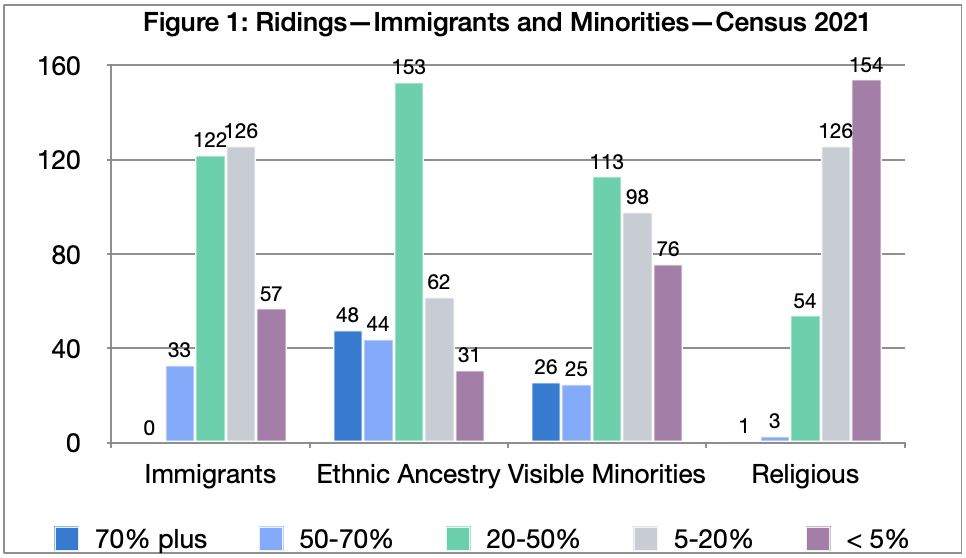
The demographic of immigrants and minorities across Canadian electoral ridings. Graph courtesy of Andrew Griffith

Given that immigration is a shared jurisdiction with the provinces, any move to restrict the numbers of permanent residents, temporary workers, and foreign students will likely be met with provincial opposition. All provinces—save Quebec—largely buy into the “more is merrier” demographic arguments. Provincial governments and education institutions rely on large numbers of international students to fund higher education, and thus have already signalled concerns with the current government’s trial balloon about capping students from abroad.

Stakeholder pressures are a further constraint. Business groups, large and small, want a larger population to address labour market needs, and that includes international students for low-value-added service jobs. A larger population also means more consumersImmigration lawyers and consultants, both in Canada and abroad, benefit from more clients. Settlement and refugee groups can continue to press for increased resources even if evaluations question their effectiveness with respect to economic immigrants. Most academics focus on barriers to immigrants and visible minorities rather than questioning their assumptions. Lobby groups like the Century Initiative and others continue to push the narrative that a larger population is needed to address an aging population, a narrative that is supported by all these stakeholders, and federal and provincial governments (except for Quebec).

Few of these stakeholders seriously address the impact of immigration on housing availability and affordability, health care, and infrastructure, despite all the recent attention to the links between housing and immigration. Most stakeholders are either in denial, claim that ramping up housing can be done quickly as many recent op-eds indicate, or argue that raising these issues is inherently xenophobic if not racist.

Global trends that also could shape a possible Conservative government include increased refugee and economic migrant flows, greater global competition for the same highly skilled talent pool and, over time, expanded use of AI and automation as a growing component of the labour market.

Immigration

Given these constraints and the fear of being labelled xenophobic, Conservatives have focused more on service delivery failures than questioning immigration levels, whether it’s permanent resident targets or the rapid increase in uncapped temporary workers and international students. Poilievre has stated that the Conservative focus will be on the “needs of private-sector employers, the degree to which charities plan to support refugees, and the desire for family reunification,” suggesting greater priority on economic and family immigration categories, as was largely the case for the Harper government. The Conservatives’ recent policy convention was largely silent on immigration. They are engaging in considerable outreach to visible minority and immigrant communities, adopting the approach of former Conservative minister Jason Kenney, “the minister for curry in a hurry.”

That being said, it is likely that a Conservative government would likely freeze or decrease slightly the number of permanent residents rather than continuing with the planned increases (the Liberal government recently indicated that it is not “ruling out changes to its ambitious immigration targets.)”
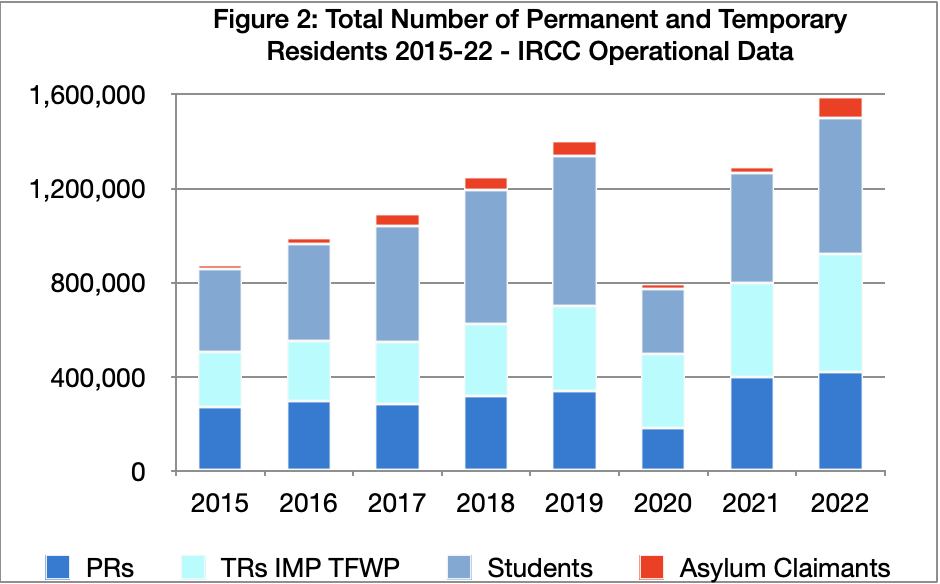
Figure two highlights the growth in permanent and temporary residents since 2015. The extent of public debate on the impact of immigration on housing provides latitude for a freeze at 2023 levels, or a small decrease given that immigrants and non-immigrants alike are affected. Graph courtesy of Andrew Griffith

It is less clear whether a Conservative government would have the courage to impose caps on temporary workers given pressure from employers, including small businesses. However, the previous Conservative government did have the political courage to impose restrictions following considerable abuse of the temporary work program, ironically exposed by the Liberals and NDP. Similarly, imposing caps on international students would run into strong resistance from provincial governments given their dependence on students from abroad to support higher education. Even placing caps on public colleges that subcontract to private colleges—which are more for low-skilled employment than education—would be challenging given employer interest in lower-wage employees. They may, however, reverse the Liberal government’s elimination of working-hour caps for foreign students.

The emphasis on charity support for refugees suggests a renewed focus on privately sponsored refugees compared to government-assisted ones. Expect the usual dynamics at play in terms of which groups have preferential treatment (e.g. Ukraine, Hong Kong) that influence all parties, and greater sensitivity to religious persecution, particularly Christians. They are likely to remember how their callous approach to Syrian refugees and the death of Alan Kurdi contributed to their 2015 defeat, and thus be more cautious in their approach to high-profile refugee flows and cases. Whether they would remove health-care coverage for refugee claimants as the Harper government did in 2012 is unclear, but as that was ruled by the Federal Court as incompatible with the Charter, they may demur. 

Whether a Conservative government would go beyond the usual federal-provincial-territorial process and provide financial support for foreign credential recognition, or be more ambitious and transfer immigrant selection of public sector regulated professions (e.g., health care) to the provinces is unclear. However, given that regulatory bodies are provincial and, for health care, provinces set the budgets, they may explore this option.

While the simplification and streamlining of over 100 immigration pathways is long overdue, given the complexity for applicants to navigate the system, and for governments to manage and automate it, such longer-term “fixing the plumbing” initiatives are less politically rewarding than addressing various stakeholder pressures. 

Given the increased number of asylum claimants, a Conservative government would be likely to restore requirements for claimants to have sufficient funds and an intent to leave, and may consider reimposing a visa requirement on Mexican nationals.

The over $1.3-billion funding for settlement agencies would likely decrease given expected overall fiscal restraint.

Citizenship 

Citizenship is arguably the end point of the immigration journey as it represents full integration into society with all the political rights and responsibilities that entails. This assumption is being challenged by a combination of Canadian economic opportunities being relatively less attractive for source countries such as China and India, along with greater mobility of highly educated and skilled immigrants. As a result, the naturalization rate is declining as shown in figure three.
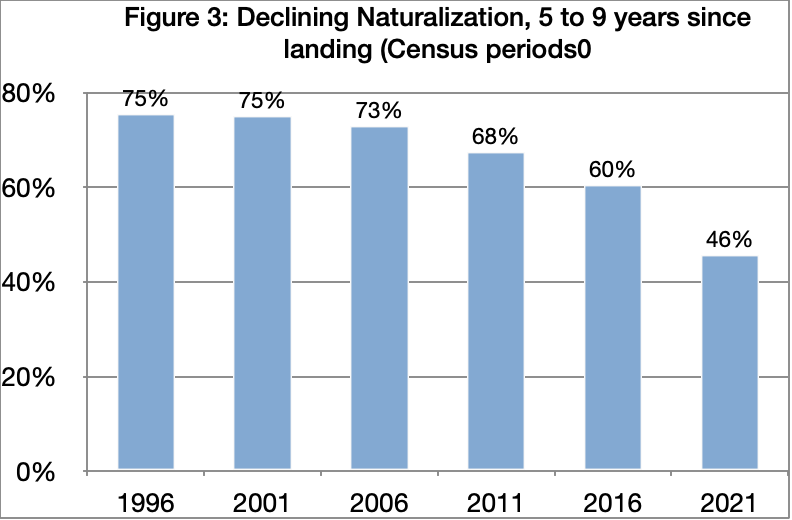
Figure three depicting naturalization rates between 1996 and 2021. Graph courtesy of Andrew Griffith

The previous Conservative government was more active on citizenship than other recent governments. In 2009, it released a new citizenship study guide, Discover Canada, with a greater focus on history, values and the military. It also required a higher passing score on the citizenship test—up to 75 per cent compared to 60 per cent—and different versions were circulated to reduce cheating. Language requirements were administered more strongly, and adult fees were increased from $100 to $530. A first generation cut-off for transmission of citizenship was implemented as part of addressing “lost Canadians” due to earlier Citizenship Act gaps. C-24 amended the Citizenship Act to increase residency requirements from three to four years, increased testing and language assessment to 18-64 years from 18-54 years, and a revocation provision for citizens convicted of treason or terror.

The Liberal government reversed the changes to residency requirements, the age changes for testing and language assessment, and the revocation provision, and promised to issue a revised citizenship study guide and to eliminate citizenship fees. Subsequently, the Liberals amended the citizenship oath to include reference to Indigenous treaty rights in response to the Truth and Reconciliation Commission.

It is unclear the degree to which the Conservatives will consider citizenship a priority in relation to other immigration-related issues. From an administrative perspective, changing residency requirements again would simply complicate program management, make it harder to reduce processing times, and would not provide any substantive benefit. Re-opening citizenship revocation would simply draw attention to the risks that countries would offload their responsibilities, as the example of former U.K. citizen and Canadian citizen by descent Jack Letts illustrates. 

Given that the Liberal government to date has not issued a revised citizenship guide, the Conservatives would likely stick with Discover Canada, issued in 2009. Similar, the existing citizenship test and pass rates, and proof of meeting language requirements would not need to be changed. As the Liberal government never implemented 2019 and 2021 campaign commitments to eliminate citizenship fees, one should not expect any change from the fee increase of 2014.

On the other hand, the pandemic-driven shift to virtual citizenship ceremonies in 99 per cent of all such events would likely to be reversed given strong Conservative opposition in recent discussions at the Standing Committee on Citizenship and Immigration, along with the proposed self-affirmation of the citizenship oath (“citizenship on a click”). It is also likely that a Conservative government may wish to revert to paper citizenship certificates, and away from the option of e-certificates

The Liberals and the NDP have been trying to weaken the first generation cut-off for transmission of citizenship for those with a “substantial connection” to Canada. Despite the Conservatives opposing this change, largely on process grounds as this was tacked on to a Senate private member’s bill, it is unclear whether they would reverse this change if implemented. However, if some particularly egregious public examples emerge, just as the Lebanese evacuation of 2006 prompted the government to legislate the cut-off given the large numbers of “Canadians of convenience,” they may well decide to act.  

The Conservatives may wish to revisit the issue of birth tourism. In 2012, they pushed hard, but ultimately the small numbers known at the time and provincial opposition to operational and cost considerations made them drop their proposal. Since then, however, health-care data indicated pre-pandemic numbers of birth tourists to be around 2,000, although these dropped dramatically during the pandemic given visa and travel restrictions.

The Conservatives are unlikely to revisit the issue of Canadian expatriate voting limitations given the Supreme Court’s ruling that expatriates have the right to vote no matter how long they have lived outside Canada

Part II

In contrast to immigration and citizenship, a Conservative government would face fewer constraints with respect to multiculturalism and employment equity. Their public criticism of wokeism, their policy resolutions stressing merit over “personal immutable characteristics“, their criticism of diversity, equity and inclusion training, and their criticism of Liberal government judicial, Governor in Council, and Senate appointments all point to a likely shift in substance and tone.

Multiculturalism and Inclusion

The Conservative government moved multiculturalism from Canadian Heritage to Immigration, Refugees and Citizenship Canada (IRCC) given its refocused the program on the integration of new Canadians. Grants and contributions were similarly refocused, and overall funding to the program declined from about $21-million to $13-million (operations and maintenance), and from about 80 to 34 employees. The Conservatives also implemented a historical recognition program to recognize previous discriminatory measures against Ukrainian, Chinese, Italian, Jewish, and Sikh Canadians.

The Liberal government moved multiculturalism back to Canadian Heritage. Funding increased dramatically, with $95-million for Canada’s Anti-Racism Strategy, refocusing the program on anti-racism and systemic barriers to full participation in Canadian society. Additional funding was provided to the Canadian Race Relations Foundation. Greater emphasis was placed on addressing barriers facing Black Canadians such as the Black Canadian Communities Initiative and the Black Entrepreneurship Program. A special representative to combat Islamophobia was appointed. More comparative research by Statistics Canada highlighted differences in visible minority economic outcomes. Heritage months for Canadian Jews and Sikhs were introduced among others. 

It is highly likely that resources would be cut sharply under a Conservative government given their overall approach to government expenditures, their general approach to limit government intervention and their scepticism regarding critical race theory, systemic racism, and diversity, equity, and inclusion training. There would likely also be a return to a more general integration focus between and among all groups. They would, of course, be unlikely to curb any of the recognition months or days, given the importance to communities (and their political outreach). 

The Conservatives would likely be more cautious about using language like “barbaric cultural practices” in their communications given how that eventually backfired in the 2015 election. One can also expect them to be cautious with respect to Quebec debates on secularism or “laïcité,” such as Bill 21.

Just as the Liberal government cancelled the Conservative appointment of an ambassador for religious freedom, a Conservative government would be likely to cancel the representative to combat Islamophobia.

Hopefully, a Conservative government would neither diminish the value of the mandatory census by reverting to the voluntary and less accurate National Household Survey approach, nor dramatically reduce the budget of Statistics Canada given the impact on the quantity and quality of data and related analysis.

A future Conservative government is likely to revisit the guidelines for funding research away from diversity, equity and inclusion priorities, along with Canada CouncilTelefilm, and others, based upon party policy resolutions

Employment Equity

A Conservative government might reduce the amount and quality of data available regarding visible minority, Indigenous Peoples, persons with disabilities represented in public service, and other government appointments. 

The Liberal government expanded public service data to include disaggregated data by sub-group, allowing for more detailed understanding and analysis of differences within each of the employment equity groups since 2017, along with data on LGBTQ+ people. Previous government reports only covered the overall categories of women, visible minorities, Indigenous Peoples and persons with disabilities. It is uncertain whether these reports under a future Conservative government would revert back to only reporting on overall group representation, hirings, promotions and separations. Given that this concerns public service management, it may well decide to continue current practice or the more sceptical elements may press for change.

On the other hand, political appointments—judges, Governor-in-Council, Senate—are another matter. Appointment processes are likely to be revised given concerns that the processes introduced by the Liberal government unduly favoured candidates more on the centre-left than centre-right. Figure 4 highlights the increased representation of women, visible minorities and Indigenous Peoples in political appointments.
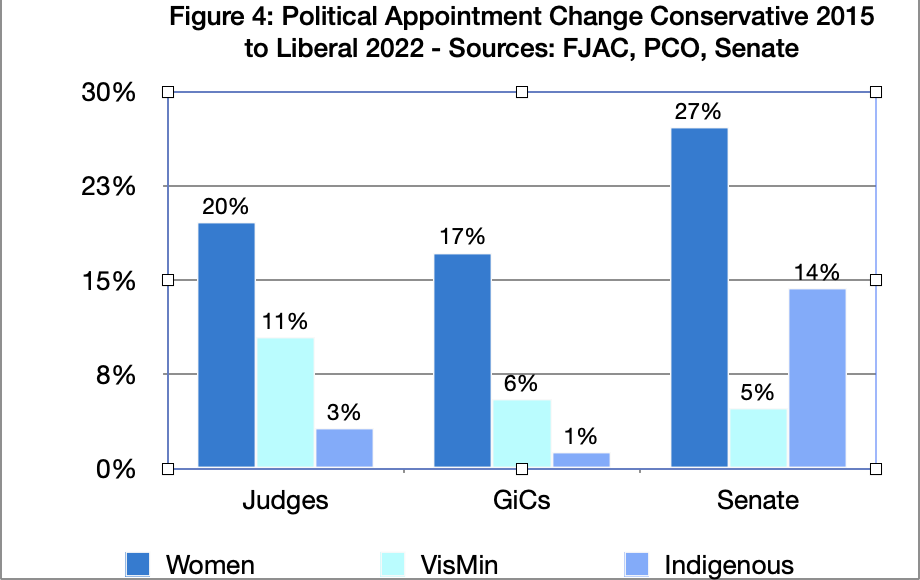
Figure four highlights the increased representation of women, visible minorities and Indigenous Peoples in political appointments. Graph courtesy of Andrew Griffith

At the end of the Conservative government, judicial appointment were 35.6 per cent women, two per cent visible minorities and 0.8 percent Indigenous. The Liberal government introduced a new application process that aimed to—and succeeded in—vastly increasing the diversity among judicial appointments. As of October 2022, they sat at: 55.2 per cent women, 12.5 per cent visible minorities, and four per cent Indigenous.

Similarly, at the end of the last Conservative government, Governor-in-Council appointments to commissions, boards, Crown corporations, agencies, and tribunals were 34.2 per cent women, 6.1 per cent visible minorities, and 2.9 per cent Indigenous. Under the Liberal government, the number of women increased to 51.4 per cent, visible minorities to 11.6 per cent, and 4.2 per cent Indigenous by January 2023.

Senate appointments present a more nuanced picture. Conservative appointment of visible minorities was at 15.8 per cent, representing a conscious effort to address under-represented groups, but women, at 31.6 per cent of appointments, and Indigenous Peoples at 1.8 per cent, were significantly under-represented. The Liberal introduction of a formally independent and non-partisan advisory board resulted in a sharp increase in diversity: 58.8 per cent women, 20.6 per cent visible minorities, and 16.2 per cent Indigenous Peoples.

Along with these process changes, the Liberal government expanded annual reporting to include visible minorities, Indigenous Peoples, persons with disabilities, and judicial appointment reporting also included LGBTQ and ethnic/cultural groups. Should a Conservative government decide to stop these annual breakdowns, it will be harder to track any shifts in representation. 

The current review of the Employment Equity Act, launched in 2021, has not yet resulted in any public report on consultations and recommendations from the Task Force. Given limited parliamentary time and higher priorities during the current mandate, it is unlikely that any revisions to the Act will be approved. However, should any legislation come to pass, it is likely that a future Conservative government might wish to revisit some of the provisions.

Concluding observations

To date, two overarching themes have driven Conservative discourse: Canada is broken, and the need to “remove the gatekeepers.” The Yeates report confirms that the immigration department is broken, reflecting long neglect of organization weaknesses, a lack of client focus, and, I would argue, an excessive multiplicity of programs that make it harder for clients to navigate, and more difficult for IRCC to manage. 

One of the ironies of assessing likely Conservative policies is immigration, citizenship, and related areas all pertain to government being “gatekeepers.” It’s easier to shrink the gate for some policies and programs than others (e.g., government political appointments). Others, such as reducing levels of permanent and temporary residents, are much more challenging given the strength of provincial, business, and other stakeholders opposition. The degree to which a Conservative government is prepared to expend political capital will obviously reflect whether or not it has a majority in Parliament. 

The sharp decrease in public support for immigration, given the impact on housing, health care, and infrastructure, likely provides greater flexibility for any future Conservative government. While there is greater flexibility with respect to multiculturalism and employment equity, a Conservative government could also be ambitious with needed immigration reforms for permanent and temporary immigration.

While some have argued that immigration and related issues have become a third rail in Canadian politics, this need not be the case. The concerns being raised are regarding the impact of large and increasing numbers of permanent and temporary migration on housing, health care, and infrastructure, not the racial, religious or ethnic composition of immigrants. These issues affect immigrants and non-immigrants alike and focus on commonalities, not differences.

Source: What changes a Conservative government might make to Canada’s immigration policies

Blogging break

Back in December.

Archaeologists discover previously unknown ancient language – The Independent

Fascinating:

Archaeological research in the Middle East is revealing how a long-forgotten ancient civilisation used previously undiscovered linguistics to promote multiculturalism and political stability.

The ground-breaking discoveries are also shedding new light on how early empires functioned.

Ongoing excavations in Turkey – in the ruins of the ancient capital of the Hittite empire – are yielding remarkable evidence that the imperial civil service included entire departments fully or partly dedicated to researching the religions of subject peoples.

The evidence suggests that, back in the second millennium BC, Hittite leaders told their civil servants to record subject peoples’ religious liturgies and other traditions by writing them down in their respective local languages (but in Hittite script) – so that those traditions could be preserved and incorporated into the empire’s highly inclusive multicultural religious system.

So far, modern experts on ancient languages have discovered that Hittite civil servants preserved and recorded religious documents from at least five subject ethnic groups.

The latest example was unearthed just two months ago. It turned out to be written in a previously unknown Middle Eastern language that had been lost for up to 3,000 years.

Over the decades, around 30,000 complete and fragmentary clay tablet documents have been unearthed in the ruins of the ancient Hittite capital – Hattussa (now known as Bogazkoy) around 100 miles east of modern Turkey’s capital, Ankara.

The great majority were written in the empire’s main language – Hittite. But the Hittite government’s scribes wrote around 5 per cent of them fully or partly in the languages of the empire’s minority ethnic groups – peoples like the Luwians (south-eastern Anatolians), Palaians (from part of north-west Anatolian), Hattians (central Anatolians) and Hurrians (from Syria and northern Mesopotamia).

The most recently discovered minority language, recorded by government scribes (and previously unknown to modern scholars) is being called Kalasmaic – because it seems to have been spoken by a subject people in an area called Kalasma on the empire’s northwestern fringe.

The discovery suggests that even the most obscure languages in the empire were being recorded, studied and preserved in written form. That in turn raises the possibility that other small previously unknown Middle Eastern languages will be discovered, recorded on Hittite imperial clay tablets, in the particular series of ancient scriptoria that the archaeologists are currently excavating at Bogazkoy.

The empire’s civil service scribes wrote all their manuscripts in a Hittite version of a pre-existing Mesopotamian-originating script (the oldest writing system in the world) called cuneiform, consisting of wedge-shaped lines arranged in groups representing syllables.

The area of the Middle East which is now Turkey was, in ancient times, particularly rich in languages.

Linguistic diversity often depends on topography. The more mountains and isolated valley systems, the more languages are likely to develop and survive.

At present only five minority languages are known from the Bronze Age Hittite empire – but in reality, given the mountainous topography, there may well have been at least 30

Indeed, just adjacent to the ancient Hittite Empire were the Caucasus mountains region which still today boasts some 40 languages.

The Hittite language is the world’s oldest attested Indo-European tongue.

The earliest inscriptions date from the 16th century BC. As an Indo-European language, it is related to most modern European languages (including English) as well as many Asian languages (including Iranian and many Indian ones). Indeed, despite the 3,000-year time gap, ancient Hittite and modern English have dozens of words in common.

Watar was for instance Hittite for “water”. Duttar was the main part of the Hittite word for “daughter”. “Wine” was wiyana, while card was “heart/cardiac” and newa was their word for “new”.

The excavations of the ancient scriptoria in Bogazkoy will allow linguistics experts to better understand the evolution of ancient Bronze Age Indo-European languages that English is distantly related to.

The current excavations are being directed by professor Andreas Schachner of the German Archaeological Institute in Istanbul – with the study of the texts on the clay tablets being undertaken by paleo-linguists from Wurzburg and Istanbul universities.

“Bronze Age Middle Eastern history is only partly understood – and discovering additional clay tablet documents is helping scholars to substantially increase our knowledge,” said cuneiform script expert, Wurzburg University professor Daniel Schwemer, who is leading the investigation into the newly discovered texts.

The excavations at Bogazkoy are currently yielding between 30 and 40 new cuneiform tablets or tablet fragments every year. Bogazkoy (ancient Hattusa) is particularly important because, as the centre of the Hittite empire (around 1650 BC to 1200 BC), it was the capital of one of the world’s first half dozen really large imperial political systems. It was therefore home to one of the world’s first really substantial document-producing civil services.

The Hittite empire stretched from the Aegean Sea in the west to what is now northern Iraq in the east and from the Black Sea in the north to Lebanon in the south.

Source: Archaeologists discover previously unknown ancient language – The Independent

Ramzy: Why diaspora communities in Canada are struggling to keep their first languages alive

Multiculturalism was always about integration into one of the two official languages. In the initial years, the program did support other languages, some of which is now provided at the provincial level (our kids attended farsi school for a few years in Ottawa). Enhancement of other languages was and is in that context as speaking an official language is crucial to integration:

Saiful Bhuiyan, who immigrated to Canada from Bangladesh via the United States two decades ago, is immensely proud of his two children. One is a software engineer and the other, a stem cell research scientist.

But, even over Zoom, I can see that underneath the pride lies sorrow. Bhuiyan, 59, who has built a successful accountancy business, fears that his children are losing their ability to speak Bangla, the family’s mother tongue.

“Now that they’re grown up … they’re talking among themselves in English, except when they’re talking with us,” he says from his home office in Windsor, Ont., a framed certificate hung on the stark white walls of the room. “And in the next generation, they might not be using it.”

At one point, he was so tormented by the loss that he became ill. He’s all too aware of the larger symbolism of language. After the partition of the Indian subcontinent in 1947, the newly formed government of Pakistan tried to make Urdu the sole national language, nearly outlawing Bhuiyan’s mother tongue. The move sparked the Bengali language movement and ultimately the Bangladesh War of Independence. The trauma of almost losing the Bangla language lives on in him.

“When I’m dying, I might not see anybody around me who can speak the language I love, the mother tongue I had when I was born,” he say.

His fears are real. Canada prides itself on being an international beacon of multiculturalism; nearly one in four people in Canada today is an immigrant. The country relies on newcomers to boost both population and productivity and aims to increase immigration levels to 500,000 newcomers a year by 2025. Yet its Multiculturalism Act, which enshrines the right of immigrants and Indigenous peoples to protect, preserve and enhance their mother tongues with government support, is falling short.

Mother tongues are in steep decline, generation over generation. Many arrive here not realizing they are likely to be the last generation in their family to speak their language. Worse, the important role of language in preserving culture is being ignored, say experts and advocates. “It’s not possible to have multiculturalism without multilingualism,” says Slava Balan, a human rights researcher and a PhD candidate at the University of Ottawa who immigrated to Quebec from Moldova. “If cultures are only reduced to the dances, songs, cuisine and all this stuff, that’s just a pretence. That’s not real multiculturalism.”

Some immigrants are finding innovative solutions on their own, while calling on governments across Canada to fulfil their responsibility to help preserve mother tongues.

Chief among those advocates is Bhuiyan. As a director with the Mother Language Lovers of the World Society and the former president of the Bangladesh-Canada Association in Windsor, he’s become one of Canada’s most passionate defenders of mother tongues. His work has helped lead to the recognition of mother tongues, from his city all the way to the federal level.

***

Language has been a political flashpoint in Canada for years. In the 1960s, amid increased tensions between francophones and anglophones, the Royal Commission on Bilingualism and Biculturalismexplored calls to protect the French language. But concerns from diaspora groups persuaded the commission to expand its scope to recognize how other ethnic groups contribute to Canada, too. In 1971, then prime minister Pierre Trudeau introduced Canada’s multiculturalism policy, positioning it within Canada’s bilingual model.

The move set up Canada as a hub of diversity, but it also set the stage for complications. Notably, Quebec has rejected multiculturalism in fear of losing francophone culture, language and tradition. Without adopting an official policy, Quebec has instead promoted the ideal of “interculturalism,” which aims to adapt newcomers to its French-speaking society.

Nevertheless, the Canadian Multiculturalism Act, passed in 1988, enshrined the federal government’s commitment to promoting and maintaining an equal, diverse society in Canada. It was the first of its kind in the world and changed Canada’s sense of self. But its implementation on languages has been disappointing.

For example, by 1991, Parliament had established the Department of Multiculturalism and Citizenship to create programs for cross-cultural understanding, heritage cultures and languages, and community support and participation. The Canadian Heritage Languages Institute Act came into effect the same year, in a bid to establish an institute in Edmonton to develop resources and standards for ethnic minority language classes in Canada. But its creation was deferred in the 1992 budget and repealed before coming into force.

While statistics are scarce, academic studies suggest that funding for heritage language retention and education has only decreased in the decades since. Federal support started strong with nearly $200 million during the first decade after the 1971 policy passed. A study in 2005 by Anjali Lowe, then a master’s student at the University of Victoria, found that it ended after that as the government chose to exclude language from its interpretation of multiculturalism. Alberta, British Columbia and Ontario offered heritage language funding through the public education system early on but have slowly phased it out, too, the study says. It adds up to failing to honour the role languages play in sustaining multiculturalism.

Bhuiyan’s experience proves the point. Despite being in communication with elected officials at all levels of government, his community still struggles to find funds for cultural events, placing a heavy burden on members to pay for these initiatives on their own.

***

Across Canada, census data show two interconnected, overwhelming trends. First, immigrants whose language is neither French nor English are arriving in strong numbers. Of the 1.3 million immigrants who arrived in Canada between 2016 and 2021, more than 900,000 had a non-official mother tongue. Today, there are nearly 400 non-official mother tongues in Canada.

Second, their children and grandchildren are leaving those languages behind in favour of the two official ones. The numbers are dramatic. About 6.3 million immigrants in Canada have a mother tongue that isn’t French or English. Among second-generation Canadians, it’s 1.2 million. By the third generation, only 250,000 people have a mother tongue other than English and French.

It’s a phenomenon I’ve felt in my own life. I immigrated to Canada from Egypt with my family as a nine-year-old in 2013. I was fluent in Arabic, my mother tongue, as well as English, and I had a better knowledge of French than the average Canadian anglophone child. But for some reason, I felt like my near-trilingualism was a curse, not a gift.

In the decade since, as I’ve struggled to make sense of who I am, I’ve found myself belittling my unique identity — responding to my parents in English rather than in Arabic and immersing myself in western pop culture to make up for missed years.

It didn’t help that all around me, I received the message that to fit in and succeed, I had to assimilate myself into this new society. Some of the messages were direct. At nine, I had to take English as a second language, a class I hardly needed. I faced comments from classmates about my slight accent. But other pressure was subtle, like encouragement from many adults in my life to become fluent in French rather than retain my mother tongue.

I’m not alone in this. Amir Kalan, an assistant professor of language and literary education at McGill University in Montreal, says his research shows this phenomenon is common among immigrant children. That’s why advocates like Bhuiyan are desperate for change. Preserving mother tongues in Can- ada — all 400 or so of them — is essential to protecting our multiculturalism, he says. “If slowly all the language is lost, culture is lost, diversity is lost, meaning that it’s going to be one country with one language and one culture, which is not colourful,” Bhuiyan says.

***

Canada’s diverse Indigenous communities know this feeling all too well. Across the country, Indigenous Peoples are fighting to reclaim their languages, which were violently suppressed after settlers arrived in Canada. Under the Multiculturalism Act and the 2019 Indigenous Languages Act, Indigenous communities are beginning to receive greater long-term funding to support language revitalization. But long before government support increased, Indigenous Peoples had to find their own innovative ways to revitalize their languages, says Lorna Wanosts’a7 Williams, professor emerita of Indigenous education, curriculum and instruction at the University of Victoria. She is the Canada Research Chair in Education and Linguistics.

Williams, a residential school survivor from the Lil’wat First Nation in Mount Currie, B.C., has dedicated her life to revitalizing Indigenous languages and providing models for other language learners as well. “One of the first things that we have to work on constantly, all of us together, is that multilingualism is a gift to the world,” Williams says. “Each of the languages portrays a very different relationship in the world that we live in and it gives us a little different understanding of this world.”

She started helping shape the curriculum for the community-led schools in her Nation with the help of a Dutch linguist between the 1960s and 1980s. “We had to develop a writing system for our language, because, like most Indigenous languages, our language is oral…but we live in a very literate environment,” she says. In doing so, Williams and her community ensured the survival of their mother tongue, Ucwalmícwts. And since then, her work has grown to help preserve other languages, too.

While government support is not nearly enough yet for Indigenous and other non-official languages, Williams hopes Canada can realize that every language can bring new knowledge to our country. “Multilingualism isn’t a divide,” she says. “Because that’s what has always been promoted, that if people speak many different languages, it hinders communication and a sense of togetherness. But it doesn’t.”

***

There are some bright spots. In April, a bill by Sen. Mobina Jaffer that called for Feb. 21 to be recognized as the annual International Mother Language Day in Canada passed with wide bipartisan support. Jaffer, who speaks Kutchi, introduced the bill in 2017, but it failed to gain momentum in the Senate through multiple attempts over four years. The bill is largely symbolic and makes no mention of the government’s mandate to support heritage languages. But it’s a step forward in recognizing Canada’s diverse communities and the languages they bring with them.

Jaffer’s attachment to her mother tongue is deeply personal. She arrived from Uganda after Idi Amin, the former dictator and president, expelled thousands of South Asians from that country in 1972. For her, and for many in other diaspora communities, language is identity.

Source: Why diaspora communities in Canada are struggling to keep their … – Broadview Magazine

Globe editorial: Who we are, and must be, as Canadians

Same principles, of course, apply to any form of racism, discrimination and hate:

…Solidarity can take many forms. Tearing down posters of those held hostage by Hamas is a hateful act; do not let that happen unopposed. Go out of your way to solicit businesses that have been targeted for being Jewish-owned. Most of all, reach out to your fellow citizens to let them know that they are not alone.

That is who we want to be, who we must be, as Canadians…

source: Who we are, and must be, as Canadians

U.N. Women’s Groups Accused of Boosting Hamas Massacre Deniers – The Daily Beast

Of note. Valid critique. Article highlights relevant comparisons and this policy and political failure:

Prominent human rights campaigners in Israel say the most important women’s organizations within the United Nations have failed to give proper recognition to the massacre and mass rape carried out by Hamas on Oct. 7.

The UN Women statement from Oct. 13, failed to mention any of the atrocities and the U.N.’s Committee on the Elimination of Discrimination against Women (CEDAW) talked amorphically about “the gendered dimensions of conflict” without laying out the brutality inflicted on women during the horrific attack.

“The silence of the international human rights and women’s rights community is deafening,” Professor Ruth Halperin-Kaddari, a former vice president of CEDAW, told The Daily Beast. “For those of us who believe in the power of international human rights institutions and in solidarity between women, it is a particularly devastating blow. The betrayal is not only to the victims of sexual abuse, but to the very integrity of the institutions.”

The reticence to comment on the specific atrocities in Israel and horrific gender-based violence in contrasts with UN Women and CEDAW’s history of speaking out in defense of women all over the rest of the world.

Source: U.N. Women’s Groups Accused of Boosting Hamas Massacre Deniers – The Daily Beast

The Return of the ‘Useful Idiot’

Some history of the term “useful idiots” and its application to some groups and individuals in the Israel Hamas war:

The Hamas charter calls for killing all Jews (not just Israelis), so how could it be that there are Jewish groups, such as If Not Now and  Jewish Voice for Peace, who carry water for Hamas? Hamas and other Islamist groups punish gays with death, so why are there LGBTQ+ groups that are pro-Hamas? Given the way that Iran and Islamists treat women, why do some feminists back them?

The Jewish groups are the most perplexing. Placing the blame for the barbaric terrorist attack of October 7thsquarely on Israel, they are busy lobbying Congress to stop sending military aid. Anti-semitic harassment does not seem to concern them, and their rallies have led to headlines that surely make Hamas leaders gleeful: “Progressive Jewish Groups Blame Israeli ‘Apartheid’ for Hamas Violence” (Newsweek) and “Hundreds Arrested as US Jews Protest Against Israel’s Gaza Assault” (The Guardian) are but two examples.

This phenomenon is not new. Lenin supposedly called people of this sort “useful idiots” and, as the phrase suggests, he had utter contempt for them, especially the liberals of the Kadet (Constitutional Democratic) party. Although they did not themselves practice terrorism, the Kadets apologized for, even applauded, it. As with Hamas, Russian terrorists of the early 20th century reveled in cruelty. It was common to disfigure a person, often chosen at random, by throwing sulphuric acid in his face. Another favorite was to toss bombs laced with nails into a crowded café “to see how the foul bourgeois will squirm in death agony.” One group threw “traitors” into vats of boiling water.  As the leading scholar of Russian terrorism, Anna Geifman, explained, “the need to inflict pain was transformed from an abnormal irrational compulsion experienced by unbalanced personalities into a formally verbalized obligation for all revolutionaries,” as it apparently was for ISIS and is for Hamas.

How could the liberals have stomached such cruelty? Paul Milyukov, the Kadet leader, declared that “all means are now legitimate… and all means should be tried,” much as apologists for Hamas favor decolonization “by any means necessary,” including, it would seem, burning babies alive. Another Kadet official, asked to condemn such terrorism, famously replied: “Condemn terror?  That would be the moral death of our party!”

No sooner had Lenin seized power than the Bolsheviks proclaimed Kadets “outside the law,” which meant anything could be done to them. Right away two Kadet leaders were murdered in their hospital beds. Since Lenin made no secret of his plans—again, like Hamas—why did the liberals not oppose him? Even Russian capitalists contributed to the Bolsheviks and other parties sworn to destroy them!

As if not to be outdone by their Russian predecessors, some American liberals justified Stalin’s purges, the Gulag, and the starvation of millions of peasants. Other liberals objected, and so a split reminiscent of what seems to be developing today took place. Closer to our time, the radical gay cultural theorist Michel Foucault, whose ideas helped form the current academic ethos, came to back Ayatollah Khomeini. In short, we are witnessing a familiar pattern.

What explains it? What makes people useful idiots? It isn’t lack of intelligence. One is most likely to find useful idiots on the campuses of elite colleges and universities. Nor is it ignorance: Hamas is proud to broadcast its atrocities. So what then is it?

In his cycle of novels about the Russian Revolution, Aleksandr Solzhenitsyn poses this very question. In one memorable scene, he describes the novel’s hero, Vorotyntsev, at a meeting of the Kadets. “They were all overwhelmingly certain that they were right, yet they needed these exchanges to reinforce their certainty,” he thinks.  And despite his better judgment, Vorotyntsev goes along with them as if he were hypnotized—not because he felt he was wrong, but out of fear of saying something reactionary.”  Today, many are unwilling to risk being called “conservative” or worse, not just to avoid the consequences that such a reputation might entail, but so as not to tarnish their sense of self, which is inextricably tied up with being on the progressive side of everything. At last, Vorotyntsev breaks free from ”the bewitchment” and speaks his mind. How wonderful it would be to get people to do the same in the present day.

Perhaps supporters of Hamas terror naively imagine that they will never find themselves the target of it. “There is reason to fear that the Revolution may, like Saturn, devour each of her children one by one,” declared the French revolutionary Pierre Verginaud at his trial, and it wasn’t long before the guillotine also claimed the revolutionaries who condemned him. Useful idiots need to use their heads before they lose their heads.

Source: The Return of the ‘Useful Idiot’

French march against antisemitism shakes up far right and far left – BBC

Of note. Of course, the anti-immigration and xenophobic discourse of Le Pen is directed against Muslims, surprising omission from the article:

Something unprecedented is happening this weekend in Paris, brought about by the war between Israel and Hamas and its spill-over in Europe.

For the first time ever, a major demonstration being attended by representatives of the major political parties includes the far right – but not the far left.

On Sunday afternoon thousands of people heeded a call from the Speakers of the two houses of parliament to show their support for French “Republican” values and their rejection of antisemitism – this in the face of a steep rise in antisemitic actions since 7 October.

Among the first to announce their presence were Marine Le Pen, three-time presidential candidate for the National Rally (formerly the National Front), and the party’s young president, Jordan Bardella.

Almost simultaneously came a rejoinder from their counterpart on the far left, Jean-Luc Mélenchon, irascible leader of France Unbowed (LFI). His party would not be attending, he tweeted, because the march was a “rendezvous for unconditional supporters of the massacre [of Gazans]”.

Source: French march against antisemitism shakes up far right and far left – BBC

Regg Cohn: Canadians who seek justice in the Israel-Hamas war should choose their words — and their targets — very carefully

Of note. Money quote:

“We used to say that the world needs more Canada.

It can now be said that Canada does not need more Middle East — neither the madness nor the menace.”

Across Canada, protesters are raising their voices for their rival truths on both sides of the Middle Eastern divide. But two harsh realities await:

First, Canadians can’t stop the endless bloodshed in Gaza and Israel from here.

Second, they quite possibly can start a new conflict on the home front — pitting Canadians against Canadians on the streets of Toronto.

That would be the worst possible legacy of the latest war.

In Sunday’s Star, I wrote at length about the continuing war against peace, based on my own journalistic journey covering the front lines in Israel, Gaza, the West Bank and Lebanon. Today, the conflict is closer to home.

Tensions are rising here just as they are around the world, notably in European countries where antisemitism and Islamophobia are two sides of the same debased coin. The difference is that Canadians aren’t habituated to so much intolerance and incitement.

Today, demonization is the common denominator.

Antisemitism is being normalized. Islamophobia is being legitimized. And xenophobia is being Canadianized.

Please don’t close your eyes to it, for it is in plain sight. If you can’t feel it — in the air, on the streets and online — then you have lost all feeling.

In my last article, I described how far-right Jewish settlers and inciters undermined the peace process in Israel with an assassination and occupation; how Hamas and Islamic Jihad acted not merely as terrorists but rejectionists, blowing up the peace process with suicide bombs targeting civilians.

Never underestimate the ability of extremists and extreme voices on both sides to hijack the agenda — two tails wagging two warring dogs.

I worry that something similar is happening here in Canada — not with weapons of war, just the weaponizing of words. Some are using social media and megaphones to drive a wedge of division.

Debate is good and democratic. Protests are core to the fabric of freedom and petitions are part of our history.

However, hate speech isn’t protected — antisemitic or Islamophobic attacks can be prosecuted. When a synagogue is hit with Molotov cocktails in Montreal, or a mosque in Ottawa is smeared with feces, it’s against the law.

Small comfort. I worry as much or more about the rhetoric that is perfectly legal yet utterly hostile, if not inciteful.

I’m not pining for a country that bans harsh words or uncomfortable ideas. But it is painful when I see people validate or celebrate protests that devalue what their fellow Canadians hold dear.

I don’t expect every protester to be a model of modulation. I’m not counting on every social media monger to show moderation.

But when it feeds bigotry and bullying, we are moving into perilous territory. There’s a fine line between protesting for peace and provoking a war of words.

That line has been crossed in recent weeks.

Those protesters who seek justice should also show judgment — in choosing their words and their targets. When they criticize Israeli actions over there, and then single out Jewish Canadians over here, it sends a chill here at home that Jews everywhere are fair game.

When crowds chant outside the Jewish Community Centre at Bloor and Spadina (on their way back from a nearby protest), it transmits an unmistakably antisemitic signal across the city that Jews are somehow interchangeable with the Israeli consulate. When protesters yell slogans outside restaurants allegedly to call out Jewish or Israeli connections — intending only to intimidate and berate those trapped inside — it sends an ominous message across the country.

Boycotts are blunt instruments at the best of times. This is the worst of times.

Shall our universities ban books or appearances by bestselling Israeli historian Yuval Noah Harari, one of his country’s harshest social critics, because of his origins? Should Canada follow the lead of Lebanon and other Arab countries in banning Wonder Woman movies because its leading woman, Gal Gadot, is Israeli?

Beware such sophistry, for it is a slippery slope.

Obviously it is possible to criticize Israel without being antisemitic — as I did and I do. It is also possible to be anti-Zionist without being anti-Jewish — though it is not as simple as it sounds.

For if Zionism is truly racism, and Israel is transparently racist, would we say the same of the Islamic Republic of Pakistan — carved out as the explicit homeland for Muslims during the 1947 partition of the subcontinent, a place where blasphemy still triggers a death sentence and church bombings remain rampant?

Polling shows most Canadian Jews are broadly supportive of Zionism and the existence of Israel (setting aside illegal settlements). So it is hardly surprising that chanting Zionism is racism, or that Israel is an abomination — and calling for its elimination — would raise alarm bells (just as attacking Ukraine’s right to self-determination would trigger anxiety among Canadians with family ties to that country).

Righteous sloganeering is the wrong way to bring people together. Without humility, there is no empathy.

We have already seen violent and hateful incidents in Canada and the U.S. against Jews and Muslims. We have already heard people claiming that pro-Palestinian protesters should be doxxed or deported for speaking out, or listened as Canadian Jews were accused of dual loyalties for having strong opinions.

Instead of reaching out across the divide and joining hands, too many Jews and Muslims can only see themselves as the bigger victim — oblivious to the other — both in the Middle East and now in Canada. But in any competition for victimhood, there are no victors — it doesn’t work over there, and it won’t help over here.

It is not too late for Canadians to regain their footing, recover their balance, reclaim their compass. But we all need better filters.

Campus excesses are today magnified by social media and then amplified by mass media — distorting the dialogue further. An echo chamber has been transformed into a boxing ring where people take their best shots to provoke the worst instincts among cheering throngs.

Instead of joining hands, we have moved to finger-pointing and flag-waving. I wince when I see the Israeli and Palestinian flags affixed to cars whose drivers honk furiously for their rival tribe or team — as if this deadly conflict were a World Cup soccer competition for the loudest fans.

In a world of conflict and ignorance, Canada can remain a country of coexistence and tolerance. At a time of political polarization, Canadians must show the path to pluralism and remain a role model for multiculturalism.

I wake up with a heavy heart when I think of the bloodshed across the Middle East now — as I did in the past for the hundreds of thousands of souls that have died in the countries I’ve covered as a foreign correspondent. But when I wake these days to what is slowly unravelling in Canada, I hear unmistakable echoes — and yes, echo chambers — from my time abroad.

Which makes my heart even heavier.

We used to say that the world needs more Canada.

It can now be said that Canada does not need more Middle East — neither the madness nor the menace.

Source: https://www.thestar.com/politics/political-opinion/canadians-who-seek-justice-in-the-israel-hamas-war-should-choose-their-words-and-their/article_8b42ba0a-ee70-59cb-9a40-7125c887c51d.html

Le rapport sénatorial sur l’islamophobie est le fruit d’une intoxication idéologique

The Quebec laicité perspective on the recent Senate report:

Irresponsable ? Catastrophiste ? Incendiaire ? On hésite sur le bon adjectif à utiliser pour décrire le rapport sur l’islamophobie que le Comité sénatorial permanent des droits de la personne (CSPDP) vient de déposer.

Les attentats à la mosquée de Québec et de London ont profondément bouleversé les Canadiens. Tous les crimes haineux mentionnés dans le rapport sont inacceptables, et les gouvernements ont la responsabilité de les combattre et doivent tout mettre en oeuvre pour favoriser la coexistence pacifique et la sécurité de leurs citoyens. Mais amplifier indûment la menace en dépeignant un climat de terreur pour les musulmans canadiens ne peut que nuire davantage. Les chiffres de Statistique Canada infirment d’ailleurs cette thèse alarmiste. Pourquoi taire, par exemple, que les populations noire et juive sont, et de loin, davantage victimes de crimes haineux ?

Ce rapport, s’il suggère bien quelques rares mesures raisonnables, préfère brosser un tableau hideux et sans nuances de la situation des musulmans canadiens. Ils se sentiraient attaqués, des femmes et des filles auraient « peur de quitter leur domicile pour aller au travail et à l’école », certains subiraient même de l’islamophobie tous les jours.

Définition, laïcité et idéologie

C’est que la définition proposée de l’islamophobie est très large afin d’englober le plus de cas possible. Par exemple, le fait de ne pas accorder aux musulmans, dans le milieu de travail, des locaux et du temps pour les prières est considéré comme relevant de l’islamophobie, au sens de racisme antimusulman (p. 66). L’approche intersectionnelle, comme les notions d’islamophobie systémique et de micro-agressions inconscientes, permet également d’amplifier le phénomène.

Le rapport reconduit également une compréhension hautement caricaturale de la Loi sur la laïcité de l’État. Les témoins interrogés, qui confondent le respect des personnes avec le respect absolu des préceptes de l’islam, « s’entendent tous pour dire que la loi 21 est discriminatoire, qu’elle a exacerbé l’islamophobie et qu’elle devrait être abrogée » (p. 65). Elle est même accusée de « déshumaniser les personnes ». On le voit, le CSPDP n’a pas entendu comme témoin un seul des nombreux musulmans qui soutiennent la loi 21.

Le rapport évite également de penser la réalité de l’islamisme violent et la peur légitime qu’il soulève, y compris chez les musulmans. Seul Rachad Antonius, parmi les 138 témoins entendus lors des 21 séances publiques, ose en traiter expressément, mais le rapport le passera sous silence. Il n’y aurait, à entendre les autres témoins, que des préjugés et des stéréotypes à combattre à grands coups de campagnes médiatiques et de formations obligatoires contre les biais inconscients pour tous les fonctionnaires et les élèves.

Le rapport ne retient que ce qui appuie une conclusion tirée d’avance. Tout écart statistique, comme la sous-représentation des musulmans chez les fonctionnaires ou leur surreprésentation dans les prisons, est compris comme une « preuve » d’islamophobie systémique, sans qu’il y ait recherche d’une explication plus plausible. Le rapport confond également idéologie et science en prétendant, sans justification, que « la plus grande menace pour la sécurité nationale provient des groupes militant pour la suprématie blanche » (p. 50). On taira donc un document sur la stratégie antiterroriste du Canada qui précisait pourtant que « l’extrémisme islamique violent est la principale menace pour la sécurité nationale du Canada » .

Une offensive contre les institutions chargées de la sécurité

Ce sont assurément les instances responsables de la sécurité nationale qui hantent ce rapport. Cinq des 13 recommandations y sont d’ailleurs consacrées, mais vont dans le sens opposé à celui qu’on attend de la part d’un comité sénatorial crédible. C’est que ce dernier semble surtout à la remorque des recommandations du Conseil national des musulmans canadiens (CNMC), contre lesquelles nous faisions déjà une mise en garde ici.

Le CNMC ne réclame en effet rien de moins que l’interruption de la stratégie nationale de lutte contre l’extrémisme violent et la radicalisation, et la suspension de la Division de la revue et de l’analyse (DRA) de l’Agence de revenu du Canada (ARC), qui est chargée de repérer les menaces de financement du terrorisme au Canada qui s’exercent par l’entremise d’organisations caritatives. Il propose plutôt que soient scrutés les organismes de sécurité nationale, dont le Service canadien du renseignement de sécurité, et les services frontaliers du Canada, qu’il soupçonne de pratiques racistes, xénophobes, islamophobes et même de subir la « pénétration de la suprématie blanche ».

Le CSPDP approuve tout cela et affirme que « les lois, les politiques et les pratiques relatives à la sécurité nationale sont profondément ancrées dans l’islamophobie et continuent de perpétuer des préjugés à l’encontre des musulmans » (p. 51). La preuve ? Soixante-quinze pour cent des révocations d’associations caritatives posant le plus grand risque de financement du terrorisme au Canada visaient des organismes musulmans, alors que ceux-ci représentent moins de 1 % de l’ensemble des organisations caritatives (p. 57). Malgré le témoignage de Sharmila Khare (directrice générale de la Direction des organismes de bienfaisance de l’ARC), selon lequel « les vérifications de la DRA ne sont entreprises que lorsqu’il y a un risque d’abus terroriste », le rapport conclut néanmoins que la DRA « fait preuve d’un parti pris structurel à l’encontre des organismes de bienfaisance musulmans » (p. 58).

Le simple fait que le modèle d’évaluation du ministère des Finances soit axé sur le risque serait même, selon le professeur de droit Anver Emon, « une déclaration explicite d’islamophobie » . Mieux, qu’un Canadien voyageant à Gaza et combattant pour le Hamas devienne suspect pour le gouvernement serait, ajoute-t-il, un « exemple d’islamophobie systémique » ! Faut-il vraiment relever que le CSPDP perd ainsi toute crédibilité en « oubliant » que le Hamas est sur la liste des entités terroristes du Canada ? Qu’en amalgamant islam et islamisme violent sous le parapluie de l’islamophobie, il mine le sentiment de sécurité de ses citoyens ?

Comment expliquer pareille intoxication irresponsable ? Une partie de l’explication réside peut-être dans le fait que la présidente de ce comité sénatorial, Salma Ataullahjan, est toujours conseillère au CNMC. Rappelons, pour finir, que cette organisation fait partie des plaignants qui sont devant les tribunaux pour faire invalider la loi 21.

Source: Le rapport sénatorial sur l’islamophobie est le fruit d’une intoxication idéologique

Neutral coverage below:

Islamophobia remains a persistent problem in Canada and concrete action is required to reverse the growing tide of hate, says a new Senate report released Thursday.

“The evidence is clear. Islamophobia is an acute threat to Canadian Muslims and urgent action is needed,” Sen. Salma Ataullahjan, chair of the Senate human rights committee, told reporters Thursday.

“We must commit to building a more inclusive country and to better promoting our Muslim relatives and friends, neighbours and colleagues.”

The report, the first of its kind in Canada, took a year and involved 21 public meetings and 138 witnesses.

The report said the committee “was disturbed to hear that incidents of Islamophobia are a daily reality for many Muslims, that one in four Canadians do not trust Muslims and that Canada leads the G7 in terms of targeted killings of Muslims motivated by Islamophobia.”

The report’s finding that one in four Canadians do not trust Muslims comes from a submission to the committee from Maple Lodge Farms, a supplier of Halal meat in Ontario’s Peel region, which said it gathered the information from a “national survey” it conducted of 1,500 Canadians.

The submission does not provide details on how the respondents were chosen or what specific questions they were asked.

The report found that Muslim women have become the “primary targets when it comes to violence and intimidation” because they are easily recognizable from their attire. As a result, many are afraid to leave their homes for work, school or other activities.

“The profound effects of gendered Islamophobia are such that it compels certain women to consider removing their hijabs to enhance their employment opportunities,” the report said.

“Testimonies highlighted the fact that Islamophobia in the workplace is not merely the consequence of a handful of people’s actions; rather, it is a systemic issue that is widespread.”

The report said that as a result, Arab women have the highest unemployment rate of any demographic group in the country.

Sen. Mobina Jaffer, Canada’s first Muslim senator, told reporters Thursday that in 2001, not long after 9/11, she was flying from Vancouver to Ottawa with about 60 members of her family when she and her husband were singled out by airport authorities.

“Coming from a refugee background to be appointed by [former prime minister Jean] Chrétien to be a senator was a great pride for my family,” Jaffer said. “And my husband and I both were called outside. And my husband and I both had to completely undress … and I don’t wish that on anybody.”

‘A confirmation of what we have been seeing over many years’

Uthman Quick, the director of communications for the National Council of Canadian Muslims (NCCM), told CBC News that the council was satisfied to see the report highlight the poor treatment of Muslim women in Canada, which he said is a growing problem.

“I think the report is really a confirmation of what we have been seeing over many years, but particularly over the last few weeks, since October 7,” he said.

Quick said there has been an increase in the number of Islamophobic incidents reported to the NCCM since the starte of the recent conflict between Israel and Hamas, a group designated as a terrorist organization by the Canadian government and other nations.

“I am hoping the recommendations are followed through upon. Now more than ever, we can see that they are absolutely needed,” Quick said.

Islamophobia and the media

The report said that the problem can be blamed in part on negative and pervasive stereotypes of Muslims the report said have mischaracterized “concepts of sharia, jihad and hijab.”

“The recurring portrayal of Muslims in media has entrenched these stereotypes, leading them to become falsely accepted as truth,” the report said.

The report found that hate-based information being spread on social media remains a growing problem, with more than 3,000 anti-Muslim social media groups or websites active in Canada.

“The frequency of hate speech and misinformation on social media platforms such as Facebook, X (formerly Twitter) and Instagram was a common concern for [committee] witnesses,” the report said.

A written submission to the committee from Meta, Instagram and Facebook’s parent company, said its efforts to combat Islamophobia are a “work in progress.” It said it is taking steps that include monitoring hate speech and engaging with Muslim communities.

Representatives from X did not appear or make a submission to the committee.

Recommendations

The report makes a number of recommendations for the federal government:

  • Ensure mandatory, regular training on Islamophobia for all federal government employees and the judiciary.
  • Launch a multimedia campaign and educational resources on Islamophobia that can be incorporated into classrooms.
  • Provide additional money to address hate-motivated crimes.
  • Increase specific Criminal Code offences for hate-motivated crimes.
  • Review the Canadian Radio-television and Telecommunications Commission’s mandate to ensure it reflects the needs, interests and aspirations of racialized communities.
  • Introduce legislation to crack down on online hate.
  • Review national security legislation to ensure it takes Islamophobia into account.
  • Modernize the Employment Equity Act to ensure it takes Islamophobia into account.

The report also recommended the federal government introduce legislation in a number of areas to help the Canada Revenue Agency better understand the context for audits of religious organizations and provide quicker decisions on appeals.

The report said that in 2021, 144 anti-Muslim hate crimes were reported to police across the country, with an additional 1,723 crimes reported that were motivated by racial or ethnic hatred.

According to Statistics Canada data used to write the report, there were 223,000 reported cases of hate crime in general in 2020, but the report said those numbers fail to provide a complete picture of hate-motivated violence against Muslims in the country.

Mohammed Hashim, executive director of the Canadian Race Relations Foundation, is quoted in the report telling the committee that only one per cent of reported hate crimes are reported to police and only a fraction of those result in charges.

“Muslims in Canada feel like they are under attack. The psychological impact of constant fear and vigilance is a heavy burden,” the report said.

“Survivors of violent Islamophobia live with the trauma of their direct experience, while countless others live with vicarious trauma brought on by justified fear that their communities are not safe.”

Source: Senate report on Islamophobia says urgent action needed to reverse rising tide of hate