Chris Selley: Backing the Houthis exposes the raw Jew-hatred of the pro-Palestinian protesters

Such extremism has little place in Canada and those publicly supporting such extremism need to reflect more on the impact of their actions:

Canada is broken in many ways, but the ability of different people from very different backgrounds to get along has not thus far been one of them. That’s very much at risk. Obviously many Jewish Canadians arrived many weeks ago at where I now find myself: Overt public support for Hamas, which is only slightly more subtle about its genocidal aims than the Houthis, has destroyed friendships and professional relationships, and weakened confidence in Canada as a safe place for Jews to live.

I abhor the idea of asking any individual Muslim (or any other Canadian) to explain and justify his position on the Israeli-Palestinian conflict. We’re allowed to think whatever we want about geopolitics inside our own heads, so long as we can be civil to each other out in the real world. But more and more, these protests are becoming an overt rejection of that latter.

Calling for an end to Israel’s war against Hamas is fair enough. The death toll is appalling, the prospects of a lasting victory uncertain. But if they’re as worried about Islamophobia as they claim to be, Muslim organizations and advocates desperately need to repudiate the naked extremism that now seems to have free run within the cause.

Source: Chris Selley: Backing the Houthis exposes the raw Jew-hatred of the pro-Palestinian protesters

Tasha Kheiriddin: Trudeau frittered away a good immigration policy for the sake of Liberal votes – National Post

Discounts the flawed policy rationale of the Barton commission recommendations but of course, political considerations also played a role. And, as we saw during the Kenney years, the liberals cannot take these voters for granted:

Immigrants are also grateful to the party that bring them in. Prime Minister Justin Trudeau learned this from his father. Pierre Elliott Trudeau took credit for the citizenship of millions of Canadians, even though many had come to Canada under previous governments. Why? Because they took their oath under his watch. And when it came to elections, the immigrant communities of the day — Italians, Greeks, Haitians, Vietnamese — tended to vote Liberal.

The implications of Trudeau Jr.’s replication of this policy are dire. Studies show that they are turning Canadians against immigration: even 62 per cent of current immigrants think we’re letting in too many people. They are impoverishing Canadians, both current and newcomer, according to the bank study. And they are also helping fuel Quebec separatism, as francophones look with alarm at rising immigrant populations in the Rest-Of-Canada. By the end of the century, Quebec risks becoming a bit player in Confederation, with only 15 per cent of its population.

This cannot continue. Instead of flooding the country with newcomers, the government needs to boost domestic productivity. That’s a harder fix — and one that won’t give them more votes. But then again, if Canadians can’t afford a decent life, the Liberals may not get their votes either.

Source: Tasha Kheiriddin: Trudeau frittered away a good immigration policy for the sake of Liberal votes – National Post

White Americans who dislike Jews also tend to endorse anti-Muslim attitudes, study suggests – PsyPost

Survey dates from 2014 but likely same trends apply:

The researchers focused on responses that reflected attitudes towards Muslims and Jews. Questions in the survey pertained to the cultural belonging of Muslims and Jews (e.g., whether participants would approve of their child marrying a Jew or Muslim, their agreement with a Muslim or Jewish ‘vision of America’), their loyalty, assimilation, and perceived power (e.g., ‘more loyal to their religion or Israel than to America’, ‘less like other Americans’, ‘have too much power’), and associated problems (e.g., ‘a threat to public order and safety’, ‘do not share my morals or values’, ‘take jobs and resources’, ‘are intolerant of others’, ‘want to take over political institutions’, ‘do not contribute to my community’, ‘are dependent on welfare and government’).”

The results showed that levels of anti-Muslim sentiment were several times higher than anti-Jewish sentiment. A clear majority of participants disapproved of a marriage between their child and a Muslim and roughly two thirds considered Muslims to be more loyal to their religion than to America. About one in four participants associated Muslims with public safety issues, while one in three believed they did not share their moral values and were intolerant.

In contrast, only about 17% of participants objected to their child marrying a Jew. Thirteen percent disagreed with Jews’ ‘vision of America’, 14% perceived them as more loyal to Israel than to America, and other negative views were less frequent.

Further analysis identified four distinct groups among the participants. The largest group, comprising 54% of participants, held few or no negative views towards both Muslims and Jews (low anti-Muslim, low anti-Jew). Another group, encompassing 26% of participants, exhibited moderate anti-Muslim and anti-Jewish views. The third group, making up 17% of participants, held strong anti-Muslim views but low anti-Jewish attitudes. The smallest group, approximately 4% of participants, harbored highly negative views towards both Jews and Muslims.

Membership in these groups was not associated with education. Men were twice as likely as women to hold high anti-Muslim, but low anti-Jew views. Older individuals were also more prone to this configuration of views. People with lower income were more likely to be in the fourth group (strong negative views of both groups). Republicans and evangelical Protestants were much less likely to be in the first group than in any of the other three groups.

“Although anti-Muslim opinion is more extensive, the two track together empirically and share a cultural logic as connected forms of ethno-religious boundary-making. Latent class analysis shows that anti-Semitism is nested within anti-Muslim attitudes, with political and religious identifications as consistent predictors of opinion,” the study authors concluded.

Source: White Americans who dislike Jews also tend to endorse anti-Muslim attitudes, study suggests – PsyPost

Ibbitson: Liberals trying to play both sides in Gaza conflict

Definition of middle of the road: road kill!

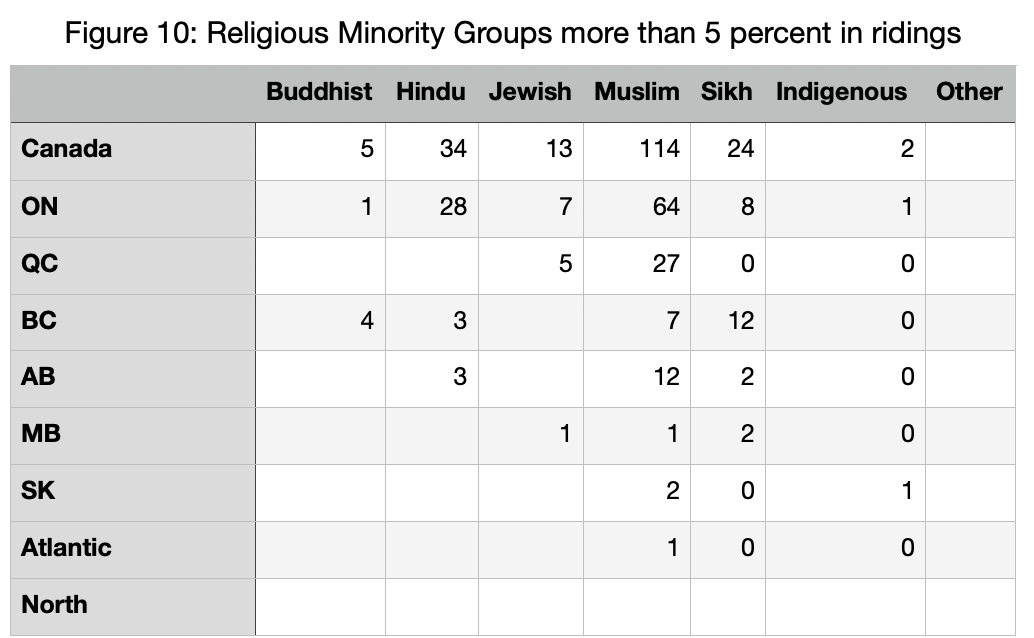
The table below highlights the number of ridings with more than 5 percent religious minorities, highlighting just how many more ridings have significant Muslim populations compared to Jewish populations.

The Liberals find themselves caught between an Israel/Conservative rock and a NDP/Palestinian hard place. And they don’t seem to have a solution, other than to placate both sides, which is no solution at all.

Source: Liberals trying to play both sides in Gaza conflict

Inside the crisis at TMU’s law school: It started with a letter of support for Palestinians. Now students and staff feel betrayed and donors are pulling out

Not really surprising that a school “branded as “a different kind of law school focused on equity and inclusion” would find itself in this mess. Kind of fitting for a university that changed its name from Ryerson to TMU, because of overly simplistic interpretations of history, activist pressure, and hurt to some students and groups, finds itself underlining its blind spot regarding anti-Jewish attitudes and anti-semitism.

Words matter, as advocates and activists rightly maintain. But now many of the activist law students are discovering this in a real personal sense with real consequences. A teaching moment:

…Public reaction was vicious. On social media, signatories were mocked and insulted in posts featuring their LinkedIn profiles, with photos of their faces. The Jewish advocacy group B’nai Brith put out a press release, calling on the school to “expel terrorist apologist students.” Some members of the legal community advocated for blacklisting all TMU students from the profession.

“I certainly wouldn’t hire any of these students,” one Toronto lawyer posted on X, “and the fact that some choose to ‘show’ their solidarity by keeping their names hidden means I’d have to write off hiring anyone from … the current crop at @LincAlexLawTMU.”

Under intense pressure from all sides, the institution waded in. What school leaders did would only further fan the flames.

The law school issued a statement that “unequivocally” condemned the “sentiments of Antisemitism and intolerance” the petition expressed, but made no mention of any possible action to address the conduct of signatories. That fell short in the eyes of two Jewish criminal defence lawyers. They penned a letter urging the school to impose consequences to “illustrate in no uncertain terms that hate speech and incitements to violence are utterly unacceptable.”

One of several non-Jewish signatories was former Ontario Court of Appeal Justice Harry LaForme, who is an Anishinabe from the Mississaugas of the New Credit First Nation. LaForme read the aspiring lawyers’ petition as a justification for what happened on Oct. 7, which, he said, disregards the rule of law, and is “completely anathema to Indigenous Peoples.”

LaForme hoped the school would create a safe space internally for signatories to distance themselves from the petition. “They (the students) have to be able to change their minds,” he said.

‘New McCarthyism’ decried by lawyers

In November, TMU hired a retired judge to conduct an external review. Former Chief Justice of Nova Scotia J. Michael MacDonald will meet signatories this month to determine whether their words breached the student code of conduct, which sets expectations for how students interact and communicate.

The school’s decision to outsource the job stoked acrimony, both from those who had been pushing administrators to quickly confront what seemed to them to be clear policy violations, as well as those who believed students were now being subjected to a witch hunt.

“A new McCarthyism” is how the response to the student petition was characterized in an open letter, signed by hundreds of members of the legal community, including Sealy-Harrington, Gadea Hawkins and other TMU professors.

Dania Majid, a Palestinian activist and head of the Arab Canadian Lawyers Association, signed that open letter. Majid, who faced intense Islamophobia as a young lawyer in the aftermath of 9/11, said the school’s characterization of the petition as antisemitic is “textbook anti-Palestinian racism.”

Majid said the students are being treated “as criminals.”

The fallout also highlighted divisions within the Jewish community, including at TMU. Shiri Pasternak, an assistant professor in criminology, is part of a group of Jewish instructors who don’t believe the petition was antisemitic and are concerned about the implications of the external review on academic freedom on campus.

“We didn’t necessarily all endorse the letter that the law students wrote,” Pasternak said. “But … we strongly believe that students should have a right to express, even imperfectly, their sense of injustice, and raise their collective voices to intervene when they see injustices.”

A campus turned tense

On campus, the atmosphere turned tense, students say. For the rest of the term, fewer classmates showed up for lectures; when they did, people who used to intermingle seemed to be sitting apart. Sam and Taylor said they felt ostracized by some of their peers, and uncomfortable coming to class.

One law school instructor, who is Jewish, moved her classes online after reading the petition. In a complaint to the university, she alleged the petition violated school policies, and had caused her to “worry for my physical safety as a result of my faith.”

Some of the law school’s roughly 450 students were upset by the timing of the petition, which dropped the week before on-campus interviews for placements at law firms.

At least one Bay Street firm asked TMU students whether they signed the petition, and refused to grant interviews to those who did. Ontario’s Ministry of the Attorney General also required law students working for the province to sign an attestation confirming they weren’t among the signatories, according to a memo from the deputy minister.

Noah Lister-Stevens, a second-year student who participated in interviews that week, was “disappointed” with his classmates for not better contemplating how their words would land. But he said the response of some law firms that seemed to be waging “a scorched-earth campaign,” was “disturbing.”

“None of the students in my school that I’ve ever spoken to are hateful people,” he said. “Everyone that I know who signed that letter is a kind person who deserves to be in that school.”

Sealy-Harrington shared with the Star several statements that he said had been provided to him by anonymous signatories. The statements accuse the administration of defaming the signatories by wrongly characterizing their petition as antisemitic, and of ignoring their pleas for help as they endured Islamophobia and racism from students, staff and the public.

“Nobody condemned the people calling us terrorists, or telling us to die, or describing in extreme detail the vile ways they would harm us or our families,” one statement said. “The school, named for an incredible justice-seeking Black man, acts only when white students complain, not when people of colour are tormented.”

The law school was renamed in 2021 for Lincoln Alexander, who was a lawyer and champion of racial equity. As Ontario’s lieutenant governor, he became the first Black Canadian to serve as a representative of the British monarchy in Canada.

A TMU spokesperson said “we respectfully disagree” with the claims of the signatories.

Administrators and staff have had nearly 200 meetings with students “to listen to their concerns and help them navigate the many available supports,” Karen Benner said in an email. “The university and law school categorically condemn any and all discrimination and harassment directed at our students and faculty, and have taken steps to address them.”

Donors cancel TMU law school scholarships

But the administration’s conversations with donors have been strained.

Criminal defence lawyer Brian Greenspan suspended a $50,000 scholarship. Greenspan said in a letter to the law school’s dean and the TMU president that the school’s namesake would be “appalled” by the petition.

The failure of administrators to categorically denounce the petitioners, Greenspan said, is “a derogation of the responsibility of those who support a civil society and a blemish on the legacy of Lincoln Alexander,” who believed in finding common ground.

The pulling of funding is an inappropriate response, according to Jim Turk, who is the director of TMU’s Centre for Free Expression, and says it takes away opportunities from future students.

Source: Inside the crisis at TMU’s law school: It started with a letter of support for Palestinians. Now students and staff feel betrayed and donors are pulling out
Lisée: Exagérer avec Bock-Côté

Useful review, as much for Lisée’s views as MBC’s:

Je veux rassurer tout de suite ceux de mes lecteurs qui souffrent de mathieu-bock-côté-phobie — oui, oui, je sais que vous êtes là : je ne suis pas un admirateur inconditionnel de celui qu’on appelle MBC. Mais voilà, je dois maintenant vous peiner en ajoutant que j’en suis un admirateur conditionnel. En plus, c’est un ami.

Je suis social-démocrate, il est conservateur. J’exècre l’avant-dernier pape, il le vénère. Je suis critique de toutes les religions, il fait l’apologie de la chrétienté. J’applaudis les programmes d’accès à l’égalité, il en rejette le principe même. Je suis inquiet du réchauffement, cela ne lui fait ni chaud ni froid. Je juge essentiel de faire reculer la pauvreté, le sujet l’ennuie. Il m’arrive même de défendre les droits des Anglo-Québécois, s’il l’a fait, cela m’a échappé. Je suis indépendantiste, lui aussi.

Je viens de terminer son dernier livre, Le totalitarisme sans le goulag (La Cité). Il exagère. C’est bien écrit. Il manie le verbe avec talent, mène sa charge avec élan. On le soupçonne content d’avoir trouvé une habile formule pour trucider tel aspect du régime diversitaire dont il a fait son ennemi personnel, puis en imaginer une seconde, puis une troisième, plus mordante encore, qu’il ne peut s’empêcher de nous proposer. On voit bien qu’il se répète, mais on pardonne, car c’est goûteux. Mais qu’est-ce qu’il exagère !

Si on suit son raisonnement, nous vivrons bientôt, nous, Occidentaux, dans un monde où une banque fermera notre compte simplement par désaccord avec notre opinion politique pourtant légale. Un monde où des manifestations seront interdites préventivement, par crainte qu’y soient prononcés des propos haineux. Un monde où utiliser le mauvais pronom pour désigner le genre d’une personne sera un acte criminel. Où on pourrait être déclaré hors-la-loi pour avoir mis en doute le récit victimaire d’une minorité. Un monde où des policiers pourront nous arrêter simplement parce que nous avons chez nous un livre qui peut être jugé offensant envers une minorité et que nous aurions dû savoir que quelqu’un pourrait l’utiliser pour le montrer à une partie du public et ainsi l’inciter à la haine (Mein Kampf ? L’Ancien Testament ? Le Coran ? Relations des Jésuites ?). 

Un monde où nous pourrons être accusés d’inciter à la haine pour des propos tenus en privé, dans notre salon. Un monde où des employés de l’État ou de grandes entreprises seront soumis à des formations les instruisant sur ce qu’ils doivent absolument penser de l’histoire de leur pays. Et où exprimer un désaccord envers une opinion bizarre — que le racisme serait bien pire au Canada qu’aux États-Unis, par exemple — peut vous valoir des accusations de suprémacisme, vous plonger dans une dépression, vous conduire au suicide.

Quand je vous disais qu’il exagérait. On serait dans Orwell, qu’il cite d’ailleurs abondamment. Bon, c’est vrai, une banque a fermé son compte au politicien britannique Nigel Farage pour raisons politiques ; devant le tollé, ils l’ont rouvert. Bon, c’est vrai, des préfets français ont interdit à l’avance des manifestations, parfois de gauche, parfois anti-laïques, parfois de l’ultradroite, parfois aussi pour interdire de taper sur des casseroles sur la trajectoire du convoi présidentiel. Est-ce si grave ?

Penser que le mégenrage soit criminalisé, c’est du délire. Quoique ce soit souhaité par une pluralité de millénariaux aux États-Unis. Idem pour la remise en question du génocide culturel autochtone canadien. Ce n’est qu’une recommandation officielle, appuyée par le ministre canadien de la Justice, pourquoi s’énerver ? Et ce livre odieux que vous avez chez vous, ce n’est qu’en Irlande qu’une loi pourrait vous entraîner en tôle pour le posséder, pas ici. Et les propos haineux tenus en privé, ce n’est qu’en Écosse qu’on pourrait vous les reprocher devant un juge. C’est loin, l’Écosse.

Quant aux formations obligatoires nous contraignant à croire que nous sommes pires que les Américains, elles ne sont imposées qu’aux employés fédéraux, à ceux des grandes entreprises, pas aux PME. Et, oui, aux directeurs d’école de l’Ontario, dont un a osé dire que c’était inexact, fut accusé d’être un suprémaciste blanc, puis s’est suicidé. Mais n’était-il pas un peu fragile ?

Sérieusement, Bock-Côté trace le portrait de ce qui pourrait nous arriver de pire, si la totalité des assauts recensés contre la liberté d’expression et de conscience devaient s’arrimer et se généraliser. S’avisant qu’il existe un médicament qui semble réduire les opinions racistes, notant que des implants cybernétiques sont en développement, il nous avertit de ne pas écarter la perspective d’utilisation de ces innovations pour contrôler nos élans et nos pensées. Je voudrais lui rétorquer que le pire n’est pas toujours sûr. Je me retiens, car ses ouvrages précédents nous avaient souvent prévenus de dérives dont on ne pouvait croire qu’on les vivrait près de chez nous, mais qui, pourtant, sont arrivées.

Évidemment, s’il s’inquiète énormément des outrances issues de la mouvance woke (un mot qu’il n’utilise pas, préférant parler de régime diversitaire), il est moins disert sur les mouvements de droite qui interdisent des lectures, réforment les programmes pour qu’on ne parle plus d’esclavage aux États-Unis, matent la liberté de la presse en Europe de l’Est. Une partie du livre est destinée à prouver que l’extrême droite politique n’existe pas en soi (il ne nie pas l’existence de groupuscules néofascistes). Qu’il ne s’agit que d’une étiquette servant à marginaliser les porteurs d’un discours dérangeant. 

La démonstration va pour la France,où les thèmes du contrôle de l’immigration et de la lutte contre la délinquance, naguère portée par le clan Le Pen, sont désormais au centre de l’action d’un gouvernement qui se dit d’extrême centre. Mathieu n’en parle pas, mais l’utilisation par les conservateurs nord-américains du mot « woke » pour étiqueter la totalité des positions progressistes et écologistes, même modérées, relève du même phénomène et mérite la même réprobation. 

Et lorsqu’il défend sans la nommer la thèse du « Grand Remplacement » des peuples historiques par les minorités, on cherche en vain dans ses pages les chiffres, l’échéancier, le moment du point de bascule, même si la transformation est visible en France et en Europe dans des cités et des quartiers.

Il y a donc à prendre et à laisser — et beaucoup à ajouter — à l’oeuvre que construit énergiquement l’ami Bock-Côté. Je conçois que les avertissements qu’il nous lance peuvent agacer, déranger. J’estime toutefois qu’il est un combattant de la liberté d’expression. Et que c’est à nos risques et périls qu’on refuserait de l’entendre.

Source: Exagérer avec Bock-Côté

Keller:The day DEI World entered Canadian politics

Keller has shifted from valid critiques of current immigration policies to critiques of DEI, given the blinders by some to anti-semitism, with one of the more blatant examples. Another one might be the KOJO Institute as their website does not mention anti-semitism based upon a word search:

….But today’s anti-racism training often isn’t at all like that. Which is how you end up with Laith Marouf. He worked for an organization that received federal funding to deliver anti-racism education, and whose contract was terminated after it came to light that he was posting antisemitic content online.

In Liberal World, claiming to be against racism, while discriminating on the basis of race, is not only wrong, it’s a philosophical contradiction. But DEI World’s anti-racism doesn’t work that way. It starts by putting groups of people into either the good racial box or the bad one, so that one can decide who is oppressed and oppressor, and who is entitled to what sort of treatment.

That’s how you end up with people posting things online that, in Liberal World, are clearly racist – and yet these same people, their minds in DEI World, sincerely believe themselves to be anti-racists.

Source: The day DEI World entered Canadian politics

Gurski: Canada’s open-door immigration policy shouldn’t mean anything goes

Valid note of caution. Encouragingly, Minister Miller was frank about this concern and the need for rigorous security checks as well as the difference between Ukraine and Gaza:

More to the point, the ongoing war in Gaza has spurred the Liberal government to announce special measures to help the family members of Canadians get out of the war zone. In theory, this is a bold and welcome move but does have a security nexus. Hamas is the ruling party in the area — and is a listed terrorist entity in Canada. Support for it in the wake of Israeli military action after the Oct. 7 terrorist attack in southern Israel is on the rise, in the region, worldwide and possibly in Canada. It is possible and perhaps even probable that Hamas members or supporters will attempt to join the queue. They cannot be allowed to succeed (I am sure CSIS is well aware of the likelihood). Imagine a scenario where a recent arrival carried out an attack in the name of Hamas on Canadian soil: I would prefer not to have to go there.

We do not want to become a nation where the anti-immigrant lobby gains influence and status. We see what is happening in Europe (for instance, the political party led by far-right, anti-Islam politician Geert Wilders recently won the most seats in the Netherlands) and it ain’t pretty. One way to avoid that eventuality is to allow our security agencies to do their job, then take their advice to heart. The consequences of not doing so are dire indeed.

Phil Gurski is President/CEO of Borealis Threat and Risk Consulting, and a firmer CSIS employee. http://www.borealisthreatandrisk.com

Source: Gurski: Canada’s open-door immigration policy shouldn’t mean anything goes

Clark:To list Iran’s Revolutionary Guards as a terrorist group, Canada needs a better way

Agree, appropriate distinction:

….Simply designating the IRGC as a terrorist organization would mean any non-citizen draftee in the IRGC would be barred from Canada – visitors, students, immigrants – with only narrow grounds to appeal.

The IRGC is big, counting roughly 150,000 troops, according to University of Ottawa professor Thomas Juneau. That means there have been a lot of conscripts. They don’t have a choice of whether they are sent to the army, the police or the Revolutionary Guards. Mahmoud Azimaee, a statistician and former conscript who was declared inadmissible to the U.S. last year, believes there are probably 10,000 Canadians who are former IRGC conscripts.

Any new regulation or law must include a well-crafted carve-out for those people.

The U.S. Trump administration didn’t do that in 2019, and it was a mistake. But the Biden administration hasn’t touched it out of fear of being labelled soft on Iran.

U.S. Secretary of State Antony Blinken told a Congressional committee in 2022 that listing Iran as a terrorist organization didn’t add much in practice, except barring more people from entering the U.S. – chiefly conscripts. “The people who are the real bad guys have no intention of travelling here, anyway,” he said.

Source: To list Iran’s Revolutionary Guards as a terrorist group, Canada needs a better way

Nicolas: «Représenter»

Hard to disagree with overall arguments in favour of diverse representation and lived experiences. However, there is a risk in conflating the simpler diversity of appearance and identity with the more complex diversity of perspectives and thought. Governments and organizations have a tendency to choose representatives for such bodies from organizations and individuals generally in agreement with their preferred policy directions, a recent example being the federal Employment Equity Act Review Task Force:

En décembre dernier, le gouvernement du Québec a annoncé la composition de son comité de sages sur l’identité de genre, lequel n’avait jamais été réclamé ni par les regroupements ni par les experts québécois liés à l’identité de genre. Parmi les trois personnes choisies, aucune n’est trans ou non binaire

Dès l’annonce, des voix se sont élevées dans les communautés LGBTQ+ pour dénoncer l’initiative caquiste. Du bout des lèvres, la ministre de la Famille, Suzanne Roy, a fini par admettre qu’une personne trans ou non binaire aurait pu avoir un rôle de « représentation » sur le comité, mais que le gouvernement avait « décidé de faire autrement ». 

Je pense qu’il y a dans ce fiasco une occasion de se pencher davantage sur cette notion de « représentation », qui a pris de plus en plus de place dans notre compréhension de l’équité et de l’inclusion sociale dans la dernière décennie. 

Depuis décembre, plusieurs ont déjà fait le parallèle avec la question des femmes. Oserait-on aujourd’hui créer un comité de sages sur la condition féminine — ou même sur l’avortement, plus précisément — sans qu’il y ait de femmes autour de la table ? Bien sûr que non. Mais pourquoi ?

Non seulement parce que les femmes doivent être « représentées » lorsqu’on discute de ce qui les concerne. Mais aussi parce que les femmes disposent d’une expérience de vie qui, lorsqu’elle se conjugue à une quête de savoir et de compréhension de ce vécu, aboutit à une expertise de la condition féminine difficilement égalable. Parce que la médecine a été développée par et pour les hommes, un ensemble de savoirs sur leur propre corps dont les femmes disposaient a longtemps été dévalorisé par la science occidentale. Et encore aujourd’hui, la sous-représentation des femmes dans les sciences à l’université joue un rôle dans les priorités qui sont établies en recherche médicale. Plusieurs aspects de la santé reproductive sont sous-étudiés parce que les gens qui gèrent les fonds dans ces domaines ne sont pas à l’image de la population. 

Il ne s’agit pas ici, donc, de simple « représentation ». Mais d’une perspective intégrant un vécu, ainsi que d’une expertise développée par une soif de connaissance quasi obsessive, qu’il est rare de développer à un tel niveau à moins que ce savoir ne soit lié à notre récit de vie.

Il y a aussi un souci du détail, un perfectionnisme, voire une absence de « droit à l’erreur » qui s’installent lorsqu’on sait que presque aucune personne qui nous ressemble n’a accès au lieu de pouvoir auquel on accède. Lorsqu’on sait qu’une bourde pourrait avoir une incidence sur toute une communauté déjà marginalisée et fragilisée socialement, mais qui nous est chère et avec laquelle on partage une partie de notre quotidien et de nos relations les plus intimes, on développe un sens éthique particulier dans notre rapport au travail. 

Si le comité de sages sur l’identité de genre adopte des recommandations qui font du mal, au bout du compte, aux jeunes trans et non binaires du Québec, ses membres auront-ils, de la manière dont leurs cercles sociaux sont établis, à regarder ces jeunes dans les yeux, dans leur vie personnelle, une fois leur mandat public terminé ? Ou pourront-ils se soustraire aux conséquences de leurs actes en éteignant leur télévision et en refermant leurs journaux ?

Ce ne sont là que quelques aspects de cette notion de « représentation » rarement explicités dans nos débats sociaux sur la « diversité » dans les lieux de pouvoir. La superficialité avec laquelle la question est comprise mène à des bourdes dont les conséquences ne sont justement pas vécues par les gens qui les commettent. 

Lorsque le comité a été annoncé, la ministre de la Condition féminine, Martine Biron, a quant à elle vu dans la composition un groupe qui sera « capable de s’élever un peu ». Il y a dans cette perspective une croyance populaire à laquelle il est aussi opportun de s’attarder. 

Si les minorités d’une société (ou les personnes que l’on a minorisées dans les lieux de pouvoir, comme les femmes) sont souvent perçues comme des « représentantes » des groupes auxquels elles appartiennent, les individus issus des groupes majoritaires, eux, seraient « neutres », au-dessus de la mêlée, objectifs, mieux capables d’indépendance intellectuelle. 

Or, ce n’est pas parce qu’un individu a moins été forcé par sa société à développer une réflexion explicite sur les groupes auxquels il appartient qu’il appartient moins à ces groupes. La majorité est un groupe. Les personnes cisgenres, dans le cas qui nous occupe, aussi. 

On le voit bien dans le discours caquiste sur les inquiétudes de « la population » relatives aux questions de genre. Le sous-texte de toutes les déclarations du parti, c’est que « la population », « les parents inquiets » et « le monde ordinaire » n’incluent pas les personnes trans et non binaires. 

Peu importe ce que pensent les trois personnes qui ont été nommées au comité, il faut comprendre que la Coalition avenir Québec les y a placées dans l’espoir d’en faire des « représentants » de cette « population » comprise comme excluant les minorités de genre. Il n’y a donc pas de « représentation » pour ces minorités  et de « neutralité » pour les « sages ». Mais bien un choix politique de ne représenter que la perspective majoritaire dans un comité chargé de se pencher sur les minorités de genre. 

Car l’expérience de vie et le vécu ne font pas qu’influer sur l’expertise développée par les personnes issues de groupes minoritaires : tous les humains sont constitués à partir de leur expérience de vie et de leur capacité plus ou moins développée à éprouver de l’empathie et de la curiosité pour les gens qui ne leur ressemblent pas.

Il n’y a pas, du côté majoritaire, l’universel et la « capacité à s’élever un peu », et, de l’autre, le « particularisme ». La société est formée par nos perspectives, nos angles morts, nos réseaux et nos intérêts, pour tous, partout, en tout temps.

Source: «Représenter»