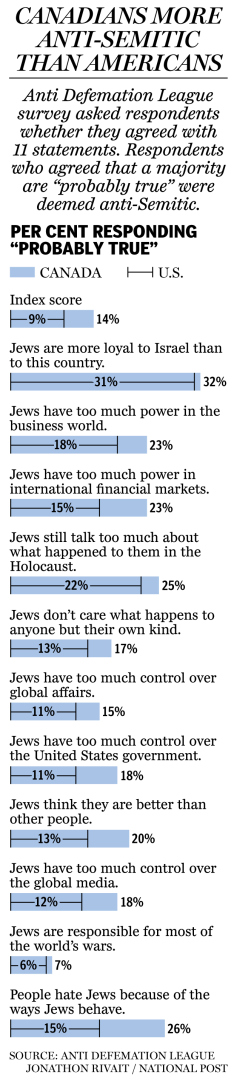
Canadians more likely to be anti-Semitic than Americans, ADL, and commentary

NP_antisemitism_c_jrFrom the recent ADL worldwide study on antisemitism, the Canadian data showing Canada slightly worse that the US but comparatively better than most other countries:

I’m a little bit surprised that the figures aren’t greater in the United States but I’m not surprised at the 14% in Canada,” said Frank Dimant, chief executive officer of B’nai Brith Canada. “We have always surmised that it is in that range — that range of ‘hardcore.’”

….

“We’re talking about 4.8 million people. That’s a lot of people who harbour this kind of hatred in their hearts.”

….

“Once, we had certain pre-conceived notions as to the stereotypic image of an anti-Semite as an illiterate boor. Today, that is simply not the case,” he said.

“We see the penetration of this disease of anti-Semitism in many new components of society… much of it is in the guise of anti-Israel.

“The coalition of hate is widespread so it ranges from academics to neo-Nazis to Islamic jihadists to radical feminists to trade unionists.”Shimon Koffler Fogel, head of the Centre for Israel & Jewish Affairs (CJIA), said the survey should provide the catalyst for a national discussion.

“For us, the real take-away is that issues like anti-Semitism and racism in general have not diminished to the point where as a society we can say we don’t have to address these concerns,” he said.

Canadians more likely to be anti-Semitic than Americans, poll finds | National Post.

And the two contrasting takes on the worldwide results, starting with Commentary on the right:

Anti-Semitism has survived the death of European theocracies, Nazism, and Communism and metastasized into a belief system embraced by Muslims and Arabs, and remains a deadly force. Though some might claim that the existence of Israel and allegations about its behavior has become the single greatest motivating factor for anti-Semitism (judging by the survey, the Palestinians are the most anti-Semitic people on Earth), that assertion must be placed up against the fact that the attitudes that indicate hostility to Jews long predate the birth of the Jewish state or its coming into possession of the West Bank in 1967. Seen in that perspective, it’s clear that Israel is just the latest, albeit a vicious, excuse for Jew hatred. If not all those who hate Israel also embrace the full roster of anti-Semitic stereotypes, their willingness to embrace the war against the Jewish state demonstrates the way Jews remain the planet’s boogeyman and the objects of unthinking bias and potential violence.

Many Jews will look at these numbers and, no doubt, wonder how they can change the minds of the haters or adopt behaviors that will undercut the stereotypes. But whatever else it tells us, the survey is a reminder that anti-Semitism is about the minds of the anti-Semites and their desire to seek out a small group for hostility, not what the Jews do. Those who will seek to blame Israel or Jewish power for these numbers are deceiving both themselves and others. Anti-Semitism is an ancient belief system that can adapt itself to any set of circumstances or locale.

Israel and the Reality of Anti-Semitism

From Haaretz on the left:

4. Iran, on the other hand, not only emerges unscathed from the survey but actually stands out for the positive. It has the lowest “Anti-Semitic Index” (56%) of all Middle East countries. It is a finding sure to confound hasbara people and one that can be attributed, among other things, to the relative sophistication of the Iranian people, to the continued existence of the local Jewish community – unlike in most Arab countries – and to the Iranian leadership’s ongoing protection, for its own reasons, of Iranian Jews.

5. In fact, the ADL poll more or less upsets the apple cart altogether in disestablishing the causal connection between anti-Jewish and what are widely perceived as anti-Israeli sentiments. Sweden – Sweden, for God’s sake – a hotbed of anti-Israeli agitation that is routinely labeled as anti-Semitic is the LEAST anti-Semitic country in Western Europe, according to this survey, along with its Nordic neighbors – Iceland, Finland, Norway and Denmark.

On the other hand, Eastern European countries such as Poland, Bulgaria and Ukraine, whose governments are rock solid supporters of Israel, harbor large segments of anti-Semitic feelings. The outliers are the Czechs, god bless them, who have always felt themselves more Western than Eastern European anyway. And what can you say about South Korea, a country with excellent diplomatic and commercial ties to Israel whose population – 53%, by ADL’s standards – has very questionable views of Jews.

….

7. The worst anti-Semitism, by ADL’s definition, was measured in the Middle East and North Africa, from the West Bank and Gaza (93%) and Iraq (92%) to Saudi Arabia (74%) Turkey (69%) and Iran (56%). No surprise there, really, given that in most Middle Eastern countries the media freely engages in anti-Jewish agitation, with governments either sitting idly by or actively taking part.

Nonetheless, it is an open question whether anti-Jewish sentiment in a region in which a. there are hardly any Jews and b. sees itself at war with the Jewish state and/or as the usurpers and oppressors of the Palestinians should really be included in the same rankings as all the rest, or whether Muslim anti-Semitism isn’t a category all to itself.

Ten comments on ADL’s global survey of anti-Semitism (It’s not all bad)

Of course, while dispiriting, in most developed countries Jews are more favourably viewed than other minorities such as Sikhs and Muslims (see as an What Europe Thinks of Jews, Muslims and Roma – Pew).

The link to the ADL study:


ADL Global 100

What Europe Thinks of Jews, Muslims and Roma – Pew

Some interesting comparative data on European country attitudes towards Jews, Muslims and Roma in the recent Pew study:

Roma, often dismissively referred to as “gypsies” in Europe, have suffered discrimination in Europe for centuries, and some estimates suggest that 70 percent of their European population was killed during the Holocaust. Last year, Europe’s tabloid media got into a frenzy over allegations that Roma families in Greece and Ireland had stolen “blond girls.” (In both cases, it was later confirmed that the children were actually Roma).

Many are predicting a good showing for right-wing and nationalist groups in the elections, which begin May 22. If so, these charts may be worth remembering: As Pew notes, “negative sentiments about all three groups are consistently more common among people on the ideological right.”

What Europe thinks of Muslims, Jews and Roma

An Open Letter to Bill Maher From a Muslim American

Rabia Chaudry on Bill Maher’s anti-Islam rants (to be fair, he rants against all religions):

Nothing I tell you would matter, though. The facts are irrelevant. That’s how bigotry operates. It’s both telling and troubling that you referred to these issues as “the Muslim question.” The reference didn’t escape me and it’s hard to believe it was anything but deliberate. Think for a second about what was unleashed by the “Jewish question” in Europe. Bigotry sometimes does that, too.

So while I support you in continuing to expose Muslims and others who shock the conscience of decent people, who destroy lives, and who wreak havoc, I caution you on the anti-Islam rhetoric. You have a massive following and are successfully leading a movement to demonize Islam in the liberal left, a place many American Muslims call home. You are leading people into rocks and hard places when you posit that Islam is the problem. You are putting Muslims up against a wall and pushing those who fear us further into spaces where little choice is left. As the mother of two American-born daughters, and a Muslim who calls the U.S. her home, I worry deeply about the solutions your followers may propose to your “Muslim question.” You should too.

An Open Letter to Bill Maher From a Muslim American | TIME.com.

Looking at Anti-Semitism and Anti-Zionism From a Literary Perspective

Interesting essay by Nora Gold on why she wrote her novel, Fields of Exile, on the issue of anti-Israel sentiment on campus:

I spent years writing a novel on this topic because I was so distressed about the anti-Israelism around me that I really couldn’t write about anything else. It was like having a fish hook in my stomach.

I was pained not only by the most obvious manifestations of anti-Israelism, like Israel Apartheid Week – during which, year after year, I witnessed the emotional and psychological damage wreaked on Jewish students and professors – but also the increasing normalization of Israel-bashing in classes, in faculty meetings, and at conferences. I was appalled that in certain disciplines it was almost de rigueur to trash Israel.‎

Looking at Anti-Semitism and Anti-Zionism From a Literary Perspective | Jewish & Israel News Algemeiner.com.

Canada must see immigration as a competitive edge – Royal Bank of Canada CEO

Strong message on immigration, diversity and inclusion from the CEO of the Royal Bank of Canada, Gordon Nixon:

Our diverse population is only an advantage to the extent we are inclusive. Full inclusion means everyone feels enabled to bring their perspectives, knowledge and experiences to the table. Diversity, together with inclusion, plays a central role in driving productivity, innovation and growth.

We are building the next phase in the growth of our great country in an era of economic interdependence, shifting demographics and wars for talent. A work force with global experience is a competitive advantage. International experience is an asset to business. Too often, we hear that newcomers with no Canadian experience would be hard to fit into the Canadian work force. In truth, international experiences relate directly to the modern Canadian context.

Business leaders – no matter the size of the company or the industry – should play an active part. A simple place to start is in guiding your company to increase diversity and to be inclusive. We all have and are impacted by systemic and unconscious biases; rather than acting as if they don’t exist, we must find ways to identify them and develop strategies to compensate for them.

Canada must see immigration as a competitive edge – The Globe and Mail.

Why Canada has a serious data deficit

More on the importance of good data by Barrie McKenna in the Globe’s Report on Business:

Prof. Gross [the C.D. Howe Institute researcher responsible for their study on Temporary Foreign Workers and their effect on increasing unemployment in AB and BC] acknowledged that perfect data is “very costly.”

So is bad data.

Employment Minister Jason Kenney recently imposed a moratorium on the use of temporary foreign workers in the restaurant industry, following embarrassing allegations of misuse by some McDonald’s franchise and other employers. And he has promised more reforms to come.

But who is to say that restaurants need imported foreign labour any less than hotels or coal mines, which are unaffected by the moratorium? And without better information, Mr. Kenney may compound his earlier decision to expand the program with an equally ill-considered move to shrink it.

The government’s troubles with the temporary foreign workers program is a classic case of bad data leading to dubious decision-making. Until recently, the government has relied on inflated Finance department job vacancy data, compiled in part by tracking job postings on Kijiji, a free classified-ad website. Statscan, meanwhile, was reporting that the national job vacancy rate was much smaller, and falling.

The problem goes way beyond temporary foreign workers. And it’s a data problem of the government’s own making. Ottawa has cut funds from important labour market research, slashed Statscan’s budget more savagely than many other departments, and scrapped a mandatory national census in favour of a less-accurate voluntary survey.

The Canadian government has demonstrated “a lack of commitment” to evidence-based decision-making and producing high-quality data, according to a global report on governance released last week by the Bertelsmann Foundation, a leading German think tank. The report ranked Canada in the middle of the pack and sliding on key measures of good governance compared with 40 other developed countries

One of the disadvantages of being in government for almost 10 years is that decisions which may have appeared to be cost-free can come back and haunt you.

Why Canada has a serious data deficit – The Globe and Mail.

What Science Says About Race and Genetics | Nicholas Wade

An excerpt from Nicholas Wade’s book, A Troublesome Inheritance, on the possible links between evolution, societies and genetics.

Racism and discrimination are wrong as a matter of principle, not of science. That said, it is hard to see anything in the new understanding of race that gives ammunition to racists. The reverse is the case. Exploration of the genome has shown that all humans, whatever their race, share the same set of genes. Each gene exists in a variety of alternative forms known as alleles, so one might suppose that races have distinguishing alleles, but even this is not the case. A few alleles have highly skewed distributions but these do not suffice to explain the difference between races. The difference between races seems to rest on the subtle matter of relative allele frequencies. The overwhelming verdict of the genome is to declare the basic unity of humankind.

….

Civilizations may rise and fall but evolution never ceases, which is why genetics may play some role alongside the mighty force of culture in shaping the nature of human societies. History and evolution are not separate processes, with human evolution grinding to a halt some decent interval before history begins. The more that we are able to peer into the human genome, the more it seems that the two processes are delicately intertwined.

A more reasoned and nuance approach that the “triple package” approach. Margaret Wente has a less nuanced summary of Wade’s arguments (What if race is more than a social construct?) but better to read this complete excerpt.

What Science Says About Race and Genetics | TIME.com.

Guess who’s not coming to dinner: Why Canada’s influential Terroir talks needs to diversify – The Globe and Mail

A reminder that we have a way to go. Starts with awareness:

Of the 89 presenters named on Terroir’s 2104 program, I count just eight who might not check the box for “white” on a census. It’s worse if you look at the contingent of Canadian chefs. Of the 28 listed, by my count there are no blacks, no Arabs, no Filipinos, none of the Sri Lankans who staff at least a third of the kitchens in this city – the list could go on and on and on. That program has just three non-white Canadian chefs on it. Only two of them, Torontonian Scott Vivian (his mother is from India), and Duncan Ly, a Vietnamese-Canadian chef from Calgary, have been given speaking roles.

…

And so this isn’t about who’s coming. It’s about who’s not. It is not so hard to find top chefs and restaurateurs with stories and skills worth sharing and who also happen to not be white, especially not when you’re sourcing guests from around the world. It’s not hard at all if you look.

Guess who’s not coming to dinner: Why Canada’s influential Terroir talks needs to diversify – The Globe and Mail.

Creux historique pour le PQ | Le Devoir

Pretty amazing polling results on the PQs fall. Will require much more serious internal PQ reflection than to date:

Les résultats détaillés montrent l’ampleur de la côte à remonter pour le PQ. Ainsi, chez les francophones, le parti est troisième (23 %) derrière la CAQ (33 %) et les libéraux (29 %). Même chose en ce qui a trait au vote des femmes (17 %).

Pire : le Parti québécois est désormais le quatrième choix des électeurs de moins de 45 ans. Québec solidaire recueille en effet plus d’appuis dans les échantillons basés sur l’âge des répondants. Il n’y a que les 55-64 ans qui sont plus réceptifs au message péquiste. « Une question s’impose clairement, dit Jean-Marc Léger : est-ce que le PQ a été le parti d’une génération ? »

La conjoncture — défaite récente, parti sans chef — explique une partie des résultats de ce sondage [quoique le Bloc québécois n’avait pas perdu de points dans le premier sondage suivant sa débandade électorale, en mai 2011]. Mais il y a plus, dit M. Léger. « C’est normal que le parti descende un peu, mais pas aussi rapidement. C’est comme si les gens sentaient que le parti a perdu son âme : on entend des militants et des députés renier la charte de la laïcité, renier l’ancienne chef, renier la démarche constitutionnelle… »

Autre résultat peu encourageant pour le Parti québécois : moins d’un tiers (32 %) des répondants du sondage aurait voté pour la souveraineté du Québec si un référendum avait eu lieu dans les derniers jours. « C’est faible, remarque M. Léger. On a souvent des appuis autour de 40 % en posant cette question. » Et même si le PQ faisait la promesse de ne pas tenir de référendum dans un premier mandat, il ne profiterait « d’aucun impact positif », indique M. Léger.

Creux historique pour le PQ | Le Devoir.

When Culture Robs Girls of Role Models

Good commentary by Amira Elghawaby on the need, within Muslim communities,  to provide more role models and visibility for women in both institutions and in popular culture:

Just take a look at most North American Muslim conferences.  How many women are on stage? From Chicago to Toronto to Ottawa, the answer is, very few. This is not for a lack of successful women leaders in our communities. We have Canadian Muslim women who are doctors, scientists, academics, educators, lawyers, engineers, filmmakers, authors, journalists, activists, editors, entrepreneurs, etc. But for some reason, our community seems unwilling to showcase their talents. Just last year, after praising the success of the Reviving the Islamic Spirit conference which attracts over 20,000 people annually, the well-known American academic, author, and consultant, Dalia Mogahed, nevertheless lamented the dearth of female speakers. Mogahed is one of just over a handful of women who have ever spoken at this immense gathering, now in its 13th year.

What is behind this? Surely, young women and girls deserve to hear from women who are paving the way forward. And, certainly, women were not invisible in Islam’s earliest days as a pioneering faith that recognized gender rights and women’s agency. Why then are our communities today so reluctant in acknowledging and spotlighting female achievements?

There seems to be a disconnect, or, more specifically, confusion around the role of Muslim women in society. There is a deep and ingrained cultural fear about intermingling. That fear is so strong that it has essentially led to the erasure of the female presence from many community institutions.  Take the barriers that have popped up at mosques across North America over the past few decades, making many women feel unwelcome and apart, as chronicled in the 2005 Canadian film Me And the Mosque. While some Muslim women themselves have internalized concerns over intermingling, so much that they cling to the barriers, the fact is that these barriers have come to represent an unwillingness to model respectful interactions between the genders. This emerges out of misplaced concepts of modesty and piety and is perhaps the attitude that led a York University student to famously ask to be exempted from working with female peers.

When Culture Robs Girls of Role Models – New Canadian Media – NCM.