Holocaust survivors: ‘Shameful’ that Pier 21 not displaying memorial to victims of ‘voyage of the damned’

One of the good projects funded by the Community Historical Recognition Program that I was involved with.

Sad that it is not being displayed (like everything Libeskind does, there is considerable complexity in the Wheel of Conscience and the mechanical difficulties are not necessarily surprising but were not anticipated at the time):

The Canadian government provided the Canadian Jewish Congress $500,000 for the memorial. The organization selected a design from world famous architect Daniel Libeskind, the child of holocaust survivors.

[Sydney) Zoltak was part of the group that selected Libeskind,

The memorial features an electric mechanism that spins wheels marked Hatred, Racism, Xenophobia and Antisemitism, which has had maintenance problems. After it was sent to the manufacturer, Soheil Mosun, in Toronto for repairs, the museum told the company to hang onto it while they decide what to do with it.

That process is ongoing, said Cailin MacDonald, a spokeswoman for the museum on Thursday.

“We are continuing to work with representatives from the Canadian Jewish Congress and the Centre for Israel and Jewish Affairs to determine next steps,” she said.

Zoltak, who praised former immigration minister Jason Kenney for his role in establishing the memorial, said the government should ask the federally funded museum to display the memorial.
Holocaust survivors: ‘Shameful’ that Pier 21 not displaying memorial to victims of ‘voyage of the damned’.

Saudi Arabia Bulldozes Over Its Heritage

A reminder that our nominal allies in the struggle against ISIS have their own ISIS and Taliban-like tendency to obliterate history and anything that does not conform to their historical and cultural interpretation of Islam:

Over the last few years, mosques and key sites dating from the time of Muhammad have been knocked down or destroyed, as have Ottoman-era mansions, ancient wells and stone bridges. Over 98% of the Kingdom’s historical and religious sites have been destroyed since 1985, estimates the Islamic Heritage Research Foundation in London. “It’s as if they wanted to wipe out history,” says Ali Al-Ahmed, of the Institute for Gulf Affairs in Washington, D.C.

Though the Saudi rulers have a long history of destroying historical sites, activists say the pace and range of destruction has recently increased. A few months ago, the house of Hamza, the Prophet Muhammad’s uncle, was flattened to make way for a Meccan hotel, according to Irfan Al Alawi, executive director of the Islamic Heritage Research Foundation. There have even been rumored threats to Muhammad’s tomb in Medina and his birthplace in Mecca.

Saudi Arabia Bulldozes Over Its Heritage | TIME.

Taking the Plunge: Immersion Programs Help Children Learn Other Languages

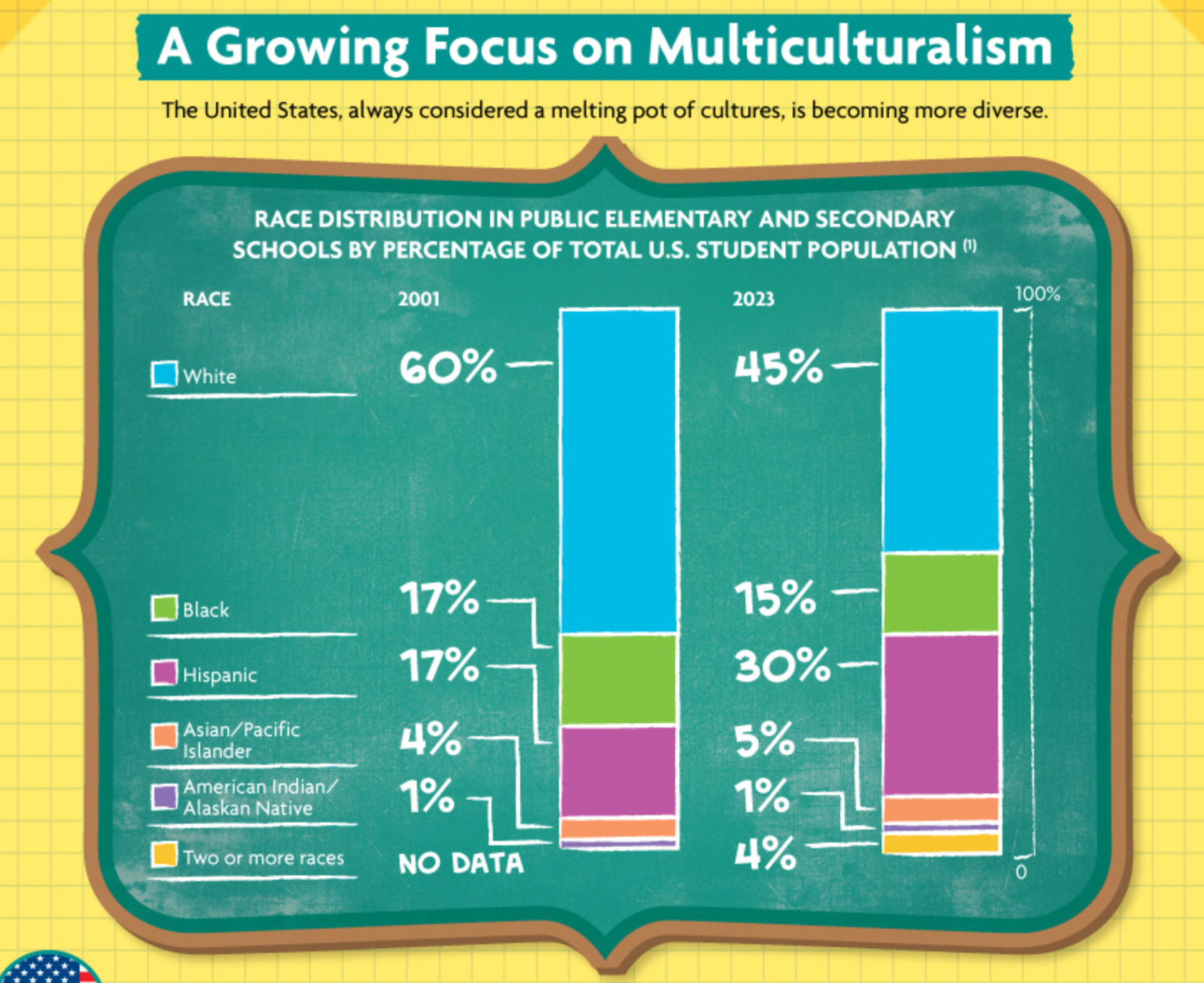
Taking_the_Plunge__Immersion_Programs_Help_Children_Learn_Other_LanguagesNice infographic on US multiculturalism and immersion education (link below has full infographic).

Taking the Plunge: Immersion Programs Help Children Learn Other Languages.

Canada Needs to Walk the Talk on Multiculturalism | David Langtry

The acting Commissioner of the Canadian Human Rights Commission, David Langtry, on discrimination and bias:

Recognizing bias is a first step toward mitigation. It should spur us to put processes and policies in place that ensure fairness. This could be as easy as preventing resume screeners from seeing the names and nationalities of applicants. Employers could also ensure an “immigrant-friendly” selection process by including new Canadians on selection boards.

Eliminating the strict requirement for Canadian experience when it is not really essential is also a good idea. The Ontario Human Rights Commission says this practice is potentially discriminatory, and has called on businesses to remove that barrier. I am hopeful that organizations across Canada will take a closer look at how they recruit talent and ensure their processes for assessing the skills and qualifications of job applicants are as fair and objective as possible.

Taking such steps makes business sense. It’s common knowledge that employers with a diverse workforce outperform competitors. Indeed, it’s expected that Canada will rely on the social and economic contribution of immigrants more than ever in future. Retiring baby boomers and low birth rates are shrinking the domestic labour pool. The entire country’s standard of living will fall without a significant increase in immigrant-based productivity, says Tal.

Part of the challenge, unstated in the article, is for immigrants to learn the Canadian workplace culture, which generally can only be learned effectively, with workplace experience.

Canada Needs to Walk the Talk on Multiculturalism | David Langtry.

Aruna Papp: A welcome new law to help prevent forced marriages

While I disagree with Papp on her characterization of Canadian multiculturalism and her support for the Bill (existing Canadian laws largely adequate), Papp is right on the need for better training and a more open discussion of the issues, primarily within affected communities, to help change the culture.

While there is a role for the Government and others in this discussion, the hectoring tone of the Zero Tolerance for Barbaric Cultural Practices Act and other rhetoric is unlikely to foster such an open discussion within the communities concerned:

Many Canadian activists for female victims of abuse shy away from challenging immigrant communities about the influence that tradition and cultural values has on domestic violence. The ideology of multiculturalism and tolerance tends to preclude any discussion of the cultural practices that rob women of their basic human rights. It is much simpler and safer to blame the abuse of women in immigrant communities on settlement issues, the Canadian government, the indifference of service providers — rather than challenging the values and traditions that need to be changed within those communities.

The next step is to provide unified training for frontline professionals such as police, social workers and health care professionals

The government’s Zero Tolerance for Barbaric Cultural Practices Act is the first step in recognizing that such pathologies exist in Canada; and that, as a nation, we need to have an open and frank discussion on this issue.

The next step is to provide unified training for frontline professionals such as police, social workers and health care professionals. At present, there are no shelters in Canada that are capable of properly dealing with victims of honour-based violence. A flawed intake can result in an incomplete or incorrect risk assessment, which can lead to an inadequate safety plan and even exposure to fatal violence.

This lack of training among frontline workers must be remedied in order to ensure that the impetus urged by this new bill can be applied directly to those who are victims of barbaric cultural practices that cannot be tolerated in our country.

Aruna Papp: A welcome new law to help prevent forced marriages

Harper policies undermine deradicalization

Reminder by Faisal Kutty of the complexities of combatting radicalization and how much of it depends on debate and discussion within the Muslim community, and how Government actions can undermine such efforts:

Radicalization must be confronted without undermining social cohesion, violating human rights and deviating from core democratic ideals.

The heavy lifting in this Herculean project must be borne by Muslims, who to their credit have repeatedly condemned violent extremism in the strongest of terms even before 9/11. In fact the National Council of Canadian Muslims NCCM recently even came out with a handbook titled “United Against Terrorism.”

However, more must be done to challenge some of the existing narratives fueling cognitive radicalization. Imams must be more proactive in undermining some of the classical texts glorifying violence and martyrdom, by emphasizing the ethical/peaceful vision of the Quran. This can only be done by deconstructing and better contextualizing the violent rhetoric in some of the Prophetic teachings and juristic interpretations adopted uncritically by too many. Parroting that Islam means peace is not enough. Teachings that may serve as the springboard to violent radicalism must be confronted head on. Such efforts must be internally driven. Any government meddling will only backfire.

Some souls may be forever lost, but this will help redirect the younger ones.

…It [the Harper Government] has ignored the death and devastation unleashed on Muslims around the world, be it through direct attacks or the unconditional support of our allies. At the domestic level Harper has targeted the community by going after its charities and organizations (defaming NCCM for instance), and even religious symbols. These play into the hands of Islamophobes and extremists alike. Ottawa is now busy tightening the already draconian anti-terror laws (preventive detention), introducing new hate laws restricting speech, amending the CSIS Act, etc. These will initially affect Muslims (as noted by leading former jurists last week) disproportionately but will eventually impact all Canadians.

Harper policies undermine deradicalization | Toronto Star.

Racism still an uncomfortable truth in Canada

Interesting experiment and pretty convincing results and analysis:

Subjects are shown a series of black faces and white faces on a computer screen. Researchers track the subject’s eye movements, to measure what the subject looks at, and for how long.

More than a thousand subjects were tested. White subjects tended to look deeply into the eyes of white faces, and were less likely to look into the eyes of black faces. Instead, they were almost three times as likely to focus on the lips or noses of black faces.

“It suggests they’re processing them not as individuals, but as members of a group,” said Kawakami.

This split-second eye bias can have some important consequences, according to Kawakami. When we don’t make eye contact with someone, we’re less likely to be able to decode their emotions, and less willing to trust or remember that person.

“Even though it might happen within the first 100th of a second, we know that downstream that can tell us whether you might hire a person, whether you have positive or negative associations with that person and whether you’re willing to interact with that person,” Kawakami explained.

Kawakami’s latest work is consistent with what some psychologists call “aversive racism.”

Unlike overt racism — blatant expressions of hatred and discrimination against racial minorities — aversive racism is characterized by more complex and subtle expressions of ambivalence toward members of a minority group.

“People are very careful about what they say about people from other categories. They’re really egalitarian, they try to be fair, but when we measure them in more subtle ways, when they’re not conscious of their responses and they’re not able to control them, then we find that racism is still quite prevalent in North America,” said Kawakami.

Mindfulness and greater self-awareness can help mitigate but not an easy or automatic process.

Racism still an uncomfortable truth in Canada: Duncan McCue – Canada – CBC News.

Discrimination a daily reality for visible minority lawyers in Ontario, report says

Not surprising that the legal profession is not immune from discrimination issues:

The blunt Law Society of Upper Canada report, titled “Challenges Faced by Racialized Licensees,” contains some disquieting findings.

“Overt discrimination and bias are a feature of daily life,” the paper concludes. “Racialization is a constant and persistent factor.”

Ontario’s legal profession has seen an increase of visible minority lawyers in recent decades. Latest figures indicate about 17 per cent of lawyers — and 28 per cent of paralegals — are not white, up from about 9.2 per cent in 2001.

In 2012, the law society set up a working group to study the issue of racism and discrimination in its ranks.

Despite the dramatic increase in minority numbers, professional acceptance is still hard to come by, according to the study.

Alienation, lack of entry and promotion opportunities and disrespect are among the problems “racialized” lawyers say they face.

“The challenges faced by racialized licensees have an impact on the reputation of the legal professions, access to justice, and the quality of services provided,” the report states.

Minority participants in the study complained that colleagues, judges and clients commonly assumed they were incompetent or ineffective. They talked about being shut out from professional opportunities or excluded from workplace social gatherings.

Last year, for example, Ontario’s top court found that two black lawyers had been racially profiled in 2008 when an administrator at a lawyers-only lounge at a courthouse in Brampton asked them — and only them — to identify themselves.

Discrimination a daily reality for visible minority lawyers in Ontario, report says | Toronto Star.

Canadian attitudes toward immigrants conflicted, CBC poll says

Despite the headline, overall confirmation of general welcoming attitude towards Immigration and multiculturalism. Some highlights:

  • 79 percent comfortable with employing or working for someone of different ethnicity;
  • 30 percent believe immigrants take jobs away from Canadians (meaning 70 percent don’t);
  • between 60 and 75 percent comfortable with being in a relationship with someone of another ethnicity;
  • between 70 and 85 percent are comfortable with neighbours of different ethnicity.

Canadian attitudes toward immigrants conflicted, poll says – Canada – CBC News.

The Powerpoint of the complete results is here:

CBC Discrimination Poll November 7 2014

Time for Japan to embrace multiculturalism

Interesting commentary on Japanese society in the context of its aging demographics:

There is an immediate assumption, then, that foreigners are impediments to the smooth functioning of Japanese society — not barbarians, exactly, but a hassle to deal with. Hidenori Sakanaka, the head of the Japan Immigration Policy Institute, said that a social revolution is necessary, in which Japan is reconceived as a multiethnic nation, in order to save it from aging into obsolescence. Such a dramatic shift in the self-conception of the Japanese people would be, he admits, painful.

But a move toward pluralism is essential if Japan is to avoid drastic economic downscaling and social stagnation. It’s time to take the first step and prove that hate speech is indeed unacceptable, and that there will be no room for racism in a changing Japan.

Time for Japan to embrace multiculturalism | Al Jazeera America.