Why Obama invoked the Crusades — and what it says about how he views terrorism – and Related Commentary

Carefully thought out strategy:

Obama, though, is not budging. And his comments on the Crusades and the Inquisition represent the latest ratcheting up in his quest to change how people talk about terrorism. He views Islamist terrorists as exploiting their religion; his opponents believe there is something about Islam that creates fanatics who are willing to carry out terrorist attacks.

For what it’s worth, Americans used to sympathize more with Obama. But the rise of the Islamic State appears to be pushing things in the opposite direction. A Pew poll in September showed, for the first time, that 50 percent of Americans viewed Islam as more likely to encourage violence than other religions. Another 39 percent said it was not more likely to encourage violence.

This could be part of the reason Obama is upping the rhetoric. Words matter, and the way this issue is framed is going to go a long way toward determining how the “war on terror” will be waged. Moreover, the rise of the Islamic State — along with the lesser-publicized Boko Haram — has ramped up the debate over terrorism and its roots to the highest point since perhaps after Sept. 11, 2001. This is a key moment in defining the terms of the debate. Both Republicans and Obama recognize that.

Obama’s critics believe he’s being Pollyannaish about the nature of the threat and how it is inherently tied to Islam. Without recognizing the seeds of terrorism, they reason, how can you combat it?

Obama disagrees wholeheartedly with that characterization and thinks attributing violence to Islam is unfair and damaging to relations between Christians and the broader Muslim population.

It’s perhaps the defining semantics debate of his presidency.

Why Obama invoked the Crusades — and what it says about how he views terrorism – The Washington Post.

Commentary from Richard LeBaron, a former U.S. ambassador (ret.) and the founding coordinator of the U.S. Center for Strategic Counterterrorism Communications Strategy:

The United States and its allies are in a conflict with certain groups that would like to convince the world that they are the true representatives of Islam.

We will succeed in that war only if we stay focused on the key element of counterterrorism strategy: excellent intelligence gained through maintenance of a first-rate intelligence community and sharing of intelligence with others; the ability to project deadly force when needed against specific groups and targets who wish us harm; and enlistment of Muslim and non-Muslim countries and communities around the world to do their fair share in combating terrorism and addressing its root causes—be those poor governance, weak states, religious incitement, or psychologically marginalized individuals looking for outlets for their rage.

Preventing the attraction to terrorism, as opposed to attacking known terrorists, is a long-term project that requires a serious approach. The contrived debate about labeling terrorism is both counterproductive and at odds with an American value system that separates religious belief from political considerations.

Those actually doing the fighting against terrorists deserve better than bumper sticker slogans to guide their actions. They should not be asked to fight a dimly understood religious war.

Declaring War on Radical Islam Is Not a Counterterrorism Strategy

The Globe Editorial on the Canadian government response is along similar lines:

Canada’s small number of terrorists thus far have been mostly self-radicalized. Think of the St-Jean-sur-Richelieu murderer Martin Couture-Rouleau or parliamentary shooter Michael Zehaf-Bibeau. Both were deeply troubled men who at some point grabbed onto ideas floating about on the Internet, and decided that the purifying appeal of violence was the answer for what ailed them. They weren’t sent here by ISIS; it would be more accurate to say that they caught a virus, albeit one that the intellectual immune system of the overwhelming majority of Canadians of all faiths is thus far resistant to.

They were also self-Islamicized. Their made-up religion of endless war had little to do with the Islam encountered in Canada’s mainstream mosques. Otherwise, this country might be overrun with Couture-Rouleaus and Zehaf-Bibeaus. It is not.

On the day of the Parliament Hill shooting, this newspaper editorialized “against exaggeration, hysteria and despair” and “in favour of calming the hell down.”

Over the past few weeks, the Prime Minister has seemed intent on riling people up and making the most of the terrorist threat. He has exaggerated the danger of ISIS and its connection to possible terrorism in Canada. That’s wrong. At a time like this, the PM should be the chief minister in charge of deflating hyperbole, putting things in perspective – and reminding Canadians that we must continue as we always have, on guard but free.

 A ‘war on terrorism’? No thanks. There are smarter ways to meet the threat 

Lastly, shallow commentary by Rex Murphy:

There have been many sins committed by many faiths, and there are tragedies even now underway. But it is a very displaced analysis that seeks to offer corrections to Christianity during a period of Islamic turmoil, and seeks out forgotten sins to ignore those so very close to mind.

He forgets history provides context and cautions us not to jump on bandwagons and the meme of the day.

Rex Murphy: In Obama’s impulse to absolve Islam, he offers a rebuke to Christianity

Graeme Hamilton: Banning centre run by controversial Montreal Imam problematic in a democratic society

Valid:

Aurélie Campana, a political science professor at Université Laval and holder of the Canada Research Chair on Conflicts and Terrorism, said countries around the world are seeking the proper balance between respecting freedoms and thwarting radicalization.

“We are all walking a tightrope, whether in Quebec in Canada or in other countries confronted by these problems,” she said. “I don’t think anyone has found a miracle solution yet.”

But turning the danger of radicalism into an emotional political issue is a recipe for increased social tensions, she said.

“In Canada, through multiculturalism, there is a relative social peace that is not found in other countries — in France, for example,” she said. “The risk is that this law indirectly calls into question the existing social balance, and that the Muslim community is stigmatized.”

Mr. Bouazzi said he hears regularly of young Montrealers leaving to join ISIS but argues that, in the short-term, the best counterweight is to appeal to Muslim families. “They do co-operate,” he said, citing the recent example of a father who called in police after his son robbed a variety store to finance a trip to join the jihad.

He said a tough law that restricts freedoms is counterproductive. “We are really in front of a dilemma: Because we want to fight terrorism that does not agree with democracy, we’re actually destroying our democracy,” he said. “It’s very important to stay strong in these situations, because we don’t want them to win.”

Graeme Hamilton: Banning centre run by controversial Montreal Imam problematic in a democratic society

Two stories about inequality

Good storytelling showing both pictures.

MilesCorak's avatarEconomics for public policy

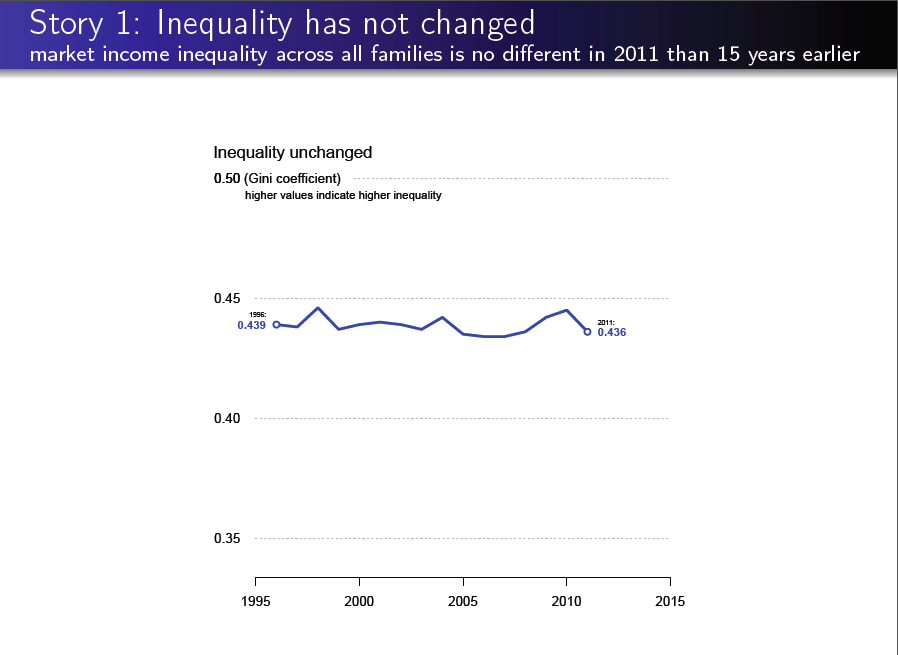
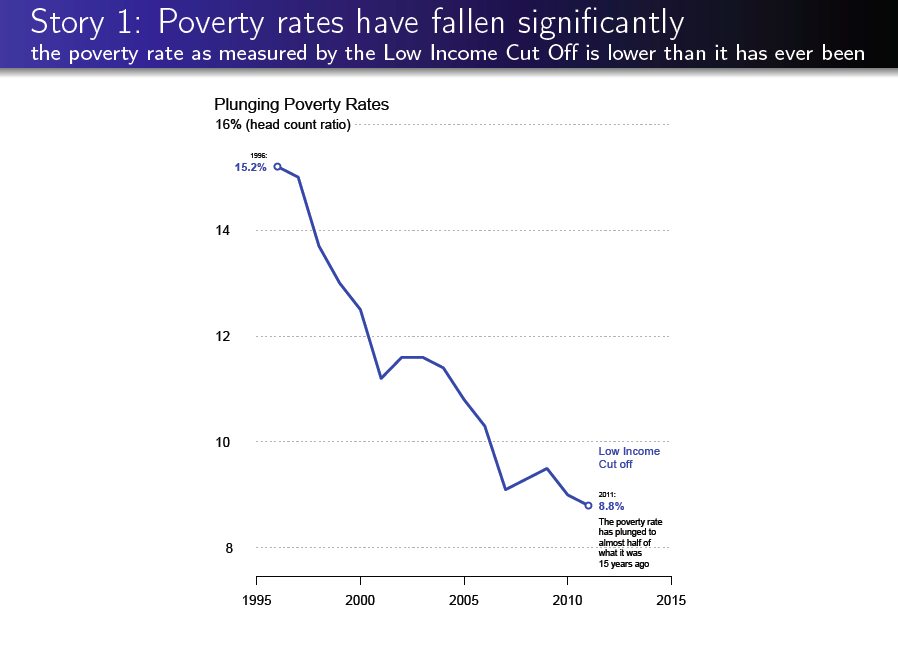
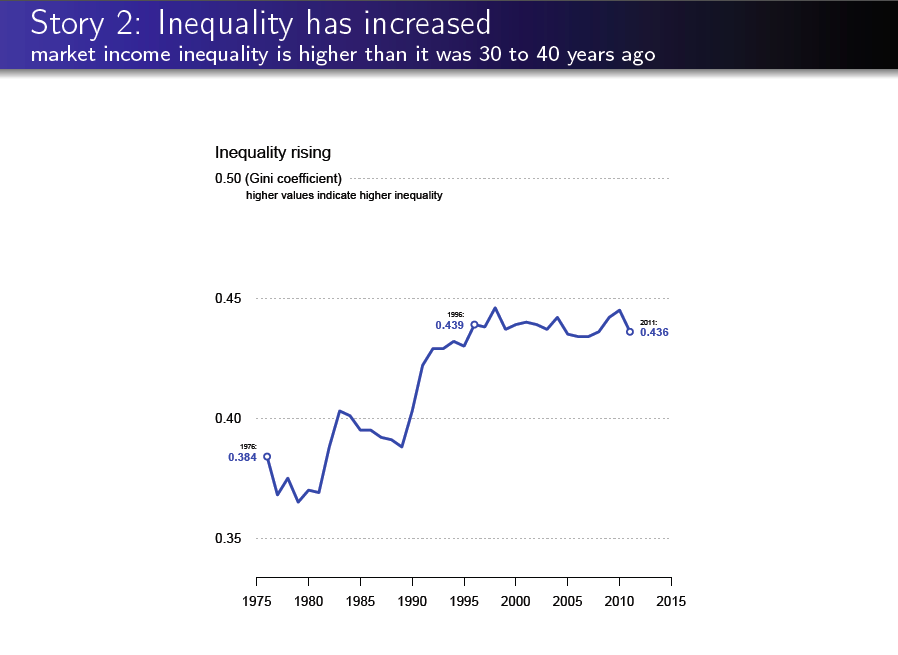
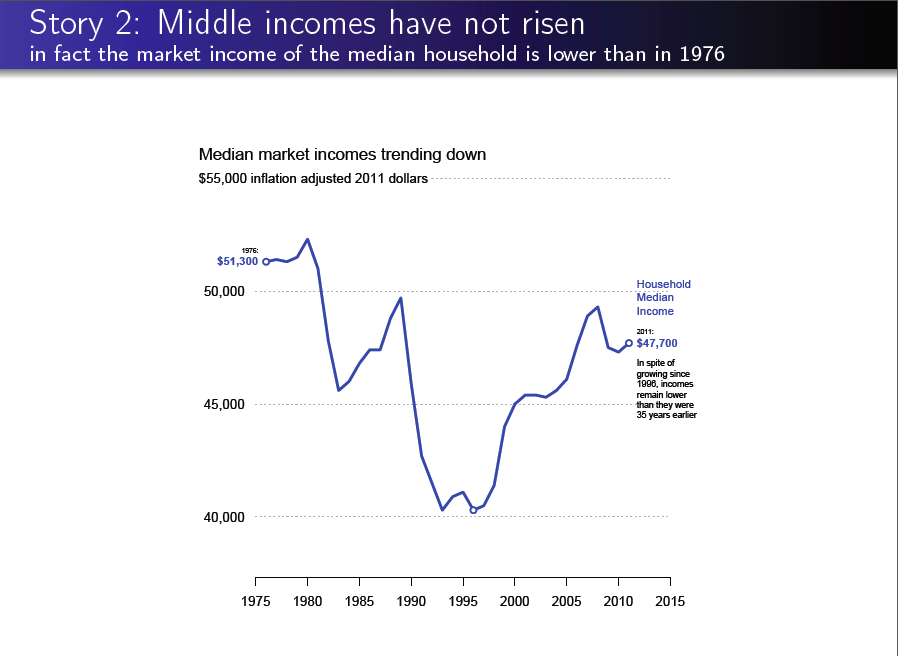
In many rich countries the “hard” facts describing the income distribution are easily available. Yet, discussions about inequality are animated by two different stories with very different public policy implications.

You can listen to a caricature of these points of view in this pair of interviews on CBC radio: http://www.cbc.ca/radiowest/2015/01/21/two-different-takes-on-the-worlds-wealthiest-one-per-cent/

I offer more detail on the way Canadians have framed these stories as a part of a presentation to the School of Policy Studies at Queen’s university.

Here is Story 1 in pictures (click on the images to enlarge).

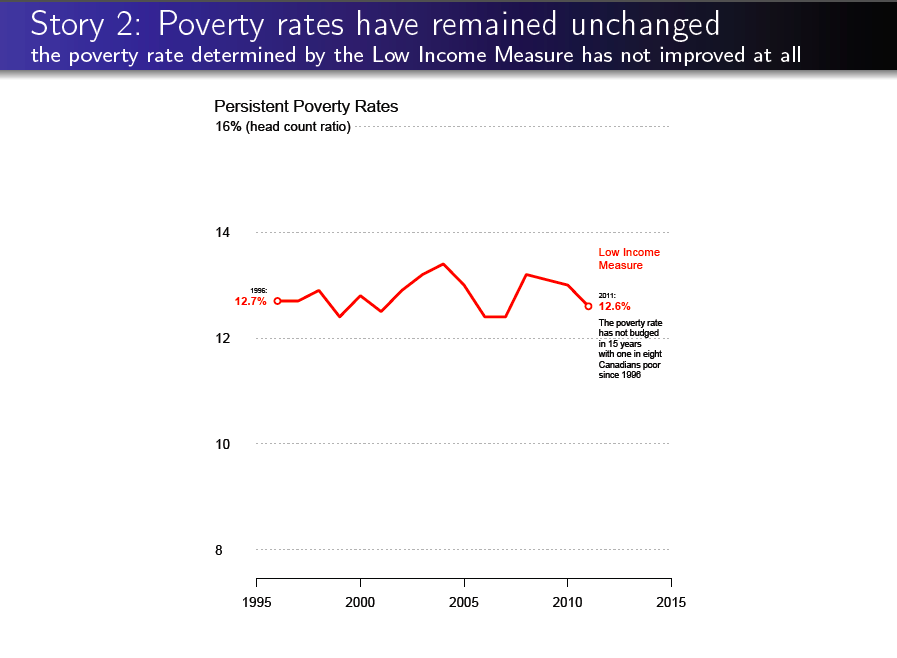
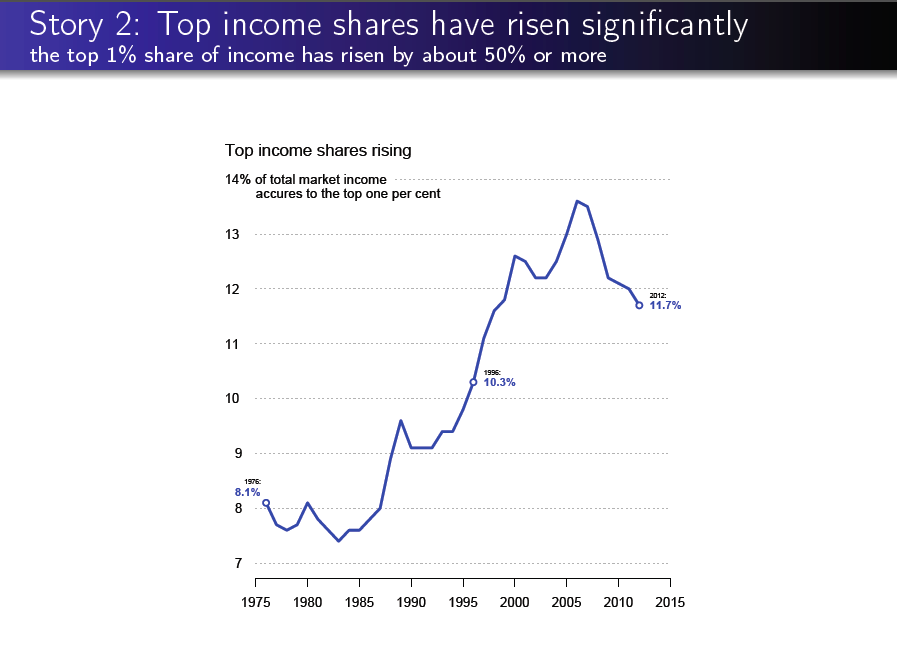
Story 1 Inequality has not changedStory 1 Middle incomes have been on the riseStory 1 Poverty rates have fallenStory 1 Top income shares have not risen much

Here is Story 2 in pictures (click on the images to enlarge).

Story 2 Inequality has increasedStory 2 Middle income have not risenStory 2 Poverty rates are unchangedStory 2 Top income shares have risen

My presentation argued that context—rooted in economic theory and the appropriate use of statistics—is needed to understand the truth behind these stories, and to turn them into a conversation useful for public policy.

Here is the full set of slides I used.

Corak_Two_Stories_about_Inequality_and_Public_Policy_presentation_to_Queens_University_February_5_2015

View original post

Islamic poets wrote their own crude irreverent satire, centuries before Charlie Hebdo

Always good to know history:

Intolerance of satire is not intrinsic to Islamic civilization. In fact, Islamic history bears its own tradition of irreverent writing on religious imagery. One of the most influential and lauded (though not uncontroversial) Arabic poets of all time, Abu Nuwas, regularly employed sexually graphic and borderline blasphemous imagery in his own brand of “Islamic satire” that resonates to this day.

Writing from Baghdad during the zenith of the Abbassid period — the Islamic empire that lasted from roughly the mid-8th to mid-13th centuries — Abu Nuwas drew on profane and offensive imagery as a way to subvert the authority of the caliph and mock the excesses of the court. Despite his critique of those in power, he himself was a court poet, providing him with an elite audience.

Often, his words directly targeted the institutions of Islam. In one colorful verse, for example, he calls sodomy the “true jihad.” Playing on the meaning of the word “Islam” as submission (to God), he draws on the word’s sexual connotations to suggest that Muslims should get non-Muslims to “submit” through sex.

In another of his verses, two young boys fall in love, and in lieu of praying five times, they fornicate five times a day when the Muslim call to prayer. Such a perversion of the religious pillars makes Charlie Hebdo’s cartoons tame by comparison.

A few centuries later, an Andalusian poet and disciple of Abu Nuwas, Ibn Sahl, composed a poem describing his conversion from Judaism to Islam as the choice to take a new lover. Seeming to violate the sanctity surrounding profane depictions of the Prophet, he writes, “I abandoned the love of Moses, to adore Muhammad.”

Is this depiction of prophet as lover less offensive than a cartoon promising readers “100 lashes if they don’t die of laughter”? Or a drawing of a woman running nude with a Burqa protruding from her rear? Both juxtapose religious imagery with the irreverent and profane in order to comment on the status quo.

Islamic poets wrote their own crude irreverent satire, centuries before Charlie Hebdo – The Washington Post.

Why a Bobby Jindal Portrait Sparked a Racial Controversy | TIME

It does say something about politics and society in America:

For however inconsequential the object of controversy is, the portraits are capable of evoking a deeply unsettling reaction. That’s because they recall a dark history with lasting consequences. In a nation whose first lawmakers had constructed American identity based largely on whether European, Asian and African immigrants’ complexions appeared sufficiently “white”—a category that had been molded and manipulated from America’s early years—that Jindal’s portraits appear to have been scrubbed of his race matters greatly. A “white” complexion once afforded the right to a political voice; it was the lifeblood of the dominant majority.

Jindal’s skin tone in his portraits matters especially because it suggests that the “official” image of an American political leader is someone that is not of South Asian or Asian race. The touchy question of skin color remains regardless of the portrait maker’s intent, because throughout history, and arguably still today, differences in skin tone, such as those between Jindal’s portraits and Jindal himself—even if just a few shades—were specifically used to construct race and Americanness.

In the mid-1700s, the category of whiteness had been open to only Anglo-Saxon immigrants, and not even to Europeans like Italians, Spaniards, French or Swedes—they were “swarthy,” said Benjamin Franklin in 1751, while Africans were “black or tawny” and Asians “chiefly tawny.” But the acceptability of “swarthy” skin shifted as waves of Asian immigrants entered North America in the 19th century, and as popular imagery of colonial Indians in British Columbia or cheap Chinese laborers in the U.S. continued their likening to black slaves: dark, faceless, subordinate. Their racialization as disposable and immutably foreign, in contrast to the better-assimilated European labor migrants, in turn lifted these “swarthy” European immigrants to a sufficiently high racial status to merit the title “free white persons.”

Why a Bobby Jindal Portrait Sparked a Racial Controversy | TIME.

Sweden’s Immigrant Influx Unleashes A Backlash

More on tensions in Sweden:

The Sweden Democrats insist that there is no connection between these attacks [on mosques] and the party’s anti-immigration rhetoric. At an interview in Malmo, party official Nima Gholam Ali Pour suggests that Muslims may have fire-bombed the mosques.

“Were there personal problems in the mosque, or was it someone from another mosque,” he asks. “There are conflicts between Muslims.”

When pressed about swastikas that have been painted on the side of mosques, though, Ali says, “Of course that’s racist. That’s racist.”

The story is more complicated than just white racist Christians attacking Muslim immigrants. Jews in Sweden say they are being attacked, too. A recent documentary on Swedish television showed a reporter walking down the street wearing a yarmulke, as a hidden camera filmed bystanders shouting insults and threats.

And in many cases, the people attacking Jews are Muslim immigrants.

“Almost exclusively, they have some sort of background in the Middle East,” says Aron Verstandig, a leader in Stockholm’s Jewish community.

Verstandig says many people try to paint these ethnic tensions as good versus evil. They want clear victims and perpetrators, in separate boxes. But in fact, he says, the roles overlap and switch.

“You have these immigrants who are very poor, and they are the victims of a lot of violence, a lot of hatred from Sweden Democrats and other right-wing parties. And they are victims in one way,” Verstandig says. “But some of them — a minority of them — are perpetrators in another way. You don’t have people who are just good and bad. It’s a very complex situation.”

Omar Mustafa of the Islamic Association of Sweden agrees. He says it’s part of humanity that there are always extremists.

“We have it in Islam, there is in Christianity, there is in the Swedish community. There is everywhere,” Mustafa says. “So it’s a good opportunity for us, the rest of society, to really take back the agenda. And we have to say to them, we don’t buy it.”

Mustafa says when fringe groups try to speak on behalf of everyone, the moderate majority needs to speak up — and say, “We have a different story to tell.”

Sweden’s Immigrant Influx Unleashes A Backlash : Parallels : NPR.

How closing the ‘word gap’ could give poorer kids an equal chance at success

Interesting and positive initiative:

That realization [that children in richer households were exposed to a whopping 30 million more words by age 3 than their low-income counterparts] inspired two projects recently launched by Eriks-Brophy, now an associate professor at the University of Toronto’s Department of Speech Pathology, and PhD candidate Hillary Ganek.

Like the Providence initiative, the researchers are making use of LENA technology. But they’re aiming to recruit Toronto-based families of varied backgrounds, to expand the scope of the discussion beyond just income level.

They also want to look at the influence of culture in how parents talk to their kids. It will be the first time LENA has been used to explore the topic.

While both acknowledge income level plays a role in children’s development, Eriks-Brophy and Ganek say framing the issue as a “gap” might be the wrong approach.

Ultimately, they hope their research will help speech pathologists and schools be more responsive to cultural variations in language learning, which Eriks-Brophy argues often gives minority children their own unique set of skills.

“It’s not necessarily the case that it’s a (word) deficit or there’s a problem. It’s a difference. And that has to be acknowledged as well.”

WHEN DR. RIPUDAMAN S. MINHAS treats families in the city’s low-income Regent Park neighbourhood, he asks some unusual questions.

In addition to inquiring about kids’ allergies and immunizations, he wants to know how many books parents have at home. He wants to know if they have a library card, and how much they sing to their children.

“The idea of this 30-million-word gap really rings true,” he says. “Because it’s something that we see every day.”

Minhas’s medical interest in words is an approach endorsed by the country’s top children’s health body. Although there is no specifically Canadian research on the effects of the “word gap,” the Canadian Paediatric Society calls low literacy a “severe and pervasive” national problem.

New programs, such as St. Michael’s Hospital’s Reach Out and Read initiative are taking this to heart. Minhas, a developmental pediatrician affiliated with the hospital, is now also embarking on research into how inner-city families can be supported in creating “linguistically rich” homes.

How closing the ‘word gap’ could give poorer kids an equal chance at success | Toronto Star.

The Women’s Mosque evolves North American Islam – Sheema Khan

North American innovation:

Sana Muttalib and M. Hasna Maznavi, co-founders of the Women’s Mosque of America, should be lauded for taking the bold and pragmatic step of providing a vehicle for Muslim women’s empowerment. The goal is to complement existing institutions and provide women with the necessary tools to make a difference in their communities. They have decided to stay within orthodoxy, by having a female imam lead only women in prayer – a practice that goes back to the time of the Prophet Mohammed. Women will be welcomed as they are – with or without a hijab. The mosque will provide public lectures for men and women by female scholars.

More importantly, it will be a centre where women can study the scriptures and traditions for themselves, within a cultural context where gender equality is non-negotiable. Or, as author Asma Barlas puts it, “unreading patriarchal interpretations of the Koran.” They will have the opportunity to discover how women helped to build Muslim societies from the seventh century onward – female warriors, Islamic scholars, judges, philanthropists, poets and rulers.

Most importantly, they will contribute to the evolution of an indigenous form of Islam that’s reflective of North American culture.

The Women’s Mosque evolves North American Islam – The Globe and Mail.

FAST launches high school anti-racism curriculum

Good cross-linkages between antisemitism, Holocaust awareness, and all forms of racism, bigotry and hate:

Voices into Action, an interactive site developed in accordance with provincial curriculum standards by a team of teachers, curriculum experts, graduate students, university professors, and consultants, contains five units that focus on issues related to human rights, genocide, prejudice and discrimination.

“It’s divided into five units and the Holocaust is a major feature throughout. It is at least a third of the content,” Miller said.

Although the program addresses racism, bigotry and hate in all forms, there is a special emphasis on anti-Semitism and the Holocaust.

The founders of FAST, Elizabeth Comper, and her husband Tony, a retired Bank of Montreal CEO, were inspired to create the organization after a series of anti-Semitic attacks in Toronto and Montreal, including the 2004 firebombing of Montreal’s United Talmud Torah Jewish day school.

“It was important to address other human rights issues, to put them on a scale, to understand that the Holocaust was as far as you could go with hatred,” Miller said.

“The Holocaust is the first chapter of units 1, 2, 3 and 4, and unit 5 is entirely about the Holocaust and it ends with a conclusion on contemporary anti-Semitism.”

Miller added that most important is the fact that the high school program is curriculum-based and completely free of charge.

FAST launches high school anti-racism curriculum | The Canadian Jewish News.

Le fisc doit sévir contre les intégristes religieux, dit Legault

Not fully thought out. Implications on freedom of speech and what about fundamentalists of other religions, such as Christians and Jews. After all, fundamentalists of all religions tend to reject the largely secular values dear to Québecois.

Will subsidies for schools, or tax exemptions, for example, be removed?

Ce serait là une façon de faire taire les leaders religieux intégristes, a fait valoir mercredi le chef du parti, François Legault.

Dans le même esprit, la CAQ réclame que soit amendée la Charte québécoise des droits et libertés de la personne, de manière à interdire les enseignements ou prêches religieux destinés à rejeter des valeurs chères aux Québécois, telles que la démocratie, l’égalité entre hommes et femmes et le respect de l’orientation sexuelle.En conférence de presse mercredi, le chef de la CAQ, accompagné de la députée caquiste Nathalie Roy, a décrit sa vision de la lutte contre l’intégrisme religieux, en demandant au gouvernement Couillard d’agir en déposant « rapidement » un projet de loi, comme il s’est engagé à le faire à maintes reprises.

« Notre système n’est pas adapté pour lutter contre l’intégrisme », a dit d’entrée de jeu M. Legault, accentuant la pression sur le gouvernement « pour protéger les valeurs québécoises ».

M. Legault a dit juger normal de restreindre les libertés religieuses de ces individus radicaux, dans une société libre et démocratique comme la société québécoise.

Les corporations religieuses jouissent de plusieurs avantages sur le plan fiscal, au niveau provincial et municipal : exemption d’impôt sur leurs revenus, déduction pour le logement, remboursement de 50 pour cent de la TVQ pour leurs achats et activités, tout comme l’exonération de la taxe foncière et de la taxe scolaire.

L’octroi, par les municipalités, de certificats d’occupation d’immeubles serait aussi visé par le plan d’action caquiste.

Selon les voeux de la CAQ, le Registraire des entreprises pourrait refuser l’incorporation à un groupe religieux qui entretient « des liens quelconques avec une organisation criminelle ou une entité terroriste reconnue au Code criminel », a indiqué de son côté la porte-parole du parti sur ces questions, Nathalie Roy.

M. Legault s’est gardé de viser une religion en particulier, ou de faire un amalgame entre religion et terrorisme.

Durant la conférence de presse, il a dit qu’il ne fallait pas pour autant « se mettre la tête dans le sable », préférant privilégier une attitude préventive : « tous les terroristes étaient d’abord des intégristes. Il y a un genre de terreau fertile » dans certaines pratiques religieuses, a-t-il commenté.

Le fisc doit sévir contre les intégristes religieux, dit Legault | Le Devoir.