In a Case of Religious Dress, US Justices Explore the Obligations of Employers – NYTimes.com

US Supreme Court hearings on religious accommodation (the Abercrombie & Fitch case):

Justice Samuel A. Alito Jr. on Wednesday warned that “this is going to sound like a joke,” and then posed an unusual question about four hypothetical job applicants. If a Sikh man wears a turban, a Hasidic man wears a hat, a Muslim woman wears a hijab and a Catholic nun wears a habit, must employers recognize that their garb connotes faith — or should they assume, Justice Alito asked, that it is “a fashion statement”?

The question arose in a vigorous Supreme Court argument that explored religious stereotypes, employment discrimination and the symbolism of the Muslim head scarf known as the hijab, all arising from a 2008 encounter at Woodland Hills Mall in Tulsa, Okla.

Samantha Elauf, then 17, sought a job in a children’s clothing store owned by Abercrombie & Fitch. She wore a black head scarf but did not say why.

The company declined to hire her, saying her scarf clashed with the company’s dress code, which called for a “classic East Coast collegiate style.” The desired look, Justice Alito said, was that of “the mythical preppy.”

…In response to Justice Alito’s question about the four hypothetical applicants, Shay Dvoretzky, a lawyer for the company, conceded that some kinds of religious dress presented harder questions, but he said the court should require applicants to raise the issue of religious accommodations.

Several justices suggested that an employer should simply describe its dress code and ask if it posed a problem. That would shift the burden to the applicant, they said. If the applicant then raised a religious objection, the employer would be required to offer an accommodation so long as it did not place an undue burden on the business.

That approach, Mr. Dvoretzky said, would itself require stereotyping.

But Justice Elena Kagan said that the approach was the lesser of two evils. On the one hand, it could require an “awkward conversation,” she said. “But the alternative to that rule is a rule where Abercrombie just gets to say, ‘We’re going to stereotype people and prevent them from getting jobs.’ ”

Justice Ruth Bader Ginsburg added that Ms. Elauf had not even known that her hijab was a problem.

“How could she ask for something when she didn’t know the employer had such a rule?” Justice Ginsburg said.

In a Case of Religious Dress, Justices Explore the Obligations of Employers – NYTimes.com.
At Malala’s citizenship ceremony, will she be forced to bare her head? – Sheema Khan

Sheema Khan makes the point regarding the wedge politics of the PM and Minister Alexander regarding the niqab, and in Minister Alexander’s case, the hijab (from someone who should and does know better):

… A few weeks ago, a federal court agreed with Ms. Zunera. However, our Prime Minister, who is campaigning for re-election, said that it was “offensive” to hide one’s face while joining “the Canadian family”. These comments were made in Quebec, where there is strong opposition to the niqab and increasing Islamophobic sentiment. Our Prime Minister chose to pander to these fears.

Citizenship Minister Chris Alexander went further, and tweeted “niqab, hejab, burqa, wedding veil – face coverings have no place in cit oath-taking”. He explained that a hijab can be used to cover the face.

Regarding the burqa issue in the U.K., you have told The Guardian: “I believe it’s a woman’s right to decide what she wants to wear and if a woman can go to the beach and wear nothing, then why can’t she also wear everything?”

Please Malala, ask Mr. Alexander if you will be required to remove your head-cover at your ceremony. And ask Mr. Harper and Mr. Alexander why Ms. Zunera should remove her niqab. Your carry great moral authority and your words will assist Muslim women who are being used as cheap political fodder. We know that you will stand by your principles.

At Malala’s citizenship ceremony, will she be forced to bare her head? – The Globe and Mail.

And Geoffrey Hall’s commentary on the risks the Government is taking:

A sizeable number of Canadians have genuine concerns about Islam. Some may even view certain of its manifestations, including the wearing of a niqab, as un-Canadian. Sure, the Conservatives may be playing on fears and unstated prejudices. But there’s a political risk inherent in dismissing those fears and prejudices without confronting them — in allowing ignorance to fester below the surface and voice itself in chauvinistic bumper stickers.

What happened with the values charter in Quebec? Remember, the Marois government introduced it because it thought it had a winner — and in the early stages of the election campaign, that’s what it looked like. But then something happened: The discussion, dialogue and opposition it provoked brought together individuals and groups from diverse cultural backgrounds — all rallying around the shared value of tolerance. Intended to draw neat lines around what is and isn’t Quebec culture, the charter managed to unite a plurality of Quebecers against it.

Which is what happens sometimes when unspoken prejudices are uttered aloud — people are forced to confront what they think in the daylight of community opinion. Right now, the federal parties are road-testing their messages for the election campaign. The Conservatives, like all the parties, always need issues they can exploit to fire up their base — and going after un-Canadian outliers has worked for them in the past.

But a message intended for core or regional audiences can linger, and turn into a liability in the heat of a campaign. The question now is how far the Conservatives can push the “I love Canada — fit in” slogan before voters tell them to f@*k off.

The risks and rewards of identity politics (pay wall)

Program aims for greater ethnic diversity on boards

Good to see expansion of this program to improve diversity of public institution boards beyond Toronto:

This week Ms. Omidvar announced the national launch of a program aimed to break down the barriers of the old-boy network by identifying, training and selecting qualified board candidates who are also either immigrants or members of a visible minority group.

“Public institutions that are created to serve the public good make better decisions for their clients and customers if the boards are diverse,” Ms. Omidvar said. “We are going to close the gap between those who live in these cities and those who serve on these boards.”

The program is called DiverseCity onBoard, and it will expand from Toronto, where it has placed more than 700 candidates on boards over the past several years, to Montreal, Vancouver, Calgary, Ottawa, Hamilton and London. The program works by matching candidates with vacancies. If a board has an opening, the program looks to connect it with a suitable match, someone with the training and expertise they require who might never have come to their attention otherwise.

“When we did our research in Toronto we asked organizations, ‘Why is it that your board still looks like old Canada?’ They said, ‘We agree completely, we want to be more reflective of the community, but we don’t have the networks,’” Ms. Omidvar said. “By putting real-life candidates in front of them, we try to dispel that myth that, ‘Oh, we don’t know any body.’”

Program aims for greater ethnic diversity on boards – The Globe and Mail.

Ontario must combat racism, says outgoing human rights commissioner Barbara Hall

Barbara Hall’s exit interview:

In an interview at commission headquarters, Barbara Hall said she strongly believes the very success of our society depends on ensuring the disadvantaged or marginalized are able to contribute fully.

“The most discouraging part of this work is the persistence of racism, particularly as it impacts black Ontarians and aboriginal people,” said Hall, whose 10 years as chief commissioner ends Friday.

“We see progress on issues but we need to — as a commission, as a society — be vigilant about these issues. It requires constant pushing.”

Discrimination, Hall said, is something that can touch everyone. As examples, she cited women returning from maternity leave to find their jobs have “mysteriously” disappeared or those sexually harassed at work.

Ontario must combat racism, says outgoing human rights commissioner – Macleans.ca.

Austria Passes Law On Islam Banning Foreign Funding

Austria’s new law – not aimed at Turkish but likely Saudi and other funding:

The legislation also offers Austrian Muslims a mix of increased rights and obligations in practicing their faith.

But the law has generated opposition from Austrian Muslim groups who say the ban on foreign funding is unfair as support from abroad is still allowed for the Christian and Jewish faiths.

The new measures include the protection of religious holidays and training for imams.

Austria’s previous “law on Islam” dating from 1912, after the annexation of Bosnia-Herzegovina by the Austro-Hungarian empire, had been widely held up as a model for Europe in dealing with Islam.

Turkey’s leading Muslim cleric, Mehmet Gormez, has decried the bill as “a 100-year regression,” arguing that no complaints have ever been lodged about the fact that Ankara funds many imams in Austria.

Austria Passes Law On Islam Banning Foreign Funding.

Research Shows White Privilege Is Real

More examples of unconscious bias at work:

A field experiment about who gets free bus rides in Brisbane, a city on the eastern coast of Australia, shows that even today, whites get special privileges, particularly when other people aren’t around to notice.

The bus study underscores this point. Drivers were more likely to let testers ride free when there were fewer people on the bus to observe the transaction. And the drivers themselves were probably not aware that they were treating minorities differently. When drivers, in a questionnaire conducted after the field test, were shown photographs of the testers and asked how they would respond, hypothetically, to a free-ride request, they indicated no statistically significant bias against minorities in the photos (86 percent said they would let the black individual ride free).

Of course, unconscious bias might play out differently in the United States than in Australia. But research in America, too, suggests that decision makers use discretion to bestow benefits in a discriminatory fashion. For example, a recent study of 22 law firms by Arin N. Reeves, a lawyer and sociologist, found that partners were less critical of a junior lawyer’s draft memo if they were told the lawyer was white than if they were told the lawyer was black.

What does white privilege mean today? In part, it means to live in the world while being given the benefit of the doubt. Have you ever been able to return a sweater without a receipt? Has an employee ever let you into a store after closing time? Did a car dealership take a little extra off the sticker price when you asked? When’s the last time you received service with a smile?

White privilege doesn’t (usually) operate as brazenly and audaciously as in the Eddie Murphy joke, but it continues in the form of discretionary benefits, many of them unconscious ones. These privileges are hard to eradicate, but essential to understand.

Research Shows White Privilege Is Real – NYTimes.com.

Racially diverse emojis miss the point – Macleans.ca

Some interesting articles on the issue of racially diverse emojis, starting with Adrian Lee taking the position that these undermine the universality and ambiguity of the current set:

The problem is, the idea and execution of racially representative emojis completely misses the point.

For starters, emojis never really had a race problem. The invention of Shigetaka Kurita, emoji have an Asian root that has in many ways been whitewashed over, with many of the original ones depicting Japanese-centric images such as a bowing businessman; it is why many of the food items in Unicode’s emojis are Japanese, from ramen to tempura shrimp. According to the Wall Street Journal, “initially supposed to depict characters with inhuman, cartoon-like complexions—for example, a yellow or orange colour.”

So the standard baseline in emojis was never really white—that’s a later interpretation that society has applied. If anything, the race problem is with Unicode, the consortium that codes symbols and images so they can be displayed across the world’s many platforms and devices, which took Kurita’s initial offering, sidelined many of the Japan-centric ones, and produced a selection of 722. (Personal research finds that Apple devices currently feature 845 emojis.)

And the reality of racial representation is that it will, invariably, leave someone out and leave someone unhappy. It has already begun; social media has noted there is no one with freckles and red hair among the six new colour options for each emoji. The backlash has started, too, as some have been furious over the bright yellow of what they are seeing as the “East Asian” skin colour—ironic, since they’re actually referring to the aforementioned “cartoon-like” emoji complexion, as Asians are not technically depicted at all, given the fact the new emojis reportedly hew to the Fitzpatrick scale, a “dermatological standard” for judging race. (The Fitzpatrick scale did not adequately measure non-white skin colour for years after its 1975 creation, dumping all non-white skin into one category.) There’s perhaps nothing more problematic than Chinese people seeing themselves as the cartoonish, bright yellow initially designed to mean literally nothing. But anyway.

… Unlike most languages, less precision serves emoji better. Emojis’ generality is exactly why it’s taken off as a universal language, not necessarily the efforts of some secretive coding consortium. Emoji are our modern-day shibboleths—they’re defined not by colour, but by context.

And while it’s hardly wrong to get our hackles up over race, it seems odd that the hill we are choosing to defend is the one where the baseline was an intentionally preposterous complexion for a fun thing whose use is derived by its ambiguity. So let’s not let racial politics needlessly creep into our woman doing the salsa: May your fist emoji mean fist-bump or solidarity or I’m-punching-you, no matter what shade it is.

Racially diverse emojis miss the point – Macleans.ca.

And the science or classification scheme behind the selection of skin tones that was used in creating these emojis:

So how did Unicode, the consortium that sets the standard for emojis, settle on particular colors for their icons? Vocativ’s Sarah Kaufman explains that the tones are based on a scale created in 1975 by Harvard dermatologist Thomas Fitzpatrick, “the father of academic dermatology,” to assess how different people’s skins reacted to varying degrees of UV rays.

Kaufman helps break down the skin categories:

  • Type I (scores 0 to 6): Pale white; blond or red hair; blue eyes; freckles — Always burns, never tans

  • Type II (scores 7 to 13): White; fair; blond or red hair; blue, green or hazel eyes — Usually burns, tans minimally

  • Type III (scores 14 to 20): Cream white; fair with any hair or eye color; quite common — Sometimes mild burn, tans uniformly

  • Type IV (scores 21 to 27): Moderate brown; typical Mediterranean skin tone — Rarely burns, always tans well

  • Type V (scores 28 to 34): Dark brown; Middle Eastern skin types — Very rarely burns, tans very easily

  • Type VI (scores 35+): Deeply pigmented dark brown to black — Never burns, tans very easily

Here’s Where Emoji Skin-Tone Colors Come From

ICYMI: Antisemitism — The Facts and the Hope | John Gerzema

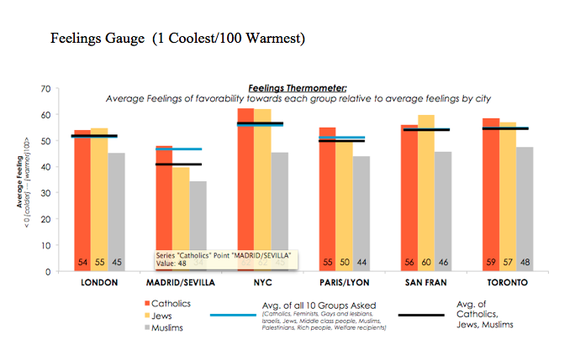
Comparative Religious Attitudes CitiesInteresting comparative study across religions and cities, with strong conclusion of how best to proceed:

The data shows that anti-Semitism, at least in the countries surveyed, is stubborn, deep-seated and chronic. It is worse than anti-Catholic bigotry but not quite as widespread as anti-Muslim feelings. Yet here’s a critical distinction: within nations, people act-out against Jews more often than they do against Catholics and Muslims. Some of this behavior seems linked to events involving Israel. However, it would be wrong to suggest a causal link between expressions of anti-Semitism and Israeli policy. Last Fall’s conflict in Gaza, for instance, may have “unleashed” anti-Semitism, acting as a false catalyst, but the feelings against Jews exist independent of the Middle East. After all, if someone predisposed to hate Jews cites Israeli policy to justify their anti-Semitism, he or she is still an anti-Semite.

Yet not all our findings were bleak. As part of our study we tried to determine whether people were affected by media mentions of Israel. When we asked our survey respondents last August to read an unbiased report on the ongoing events in Israel and Gaza we saw expressions of anti-Jewish feelings decline. People who told us they were “somewhat open” to new information moved from a 14 percent to 25 percent likelihood of sympathizing with Israel. Those that were “very open” moved from 35 percent to 42 percent likelihood of sympathizing with Israel. We saw related reductions in the number of people who said they had negative thoughts about Jews in general.

So the data offers hope that hearts and minds can be affected by honest, reliable, unadulterated information. We can inform instead of inflame. We can teach instead of just talk. We can exercise our freedom of speech and freedom of the press as a means to contest cultural boundaries. The alternative is watching bigotry of all kinds — against Muslim or Jew, Catholic and, sadly, a long list of other groups — dominate the discussions around the world. The evidence is there that we can create change and counteract the hate that occurred last week and continues to be so pervasive and pernicious. It is up to all of us to engage, enlighten and educate.

Anti-Semitism — The Facts and the Hope | John Gerzema.

Prime Minister, this isn’t how we should do things in Canada | Elghawaby

Amira Elghawaby of the NCCM reacting to the Government’s messaging, making three points:

  1. Stoking fear of the “other”;
  2. Pretend to care about Canadians wrongfully imprisoned abroad but do as little as possible to get them released; and,
  3. Act tough on terror.

Similar to other commentary I have already posted.

Hard not to disagree with her conclusion:

The government that says it is committed to protect Canadians is the same one that alienates the very communities it needs to empower and work with. Prime Minister, this shouldn’t be how we do things here.

Prime Minister, this isn’t how we should do things in Canada | Toronto Star.

If IS falls, Canada must be ready for the return of foreign fighters – Momani and Dawson

Sobering assessment of one of the major gaps in the Government’s overall approach in reducing the risk of radicalization and returning fighters by Bessma Momani and Lorne Dawson:

The provisions of Bill C-51 attempt to stem the supply side of terrorism, by censoring online conversations and beefing up CSIS and RCMP capacities. But the bill does not have a strategy to tackle the demand side of the problem, such as de-radicalization programs, building capacities and resilient communities through political empowerment, and supporting alternative narratives in vulnerable demographic groups. Security measures have a troubling tendency to feed back into the radicalization process itself. If IS is decapitated, the threat posed from returning fighters is theoretically higher than if it is simply contained, and it is unlike the consequences of defeating al-Qaeda for the radicalization of Western youth.

What can be done? Investing in prevention tools can help stop the feedback loop that could further radicalize new recruits and returning fighters. Prevention means we need to understand the appeal of IS as a cult, couched in medieval misinterpretations of an otherwise peaceful religion. Stemming the supply and re-offence of returnees requires detoxing wannabe fighters; understanding how vulnerable youth and misfits are searching for identity online; working with religious and community leaders to help would-be radicals discern the difference between scripture and propaganda; and de-glorifying the violence and militancy of travelling to Syria or other fronts. Disillusioned returnees can be used to describe the mundane and hypocritical life under IS rule. Some of the fighters who have returned to civilian life tell tales of how quickly they became disenchanted, as they were assigned to cleaning toilets and working Twitter accounts, and not trusted with combat or decision-making roles. This is not to say that we can expect a flood of ‘innocent’ returnees, but there will be some and we ought to be prepared with a variety of tools to suppress further radicalization other than our prison system.

Investing in de-radicalization/reintegration programs will address the demand side of terrorism that Bill C-51 does not. This will cost money and require considerable ingenuity, but other nations facing a much more severe threat from returnees, such as Germany and Denmark, have initiated such programs. The government should acknowledge that using the law may seem like a quick and cheap fix, but ignoring the need for a more “sociological” approach will cost more in the long run.

If IS falls, Canada must be ready for the return of foreign fighters – The Globe and Mail.