EU States Fail to Record Anti-Semitism as Incidents Increase

A reminder of the importance of collecting reliable, and to the extent possible, consistent data.

The StatsCan Police-reported hate crime in Canada, 2012 is such an example, particularly useful given the inter-group comparisons by ethnicity and religion, and is more objective than statistics collected by individual groups.

A report published Wednesday by the Fundamental Rights Agency (FRA) in Vienna finds that anti-Semitic incidents are on the rise throughout Europe, but the virtual absence of proper data collection and “gross under-reporting” make it difficult to trace the trend accurately.

“Despite the serious negative consequences of anti-Semitism for Jewish populations in particular, as the FRA’s relevant survey showed … evidence collected by FRA consistently shows that few EU Member States operate official data collection mechanisms that record antisemitic incidents in any great detail,” the report says. It points out that “this lack of systematic data collection contributes to gross underreporting of the nature and characteristics of anti-Semitic incidents that occur in the EU. It also limits the ability of policy makers and other relevant stakeholders at national and international levels to take measures and implement courses of action to combat antisemitism effectively and decisively, and to assess the effectiveness of existing policies. Incidents that are not reported are also not investigated and prosecuted, allowing offenders to think that they can carry out such attacks with relative impunity.”

But even where data do exist, according to the report, “they are generally not comparable, not least because they are collected using different methodologies and sources across EU Member States. Furthermore, while official data collection systems are generally based on police records and/or criminal justice data, authorities do not always categorize incidents motivated by anti-Semitism under that heading.”

Source: The Jewish Press » » Report: EU States Fail to Record Anti-Semitism as Incidents Increase

Religious Minorities in the Public Service: What the data tells us

Public_Administration_-_Religious_Minorities_-_Core_Public_AdminTo complement the employment equity analysis in my book Multiculturalism in Canada: Evidence and Anecdote (see here), I applied the same methodology using NHS data for religious minorities.

This was prompted in part by Minister Clement’s comment that hijabs and niqabs “are frequently worn” in the public service and that “I’m sure we have employees in the public sector who wear a niqab – I’m sure we do.”

The full series of charts, tables  and related analysis are found here.

The main conclusions:

Policy makers at all government levels should complement their internal employment equity data with the NHS to assess whether there are issues with respect to particular groups. This analysis of religious and visible minority data indicates that there is variation among groups, and this needs to be considered as part of employment equity strategies and programs. The five-year frequency of this NHS data also provides a longer-term view of employment equity trends than the annual government reports, which tend to focus on year-to-year changes.
Given overall demographic trends, the percentage of newer religious minorities in government will likely continue to increase. While most members of religious minorities may not need or request accommodation, the more traditional members will, and it is likely that the number and type of requests will increase.
Getting back to Minister Clement’s statement, while we know that some 8,800 Canadian Muslims work for the federal government (47 percent women), we do not have any information regarding their religiosity and the extent to which deeper religiosity is reflected in men’s facial hair or women’s head coverings (which do not mean identical religiosity, beliefs or interpretations of the respective religions). Nor do we have such information regarding other religions (e.g., Canadian Jewish public servants wearing the kippa, or Canadian Sikh public servants wearing turbans and carrying the kirpan). Nor to my knowledge is there any publicly available summary of religious accommodation requests.
We may not have hard numbers to back his assertion that “we have employees in the public sector who wear a niqab.” However, any public servant who wished to wear a niqab would provoke considerable bureaucratic discussion regarding whether this could be accommodated. That no such discussion has come to light suggests that there are no such cases at the federal level.
At some time, however, it is likely that someone will request such an accommodation (just as voting, citizenship and judicial processes have shown). While some would argue that such a request should be accommodated, this would not be healthy to an integrated workplace and society given the degree to which the face provides needed cues to interpret words.
In the interim, the public service may wish to consider collecting and analyzing data related to accommodation requests in core public administration to complement employment equity reporting and strengthen the current framework by providing a more comprehensive and consistent evidence base.


Barbara Kay: Ten reasons to ban the niqab — in public

Barbara Kay captures the popular view, but one that ignores the rights dimension (which distinguishes us from Saudi Arabia) and that wearing the niqab is not necessarily political. Her arguments, which capture the popular view, are simplistic and more rhetorical than grounded (and in some cases, using the same logic, would impact upon other religious practice or clothing).

That being said, discomfort over the niqab is real and justified.

When working on multiculturalism issues in 2008 when this issue came up (Quebec), I asked my staff, generally disposed to accommodation, whether they would feel comfortable with a niqab-wearing woman in the team. Silence!

  1. The niqab is not a religious obligation, it is, according to many Islamic scholars, a regional custom. But even in Saudi Arabia, where it is considered a religious obligation, it is removed by women participating in the hajj. Why must Canada be more niqab-consistent than Saudi Arabia?
  2. The niqab is indecent. Beyond “offence,” which can be cognitively managed, decency standards go to the heart of our psychological well-being in society, and is beyond our cognitive control. Our sense of decency is what regulates our comfort zone amongst strangers. Decency standards are not imposed by a charter, but spring up organically in all societies under a variety of historical and cultural influences. Decency standards differ amongst societies and shift with time, but the when-in-Rome principle is universally accepted by reasonable people.
  3. Decency here resides in the perceived broad middle of a spectrum. Just as full nakedness provokes extreme discomfort in most Canadians, so does full cover. That full cover is almost invariably a Muslim custom is immaterial to those of us who find it indecent. (So enough, please, with the “Islamophobia” shtick.)
  4. Double standards: it is inconceivable that we would allow men to mask themselves in civic interaction, even if they considered it a religious obligation, because masked men are threatening to women (and other men). We should not permit to women what we would not permit to men.
  5. The only societies that mandate the niqab as a social norm are those in which women are considered sexual chattel with virtually no rights. Willed indifference to the niqab is more than tolerance; it is an endorsement of gender-rights relativism in our national home — equality for our women, inferior status for theirs.
  6. The editorial notes that “only a tiny minority of women” opt to wear the niqab. This is precisely why it should be regulated now, when it is enforceable, not when potentially thousands of women adopt it and it is unenforceable.
  7. Some women wearing the niqab have had it imposed on them against their will. What is the lesser evil: that all women should be forced to show us their faces while interacting with us in the public sector, or that we facilitate the lifelong misery of voiceless women? We should err on the side of support for vulnerable women yearning to fully integrate into Canadian life.
  8. The niqab is a gross insult to Canadian men, as it suggests they require a physical barrier to prevent lascivious thoughts or behaviour.
  9. The niqab is a gross insult to uncovered women, suggesting their “immodesty” invites sexual attention.
  10. In the West, the niqab is often a political statement, a proud sign of militant Islamist activism. “Put on your niqab!” cried Hezbollah supporter Yvonne Ridley at a Montreal Canadian Islamic Congress fundraiser in 2007. It wasn’t modesty she was encouraging, but participation in the stealth jihad.

The niqab differs from other fashion accessories that promote faith and modesty like the kippah or hijab, and to pretend otherwise is disingenuous. The arc of contemporary Islamism, still in its ascendancy, frightens us. Our alleged “moral panic” is actually moral revulsion. When a symbol comes with this much baggage, libertarian rigidity in its support looks less like principled idealism and more like cultural self-sabotage. No leader who grasps and uproots this nettle need feel ashamed. True patriot love demands nothing less.

Source: Barbara Kay: Ten reasons to ban the niqab — in public | National Post

Securities regulators urged to make gender diversity policies mandatory

Hard to argue with greater transparency and reporting as a way to encourage change, which should also apply to visible minorities:

Canadian securities regulators should make gender-diversity policies mandatory for companies on the Toronto Stock Exchange after a majority of companies rejected voluntary standards this year, according to Women’s Executive Network founder Pamela Jeffery.

Ms. Jeffery, who heads the Toronto-based advocacy organization for women in business, told an Ontario Securities Commission round-table forum that Britain’s corporate governance code requires companies to report annually on their diversity policies, and the country has seen rapid improvement in the proportion of women on its boards and in senior executive roles.

“Given that only 14 per cent of [Canadian] issuers have disclosed the adoption of a written policy, we’d like to see issuers required to disclose a written board and executive board diversity policy,” Ms. Jeffery said.

Canadian companies should also be required to report annually on their internal targets for women, she said.

The OSC forum Tuesday was organized to discuss compliance to date with new voluntary standards, introduced this year, that recommend companies should create gender-diversity policies to get more women in senior roles.

A report released Monday by securities regulators shows only 14 per cent of 722 TSX-listed companies have created formal diversity policies in the wake of the new standards, while 65 per cent said they have decided not to have a policy and a further 21 per cent reported only informal policies or policies that do not mention gender diversity.

Osgoode Hall law professor Aaron Dhir, who specializes in issues of corporate diversity, told the OSC forum his research shows Australia and Britain both saw significant increases in the proportion of women on their boards after they introduced new reporting standards.

In Australia, for example, the proportion of women on ASX 200 boards grew to 20 per cent in 2014 from 8 per cent in 2011 after regulators introduced a rule similar to Canada’s new standard. In 2011, 61 per cent of Australian companies reported having a diversity policy, which has grown to almost 100 per cent this year, Prof. Dhir said.

Canada’s new standard is one of the best Prof. Dhir said he has seen compared to diversity rules in other countries like the United States, but companies need time to respond. He is “cautiously optimistic” more will adopt diversity policies in coming years.

Source: Securities regulators urged to make gender diversity policies mandatory – The Globe and Mail

Linguist documents dying languages still spoken in Toronto

Interesting. Another aspect of Toronto’s diversity and the diversity within communities:

Paolo Frascà’s rare Italian dialect “fossilized” in Toronto and found its own community here.

“That is why I speak the dialect probably better than the people in my generation back home in Italy,” said Frascà, 24. “It’s because I moved here when I was 13 years old.”

He speaks a language particular to a small town of about 3,000 people in the region of Calabria in southern Italy. This tongue is closer to Latin than typical Italian because of the region’s late Romanization. Back home, younger generations like his don’t speak Santonofrese — named after the town of Sant’Onofrio —because it is seen as “lowbrow.” He says that thanks to Toronto’s large Italian community, there may be several endangered languages and dialects like his preserved in the city as people continue to speak them with their family.

That’s not always the case, though. Anastasia Riehl, who started the Endangered Languages Alliance Toronto, has been documenting which of the world’s dying languages are spoken in Toronto, including Frascà’s. Some are spoken by just one or two people in the city, or even in the world. Without a community to share it, those people stop speaking their language and absorb the regional language instead.

Riehl began the Alliance in Toronto after her Cornell University grad school colleague, David Kaufman, launched one in New York. After years of documenting languages overseas, she discovered the last fluent speaker of a dying Latvian language, Livonian, lived outside Toronto. The woman, Grizelda Kristina, was 101 and ailing.

“That’s when I was like, ‘OK, let’s just say we’re going to do this,’” she said of the day in 2011 when she hopped on a flight to Toronto from Argentina, where she was vacationing, to interview the woman, who died two years later.

Since then, she’s interviewed more than a dozen speakers of eight endangered languages from around the world. She’s working on a short documentary detailing the stories of three speakers. Riehl has taken time off from her role running the Strathy Language Unit at Queen’s University to devote more time to the project.

Toronto’s position as one of the most diverse cities in the world — more than 30 per cent of its residents speak a language other than English or French — makes it an “as good if not better” place to document endangered languages.

The city’s website pegs the number of languages and dialects spoken in the city at more than 140, but Riehl estimates there are “dozens” that don’t appear in census figures. Any language becomes endangered, according to the United Nations Organization for Education, Science and Culture (UNESCO), when its speakers cease to use it and when it is no longer passed on to the next generation.

“The global context we’re in has definitely impacted [language loss] because people have all these pressures to speak a more dominant language,” Riehl said, explaining that the phenomenon doesn’t only appear in English-speaking countries. “It’s a sad way to think about it, but it’s one of the few things [immigrants] bring with them.”

She says the best way to preserve a language is for children to speak it and use it.

“I’m thinking of these refugees, especially the kids who end up in these new places — it just seems like it’s so much better for them if there can be a way to support them in their native language.”

But the shyness younger immigrant generations, like Frascà’s, experience in speaking their language contrasts with the shame indigenous peoples of North America were forced to bear for years under colonization, said David Kaufman, founder of the Endangered Languages Alliance in New York and Riehl’s former Cornell colleague.

“The tragedy in New York, I would say, is that you can find almost every language under the sun except the indigenous language of New York itself, which is Lenape,” an Algonquin language, he said, adding that the only place the language is now spoken and taught is in Ontario.

Read more of this post

Investigation shows cracks in Canada’s plan to stop homegrown terrorism

More indications of the gap in the Government’s anti-radicalization strategy:

Federal authorities argue they are tackling the problem in a number of ways, by enhancing enforcement powers, toughening laws and developing strategies to counter terrorist propaganda.

But with gaps in programs to prevent radicalization, grassroots communities across Canada have stepped up, using their own time and money to stop young people from reaching the battlefields of Syria and Iraq.

“We Canadians have been scared into believing that there are locust-like masses” of terrorists, says Hussein Hamdani, who’s helped with 10 intervention cases of young would-be terrorists, and sat on the government’s terrorism advisory panel for a decade.

“All this rhetoric, and there seems to be no corresponding investment in prevention.”

Instead of being given counselling or mentorship, he argues Canadian youth at risk of radicalization are largely ignored, left to watch videos glorifying their compatriots abroad.

… Security experts such as Phil Gurski say Canada is at risk of losing the battle for the hearts and minds of at-risk youth, without improved efforts to combat the underlying message of violent extremists.

“The Islamic State has a lot going for it. It’s got territory, it’s got quasi-religious authority,” says Gurski, who spent 12 years as a Canadian Security Intelligence Service agent and has specialized in al-Qaida-inspired radicalization for three decades.

Others like Blaney argue Canada has a solid record of deterring attacks and thwarting terrorist travel, but it’s hard to deny ISIL’s momentum.

…“There’s a sense of purpose, there’s a sense of addressing historical grievances,” Gurski explains. “That’s why people are flocking to it — that’s why it’s got 20,000 foreign fighters.”


… But how big is the threat?

By last October, the RCMP flagged 80 Canadians as having returned after supporting groups like ISIL abroad.

Source: Investigation shows cracks in Canada’s plan to stop homegrown terrorism | Calgary Herald

Multiculturalism: Getting the Balance Right – Reflections for a new government

With a federal election upon us and the possible change of government, what are the multiculturalism policy changes an incoming government may wish to consider, and which policies may it wish to keep?

The Conservative Government under Minister Kenney refashioned multiculturalism through greater emphasis on integration than accommodation. In many ways, this was reverting to the original recommendations of the 1969 Report of the Royal Commission on Bilingualism and Biculturalism that stressed integration over assimilation, while recognizing the need for individuals and groups to maintain their cultural identities within the overall Canadian legal and values framework.

But Kenney made a number of important shifts. He emphasized that multiculturalism involved relations between all groups of Canadians, not just ‘mainstream’/visible minority relations. Prejudice and discrimination were issues between different visible minority groups. Religious diversity became a more explicit part of multiculturalism. Emphasis shifted from equality and employment equity to ensuring government services were more attuned to serving an increasingly diverse population.

The government also delivered on a series of historical recognition activities for groups that had either been subject to wartime internment (i.e., Ukrainian and Italian Canadians) and immigration restrictions (i.e., Chinese, Indo, and Jewish Canadians). He revised the grants and contribution program to include both project funding and event funding (food and folklore), but with an explicit focus on bringing communities together. He broadened racism and discrimination programming to include specific forms but disappointingly only focused on antisemitism, largely abandoning broader messaging.

The citizenship program reinforced this integration messaging, as well as warnings against ‘barbaric cultural practices’ such as forced marriage and importing ‘homeland’ conflicts into Canada. The Government also used niqabs at citizenship ceremonies as a wedge issue.

Many of the above policy shifts were needed and reflect the ongoing evolution of Canadian diversity. However, in its focus on social cohesion the Government neglected social inclusion.

Early symbolic changes could include language changes. Fully accept that multiculturalism is the Canadian brand of diversity and stop trying to shift to pluralism (which is less integrative). Retain the emphasis on integration — across all communities — but with more acknowledgement of accommodation. Stop using the niqab as a wedge issue but reinforce that accommodation cuts both ways. Reduce the emphasis on the monarchy, both for Canadian identity reasons as well as the mixed history British colonialism has for many groups. Re-assert the equality aspects of multiculturalism along with employment equity.

Beyond language, what other policy and program changes should be considered?

The Annual Report on the Operation of the Canadian Multiculturalism Act needs to become a more informative, evidence-based report on the state of multiculturalism in Canada. Ideally, submissions made by individual departments extolling their progress would be complemented by more independent perspectives.

A new government will certainly wish to revisit the program’s objectives. While the core of first objective, “promote intercultural understanding … and equal opportunity … core democratic values” should remain, more inclusive language on accommodation should replace the emphasis “civic memory and pride.” The second objective — improving the responsiveness to an increasingly diverse population — needs to be broadened to (re)include employment equity within government institutions, given the poor record of some departments and agencies. No change is required to the third objective which essentially enables international activity.

A new government needs to ensure that specific anti-racism initiatives (i.e., antisemitism) are complemented by broader anti-discrimination messaging, along with other targeted initiatives as appropriate (e.g., anti-Muslim activity).

This needs to be linked to a review of the current governance arrangements for the Canadian Race Relations Foundation, established as part of redress for Japanese Canadian World War II internment. The Foundation, arms-length but with board members appointed by the Government, has arguably not lived up to expectations. Consultations and evaluation, jointly with the National Association of Japanese Canadians, are needed to ensure its continued relevance and effectiveness.

Moreover, responsibility for the International Holocaust Remembrance Alliance (IHRA) needs to be brought back to the multiculturalism program rather than being housed in the Office of Religious Freedom as IHRA’s focus is broader than religion.

A new government should examine the balance between grant and contribution funding for immigrants (almost $600 million for settlement services and the like) and funding for longer-term integration issues under multiculturalism (less than $9 million). Shifting $10 million to multiculturalism projects — more than doubling the budget — would allow for more effective programming to address second-generation issues such as racism and discrimination, radicalization and extremism, and equity and inclusion, with little or no detectable impact on settlement services. A new government will also need to consider whether it wishes to retain ministerial sign-off on projects (for greater political direction) or have this delegated as it does for settlement programming to improve program timeliness and efficiency.

A review of the effectiveness of the Government’s $30 million contribution in 2006 to the Global Centre for Pluralism would allow those board members appointed by the Government to play a more effective role.

A new government will also need to address the dilution of multiculturalism resources and expertise within CIC. Resources have been cut and dispersed, and beyond the Annual Report, and the small grant and contribution, there is little sign that longer-term integration issues are being given the attention that they deserve. Part of this reflects the natural consequences of the functional rather than business line model, which invariably results in resources and management attention devolving to CIC’s ‘centre of gravity’ — immigration.

One of the clearest examples is the loss of research capacity and focus on multiculturalism and longer-term second-generation issues. Given the importance of these to the ongoing success of integration, this capacity needs to be strengthened. A more ambitious agenda would include resuscitating the Ethnic Diversity Survey (not to mention the Census!), last conducted in 2002, but strengthened to reflect religious as well as ethnic diversity.

This dilution has been further exacerbated by the complex web of Ministerial responsibilities between Minister Kenney, as the political minister responsible, Minister Alexander as the departmental minister, and junior Minister Uppal, having largely a ceremonial role. Absent any major machinery change — disruptive at the best of times — any new Prime Minister  should consider only having two ministers, one being the senior minister for CIC, the other being the junior minister, ideally responsible for both citizenship and multiculturalism, to provide somewhat of a counter-weight to the immigration centre of gravity.

While in an ideal world, the 1988 Canadian Multiculturalism Act should be reviewed and updated, the current Act provides sufficient flexibility for governments to interpret and implement policies and programs, as demonstrated under the Conservative government. However, should a new government wish to be more ambitious, any review of the Act should also consider whether a parliamentary Multiculturalism Commissioner would be appropriate to provide a stronger political focus.

While compared to some of the other immigration and citizenship-related issues facing a new government, multiculturalism will be a secondary priority. However, more inclusive language into any messaging can set the tone and signal changes in direction, with more substantive changes to follow as priorities allow.

— Multiculturalism: Getting the Balance Right

Multiculturalism in Canada: Evidence and Anecdote: Book Launch Toronto 13 October

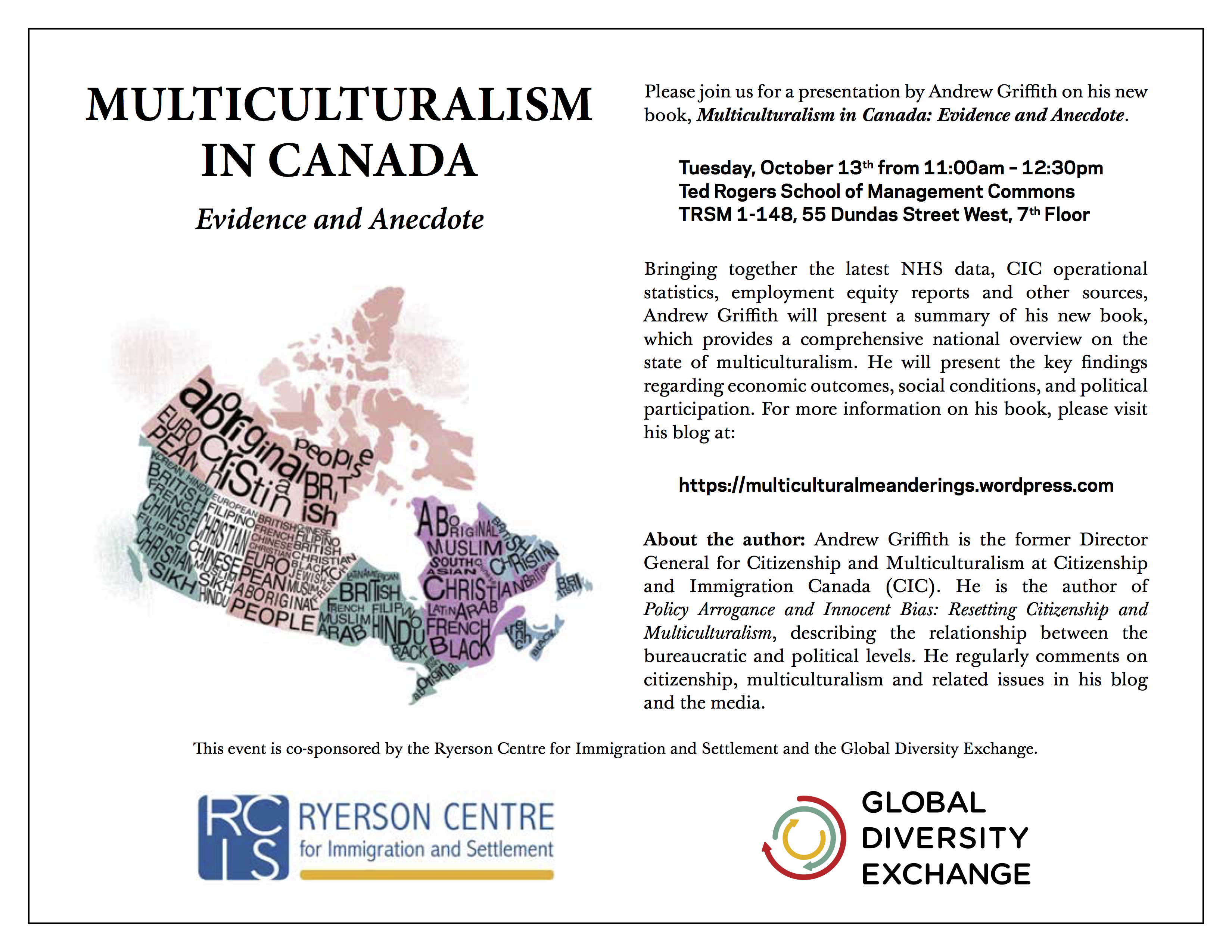
For those of you in Toronto, Ryerson’s  Centre for Immigration and Settlement and the Global Diversity Exchange are hosting my book launch, Tuesday October 13th at 11 am. Poster below:

Griffith Ryerson GDX flyer

Griffith Ryerson GDX flyer

Australia Could Make Everyone a Terrorist

Appears an initiative aimed at providing teachers with tools to identify potential radicalization went a bit too far with too broad a reach:

Last week the Australian government sparked public furor over a campaign to help teachers identify signs of the radicalization process in the classroom with a prepared pamphlet.

The 32-page document, known as the “radicalization awareness information kit,” provides warning signs to indicate whether a young person is on a path to violent extremism. The pamphlet paints outlandish examples of radicalized youth who range in character, including a student named Karen who was “involved in the alternative music scene, student politics and left-wing activism.” Local media lambasted the government for conflating activism with violent extremism, blurring the line between national security threats and political expression.

While the illustrations were exceptionally misguided, the greater concern lies with creating a simplified checklist to identify young people as potential terrorists. As the Guardian rightly pointed out, doling out a canned guideline of behaviors to identify extremism not only engenders intolerance, it creates a culture of profiling—akin to the one that led to the arrest in Texas of a 14-year-old Muslim student who wanted to impress his teachers with a homemade clock that was mistaken for a bomb. A similar program in the U.K. led to an at-risk radicalization list to include a three-year-old as a potential future extremist.

…Gary Bouma, a professor involved with the initiative, reportedly distanced himself from the report upon learning it was distributed to teachers. Bouma tells the Daily Beast he did not “distance himself” from the research, but was merely concerned that teachers would not be provided with training to complement the booklet. Bouma says he’s been assured that teachers will receive the proper training to use the manuals, but what type of training would that entail?

“There’s a difference between people who get involved in what you would call incidental violence as a result of a political protest,” Victoria University professor Michele Grossman told the Guardian, referring to the case study linking a student’s penchant for left-wing activism to extremism. “To me, that’s not what we mean when we talk about facing and tackling the very serious issues around violent extremism.”

Source: Australia Could Make Everyone a Terrorist – The Daily Beast

Asians will be largest immigrant group in U.S. in 50 years: Pew study

Pew_Immigration_ProjectionsInteresting demographic shift and may, over time, shift immigration debate in USA:

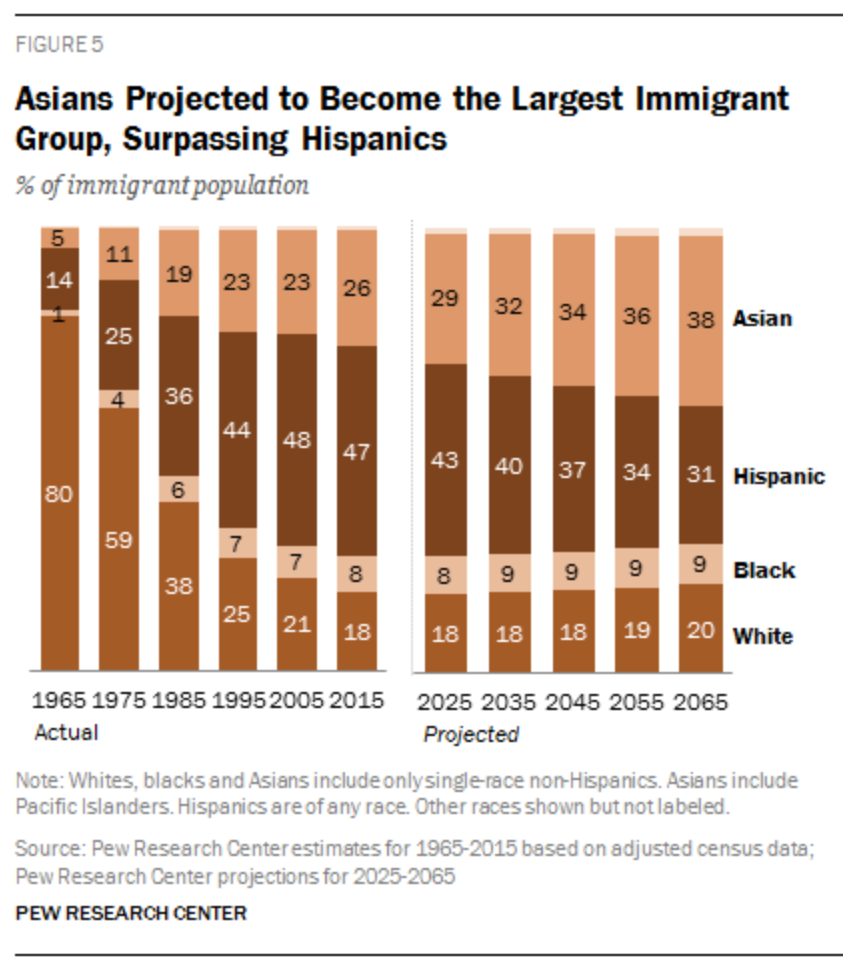
In a major shift in immigration patterns over the next 50 years, Asians will have surged past Hispanics to become the largest group of immigrants heading to the United States, according to estimates in a new immigration study.

The study looks in detail at what will happen by 2065, but the actual tipping point comes in 2055.

An increase in Asian and Hispanic immigration also will drive U.S. population growth, with foreign-born residents expected to make up 18 per cent of the country’s projected 441 million people in 50 years, the Pew Research Center said in a report being released Monday. This will be a record, higher than the nearly 15 per cent during the late 19th century and early 20th century wave of immigration from Europe.

Today, immigrants make up 14 per cent of the population, an increase from five per cent in 1965.

The actual change is expected to come in 2055, when Asians will become the largest immigrant group at 36 per cent, compared with Hispanics at 34 per cent. White immigrants to America, 80 per cent back in 1965, will hover somewhere between 18 and 20 per cent with black immigrants in the eight per cent to nine per cent range, the study said.

Without any post-1965 immigration, the U.S. would be 75 per cent white, 14 per cent black, eight per cent Hispanic and less than one per cent Asian, Pew said.

Currently, 47 per cent of immigrants living in the United States are Hispanic, but by 2065 that number will have dropped to 31 per cent. Asians currently make up 26 per cent of the immigrant population but in 50 years that percentage is expected to increase to 38 per cent.

Pew researchers analyzed a combination of Census Bureau information and its own data to develop its projections.

Part of the reason for the shift is that the fertility rate of women in Latin America and especially Mexico has decreased, said Mark Hugo Lopez, Pew’s director of Hispanic research. In Mexico, Lopez said, women are now having around two children, when back in the 1960s and 1970s, they were having about seven children per woman.

“There are relatively fewer people who would choose to migrate from Mexico so demographic changes in Mexico have led to a somewhat smaller pool of potential migrants,” he said. “At the same time we’ve seen a growing number of immigrants particularly from China or India who are coming for reasons such as pursuing a college degree or coming here to work temporarily in the high-tech sector.”

Source: Asians will be largest immigrant group in U.S. in 50 years: Pew study – World – CBC News

Link to study: Modern Immigration Wave Brings 59 Million to US, Driving Population Growth and Change Through 2065