Multiculturalism in Canada: Evidence and Anecdote – Book Launch 13 October Reminder

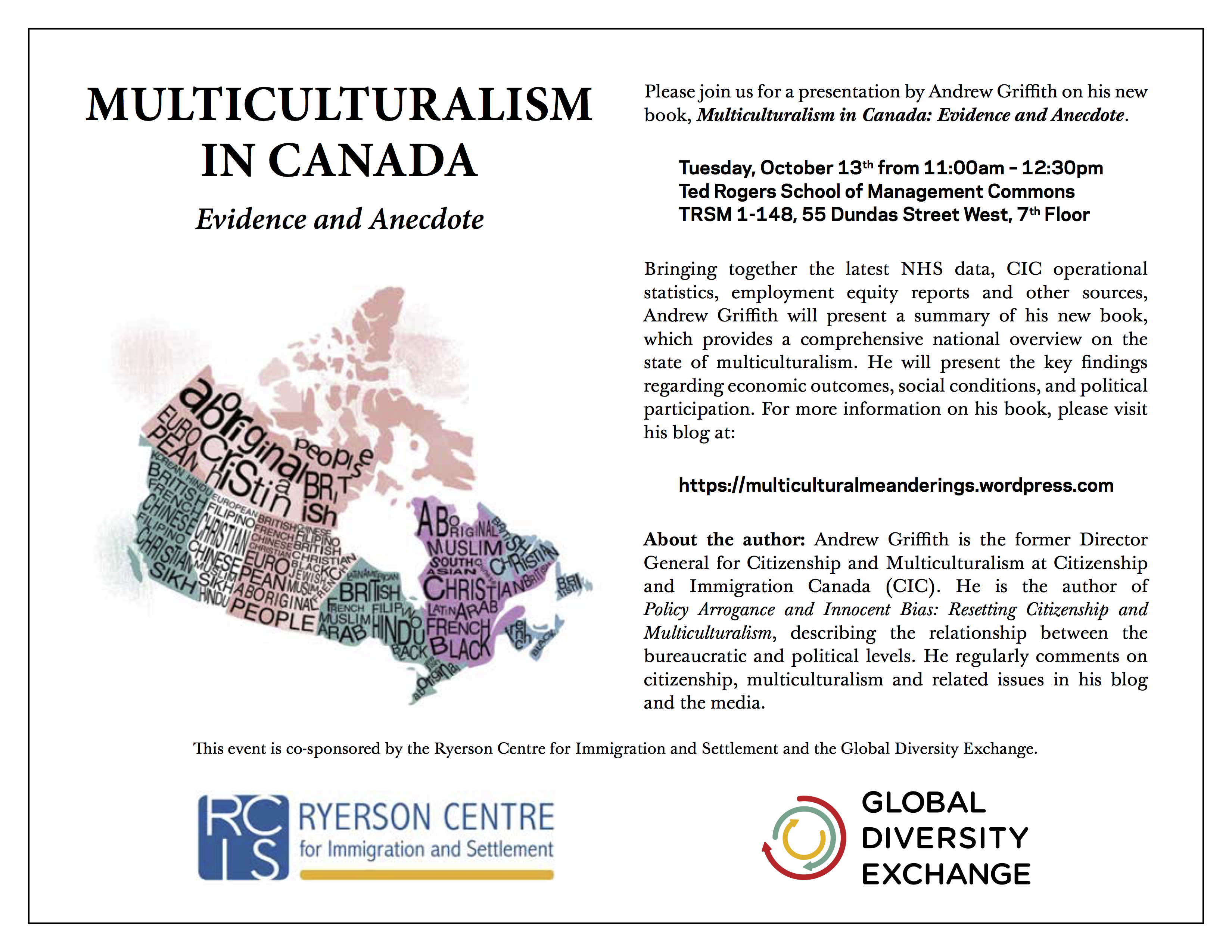
A reminder for those of you in Toronto, Ryerson’s  Centre for Immigration and Settlement and the Global Diversity Exchange are hosting my book launch, one week from today, Tuesday October 13th at 11 am.

Poster below:

Griffith Ryerson GDX flyer

Griffith Ryerson GDX flyer

Conservatives crank up values clash by taking aim at ‘barbaric cultural practices’

Interesting that just two short years ago, Minister Kenney was accusing the Parti québécois of wedge and identity politics, and demonstrating  strong and principled opposition to the proposed Charter of Values:

“When Quebecers begin to actually contemplate the idea that provincial bureaucrats might be getting out a tape-measure to measure the size of people’s crosses, to see whether or not their earring is too obviously religious — this gets to a point of almost Monty Python-esque absurdity,” he said.
“And I don’t think the majority of Quebecers support will support that kind of overbearing application of power.”
Kenney noted that just a few decades ago, most of Quebec’s schools and hospitals were largely run by nuns “wearing headscarves and crosses.
“That’s the tradition of Quebec itself and I think it’s something that should be respected,” he said.
Earlier this week, Kenney said he will ask the Department of Justice to review the values charter if it becomes law in Quebec, to see if it violates the constitutional protection around freedom of religion in Canada.
Asked why Ottawa is wading into Quebec politics, Kenney said the federal government is prepared to mount a legal challenge against the plan because it’s a “clear effort to violate what are undeniably fundamental and universal rights, like freedom of religion.”
Quebec Premier Pauline Marois has said she is “very proud of the charter,” and is looking forward to a debate on it.
“I think we need to set clear guidelines for how we live together,” she told reporters on Wednesday.
But Kenney said such guidelines are counterproductive to creating a harmonious Canada.
“At the end of the day, integration outcomes depend on immigration inputs and if you want people to become a part of your society and fully participate in it, then you have to create a space (and) send a message that people are welcoming (and) including.”

Jason Kenney calls Quebec’s values charter ‘Monty Pythonesque

But he did support the requirement for citizens to show their faces when receiving government services:

He said that there “is an expectation that newcomers should make an effort to integrate successfully into Canadian society,” while adding that governments have “to be welcoming and to create equality of opportunity.” Mr. Kenney added that it is reasonable, as proposed in the charter, to call on all citizens to “show their faces” during interactions with the government.

Conservatives vow to challenge Quebec charter, should it pass

Today, the tone is different, and the Conservatives, as so many observers have noted, are aggressively playing the identity cart and the politics of fear. The latest summary of the culture wars and wedge politics of the Conservatives:

If it wasn’t clear already, the culture war is definitely on now  and the pollsters say it’s working,

With the polls moving the Conservatives’ way and sensing that a majority could yet be in sight, the Tory campaign is pressing hard on the hot button of identity politics, promising a new RCMP “tip line” to enable Canadians to report “barbaric cultural practices” such as sexual slavery or so-called honour killings.

On CBC News Network’s Power & Politics, Liberal pundit Amanda Alvaro fumed that this was a “barbaric political practice” by the Conservatives.

A good line, but, hey, could two more weeks of cultural combat put the Conservatives over the top? Somebody seems to think so.

Even as two of his colleagues were promising the new tip line, Calgary Conservative Jason Kenney launched a fresh attack on the wearing of a niqab, or face veil, which he called “medieval” and “tribal.”

While he was at it, Kenney blasted the Liberals and the NDP — again — for opposing the revocation of citizenship for convicted terrorists.

Do we need a tip line?

Of course, Canadians can already call police to report any crime, at any time. It’s hard to see how calling a different number will make much difference. Besides that, the urgent need for a special tip line does not seem to have gripped the Conservatives during their 10 years in office — only now, in the final days of an election campaign.

One thing the tip line does, though, is enable them to keep talking about an issue that seems to be firing up the troops.

The Conservatives’ emphasis on the defence of what they call “Canadian values” is credited by pollsters with a significant uptick in their support, particularly in Quebec.

And it’s not a risky strategy: a poll done by the Privy Council Office in March of this year, paid for by taxpayers, found 82 per cent of Canadians in support of the Conservatives’ bid to ban the wearing of a niqab at citizenship ceremonies. In Quebec, that number was even higher — 93 per cent.

“We need to stand up for our values,” said Conservative candidate Chris Alexander, who is in a tight race for re-election in the Ontario riding of Ajax.

“We need to do that in citizenship ceremonies. We need to do that to protect women and girls from forced marriage and other barbaric practices.”

Joining him was Kellie Leitch, the Conservative candidate in Simcoe-Grey, who said the tip line would mean that “citizens and victims can call with information about incidents of barbaric cultural practices here in Canada.”

She did not say what, if anything, prevents Canadians from doing that now.

However, she did say there would also be a new RCMP task force to enforce the Zero Tolerance for Barbaric Cultural Practices Act, which received royal assent in June. In addition, she promised a $12-million fund, over four years, to assist overseas aid groups to stop forced marriages of girls and young women in conflict zones.

“The Conservative government is not afraid to defend Canadian values and to be clear that these practices have no place in Canadian society,” said Leitch.

Kenney takes on the ‘medieval’ niqab

Kenney, simultaneously, was in Halifax to tout the Conservatives’ naval shipbuilding project. When asked about the niqab, though, he seized the chance — and denied that he was in any way demonizing Muslims.

“I think it’s completely wrong-headed to associate the niqab with Islam,” Kenney said.

“The niqab reflects a medieval tribal custom that reflects a misogynistic view of women.”

Kenney is correct that the vast majority of Muslim women, in Canada and worldwide, do not wear a veil and do not see it as a religious requirement. On the other hand, it just happens that those who wear it tend to be Muslims.

A new passport?

But, details, details. They don’t seem likely to interfere with the Conservative strategy. Kenney pressed on, repeating his attacks on those who differ with the cancellation of citizenship for Canadian convicted terrorists.

Kenney referred to the case of Farah Mohamed Shirdon, from Calgary, who was videotaped burning his Canadian passport while fighting with ISIS in June 2014.

“Mr. Trudeau and Mr. Mulcair,” said Kenney, “think that if that fellow shows up at one of our embassies, we should issue him a new passport and welcome him back to Canada.”

Both the Liberal and NDP leaders have said terrorists who are Canadian citizens should be in jail. But Tom Mulcair, well aware of the erosion of his poll numbers in Quebec, seemed to want to change the subject when he appeared for a pre-debate interview on City-TV in Montreal.

Mulcair said he would counter the Conservative tactics “by making sure that we don’t let Stephen Harper hide behind the niqab.”

When the host asked, “Well, let’s talk about the niqab,” Mulcair responded, “Well, let’s talk about his balance sheet — about what he’s done to Canada.”

But the Conservatives do want to talk about the niqab. And passports. And barbaric cultural practices. And, if a majority is possible, they’re not going to stop.
Read more of this post

Myth-busting ridings: Shedding light on visible minority women in federal politics

Worth noting (apart from my book being quoted!):

A new myth-busting study by Equal Voice, a national, multi-partisan organization dedicated to electing more women to all levels of political office in Canada, provides a fresh way of looking at female representation on the federal stage. In analyzing Canada’s 33 most ethnically diverse ridings, they found that, contrary to stereotypes that visible minority communities are less open to women leaders, representation of female visible minority candidates is far higher than that of the non-visible minority candidate pool. Part of the reason? Political parties cultivate visible minority women in these communities in a way we don’t see them do with so-called “old stock” Canadians, to employ the risible term used by Stephen Harper in a recent leaders’ debate.

The Equal Voice study was undertaken to determine candidate diversity in diverse ridings, says its executive director Nancy Peckford. Researcher Grace Lore, a Ph.D. political science student at the University of British Columbia, crunched data on 33 ridings where more than 50 per cent of the population is visible minority as identified by Andrew Griffith in Multiculturalism in Canada: Evidence and Anecdote —23 ridings in Ontario, eight in B.C., one in Quebec and one in Alberta. Forty per cent of visible minority candidates were women; among candidates of the non-visible minority pool, women comprised just 21 per cent. These aren’t lame-duck contenders, says Lore: “Many of the visible minority women in those 33 ridings are absolutely in winnable ridings.”

Parties are strategic in these ridings, says Peckford, many of which are battlegrounds in the current federal campaign: “Parties inherently understand that to be competitive they need to reflect the community back to them,” she says. “I think there is a lot of diligence to ensure they’re choosing candidates who have fairly comprehensive reach.” The effort seems to be encouraging women to come forward, she says: “It’s auspicious. We need more of it.”

Asked why less diverse ridings don’t field women, Peckford is quick to answer: “I don’t think they have to try as hard,” she says.

The study’s finding is consistent with research documenting that female visible minority MPs are better represented in Parliament than in the general population. A 2008 study, “Ethnoracial minorities in the 38th Parliament: Patterns of change and continuity,” by Jerome Black reveals that representation of minority women doubled between 1993 and 2004, from just 4 per cent to 8 per cent (though, as Lore points out: “that’s hardly a level to cheer about”). By 2004, minority women comprised 40 per cent of minority MPs. “Given that, in 2004, women overall comprised just 21 per cent of all MPs, that’s pretty incredible,” Lore says. Minority women have done better than minority men, she points out: “So the way we can phrase this is when we do more to get more women, we end up with more diverse candidates overall.”

Mulcair, the niqab and ‘a dangerous game’ – Patriquin

Patriquin gets it right:

It’s gross stuff, reminiscent of the Parti Québécois identity campaign of 2014, and it deserves to be shouted down. Tonight, finally, one of the leaders did just this. Tom Mulcair’s statement during the fifth and final election debate on those few square inches of face-covering cloth deserves to be quoted in its entirety.

“The way Mr. Harper says it, it’s like there are people here that are pro-niqab. No one here is pro-niqab. We realize that we live in a society where we must have confidence in the authority of the tribunals, even if the practice is uncomfortable to us. If a journalist says something that is uncomfortable to me, I still support his right to say it. Mr. Harper, you are playing a dangerous game of the kind I’ve never seen in my life.”

Since the outset of the campaign, the NDP leader has been dogged with accusations of political pandering—of changing his message depending on the audience. Yet here he was in Quebec, the NDP’s power base and the place where anti-niqab sentiment is at its highest, saying exactly what much of his electorate doesn’t want to hear.

….But back to Mulcair. In the throes of the 2014 Quebec election, when the Parti Québécois introduced a bill that would ban religious head coverings of all sorts from Quebec’s civil service, it was Trudeau who denounced it as an unseemly electoral gambit. Mulcair remained largely silent. “We don’t want to give ammunition to the separatists,” his aide told me at the time.

The PQ ended up losing the election. As it turned out, the scapegoating of religious minorities wasn’t boffo electoral fodder after all. Quiet then, Mulcair was anything but tonight, giving Conservative and Bloc attempt to capitalize on fear the full-throated condemnation it deserves. Mulcair is nothing if not calculating, and perhaps he has calculated that the niqab isn’t nearly the electoral millstone some of his opponents hope. That is a hell of a gamble. It is also an honourable one.

Source: Mulcair, the niqab and ‘a dangerous game’ – Macleans.ca

L’Assemblée nationale dénonce l’islamophobie

Think this is a first in Canada, and striking that it is happening during the federal election and the Conservative use of the niqab for wedge politics, not to mention the bill before the Quebec legislature banning the niqab for giving or receiving public services:

Les 100 députés présents au Salon bleu se sont prononcés en faveur de l’initiative de la députée de Québec solidaire, Françoise David. Aucun ne s’y est opposé.

Le texte appelle les élus à s’inquiéter de la prolifération de matériel «à caractère islamophobe et raciste» sur les réseaux sociaux ces dernières semaines. Il enjoint aussi l’Assemblée nationale à affirmer que «les Québécois de confession musulmane sont des citoyens à part entière et que cette Assemblée condamne sans réserve les appels à la haine et à la violence contre tous les citoyens du Québec».

Le vote survient alors que la question du niqab dans les cérémonies de citoyenneté est devenue un thème central de la campagne fédérale. Il arrive quelques jours après que deux adolescents aient fait chuter une musulmane enceinte en lui arrachant son hijab à Anjou.

Dans ce contexte, Françoise David tenait mordicus à inclure le mot «islamophobe» dans le texte.

«Les incidents qui se multiplient depuis quelques semaines sont des incidents qui touchent particulièrement les musulmans du Québec», a-t-elle indiqué.

Réserves

Sauf que les tractations en coulisse et le débat qui a précédé le vote ont mis en relief une hésitation des partis à dénoncer l’«islamophobie». Le Parti libéral, le Parti québécois et la Coalition avenir Québec ont tous plaidé pour qu’on élargisse le texte de la motion afin de dénoncer tous les actes d’intolérance, et non seulement ceux à l’égard des musulmans.

«Je comprends la députée et la formation de Québec solidaire de vouloir mettre l’accent sur l’islamophobie, mais, nous aussi, on avait souhaité une portée plus large parce qu’en fait, lorsqu’on a fait la consultation sur la politique publique, il y a beaucoup de gens qui sont victimes d’intolérance», a affirmé la ministre de l’Immigration, Kathleen Weil.

Le député péquiste Maka Kotto souhaitait aussi amender la motion de Mme David pour «lui donner une note plus universelle, y intégrer en fait toutes les discriminations possibles, toutes les victimes potentielles de racisme».

Dans les rangs péquistes, on souhaitait éviter que l’appui à la motion soit perçu comme une condamnation du débat sur le niqabLe parti considère qu’il est légitime de s’opposer au port de ce voile intégral et de le considérer comme un instrument d’oppression des femmes.

En entrevue, M. Kotto a noté que les musulmans sont victimes de préjugés depuis les attentats du 11 septembre 2001, une tendance lourde qui dépasse les événements des dernières semaines.

Alors pourquoi cette réserve face au mot «islamophobe»?

«Parce que nous avons conscience du fait que le regard nourri de préjugés n’est pas le monopole de la seule société québécoise dans sa sphère de natifs», a-t-il répondu.

La CAQ a elle aussi plaidé pour qu’on retire les références à l’islamophobie du texte de la motion.

«”Islamophobe” veut aussi dire avoir peur de l’islam, a expliqué la députée caquiste Nathalie Roy. Les citoyens du Québec n’ont pas peur des religions. Cependant, si cette Assemblée nationale avait vraiment du courage, elle défendrait les oppressés, certes, c’est ce que nous disons, mais aussi elle dénoncerait les oppresseurs, elle dénoncerait l’islamisme radical.»

Immigrants more likely to consider Canadian symbols important to national identity

SC - GSS Immigrant Native Comparisons.001

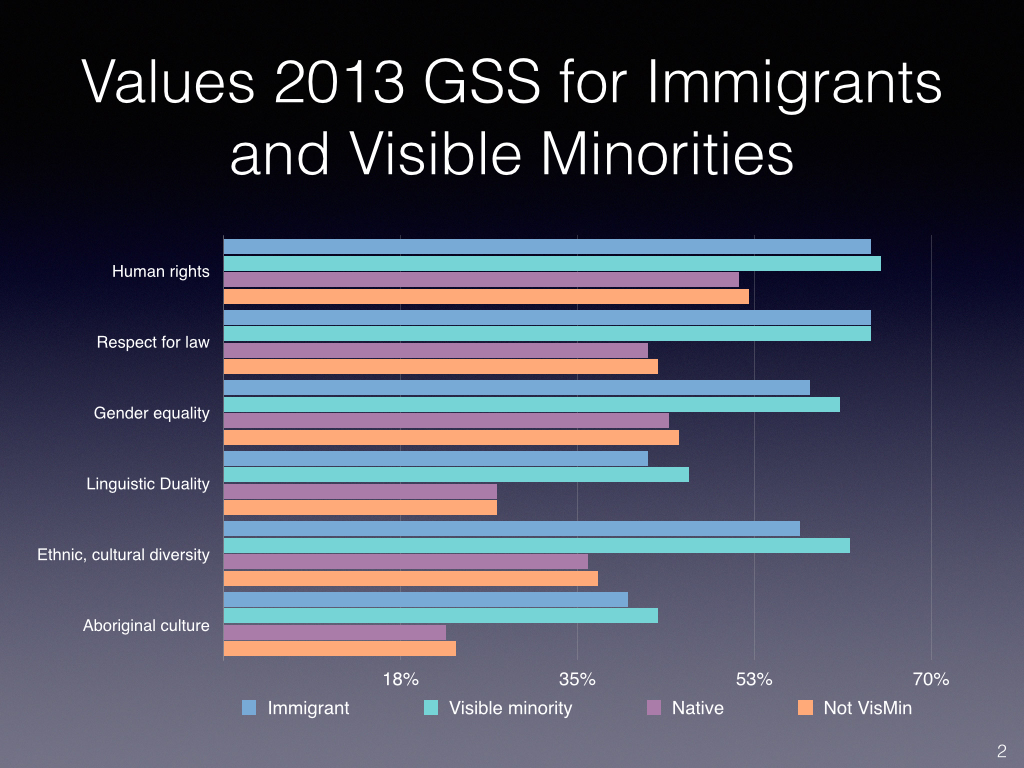
SC - GSS Immigrant Native Comparisons.002Interesting findings from the General Social Survey. For the charts, I have focussed on the contrast between immigrants (first generation) and the native-born and visible minorities (multiple generations but the vast majority first generation) and non-visible minorities.

The key takeaway, and no significant change from earlier surveys, is that for the most part, visible minorities and immigrants have higher level of attachment to Canada than the native-born (in early briefings to Minister Kenney, this type of evidence was cited to indicate that there was no need for major changes to the citizenship program:

The vast majority of Canadians think symbols like the flag and the national anthem are important to Canada’s identity, an expansive survey of opinions by Canada’s national data agency suggests.

More than nine in 10 Canadians surveyed by Statistics Canada said symbols like the Charter of Rights and Freedoms and the flag were important symbols of national identity. Other iconic notions such as the national anthem, the Mounties and hockey were also cited by more than three-quarters of Canadians polled in the agency’s General Social Survey, which asked 27,695 Canadians from all provinces and territories for their views on Canada’s national identity in 2013.

The vast majority of respondents said they believed that Canadians shared specific values. Exactly what those values are, however, is a subject of some debate.

Human rights a major factor

The thing most often cited by those who think Canadians share specific values was the value of human rights, at 92 per cent of respondents. Respect for aboriginal culture (68 per cent) and linguistic duality (73 per cent) also came up a lot.

By and large, immigrants and minority groups were more likely to believe national symbols are very important to Canada’s national identity.

This picture sent out last year by a B.C. RCMP detachment was deemed to be one of the most iconically Canadian images in recent memory. (Royal Canadian Mounted Police)

That gap was especially pronounced when it comes to valuing the importance of the national anthem. When asked about the importance of O Canada, 75 per cent of immigrants viewed it as very important, compared to 61 per cent of non-immigrants.

And all national symbols were viewed as more important by visible minorities than by Canadians at large. The gap was largest in terms of the significance of the charter (82 per cent versus 68 per cent), while the smallest differences were evident for the RCMP (59 per cent versus 54 per cent) and hockey (52 per cent and 45 per cent).

The great frozen game

On the subject of hockey, there’s a gap in how important our national sport is perceived to be between men and women. Half of all men said hockey was important to Canada’s national identity. Only 42 per cent of women said the same.

There was also a gender gap with regards to the belief of whether Canadians even share specific values — never mind what those values may be.

Some 41 per cent of women believed to a great extent that Canadians valued equality between men and women, compared to 53 per cent of men. That gap existed across all age groups, although it was most pronounced among people under 25, where 46 per cent of women said so, but 63 per cent of men did.

Among those over the age of 75, 31 per cent of women said so, compared with 46 per cent of men.

National pride

By and large, Canadians are on the whole proud of Canada’s national identity. That statement is especially true of immigrants, as they “reported a greater feeling of pride in being Canadian and in Canadian achievements,” the data agency said.

There were some geographic differences, however, with people from Quebec feeling generally less proud of Canada’s national identity. Within Quebec, residents of Saguenay had the lowest level of pride in the province, with 52 per cent saying they were either proud or very proud to be Canadian, while residents of Gatineau had the highest levels of pride in Quebec at 76 per cent.

Source: Immigrants more likely to consider Canadian symbols important to national identity – Business – CBC News

Ontario sex-ed protest ‘unlike anything I’ve ever experienced,’ principal says

On the front-lines, the principal of Thorncliffe Park, who comes across well in his efforts to reach out to parents (about 200 students out of 1,400 are not showing up – 14 percent):

He doesn’t want to be there, but Jeff Crane is on the front lines of a province wide debate over the sex education component of Ontario’s new health and physical education curriculum.

Crane is the principal of Toronto’s Thorncliffe Park Public School.

Crane should have 1,400 students at the elementary school every weekday. Instead, he’s averaging about 1,200 as parents keep kids home over opposition to the sex education component of the curriculum, which was updated this year for the first time since 1998.

Crane, exasperated by the protests, told CBC Radio’s Metro Morning on Thursday he wants to see the students back in school.

“It’s been unlike anything I’ve ever experienced or ever thought I would experience in a school in Toronto,” Crane told host Matt Galloway. “I’ve spent the past several weeks trying to convince parents to come to school. I never thought we would be doing that in the city of Toronto.”

A group of parents is planning a one-day protest today that if successful, would keep more kids away from classes.

Crane said since the protests began at the start of the school year, he has been busy meeting with small groups of parents, trying to assure them that sex education forms a “tiny component” just “a few lessons” of the overall health and physical education curriculum.

Most of the parents opposed to the curriculum have roots in countries outside Canada. Many feel the curriculum — which teaches students the correct names of sex organs in Grade 1, discusses same-sex relationships by Grade 3, and outlines the perils of sexting in Grade 7 — is  “too much too soon.”

The Wynne government has said the upgraded curriculum is needed to keep children safe in light of changes in technology since the late 1990s, including the advent of social media and the widespread use of smartphones.

But Crane said other parents, a minority among those protesting, have told him their opposition stems from the belief the curriculum is part of a “homosexual indoctrination of Ontario” led by Premier Kathleen Wynne.

“It’s become more about that than about the curriculum,” he said. “These protesters are unreasonable. I can’t reach them.”

As the protest has continued, Crane said parents are holding teaching sessions in groups at a park near the school and in a local community centre using “books from Costco.”

“They aren’t being taught properly,” he said.

Crane said he has had to chase protesters handing out misleading information away from his school. Last month, the words “shame on you” were spray painted on a school building.

So Crane continues his work to “dispel myths” about the curriculum and ensure the school is a welcoming place for all students.

He said his goal is to convince parents that his school “is a place that you can still trust.”

Source: Ontario sex-ed protest ‘unlike anything I’ve ever experienced,’ principal says – Toronto – CBC News

Nenshi and ‘people like him’ are the ones politicizing niqab issue, Jason Kenney says (with a straight face)

The back and forth between Calgary Mayor Nenshi and senior Minister Jason Kenney on the politicization of the niqab, starting with Nenshi (who I think has it nailed):

Stephen Harper is playing a “dangerous” political game with his position on the niqab and “dog whistle politics” when he speaks about the Syrian refugee crisis, said Calgary Mayor Naheed Nenshi.

In an interview on SiriusXM’s Everything is Political, Nenshi told Evan Solomon that Harper’s decision to challenge the Federal Court of Appeal decision over the ability of a woman to wear a niqab during citizenship ceremonies is being done merely in the service of scoring political points.

“This is unbelievably dangerous stuff,” Nenshi said. “I spoke with a group of mayors and councillors from all over Alberta last week, and in my speech with all of these people from small town Alberta, I stood up and said this is disgusting and it is time for us to say stop it—to say this is enough,” Nenshi said.

He called out the Conservatives’ request for stay on the Federal Court of Appeal decision on the niqab. “They are spending millions of millions of dollars of yours and my money on what is an unwinable appeal in order to appeal to a certain political segment because they think the polls say that most people don’t want this,”  Nenshi said.

Nenshi was complimentary on the stances both Thomas Mulcair and Justin Trudeau have taken on the issue.

Source: Nenshi’s harsh words for Harper – Macleans.ca

Hard to imagine him saying this with a straight face as he knows better (no matter how seriously he believes in the substance of the Government’s position):

But Kenney, the Conservative cabinet minister from Calgary who introduced the niqab ban, denied the Tories are seeking to gain political advantage from the issue.

“If anything’s dangerous, it would be legitimizing a medieval tribal custom that treats women as property rather than people,” Kenney, currently running for re-election in Calgary Midnapore, said in an interview Thursday.

“It seems to me that it’s the mayor and people like him who are politicizing it. I don’t think this should be an issue of contention.”

The Conservatives point to surveys showing public support for banning the niqab in citizenship ceremonies and they have jumped in the polls since the issue became prominent during the campaign, which will see voters cast their ballots on Oct. 19.

Kenney, who is currently defence minister, said Nenshi’s comments would have no impact on the campaign, either nationally or in Calgary.

And he said it would have no affect on his working relationship with Calgary’s mayor moving forward.

“We’re all used to Naheed’s running social commentary on everything. That’s nothing new,” said Kenney.

Source: Nenshi and ‘people like him’ are the ones politicizing niqab issue, Jason Kenney says

Sex-education protests give birth to new private schools in Toronto

Hard to see that this will improve the economic and social outcomes of these communities, some of which are struggling (see Toronto school board sets higher improvement targets for students based on race, sexual orientation), not to mention the broader issue of integration into a diverse society:

In a strip mall in northwestern Toronto, behind a blank storefront, old wooden desks are lined up in rows of three. At 3 p.m., children pour into the parking lot carrying books, while a little girl and boy stay behind at their desks, giggling and copying vocabulary from a blackboard while they wait to be picked up.

The school opened in September and has 30 students. Their six teachers lead Somalian and Arabic language lessons on top of the regular curriculum, plus Islamic studies.

They’re poorly paid, as tuition is only $250 monthly per student. But there’s a waiting list of more than 200 and the teachers have been promised that the school will balloon, along with their salaries, as soon as its directors can find a bigger space.

Called Rauf Academy, it is one of a handful of similar brand-new schools in the Toronto area, a legacy of parental anger over Ontario’s new sex-ed lessons that promises to outlive this year’s protests, such as a day of mass absences planned for Thursday.

“We heard the rumblings that a lot of parents are going to remove the kids, so we said, well, that might give us the kick-start, the momentum we need,” said Rauf Academy’s director, Yacoob Bayat.

His staff count two other homegrown schools nearby in Etobicoke, and another school director says two more opened their doors in Mississauga a month ago.

The sex-ed curriculum took effect in September, although its lessons won’t be taught in Toronto schools until later this year. Mr. Bayat said the province made another mistake by not reaching out to protesting parents, leaving them feeling there would be no meaningful religious accommodation.

Islamic schools have long gotten their starts in Toronto with bare-bones operations like this one. But Mr. Bayat and other school leaders say their ultimate goal is to create an alternative for Muslim families, a community-funded system of free education. So far 11 schools are working together as an informal board.

“As crazy as it sounds, maybe this was a good thing. Maybe this is what the community needed to galvanize and to do something,” said Mr. Bayat, a car mechanic originally from South Africa. “Communities in general, they know we’ve got a problem, but unless somebody takes the lead, nobody really does anything.”

Others in Toronto’s Muslim community say they don’t want parents to lose sight of the benefits of regular public education.

“The level of quality is really high,” said Rabea Murtaza, a mother and college teacher who is a member of a two groups supporting the new curriculum. “And if you walk away, you lose the opportunity to make any difference at all.”

Source: Sex-education protests give birth to new private schools in Toronto – The Globe and Mail

Andrew Coyne: To uncover or not to uncover — why the niqab issue is ridiculous

Hard to argue his logic. But whether logic will carry the day against emotion and wedge politics is another matter:

Is accepting the right of others to adhere to a religious doctrine and style of dress that others find distressing or demeaning to women an example of the dreaded cultural relativism? No, it is an example of pluralism. What’s the difference? Relativism holds that truth does not exist; pluralism, that there is such a thing as truth, but that none of us is in automatic or absolute possession of it.

A liberal society is pluralist, not relativist. It allows each of us to pursue our vision of the good life, to hold and espouse our ideals of what is just, without prejudice to the notion that goodness and justice exist: indeed, precisely so that we may more nearly approach them as a society. Neither is a liberal society incompatible with the idea of cultural norms: beliefs that are commonly shared, practices that are commonly observed. It draws the line only at enforcing these norms upon the unwilling.

It would be one thing if the women who insist on their right to wear the niqab at the citizenship ceremony, to the point of going to court to defend it, were in fact being forced to wear it. But there is no evidence of this: quite the contrary. Far from meek and submissive, they give every sign of being quite obstreperously independent, rock-ribbed individualists, willing to assert their rights even in the face of a hostile majority.

We talk a lot about Canadian values in this debate. I am inclined to think that, in their own way, it is the niqabistes who best embody those values. In their ornery unwillingness to bend to others’ sensitivities, in their insistence on going their own way on a matter of principle, those women are in the finest Canadian tradition of hellraising. I think we ought to let them be.

Source: Andrew Coyne: To uncover or not to uncover — why the niqab issue is ridiculous