Kareem Abdul-Jabbar: Hollywood Diversity Is a Special Effect | TIME

Good commentary:

Hollywood is the face of America to much of the world. Other cultures learn about us from what they see in our movies and television shows. And Hollywood has been creating roles of true substance for minorities, women, and other marginalized groups. For that, the industry should be applauded, and encouraged to do more. But if they want to achieve true diversity—and we don’t yet know if they do—that must happen not only in front of but behind the cameras, with writers, directors, producers, and others. They need to show they value those voices and stories in the larger culture. It’s a star, I think, within their grasp.

Source: Kareem Abdul-Jabbar: Hollywood Diversity Is a Special Effect | TIME

One week after the Federal election: The aftermath in Québec’s context (#380)

Quebec Culture Blog well worth following for its insights and enjoyed working him in this piece.

Michael Den Tandt: You want a ‘sunnier’ conservatism, Jason Kenney? What a comedian

Some uncomfortable truths here, particularly given the drubbing the Conservatives received in those suburban ridings where new Canadians and visible minorities form a majority or close to a majority of voters (see Visible minorities elected to Parliament close to parity, a remarkable achievement):

Jason Kenney is a wizard in a scrum. Intellectually nimble, rhetorically agile, reflexively partisan, the Conservatives’ former “Mr. Fix-it” is everything one could ask for in a future party leader, yes? Of course yes. Kenney is also, it turns out, a comedian.

“We need a conservatism that is sunnier and more optimistic than we have sometimes conveyed,” he was quoted by The Canadian Press as saying, following his party’s historic drubbing at the hands of Justin Trudeau, a man Kenney himself has incessantly belittled and mocked, for years.

Apparently defeat has refocused the former immigration and multiculturalism minister’s mind on the better angels of his nature. Kenney, long believed to be angling for the Tory leadership in a post-Harper era, has had his conversion on the road to Damascus. He wishes to purge his party of its grim, Harperesque baggage. Perhaps he will be the wire brush, to borrow the Liberal expression from the post-Sponsorship-scandal era, to scrape the Conservative party clean. Perhaps he will tell jokes and smile and speak of building a greater Canada. Perhaps he, too, will hold a news conference in the National Press Theatre, during which he gently reminds shell-shocked journalists they have a role to play in democracy, and are not despised.

Optimism, it has been miraculously revealed, works, and Jason Kenney will be its new blue paragon.

Seriously, now. If there is a single minister other than Stephen Harper who must wear the Conservative loss, it is Kenney. That’s due to his abilities and strengths, ironically enough, as much as his omissions and flaws.

It was Kenney who famously delivered Ontario’s 905 seats, where many hundreds of thousands of new Canadians reside, in the 2011 federal election. It was he, lovingly dubbed the Minister of Curry-In-a-Hurry, who managed to pull off the apparent miracle of streamlining and toughening Canada’s immigration and refugee system, while increasing support among the various communities most affected.

It was Kenney also who spoke up most loudly and clearly, among federal ministers, in the fall of 2013 when former Parti Québécois premier Pauline Marois hauled out her xenophobic charter of values, which later cost her the premiership. “If you want people to become a part of your society and fully participate in it, then you have to create a space (and) send a message that people are welcoming (and) including,” Kenney was quoted by CTV as saying at the time.

But two years later, in the heat of a campaign, there was Kenney front and centre in the bid to transform fear of niqab into votes. It was on Oct. 2, in fact, the day his colleagues Chris Alexander and Kellie Leitch unveiled their proposed “barbaric cultural practices” tip line, that Kenney said this to radio host Evan Solomon: “I believe it (the niqab) reflects a misogynistic culture that — a treatment of women as property rather than people, which is anchored in medieval tribal customs …”

Four days later, prime minister Stephen Harper doubled down, saying in an interview with CBC’s Rosemary Barton that he’d consider banning the veil across the civil service. There were no women wearing niqabs in the civil service, it later emerged, but never mind. This was the Conservative leader saying the wrangling would go on, and on. That very week, Conservative support began to slump, polls showed. It never recovered.

What a difference a day makes: The reframing of Canadian Muslims has begun

More evidence of how the change in tone is being noticed:

Women in headscarves are smiling everywhere. They are in the subway station in Montreal with brightly coloured headgear and cell phones to match. They are at a rally in Ottawa, up close with the prime-minister-designate as they snap selfies that will trend on Twitter. They are walking with their heads held just a little higher, returning smiles offered by random passersby.

What a difference a day makes. The same women who were expressing feelings of fear and discomfort just walking to a mall, or to school, are now the same women whose text emoticons are high-fives, fist bumps, and smiley faces as they share videos of Justin Trudeau bhangra dancing.

It is as though Canadian Muslims, and Canadian Muslim women in particular, stepped out of one frame and into another.

The previous frame had been imposed on them, without their consent and despite their protests. Throughout the election, Canadian Muslims watched as they were vilified as “other,” practitioners of “barbaric cultural practices,” and making choices alien from “Canadian values.”

This othering led to a documented spike in anti-Muslim incidents, including verbal and physical attacks on visibly Muslim women in both hijab and niqab, along with increased Islamophobic online postings and comments.

Yet this deliberate framing throughout the election period was nothing new. Canadian Muslim communities have endured years of it. Whether it was making sweeping generalizations about an entire faith – claiming that “Islamicism” was the greatest threat facing Canada – or suggesting that Canadian mosques could be harbouring radical extremists – a decade of Stephen Harper changed perceptions about Canadian Muslims in deeper and perhaps more hurtful ways than even the aftermath of 9/11.

Back then, Prime Minister Jean Chretien made it a point to visit Ottawa’s main mosque soon after those horrific attacks, memorably doffing his shoes and joining the congregants in a public show of solidarity.

Little of that was on show during the Harper years. After the deadly attack at Parliament Hill by a deranged individual pledging allegiance to violent extremist ideology a year ago, the Prime Minister went nowhere near a mosque.

The local police chief, on the other hand, reached out to community leaders to reassure them that the force was on alert in case of any backlash. Mr. Harper preferred to amplify the incident as a terrorist attack and underplay the details of the perpetrator’s life, including the fact that he was a homeless drug addict who had no formal connection to international terrorist groups.

…Canadian Muslims stepped out of those unfair frames every day as they continued to lead typical lives, yet the national framing and its impacts could not be ignored. A poll found that the number of Canadians holding negative impressions of Islam and Muslims had climbed to 54 per cent in 2013 from 46 per cent in 2009.

Is this now over? Probably not: There is a small but growing cottage industry of anti-Muslim bloggers and commentators who seem bent on suggesting that Islam and Muslims are inherently anti-democratic and dangerous. This may be helping to feed a nascent anti-Muslim movement in this country.

Yet a change in tone and rhetoric from the highest office in the land is certainly something to smile about. That alone will help change the picture, or at least refocus the lens.

Random or arbitrary police carding will stop, province says

As always, the devil is in the details, but the direction is clear:

Random and arbitrary carding by police forces across Ontario will be illegal by the end of fall.

Yasir Naqvi, minister of community safety and correctional services, made the announcement during a debate Thursday where MPPs from across the province spoke out against carding. At the time they were considering a private member’s motion from an NDP MPP to ban random and arbitrary carding, also known as street checks.

“It’s a historic day,” said Margaret Parsons, executive director of the African-Canadian Legal Clinic, who watched the debate in the legislature.

“This is a monumental shift in our province,” said Parsons, who has worked to end carding. She repeatedly paused to compose herself when talking to the Star outside the legislature.

“We have been around for 21 years. We have been fighting on this issue since the day our doors opened, in July 1994.”

Earlier in the legislature, Naqvi moved quickly during debate to address the motion from NDP MPP and deputy party leader Jagmeet Singh.

“We as a government stand opposed, Speaker, to any arbitrary, random stops by the police simply to collect information when there are no grounds or reason to do so,” Naqvi said. “We have heard from the community that street checks, by definition, are arbitrary as well as discriminatory and therefore cannot be regulated; they must simply be ended. The province agrees that these types of stops must end.”

Asked later, outside the legislature, if Premier Kathleen Wynne, who was not at Thursday’s debate on the issue, supports the ban of carding and random street checks, Naqvi emphatically said, “What we’re doing is our government’s position under the leadership of premier Kathleen Wynne.”

Immigrants in America More Likely Self-Employed, Study Finds | TIME

A marginal difference:

A new Pew Research Center study shows that 10 percent of Americans are self-employed, compared to 11 percent of immigrants.

… self-employed Americans and their employees accounted for 44 million jobs in 2014 or 30 percent of the national workforce.

Canadian data that I have seen shows a larger difference between Canadian-born and immigrants (Immigrants took the brunt of recession-year turn toward self-employment).

Source: Immigrants in America More Likely Self-Employed, Study Finds | TIME

My article: Visible minorities elected to Parliament close to parity, a remarkable achievement

My article in today’s Hill Times (note updated 25 Oct with the addition of one Conservative MP):

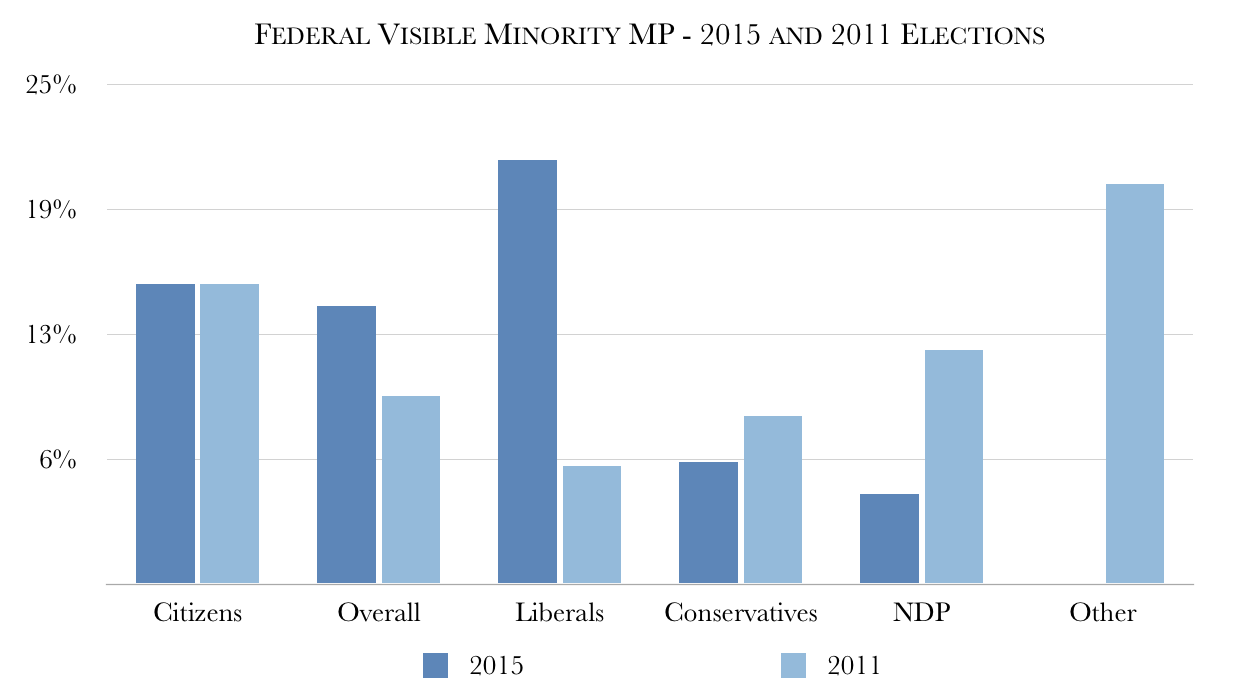
In contrast to the 2011 election, where 9.4 percent of all MPs were visible minorities, 2015 representation is aligned to the number of visible minority citizens (14 percent compared to 15 percent). Moreover, the success of the Liberal Party in decisively winning the visible minority vote  suggests that the Conservative Party’s extensive outreach to immigrant and visible minority communities had limited impact in stemming losses, and that concerns over the impact of changes to citizenship and immigration may have played a part.

Moreover, the percentage of visible minorities elected was identical to the percentage of visible minority candidates, which also had increased to 14 percent from 10 percent in the elections of 2004, 2006, 2008 and 2011 (see Visible Minority Candidates – 2015 Election – Background Note for details). The Liberal party had the most visible minority candidates (16 percent) with the Conservative party and the NDP had slight under-representation (13 percent)

For comparison, the number of women and Aboriginal MPs only slightly increased in 2015. Analysis by Equal Voice shows the number of elected rose from 25 percent in 2011 to 26 percent today (88 women). Representation of Aboriginal peoples also increased to 10 seats (3 percent) from 7.

To assess visible minority representation I have used candidate names, photos and biographies to identify visible minority candidates. Although not as exact as identifying women candidates (e.g., subjectivity in analyzing photos), it nevertheless provides a reasonably accurate indication of how well Canadian political party candidates represent the population of visible minorities who are also Canadian citizens (15 percent). I was not able to break this down by those who are first generation immigrants and those who were born in Canada (second generation).
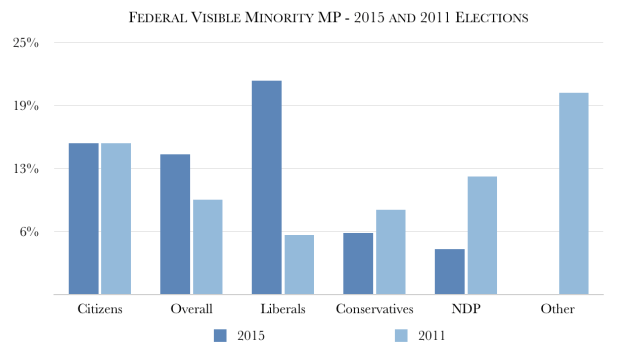
 

Federal Election 2015 and 2011 ComparisonThe chart above contrasts the 2015 visible minority representation with the 2011 election results. Not surprisingly, the Liberals, given their overall strong election result, will have the caucus with the largest number of visible minority MPs: 39 or 21.2 percent, significantly above the percentage of visible minority citizens (and Liberal candidates). Conversely, given their poor results, both the Conservatives and the NDP elected less than half of their visible minority candidates.

Federal Election 2015 VisMin Mps GenderLooking at 2015 results only, the chart above provides the comparative numbers for each party in the 47 ridings that elected visible minority MPs, minority, broken down by gender. As others have noted, given that the overall number of visible minority MPs is comparable to the number of visible minority candidates (14 percent), visible minority candidates ran in ridings where they can be elected,.

While 23 of these 47 MPs come from ridings where 50 percent are visible minority, 15 come from ridings between 20 to 50 percent visible minority. Surprisingly, nine come from ridings with less than 20 percent visible minority, and five of those with less than five percent. In other words, visible minorities were even elected in ridings where over 80 percent are non-visible minorities.

Visible minority MPs are 68 percent men, 32 percent women, higher than the percentage of all women MPs (26 percent).

Liberal visible minority candidates won 39 seats (83 percent), the Conservatives five (13 percent), the NDP 2 (4 percent).

Table 1 2015 Election – List of Visible Minority MPs lists the ridings, their percentage of visible minorities, and the MPs elected.

Turning to the 33 ridings where visible minorities comprise more than 50 percent of the population  (which we will call visible majority ridings), the following characteristics emerge:

  • Both two-thirds of candidates (68) and two-thirds of elected MPs (23) are visible minority;
  • 48 percent are visible minority men, 21 percent visible minority women;
  • The Liberals took all but three of these ridings (two went Conservative, one NDP);
  • The popular vote for these 33 ridings shows stronger support for Liberals among visible majority ridings (52.3 percent) compared to overall results (39.5 percent). Riding-by-riding, the winning Liberal candidate won over 50 percent of the vote, a majority not just a plurality;
  • In contrast, the popular vote for the Conservatives in these ridings is virtually identical (31.6 percent) to their overall results (31.9 percent). It would appear their base vote is the same among visible minorities as the general population.
  • The NDP did less well in these ridings (15.9 percent) compared to their overall results (19.7 percent);
  • Out of the 9 ridings where Chinese Canadians formed the dominant group, 3 Chinese Canadians were elected. In contrast, out of the 14 ridings where South Asians formed the dominant group, 8 were elected, mainly Sikh Canadians; and,
  • 10 non-visible minority MPs were elected in these ridings.

Table 2 2015 Election – 33 Ridings more than 50 percent visible minorities provides the demographics of these ridings, along with the names of elected MPs and their share of the popular vote.

Implications

In many ways, this is a remarkable achievement, achieving close to parity in parliamentary representation of visible minorities. No other comparable country is as representative of its population.

Visible minority MPs, as all MPs, will be expected to play not only on the issues of interest to their constituents but also on broader policy issues and debates. And hopefully, the incoming government will provide greater latitude for all MPs for debates and discussion, rather than the excessive reliance on centralized talking points under the Conservative government.

They can be expected also to play on foreign policy and diaspora issues of interest to their community, much as other ethnic communities such as Ukrainian Canadians and Canadian Jews continue to do.

Secondly, with 39 visible minority MPs in the incoming Liberal government, we will need to see how many are appointed to cabinet and to which positions, and how this is balanced against other cabinet representation issues like regional representation (PM Trudeau has already committed to gender parity). The Conservative government relegated visible minorities to junior positions (multiculturalism, sport, seniors) and it remains to be seen whether Liberal Prime Minister Trudeau will appoint a visible minority member to a more senior position.

Thirdly, the Conservative party needs to reflect on the effectiveness of the extensive outreach of Minister Kenney and others to new Canadian communities. Being 20 percent behind the Liberals in many of these ridings means that ‘being there’ is not enough. While some of this shift reflects the general trend in urban Canada, it also likely reflects changes to citizenship and immigration policy which impact on these communities (e.g., more difficult family reunification and citizenship). And overplaying the niqab and related issues in such an obvious wedge politics manner can hardly have helped.

One thing is clear. Visible minorities are an intrinsic part of electoral and political strategies. No party can afford to ignore them, given their size and political weight. And one of the election’s lessons is that the divisiveness of wedge politics is not a winning strategy among visible minority and other voters. Hopefully, that will be an enduring lesson, sparing Canadians of whatever origin, of such approaches in the future, and strengthening overall integration.

Source: Visible minorities elected to Parliament close to parity, a remarkable achievement | hilltimes.com
Long-form census could be reinstated for 2016, experts say

An early test  of the incoming Liberal government, one that looks like it could be done:

The return of the long form, promised by Justin Trudeau during the election campaign, would yield vastly more reliable data and cost less than running another national household survey, the former heads of the agency say.

“It should be possible. I am certainly very hopeful. But [the decision] needs to be done very soon. It’s an enormous logistical operation,” said Ivan Fellegi, chief statistician from 1985 to 2008.

It’s “no problem” to reintroduce the long form in time for the 2016 census, said Munir Sheikh, head of the agency from 2008 to 2010. The questions needn’t change, he said – just the instructions at the top. “All they need to do is put on the front page that this is mandatory.”

The other step is for “cabinet to approve it as a census, which they can do at any time – it would take a matter of seconds.”

Researchers are already pressing for action. “Undoing these mistakes cannot wait; the time for action is now as Statistics Canada is on the cusp of launching the 2016 census,” says a letter signed this week by 61 academics and directors of research centres, including Statscan’s former assistant director Alain Bélanger.

Issuing an immediate order in council “is the only way to implement the long form in time for the census six months from now,” they said. “This must be one of the first moves made ​​by the Liberal government of Mr. Trudeau. It would mark a clear break with the previous government and ensure that future social policies can be made on scientific grounds rather than ideological dogmatism.”

….The Liberal platform pledges to “immediately” restore the mandatory long form – and make Statistics Canada “fully independent.”

Mr. Sheikh, who resigned over the controversy in 2010, said having the agency operate at arm’s length to the government is an even more crucial step. “I would say that is more important than restoring the long-form census, because that really was the cause of the problem, that the government can interfere with Statscan on issues like this.If you have an independent agency, the census in the future wouldn’t be the cabinet or minister’s problem, it would be the chief statistician’s problem.”

Mr. Sheikh said “anyone who uses data” will benefit from the return of the census. The biggest beneficiaries would be governments at all levels, “which have to base their policies on reliable data. And then of course researchers, who use this data to determine social outcomes, the condition of households in terms of income, poverty, unemployment, the state of housing, transportation needs, the needs of ethnic minorities, language, the employment equity act. Any kind of social and economic policy issues you can think of really are related to the census.”

As well, “the census provides an anchor to all other surveys, will have much more reliable data to check all other survey results against that.”

Both former chief statisticians said the switch could save money by reducing printing costs and expenditures associated with the labour required to administer and analyze the separate household survey. The NHS was sent to about 4.5 million Canadian households while the 2006 long-form census was sent to 2.5 million dwellings. Running any census is a massive undertaking that typically takes years to plan. The total projected budget for the 2016 census – which had been planned as a mandatory short form and voluntary NHS – is $701.8-million.

Statistics Canada wouldn’t comment on whether it’s possible to make the changes in time for the 2016 census. “It’s a policy matter, and we can’t comment,” said spokesman Peter Frayne.

Other experts say it can be done. “It is inherently easier to return to a well-tested methodology” such as the traditional census, said Ian McKinnon, chair of the National Statistics Council. “If any statistical agency in the world can do it, Statistics Canada can.”

Reinstating the census “soon, both sends a signal of change of policy, and interest in basing policy on evidence – evidence-based decision-making, which I think is very healthy,” said Charles Beach, professor emeritus at Queen’s University and head of the Canadian Economics Association. Moreover, “doing something that is both cost effective and more useful, it’s an economic no-brainer.”

Source: Long-form census could be reinstated for 2016, experts say – The Globe and Mail

Ethnic voters in 905 expecting action on Liberal promises

More hints on what will be the Liberal government’s citizenship and immigration priorities:

After decades of virtually blind allegiance to the Liberals from newcomers to Canada, who benefitted from the party’s immigration and multicultural policies, those supporters, along with their now grown children, began to ask, “What have you done for me lately?” as many struggled to fulfill the Canadian dream.

The Conservatives, sensing this growing resentment, swept in during the 2011 election and played on the “taken for granted” mood, despite offering little in the way of actual policy. They targeted so-called “ethnic ridings” in places such as Brampton and Markham.

The approach worked.

Now, Liberals in the suburban regions around Toronto are saying they won’t let it happen again.

“I will acknowledge that, in the past, we did take these communities for granted, and we paid the price,” says John McCallum, who on Monday won the newly created riding of Markham-Thornhill. In 2011, he was the only Liberal who won in the 905 area code.

“I was called an endangered species.”

 In 2011, almost three-quarters of Markham residents, 72.3 per cent, were visible minorities. McCallum undertook an extensive outreach to help his party reconnect with ethnic communities.

“First, a large number of our new MPs in the 905 are from those communities (11 of the 25 Liberal ridings in the 905 portion of the GTA will now be represented by visible minorities.) They know what’s important in their communities. The Conservatives had policies that were bogus and the people in the so-called ethnic communities caught on to that.”

McCallum says it will now be up to his party to repeal some of those policies, such as parts of Bill C-24 that created different citizenship rights based on national origin. “We have to deliver what we promised … I think the Conservatives have taken the ethnic communities to be fools.”

McCallum mentions recent Conservative advertisements in Punjabi and Chinese languages that misrepresented Liberal promises, claiming they would lead to drug-injection sites and “brothels in our communities.”

But he says that to counter the Conservatives’ “disrespect” for ethnic voters, the Liberals will have to quickly deliver on their promises such as speedier processing of family-class applicants.

Navdeep Bains will return to Ottawa to represent Mississauga-Malton after being defeated in 2011.

Navdeep Bains, who will return to Ottawa to represent Mississauga-Malton after being defeated in 2011, agrees with McCallum. He had represented a riding that included parts of Mississauga and Brampton, cities where the visible minority population is more than 60 per cent. The Conservatives swept all the seats in the two cities last election. On Monday, Liberals won all 11 of them.

One of the issues Bains wants to take action on is foreign credential recognition, a file that has languished in Ottawa at the expense of the economy, as highly skilled immigrants end up toiling in jobs that don’t utilize their skills. “This came up time and time at the doors,” he says.

Bains says that under Trudeau his community’s deepest concerns will finally be dealt with. “This issue is absolutely critical to our economy.”

Bains and McCallum both emphasized that many of the concerns they hear in their diverse communities are the same as those voiced across Canada — job creation, health care, infrastructure and inclusiveness.

“The prime minister wants us to be a strong voice for our constituents,” Bains says, adding that if he and other MPs are able to do that, the Liberals will be just fine. “That’s the big difference between Mr. Trudeau and Mr. Harper. Mr. Harper, he muzzled his MPs.”

Source: Ethnic voters in 905 expecting action on Liberal promises | Toronto Star

Robyn Urback and Barbara Kay on the backfiring of wedge politics

Two contrasting views in the details (niqab or snitch line), starting with Robyn Urback on the niqab):

And there, in the 905, was where the second profound impact of the niqab debate seemed to reverberate Monday night. The region, which was Conservative blue in 2011, switched to almost entirely red, except for the ridings of Vaughan and Markham-Unionville. The 905 had been, at one time, a symbol of Conservatives’ immigrant-outreach success, led by one-time minister of immigration, citizenship and multiculturalism Jason Kenney. When the Conservatives swept the region in 2011, taking almost all of the Liberals’ seats in York region, Kenney attributed his success to support from new Canadians. “Our appeal to them has been honest,” he said. “New Canadians increasingly realize that their values are Conservative values.”

Whereas in 2011 the Tories were talking to immigrant communities, in 2015 they were talking about them

Four years later, the Tories were singing a different tune, making a point of listing the ways in which immigrant values are incompatible with Canadian values. While the Liberals spoke about removing unnecessary barriers to immigration and accelerating family reunification, the Tories attacked the niqab, defended bottlenecks in Syrian refugee process and mused about launching a hotline to report “barbaric cultural practices.” Whereas in 2011 the Tories were talking to immigrant communities, in 2015 they were talking about them.

The 905 responded on Monday by giving the boot to many of its once-prominent Tories, including citizenship and immigration minister Chris Alexander, who lost by more than 10,000 votes. It became clear that while the Conservatives may have been correct in pegging the niqab as a wedge issue, they left themselves on the wrong side of it.

Certainly there were other factors at play in the last 78 days: the trial of Senator Mike Duffy, Mulcair’s flip-flopping on pipelines and free trade, Trudeau’s personal gregariousness and aspirational vision for the country. But in Quebec and the 905, two regions that arguably mattered most this election, the niqab — and discussions thereof — appeared to be the foremost factor to tip support away from the Tories, either directly, or by extension. It seems one or two people — specifically, two veiled women — really can make a difference.

Barbara Kay states it was the snitch line:

I think Harper’s big mistake was in taking discontent with the niqab for permission to go big on all culturally-rooted misogynist practices. His proposal for a tip line to report “barbaric cultural practices” like forced marriages to the RCMP was overkill, and struck a sour note, even amongst those Canadians – like me – who were his staunchest supporters for a face-cover ban.

No policy is more likely to make entire communities feel singled out as inherently suspicious than a snitch line

Face cover is a very specific, very public practice that is quite separate from “barbaric” cultural customs carried out in private. Face cover is more than the sum of its single part. As I have argued in many columns over the past few years, face cover is charged with so much negative political, ideological and cultural baggage, it does indeed cause “harm” to the social fabric. I firmly believe Quebec is abiding by a precautionary principle that is wise. Endorsing face cover in situations where the public has no option, and must deal with a covered representative of the government – nurse, policewoman, teacher, passport control officer – is to endorse a barbaric custom entirely at odds with the principles of openness and social reciprocity we take for granted as a social right, but which need protection. Harper recognized this wisdom, and that is where he should have stopped.

Don’t get me wrong. I am very troubled by practices like forced marriage, which is a retrograde, tribal custom that should have no place in our society. We know it is happening in certain cultural communities in Canada, and I applaud any government that tackles the problem.

But there was no pressing need to bring it up at this time, and no public incident that facilitated its organic emergence into public debate. Unlike the niqab, nobody from South Asia was demanding that the government recognize forced marriage as commensurate with Canadian values. And the “tip line” has odious Orwellian connotations to it. It had a seriously chilling effect, and did indeed seem to cast Harper’s “popular” niqab stance in the light of “populism,” even “ugly populism.”

The result was that people who quite defensibly resist face cover in the citizenship ceremony – or in the giving and getting of pubic services – now found themselves in the highly uncomfortable position of seeming to endorse Stasi-era tactics of social control. No strategy is more calculated to bring out racist mischief-makers and vengeful false allegers than a snitch line. No policy is more likely to make entire communities feel singled out as inherently suspicious than a snitch line. And no policy is more likely to make the party that proposes it look imperious, bullying and nativist.

The Conservatives blew it. They occupied what was perceived as the moral high ground by most Canadians, and then, thinking that was base camp rather than a distinctive summit, kept climbing into thin air. They ran out of oxygen, and deserved to.

Barbara Kay: It was the snitch line, not the niqab stance, that hurt Harper