Learn English or leave? Mind your language, Mr. Cameron: Shasta Aziz

Valid points:

If Mr. Cameron’s government is serious about immigrant women learning English, it first needs to reverse the deep funding cuts it has made to organizations providing these services.

Of course, speaking English is going to assist any woman living in the U.K. and will help her to navigate through her daily life with more confidence and ease. But no amount of learning English is going to help integrate a woman if her and her ilk are marked as a problem and a catalyst for fragmenting society.

This is the subtext behind much of the hysterical tabloid media coverage of Muslims in Britain, in the age of the so called war on terror.

Many Muslim women here tell me that they feel increasingly uncomfortable in the country of their birth. They feel exhausted by having to constantly explain who they are and to prove they are loyal to their country every time there is a terrorist atrocity in the world – because the default position is they’re guilty by association.

The politics of identity are becoming more and more loaded in an increasingly polarized world. It is becoming harder especially for young British Muslims to navigate their way through all the noise and increasingly hostile discourse around what it means to be a Muslim in the west.

Monday’s announcement is simply another failed and missed opportunity by the British government to build a meaningful dialogue with a section of the population that it needs to urgently reach out and engage with.

One Muslim woman I interviewed in London after the terrorist attacks in Paris late last year asked me “how am I expected to feel comfortable and at ease in my society if every time I leave my house I’m looking over my shoulder to see who might physically attack me because I’m a visible Muslim woman who wears a hijab? How can anyone expect me to feel like a valued member of my society?”

That is a very good question – and one Mr. Cameron should start thinking about carefully.

Source: Learn English or leave? Mind your language, Mr. Cameron – The Globe and Mail

Global Centre for Pluralism 2016 Corporate Plan

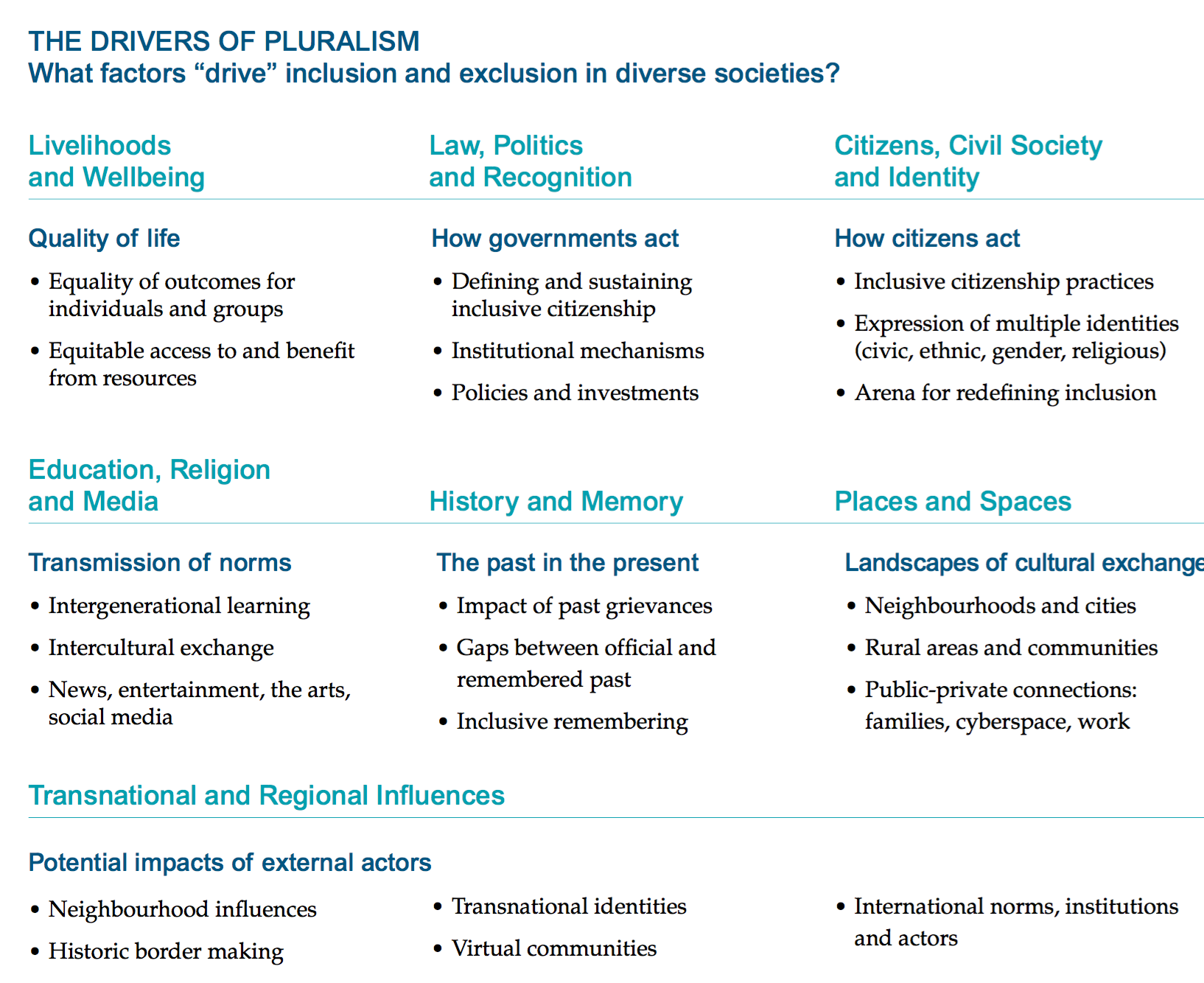
GCP Drivers of PluralismThe 2016 Corporate Plan is out and worth a quick read. The most interesting aspect is their effort to develop pluralism indicators as per the framework above.

Will be interesting to see how this adds to other indicator efforts, more focussed on OECD countries (e.g., MIPEX, OECD), and the ability to obtain good comparative and consistent data.

Some of the elements in the GCP framework will pose particular challenges in this regard (e.g., education, religion and media, history and memory).

Download the 2016 Corporate Plan >

Schools are not powerless to address racial disparities

 Sachin Maharaja, a teacher in the TDSB, on racial disparities.
Data can be helpful in identifying and addressing disparities, both for the school system as well as for the people within the communities themselves, who also have to avoid fatalism:

One thing we do know for sure is that students in our school systems are not all given the same opportunities. Data from the TDSB, one of the only boards to collect detailed demographic information, has shown that students from lower income neighbourhoods are much less likely to be identified as gifted, more likely to be identified as having a learning disability, and more than twice as likely to be placed in applied-level classes. Race also plays a major role in how schools treat children. That is why black students represent 13 per cent of the TDSB population, but only 3 per cent of its students identified as gifted. Meanwhile white students, who make up 32 per cent of the TDSB population, comprise more than half of its students identified as gifted.

While some have disputed the role that racism plays in such inequitable treatment, we have empirical evidence that should put such notions to rest. A 2015 study by researchers at Stanford University gave teachers copies of student records with names that had been changed to be either stereotypically black or white sounding. When teachers saw records with black sounding names, they were much more likely to recommend that those students be suspended from school than when they saw identical records with white sounding names.

Given this reality, having demographic information on our students at least gives us the opportunity to address these glaring inequities. But not everyone thinks this is even a real problem. A Toronto teacher who teaches in a low income neighbourhood once told me that the reason black students and those from low income households are disproportionately placed in lower academic streams is due to “the conditions of their upbringing.” It is this culture of resignation which can be the downside of school systems having an excessive focus on poverty and race.

We see this attitude in some parts of the United States, which has collected detailed race and income statistics for years. Diane Ravitch, an education historian and one of the most prominent voices in American education, demonstrated this when she told a 2011 rally of teachers in Washington, D.C. that “our problem is poverty, not schools.” It was no coincidence then that when Time magazine journalist Amanda Ripley later interviewed D.C. teachers, many stressed all of the disadvantages that their students faced. One teacher relayed the common complaint to Ripley that “parents on this side don’t have the know-how to raise their children.” The result of this type of attitude was that at the end of the school year, students in this teacher’s class fell further behind grade level in reading than when they started, and performed significantly worse than other low-income students in D.C. who had started the year at the exact same reading level.

On balance, it is a good thing to have more detailed information on the students we serve. Burying our heads in the sand and pretending that problems don’t exist is clearly not the solution. But as we better understand the racial backgrounds of our students and the issues of poverty they face, we should be careful to not let that lead to a culture of fatalism and low expectations in our schools.

Lessons from the Japanese Canadian internments: Policies built on fear won’t make us safer

Jordan Stanger-Ross, Eric Adams and Laura Madokoro on some of the lessons from WW II Japanese Canadian interment (for those who have not read it, Joy Kogawa’s novel Obasan captures the reality):

The wartime fates of people of Japanese descent in North America have recently returned to headline news. The National Association of Japanese Canadians, which in the 1980s led the Redress movement, called last year for the repeal of Bill C-51 (the complex omnibus legislation dealing with surveillance, information sharing among government agencies and various new terrorist-related crimes) by reminding the government of what then-prime minister Brian Mulroney called its “solemn commitment” that the mistreatment of Canadians in the name of security would “never again in this country be countenanced or repeated.”

In the fall, NDP Leader Tom Mulcair explicitly compared Bill C-51 to the Orders-in-Council of the 1940s, which curtailed the rights of Japanese Canadians. In the United States, Donald Trump indicated that the mass internment of Japanese Americans during the war may have been the correct policy, shortly before calling for “a total and complete shutdown of Muslims entering the United States.”

Jan. 19, 1943, is therefore a date worth remembering. The forced sale of Japanese-Canadian property marked a moment in Canada’s past when racism, misunderstanding and fear wrapped themselves in misguided notions of security and in the formal language of the law. Other and nefarious agendas could be pursued in a political atmosphere clouded by fear. We live with the legacy of those decisions today – the lost property, livelihoods and connections of a generation of Canadians, the eradication of a downtown neighbourhood in Vancouver, the painful memories of lives dispossessed.

Source: Lessons from the Japanese Canadian internments: Policies built on fear won’t make us safer – The Globe and Mail

David Cameron to back Muslim veil ban, will announce anti-radicalization measures

Sigh. Pandering to the base (and UKIP) more than improving integration, and by applying it to Muslims only as appears from press accounts (some other religions have separate seating for men and women), further reinforces the Islamist narrative:

Muslim women can be banned from wearing veils in schools, courts and other British institutions, David Cameron has said.

The Prime Minister said he will give his backing to public authorities that put in place “proper and sensible” rules to ban women from wearing face veils.

The Government is also preparing to announce a series of measures designed to stop British Muslims becoming radicalized and travelling to the Middle East to join terrorist groups like Islamic State of Iraq and the Levant.

As part of the plans, ministers will pledge to outlaw gender segregation in public buildings amid concerns that some Muslim organizations are forcing women to sit separately.

Nicky Morgan, the Education Secretary, will also today announce plans to force schools to help stop teenagers travelling abroad to fight alongside jihadist groups such as ISIL.

Schools will be required to inform councils when pupils stop attending without any explanation and Muslim parents will be encouraged to carry out checks to ensure their children are not being radicalized.

Cameron also announced that tens of thousands of Muslim women would face deportation unless they pass a series of English language tests after coming to Britain on spouse visas.

The Prime Minister’s comments about veils will reignite the row over whether British institutions should be able to stop women covering their faces for religious reasons in public places.

The Prime Minister refused to endorse a French-style blanket ban but made clear that individual organizations could choose to stop Muslim women wearing the veil.

Source: David Cameron to back Muslim veil ban, will announce anti-radicalization measures

Religious freedom office faces uncertain future as Liberals consider wider human-rights proposals

Good in-depth piece, with considerable commentary offering advice on what the Government should consider:

The Liberal government is considering whether to scrap Canada’s controversial Office of Religious Freedom — considered a signature achievement by the previous Conservative government — and instead focus on ways to champion a broader array of human rights abroad.

Unless the new government intervenes, current Ambassador for Religious Freedom Andrew Bennett’s three-year term will expire Feb. 18. The office’s mandate and funding, about $5 million a year, will run out on March 31.

Supporters of the office are urging the Liberals to save it. Others are calling for big changes, if not its outright abolition. The government is weighing its options.

“Beyond March, the government has not made a decision with respect to the mandate and associated budget of the office,” said Adam Barratt, a spokesman for Foreign Affairs Minister Stéphane Dion. “The minister is examining options and how best to build on the work that has been accomplished in the area of religious freedom while promoting human rights as a whole.”

The Office of Religious Freedom was the subject of controversy even before it was formally established on Feb. 19, 2013. It was promised by the Conservatives during the 2011 election, but some worried it would be used to selectively champion Christianity, woo certain ethnic voter groups and pursue pet projects of the government.

Those who supported its creation argued there was is a growing link between religious freedom and democratic rights. They also said religion was becoming an increasingly important factor in international affairs, and having an office dedicated to the issue would benefit Canada abroad.

Bennett subscribes to that belief. Sitting in his office at the Department of Global Affairs, surrounded by religious symbols from different faiths, Bennett warned recently that Canadian diplomats risk a “blind spot” if they don’t have a strong grasp of how religion influences countries’ actions.

“We need to ensure that if we want to be really nuanced and winsome in how we engage countries that are deeply religious, that we can actually employ language that enables us to have a deeper engagement,” he told the Citizen. “If we can’t do that, then we risk developing or having a serious diplomatic blind spot.”

Even those who question the need for an Office for Religious Freedom have been impressed by Bennett, the well-spoken policy analyst at the Privy Council Office who also moonlights as a professor and dean at a small Christian college in Ottawa.

“Anytime I reached out for him, he was open, available and worked within the mandate,” said former NDP MP Paul Dewar, who was his party’s foreign affairs critic for years. “I think he did as good a job as he could to connect with groups from different religions and really try to engage to the extent he could.”

That doesn’t mean his term has escaped controversy. When the Conservative government appealed a court ruling that struck down a ban on face coverings during citizenship ceremonies, Dewar asked for Bennett’s position on the issue. The ambassador replied it was outside his mandate.

Bennett, however, admits that what happens in Canada has an impact on his ability to champion religious rights abroad. For instance, he says Turkish officials were quick to raise Quebec’s controversial Charter of Values two years ago when he was pressing them on the treatment of religious minorities in Turkey.

But even now, Bennett refuses to talk about the niqab debate, or the use of identity politics during the election debate. Mandate restrictions aside, he says Canada is different from Turkey and other places because it has a healthy democracy in which such issues can be debated.

“We need to be conscious as Canada that we have our own challenges that we have to engage,” he said. “But at least we’re able to engage them. In many countries, they can’t even talk about them.”

…Father Raymond de Souza wants the government to keep the office. A Roman Catholic priest and National Post columnist, de Souza is also chair of the Office of Religious Freedom’s external advisory committee. He says the federal government spends more on water treatment plants abroad than on the office each year.

“And if you ask why are there Syrian refugees in the first place, at least part of the answer is religious liberty,” he said. “People are fleeing religious persecution … The foreign policy issues that the government of Canada has at the top of its agenda are sort of shot through with religious liberty questions.”

…Alex Neve, the head of Amnesty International Canada, said the human rights group appreciated Bennett’s frequent public interventions on both individual and broader issues of religious persecution abroad. And he suggested the government might consider appointing ambassadors focused on other human rights.

“There is considerable value in devoting dedicated resources to a particular human rights concern, and appointing high level ambassadors or envoys to represent Canada globally with respect to that issue, as has been done with the Office of Religious Freedom,” he said.

Conservative foreign affairs critic Tony Clement hopes the Liberal government will keep the office and Bennett. He says both have contributed to religious freedom abroad, and transformed Canada into “a voice for research and advocacy and collaboration in order to protect people and their religious freedoms.”

But even some supporters question its impact. One is Imam Abdul Hai Patel, founder of the Canadian Council of Imams, Muslim chaplain for the University of Toronto and York Regional Police, and another member of the office’s external advisory board.

“I welcome the office. But then it has limited or no powers really to do anything,” said Patel. “I think it hasn’t really fulfilled the purpose for which it was intended, because it has no teeth and there was a limited budget.” He would like to see the office have more independence and influence, like its counterpart in the U.S.

Some Canadian diplomats have also quietly grumbled that the creation of the office politicized the issue of religious freedom, and hurt Canada’s ability to advance it abroad by putting it into a silo.

History might be against Bennett and the office surviving under the current Liberal government. Unlike the U.S. and some other countries, Canada has not traditionally appointed ambassadors for specific themes. And, fairly or not, the ambassador and office are inextricably linked to the previous Conservative government.

Bennett argues the office is needed more now than ever. In particular, he would like to offer more training to Canadian diplomats, to protect against that potential “blind spot” as religion and belief become more and more important in international politics.

And he says there’s an appetite for what the office has to offer. He says he has always acted as a non-partisan public servant. “My goal for the office is to just do the work. I just want to help people. I want to take that Canadian experience and try to assist as best we can people who are being persecution.”
Source: Religious freedom office faces uncertain future as Liberals consider wider human-rights proposals

Shireen Ahmed: Why are my kids on the no-fly list?

More on children being on the no-fly list, Shireen Ahmed’s experiences:

The first time I was unable to check-in online for a domestic flight, I assumed it was because I had a baby. Perhaps it was the amount of luggage, or the stroller I used to facilitate travel with my four children, all under the age of seven, to our cottage in Prince Edward Island.

When I arrived at Toronto’s Pearson airport, the agent asked me to identify two males in my party. I pointed to my 15-month-old, who was slobbering over a pear, and my seven-year-old, who was playing with Lego figurines, and her mouth dropped. She proceeded to make a few calls. I didn’t listen because I was making sure my kids didn’t sit on the luggage scale (flying with children is so much fun!).

When I travel, I am prepared to be selected for “random extra security checks,” as I have brown skin and wear a hijab. But I didn’t have a clue that my second-generation Canadian children might be flagged as security risks. The idea did not occur to me because it was completely nonsensical.

A senior agent came by shortly thereafter and proceeded to enter information into the computer and make more phone calls. My patience was wearing thin. He hurriedly explained that there was an issue with one of my children. Eventually, we were escorted through security to the gate and settled into our seats. I didn’t think much of it. It had only taken an extra 40 or 50 minutes and we had arrived at the airport three hours early. Yet the actual issue would take over eight years to resolve.

I was prepared for extra screening because I have brown skin and wear a hijab. But I never thought my second-generation Canadian children might be flagged as security risks.

We have struggled with this since my eldest child — Saif-ullah, now 15 — was seven-years-old. He’s no longer a precocious, round-faced child, and I can no longer shield him from what he knows. He’s a high school student who has conversations with his peers, some of whom are also on no-fly lists. All are of African, Arab or South Asian descent.

Sure, anticipating delays and going to the airport five-hours early could be construed as normal. So could making up a story that did not involve explaining to my son that his name set off some type of alarm. But the truth is that such things are only necessary for people with names such as Ahmed, Khan, Hussain or Syed — names that are common in many other countries.

Source: Shireen Ahmed: Why are my kids on the no-fly list?

Anti-Establishment MPs Shake Up Spain’s New Parliament : NPR

Diversity in the new Spanish Parliament:

A brass band marched up to the doors of Spain’s Congress, escorting a new crop of lawmakers, younger and more diverse than ever before. Many arrived by bicycle, wearing T-shirts instead of neckties and sporting ponytails and even dreadlocks. A dozen of them are in their 20s, recent college grads. The new lawmakers include Spain’s first black MP and a physicist confined to a wheelchair. Podemos has arrived. The left-wing party has transformed and unsettled Spanish politics, weaning about a fifth of parliamentary seats in last month’s election. In large part because of Podemos, this parliament has a record number of women – 40 percent.

Source: Anti-Establishment MPs Shake Up Spain’s New Parliament : NPR

The Oscars’ Racist Refusal to Honor Modern Black Heroes – The Daily Beast

The Academy member numbers say it all:

As of 2014, the Academy was 94 percent white, 76 percent male, and an average of 63 years old. Do 63-year-old white men readily identify with a gangsta rap biopic set in the late ‘80s? Do they see it in the same grandiose fashion as they would, say, a film about a ‘50s country star or ill-fated ‘60s rock ‘n’ roller? Do the “fucks” and “niggas” in the soundtrack make it hard for them to view it in the same light as a movie about Steve Jobs or Brian Wilson? Maybe they can only relate to black struggle when it’s couched in a package they find acceptable, like a biopic about a soul singer they grew up listening to or a period piece about an embattled slave fighting for his freedom. Maybe old white men don’t know shit about new, black cinema.

Source: The Oscars’ Racist Refusal to Honor Modern Black Heroes – The Daily Beast

Canada Council’s diversity focus brings new opportunities, challenges

Ironic that this story comes out the week of the #OscarsSoWhite nominations. And interesting that this initiative dates from the Harper government, not the new government’s diversity and inclusion agenda:

The Canada Council for the Arts is getting a new funding model in April of 2017 – a total rethink of the Ottawa-based granting council that reduces its number of programs from 148 to a streamlined six.

As details of this shift have started to emerge in recent weeks, however, the most striking change may be the direct tying of diversity to funding for large arts organizations for the first time since the Canada Council was established in 1957. It’s not just the diversity of art and artists that will come under scrutiny in the future at institutions with revenue of more than $2-million. If the administration or backstage crew at your opera or ballet company, or the audience for your symphony or theatre company, or the board of directors of your art gallery, does not demonstrate a “commitment to reflecting the diversity of your organization’s geographic community or region,” this will now affect the size of grant received from the federal arts council.

“It’s clearly an assessment criteria – it’s no longer a wish,” says Simon Brault, appointed the director and CEO of the Canada Council in 2014 for a five-year term. “The companies that are performing the most will get more money – it’s a real incentive.”

With the Canada Council’s budget expected to double over the next two years – from $180-million to $360-million, if the Liberal government keeps its campaign promise – Brault will actually have the new funds needed to achieve his objectives. “We want to make sure [the doubled budget] is not a money pit – to make sure that we are advancing the quality of production and the progression of diversity.”

With this move, the Canada Council finds itself in line with current thinking in other multicultural countries. Just over a year ago, for example, Arts Council England (ACE) shifted its priorities – announcing that arts organizations that did not show progress in diversifying their programming and audiences could see their grants cut. And results are already being seen, with Black and Minority Ethnic (a British term) representation in the arts work force supported by ACE increasing from 13 to 13.7 per cent – the equivalent of an additional 576 jobs.

Judging by conversations with many of the artistic directors, executive directors and administrators at Canada’s top theatre and dance companies and orchestras this week, the initial reaction to the Canada Council’s new assessment criteria – where diversity is second only to artistic excellence – has been overwhelmingly positive, even if these arts heads eagerly await more concrete details on how it will work.

Source: Canada Council’s diversity focus brings new opportunities, challenges – The Globe and Mail