Islamisme et droits des trans, même combat ? Le grand paradoxe des campements pro-palestiniens

Some of these contradictions are truly hard to understand:

Les campements contre Israël et en soutien aux Palestiniens se sont multipliés sur les campus des universités occidentales, surtout canadiennes. Ils sont notamment installés à l’Université McGill, à l’Université de Toronto et à l’Université de la Colombie-Britannique.

Ils révèlent selon moi une tendance plus profonde que de simples circonstances géopolitiques.

Les étudiants et professeurs mobilisés pour soutenir la résistance palestinienne représentent un courant de radicalisation où la défense des droits LGTBQ+ et le radicalisme islamiste coïncident.

Je m’intéresse depuis un certain temps aux problématiques liées à la liberté universitaire et aux discours des groupes radicaux dans le contexte universitaire et l’éducation en général.

Les paradoxes du radicalisme

Il y a une contradiction apparente dans cette alliance entre des islamistes et des militants occidentaux pour les droits de la personne. On peut en effet penser que là où la charia, la loi musulmane, est appliquée, les personnes gays ou trans subissent de la répression, écopent de peine de prison et risquent même la mort (c’est le cas en Iran, en Arabie saoudite, en Afghanistan et dans d’autres pays musulmans). On pourrait dire la même chose de la situation des femmes dans des pays musulmans où leurs droits sont constamment bafoués.

Mais cela ne semble pas perturber les militants universitaires. Ils voient dans la résistance islamiste contre le sionisme le feu révolutionnaire nécessaire pour en finir avec l’Occident « hétéro-patriarcal », c’est-à-dire un supposé ordre social dominé par les hommes depuis la nuit des temps.

Michel Foucault, l’un des pères du postmodernisme qui inspire nombre de ces militants pro-palestiniens, avait exprimé le même enthousiasme dans les préludes de la révolution iranienne. L’athée homosexuel de gauche qu’était Foucault écrivait avec une vision presque prophétique en 1979 sur les conséquences de la révolution islamique naissante :

En effet, il est exact de dire qu’en tant que mouvement « islamique », il peut incendier toute la région, renverser les régimes les plus instables et perturber les plus solides […].

Dans une chronique plus récente sur le campement à l’Université de Turin, le journaliste Stefano Cappellini observait :

Dans la salle de classe occupée de l’université, les étudiants accroupis écoutent l’imam qui glorifie le jihad. Pas le jihad coranique, la tension morale vers la pureté religieuse. Précisément la guerre sainte du jihad, la destruction physique des infidèles […] alors qu’autrefois le motif politique de la solidarité pro-palestinienne était la communauté d’objectifs, aujourd’hui c’est l’adoption des objectifs des autres : des filles et des garçons suspendus aux lèvres d’un homme religieux qui, au fond, les enrôle dans une guerre sainte dont ils pourraient potentiellement être eux aussi de futures victimes ».

Plusieurs signes confirment la confluence du radicalisme de gauche et des revendications de l’islamisme palestinien. Beaucoup d’entre eux participent au discours mondial très uniforme et synchronisé des militants pro-Hamas dans les universités. C’est également le cas dans leurs omissions ou non-dits, selon le linguiste Oswald Ducrot, qui a fait des contributions significatives à l’analyse du discours. Ainsi, les silences « stratégiques » dans le discours des militants pro-palestiniens cachent les aspects du conflit qui ne vont pas dans la direction idéologique de leur rhétorique.

Les mêmes slogans partout

La diabolisation du sionisme, le mouvement national qui prônait la création d’un État juif sur la terre d’Israël où la nation juive est née, est le thème qui unit la rhétorique de ces universitaires.

Les slogans que l’on entend et lit sur les campus universitaires sont simplistes, mais choquants : « Le sionisme est le nazisme » (l’inversion des rôles de victimes et de victimaires) ; « Le sionisme est du racisme » (une vieille accusation promue par la défunte URSS qui a pris de l’ampleur parmi les radicaux d’aujourd’hui) ; « Le sionisme est génocidaire » (les exterminés deviennent des exterminateurs).

Autre expression récurrente : « Le sionisme est colonialiste » : les Juifs seraient des « Européens blancs » qui auraient colonisé les terres des « vrais » aborigènes palestiniens, même s’il est bien connu que des milliers de musulmans égyptiens, algériens et bosniaques ainsi que des Circassiens ont émigré vers la Palestine ottomane au XIX siècle. Bien que cela soit nié par plusieurs, il s’agissait alors d’un territoire assez dépeuplé, en raison de son manque d’importance commerciale pendant l’occupation ottomane, des dures conditions de vie dans le désert, ainsi que des marais infestés par la malaria.

Boycotter Israël

L’autre stratégie discursive exige que les universités mettent un terme à leurs relations de coopération et d’échange avec leurs pairs israéliens et cessent d’investir leurs fonds dans des entreprises liées à Israël. Cette initiative suit la même logique du Boycottage, Désinvestissement et Sanctions promu par des groupes pro-palestiniens, et ce bien avant le conflit actuel à Gaza.

Il y a ceux qui ont réussi à exclure des professeurs sionistes de l’université, comme cela s’est produit à l’Université de la République en Uruguay.

Des omissions significatives

Le discours de la résistance comporte aussi des omissions significatives. Le massacre et les horreurs du 7 octobre 2023 perpétrés par le Hamas et le Jihad islamique ne sont pas évoqués ou sont minimisés. Pour ces militants de gauche radicale, il n’existe pas d’otages israéliens, vivants ou morts. Leur silence l’est autant sur la participation du régime iranien, lequel apporte un soutien financier et logistique en matière de renseignement et d’armement aux islamistes palestiniens, ou du Qatar, le principal bailleur de fonds de Hamas.

Il n’y a aucune mention du rôle déstabilisateur du Hezbollahdans la région, une milice pro-iranienne qui attaque le nord d’Israël. Aucune mention non plus des attaques terroristes du Hamas survenues lors de la seconde Intifada (2000-2005).

Un phénomène générationnel

Les racines du conflit israélo-palestinien remontent à plus de cent ans et couvrent toute l’histoire du XXe siècle. Il comprend les horreurs de l’Holocauste et la collaboration avec les nazis du grand mufti de Jérusalem, Amin Al-Husseini, qui s’est installé à Berlin pendant la Seconde Guerre mondiale pour faire la propagande anti-juive en arabe.

Il y a eu aussi l’exode des communautés juives des pays arabes, soumises à des persécutions, des attaques et dans certains cas des expulsions (des centaines de milliers de ces réfugiés juifs ont été intégrés dans l’État d’Israël). Mais la nouvelle génération d’étudiants ne connaît pas cette histoire.

En outre, notamment dans le cas des universités aux États-Unis et au Canada, une population plus diversifiée sur le plan social et ethnique est entrée dans les universités, modifiant ainsi la composition démographique des campus. Elle inclut des groupes qui étaient soit marginalisés (par exemple, des populations « racisées ») ou peu représentés dans les universités. Sous l’influence des politiques identitaires, qui s’expriment aujourd’hui dans les initiatives de diversité, d’équité et d’inclusion (DEI), certains jeunes ont tendance à voir le monde sous l’angle de la dualité des oppresseurs et des opprimés.

Le rôle des réseaux sociaux dans ces mobilisations ne peut pas non plus être exclu. Ces plates-formes façonnent la perception des conflits dans le monde avec leur charge de désinformation, leurs images terribles (parfois manipulées) et leur forte émotivité qui suscite l’indignation.

Les étudiants chantent « du fleuve à la mer », c’est-à-dire que tout le territoire de la Palestine (y compris celui d’Israël avant la guerre de 1967) soit libéré des Juifs souverains. Il s’agit de la réalisation du rêve islamiste de garder les Juifs comme dhimmis, le mot en arabe qui les désigne comme des sujets de seconde classe. N’excluons cependant pas que les jeunes ne comprennent même pas ce qu’ils chantent. Ce serait très typique de cette époque d’ignorance « informée ».

Source: Islamisme et droits des trans, même combat ? Le grand paradoxe des campements pro-palestiniens
Dejean | Faut-il tolérer la tenue d’activités religieuses dans l’espace public?

The latest Quebec religion/laïcité debate:

Une prière organisée le dimanche 16 juin par une communauté musulmane dans le parc des Hirondelles (Ahuntsic-Cartierville) a suscité une controverse, au point que la mairesse de l’arrondissement est allée en ondes pour justifier la tenue de l’événement. Il faut souligner qu’il ne s’agissait pas d’une première fois, mais la diffusion sur les réseaux sociaux d’une vidéo montrant des musulmans, en marge d’un rassemblement en soutien à la Palestine, priant aux intersections de Stanley et Sainte-Catherine n’est sans doute pas étrangère à la controverse.

Ces deux événements posent plusieurs questions : faut-il tolérer la tenue d’activités religieuses dans l’espace public ? Et si oui, à quelles conditions ? Et parmi les traditions religieuses qui organisent des activités religieuses dans l’espace public, l’islam fait-il l’objet d’un traitement différentiel ?

Dans une chronique en date du 12 juin, Richard Martineau déclarait : « Imaginez des gens avec des croix qui décident, eux autres, en plein milieu du centre-ville de Montréal, ils arrivent et puis ils prient avec des croix et puis Jésus et puis tout ça. On aurait raison de dire : “ça, c’est des crinqués”. Les gens diraient : “L’extrême droite chrétienne, l’extrême droite catholique, ça a pas de bon sens.” »

J’invite donc le chroniqueur à participer le 13 juillet prochain à La marche pour Jésus, qui correspond précisément à ce qu’il décrit. Lors de l’édition de 2023, plusieurs centaines de chrétiens — majoritairement protestants évangéliques — défilaient dans le centre-ville de Montréal (sur René-Lévesque et Sainte-Catherine), distribuaient des dépliants qui invitaient les passants à « donner leur vie à Jésus », tandis que des haut-parleurs diffusaient de la musique pop chrétienne. Étrangement, personne ne s’en est ému.

De la même façon, la présence de membres de l’Association internationale pour la conscience de Krishna, plus connus sous le nom des « hare krishna » en référence au mantra que les fidèles scandent en musique, à proximité de certaines stations de métro de Montréal ou encore les opérations de prosélytisme de prédicateurs évangéliques dans les transports en commun ne suscitent pas vraiment de réaction.

La controverse autour de la prière dans le parc des Hirondelles, tout comme La marche pour Jésus ou encore les nombreuses processions organisées par des groupes religieux à proximité de leurs lieux de culte, remet sur le devant de la scène la question de savoir si l’expression collective du religieux doit être autorisée dans l’espace public. Quand un chroniqueur comme Richard Martineau, dans la même chronique que celle citée précédemment, déclare : « Que tu pries dans une mosquée, que tu pries chez toi, j’en ai rien à foutre. Mais prier dans la rue, c’est une manifestation de force, c’est un symbole », il se positionne en faveur d’une limitation du religieux à l’espace domestique ou cultuel.

Cette position, assez courante, se fonde sur l’idée que la neutralité de l’État passe nécessairement par l’évacuation de toute manifestation religieuse de l’espace public. Une telle idée est rendue possible par l’ambiguïté de l’expression « espace public », à la fois « sphère publique » (domaine du politique et de la discussion démocratique) et espace géographique de circulation ouvert à toutes et tous (les rues, les places, les parcs…).

Si la laïcité implique bien une neutralité de la sphère publique envers les différentes traditions religieuses, il n’en va pas de même de l’espace public au sein duquel les différentes visions du monde (notamment religieuses) peuvent s’exprimer librement, dans les limites de ce qui est autorisé par la loi. Il serait d’ailleurs malvenu dans une société libre et démocratique que l’État en vienne à réguler l’expression des convictions de ces citoyennes et citoyens.

Pour autant, faut-il accepter toutes formes d’expression collective du religieux sur la base du respect de la liberté de conscience et de religion énoncées dans les chartes ? Il apparaît que non, et l’on a tendance à oublier que le premier article de la Charte des droits et libertés de la personne rappelle que ceux-ci ne sont pas absolus et peuvent être restreints « dans des limites qui y sont raisonnables et dont la justification peut se démontrer dans le cadre d’une société libre et démocratique ».

Ajoutons que, sur un plan pratique, la Ville de Montréal possède un Règlement concernant la paix et l’ordre sur le domaine public qui permet d’encadrer la tenue d’activités, quelle qu’en soit la nature. Par exemple, l’article 10 stipule que « l’initiateur ou l’organisateur de tout défilé, parade, procession, marathon, tour cycliste, doit présenter au directeur du Service de la circulation et du transport une demande d’autorisation à cette fin, au moins 30 jours avant la date prévue pour l’événement ». Sur cette base, il est possible d’évaluer de façon objective les conséquences, et les nuisances potentielles, de la tenue d’activités dans l’espace public.

Frédéric Dejean est professeur au département de sciences des religions de l’Université du Québec à Montréal.

Source: Idées | Faut-il tolérer la tenue d’activités religieuses dans l’espace public?

More reasonable, IMO, than the contrary view expressed by Nadia El-Mabrouk and the Rassemblement pour la laïcité: Idées | Les parcs ne sont pas des lieux de culte

RCMP surprised hate groups are “increasingly racially diverse”

Always interesting to see how organizations operationalize specific laws, regulations and policies. Pretty thorough information kit and their assessment is reasonable. One pet peeve, absolute numbers rather than numbers per thousand of people is less helpful in assessing the extent even if many hate crimes and incidents are not reported.

The RCMP is surprised that hate groups in Canada are recruiting racialized people and becoming increasingly ethnically diverse

In a report on hate crimes and incidents released this year, the RCMP noted about a notable shift in the racial diversity of individuals joining what it calls “hate groups.” 

The RCMP defines a “hate group” as any organization or collection of individuals “whose goals and activities attack or vilify an entire group of people on the basis of colour, race, religion, national or ethnic origin, age, sex, sexual orientation, gender identity or expression, or mental or physical disability.”

In its report, the RCMP blames the “rise of populist politics and the normalization of racist and incendiary political rhetoric” on the rise of said groups without pointing to specific examples.

The RCMP notes that while hate groups are still “overwhelmingly white and male” there’s been a recent shift in the demographic. 

True North reached out to the RCMP for comment but did not receive a response. 

“People who join hate groups come from all socioeconomic backgrounds, professions, and, perhaps surprisingly, they appear to be increasingly racially/ethnically diverse,” the report reads. 

“In recent years, some hate groups in the United States and Canada have actively recruited members from racialized groups in an attempt to soften their public image and bolster recruitment.”…

Source: RCMP surprised hate groups are “increasingly racially diverse”

Full report: Facts, Trends and Information for Frontline Police Officers

Christopher Dummitt: Four ways Pierre Poilievre and the Conservatives can fight woke ideology 

Suspect some of these ideas are being seriously considered by the Conservative Party in planning for a likely change in government. In an ideal sense, this would lead to a new thesis, anti-thesis and synthesis, reversing some of the excesses of the current government while recognizing that greater attention to diversity and inclusion issues was needed to address representation and other gaps.

However, it is more likely that the temptation will be to wade into such “cultural war” virtue signalling given its appeal to their base and the lesser importance of these issues to Canadians compared to housing, healthcare, infrastructure, foreign interference etc. Checking and rating candidates for political viewpoints raises any number of issues whether with respect to right or left-wing views.

But Kaufmann and Dummitt should know better the risks of simply replacing one dominant ideological tendency with another rather. Interesting that they choose that approach rather than arguing for a “merit-based” or more balanced approach., suggesting the intent is as much ideological than arguing for of …Kaufmann outlines a 12-point plan but I’ll simplify it to four points and a coda.

I have sympathy for the view that the pendulum has shifted too far and that a rebalancing is needed but not convinced that some of these ideas are workable or lead to an improved syntheses:

Insist on politically neutral institutions

Conservatives should take the high ground and insist on politically neutral institutions. In everything from the CBC/Radio Canada to university research funding and heritage institutions, the government should enshrine political neutrality. This means not disseminating politically divisive concepts like “white privilege” or claiming that psychological “harm” can override free speech.

Even though some conservatives might not agree, the BBC in the U.K. could be a model. I used to live in London and attend live tapings of topical radio comedy shows. For every joke they did about one political party or idea, they had to have another taking on the other side. It was sometimes over the top—certainly, the comedians poked fun at it—but the emphatic insistence on equal treatment mattered. Right up and down the public service, a new conservative government should insist on politically neutral institutions and the end of spreading woke ideas “on the sly” through the seemingly neutral dissemination of leftist ideas. If an overwhelming majority of the public accepts these ideas—only then should they be taken up by public institutions.

Redo DEI to include political viewpoints

Kaufmann thinks that while it might be tempting to get rid of DEI this probably isn’t feasible. What is possible is to insist that it be done right. Any institution that wants to hire based on categories of identity must include political viewpoint as an equity category. Many of our institutions, especially but not only universities, are now left-wing monoliths. A Conservative government should insist that this obvious lack of diversity be tackled right alongside other issues.

A Conservative government should also insist that DEI be done accurately. That is, it can’t be done by comparing the share of a certain group’s place in a profession, like engineering, with their share in the general population. It should instead be based on that group’s share in the applicant pool. We should try to identify where the problem arises. Are discrepancies happening because of actual discrimination in hiring or are there just not enough applicants? If there aren’t enough applicants, deal with that problem (if indeed it is a problem). We shouldn’t expect every group’s share of the population to be exactly replicated in every field of work. Only if we have evidence of discrimination should discriminatory hiring quotas be implemented.

Focus on national belonging

Different groups of Canadians will find different parts of the Canadian story more meaningful. Maritimers will likely be more interested in our seafaring heritage. African Canadians might take more pride in Canada’s place as one part of the Underground Railroad (though others will of course be fascinated too). But our national heritage institutions should stop focusing on what divides us and instead embrace what brings us together.i

It doesn’t mean overlooking our blind spots. However, it does mean interpreting them correctly. A Conservative government should insist that those dark places in the Canadian record be considered from a global perspective. We should get rid of woke parochialism which exclusively focuses on Canadian and Western sins. When dealing with issues like colonialism and violence, heritage institutions must be made to interpret these parts of our history in line with the existence of worldwide non-Western forms of slavery, imperialism, and violence including among pre-contact Indigenous peoples.

This means embracing a “retain and explain” cultural policy where the assumption should be that names, statues, and other honorifics are retained except in very exceptional circumstances. What’s more, explanations cannot be one-sided accounts but must interpret figures and events within their global context.

 Remember it’s about the people

Given that so many of our institutions have been taken over by woke activists and their liberal sympathizers, a new Conservative government should make it a priority to restaff the boards and institutions to achieve political diversity. Time and again, conservative governments are stymied because the actual people in the public service align with non-conservative beliefs. This means working on two fronts.

First, find and appoint non-woke political candidates to cultural and public service institutions across the country. The goal is political balance. Second, and this is where Kaufmann really focuses, conservatives need to build pipelines to ensure that when a government goes looking for people, they can find qualified and trained individuals. This means creating a Federalist Society for the public service—the equivalent of that highly influential American conservative legal organization that funnels law students and ideas into the American legal system. Similarly, we need an Austrian School for culture—a conduit for woke-critical ideas in our university world that can generate an idea base that can serve as the cultural equivalent to what the Austrian School did for economic liberalism.

Coda

Finally, a coda. All of the above will help and can be put into action. But Kaufmann also has one final and important bit of advice that can be done right now. Stop using the woke language. Rip off the velvet glove and expose the radioactive illiberalism that lies beneath.

This means insisting on using evocative words and images. Unless there is specific evidence that a particular institution has been discriminatory, when that institution hires based on DEI quotas this should be called out for what it is: anti-White or anti-Asian or anti-male or anti-heterosexual prejudice. Unmask the language of equity to show the discriminatory and vengeful impulse at its heart.

Don’t accept the language of “gender-affirming” care when we are talking about giving adolescents drugs that might chemically castrate them. When people want to bind young girls’ breasts or surgically remove them, describe it for what it is: gender-based violence. Use vivid imagery like pictures of the outsized prosthetic breasts of the Toronto area teacher who caused such controversy recently. Canadians support liberal non-discrimination. They want a country that accepts all its citizens. But they also can smell when something is foul and conservatives need to be sufficiently brave and clear to point out when woke ideas are illiberal.

What all of this means is that modern social conservatism can look a lot different from the Liberal attack-ad caricature. A new Conservative government could stand for policies that treat all Canadians equally, could enshrine politically neutral public institutions, and could show pride in our national history and culture. These aren’t just defensible shield issues; they are worth going on the attack to promote.

Source: Christopher Dummitt: Four ways Pierre Poilievre and the Conservatives can fight woke ideology

StatsCan: Recent immigrants report greater difficulty making ends meet and are less satisfied with their amount of free time

Of note (albeit not surprising):

According to the most recent data from the Survey Series on People and their Communities (SSPC), in April 2024, slightly over 3 in 10 Canadians (31%) found it difficult to meet their financial needs in terms of transportation, housing, food, clothing and other necessary expenses in the past 12 months. During this period of higher living costs, Canadians may also need to work more hours to make ends meet. Indeed, about one-third (31%) of Canadians reported having a high level of satisfaction with the amount of free time they had to do the things they like.

Not all individuals are experiencing this period of economic contraction equally. Recent immigrants, for example, often report experiencing income-related challenges, which may affect their level of satisfaction with free time. Canada has admitted record numbers of immigrants in recent years, and to better understand the experiences of recent immigrants, this release presents an analysis using the April 2024 wave of the SSPC: Social Cohesion and Experiences with Discrimination.

Recent immigrants report having greater difficulty meeting their financial needs during the past 12 months

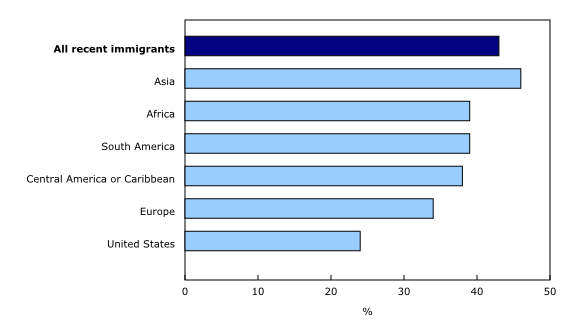
Recent immigrants (defined in this release as those admitted in 2005 or after) often face unique economic challenges in adapting to a new country and were more likely to report having greater difficulty in making ends meet. Specifically, in April 2024, a larger proportion of recent immigrants (43%) reported finding it difficult or very difficult to meet their financial needs over the past 12 months, compared with more established immigrants (29%) and non-immigrants (29%). Similarly, non-permanent residents were more likely to report finding it difficult or very difficult to make ends meet (37%) than non-immigrants.

Not all immigrants share the same economic experiences when arriving in Canada. In April 2024, while newcomers from the United States (24%) and Europe (34%) were the least likely to report experiencing financial difficulty in the past 12 months, newcomers from other regions were more likely to experience hardship during this transition. In general, newcomers arriving from Asia (46%) reported having the highest level of difficulty making ends meet. Some of these differences may be related to category of admission, which was not considered in this study.

Chart 1 
Percentage of recent immigrants (arriving since 2005) who reported having difficulty meeting financial needs over the past 12 months, by region or country of birth, Canada, April 2024

Chart 1: Percentage of recent immigrants (arriving since 2005) who reported having difficulty meeting financial needs over the past 12 months, by region or country of birth, Canada, April 2024

Racialized Canadians, especially racialized immigrants, are more likely to report experiencing financial difficulty 

Previous studies have shown that racialized Canadians may face greater economic uncertainty and, therefore, may have a more difficult time meeting their financial needs than non-racialized Canadians. In April 2024, West Asian (48%), South Asian (43%), Latin American (42%), Black (40%), Arab (38%) and Filipino (35%) Canadians were more likely to report having difficulty meeting their financial needs in the past 12 months than the non-racialized, non-Indigenous population (28%). In contrast, Chinese Canadians (22%) were the least likely to report experiencing financial difficulty in the past 12 months. 

Most of these observed differences are related to also being an immigrant. In April 2024, most Canadian-born racialized people reported having a similar experience as Canadian-born non-racialized people in Canada. For example, 28% of South Asian people born in Canada reported having difficulty making ends meet, the same proportion as the non-racialized, non-Indigenous population. However, nearly half (47%) of South Asian immigrants reported having difficulty making ends meet in the past 12 months. These results highlight the importance of understanding financial difficulty through a lens of intersectional identities, including experiences of immigration. 

Recent immigrants are less likely to report having satisfaction with their amount of free time

Economic challenges may lead to work-life balance conflicts, if workers need to work more hours, and potentially reduced satisfaction with the amount of free time available. As of spring 2024, 40% of Canadians who did not report having difficulty making ends meet also reported having a high level of satisfaction with their amount of free time. However, 12% of people who experienced difficulty making ends meet in the past 12 months reported having a similar level of satisfaction. 

In April 2024, more recent immigrants to Canada reported having lower satisfaction with their amount of free time than immigrants who had arrived earlier and non-immigrants. In fact, 23% of recent immigrants said that that they had a high level of satisfaction with their amount of free time, compared with 33% of more established immigrants and 32% of non-immigrants. About 27% of non-permanent residents reported having high satisfaction with their amount of free time.

Not all newcomer groups experienced similar levels of satisfaction with their amount of free time. For instance, in April 2024, newcomers from Asia were the most likely to report having financial difficulty and were one of the least likely to report having satisfaction with their free time (22%). In contrast, despite being the least likely to report experiencing financial difficulty, recent immigrants from Europe were among the least likely to report having a high level of satisfaction with their free time, at 20%. 

Further, in April 2024, recent immigrants from the United States (32%) were as likely to report having high satisfaction with their amount of free time as non-immigrants. These results indicate that satisfaction with amount of free time may depend on many other factors that were not measured by this study, including work-life balance, cultural perception of free time, family structure and supports, and personal outlook. 

Source: Recent immigrants report greater difficulty making ends meet and are less satisfied with their amount of free time

What struck my attention when away

Immigration

Century Initiative’s 100 million population goal by year 2100 was meant to be provocative – and isn’t a target – CEO says

Appears to be flailing around given that their fundamental arguments appear to have failed:

Ms. Lalande said the 100 million population goal for 2100 “was meant to be provocative and bold” and to “spark an economic recharge.” The ultimate objective isn’t to see a specific population number by 2100, she said, but for Canada to be strategic and thoughtful in planning for growth.

“We don’t believe that growth should happen at all costs,” she said, saying the 100 million figure “was meant to galvanize the conversation and to spark debate and discussion of what the country could be and how we need to get there.”

But she warned against curtailing immigration, saying “that approach would result in an aging, less-skilled work force, less foreign investment, less diversity and less influence” globally.

Source: Century Initiative’s 100 million population goal by year 2100 was meant to be provocative – and isn’t a target – CEO says

Government criticized for limiting immigration sponsorships to four-year-old list

Never possible to satisfy demand:

Immigrants who came to Canada with the hope that their parents or grandparents could one day join them say they feel cheated after the federal government opened a sponsorship lottery this month drawing from a four-year-old list of applicants.

They are upset because Ottawa decided to allow around 30,000 sponsorships this year, but excluded applicants from joining the program if they had not registered an interest in 2020.

Some told The Globe and Mail that if they can’t successfully sponsor their relatives at some point, they may have to leave this country themselves to take care of them.

Immigration, Refugees and Citizenship Canada (IRCC) is sending out 35,700 randomly selected invitations to Canadian citizens and permanent residents to apply for the Parents and Grandparents Program (PGP).

The invitations are drawn from a list of 200,000 people who expressed an interest in sponsoring their relatives in 2020.

Not everyone who receives an invitation to apply will submit a PGP application; however, IRCC said it ultimately expects around 32,000 grandparents and parents to qualify for permanent residence….

Source: Government criticized for limiting immigration sponsorships to four-year-old list

Caregivers from abroad to be given permanent residence on arrival under new pilot programs

Of note, addressing some past concerns:

The pilots, which are enhanced versions of two programs set to expire on June 17, will put qualified nannies, child-care and home-support workers on a fast track to settling in Canada.

Caregivers working for organizations that provide temporary or part-time care for people who are semi-independent or recovering from an injury or illness will also qualify under the new programs, which Immigration, Refugees and Citizenship Canada (IRCC) said will later become permanent.

Canada will admit more than 15,000 caregivers as permanent residents in the next two years, as part of Canada’s overall immigration targets, according to IRCC.

“Caregivers play a critical role in supporting Canadian families, and our programs need to reflect their invaluable contributions,” Mr. Miller said in a statement….

Source: Caregivers from abroad to be given permanent residence on arrival under new pilot programs

Canada needs an Immigrant Bill of Rights

Hard to see how adding another layer will necessarily improve processing and client service compared to addressing systemic issues:

This is why in a new report entitled Let’s Clean Up Our Act, the Canadian Immigration Lawyers Association (CILA) encourages the federal government to introduce an Immigrant Bill of Rights to provide newcomers with greater protection and an enhanced experience. 

We also believe the Immigrant Bill of Rights should be complemented by introducing an Ombudsperson for Immigration, Refugees, and Citizenship Canada (IRCC), and the Canada Border Services Agency (CBSA). 

These recommendations are far from novel or controversial.  

Numerous federal departments and agencies already have a bill of rights and/or ombudspersons.  

Source: Canada needs an Immigrant Bill of Rights

Tasha Kheiriddin: Brace for a possible tsunami of illegal migrants if Trump is re-elected

So almost a dedicated stream and pathway to citizenship? But that would require Canadian residency for at least three years, not “just being on our side:”

So what can Canada do that is positive? Apart from planning for these specific eventualities, Heyman suggests that we process as many Americans as possible for the equivalent of an American H1 Visa to Canada — not necessarily to live here, but to have a Canadian passport in their pocket and advocate for our country south of the border. “You’ve got a generational opportunity to get the top talent, people with means and skills, on your side — and possibly into your country,” Heyman said. A silver lining, perhaps, but the tsunami still looms.

Source: Tasha Kheiriddin: Brace for a possible tsunami of illegal migrants if Trump is re-elected

Rioux | «It’s the immigration, stupid!»

On the results and aftermath of the European Parliament elections and the political shakeout in France:

Son coup de tête a déjà provoqué le rassemblement de la gauche autour de son aile la plus radicale (La France insoumise) qui se complaît dans une forme de romantisme révolutionnaire flirtant avec l’antisémitisme et les appels à la violence. À droite, il a accéléré l’éclatement des Républicains, dont les jours étaient comptés, au profit d’un RN portant certes des revendications partagées par la majorité des Français, mais sans expérience ni cadres chevronnés et dont le programme économique est pour le moins boiteux.

Derrière l’apparence du combat des extrêmes, ne serions-nous pas en train de découvrir le nouveau visage de ce que sont tout simplement devenues, après une période d’effacement, la gauche et la droite ? Pour le dire simplement, la nouvelle gauche est aujourd’hui plutôt multiculturelle, wokiste et décoloniale. La nouvelle droite, plutôt nationaliste, souverainiste et conservatrice.

Dans la fureur et le chaos, nous assistons non seulement au retour de l’opposition entre droite et gauche, mais peut-être aussi de l’alternance sans laquelle aucune démocratie ne saurait survivre.

Source: Chronique | «It’s the immigration, stupid!»

Antisemitism, Israel Hamas war

Abella: What happened to the legacy of Nuremberg and the liberal democratic values we fought the Second World War to protect?

Well worth reading:

To paraphrase Martin Luther King, the arc of the moral universe may be long, but it does not always bend towards justice. And that means that too many children will never get to grow up, period – let alone in a moral universe that bends toward justice and the just rule of law.

I used to see the arc of my own life bending assertively from Nuremberg to ever-widening spheres of justice, but in this unrelenting climate of hate, I feel the hopeful arc turning into a menacing circle.

We need to stop yelling at each other and start listening, so that we can reclaim ownership of the compassionate liberal democratic values we fought the Second World War to protect, and to put humanity back in charge by replacing global hate with global hope.

My life started in a country where there had been no democracy, no rights, no justice. It instilled a passionate belief in me that those of us lucky enough to be alive and free have a particular duty to our children to do everything possible to make the world safer for them than it was for their parents and grandparents, so that all children, regardless of race, religion or gender, can wear their identities with pride, in dignity, and in peace.

Source: What happened to the legacy of Nuremberg and the liberal democratic values we fought the Second World War to protect?

Regg Cohn: Doug Ford isn’t the only one who has fumbled on antisemitism

Also well worth reading by those who have no answers to these questions:

To be sure, critics of Israel — of which I am one — are not necessarily anti-Israeli (or anti-Jewish). But a good many are so adamantly opposed to the existence of the state of Israel, for reasons of history or bigotry, that you have to ask:

Where would those millions of Jews go? Back to Poland, as some like to taunt? Here to Canada, where they feel increasingly besieged? Stay where they are in a single state where “Palestine shall be free, from the river to the sea,” subsuming and consuming the Jewish state?

Israel is guilty of many sins during its long decades of occupation, although neither side is blameless about missed opportunities. After the Oct. 7 Hamas massacre of more than 1,200 Jews and the taking of hostages, Israel’s overreaction and overreach transformed a just war of defence into a war without justifiable limits.

Source: Doug Ford isn’t the only one who has fumbled on antisemitism

Lederman: The banning of an Israeli-American graphic novelist shows how some arts organizations are rushing to judgment

Exclusion is not the answer except in extreme cases where it crosses into hate speech:

With Israel and Hamas at war, there has been so much screaming at one another, across a widening divide. What could be accomplished by having actual conversations?

This isn’t the only instance of selective targeting of Israeli, Jewish or Palestinian artists by arts organizations. With festival and awards season approaching in the fall, there is reason to fear more exclusions to come.

Source: The banning of an Israeli-American graphic novelist shows how some arts organizations are rushing to judgment

Citizenship

Mansour: Citizenship in the Multicultural State

Interesting evolution by Mansour compared to his earlier writings:

In conclusion, it might be said that the generation of 1968 was a pioneer generation in the making of a new political agenda that goes beyond the attachment to the state of which a citizen is a member. Canada has contributed to this agenda, internationalist and multicultural, through the social changes that have occurred in the years since its centenary anniversary. As a result, Canadians are in the midst of emerging new sensibilities that are more open to the world, more receptive of other cultures, more inclined to accepting international law and adjusting domestic statutes to that requirement. These changes render older political arrangements less meaningful in the twenty-first century.

Source: Citizenship in the Multicultural State

Foreign interference

Three article of interest of foreign interference and the shameful “witting” involvement of some MPs

‘Witting’ involvement changes the nature of foreign interference

NSICOP doesn’t name the parliamentarians who are witting participants in foreign interference. It raises a question about parliamentarians. It calls on the government to brief MPs about interference – and warns MPs to “reduce their vulnerabilities.”

And once again, it is another report telling the public that the Canadian government has not done enough to counter the threat of foreign interference. If anything, those warnings have grown louder.

This time, what a committee of parliamentarians has told us in clearer terms than ever is that the threat of interference from abroad includes participants here in Canada, inside Parliament, who have something to gain from dealing with foreign actors.

Source: ‘Witting’ involvement changes the nature of foreign interference

Coyne: We need to know the names of the traitor MPs, but don’t count on any of the parties to give them up

The Liberals’ tactic of deny, delay and deflect – first denying the allegations, then, when they can no longer be denied, denying they matter – has proved largely successful. Polls show that foreign interference ranks low on the public’s list of important issues. The Opposition is likely to take the hint. It was to their advantage to demand a public inquiry, so long as the government refused – and so long as they could be assured its findings would only stick to the government. But now? What’s in it for them?

For that matter, the same might apply to certain sections of the media: The report refers to Chinese officials “interfering with Canadian media content via direct engagement with Canadian media executives and journalists,” while a redacted passage cites “examples of the PRC paying to publish media articles without attribution.”

So if none of the parties is keen on turning over this rock, if law enforcement are unwilling and the media nervous – Mr. Dong’s lawsuit against Global News will have had a useful chilling effect – then the betting proposition has to be that nothing will happen. None of the MPs involved will be prosecuted, or named, or face consequences of any kind. And the public will shrug. Experience has taught them that, in this country, nobody ever faces consequences for this kind of thing.

Unless … unless a lone MP stands up in the House and names the names.

Source: We need to know the names of the traitor MPs, but don’t count on any of the parties to give them up

Yakabuski | L’ingérence étrangère et l’indifférence libérale

Tout au plus, la vice-première ministre, Chrystia Freeland, a-t-elle promis que les libéraux effectueraient « un suivi interne » dans la foulée du rapport. Comme son collègue à la Sécurité publique, elle n’a pas semblé désireuse d’aller au fond des choses. Est-ce parce que le caucus libéral compte beaucoup de députés issus des communautés culturelles qui entretiennent des relations étroites avec les représentants au Canada des gouvernements de leurs pays d’origine ? Certains de ces députés craignent, avec ou sans raison, une chasse aux sorcières dans la foulée du rapport McGuinty.

« La garantie que je peux donner aux Canadiens est que notre gouvernement prend très, très au sérieux l’ingérence étrangère », a réitéré cette semaine Mme Freeland. Or, la réaction du gouvernement au dernier rapport laisse, encore une fois, une impression contraire.

Source: Chronique | L’ingérence étrangère et l’indifférence libérale

Other

Hindutva ideology proved costly for India’s Narendra Modi

Of note:

The decade-long entrenchment of far-right ideologies in India, an over-focus on dividing Hindus and Muslims and on wealth generation for the rich eroded the country’s human rights record, judicial autonomy and press freedom.

That people with the least individual power were able to collectively push back against plans of the most powerful has rekindled the flame of democracy domestically and fanned hopes of resistance against tyranny globally.

Source: Hindutva ideology proved costly for India’s Narendra Modi

A Plea for Depth Over Dismissal

Agree:

To be clear, this article is not a plea for a return to scorecard history. Scorecard history is not a sound approach either. For, in the end, history is a qualitative discipline. Ranking prime ministers, or anyone else for that matter, is a silly exercise. Good deeds and bad deeds cannot be weighted and tallied up so that some final score can be determined. For that matter, categorizing deeds as good or bad in the first place flattens a great deal of complexity, like intentionality or unforeseen consequences, and it is precisely in that great universe of gray that real insights can be found. Insights into continuities between past and present, into how politics work in practice, and into the most accurate assessments of legacy. For the legacy of most leaders, much like the legacy of the policy of multiculturalism, will be neither entirely beneficial nor detrimental. But through a rigorous, nuanced, and deep examination of the lives and legacies of politicians and their policies, we stand to learn much about our country’s past – and its present too.

Daniel R. Meister is a Banting Postdoctoral Fellow in the Department of Political Science at the University of New Brunswick. He is the author of The Racial Mosaic (MQUP 2021).

Source: A Plea for Depth Over Dismissal

How diverse are Order of Canada appointments?

My latest analysis (for the charts, go to the IRPP link):

In the 2015 federal budget, the Harper government announcedadditional funding of $13.4 million over five years and $2.8 million in ongoing funding for the Canadian honours system.

The objective was to enhance inclusivity by increasing Order of Canada nominations from “under-represented sectors,” such as business, and regions, particularly the West.

The funding was prompted by an Ottawa Citizen analysis that showed only 26 per cent of recipients since the Order’s creation in 1967 came from the West, compared to its 31 per cent share of the population.

In contrast, Atlantic Canada, with 11 per cent of the population, had double the representation in recipients. The study also highlighted a growing proportion of awards going to individuals in the arts, while the share for business professionals had decreased.

Nine years later, has the desired shift occurred? Did the change in government later in 2015 influence the outcomes?

I evaluated that question by delving into an analysis of more than 2,000 Order of Canada appointments made between 2013 and 2023, examining regional, background and employment-equity perspectives.

Approximately three per cent of appointments are companions (the highest rank), 22 per cent are officers and nearly three-quarters are members (the lowest rank).

It is crucial to distinguish award and recognition programs from employer-employment equity initiatives and political appointments.

Employers, whether private or public sector, have considerable levers to increase diversity. Governments have considerable latitude in their appointments, as seen in the increased representation of women, racialized minorities and Indigenous Peoples under the Trudeau government.

Award and recognition programs, however, can’t do much more than encourage more nominations from underrepresented groups.

https://e.infogram.com/3383e710-d685-4697-8ae3-6a0acb642705?parent_url=https%3A%2F%2Fpolicyoptions.irpp.org%2Fmagazines%2Fjune-2024%2Fdiversity-order-canada%2F&src=embed#async_embed

Diversity

Figure 1 explores diversity through a lens of gender, racialized minority and Indigenous perspectives, comparing the average percentage of the awards given from 2013-17 and 2018-23 with the data from 2023.

There are fluctuations between the years for all groups, but the percentages of racialized minorities and Indigenous Peoples have trended upward, with a significant leap in 2023.

Racialized minorities, however, are still notably underrepresented relative to their population share, while the representation of Indigenous Peoples surpasses their demographic proportion.

Within the appointments of racialized minorities, women constitute 30 per cent, reflecting an increase to 32 from 27 per cent between 2013-17 and 2018-23.

In terms of Indigenous appointments, there is near gender parity but with a slight decline in the percentage of Indigenous women appointed, dropping to 45 from 52 per cent over the same period.

https://e.infogram.com/340c0bfc-a7d3-49d6-8812-4f2e6ae0e1b3?parent_url=https%3A%2F%2Fpolicyoptions.irpp.org%2Fmagazines%2Fjune-2024%2Fdiversity-order-canada%2F&src=embed#async_embed

Rank comparisons

Figure 2 presents a comparison of representation by rank. The proportion of women among companions declined notably between these two periods, whereas their representation among officers increased, along with a decrease in members.

In the case of racialized minorities, the share of companions decreased, but their representation among officers and members increased. Similarly, a shift is observed among Indigenous officers and members, marked by a significant increase in the number of Indigenous companions.

Traditional employment analysis involves assessing levels or ranks in Order of Canada terms and their corresponding representation. The conventional expectation is to observe higher representation at more junior levels, compared to senior positions. However, this general trend holds true only for women.

In contrast, there is a reversal of this pattern for Indigenous Peoples while racialized minority officers exhibit a higher percentage than members. This indicates a deliberate and conscious effort to appoint Indigenous Peoples to the more senior ranks, as illustrated in Table 1.

https://e.infogram.com/883c0f0b-2742-4cbe-b6ae-f276846ff2d0?parent_url=https%3A%2F%2Fpolicyoptions.irpp.org%2Fmagazines%2Fjune-2024%2Fdiversity-order-canada%2F&src=embed#async_embed

Promotions to the companion level constitute 43 per cent of all recipients. However, only 4.7 per cent of officer appointments are promotions from the member level.

https://e.infogram.com/b1f57efb-f250-4da5-9698-b8d446498158?parent_url=https%3A%2F%2Fpolicyoptions.irpp.org%2Fmagazines%2Fjune-2024%2Fdiversity-order-canada%2F&src=embed#async_embed

Regional representation

Figure 3 examines the regional balance. British Columbia appointments increased from 11.3 per cent (2013-17) to 13.3 per cent (2018-23), and Prairie appointments rose from 12.1 per cent to 14.7 per cent.

Conversely, Ontario appointments declined from 46.3 per cent to 43 per cent, and Quebec appointments decreased from 21.4 per cent to 19.7 per cent.

In 2023, British Columbia appointments exceeded B.C.’s share of the population, while the Prairies remained underrepresented. Quebec underrepresentation increased, while both Ontario and Atlantic Canada saw an increase in overrepresentation.

The North was slightly underrepresented. Recipients who spent part of their careers abroad accounted for slightly more than three per cent of all recipients.

https://e.infogram.com/0a683ec3-d5af-439c-a606-93a70b44561b?parent_url=https%3A%2F%2Fpolicyoptions.irpp.org%2Fmagazines%2Fjune-2024%2Fdiversity-order-canada%2F&src=embed#async_embed

Background of recipients

Figure 4 explores the diversity of backgrounds among Order of Canada recipients. Generally, backgrounds in the arts, health, business and public service dominate, with notable representation from individuals with academic, activist and scientific backgrounds.

The percentage of business-oriented recipients slightly declined. The same holds true for those with backgrounds in arts, academia and communications from 2013-17 to 2018-23. Conversely, there was an increase in individuals with backgrounds in health, activism, sports, science and philanthropy.

As for representation from the West, particularly the Prairies, there has been a small regional shift, likely reflecting an overall economic shift to Western Canada.

The Chancellery of Honours is responsible for overseeing the Governor General’s award programs. Chancellery staff met with me to discuss these findings. They also provided an update on efforts to improve representation.

The chancellery now has a statistician who tracks nominations and appointments and who validated this analysis.

This advisory council is reasonably diverse in terms of women, racialized minorities and Indigenous Peoples. The Governor General and staff make ongoing efforts to encourage nominations from underrepresented groups. Regrettably, they declined to provide data on nominations, though they did indicate that more women are appointed than nominated.

In terms of employment-equity groups — women, racialized minorities, and Indigenous Peoples — underrepresentation reflects the overall pattern of society as a whole, where relatively fewer people from these groups have prominent or senior positions.

That said, the increase in racialized minority and Indigenous appointments is notable, particularly in contrast with the stagnation of appointments of women, who make up about one-third of appointments.

Note on methodology

This analysis relies on the Order of Canada appointment lists released by the Governor General in June and December. Gender details are directly sourced from names and citations, while information regarding racialized minorities and Indigenous Peoples is obtained through a combination of names, citations and, when necessary, web searches.

Provincial data is extracted from the appointment lists, with a preference for the smaller province in cases where more than one is listed (although this is a rare occurrence).

Source: How diverse are Order of Canada appointments?

Executive Diversity within the Public Service: An Accelerating Trend 

My latest analysis, focussing on diversity among executives as well as an update on hirings, promotions and separations:

Source (behind firewall): Executive Diversity within the Public Service: An Accelerating Trend 

Blogging break for the next few weeks

Will, however, post some upcoming articles on Order of Canada appointments and on Diversity among the Executive Ranks.

Aristotle Foundation: ‘Overwhelming majority of the Canadian poor are white,’ report finds [misleading use of statistics]

Both the article and the report misrepresent the data as it looks at number living in poverty rather than the percentage of each group who are in poverty. For example, stating that 58 percent of white people living in poverty is less than their 74 percent of the Canadian population.

The table below provides a more accurate picture by contrasting the share of the population and poverty rates by group and generation, compared to the non visible minority population. Poverty rates remain higher across generations for Blacks, Latin American and West Asians.

It is one thing to argue against the degree that race affects poverty rates or the effectiveness of specific policy approaches, another to present the data in a tendentious manner or to argue that systemic racism has no impact on poverty rates:

A new report by the Calgary-based think tank Aristotle Foundation suggests that Canada’s race-based approach to fighting poverty might be flawed, since it is based on an incorrect assumption that race, racial discrimination and poverty are tightly linked.

The paper, “Poverty and Race in Canada: Facts about Race, Discrimination, and the Poor,” analyzed recent Statistics Canada data and also looked at public policy initiatives at both the provincial and federal levels that are designed to fight poverty.

It found that between 7.4 and 10.6 per cent of Canadians are living in relative poverty, depending on how one defines the term.

At the low end, defined by low after-tax income, some 58 per cent or 1.6 million people living in poverty are white, or what StatsCan refers to as “not a visible minority nor Indigenous.” For the other figure, which measures poverty based on the cost of living, 2.5 million people or 64.4 per cent of the group living in poverty are white.

“In other words, the overwhelming majority of the Canadian poor are ‘white,’ and thus cannot receive race-based allocations from governments if unchangeable characteristics such as skin colour or ethnicity are accounted for in policy,” the group said in a press release announcing the findings.

The paper points to government documents that use the link between race and poverty to justify race-based remedies that it says ignore many needy people.

A federal document outlining Canada’s anti-racism strategy notes: “Anti-Black racism is manifested in the legacy of the current social, economic and political marginalization of African Canadians in society such as the lack of opportunities, lower socio-economic status, higher unemployment, significant poverty rates and over-representation in the criminal justice system.”

Ontario’s anti-racism strategic plan includes the same statement almost word for word.

What’s more, the report says, government anti-poverty programs with racial qualifiers can end up misdirecting resources to those who are not even poor.

It cites Ontario’s Racialized and Indigenous Supports for Entrepreneurs (RAISE) grant program. Using the low-income-after-tax measure, eligibility for this race-based funding would apply not only to 1.4 million low-income earners in Canada (the total low-income visible minority and Indigenous population) but also to nearly 10.5 million minorities or Indigenous who are not low income, while excluding non-minority, non-Indigenous low-income earners.

“Put another way,” the report says, “this funding would be inaccessible to 64 per cent of those who are low-income, and of those who do qualify for the funding based on race, only 11.9 per cent are low-income. This is not a sensible way to design an anti-poverty program.”

The study also found that some minority groups in Canada are as likely or in some cases less likely to be poor compared to white Canadians. These included Canadians of Japanese, Korean, South Asian and Chinese ancestry, all of whom have higher average weekly earnings that their white counterparts.

The study suggests delinking poverty from race, and says governments should strive to address the “root issues” of poverty by strengthening, or minimizing interference with, what it calls the “success sequence”: finish high school, work full time, and marry before having children. These markers, it says, predicate a non-poverty life for the vast majority of people in the U.S. and Canada.

“Systemic racism is not the cause of poverty in Canada,” says lead author and financial analyst Matthew Lau. “While some visible minority groups experience poverty in numbers disproportionate to the general population, it is also true that some visible minority groups are less likely to live in poverty, such as Canadians of Filipino, South Asian, and Latin American ancestry.”

“Poverty is colour-blind, and thus poverty policy which excludes some Canadians and favours others based on colour or ethnicity omits a vast swath of the poor in Canada, in addition to being illiberal,” adds co-author and Aristotle Foundation research director David Hunt, “The focus of anti-poverty policy in Canada should instead be focused on the individuals in need and on creating widespread opportunity for all.”

Source: ‘Overwhelming majority of the Canadian poor are white,’ report finds, Report link: https://aristotlefoundation.org/reality-check/poverty-and-race-in-canada-facts-about-race-discrimination-and-the-poor/#:~:text=In%20summary%2C%20poverty%20rates%20in,are%20truly%20living%20in%20destitution.