Europe under siege: Good long read by Paul Wells

Good long read by Wells on the radicalization and other challenges in Europe. Where he ends up of note:

All of which suggests, to me, that the long-term solution to the urban terror of ISIS is not to shut down borders, banish newcomers, bulk up the surveillance state and out-tough the murderers. Certainly there is a market for that prescription. On a Monday night several days after the Brussels bombings, a gang of thick-necked soccer hooligans descended on the square in front of the Bourse, tearing down peacenik banners and picking fights with passersby who seemed, in the eye of the roving strongmen, excessively eager to make nice with Islamists. The police finally saw the counterprotesters off with water cannon. There will be plenty of politicians offering the marchers their brand of tough medicine in the next election, in Belgium and across Europe. There have been for decades.

But if Islamism is vying for the attention and affection of distracted and dissolute kids, whether second-generation rebel sons of moderate Muslims or slapdash converts from Christianity or atheism, then it is not in the West’s long-term interest to try to out-tough the killers. Rather it is to sap the appeal of terror and murder by ensuring, consistently over the long term, that another way of life really does look better.

On that score, I daresay that Europe, for all its strains and its frequent inanity, is doing well. On a bad day you could almost sell the notion that EU and ISIS are funhouse-mirror images of each other: polyglot, border-skipping multinational operations that operate in defiance of history, logic or human nature. But the comparison flatters ISIS and cheats Europe. The foreign fighters who have streamed to Raqqa to join the jihad have as often recoiled in horror as they have been embraced as useful recruits. The murders of innocent dozens in Paris, including Muslims, have badly undercut the appeal of ISIS in the French-speaking world. Cédric Mas, a French analyst, has pointed out that the latest issue of Dar al-Islam, the French-language ISIS propaganda magazine, devotes an unprecedented amount of space to defensive arguments for its terror attacks in Europe—and contains no long-term forecasts about the organization’s future. It is as if, at the moment of its apparent triumph, ISIS has found itself thrown on the back foot among its own clientele.

Europe, meanwhile, is Europe, revelling in its history and culture, refining its admittedly clumsy policing, learning from error. And not incidentally, living as a rich, compelling community—richer in many places, in important ways, than Brussels.

On Monday at a conference organized by the European Policy Centre think tank, Thomas Fabian, the deputy mayor of Leipzig, described the policies his German city of 500,000 people has adopted to integrate the more than 5,000 migrants who moved there last year. The newcomers are distributed throughout the city, including in affluent neighbourhoods, instead of being left in ghettos, Fabian said. The newcomers are obliged to take German lessons. Each family is assigned a city social worker to check in now and again, but for the most part newcomers are encouraged to leave their homes to visit doctors and other services, to strengthen their personal responsibility and self-reliance. The goal of it all, Fabian said, is to make sure the newcomers join Leipzig’s broader community, a community whose residents, 300 years ago, included Johann Sebastian Bach.

This is a better way to act. It is more fulfilling and will, over time, be more attractive. By coincidence I arrived in Brussels on the same Thalys train route, from Amsterdam through Brussels to Paris, on which three vacationing Americans subdued Ayoub El-Khazzani eight months ago. No guard rifled through my bag as I boarded, and the train did not stop at the border between the Netherlands and Belgium.

In my car was an American family. The mother read aloud to her three sons from a Harry Potter book for the duration of the two-hour trip. A society where family, community, technology and security can co-exist that well—most of the time, never perfectly—is stronger than it looks. Stronger than it has been made to feel this year. In the long-term battle between Europe and its assorted tormenters, keep betting on Europe.

Source: Europe under siege

Is ‘counter-radicalization’ just another way of blaming all terrorism on Muslims? – iPolitics

Still in the denial stage: Monia Mazigh and Azeezah Kanji on counter-radicalization. Would be more helpful and useful to suggest or recommend better ways to engage Canadian Muslims and counter-radicalization strategies:

Which leads to the question: What exactly will Canada’s new Office of Counter-Radicalization be countering?

Few answers are to be found in the written output of Canadian security agencies: Their reports are opaque regarding the mythical connection between religious/ideological radicalization and “terrorism” — which seems to be assumed rather than proven. A 2011 CSIS study acknowledged that “the search for patterns and trends on radicalization remains elusive”, even while a report produced the very next year claimed, with surprising confidence, that “the Service has a solid grasp on this topic.”

Questionable as the concept of radicalization is, CSIS publications manage to cast a broad pall of suspicion on Muslims in Canada. “Islamist radicalization,” according to one (unsupported) CSIS assessment, can occur “just about anywhere … these people gather.”

open quote 761b1bCounter-radicalization programs in Western liberal democracies have largely been thinly-veiled exercises in targeting Muslims — even though non-Muslims have been responsible for the majority of political violence in both America and Europe.
Even Muslims’ dreams have been represented as a site of potentially dangerous activity – putting a strange new spin on the concept of “sleeper cells.” The generally overwhelming focus on Muslims is curious, given that CSIS’s own internal documents identify right-wing and white-supremacist violence as a greater threat than violence by Muslims (as described last year in the Toronto Star).

Source: Is ‘counter-radicalization’ just another way of blaming all terrorism on Muslims? – iPolitics

Phil Gurski’s similar and well-expressed take:

I have to admit I feel exasperated when I read things like this. Can we not get past these issues? Can we not at least agree on the following fundamental truths?

a) a small number of people will embrace radical ideologies

b) an even smaller number of these will plan acts of serious violence

c) a subset of b) will be Muslim

d) doing nothing is not an option.

What is so problematic about this? How can anyone who cares about Canada not see this as a priority? No, it is not our top priority and never will be, but that nevertheless does not mean we an ignore it.

I know that a number of serious missteps have been made (i.e. every time Donald Trump opens his mouth) and that the programmes that have been initiated have not been perfect (the UK’s PREVENT strategy comes in for some particularly scathing criticism). But I also know that there are some who seem to stop at complaining and don’t offer anything helpful in exchange. This is not going to help us solve this problem.

A few things need to happen. Governments have to work much more closely with communities, religious leaders, teachers, doctors. social workers, parents and anyone who is in a position to observe radicalisation at work and who wants to play a role in countering it. Communities need to get off their “woe is us” bandwagon, acknowledge there is a problem that needs fixing and stop denying reality. We all must figure out ways to move this dialogue beyond finger-pointing and acrimony.

If we don’t people are going to continue down the path to violent extremism, leaving behind traumatised families and broken communities, and others are going to die.

Source: Borealis Threat & Risk Consulting

Having a Difficult Conversation with Someone from a Different Culture: HBR

A good piece outlining some of the cultural differences and how to be mindful of them, particularly in difficult conversations:

When you think of it this way, having a difficult conversation with someone from another culture can appear perilous — and it can be. So, what can you do about it?

  • Survey the landscape of the conversation you need to have, and identify potential places where these trip wires might ensnare you.
  • Take stock of what you know about the other person and her culture. If you don’t know anything at all, now is a good time to do some research, because chances are that if it’s a difficult conversation you have to have, then it’s also an important one.
  • Look for places where you can overlap with their style. For most people, it’s not all or nothing. Someone from a task-oriented culture can preface what they say with five to ten minutes of tea and conversation about the relationship, for example, and someone from a more formal culture can intentionally dial down the seriousness for one conversation.
  • Focus on the trip wire that matters the most. If it’s too much pressure to sail over all four of these, prioritize the one you think could be most vital in this particular context.

By definition, it’s never easy to have a difficult conversation. However, when we have these across cultures, it can be downright confounding. By being mindful of these trip wires and delicately stepping over and around them, you can prevent the conversation style from getting in the way of the content.

Source: Having a Difficult Conversation with Someone from a Different Culture

Religious Accommodation Still a Struggle in Quebec

Some insights from a recent Canadian Race Relations Foundation workshop on faith and social inclusion in Montreal:

There was consensus among the panelists that schools are the best place to be pro-active.

Gagnon gave credit to Quebec’s Spiritual and Community Animation program in elementary and secondary schools. As a former spiritual and community animator at the EMSB, he said focusing on spirituality rather than religion provides “a window to talk about what we have in common.”

The program was introduced after Bill 118 (2000) deconfessionalized public school boards and introduced a mandate to promote diversity and pluralism.

“There’s always this push and pull,” said Poupko. “I think it has do with asking what’s reasonable and expecting a common sense response.”

That’s the approach Cristina Bajenaru takes as Project Coordinator at the Centre d’Encadrement pour Jeunes Femmes Immigrantes, a community organization that helps young immigrant women integrate.

Bajenaru said her clientele comes from 60 countries so she has to take a common sense approach to accommodation. If her training workshops coincide with Muslim holidays, she explained, “I can’t tell them to come, but I can’t tell them not to come either.” She said she lets them decide, and roughly half the class ends up staying home.

Through community consultations, the CRRF compiled dozens of other real scenarios that have come up in workplaces across the country. These are included in the Faith and Belonging Toolkit, a resource for workshop participants to encourage discussion and develop appropriate responses to accommodation.

Using the resource, Gagnon said he was impressed at the ability of the group to come up with solutions to complex scenarios.

“Spirituality in the public sphere, in [the] workplace, in society, when we talk about it reasonably and calmly, we find solutions,” he said.

Source: Religious Accommodation Still a Struggle in Quebec – New Canadian Media

Conservative MP Deepak Obhrai: New Rules Turning Tories Into ‘Elitist And White-Only’ Club

Interesting – and a major risk for the party given the importance of new Canadian voters:

A longtime Conservative MP is blasting his own party for becoming an “elitist and white-only” club.

Calgary MP Deepak Obhrai, the dean of the Tory caucus, told The Huffington Post Canada he is deeply frustrated by new rules the party imposed earlier this year that raised the annual Conservative membership fee to $25 — “the highest of any party” — and set the entrance fees for leadership contestants at $100,000. 

deepak obhrai

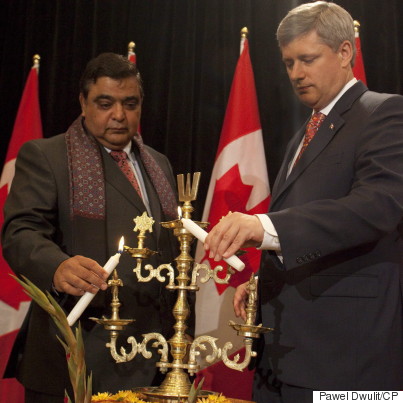
Deepak Obhrai and former prime minister Stephen Harper celebrate Diwali by lighting a candle on Parliament Hill on Oct. 8, 2009. (Photo: Pawel Dwulit/Canadian Press)

“Since we lost power in 2015, I have become very concerned about the direction my party has taken,” he told HuffPost over the phone on Thursday.

“These actions, in my view, have disenfranchised a vast majority of Canadians. Newcomers, immigrants, low-income Canadians, and those economically challenged will be turned off and walk away because they can’t afford these high fees…

“What is concerning me is that, unfortunately, [the Conservatives] will be seen as an elitist and white-only party,” he said.

Ethnic communities’ outreach

Since his election in 1997, Obhrai said he’s been working his “butt off” to bring immigrants to the party, a job that was subsequently taken on with great fanfare by former cabinet minister Jason Kenney. Success in connecting with ethnic communities culminated in the Tories’ majority election win in 2011, Obhrai said.

But that work has been dropped as a priority for the Conservatives under the leadership of party president John Walsh, Obhrai said. He added that the party has lost touch with grassroots members and pointed out that the caucus was not consulted.

“This party has become a party that is seen [to be only] for like rich people, I ask why? Why only for those who can afford it? Why the rich?

“For a family of four, it’s like asking them to give $100, and then also asking them to give through a credit card, which many don’t have. I have had these problems and my EDA [electoral district association] passed a motion telling the national council that we are unhappy with these rules,” the Calgary MP told HuffPost.

Source: Conservative MP Deepak Obhrai: New Rules Turning Tories Into ‘Elitist And White-Only’ Club

The big reason why Brad Wall can’t be prime minister

Sums up one of the fundamental realities well but ignores that many new Canadians send their children to French immersion programs:

A paradox encompasses two mutually exclusive propositions that are nonetheless both true. Federal bilingualism is such a paradox.

It is right and proper that senior federal politicians and public servants must speak both English and French. English-speakers need only ask themselves how they would feel about a unilingual French cabinet minister or Supreme Court judge to understand that truth. Canada is a bilingual country. Ottawa must be bilingual. Case closed.

But the bilingualism requirement is also exclusionary, which government hiring practises should not be. Because only 17.5 per cent of Canadians are bilingual, it effectively prohibits four out of five of us from advancing in the federal public service or in federal politics. It discriminates against Western Canadians, people from Southern Ontario, Quebeckers who don’t live near the Ontario or New Brunswick borders (those two “bilingualism belts” are where most bilingual Canadians are to be found) and most Atlantic Canadians.

It similarly discriminates against most immigrants, who come from China, India, the Philippines and other countries where French isn’t spoken.

Such observations often provoke a retort from Graham Fraser, the Commissioner of Official Languages. But as Mr. Fraser himself recently observed: “Canada is a country with two unilingual majorities: Some 60 per cent of Francophones do not speak English, and some 90 per cent of Anglophones do not speak French.” Almost 50 years of official bilingualism haven’t changed that reality, and the next 50 years are unlikely to change it either.

The bilingual paradox inhibits the ability of political parties to renew. Mr. Wall and entrepreneur Kevin O’Leary have both been touted as possible leaders for the Conservative Party, but both have no hope of leading that party, because both are unilingual and Canada’s prime minister simply must be bilingual.

And the lost opportunities extend far beyond these two. We may never know what potential prime minister was lost to the country when, years ago, she decided not to run for Parliament because her second language is Mandarin, not French.

And please, let’s dispense with the idea that Mr. Wall or anyone like him could “pick up” French if they wanted to lead the Conservative Party. Middle-aged learners, unless they inherently gifted, do not “pick up” a second language well enough to joust in the House of Commons or take part in a national leaders’ debate. Stéphane Dion’s English is actually quite good – certainly better than Mr. Wall’s French would ever be – yet many English Canadians considered it inadequate when he was Liberal leader.

Brad Wall is a popular and effective premier who will never become prime minister because he can’t speak French. That’s the price of the paradox. And there really isn’t anything anyone can do about it.

Source: The big reason why Brad Wall can’t be prime minister – The Globe and Mail

ICYMI: Le Centre de prévention de la radicalisation fait l’objet de pressions

The Centre is off to a rocky start. There may be some lessons here for the planned federal Office of the Community Outreach and Counter-radicalization Coordinator:

Le Centre de prévention de la radicalisation menant à la violence de Montréal (CPRMV), créé il y a un an pour aider les proches et les personnes à risque d’être radicalisées, fait l’objet de pression et d’attaques cinglantes de la part de certains musulmans qui l’accusent d’être partial et de critiquer « sans ménagement la pensée islamique ».

Les critiques déposées par cette minorité à l’égard du CPRMV ne sont pas nouvelles, mais cette semaine, la vigueur de leurs attaques a redoublé d’ardeur, allant jusqu’à entraîner le départ d’une de ses chercheuses, accusée d’être « schizophrène » et d’« être tout sauf objective concernant la pensée et les courants religieux, musulmans, qu’elle dit étudier ».

Le site Muslim News a en effet mis en ligne jeudi après-midi un texte non signé, critiquant vertement le choix du CPRMV d’avoir recruté la chercheuse et spécialiste de la radicalisation Mounia Ait Kabboura, en février dernier. Le texte « Quelle mouche a piqué les anti-radicaux ? » est une salve virulente visant à miner la crédibilité de la nouvelle recrue.

Source: Le Centre de prévention de la radicalisation fait l’objet de pressions | Le Devoir

ICYMI: Anxiety in Vancouver over Hong Kong’s future

A different angle on diaspora politics:

Vancouver has long been intimately tied to this kind of soul-searching about the future of Hong Kong.

Hundreds of thousands of Hong Kong Chinese became Canadian citizens in the late 1980s and 1990s after the Tiananmen Square massacre in Beijing in 1989 and in the years leading up to 1997. But many later returned to work and live in Hong Kong as mainland China prospered economically.

At the same time, a generation of Chinese and non-Chinese Canadians from Vancouver also packed their bags and headed to Hong Kong seeking adventure, work and ties to their heritage as political fears gave way to the lure of interesting opportunities — often, again, tied to the rise of mainland China.

As such, both groups, especially those with more established business interests, are generally more constrained to speak up publicly for Hong Kong’s interests, though many will privately sigh.

“Concerns for Hong Kong go hand-in-hand with needing to also consider their beneficial relationship with China,” observes Helen Hok-Sze Leung, associate professor at Simon Fraser University, who grew up in Hong Kong.

Lam and others, however, are part of a younger generation in Vancouver who relate with peers in Hong Kong who have become more strident in identifying themselves as being part of a Hong Kong that is culturally separate from mainland China.

“It’s the city where I grew up so I have stronger ties and I naturally feel bad” about what is happening, says Lam.

“I go onto Twitter and Weibo and see Hong Kong young people writing (in the local dialect) of Cantonese and declaring themselves as Hong Kongers first,” says Leung. “This is a generation that was born under (mainland) Chinese rule and yet their sense of local (Hong Kong) identity and asserting that culture seems stronger than in my generation, and this percolates to migrants (who move to Vancouver).”

Lee, the lecturer, recently spoke about independent film Ten Years, which became an unexpected hit in Hong Kong when it was released in mid-December. The film consists of five ominous short stories hypothesizing what Hong Kong will be like 10 years from now. In one, cab drivers who speak Cantonese instead of Mandarin have their livelihoods clipped when they are prohibited from picking up certain passengers. In another, books are censored and banned ones are pulled off shelves.

According to Reuters, the film broke box office records in Hong Kong for attendance, but around a month later, after mainland Chinese state-controlled publication “denounced Ten Years in a January editorial,” the filmmakers were told by cinemas in Hong Kong they couldn’t continue showing it because of scheduling issues.

Source: Anxiety in Vancouver over Hong Kong’s future

Dans les coulisses de la francisation: Language and integration

Quebec debates over the francisation of immigrants and the number leaving Quebec (without asking why):

«Québec peine à franciser ses immigrants », apprenait-on il y a quelques mois. Le genre de manchettes qui donne froid dans le dos, vu l’importance de la chose pour l’avenir du Québec. Quand le français se porte mal, tout le monde se retrouve un peu amoché, car la langue est, jusqu’à nouvel ordre, notre seul projet de société. En même temps, la loi 101 n’a jamais été une baguette magique. La francisation est-elle vraiment plus difficile aujourd’hui ?

À en croire une femme qui en fait son pain et son beurre depuis sept ans, le diagnostic n’est pas du tout exagéré. « Tout a changé », dit-elle, se référant à la fois au nouveau programme du ministère (MIDI) et aux immigrants à qui elle enseigne. Cette femme — qui ne veut pas être identifiée « tellement tout est politique » — en a long à dire sur les coupes, mais aussi sur la nouvelle composition des classes. Depuis plus d’un an, 50 % des élèves sont iraniens, du jamais vu pour ce qui est d’une telle communauté.« On dépense une fortune pour des gens qui ont peu d’intérêt à apprendre le français », dit mon interlocutrice.

Les ressortissants iraniens, ainsi que chinois et indiens, sont les moins susceptibles de rester au Québec. Un sur deux quitte la province pour une autre quelques années après son arrivée. Le Québec a pourtant accueilli 6000 Iraniens en 2014, et plus de 3000 dans les neuf premiers mois de 2015, en première et deuxième position du palmarès des groupes reçus. Selon le MIDI, ce sont des immigrants qui auraient été refusés ailleurs au Canada après un changement de critères de sélection. Mais pourquoi accepterait-on des gens devenus inadmissibles au fédéral et qui sont, de plus, de moins bons candidats à la francisation ? « Les Latinos savent très bien où ils débarquent en arrivant ici, dit Mme F (pour francisation). Les Brésiliens et les Colombiens sont ceux qui semblent s’intégrer le mieux ; ils sont toujours une valeur ajoutée dans une classe. »

Les problèmes en francisation ne se limitent pas à la motivation de certains élèves. Le nouveau programme du MIDI fait aussi grincer des dents. D’abord, les établissements de francisation — des universités ou des cégeps très souvent — ne sont plus vus comme des « partenaires », mais plutôt des « mandataires », un peu comme nous ne sommes plus des « patients », mais des « clients » aux yeux du ministère de la Santé. Ensuite, les professeurs n’ont plus de pouvoir d’évaluation. Finis, les tests de classement et les notes en cours de route. À la manière Barrette, c’est le ministère qui décide désormais des niveaux de compétence (il y en a trois) et de l’évaluation finale. Résultats ? « On se retrouve avec des classes à deux, trois vitesses, et plus personne ne reprend une classe. Après le troisième niveau, ils sont souvent à peine capables de conjuguer un verbe », dit Mme F.

Source: Dans les coulisses de la francisation | Le Devoir

Has Labour under Corbyn really gone soft on antisemitism? | Tony Klug 

One of the more thoughtful and balanced commentary on the UK Labour antisemitism issue:

For Britons on all sides, it means reflecting on the critical role Britain and Europe played in instigating the conflict in the first place. The tragic historical Arab-Jewish clash was the product of generations of virulent European antisemitism at home and rampant imperialism abroad. It was white Europe’s innate sense of superiority and its routine oppression that fostered Jewish nationalism, Arab nationalism and Palestinian nationalism. Europe’s present-day assumption of the moral high ground over a conflict it helped to shape is breathtakingly audacious. Those on the British left today who disdainfully dismiss Israel as merely a colonial-settler state conveniently forget that Jews were not sent to Palestine as agents of imperial Europe, but were fleeing the continent for their lives.

For its victims, the systematic annihilation of two-thirds of European Jews was not just a shocking historical statistic. A cataclysm of that magnitude has inevitably left an indelible mark on the psyche of a people made to feel not just powerless, but also utterly degraded and worthless. Probably most Jews, including strong critics of successive Israeli governments, hold on to Israel as the phoenix that arose from the ashes. Many lament that the Jewish state did not come into existence 10 years earlier, for that might have saved up to 6 million Jewish lives.

It is these sentiments that are generally uppermost in the minds of Jews who passionately parade their support for Israel. Their myopia regarding the increasingly desperate Palestinian plight is shadowed by the insensitivity of others who dismiss them as simply bigots or oppressors. This is felt particularly keenly when their accusers seem much less exercised by the gross human rights abuses of a host of despotic regimes or the brutal antics of armed militant groups, and in some cases even make excuses for them.

Historically, Jews and Arabs have mostly had cordial relations. The Jewish and Muslim belief systems and customs have much in common. The contemporary conflict has severely undermined these ties and has fostered in their place the parallel phenomena of anti-Jewish sentiment in the Arab and Muslim worlds and anti-Muslim and anti-Arab sentiment in the Jewish world. Ultimately, only a resolution of the conflict will settle these matters. Here, Europe could be appropriately and energetically engaged. Meanwhile, it should not be forgotten that Israeli Jews and Palestinian Arabs are fated to live alongside each other one way or another. Thus they both have an intrinsic interest in spurning the sometimes dubious support of fair-weather third parties whose antipathy to one side or the other can be so odious that it could poison relations indefinitely.

By promptly excluding Downing and Kirby, and investigating recent allegations of endemic antisemitism in the Oxford University Labour Club, the Labour party is showing itself to be alert to this insidious menace. But these steps might be tinkering at the edges. Without prejudging them, a comprehensive open inquiry into antisemitism on the British left, including the Labour party, would help clarify the underlying issues and draw out the important distinctions. As proudly proclaimed opponents of racist bigotry in all its forms, Jeremy Corbyn and the party he leads could provide an important service to the fabric of community relations by taking on this challenge.

Source: Has Labour under Corbyn really gone soft on antisemitism? | Tony Klug | Opinion | The Guardian