What France thinks of multiculturalism and Islam – The Washington Post

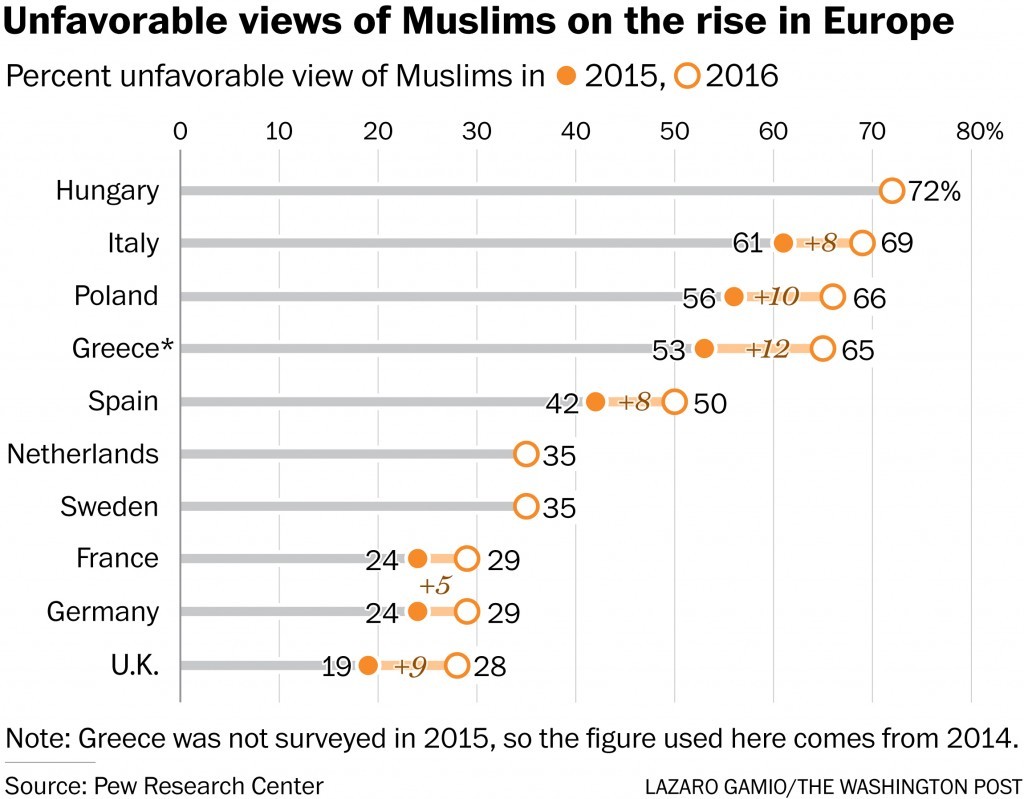
2300europemuslims-11-1024x799Some interesting polling data that sometimes gets lost in the rhetoric:

In the aftermath of a devastating attack in Nice, France, Poland’s interior minister, Mariusz Blaszczak, told reporters that the blame lay with the embrace of multiculturalism. “Have we not learned lessons from previous attacks in Paris and Brussels?” the Financial Times reported Blaszczak as saying. “This is a consequence of the policy of multicultural politics, and political correctness.”

A member of Poland’s controversial right-wing Law and Justice Party, Blaszczak’s point may be in bad taste. However, many around the world probably agree with it.

It’s certainly hard to disagree with the idea that France seems to be more embracing of multiculturalism than Poland. In a recently released study by the Pew Research Centerthat was conducted early this year, just 24 percent of French people were found to believe that diversity made France a worse place to live. A higher proportion, 26 percent, said it made France better, while 48 percent said that it didn’t make much difference.

These results appeared to show that France has one of the most tolerant, though also largely indifferent, attitudes to racial and ethnic diversity in Europe. Only Spain had a higher positive view of diversity. Meanwhile, in Poland, 40 percent of the population said that diversity was a negative, while only 14 percent said it could be a positive and 33 percent said it made no difference. Hungary, Italy and Greece were the only countries with higher negative feelings toward diversity.

The same poll found that France had a far more positive view of Muslims than much of Europe. Despite a series of terror attacks that were inspired by Islamic extremism, just 29 percent of French citizens were found to have a negative view of Muslims, while 67 percent had a positive view. While this was an increase of 5 percentage points over previous years, only Germany and Britain had more positive views.

Conversely, in Poland, 66 percent had negative views of Muslims, while only 19 percent said they had positive views. Hungary and Italy were the only countries with more negative views — 72 percent and 69 percent, respectively.

People in Poland were also far more likely to believe that Muslims in their country were supporters of groups like the Islamic State, a group whose supporters have cheered the attack on Nice but have not claimed official responsibility. Twelve percent of Poles were said to believe that “most” Muslims in their country supported extremist groups, and a further 23 percent said “many.” Just 12 percent said “very few” supported these groups. In France, 44 percent said “very few” Muslims in their country supported extremism, while just 6 percent said “most” and 13 percent said “many.”

And despite the perceived link between refugees from Muslim majority countries and terrorism that is widespread across Europe, Pew’s data showed that on the whole, French citizens were more concerned about economic factors.

Source: What France thinks of multiculturalism and Islam – The Washington Post

Visible minorities less likely to view police favourably: survey

Not surprising, although it would be interesting to have a breakdown by visible minority group to see if there are significant differences between their confidence in the police (my hypothesis is that Black Canadians, given the prevalence of carding and other practices, would likely have the lowest level of confidence).

The contrast with USA data, however, is striking:

The majority of Canadians view their police forces favourably, but confidence erodes when members of visible minorities are polled, according to a new survey from Angus Reid.

When asked if they have trust in the police and justice system, Canadians said “yes” about most institutions, with only the criminal courts failing to reach a majority of support. Sixty-eight per cent of white people expressed confidence in police while 58 per cent of members of visible minorities did so.

Support for the police and justice system appears to be growing, with a small increase from 2014 and a near-spike from the lows of 2012, when none of the institutions broke 40 per cent support.

Quebec led the way in all categories, with support often more than 10 percentage points higher than in other provinces. Atlantic Canada and British Columbia had the lowest levels of trust.

The survey of 1,505 residents from across the country comes at a time of greater scrutiny of policing. Most recently, Black Lives Matter Toronto staged a sit-in during the Toronto Pride Parade on July 3 to protest against what they argue are discriminatory policing practices targeting black residents in the city.

The results hinted at the frustrations: Of those surveyed, 58 per cent of members of visible minorities trusted the institutions, 10 percentage points lower than white respondents.

While there is a discrepancy between whites and members of visible minorities in Canada, the results are magnified in the United States, where the summer has seen racial tensions simmer in wake of two recent shootings of black men by police. Only 39 per cent of members of visible minorities express confidence in the police, compared with 62 per cent of white residents, a Gallup poll found.

Despite the largely positive Canadian results, the Angus Reid survey also highlighted troubling data about the challenges facing members of visible minorities in the country.

Over a 10-year period, the black inmate population in Canada has surged 60 per cent. In Toronto, where black people make up less than 10 per cent of the population, 41 per cent of youth in child welfare services are black. In Vancouver, close to 60 per cent of people in poverty are members of visible minorities; in Toronto, it’s 62 per cent.

Source: Visible minorities less likely to view police favourably: survey – The Globe and Mail

Facebook still isn’t very diverse, but it wants you to know it’s trying – Recode

Facebook_still_isn’t_very_diverse__but_it_wants_you_to_know_it’s_trying_-_RecodeLatest update on tech diversity:

Facebook is still a mostly white, mostly male tech company. But it wants you to know that it’s trying to fix that.

Facebook published its employee demographic data on Thursday, revealing data very similar to what the company reported last year around this time. The key metrics:

  • Facebook’s U.S. employees are 90 percent white or Asian, down from 91 percent in 2015.
  • Facebook’s senior leadership is 92 percent white or Asian, down from 94 percent last year.
  • Men account for 83 percent of Facebook’s technical jobs, a slight improvement from last year, when men had 84 percent of these positions.
  • Women make up 27 percent of Facebook’s senior leadership, up from 23 percent in 2015. This was, on paper, the company’s biggest improvement.

No, these are not significant changes. But they are small improvements.

Maxine Williams, Facebook’s global director of diversity, was keen to point out that while the baseline numbers have not changed much, Facebook is trending in the right direction. Take hiring, for example. Just 3 percent of Facebook’s senior leadership is black, but 9 percent of the senior leadership hires over the past year have been black, Williams said.

How is Facebook going about diversifying its new hires? Well, one move has been to implement a version of the NFL’s Rooney Rule, where at least one minority candidate must be interviewed for each open position. A handful of Facebook teams started using this strategy last summer, but others have since joined in, Williams said.

Source: Facebook still isn’t very diverse, but it wants you to know it’s trying – Recode

Quebec PQ: Alexandre Cloutier défend ses voeux aux musulmans pour la fin du ramadan

More PQ debates on multiculturalism/interculturalism, and whether it is appropriate or not for politicians to wish people well during religious holidays:

Le candidat à la direction du Parti québécois Alexandre Cloutier a défendu, jeudi, ses voeux adressés aux musulmans à la fin du ramadan, en se réclamant de Barack Obama et de Bernie Sanders.

L’enjeu de la laïcité continue donc de diviser au Parti québécois, puisque M. Cloutier répond ainsi aux critiques de Jean-François Lisée, un de ses rivaux dans la course actuelle. M. Lisée avait alors fait une charge contre la position multiculturaliste de Justin Trudeau tout en faisant un rapprochement cinglant avec les voeux d’Alexandre Cloutier.

Dans une entrée de blogue publiée par le site Huffington Post jeudi matin, M. Cloutier, qui est député de Lac-Saint-Jean, affirme avoir été «surpris» par les «vives réactions» provoquées par son message émis sur Twitter.

Il dit avoir formulé ces voeux «avec candeur» et par «esprit d’ouverture et de respect» à l’égard des 250 000 Québécois de confession musulmane qui allaient célébrer l’aïd, la fin du ramadan, la semaine dernière.

C’est ainsi, selon lui, que le Parti québécois doit manifester son ouverture et sa capacité à rassembler les électeurs, en faisant appel aux «valeurs d’ouverture» du fondateur de la formation, René Lévesque.

«J’ai la ferme conviction que c’est en commençant par de tels signaux que le Parti québécois ouvre ses horizons et peut aspirer à rassembler davantage», peut-on lire. Ces gestes s’imposent afin de mettre un terme aux «déceptions électorales», poursuit-il.

Et il a laissé savoir qu’il continuera à souligner les fêtes et les moments forts de la vie des communautés culturelles. En cela, il dit s’inspirer d’autres personnalités politiques: Barack Obama, le candidat malheureux à l’investiture démocrate Bernie Sanders et Pauline Marois.

«J’ai exprimé ces voeux comme le président Barack Obama et le candidat Bernie Sanders l’ont fait, aux États-Unis. Comme notre première ministre Pauline Marois l’a fait, elle aussi, en 2013. Je l’ai fait comme tous les députés de l’Assemblée nationale offrent leurs meilleurs voeux de Pâques et de Noël à leurs électeurs, chaque année», écrit-il.

Aux yeux de M. Lisée, ces voeux contrevenaient au principe de neutralité de l’État, mais M. Cloutier soutient qu’il ne «partage pas son avis». Le PQ doit continuer à défendre la laïcité de l’État «en unissant les Québécoises et les Québécois derrière une vision commune du vivre-ensemble», écrit-il.

M. Cloutier soutient que son parti peut s’inspirer des recommandations du rapport Bouchard-Taylor, qui font consensus avec la Coalition avenir Québec et Québec solidaire.

Dans un texte publié sur le site web de sa campagne, M. Lisée, qui est député de Rosemont, s’en est pris à la pratique voulant que les chefs politiques saluent les fêtes religieuses. Il avait pris prétexte des voeux officiels transmis par le premier ministre Justin Trudeau à chacune des fêtes religieuses. Selon lui, la vie des communautés ne se limite pas à leurs pratiques religieuses et on ignore ainsi tous ceux qui sont non pratiquants, agnostiques ou athées.

«Même sans la dérive trudeauiste, la pratique voulant que des chefs politiques saluent les fêtes religieuses mérite réflexion, avait écrit M. Lisée. C’est exactement ce que j’ai indiqué lorsque mon collègue Alexandre Cloutier a souligné la fin du ramadan, un événement effectivement majeur de la vie de nos concitoyens musulmans même si les deux tiers d’entre eux ne sont pas pratiquants.»

Ainsi, un chef de parti et de gouvernement qui se veut un gardien de la laïcité et de la neutralité de l’État devrait s’abstenir de participer à des rituels religieux, a fait valoir le député de Rosemont.

Read more of this post

Denmark: How Flipping The Script Helped Keep Young Muslims From Joining ISIS

Good example of a counter radicalization strategy:

One day in 2012 a group of policemen in a Danish town was sitting around in the office when an unusual call came in. This town, called Aarhus, is a clean, orderly place with very little crime. So what the callers were saying really held the cops’ attention. They were parents, and they were “just hysterical,” recalled Thorleif Link, one of the officers. Their son was missing. They woke up one day and he was gone.

The officers put together whatever clues they had about the missing person: He was a teenager who went to a local high school, and he lived in a largely Muslim immigrant neighborhood just outside town. But before they got any further with their investigation, they got another call, from another set of parents. Their son was missing too.

“Why is this going on?” asked Allan Aarslev, a police superintendent.

After talking to the parents and snooping around the neighborhood the police figured it out: These young men and women had gone to Syria. They were among the exodus of thousands of European citizens who were drawn to the call put out by ISIS, the Islamist terrorist group, for Muslims worldwide to help build the new Islamic state.


Link and Aarslev are crime prevention officers. They usually deal with locals who are drawn to right-wing extremism, or gangs. The landscape of global terrorism was completely new to them. But they decided to take it on. And once they did, they wound up creating an unusual — and unusually successful — approach to combating radicalization.

The rest of Europe came down hard on citizens who had traveled to Syria. France shut down mosques it suspected of harboring radicals. The U.K. declared citizens who had gone to help ISIS enemies of the state. Several countries threatened to take away their passports — a move formerly reserved for convicted traitors.

But the Danish police officers took a different approach: They made it clear to citizens of Denmark who had traveled to Syria that they were welcome to come home, and when they did, they would receive help with going back to school, finding an apartment, meeting with a psychiatrist or a mentor, or whatever they needed to fully integrate back into society.

Their program came to be known as the “Aarhus model.” It’s been called the “hug a terrorist” model in the press, but this description never sits well with the cops. They see themselves as making an entirely practical decision designed to keep their city safe.

As they see it, coming down hard on young, radicalized Muslims will only make them angrier and more of a danger to society. Helping them is the only chance to keep an eye on them and also to keep the peace in their town.

Link and Aarslev were intuiting what scientists who study radicalization are coming to see.

“The original response was to fight [extremism] through military and policing efforts, and they didn’t fare too well,” says Arie Kruglanski, a social psychologist at the University of Maryland who studies violent extremism. “That kind of response that puts them as suspects and constrains them and promotes discrimination — that is only likely to exacerbate the problem. It’s only likely to inflame the sense there’s discrimination and motivate young people to act against society.”

Their approach has a basis in research on interpersonal relations as well.

Christopher Hopwood, an associate professor of psychology at Michigan State University, studies something called noncomplementary behavior. Complementary behavior is the norm. It means when you act warmly, the person you are with is likely to act warm back. The same is true with hostility. But noncomplementary behavior means doing the unexpected. Someone acts with hostility and you respond warmly. It’s an unnatural reaction, and it’s a proven way to shake up the dynamic and produce a different outcome than the usual one.

The nonviolent resistance movements of Martin Luther King Jr. and Mahatma Gandhi are the most well-known examples of this tactic. The Aarhus model is another. How did it unfold in real time? Consider the case study of a young man we call “Jamal.” Jamal is not his real name, and we don’t usually use pseudonyms, but he asked us to not use his name. He doesn’t want to be known as a person who almost became a terrorist. He wants a job and a life now. But that didn’t seem possible for a while.

Jamal was born in Somalia; his family moved to Denmark because Somalia was in the middle of a civil war. His was the only black family in the neighborhood and the only Muslim family, and his childhood wasn’t easy. Kids called him names, asked him if he had the same blood as they did, and teased him. For a long time he just would fight back, but he knew he was disappointing his father.

When he was a little older Jamal decided to take a different tack. He tried to be the good kid. He studied and made jokes in class, and his stress eased. The teachers liked him, his classmates liked him, and he began to make Danish friends and even to feel more Danish.

Then one day in high school his teacher organized a debate about Islam. Jamal had just been on the hajj, the pilgrimage to Mecca, with his family, and he was infused with a newfound religious identity. And during the debate one of the girls started saying to the class that Muslims “terrorize” the West, and kill people and stone women. Jamal argued with her and eventually lost his temper, saying, “People like you should never exist.”

After that moment, Jamal’s life went off the rails. The teacher told the principal, who told the police, who questioned Jamal about being a terrorist. Jamal had to stay home from school and miss his final exams. The police cleared him, but it was too late for him to redo his exams so he had to redo some of high school. He was furious about it. Soon after the investigation his mother died, and he blamed her death on the stress caused by the investigation. He began to feel rejected by the West.

During that year he ran into a group of fellow Muslims who had experienced some of the same discrimination. One of them had an apartment, and the group spent a lot of time there talking, praying and watching videos of Anwar al-Awlaki, a famous English-speaking imam. The friends talked a lot about jihad and making the trip to Syria. Two of the guys in the apartment began planning their trip.

While he was living in that apartment, Jamal got a call from Link, who had heard about his case. Jamal cursed him out and tried to hang up the phone, but then Link did something Jamal didn’t expect: He apologized, for the ordeal his fellow officers had put Jamal through. Hearing a policeman take responsibility for his life getting derailed really moved Jamal. He agreed to come into Link’s office.

When Jamal got there, Link introduced him to Erhan Kilic, one of the first official mentors hired by the program. Kilic was a fellow Muslim who had also faced discrimination in Denmark as a child. But he had taken a very different path. He had decided to embrace Denmark as his country. He now had a wife and two daughters and a successful practice as a lawyer. Kilic relayed to Jamal the main message of the Aarhus program: If he chose to, Jamal could also find his place in Denmark.

This is what sets the Aarhus program apart. It didn’t use force to stop people from going to Syria but instead fought the roots of radicalization, Kruglanski says. “There are strong correlations between humiliation and the search for an extremist ideology,” he says. Organizations like ISIS take advantage of people who, because of racism or religious or political discrimination, have been pushed to the margins of society.

Link and Aarslev’s program showed people like Jamal that there was a place for them.

“Aarhus is the first, to my knowledge, to grapple with [extremism] based on sound social psychology evidence and principles,” Kruglanski says. What Link and Aarslev were doing was so unexpected that it created an opening for people to think differently about their ideology. “They expect to be treated harshly,” Kruglanski says. Instead, they got the opposite. “That kind of shock opens people’s minds to maybe they were wrong about their society that they perceived as their enemy. It opens a possible window into rethinking and re-evaluating.”

Starting in 2012, 34 people went from Aarhus to Syria. As far as the police know, six were killed and 10 are still over there. Of the 18 who came back home, all showed up in Aarslev and Link’s office, as did hundreds of other potential radicals in Aarhus — about 330 in total.

But the program is admired for another accomplishment: Since the initial exodus of young people, very few have left from Aarhus for Syria, even when traffic from the rest of Europe was spiking. Last year, in 2015, it was just one person.

The program is still precarious, though. One terrorist attack in Aarhus could undo much of the work that has been done. But the officers are willing to keep trying. As Link put it, there are still “strong forces” out there tempting young Muslims to leave their lives in the West and join the battle.
Read more of this post

Police diversity fails to keep pace with Canadian populations

Police_diversity_fails_to_keep_pace_with_Canadian_populations_-_Manitoba_-_CBC_NewsSurprised they were able to get this much data.

When I asked for the date from the major police forces – Toronto, Vancouver, Calgary, Montreal – the quality of data was mixed (Alberta does not collect employment equity information):

Only one major city in Canada — Halifax — staffs a police force that is as racially diverse as its community, CBC News has found.

All other major law enforcement agencies across the country fail to reflect their communities’ diversity among their ranks, leaving large swaths of visible minorities and Indigenous populations without representation.

  • While 57 per cent of Peel region, outside Toronto, is diverse, its police force has only 19 per cent non-white officers.
  • 54 per cent of Vancouverites are from minority groups, whereas 22 per cent of its police force match that profile.
  • For York region, also neighbouring Toronto, that ratio is 44 per cent for the population, but 17 per cent for the police force.
  • In Edmonton, 35 per cent of its citizens are visible minorities or Indigenous, yet those groups are represented in less than 10 per cent of its police force.
  • In Nunavut, 12 per cent of the police force is Aboriginal, but the territory is almost 90 per cent Indigenous.

These findings come as minority groups across North America are shining the spotlight on allegations of abuse of authority and discrimination among polices forces.

In May, CBC News surveyed all major police forces in Canada in order to establish a national snapshot of the racial diversity of key law enforcement agencies.

These figures were then compared to the demographic makeup of the public for each community using the results of the 2011 National Household Survey to calculate the disparity between the racial profiles of police and general populations.

…The Toronto Police Service says one of the key impediments to achieving better representation is that the rate of officer turnover has been outpaced by the rapidly changing community.”In 2000 we were at about nine per cent visible minority. We’re now at about 24 per cent,” says Mark Pugash, director of corporate communications for the force.

“People who join tend to stay for 30 years, or in other cases 35 years or longer. So there’s not a great turnover. We’ve also had hiring freezes for a number of years in recent times.”

Pugash says that when Toronto police hire, they have focused on recruiting Somali Canadians, and have also been successful in debunking certain myths about policing through a program that teams up youths with officers.

Source: Police diversity fails to keep pace with Canadian populations – Manitoba – CBC News

USA: New York to pay citizenship application fee for 2,000 immigrants – NBC-2.com

Canadian citizenship fees, including the cost of pre-assessment of language, are currently around $830, making the cost unaffordable for many low-income immigrants and refugees:

New York state will cover the application fee for U.S. citizenship for an estimated 2,000 low-income immigrants, with winners to be selected by a lottery, state officials announced Wednesday.

The drawing is an effort to help those immigrants who cannot easily afford the existing $680 fee for applying for citizenship. It will be open to approximately 160,000 immigrants now living in New York whose incomes are low, but just too high for federal assistance.

New York Secretary of State Rossana Rosado said the application fee – which is soon set to go up to $725 – often poses a significant burden for many immigrants struggling to make ends meet in a new nation.

“It’s a huge obstacle,” Rosado told The Associated Press. “For many of those families citizenship is a luxury. It shouldn’t be.”

The federal government already waives the application fee for immigrants in the lowest income bracket. An estimated 400,000 in the state are eligible for the help, Rosado said, but many may not know it. Rosado said the lottery is also intended to act as an outreach campaign for those immigrants who aren’t aware of the federal fee waiver.

Democratic Gov. Andrew Cuomo’s administration authorized the lottery program after advocates for immigrants proposed the idea. Private donors will contribute money to help the state pay the application fees.

Source: NY to pay citizenship application fee for 2,000 immigrants – NBC-2.com WBBH News for Fort Myers, Cape Coral & Naples, Florida

Broken Melting Pot Is No Alternative To Canadian Multiculturalism | Jack Jedwab

Good commentary by Jedwab.

Reality in many parts of USA is closer to multiculturalism than melting pot, given strong ethnic communities and identities, despite political discourse and posturing:

Those driving the melting pot rhetoric might argue that it refers to the immigrant experience and is therefore not about the American-born black population. That observation however makes illusory the melting pot objective of creating a harmonious whole. As regards immigrant acceptance in the American melting pot, the success of Donald Trump’s campaign has also served as a reminder of the high levels of anxiety and hostility towards immigration and diversity. Then again, perhaps the melting pot theorists were thinking about melting white European and not Hispanic immigrants. Well, so much for the idea that the American model of diversity seeks to make one out the many.

In a thoughtful essay in a 2012 edition of the journal National Identities , northeastern University political science professor David Michael Smith notes that the success of the melting pot rhetoric is attributable to the concept’s ambiguity. It simultaneously represents both uniformity in its end product and the presence of diversity which it must somehow incorporate. Smith observes that “…in the first instance, attention is focused on the creation of a ‘new race” or ”new compound’ which is nonetheless homogeneous in character.” It by virtue of this ambiguity that the concept it used across a spectrum of Americans that rally those who are favorable to immigration and those opposed to it.

Paradoxically, when it comes to describing cultural pluralism in the United States, the trend amongst several American thinkers is towards some variant on the idea of multiculturalism. For some time, the tired melting pot adage has been giving way to a depicting the country as a “salad bowl” with a mixture of various ingredients that keep their individual characteristics. Even the most ardent American proponents of the melting pot acknowledge that it is increasingly difficult to defend the idea.

Sure Canadian multiculturalism has historically and continues to confront a set of important challenges, but it’s difficult to give credibility to misinformed critics that point south of the border to offer a better alternative.

Source: Broken Melting Pot Is No Alternative To Canadian Multiculturalism | Jack Jedwab

The Tenors sang ‘All Lives Matter’ in ‘O Canada.’ They were wrong.

One of the better commentaries – Adrian Lee provides one of the clearest expressions of why the critics of ‘Black Lives Matter’ have it wrong:

In place of the lyrics “With glowing hearts we see thee rise, The True North strong and free,” the group sang instead: “We’re all brothers and sisters/All lives matter to the great,” raising a marker-scrawled sign “All Lives Matter,” before returning to the standard lyrics in French. (A note of pity here for Michael Saunders, the Toronto Blue Jays’ Canadian-born outfielder, who stared blankly into the sun as the camera panned to him during this moment.)

Let’s leave aside what they could have meant by “to the great,” and take a moment to explain why the statement “All Lives Matter” alone here is thoughtless, at best. As a dismissal, or even a response to the statement “Black Lives Matter”—a movement and rallying cry for black communities in America, Canada and beyond who have witnessed, experienced and felt acts of discrimination (both overt and subtle) and are refusing to accept societal norms that have produced police brutality and other acts of violence—it is unworthy. It is a statement that salves the oppressor; it is a sentence that erases the pain by equating that pain to those experienced by everyone. It is, as the popular argument goes, the equivalent of telling a neighbour whose house is on fire that all houses matter. It is, as my colleague Jason Markusoff noted on Twitter, the rhetorical equivalent of interrupting those solemnly pausing on Remembrance Day to say “Never forget” with a haughty “No, it should be ‘Never forget all genocides’.” Never mind that taking vitriolic offence to the brusque response one often receives to “all lives matter” takes away from the actual issues at hand. “All Lives Matter” is, at best, unhelpful because it refuses to acknowledge that people are different, and some people are hurting right now.

Some may point to U.S. President Barack Obama’s more diplomatic note at the recent NATO summit in Warsaw: “When people say ‘black lives matter,’ that doesn’t mean blue lives don’t matter. That just means all lives matter.” This, it’s worth noting, is a different point than merely saying “All Lives Matter.” That’s because saying “Black Lives Matter” does not mean “only black lives matter”; that’s a flawed premise too, and it’s a defensive reading that refuses to acknowledge that those lives actually do. The conceit of “Black Lives Matter” is about focus, and not about exclusion; the reality that most of North American society has focused expressly on lives that are not black makes this urgent, and makes “All Lives Matter” particularly cruel.

Source: The Tenors sang ‘All Lives Matter’ in ‘O Canada.’ They were wrong.

Rise in anti-Semitism in Western Europe, decrease in Eastern Europe: poll | i24news

Interesting findings and linkage to concerns over large-scale arrival of migrants and refugees:

A recent survey has revealed a rise in anti-Semitism in Western Europe, while at the same time there has been a decline in anti-Jewish sentiments in Eastern European countries.

The survey was conducted by the EJA (European Jewish Association) ahead of a discussion Wednesday on anti-Semitism in Europe at the Israeli Knesset’s Committee for Immigration, Absorption and Diaspora.

The poll found that 19 percent of Jewish communities – the vast majority of them in Western Europe (mainly in France, Switzerland, Belgium, Germany, the Netherlands and Northern Ireland) – reported a rise in anti-Semitism.

In Antwerp, Belgium, one community reported a marked rise in antisemitism (5 on a scale of 5), while another community in the same city reported relative calm.

Communities in the Netherlands reported a rise in anti-Semitism (4 on a scale of 5), as did the Jewish community in Nancy, France.

However, some 9.5% of Jewish communities – the vast majority of them in Eastern Europe – reported a decline in anti-Semitism in the past year.

Around 66% of Jewish communities throughout Europe (East and West) reported a lack of real change in the level of anti-Semitism in the past year.

The survey was conducted last Thursday among a representative sample of communities in capital cities and outlying towns throughout Europe, from Belfast in Northern Ireland in the West to Tbilisi, Georgia in the East.

In cities where there are large concentrations of Jews (Paris and Antwerp, for example), the sample included a number of communities in the same city.

The survey comes just months after an annual study on global anti-Semitism found that the number of violent anti-Semitic incidents worldwide fell considerably in 2015, partly because the extreme right has been focused on Muslims.

Violent anti-Semitic incidents dropped more than 40 percent in 2015, but other kinds of anti-Semitic displays increased dramatically in Europe, stated the Annual General Analysis on Anti-Semitism Worldwide, published jointly by Tel Aviv University, Kantor Center for the Study of Contemporary European Jewry and the European Jewish Congress.

The report attributed the decrease to a number of factors, including an increase in security measures, the growing fear of terrorism that may increase sympathy for Jews targeted for violence, and the lack of a military confrontation involving Israel in 2015.

Another factor cited in the report was the flow of over a million immigrants and refugees to Europe in 2015, which caused a trend of anti-immigrant sentiment that has strengthened extreme right parties. In Scandinavian countries, extreme right sympathizers have been gravitating towards major centrist and right parties for practical reasons.

The extreme right has also in many cases pointed at Jews as the root cause of terrorism, claiming they fostered Muslim immigration in order to undermine European culture. “The Jews are depicted as directly responsible for the migration wave, either by causing the war in Syria and Iraq and by creating ISIS […] because of the wish to achieve the following goals: to destroy European racial identity, to incite Christians and Muslims against each other, to create a Middle East devoid of Arabs and Muslims and even to destroy western democracies in order to control them – an accusation which is a derivative of conspiracy theories. Jews are guilty of the Islamization of Europe by bringing in the refugees, and of the opposite as well, of Islamophobia, by allegedly misusing the anti-Muslim rhetoric in order to invoke support for Israel,” said the report.

Source: Rise in anti-Semitism in Western Europe, decrease in Eastern Europe: poll | i24news – See beyond