A lesson in reaction to John Carpay’s rainbow flag comparison: the cross does not justify lunacy – Coren

I always find it somewhat amusing with the contrast between more reasoned argumentation in mainstream publications and some true colours emerge at an event organized by Rebel Media. As Carpay should know, invoking Hitler or the Nazis means he has lost his arguments (Godwin’s law):

I was shocked when it was revealed that Christian conservative lawyer John Carpay had compared the rainbow flag to the Nazi swastika. Not because Carpay had drawn the grotesque juxtaposition, but because it had taken so long for such a sentiment to be made public.

Last Saturday, Calgary-based Carpay, a leading voice with the Justice Centre for Constitutional Freedoms, and ubiquitous within social conservatism, spoke at a conference organized by Rebel Media, where the sewers breathe and the ghouls come out to play.

“How do we defeat today’s totalitarianism?” he asked rhetorically. “You’ve got to think about the common characteristics. It doesn’t matter whether it’s a hammer and sickle for communism, or whether it’s the swastika for Nazi Germany or whether it’s a rainbow flag, the underlying thing is a hostility to individual freedoms.”

He later apologized, explaining that he was actually discussing totalitarianism when he listed the rainbow flag with the emblem under which 12 million people were slaughtered in death camps — including, of course, many gay men. Such apologies are usually signs of being sorry because someone is caught, not because they are genuinely contrite. Change of heart and mind come about not due to pressure, but because of personal conviction.

I’ve known Carpay for many years, and he’s not an evil man. A little eccentric, extremely conservative, but not evil. What he is, however, is a committed right-wing Christian, and that’s a world few of us know well.

In the United States it’s enormously influential, in Canada less so but — as we saw with the leadership victories of Andrew Scheer federally and Doug Ford in Ontario — it can muster perhaps 20 per cent of any conservative race, and thus decide a vote.

At the heart of their beliefs is the conviction that there is a spiritual war taking place, and that the major battlefields are life and sexuality. The rights of women to control their bodies, or of gay men and women to live equally and enjoy the same rights as the heterosexual majority, are not signs of progress or liberty, but a satanic attack on God’s plan, and on the safety and sanctity of the Christian family.

Within evangelical circles and on the right of the Roman Catholic Church it’s a commonplace view, as any casual reading of socially conservative media platforms or blogs will show.

One of the books often quoted is The Pink Swastika, co-authored by the odious Scott Lively. He’s notorious for his anti-gay extremism, has advocated the criminalization of “the public advocacy of homosexuality”, and spread his venom in Uganda and Russia, where LGBTQ people live in fear of their lives. His book, subtitled “Homosexuality in the Nazi Party” is now in its fifth edition. No credible historian takes it at all seriously, but many Christian social conservatives certainly do.

At the epicentre of all this is fear, and in that it is not unlike the cult that has developed around bestselling author Jordan Peterson. Long powerless groups are finally speaking out and up for their rights, and whether they are women, gay, trans, native, or Black, their insistence on justice intimidates many of those who have long taken it for granted.

Within a conservative Christian context, it’s comforting to paint the entire struggle in spiritual colours, because if God is on your side it’s all going to be OK. Problem is, Jesus never mentions homosexuality, and is in fact stunningly indifferent to what some around him insist is sexual sin. Lesbianism is never referred to in the Old Testament, and the subject of homosexuality is spoken of a mere handful of times in the entire Bible. If any demand permeates the Gospels it’s love, acceptance, and the welcoming of the marginalized.

Carpay’s apology is irrelevant. What matters is that reactionaries shame the voice of Christ with their fanaticism, that Nazism is minimized by such grimy propaganda, and that LGBTQ people — still persecuted, humiliated, and killed in large parts of the world — have once again been assaulted.

The rainbow flag is a symbol of liberation, but the swastika is an icon of genocidal horror. That anybody should think otherwise, and use the cross to maintain their lunacy, makes this Christian very angry indeed.

Source: A lesson in reaction to John Carpay’s rainbow flag comparison: the cross does not justify lunacy – Coren

The Rise of the Resentniks: And the populist war on excellence.

Interesting take by Brooks. Always felt there was an element of resentment in Canadian conservative attacks on elites, and the exaggerated distinctions between the “anywheres” and “somewheres”:

There’s a powerful moment at the start of Anne Applebaum’s recent essay in The Atlantic. She’s recalling a party she threw on Dec. 31, 1999, at her home in Poland. Many of the hundred-odd guests were Polish, but others flew in from around the world for a weekend together, to greet the new millennium.

Most of the guests were conservatives — which in those days meant being anti-Communist and pro-market, but also believing in international alliances like NATO. The party was a great success, lasted all night and continued into brunch the following day. Everybody felt a part of the same team.

“Nearly two decades later,” Applebaum writes, “I would now cross the street to avoid some of the people who were at my New Year’s Eve party.” She estimates that half the people at that party are no longer on speaking terms with the other half.

For example, in recent years Applebaum has not had a single conversation with a woman who was once one of her closest friends and is godmother to one of her children. She tried to reach out to this woman and suggested they get together, but the woman refused. “What would we talk about?” she texted.

Those of us who came of age in conservative circles know exactly what Applebaum is talking about. The same kinds of rifts have opened up among conservatives around the world, in Britain, Italy, Germany and the U.S.

Some conservatives stayed on the political trajectory they were on in 1999. Others embraced populist nativism. They wandered into territory that is xenophobic, anti-Semitic, authoritarian. Still others were driven leftward by the reactionary revival.

What happened? This is the story I would tell.

During the Cold War, being a conservative was a moral cause. You were fighting Communist tyranny — aligned with Aleksandr Solzhenitsyn and Lech Walesa. But you were somewhat marginalized in your own society. Liberals controlled the universities, the news media, the cultural high ground, so the right attracted many people with outsider personalities.

Then with the election of Reagan and Thatcher and in the years afterward, conservatives built their own counter-establishment — think tanks, publications, broadcasting outlets. As conservatism professionalized, it despiritualized. After the Soviet Union collapsed, conservatism no longer had a great moral cause to rally around. It became a technocratic, economics-focused movement concerned with small government and entitlement reform. Compassionate conservatism and the dream of spreading global democracy were efforts to anchor conservatism around a moral ideal, but they did not work out.

Many conservatives simply could not succeed in the new conservative counterestablishment. In any meritocracy, there are going to be a lot of people who lose out and do not get the glittering career they think they are due. Sooner or later those people are going to rise up to challenge the competition itself and to question its idea of excellence. “Resentment, envy, and above all the belief that the ‘system’ is unfair — these are important sentiments among the intellectuals of the Polish right,” Applebaum writes.

At the same time, they resent how spiritually flat conservatism has become. “The principles of competition, even when they encourage talent and create upward mobility, don’t necessarily answer deeper questions about national identity, or satisfy the human desire to belong to a moral community,” Applebaum continues.

In such a situation, you’re almost bound to get a return of blood-and-soil nationalism. The losers in the meritocratic competition, the permanent outsiders, seize on ethnic nationalism to give themselves a sense of belonging, to explain their failures, to rally the masses and to upend the meritocracy.

In office, what the populist nationalists do is this: They replace the idea of excellence with the idea of “patriotism.” Loyalty to the tribe is more important than professional competence. In fact, a person’s very lack of creativity and talent becomes proof of his continued reliability to the cause, as we’ve seen in the continued fealty to King Trump.

While there is a sprinkling of good professionals in the Trump administration, they are there by accident, not by intent. Many of those staffing the White House could not get a job in any normal Republican administration, which selected people according to any traditional criteria of excellence.

And now, as Trump reshuffles his administration yet again, we see the remnants of the B and C teams replaced by members of the D team. Over the past few days, there’s been a lot of gossip over whether Acting Attorney General Matthew Whitaker will keep his job. But it almost doesn’t matter, because from here on out, it’s Whitakers all the way down.

If conservatism is ever to recover it has to achieve two large tasks. First, it has to find a moral purpose large enough to displace the lure of blood-and-soil nationalism. Second, it has to restore standards of professional competence and reassert the importance of experience, integrity and political craftsmanship. When you take away excellence and integrity, loyalty to the great leader is the only currency that remains.

USA: Blacks Are Twice as Likely as Whites to Experience Sudden Cardiac Death

Striking. Both the fact and lack of explanations:

The rate of sudden cardiac death in African-Americans is twice as high as in whites, and no one knows why.

Sudden cardiac death is an unexpected fatality from cardiac causes that happens within an hour of the onset of symptoms, usually with no known cause.

For more than six years, researchers followed 9,416 blacks and 13,091 whites who had no history of cardiovascular disease. Over the period, 67 whites and 107 blacks died suddenly with heart symptoms. The study is in the Journal of the American College of Cardiology.

The researchers controlled for education, physical activity, depression, cholesterol and other factors. Blacks tended to have lower incomes, were less likely to be insured and had higher rates of smoking, diabetes and high blood pressure. But even after accounting for these differences, they found that the risk for sudden cardiac death was still 97 percent higher in blacks than in whites.

The lead author, Dr. Rajat Deo, an associate professor of medicine at the University of Pennsylvania Perelman School of Medicine, said that there could be variables they were unable to rule out, or unknown genetic factors that predispose blacks to heart rhythm disorders.

In any case, he said, “Over the last two decades, we’ve seen a reduction in heart attacks and stroke, but we haven’t seen the same kind of reduction in sudden cardiac death. I think more work needs to be done.”

Amazon’s Algorithm Has an Anti-Semitism Problem

As we are also seeing in the ongoing Facebook scandals, tech hasn’t managed to include ethical and moral considerations in its business models and algorithms:

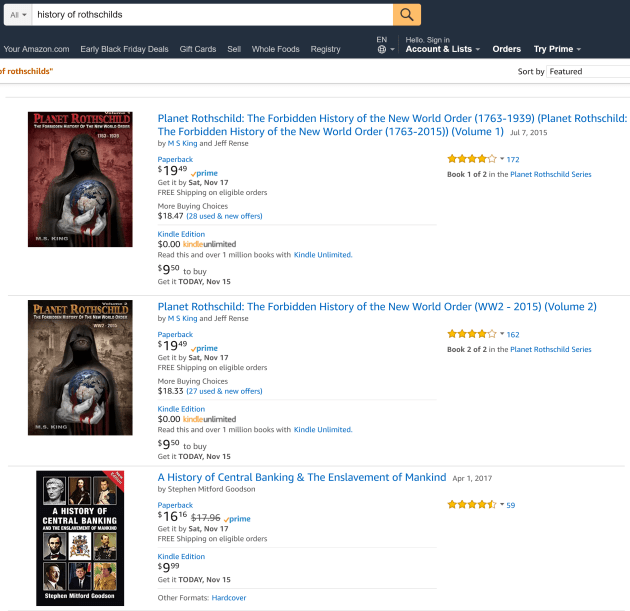
In the wake of the Pittsburgh massacre, I invited my followers on Twitter to send me their inquiries about anti-Semitism. The response was overwhelming, and ran the gamut from questions about specific aspects of the prejudice to requests for advice on how to help fight it. One reader asked for more information about the Rothschild family, the Jewish banking dynasty that is a favorite bogeyman of anti-Semites and is typically used as a stand-in for the Jewish conspiracy that purportedly controls world affairs. He explained that some in his circle of friends regularly make bigoted remarks about the Rothschilds and their vast power and he wanted to set them straight. I’d written a report about the Rothschilds in school years ago, but figured there was probably better, more up-to-date material out there. So like anyone else, I went to Amazon.com and plugged in “history of rothschilds.” To my surprise, this is what I got:

amazonrothschilds
Rather than direct me to serious scholarship on the Rothschilds, like historian Niall Ferguson’s multivolume history on the family, Amazon first recommended blatantly bigoted content.

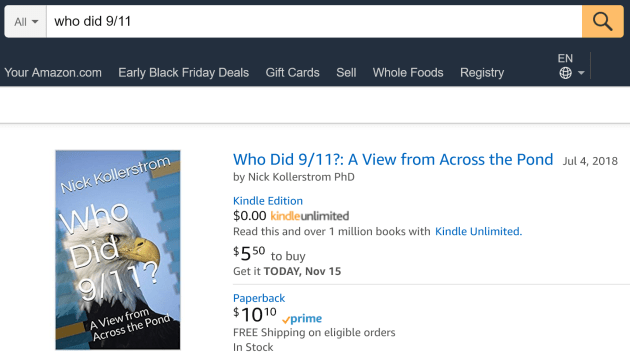
This isn’t the only instance of Amazon’s algorithm feeding intellectually bankrupt content to intellectually curious readers regarding fraught subjects. A search for “who did 9/11” yields this book as the #1 search result:

amazon911

As the book’s own blurb notes, its author, Nick Kollerstrom, is a “longtime member of Britain’s 9/11 truth group.” Among other conspiracies, the book contains an entire chapter entitled “9/11 and Zion” which blames the attack on the Jews. (Kollerstrom also happens to be a Holocaust denier who infamously declared, “Let us hope the schoolchildren visitors are properly taught about the elegant swimming pool at Auschwitz, built by the inmates, who would sunbathe there on Saturday and Sunday afternoons while watching the water polo matches.”)

Similarly, if one searches for “Jews and the slave trade,” the second, fourth, and fifth results are not scholarship on the subject, but notoriously anti-Semitic publications from Louis Farrakhan’s Nation of Islam. Farrakhan has worked for years to mainstream the baseless anti-Semitic conspiracy theory that Jews were behind the African slave trade.

(All searches above were done logged out from Amazon while incognito on Chrome, to ensure that the search results were the default ones, and not influenced by the specific user or their past search history.)

This isn’t Amazon’s first run-in with anti-Semitism concerns. Back in 2000, the company came under fire for stocking The Protocols of the Elders of Zion, one of the most influential anti-Semitic tracts in history. At the time, while firmly distancing itself from the bigoted content, Amazon insisted that it would not remove it from the catalog, because the company does not censor books. Today, copies of The Protocols on Amazon carry a cautionary message from the Anti-Defamation League and the following disclaimer from the company:

As a bookseller, Amazon strongly believes that providing open access to written speech, no matter how hateful or ugly, is one of the most important things we do. And because we think the best remedy for offensive speech is more speech, we also make available to readers the ability to make their own voices heard and express their views about this and all our titles in reviews and ratings.

It’s a reasonable defense. But it does not cover Amazon’s algorithm prioritizing the bigoted books over the legitimate ones.

The problem here is not that Amazon sells anti-Semitic material. The problem here is not that Amazon is trying to be anti-Semitic. It’s that the company is ignorant of anti-Semitic ideas, and so has not trained its algorithm to discount them. If a human librarian were asked about the Rothschilds, 9/11, or Jews and the slave trade, they would know how to distinguish between conspiratorial rantings and genuine documentation. They would also likely be aware of the anti-Semitic canards swirling around the subjects, and would steer interested readers away from them. Amazon’s vaunted search engine, perfectly tuned to maximize sales and the user’s shopping experience, has no such cultural competency.

Beyond the moral failure, these results also represent a straightforward professional failure. When a person searches for “history of rothschilds,” they are looking for historical information on the family, not a book featuring a shadowy figure squeezing blood out of globe. A bookselling algorithm that feeds readers misinformation is a broken bookselling algorithm.

If big tech companies like Amazon, Facebook, and Google want to get serious about combating online hate and misinformation, they need to start developing cultural competency on bigotry—and fast. They need not just coding experts working on their algorithms, but anti-hate experts who can flag conspiratorial currents. After all, it’s impossible for computers to identify a prejudice if they don’t know what it looks like. It’s about time we started teaching them.

Source: Amazon’s Algorithm Has an Anti-Semitism Problem

Trump Is Reshaping The Judiciary. A Breakdown By Race, Gender And Qualification

Good analysis with significant longer-term impact. Sharp contrast with Canadian judicial appointments under the current government where by my count, 56 percent are women, 9 percent visible minority and 3 percent Indigenous peoples:

The Trump administration has already written the opening chapters of what could be its most enduring legacy: the makeup of the federal courts.

In partnership with Senate Majority Leader Mitch McConnell, the Trump White House has secured lifetime appointments for 29 appeals court judges and 53 district court judges. That’s not to mention two Supreme Court nominees.

“He came into office with a mandate to nominate judges in the mold of Justice [Antonin] Scalia and Justice [Clarence] Thomas,” said Carrie Severino, chief counsel at the Judicial Crisis Network, which advocates for conservative judges. “That was a key reason he won the presidency.”

Supporters will celebrate that record this week at the annual convention of the Federalist Society, whose primary mission is to place conservatives on the courts.

The effort is so important to the Republican legal community and the party’s voting base that lawmakers have been holding hearings for nominees while the Senate was in recess, aiming to confirm those candidates in the lame-duck session scheduled before the end of the year.

Critics call this an abuse of the system and point out that all the Trump picks for the appeals courts and the Supreme Court tend to have something in common: most of them are white men.

“Of his 43 appellate nominations, none are African-American,” said Vanita Gupta of the Leadership Conference on Civil and Human Rights.

“None are Latino. Only nine are women. Our nation’s great diversity should be reflected in its government institutions, especially the federal judiciary, which serves as the guardian of our rights and liberties.”

Also notable, said Democratic Sen. Patrick Leahy of Vermont, is that the Republican-controlled Senate limited President Obama to two circuit court judge confirmations and 22 district court nominations during his final two years in office.

Obama’s choice for the Supreme Court, Merrick Garland, never got a hearing.

NPR aggregated these data from public sources and inquiries to judicial nominees. This presentation reflects the state of nominations formally sent to the Senate as of Nov. 14, 2018. View the full spreadsheet here.

Source: Trump Is Reshaping The Judiciary. A Breakdown By Race, Gender And Qualification

What has Germany really learned – and remembered – from Kristallnacht?

Good commentary with the lingering questions “What have we learned from the Shoah?”:

Last week, Germany memorialized the 80th anniversary of Kristallnacht – “the night of broken glass” – during which 1,400 synagogues and innumerable Jewish businesses throughout the country were vandalized. There were dozens of killings on that day, Nov. 9, 1938. At least 30,000 Jewish men were arrested and sent to concentration camps.

It was the visible unravelling of the old as a violent new social order was born, yet the savagery had not emerged from a void, as many have since argued. For almost a century, anti-Semitic speech had been increasingly normalized in public discourse. The brutality of Kristallnacht was an unsurprising outcome once a leader able to channel hatred arrived on the scene.

As the 2018 memorial date approached, the German government banned a planned protest march by far-right groups. This was a risky move in a liberal democracy, but necessary, according to Thomas Lutz, who heads the Memorial Museums Department of the Topography of Terror Foundation in Berlin. Mr. Lutz told me he encouraged the authorities to take preventative action. He belongs to the postwar generations who have made moral responsibility and Holocaust education their life’s work – a group that is being tested as never before. The radical Alternative for Germany party (AfD) is a serious threat to the German liberal consensus. Having entered the political mainstream in 2017, its leaders are hostile to foreigners and to Holocaust memorialization in the name of resurgent ethnic nationalism.

Two political streams are emerging where, until recently, there was only one. The AfD is increasing its support, but last week the older ethos was also visible when a 94-year-old former SS guard went on trial for crimes committed in Poland. “Germany owes it to the families and victims to prosecute these Nazi war crimes even today,” the prosecutor said. “This is a legal and moral question.”

No country has made greater efforts to atone for Second World War crimes than Germany, the perpetrator state. Since the 1970s, schoolchildren have learned about the Holocaust through history classes and mandatory visits to concentration camps. Museums such as Mr. Lutz’s superb Topography of Terror, which details the Nazi regime in words and pictures, have been erected. Small and large memorials pepper Berlin, including the massive and unsettling Holocaust Memorial near the famous Brandenburg Gate.

On the other hand, the former East Germany did not parallel this education. According to Communist ideology, there were no war criminals east of the Wall: they all lived in the West; a fiction that blocked acknowledgement and reflection. At reunification in 1990, the two cultures were largely strangers, and in the subsequent years, the promise of measurable gain has not materialized in much of the East. One can plot the growth of animosity. Simmering resentments soared in 2015 when Chancellor Angela Merkel allowed a million poorly vetted refugees into the country. Postwar taboos against racist speech loosened, possibly liberated by trash talk from the new U.S. President. Permission to spout hatred almost always radiates from the top.

On the anniversary last week, Ms. Merkel delivered a powerful address in a reconstructed synagogue in Berlin. She decried the “worrying” rise of anti-Semitism in her country. She called for the safeguarding of protective institutions and the liberal values that underpin them. And she asked the seminal question we once thought we had answers to, but has since become ambiguous: “What did we really learn from the Shoah, this rupture of civilization?”

“Democracy is complicated,” she said. “It relies on balance between majority and minority, on the division of powers.” Then she addressed an evident truth: Those who felt left behind were looking for simple, not complicated, answers – and they were finding them among racist nationalists.

Given its 20th-century history, the revival of right-wing German nationalism is a fearful prospect – not least to Germans themselves. Yet as important as it is to march in the streets, simple confrontation is not an effective strategy. New research suggests that cultural memory has a shelf life of 70 to 80 years – exactly the time that has elapsed since the Holocaust. Better solutions to the economic problems and social resentments of those who feel outstripped must be reimagined.

Angela Merkel is Europe’s wisest leader, but she has been fatally weakened by the political rise of the extreme right in both parts of her country. In her forthcoming absence, others must defend the democratic values she embodies and with which she has served her country.

Her question, “What have we learned from the Shoah?” hangs in the air.

Source: What has Germany really learned – and remembered – from Kristallnacht?

Racial profiling concerns raised after ‘DNA sweep’ targeting Middle Eastern men alleged in B.C.

Of note:

Civil liberties watchdogs say they’re troubled by a recent media report that suggested homicide investigators in B.C. targeted numerous Middle Eastern men in a voluntary DNA collection “sweep” as part of their investigation into the killing of a teenager.

The use of a DNA dragnet, they say, raises immediate concerns about racial profiling, coercion and the targeting of vulnerable populations, as well as questions about what’s done with DNA samples after they’ve been collected.

“If you’re trying to build trust in communities to further your investigation, make this something people will find credible,” said Micheal Vonn, policy director of the B.C. Civil Liberties Association.

The body of 13-year-old Marrisa Shen was found in a wooded area of Central Park in Burnaby, B.C., in July 2017, prompting a massive investigation that at its peak eclipsed 300 investigators.

Two months ago, the region’s Integrated Homicide Investigation Team (IHIT) announced that a suspect, Ibrahim Ali, 28, had been arrested and charged with first-degree murder. Ali, a permanent resident of Canada, had arrived in the country in March 2017 as a privately sponsored refugee from Syria.

Police would not say how they homed in on Ali. During their 14-month investigation, they canvassed more than 1,300 residents, conducted 600 interviews and identified and eliminated 2,000 “persons of interest.”  The killing was said to have been a random act.

This week, the Burnaby Now newspaper reported that prior to Ali’s arrest, police had approached numerous Middle Eastern men across the region — including those who escaped “persecution in totalitarian regimes” — asking them if they would voluntarily provide samples of their DNA.

One of those men, Ayub Faek, fled Iraq as a refugee and came to Canada in the early 2000s. He said homicide investigators called him out of the blue and asked if they could come talk to him.

“When they came, I asked them, ‘Why me?’ and they say, ‘Not only you; many people,’” Faek told the newspaper. “I said, ‘Do you have clue like about why, for example, me?’ Maybe they have clue. They didn’t tell me. They didn’t tell me anything.”

Faek said he was asked about his work and visits to the park and was shown Shen’s picture. He agreed to provide a sample of his blood from his finger. “You don’t want to do that … but you have to say yes,” he said.

The Burnaby Now also spoke with Ariyan Fadhil, another Burnaby resident who fled Iraq in the early 2000s. He said he was questioned in a van during his lunch break and agreed to give a DNA sample.

“I knew that, if they want, they’re going to get an order from court or something, I don’t know, to take it from me, so that’s why I gave it,” he said.

Both men told the paper they were skeptical about the assurances they got that their DNA samples would be destroyed after the investigation was complete.

Cpl. Frank Jang, a spokesman for IHIT, said in an email Wednesday that it would be improper to comment while the case is before the courts.

“What I can tell you is that IHIT strictly adheres to Canadian law and RCMP policy with respect to the handling of DNA exhibits.”

The RCMP’s website states that DNA profiles must be removed from a database in a “timely manner” if the donor asks for its removal or if it is no longer useful in the investigation for which it was obtained.

But Vonn said police agencies should take the extra step of providing written verification to people that samples have been destroyed.

“You should be able to take that to the bank,” she said.

As for the act of collecting DNA samples in the first place, Vonn said while it is described as voluntary, there’s still an inevitable “element of coercion” involved because if you don’t agree to give a sample, that could make you a target of suspicion.

“No doubt police are very alive to how delicate a balance this is,” she said. “In other cases, we’ve heard in media reports people say the officer made it clear, ‘You don’t do this. We’ll put you under a microscope.’”

The use of DNA sweeps has come under scrutiny in the past. In 2016, in response to a complaint, Ontario’s Office of the Independent Police Review Director examined the use of the technique by Ontario Provincial Police detectives investigating a sexual assault in Bayham, a rural municipality in southwestern Ontario.

While police succeeded in finding the culprit — a migrant worker from Trinidad — the review found that the DNA canvass carried out by police had been “overly broad.”

DNA was obtained from virtually “every local migrant worker of colour,” regardless of physical characteristics, the review found.

The scope of the DNA sweep “could reasonably be expected to have an impact on the migrant workers’ sense of vulnerability, lack of security and fairness. It could also send the wrong message to others in the local community about how migrant workers, as a group, should be regarded,” the review found.

And while DNA samples of those individuals cleared in the investigation were destroyed, the OPP “took no steps” to notify migrant workers this had taken place.

Dozens of migrant workers from that case have since filed complaints with the Human Rights Council of Ontario.

And one of those workers is the plaintiff in a proposed class-action lawsuit against the province of Ontario alleging that the results of DNA samples collected in this and other cases have been retained unlawfully.
Source: Racial profiling concerns raised after ‘DNA sweep’ targeting Middle Eastern men alleged in B.C.

Latinos Increasingly Concerned About Their Place In U.S. Society, Survey Finds

Hardly surprising given the language of President Trump and the impact of his policies:

One out of every two Latinos in the United States says that life has become more difficult for them in the past year, according to a recent survey by the Pew Research Center, a nonpartisan think tank in Washington, D.C.

Mark Lopez, director of global migration and demography research at Pew and a co-writer of the survey, says the findings reflect a turn “towards being pessimistic about the country, about the direction of the country and also the future for their own children.”

Lopez says Latinos have traditionally been more optimistic than the general U.S. population about life in the United States. “But that’s changed,” he says.

Nearly 4 in 10 Latinos say they experienced some kind of harassment related to their ethnicity in the past year.

Chart showing that four-in-ten Latinos experienced an incident and heard expressions of support tied to their background in the past year.

Yet a similar number say they have also heard expressions of support for Latinos.

The experience of 38-year-old Janet Sadriu illustrates both of these findings.

Sadriu was driving on a two-lane, 35 mile-an-hour city street in Houston recently when a driver passed her on the right, pulled next to her and started yelling obscenities at her at a red traffic light. She pulled out her phone and started recording him.

Houston resident Janet Sadriu recorded this video when a driver started yelling obscenities at her at a red traffic light.

“I don’t know him,” says Sadriu, “but he automatically assumed I’m Hispanic. I have black hair, I’m not blue-eyed and white.”

“Learn English,” he rants in the video. “It’s my country. Get out.”

Sadriu was born in Mexico. She’s a U.S. citizen and has lived in the United States since 2009.

“I was shocked and shaken,” she says. “I was afraid that this man was going to follow me and pull out a gun.”

Sadriu, whose 2-year-old daughter was in the car with her, filed a police report.

Sadriu says she was angry when she posted her video on social media. “I was thinking of other immigrants who are out of status,” she explained, “and who are afraid to speak up or ashamed and would not expose this man’s ugly behavior.” But she’s also hoping for change, so that “by the time my daughter is older, she is going to live in a world where all the racism and hate and bullying is gone.”

She says the response has been overwhelmingly kind and supportive.“People from all over don’t agree with this type of behavior,” she says.

According to the Pew survey, 38 percent of Latino respondents experienced similar incidents in the past year. Some said they were asked not to speak Spanish in public or were told to go back to their country.

Nearly two-thirds of Latino respondents say that Trump administration’s policies have been harmful to their communities. The survey found many Latinos are more worried about deportation and family separation. They are also more concerned about their personal finances than in past years, even though the country’s economy is doing well and Latino unemployment is at historic lows, according to Pew.

Social media documents harassment

Other recent examples of harassment include an incident in May, when a lawyer in Manhattan threatened to call ICE agents on the kitchen staff making his lunch.

Last month, a Colorado woman harassed two women for speaking Spanish at a supermarket.

At Andy’s Restaurant in Lovettsville, Va., in October, a Guatemalan family was accosted by a white woman finger-wagging at them for speaking Spanish. In the video, the woman is heard demanding, “show me your passports,” followed by, “go back to your f****** country.”

A response to the belligerent woman was posted on Andy’s Facebook pageby the restaurant owners. “Thank you for thinking that you have a right to express your venomous and vitriolic views — no matter how odious and ignorant — wherever and whenever you desire,” they posted. “Thank you —and we mean this with all the aforementioned respect that you rightfully deserve — for never returning to Andy’s. You are not welcome.”

Comments to Andy’s Facebook post quickly poured in from all over the country with words of support like Caroline Hart’s: “Thank god for human beings like you.”

Janet Sadriu, the Houston mom who experienced verbal harassment while driving “just for my looks,” has a message for Hispanics who encounter such harassment. She urges them “not to be afraid and speak up.” There are more good than bad people out there, she says.

Source: Latinos Increasingly Concerned About Their Place In U.S. Society, Survey Finds

Hate crimes in U.S. up 17 per cent in 2017, third consecutive year with increase

Latest numbers (Canadian numbers should be out shortly):

Hate crimes in the United States rose 17 per cent last year, the third consecutive year that such crimes increased, according to newly released FBI data.

Law enforcement agencies reported 7,175 hate crimes occurred in 2017, up from 6,121 in 2016. That increase was fueled in part by more police departments reporting hate crimes data to the FBI, but overall there is still a large number of departments that report no hate crimes to the federal database.

More than half of such crimes, about 3 of 5, targeted a person’s race or ethnicity, while about 1 of 5 targeted their religion.

Of the more than 7,000 incidents reported last year, 2,013 targeted black Americans, while 938 targeted Jewish Americans. Incidents targeting people for their sexual orientation accounted for 1,130 hate crimes, according to the FBI.

The FBI has urged local police departments to provide more complete information about hate crimes in their jurisdictions.

Of the more than 7,000 hate crime incidents in 2017, more than 4,000 were crimes against people, ranging from threats and intimidation to assault, to murder. More than 3,000 were crimes against property, ranging from vandalism to robbery to arson.

Acting Attorney General Matthew Whitaker said the new figures are “a call to action – and we will heed that call. The Department of Justice’s top priority is to reduce violent crime in America, and hate crimes are violent crimes. They are also despicable violations of our core values as Americans.”

Whitaker said he was “particularly troubled by the increase in anti-Semitic hate crimes,” which are already the most common type of religious hate crime in the United States.

Anti-Semitic hate crimes rose 37 per cent in 2017. Anti-Islamic hate crimes declined 11 per cent last year, with 273 such incidents, the data show.

Source: Hate crimes in U.S. up 17 per cent in 2017, third consecutive year with increase

How Stan Lee and His Marvel Superheroes Fought Against Racism

One of the better articles out regarding Stan Lee’s anti racism messages in his stories:

“It’s an extension of the fairy tales we read as kids. Or the monster stories or stories about witches and sorcerers. You get a little older, and you can’t bother with fairy tales and monster stories anymore, but I don’t think you ever outgrow your love for things that are fantastic, that are bigger than you are—the giants or the creatures from other planets or people with superpowers who can do things you can’t.” – Stan Lee

Stan Lee has passed away at age 95, and the famed “Smilin’ Stan” that the world knows as the face of Marvel Comics leaves behind a towering legacy. Lee created characters and told stories that reflected the struggle in American society between the idealized way we view ourselves and the harsh ugliness in our culture that is impossible to ignore. Born Stanley Martin Lieber in New York City, the beloved comics legend co-created iconic superheroes like Spider-Man, the Fantastic Four, The Incredible Hulk, Daredevil, the Avengers, the X-Men and Black Panther in the 1960s, helping to establish Marvel Comics as the foremost rival to longstanding D.C. Comics.

Lee’s characters and stories reflected the pathos in ‘60s culture—giving voice to adolescent angst via Spider-Man just as the youth culture boom of the decade was beginning to take hold; addressing then-current anxieties about space exploration via the Fantastic Four; using the Hulk as a metaphor for repression and government shadiness; and the X-Men functioned as a symbol for marginalized citizens’ fight for their right to exist. Alongside fellow luminaries such as Jack Kirby and Steve Ditko, Lee set Marvel apart not only by placing its super-powered protagonists in the middle of real-world troubles but beyond that, by giving voice to those issues. To fully appreciate what that means, one has to understand the cultural landscape when Lee rose through the ranks at Marvel.

In the mid-1950s, watchdog groups derided comic books as a scourge—a corrupting element in youth culture that promoted the occult, violence and deviancy. Lee and Kirby debuted Black Panther in 1966 in the pages of Fantastic Four. Marvel’s first black hero was prince of a fictional African nation called Wakanda and, despite some unfortunate characterizations (The Thing refers to the country as “Tarzan land” in an early panel), the presentation of a black superhero from Africa with supreme intellect and advanced technology was groundbreaking and indicative of what made Lee’s tenure special.

“Marvel has always been and always will be a reflection of the world right outside our window,” Lee said in a popular 2017 video. “That world may change and evolve, but the one thing that will never change is the way we tell our stories of heroism.

“Those stories have room for everyone, regardless of their race, gender or color of their skin. The only things we don’t have room for are hatred, intolerance and bigotry.”

Lee has talked about the popular X-Men as a metaphor for black Americans’ struggle for civil rights. In Marvel canon, the X-Men are part of a human subspecies called mutants, born with superhuman abilities and hated by much of humanity for what they are. It has been widely accepted that Charles Xavier, the X-Men’s idealistic founder, was loosely based on Martin Luther King, Jr.; while the team’s most famous foe, Magneto, was drawn from Malcolm X. Xavier believes that humans and mutants can peacefully coexist; Magneto believes mutants must overthrow humans before they are decimated by their hateful oppressors.

“I did not think of Magneto as a bad guy,” Lee once said. “He was just trying to strike back at the people who were so bigoted and racist. He was trying to defend mutants, and because society was not treating them fairly, he decided to teach society a lesson. He was a danger of course, but I never thought of him as a villain.”

“[Magneto] was just trying to strike back at the people who were so bigoted and racist. He was trying to defend mutants, and because society was not treating them fairly, he decided to teach society a lesson.”

Lee understood how comic books reflected and affected those who read them. He also understood that great storytelling connected with the times. It should be noted that the dynamic between Xavier and Magneto, in particular, evolved over time, and in the hands of various other writers like Chris Claremont, the parallels with King and X became more apparent. Lee was uneasy about Black Panther being associated with the revolutionary party of the same name (so much so that the character was almost rechristened “Black Leopard”) and Magneto’s background as a Holocaust survivor was another Claremont development. As was the case with many iconic, long-running comics heroes, Lee’s original vision was expanded upon, but the history of collaboration has often led to commentary about how much credit should go to Marvel’s most iconic creator.

Lee loved the fans and loved the spotlight, to the point where there was criticism that he was a glory hound. His penchant for self-promotion spawned criticism from former colleagues and observers, especially those who felt he’d overshadowed and taken credit from collaborators like Jack Kirby and Spider-Man co-creator Steve Ditko. Kirby, whose artwork came to define the Fantastic Four and X-Men, was a freelancer, as opposed to a Marvel employee like Lee.

“There was never a time when it just said ‘by Stan Lee,’” Lee told Playboyin 2015. “It was always ‘by Stan Lee and Steve Ditko’ or ‘by Stan Lee and Jack Kirby.’ I made sure their names were always as big as mine. As far as what they were paid, I had nothing to do with that. They were hired as freelance artists, and they worked as freelance artists. At some point they apparently felt they should be getting more money. Fine, it was up to them to talk to the publisher. It had nothing to do with me. I would have liked to have gotten more money, too.”

“Bigotry and racism are among the deadliest social ills plaguing the world today…The only way to destroy them is to expose them—to reveal them for the insidious evils they really are.”

Regardless of ongoing controversy surrounding the contributions of Kirby and others, Lee should be remembered for being an agent of change in his medium. A 1968 post from Lee’s mail column has been making the rounds in the wake of his death. In it, Lee makes plain his stance on racism.

“Let’s lay it right on the line. Bigotry and racism are among the deadliest social ills plaguing the world today. But, unlike a team of costumed super-villains, they can’t be halted with a punch in the snoot, or a zap from a ray gun. The only way to destroy them is to expose them—to reveal them for the insidious evils they really are. The bigot is an unreasoning hater—one who hates blindly, fanatically, indiscriminately. If his hang-up is black men, he hates ALL black men. If a redhead once offended him, he hates ALL redheads. If some foreigner beat him to a job, he’s down on ALL foreigners. He hates people he’s never seen—people he’s never known—with equal intensity—with equal venom.

“Now, we’re not trying to say it’s unreasonable for one human being to bug another. But, although anyone has the right to dislike another individual, it’s totally irrational, patently insane to condemn an entire race—to despise an entire nation—to vilify an entire religion. Sooner or later, we must learn to judge each other on our own merits. Sooner or later, if man is ever to be worthy of his destiny, we must fill our hearts with tolerance. For then, and only then, will we be truly worthy of the concept that man was created in the image of God—a God who calls us ALL—His children.”

Stan Lee’s creative voice helped reshape the role of comics in American society and helped affect how American society saw comics. In doing so, Lee helped challenge his readers and his peers. His characters live now as part of the fabric of our culture—in blockbuster movies, acclaimed TV shows, video games and a host of other media. Generations of comic-book lovers saw themselves in those characters, and that was what he’d wanted all along. As some quarters of America tell themselves that politics have no place in pop art, the proof in Stan Lee’s history reminds us that the message has always been a part of the medium. Those who believe otherwise maybe have to consider that they aren’t the “good guy” in the story. After all—you can’t be a hero if you don’t stand for anything.

Source: How Stan Lee and His Marvel Superheroes Fought Against Racism