On the complexities of identities and the sticking to tired tropes regarding immigration in the UK:
As a born and bred product of British multiculturalism, it’s hard for me to comprehend the ongoing demonisation of immigrants. Growing up in a mixed-race family was getting a new pencil case before the start of term; plastering Spice Girls posters on my wall; eating fish and chips on a Friday in the school canteen; Sundays spent wrapped in the love of my nana’s chicken curries, gulab jaman and jalebis.
My childhood feels typically British because multiculturalism is my norm – something that, in my lifetime, has been the bedrock of British culture and, historically, a source of great pride. Yet, in this post-Brexit climate, it’s hard not to notice the mood shifting.
At a time when global anti-immigrant sentiment is reaching fever pitch, a study claiming that four in 10 people believe multiculturalism has undermined British culture feels like sticking the knife in. It’s just another reminder to the UK’s migrant or minority ethnic communities that they will never be British enough.
It’s baffling to me that a sizeable minority of people could feel that British culture is being stifled by multiculturalism. Are we talking about the same tea-drinking culture that includes chicken tikka masala as a national dish and holds St George as its patron saint?
Researchers found negative opinions around Islam were often mentioned during panel discussions, with participants regularly citing the Rotherham and Rochdale sexual abuse scandals involving Asian men and white British girls. Those in rural areas also tended to have less positive views about immigration, according to the study.
It’s hard not to feel this is just the same lazy racism of the sort my family weathered in the 50s, 60s, 70s – and every decade since. It seems odd that Islam and Asian immigration are now automatically associated with the Rotherham and Rochdale scandals, yet I didn’t see white men being vilified following decades of child abuse scandals in the Catholic Church.
To those who don’t support multiculturalism, I’d love to ask: do you know any immigrant families? Have you taken the time to understand who they are or their stories? Or do you just hate people who don’t look like you? People are scared of what they don’t know but surely it’s time we stopped indulging ignorance. It’s hurtful and alienating to the millions of us whose legitimacy is placed second to the views of the xenophobic.
This constant othering of migrants, first-generation or otherwise, is tiring. I know immigration – and it’s not something to fear. My Muslim grandfather grew up in India, the son of an army officer supporting the British during World War II. He idolised British customs and since his arrival to the UK in the 50s has dedicated his life to working as a doctor for the NHS. He wears tweed and eats marmalade on toast – but he also attends his local mosque and eats lime pickle. Surely he’s as British as they come? And isn’t that exciting?
We have to stop conflating immigration with low-skilled workers and segregation of communities – it is bigoted and unrepresentative. No two immigrant families are the same, every family has their story. It’s frustrating to see the same tired tropes of British immigrants wheeled out with clockwork regularity – and the framing of this study feels particularly unhelpful.
It feels sad remembering how many times I tried to assimilate as a child and downplay my ethnicity – “no, but my mum was born here”, “we’re not really Indian Indian”, “we don’t eat Indian food that much” – trying to preempt the ignorant questioning that would follow as soon as I mentioned my heritage. But as an adult, I feel fiercely unapologetic, and increasingly unwilling to be an educator to those who need convincing why immigration is good.
The researchers did find a majority (59%) of those surveyed felt diversity brought by immigration had enriched British culture and 63% felt migrant workers supported the economy and brought valuable skills to the UK, so clearly all is not lost. These are the stats we need to be focusing on – the resounding consensus that multiculturalism is important and continues to make a valuable contribution to our society.
Instead of continuing this tired debate, we should be turning our attention to what it means to be British today, in all its richness and difference, and celebrating what makes our culture so unique. That’s where representation in media and popular culture becomes so important, along with social mobility in education and employment. It’s time the multiculturalism debate is taken off the table, because it’s already here. Multiculturalism has happened – deal with it.
One of the most eye-opening assignments of my undergraduate years was to watch three hours of prime-time network television, log every commercial and reflect on the general story that corporate America was telling the nation.
In the class discussion the day after, the professor emphasized that while politicians generally craft their messages to appeal to the immediate concerns of likely voters, corporate America is in the business of owning both the present and the future. Their goal is to develop brand loyalty in the key demographic of 18-49 year olds in the hopes that their products will be purchased both now and many years from now.
One of the things that we talked about in Professor Landay’s class was how white the commercials felt compared to the multiculturalism that was the University of Illinois in the mid-1990s. It felt like corporate America had not yet caught up to the shift in both demographics and tastes that was already a reality on American campuses.
That is no longer true.
Pay attention to the commercials during prime time these days and it seems obvious that corporate America has a really good idea about the future.
Consider this sample:
A relaxed Serena taking a jog through a funky outdoor market and using her Chase app to purchase a necklace she likes;
An intense Serena staring straight at the camera and channeling L.L Cool J saying ‘Momma’s Gonna Knock You Out’ (one of my favorite songs);
A mellow Colin Kaepernick in an impressive afro set against a city scene encouraging people to dream crazy dreams as a reel of largely female and minority athletes (Lebron, Serena, a black wrestler with no legs, a black football player with one hand, a girl who is both homecoming queen and a linebacker) achieve great things;
A hipster-nerdy white guy coming across a minority family who can’t agree on the music to play at their barbecue. He helps them with their tech issues and then puts in a vote for old reggaeton.
I resonate with these scenes, this music, these characters. They speak in the rhythms that I’m familiar with, reference songs I like, walk on streets that I recognize, nod at political views that I generally hold.
I’m a highly educated brown guy who lives in a city. Is it not abundantly clear that corporate America is signaling to the nation that the future belongs to people like me?
Look closely at this commercial by Apple for the Mac.
I see these characters every day. The chic women of color who are launching companies, the black writer trying to get a line in a poem just right, the ponytailed chef-owner figuring out what micro-roastery has the choicest espresso beans this season. These are the people who populate my world on the north side of Chicago.
Anybody in that Mac commercial look like they live in Cracker Barrel America and work at a steel mill or in a coal mine? Anybody look like a small town cop?
What’s the message that these commercials are sending to those folks?
There is simply no question that corporate America has a clear sense of where the puck is going – an urban, hipster, multicultural future – and is aggressively skating to it.
A part of me is celebrating. After all, I grew up not seeing myself on television, so to see my world on commercial after commercial, well, what’s not to like?
A part of me wonders how it feels to be someone else, those people who are in uncool America, working the jobs and living the lives that Apple commercials don’t feature. That’s who Paul Simon had in mind when he wrote the song Wristband:
The riots started slowly
With the homeless and the lowly
Then they spread into the heartland
Towns that never get a wristband
Kids that can’t afford the cool brand
Whose anger is a shorthand
For you’ll never get a wristband
And through it all I’ve got questions about culture and power.
Culture and power are central concepts for diversity progressives. Think Foucault, Bourdieu, Said, bell hooks, the Frankfurt school. The big idea here is that cultural portrayals and patterns have immense socio-political power. The way the “Orient” is imagined facilitates colonialism.
Perhaps because of this analysis, the kind of power that diversity progressives have sought (over the past couple of generations at least) is cultural power – the pages of the The New Yorker, professorships at Harvard, slots in cool film festivals. Consider that battle won.
As the Swet Shop Boys rap:
Trump want my exit, but if he presses a red button
To watch Netflix, bruv, I’m on
One of the upsides of this approach is that your worldview can dominate The New Yorker and you can still claim to be part of the cultural resistance. The New Yorker is elite but, relatively speaking, small.
But Nike, Apple and Chase Bank are not small. They shape attitudes and worldviews at a mass level. Commercial radio and Hollywood blockbusters do too. All of these massive engines of cultural power are pumping out the same messages. Those brown kids you dismissed as having funny names, weird religions and smelly food, we might have been on the margins thirty years ago, but we are very much at the center now. This is the age of Beyonce and Black Panther. There might be a cretin in the White House, but the culture is ours.
The trouble with this is not just who is left out, but how the people who are now on the inside understand themselves.
Because culture/power is not just a dispassionate analytical paradigm, it is a moral stance, an advocacy movement, an intervention intended to authorize a particular group of people to overthrow their colonizers and claim their agency. I remember reading the aforementioned writers as an undergraduate and feeling both righteous and empowered in the process. To be marginalized and oppressed was to be honorable and virtuous.
But the empire has not only struck back, it is strutting it on prime time. This has to affect how you teach Orientalism, right?
This is an interesting exercise by 6 Degrees, developing a pro-immigration interpretation of commonly used terms to help change the tenor of immigration discussions and debates. Of course, those with concerns over immigration could develop a version with a more negative slant.
My take, for what it’s worth, is that the wording chosen (e.g., “noble term,” “ferociously loyal”) overstates the more complex reality and mix behind each of the definitions.
It is surprising that they denigrate the word “integration” which was so seminal in the development of the Canadian approach to multiculturalism and diversity in making the distinction with “assimilation,” as expressed so eloquently in the 1960s Royal Commission on Bilingualism and Biculturalism Volume IV, The Cultural Contribution of the Other Ethnic Groups 5:
Integration, in the broad sense, does not imply the loss of an individual’s identity and original characteristics or of his original language and culture. Man is a thinking and sensitive being ; severing him from his roots could destroy an aspect of his personality and deprive society of some of the values he can bring to it. Integration is not synonymous with assimilation. Assimilation implies almost total absorption into another linguistic and cultural group. An assimilated individual gives up his cultural identity, and may even go as far as to change his name. Both integration and assimilation occur in Canada, and the individual must be free to choose whichever process suits him, but it seems to us that those of other than French or British origin clearly prefer integration.
And their definition of inclusion is overly open-ended, as there are limits to what should and can be included, although these evolve over time.
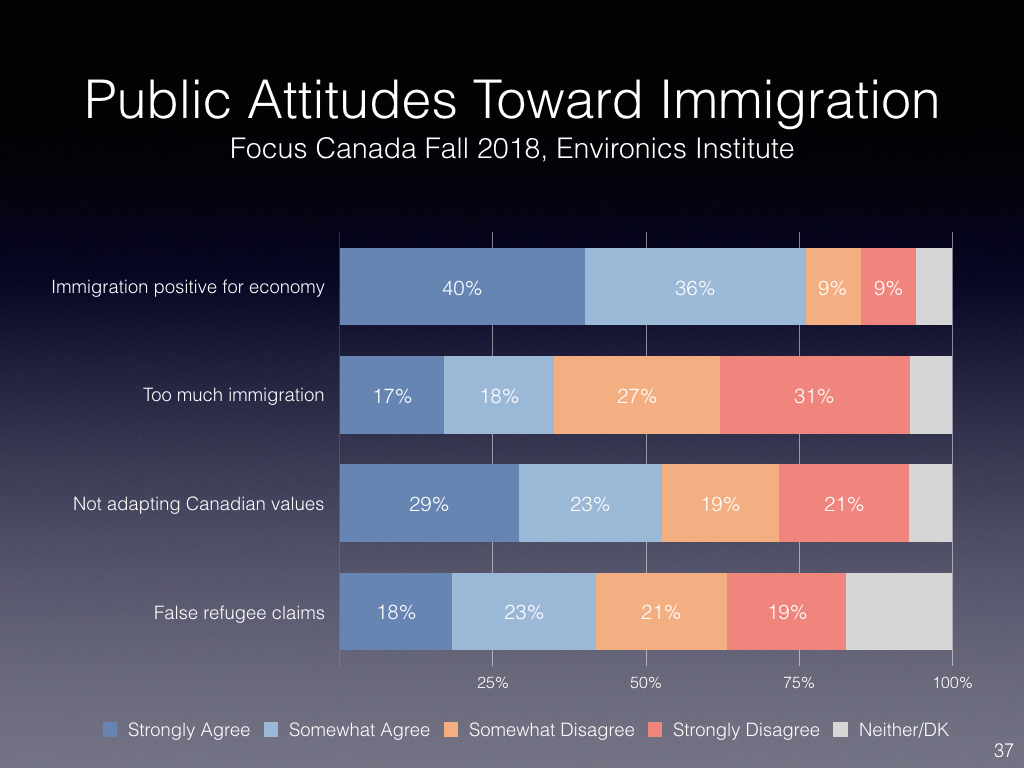
As a discussion tool among the like-minded, it provides some key messages for use in immigration conversations and discussions. I am less confident, however, how effective a discussion tool it would be to engage those with concerns about immigration numbers and the values of newcomers (a consistent concern in polling):
IMMIGRANT / noun. [From Latin immigrantem, “to go into, to move in,” origins in Latin emigrantem “to move away,” first used in English in 1794.]
1. An individual who leaves one country to become the citizen of another.
2. A noble term describing someone with the courage, decisiveness and consciousness to wish to change their lives by changing their country.
3. An individual whose qualities enrich their new society through public structures, culture, politics and economics.
4. On average, more comfortable with risk than those born in the country.
5. Tends to be more ferociously loyal to their new country and its ideas of justice than those born there.
6. An immigrant is to engagement what a citizen is to marriage.
REFUGEE / noun. [From French réfugié “gone in search of refuge;” From refuge.]
1. Someone who flees their home to save their life.
2. Not simply persecuted by others, as the legal definitions insist.
3. Victim of everything from war and prejudice to drought and economic collapse.
4. As in, a victim of calamity, human or nature-made. It could be you.
5. Or an identified enemy of the state, for example, someone who speaks up. It could be you.
6. In both cases, an attempt by those with power to dehumanize those without. It could be you.
7. Requires courage.
8. More popular than asylum seekers. Refugees may appeal to everyone’s fear of suffering, but an asylum seeker is a refugee looking for a place to live next door to you.
9. One who escapes despair, walks across the Sahara, is abused, raped, beaten, used as slave labour and finally risks their life on a boat only to be categorized by Europeans as economic migrants. A form of persecution.
INTEGRATION / noun. [From 1610s, to mean “act of bringing together the parts of a whole,” from French intégration, from Late Latin integrationem “to make whole.”]
1. Probably better than assimilation, but a poor second to inclusion.
2. Unfortunately assumed to be a benign process by which someone is incorporated into a society.
3. A step, once understood as the only one necessary for dominant groups to deal with others.
4. Assumes a list of adjustments that newcomers must make to become acceptable.
5. Views societies as static and brittle that will crumble upon contact with difference.
INCLUSION / noun. [From 1839, to mean “that which is included,” from 1600s, to mean “act of making a part of,” from Latin inclusionem “to shut in, to enclose.”]
1. The act of including, the state of being included, with unhelpful Latin roots.
2. Actually, the process of creating an authentic space for belonging, regardless of who you are or how long you have been here.
3. Once established, best left to grow on its own and shape itself.
4. Dead in the water if reduced to government policy.
5. Complicated by realistic expectations on an unrealistic timeline.
6. Essential for gauging a society’s fairness and spiritual health.
7. Ultimately, about learning how to live together.
POWER / noun. [From 1300s, “ability to act or do, authority, strength,” from Anglo-Norman French pouair, from Old French povoir, “to be able,” from Latin potis “powerful.”]
1. The possession of control, authority or influence over others.
2. An incontrovertible fact, present in all human interactions.
3. Can be found in right hands and wrong hands alike.
4. Historically housed in states, governments, armies and religions.
5. Now being challenged by new actors who seek to wield their own power to affect their desired outcomes outside these institutions.
6. For all that, still predominantly held by white men.
AGENCY / noun. [From medieval Latin agentia “effective, powerful,” from 1650s to mean: “active operation,” from 1670s to mean: “a mode of exerting power or producing effect.”]
1. Action personified. A grand aspiration of young Westerners in the early 21st century.
2. An ethical belief that the misdistribution of power must be corrected.
3. The determination to let silenced voices be heard.
4. An ability limited or amplified by structural factors, including class, age, gender, religion, education and ethnicity.
5. Often burdened by high expectations.
6. Frequently used by frustrated individuals driven to fury by political orthodoxy.
7. Tends to underestimate the power situated in legislatures, global institutions, corporations and their bureaucracies.
COMMUNITY / noun. [From Old French comunité “community, everybody,” from Latin communitatem “society, fellowship,” from communis “common, public, shared by all.”]
1. A group of individuals with shared commonality.
2. A self-declared body with collective religious, political, professional, social or even national affiliations.
3. A way to belong.
4. The experience of empowerment, legitimation, solidarity and security.
5. Gone wrong, a force of atomization, largely unintentional.
6. A term so overused it has triggered skepticism about its intentions.
DEMOCRACY / noun. [From French démocratie, from Medieval Latin democratia, from Greek demokratia “popular government,” from demos “common people” + kratos “rule, strength, power.”]
1. In trouble in 2018.
2. An expression of the citizen as the source of legitimacy of the state.
3. An idea that has steadily expanded to enfranchise all adults, including women, people of colour and Indigenous peoples.
4. A system once naively declared to be the endpoint of humanity’s political evolution.
5. Not as parochial as many believe, with roots in many places not named Greece.
6. For some, merged and acquired by private interests over the last half-century.
7. For others, pace Churchill, the least bad of all systems.
8. A form of government built on credible institutions but dependent on engaged citizens. One requires the other.
Expect it will go. Sad, given that one of the main activities was data collection, data needed to inform policy:
What will happen to the province’s anti-racism directorate?
For many who work in anti-racism, this has been the question since June, when Doug Ford’s Progressive Conservatives won the provincial election with a majority government.
Community members who worked closely with the anti-racism directorate say they’ve received no answers from the government, which controversially moved the directorate to a new ministry and recently disbanded its subcommittees.
Longtime anti-racism advocates who lived through the Mike Harris years are now having flashbacks to 1995, when his Conservative government was elected to Queen’s Park — and promptly moved to eliminate what was then called the anti-racism secretariat, established just a few years earlier.
Two decades would pass before the anti-racism body was revived by the Liberal government in 2016, amid controversy over carding and debate over the acceptance of Syrian refugees. But less than two years into its mandate, the body, this time labelled a “directorate,” has fallen back into the hands of a Conservative government and community activists worry the province’s anti-racism efforts are once again doomed to fail.
“It just feels like 1995 all over again, where we take two steps forward only to go three or four steps backwards,” said Nigel Barriffe, president of the Urban Alliance on Race Relations. “What we see is a very hard, right-wing government that I don’t believe has any intention of honouring the commitment that the previous government has made towards the anti-racism directorate’s strategy.”
There are already early signs that changes are coming to the directorate, which had a number of subcommittees, including four community groups that consulted on issues of anti-Black racism, anti-Indigenous discrimination, Islamophobia and anti-Semitism.
In early August, some members of the subcommittees told the Star they were contacted by staff and informed that their services would no longer be needed. “It was basically ‘Yep, your year is up, thank you very much,” said longtime Jewish rights advocate Bernie Farber, who co-chaired the anti-Semitism committee.
Farber said he and other members received no information about the future of the directorate, whose aim is to advance racial equity and address systemic racism in government policy legislation programs and services.
Nothing can be gleaned from Premier Ford’s mandate letters to ministers, either, which might clarify some of his intentions for the anti-racism directorate — the government is keeping these letters secret, even though they were publicly released under the previous administration.
The anti-racism directorate also ignored a list of questions sent by the Star on Aug. 20. These questions included: What is the directorate’s budget? What’s happening with the government-wide plans to collect race-based data? And what are the province’s priorities for the anti-racism directorate going forward?
“We don’t know anything,” said MPP Michael Coteau, who was previously the Liberal minister in charge of the directorate. “One of the most troubling pieces with the new government is that there’s been no transparency with regard to their mandate.”
“People are quite worried,” said MPP Laura Mae Lindo, the NDP critic for anti-racism. “You can’t approach anti-racism that way; you have to be transparent in what it is that you’re doing. You have to be willing to listen to the community organizations.”
To Barriffe, what the Ford government has been transparent on is its views toward issues that matter to racialized communities. He points to comments Ford made during his campaign where he expressed support for TAVIS, a now-defunct police unit that was heavily criticized for its negative impact on racialized communities. When the NDP recently introduced a motion to ban police carding — also known as “street checks,” which disproportionately affect people with black and brown skin — and destroy data collected through the practice, Conservative MPPs largely voted against it.
“I think that we have to believe what we see and what we see is them reversing all of the forward movement that we made in addressing anti-Black racism in society,” he said.
But Barriffe doesn’t necessarily think the Ford government will kill the anti-racism directorate outright. Rather, he suspects it will die from a thousand cuts — neglected and “defanged from its original purpose and intent.”
Already, the directorate has been relocated to the Ministry of Community Safety and Correctional Services, which is headed by MPP Michael Tibollo — the minister who was heavily criticized by opposition parties for making “blatantly racist” comments in July, when he described wearing a bulletproof vest during a visit to the Jane and Finch neighbourhood.
The move diminishes the directorate’s influence within the government, said Avvy Go, director of the Chinese & Southeast Asian Legal Clinic, who served on the directorate’s consultative body.
Previously, the directorate was based at the Cabinet Office. “The idea behind that was that anti-racism is important across the board, not just for any one ministry, and that all the ministries must pay attention to the issue of racism and finding ways of eliminating it,” she said. “Once you’ve slated it under one particular ministry, then we lose that cross-departmental knowledge-sharing and accountability measure.”
But the decision to move the directorate to this ministry — the same one in charge of police and prisons — also sends a troubling message, says longtime community activist Nene Kwasi Kafele, who also served on the consultation group with Go.
“The implication (is) that racism is simply an issue of policing and safety,” he said. “In my view, there’s some dog-whistle stuff around Black people and racialized communities being a danger, and therefore targeted approaches to them generally need to be subsumed under an area that addresses security and safety. It’s a terrible message.”
Lindo notes that the directorate, under the previous government, did have its flaws, however. For one, she believes it could have done a better job of folding in the work of community groups, many of which have already been on the front lines of anti-racism for decades.
Farber also has his criticisms of the directorate. He felt issues relating to anti-Semitism and Islamophobia were not prioritized as much as they should have been during the early stages of the directorate — though he started seeing signs of progress in the months leading up to the election.
“We started to make some headway; there were resources there that we were looking at to provide education on anti-Semitism,” Farber said. “And that’s what we were working towards, during the time leading up to the last provincial election. And then, quite frankly, things sort of grinded to a halt.”
Kafele points out, however, that while the directorate was just getting started, it did achieve some major accomplishments. The provincial government now has a legislative mandate towards combating racism in the province, he said, as well as a commitment to collecting disaggregated race data; commitments were also made towards underserved and marginalized populations, like Black youth in Ontario.
None of this existed back in the early ’90s, when both Kafele and Farber were involved with the anti-racism secretariat the first time around. And despite some of its early hiccups, Farber agrees the need for an anti-racism directorate is as urgent as ever, especially with the rise of right-wing extremist groups and an increasingly polarized political climate.
“The government gives (importance) to concepts like a buck-a-beer but not when it comes to racism, which has huge impacts on society,” Farber said. “The world is getting not just more complex but more dangerous, and we need to have policies and understandings in place as these issues go forward.”
Interesting discussion piece on the interface and compatibility of Muslims with liberal democracy and human rights. Some of the same concerns he raises, of course, can be applied to more traditional or fundamentalist strains of all religions.
Try substituting the names of other religions for Islam and Muslims to see some common threads:
MOHAMMAD FADEL, an associate law professor at the University of Toronto, is one of North America’s most thoughtful commentators on the interface between Islam, liberal democracy and Western understandings of the rule of law. He has made an elaborate case for the possibility of Muslims, including theologically conservative ones, finding a comfortable place in a diverse, noisy liberal democracy where many value systems co-exist. He draws on the ideas of John Rawls, perhaps the greatest American political philosopher of the late 20th century, to show that “public reason” can serve as a kind of common denominator between citizens with utterly different world views.
So it is sobering to find that in a newly published set of essays on Islam and the Western understanding of human rights, Mr Fadel puts more emphasis on difference than compatibility. His contribution is the sharpest of the essays, published by the Atlantic Council, an influential think-tank based in Washington, DC, under the title “The Islamic Tradition and the Human Rights Discourse”.
Mr Fadel artfully uses a Western source to show that basic concepts like freedom and happiness have one meaning for a liberal humanist and another for a theist idealist who sees the purpose of human life as devotion to God. For somebody in the latter camp, an addicted gambler is anything but free; but to the secular liberal, that way of life could simply be one way of exercising formal freedom.
Islamic thought about the family, as Mr Fadel adds, is oriented not only to the short-term happiness of individuals, and also to other perceived desirables such as “a reasonably stable household that produces a new generation of Muslims.” So Muslim thinkers could not be expected to see religiously mixed marriages in the same light as a secular libertarian would. He concludes that:
It is impossible to expect a complete convergence between human rights norms and Islamic norms: human rights norms are almost entirely concerned with securing the autonomy of individuals to make choices for themselves, while Islam is about influencing individuals’ choices about how to live their lives.
Asked if he had become more downbeat about Muslim communities finding a place in Western societies, Mr Fadel told Erasmus that he believed more passionately than ever in the need for such co-existence. But it was an observable fact that in Western societies, that effort was growing harder. Arguments, for example over female attire and the raising of children, suggest that in many Western countries, “liberals don’t trust Muslims, and therefore want to regulate their lives more closely, and Muslims don’t trust liberal society, which means they are less likely to have confidence in a neutral, rules-based political system and more likely to focus on their own communal life,” he says.
All the contributors to the new volume are themselves Muslim, and they bring to the subject of human rights concepts and assumptions that would be unfamiliar to most non-Muslims. Perhaps the most upbeat note is struck by the volume’s editor, H.A. Hellyer, who argues that Islam must rediscover the virtue of “rejuvenation”—new thinking about old texts and concepts—which, contrary to what many people say, is “deeply held within the Islamic tradition”. The oft-repeated proposition that in Islam, the gates of ijtihad (theological reasoning) were slammed shut a millennium ago is simply false, in Mr Hellyer’s view.
Another contributor is Mustafa Ceric, the grand mufti emeritus of Sarajevo, who makes a pointed rejoinder to Western critics of Islam. It takes the form of a riff on the word “dhimmitude”. Among contemporary Islamo-sceptics, that term has been used in two senses. It refers to the second-class but still protected status which traditional Muslim empires offered to non-Muslim, especially Christian and Jewish, subjects. Today’s sceptics also use the word to denounce Westerners who seem excessively deferential to Islam.
As Mr Ceric notes, the “dhimmi” status in Ottoman times did at least allow religious minorities to remain alive, as long as they were loyal and law-abiding. His co-religionists who suffered genocide in Bosnia did not benefit from any such concession. That is a fair point. But if we are to judge any religion (Islam, Christianity, even Buddhism) or secular creed (Marxism, nationalism, fascism) by the respect shown by its adherents for the right to life over the last couple of centuries, then none fares too well.
Good commentary by Ivison on the shallowness of Bernier’s thoughts on immigration and his new party, the People’s Party of Canada:
Maxime Bernier is set to reveal details about his new party, including its name Friday in Ottawa.
In an interview in his Parliament Hill office late Thursday, he admitted he has registered the People’s Party of Canada but that he also likes the Citizens’ Party.
Whatever Canada’s newest party ends up being called, some of its traits are already clear, and others will become less opaque after the press conference.
It is apparent, for example, that Bernier will oppose corporate welfare in all its forms, as he has done so since he told a bicycle factory owner in his riding of the Beauce, Que., that as Conservative industry minister he would not support quotas on cheap Chinese bicycles because it would increase the price of bikes for all Canadians.
We know that Bernier will advocate for an end to the cartel of supply management for dairy and poultry — a system he argues is unfair and regressive for low-income earners. This has been another Bernier staple for more than a decade.
“People are fed up of politicians who say one thing one day and another the day after. What I’m looking for is doing politics like I believe. People like authenticity and I think I have the courage of my convictions and am authentic. That’s why people like what I’m doing,” he said.
But when we discuss the murky topic of what he calls “extreme multiculturalism” there is a sense that Maxime Bernier is not as authentic as he would like you to believe.
He makes much of the fact that he is not looking to promote policies simply to win votes. “I’m very different from other politicians,” he said.
But elected officials tend not to be that distinct from one another — the business of reaching for power contorts them all in similar fashion.
On the diversity issue that sparked such controversy when he suggested on Twitter that there should be limits, Bernier’s thinking sounds muddled. He denies he’s playing the race card, invoking dog-whistle politics or engaging in the same nativism that resulted in him lampooning former Conservative leadership rival Kellie Leitch as a “Karaoke Trump.”
But when I suggested his references to “diversity” led many people to assume he is referring to people of colour, his denial ends up sounding like an affirmation.
“They are misinterpreting what I am saying. When I talk about diversity, I am talking about diversity of opinion, diversity of values, diversity of what you believe,” he said. “I’ll give you an example, if you have two people coming to Canada and one of them wants to kill Jewish people and the other one doesn’t, are we better to have two people who believe in different things or two people coming to Canada who don’t want to kill Jewish people?”
A charitable interpretation is that Bernier is musing aloud, that he hasn’t really thought it through and the example quoted came to him in the moment.
I remind him that in the Conservative leadership platform that will form the basis for the new party’s policies, he described tolerance for diversity as a “Canadian value.”
“I still believe that,” he said, before adding quickly, “I don’t believe in mass immigration.”
The leadership platform advocated the admission of 250,000 new entrants a year — a figure in line with the Harper government’s average intake.
Yet, the Trudeau Liberals have increased the level to 310,000 this year, a number the Conference Board of Canada said will help sustain long-term economic growth, given the rapidly aging population and low birth rate. The number is high by historic levels but reflects that the number of deaths will outpace the birth rate by the 2030s.
On the one hand, Bernier says he believes in immigration in line with the economic needs of the country but, on the other, says the rate should be reduced from the target that many economists believe will help drive growth.
The reasons are not clear.
“I believe in unity also — sharing the same values. Diversity is good. This country is built on diversity and people coming from different religions and points of view,” he said. “But what I’m asking is that the people coming to Canada share our Canadian values — respect for rule of law, equality of men and women, the tolerance of diversity. What I’m asking is that if you come to Canada, you must share our Canadian core values.”
I ask him if he thinks there is a problem with integration of immigrants, given studies suggest employment, earnings and language outcomes between second-generation visible minority groups and whites with Canadian-born parents are negligible; that the children of immigrants learn Canadian values, social norms and official languages through schools, friends and neighbourhoods, all of which makes Canada a model for integration. Is he focusing on a non-existent problem?
“I’m saying we must question this extreme multiculturalism — people who come must integrate and yes, you’re right, they are doing (that). The history of immigration in Canada is great, it’s very positive. The change has happened under the Trudeau government. People who come here have more points if they speak English, they have more points if they speak French, so we have a system and the system was working for the last half century. The Trudeau government changed that in this mandate. I’m saying we must go back to what we did in the past.”
Trudeau’s track record is certainly wide open to criticism. This year just 57 per cent of immigrants will come from the economic class, compared to 63 per cent of the 260,411 entrants in the last full year of the Harper government (28 per cent will be family class, compared to 25 per cent in 2014, while 14 per cent are set to be refugees, in contrast to just 11 per cent four years ago).
The changes to increase family unification numbers by 20,000 people a year were transparent electoral bribes to immigrant communities in the suburbs.
But Bernier hasn’t made the thoughtful policy case for reversing those changes. Instead he has made vaguely illiberal noises that attract the kind of fellow travellers who do not respect the values the leader of Canada’s newest political party claims to espouse — equality, respect for the law and tolerance of diversity. Anyone who has followed Maxime Bernier’s career over the past decade or more knows it is just not him. Authentic? Not so much.
Another good contribution to ongoing debates about multiculturalism:
Maxime Bernier has argued that multiculturalism is a divisive policy that encourages Canadians to identify with their own “tribes” at the expense of their wider society. But there’s abundant evidence that, far from dividing Canadians into factions and hyphenated identities, multiculturalism (or “interculturalism” in Quebec) actually encourages belonging, participation and integration. Critically, it does this by treating all Canadians – not just immigrants – as part of the country’s multicultural fabric (with the exception of the 5 per cent of people in Canada who are Indigenous, few of whom would see themselves as part of the multicultural experiment).
Let’s clarify our terms. “Multiculturalism” refers to a specific policy framework with a history – it was adopted in 1971 – and a budget. The 2018 federal budget allocated $23-million for “multiculturalism” programs over the next two years, primarily the development of a national anti-racism strategy and support for community groups working to help newcomers integrate. That sum is a fraction of 1 per cent of the total federal budget expenditures of about $338-billion.
But multiculturalism is also something less concrete and more powerful: it’s a sensibility that millions of Canadians have adopted as they navigate diversity in daily life in their communities.
We believe that in most places the sensibility of multiculturalism boils down to two key elements. One is simple respect for diversity of race, ethnicity, culture and religion: the sense that diversity is normal, not a problem to be solved. The other is acceptance of the idea that integration works best when it works both ways: Newcomers should do their best to adapt, and those who came before have a role to play in creating environments that support that integration. You can’t integrate into a group that refuses to accept you or treat you fairly.
The idea of multiculturalism pervades Canadian institutions: public schools, neighbourhoods, workplaces, civic life and politics. And this is true far beyond Canada’s three largest cities. Resource jobs have drawn tens of thousands of newcomers to smaller centres in Alberta and Saskatchewan; Atlantic Canada has been courting settlement aggressively; and the Northwest Territories recently recorded its largest-ever immigrant inflow. As communities across Canada become more diverse, they begin to draw on the formal practices and informal habits that constitute day-to-day multiculturalism.
We believe both the policy and practice of multiculturalism help to explain why 85 per cent of immigrants eventually become citizens, which is a higher naturalization rate than in other major immigrant-receiving countries. Citizenship, in turn, enables voting and other forms of political participation; 46 sitting MPs were born outside Canada – the highest share of foreign-born legislators in any country. (And, no, these MPs are not just elected by members of their own groups; only four ridings in Canada are dominated by a single minority ethno-cultural group.)
Multiculturalism is so much a part of our society that in a recent Environics Focus Canada survey, in response to an open-ended question (no response categories provided) about what makes Canada unique, the overwhelming first choice was “multiculturalism/diversity.” It’s true that Canadians sometimes like the general idea of multiculturalism more than they like specific real-life implications – but this doesn’t make multiculturalism meaningless. For one thing, even the aspiration toward genuine inclusion and equity for all groups is not one that all societies share. Multicultural principles have also given rise to many concrete accommodations that have reshaped both daily life and familiar symbols such as police and military uniforms.
When asked what values immigrants should adopt, those born in Canada and those born elsewhere give the same top answers: respect for Canada’s history and culture comes first, followed by knowledge of English or French, tolerance of other people and religions and respect for the law.
Large majorities across both groups believe immigrants can be just as good citizens as anyone born here. Immigrants tend to express slightly more pride in Canada than the Canadian-born do, although large majorities of both groups are proud of their country. The vast majority of immigrants identify more with Canada (78 per cent) than with their country of birth (12 per cent).
The architects of the original policy framework of multiculturalism might not have anticipated that it would become so central to the national identity, or so deeply embraced by people whose ancestors fit easily into old, colonial ideas of monocultural or bicultural Canada.
But while they might not have foreseen the exact contours of contemporary Canada, they did understand the importance of a strong social fabric. Canadian multiculturalism has always aimed at integration, not fragmentation. Three of the four original pillars of the policy focused on participation and inclusion, while only one committed to supporting groups’ efforts to sustain their heritage cultures.
Almost a half-century later, multiculturalism is larger and deeper than a government policy. It’s notable that our surveys find Canadians’ identification with multiculturalism varies so little according to migration status and identity group. If Mr. Bernier intends to attack Canadian multiculturalism, his opponents will include Canadians from every corner of the globe, and plenty of Canadians whose families have been here for generations. In other words, they’ll look a lot like Canada.
Long read, written in 1916. While somewhat dated in terms of examples (e.g., only in context of European immigration) and language, captures well the distinction between assimilation and integration:
Though the United States would not enter World War I for another year, by 1916 the ethnic animosities tearing Europe apart could be felt keenly within American communities. Immigration rates had soared in the preceding decades—in 1910, nearly 15 percent of the population had been born outside of the United States. The growing number of new arrivals was regarded with resentment and suspicion from many native-born Americans. As the conflict unfolded overseas, those feelings only intensified.
The progressive writer Randolph S. Bourne recognized the rising tension, and in July 1916 he responded by challenging not only the idea that immigrants posed a threat to American democracy, but also the ideal of a “melting pot” that would assimilate the nation’s diverse population.
“We act as if we wanted Americanization to take place only on our own terms, and not by the consent of the governed,” he wrote. But, he continued, “America shall be what the immigrant will have a hand in making it, and not what a ruling class, descendant of those British stocks which were the first permanent immigrants, decide that America shall be made.”
The bitterness directed toward newcomers would soon thereafter be codified into restrictive new immigration quotas that perpetuated racial and ethnic discrimination. But Bourne offered a hopeful alternative to that ethno-nationalist antagonism, imagining an Americanism that could be broadened, strengthened, and united by embracing persistent cultural differences rather than one that closed itself off to them. — Annika Neklason
No reverberatory effect of the great war has caused American public opinion more solicitude than the failure of the ‘melting-pot.’ The discovery of diverse nationalistic feelings among our great alien population has come to most people as an intense shock. It has brought out the unpleasant inconsistencies of our traditional beliefs. We have had to watch hard-hearted old Brahmins virtuously indignant at the spectacle of the immigrant refusing to be melted, while they jeer at patriots like Mary Antin who write about ‘our forefathers.’ We have had to listen to publicists who express themselves as stunned by the evidence of vigorous nationalistic and cultural movements in this country among Germans, Scandinavians, Bohemians, and Poles, while in the same breath they insist that the mien shall be forcibly assimilated to that Anglo-Saxon tradition which they unquestioningly label ‘American.’
As the unpleasant truth has come upon us that assimilation in this country was proceeding on lines very different from those we had marked out for it, we found ourselves inclined to blame those who were thwarting our prophecies. The truth became culpable. We blamed the war, we blamed the Germans. And then we discovered with a moral shock that these movements had been making great headway before the war even began. We found that the tendency, reprehensible and paradoxical as it might be, has been for the national clusters of immigrants, as they became more and more firmly established and more and more prosperous, to cultivate more and more assiduously the literatures and cultural traditions of their homelands. Assimilation, in other words, instead of washing out the memories of Europe, made them more and more intensely real. Just as these clusters became more and more objectively American, did they become more and more German or Scandinavian or Bohemian or Polish.
To face the fact that our aliens are already strong enough to take a share in the direction of their own destiny, and that the strong cultural movements represented by the foreign press, schools, and colonies are a challenge to our facile attempts, is not, however, to admit the failure of Americanization. It is not to fear the failure of democracy. It is rather to urge us to an investigation of what Americanism may rightly mean. It is to ask ourselves whether our ideal has been broad or narrow—whether perhaps the time has not come to assert a higher ideal than the ‘melting-pot.’ Surely we cannot be certain of our spiritual democracy when, claiming to melt the nations within us to a comprehension of our free and democratic institutions, we fly into panic at the first sign of their own will and tendency. We act as if we wanted Americanization to take place only on our own terms, and not by the consent of the governed. All our elaborate machinery of settlement and school and union, of social and political naturalization, however, will move with friction just in so far as it neglects to take into account this strong and virile insistence that America shall be what the immigrant will have a hand in making it, and not what a ruling class, descendant of those British stocks which were the first permanent immigrants, decide that America shall be made. This is the condition which confronts us, and which demands a clear and general readjustment of our attitude and our ideal.
* * *We are all foreign-born or the descendants of foreign-born, and if distinctions are to be made between us, they should rightly be on some other ground than indigenousness. The early colonists came over with motives no less colonial than the later. They did not come to be assimilated in an American melting pot. They did not come to adopt the culture of the American Indian. They had not the smallest intention of ‘giving themselves without reservation’ to the new country. They came to get freedom to live as they wanted to. They came to escape from the stifling air and chaos of the old world; they came to make their fortune in a new land. They invented no new social framework. Rather they brought over bodily the old ways to which they had been accustomed. Tightly concentrated on a hostile frontier, they were conservative beyond belief. Their pioneer daring was reserved for the objective conquest of material resources. In their folkways, in their social and political institutions, they were, like every colonial people, slavishly imitative of the mother country. So that, in spite of the ‘Revolution,’ our whole legal and political system remained more English than the English, petrified and unchanging, while in England law developed to meet the needs of the changing times.
It is just this English-Americanconservatism that has been our chief obstacle to social advance. We have needed the new peoples—the order of the German and Scandinavian, the turbulence of the Slav and Hun—to save us from our own stagnation. I do not mean that the illiterate Slav is now the equal of the New Englander of pure descent. He is raw material to be educated, not into a New Englander, but into a socialized American along such lines as those thirty nationalities are being educated in the amazing school of Gary. I do not believe that this process is to be one of decades of evolution. The spectacle of Japan’s sudden jump from medievalism to post-modernism should have destroyed the superstition. We are not dealing with individuals who are to ‘evolve.’ We are dealing with their children, who with that education we are about to have, will start level with all of us. Let us cease to think of ideals like democracy as magical qualities inherent in certain peoples. Let us speak, not of inferior races, but of inferior civilizations. We are all to educate and to be educated. These peoples in America are in a common enterprise. It is not what we are now that concerns us, but what this plastic next generation may become in the light of a new cosmopolitan ideal.
We are not dealing with static factors, but with fluid and dynamic generations. To contrast the older and the newer immigrants and see the one class as democratically motivated by love of liberty, and the other by mere money-getting, is not to illuminate the future. To think of earlier nationalities as culturally assimilated to America, while we picture the later as a sodden and resistive mass, makes only for bitterness and misunderstanding. There may be a difference between these earlier and these later stocks, but it lies neither in motive for coming nor in strength of cultural allegiance to the homeland. The truth is that no more tenacious cultural allegiance to the mother country has been shown by any alien nation than by the ruling class of Anglo-Saxon descendants in these American States. English snobberies, English religion, English literary styles, English literary reverences and canons, English ethics, English superiorities, have been the cultural food that we have drunk in from our mothers’ breasts. The distinctively American spirit—pioneer, as distinguished from the reminiscently English—that appears in Whitman and Emerson and James, has had to exist on sufferance alongside of this other cult, unconsciously belittled by our cultural makers of opinion. No country has perhaps had so great indigenous genius which had so little influence on the country’s traditions and expressions. The unpopular and dreaded German-American of the present day is a beginning amateur in comparison with those foolish Anglophiles of Boston and New York and Philadelphia whose reversion to cultural type sees uncritically in England’s cause the cause of Civilization, and, under the guise of ethical indepenence of thought, carries along European traditions which are no more ‘American’ than the German categories themselves.It speaks well for German-American innocence of heart or else for its lack of imagination that it has not turned the hyphen stigma into a ‘Tu quoque!’ If there were to be any hyphens scattered about, clearly they should be affixed to those English descendants who had had centuries of time to be made American where the German had had only half a century. Most significantly has the war brought out of them this alien virus, showing them still loving English things, owing allegiance to the English Kultur, moved by English shibboleths and prejudice. It is only because it has been the ruling class in this country that bestowed the epithet that we have not heard copiously and scornfully of ‘hyphenated English Americans.’ But even our quarrels with England have had the bad temper, the extravagance, of family quarrels. The Englishman of to-day nags us and dislikes us in that personal, peculiarly intimate way in which he dislikes the Australian, or as we may dislike our younger brothers. He still thinks of us incorrigibly as ‘colonials.’ America—official, controlling, literary, political America—is still, as a writer recently expressed it, ‘culturally speaking, a self-governing dominion of the British Empire.’
The non-English American can scarcely be blamed if he sometimes thinks of the Anglo-Saxon predominance in America as little more than a predominance of priority. The Anglo-Saxon was merely the first immigrant, the first to found a colony. He has never really ceased to be the descendant of immigrants, nor has he ever succeeded in transforming that colony into a real nation, with a tenacious, richly woven frabric of native culture. Colonials from the other nations have come and settled down beside him. They found no definite native culture which should startle them out of their colonialism, and consequently they looked back to their mother-country, as the earlier Anglo-Saxon immigrant was looking back to his. What has been offered the newcomer has been the chance to learn English, to become a citizen, to salute the flag. And those elements of our ruling classes who are responsible for the public schools, the settlements, all the organizations for amelioration in the cities, have every reason to be proud of the care and labor which they’ve devoted to absorbing the immigrant. His opportunities the immigrant has taken to gladly, with almost pathetic eagerness to make his way in the new land without friction or disturbance. The common language has made not only for the necessary communication, but for all the amenities of life.If freedom means the right to do pretty much as one pleases, so long as one does not interfere with others, the immigrant has found freedom, and the ruling element has been singularly liberal in its treatment of the invading hordes. But if freedom means a democratic cooperation in determining the ideals and purposes and industrial and social institutions of a country, then the immigrant has not been free, and Anglo-Saxon element is guilty of just what every dominant race is guilty of in every European country: the imposition of its own culture upon the minority peoples. The fact that this imposition has been so mild and, indeed, semi-conscious does not alter its quality. And the war has brought out just the degree to which that purpose of ‘Americanizing,’ that is, ‘Anglo-Saxonizing,’ the immigrant has failed.
For the Anglo-Saxon now in his bitterness to turn upon the other peoples, talk about their ‘arrogance,’ scold them for not being melted in a pot which never existed, is to betray the unconscious purpose which lay at the bottom of his heart. It betrays too the possession of a racial jealousy similar to that of which he is now accusing the so called ‘hyphenates.’ Let the Anglo Saxon be proud enough of the heroic toil and heroic sacrifices which moulded the nation. But let him ask himself, if he had had to depend on the English descendants, where he would have been living to-day. To those of us who see in the exploitation of unskilled labor the strident red leit-motif of our civilization, the settling of the country presents a great social drama as the waves of immigration broke over it.
Let the Anglo-Saxon ask himself where he would have been if these races had not come? Let those who feel the inferiority of the non-Anglo-Saxon immigrant contemplate that region of the States which has remained the most distinctively ‘American,’ the South. Let him ask himself whether he would really like to see the foreign hordes Americanized into such an Americanization. Let him ask himself how superior this native civilization is to the great ‘alien’ states of Wisconsin and Minnesota, where Scandinavians, Poles, and Germans have self-consciously labored to preserve their traditional culture, while being outwardly and satisfactorily American. Let him ask himself how much more wisdom, intelligence, industry and social leadership has come out of these alien states than out of all the truly American ones. The South, in fact, while this vast Northern development has gone on, still remains an English colony, stagnant and complacent, having progressed culturally scarcely beyond the early Victorian era. It is culturally sterile because it has had no advantage of cross-fertilization like the Northern states. What has happened in states such as Wisconsin and Minnesota is that strong foreign cultures have struck root in a new and fertile soil. America has meant liberation, and German and Scandinavian political ideas and social energies have expanded to a new potency. The process has not been at all the fancied ‘assimilation’ of the Scandinavian or Teuton. Rather has it been a process of their assimilation of us—I speak as an Anglo-Saxon. The foreign cultures have not been melted down or run together, made into some homogeneous Americanism, but have remained distinct but cooperating to the greater glory and benefit not only of themselves but of all the native ‘Americanism’ around them.* * *
What we emphatically do not want is that these distinctive qualities should be washed out into a tasteless, colorless fluid of uniformity. Already we have far too much of this insipidity, — masses of people who are cultural half-breeds, neither assimilated Anglo-Saxons nor nationals of another culture. Each national colony in this country seems to retain in its foreign press, its vernacular literature, its schools, its intellectual and patriotic leaders, a central cultural nucleus. From this nucleus the colony extends out by imperceptible gradations to a fringe where national characteristics are all but lost. Our cities are filled with these half-breeds who retain their foreign names but have lost the foreign savor. This does not mean that they have actually been changed into New Englanders or MiddleWesterners. It does not mean that they have been really Americanized. It means that, letting slip from them whatever native culture they had, they have substituted for it only the most rudimentary American—the American culture of the cheap newspaper, the ‘movies,’ the popular song, the ubiquitous automobile. The unthinking who survey this class call them assimilated, Americanized. The great American public school has done its work. With these people our institutions are safe. We may thrill with dread at the aggressive hyphenate, but this tame flabbiness is accepted as Americanization. The same moulders of opinion whose ideal is to melt the different races into Anglo-Saxon gold hail this poor product as the satisfying result of their alchemy.
Yet a truer cultural sense would have told us that it is not the self-conscious cultural nuclei that sap at our American life, but these fringes. It is not the Jew who sticks proudly to the faith of his fathers and boasts of that venerable culture of his who is dangerous to America, but the Jew who has lost the Jewish fire and become a mere elementary, grasping animal. It is not the Bohemian who supports the Bohemian schools in Chicago whose influence is sinister, but the Bohemian who has made money and has got into ward politics. Just so surely as we tend to disintegrate these nuclei of nationalistic culture do we tend to create hordes of men and women without a spiritual country, cultural outlaws, without taste, without standards but those of the mob. We sentence them to live on the most rudimentary planes of American life. The influences at the centre of the nuclei are centripetal. They make for the intelligence and the social values which mean an enhancement of life. And just because the foreign-born retains this expressiveness is he likely to be a better citizen of the American community. The influences at the fringe, however, are centrifugal, anarchical. They make for detached fragments of peoples. Those who came to find liberty achieve only license. They become the flotsam and jetsam of American life, the downward undertow of our civilization with its leering cheapness and falseness of taste and spiritual outlook, the absence of mind and sincere feeling which we see in our slovenly towns, our vapid moving pictures, our popular novels, and in the vacuous faces of the crowds on the city street. This is the cultural wreckage of our time, and it is from the fringes of the Anglo-Saxon as well as the other stocks that it falls. America has as yet no impelling integrating force. It makes too easily for this detritus of cultures. In our loose, free country, no constraining national purpose, no tenacious folk-tradition and folk-style hold the people to a line.The war has shown us that not in any magical formula will this purpose be found. No intense nationalism of the European plan can be ours. But do we not begin to see a new and more adventurous ideal? Do we not see how the national colonies in America, deriving power from the deep cultural heart of Europe and yet living here in mutual toleration, freed from the age-long tangles of races, creeds, and dynasties, may work out a federated ideal? America is transplanted Europe, but a Europe that has not been disintegrated and scattered in the transplanting as in some Dispersion. Its colonies live here inextricably mingled, yet not homogeneous. They merge but they do not fuse.
America is a unique sociological fabric, and it bespeaks poverty of imagination not to be thrilled at the incalculable potentialities of so novel a union of men. To seek no other goal than the weary old nationalism, — belligerent, exclusive, inbreeding, the poison of which we are witnessing now in Europe, — is to make patriotism a hollow sham, and to declare that, in spite of our boastings, America must ever be a follower and not a leader of nations.
II
If we come to find this point of view plausible, we shall have to give up the search for our native ‘American’ culture. With the exception of the South and that New England which, like the Red Indian, seems to be passing into solemn oblivion, there is no distinctively American culture. It is apparently our lot rather to be a federation of cultures. This we have been for half a century, and the war has made it ever more evident that this is what we are destined to remain. This will not mean, however, that there are not expressions of indigenous genius that could not have sprung from any other soil. Music, poetry, philosophy, have been singularly fertile and new. Strangely enough, American genius has flared forth just in those directions which are least understanded of the people. If the American note is bigness, action, the objective as contrasted with the reflective life, where is the epic expression of this spirit? Our drama and our fiction, the peculiar fields for the expression of action and objectivity, are somehow exactly the fields of the spirit which remain poor and mediocre. American materialism is in some way inhibited from getting into impressive artistic form its own energy with which it bursts. Nor is it any better in architecture, the least romantic and subjective of all the arts. We are inarticulate of the very values which we profess to idealize. But in the finer forms—music, verse, the essay, philosophy—the American genius puts forth work equal to any of its contemporaries. Just in so far as our American genius has expressed the pioneer spirit, the adventurous, forward-looking drive of a colonial empire, is it representative of that whole America of the many races and peoples, and not of any partial or traditional enthusiasm. And only as that pioneer note is sounded can we really speak of the American culture. As long as we thought of Americanism in terms of the ‘melting-pot,’ our American cultural tradition lay in the past. It was something to which the new Americans were to be moulded. In the light of our changing ideal of Americanism, we must perpetrate the paradox that our American cultural tradition lies in the future. It will be what we all together make out of this incomparable opportunity of attacking the future with a new key.
Whatever American nationalism turns out to be, it is certain to become something utterly different from the nationalisms of twentieth-century Europe. This wave of reactionary enthusiasm to play the orthodox nationalistic game which is passing over the country is scarcely vital enough to last. We cannot swagger and thrill to the same national self-feeling. We must give new edges to our pride. We must be content to avoid the unnumbered woes that national patriotism has brought in Europe, and that fiercely heightened pride and self-consciousness. Alluring as this is, we must allow our imaginations to transcend this scarcely veiled belligerency. We can be serenely too proud to fight if our pride embraces the creative forces of civilization which armed contest nullifies. We can be too proud to fight if our code of honor transcends that of the schoolboy on the playground surrounded by his jeering mates. Our honor must be positive and creative, and not the mere jealous and negative protectiveness against metaphysical violations of our technical rights. When the doctrine is put forth that in one American flows the mystic blood of all our country’s sacred honor, freedom, and prosperity, so that an injury to him is to be the signal for turning our whole nation into that clan-feud of horror and reprisal which would be war, then we find ourselves back among the musty schoolmen of the Middle Ages, and not in any pragmatic and realistic America of the twentieth century.
* * *We should hold our gaze to what America has done, not what medieval codes of dueling she has failed to observe. We have transplanted European modernity to our soil, without the spirit that inflames it and turns all its energy into mutual destruction. Out of these foreign peoples there has somehow been squeezed the poison. An America, ‘hyphenated’ to bitterness, is somehow non-explosive. For, even if we all hark back in sympathy to a European nation, even if the war has set every one vibrating to some emotional string twanged on the other side of the Atlantic, the effect has been one of almost dramatic harmlessness.
What we have really been witnessing, however unappreciatively, in this country has been a thrilling and bloodless battle of Kulturs. In that arena of friction which has been the most dramatic—between the hyphenated German-American and the hyphenated English-American—there have emerged rivalries of philosophies which show up deep traditional attitudes, points of view which accurately reflect the gigantic issues of the war. America has mirrored the spiritual issues. The vicarious struggle has been played out peacefully here in the mind. We have seen the stout resistiveness of the old moral interpretation of history on which Victorian England thrived and made itself great in its own esteem. The clean and immensely satisfying vision of the war as a contest between right and wrong; the enthusiastic support of the Allies as the incarnation of virtue-on-a-rampage; the fierce envisaging of their selfish national purposes as the ideals of justice, freedom and democracy—all this has been thrown with intensest force against the German realistic interpretations in terms of the struggle for power and the virility of the integrated State. America has been the intellectual battleground of the nations.
III
The failure of the melting-pot, far from closing the great American democratic experiment, means that it has only just begun. Whatever American nationalism turns out to be, we see already that it will have a color richer and more exciting than our ideal has hitherto encompassed. In a world which has dreamed of internationalism, we find that we have all unawares been building up the first international nation. The voices which have cried for a tight and jealous nationalism of the European pattern are failing. From that ideal, however valiantly and disinterestedly it has been set for us, time and tendency have moved us further and further away. What we have achieved has been rather a cosmopolitan federation of national colonies, of foreign cultures, from whom the sting of devastating competition has been removed. America is already the world-federation in miniature, the continent where for the first time in history has been achieved that miracle of hope, the peaceful living side by side, with character substantially preserved, of the most heterogeneous peoples under the sun. Nowhere else has such contiguity been anything but the breeder of misery. Here, notwithstanding our tragic failures of adjustment, the outlines are already too clear not to give us a new vision and a new orientation of the American mind in the world.
It is for the American of the younger generation to accept this cosmopolitanism, and carry it along with self-conscious and fruitful purpose. In his colleges, he is already getting, with the study of modern history and politics, the modern literatures, economic geography, the privilege of a cosmopolitan outlook such as the people of no other nation of to-day in Europe can possibly secure. If he is still a colonial, he is no longer the colonial of one partial culture, but of many. He is a colonial of the world. Colonialism has grown into cosmopolitanism, and his mother land is no one nation, but all who have anything life-enhancing to offer to the spirit. That vague sympathy which the France of ten years ago was feeling for the world—a sympathy which was drowned in the terrible reality of war—may be the modern American’s, and that in a positive and aggressive sense. If the American is parochial, it is in sheer wantonness or cowardice. His provincialism is the measure of his fear of bogies or the defect of his imagination.Indeed, it is not uncommon for the eager Anglo-Saxon who goes to a vivid American university to-day to find his true friends not among his own race but among the acclimatized German or Austrian, the acclimatized Jew, the acclimatized Scandinavian or Italian. In them he finds the cosmopolitan note. In these youths, foreign-born or the children of foreign-born parents, he is likely to find many of his old inbred morbid problems washed away. These friends are oblivious to the repressions of that tight little society in which he so provincially grew up. He has a pleasurable sense of liberation from the stale and familiar attitudes of those whose ingrowing culture has scarcely created anything vital for his America of to-day. He breathes a larger air. In his new enthusiasms for continental literature, for unplumbed Russian depths, for French clarity of thought, for Teuton philosophies of power, he feels himself citizen of a larger world. He may be absurdly superficial, his outward-reaching wonder may ignore all the stiller and homelier virtues of his Anglo-Saxon home, but he has at least found the clue to that international mind which will be essential to all men and women of good-will if they are ever to save this Western world of ours from suicide. His new friends have gone through a similar evolution. America has burned most of the baser metal also from them. Meeting now with this common American background, all of them may yet retain that distinctiveness of their native cultures and their national spiritual slants. They are more valuable and interesting to each other for being different, yet that difference could not be creative were it not for this new cosmopolitan outlook which America has given them and which they all equally possess.
A college where such a spirit is possible even to the smallest degree, has within itself already the seeds of this international intellectual world of the future. It suggests that the contribution of America will be an intellectual internationalism which goes far beyond the mere exchange of scientific ideas and discoveries and the cold recording of facts. It will be an intellectual sympathy which is not satisfied until it has got at the heart of the different cultural expressions, and felt as they feel. It may have immense preferences, but it will make understanding and not indignation its end. Such a sympathy will unite and not divide.Against the thinly disguised panic which calls itself ‘patriotism’ and the thinly disguised militarism which calls itself ‘preparedness’ the cosmopolitan ideal is set. This does not mean that those who hold it are for a policy of drift. They, too, long passionately for an integrated and disciplined America. But they do not want one which is integrated only for domestic economic exploitation of the workers or for predatory economic imperialism among the weaker peoples. They do not want one that is integrated by coercion or militarism, or for the truculent assertion of a medieval code of honor and of doubtful rights. They believe that the most effective integration will be one which coordinates the diverse elements and turns them consciously toward working out together the place of America in the world-situation. They demand for integration a genuine integrity, a wholeness and soundness of enthusiasm and purpose which can only come when no national colony within our America feels that it is being discriminated against or that its cultural case is being prejudged. This strength of cooperation, this feeling that all who are here may have a hand in the destiny of America, will make for a finer spirit of integration than any narrow ‘Americanism’ or forced chauvinism.
* * *
In this effort we may have to accept some form of that dual citizenship which meets with so much articulate horror among us. Dual citizenship we may have to recognize as the rudimentary form of that international citizenship to which, if our words mean anything, we aspire. We have assumed unquestioningly that mere participation in the political life of the United States must cut the new citizen off from all sympathy with his old allegiance. Anything but a bodily transfer of devotion from one sovereignty to another has been viewed as a sort of moral treason against the Republic. We have insisted that the immigrant whom we welcomed escaping from the very exclusive nationalism of his European home shall forthwith adopt a nationalism just as exclusive, just as narrow, and even less legitimate because it is founded on no warm traditions of his own. Yet a nation like France is said to permit a formal and legal dual citizenship even at the present time. Though a citizen of hers may pretend to cast off his allegiance in favor of some other sovereignty, he is still subject to her laws when he returns. Once a citizen, always a citizen, no matter how many new citizenships he may embrace. And such a dual citizenship seems to us sound and right. For it recognizes that, although the Frenchman may accept the formal institutional framework of his new country and indeed become intensely loyal to it, yet his Frenchness he will never lose. What makes up the fabric of his soul will always be of this Frenchness, so that unless he becomes utterly degenerate he will always to some degree dwell still in his native environment.
Indeed, does not the cultivated American who goes to Europe practice a dual citizenship, which, if not formal, is no less real? The American who lives abroad may be the least expatriate of men. If he falls in love with French ways and French thinking and French democracy and seeks to saturate himself with the new spirit, he is guilty of at least a dual spiritual citizenship. He may be still American, yet he feels himself through sympathy also a Frenchman. And he finds that this expansion involves no shameful conflict within him, no surrender of his native attitude. He has rather for the first time caught a glimpse of the cosmopolitan spirit. And after wandering about through many races and civilizations he may return to America to find them all here living vividly and crudely, seeking the same adjustment that he made. He sees the new peoples here with a new vision. They are no longer masses of aliens, waiting to be ‘assimilated,’ waiting to be melted down into the indistinguishable dough of Anglo-Saxonism. They are rather threads of living and potent cultures, blindly striving to weave themselves into a novel international nation, the first the world has seen. In an Austria-Hungary or a Prussia the stronger of these cultures would be moving almost instinctively to subjugate the weaker. But in America those wills-to-power are turned in a different direction into learning how to live together.Along with dual citizenship we shall have to accept, I think, that free and mobile passage of the immigrant between America and his native land again which now arouses so much prejudice among us. We shall have to accept the immigrant’s return for the same reason that we consider justified our own flitting about the earth. To stigmatize the alien who works in America for a few years and returns to his own land, only perhaps to seek American fortune again, is to think in narrow nationalistic terms. It is to ignore the cosmopolitan significance of this migration. It is to ignore the fact that the returning immigrant is often a missionary to an inferior civilization.This migratory habit has been especially common with the unskilled laborers who have been pouring into the United States in the last dozen years from every country in southeastern Europe. Many of them return to spend their earnings in their own country or to serve their country in war. But they return with an entirely new critical outlook, and a sense of the superiority of American organization to the primitive living around them. This continued passage to and fro has already raised the material standard of labour in many regions of these backward countries. For these regions are thus endowed with exactly what they need, the capital for the exploitation of their natural resources, and the spirit of enterprise. America is thus educating these laggard peoples from the very bottom of society up, awaking vast masses to a new-born hope for the future. In the migratory Greek, therefore, we have not the parasitic alien, the doubtful American asset, but a symbol of that cosmopolitan interchange which is coming, in spite of all war and national exclusiveness.
Only America, by reason of the unique liberty of opportunity and traditional isolation for which she seems to stand, can lead in this cosmopolitan enterprise. Only the American—and in this category I include the migratory alien who has lived with us and caught the pioneer spirit and a sense of new social vistas—has the chance to become that citizen of the world. America is coming to be, not a nationality but a trans-nationality, a weaving back and forth, with the other lands, of many threads of all sizes and colors. Any movement which attempts to thwart this weaving, or to dye the fabric any one color, or disentangle the threads of the strands, is false to this cosmopolitan vision. I do not mean that we shall necessarily glut ourselves with the raw product of humanity. It would be folly to absorb the nations faster than we could weave them. We have no duty either to admit or reject. It is purely a question of expediency. What concerns us is the fact that the strands are here. We must have a policy and an ideal for an actual situation. Our question is, What shall we do with our America? How are we likely to get the more creative America—by confining our imaginations to the ideal of the melting-pot, or broadening them to some such cosmopolitan conception as I have been vaguely sketching?* * *The war has shown America to be unable, though isolated geographically and politically from a European world-situation, to remain aloof and irresponsible. She is a wandering star in a sky dominated by two colossal constellations of states. Can she not work out some position of her own, some life of being in, yet not quite of, this seething and embroiled European world? This is her only hope and promise. A trans-nationality of all the nations, it is spiritually impossible for her to pass into the orbit of any one. It will be folly to hurry herself into a premature and sentimental nationalism, or to emulate Europe and play fast and loose with the forces that drag into war. No Americanization will fulfill this vision which does not recognize the uniqueness of this trans-nationalism of ours. The Anglo-Saxon attempt to fuse will only create enmity and distrust. The crusade against ‘hyphenates’ will only inflame the partial patriotism of trans-nationals, and cause them to assert their European traditions in strident and unwholesome ways. But the attempt to weave a wholly novel international nation out of our chaotic America will liberate and harmonize the creative power of all these peoples and give them the new spiritual citizenship, as so many individuals have already been given, of a world.
Is it a wild hope that the undertow of opposition to metaphysics in international relations, opposition to militarism, is less a cowardly provincialism than a groping for this higher cosmopolitan ideal? One can understand the irritated restlessness with which our proud pro-British colonists contemplate a heroic conflict across the seas in which they have no part. It was inevitable that our necessary inaction should evolve in their minds into the bogey of national shame and dishonor. But let us be careful about accepting their sensitiveness as final arbiter. Let us look at our reluctance rather as the first crude beginnings of assertion on the part of certain strands in our nationality that they have a right to a voice in the construction of the American ideal. Let us face realistically the America we have around us. Let us work with the forces that are at work. Let us make something of this trans-national spirit instead of outlawing it. Already we are living this cosmopolitan America. What we need is everywhere a vivid consciousness of the new ideal. Deliberate headway must be made against the survivals of the melting pot ideal for the promise of American life.
We cannot Americanize America worthily by sentimentalizing and moralizing history. When the best schools are expressly renouncing the questionable duty of teaching patriotism by means of history, it is not the time to force shibboleth upon the immigrant. This form of Americanization has been heard because it appealed to the vestiges of our old sentimentalized and moralized patriotism. This has so far held the field as the expression of the new American’s new devotion. The inflections of other voices have been drowned. They must be heard. We must see if the lesson of the war has not been for hundreds of these later Americans a vivid realization of their trans-nationality, a new consciousness of what America meant to them as a citizenship in the world. It is the vague historic idealisms which have provided the fuel for the European flame. Our American ideal can make no progress until we do away with this romantic gilding of the past.
All our idealisms must be those of future social goals in which all can participate, the good life of personality lived in the environment of the Beloved Community. No mere doubtful triumphs of the past, which redound to the glory of only one of our transnationalities, can satisfy us. It must be a future America, on which all can unite, which pulls us irresistibly toward it, as we understand each other more warmly.
To make real this striving amid dangers and apathies is work for a younger intelligentsia of America. Here is an enterprise of integration into which we can all pour ourselves, of a spiritual welding which should make us, if the final menace ever came, no weaker, but infinitely strong.
Chances are Ontario’s Doug Ford will not for long be the only premier to bypass the Charter of Rights and Freedoms to push through a controversial item on his legislative agenda.
Depending on the outcome of the Quebec Oct. 1 election, Prime Minister Justin Trudeau’s home province could be next.
But if that were to happen it would not be as a result of a domino effect triggered by Ford’s use of the ‘notwithstanding’ clause of the Constitution to have his way in the legal battle over the size of Toronto’s next municipal government.
The prospect of a move along similar lines was part of Quebec’s longstanding debate over the place of religious rights in a secular society before this week’s developments at Queen’s Park.
A Coalition Avenir Québec or a Parti Québécois government would scrap the controversial Liberal law that prescribes public services be received and dispensed with one’s face uncovered.
They would replace the so-called veil ban with the imposition of a secular dress code on public servants deemed to be in a position of authority. The list includes judges, prison guards, teachers and, in the case of the PQ, child care workers.
If the courts found that approach to be unconstitutional, CAQ and PQ leaders François Legault and Jean-François Lisée have both said they would have no qualms about using the notwithstanding clause to forge ahead.
At midcampaign, the notion that two of the main contenders for government in Quebec would not let the Charter stand in the way of their secularism agendas has not emerged as a wedge issue. That’s not a hill Philippe Couillard’s Liberals want to risk dying on between now and Oct. 1.
Their government’s veil ban has yet to be enforced. The courts have suspended its application until a challenge to its constitutionality has been adjudicated. Based on his previous statements, Couillard would not — should his party win power next month and the courts invalidate its veil law — be inclined to salvage it by using the notwithstanding clause.
But the premier is also on record as saying that the notwithstanding clause exists for a purpose; that it is there to be used by governments. And indeed, the Quebec Liberals have done exactly that in the not-so-distant past.
In 1988, the government of then-premier Robert Bourassa overruled a Supreme Court ruling that found the province’s French-only sign law to be in breach of the Charter. That cost Quebec’s Liberal government a critical amount of goodwill on the constitutional front. It contributed to the 1990 demise of the Meech Lake Accord. It also earned the province a black eye in many international circles. When the clause expired five years later, Bourassa’s government did not renew it. Instead it belatedly aligned the sign law with the Supreme Court’s prescriptions.
Now, as then, the federal government has the power to disallow a provincial law. But that power has not been used since 1943 and, by all indications, the current prime minister is no more inclined to dust it off than his father was at the time of the introduction of the PQ’s language law in the late seventies.
On Tuesday, Trudeau said he would leave it to Ontario voters to judge whether Ford’s decision to reach for the biggest hammer in the constitutional toolbox to quash opposition to his bid to shrink Toronto’s municipal government in the middle of an election campaign was appropriate.
If the prime minister used the constitutional levers at his disposal to intervene in the dispute between Queen’s Park and Toronto city hall, he would set himself up to do likewise if the next Quebec government ever does suspend some of the Charter rights enjoyed by the province’s religious minorities.
It is hard to think of anything more likely to trigger an all-out Ottawa/Quebec brawl than a move by a federal government to nullify a law passed in the National Assembly.
The notwithstanding clause is more widely seen as a legitimate tool in Quebec than anywhere else in Canada. But it would be simplistic to conclude that repeated use has normalized the practice. The province’s difficult history with constitutional politics and the autonomist instincts of its francophone majority largely account for the difference.
It is too early to know whether Ford’s use of the notwithstanding clause will start a trend that will spread to other provincial capitals or, on the contrary, make reaching out for it more politically toxic everywhere. But without support to do away with the clause from either Ontario or Quebec, it is not about to be written out of the Constitution.
Geert Wilders had a similar effect on Dutch politics, shifting the consensus to the right and anti-immigration.If Bernier succeeds in creating a new party, and if that party gains some support, it could have a similar effect but, IMO, much smaller effect given Canadian demographic and political realities:
Never mind the headlines: Sunday’s election in Sweden was a major setback for the far right. The populist-nationalist Sweden Democrats may have seen their percentage of the vote increase from 13 percent in 2014 to just shy of 18 percent this year, but they and many experts anticipated a much higher share; some even predicted that they would become the largest party in the country. Such an outcome would have been in keeping with their history of rapid growth, of more than doubling their previous tally in every election since 1998. Instead, they posted unexpectedly meager gains, which will do little to strengthen their influence in a deadlocked parliament where all other parties, center-right as well as left, refuse to negotiate with them.And yet, this conclusion is the result of what some may consider a troubling bargain. In past contests, the Sweden Democrats’ keystone political cause of reducing immigration had been used to stigmatize the party. This year, multiple parties —including the center-left Social Democrats and center-right Moderates—included calls for reduction in their platform.
The anti-immigration position was normalized even as it was neutralized.
At the center of this drama is an unusually complicated political party. When compared to other nationalist forces in Europe, the Sweden Democrats appear relatively moderate. They expel members who make explicitly racist or anti-Semitic statements, claim to reject ethno-nationalism, endorse a pathway toward full civic and cultural membership for Sweden’s minorities, have shown little love for global strongmen such as Russian President Vladimir Putin or President Donald Trump, and are headed by Jimmie Åkesson—a blushing mother-in-law’s dream with gentle mannerisms. But if style and policy place the Sweden Democrats on the softer side of global anti-immigrant movements, their history does not: They were born in 1988 from the merger of a tax-populist party and a white-nationalist organization.
Despite the Sweden Democrats’ internal reform campaigns aimed at repelling radicalism, most Swedes were horrified when the party first entered parliament in 2010 with 5.7 percent of the vote. In their eyes, homegrown neo-Nazis had marched into government, thrashing a global reputation of exceptional tolerance and progressivism in the process. For existing parties, dialogue with the newcomers was out of the question: It was acquiescence to extremism. Moral consensus and political logic seemed to dictate the repudiation of the Sweden Democrats and all they stood for, first and foremost their agenda to restrict immigration. Commitment to Sweden’s generous refugee policy became dogma.It was a righteous stand, perhaps, but also a short-sighted one. Sizable minorities of Swedes since the late 1990s have wanted reductions in the number of immigrants admitted to the country as well as more emphasis on assimilation rather than multiculturalism. Those sentiments had no outlet in establishment politics, creating an opportunity for the Sweden Democrats. Scandal after scandal—including those revealing that its lower ranks included racist ideologues and anti-Semites—could not stop the party’s growth so long as it held the monopoly on immigration skepticism. Whether motivated by economics, cultural concerns, or racism, voters seeking cuts in immigration had only one option. That remained true even after the Sweden Democrats climbed to a 12.9 percent share of the vote in 2014.
But an unprecedented shift in Swedish politics came the following year. War, poverty, and political strife across North Africa and the Middle East sparked a massive wave of immigration to Europe, and Sweden was one of the prime destinations. By the end of 2015, Sweden had received upwards of 160,000 asylum seekers, more per capita than any other country in Europe.
Prime Minister Stefan Löfven initially said there was theoretically no limit to the number of immigrants Sweden could embrace. But it soon became clear that a limit had in fact been reached. Sweden’s schools, hospitals, and law enforcement could not handle such numbers. In late November 2015, the center-left government, headed by the Social Democrats and the Green Party, initiated restrictions on refugee immigration. And the center-right Moderate Party, whose leader just a year before had called on Swedes to “open their hearts” and allow large-scale immigration to continue, called for closed borders.
It was a U-turn on Swedish politics’ definitive issue. (American readers looking for a comparison might imagine the Democratic Party ending Social Security, or Republicans annulling the Second Amendment.) And its implicit message was bitter for the political establishment. The Sweden Democrats had been right: Refugee migration was destabilizing the country.
Forced by circumstance, with great reluctance and occasional pain—the Green Party leader sobbed as she announced cuts to refugee migration during a press conference—Sweden’s politicians moved toward a new political consensus. The country’s largest parties, the Social Democrats and the Moderates, as well as the center-right Christian Democrats, adopted platforms calling for reduced immigration, and they carried those positions into elections this year.The parties differed on how much of a reduction they sought and how to achieve it. There was enough cross-party agreement, however, to make immigration a somewhat boring topic of debate in this year’s election. Immigration was just one subject among many, sharing space with youth unemployment, health care, and gender equality.
In a sense, then, the Sweden Democrats succeeded beyond their wildest dreams: Parties espousing restrictions to immigration received a combined three-quarters of the vote, and ideas once confined to the far right spread into the establishment. Yet if the Sweden Democrats won on policy, they lost their political cudgel. The far-right party will not have the opportunity to implement its long-desired reductions in immigration, or any other policy for that matter. Future border restrictions will be pursued by centrists, and in the eyes of many Swedes, this will mean more thoughtful and compassionate policy.