‘China is your daddy’: Backlash against Tibetan student’s election prompts questions about foreign influence

Disturbing if not surprising:

What might otherwise be the usual mudslinging around a student election has turned into a political firestorm on a Toronto university campus, where a newly-elected student president is raising questions about the source of pro-China attacks against her.

On Saturday morning, Chemi Lhamo, 22, learned she’d been elected student president at the University of Toronto’s Scarborough campus (UTSC).

By noon, her phone was buzzing incessantly with notifications. But instead of messages of congratulations, Lhamo — a Canadian citizen of Tibetan origin — realized a photo she’d posted on Instagram for the Lunar New Year was attracting thousands of hateful comments, most rife with anti-Tibet sentiment, some threatening.

“China is your daddy — you better know this,” read one comment.

“Ur not gonna be the president of UTSC,” read another. “Even if you do, we will make sure things get done so u won’t survive a day. Peace RIP.”

That wasn’t all. A petition calling on Lhamo to step down had amassed nearly 10,000 signatures.

And there was a message on the Chinese mobile service We Chat making the rounds, calling on Chinese international students to stop Lhamo from becoming president.

The message, posted by the account Ladder Street, said: “The U of T student union is about to be controlled by Tibetan separatists.” The message also says Lhamo shouldn’t benefit from the millions of dollars brought in each year by Chinese students.

A message on the Chinese mobile service We Chat is making the rounds, calling on Chinese international students to stop Lhamo from becoming president. (CBC)

“At first, of course, it takes you aback,” Lhamo said in an interview with CBC News.

“As a leader within the community, it’s heartbreaking to see sometimes that your constituents or your students that you are so passionate about serving are upset about you.”

Foreign influence ‘beyond plausible’

Beyond that, Lhamo said she is worried about her safety and took her concerns to the University of Toronto. On Monday, the students union made the decision to close her office due to security concerns.

The onslaught of hate also has Lhamo questioning whether larger forces might be behind the harassment.

That’s something Michel Juneau-Katsuya, a former senior CSIS official for the Asia-Pacific region, said would be entirely consistent with what he observed during his 40 years in the intelligence service.

“I would have expected such a thing … particularly because she’s a young woman who has been actively involved in her circle of free Tibet,” said Juneau-Katsuya, acknowledging he didn’t have definitive proof of foreign influence in Lhamo’s case.

Lhamo’s participation in groups supportive of Tibetan independence from China would have made her a threat in the eyes of the Chinese intelligence services, Juneau-Katsuya said.

Asked if Chinese government forces might be at play in the campaign against Lhamo, Juneau-Katsuya said, “it’s beyond plausible.”

“The university centres have always been a great pull of attraction for either stealing intellectual property or trying to influence politically,” he said.

Academic cautions against ‘hyped-up’ allegations

As an example, Juneau-Katsuya cited the Confucius Institute, a Beijing-run cultural organization which has been criticized as an attempt by the Chinese government to conduct surveillance and extend its political influence.

Over the years, several Confucius Institute programs across Canada and the United States have closed amid concerns about their aims, with the Toronto District School Board voting to end its partnership with the organization in 2014.

“It is their strategy to try to undermine, to try to mute any form of opposition or dissidence that could at one point or another gain access to a mic,” Juneau-Katsuya said.

But at least one academic cautions against making assumptions about the source of the vitriol.

Lynette Ong, a professor of political science at the University of Toronto’s Munk School of Global Affairs and Public Policy, said that in the wake of the arrest of Huawei CFO Meng Wanzhou and subsequent arrest of two Canadians in China, “public opinion has shifted significantly against the Chinese community.

“It is of utmost importance to separate Chinese students, individuals, companies from the Chinese government,” said Ong. “Given the tense bilateral Canada-China relations now, any hyped-up allegations without firm evidence does no good to any parties.”

Chinese embassy doesn’t respond

The Chinese embassy in Ottawa didn’t respond to questions about the extent of its involvement with student groups on Canadian campuses or whether it has a position on Lhamo’s election.

The Ladder Street, a student group at the University of Toronto Scarborough campus, did not respond to inquiries about whether it was behind the WeChat message or whether it receives support from the Chinese government.

Global Affairs Canada did not immediately respond to requests for comment.

Asked if the University of Toronto was investigating the source of the online vitriol against Lhamo, spokesperson Don Campbell said, “We continue to be in touch with the student. The extent of our focus is on making sure she feels safe and is aware of university services available to her.”

Lhamo said she would like to see more action from the university, including a formal investigation.

For now, she said she sees the online attacks against her as an opportunity to put the values she said she was raised with into practice.

“This is my chance … to test myself whether or not I can be patient and have compassion for other entities that don’t necessarily feel the same way towards me.”

Source: ‘China is your daddy’: Backlash against Tibetan student’s election prompts questions about foreign influence

Immigration policy requires a rethink

Good thoughtful discussion of some of the bigger picture immigration issues by Mohammad Qadeer:

Immigration has evolved into a defining issue of national politics in most western countries, dividing liberals from populists and globalists from nationalists. Policy in this area is increasingly intertwined with border security, foreign relations, economics, trade and social integration. Governments can no longer simply tweak the criteria for the number, type and national origins of the persons they intend to admit as immigrants.

Today immigration must be seen in an international context, and nations must aim to balance the interests of both sending and receiving countries. Policies governing the two streams of immigration — refugees and voluntary immigrants — need re-examination.

Recent refugee crises have already shifted the parameters of immigration policy, notably in response to the global trends and international events of the past decades. The long wars in Afghanistan and the Middle East, the turmoil and climatic catastrophes of Central and Western Africa, the crime and oppression of Honduras, Guatemala and recently Venezuela have displaced millions. The United Nations High Commissioner for Refugees estimates that the number of forcibly displaced persons in 2017 was 68.5 million. This number is increasing year by year.

Though most refugees seek shelter in neighbouring countries, the dramatic arrival of boatloads of asylum seekers on European shores and the “caravans” of Central Americans heading to the US southern border have triggered populist reactions in these countries, arousing anti-immigration sentiments and roiling national politics. Canada has not been immune from these sentiments, despite its reputation as an immigrant-welcoming country. The Conservative Party is demanding that asylum seekers who cross the border outside the official points of entry be barred.

Countries have moral, legal and international obligations to fairly adjudicate asylum claims in order to protect persecuted and endangered people whose life or security is in jeopardy. There is also a humanitarian imperative to take in persons in extraordinary distress. Yet these obligations have political underpinnings. Usually liberal and socialist groups favour accommodating refugees, and some even advocate for open borders, whereas nationalists and right-wing conservatives demand secure borders and limits on asylum seekers.

These political divisions have sharpened in recent years, and the political parties opposing refugees have made major gains in most countries. Angela Merkel, the German chancellor, has paid for her acceptance of a million refugees by her party’s losses in state elections. Italy has elected a government that has barred rescue ships from entering ports. President Trump is adamant about building a wall on the southern border.

Neither barring nor opening up entry into Western countries can solve the overall problem of asylum seekers. It has to be addressed at the source. Many countries are riven by rebellions, terrorism, ethnic and religious violence, poor governance, climatic disasters and poverty. On top of these internal disorders, foreign interventions and invasions (as in Afghanistan, Iraq, Syria, Libya, Somalia) are turning millions into refugees. These events that cause people to leave their homes have to be dealt with by the concerted but non-military efforts of major powers in the interest of global order.

A consensus is emerging that refugees should be protected in and near their homelands. The recently negotiated Global Compact for Safe, Orderly and Regular Migration, while holding refugees and migrants to be entitled to universal human rights, commits its signatories to create conducive conditions “for people to lead, peaceful, productive and sustainable lives in their own country” (objective 2, paragraph 18).

A UN body should be ready to temporarily administer a part or the whole of a country where the government fails to protect its people. For this purpose, the Trusteeship Council, initially formed to administer territories in transition from colonialism to independence, could be revived in a new role. It may set up international rule temporarily to establish order and safety and help people stay in their homeland or nearby.

But a stable social order in a Southern country should not be disturbed even if its government is less than democratic, except if it is carrying out ethnic or religious genocide. The lesson of the Western military interventions in the Middle East and Africa is that they tend to turn into unending wars, producing refugees.

The second stream of immigrants is of those selected by Western countries for their skills, professional talents and entrepreneurship. The US admits about 1.1 to 1.3 million permanent residents per year. Canada, with a population less than one-tenth as large, takes in more than 300,000 immigrants and another 300,000 or so temporary workers per year. The UN’s Population Division estimates that in 2017, 258 million persons were international migrants, apart from millions of expatriate workers. In 2017, Gallup estimated that worldwide 700 million would like to migrate. Obviously not everybody is packed to move, but potentially there are millions aspiring to migrate.

Legal immigration has its own policy challenges. It creates a brain and talent drain in sending countries; in the short run, remittances bring a financial infusion and benefit individual migrants, but in the long run, out-migration takes away people who could have contributed to the prosperity and stability of those societies. The vicious cycle of the brain drain is that as the more qualified and enterprising people leave, more aspire to follow them, draining away prospective nation builders. A stable world order in which all countries may prosper requires that the development needs of the sending countries should be balanced against the demand for immigration in the receiving countries.

Within Western countries, the aging and potentially shrinking population is driving the demand for migrant workers. The economic and demographic interests of these countries are the pull factor for immigration, but the resulting dilution of their social, cultural and ethnic composition of nations arouses resistance. Canada, for example, may be a more prosperous country with a majority of its population foreign-born, but it will be a different country. A new entrant in Canadian politics, the People’s Party of Canada, led by Maxime Bernier, demands that immigration should not “forcibly change the cultural character and social fabric of Canada.” Balancing the conflicting demands is a political challenge that will not go away.

Advancing technologies are introducing a new consideration. Automation and artificial intelligence are expected to make 40 percent of jobs free of human labour. Is it desirable for countries to bring large numbers of immigrants into a volatile job market, where job security may be scarce and human labour not in high demand?

In a world of global trade, the movement of people cannot be restricted. What may become necessary are new forms of citizenship and different sets of residents’ rights. In the policies of the near future, immigration may no longer be viewed as the transfer of a population stock from one country to another; the new model may be one of migrants circulating among countries, with associated rights of settlement and movement. Such an approach to immigration may change the idea of nationhood itself.

Source: Immigration policy requires a rethink

Singapore — history haunts the ultra-modern state

Nice long read, similar to some of the debates regarding Canadian historical features:

From Cape Town to San Francisco, cities have been toppling monuments to historical figures with troubling legacies. In Singapore, authorities have opted for a more genteel way of dealing with the statue of Sir Thomas Stamford Raffles, the British colonialist who in 1819 chose the tiny island as the East India Co.’s new regional base.

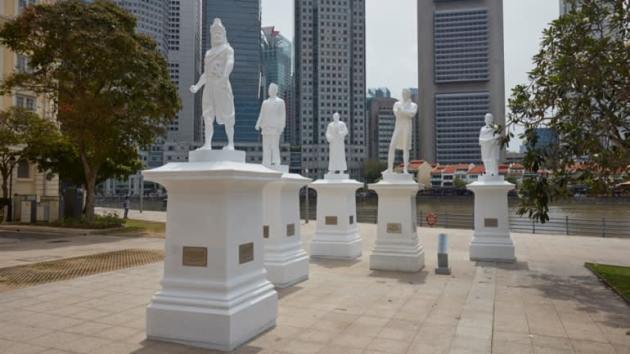
They are diluting the imperialist’s prominence by erecting for the year four new statues of Asian pioneers near Raffles.

The government is commemorating the bicentennial of Raffles’s landing with a yearlong pageantry of exhibitions, essays and events (there may even be a national election).

It is a means to interrogate Singapore’s rich but oft-overlooked pre-independence history. Yet the process involves risks — it exposes some inherent contradictions about a global city’s identity, as interpreted by a heavy-handed state.

Compared with India and most other former British colonies, independent Singapore has always had a romantic view of colonialism. The country’s most famous hotel and school are named after Raffles. In 2015, when UNESCO designated Singapore’s Botanic Gardens as the country’s first and still only World Heritage site, it was remarkable because rarely does a post-colonial state nominate a colonial landmark rather than an indigenous relic.

Four statues of Asian pioneers were erected near Raffles in January. (Courtesy of Singapore Bicentennial Office)

Colonialism’s Singaporean fans suggest that the modern city has thrived partly because of its legacies, including the English language, common law and the port, still one of the busiest in the world.

Critics say that colonialism was fundamentally corrupt and exploitative, pointing to some debilitating vestiges of the era, such as lingering racial biases and a neoliberalism that excessively benefits the owners of capital and land at the expense of workers.

Three of the four pioneers whose images now grace the new plinths thrived under British rule in the 1800s. They are Munshi Abdullah, a Malay-language author and translator, who was of Arab-Tamil ancestry but was accepted into the Malay community; Indian businessman Narayana Pillai; and Chinese merchant Tan Tock Seng.

The fourth is Sang Nila Utama, a visiting Srivijayan prince who in 1299 bestowed the Sanskrit name Singa-pura, or lion city. His inclusion reflects a grander aim. Singapore is using the bicentennial not simply to reconsider its colonial past, but to stretch its history back by a further 500 years. Singapore’s popularly recognized history is, in other words, going from two centuries to seven. A society hitherto obsessed with the future is waking up to the power of the past.

As somebody born into an ethnic Indian family and brought up in Singapore in the 1970s, I see this as an ambitious effort that could help Singaporeans, often caricatured as unmoored economic digits, better understand our place in this world. It will, for one, serve as a reminder of Singapore’s centrality to the Malay world, and Southeast Asia at large.

That could in turn prompt further scrutiny of The British Empire. For even if Singapore’s colonial experience was relatively mild, horrors were never far away. In 1812, for instance, Raffles led British and Indian soldiers in a violent sacking of the royal palace of Yogyakarta (some of his spoils are on display at an even-handed new exhibition at Singapore’s Asian Civilizations Museum, held in conjunction with the British Museum).

Meanwhile, even as merchant Pillai was moving to Singapore with Raffles and building a successful career under the British, thousands of his fellow Tamils were being indentured by the British for backbreaking work on plantations in Fiji, Mauritius and Malaya.

Singapore, then, as a trading hub of the British Empire, was the varnished administrative center, a glittering front that sheltered its inhabitants from tragedies elsewhere.

Today, Singaporean society is coming to terms with its potential complicity in contemporary global nefarious activities. This includes serving as a corporate hub for unscrupulous palm-oil companies engaging in land grabs in Indonesia; a transshipment point for the illegal trafficking of humans and wildlife; and a tax haven for multinationals and millionaires alike. “The Switzerland of the East” is growing a conscience. A broader understanding of Singapore’s role in the British Empire’s global network will help in that maturation.

Critics wail that the bicentennial pomp is nothing but a cynical ploy by the ruling People’s Action Party to energize citizens ahead of a possible general election. Yet it is not clear how a richer historical appreciation might affect the PAP’s modern standing. The PAP’s enduring creation myth is that it miraculously transformed Singapore from a “fishing village” in the 1960s to a modern metropolis by the 1990s. “From swamp to skyscrapers,” screamed a fawning BBC tribute to Singapore in 2015, on the anniversary of its independence.

Yet just months after Raffles landed, people were flocking to the fast-growing trading colony. “Merchants from every country came to trade,” wrote Abdullah of early 1800s Singapore. “But they did not care so much to do business as they did to see the new town.”

St. Andrew’s School, which I attended, was founded in 1862. In the 1950s, Singapore was already no swamp but one of Asia’s most well-developed and multicultural cities.

The bicentennial commemorations should finally bust the fishing village myth, indicating that the PAP in 1959 took over a bustling, multicultural port well-positioned to capitalize on East Asia’s industrial boom. This could rub some of the sheen off the party’s (nonetheless impressive) legacy.

Any reassessment of colonial misdeeds could also lead to an exploration of potential post-colonial injustices, most notably the numerous alleged communists imprisoned without trial by the PAP, in an intermittent campaign (inherited from the British) that lasted from the 1960s well into the 1990s, when the last prisoner was released. For the PAP, it may be tricky urging the electorate to scrutinize only the British legacy — but not its own.

The new statues are also a reflection of the PAP’s dogmatism in codifying identity and organizing society through an unchanging racial lens, known colloquially as CMIO (Chinese, Malay, Indian, others). In a system derived from colonial-era classifications, every Singaporean is ascribed by age 15 one of the four “races,” which then determines what second language the person can learn in public school and in which neighborhood they can purchase public housing, among other things.

The four pioneers chosen each belong to one of the three major ethnic groups in the country while Raffles himself is the representative of that amorphous “others” category, which includes everybody from Armenians to Yemenis.

It is a reminder that state-ordained representation was a bigger consideration in erecting the four states than fame. After the unveiling in January this year, Singaporeans rushed to Google “Munshi Abdullah” and “Narayana Pillai,” the respective Malay and Indian figures we now have to commemorate. Few knew who they were.

Yet any effort to comprehensively represent identities in a global city is doomed to fail. Almost immediately, women complained about their exclusion from the all-male statuary. Today, Singapore is home to scores of ethnicities, each splashing their own color onto the city’s always-somewhere-between-Asia-and-the-West palette.

Moreover, the multicultural dogmas of CMIO do not gel with the reality of Chinese predominance, say critics. The PAP recently chose its next leader — and thus Singapore’s probable next prime minister — from a longlist comprised of six ethnic Chinese men. (Tharman Shanmugaratnam, the immensely popular Indian deputy prime minister, was the notable exclusion).

Singapore’s stated immigration policies, meanwhile, give preference to ethnic Chinese migrants to ensure the group always retains its supermajority, currently over 70% of the population of 5.5 million.

All of this reflects the ethnic determinism of Lee Kuan Yew, Singapore’s first prime minister, who said that Singapore’s success was due to the fact that the majority of its people are Chinese who are “practical,” in contrast with Indians, who “believe in the politics of contention.” He separately noted that Malays are “not as hardworking and capable as the other races.”

Under the British, Singapore thrived as a free port where, as evidenced by Abdullah, Pillai and Tan, a person of any color could succeed — as long as they did not challenge white rule. The PAP is, in some ways, the colonialists’ natural successor.

Ethnic nationalists everywhere might draw succor from the paradox of a global city run meticulously along racial lines by a dominant group.

Nevertheless, history is not destiny. Many younger Singaporeans yearn for the day when race and gender (and sexual orientation) no longer matter, and society strives to protect the downtrodden as much as it elevates the elites.

If and when that comes, perhaps Raffles will be joined not by just four other men on the Singapore River but by dozens of figures representing the city’s many hues.

Source: Singapore — history haunts the ultra-modern state

The English Voice of ISIS Comes Out of the Shadows

The Canadian connection. No rush for consular assistance:

More than four years ago, the Federal Bureau of Investigation appealed to the public to help identify the narrator in one of the Islamic State’s best-known videos, showing captured Syrian soldiers digging their own graves and then being shot in the head.

Speaking fluent English with a North American accent, the man would go on to narrate countless other videos and radio broadcasts by the Islamic State, serving as the terrorist group’s faceless evangelist to Americans and other English speakers seeking to learn about its toxic ideology.

Now a 35-year-old Canadian citizen, who studied at a college in Toronto and once worked in information technology at a company contracted by IBM, says he is the anonymous narrator.

That man, Mohammed Khalifa captured in Syria last month by an American-backed militia, spoke in his first interview about being the voice of the 2014 video, known as “Flames of War.” He described himself as a rank-and-file employee of the Islamic State’s Ministry of Media, the unit responsible for publicizing such brutal footage as the beheading of the American journalist James Foley and the burning of a Jordanian pilot.

“No, I don’t regret it,” Mr. Khalifa said from a prison in northeastern Syria. “I was asked the same thing by my interrogators, and I told them the same thing.”

A thin, diminutive man who occasionally broke into a grin during the hourslong conversation with The New York Times, Mr. Khalifa said he immigrated as a child from Saudi Arabia to Toronto, where he learned to speak much like a native-born Canadian. He said he had studied computer systems technology and worked for a contracting company before leaving for Syria — drawn to the battlefield by watching YouTube.

Terrorism experts say it is hard to overstate the role his effortless English narration played in bringing the terrorist group’s propaganda to English speakers and luring some of them to its cause.

Mr. Khalifa has admitted to narrating “Flames of War,” a 2014 propaganda video showing the execution of Syrian prisoners.CreditSITE Intelligence Group

“His voice is the most recognizable English-speaking voice to have ever appeared in Islamic State propaganda,” said Charlie Winter, a senior research fellow at the International Center for the Study of Radicalization at King’s College London.

To verify Mr. Khalifa’s claim, The Times asked three audio-forensic experts to compare the anonymous voice on the “Flames of War” video with a televised statement by Mr. Khalifa aired in Syria shortly after his capture. Though such analyses are not foolproof, all three experts concluded it was highly likely that Mr. Khalifa was the narrator.

It is “134 times more likely that the unknown speaker” is Mr. Khalifa than someone else, Catalin Grigoras and Jeff M. Smith wrote in a report prepared for The Times. Both are forensic audio specialists at the University of Colorado’s National Center for Media Forensics.

Robert C. Maher, a voice recognition expert at Montana State University in Bozeman, created a spectrogram comparing the pronunciation of specific words in the two audio clips, concluding that “the speech tone, pitch, cadence and pronunciation is the same in these examples.”

Later, a U.S. official briefed on the matter confirmed to The Times that Mr. Khalifa was indeed the narrator.

The release of the “Flames of War” video on Sept. 19, 2014, marked a turning point for ISIS, coming less than three months after the founding of the group’s caliphate. Until then, the group had published shorter, less ambitious videos.

Filmed in part by an ISIS fighter equipped with a GoPro camera, the 55-minute video was the first to create an immersive experience, showing a soldier digging a trench before an operation, conducting surveillance and then engaging and overrunning the enemy. Because it was narrated in English, it became a touchstone for recruits from Australia, Britain and North America, according to Mr. Winter.

For Mr. Khalifa it was the beginning of a prolific career. The sum of his narration work — believed to include dozens of audio and video clips — serves as a sampling of the Islamic State’s most influential English-language propaganda.

“He is a symbol — the voice coming out of ISIS, speaking to the English-speaking world, for the better part of the last four to five years,” said Amarnath Amarasingam, a prominent researcher in Toronto who studies radicalization in Canada.

Mr. Khalifa is now among hundreds of ISIS fighters from approximately 50 countries who are locked in prisons in northern Syria. Thousands of their wives and children are being held in detention camps, free to move among the tents but unable to leave. Mr. Khalifa said he had married in the caliphate and had two children, though it was unclear where they were now.

Canada is one of many countries that have been reluctant to take back their citizens, worried that battlefield evidence may be deemed inadmissible in court, making it difficult to secure prosecutions.

A month after his capture, Mr. Khalifa’s future was uncertain. He said he had not received a visit from Canadian authorities or been offered consular help. The Royal Canadian Mounted Police declined to comment on his detention, as did the Canadian foreign ministry. The F.B.I. also declined to comment.

Mr. Amarasingam, the Toronto researcher, was among the first to take an interest in the unnamed narrator’s possible Canadian connection, after noticing the distinct accent of the speaker in an ISIS video boasting about the 2015 attacks in Paris. “I thought, this guy sounds like people I grew up with,” Mr. Amarasingam said.

Later, on a research trip to Syria, Mr. Amarasingam and the journalist Stewart Bell were given access to a Canadian fighter captured nine months ago. The combatant, Muhammed Ali, said he had met and befriended the narrator, describing him as a Canadian of African descent who used the nom de guerre Abu Ridwan.

In an interview with The Times, Mr. Ali agreed to listen to an audio recording of the recently captured Mr. Khalifa. “That’s him,” he exclaimed. Mr. Ali said Mr. Khalifa’s identity as the narrator was not widely known in the caliphate. “That’s not something he shares,” Mr. Ali said. “But once you speak to him, it’s obvious.”

In a two-minute televised statement after being captured by the Syrian Democratic Forces, Mr. Khalifa identified himself as an ISIS fighter and gave his name as Mohammed Abdullah Mohammed, which follows the Arab naming convention of his first name followed by his father’s and grandfather’s names. He admitted to attacking the local Kurdish militia but made no mention of his role as the narrator.

The brief statement was enough for analysts to recognize the voice as that of the narrator, though officials with the militia group said Mr. Khalifa initially denied his role.

In the interview with The Times, Mr. Khalifa spoke in the presence of two Kurdish prison officials, who recorded the exchange but did not interfere. He clarified that his legal name was Mohammed Khalifa, a detail confirmed by Mr. Amarasingam, who has been in touch with one of his childhood friends in Canada. Mr. Khalifa downplayed his significance in the Islamic State and insisted that he had not appeared in any execution videos beyond providing the voice-over narration, a claim that could not be immediately verified since most executioners wore masks.

He said he was born in Jeddah, Saudi Arabia, to parents of Ethiopian descent, earned a diploma in computer systems technology from Seneca College in Toronto and led an unremarkable work life as an information technology specialist, including for Kelly Services, an IBM contractor. IBM did not immediately respond to a request for comment.

Reached by phone, Kelly Services confirmed that a Mohammed Khalifa was contracted by the company from May 2009 to April 2010 in Markham, Ontario. Seneca College declined to comment.

By 2013, Mr. Khalifa was listening to online lectures by the Qaeda propagandist Anwar al-Awlaki. He said they convinced him of the necessity of jihad. But it was a YouTube video, not unlike the ones he would later narrate, that helped him make the leap. It showed a group of British fighters speaking English on the front line in Syria, he said, giving him the sense that he could fit in.

Mr. Khalifa said he crossed into Syria in 2013 and initially joined the Muhajireen wal Ansar Brigade led by Omar al-Shishani, a Georgian militant who would become the Islamic State’s minister of war. The brigade pledged allegiance to ISIS in late 2013, and before the caliphate was declared in 2014, Mr. Khalifa said he had already begun working for the group’s media ministry, among the most crucial organs of the terrorist state.

He said he was initially employed as a translator, helping render Arabic copy into English, before being asked to work as a narrator. Asked which videos he worked on, he initially demurred, before quietly answering, “Like ‘Flames of War.’”

The media unit, he said, was led by Abu Muhammad al-Furqan, an Iraqi confidante of the Islamic State’s leader, Abu Bakr al-Baghdadi. The media chief, killed in an airstrike in 2016, was intimately involved in vetting the group’s work, reviewing scripts and requesting edits, Mr. Khalifa said.

The chief insisted that the execution videos feature a diversity of killers, so no single participant rose in prominence above others. A camera team roamed the caliphate scouting for the ideal executioners, Mr. Khalifa said. They were especially keen to find people from different nationalities to underscore the group’s global reach.

“The intention was to not make anyone into a celebrity,” Mr. Khalifa said.

The team staged the executions, capturing the scene using still cameras, GoPros and drones, and then delivered the raw footage on an SD card to the media unit’s office, inside a villa on the Euphrates 12 miles outside Raqqa, Syria.

There, he said, an editing team pored over the footage, storyboarding the narrative arc and adding sound effects and narration.

Mr. Khalifa claimed that he had had no role in filming or carrying out the scenes he narrated, which included deploying underwater cameras to capture the staged drowning of prisoners.

“I was just the voice,” Mr. Khalifa said, insisting that his work was confined to the studio.

He said he was chosen for that role by an Australian supervisor who went by the name of Abu Abdullah.

“He would give me a text, like a script, and I would review it for mistakes, and then we would record,” he said. “He would then review it and see if there was anything that he would like me to place emphasis on.”

At first, Mr. Khalifa said, the audio was recorded in a professional studio, with walls made of foam to absorb ambient sound. They used the software Magix Samplitude to edit the sound, and the finished productions were broadcast through a portable satellite dish.

But that all changed with American airstrikes in late 2014, Mr. Khalifa said. They had to relocate to urban centers starting with Raqqa, moving from house to house, aware that the proximity to civilians helped protect them.

As the Islamic State’s territory shrank, the media team was pushed out of Raqqa, but remained active, carrying the satellite dish with them, he said. They worried that the dish might give them away, but they continued transmitting nonetheless. In the final weeks before his capture, Mr. Khalifa estimated, there were at least 20 media operatives in the group’s last pocket in Syria, which has since been reduced to a tiny patch of land.

“Guys I knew agreed to work out of their homes,” he said. “They still took the risk.”

By the time he was apprehended last month, Mr. Khalifa said he had stopped working for the media unit and had picked up a Kalashnikov rifle to defend the Islamic State. Officials with the Syrian Democratic Forces said he had tried to attack their position. Mr. Khalifa said he had approached a villa, entering from below while soldiers were on an upper floor.

After a protracted gunfight, he said, he was bleeding and alone. The videos he had narrated were full of bravado, his voice representing a group that had vowed never to give up. But after more than six defiant years in the battle zone, Mr. Khalifa said, he did something that he never thought possible.

“I was exhausted. My ammo was gone,” he said. “They kept calling on me to surrender, and so I threw down my weapon.”

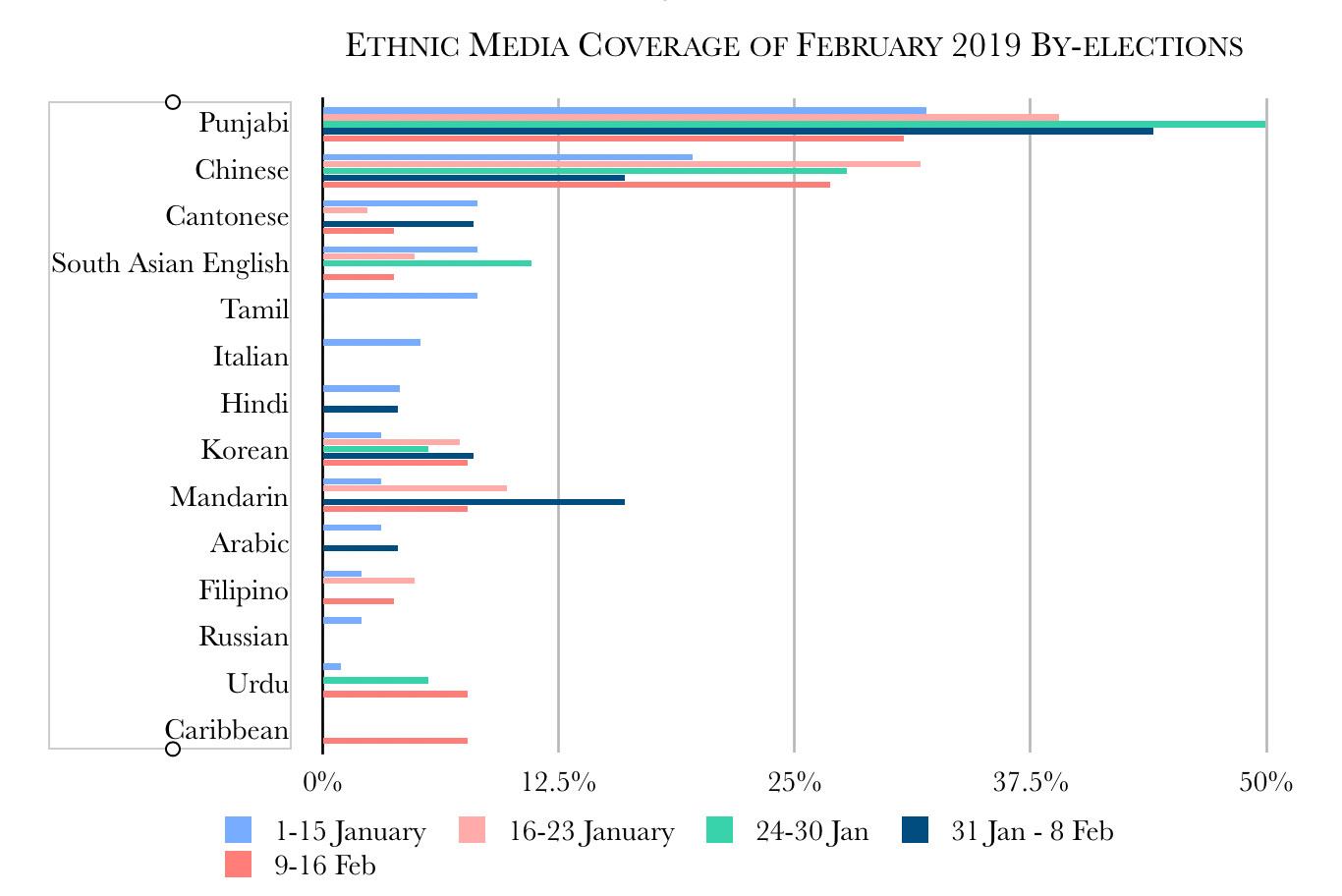
Diversity Votes — February By-elections: Matching Census Data with Ethnic Media Coverage (9-16 February 2019)

For background data on the riding demographic, economic, social and political characteristics, see: February By-elections: Matching Census Data with Ethnic Media Coverage (1-18 January 2019). 

Note: While Chinese in the chart of ethnic media coverage refers to written media, Cantonese and Mandarin to broadcast oral media, I generally summarize all three as Chinese media except where indicated. 

Ethnic Media Coverage

The ongoing focus on Burnaby South continued, in particular given the visit of PM Trudeau to the riding to support Liberal candidate Richard Lee. Overall, coverage remained stable at 26 articles, compared to 25 articles the previous week .

While Punjabi ((30.8 percent) and Chinese (38.5 percent) comprised the majority of ethnic media coverage of the by-elections, this was less than previous weeks. New to ethnic media coverage were two stories covered in Caribbean (English) media.

The Prime Minister’s visit featured was covered by all ethnic media covered during this period and was the focus of virtually all the articles in Chinese media. There was some mention of the ongoing scandal regarding possible interference in the judicial process involving SNC Lavalin and former justice minister Wilson-Raybould. Calls by Conservative leader Andrew Scheer and NDP Jagmeet Singh for the PM to waive solicitor-client privilege were reported in Punjabi and Caribbean media.

NDP leader Singh appeared to have more success getting his messages out regarding housing and pharmacare than previous weeks, particularly in the Punjabi media, with only one article reporting on the criticism over the NDP opposing recognition of Juan Gerardo Guaidó as acting Venezuelan president.

In Korean media, there were reports on a campaign event for Conservative candidate Jay Shin attended by Richmond MP Alice Wong as well as a visit by NDP candidate Singh to Northroad Korean town.

 In Urdu media, there was a report on Conservative criticism of the impact of the mortgage stress test on housing affordability.

In Caribbean media, there was coverage of Outremont, largely a profile of Liberal candidate Rachel Bendayan.

 Only two commentaries this week. One article in Punjabi media picked up on the arguments by Macleans writer David Moscrop (What if Jagmeet Singh really did have a $5.5 million mansion? Should we care?) without stating their own position. The other article in Chinese media focussing on Burnaby South provoked a range of comments regarding the prospects of the Liberals in the by-election and the upcoming general election.

Most of the general election coverage continued to focus on the government’s announced measures to reduce foreign interference in the federal election as well as the CBC analysis of the impact of Twitter trolls on political debates in Canada (Twitter trolls stoked debates about immigrants and pipelines in Canada, data show) and the Nanos survey showing that 60 percent of Canadians believe Facebook will have a negative impact on the election (More than six in 10 Canadians say Facebook will have a negative impact on fall election: survey).

Chinese media has also been covering extensively, as one would expect, the ongoing developments of the US extradition request of Huawei executive Meng Wanzhou, speculation regarding possible additional Chinese retaliation and former Ontario Liberal cabinet minister Michael Chan’s concerns regarding anti-Chinese sentiment of the Conservatives and populists.

See the MIREMS blog for some of the stories being covered: MIREMS blog.

The Economist: Third-generation Muslims in the West are devising a new Islam for themselves

Worth reading and thoughtful exploration of the different tendencies and developments:

People are of two types in relation to you,” Imam Ali, the prophet Muhammad’s son-in-law and one of his first caliphs, or successors, is reputed to have said. “Either your brother in Islam, or your brother in humanity.” The Shia community of Mahfil Ali in north London tries to turn word into deed. Women often open services with a prayer. Sermons are in English. For the past decade the community has gone to the local church on Christmas Eve to attend midnight mass. Most ambitiously, it is turning its two-hut mosque into a £20m ($26m) Salaam (Peace) centre, complete with sports facilities, a restaurant, a theatre and a public library. There is talk of making a prayer space for Christians and Jews. “We want to nurture the community that nurtured us,” says a local leader.

Mosques in the West have come a long way since migrant workers rolled out plastic mats in their back rooms. A new generation of cathedral mosques has brought Islam out of Muslim districts into the public arena. Instead of traditional structures with inward-looking courtyards, their architects now design wide staircases that connect to the street. Sports facilities draw in younger Muslims who may have lost interest in the faith, as well as non-Muslims. The Islamic Centre of Greater Cincinnati, spread over 18 acres (seven hectares), is one of many in America that feels more like a country club than a mosque. Christian and Jewish teams compete in its basketball league.

Foreign organisations, Western governments and jihadists have all sought to speak for and mould Islam in the West, but the more established the faith becomes there, the less truck it wants with any of them. Of the three generations that have grown up since Muslims arrived in the West in the 20th century, the third is the most stridently opposed to government interference, be it foreign or Western, and to jihadist propaganda. As time passes, the old ties loosen. In most of the West, unlike in Muslim countries, no licence is currently needed to become an imam. Instead of a faith shaped from outside, millennial Muslims are creating something unprecedented: a do-it-yourself Islam.

That makes the religion frustratingly messy, but also diverse, dynamic and fluid. It is fragmenting into myriad interpretations, permutations and sects. Each by itself might be small, but collectively they are acquiring a critical mass that is pushing the faith’s boundaries. Western Islam covers the full spectrum of Islamic traditions, from the most conservative to the sort that considers Islam a culture but no longer a faith, and everything in between.

The four schools of Western Islam

To outsiders, the Salafist strand of the faith looks deeply traditional and unwelcoming. Its members wear Islamic dress and send their children to segregated Muslim schools. Boys in white tunics shiver in the cold. Teachers focus on scripture. But the Salafists insist that much of what they believe chimes with a Western approach to the faith. “Its appeal is like that of Protestant reformation in Christianity,” says Yasir Qadhi, America’s best-known preacher, who studied with Salafist masters. “It gives the individual direct connection to the text without going through a cleric or priest. It’s intellectually empowering.”

Though German officials, among others, have cut off dialogue, a new generation of Salafists is experimenting with greater openness. Searching for allies to stem secularism’s advance, Salafist imams engage in interfaith dialogue with like-minded conservatives of other faiths. The rapid influx of converts, too, has forced them to find ways to deal with their non-Muslim relatives. For role models, preachers look to the first Muslims in Mecca 1,400 years ago. They were also converts but kept their ties with their pagan families. And when they were persecuted, they embarked on the first hijra, or migration, and found refuge with the Christian rulers of Abyssinia. From his home in Memphis, Tennessee, Mr Qadhi plans to launch a new Islamic seminary later this year, staffed exclusively by Western lecturers. The teaching there, he says, will be “post-Salafist”, concentrating on the essentials. “While old-school Salafists are arguing over the minutiae of Islamic law, their children are debating whether or not God even exists,” he adds.

Western Islam is fragmenting into myriad interpretations

The second strand of the faith, political Islam, has long advocated engagement with non-Muslim society, not least to defend the interests of the umma, or Muslim community. Its main organisation, the Muslim Brotherhood, began as an armed anti-colonial movement in the Middle East. But chased into exile, its leaders have established a host of offshoots which profess loyalty to the West and praise its democratic systems (to the horror of the Muslim rulers they fled). It can be highly pragmatic. At a class at the Institut Européen des Sciences Humaines in Paris, Europe’s largest Muslim college and a bastion of Brotherhood orthodoxy, a female lecturer emphasises the flexibility of the sharia, or Islamic law, and its guiding principle of maslaha, or communal interest.

Another of the Brotherhood’s institutions, the Dublin-based European Council for Fatwa and Research, is rewriting orthodox precepts. Its jurists have approved mortgages, despite the Islamic prohibition on interest. They have ruled that female converts to Islam can keep their non-Muslim husbands. And some increasingly turn a blind eye to ways of life hitherto deemed deviant. “I’m not God. It’s his business. I don’t interfere,” says Taha Sabri, the imam of an Islamist mosque in Berlin.

If the Brotherhood gives Islam a Western hue, liberals, the third strand, give their Western lifestyles an Islamic one. For more than a generation, Bassam Tibi, a devout academic of Syrian origin at Göttingen university in Germany, has campaigned for “euro-Islam”, which by his definition is rooted in the principles of the Renaissance, Enlightenment and French Revolution. The faith, he says, has to adapt to its new environment, just as it did when it spread elsewhere in the world. “Africans made an African Islam and Indonesians made an Indonesian one,” he notes. “Islam is flexible and can be European.”

A few congregations of women-led mosques have surfaced in the West beyond the ivory towers of academia. Some are women-only, others mixed. Weekly prayers are often conducted on Sundays for members unable to leave work on Fridays. In 2008 Rabya Mueller, a former Catholic nun who converted to Islam, formed the Islamic Liberal Bund, modelled closely on liberal Judaism, and has begun leading prayers. Together with Lamya Kaddor, a German woman with a Syrian background, she is replacing Islam’s patriarchal baggage with gender equality and a commitment to gay rights. Much of their work, she says, involves marrying Muslims and non-Muslims of either gender. On Twitter, @queermuslims advertises prayer meetings for homosexual adherents of the faith. A training centre for gay imams has opened in France.

At the far end of the spectrum, a fourth strand wants to dispense with the religion altogether. In November six German academics, including one non-Muslim, formed the Secular Islam Initiative to promote “a folkloric relationship to Islam”, according to one of its founders, Hamed Abdel-Samad, the son of an Egyptian imam and author of a critical biography of the Prophet Muhammad. The organisation is still at the fledgling stage, but it may express the views of a surprising number of Muslims born in the West. According to a German government survey, only 20% of the country’s Muslims belong to a religious organisation. Many of the rest lead secular lives.

The number of lapsed Muslims in France is probably even higher than in Germany, particularly among descendants of north Africa’s Berbers, many of whom have long viewed Islam as a figleaf for Arabisation. Half the men of Algerian origin in France marry outside the faith, and 60% of those of Algerian parentage say they have no religious affiliation. In America the Pew Research Centre estimates that 23% of Muslims no longer identify with the faith. “We’re facing the same problem of assimilation as the Jews,” says an imam in Dearborn, Michigan.

Thinking the unthinkable

Mosques seeking to rejuvenate their flock are having to adapt to changing sexual practices, too. Half of America’s Muslim students, male and female, admit to having had premarital sex, according to a study in 2014. “When I began teaching in 2003, no girl would admit to having a boyfriend,” says Ms Kaddor, who until recently taught religious studies for Muslims in a Rhineland school. “Now, some openly say they’re bisexual.” Muslim dating apps abound. “Find a beautiful Arab or Muslim girl on muzmatch,” promises one that claims a million users, complete with an optional chaperone feature.

Women are also increasingly demanding a say, not least because they are now typically better educated than men. The number of women on mosque boards is still small but growing, even in orthodox communities. Inside the prayer hall, women, originally confined to the gallery, are moving to the back of the ground floor and sometimes down the sides. In many Black American mosques men and women share the same hall. Prejudice against homosexuality remains strong but is retreating. Among British Muslims over 65, 76% want to ban the practice; for those aged 18-24, the proportion is 40%.

Adherents of all four strands often change allegiance. Mr Abdel-Samad was briefly a Muslim Brother before converting to secularism. Many Salafist preachers were nominal Christians who trod the path in reverse. Such cross-fertilisation does not always breed understanding. Imams deviating from orthodoxy risk expulsion from their mosques. Abdel Adhim Kamouss, a Salafist preacher in Berlin, has been ousted from two mosques for asserting that the Prophet did not condemn homosexuality or shaking hands with women. Mr Kamouss is one of several people interviewed for this report to receive a fatwa sentencing him to death for apostasy. In the suburbs of some British cities Muslim shopkeepers are forced to close before Friday prayers. And women can still become victims of honour crimes in conservative enclaves such as Dewsbury in northern England.

Optimists say such violence is a sign of desperation. In France the last known honour crime was committed two decades ago. Across the West Muslims turn out to vote in greater numbers than the rest of the population and increasingly interact with non-Muslims. For many of the younger ones, divisions of sect, ethnicity and religious observance are less and less relevant. In short, given a range of choices, Muslims in the West increasingly see Islam more as a matter of personal choice than a creed guided by government, whether at home or abroad. “The younger generation has won the battle,” says Olivier Roy, a French author on Islam in the West.

Arab governments sometimes berate their Western counterparts for not doing enough to curb extremism, by which they often mean curbing their exiled dissidents. In fact, Western governments do monitor hate speech and support for terrorism. But viewing Islam primarily through a security prism distorts relations between Muslims and non-Muslims in the West.

Religious leaders are seeking to bridge divides

Muslim inclusion in local decision-making can break down prejudice but often faces resistance from communities. Jennifer Eggert, a Muslim expert on terrorism, tours London mosques arguing for Muslims to play a bigger part in countering terrorism. The New York Police Department overcame communal mistrust by creating a Muslim Officers Society, the first in America. This has helped increase police recruitment among Muslims from fewer than a dozen in 2001 to over 1,000, says its founder, Adeel Rana. The inauguration last month of America’s first two Muslim congresswomen may also help normalise Muslim participation at all levels of society.

Integrating Islam more into national histories could play a part, too. In some British mosques imams pinned poppies on each other to mark the centennial of the first world war and remember the hundreds of thousands of Muslims killed in battle. But their sacrifice is rarely commemorated at national level, contributing to the feeling that Muslims remain outsiders. Now “we are creating a generation not of foreign fighters but of foreign citizens,” says Khalid Chaouki, a former mp in Italy’s parliament who runs the country’s largest mosque in Rome.

Cultural programmes, too, can cross communal boundaries. When the Benaki Museum in Athens began offering school tours of its Islamic art collection, an mp accused it of spreading the culture of terror. A decade on, the museum has expanded the programme to include interactive tours of life in Ottoman Athens. “We’re filling a big gap in our history that most schools skip over,” says Maria-Christina Yannoulatou, the head of the museum’s education department, referring to 450 years of Muslim rule that Greece omits from its curriculum. “We want to challenge taboos and show the ordinary lives that heroic histories obscure.”

Religious leaders are also seeking to bridge divides. Many priests work hard to counter far-right narratives, accusing anti-immigrant politicians of betraying Christian ethics. Many churches double as sanctuaries for refugees. Some synagogues as well as churches in America host Muslim Friday prayers for congregations lacking a space to worship. In the same vein, after a right-wing gunmen fired on a Pittsburgh synagogue in October, Muslims packed the vigils, sent tweets of condolence and spoke at events on anti-Semitism. In Germany’s election in 2017 church-going voters were three times less likely to vote for the far-right afd party than secular ones.

Having settled in the West for the third time in history, this time in a different role, Islam seems destined to stay. The journey so far has not been easy. But a third generation of Muslims now seems set to become a permanent part of a more diverse, more tolerant Western society—as long as that society continues to nurture those virtues.

Source: Third-generation Muslims in the West are devising a new Islam for themselves

Douglas Todd: Why populism hasn’t come to (English) Canada. Yet

Eric Kaufmann’s work continues to strike a chord among those with concerns about immigration levels and populism (see for example Margaret Wente’s Can Canada avoid a populist revolt?).

Kaufmann’s explanation of “Canadian exceptionalism” – the English-French divide, a high-percentage of foreign-born, the lack of a Conservative tabloid press (Toronto Sun?), and labelling as racist those who question current immigration levels – tend to leave out some of the early fundamentals that shaped Canada:

  • a culture of accommodation, often imperfect, between English and French Canada, less so with Indigenous peoples, that required recognition and compromise as basic to Canada;
  • a multiculturalism that developed in response to earlier waves of mainly white and Christian immigration;
  • an approach based on integration, as distinct from assimilation, articulated by the 19 Bi & Bi Commission report on the “other groups.”

And if identity has become the “battle front of the 21st century,” does this not reflect in part the fact solutions to economic issues – precarity, inequality – remain elusive.

I also find tiresome the refrain against “cosmopolitan imperialists” and elites. Most of the people engaged in these debates, including Kaufmann, are by definition part of elites in terms of education, income levels, public profiles and the like:

Populism has arisen virtually everywhere in the West, but remains weak in English Canada.

The election of Donald Trump, the Brexit vote, resistance to high immigration in Australia, mounting European nativism and last year’s Quebec election are strong signs that growing centre-right white populism will be tenacious.

It’s often said that people in the U.S. display “American exceptionalism,” the belief they’re uniquely committed to freedom. But there is also a “Canadian exceptionalism,” a deep belief among English Canadians they are uncommonly tolerant and will make a success of multiculturalism when others will not.

A ground-breaking new book by Vancouver-raised political scientist Eric Kaufmann peels back the layers of Canadian exceptionalism while detailing the increasingly tense decline of white populations in Europe, the U.S. and Australia. It places an extra focus on big cosmopolitan cities in which whites are no longer the majority, such as Toronto and Metro Vancouver.

Even though Whiteshift: Population, Immigration and the Future of White Majorities delves into race, culture and identity in ways some will find uncomfortable, the book has attracted supportive reviews across Britain’s vigorous press. It’s being called “insightful,” “valuable,” ”substantial,” “brilliant,” “extraordinarily deep and wide” and far ahead on the immigration discussion.

Whiteshift is bursting with ideas, which synthesize old theories into something altogether novel. They include Kaufmann’s positive argument that declining white populations in the West, to avoid extreme nationalism, will need to embrace what he calls “whiteshift.”

He defines the term as “the turbulent journey from a world of racially homogeneous white majorities to one of racially hybrid majorities.” In other words, Whiteshift envisions a Western world a century from now of predominantly intermarried people who are beige in colour.

But Kaufmann – who is of mixed Latino, Chinese and Jewish ancestry while regularly viewed as white – is not a one-world globalist dreamer, as many say is the case with Prime Minister Justin Trudeau.

Identity has largely replaced economics as the battle front of the 21st century, Kaufmann says. And he understands how many conservative whites are losing confidence in their identity; leading to “a growing unwillingness to indulge the anti-white ideology of the cultural left.”

The Economist agrees, remarking in its review of Whiteshift that nativism is rising because free-market globalism and high immigration have disrupted Western economies and the “culture is dominated by preening elites who not only think they are cleverer than the average person but also that they are more virtuous.”

It is virtually only in the West, says the professor at the University of London, Birkbeck, that the educated feel it necessary to oppose their own culture and celebrate its decline. Although some consider it radical, Kaufmann makes the point that white majorities are an ethnic group whose conservative members have the same normal attachments to group as minority ethnic groups.

Many white people in Europe, of both the right and welfare-state-supporting left, have started resisting the “cosmopolitan imperialists,” he says. Virtually no European politician has dared use the word “multiculturalism” since the 1990s.

But the term still has traction in Canada, where Vancouver pollster Mario Canseco found this month that 62 per cent of Canadians think multiculturalism has been good for the country, while 33% believe it’s been bad.

Because of Canadian exceptionalism, Kaufmann says, English Canada is perhaps the only place left in the Western world where almost all right-wing politicians fear being accused of racism for suggesting immigration levels decline. That’s despite Canadian polls consistently showing roughly four in 10 Canadians think immigration has been a mostly negative force.

French-speaking Quebeckers don’t adhere to the same prohibitions. They recently elected Premier Francois Legault, who this year reduced his province’s immigration rates by 20 per cent in the name of improving integration. Legault even managed to get public support from Trudeau, who has to go along because he can’t afford to alienate francophone voters.

Four of five voters for Brexit ranked immigration as their top concern.

Why has white popularism not taken hold in English Canada, at least not yet?

There are at least three reasons, and one is the English-French language divide. Kaufmann takes seriously the notion that the Conservative party is hemmed in on immigration.

English Canadians who want to reduce immigration, and thus slow the expansion of Asian and other cultures, would normally hope to be supported by the Conservatives. But the party is incapable of allying with like-minded French populists in Quebec, who instead vote for the Bloc Quebecois and Legault’s Coalition Avenir Quebec.

A second reason Kaufmann believes most Canadians quietly accept rapid ethnic change, which comes from having a population that is 21 per cent foreign born, is that “Anglo-Canadians share the relatively pro-immigration outlook common to all Anglo settler societies.”

Given this outlook, he said, English Canada, unlike Australia, New Zealand, the U.S. and Britain, “lacks a conservative tabloid press” ready to poke holes in immigration policy.

Kaufmann finds it significant that the highest-profile critics of immigration and multiculturalism in Canada have been people of colour: Writer Neil Bissoondath, academic Salim Mansur and environmentalist David Suzuki. Their minority status, he said, has made it possible for them to “withstand the charge of racism.”

In a revealing chapter, titled Canadian Exceptionalism: Right-wing Populism in the Anglosphere, Kaufmann zeroes in  the battle over foreign capital fueling the housing crisis in Metro Vancouver, where he grew up after being raised in Hong Kong and Japan.

Kaufmann cites how prominent visible minorities, such as Andy Yan, Albert Lo and Ujjal Dosanjh, were able to fight back against claims made by white real-estate developers and politicians that it is “racist” to say that foreign capital, especially from China, has been exacerbating high housing prices.

The Vancouver example leads Kaufmann to the novel idea that, since the Canadian elite generally supports pro-growth, high-immigration thinking, one of the few ways a populist party could emerge in Canada is “if there were a substantial non-white anti-immigration vote or a minority anti-immigration candidate.”

Since that may not happen, Kaufmann predicts the white population of Canada will be in the minority by 2050. Whereas whites in Montreal will account for about seven in 10 people by that date, the proportion will drop to about three in 10 in Toronto and Metro Vancouver.

It could work out, Kaufmann suggests, particularly if immigration policy is changed. But only if English Canadians avoid the kind of hostilities linked with extreme white nationalism. Peace and prosperity will also require people accept that the definition of white is blurring, to include people of mixed races.

Even though regions in which one ethnic group predominates generally experience more unity than those with highly multi-racial societies (such as in Guyana or Belize), Kaufmann foresees a decent chance much of English Canada could end up somewhat like Canada’s largest city.

He envisions a kind of “Toronto-writ-large” across all of English Canada: “A dynamic, low-cohesion, future-oriented society with an attenuated connection to its British and European past.”

Source: Douglas Todd: Why populism hasn’t come to (English) Canada. Yet

Frank, revealing report on race relations made public by Ottawa police

Good that the report was made public and hopefully there will be meaningful consideration and appropriate follow-up to some of the recommendations:

Fear and mistrust of Ottawa police and public concerns about police leadership, accountability and transparency are the “overarching” themes of a report on race relations that was so stressful for officers doing the study that they had to have special counselling to deal with abuse from the public and their fellow cops.

“The vast majority of officers go out there every day with the idea that they’re going to do the best job that they can,” said Insp. Isobel Granger, who led the seven-member team and wrote the final report that was released this week. “So, when the community comes to you and says you’re not treating us fairly, it leaves a questions mark and you wonder, ‘What am I doing?’”

The 146-page final report of the Ottawa police Outreach Liaison Team was completed more than a year ago, but was only made publicly available this week on the Ottawa police website. The team was created in August 2016 in the weeks after the death of Abdirahman Abdi with a mandate to engage with the city’s racialized community “and rebuild the community’s trust and confidence in the Ottawa Police Service.” It spent a year researching the report and met with approximately 1,000 individuals and community groups.

It identified 32 issues, including everything from systemic barriers inside the police service affecting women, minorities and LGTBQ officers, complaints about the service’s “ineffective” and “out of touch” Community and Police Action Committee to the number of unsolved homicides in the Somali community.

The report was prepared as an internal document for police, but was shared last year with some of the community leaders who had been consulted. It is unusually frank for a public document, includes sections on how the team was brainstorming about public reaction into findings of the province’s Special Investigations Unit on Abdi’s death. (The SIU charged Const. Daniel Montsion with manslaughter, assault with a weapon and aggravated assault in Abdi’s death. His trial is scheduled to resume Feb. 25.)

The report also includes unflinching criticisms the outreach term heard such as “attitudes surrounding black youth need to change” and “police should stop assuming people are LIARS.” Police senior officers were criticized by the public for not attending public meetings, while police officers themselves criticized “racism and/or ineptitude or incompetence in selection and promotion processes.”

Granger wouldn’t say if she thought those criticisms were valid. What was important was that people felt that way.

“I come from the standpoint that your perception is your reality,” she said. “We need to know what that perception is because, if there is a misunderstanding, we need to work together to create a common understanding … common values. And, if it’s for real, we have to work together to change the reality.”

“I’m in the police service, so I will see things differently, (but) it’s not what I feel that’s important, it’s what the community feels that’s important.”

Granger said progress had been made since she delivered her final report last January. Last summer, police launched the new Community Equity Council with the aim of strengthening the relationship between police and Indigenous, faith-based and racialized communities. As well, Granger’s team’s report has been adopted as a foundation document in the police service’s multi-year action plan for Equity, Diversity and Inclusion.

“There’s a lot being done. Sometimes meaningful change appears not to be happening and maybe to some people it appears slow — and maybe it is slow — but we want meaningful change to happen. I’d rather not rush, but I want to see change, too.”

Though the team was formed after Abdirahman Abdi’s death, it found itself dealing with other controversies and tragedies. In October 2016, a veteran Ottawa officer pleaded guilty to police act charges after he was identified making racist comments online about the death of Inuit artist Annie Pootoogook. That same month, a study of three years of data about Ottawa police traffic stops revealed the stops were “consistent with racial profiling.”

It all took a toll on Granger and her team, which was “on the receiving end of hostile treatment” from community groups.

“In the course of their day-to-day work, the officers were frequently subjected to verbal abuse and/or challenging behaviours and these experiences, which began to take a personal toll on the officers,” the report says. “They also expressed that coming into work was becoming difficult as they were being subjected to similar behaviours internally.”

The team developed a support plan, including team debriefings and skills training to help them cope. Some of her officers were working 18-hour days on the research, Granger said.

“We were listening to a lot of raw emotions, internally and externally. It’s very difficult not to be affected by it … Fortunately, the individuals members went on to healthy next steps  in their career, but it wasn’t easy,” she said.

“When one person is put under scrutiny, the whole police service is put under scrutiny. What people don’t realize is that, when something traumatic happens, it affects all of us, inside (the police) and outside.”

The full Outreach Liaison Team Final report can be downloaded from the Equity Diversity and Inclusion page of the Ottawa Police Service website.

Source: Frank, revealing report on race relations made public by Ottawa police

Un conseiller de Maxime Bernier défend ses écrits polémiques

A useful reminder that in today’s digital world, previous writings can be easily researched and exposed. Whether this will make a difference to Bernier’s supporters and potential supporters, is less certain:

Un proche conseiller du chef du Parti populaire du Canada (PPC), Maxime Bernier, a défendu une série de positions cinglantes et volontairement «polémiques» sur des questions épineuses au Québec dans un blogue peu connu qu’il chapeautait de 1999 à 2016.

Martin Masse, qui agit comme stratège et porte-parole de la formation d’inspiration libertarienne de l’ex-ministre conservateur, s’en est notamment pris aux participantes de la Marche mondiale des femmes en les qualifiant de «féministes hystériques» ou encore de «lesbiennes frustrées».

Il décrit la «large dissémination» des armes comme une condition sine qua non «à la sauvegarde de la civilisation», préconise «le droit de discriminer» comme solution à la polémique sur le port de signes religieux et qualifie l’ex-premier ministre québécois René Lévesque de «pygmée».

En entrevue, M. Masse a indiqué qu’il ne voyait pas la «pertinence» de ressasser ses écrits passés, mais maintient qu’il n’en renie pas un mot.

Certains des textes recensés par La Presse au cours des derniers jours à partir des archives du blogue se voulaient provocants et peuvent heurter les «oreilles sensibles». D’autant plus que «la rectitude politique est encore plus présente» aujourd’hui qu’à l’époque où ils ont été rédigés, a-t-il noté.

«Des gens peuvent trouver que j’allais loin là-dedans, dans mes attaques», relève le conseiller.

De la violence «imaginaire»

Dans un texte paru en octobre 2000 sur ce qu’il appelle «La marche des femmelettes», M. Masse reprochait, par exemple, aux activistes ayant défilé dans les rues à l’appel de la Fédération des femmes du Québec d’être «des parasites incapables de se prendre en main» qui cherchaient à mettre des «bâtons dans les roues du développement capitaliste».

Elles étaient issues, écrit-il, de «quelques sous-sections marginales de la gent féminine», dont, outre les catégories précitées, «les vieilles grincheuses qui ont mal planifié leur vie», les «fainéantes qui veulent plus d’argent et de meilleurs appartements», les «immigrantes déphasées» ainsi que les «victimes de violence conjugale réelle ou imaginaire».

Dans un autre article paru en mai 1999 et intitulé «Littleton, les armes et la civilisation», M. Masse défend l’idée que «la liberté ne peut tout simplement pas s’épanouir réellement sans une large dissémination des armes» et prévient qu’elle risque de disparaître si les citoyens «ne peuvent plus s’armer».

Le conseiller n’a pas voulu dire s’il adhérait toujours à cette vision des choses, qui va largement au-delà de l’approche préconisée officiellement par le PPC en matière d’accès aux armes.

Questionné à ce sujet, M. Masse a précisé que ses «opinions profondes» ne concernaient que lui et qu’il défendait publiquement la position officielle de la formation de M. Bernier.

Le stratège n’a pas voulu non plus revenir sur l’approche préconisée dans un texte sur les accommodements religieux dans lequel il s’opposait, comme libertarien, à l’idée que l’État joue un rôle dans la régulation du port de signes religieux.

C’est aux individus eux-mêmes, écrivait-il, d’exercer une forme de contrôle qui «enverrait un message clair à ceux qui ne sont pas les bienvenus ici».

Une femme portant la burqa, notait l’auteur, «aura le choix de s’habiller comme une personne civilisée ou bien de retourner vivre dans sa société d’origine» si personne ne veut «lui acheter ou lui vendre quelque chose, ni la soigner, ni éduquer ses enfants, ni lui louer un appartement, ni l’embaucher».

Dans un texte paru en 2001 intitulé «La statue à Ti-Poil», M. Masse revient par ailleurs sur la polémique suscitée par la taille de la statue aménagée près de l’hôtel du Parlement en l’honneur de René Lévesque.

Après avoir fustigé le rôle accru conféré à l’État par le politicien, le conseiller du PPC le qualifie de «petit despote nationalo-étatiste assoiffé de pouvoir» et de «pygmée», relevant que la statue est «réaliste» tant sur le plan politique que sur le plan physique.

Dans deux autres textes qui avaient été montrés du doigt la semaine dernière par l’organisation juive B’nai Brith, M. Masse s’efforce de démontrer que Jean-Marie Le Pen et l’ex-dirigeant autrichien Jörg Haider n’étaient pas des «néonazis». Il précise bien qu’il ne partage pas leur idéologie, mais souligne qu’il est important de ne pas les décrire abusivement.

Cet appel à la rigueur intellectuelle n’empêche pas Martin Masse de qualifier des militants écologistes de «fascistes verts» dans un texte paru en février 2010 dans lequel il fustige les défenseurs du «réchauffisme».

Dans un autre article, paru en avril 2008, il s’en prend aux «fémifascistes».

L’évocation du «fascisme» ne devait pas être comprise dans le «sens strict du mot» et visait à souligner que ces activistes manifestaient une «attitude autoritaire et un étatisme extrême», a expliqué M. Masse.

En novembre 2005, le proche de Maxime Bernier a déploré dans un texte intitulé «La démocratie, c’est le socialisme» que ce système politique soit utilisé pour «justifier la mainmise de l’État sur des pans entiers de la vie des individus».

M. Masse s’y réjouit de «l’indifférence grandissante de la population envers la politique» et relève que les libertariens devraient avoir comme objectif «de discréditer la politique» plutôt que de «travailler à renforcer la démocratie» en «s’impliquant» dans ce domaine.

Il affirmait qu’un «Parti libertarien» qui deviendrait populaire serait porté à faire des compromis «pour se faire élire ou rester au pouvoir» et contreviendrait aux principes qu’il prétend défendre.

M. Masse a indiqué que sa pensée avait évolué à ce sujet depuis 15 ans.

«Si je pensais que l’implication politique était inutile, je ne ferais pas ce que je fais», a-t-il relevé, précisant qu’il n’avait pas à «raconter le cheminement intellectuel» effectué durant cette période.

Le conseiller de Maxime Bernier, qui a quitté son poste à l’Institut économique de Montréal l’été dernier pour soutenir la création du PPC, a précisé que le chef du parti n’avait pas lu l’ensemble des textes qu’il a écrits dans le passé.

Il a dit avoir confiance cependant que l’ex-ministre conservateur n’y trouverait rien à redire.

La plupart des textes, explique M. Masse, étaient des écrits «très sérieux d’inspiration philosophique» servant à exposer ses thèses libertariennes. «Des fois, je me laissais aller dans des textes plus polémistes, où je ne me gênais pas», résume-t-il.

Quatre écrits controversés :

> Les armes : 1er mai 1999

«La liberté ne peut tout simplement pas s’épanouir réellement sans une large dissémination des armes, et on peut s’attendre à ce qu’elle disparaisse à plus ou moins long terme si les citoyens ne peuvent plus s’armer.»

> La burqa : Octobre 2000

«On ne devrait pas pouvoir expulser une femme portant une burqa, ni la forcer à l’enlever. Sauf que si personne ne souhaite transiger avec elle – ni lui acheter ou lui vendre quelque chose, ni la soigner, ni éduquer ses enfants […], ni lui louer un appartement, ni l’embaucher – eh bien cette femme aura le choix de s’habiller comme une personne civilisée ou bien de retourner vivre dans sa société d’origine.»

> René Lévesque : Mai 2001

«[René] Lévesque n’était qu’un pygmée, à tous égards, et pour une fois, la statue qu’on a consacrée à ce politicien, en plus d’être réaliste sur le plan physique, l’est aussi sur le plan politique.»

> La politique : Novembre 2005

«La chose la plus naïve et inutile que pourraient d’ailleurs faire les libertariens, c’est bien de tomber dans ce piège et de travailler eux aussi à renforcer la démocratie en s’impliquant dans le processus politique pour faire avancer leurs idées.»

Source: Un conseiller de Maxime Bernier défend ses écrits polémiques

Québec 2018 : les raisons du vote

Interesting analysis of the recent Quebec provincial election with some good exit polling analysis that suggest immigration and head coverings were not as significant as the desire for change compared to overall impressions of the respective parties:

Chaque campagne électorale donne lieu à des stratégies de la part des partis pour convaincre les électeurs de leur accorder leur vote. Toutes s’accompagnent également d’analyses de chercheurs et de chroniqueurs relatives au succès ou à l’échec de ces approches. De même, les sondeurs posent des questions sur les enjeux considérés comme les plus importants, en employant habituellement des questions fermées. La campagne électorale québécoise de 2018 n’a pas fait exception. Mais on a tout lieu de se demander : Les stratégies partisanes fonctionnent-elles ? Sont-elles déterminantes dans le choix fait par les électeurs ?

Pour examiner ces questions, nous avons collaboré avec la firme Ipsos pour réaliser un sondage postélectoral auprès des répondants au dernier sondage préélectoral mené par la firme entre le 26 et le 28 septembre 2018. Ipsos a pu joindre 842 (67 %) des 1 250 répondants au sondage préélectoral. De ce nombre, 592 ont répondu en ligne et 250 par entrevue téléphonique. Le sondage était court, demandant aux répondants s’ils avaient voté et pour qui. De façon à obtenir une information non dirigée sur les raisons du vote, il contenait aussi une question ouverte : « Quelle est la principale raison qui explique votre vote ? » Ensuite étaient posées deux questions liées aux enjeux de la campagne : l’une sur l’immigration — vue comme un enjeu majeur à tout le moins pour les deux principaux partis —, l’autre sur l’appui à l’indépendance du Québec — considérée comme un « non-enjeu » dans cette campagne.

Les avantages de poser une question ouverte sont connus : cela donne accès à l’opinion spontanée, sans filtre, du répondant. Par contre, ce type de question est exigeant pour le répondant et, dans les entrevues téléphoniques, également pour l’intervieweur. Dans notre sondage, 70 % des répondants ont été joints par sondage Internet, ce qui rend encore plus direct l’accès à l’opinion.

Les raisons mentionnées du vote pour un parti

Notons au départ que le sondage postélectoral d’Ipsos, montrant qu’il y a eu un mouvement important vers la Coalition avenir Québec (CAQ) en fin de campagne, reproduisait presque parfaitement les résultats du scrutin, sauf pour une légère sous-estimation du vote pour Québec solidaire (QS).

Les répondants ont donné des réponses plus ou moins élaborées à la question ouverte. Celles-ci étaient constituées soit d’un seul groupe de mots — « le changement », « l’environnement », « c’est mon parti » — soit d’une ou plusieurs phrases. Ipsos a effectué un premier codage des réponses : elle a élaboré un plan permettant de regrouper l’ensemble des raisons mentionnées en un nombre réduit de codes thématiques et a codé la première raison mentionnée par chaque répondant. Nous avons vérifié et validé ce codage initial. De plus, pour nous assurer d’avoir le portrait le plus complet possible de toutes les raisons mentionnées, nous avons codé une deuxième raison lorsque cela était justifié, en utilisant les mêmes codes que ceux élaborés par Ipsos. En codant cette deuxième mention, nous avons tenu compte de toute mention d’enjeux — immigration, environnement, etc. — qui n’aurait pas été codée au départ. Nous avons ajouté un code spécifique lorsqu’un répondant mentionnait les « valeurs du parti » comme raison de son vote.

Au total, 673 personnes ont déclaré avoir voté, et plus de 97 % d’entre elles ont indiqué au moins une raison pour expliquer leur vote. En additionnant les premières et deuxièmes raisons mentionnées, 739 réponses en tout ont été codées. Le tableau ci-dessous présente les raisons données par les répondants en fonction de leur choix politique. Comme nous avons codé jusqu’à deux raisons, la somme des pourcentages pour chaque parti dépasse 100 %. Les raisons les plus fréquemment mentionnées étaient l’appréciation positive du parti pour lequel les répondants ont voté (25 %) et, à l’opposé, la volonté de changement et de « se débarrasser des libéraux » (25 %). Il existe toutefois de multiples autres raisons, dont les proportions variaient fortement selon les partis.

Le vote pour le Parti libéral du Québec (PLQ) est un vote positif, d’appréciation, pour 36 % des répondants qui ont appuyé ce parti. Les répondants parlent de leur opinion favorable à l’égard des politiques et des idées du parti comme de son chef, de même que du gouvernement sortant. On peut ajouter la mention de la santé de l’économie et de la gestion des finances publiques (13 %) parmi les raisons positives. Le PLQ est aussi perçu comme le parti qui protège les droits des anglophones (7 %). Par ailleurs, il y a 7 % des répondants qui mentionnent « avoir toujours voté pour ce parti », et encore 7 % pour qui le candidat local est la principale raison du vote. On peut ensuite regrouper ceux qui ont voté contre les autres partis ou par élimination (en choisissant le parti « le moins pire »), soit 12 % des répondants. Qu’en est-il des enjeux considérés comme majeurs ? Le fait que le PLQ soit un parti fédéraliste est mentionné par 7 %, et l’immigration — un vote à l’encontre de la proposition de la CAQ de réduire le nombre d’immigrants — par 5 %.

https://e.infogram.com/989c7136-530d-4a88-b65a-bb8a38d14e19?src=embed#async_embed

Passons maintenant au deuxième parti « traditionnel », le Parti québécois (PQ). L’appréciation positive du parti ou de son chef est mentionnée par 20 % des répondants ; 13 % indiquent avoir voté pour ce parti par habitude, parce que c’est « leur parti ». L’appréciation du candidat local (20 %) est presque aussi fréquente que l’appréciation du parti. Le vote par élimination, contre les autres partis, est mentionné par 13 % de ceux qui ont appuyé le PQ. Seuls 4 % indiquent la volonté de changement. Qu’en est-il des grands enjeux ? La souveraineté est mentionnée par 14 % des répondants, et l’immigration, par aucun. Tout comme pour le PLQ, très peu nomment l’environnement. Le PQ apparaît malgré tout comme le parti pour lequel la question nationale est la plus importante.

Pour ce qui est de QS, le parti se démarque par une forte appréciation positive de ses positions et politiques en général (33 % des répondants), qui est presque aussi prononcée dans le cas du PLQ, suivie de la volonté de voter « à gauche » (9 %) et de l’appréciation du candidat local (7 %). La volonté de changement est mentionnée par 16 % des répondants. Par contre, le vote par élimination, contre les autres partis, rejoint 7 % des répondants. Pour ce qui est des grands dossiers, QS se distingue par le fait que ses supporteurs sont préoccupés par l’environnement (21 %), un enjeu qu’ils sont presque les seuls à mentionner. Pratiquement aucun ne nomme l’immigration ou l’indépendance du Québec. Les répondants qui ont soutenu QS sont proportionnellement les plus nombreux à mentionner les valeurs défendues par le parti comme raison de leur vote (10 %).

Comment se caractérise le parti qui a pris le pouvoir dans cet univers ? Le vote pour la CAQ apparaît d’abord et avant tout comme un vote négatif. Près de 55 % des répondants qui ont appuyé la CAQ invoquent la nécessité d’un changement et la volonté de chasser les libéraux du pouvoir, et 8 % déclarent avoir voté pour « le moins pire » des partis ou contre les autres partis. À peine plus de 17 % indiquent une appréciation positive du parti, de ses politiques et de son chef. Les autres raisons — candidat local, économie et finances — ont retenu peu d’attention. L’immigration, perçue par certains observateurs comme « la question de l’urne », n’est mentionnée que par cinq répondants. La question nationale n’est pas du tout mentionnée. Après avoir recherché toute réponse relative à l’enjeu de la laïcité, nous avons trouvé une seule mention de la laïcité et deux mentions relatives à la chrétienté, mais aucune du port de signes religieux.

Les répondants qui ont appuyé un autre parti indiquent surtout le vote par élimination, contre les autres partis (47 %), et dans une moindre mesure l’appréciation positive du parti qu’ils ont choisi (31 %). Notons enfin que la santé et les bénéfices pour la famille se trouvent dans la catégorie « autres », vu la très faible fréquence de mentions.

Que conclure de ces données ? Les répondants font surtout une appréciation globale des positions des partis, plutôt qu’une appréciation liée à un enjeu en particulier. L’immigration ne se révèle pas un enjeu premier dans la décision du vote, pas plus que la laïcité de l’État. La question nationale n’est pas non plus une question centrale, et elle est mentionnée presque exclusivement par les électeurs du PQ et du PLQ. L’environnement constitue le premier enjeu exclusif des répondants qui ont voté pour QS. Enfin, ceux qui ont appuyé la CAQ sont les plus homogènes dans leurs raisons de vote : c’est le changement et le vote par élimination qui sont les plus fréquemment mentionnés. Les enjeux mis en avant par ce parti ont été « avalés » par la volonté de changement. Comment ces réponses spontanées se comparent-elles aux réponses aux questions fermées ?

Les deux enjeux majeurs qui ont été sondés directement

Les répondants se répartissent presque également entre ceux qui pensent qu’il faut réduire l’immigration (44 %) et ceux qui disent qu’il ne faut rien changer (42 %). Moins de 14 % considèrent qu’il faut augmenter le nombre d’immigrants. La figure 1 montre, comme on peut s’y attendre, que la réduction de l’immigration est nettement plus populaire chez les électeurs qui sont en faveur de la CAQ (61 %) que chez les autres, et un peu plus populaire chez ceux qui ont voté pour le PQ (50 %). Tant les supporteurs du PLQ que de QS sont majoritairement favorables (54 %) à un maintien de la situation actuelle. À peine 20 % de ces électeurs se prononcent pour une réduction de l’immigration et un peu plus de 20 % pour une augmentation. Il n’y a pas de différence significative sur l’enjeu de l’immigration entre ceux qui ont appuyé QS et ceux qui ont voté pour le PLQ. Notons qu’environ le tiers des répondants qui ont choisi la CAQ et le PQ sont également favorables à un maintien de la situation actuelle.

https://e.infogram.com/1223e48b-9330-4f0a-b168-b2200d703f45?src=embed#async_embed

Pour ce qui est de la question nationale, 12 % de l’ensemble des répondants se disent « très favorables » et 20 % « assez favorables » à l’indépendance du Québec, « c’est-à-dire que le Québec ne fasse plus partie du Canada », comme précisé dans la question posée, pour un total de 32 %. Comme le montre la figure 2, les indépendantistes se trouvent surtout au PQ (78 % des répondants qui ont voté pour ce parti si on additionne les « très favorables » et « assez favorables ») et dans une moindre mesure à QS (47 %). Les supporteurs de la CAQ favorisent cette option à 33 % et ceux du PLQ à 5 % à peine. On constate, tout comme dans les réponses aux questions ouvertes, que la question nationale différencie d’abord et avant tout les partis traditionnels, le PLQ et le PQ. Les deux autres partis regroupent à la fois des électeurs favorables et défavorables à l’indépendance.

https://e.infogram.com/03a3f35a-3322-482e-9179-25abe05838eb?src=embed#async_embed

Il est possible de tirer plusieurs conclusions des résultats de notre enquête. Lorsqu’ils révèlent spontanément les raisons de leur vote, les répondants sont peu enclins à mentionner des enjeux précis. L’appréciation positive globale d’un parti, de ses politiques, de sa direction, est caractéristique de ceux qui ont appuyé le PLQ et QS, alors que le vote « contre » est caractéristique de ceux qui ont voté pour la CAQ. L’attachement au parti — le vote « parce que c’est mon parti », celui « pour lequel j’ai toujours voté » — est plus fréquent chez les électeurs favorables aux partis traditionnels, le PLQ et le PQ. Pour ce qui est des enjeux, celui qui différencie le plus les partis est l’environnement, l’enjeu de prédilection de QS. Ni l’immigration ni la laïcité n’apparaissent importantes parmi les raisons spontanées du vote.

Pour ce qui est des réponses aux questions fermées, l’immigration différencie les partis, mais pas de façon absolue. On trouve des supporteurs de la CAQ favorables à un maintien du nombre d’immigrants et des supporteurs du PLQ favorables à une réduction, et ce, dans une proportion non négligeable. La similitude des positions des répondants qui ont appuyé QS et le PLQ sur cette question doit être soulignée. Enfin, en ce qui concerne la question nationale, elle continue à différencier le PLQ et le PQ mais pas vraiment les autres partis. Il faut souligner que l’appui à des positions précises de certains partis ne constitue pas une raison nécessaire ou suffisante pour voter pour ces partis, comme en témoignent les différences entre les raisons spontanées mentionnées pour expliquer le vote et l’appui à certaines politiques phares des partis.

Nos conclusions sont similaires à celles de Charles Breton et Justin Savoie qui utilisent une méthodologie très différente — une analyse conjointe — et un échantillon panel Web de convenance pour étudier l’impact d’enjeux prédéfinis sur le vote. Eux aussi concluent que la question nationale est l’enjeu qui différencie les électeurs libéraux et péquistes. Pour ce qui est de l’immigration, ils estiment que l’appui à la proposition d’augmenter le nombre d’immigrants est celle qui diminue le plus les probabilités de voter pour la CAQ. Nos données montrent que cette proposition recueille à peine 22 % d’appuis chez les électeurs qui ont voté pour le PLQ.

Cet article fait partie du dossier Élections Québec 2018.

Source: Québec 2018 : les raisons du vote