Multiculturalism is a bad fit for Quebec, immigration minister says

Here we go again. On the positive side, they will need to develop a definition that can be reviewed and assessed:

The minister responsible for immigration has justified the presentation of new legislation on the integration of immigrants by saying he wants to promote a common Quebec culture and less “ghettoization” of new arrivals.

Jean-François Roberge, the minister of immigration, francization and integration, said the legislation he will table Thursday will act as a counterweight to the Canadian concept of multiculturalism, which he said remains a bad fit for Quebec because it fails to clearly define a common culture with principles Quebecers believe in. Newcomers need to clearly understand Quebec is different from the rest of Canada when they arrive, Roberge said.

He said the proof of the need for a new bill, with a focus on the concept of interculturalism, lies in part in new data produced by Quebec’s French language commissioner showing the children of immigrants identify less with Quebec than their parents did.

“There is something broken,” Roberge told reporters at a news conference. “I don’t think we have, at this moment, a clearly defined social contract. We never outlined it. “We can’t criticize people who are not aware of something that has never been clearly defined.

“With our plan, with our bill, we will be pretty clear: We are a nation, we have a culture, we have democratic values, men and women are equal. People coming here must accept that.”

Roberge, however, was vague on how he plans to apply what is for now a statement of principles. The mechanics of how it will be applied will be included in the legislation, he said. He said the bill will revolve around the principle of reciprocity and a “moral obligation to adhere to Quebec culture in the larger sense.”

“We are a welcoming society; we remain open to the world. We want diversity on the Quebec territory, but we want a mix. We don’t want people living apart from one another. We think the ghettoization does not serve social cohesion.”

Roberge dismissed questions about whether the Coalition Avenir Québec government is again stirring up the identity issue as a way to shore up its sliding popularity. He said the CAQ government adopted other pieces of identity legislation, such as Bill 21 on state secularism and Bill 96 overhauling the Charter of the French Language, early in its mandate before the party fell from grace with voters.

“Our values don’t change based on the latest polls,” Roberge said. Roberge made the comments as the National Assembly resumed work Tuesday following the Christmas break.

Much of the focus of the session will be on the economy and the potential impact of U.S. tariffs. Premier François Legault made it clear at a caucus last week that other issues will be on the agenda, including those revolving around identity.

Roberge set the stage for the bill in a video Monday in which he said the new legislation will be a logical followup to Bills 21 and 96. “For the first time in our history, we will define who we are and how we want to continue to evolve as a nation,” Roberge said in the video. “With this bill, we propose a social contract uniting all Quebecers.”

But he was hit with questions about the government’s current inability to offer enough French courses to meet the demand from those arriving here. On the defensive, Roberge said Quebec is teaching the language to more people than ever — 80,000 in 2024 alone — and will improve the situation further in 2025. Waiting lists are long because too many immigrants have arrived in Quebec and he plans to reduce the total in the future, he said.

“Those who are here will be able to learn French and we will put the brakes on new arrivals, including temporary (immigrants), on our territory.”

Quebec’s opposition parties remained skeptical Tuesday about the government’s motives. Interim Liberal leader Marc Tanguay said his party is always open to discussing such issues as interculturalism, but warned the new bill has to respect fundamental rights. He said the government also has to put up the money to back its principles, which he said it has not done in the past.

“I think the first person who spoke of interculturalism was (former Liberal premier) Robert Bourassa in the ‘70s,” Tanguay said. “We are interculturalists and ready to work on this, but again the devil is in the details. We must not divide (Quebecers).”

Québec solidaire co-spokesperson Ruba Ghazal said there is an “incoherence” in Roberge’s message because he says immigrants need to integrate, yet the government keeps cutting French courses.

Parti Québécois Leader Paul St-Pierre Plamondon said that while he doesn’t believe everything in the new bill will be useless, the CAQ’s track record on immigration remains questionable because of its lack of results. “Let’s just say the CAQ has been good at window-dressing for the past seven years, so we’ll keep an eye on that,” St-Pierre Plamondon told reporters.

Source: Multiculturalism is a bad fit for Quebec, immigration minister says

Five years on, Chinese Canadians recall ridicule and racism over pandemic precautions

Another reminder. One of my memories was flying back from LA late January 2020 and we and Chinese were the only ones wearing a mask:

…Once the pandemic was officially underway, data would eventually emerge suggesting caution in Chinese communities had yielded results, notably in the Metro Vancouver community of Richmond, B.C.

The city’s population is 54 per cent ethnically Chinese, according to the 2021 census, making it the most Chinese city in North America.

More than two years into the pandemic, British Columbia’s COVID-19 case distribution report in July 2022 showed the city had an infection rate by far the lowest in the Lower Mainland, and less than half of that in nearby Surrey. In a colour-coded infection heat map from that time, Richmond stands out as a pale island, surrounded by more heavily infected neighbouring municipalities.

Zhang says he has no doubt why Richmond’s COVID-19 numbers were so low before the virus mutated and new variants resulted in much higher rate of spread worldwide.

“I believe the COVID-19 cases in the Chinese community were the lowest since we paid so much attention to the pandemic and we set up systems to protect ourselves from COVID-19,” he said.

Poutanen said the process of making health recommendations against a new, evolving virus was similar to shooting at a moving target.

Health officials in Canada initially recommended against mask use by healthy, asymptomatic individuals. That ran counter to what health officials were saying in China and Hong Kong.

“Initially the thought was (for) symptomatic masking, but general masking was not needed,” Poutanen said of the Canadian response.

“That was partly because the thought was symptomatic spread is predominantly how this was being transmitted, but that changed. I certainly think that no question, masking — the mask mandates and knowledge of what masking can do now — is one of the ongoing infection control measures that we continue to use that is effective.”

Wu and other Chinese community members pointed to memories of the SARS outbreak from 2002 to 2004 in Hong Kong and mainland China, where hundreds of people died, as the dominant factor in their response to COVID-19. SARS also killed more than 40 people in Canada.

Wu still winces at the thought of how she was treated in the earliest days of the COVID-19 pandemic.

“It was just like it happened from yesterday,” Wu said, recalling being “the centre of attention” when she went masked and gloved into a grocery store, other shoppers “rolling their eyes.”…

Source: Five years on, Chinese Canadians recall ridicule and racism over pandemic precautions

Lipstadt: Antisemitism Is a Bipartisan Problem

Another reminder and warning:

At the conclusion of my confirmation hearings before the Senate Foreign Relations Committee in 2022, I was approached by a member of the committee who asked which posed a greater threat, antisemitism emanating from the political left or the political right? The question did not surprise me. I had heard it often, long before President Joe Biden had nominated me to serve as the State Department’s special envoy to monitor and combat antisemitism, the position I held for the past three years.

I replied that it made little difference to me whence the antisemitism came, I was against it. I described myself as an “equal opportunity” hater of antisemitism. The senator who asked seemed satisfied with my answer.

As the new administration begins and I leave this position, I have come to see, more clearly, that this oft-debated left/right question — that is, which side is worse — often serves as a political smoke screen.

The problem is that many on both the left and the right fail to call out antisemitism when it appears on their side of the political spectrum: Too many on the left are silent when it rears its head on university campuses. Too many on the right fail to condemn the overt antisemitism expressed by white nationalists. When I encounter this, it is clear to me that the intent is not to fight antisemitism but to use antisemitism as a cudgel against political opponents.

This is far too narrow a prism through which to acknowledge, assess and call out this hateful phenomenon. In the past few years, having witnessed the continued harm of antisemitism worldwide, I have become convinced that these double standards, which reduce the fight against antisemitism to partisan bickering, obscure the far greater threat that is Jew hatred.

I now see the threat in a multitiered fashion. Antisemitism is, first and foremost, a peril to Jews, their institutions and their communities. Whether the attack is on a synagogue in Australiasoccer fans in Amsterdam or women in Kibbutz Re’im and at the Nova music festival near the Israel-Gaza border, Jews are the target. And this alone would make it a legitimate matter for governments to address seriously. But antisemitism poses a threat beyond the threat to Jews.

It also threatens democracy and the rule of law. The cornerstone of antisemitism is a conspiracy myth which holds that “the Jews” control the most powerful levers of society, in government, media, finance and more. This lethal belief posits that Jews seek to empower and enrich themselves at the expense of all others. One might be inclined to dismiss this outlandish myth as merely a wild fantasy. But it has served as the rationale for genocide. Millions have been murdered because of it.

Those who adhere to this conspiracy theory — who see power ceded, not to a legitimate government, but to a Jewish cabal — have lost faith in the rule of law and are looking for someone or some group of people to blame. They’re willing to believe that their votes do not help them, their leaders do not represent them and their institutions do not protect them. Their distorted worldview renders accountable, rules-based government an illusion.

We have repeatedly seen malign groups and governments using it as a means of deepening public division within societies and among countries. Russia has propagated antisemitic conspiracy myths to help justify its war against democratic Ukraine. Iran supports the terrorist groups Hezbollah, Hamas and the Houthis by helping them cultivate antisemitic ideologies to justify depraved violence throughout the region. Their primary goal may not be only to spread Jew hatred, but to use Jew hatred to sow societal divisions and make all of us doubt the political health and strength of the democratic world.

Anything that erodes the rule of law and undermines our national security must be confronted collectively. But when antisemitism is viewed through a left/right lens, we risk making it the subject of a partisan debate. In doing so, we obscure the global threat it poses.

My tenure at the State Department was dedicated to ensuring that world leaders commit to taking the politics out of this issue. In 2024, the United States led 38 countries and four international bodies in outlining the Global Guidelines for Countering Antisemitism. These guidelines represent a landmark global framework intended to tackle Jew hatred and outline 12 best practices for governments and civil society to identify and act against this scourge. The guidelines make clear: “avoid politicization.” By endorsing these guidelines, members of the international community vow to combat antisemitism not as a political issue, but as a moral and policy imperative.

And in 2023, the United States released our first National Strategy to Counter Antisemitism. The National Strategy calls on members of Congress from both parties to work together and condemn antisemitism in all its forms. As I reflect on my tenure, I am proud of the important partnerships that I have forged on both sides of the aisle. Together, we must recognize that antisemitism assaults the very principles that define our open, free and democratic society. Tackling the current surge of global antisemitism must remain a bedrock of bipartisanship.

When antisemitism leads to violence, as it all too often does, the question we must ask ourselves is: How will we — Jew and non-Jew, left and right, people of all persuasions and beliefs — unite and respond?

Source: Antisemitism Is a Bipartisan Problem

Trudeau to fill Senate vacancies before retiring: source

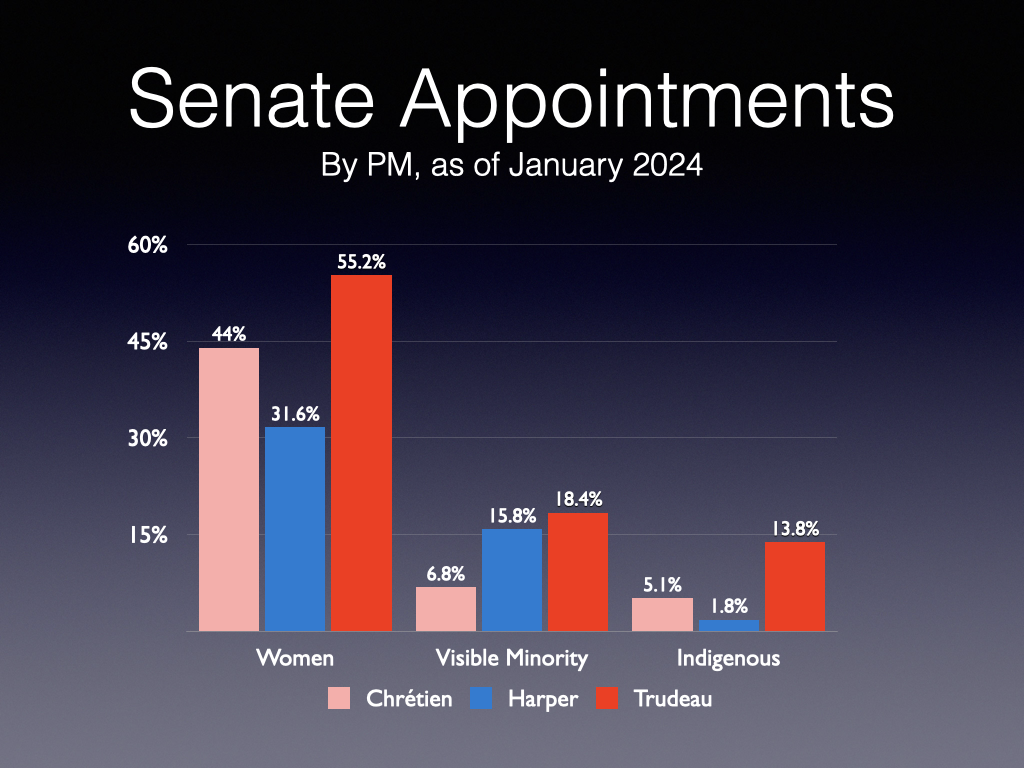
Diversity stats of appointments by PM (last minute senate appointments can be a poisoned chalice for governments):

…Prime Minister Justin Trudeau is planning a final wave of appointments to fill the 10 vacancies in the Senate before he retires in March, Radio-Canada has learned.

The move would allow him to leave a mark on Parliament for years to come, as these unelected legislators will be able to sit until the age of 75.

A source familiar with the matter says that the selection process for the future senators is already underway and should be completed before his departure. After proroguing Parliament earlier this month, Trudeau announced that he will leave power after the Liberal Party chooses a new leader on March 9.

In a written response, the Prime Minister’s Office confirmed that the advisory board for Senate appointments is at work to propose candidates for all vacancies.

“Prorogation did not affect the ability of the Governor General to make appointments to the Senate based on the advice of the prime minister,” said PMO spokesman Simon Lafortune. “The prime minister takes his responsibility to appoint senators seriously and will do so as long as he remains in office.”

The prime minister likes to praise the independence of the senators he has appointed since 2016, but he has nonetheless picked several high-profile Liberals to sit in the Senate in recent years.

The Conservative Party of Pierre Poilievre, which is leading in national polls, has long been critical of Trudeau’s choices of senators. The Conservatives now fear that Trudeau-appointed senators will try to block their agenda if the party wins the next election, which is expected in the spring.

There are currently 12 senators affiliated with the Conservative Party in the 105-seat chamber.

“For someone who advocated an independent Senate, [Trudeau] will have ended up filing the Senate with a large majority of Liberals or people who support his policies,” said Conservative Senator Claude Carignan….

Source: Trudeau to fill Senate vacancies before retiring: source

Lederman: At Auschwitz, there was no why

Lest we forget:

…Some of those lucky enough to survive Auschwitz not completely broken – many were – emerged with various whys as they sought a reason to go on. Primo Levi needed to tell the world. Elie Wiesel made it his mission to stop such horrors from happening ever again.

My mother’s why was simpler, less grandiose – if no less extraordinary. She met another survivor, they married, had three daughters. My parents, no longer alive, now have 23 descendants walking (or, in one sweet case, still just crawling) the Earth. We are her why.

I keep searching for mine. An obvious lesson of Auschwitz – beyond “do not murder” – could be to show kindness, care and respect for our fellow human beings. (I’ve had my moments, I know. I’m working on it.)

These can be small gestures, or they can be very big ones. But they must trump cruelty. I don’t think I need to explain why.

Source: At Auschwitz, there was no why

Anti-Defamation League finally comes for Elon Musk after his series of Nazi ‘jokes’

So Tesla owners, any buyers’ remorse?

The Jewish Anti-Defamation League has attacked tech billionaire and close Donald Trump adviser Elon Musk for making light of the Holocaust with a series of Nazi “jokes” Thursday.

The sharp criticism came just days after the ADL defended Musk against accusations of anti-semitism and racism by saying his controversial stiff-armed salute at Trump’s inauguration Monday was simply “awkward” and not a Nazi salute — even though it was widely hailed as such by white nationalists and many other of Trump’s MAGA supporters.

Musk mocked the controversy over his salute Thursday with a series of quips on X featuring word play with the names of some of Adolf Hitler’s leading Nazis, including Rudolph Hess, Joseph Goebels, Hermann Göring and Heinrich Himmler, who played key roles in killing 6 million Jews.


“Don’t say Hess to Nazi accusations!” Musk wrote in a post, adding: “Some people will Goebbels anything down! Stop Gőring your enemies! His pronouns would’ve been He/Himmler! “

Musk concluded: “Bet you did nazi that coming,” with a laughing-to-tears emoji.

This time ADL head Jonathan Greenblatt quickly slammed back at Musk on X: “We’ve said it hundreds of times before and we will say it again: the Holocaust was a singularly evil event, and it is inappropriate and offensive to make light of it … @elonmusk, the Holocaust is not a joke.”

In its own post Thursday the ADL quoted Greenblatt’s message, and added: “Making inappropriate and highly offensive jokes that trivialize the Holocaust only serve to minimize the evil and inhumanity of Nazi crimes, denigrate the suffering of both victims and survivors and insult the memory of the six million Jews murdered in the Shoah.”

The response was a pointed turnaround following the uproar after Musk’s controversial salute Monday, when the ADL came to his defense.

“This is a delicate moment,” the ADL emphasized in its message on X then.

“It seems that [Musk] made an awkward gesture in a moment of enthusiasm, not a Nazi salute, but again, we appreciate that people are on edge. In this moment, all sides should give one another a bit of grace, perhaps even the benefit of the doubt, and take a breath,” it added.

Musk has yet to respond to the new ADL criticism.

Source: Anti-Defamation League finally comes for Elon Musk after his series of Nazi ‘jokes’

Along with: Elon Musk makes surprise appearance at AfD event in eastern Germany

Elon Musk made a surprise appearance during Germany’s Alternative für Deutschland (AfD) election campaign event in Halle in eastern Germany on Saturday, speaking publicly in support of the far-right party for the second time in as many weeks.

Addressing a hall of 4,500 people alongside the party’s co-leader, Alice Weidel, Musk spoke live via video link about preserving German culture and protecting the German people.

“It’s good to be proud of German culture, German values, and not to lose that in some sort of multiculturalism that dilutes everything,” Musk said.

Last week, the US billionaire caused uproar after he made a gesture that drew online comparisons to a Nazi salute during President Donald Trump’s inauguration festivities.

On Saturday, he said “children should not be guilty of the sins of their parents, let alone their great grandparents”, apparently referring to Germany’s Nazi past.

“There is too much focus on past guilt, and we need to move beyond that,” he said.

Musk, who spoke of suppression of speech under Germany’s government, has previously attacked German chancellor Olaf Scholz on X.

For his part, Scholz on Tuesday said he does not support freedom of speech when it is used for extreme-right views.

Musk spoke in favour of voting for the far-right party. “I’m very excited for the AfD, I think you’re really the best hope for Germany’s fight for a great future for Germany,” he told onlookers.

Akkad: Biden was a failure. Trump will be a catastrophe

Remarkably simplistic analysis, assessing Biden only by his action and inaction with respect to Israel and Gaza. No mention of Ukraine, no mention investments in the American economy etc. Also telling is his silence on Hamas and the October 7 killings and hostage taking, which affected both white and brown Israelis:

…But a deranged right-wing capitalizing on the empty dissociation of neo-liberal politics is not some uniquely American phenomenon. It is coming for Canada, it is coming for Germany, it will fester everywhere the performance of great virtue accompanies the absence of substance. There is immense cruelty on the way, and given how quickly the CEO class has positioned itself in total fealty to the Trump administration, there will be little institutional resistance. If only as an act of pre-emptive penance to future generations’ history books, it will be important to document this cruelty, to not become desensitized. Just as it is important to document the cruelty that has led us here.

Joe Biden spent his much of his final few days as President trying to frame his administration as a successful one. It’s what Presidents do. There’s nothing interesting or novel about it, and anyway many of his predecessors have presided over the killing of faraway brown people in much greater numbers before retiring comfortably into the role of respected elder statesman. What is perhaps most fascinating about this particular bit of reputation massage is that it may well mark the last time any such administration is able to even pretend its success isn’t dependent on ignoring the suffering of distant others. Because distance is a relative thing. Today the town that burns is by chance someone else’s, but not for long. Today the crops fail elsewhere, but not for long. Today the drone executes a child in another part of the world, but not for long.

Today, America loves you back.

Source: Biden was a failure. Trump will be a catastrophe

Monneuse: Repression, resentment and resilience: A portrait of concentration camp survivors 80 years after their liberation


Interesting qualitative research and findings:

This is why, at the beginning of the 2000s, I began studying the journey of 625 Jewish survivors and/or resistance fighters who had been deported from France to Nazi death camps. I interviewed around 30 of them, as well as their families (brothers and sisters, spouses, children).

What is striking at first glance is the diversity in both the survivors’ trajectories and their levels of resilience. Some were haunted by nightmares every day until the end of their days, while others went on to live happy lives. Some returned to their previous lives (same job, place of residence and spouse) while others completely changed their lives. 

Despite these differences, we can identify four main profiles of survivors. 

  • The repression profile
  • The identity investment profile
  • The rehashing profile
  • The resilience profile…

Source: Repression, resentment and resilience: A portrait of concentration camp survivors 80 years after their liberation

Yakabuski: Supreme Court ruling on secularism law could land like a bomb in Quebec

Likely but inevitable:

…The Supreme Court must now decide whether to caution the pre-emptive use of the notwithstanding clause and determine whether the law violates minority-language and gender-equality provisions of the Charter that cannot be overridden by Section 33. Whatever it decides, it will not end the political debate in Quebec.

The CAQ government has already promised to table new legislation this year to reinforce Quebec’s secularist identity after launching investigations at 17 schools where teachers are alleged to have omitted curriculum that conflicted with their religious values. Mr. Legault has also raised the possibility of banning prayer in public spaces, such as city parks, where Muslims often gather to pray collectively.

In 2022, Prime Minister Justin Trudeau forcefully denounced the pre-emptive use of the notwithstanding clause after Ontario briefly invoked it in a dispute with education support workers. “The Charter of Rights and Freedoms cannot be a suggestion,” Mr. Trudeau said then.

However, it will fall to his successor as Liberal Leader and Prime Minister, if not a future Conservative government led by Pierre Poilievre, to articulate Ottawa’s position on Bill 21 before the Supreme Court. Whoever is in charge, they will need to weigh the political sensitivities of the law in Quebec against the imperative of standing up for the Charter.

“It is paramount, even vital, for Quebec to be able to make its own choices, choices that correspond to our history, our distinct social values and our aspirations as a nation,” Quebec Justice Minister Simon Jolin-Barrette and Secularism Minister Jean-François Roberge wrote on X on Thursday, while calling on other provinces to join Quebec in defending the “parliamentary sovereignty” of their legislatures.

If the top court overturns parts of Bill 21, a political storm is almost certain.

Source: Supreme Court ruling on secularism law could land like a bomb in Quebec

Costco defends its diversity policies as other US companies scale theirs back

Another reason to shop at Costco:

Costco is pushing back on a shareholder proposal that urges the wholesale club operator to conduct an evaluation of any business risks posed by its diversity, equity and inclusion practices. Investors were expected to vote on the recommendation during the company’s annual meeting Thursday.

The National Center for Public Policy Research, a conservative think tank based in Washington, submitted the proposal, arguing that Costco’s DEI initiatives hold “litigation, reputational and financial risks to the company, and therefore financial risks to shareholders.”

The think tank has made a similar proposal to Apple, and like some American companies that already scaled back or retreated from their diversity policies, cited a U.S. Supreme Court decision in July 2023 that outlawed affirmative action in college admissions.

Costco officials could not be reached for comment on the DEI proposal.

But Costco’s board of directors voted unanimously to ask shareholders to reject the motion. The board said it believes “our commitment to an enterprise rooted in respect and inclusion is appropriate and necessary. The report requested by this proposal would not provide meaningful additional information.”

Source: Costco defends its diversity policies as other US companies scale theirs back

List of other companies not abandoning DEI:

Top 5 Companies Sticking True to DEI Programs