In Quebec’s secularism law, an Ontario police force sees a source of recruits

Reminds me of Ontario hospitals doing the same thing during the 2013 PQ charter of values debates:

An Ontario police force will launch a recruiting campaign targeting Quebec residents affected by the province’s new law on religious symbols.

The Peel Regional Police, which covers territory including the cities of Mississauga and Brampton, will conduct a campaign in Quebec after a motion was passed unanimously by the region’s police services board on Friday.

The police force “believes in the values of diversity and inclusion, including the accommodation of religious symbols,” the motion states. It goes on to say that the police board “invites all affected individuals either pursuing or training for a career in policing in Quebec to apply for a career with the Peel Regional Police.”

The motion calls for the police force to place advertising “within Quebec.”

Quebec’s religious symbols law, which was passed last Sunday, will bar public school teachers, government lawyers, judges and police officers from wearing religious symbols while at work.

The Peel Regional Police have just over 2,000 uniformed officers and 800 civilian staff, said Constable Danny Marttini, a spokesperson for the force. They hire approximately 100 new recruits every year, she said.

The police board motion was seconded by Patrick Brown, Brampton’s mayor and the former leader of the Progressive Conservative Party of Ontario, who declared his opposition to Quebec’s law in a statement released Friday.

“We need to send a strong message to proponents of [the secularism law] in Quebec,” the statement says. “This law is an affront to freedom of religion and an infringement of the Canadian Charter of Rights and Freedoms.”

Brown has also introduced a similar motion with Brampton’s city council for recruiting for the city’s fire and emergency service.

Another motion calls for the city to join a legal challenge to Quebec’s law initiated by the Canadian Civil Liberties Association and the National Council of Canadian Muslims.

In his motion advocating for Brampton to join the legal challenge, Brown writes that the city “is ground zero for diversity and Canadian multiculturalism, and [Brampton’s] Council bears a responsibility to stand up in defence of the Canadian multicultural mosaic.”

Those motions will be considered at a council meeting on June 26.

Brown’s statement says the law on religious symbols will prohibit Jews, Muslims, Sikhs and others who wear religious symbols from pursuing careers in many public sector jobs.

The Islamic Cultural Centre of Quebec thanked the Peel police force for its action.

“Thanks to the Peel Regional Police for applying the values of the Canadian Charter of Rights and Freedoms,” the organization said on Facebook.

Source: In Quebec’s secularism law, an Ontario police force sees a source of recruits

‘Ground zero for multiculturalism’: Brampton mayor blasts Quebec’s ‘religious symbols’ bill

Not surprising, given the demographics of Brampton:

Brampton Mayor Patrick Brown [former Ontario PC leader] is speaking out against the Quebec provincial government’s Bill 21, which prohibits government employees from wearing religious symbols, and is tabling a motion at council’s next meeting to make the position official.

On Friday (June 21), Brown issued a statement strongly condemning Quebec Premier Francois Legault’s provincial government for passing the controversial Bill 21 into law on June 16.

“Bill 21, of course, is the law that will ban Jews, Muslims, Sikhs and others who wear symbols of their faith from pursuing careers in numerous public sector jobs,” said Brown in his statement.

Brown, once leader of the Progressive Conservative (PC) Party on Ontario before winning the mayor’s chain last October, also sits on the Peel Police Services Board. He seconded a motion at Friday’s board meeting approving a campaign to recruit Quebec residents interested in a career in policing affected by the new law in that province.

The police board motion also directs Peel police to “place select advertising within Quebec promoting a career at the Peel Regional Police.”

“I was pleased to second the motion at today’s Peel Police Services Board encouraging those Quebec residents interested in a career in policing to apply to Peel Regional Police. We are ground zero for multiculturalism,” added Brown in his statement.

The mayor’s statement included a pair of council motions he said he intends to table at Brampton council’s June 26 special meeting. The first would add the City of Brampton to an ongoing legal challenge.

The second follows the Peel police board motion’s lead inviting those affected by the new laws in Quebec interested in a career in firefighting to apply in Brampton, while also placing select advertising in that province to that end.

Council will debate both motions at its June 26 meeting at city hall from 9:30 a.m. to 5:30 p.m.

“We need to join the legal challenge initiated by the Canadian Civil Liberties Association and the National Council of Canadian Muslims to protect religious freedom. If we don’t stand up for religious freedom in Brampton which is the most culturally and religiously diverse city in Canada than who will?” said Brown.

Source: ‘Ground zero for multiculturalism’: Brampton mayor blasts Quebec’s ‘religious symbols’ bill

Federal riding profiles: A visible minority view

How does Canada’s political map of 338 ridings look in terms of the percentage of visible minorities? How do visible minority rich ridings compare to ridings with fewer visible minorities in terms of demographic, economic and social characteristics, and electoral results? 

Their electoral importance is clear, with 41 ridings in which visible minorities form the majority and an additional 93 ridings in which visible minorities form between 20 to 50 percent of the population.

By looking at ridings grouped by their percentage of visible minorities, the changing nature of Canada’s political landscape can be seen. As party electoral strategies focus on defining a winning approach given the needs and make-up of each riding’s population, having a comprehensive look at the demographic, economic and social characteristics helps one understand the various factors at play in electoral strategies. Political parties, of course, have their own more detailed data at the polling station level; this analysis aims to level the playing field, so to speak, for the rest of us.

This analysis provides a visible minority lens to ridings and their relation to demographic, economic, social and political characteristics. Given the ongoing trend of increasing immigration levels, that close to 80 percent of immigrants are visible minority, and the increased number of Canadian-born visible minorities, this approach provides a future-centred perspective to the political map.

While political parties collect some of this and other data at a much more granular level (postal code and polling station), the riding level provides a good sense of the diversity between ridings, and helps explain some of the political strategies employed to reach voters.

The higher unemployment rates, lower median incomes and greater prevalence of low income, suggest that economic issues are as significant as immigration-related issues such as family reunification in visible minority majority ridings. With their younger age profile and larger number of families, family-friendly policies are also important but childcare may be seen more though a family reunification perspective (parents and grandparents) than through government programs.

Identity politics play out differently depending on the percentage of visible minorities as the experience of the last election shows. Efforts by the Conservatives with respect to the “barbaric cultural practices” tip line and the effective distinction between Canadian-only and dual citizens in their citizenship revocation provisions, while appealing to many, created unease among visible minorities and provided an opening for the Liberal “a Canadian is a Canadian is a Canadian” language.

However, a likely common thread among most Canadians, whatever their origins, is that immigration and citizenship need to be managed and that the fairness and integrity of the processes is maintained. Public concern regarding irregular arrivals (“queue jumping”) and increased numbers of birth tourists are but the obvious examples. While for some, expressing these concerns may be driven by xenophobia, for most it is more likely driven by concerns over fairness and people taking advantage of policies and processes. 

Tables and analysis

This article uses 2016 Census Profile federal electoral district along with Elections Canada voting results by electoral district to highlight similarities and differences. The three broad groups of ridings — 41 ridings in which visible minorities form the majority, 93 ridings in which visible minorities form between 20 to 50 percent of the population, and 169 ridings with less than 20 percent visible minority — are subdivided to provide greater granularity. The groupings with the smallest number of ridings have the lowest variation or range in any of the indicators.

The full analysis can be found: Federal riding profiles: A visible minority view

Citizenship policy challenges the next government will face – My latest

Citizenship is the neglected child of immigration-related policies. It attracts less attention, and it has a lower profile and fewer resources than other areas. This is evidenced by wide swings in the number of new citizens, periodic funding shortfalls and the paucity of data, compared with that for immigration.

….

Full text: Citizenship policy challenges the next government will face

Loi 21: Trudeau dénonce, sans plus

Of note (see Andrew Coyne: Will leaders tolerate religious segregation just because it’s Quebec?):

La loi québécoise sur la laïcité a rattrapé Justin Trudeau sur le toit de l’ambassade canadienne à Washington, jeudi.

Mais le premier ministre s’est, une fois de plus, contenté de dénoncer la loi du gouvernement Legault, sans dire ce qu’il ferait pour la contrer.

La question est venue en toute fin de point de presse, après une journée à rencontrer le président Donald Trump et des politiciens américains pour discuter de la ratification du nouvel ALENA.

Pourquoi M. Trudeau n’a rien dit depuis l’adoption à Québec du projet de loi 21 ?

« Ma perspective et mes opinions là-dessus ont toujours été très claires », s’est défendu le premier ministre.

« Je suis évidemment préoccupé par une atteinte aux droits fondamentaux des Canadiens », a-t-il ajouté.

Mais pas plus que ses ministres, cette semaine à Ottawa, n’a-t-il voulu dire ce que son gouvernement ferait concrètement pour répondre à cette « atteinte aux droits fondamentaux ».

Lorsque le projet de loi était débattu à Québec, on refusait à Ottawa de dire si on songeait à se joindre à un recours devant les tribunaux pour l’attaquer. On disait attendre de voir le contenu final de la loi une fois adoptée.

Au lendemain de l’adoption de la loi, le ministre fédéral de la Justice, David Lametti, n’avait toujours rien à dire de plus.

« On va regarder ce qui se passe sur le terrain. Aussi on va prendre le temps pour étudier les amendements qui ont été ajoutés à la loi. Et on va agir d’une façon prudente », disait le ministre Lametti lundi.

Il refusait toutefois d’exclure une intervention éventuelle de son gouvernement devant les tribunaux.

« Nous allons sûrement nous assurer que nos opinions soient bien connues et nous continuerons à défendre les droits des Canadiens », a répété, de son côté, M. Trudeau à Washington, jeudi.

Le journaliste lui a alors demandé s’il était temps de faire disparaître la clause dérogatoire.

Le premier ministre a préféré ne pas répondre à cette question.

Source: Loi 21: Trudeau dénonce, sans plus

There’s a gaping hole in our democracy

Former Conservative Senator Oliver on the under-representation of Black Canadians.

His solutions are not as easy as he states, and certainly the current government has a good overall record in its appointments in terms of increased numbers of women, visible minorities and Indigenous peoples:

Canada was once the envy of the world with our legislation on multiculturalism, tolerance, and ethnic fairness. But our democracy, indeed all our democratic institutions, have failed us because, as Prime Minister Justin Trudeau said,” our House of Commons, the heart of our democracy, should look more like the composition of Canadian society”— including more Black MPs, but, sadly it doesn’t. However, the good news is that we are capable of reaching that pinnacle of democratic excellence once again if we could just learn how to accept diversity.

Some things never seem to change. In nature, virtually all plant and animal life change and adapt with time. But attitudinal change is difficult, particularly as it relates to our Canadian democratic demographics. They seem strangled by decades, indeed centuries, of insidious, often painful, and subtle racism that prevents minorities, specifically African Canadians, from participating, in a meaningful way, in the framework of Canadian society. And that includes being elected or appointed to Canada’s parliamentary institutions. In February, during Black History Month, Prime Minister Trudeau stated that he wants to do more to “recruit and elect Black Members of Parliament.”

Last year, our prime minister also announced that Canada officially recognized the UN International Decade for People of African Descent. But so far, that recognition, like the recruitment promise, has not made its way into the heart of our parliamentary institutions. It seems that everything, from gerrymandering, certain racially biased laws and regulations, to some blatant mainstream political party racial insensitivity, have kept our political and bureaucratic institutions virtually white. Of 338 members of the House of Commons, there are fewer than 10 African Canadians. Is that representative of the Canadian mosaic? Hardly. Where are they? Why aren’t more nominated and elected?

As the United Nations puts it, for far too many Canadians, anti-Black racism, discrimination and inequality are part of their daily lives. It reaches into our democratic institutions. It’s unacceptable and, frankly, it’s time our government took some concrete, positive steps to change and correct it.

What, you may ask, is so wrong if people in the seats of power in our democratic institutions do not reflect the face of Canada? What if they are all from the white majority? So, what? Well, for one thing, anti-Black racism is a fact and a reality in Canada today. It exists. Equality of opportunity for all is non-existent. So if African Canadians are not represented, their issues, concerns, aspirations, and needs can easily be unconsciously overlooked and ignored. That constitutes a fundamental failure of our democracy.

There are answers and there are solutions. But it will not be cured with one token appointment of a lone Black person delegated to the back corner. It requires critical mass to ensure a viable result.

All of this can be easily and quickly rectified starting with executive action in Ottawa. For instance, the next 10 appointments to the Senate of Canada could be African Canadians. More eminently qualified Black lawyers and judges could be immediately appointed by cabinet to our Supreme and Superior Courts throughout the land. The next three deputy ministers appointed in the public service could easily be African Canadians. There is a huge pool of bilingual, highly skilled senior EX managers awaiting a call. The prime minister could also act on another UN recommendation because we desperately need a new Department of Diversity headed by a seasoned and qualified Black Canadian deputy minister. The next 15 order-in-council executive appointments to our largest and most powerful Crown corporations could easily be African Canadians, and all of that can be done with the stroke of a pen. It simply takes executive will. Prime Minister Trudeau could implement all of the above before the next federal election.

That’s how easy it would be to implement, throughout Canada, the directives and wishes of the United Nations for this International Decade for People of African Descent. Once implemented, Canadians could observe these talented and qualified Black men and women perform with competence and integrity in these senior positions. At the same time, the remnants of this latent anti-Black racism would slowly dissipate and disappear. These exceptional Black leaders would be part of our cultural mosaic, which makes Canada so great. And Canada would once again return to its position of envy around the globe because of the strength of our democratic institutions.

Let’s fill that gaping hole in our democracy. Now is the time for all Canadians to call on their parliamentary representatives to force the executive to carry out these changes. What a better place Canada would then be for all of us.

Source: There’s a gaping hole in our democracy

Want more diversity in politics? Start by looking at political parties: Tolley

Good piece by Tolley. The only other point I would add is that visible minority candidates tend to run in ridings with significant numbers of visible minorities and immigrants, where likely the local riding party memberships reflect that diversity:

The 2015 federal election saw a record number of women, Indigenous peoples, and racialized Canadians elected to the House of Commons. When he selected his ministry, Justin Trudeau lauded it as “a cabinet that looks like Canada.” These gains are notable, but they should not be taken for granted. There are still representational gaps: women, Indigenous peoples, and racialized Canadians all occupy proportionately fewer seats in the House of Commons than their share of the Canadian population.

To get at the root of electoral under-representation, forget the electoral system. You need to look no further than Canada’s political parties. Parties control access to the House of Commons because they select nearly all of the candidates who appear on the ballot. Even so, the processes that parties use to recruit and select candidates are so opaque that the nomination stage has been referred to as the “black box” of Canadian politics. One thing is clear: if there is a representational deficit in the House of Commons, it’s because when parties nominate candidates, the ones they choose are still disproportionately white and male.

The problem isn’t voter bias. Of course voters harbour prejudice, but on election day, their preference for a particular party or leader tends to override whatever reservations they might have about a candidate’s race, gender, or demographic background. As a result, researchers have largely concluded that when women and minorities run, they win. What this means is that if parties nominated more diverse candidate slates, there would be more diversity in Parliament. The representational gap begins with parties, and the demographic mismatch between Parliament and the population only widens as prospective candidates move through each stage of recruitment, beginning with the decision to run for office and continuing until the ballots are counted.

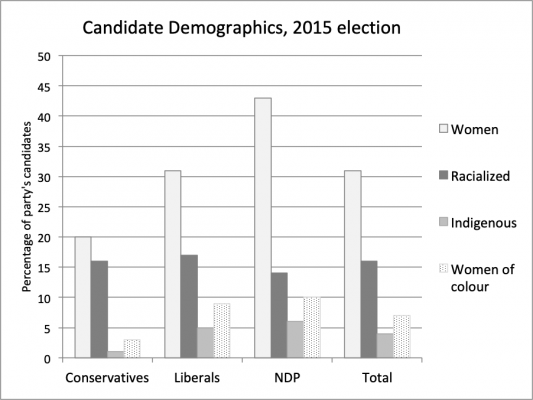
Parties are not obligated to release data on the diversity of their candidate slates, so researchers and journalists are left to tally the statistics. They do this by consulting candidate biographies and other publicly available information, but even then, it’s hard to compile a full picture beyond the three main parties. In 2015, our best estimates suggest that at least 80 per cent of candidates were white, and 70 per cent were men.

Data compiled by the author, using candidate biographies and other publicly available sources. Women of colour includes both Indigenous and racialized women.

So, why don’t parties nominate more women and minorities? In some cases, political parties underestimate the electoral prospects of candidates who don’t fit the profile of the prototypical politician. There is also evidence that they filter women into unwinnable ridings and pigeonhole racialized candidates into only the most diverse districts. Gatekeeping matters.

My research shows that racialized candidates are more likely to emerge when the party’s riding association president is also racialized; otherstudies confirm that women riding association presidents are positively related to the selection of women candidates. Perhaps it’s because women and racialized gatekeepers have more diverse networks and can draw on these resources when identifying potential candidates, but it also appears that under-represented groups respond more positively to recruitment from gatekeepers with backgrounds like their own. Diverse local party leadership might also signal the party’s openness to a variety of candidates.

Despite this, my own research suggests that at least three-quarters of riding association presidents—the most prominent local party gatekeepers—are white and male. Candidate search committees typically assist riding association presidents, but the face of local recruitment efforts is still relatively homogenous. Parties might have more success in their efforts to recruit candidates with a wider range of characteristics and life experiences if the executives of their local riding associations were themselves more diverse.

The NDP has tried to tackle the challenge through an equity policy that commits to running women candidates in at least 50 per cent of all districts, and members of other equity groups in a further 30 per cent; “equity groups” is a catch-all for racialized minorities, Indigenous peoples, persons with disabilities, individuals who are LGBTQ, and youth. Although in 2015, the party nominated more women candidates than either the Liberals or the Conservatives, they nominated the fewest racialized minorities. This suggests that even an explicit commitment to more diversity is not enough. In 2017, the Liberals and Conservatives defeated a private member’s bill that would financially penalize parties for not running more women candidates

Other less formal means have also been tried. For example, prior to the last election, the federal Liberals launched an initiative called #AskHer. The idea was simple and grounded in research that shows women candidates need far more encouragement to run for office than men do. The Liberal Party asked Canadians to identify qualified women candidates whom they thought the party should approach to run. From these submitted names, just one woman—Celina Caesar-Chavannes— was ultimately elected as a Member of Parliament.

Parties have long been the gatekeepers to elected office, but apart from requiring them to disclose the names of their donors and abide by some basic electoral rules, there is little—aside from public pressure—to hold them to account. The 2019 election is an opportunity to do so. How many candidates from equity-seeking groups did parties approach and encourage to run for office? What measures are they putting in place to recruit diverse candidates to office? And how are parties supporting new candidates, whether that’s through training, a financial contribution, or volunteers? Last election, parties told voters to #AskHer. This time, we need to ask more of parties.

Source: Want more diversity in politics? Start by looking at political parties

Journalists inherit ‘institutional blindspots’ that cloud coverage of race in politics, says media expert

From the Hill Times, Erin Tolley on blindspots, myself on diversityvotes.ca and others:

Increasing the diversity of newsrooms isn’t a cure-all for improving political coverage of racialized people, says a media expert, who argues that journalists often end up inheriting the institutional blindspots of the outlets they work for. 

“Even journalists of colour sometimes will produce coverage that differentiates and treats white and racialized subjects differently,” said Erin Tolley, political science professor at University of Toronto, in a phone interview. “Journalists are a product of the institutions that see whiteness as a norm. It’s not a problem of individual journalists.” 

Prof. Tolley spent four years surveying the mainstream media’s coverage of race in politics with data from the 2008 federal election, including how its depiction of non-incumbent, visible-minority candidates’ viability compared to non-incumbent, white candidates. 

“White, straight men are still seen as people who deserve to be in institutions of power, who naturally fit into those roles. … [Journalists] come at stories about racialized subjects with a different standard,” she said. “They present the white, non-incumbent candidates as more politically viable, more qualified to win, than racialized non-incumbents.” 

These unconscious biases towards visible-minority candidates tend to disappear from coverage, she said, when they occupy political office. 

Andrew Griffith, former director general at Citizenship and Immigration Canada during the Harper era, echoed Prof. Tolley’s assertion that improving diversity within one’s ranks doesn’t necessarily translate into a diversity of thought, particularly when the culture of the institution in question might promote conformity. “You had management teams that had a degree of diversity, but the corporate culture is about conforming. Did those diverse people bring a diverse perspective? You didn’t necessarily see that,” Mr. Griffith said of his own experience in government. 

Since retiring from public service, Mr. Griffith has now developed a tool with Mirems—a company that monitors and translates coverage from ethnic media sources—aimed at providing context about how issues are being covered in diaspora communities. The online tool is at Diversityvotes.ca. For journalists, he said, it can serve as a resource to deepen their understanding of the complexity of ethnic communities and to demystify perceptions that there’s a monolithic ethnic vote. “There’s a diversity with the diversity, and simply labelling or assuming people within a community are representative of an entire community is dangerous,” Mr. Griffith said. 

When confronted with their biases, Prof. Tolley said, journalists she interviewed—who spoke on the condition of confidentiality—tried to explain away differences in their framing of a candidate’s electability. For example, she observed that non-white candidates were more seen as long-shot candidates compared to their white counterparts. They insisted that any differences stemmed from a candidate’s level of experience, not stereotypes, even as she pointed out that those factors had been controlled for in the research. (The findings were published in her book, Framed: Media and the Coverage of Race in Canadian Politics.)

The Canadian Press style guide’s—the definitive handbook that many reporters have copies of handy—section on race illustrates how journalists are instructed to think about the subject of racial stereotypes, Prof. Tolley said. In both the previous and latest editions of the guide, one measure for determining whether it’s “pertinent” to mention a person’s race is if one is reporting on an “accomplishment unusual in a particular race.” Thinking of issues of race in those terms, she said, shows “some outdated thinking about race and racial characteristics. In defending CP’s standards, the guide’s editor, James McCarten, told her in an interview for the book that the word “unusual” may not be the right word, but he stood by the guideline, saying, “journalism oftentimes is all about firsts” and “historically relevant” events. 

Efforts to deepen coverage of race, politics 

Ryan McMahon, the host of Canadaland’s Thunder Bay podcast series, said that his Anishinaabe identity, coupled with the privilege of not immediately being seen as Indigenous because of his skin colour, informs his approach to reporting on issues of race. 

In setting out to tell the story of why Thunder Bay has the highest hate-crime rates in Canada and why there’s deep distrust in the city’s institutions, Mr. McMahon said, the “one thing” the podcast got right was getting someone like him to report on the city. Having firsthand exposure to the subtle ways that racism manifests itself, he said, helps in identifying and effectively naming racism. In his hometown of Fort Frances, Ont., for example, it was “rare” to see a “brown face” behind the cash register. 

“The way I experience racism is very different than someone who is visibly native. I can walk down the street and not be identified as Indigenous, so my experience is very different,” Mr. McMahon said. “[Racism in Canada] is often quiet, but aggressive, unspoken. … The kind of racism we’re talking about isn’t necessarily a Nazi skinhead, KKK apologist. It can often be an unconscious ignorance, with deeply held misperceptions. People hold on really tightly to stereotypes.” 

The groundwork laid by journalists such as Mr. McMahon and Toronto Star’s Tanya Talaga in chronicling the systemic racism in Thunder Bay that underpins its public institutions—and the national conversation that followed—helped open up the space for The Globe and Mail to establish a temporary presence in the northwestern Ontario city earlier this year. The paper had also done extensive coverage of Adam Capay, the Lac Seul First Nation man who spent about four years in solitary confinement. 

David Walmsley, The Globe’s editor-in-chief, explained in a staff memo that temporarily setting up shop in Thunder Bay, in an election year, presents this country a “chance to look inward and to encourage improvement in areas where we all know improvement needs to be made.”

Having spent more than a decade reporting on Indigenous issues, veteran Hill reporter Gloria Galloway was among the first reporters assigned to live for a couple of months in Thunder Bay, as part of the paper’s effort to deepen its coverage of the systemic racism in the city. The Globe does not have an Indigenous reporter on its staff, so it had a “limited pool” to choose from for the first stint, Ms. Galloway said. 

That The Globe, the country’s national newspaper, still doesn’t have an Indigenous columnist or staff reporter is a reflection of how the “markers” for improving diversity don’t appear to have moved much in Canadian media, said Mr. McMahon, who added that there are a bunch of journalists who are closer to the story. He said he’s been disappointed by The Globe’s coverage of Thunder Bay, pointing to the first piece released that gave an extensive overview, in interactive form, of the issue, with interviews from a cast of characters in the city. “So far, we’ve seen a Thunder Bay 101 piece. I understand why they had to do that, but it was a surface-level piece, a collection of stories that other journalists have already told,” Mr. McMahon said.

Ms. Galloway acknowledged that there’s a “huge learning curve” that comes with reporting on Indigenous issues, as a white woman. But, over time, through her reporting, she said, she’s developed a “sensitivity” to covering issues of race and has developed friendships and earned the respect of Indigenous peoples: “Every year, I’ve learned how much more I don’t know.”

Ms. Galloway said The Globe’s decision to dedicate resources to cover Thunder Bay was not an “insignificant financial commitment” for the paper, particularly in an election year. “I was pulled out of the Ottawa bureau for months. Losing a body in Ottawa for us is very difficult,” she said.

But there was an acknowledgment that shining a light on the situation could help elevate the issue to become part of the election discussion. “We’re not activist journalists, but certainly, there’s a sense in The Globe culture that shining a light on things that are wrong and having corrective action is [important],” Ms. Galloway said. 

Though Ms. Galloway is retiring next week, having decided to take a voluntary buyout, she said, the paper is committed to having a presence in Thunder Bay through the summer and fall. 

Source: Journalists inherit ‘institutional blindspots’ that cloud coverage of race in politics, says media expert

Andrew Coyne: Will leaders tolerate religious segregation just because it’s Quebec?

Typical trenchant Coyne column:

According to the premier of Quebec, it’s all about pride. Quebecers, Francois Legault claims, are forever stopping him in the street to tell him “‘Mr. Legault we are happy.’ I say why and they say ‘it’s because we are proud.’… To feel this regained pride among our people, who are standing up, advancing, makes me the happiest man in the world to be their premier.”

And what is this miraculous thing that has restored Quebecers’ sense of pride to them? What has prompted ordinary Quebecers to buttonhole the premier to tell him how happy — and proud — they are? A bill that prohibits those in “positions of authority” in the civil service, including not only judges and police officers but teachers, from wearing religious symbols on the job.

Which is to say, that prohibits those whose faith obliges them to wear such symbols from working in those positions. Or if we are really being frank, that bars them to observant Muslims — also Sikhs and some Jews, but really Muslims.

That, according to the premier, is what has caused Quebecers to walk erect again: Bill 21, “An act respecting the laicity of the state,” passed in a special weekend sitting of the legislature, with the help of closure.

The bill will of course face a raft of court challenges, its prophylactic invocation of the notwithstanding clause, er, notwithstanding. The clause may save the law from judicial invalidation on the grounds of its manifest violations of Charter guarantees of equality or religious freedom, but it does not shield it from judicial scrutiny on other grounds: as a possible violation of the division of powers, say, or of women’s rights, or indeed as an improper use of the clause itself.

Whether the courts will be willing to go to such novel lengths remains in doubt. So we are faced with a question I raised some months ago: is this a state of affairs the country can tolerate? On the evidence, it would seem we can. The government of the second-largest province in the country has just passed a law forbidding the province’s religious minorities from working in much of the public service  — and when we say religious minorities, we are typically also talking of racial minorities — and the reaction elsewhere is … silence. No federal leader issued a statement in response. No other premier spoke up.

Oh, there was some perfunctory criticism from both quarters when the bill was introduced, though in curiously muted language. Justin Trudeau ventured, indirectly, that he didn’t think “that a lot of people feel that … we should be legitimizing discrimination of our citizens based on religion.” Andrew Scheer noted, vaguely, that “a society based on fundamental freedoms and openness must always protect fundamental individual rights and should not in any way impede people from expressing themselves.” Even Jagmeet Singh, whose turban would preclude his employment as a cop or teacher in Quebec, confined himself to observing that “this law that is being proposed is something that divides the population… instead of bringing people together.”

But now even that is apparently too much. Whether or not one thinks some sort of federal action is required — I do not see why it is any less legitimate for the federal government to use its constitutional power to “disallow” provincial legislation than for the Supreme Court to do so, but neither is that the only means at the feds’ disposal — it is extraordinary that it should not even be considered worthy of comment.

If this had been tried in any other province — well, why proceed? It wouldn’t be tried in any other province. But if it were, the feds, the media and the rest of the great and the good would descend on the offending province like Moses from Mount Sinai, full of fiery denunciations of the bigotry that presumably inspired it. But because it is Quebec — and, one suspects, because there’s an election in the offing — we are invited, as ever, to understand, or at any rate to shut up.

We have to avoid the temptation to abstraction. This is not merely an “intrusion on religious freedom” or “incompatible with religious equality” or “a misunderstanding of religious neutrality.” It is a religious hiring bar. Its effect, if not its aim, is to enforce a kind of segregation over much of the public sector.

To be sure, it applies only to some jobs, and not the whole of the civil service, as the Parti Québécois had previously proposed in its “charter of values.” And the government has partially exempted existing employees: while they would not be fired from their current jobs — no tearful scenes for the networks — neither could they move to a new location, take a new job, or accept a promotion within the areas prohibited to them.

But this is small comfort to those Quebecers who might aspire to work as teachers, police officers, judges and so on, whose government has essentially told them: No Muslims (or Sikhs, or orthodox Jews) need apply. Even existing employees who profess these faiths must surely see how limited a future the government has in mind for them. Over time, they may be expected to take the hint, and leave.

We are surely past the stage now where some tenured idiot will attempt to justify this in the name of French concepts of secularism or Quebecers’ scarred memories of their Church-dominated past, but just in case: it is probably no coincidence that Bill 21 should have been passed on the same weekend as Bill 9, another law of dubious constitutionality that would impose a “values test” on immigrants to the province. This is about putting the province’s minorities — religious, racial and otherwise — in their place.

Which leaves the rest of us with a decision to make. Sixty-odd years ago the United States decided it was not prepared to tolerate racial segregation in its schools in the name of “states’ rights.” Will we tolerate religious segregation in the public service on the principle that “what happens in Quebec stays in Quebec”?

Fears of ‘secularism police’ in Quebec raised by last-minute changes to religious symbols bill

So much for social peace and “settling the issue:” Can expect an ongoing stream of stories regarding individuals affected, enforcement actions taken and legal challenges:

Quebec’s opposition is warning last-minute changes to the Coalition Avenir Québec’s religious symbols law open the door to the establishment of “secularism police.”

In the final hours before Bill 21 was passed late Sunday, the CAQ introduced several amendments, including provisions to ensure the law is being followed and to impose disciplinary measures if it is not.

Liberal MNA Marc Tanguay, who voted against the bill, said the changes would lead to what he described as “secularism police.”

“It was never discussed, it’s unacceptable,” Tanguay said on Twitter.

Sol Zanetti, an MNA for Québec Solidaire, the second opposition party, also expressed concern about the change.

“So now will there be police officers going after people to check if they have religious signs? We don’t know.”Q

The legislative session was originally scheduled to be suspended for the summer break last Friday.

However, members of the National Assembly sat through the weekend after the CAQ used its majority to invoke closure and put an end to debate over Bill 21, as well as its contentious immigration legislation, Bill 9.

The secularism law bars public school teachers, government lawyers, judges and police officers from wearing religious symbols while at work.

The bill passed 73 to 35, with the CAQ as well as the Parti Québécois, the third opposition party, voting in favour.

Not police, but ‘verification,’ CAQ says

Immigration Minister Simon Jolin-Barrette rejected the opposition’s characterization of the amendments to Bill 21, saying they are meant simply to ensure the law is followed.

He said the government needs the power to ensure institutions, such as school boards, comply with the new rules.

School teachers hired after March 28 will not be allowed to wear religious symbols. Those already on the job are to be exempted under a grandfather clause.

“If a school board doesn’t respect the bill, we have the power of verification to see why they don’t respect the bill,” Jolin-Barrette said.

The English Montreal School Board has already said it will not enforce the law.

Religious groups and legal experts have argued the law unfairly discriminates against minorities, particularly Muslim women who wear the hijab.

The National Council of Canadian Muslims and the Canadian Civil Liberties Association announced they are challenging the law Monday.

A protest is also planned for Montreal.

Jolin-Barrette, who tabled the legislation, reiterated Monday the secularism law was long overdue, after years of debate over religious accommodation in the province.

Source: Fears of ‘secularism police’ in Quebec raised by last-minute changes to religious symbols bill