Domise: Who gets to be a ‘teen’ and a ‘good kid’?

Worth reflecting on:

For a very long time, I’ve been of the mind that corporal punishment is detrimental for black children, and should be discouraged. Many in the Caribbean community would likely disagree; spare the rod, spoil the child is an axiom I learned from elders long before I first read its source quote in the Book of Proverbs. But it never sat well with me that black children, faced with a world that would capriciously limit their opportunities, fling them into the maw of the criminal justice system, and justify their murder at the hands of police and vigilantes, should come home—their only refuge against a world that fears and misunderstands them—only to be faced with more harsh discipline.

In her recent book Spare the Kids, journalist, anti-spanking advocate and Morgan State University professor Dr. Stacey Patton draws a solid line between corporal punishment and the violence of western colonialism, slavery, and genocide. The harsh treatment of white children endemic in Europe, Patton argues, gave way to a widespread belief in the innocence of children that stigmatized use of “cat-o’-nine-tails, shovels, canes, iron rods and sticks” in the 19th century.

In place of such punishment, which often resulted in infanticide, and wasn’t prosecuted for a long time, came the manual discipline we refer to today as spanking. “In other words,” writes Patton, “white people began to recognize the vulnerability of their own children and had to rescue them, if only partially, from this unthinkable close proximity to blackness and the brutality of childhood.”

For the African-descended and Indigenous people of the Americas, regarded as the most savage and therefore childlike members of the human race, the concept of childhood carries a much different import. All punishments allotted to them—floggings, rape, torture and murder—were not considered wanton violence, but instead the loving attempt of the white patriarch to drive savagery out of their bodies and instill the values of civilization. This belief, that black and Indigenous peoples must be refined through the disciplining of their bodies and minds, has lingered in the white psyche long after the emancipation of black people, and the recognition of Indigenous sovereignty.

It is a belief that white people, as humanity’s patriarchs, have a responsibility to discipline humanity’s children.

This belief is why the words “boy” and “girl” can become slurs when they slide off the white tongue, directed at grown adults. Meanwhile, our children are stamped from birth with the stigma of maturity; plenty of studies exist to show that our children are viewed as older and less innocent by teachers, police and other authority figures who are, by the oaths they take and the titles they wear, supposed to be children’s protectors.

This has tainted racialized communities with a social paradox that quickly ages children out of childhood in order to strip from them the aegis of innocence, yet also infantilizes our adults in order to subordinate them to white hegemony. Thus, acting in loco parentis, the brutality visited on racialized adults and children alike by authority figures—our schools, police, court systems—is not seen as cruel and unjust violence, but instead as a form of socialized corporal punishment, birthed by colonialism and nurtured institutions—our political class and mass media—which function as vestiges of white patriarchal hegemony.

The acceptance of this socialized corporal punishment, by white authority figures, is why Eric Casebolt (then a McKinney, Texas police officer) can throw a black child through the air, drag her by the hair, and slam her to the ground, and not only will he not be charged with a crime, a prominent white news anchor will comment “The girl was no saint, either.” It’s how former Cleveland police officer Timothy Loehmann can jump out of a police cruiser and summarily execute 12-year-old Tamir Rice, and have his actions covered by a municipality that blames Rice for failing to “exercise due care to avoid injury.” And it’s also how an all-white jury can acquit Saskatchewan farmer Gerald Stanley of second-degree murder, even after Stanley admitted to aiming a handgun at Cree youth Colten Boushie and pulling the trigger.

Spare the rod and spoil the child. If there is no child to be found behind those savage eyes, then put down a threat.

On the other hand, white youth who commit atrocities in the name of white nationalism are not only draped in the innocence of childhood from birth, but are covered by its long tails into adulthood.

Consider the case of Kam McLeod and Bryan Schmegelsky, two young white men from Port Alberni, British Columbia, who are currently the subjects of a nationwide manhunt. Early on, when their disappearance shifted from missing teenagers to murder suspects, news media continued referring to them as “teens” and uncritically ran pull-quotes from community members who called them “boys.”

To be clear, these “boys,” 18 and 19 respectively, are not only prime suspects in the murders of three people, but Schmegelsky is alleged to have uttered violent threats to his classmates, and have a fascination with neo-Nazi imagery and organizations. Yet, their families have been offered uncritical coverage in Canadian news: McLeod’s father describing him as “kind, considerate and caring,” and Schmegelsky’s father describing his son as “a child in some very serious pain.”

Not long after McLeod and Schmegelsky’s alleged killings, 19-year-old Santino William Legan, of Gilroy, California, armed himself with a legally purchased AK-47 variant rifle, and opened fire at a local town festival. Three people were killed, two of them children, and another 12 people were injured by gunfire. Though Legan was himself killed in a shootout with police, and was found to have posted links to a white supremacist manifesto on one of his social media pages, he was—rather amazingly—described in a tweet by South Carolina-based The Greenville News as “a quiet teen who stayed out of trouble.”

The infantilizing and innocence-jacketing of white murderers and murder suspects is part and parcel of a long tradition; the childhood of New Zealand mosque shooter Brenton Tarrant (aged 28) was given an extensive profile by Australia’s The Daily Telegraph, Dylann Roof (aged 21) was described as a “sweet kid” corrupted by “internet evil” in coverage after his arrest, and was even brought a Burger King meal by police while in custody. Twenty-two-year-old Santa Barbara shooter Elliot Rodger’s “happy childhood” in England was covered by The Guardian, and it took years to debunk the myth that Dylan Klebold and Eric Harris, the mass shooters at Columbine (aged 17 and 18 respectively), were lonely kids retaliating for a lengthy history of being bullied in school.

Rather than harsh social discipline, young white men who commit these heinous acts are faced with a society endlessly devoted to making sense of their crimes. Behind that, I believe, is a motivation to understand how white children brought up according to plan, and kept safe from exposure to socially corrupting elements—drugs, crime, pornography—could regress so drastically from civilization to savagery. Racialized children, on the other hand, are born into stigma and need no such understanding or explanation. Their already and always existing predisposition for delinquent behavior requires purging from their bodies, and if they happen to be injured or die in the process, well, they should have exercised due care.

I have no doubt that, when Schmegelsky and McLeod are finally apprehended, plenty of coverage will be devoted to figuring out where these young men went wrong. I also have no doubt that, even in the face of glaring evidence that white mass shooters are working from a well-established ideology that requires the removal—if not extermination—of non-white races for a harmonious society, plenty of coverage will be devoted to missing that point.

What I do doubt, however, is that the broader conversation on mass killings will land on the relationship between white supremacy and the power it grants white people (white men in particular) to inflict brutality on others, as well as the logics to justify it.  The social agreement to infantilize spree killers after they’ve passed into adulthood is only one factor in a broader environment of racialized patriarchy; one that warps them in to believing they are acting as soldiers in a race war, and every murder they commit, even against other white people (whom they often deem to be enablers of race-mixing and demographic replacement) is a swing of the rod for the good of society.

And this is why I believe corporal punishment inside the home to have such a damaging effect on black children. A world which grants them no childhood, no innocence, and no protection from physical harm against the people who believe they are entrusted with the responsibility to purge the world from the perceived savagery of our races, well, that’s a harsh enough world already. At the very least, they should find safe shelter from that world with their families, and inside their homes.

Source: Who gets to be a ‘teen’ and a ‘good kid’?

Holocaust survivors have home ransacked as antisemitic incidents hit new record in UK

Of particular note “Where a perpetrator’s ethnic appearance was recorded, over two thirds were described as white, 12 per cent Asian, 11 per cent black and 8 per cent Arab or north African”:

Holocaust survivors had their home ransacked and sprayed with graffiti in one of a record number of antisemitic incidents reported in the UK.

The Community Security Trust (CST) said the elderly couple returned from holiday in April to find the house “ransacked and desecrated” with “c*** Jews” scrawled in large letters across their living room wall.

Other incidents saw Jewish victims punched, kicked or pelted with stones, bottles and eggs, while swastikas and slogans including “gas the Jews” were sprayed on buildings.

The CST, which monitors antisemitism and provides security for Jewish communities, recorded a total of 892 incidents in the first six months of this year – a 10 per cent increase on last year and a new record.

It named discussions around antisemitism in the Labour Party as one cause of spikes in reports, as well as wider divisions in British society.

CST chief executive David Delew said: “This is the third year in a row that CST has seen an increase in reports of antisemitic incidents.

“The problem is spreading across the country and online, it reflects deepening divisions in our society and it is causing increasing anxiety in the Jewish community.

“It will take people of all communities and backgrounds standing together to turn this tide of hate around.”

The highest monthly totals were February and March, when antisemitism was prominent in news and politics because of the continuing controversy over antisemitism in the Labour Party.

The period saw MPs including Luciana Berger, Chris Leslie and Chukka Umunna, leave the party as some cited antisemitism as a reason for their decision.

The CST recorded 25 antisemitic incidents in February and 30 in March that were related to arguments over the Labour Party, while the debate is also believed to have increased online abuse against Jewish organisations and public figures who commented on the issue.

“Many of these antisemitic reactions were in the wider context of ‘smear’ accusations, spoke of conspiracy and attempted to delegitimise clear evidence of antisemitism,” the report said.

“It is hard to precisely disaggregate the impact of the continuing Labour antisemitism controversy upon CST’s statistics: but it clearly has an important bearing.

“The trend for monthly totals above the 100 figure began in April 2016 following controversial comments by Ken Livingstone and it has only fallen below 100 twice since then.

“In this context, the dynamics of antisemitism are similar to other forms of racism or political violence: expressions of hatred worsen when perpetrators feel motivated or emboldened to act.”

The CST recorded 145 cases involving antisemitic conspiracy theories, 67 with a “far-right political motivation”, nine linked to Islamist extremism and 12 to other religions, and five related to Brexit.

The charity does not consider criticism of Israel or Zionism “inherently antisemitic” but 203 antisemitic incidents alluded to the Middle East, including those equating the Israeli government with Nazis.

More than a third of recorded incidents involved social media, which the CST called an “essential and convenient vessel” for antisemites to harass, abuse and threaten Jews.

The CST said it does not trawl for online incidents and only records those reported by the public and involving an offender or victim in the UK.

The report found the most common kind of offline incident was the “random, spontaneous, verbal abuse of strangers who are believed for whatever reason to be Jewish, as they go about their lives in public spaces”.

Antisemitic assaults rose by 37 per cent to 62 in the six-month period, while there were also 38 incidents of damage and desecration.

Jewish individuals in public, under half of whom were wearing religious symbols or clothing, were targeted in 225 incidents, many involving antisemitic abuse or threatening language.

Other incidents targetted Jewish organisations, communal events, commercial premises, synagogues and schools.

Almost two thirds were recorded in London and Manchester, the two largest Jewish communities in the UK, followed by Hertfordshire, Merseyside, Gateshead and Leeds.

Where a perpetrator’s ethnic appearance was recorded, over two thirds were described as white, 12 per cent Asian, 11 per cent black and 8 per cent Arab or north African.

The National Police Chiefs’ Council said it would analyse data to establish whether increases recorded by the CST “reflect a greater incidence of hate crime or further improvements in reporting levels”.

Assistant chief constable Mark Hamilton, the lead for hate crime, said: “It can never be acceptable to abuse someone because of their ethnicity or religion, but we see that there are still far too many in our society who are prepared to act illegally, fuelled by global events, divisions in our own society or by bigoted ideologies.

“The police will continue to improve our services to victims and to help bring offenders to justice.”

The European Jewish Congress said the trend of “spiralling antisemitism” was being mirrored in other countries around the world.

President Moshe Kantor said he was “deeply concerned” at the CST’s report, adding: “We once again note the correlation between incidents on the ground and escalating antisemitism in the Labour Party, which shows that the failure of political leaders to address antisemitic discourse from within has emboldened perpetrators to commit hateful acts.

“We call on our political leaders, teachers and community leaders alike to take a stand in calling out antisemitism and all forms of hatred.”

Andrew Gwynne MP, Labour’s shadow local government and communities secretary said: “It is deeply distressing to see antisemitism rising in our society and many other countries. Earlier this year it was revealed that as many as one in 20 people in the UK do not believe the Holocaust took place. That is a staggering statistic.

“This report, detailing the rise in antisemitic abuse, including the desecration of Jewish property, demonstrates how much further we have to go to root this ancient prejudice out of our society. We thank the Community Security Trust for the vital work it does highlighting and confronting antisemitism and in providing support and security for Jewish communities.

“The Labour Party is committed to challenging and campaigning against antisemitism in all its forms. Our Party has taken swift and decisive action in response to antisemitism complaints, with a more than four-fold increase in the rate at which antisemitism cases are dealt with, and we recently launched an education programme to deepen understanding about antisemitic stereotypes and conspiracy theories.”

Source: Holocaust survivors have home ransacked as antisemitic incidents hit new record in UK

Statistique Canada revoit sa question sur l’origine ethnique (count of Canadian Jews)

Not a bad solution. We will see how effective it is in the 2021 Census:

Des responsables de Statistique Canada estiment que deux fois plus de personnes auraient pu s’identifier comme juives dans le cadre du recensement de 2016 si le questionnaire avait été formulé d’une manière légèrement différente.

Le nombre de personnes s’identifiant comme ethniquement juives est en baisse depuis 2001, mais la dégringolade de 53,6 % observée entre 2011 et 2016 a largement excédé les baisses enregistrées entre les cycles de recensement précédents.

Si les tendances en matière de réponse s’étaient maintenues, le recensement aurait permis d’identifier entre 270 000 et 298 000 personnes juives au pays en 2016, au lieu des quelque 144 000 personnes juives recensées, indique un récent rapport technique de Statistique Canada.

L’agence fédérale fait valoir que le déclin enregistré ne peut pas être expliqué par les décès, l’émigration ou encore des erreurs dans la compilation des données.

Le déclin serait plutôt imputable à la reformulation de la question sur les origines ethniques et culturelles, estime-t-on.

La mention « juif » avait été retirée de la liste d’exemples accompagnant cette question, ce qui pourrait avoir porté certains répondants à croire qu’elle concernait seulement les origines liées à un pays particulier.

Des groupes ethniques et culturels se fient au recensement pour obtenir un portrait aussi précis que possible du nombre de membres de leur communauté, mais les données servent à plusieurs autres fins.

Élections Canada, par exemple, a évoqué le recensement lundi pour expliquer sa décision de ne pas changer la date du scrutin fédéral cet automne, même si elle coïncide avec une fête observée par les juifs pratiquants qui ne pourront ni voter ni participer à des campagnes ce jour-là.

Une nouvelle version de la question

En vue du prochain recensement prévu en 2021, Statistique Canada a décidé de mettre à l’épreuve une nouvelle version de la question, qui consiste à fournir non pas des exemples d’origine ethniques, mais bien une brève description de leurs différents types, en plus d’un lien vers « une liste exhaustive de plus de 400 origines » pour les répondants ayant besoin d’une aide supplémentaire.

« Cette approche pourrait mitiger l’effet de suggestion proposé par des exemples spécifiques », fait-on valoir dans le rapport technique.

Le retrait complet des exemples n’est toutefois pas une option, puisqu’il pourrait entraîner d’autres risques comme le fait que des répondants ne comprennent pas l’essence de la question.

« Nous sommes un pays qui accommode des identités multiples, mais mesurer ces identités multiples devient de plus en plus complexe », souligne le directeur de l’Association d’études canadiennes, Jack Jedwab.

Les données sur les diverses origines ethniques au sein de la population canadienne risquent selon lui de fluctuer encore davantage dans les années à venir en raison, entre autres, de l’« évolution de la manière que les gens comprennent la notion d’ethnicité » ainsi que l’intérêt grandissant envers les services de généalogie en ligne.

Source: Statistique Canada revoit sa question sur l’origine ethnique

Sign of the times: China’s capital orders Arabic, Muslim symbols taken down

More evidence of Chinese repression of minorities. Another great backdrop for the 2020 International Metropolis Conference in Beijing:

Authorities in the Chinese capital have ordered halal restaurants and food stalls to remove Arabic script and symbols associated with Islam from their signs, part of an expanding national effort to “Sinicize” its Muslim population.

Employees at 11 restaurants and shops in Beijing selling halal products and visited by Reuters in recent days said officials had told them to remove images associated with Islam, such as the crescent moon and the word “halal” written in Arabic, from signs.

Government workers from various offices told one manager of a Beijing noodle shop to cover up the “halal” in Arabic on his shop’s sign, and then watched him do it.

“They said this is foreign culture and you should use more Chinese culture,” said the manager, who, like all restaurant owners and employees who spoke to Reuters, declined to give his name due to the sensitivity of the issue.

The campaign against Arabic script and Islamic images marks a new phase of a drive that has gained momentum since 2016, aimed at ensuring religions conform with mainstream Chinese culture.

The campaign has included the removal of Middle Eastern-style domes on many mosques around the country in favor of Chinese-style pagodas.

China, home to 20 million Muslims, officially guarantees freedom of religion, but the government has campaigned to bring the faithful into line with Communist Party ideology.

It’s not just Muslims who have come under scrutiny. Authorities have shut down many underground Christian churches, and torn down crosses of some churches deemed illegal by the government.

But Muslims have come in for particular attention since a riot in 2009 between mostly Muslim Uighur people and majority Han Chinese in the far western region of Xinjiang, home to the Uighur minority.

Spasms of ethnic violence followed, and some Uighurs, chafing at government controls, carried out knife and crude bomb attacks in public areas and against the police and other authorities.

In response, China launched what it described as a crackdown on terrorism in Xinjiang.

Now, it is facing intense criticism from Western nations and rights groups over its policies, in particular mass detentions and surveillance of Uighurs and other Muslims there.

The government says its actions in Xinjiang are necessary to stamp out religious extremism. Officials have warned about creeping Islamisation, and have extended tighter controls over other Muslim minorities.

‘NEW NORMAL’

Analysts say the ruling Communist Party is concerned that foreign influences can make religious groups difficult to control.

“Arabic is seen as a foreign language and knowledge of it is now seen as something outside of the control of the state,” said Darren Byler, an anthropologist at the University of Washington who studies Xinjiang.

“It is also seen as connected to international forms of piety, or in the eyes of state authorities, religious extremism. They want Islam in China to operate primarily through Chinese language,” he said.

Kelly Hammond, an assistant professor at the University of Arkansas who studies Muslims of the Hui minority in China, said the measures were part of a “drive to create a new normal”.

Beijing is home to at least 1,000 halal shops and restaurants, according to the Meituan Dianping food delivery app, spread across the city’s historic Muslim quarter as well as in other neighborhoods.

It was not clear if every such restaurant in Beijing has been told to cover Arabic script and Muslim symbols. One manager at a restaurant still displaying Arabic said he’d been ordered to remove it but was waiting for his new signs.

Several bigger shops visited by Reuters replaced their signs with the Chinese term for halal – “qing zhen” – while others merely covered up the Arabic and Islamic imagery with tape or stickers.

The Beijing government’s Committee on Ethnicity and Religious affairs declined to comment, saying the order regarding halal restaurants was a national directive.

The National Ethnic Affairs Commission did not respond to a faxed request for comment.

While most shopkeepers interviewed by Reuters said they did not mind replacing their signs, some said it confused their customers and an employee at a halal butcher shop accused authorities of “erasing” Muslim culture.

“They are always talking about national unity, they’re always talking about China being international. Is this national unity?”

Source: Sign of the times: China’s capital orders Arabic, Muslim symbols taken down

Groin-waxing human rights complainant has history of anti-immigrant comments

How does the intersectionality approach issues like this?

New anti-immigrant comments from self-identified transwoman Jessica Yaniv — who has complaints against female immigrant estheticians before the B.C. Human Rights Tribunal for refusing to wax her male genitalia — have surfaced, shedding more light on the complainant whose lawsuits have made international headlines.

“lol i cant stand asians (sic),” wrote Yaniv in one Facebook conversation, according to a report this weekfrom Montreal-based news outlet The Post Millennial.

In the conversation, Yaniv described to a former online friend how she got an Asian e-commerce seller penalized on eBay.

In another conversation there’s both audio and a written message where Yaniv refers to Sikhs disparagingly.

“Can’t stand them turban f–kers,” she wrote in one message.

“Like, I was just having a joke with one of my friends on Snapchat. I was like ‘Okay, this guy is a turban f–ker.’ And the media decided to take this and make it into a whole big spiel over a three-second audio clip,” explained Yaniv to the Sun in a phone interview.

“And my defence for that is that I was pissed and the the guy literally rejected me for a massage after I mentioned I’m transgender.”

In another social media conversation — which the defence presented at the B.C. Human Rights Tribunal as evidence of Yaniv having a history of bigotry towards different minority groups — she sounds off on immigrants in B.C. generally.

“We have a lot of immigrants here who gawk and judge and aren’t exactly the cleanest people. They’re also verbally and physically abusive… They lie about s–t, they’ll do anything to support their miserable kind and make things miserable for everyone else.”

Critics such as Calgary Herald columnist Licia Corbella argued that getting one’s groin waxed is not a human right.

“Inherently, the right of a woman not to wax a man or a woman’s genitals has to be as fundamental a human right as one can find,” said employment lawyer Howard Levitt.

“I think that now that the public is looking at [Yaniv’s human rights claims,] and realize how outrageous it is, the B.C. Tribunal, fearful for keeping their jobs — will find a way to dismiss these cases. …The public glare is a wonderful thing sometimes.”

Yaniv told the Sun she was only discriminated against and rejected from getting a Brazilian wax once she disclosed she is transgender to 16 salons.

“These estheticians do male waxing,” claims Yaniv. “All of these waxing treatments were under the name Jonathan. It was only after I mentioned that I’m transgender that they ended up [declining] me service.

Calgary constitutional lawyer Jay Cameron is providing pro bono legal representation to five of the 13 respondents, some minority women, that Yaniv is suing and disputes Yaniv’s claims.

“The idea that the state would compel or punish a woman who is not trained and who is not comfortable to wax male genitals and fine her for refusing on the basis of gender identity or expression is just beyond the pale,” said Cameron

The Post Millennial also reported on sexually inappropriate conversations Yaniv allegedly had with then-underage girls.

“From speaking to five victims, three of which I profiled for The Post Millennial, I learned Yaniv demonstrated patterns of clearly disturbing sexual and emotionally abusive behaviour, specifically towards young girls,” said journalist Anna Slatz.

“Of the three girls I profiled, two had been subjected to vastly inappropriate and unwanted attentions from Yaniv when they were just 14 years old. The attentions surrounded sex, menstruation, and access to various women’s washrooms where Yaniv seemed to believe nude young girls would be present.”

Yaniv told the Sun “It’s a bunch of crap,”

“Yaniv’s assertion that the victims I profiled provided fake or photoshopped is demonstrably untrue,” says Slatz.

Levitt says the Human Rights Tribunals in Canada tend to “go on messianic, ideological missions… They attract as their judges or as their supposedly neutral chairs radical zealots in lots of cases. And they interpret the law to enhance their own power and jurisdiction, and pursue the standards of political correctness that are anathema to most Canadians.”

Source: Groin-waxing human rights complainant has history of anti-immigrant comments

Andrew Sullivan provides his perspective on what considerations should apply in such cases and the need for more nuance:

If Jessica Yaniv did not exist, the religious right and Fox News would have to invent her. Yaniv is a trans woman in Canada who has been suing multiple businesses for abuse of her human rights under British Columbia’s laws. She booked various appointments online with local female-only beauticians to get a Brazilian wax, and was refused when she showed up. The reason is that Yaniv has male genitalia.

Many of the beauticians worked out of their own homes with children present, most were immigrant women, one with Sikh religious strictures against touching male genitals other than her husband’s. The notion that women can have male genitalia hadn’t dawned on these obvious bigots when they decided to open up beauty shops, and they felt humiliated and exploited by the request. The cases have not yet been decided, but the women are already feeling the repercussions on both a personal and professional level. A lawyer representing some of the women says that one has been unable to sleep for months, racked with depression and anxiety: she eventually closed down her business; others think they might follow suit soon. And even if the cases don’t succeed, and their businesses stay open, the stigma of being associated with bigotry will linger.

In Ricky Gervais’s words: “How did we get to the point where women are having to fight for the right to choose whether they wax some big old hairy cock and balls or not? It is not a human right to have your meat and 2 veg polished.” But, according to British Columbia’s definition of human rights, it is, if you are a woman. Female-only salons have to accept every woman, including those with balls. And according to the proposed Equality Act, the gay lobby’s chief legislative goal, backed by every Democratic candidate, it would be a human right in America as well. Yaniv has described the beauticians’ refusals as “hate crimes.” And technically, they might be.

The case, of course, is a very, very rare one in its grotesquerie. Yaniv is an obviously somewhat disturbed troll. She has allegedly made creepy overturesto underage girls online, has been cited by a 14-year-old for alleged “child exploitation,” and she is now applying for a permit to host a topless swimming-pool party for “LGBTQ2S” individuals, 12 and above, without their parents being present. She has long seemed obsessed with tampons, says she has heavy periods, has publicly inveighed against immigrants, and has exulted when she has forced businesses to close down. She’s an extreme outlier in many ways — and terrible PR for other trans people who are not seeking this kind of pointless, offensive conflict. No serious trans groups support her. They rightly see her as a threat to the trans movement, confirming the worst allegations against trans people made by the hard right. Largely ignored by the mainstream American press, she has even inspired a hashtag worthy of Eric Cartman: #waxmyballs.

The trouble is, the way this issue is currently being understood, it’s hard to think of how you prevent trolls or fanatics like Yaniv from gaming the system. If your gender is determined entirely by self-definition, needs no further support or evidence, and always trumps genital biology, it’s a legal regime ripe for abuse. The current insistence that a trans woman is a woman in every single respect also ends in the absurdity of talking about a woman’s scrotum. It should be possible to defend trans women and trans men from discrimination without being forced into a surreal world, where a penis is a female organ and a vagina is a male one.

The truth is that trans people have the body of one sex and the mind and psyche of another. The mind is a much more central part of human identity than the genitals, and that is what ultimately should determine gender. But respecting this — and those who form this part of humanity — need not deny the physiological reality that trans women are not women in every single way. Trans women should be treated as women, but not conflated entirely with them. If they were simply women, in the brain and in the body, they would not be trans, would they?

I’m not sure how you quite pull this off, but subsuming sex into gender, making gender entirely a subjective choice for anyone, and placing this understanding of human sex into core civil-rights law is what makes Yaniv’s case possible. More nuanced laws that define gender identity as something more than mere subjectivity, protects trans people from discrimination, but allows for exceptions in nonmedical physically intimate interactions, seems a pretty good compromise. Imposing a very new ideology by force of law, rather than making pragmatic adjustments that will actually help the vast majority of trans people, is rife with unintended consequences.

If Yaniv’s case helps us recognize that, it may yet turn out for the good.

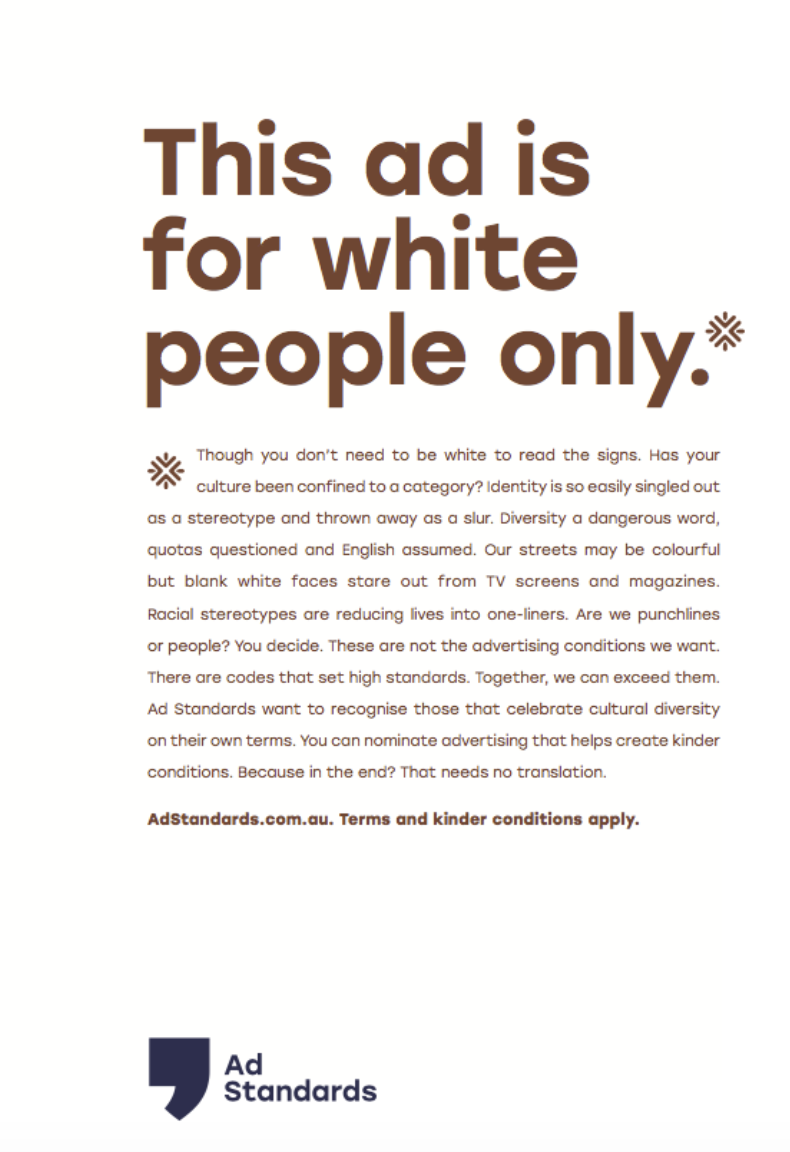
Australian advertising body targets ‘white people’ to highlight ad codes

Good ad:

Australia’s advertising industry watchdog, Ad Standards, has launched a “provocative” campaign to draw attention to sexism, racism and other issues in advertising.

The campaign, which is running across TV, newspapers, radio and outdoor aims to generate awareness of the advertising codes while showcasing how the majority of marketing messages portray sexist gender stereotypes and fail to reflect the multicultural population.

The ‘Kinder Conditions’ ads feature lines such as “This ad is for white people only”, “If you’re a woman don’t bother reading this ad” and “This ad is brainwashing your children”.

Fiona Jolly, CEO of Ad Standards, said the campaign aims to remind Australians that discriminatory and offensive advertising is prohibited while advocating for positive social messaging in advertising.

“The advertising Codes are in place to achieve a greater good for everyone, protecting the nation with standards that reflect society’s values across wide-ranging social issues”.

“Australians may not be aware that certain codes exist which is why we have set about bringing them to the forefront – it’s not because we get a lot of complaints about them. If the public has concerns about these issues, they can raise them and Ad Standards will act on behalf of their concerns.

“The fact is, while the advertising Codes set high standards, we can encourage brands to exceed these to create positive change in the world. The public should be aware of the standards in place and be encouraged to value socially progressive advertising,” said Jolly.

As part of the campaign, Ad Standards is encouraging the public to nominate ads which promote social good by breaking gender stereotypes, increasing diversity and social inclusion, promoting healthy food, safe driving, responsible marketing to children and transparency in advertising.

The campaign was created by Loud Communications.

Source: Australian advertising body targets ‘white people’ to highlight ad codes

Immigrant PPC candidate Winnipeg-South supports party plan to cut immigration, People’s Party of Canada candidate in Sask. slammed over call for more ‘hate speech’

Particularly interesting given he has worked in settlement services (but he favours multiculturalism):

A Muslim immigrant from Afghanistan whose job is helping resettle newcomers says he’s running for the People’s Party of Canada because he likes its stance on curbing immigration.

“It’s a very clear platform,” said Mirwais Nasiri, candidate in Winnipeg South for the fringe federal party.

The 39-year-old came to Canada more than a decade ago, to join his wife, who arrived as a privately sponsored refugee in 2004. He works as a settlement facilitator at the Immigrant Centre in downtown Winnipeg.

Nasiri said he’s in favour of PPC Leader Maxime Bernier’s pledge to cut Canada’s annual immigration targets by more than half, from roughly 350,000 people in 2018.

“For me, it makes sense,” said Nasiri. “If you bring immigrants to this country, we have to make sure we find them housing and they settle down. If we have less immigrants — 100,000 or 150,000 — at least we can take care of them.

“Employment is a big issue,” said the man whose first job was at Welcome Place as a life skills trainer, helping newcomers learn the basics of living in Canada. He said he knows physicians and engineers who cannot find jobs in their fields. “They’re struggling… Many people coming here to Winnipeg can’t find jobs, so they go to Toronto because they think they can find more opportunity.”

However, in December, Statistics Canada reported the employment rate for core working-age immigrants rose to 78.9 per cent in 2017, the highest since 2006, when comparable data became available. Employment rates among immigrants tend to increase the longer they have been in the country, StatsCan said.

Meanwhile, the corresponding employment rate for the Canadian-born population was 84 per cent.

Nasiri said he’s still waiting for several family members in Afghanistan to join him Canada, after sponsoring them in 2011. He’s not keeping his fingers crossed they’ll arrive any time soon, thanks to immigration policy he called unfair.

When asked about immigration being required to boost Canada’s aging population and declining birth rates, Nasiri was dismissive.

“We have enough people,” said the PPC candidate. “We have many young people who are getting married and just establishing a life.”

Statistics released in March show more than six millions Canadians are 65 and older; by 2030, seniors will number more than 9.5 million and make up 23 per cent of the population.

“We’ll still take care of our own people,” Nasiri said. “We’ll have more population in the future.”

Even though Bernier has said he wants to repeal the Multiculturalism Act, and promised to “reject immigrants that do not share Canadian values,” Nasiri said he doesn’t think the party is opposed to multiculturalism.

“The beauty of Canada is the multiculturalism,” he said. “As a multicultural country, you can practice your religion, you can practice your language, your culture… No one is stopping you. Canada is a great country.”

No one has ever questioned his values or his loyalty to Canada, Nasiri said.

“When I came in 2009, the first thing I got when I landed in Toronto at the port of entry, was the immigration officer told me, ‘Welcome home.’ This was a great shock. I was so happy. Since I got here, I never feel that I’m just a stranger, an immigrant, a refugee. I feel always like a proud Canadian.”

He said he’s proud of his party, especially its opposition to the federal carbon tax. Nasiri said he thinks a PPC government could be convinced to raise the minimum wage — even though Bernier is an adherent of libertarianism, believing supply and demand should set wages and prices.

Meanwhile, the board the Elmwood-Transcona PPC riding association publicly quit earlier this month because, it said, too many supporters are “racists, bigots, anti-Semites, and conspiracy theorists.” In Winnipeg Centre, the riding association doxxed a critic who convinced a gallery owner not to rent space to the PPC for an event.

“I haven’t seen anything of this issue in our People’s Party of Canada,” Nasiri said, adding his wife and some co-workers at the Immigrant Centre have offered encouraging words.

“‘We’re proud you stand for something,'” is what he’s been told, Nasiri said. “I stand for this party to help my people in South Winnipeg — immigrants and non-immigrants.”

Source: Immigrant PPC candidate supports party plan to cut immigration

On the other hand:

A Saskatchewan People’s Party of Canada (PPC) candidate is defending comments in support of the use of “hate speech” he made recently on social media.

Some groups say they fear the comments could incite violence.

“Our country could use more hate speech, more offensive comments, more ‘micro-aggressions’, more violation of safe spaces with words and more critical thinking,” Cody Payant wrote on his Facebook page and Twitter account on July 16.

“Words are not violence and when we don’t have them to debate and articulate our thoughts when communicating, then all we have left is guns,” he added.

A confirmed candidate

Payant was nominated in May to run under the PPC banner in Saskatchewan’s Carlton Trail-Eagle Creek riding. He is listed on the party’s website as an official candidate.

Payant said he wrote the post partly in defence of Lindsay Shepherd, a former Ontario teaching assistant who was briefly barred from Twitter following an acrimonious online exchange with Jessica Yaniv, a transgender activist.

But Payant’s broader comments about hate speech and violence were noticed by Yellow Vests Canada Exposed. The Twitter group has monitored comments made by representatives of former federal cabinet minister Maxime Bernier’s People’s Party of Canada since the party’s launch in 2018.

An administrator for the Yellow Vests Canada Exposed said the group saw Payant’s post as encouraging violence.

The Canadian Anti-Hate Network agreed.

“It is a threat of sorts,” said Evan Balgord, the network’s executive director.

The comments hardly came as a surprise, Balgord added.

“It is a fairly common argument, actually, pushed by often right-wing extremists,” Balgord said. “Their conception is if you don’t let me say my hateful things then, oh, I won’t do it, but maybe some people I know or those other more crazy people, if you silence them, then they’re going to get violent.”

‘Hate speech is best said out loud’

In an interview with CBC News on Tuesday, Payant said he stood by his post and expanded on his intended message.

“Words are a tool,” he said. “Words are what we use to resolve conflicts in our society, so that suppression of free speech or suppression of expression is kind of an authoritarian tool.

“So if I had the choice between free speech and the alternative [violence], the alternative is always much worse.”

It’s better to have people voice their hate and face criticism for it than to have their feelings lead to violence, Payant said.

“Hate speech is best said out loud in the public square so it can be criticized and then broadly rejected by reasonable people in society,” Payant said. “It’s part of how we become well-adjusted people and how we communicate effectively as a society and how we resolve conflicts, and when we don’t have those words then all we have left is guns.

“Words are used to resolve conflicts without resorting to physical violence.”

Bernier will be in Saskatoon Wednesday to confirm the slate of northern Saskatchewan PPC candidates for this fall’s federal election.

Source: People’s Party of Canada candidate in Sask. slammed over call for more ‘hate speech’

Hong Kong tensions reach B.C’s Simon Fraser University as notes, posters supporting protests partly torn down

Suspect we will see more of these tensions:

Tensions from protests in Hong Kong appear to be spilling over onto campuses around the world, including a university in British Columbia, where a student-organized campaign supporting Hong Kong demonstrators was disrupted.

Last week at Simon Fraser University’s Burnaby campus, Hong Kong international students and peers who have ties to the territory put up a “Lennon Wall” – a message board full of posters and colourful sticky notes that mainly express solidarity with Hong Kong’s demonstrators. According to some students, these notes, bearing messages such as “Stay with Hong Kong” and “Fight for Hong Kong,” were partly torn down three nights in a row.

There also was unrest at a university in Australia last week, where disagreements on the Hong Kong political turmoil turned violent. As seen in footage circulated on social media, punches were exchanged at the University of Queensland between pro-Beijing students and those who back the Hong Kong protesters, who began marching to oppose China’s proposal to extradite criminal suspects to the mainland.

Some SFU students from Hong Kong said they were disappointed to see those notes being ripped off.

“When the wall got destroyed, [I was] not surprised, but I am just disappointed, really disappointed,” said Michael Chan, president of SFU Hong Kong Society, who is familiar with the incident even though his group didn’t start the wall.

Mr. Chan said damaging the wall infringes on freedom of speech, and he calls on the university to protect such rights on campus.

Taylor Cheng, who left a note on the wall, said she hopes the vandals would express their opposition in a more respectful way. “I thought everyone could communicate in a civilized, well-mannered way,” she said, adding the incident has been reported to the university.

SFU spokesperson Adam Brayford said on Sunday the Campus Public Safety is looking into the vandalism reports.

Rummana Khan Hemani, SFU’s vice-provost and associate vice-president of students and international pro-tem, said the university expects students to express their views in a lawful and respectful manner. “We do not know if these specific posters were approved to be posted. However, the removal of approved posters or unapproved posters in a disrespectful manner is not acceptable,” she said in a statement.

So far, it is not clear who damaged the wall. Both Mr. Chan and Ms. Cheng have seen screenshots from a large SFU student group chat on WeChat that some students are critical of such campaigns and condemned Hong Kong separatism.

The incident has left Mr. Chan and Ms. Cheng with concerns that if tensions escalate on their campus, there may be violence similar to what happened in Queensland. “I don’t want SFU to become the second University of Queensland incident,” Ms. Cheng said.

Mr. Chan said he is worried that some messages on the wall may irritate some students from mainland China who may hold different views on the issue. “They may be angry. … I am worried this kind of [violent] situation may happen,” he said.

William Chen, a third-year student at SFU who is from mainland China, said the Lennon Wall campaign generates “a barrier” between him and some of his Hong Kong friends.

“My first reaction was sad rather than angry,” he said. “The conflicts in Hong Kong happened because some Hong Kong people are unsatisfied with some policies set by China. [But I wonder] who spread the anger to here.”

He said the campaign does not represent the views of all students from Hong Kong and may increase the tension between students from the territory and mainland. He further added that some mainland Chinese students may think these messages encourage Hong Kong independence.

Jia Tiancheng, a student from Douglas College in the Vancouver area, said if the posted notes are purely showing support for the protesters, then they’re acceptable. But if some contain radical political opinion, then it’s just “expressing rage.”

Mr. Jia, who is from Harbin, a city in northern China, said since the extradition bill has been suspended, Hong Kong protesters should have achieved their goal. But the continuing protests that demand the resignation of the city’s leader, Carrie Lam, and the complete withdrawal of the bill doesn’t benefit the city.

Students from Hong Kong and mainland China all expressed their longing for more understanding and communication.

“Hong Kong students are fighting against the extradition law, and is not trying to fight for Hong Kong to become an autonomous country, nor are we attacking Chinese people, “Ms. Cheng said.

“Hong Kong students welcome dialogue and discussion. We are not going against the fact that there will be different political stakes on the issue.”

Mr. Chen said many students from mainland China usually do not care about political issues, however, in this case, he agrees that some mainland Chinese students believe Hong Kong people are using protests to promote Hong Kong independence.

“They find it surprising: why Hong Kong wants independence,” he said.

“There has to be a good communication between students from Hong Kong and China, otherwise, the conflicts are inevitable.”

Source:     Hong Kong tensions reach B.C’s Simon Fraser University as notes, posters supporting protests partly torn down Xiao Xu July 29, 2019     

Canada’s only Africentric school was launched amid calls to better support Black youth. Ten years on, has it fulfilled its promise?

Unclear:

The fall term is weeks away, but Kyeron Banton is already thinking about delving into school books to get a jump-start on Grade 9.

“If you don’t do any work, your brain kind of shuts down and then when school starts you don’t remember anything,” says the recent graduate of the Africentric Alternative School, which celebrated its 10th anniversary at a gala last month.

Kyeron, 13, was among the first cohort at the school to complete junior kindergarten through Grade 8, and credits her time there with instilling a strong work ethic.

“Your skin has nothing to do with what’s in your head and has nothing to do with why you can’t be great,” she says. “All of us can be excellent.”

That’s the message behind Canada’s only Africentric school, located on Sheppard Ave. W. near Keele St., nestled amidst rental buildings in a racially diverse working class neighbourhood in the city’s northwest.

“It’s always been a safe spot,” says Kyeron. “People can be their authentic selves, because they’re not being scared that they’re going to be stereotyped as loud or ghetto or stupid … I know who I am. I’ve built up my character over these years. I know history.”

The elementary school, which opened in 2009 to better support and engage Black students, is vital, say parents and educators. Children see themselves reflected in the curriculum and its leadership. It promotes positive Black identity and there’s a strong sense of community.

“Belonging matters, especially for racialized students … (that) is huge to ensuring that they are successful,” says Toronto District School Board Superintendent Audley Salmon, who represents the school and calls it a success. “That is one thing we have certainly learned from the Africentric (school).”

But that success has been hard won and it could be said to be tempered by ongoing challenges. There’s no school bus service, test scores are shaky and enrolment is declining. Supporters of the school say it must be better resourced to continue building on its vision.

The TDSB, the country’s largest and most diverse school board, has 582 schools, serving 246,000 students — 11 per cent of whom are Black.

Statistics show Black students have historically performed below average. They’re more likely to be labelled with special education needs, suspended and expelled, and streamed into programs that don’t lead to university or college.

In fact, efforts had been made to address the issue for decades, including a short-lived Afro-Caribbean alternative high school that operated in the mid-1980s, and a 1995 Royal Commission Report on Learning that recommended Black-focused schools. The idea sparked controversy; some called it segregation, others said it was needed to tackle the 40 per cent dropout rate amongst Toronto’s Black youth. By the mid-2000s, that idea remained divisive, even amongst members of the Black community, however the board voted in 2008 to move ahead with a small innovative school.

The Africentric school opened for students in junior kindergarten to Grade 5 in September 2009, and that fall, 128 kids from across the GTA enrolled.

They share a building, and some spaces, with Sheppard Public School. The library seems divided by an imaginary line: On one side is a poster of Maple Leafs centre Auston Matthews, while on the other is a poster of South Africa’s late president Nelson Mandela. One side is filled with typical children’s books, while the other is clearly focused on the Black experience.

Hallways are adorned with images of the Underground Railroad, of Halifax’s Africville and trailblazers such as Canada’s first Black citizenship judge Stanley Grizzle and first Black Governor General Michaëlle Jean.

School days start like most others, with children singing ‘O Canada.’ But twice a week, there’s also an assembly, where they sing the Black National Anthem — James Weldon Johnson’s “Lift Every Voice and Sing” — and recite The School Pledge, promising to be “focused, self-disciplined and ready to learn.”

Teachers, most of whom are Black, incorporate Black history, experiences and contributions into the curriculum. Their role was examined in a recent report co-authored by York University professor Carl James, who holds the Jean Augustine chair in Education, Community and Diaspora.

“Where student potential has been unrecognized, these teachers nurture it,” according to the May article, published in the journal Curriculum Inquiry. “Where Blackness has been negated, these teachers supplant anti-Blackness with pro-Blackness.”

Staff look to best practices in the United States, where Black-focused schools are a success and there’s been extensive research done. The school also shares what it’s doing. Educators from the Durham District School Board and Halifax’s Africentric-focused Delmore ‘Buddy’ Daye Learning Institute have visited.

Many students, most of whom are Black, start in kindergarten, enrolled by parents supportive of the school’s vision. And some join in later grades — the school now goes to Grade 8 — looking for a better fit, sometimes after experiencing racism, bullying and behavioural issues at other schools.

Principal Luther Brown, who retired in June after more than two years at the school, says staff work hard to prepare students for life and improve attitudes about school — and parent feedback has been positive.

Paul Osbourne has been involved with the Africentric school since Day One — his two younger children attend and two older ones are graduates. Growing up in Toronto, he never had a Black teacher, and never learned the accomplishments of historical and contemporary Black figures, noting, “We didn’t see examples that would inspire us.”

Osbourne, a social worker, wanted something different for his kids. He wanted them in a space where their values and customs were shared and they would feel comfortable having dreads, wearing an African shirt and eating Caribbean foods, such as curry goat.

He says good relationships between staff and parents, who have historically felt disenfranchised, make the school “more than just brick and mortar.”

“If a young person wants the help they will get the help,” he says, adding there’s a “family approach” at the school he hasn’t experienced elsewhere. “With teachers, it’s not just about the academics … It’s more of a mentor relationship.”

The sentiment is shared by recent graduate Jesse Mark, 13, who attended from junior kindergarten to Grade 8. Raised by a single mother, he says strong male role models in his teachers were crucial

“It turned me into the person I am,” says the teen. “You can’t find a better community than (this school).”

There’s no Africentric high school for grads such as Jesse. While there was talk of creating one, the TDSB settled on Africentric programs at Winston Churchill Collegiate Institute in the east end and Downsview Secondary School in the west. Jesse, who’s keen on athletics, will go to James Cardinal McGuigan Catholic High School in September. He wants to attend university, after which he dreams of playing professional basketball or becoming a mechanical engineer.

“We have a job of making this school be on the map,” he says.

But the school doesn’t appeal to all, even Black families in the neighbourhood. Sharri Chin, sends her boys — one is going into Grade 3 and another junior kindergarten — to Sheppard Public School. She also plans to send her toddler there.

“I just want my kids to be with everyone,” says Chin. “There’s no reason for our kids to be segregated. We live in Canada, in Toronto, it’s diverse, it’s multicultural.”

She’s heard good things about the Africentric school. That there are teachers who may be better at addressing the needs of Black students and community issues, and that its standardized test scores, done by the province’s Education Quality and Accountability Office (EQAO) have, for the most part, been higher than Sheppard’s. But, it boils down to “personal preference.”

In its first years, the school built on strong test results, which measure reading, writing and math skills in Grades 3 and 6. In 2012-13, most results were far above the board average: Amongst third graders, 86 per cent met provincial standards in reading and math, and 93 per cent in writing. And amongst sixth graders, 79 per cent were reading, 93 per cent writing and 57 per cent doing math at those standards. Each of those grades had 14 students.

Similarly, enrolment during those early years grew, reaching a high of 188 students in 2012-13, according to TDSB figures calculated mid-year. But in 2013-14, test results tumbled far below average — for example, Grade 3 math scores dropped to 33 per cent. And enrolment fell and continued to decline — last year there were 106 students and the same number is projected for September.

When asked about the downward trends, some community members seem reluctant to be critical of the school, which opened to great fanfare, attracting committed parents with bright kids. But there have been setbacks: Some parents pulled their kids out. Some were disappointed that more programming and resources had never materialized. Others were tired of long commutes because there is no school bus service. And some were frustrated over parental disputes about what an Africentric curriculum should look like. Plus, there has been a high turnover rate amongst the school’s principals, which meant they had to start from scratch on building up relationships with students and parents.

Although enrolment is at its lowest with 106 students, Brown notes the numbers are on par with alternative schools. Still, he’d like to see enrolment grow, “with the appropriate kinds of resources,” including teaching assistants for literacy, numeracy and social skills.

In a small school, a few academically weak, or strong, students can skew statistics. Brown says EQAO scores aren’t where they’d like them to be, but are improving. The most recent figures available show 2016-17 scores still below board average but appear to be on the rise. Grade 3 results, for example, jumped between 10 and 20 per cent from the previous year. But Grade 6 scores aren’t as clear because results from the previous year aren’t public due to low class size.

“There was a turbulent time, but we’ve come through the storm,” says Osbourne, who’s also chair of the parent council. “Now, there’s an upswing, in terms of academics, parents and community members are more engaged, the student-teacher relationship is a lot better and leadership has been strong in the last couple of years.”

Professor James, who led a three-year research study between York University, the TDSB and the nascent school that culminated in a 2015 report, says when assessing the school, it’s important to look beyond EQAO scores.

“We must use other measures, especially when the idea for establishing the school is based on addressing the educational needs of students, taking into account their cultural and social backgrounds,” James told the Star. “There is certainly an irony assessing the students using such a tool when we are trying to be culturally responsive to their learning.”

Brown agrees: “We also have to look at how are students feeling and behaving, and what’s the climate in the school … These are all measures that are hard to quantify, but are important.”

Parent Jessica Vorstermans has been awed by what daughter Saskia is learning. She comes home from school talking about everything from civil rights leader Martin Luther King Jr. to issues such as shadism. Saskia is 4.

“She’s like ‘Black is beautiful. All shades of Black are beautiful,’” says Vorstermans. “That’s amazing that she’s having access to that in junior kindergarten.”

Teachers in other schools may talk about these issues, but at the Africentric school “it’s a guarantee,” she says. It was important to send her mixed-race daughter to a school where she can access a piece of her identity she wouldn’t get at a regular school, and intends to send her toddler there too.

“We feel so lucky that our daughters are able to learn, grow and thrive in a school community that honours them as beautiful Black children who are going to make big changes in our world,” says Vorstermans, an assistant professor at York University.

Plus, they’re “living in a world with a lot of anti-Black racism” and will be “equipped to meet that.”

That’s a key goal of the school, explains Brown.

“It is a space where students are better able to understand themselves within the context of racism and, therefore, be better able to move around in that environment in a safe way,” he says. “In spite of the pressure that will come — economic or social — they can still be resilient, to the point where they can become whatever it is they want.”

Former student Kemora Manning, at 15, has already faced some of those pressures head-on.

“I can be anything I set my mind to,” says Kemora, who dreams of being a politician. She credits the Africentric school with broadening her definition of being Black, given the negative stereotypes of Black culture that abound in media and on TV. Learning about the Black community’s challenges and accomplishments fuelled her with “a positive pressure to do my best … to carry the torch and continue to represent my community in a positive light.”

Kemora left the school after Grade 6 to attend a gifted program in Grades 7 and 8, and now goes to Etobicoke School of the Arts, where she’ll be starting Grade 11. She says going to schools where she was among the minority as a Black student was “kind of jarring” because of the racism and ignorance she encountered. In the gifted program, one student likened her complexion to cow manure and another told her to get over slavery. And in high school, she’s met students, including Black kids, who have never heard of apartheid, and are surprised she doesn’t “act Black.”

While those situations can leave her feeling like, “It’s me against the world,” Kemora always talks it out with her peers about what it means to be Black. And she’s got the facts to back up her arguments.

Her mother Debby Ennis, who spent part of her childhood in Jamaica, never learned about Black history and culture the way her daughter has. Ennis, who’s an early childhood educator, has five children, but only her youngest — Kemora and Trevon — attended the Africentric school. She says they have a much stronger “knowledge of self” and deeper connection to the Black community compared with their siblings who went to regular schools.

When it comes to the key issue the school set out to tackle — the high dropout rate of Black teens — Principal Brown notes, “One school won’t solve the problem — it’s a systemic problem that has to be addressed in a broader context.”

According to the TDSB, there have been improvements. The board no longer tracks dropout rates, because many students eventually return to school. Rather, it tracks high school graduation rates of students over a five-year period. When you look at grad rates in recent decades, the fastest improving group were those who identified as Black, especially females.

The five-year graduation rate for Black students in 1992 was 44 per cent, meaning the remainder dropped out, switched school boards or took longer to get their diploma. By comparison, the average overall graduation rate was 56 per cent. By 2016, the graduation rate for Black students was 78 per cent, compared with an 84 per cent overall average. This 34-percentage-point increase represents the largest graduation rate increase for any racial group. And by gender, 88 per cent of Black females graduated, compared with 71 per cent of Black males.

But, when you look at a range of other TDSB data — things such as school readiness in kindergarten, attendance rates, grades, suspensions and credit accumulation in Grade 9 — Black students are either the lowest-performing or in the bottom three with Latin American and Middle Eastern students.

“There are a lot of kids out there who aren’t seeing themselves in the day-to-day instruction taking place and that’s a huge challenge,” Superintendent Salmon told the Star, adding he believes the TDSB has learned from the Africentric school on how to better meet the needs of racialized students. For instance, providing professional development for educators who serve predominantly non-white communities. He suggests the TDSB’s work at creating a more inclusive learning environment across the board could explain why parents are keeping their kids in neighbourhood schools, rather than enrolling them in the Africentric school.

But for some, the Africentric school continues to have a strong appeal — despite the fact there’s no busing, which makes the commute a challenge. Osbourne, who lives in Scarborough, spends about an hour in morning traffic driving his children, Andwele and Abeni, to the Africentric school. They then spend up to 90 minutes taking the TTC home. It’s tiring, but the kids are committed, he says.

Osbourne has long advocated for another Africentric grade school in the city’s east end. He, and other parents, have submitted a proposal to the TDSB, met with a trustee and spoken with administrators at Winston Churchill Collegiate Institute about establishing a feeder school for its Africentric program. But they’ve been unsuccessful.

University of Toronto professor George Dei, an early proponent of the Africentric school, says “equity costs money.” He says more resources are needed at the school — including transportation, curriculum materials, computers and more staffing. Even its own separate building — so it doesn’t have to share spaces like the library, computer lab and gym — is important, because “otherwise people see it as being secondary or second class.”

“You cannot treat an Africentric school like any other alternative school because it’s intended to address a problem, and therefore it calls for more resources directly to the school. It calls for different responses,” says Dei, a professor at the Ontario Institute for Studies in Education, whose research includes anti-racism education. “Groups that have historically been disadvantaged demand targeted responses.”

Salmon says the board would like to provide more resources to all of its schools, but has limited funds.

Reflecting on the last decade, Dei says there have been successes and challenges, “We must learn from both.”

“We are a long way from realizing the dreams of an Africentric school,” said Dei. “We need to attract multiple solutions to the question of Black education. The Africentric school is not a panacea, but at least it is something to think about. It cannot be taken out of the equation.”

His comments are echoed, in part, by Professor James. He says the TDSB needs to determine the kinds of supports necessary beyond basic staffing requirements. The school has attracted students of all academic backgrounds, including those with special needs, but hasn’t had the appropriate supports, he says.

“I’m not sure that we can say that (the school) has made the impact that we all looked forward to,” says James, noting it didn’t have “the kind of infrastructures to really accomplish as much as it would have wanted.”

The first decade was “a good start that we need to build on,” adds James.

Kyeron, the recent grad, sees a bright future for herself. She says her teachers boosted her confidence and taught her to persevere, qualities that will guide her when she goes to Earl Haig Secondary School for the Claude Watson Arts Program, and eventually university, where she plans to study law.

“They’re going to really judge how we turn out in life based on where we got our education for the first 10 years,” she says. “We’re going to make them very proud.”
Source: Canada’s only Africentric school was launched amid calls to better support Black youth. Ten years on, has it fulfilled its promise?

In a push for diversity, medical schools overhaul how they select Canada’s future doctors

This is what it takes to move the needle to address socioeconomic diversity:

Have you ever used a food bank? Were you raised by a single parent? What was your family income in the second decade of your life? And how should the answers to those questions influence who gets into medical school?

Medical schools used to say their job was to find the best and the brightest. But the selection method, based on grade-point averages, the Medical College Admission Test (MCAT) and a face-to-face interview, has resulted in classes that fall short of some universities’ goals for racial and socio-economic diversity.

Now some schools are asking if the process is truly fair, and if not, how it ought to change. Across Canada, medical schools are taking steps to shape incoming classes by offering advantages to applicants from certain demographic groups.

In a given year, only 10 per cent to 20 per cent of applicants are admitted. Many schools could probably choose a similarly capable cohort from among the applicants they reject. But finding the right demographic mix is increasingly an important concern.

Medical schools in Canada exercise overwhelming influence over admission to the profession. About 75 per cent of physicians in this country are Canadian graduates, so the process by which admissions decisions are made is crucial not only to the applicants but to society as a whole. They shape the future of health care.

At the University of Manitoba, the admissions committee studied years of data and found a pretty clear pattern: Wealthy white students from big cities were more likely to be interviewed and more likely to get in, partly because of built-in advantages. As undergrads they don’t have to work part-time to pay for school, they’re able to pay for MCAT prep courses and, in interviews, they can cite an impressive range of travel and volunteer experiences.

The result is that a public university’s system seems to ensure opportunity for the already fortunate.

Bruce Martin, the U of M’s dean of admissions, set out to tinker with the crucial first stage of the admissions process so that more applicants from different backgrounds got through. He knew he could do so by systematically boosting scores based on certain attributes or experiences. But which attributes to target?

Sample questions appearing on University of Manitoba medical school applications: family history
  1. Were you raised by a single parent due to divorce, death of a parent, or a teen parent?
  2. Were you ever a child or youth in care?
  3. Are you a parent taking care of one or more children on your own?
  4. Did your parents or guardians graduate from college or university?
  5. Were you or your family admitted to Canada with refugee status?

Source: Dr. Bruce Martin, University of Manitoba Admissions

He convened a panel of people from outside the university with experience in race relations and alleviating poverty and asked them to consider how the medical school could diversify its student body.

They decided to add a section to the application that would elicit the information they sought. They came up with more than 30 questions, many of them deeply personal and revealing, including factors such as visible minority status, sexual orientation, involvement with the child-welfare system and living with family members who suffer from addiction.

The committee then ranked each question based on the perceived level of disadvantage suffered by the applicant. Should having a family member with a disability be a greater consideration than whether your parents graduated from university, or having a child-welfare file?

U of M sample questions: economic information
  1. Did you or your family ever have to use a food bank?
  2. During the second decade of your life, was the annual gross income in the household in which you lived between $40,000-$75,000?
  3. During the second decade of your life, did you have to work to contribute to family income?
  4. Will your parent(s) be paying for the tuition fees if you get accepted to our medical school?
  5. Do you currently receive student aid?

Source: Dr. Bruce Martin, University of Manitoba Admissions

The numerical values assigned to each answer are combined to create an arithmetic modifier meant to reflect the degree to which the applicant’s background would put them at a disadvantage in the application, Dr. Martin said. (It turns out that a history of substance abuse moved the needle more than being a visible minority, while needing student aid rated well below using a food bank.)

The goal was relatively modest: a 5-per-cent increase in the number of medical students with diversity attributes.

“We didn’t want to have a quota system. But we want to increase the number of diverse individuals on an incremental basis,” Dr. Martin said.

U of M sample questions: other sociocultural determinants
  1. Do you consider yourself to be a member of a Visible Minority?
  2. Do you identify as First Nations, Metis, Inuit or other North American Indigenous ancestry?
  3. Is your primary language other than English or French?
  4. Do you have a participation or activity limitation that has an impact on your day-to-day life?
  5. Were you raised or are you living in a household in which there was/is a person living with substance abuse?

Source: Dr. Bruce Martin, University of Manitoba Admissions

Other schools have set a similar goal but have taken a different approach. The University of Saskatchewan, for example, now reserves six of its 100 seats for applicants whose families earn less than $80,000 a year. At the University of Toronto, a special stream has been created for black applicants. At Dalhousie University, in Halifax, the medical school says it recognizes that affirmative action is required to increase admissions of African-Nova Scotians and Indigenous people. And at the University of Calgary, applicants from underrepresented groups are asked to “highlight their background and experiences.”

Many schools have the same goals as the University of Manitoba, Dr. Martin said, but are not as transparent about how they aim to achieve a diverse incoming class.

At Newfoundland’s Memorial University, for example, acting dean of admissions Paul Dancey said the school takes a “holistic approach,” which is common at Canadian universities. He said it involves looking in great detail at all aspects of the candidate, not just their academic record, and paying particular attention to barriers that may have affected their grades or extracurricular activities. (Dr. Martin said Manitoba chose not to take the holistic approach because it relies on the judgment of individual evaluators and can be susceptible to bias.)

The drive to consider racial and socio-economic equality in admissions is also leading major changes in the U.S. college system. The College Board now includes what’s being called an adversity score in SAT test results based on demographic factors such as crime and poverty levels in a student’s neighbourhood and school district. The board said it could no longer ignore the extent to which differences in wealth and race were reflected in test scores, which are very influential in the admissions process. The method for calculating the score has not been released, but it’s based on public information, not answers submitted by students.

For students, the application process remains slightly mysterious, to prevent someone from gaming the system.

Fatemeh Bakhtiari, a second-year medical student at the U of M, was born in Afghanistan and came to Canada as a child. Growing up in Winnipeg, her family was not wealthy. Her mother worked as a grocery clerk and her father was a truck driver. Ms. Bakhtiari excelled in school and at university set her sights on medicine. But she didn’t have many of the advantages that other applicants could rely on, such as a family member who is a doctor. She also had to work part-time in restaurants and retail while studying.

“I had no idea where to start,” she said. “If it wasn’t for Google, I don’t where I would’ve been.”

She remembers answering questions on her application about her family income and whether she identifies as a visible minority or LGBTQ, but she didn’t understand why those questions were being asked. She said she has no idea whether her answers had any role in her success. She said her GPA was strong, she wrote her MCAT three times to improve her score and felt very confident about her interview performance.

“I don’t know the scoring system or how it works,” Ms. Bakhtiari said. “I don’t know if it was my MCAT, my GPA or my interview that got me through. They don’t tell you.”

At the white coat ceremony where new medical students are welcomed and take the Hippocratic Oath, the U of M’s dean of the faculty of medicine, Brian Postl, said the school was proud of the diversity of Ms. Bakhtiari’s class. More than half are women, 10 per cent are Indigenous, 20 per cent are from rural areas and 50 per cent are from families with incomes of less than $75,000. Ms. Bakhtiari said she believes the diversity of her class is valuable for two reasons: Diverse groups have been shown to be more innovative, and physicians should reflect the population they serve.

Manitoba’s diversity initiatives started more than 30 years ago with attempts to get more Indigenous people into medicine. About a decade ago, the medical school also began to see rural candidates as particularly desirable. Canada was facing a staffing crisis in rural and remote hospitals and medical offices, and researchers began trying to identify what made a medical student more likely to stay and practise in a rural area. A key factor was having grown up in a small town or farming community. That’s when Manitoba began using an arithmetic modifier to place students with a rural background at an advantage.

The university was following a path laid by the Northern Ontario School of Medicine (NOSM), which opened in 2005 with a mandate to turn out doctors for the region – and made no bones about giving priority to students with a rural or remote upbringing.

Roger Strasser, until recently the dean and chief executive officer of the NOSM, said his program gets about 2,000 applications a year. It whittles those down to 320, who are invited for interviews based on a three-pronged score comprising a grade-point average, a personal statement and what’s called a context score, derived from answers about a person’s background and upbringing. The algorithm for deriving the context score is confidential, Dr. Strasser said, but he was transparent about its key implication.

“Applicants who’ve grown up in Northern Ontario or other remote, rural, Indigenous or francophone settings, they get the highest score. The people who are not Indigenous or francophone or come from big cities like Toronto get the lowest score,” Dr. Strasser said.

Ninety-two per cent of NOSM students have grown up in Northern Ontario, and the other 8 per cent are from rural and remote parts of the rest of Canada. About 2 per cent of applicants are Indigenous, but in the past few years the selection system has been tweaked to increase the number of successful Indigenous applicants, including giving them training to succeed in the interview process. The class went from about 7-per-cent Indigenous over the school’s first decade to about 12 per cent for the past three years, Dr. Strasser said.

He said one of his biggest challenges as dean is the criticism from families in Toronto, who believe their children are excluded from his school.

“My response is, if you look at the numbers, this is just the reverse of the way it is for people from Northern Ontario applying to med school in Toronto or the other big cities. So in a sense, you could say it’s true, there is, let’s call it a bias, but what we’re doing is just countering the bias that’s built into the admissions process of other medical schools,” Dr. Strasser said.

It has become conventional wisdom, supported by research, to say medicine is done better when doctors come from diverse backgrounds, Dr. Martin said. A cohort of physicians with a broad range of life experiences are better able to understand the needs of the population.

The applicants selected under Manitoba’s diversity initiative all meet the school’s admissions criteria, but they might not otherwise have reached the top of the admissions heap. The flip side, however, is that some people who’ve worked hard and achieved a great deal won’t get in, Dr. Martin said. That’s difficult for some to reconcile.

Even his own colleagues, worried about their children’s prospects, have cornered him on this matter. The conversations were uncomfortable, he said.

“We in medicine have generally been white, socio-economically advantaged and male. And that’s not who we serve,” he said.

“It’s my mission to pick people who are suited to the profession and can meet the needs of the population.”

Source: In a push for diversity, medical schools overhaul how they select Canada’s future doctors