Good in-depth survey, as typical of Pew. Worth doing the test quiz (for the record, got 11 out of 15 or 73 percent):
Most Americans are familiar with some of the basics of Christianity and the Bible, and even a few facts about Islam. But far fewer U.S. adults are able to correctly answer factual questions about Judaism, Buddhism and Hinduism, and most do not know what the U.S. Constitution says about religion as it relates to elected officials. In addition, large majorities of Americans are unsure (or incorrect) about the share of the U.S. public that is Muslim or Jewish, according to a new Pew Research Center survey that quizzed nearly 11,000 U.S. adults on a variety of religious topics.
Our surveys often ask people about their opinions, but this one was different, asking 32 fact-based, multiple-choice questions about topics related to religion (see here for full list of questions). The average U.S. adult is able to answer fewer than half of them (about 14) correctly.
The questions were designed to span a spectrum of difficulty. Some were meant to be relatively easy, to establish a baseline indication of what nearly all Americans know about religion. Others were intended to be difficult, to differentiate those who are most knowledgeable about religious topics from everyone else.
The survey finds that Americans’ levels of religious knowledge vary depending not only on what questions are being asked, but also on who is answering. Jews, atheists, agnostics and evangelical Protestants, as well as highly educated people and those who have religiously diverse social networks, show higher levels of religious knowledge, while young adults and racial and ethnic minorities tend to know somewhat less about religion than the average respondent does.
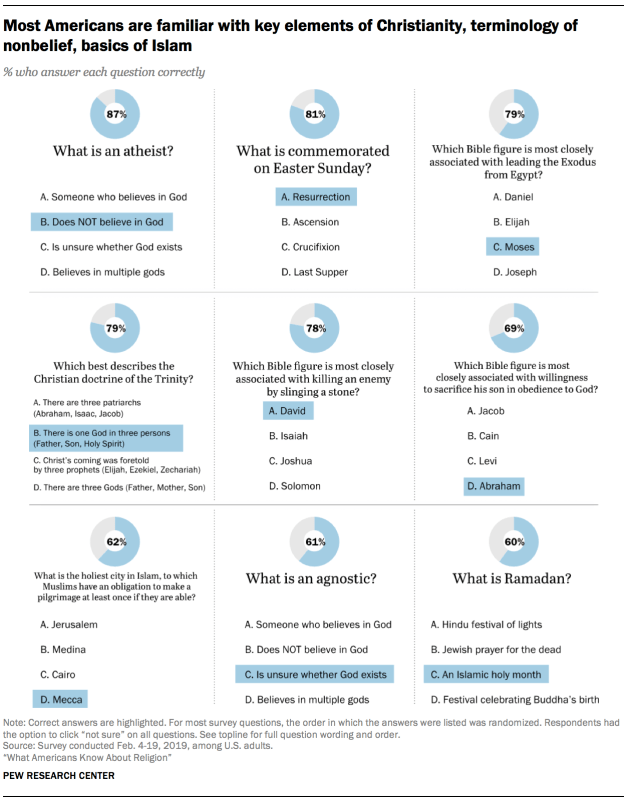
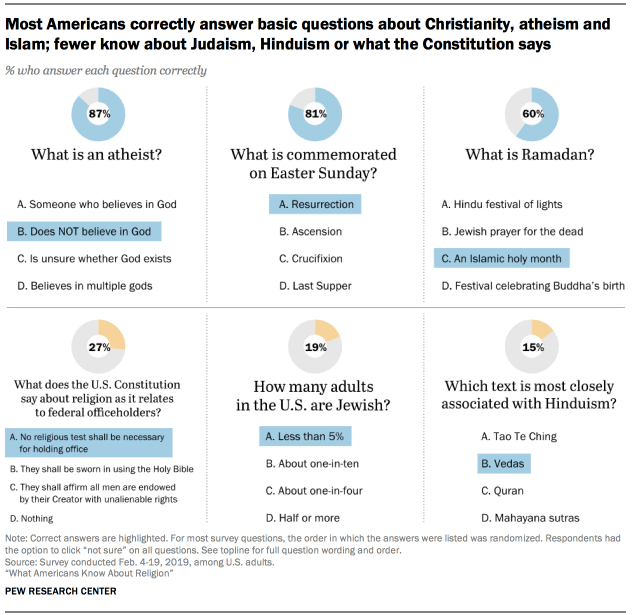 Overall, eight-in-ten U.S. adults correctly answer that in the Christian tradition, Easter commemorates the resurrection of Jesus – rather than the Crucifixion, the Ascension to heaven or the Last Supper. A similar share know that the Christian doctrine of the Trinity holds that there is one God in three persons – the Father, the Son and the Holy Spirit. Eight-in-ten Americans correctly identify Moses as the biblical figure who led the Exodus from Egypt, and David as the one who killed an enemy by slinging a stone, while seven-in-ten know that Abraham is the biblical figure who exhibited a willingness to sacrifice his son in obedience to God.
Most Americans also are familiar with two different terms that indicate a lack of belief in God. Almost nine-in-ten correctly identify the definition of “an atheist” (someone who does not believe in God), and six-in-ten correctly select the definition of “an agnostic” (someone who is unsure whether God exists).
Even some of the basics of Islam are familiar to a wide swath of the public. Six-in-ten U.S. adults know that Ramadan is an Islamic holy month (as opposed to a Hindu festival of lights, a Jewish prayer for the dead, or a celebration of the Buddha’s birth) and that Mecca (not Cairo, Medina or Jerusalem) is Islam’s holiest city and a place of pilgrimage for Muslims.
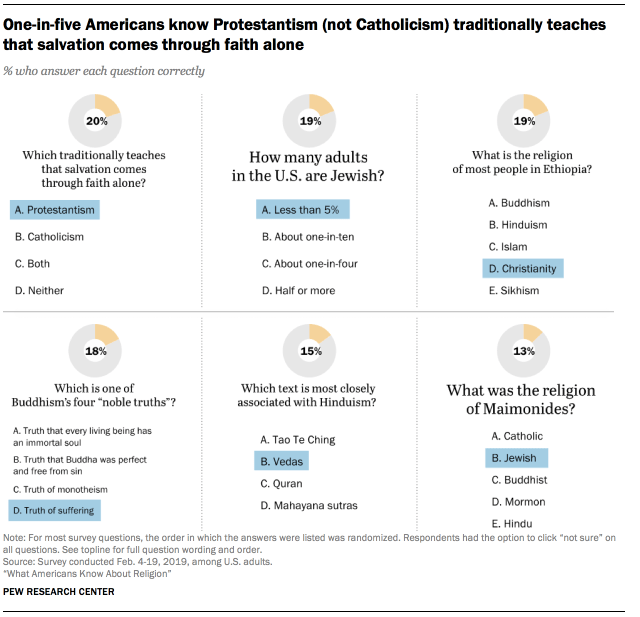
 On the other hand, Americans are less familiar with some basic facts about other world religions, including Judaism, Buddhism and Hinduism. Just three-in-ten U.S. adults know that the Jewish Sabbath begins on Friday, one-quarter know that Rosh Hashana is the Jewish New Year, and one-in-eight can correctly identify the religion of Maimonides (an influential Jewish scholar in the Middle Ages).
Roughly one-in-five Americans (18%) know that the “truth of suffering” is among Buddhism’s four “noble truths,” and just 15% correctly identify the Vedas as a Hindu text.
Many Americans also struggle to answer some questions about the size of religious minorities in the U.S. and about religion’s role in American government. For instance, most U.S. adults overestimate the shares of Jews and Muslims in the U.S. or are unaware that Jews and Muslims each account for less than 5% of the population. And when asked what the U.S. Constitution says about religion as it relates to federal officeholders, just one-quarter (27%) correctly answer that it says “no religious test” shall be a qualification for holding office; 15% incorrectly believe the Constitution requires federal officeholders to affirm that all men are endowed by their Creator with certain unalienable rights, 12% think the Constitution requires elected officials to be sworn in using the Bible, 13% think the Constitution is silent on this issue, and 31% say they are not sure.

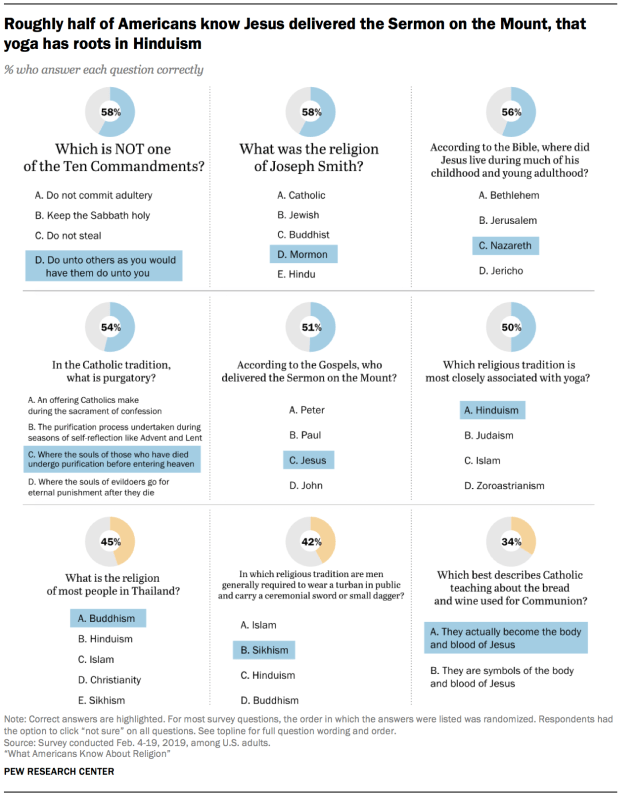
 Nine of the survey’s questions were moderately difficult for respondents; more than three-in-ten but fewer than six-in-ten respondents were able to answer them correctly. These questions include one about the Ten Commandments (58% know that the golden rule is not one of the Ten Commandments), one about the Gospel account of the Sermon on the Mount (51% know it was delivered by Jesus rather than by Peter, Paul or John), and one about the Catholic teaching on transubstantiation (34% know the Catholic Church teaches that during the Mass, the bread and wine used for Communion are not symbolic, but actually become the body and blood of Jesus).
 These are among the key findings of a survey conducted online Feb. 4 to 19, 2019, among 10,971 respondents. The study was conducted mostly among members of Pew Research Center’s American Trends Panel (a nationally representative panel of randomly selected U.S. adults recruited from landline and cellphone random-digit-dial surveys and an address-based survey), supplemented by interviews with members of the Ipsos KnowledgePanel. The margin of sampling error for the full sample is plus or minus 1.5 percentage points.
The survey was designed to measure the public’s knowledge about a wide range of religious subjects. The religious knowledge section consisted of 32 questions in total, including 14 about the Bible and Christianity, 13 about other world religions (four about Judaism, three about the religious composition of particular countries, two each about Islam and Hinduism, and one each about Buddhism and Sikhism), two about atheism and agnosticism, two about the size of religious minorities in the U.S. adult population, and one about religion in the U.S. Constitution. For a list of all the questions, see here.
The average respondent correctly answered 14.2 of the 32 religious knowledge questions. Just 9% of respondents gave correct answers to more than three-quarters (at least 25) of the questions, and less than 1% earned a perfect score.
At the other end of the spectrum, one-quarter of respondents (24%) correctly answered eight or fewer questions, and a clear majority (62%) got half (16) or fewer correct. This includes 2% of respondents who did not answer any questions correctly, mainly because they checked “not sure” in response to most or all the questions.

How various religious groups fare on the survey
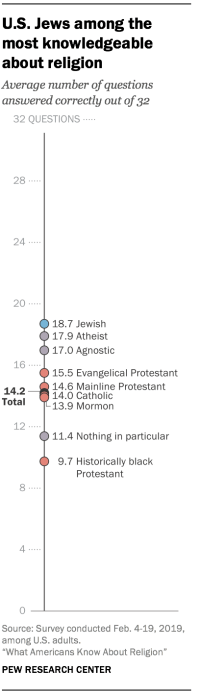 On average, Jews, atheists, agnostics and evangelical Protestants score highest on the new survey of religious knowledge, outperforming members of other Protestant traditions, Catholics, Mormons and Americans who describe their religion as “nothing in particular.”
Jews get 18.7 questions right, on average. Self-described atheists and agnostics also display relatively high levels of religious knowledge, correctly answering an average of 17.9 and 17.0 questions, respectively.
Protestants as a whole correctly answer an average of 14.3 questions, with members of the evangelical Protestant tradition (15.5) doing best within this group.
Catholics (14.0) and Mormons (13.9) perform similarly to one another and to U.S. adults overall.
The survey does not include enough interviews with Muslim, Hindu, Buddhist or Sikh respondents to permit analysis of their levels of religious knowledge.
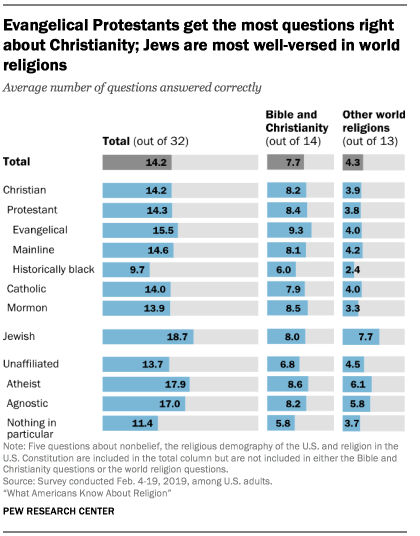 Looking only at questions about the Bible and Christianity, evangelical Protestants give the highest number of right answers (9.3 out of 14, on average). Atheists and Mormons are among the next highest performers, getting an average of 8.6 and 8.5 questions right, respectively. Atheists and agnostics do about as well on questions about the Bible and Christianity as do Christians overall.
Jews are the top performers on questions about other world religions, getting 7.7 questions right, on average, out of 13 questions about Judaism, Islam, Buddhism, Hinduism, Sikhism and global religious demography. Atheists (6.1) and agnostics (5.8) also do well on these questions compared with the national average (4.3).
Other factors associated with religious knowledge
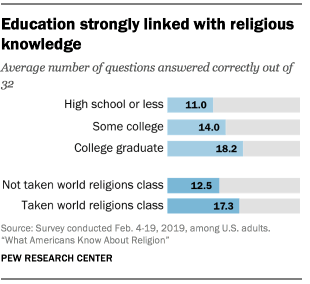 Beyond religious affiliation, what other factors are linked with how much religious knowledge a person has? The survey indicates that educational attainment – how much schooling an individual has completed – is strongly associated with religious knowledge. College graduates correctly answer 7.2 more questions, on average, than people with a high school education or less schooling.
One possible explanation for why Jews, atheists and agnostics score among the highest on this survey is that all three of these groups are highly educated, on average. However, Jews, atheists and agnostics display greater religious knowledge than other groups even after controlling for education and other demographic characteristicsassociated with knowing more about religion. (For additional discussion of statistical regression analysis exploring the factors associated with religious knowledge, see Chapter 3.)
Another educational factor linked with religious knowledge is having taken a class on world religions. Those who say they have taken a world religions class (e.g., in high school or college) answer 17.3 questions correctly, on average, compared with 12.5 among those who have not taken such a class.
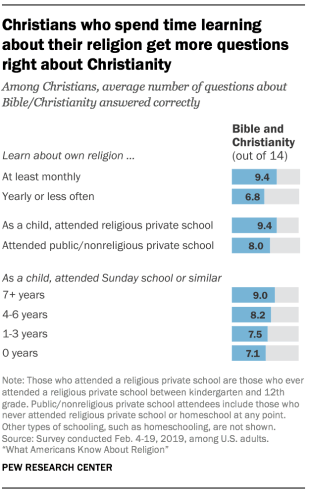 Among Christians, knowledge of the Bible and Christianity is closely linked both with the amount of effort respondents say they invest in learning about their faith and with their religious background. Christians who say they regularly spend time learning about their own religion (for example, reading scripture, visiting websites, listening to podcasts, reading books or magazines, or watching television) answer more questions correctly about the Bible and Christianity than do those who say they make such efforts to learn about their faith less often (9.4 questions right out of 14 total, vs. 6.8).
The survey also finds that Christians who attended a religious private school while growing up answer 9.4 questions about the Bible and Christianity correctly, on average. By comparison, Christians who attended a public school or a nonreligious private school get fewer of those questions right. Similarly, Christians who spent many years attending Sunday school or a similar type of religious education (for example, CCD for Catholics) correctly answer more questions about the Bible and Christianity than do Christians who never attended Sunday school.
The survey did not include enough interviews with Jews, Muslims, Buddhists, Hindus or members of other religions to permit reliable analysis of the connection between their religious education and knowledge of their respective religions.
 In addition to educational factors, the religious diversity of Americans’ social networks also appears to have a connection with levels of religious knowledge.
The survey included a set of questions asking respondents whether they personally know someone who is an evangelical Christian, a Catholic, a Mormon, a Jew, a Muslim, an atheist, a Buddhist, a Hindu or a mainline Protestant. Respondents who know someone who belongs to a religious group tend to correctly answer more questions about that religion. For example, those who personally know someone who is Muslim are far more likely than those who do not know anyone who is Muslim to identify Ramadan as an Islamic holy month (76% vs 46%). And while 71% of respondents who know someone who is Hindu also know that yoga has its roots in the religion, just 43% of those who do not know a Hindu are aware of yoga’s Hindu roots.
Overall, Americans with the most religiously diverse social networks earn the highest scores on the religious knowledge survey. On average, respondents who know someone from at least seven different religious groups answer 19.0 questions right, on average, while those who know someone from three or fewer religious groups average 8.6 right.
Religious knowledge linked with more favorable views of religious groups
The survey also asked respondents to rate nine different religious groups on a “feeling thermometer” ranging from 0 (coldest and most negative) to 100 (warmest and most positive). Overall, Americans give Jews an average rating of 63 degrees. Catholics and mainline Protestants each receive an average rating of 60 degrees, followed closely by Buddhists (57 degrees), evangelical Christians (56 degrees) and Hindus (55 degrees). The average ratings given to Mormons, atheists and Muslims hover near the 50-degree mark.
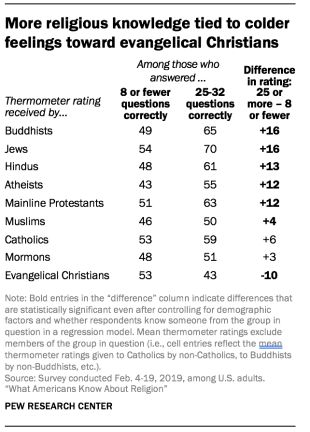 Those who are most knowledgeable about a religion (and are not members of that religion) tend to rate the religion’s adherents most favorably. For instance, Buddhists receive an average thermometer rating of 67 degrees from non-Buddhists who correctly answer both of the survey’s Buddhism-knowledge questions correctly, but just 53 degrees from those who answer neither Buddhism-knowledge question correctly. The average rating given to Hindus is 11 degrees warmer among those who know a lot about Hinduism than among those who know little about Hinduism.
Moreover, higher scores on the overall (32-point) religious knowledge scale tend to be associated with warmer evaluations of most religious groups. Jews, for instance, receive an average thermometer rating of 70 degrees from non-Jews who answer 25 or more religious knowledge questions correctly, compared with just 54 degrees from those who answer eight or fewer questions correctly. One exception to this pattern is evangelical Christians, who are rated most warmly by those at the low end of the religious knowledge scale.
Other findings from the survey include:
-
- Half of Catholics in the United States (50%) correctly answer a question about official church teachings on transubstantiation – that during Communion, the bread and wine actually become the body and blood of Christ. The other half of Catholics incorrectly say the church teaches that the bread and wine used in Communion are just symbols of the body and blood of Christ (45%) or say they are not sure (4%).
- Christians who attend religious services at least once a week correctly answer nearly 10 of the survey’s 14 questions about the Bible and Christianity, on average (9.6). By contrast, Christians who say they seldom or never attend religious services correctly answer an average of 7.2 of these questions.
- Just one-in-five Americans (20%) know that Protestantism traditionally teaches that salvation comes through faith alone, a key theological issue in the Protestant Reformation. One-in-ten incorrectly believe that Catholicism teaches that salvation comes through faith alone, while the remainder of adults declined to offer a response in the survey (38%) or wrongly state that both Protestantism and Catholicism teach this (23%) or that neither Christian tradition teaches this (8%). Evangelical Protestants are more likely than other groups to know the traditional Protestant teaching, though even among evangelicals, far fewer than half (37%) answer the question correctly.
- When asked to choose the best description of the “prosperity gospel” from a list of options, roughly one-in-five adults (22%) correctly identify it as the idea that those of strong faith will be blessed by God with financial success and good health. Half of Americans (49%) say they are not sure what the prosperity gospel is. About one-in-eight (12%) incorrectly believe that the prosperity gospel is the teaching that it is easier for a camel to go through the eye of a needle than for a rich person to enter the kingdom of God. An additional 8% think it is the belief that God’s blessing is given to the poor in spirit who shall store up treasures in heaven, and 7% say the prosperity gospel reflects the notion that “to whom much is given, much is expected.”
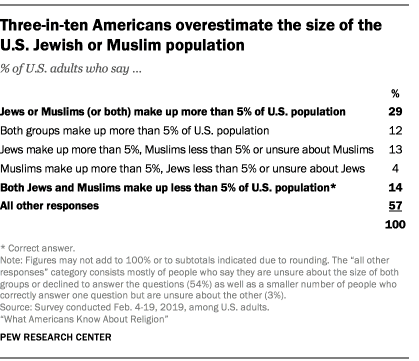 Three-in-ten U.S. adults (29%) overestimate the size of the U.S. Jewish or Muslim populations, incorrectly stating that one or both of these groups make up more than 5% of the U.S. population. This includes 12% who think the size of both groups exceeds 5%, 13% who think Jews account for more than 5% of U.S. adults, and 4% who believe the Muslim population is larger than it is. Just 14% of respondents know that the Jewish and Muslim communities in the U.S. each make up less than 5% of the overall U.S. population. And slightly more than half of U.S. adults (54%) say they are unsure about the size of both the Jewish and Muslim populations.
- Questions about different religions not only vary in difficulty, but also focus on specific aspects of religions and do not cover the breadth of knowledge people may have about any specific religion. As a result, the survey cannot definitively state that Americans are more knowledgeable about Islam than they are about other non-Christian religions. Still, respondents were more likely to correctly answer the questions about Islam in this particular survey than they were to choose the correct answers about Judaism, Hinduism, Buddhism and Sikhism. Indeed, roughly six-in-ten Americans know that Ramadan is an Islamic holy month and that Mecca is Islam’s holiest city, roughly double the share of U.S. adults who know when the Jewish Sabbath starts or what the Jewish holiday of Rosh Hashana celebrates.
- Men get more questions right, on average, than women (15.5 vs. 13.0). And Americans who are 65 or older correctly answer about 16 questions, on average, while those under 30 get fewer right (11.9). Non-Hispanic white respondents score higher (15.4 questions right, on average) on the survey’s religious knowledge questions than black respondents (10.5) and Hispanic respondents (11.7). These gender, age, and racial and ethnic differences are statistically significant even after controlling for education, religious affiliation and the religious diversity of respondents’ social networks (see Chapter 3 for more details).
This is the second time Pew Research Center has tested how much U.S. adults know about religion. The first survey, conducted in 2010, found that atheists, agnostics, Jews and Mormons were the top performers, while in the new survey, atheists, Jews, agnostics and evangelical Protestants scored highest. However, there are several important differences between the two surveys that make them not directly comparable. To begin with, many of the questions asked in the new survey were not asked in 2010. Just 12 of the 32 current knowledge questions appeared on the 2010 survey, and all the repeated questions have been modified in ways that make direct comparisons impossible.
Another difference is that the 2010 survey was conducted on the phone by live interviewers, while the current survey was conducted online with respondents entering their own answers. Sometimes when the same question is asked in two different modes, such as over the phone and online, there is a difference in results attributable to what survey methodologists call a mode effect. In other words, the presence of a live interviewer may encourage people to answer questions differently than they would if no one was observing their (self-recorded) responses.
Also, the 2019 survey included a “not sure” response to every religious knowledge question; respondents were given the explicit option of clicking “not sure” and skipping to the next question whenever they were unsure of an answer. By contrast, in the 2010 survey, respondents did not have an explicit “not sure” response option read to them over the phone. Instead, respondents were able to say they “don’t know” only if they volunteered it as a response. As a result of all these differences, the results cannot speak to whether Americans have become more or less knowledgeable about religion over the past decade.
Moreover, there is no objective way to determine how much the U.S. public should know about religion, or what are the most important things to know. As with the 2010 survey, the questions in the 2019 survey are intended to be representative of a body of general knowledge about religion; they are not meant to be a list of the most essential facts.
Roadmap to the report
The remainder of this report explores these and other findings in more detail. Chapter 1 takes a step-by-step look at how people from a variety of religious traditions performed on each of the survey’s religious knowledge questions. Chapter 2 goes a step further and examines which factors beyond religious affiliation are linked with higher and lower levels of religious knowledge. Chapter 3 reports the results of multiple regression models that assess the relative impact of religious, social and demographic factors on religious knowledge. And Chapter 4 examines the results of the survey’s “feeling thermometer” questions, with a focus on how religious knowledge is linked with positive and negative attitudes toward a variety of religious groups.
Religious knowledge questions
Questions below have been paraphrased for brevity; most response options were randomized. Correct answers are noted in bold. See topline for exact wording and question order.
Bible
• Which Bible figure is most closely associated with leading the Exodus from Egypt? Moses, Daniel, Elijah, Joseph
• Which figure is most closely associated with killing an enemy with a stone? David, Isaiah, Joshua, Solomon
• Who is most closely associated with willingness to sacrifice his son to obey God? Abraham, Jacob, Cain, Levi
• Who is most closely associated with saving Jews from murder by appealing to king? Esther, Ruth, Sarah, Rebecca
• Which of these is NOT in the Ten Commandments? Golden rule, no adultery, no stealing, keep Sabbath holy
• Who delivered the Sermon on the Mount? Jesus, Peter, Paul, John
• Where did Jesus live during his childhood and young adulthood? Nazareth, Bethlehem, Jerusalem, Jericho
Elements of Christianity
• Easter Sunday commemorates what? Resurrection, Ascension, Crucifixion, Last Supper
• Which best describes the Trinity? One God in three persons (Father, Son, Holy Spirit), there are three patriarchs (Abraham, Isaac, Jacob), coming of Christ foretold by three prophets (Elijah, Ezekiel, Zechariah), there are three Gods (Father, Mother, Son)
• Which is the Catholic teaching about bread and wine in Communion? They become actual body and blood of Christ, they are symbols of the body and blood of Christ
• In Catholicism, purgatory is … where souls are purified before entering heaven, an offering made during confession, purification process made during self-reflection, where souls go for eternal punishment
• Which group traditionally teaches that salvation comes through faith alone? Protestantism, Catholicism, both, neither
• Prosperity gospel teaches … strong faith leads to financial success and good health, easier for camel to go through eye of needle than for rich person to enter the kingdom of God, to whom much is given much is expected, God’s blessing is given to the poor who store up treasures in heaven
• What was the religion of Joseph Smith? Mormon, Catholic, Jewish, Buddhist, Hindu
Elements of Judaism
• What best describes Rosh Hashana? New Year, Day of Atonement, candles lit for eight nights, end of Torah reading
• Which religious tradition is Kabbalah most closely associated with? Judaism, Hinduism, Islam, Zoroastrianism
• What was the religion of Maimonides? Jewish, Mormon, Catholic, Buddhist, Hindu
• When does the Jewish Sabbath begin? Friday, Thursday, Saturday, Sunday
Elements of world religions
• What is the holiest city in Islam, to which Muslims are expected to make a pilgrimage? Mecca, Jerusalem, Medina, Cairo
• Ramadan is … an Islamic holy month, Hindu festival of lights, Jewish prayer for the dead, festival for Buddha’s birth
• What is the religion of most people in Indonesia? Islam, Buddhism, Hinduism, Christianity, Sikhism
• Which religious tradition is yoga most closely associated with? Hinduism, Judaism, Islam, Zoroastrianism
• Which text is most closely associated with Hindu tradition? Vedas, Tao Te Ching, Quran, Mahayana sutras
• Which is one of Buddhism’s four “noble truths”? The truth of suffering, every being has immortal soul, Buddha was perfect, monotheism
• What is the religion of most people in Thailand? Buddhism, Hinduism, Islam, Christianity, Sikhism
• What is the religion of most people in Ethiopia? Christianity, Buddhism, Hinduism, Islam, Sikhism
• Which religion requires men to wear a turban and carry a ceremonial sword? Sikhism, Islam, Hinduism, Buddhism
Atheism and agnosticism
• An atheist … does NOT believe in God, believes in God, is unsure whether God exists, believes in multiple gods
• An agnostic … is unsure whether God exists, believes in God, does NOT believe in God, believes in multiple gods
Religion and public life
• What does the U.S. Constitution say about religion as it relates to federal officeholders? No religious test necessary for holding office, sworn in using Bible, must affirm that all men are endowed by Creator with unalienable rights, does not say anything
• How many adults in the U.S. are Jewish? Less than 5%, one-in-ten, one-in-four, half or more
• How many adults in the U.S. are Muslim? Less than 5%, one-in-ten, one-in-four, half or more


