Misleading article given that it leaves out the important qualification of the first generation limit on parents passing on their citizenship to their children if they themselves were born outside of Canada.
Surprising, given that this provision has been in place since 2009:
Canada allows the children of its citizens to apply for Canadian citizenship.
If you have at least one biological or legal parent who was a Canadian citizenship at the time of your birth, you can submit a Proof of Citizenship application to Immigration, Refugees and Citizenship Canada (IRCC). The fee is only $75 CAD.
You are able to claim Canadian citizenship at any time in your life. You are also able to apply for Proof of Citizenship even if your Canadian parent is deceased.
IRCC requires evidence of your Canadian parent. This can come in the form of your parent’s birth certificate, Canadian citizenship card, or citizenship certificate.
Once IRCC receives your application, it will send you an “acknowledgment of receipt.” They will then send you a Canadian citizenship certificate once your application has been approved.
Becoming a Canadian citizen is beneficial for many reasons. Canada is a stable country with a diverse society and strong economy. The country offers safety, security, universal healthcare, and high quality education. In addition, the Canadian passport is one of the world’s strongest, offering visa-free travel to 185 countries.
An experienced and trusted Canadian immigration lawyer can help submit your Proof of Citizenship application. They will use their expertise to ensure you submit a complete and accurate application. This is important since the pandemic has slowed down IRCC’s processing. Pre-pandemic, it took IRCC five months to process Proof of Citizenship applications. Now its website is reporting an average processing time of 17 months. A lawyer can help you avoid waiting any longer than necessary to gain Canadian citizenship.
The good news is Canada is making greater investments in technology to improve its immigration processing. Moreover, the wait to get Canadian citizenship is worth it in the end, due to the plethora of advantages Canada has to offer.
Interesting account. Remember from my days in multiculturalism following the UK’s PREVENT inititiatives to counter radicalization and extremism, and this article highlights one of the think tanks involved. Others with more experience in countering violent extremism may have some comments on this account:
In the wake of the calamity of the Iraq invasion of 2003, one might have supposed that the ideology which lay behind Tony Blair and George W Bush’s bloody misadventure would have been discredited. This has not happened. Neo-conservatism has continued to set the parameters for a great deal of policy discourse, and its supporters have continued to occupy many of the most prominent positions in British (and American) public life.
There are a number of reasons for this resilience. In the UK, Policy Exchange, a London-based think tank, is one organisation which kept the neo-conservative flame burning. Though its public profile is small, it has exerted prodigious influence in political circles. In conventional politics, Policy Exchange was at first associated in particular with ‘marketisation’, an ugly word which describes how the disciplines of the private sector have been introduced into the education system and the wider civil service. The think tank’s most enduring achievement, however, has probably been the reshaping of government policy towards British Muslims.
To simplify a rather complicated story, the British government, police and intelligence services originally saw their job as enforcing the law rather than policing ideology or personal beliefs. Abu Hamza, the notorious one-eyed cleric who made no secret of his sympathies with al-Qaeda, provides a fascinating illustration of this approach. Hamza, who used his position as imam of the Finsbury Park mosque to preach violent jihad, was skilful at ensuring that his public pronouncements stayed just within the law. There was general amazement and surprise when his eviction was suddenly brought about not apparently by the British state, but by his own congregation, who locked the doors of the mosque against him. The Metropolitan Police were, however, involved in Abu Hamza’s downfall. Its policemen built up close relations with the mosque’s faithful and were unobtrusively stationed nearby on the day of the imam’s eviction in case of trouble. This sensitive operation was a model of old-fashioned intelligence work and community policing.
However, the Muslim congregation who threw out Abu Hamza themselves held views which many sections of British society would find offensive. The congregation included sympathisers with Hamas, the Palestinian resistance group. Probably without exception, they were hostile to the invasions of Afghanistan and Iraq, and were dismayed by the Israeli occupation of the West Bank and Gaza. Many worshippers at the mosque held socially conservative views about homosexuality and women which, while by no means unknown among the Conservative Party membership, are no longer mainstream opinions in the modern UK. None of these views bothered the Metropolitan Police. They were happy to work with the Muslim community for the removal of a figure who they rightly saw as a menace.
This kind of ‘multicultural’ approach lay at the heart of what was then the British way. As long as they obeyed the law, immigrants were allowed to bring with them the traditions and customs of the countries they had left behind. This approach fitted in naturally with the national tradition of letting in dissidents and exiles from abroad, from the Huguenots expelled from France in the seventeenth century to the Jews who made their way to the UK as refugees from the Russian pogroms before the First World War, or later as refugees from National Socialism.
Policy Exchange dismantled the British approach of tolerance. Its analysts naturally agreed that the police should counter violence. But they disagreed profoundly with any tolerance of the ideas which (so they maintained) might become gateways to this violence. Policy Exchange’s connections were second to none. It was set up in 2002, in the wake of heavy Conservative Party defeats in the 1997 and 2001 general elections, by a group of Conservatives who feared their party was destined to perpetual opposition. These were the self-proclaimed Tory ‘modernisers’. They greatly admired Blair and had supported the Iraq War. These modernisers believed that their mission was to help the Conservatives copy Blair’s achievements in making the Labour Party electorally successful. Michael Gove, at the time of writing a senior member of the Boris Johnson government, was the first chairman of Policy Exchange.
When David Cameron ran for the Tory leadership after the 2005 general election defeat, he looked to Policy Exchange for ideas. The organisation – defined by the Evening Standard as “the intellectual boot camp of the Tory modernisers” – helped shape his thinking. At its heart, Policy Exchange spoke of a political philosophy which appeals almost as deeply to the Blairite or Starmer wing of the Labour Party as it does to David Cameron or Boris Johnson’s Conservatives. Better than any comparable organisation, it has come to articulate what was rapidly becoming the philosophy of the British governing class in the 21st century.
Policy Exchange and British Muslims
When the think tank was founded, it contained a ‘Foreign Policy and Security Unit’. As far as can be ascertained, its publications focused on foreign policy, but displayed no interest in domestic ‘extremism’. This changed with the arrival of Dean Godson with the title of research director of international affairs in 2005. Godson, who had worked as chief leader writer for the Daily Telegraph, appeared to interpret his international brief as a mandate to generate domestic policy towards British Muslims. This should never cause surprise: the political right in the UK has a habit of discussing British Muslims as if they were a foreign policy issue.
Godson came from a family with a tradition of interest in Cold War intelligence work, propaganda and covert action. His father Joseph Godson was Labour attache at the United States embassy in London in the 1950s and used his influence to promote the interest of the pro-US wing of the Labour Party.
From 2005 onwards, Godson seems to have been on a mission to rip up the counter-terrorism strategy adopted by successive British governments. He promoted the new approach to Muslims through research papers, seminars and, not least, media muscle. In particular, he argued that methods used by the British state against terrorism – above all against the IRA during the Troubles – were no longer relevant. In Ireland, British ministers were happy to work with Catholic communities in order to isolate the gunmen and bring about reconciliation.
Confronted with the threat of terrorism in the aftermath of the 9/11 attack on the Twin Towers, the first instinct of the British state was to copy the Irish experience. The police identified leaders who they felt they could trust with links into local communities. They sought to draw these figures into British politics, inviting them on to public platforms and making public funds available. In this way, they hoped to single out and segregate those individuals with an inclination to violence while gaining intelligence about their activities.
Policy Exchange argued that this strategy was wrong because, so it claimed, the British government was not merely confronting terrorists. Something much bigger was afoot: a confrontation of ideologies. For Policy Exchange, the UK was one of a band of free states, led by the US, that were engaged in a mortal battle against a set of deadly foes dedicated to a project to destroy Western civilisation. These foes were called ‘Islamists’ and they subscribed to a murderous ideology called Islamism. Policy Exchange acknowledged that not every Islamist was violent. However, over the long term that was irrelevant: Islamism had to be fought and ultimately it had to be defeated.
Islamism, said Policy Exchange, is a worldview which teaches its adherents that Islam is a comprehensive political ideology and must be treated as such. According to Policy Exchange, the Islamist outlook is one that essentially divides the world into two distinct spheres: ‘Muslim’ and ‘the rest’.
There could therefore be no negotiation. Islamists could never accept democracy, the rule of law, political institutions or the nation state. There was therefore no point in bringing Muslims into politics unless they renounced Islamism, in which case they could be welcomed.
According to Policy Exchange’s analysis, the core aim of counter-terrorism policy was no longer just protecting British citizens against violence. It was also the assertion of what Policy Exchange claimed to be Western values against so-called Muslim ‘extremism’. This grand battle of ideas demanded a return to the strategy of counter-subversion employed against the Soviet Union during the Cold War. My close reading of Policy Exchange publications has led me to conclude that Godson was, in essence, arguing that British Islamists should be isolated, never embraced and treated as suspect.
Twenty years ago I would attend the Telegraph leader conference. Godson, as chief leader writer, held court. He was a good mimic, an art he used to mock or denigrate political opponents or, if feeling cheerful, merely to entertain. He welcomed acolytes, but I took the liberty of challenging Godson. That evening I received a message through a mutual friend, who had arranged a dinner so that we could get to know each other better, that Godson was offended and no longer wanted to come across me socially. He was as good as his word.
A survey of his work at Policy Exchange suggests Godson had three objectives. First, he sought to weaken – or, better still, wreck – the alliance between the British left and British Muslim organisations. This he did by portraying Islamism as an outlandish far-right movement, with features in common with fascism. Secondly, Policy Exchange sought to challenge multiculturalism both as an idea and, more especially, as a basis for government policy. Above all, Godson was determined to break the link between so-called Islamist movements and the British state.
Godson was successful in all these objectives. His excellent Whitehall and Westminster connections may well have helped. These connections endure. Policy Exchange can whistle up a Cabinet minister for an event, an op-ed in a newspaper or access to Downing Street, while its authors are sought as experts on Islam on radio and television. The organisation’s reports tell the Conservative Party exactly what its leaders want to hear. At least six special advisers in the Boris Johnson government previously worked for Policy Exchange.
Godson’s first publication for Policy Exchange targeted British government collaboration with what was coming to be termed ‘radical Islam’. The author, Martin Bright, was a left-leaning journalist and then political editor of the New Statesman. This in itself sent out the important message that Policy Exchange worked with both political persuasions. Bright’s analysis was based on leaked material, courtesy of a Foreign Office source alarmed at the government’s relationship with Muslim organisations both in the UK and overseas. “It depresses me deeply,” wrote Bright, “that a Labour government has been prepared to rush so easily into the arms of the representatives of a reactionary, authoritarian brand of Islam, rather than look to real grassroots moderates as allies.”
Bright’s document took aim at two targets: the Muslim Brotherhood and the Muslim Council of Britain. Policy Exchange (and Bright) present the Muslim Brotherhood as an Islamist movement guilty of propagating a dangerous ideology at odds with the West. As for the Muslim Council of Britain, that was condemned as guilty of being Islamist too. Bright’s document was an important blow in a campaign which would eventually lead to the severing of relations between the British government and the MCB. Policy Exchange can claim a large part of the credit.
Godson was an acute talent-spotter. Munira Mirza wrote his second publication and later worked with Boris Johnson when he was mayor of London, before moving to the crucial role of head of the Downing Street policy unit. Mirza demanded an end to “institutional attacks on Britain and its culture”, arguing that “the preoccupation with Muslim vulnerability and Islamophobia has skewered our understanding of why such problems exist, and in many ways, has made things worse for Muslims.” Mirza asserted that this reflected a “victim mentality” which was “given social credence by institutions, politicians, the media and lobby groups”. Her report also claimed Islamophobia has been ‘exaggerated’ by some British Muslims. Policy Exchange has a long history of questioning the idea of Islamophobia and has a record of recruiting members of minority groups to do the questioning.
The invention of non-violent extremism
In 2009, Policy Exchange published a report which explicitly presented the demand for the British state to apply to British Muslims the same counter-subversion regime used against trade unionists, socialists and others during the Cold War. This well-written and powerful polemic probably represents – more explicitly than any other Policy Exchange publication – the full Godson agenda. It was written by two Cambridge scholars. Martyn Frampton was a fellow of Peterhouse, the high Tory Cambridge college. His co-author Shiraz Maher was a former member of Hizb ut- Tahrir, having worked for the organisation as a regional officer in the north- east of England.
Frampton and Maher’s report called for the government to reinstate the 1989 Security Service Act, which would give MI5 the power to investigate subversion. As far as the British government was concerned, this involved a giant conceptual leap. The ‘Preventing Violent Extremism’ initiative was rebranded as, simply, ‘Preventing Extremism’.
This was also a profound change of policy because it implied that the state should target not just violence but opinion as well. It criticised the government for “stressing law enforcement and strict security concerns over and above everything else’” Instead, it should deal with “non- violent radicals” who were “indoctrinating young people with an ideology of hostility to Western values”.
In other words, Policy Exchange wanted to create a new relationship between the British state and Muslims. This project meant creating a different kind of British citizenship. It led to a new concept in British public discourse: non-violent extremism. Policy Exchange was urging that Muslims should be obliged to sign up to a set of beliefs that fell within a state prescribed remit. In order to become British, Muslims were being asked to deny, or at least modify, their own identity and heritage. Until that moment, British citizens had generally been allowed to think and conduct themselves as they wanted, as long as they stayed within the law. The invention of the concept of non- violent extremism meant citizens could now be harassed, put on secret lists or barred from public life for offences which they often did not even know they had committed. It lies at the heart of the Prevent doctrine.
Prevent was used to fund organisations that would promote the government line on terrorism and extremism. But there was another component to the programme, which the Cameron government adapted to target “non-violent extremism” rather than just violent extremism. In 2015, Prevent became a legal duty for public sector institutions – including hospitals, schools, and universities. Under Prevent, public sector workers were and are (at the time of writing) expected to report anyone they suspect of extremism to the programme.
Extremism, according to the government, constitutes “vocal or active opposition to British values”. This means that people whose views may be mainstream or illiberal, but certainly not illegal, can be targeted as a threat to British society.
In a school context, Prevent demands that any teacher who suspects a pupil of having been radicalised must report them to the programme. The policy has failed at the crucial test of effectiveness. From April 2020 to March 2021, 86 per cent of referrals to the programme were false positives – representing people who were wrongly referred. Prevent only occasionally catches the people that it wants to. Even these individuals, however, have never committed a crime. There is, moreover, no evidence that they will ever commit a crime in the future, or that they would have committed a crime were it not for being identified by Prevent. Government statistics, meanwhile, do not illuminate the full picture: there are thousands of cases within schools, universities and hospitals where innocent people, often children, are needlessly interrogated and harassed over suspected extremism. Their cases are dismissed before being officially referred to Prevent and are left out of the official statistics.
Muslims are disproportionately affected by the policy, which relies on profiling. Over 70 per cent of Muslims in England and Wales live in ‘Prevent Priority Areas’ (PPAs), compared with just over 30 per cent of the general population. By requiring public sector workers to report people they find suspicious, moreover, Prevent effectively compels them to act on their prejudices and makes Muslims subject to majoritarian biases.
The development of the concept of extremism, pushed by think tanks like Policy Exchange, has had a material impact on the lives of ordinary British Muslims, pressuring them to assimilate by downplaying their distinctiveness from other Britons.
The idea of non-violent extremism thus brought with it a particular conception of national belonging: if foreigners wanted to become British, why shouldn’t they be like Britons? But this wasn’t a British logic. This country has always had a generous and capacious identity. You can be British at the same time as being Welsh, Jamaican, Cornish, Black, Jewish, Hindu, Muslim or Scottish. The biggest problem is that nobody can be certain who is – or who is not – a non- violent extremist. That is why all attempts to establish a legally secure definition have so far failed.
Policy Exchange’s proposals have shifted the UK towards an American model of citizenship where new arrivals are expected to abandon old identities and join a common melting pot. Policy Exchange’s project to save Britishness was therefore also an attempt to destroy it. But Policy Exchange could not have won its argument without powerful allies, and the most important of these was the Conservative Party. The Fate of Abraham: Why the West is Wrong about Islam is published on 12 May by Simon & Schuster. Peter Oborne won best commentary/blogging at the Drum Online Media Awards in both 2022 and 2017 for articles he wrote for Middle East Eye. He was also named as British Press Awards Columnist of the Year in 2013. He resigned as chief political columnist of the Daily Telegraph in 2015. His latest book, The Assault on Truth: Boris Johnson, Donald Trump and the Emergence of a New Moral Barbarism, was published in February 2021 and was a Sunday Times Top Ten Bestseller. His previous books include The Triumph of the Political Class, The Rise of Political Lying, and Why the West is Wrong about Nuclear Iran.
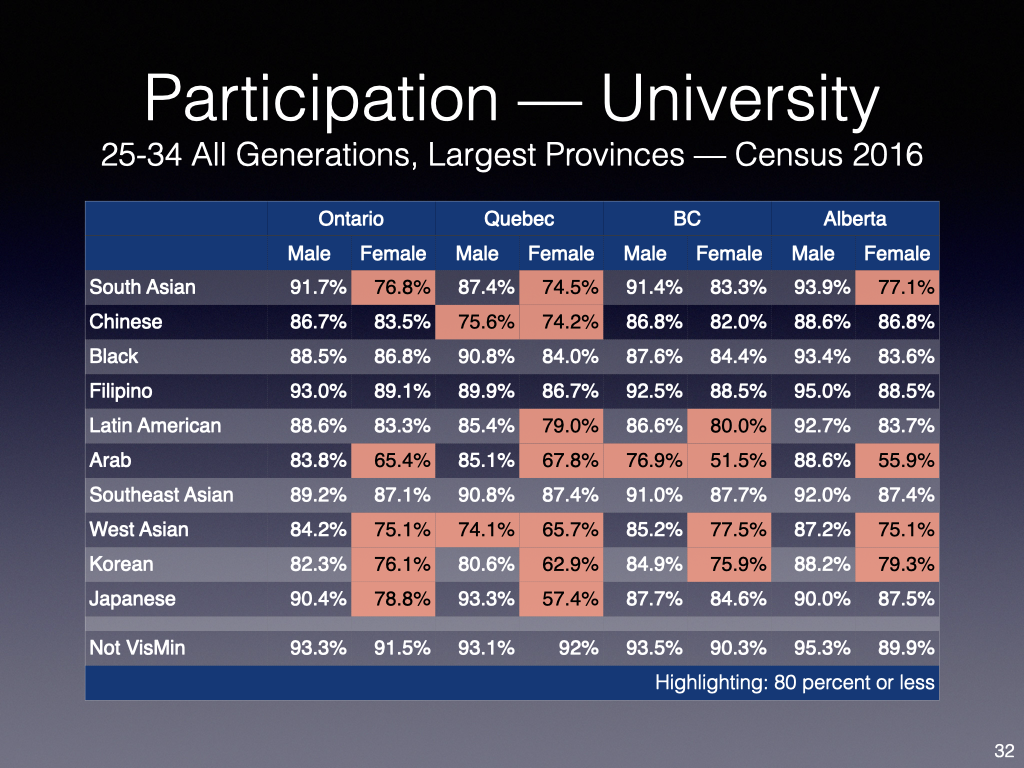
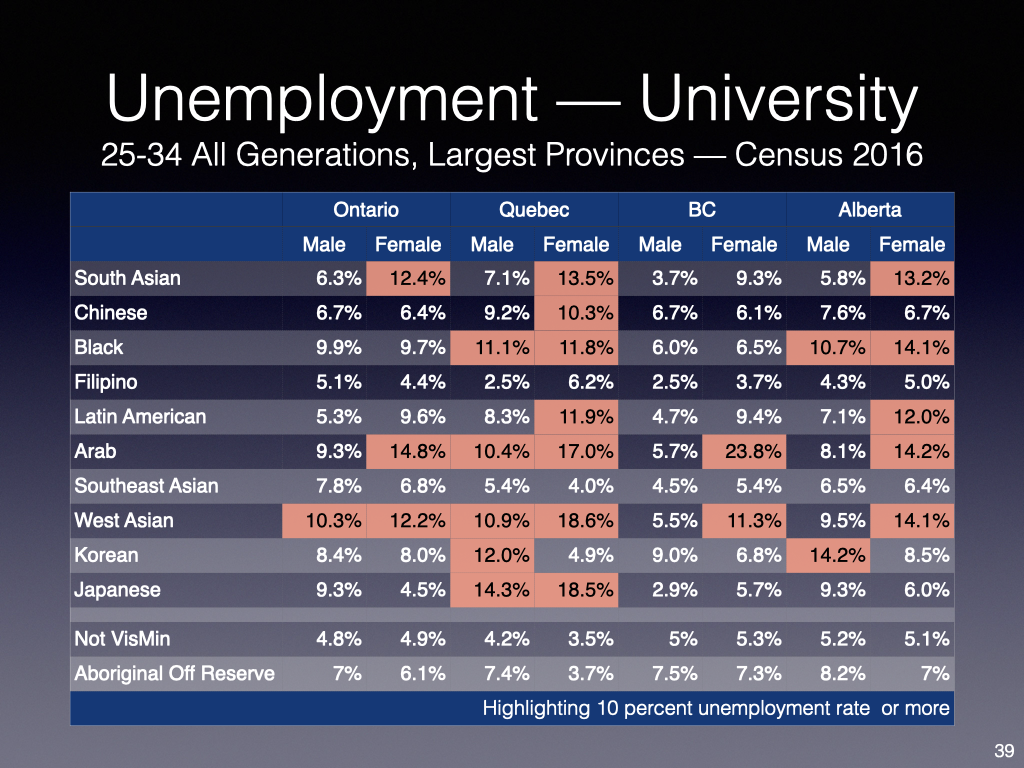
For some context, 2016 census data (not public opinion research) for the younger 25-34 year old cohort. Some of the issues flagged in the study are common to other visible minority groups. Income data is relatively strong for Arab women, lower participation may reflect the impact of family caring, with higher unemployment reflecting in part bias. Regional variations, in particular the relatively poor outcomes for women in Quebec, are notable:
The Canadian Arab Institute released a report last week that attempts to explain why some Arab women aren’t succeeding in Canada’s workforce. It’s compelling reading for anyone invested in the nation’s overall prosperity and success.
The new study titled, “Employment barriers facing Arab Women in Canada”, combines surveys collected by Abacus Data, focus groups and interviews conducted in Ontario, Quebec, and Alberta (provinces with the highest populations of Arab-Canadians). The result is a helpful list of recommendations that would help any newcomer or immigrant trying to navigate the job market.
“Overall, social exclusion describes a state in which individuals are unable to participate fully in economic, social, political and cultural life,” points out the United Nations.
Some Arab-Canadians are having a hard time participating economically, despite the historic presence of these diverse communities in Canada dating as far back as 1882, as chronicled by academic Houda Asal in her book, “Identifying as Arab in Canada: a Century of Immigration History.”
As one of the fastest growing immigrant communities in the country, with seven out of 10 who are first generation immigrants, dreams of success are too often stalled by systemic barriers threatening to “push Arab-Canadians further into poverty and social isolation,” notes the report.
During the fall of 2020, Arab-Canadians had one of the highest unemployment rates in the country at 17.9 per cent, compared to a national unemployment rate of 9 per cent. Fast forward to today, Arab-Canadians continue to be among those with the highest unemployment rates, according to the March 2022 Labour Force Survey.
And Arab women are among the worst off.
“ … why do Arab women have a higher unemployment rate than most non-Arab women?” question the report’s authors. “Our main objective in this study is to understand the knowledge gaps behind the ever-increasing employment barriers facing Arab women and filling these gaps with evidence that inform policy recommendations.”
The researchers approached the question by dividing an individual’s career into different chronological stages. The result is helpful in understanding how those seeking work tend to experience obstacles at various junctures in their journey — information gathering about the local labour market, looking for job opportunities, during the recruitment process, while gaining work experience and being better integrated in the workplace, and in further career development and future growth.
The most significant impediments identified included inadequate employment services, lack of recognition of foreign credentials and opportunities to upgrade, lack of opportunities to gain Canadian experience, language/communication obstacles (not based on proficiency in either of the official languages, but due to a lack of knowledge of industry-specific terms), and discrimination based on one’s identity.
The report’s concluding recommendations would improve the chances of most newcomers and immigrants in finding and retaining employment commensurate with their professional skill-set. These include:
Creating central portals of information about the labour market so it’s easier to access information about the job market.
Encouraging the federal government to work with the provinces to provide information to immigrants about degree equivalency processes before their arrival to Canada so they can better prepare.
Encouraging workplaces to implement standardized performance evaluations to remove concerns about bias in performance reviews and fears of reprisals when individuals report microaggressions or blatant discrimination.
More funding for organizations that provide mentorship and social networking for newcomer and racialized women.
Tailored communication and soft skills training opportunities in industry-specific terms and language.
Measuring the success of employment support services not on whether newcomers or immigrants have secured survival jobs, but whether employment matches the skills of their clients.
These recommendations won’t come as a major surprise to those who have long worked with immigrant and newcomer communities. What should surprise all of us is how long it’s taking to address these hurdles.
Toronto police say there has been a 22 per cent increase in hate crimes in the city.
The force says there were 257 hate-motivated incidents in 2021, up from 210 such incidents the year before.
Police say the pandemic and geopolitical events are believed to be contributing factors in the increase.
The force says religion, ethnic or national origin were the dominant motivating factors in the incidents.
It says east and southeast Asian communities were the most targeted.
Toronto police say they are expanding their hate crime unit.
Police Chief James Ramer says hate crimes are increasing year over year.
“Hate crimes victimize not only the person, but also the communities they identify with and the negative effects can be long-lasting,” Ramer said in a written statement.
“We know hate crimes often go unreported and we are committed to working alongside our community partners to break down barriers and develop relationships so that more people will feel comfortable coming forward to report these crimes.”
East and southeast Asian communities were the predominant victims of assaults, followed by the Black community while Jewish and Black communities were the predominant groups targeted for mischief incidents, police said.
Black and LGBTQ communities were the dominant group for being threatened, the force said.
Similar analysis to that of The Economist. Biggest surprise to me is the inclusion of the USA in the top 10 – but perhaps I shouldn’t be:
The COVID-19 pandemic directly or indirectly caused 14.9 million deaths in 2020 and 2021, the World Health Organization said on Thursday, in its newest attempt to quantify the outbreak’s terrible toll.
That’s around 2.7 times more than the 5.42 million COVID-19 deaths the WHO says were previously reported through official channels in the same 2-year period.
Here’s a rundown of four main points in WHO’s report:
Overall, deaths are far higher than those in official reports
In its tally, WHO aims to quantify “excess mortality,” accounting for people who lost their lives either directly, because of contracting COVID-19, or indirectly, because they weren’t able to get treatment or preventive care for other health conditions. The figure also takes into account the deaths that analysts say were prevented because of the pandemic’s wide-ranging effects, such as curtailing traffic and travel.
The pandemic’s current reported death toll is 6.2 million, according to Johns Hopkins University’s COVID-19 tracker.
India is seen suffering a much deeper loss than reported — a finding that India disputes
In some cases, WHO’s figures depict a shockingly wide gulf between official figures and its experts’ findings. That’s particularly true for India, where WHO says millions more people died because of the pandemic than has been officially reported.
India reported 481,000 COVID-19 deaths in 2020 and 2021. But William Msemburi, technical officer for WHO’s department of data and analytics, said on Thursday that the toll is vastly higher, with 4.74 million deaths either directly or indirectly attributable to the pandemic — although Msemburi said that figure has a wide “uncertainty interval,” ranging from as low as 3.3 million to as high as 6.5 million.
The data behind the staggering figures promise to expand the understanding of the pandemic’s true effects. But the findings are also a flashpoint in debates over how to account for unreported coronavirus deaths. India, for instance, is rejecting WHO’s findings.
India “strongly objects to use of mathematical models for projecting excess mortality estimates,” the country’s health ministry said on Thursday, insisting that WHO should instead rely on “authentic data” it has provided.
10 countries accounted for a large share of deaths
Deaths were not evenly distributed around the world. The WHO says about 84% of the excess deaths were concentrated in three regions: Southeast Asia, Europe and the Americas.
And about 68% of the excess deaths were identified in just 10 countries. WHO listed them in alphabetical order: Brazil, Egypt, India, Indonesia, Mexico, Russia, South Africa, Turkey and the United States.
Overall, WHO found the number of excess deaths was much closer to reported COVID-19 deaths in high-income countries than in lower income countries.
Many countries still lack reliable health statistics
The WHO says it relied on statistical models to derive its estimates, looking to fill in gaps in official data.
“Prior to the pandemic, we estimate that 6 out of every 10 deaths were unregistered” worldwide, said Stephen MacFeely, director of WHO’s department of data and analytics. “In fact, more than 70 countries do not produce any cause of death statistics. In the 21st century, this is a shocking statistic.”
By creating its report on excess mortality, WHO is pursuing several goals, such as urging governments to improve their health-care interventions for vulnerable populations and to adopt more rigorous and transparent reporting standards.
“Knowing how many people died due to the pandemic will help us to be better prepared for the next,” said Samira Asma, WHO’s assistant director-general for data and analytics.
The “grandmother perspective” to data collection, which I first learned from Gwen Phillips of the Ktunaxa Nation, suggests that government should collect data as a grandmother would collect information about her family: to better care for them, rather than exercise control with a big-brother mentality. This perspective formed the basis for the recent recommendations on disaggregated data collection from British Columbia’s Office of the Human Rights Commissioner to the provincial government.
A grandmother collects her grandchildren’s stories like pencil marks on the wall, measuring their growth. Data can also tell a story – one that helps us to understand people’s needs at a community level. Policy makers, too, need good information to design good law, policy and services.
This week, the B.C. government introduced the Anti-Racism Data Act, new legislation to collect disaggregateddemographic data. The new law, if passed, facilitates the collection of personal information for the purposes of identifying systemic racism and advancing racial equity.
Disaggregated demographic data are information based on different aspects of our identities: for example, information broken down by race, gender or educational status. While the Statistics Canada census already collects disaggregated data in relation to the general population, this new law will facilitate the collection of such data in relation to government policies, practices and services, such as health care. Comparing statistics based on these two datasets can reveal patterns and inequalities. Information about inequalities, in turn, can help us design better policies to tackle systemic discrimination. We can’t act on what we don’t know.
Importantly, data must be collected on more than just racism in order to be effective. If we can’t understand how gender, race, age and other factors work together or intersect to inform our experiences in the world – and more accurately, how sexism, racism, ageism, ableism and so on inform our experiences – then we won’t be able to create good public policy that meets people’s real needs.
Race-based data only tell part of the story. For example, we know that in Canada, racialized men earn 78 cents for every dollar earned by white men, according to a 2019 Canadian Centre for Policy Alternatives report. But that gap widens significantly for racialized women, Indigenous women, transgender women and women with disabilities. Indeed, racialized women earn only 59 cents for every dollar earned by white men.
Treating all racialized people as a homogenous group not only obscures the problem, but it also reinforces it by leading to solutions that are only tailored to the experiences of the dominant subgroup within that category.
We may identify racist stereotypes as being one of the barriers contributing to the wage gap. But we also need to understand that stereotypes of racialized women may be quite different than stereotypes of racialized men. Ignoring these gendered differences silences and omits the experiences of racialized women. We need to truly understand the scope and complexity of the wage gap in order to solve it; intersectional data collection and analysis is key to that end.
However, there is a serious downside to collecting all this information. Despite its power to focus the gaze of policy makers on real world inequities, data also have the power to reinforce negative stereotypes, and some people have legitimate concerns about sharing this information.
In recent recommendations from my office, we called on the provincial government to put control over data in the hands of those from whom the data are being collected. For example, disaggregated demographic data about a First Nation should only be collected in service of that community and upon the consent of that Nation, and used at their direction. The new legislation creates advisory roles for those who are directly impacted to embed this democratic approach to data and to counter any harms it may cause.
For decades, racialized communities, scholars and activists have been calling for this kind of legislation. Over the last two years, the public calls for disaggregated-data collection have grown louder. Protests against police brutality, a growing awareness of the ways in which racism impacts health outcomes, including those of COVID-19, and a movement to push back on the mainstream emergence of white nationalism have brought systemic racism into the consciousness of the masses. While data may not be the most glamorous call to action, they may be one of the most fruitful.
The new legislation is an important marker of our growth toward a more equal society. However, data collection is just one pencil mark on the wall; the next milestone to measure will be whether we are able to use it to create real social change. Implementation requires using intersectional data and a meaningful community governance model to turn information into action.
Kasari Govender is British Columbia’s first independent Human Rights Commissioner. BC’s Office of the Human Rights Commissioner exists to address the root causes of inequality, discrimination and injustice in the province by shifting laws, policies, practices and cultures.
In March, at the annual Conference on College Composition and Communication, one panel presentation was of particular interest: It concerned requirements in first-year college composition classes and discussed the idea that for students whose home dialect is Black English, or another nonstandard dialect, requiring them to write in standard English is a potentially unjust, if not flatly racist imposition, forcing some students to suppress their true selves in favor of a hegemonic artificiality. This school of thought holds that writing instructors should allow — encourage — such freshmen to write either purely in their home dialect or to engage in “code-meshing,” mixing the home dialect and the standard.
It’s an approach that accomplishes the feat of both underserving Black English speakers and diminishing Blackness.
During the panel’s Q. and A., an attendee presented this question: “What do we do when the resistance to code-meshing, for example, in our writing classrooms, comes from our BIPOC students? I ask because, of my attempts to encourage students to use their home dialects in writing, Black students in particular often resist those practices as setting them up for failure. Which only reflects how ingrained they are in a system that is inherently racist.”
The question and the panelists’ answers were quite revealing, including one from Asao Inoue, a rhetoric and composition professor at Arizona State University, who responded that when he hears that kind of objection from a student, he asks himself:
Is it that I have to say, or I have to create a classroom, and a learning experience, that demeans the linguistic history of that student in order for that student to go into the world and go into unfair racist, white supremacist systems and succeed? … Because if that student says, “You’re setting me up for failure,” what they’re saying is, “I want to succeed in that unfair system. I want to game that system.”
But, Inoue continued:
You’re always still going to be Black, or you’re always still going to be Latinx, or you’re always still going to be something else. … you can mouth the words that are white, but they’re coming from a body that’s something else, and you may be read that way. And so, for me, my goal as an educator is to change the system.
Because, he said:
What they’ve been exposed to is capitalist-inflected [expletive] about education being the way in which we, you, become a nice little cog in the system and you get skills. So you can go out in the world and make Microsoft more money.
While not all writing professors would go that far, in terms of appending a critique of capitalist reality to teaching freshman composition, just the notion that standard English is exterior to Black students’ real selves requires a closer look, because it tracks with worrisome currents in the way we are encouraged to think about race, especially lately.
Few familiar with today’s academic world will find Inoue’s opinions especially surprising. The idea in education circles that standard English functions as an unjust “gatekeeper,” holding back students of color, has been around for a long time. Related has been the idea that at the grade-school level, Black students whose home dialect is Black English should be taught as bilinguals of a sort. Adherents of this philosophy don’t say standard English should be withheld but suggest that standard English and Black English should be presented as different languages, as it were. Recall the “Ebonics” debate that gained national attention in the 1990s.
In 1993, English Leadership Quarterly, a publication of the National Council of Teachers of English, published a piece by two Indiana University of Pennsylvania English professors, Donald A. McAndrew and C. Mark Hurlbert, arguing that:
Writers should be encouraged to make intentional errors in standard form and usage. Attacking the demand for standard English is the only way to end its oppression of linguistic minorities and learning writers. We believe this frontal assault is necessary for two reasons: (1) it affords experienced writers, who can choose or not choose to write standard English, a chance to publicly demonstrate against its tyranny and (2) if enough writers do it regularly, our culture’s view of what is standard and acceptable may widen just enough to include a more diverse surface representation of language, creating a more equitable distribution not only of the power in language and literacy but also, ultimately, of the power in economics and politics that language and literacy allow.
Later, as The Washington Times reported in 1995, the N.C.T.E. discussed eliminating “English” from its name. That year, a delegate to its annual convention said, “If we are to offer diversity, there can be a conversation about language arts, but not about English.”
But in the same way that the idea of eliminating references to “English” strikes most as overboard, the idea that for Black people standard English is something wholly apart is simply inaccurate. For most Black Americans, both Black and standard English are part of who we are; our English is, in this sense, larger than many white people’s. In “The Souls of Black Folk,” W.E.B. Du Bois wrote, “I sit with Shakespeare and he winces not … I summon Aristotle and Aurelius and what soul I will, and they come all graciously with no scorn nor condescension.” On a less exalted level, a great many Black people toggle endlessly between standard and Black English, day in and day out — we code-switch. I always liked how Gloria Naylor was able to get this across, as in this scene from her novel “Mama Day”:
“We ain’t staying long,” Ruby says, pulling up a chair. “But I thought it would be nice for us to meet Cocoa’s new husband.”“It’s a pleasure,” George says.“Doubly mine,” says Ruby. “And this here is my new husband, Junior Lee.”“Pleasssurre.” Junior Lee manages a nod. “Hear you a big railroad man.”“No, I’m an engineer.”
In that exchange, the characters aren’t dipping in and out of what they think of as a cold, alien dialect. They are sounding subtly different notes according to which dialect they render each thought or gesture in. Standard English forms are as much theirs as Black English ones.
Communicating in this way, Black Americans are doing what other people do worldwide, living between two varieties of a language. Swiss people’s formal Hoch Deutsch is almost a different language from the Swiss German they speak informally. The Arabic speaker typically controls both the Modern Standard Arabic derived from the language of the Qur’an and used in formal settings and a local dialect used for real life, like Egyptian or Moroccan.
People in these countries and beyond would find familiar Maya Angelou’s observation in “I Know Why the Caged Bird Sings,” couched as completely unremarkable:
In the classroom we all learned past participles, but in the streets and in our homes the Blacks learned to drop s’s from plurals and suffixes from past-tense verbs. We were alert to the gap separating the written word from the colloquial. We learned to slide out of one language and into another without being conscious of the effort. At school, in a given situation, we might respond with “That’s not unusual.” But in the street, meeting the same situation, we easily said, “It be’s like that sometimes.”
To give some credence to those freshman-comp panelists, we might say that Angelou could have turned away from the “That’s not unusual” and that Du Bois could have considered that in real life Shakespeare, Aristotle and Marcus Aurelius might have looked down on him as some kind of “Aethiope.”
But subordinated and even despised people can, over time, with full awareness of the unjustness of racism, embrace even a foreign language, as opposed to a dialect, that is initially forced upon them. They can come to process it as a part of who they are, as people existing at a particular time, amid a dynamic synergy between the then and the now, the us and the them, the imposition and the resilience.
Many Indians, for instance, cherish English as one facet of the expression of modern Indianness, despite its imposition under colonial rule. Not long ago, I took in Netflix’s Bollywood romantic comedy “Love Per Square Foot,” in which the characters speak “Hinglish,” a neat blend of English and Hindi, a common linguistic phenomenon among many people in India and throughout the Indian diaspora. In the movie, there is nary a suggestion that the English feels to the characters like a spritz of cold water on every second sentence from a mustachioed British imperialist. In the same way, Congolese people go back and forth between French, their African lingua francas such as Lingala (memorably featured in, for example, the documentary “When We Were Kings”) and local indigenous languages few have heard of beyond where they are used.
Too often, what we’re presented with as authentically Black is a kind of essentialization. The idea that people’s authenticity stops at their home dialect does not reflect how people operate linguistically or their experience. Foisted on Black Americans, this idea of the standard dialect as a quiet menace, whatever its progressive intentions, is limiting. Even if the idea is not to ban the standard from a curriculum, if standard English is presented with an eye roll as the province of The Man, this is based in a conception of Blackness needlessly smaller than the reality of it.
Linguistically, Black Americans can and do walk and chew gum at the same time, like countless people around the world — and like it.
Of note. The public service has done so. But whether such a change would result in a measurable increase in diversity is uncertain. It will be interesting to see if the RCMP’s recent removal of the requirement results in any significant improvement to their notoriously poor results.
Will also be interesting to see if any backlash to these changes in terms of the meaningfulness and advantages of citizenship:
Canada’s military is not yet ready to allow permanent residents to join its ranks, even as it struggles to boost recruitment and fix the growing diversity gap in the nation’s armed forces.
In response to a request from New Canadian Media, ahead of the inaugural Navy Fleet Weekend in Vancouver, numbers provided by the Canadian Armed Forces (CAD) show that three-quarters of its ranks are white men.
Women make up 16.3 per cent of the Canadian military demographic; Indigenous peoples come in at 2.7 per cent while there is less than 12 per cent of visible minorities in the Canadian military make-up.
Canada needs about 100,000 troops to be at full strength, but it is short about 12,000 regular force troops and reservists currently.
Scrapping the citizenship requirement
A little-known immigration pathway called the Foreign Skilled Military Applicant (FSMA) has only seen 15 successful candidates over the last five years.
“Over the last year alone, the Canadian Forces Recruiting Group (CFRG) interacted with approximately 100 individuals who were interested in joining the military through the FSMA,” military spokesperson Major Brian Kominar told NCM.
“Discussions involving the Department of National Defence, the Canadian Armed Forces, and Immigration, Refugees and Citizenship Canada (IRCC) on lifting the citizenship requirement are continuing, though there are no changes to announce at this time,” he said.
The CBC reported in 2018, in line with the government of Canada’s objective of raising the number of forces personnel, there are discussions to review the possibility of foreign nationals’ recruitment beyond skills applicants.
Lifting the forces’ citizenship requirement would be a sharp departure from Canada’s traditional recruitment practices and could open the doors to applications from thousands of permanent residents, the CBC reported.
Other countries — the U.S. among them — allow non-citizens to serve, with certain restrictions on the positions and ranks they can hold.
In 2016, the RCMP scrapped its citizenship requirement, allowing permanent residents who have lived in Canada for more than 10 years to apply. The goal was, in part, to boost diversity in the ranks.
“We invite any associations, agencies, or organizations that work with new Canadians to contact the Canadian Forces Recruiting Group and find out what resources and tools are available to improve awareness of the over 100 full-time and part-time occupations available in the Canadian Armed Forces,” said Major Kominar.
“Non-Canadian citizen applicants must meet IRCC guidelines and requirements before proceeding through the CAF recruiting system,” he added.
“The proportion of people belonging to visible minorities in the labour force who were born in Canada is expected to increase from 20 per cent in 2016 to 26 per cent of the labour force by 2036…the increasing ethnocultural diversity of the labour force is expected to continue,” the report noted.
Earlier this month, Chief of the defence staff Gen. Wayne Eyre told the Ottawa Defence Conferencethat the CAF needs to “win the battle for talent” both in the recruitment and retention of new military members.
“If we don’t keep pace with the changing demographics, the changing face of Canada, we are going to be irrelevant,” he told the conference.
Among those taking the message to new immigrants to seek careers in the CAF is Manjot Pandher who moved to B.C. from India in 2010 and joined the Canadian Navy seven years later.
“It has provided me with great opportunities to travel while I was at school and learn new skills which will help me in my civilian career, later in life,” said Pandher, who is now a Navy Sailor 2nd Class.
“The military is a big family which welcomes everyone and being part of this family, you feel connected to Canada as a whole,” Pandher told NCM, adding that he will be at the Canadian Navy Fleet weekend.
The upcoming event, from April 29 to May 1, 2022, alongside the Burrard Dry Dock Pier in North Vancouver will feature Her Majesty’s Canadian Ships (HMCS) Vancouver, Winnipeg, Brandon, and Edmonton, plus three Patrol Craft Training Vessels, the Naval Tactical Operation Group, and Fleet Diving Unit (Pacific).
On May 1, marching contingents from the ships will be attending the Battle of the Atlantic Ceremony at Sailor’s Point Memorial in Waterfront Park, North Vancouver, to commemorate the 77th anniversary of the Battle of the Atlantic.
Quebec’s higher education minister says legislation tabled today would allow “any word” to be uttered in university classrooms as long as it’s used in an academic context.
Danielle McCann told reporters Bill 32 is great news for Quebec students, including racialized students, because it preserves a high-quality learning environment in the province’s universities.
The bill draws on a committee report last December requested by the government in response to a scandal at University of Ottawa in 2020, when a professor was suspended for using the N-word during a class lecture.
At the time, Quebec Premier François Legault and Liberal Opposition Leader Dominique Anglade — who is Black — both said the university should have defended the professor for using the word in an academic context.
Bill 32 enshrines the right to teach, conduct research and share results, critique society and freely take part in the activities of professional university organizations.
The legislation requires universities to adopt an academic freedom policy and appoint a person responsible for implementing the policy.
The bill’s preamble defines academic freedom as “the right of every person to engage freely and without doctrinal, ideological or moral constraint in an activity through which the person contributes, in their field of activity, to carrying out the mission of such an educational institution.”
Appears to be a strong rebuttal to Lisée’s column, reprinted below:
Qu’est-ce que c’est, au fond, la discrimination positive ? Il s’agit de favoriser, dans certains cadres, un ou des groupes de personnes qui subissent de la discrimination ou des désavantages systémiques afin de rétablir une égalité des chances.
Parfois, ça peut se faire sous forme d’encouragements, d’incitatifs à offrir des postes à certaines personnes issues de groupes qui risqueraient d’être autrement sous-représentés. Parfois, on va plus loin et on exige un seuil minimum de représentation.
La Loi sur la Cour suprême du Canada, par exemple, stipule que trois des neuf juges en poste doivent venir du Québec. Cette loi a été écrite par des gens qui ne croyaient pas que tous les gouvernements fédéraux, peu importe leur inclination idéologique et la provenance de leurs députés, s’assureraient d’une représentation des experts en droit civil québécois à la Cour suprême, simplement par bonne volonté et par reconnaissance de leurs compétences. Par crainte de biais systémiques qui nuiraient aux candidatures québécoises, notamment, on leur a réservé des postes.
La Loi sur la radiodiffusion, qui donne entre autres son mandat au CRTC et à CBC/Radio-Canada, a aussi abondamment recours à des mesures de discrimination positive. Partout au Canada, on craint — depuis l’invention des médias de masse, essentiellement — que le contenu américain noie les ondes et empêche notre industrie radiophonique et télévisuelle de se développer. Face à Goliath, on a armé David de quotas. Nos médias généralistes ont l’obligation de produire ou de diffuser de 40 % à 60 % de contenu canadien pour conserver leur permis du CRTC.
Pour protéger la culture francophone, on va encore plus loin. La loi exige que les stations de radio de langue française consacrent au moins 65 % de leur programmation hebdomadaire de musique populaire à de la musique en français. Ces quotas donnent nécessairement un bon coup de pouce à la visibilité des artistes francophones, et ont joué un rôle important dans le développement de l’industrie culturelle québécoise. Malgré ces mesures, on ne remet pas en question la « compétence » des musiciens dont les œuvres passent constamment à la radio. On comprend que, pour répondre aux avantages injustes (notamment financiers) qui propulsent la carrière des artistes anglo-américains, la discrimination positive a un rôle à jouer.
La loi 101, elle aussi, carbure largement à la discrimination positive. Dans un contexte de discrimination systémique importante contre les francophones dans un ensemble de secteurs d’emploi, le gouvernement du Québec a adopté des mesures musclées. Depuis, une grande partie des emplois offerts au Québec sont réservés aux candidats qui maîtrisent le français. Il est indéniable que la loi a joué un rôle majeur dans l’amélioration des perspectives économiques des Franco-Québécois ces dernières décennies.
Au fédéral, la Loi sur les langues officielles permet aussi d’exiger le bilinguisme dans plusieurs postes de la fonction publique. Et puisque les francophones sont plus nombreux que les anglophones à être bilingues, la mesure peut largement être assimilée à une forme de discrimination positive. Cette législation arrive-t-elle à complètement corriger le déséquilibre des forces entre le français et l’anglais à Ottawa ? Non, pas du tout. Le collègue Boris Proulx fait notamment un travail important pour mettre en lumière le désavantage systémique qui subsiste malgré la loi. Il a d’ailleurs montré que le problème semble particulièrement criant à Affaires mondiales, où les francophones demeurent pratiquement absents de la haute direction.
Cette situation illustre bien que la discrimination positive en emploi peut être contournée assez facilement par des élites déterminées à se reproduire entre elles, surtout si on fonctionne par encouragements et incitatifs à l’embauche plutôt que par exigence réglementaire. Elle montre aussi qu’elle ne mène certainement pas à un « régime de domination inversé » du groupe historiquement discriminé. Au mieux, la discrimination positive limite une partie des « dommages » à l’égalité des chances causés par les inégalités structurelles.
Les commentateurs qui montent aux barricades contre la discrimination positive depuis quelques jours ont certes bâti leur carrière en faisant face à beaucoup moins d’obstacles que bien des femmes et que bien des personnes racisées, autochtones ou handicapées qui ont pourtant autant de talent et de compétences qu’eux, sinon plus. Ils ont aussi tiré profit (directement ou indirectement) de cette infrastructure légale complexe de discrimination positive échafaudée au siècle dernier pour corriger une partie des inégalités systémiques entre francophones et anglophones. Sans les exigences du CRTC, sans la loi 101, sans bien d’autres réglementations encore, la vie culturelle, médiatique, politique et économique du Québec et du Canada serait méconnaissable.
Cette réalité indéniable, on la passe sous silence : c’est bien plus commode. Des chroniqueurs réclament donc que les unilingues anglophones soient exclus d’emblée de certains postes (comme celui de p.-d.g. d’Air Canada), d’une part, puis disent toute leur horreur du principe même d’exclure les plus privilégiés de certains concours (en parlant d’une chaire de recherche à l’Université Laval), d’autre part. Leur crédibilité repose sur l’espoir qu’on ne se rende pas compte de ce manque flagrant de cohérence.
La seule issue possible d’un débat aussi mal posé, c’est l’hypocrisie et le deux poids, deux mesures. On peut tout à fait discuter de la pertinence des mesures de discrimination positive les plus contraignantes selon le contexte. Mais il est difficile de le faire avec des gens qui, après avoir utilisé une échelle pour que leur propre groupe social accède aux sommets, cherchent à en interdire la construction de nouvelles pour ceux qui sont encore en bas.
And the original article that likely provoked Nicolas:
Les nouvelles sont un peu moches pour les jeunes universitaires en histoire de la région de Québec. S’ils souhaitaient parfaire leur parcours, à la maîtrise ou au doctorat, avec l’appui d’un enseignant de pointe et des budgets qu’offre une chaire du Canada, l’occasion leur a filé entre les doigts à 16 heures le lundi 8 novembre dernier. À ce moment, aucun candidat acceptable n’avait postulé pour diriger à l’Université Laval les chaires d’histoire de l’Amérique latine, d’histoire romaine, d’histoire du Canada-Québec et d’histoire de l’art du Québec et du Canada.
Comme chacun le sait désormais, les hommes blancs non handicapés ne pouvaient pas aspirer à occuper la direction de ces chaires, comme celle de biologie dont on parle depuis la semaine dernière. Toutes les facultés montent des projets et tentent de trouver des porteurs non blancs pour atteindre la cible et figurer, en juin, parmi les finalistes. Beaucoup tombent au combat dès la première étape.
Pour comprendre pourquoi l’Université Laval se trouve dans ce pétrin, procédons à une vérification statistique simple. Pour avoir droit à la manne fédérale, les universités doivent atteindre des seuils stricts en matière de diversité. Pour les femmes et les handicapés, leur proportion est répartie équitablement dans le pays. Mais la cible que l’université doit atteindre pour ce qui est des « minorités racisées » est de 22,3 %. C’est la moyenne canadienne. Quelle proportion occupent ces minorités à Québec ? Statistique Canada est précis : 6,5 %. (Et c’est exactement la proportion présente au sein du corps professoral de l’Université Laval.) Et quelle est-elle à Toronto ? 51,5 %.
Bref, les universités torontoises peuvent combler leurs chaires du Canada en n’affichant que la moitié de la diversité présente sur leur territoire et n’ont qu’à se pencher pour trouver, localement, des professeurs répondant au portrait-robot. Québec (ou Rimouski, Sherbrooke ou Chicoutimi) doit recruter loin, très loin, et s’adonner à de grandes séductions.
Pour bien savourer la situation, supposons qu’un apôtre de l’accession à l’égalité ait déterminé qu’historiquement, les Canadiens français ont souffert de discrimination dans les études supérieures. J’invente, je sais, mais on jase, là. Pour redresser ce tort, il sommerait toutes les universités du pays d’embaucher leur juste part de profs canadiens-français, soit 23 %, la moyenne canadienne, sous peine de perdre leur financement. On gage que l’Université Laval n’aurait aucune peine à recruter, mais que la chose serait pénible à Toronto et à Edmonton ?
Voilà des subtilités qui ont échappé à ceux qui ont pris la décision de mettre nos universités dans cet entonnoir. Répondant à des plaintes d’universitaires mécontents de la sous-représentation des minorités dans le Programme des chaires de recherche du Canada, la Commission canadienne des droits de la personne a accepté d’emblée qu’il fût juste et bon que les titulaires de ces chaires soient dans un délai assez court représentatifs de l’arc-en-ciel des différences qu’on retrouve, en moyenne, dans la société canadienne, concluant que les retardataires seraient privés de financement, point à la ligne. La Cour fédérale a estampillé ces accords et leur a donné force de loi.
On voit un peu partout une mobilisation forte pour l’augmentation de la présence de membres des minorités en emploi, dans des postes de décision et de grande visibilité. J’applaudis. Il est indéfendable qu’on trouve encore trop peu de minorités visibles dans les corps policiers, chez Hydro et à la SAQ dans la région montréalaise, où la peau de 34 % de nos concitoyens n’a pas la pigmentation qui dominait jadis en Normandie. Mais à Rimouski, où ils sont moins de 2 % ?
La question est : jusqu’où doit-on aller, comment et à quelle vitesse ? Les pédagogues nous enseignent par exemple que la sous-représentation masculine au primaire et au préscolaire est un déterminant de la sous-performance des garçons, en manque de modèles. Utilisons la méthode des chaires et retirons en 10 ans le financement des garderies et des écoles primaires qui ne comptent pas 50 % d’éducateurs et de professeurs mâles ! C’est raide, mais c’est pour la bonne cause. N’êtes-vous pas scandalisés par les taux d’échec et de décrochage des garçons (seuls 68 % obtiennent un diplôme d’études secondaires à temps) ?
Penchons-nous avec la même méthode déterminée sur l’industrie de la construction. La paie est excellente, l’emploi abondant, mais on n’y trouve pas 3 % de femmes, et cela ne progresse qu’à pas de tortue. Annonçons que, d’ici 2029, les seuls entrepreneurs pouvant postuler pour des travaux publics devront démontrer que la moitié de leurs travailleurs sont des travailleuses !
Si ces propositions vous semblent excessives, ou du moins précipitées, le cas des chaires est, à mon avis, pire encore. Car lorsqu’on réfléchit à la pyramide des compétences, n’est-il pas curieux que le lieu où on exige désormais une représentation stricte soit sur la pointe, là où il s’agit de faire franchir, par les meilleurs cerveaux, les frontières actuelles de la connaissance humaine ? Les chercheurs ont trouvé une façon pour éliminer les préjugés dans la distribution de subventions de recherche. Ils déposent leurs dossiers « à l’aveugle », c’est-à-dire sans inscrire leur nom ou celui de leur établissement. Les candidats pour ces chaires ne devraient-ils pas être aussi choisis ainsi ? Et tant mieux si l’excellence est incarnée par une Autochtone handicapée ?
Comme il y a, dans les filières universitaires, une sous-représentation des étudiants venant de certains milieux, n’est-ce pas là qu’il faut multiplier les passerelles pour les attirer ? Sachant que le Québec fait déjà mieux que le reste de l’Amérique pour tous les revenus modestes, avec les droits de scolarité les plus bas et les prêts et bourses les plus généreux.
Nous sommes donc aux prises avec des apprentis sorciers de l’égalité. Ils nuisent à la fois à la science, à l’éducation et à la cause qu’ils estiment servir.



 Multicultural Meanderings