CRTC CBC License Renewal: “equity-seeking communities” requirements

Of interest and thanks to Sarkonak for noticing this change and The Line for bringing it to wider attention.,

Significant change from softer encouragement to hard targets, one that suggests the government may adapt a similar approach to employment equity in the public service and possibly federally-regulated sectors (e.g., bank, communications and transport), even if the original policy based on self-declaration and annual reporting has resulted in a much more diverse public service.

I also think their caution that such overt political goals run the risk of undermining the perceived independence of the CRTC and the CBC, one that a future government may use for its own political priorities:

We at The Line have a confession: we don’t slavishly follow every item coming and going out of the CRTC — although it is becoming increasingly clear that we ought to. So we admit that we missed, in June, the decision that came from this regulatory body that renewed CBC’s broadcasting license for another five years. 

Because, frankly, this is usually pretty rubber stamp stuff. 

So credit where it is due, we must tip the hat to Jamie Sarkonak for noticing some pretty significant changes in this renewal notice. 

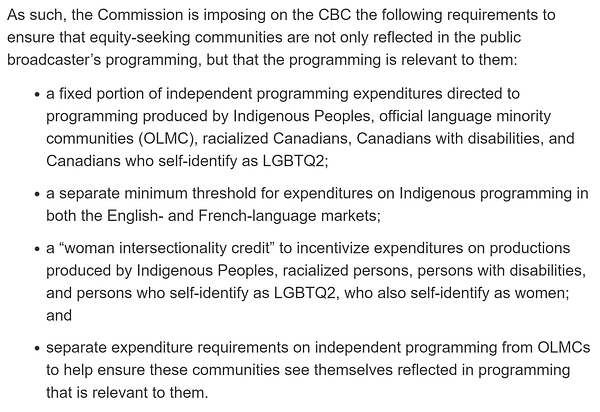
Jamie Sarkonak @sarkonakjThe CRTC @CRTCeng just imposed DEI requirements onto CBC programming. CBC must dedicate 30% of its independent programming budget to the following identity categories: Indigenous, language minorities, visible minorities, disabled, and LGBTQ. #cdnpoli crtc.gc.ca/eng/archive/20…
Image

We read through the renewal notice ourselves and, yeah, she is correct. The CBC has a vague public mandate to inform and entertain Canadians for the purpose of creating a kind of shared national identity. Implicit in this mandate is the notion that the public broadcaster ought to broadly reflect and represent the Canadians who pay its bills. To that end, although previously the CBC could certainly choose to devote resources to “Canada’s equity-seeking communities” (and it certainly has!) never before to our knowledge has it been required to devote specific expenditure requirements to those communities as part of its license renewal. 

From the ruling: 

“As such, the Commission is imposing on the CBC the following requirements to ensure that equity-seeking communities are not only reflected in the public broadcaster’s programming, but that the programming is relevant to them.”

The CRTC is demanding a “fixed portion of independent programming expenditures directed to official language minority communities (OLMC), racialized Canadians, Canadians with disabilities, and Canadians who self-identify as LGBTQ2.” Additionally, it will grant a: “‘woman intersectionality credit’ to incentivize expenditures on productions produced by Indigenous Peoples, racialized persons, persons with disabilities, and persons who self-identify as LGBTQ2, who also self-identify as women.”

There are additional requirements for French language programming, of course. 

This line also caught our attention from the notice: 

“The Commission supports the Government of Canada’s commitment to renewing the relationship with Indigenous Peoples, based on the recognition of rights, respect, co-operation and partnership. On a broader level, the Commission also recognizes that Call to Action 84 of the Truth and Reconciliation Commission and the United Nations Declaration on the Rights of Indigenous Peoples (UNDRIP) tie into some of the objectives of the Broadcasting Act in that they refer to the reflection of Indigenous Peoples in the programming broadcast by the CBC.” 

The CRTC is demanding changes to the election of the CBC ombudsman to ensure he or she is “sensitive to issues surrounding Indigenous people, racialized Canadians and other equity-seeking communities.” 

It is also setting out “new expectations regarding the CBC’s Journalistic Standards and Practices to help ensure that journalists can provide relevant feedback and equity-seeking communities are consulted in any future review of the JSP.” 

(The JSP is basically the bible of CBC journalism and guides its employees in how it approaches reporting, analysis and opinion. The JSP has come under particular scrutiny in recent years when it was alleged that the expectation of “objective” journalism would distort how the outlet approaches racism. Attentive readers will note the obvious allusion to “moral clarity” here.)

Whether or not you agree with the outcomes being sought, what is clear is that the CRTC (which is appointed by the governor general, on advice of the privy council) is having explicitly political goals written into its license renewals. 

Now, don’t misread us, here. The CBC ought to be free to pursue equity goals in programming, or reviews of its JSP, or whatever it feels necessary to meet its mandate according to its own discretion. We happen think these outcomes are best exercised by trusted leaders and experienced producers who have the latitude to use editorial discretion, rather than by rigid quota or expenditure goals. 

To have these demands placed on it by an external regulator in order to fulfil the political goals of that regulator and, ultimately, its political masters, is playing with fire in the worst kind of way. 

For starters, one of the first pieces we ran here at The Line was from a documentary filmmaker who noted the ways in which diversity quotas shifted incentives in filmmaking. Just as students write to the test, quotas of this sort shift the focus in content production, forcing creators to produce content that checks a box, rather than fulfil a real audience desire. This creates a CBC that is dooming itself to be less relevant to the general public even as its relevance is growing more crucial thanks to the economic collapse of private media. The system is all the more insulting considering there is, in fact, a real audience desire for different voices and perspectives in our media landscape. 

(The Line can think of two such examples of CBC shows that were compelling and worth watching regardless of their diversity requirements: check out Sort Of and Trickster if you haven’t already. Unfortunately, the latter was cancelled when it was revealed that director Michelle Latimer was not as Indigenous as previously stated.) 

The second most obvious problem with all of this falls under the maxim “Do not give your enemies the weapons they will use to kill you.” In other words, having established this norm, do you not think that Prime Minister Pierre Poilievre, having done his damndest to stack the CRTC, will not do the same thing in turn? What is the CBC going to do when its license renewal is subject not to fulfilling the requirements of UNDRIP, but rather to concepts like “viewpoint diversity” and “journalistic objectivity,” as defined by Poilievre’s crew? The pendulum always swings back, friends, and it usually swings back harder when pushed. 

Source: The Line Dispatch 13 August

Passport delays spur some Canadians to game the system with fake travel plans

Ongoing saga. Understandable that some would feel need to game the system or engage line-up placeholders:

Canadians are getting creative trying to cut the long waits for passports that have been dragging on for close to five months after a surge in post-pandemic travel demand overwhelmed the system.

By Aug. 11, a total of 1,092,560 passport applications had been filed this year – with more than 550,000 of those applications flooding in since April.

Service Canada said it’s prioritizing the applications of people traveling imminently, increasing staff and processing sites.

Despite all this, applicants say they are spending thousands of dollars to travel to less-busy passport offices — or even faking travel plans to speed the process to beat the 340,000-application backlog.

Federal officials say they are working to fix the problem.

Fake trips impact entire system

Karina Gould, the minister responsible for passport services, said Canadians are getting their passports on time, and there’s no need to “fake” travel — booking a flight you do not plan to take — to be eligible for Passport Canada’s urgent 48-hour approval mechanism.

“That impacts the whole system. There are a lot of people who did the right thing. They sent off their passports well in advance. Their applications are impacted by anyone who books fake travel,” Gould told CBC in a phone interview on Friday.

She had heard of the practice, but doubts it is widespread.

“I would be very disappointed to hear that, because that would be putting additional pressure on a system that is already pressured,” said Gould.

Meanwhile in Toronto, a man who CBC agreed to call Robert, said he has spent the past 59 days organizing 10 staffers to hold spots in lineups for about 500 absent passport applicants.

He said he has earned up to $1,000 per day offering this service.

No passport number needed to book many online flights

“Most of my customers book fake flights just to get their passports so they can drive across [the border],” said Robert.

“You’re going through more hoops to drive across [the border] than to fly. So what they do is just book a fake flight. It’s usually Toronto to New York or Toronto to Miami, and within 24 hours, they cancel it,” he said of his customers.

Multiple travel agents and Air Canada confirmed that many flights can be booked online without a passport number, and full-fare or business class ticket is often refundable.

Other travellers head to out-of-province Service Canada offices where the lines are not so long, with some citing shorter waits in Halifax or St. John’s.

St. John’s photographer Robert Young often gets called on for passport photos.

He said lately more travellers from other parts of Canada are utilizing the passport processing services in at Newfoundland.

“We’ve always gotten people from the edges of the world — like Pangnirtung (Baffin Island) — but now they are showing up from bigger cities,” said Young.

Government promises fix is working

Gould said lineups have decreased with the hiring of 500 new staffers, extended hours and the prioritizing of applicants with imminent travel plans, within 48 hours.

Back on July 25, Service Canada expanded passport pick-up services, adding five more locations in Ontario, Quebec, Alberta and B.C. to the 29 existing passport offices.

In Ontario and Quebec, a business has popped up to deal with the long waits for passport applications. Line standers charge about $40-$60 per hour or a flat fee of about $240 to line up at dawn and hold applicant’s place so they can apply to get a Canadian passport or renewal. (Roger Thompson)

This and other measures – like transferring application files to one of the 300 Service Canada offices upon request — aimed to reduce passport processing waits.

But many who mailed in applications last spring say the turnaround remains sluggish.

It’s difficult to get anybody on the phone or get an accurate status on an application, according to many applicants, including Paula Langley, a Canadian living in the U.S. who applied for a new passport in April.

Updates difficult to get

“The biggest problem is people being unable to get an answer about where in the process their passport is. I think the issue is partially technology. They are likely using outdated software. Other countries let you check your status in an online portal,” said Langley.

“It is very difficult to even get somebody on the phone to ask questions. The 1-800 number just cuts off after the queue of callers gets too high.”

On Passport Canada’s website, delivery is promised in 46 days or six and a half weeks. But anyone needing a passport within two business days can go to specialized sites offering urgent service, if they have proof of travel.

The government’s plan was to ease backlogs, but it’s given some a chance to jump the queue by booking and then cancelling travel.

Broken system

“It’s upsetting,” said Leanne MacLeod who runs Getaways by Leanne out of Toronto and offers passport advice online. What’s not helping, she said, is booking a “fake” trip that you cancel to get travel documents.

“I’ve seen people recommend booking a refundable hotel, then cancelling,” she said. “It’s really what’s holding up the whole process right now. For every person who gets ahead, one gets bumped.”

Taylor Bachrach, the New Democratic Party’s transport critic, said the fact that people are trying to work around the system is evidence it’s not working.

“It shows how frustrated people are and the lengths they are willing to go,” said Bachrach.

“If people are having to ‘game’ the system to get their documents, that shows how broken the system is.”

People in his Skeena Bulkley Valley constituency in Northern B.C. live a 12-hour drive from the nearest passport office.

Bachrach has one staffer who has spent the past several weeks devoted to helping constituents secure passports.

Family trips at risk

“I have a constituent whose family needed to travel to the United States, and we were able to work with the federal government to arrange for the passports to be picked up. But he had to incur $2,000 in extra travel costs to get from here in Smithers, B.C., all the way to Victoria to pick up the passports. … This obviously has a big impact on people.”

Bachrach said these months of passport chaos are “unacceptable.”

“The increased demand for passports was entirely predictable. But the Liberals failed to act even though they had months to prepare for travel to return.”

That lack of foresight has left many Canadians apprehensive, with only a few weeks of summer left. Joseph Ivens of Terrace, B.C., applied to renew his two teens’ passports back on April 4.

The family of five has saved for a trip to Mexico for four years. The flight is booked for Aug. 27, but the passports have not come.

Minister promises family passports are coming

The father of three said he’s made hundreds of calls, several requests for a file transfer and appealed to his member of parliament. He may be forced to travel to Calgary or Vancouver at the last minute to try to secure the travel documents so the holiday is not lost.

“It’s causing my family massive stress with loss of sleep. It’s breaking us,” said Ivens. “I have no recourse.”

Gould, the minister responsible for passport services, told CBC on Friday that Ivens will get travel documents on time.

“He will get his passport. I understand people are stressed, but everyone is getting their passport on time,” said Gould.

Source: Passport delays spur some Canadians to game the system with fake travel plans

McWhorter: The default should be to extend grace to those who’ve breached woke etiquette

Agree:

Paul Laurence Dunbar was perhaps the pre-eminent Black poet of the era after Reconstruction. In a new biography, the Princeton University English professor Gene Andrew Jarrett takes Dunbar’s rather glum, shortish life and pulls off a book that pulls you along like an open bag of potato chips; for the first 100 or so pages, I could barely put it down. But there’s one thing that jars like a wrong note every time it comes up: Dunbar regularly and casually referred to Black people of a lower social class than his with the N-word. An example: “I dressed at the hall dressing room in all clean linen, but had to send a [N-word] out for a standing collar because mine were all lay-downs.”

Sadly, this wasn’t atypical for more fortunate Black people of the era. Dunbar’s erudite and accomplished wife, Alice Dunbar Nelson, also used the word freely in their letters. The mother of the late-19th- and early-20th-century Black composer and conductor Will Marion Cook used the word in dismay at her classically trained son’s pursuing popular music with sometimes salty lyrics.

That kind of open classism — particularly when directed by middle- and upper-class Black people of the Victorian era toward working-class Black people — can be startling for contemporary readers. Today, for a well-heeled Black person to denigrate a less well-off Black person in this way would be deemed malicious at worst or elitist respectability politics at best.

Knowing this about Dunbar might sour someone’s opinion of him as an individual, but his use of the N-word and the sentiment behind it are unlikely to reduce his stature as a literary figure. And almost no one would consider this as grounds for a retroactive reckoning, reconsideration or, yes, cancellation of the kind to which the legacies of various historical figures are now subject. If for no other reason, then probably because his is a case of intra-Black offense being given.

One can quibble about what being canceled really means; the answer probably lies somewhere between Woodrow Wilson’s name being removed from Princeton’s public policy school and Gina Carano being dropped from the cast of “The Mandalorian.” But with Dunbar, it’s hard to imagine anyone kicking up much dust or writing, let’s say, a think-piece asking us to affix his condescension toward fellow Black people to him like a Homeric epithet, nullifying or adulterating his intellectual contributions.

That’s a good thing. We should be able to evaluate various figures, past and present, by noting their indecorous or hateful views and continuing to appreciate, even celebrate, their achievements without making them candidates for cancellation. And Dunbar’s case gets me thinking about people with less immediately dismissible stains on their records for whom the almost recreational hostility of cancel culture has held off.

Being Black and a woman seems to discourage the mob, for example. And my point, to be very clear, isn’t that Black women wrongly benefit from some kind of special pleading. It’s that, on the contrary, the forbearance that’s been extended to a number of prominent Black women in recent times should be the norm.

The Pulitzer Prize-winning novelist Alice Walker has produced writing and made statements that are readily interpreted as antisemitic, and while there have been a few protests and disinvitations and criticism aplenty, no real movement has arisen to demand that her artistic achievements be viewed through this prism. As The Atlantic’s Caitlin Flanagan argued, Walker has been treated rather “gently” about this issue, specifically in a New Yorker article written this past spring, whereas few could imagine similarly gentle treatment of J.K. Rowling for views many interpret as transphobic. Flanagan notes that in contrast, in 2020 The New Yorker asked, about another literary figure, “How Racist Was Flannery O’Connor?”

A few weeks after apologizing for her anti-Israel “Benjamins” tweet in 2019, Representative Ilhan Omar of Minnesota got the chance, in the pages of The Washington Post, to clarify her stance on the Israel-Palestinian conflict and remains a hero to many on the political left; this week, she won her Democratic primary.

In 2015 the actress Phylicia Rashad said of her former co-star Bill Cosby’s accusers, “Forget these women.” Last year, when Cosby’s sexual assault conviction was overturned, she tweeted, “FINALLY!!!!” before deleting it, tweeting a walk-back and apologizing to the Howard University community. She remains the dean of Howard’s college of fine arts.

The MSNBC host Joy Reid was revealed to have written homophobic blog posts in the aughts, and her later attempts to explain them away weren’t terribly convincing. This blotted her record, but after a brief outcry, her career as a progressive oracle on prime-time TV remains intact.

Contrast Reid’s situation to the Emmy-winning actress Roseanne Barr being fired from the sitcom she starred in because of a racially demeaning tweet about the former White House adviser Valerie Jarrett. Try to imagine a white male university official getting so smooth a ride as Rashad after caping for Cosby. Ponder the stock response of Democratic voters to a white male member of Congress accused of antisemitism.

Is there a sense on the left — where it seems the canceling impulse is strongest — that Black women should get more of a pass on transgressions of social justice etiquette because of the double burden of being female and Black? I’m not sure.

But whatever our verdict on that, I am sure that this measure of forbearance should be the default for public or historical figures. Of course, it’s fair, maybe necessary in some instances, to chastise these figures. Of course, sometimes there will be transgressions so widely condemned that the transgressors are irredeemable. But most of the time, emphasizing people’s contributions despite their flaws — seeing them in totality and not boiling down their lives to their specific missteps — is just civilized rationality. The idea that an isolated breach of social justice etiquette should derail a career is calisthenic. So when we see that happening, we should hesitate and, in most cases, root for outcomes where people get criticized, perhaps, for their wrongthink but not shoved out of the public square.

I recommend Walker’s “The Temple of My Familiar,” a book that left me ashamed of being a man and yet wanting to read it again. Reid’s career as a broadcaster outweighs any parochial views about gay people she now disavows. I’d happily see Rashad in acting roles forever, despite my disappointment in her take on Cosby. I, frankly, wouldn’t vote for Omar but accept that voters in her district see things differently.

We know, certainly, there are situations where people other than Black women have avoided cancellation. Dave Chappelle comes to mind. My point, again, is that some degree of grace is called for in most cases — for the college professor who says something impolitic in class and the historical figure whose words are appalling now but were consistent with his times.

We need to rethink the entire practice of treating unpretty sentiments as if they summed up anyone’s life or work, whether you’re talking about a political titan or a contemporary celebrity. That Thomas Jefferson was an enslaver and thought of Black people as inferior is a sad aspect of his totality, and his hypocrisy on race should be noted. But it doesn’t negate all else he accomplished, including drafting the Declaration of Independence, a document that guides and governs our very way of life.

Back to O’Connor and the racism that has caused some to reconsider her work. Yes, she used the N-word freely in letters and wrote, “About the Negroes, the kind I don’t like is the philosophizing prophesying pontificating kind, the James Baldwin kind. Very ignorant but never silent.” It reflects a bigotry and a parochialism not unlike Dunbar’s. (And she’s just wrong about Baldwin.) But that doesn’t dilute the brilliance or literary value of a story such as her “Parker’s Back.” And it won’t work to claim that the difference between O’Connor and Dunbar is that his objectionable remarks were intra-Black. By today’s woke standards, wouldn’t classism tinged with racism be an intersectional double whammy? If there’s room to look beyond his flaws, O’Connor should get the same treatment.

One more: The biologist E.O. Wilson, who died last year, faced accusations of racism, a charge that continues to be explored. One article describes an epistolary cordiality with the Canadian psychologist J. Philippe Rushton, who had openly racist views about Black people. In one such letter, Wilson reportedly praised Rushton’s paper arguing that “Black and non-Black people pursue different reproductive strategies.” That’s far from ideal, but even less ideal is any sense that this aspect of Wilson must be ongoingly considered amid our assessment of his pioneering genius. I was knocked out by his book “Consilience: The Unity of Knowledge,” about the progress of our understanding of the world, and considering how he may have felt about Black people would have been quite irrelevant to the experience.

Whether we’re talking about the past or the present, the idea that being insufficiently progressive or sensitive can wind up being the measure of a person’s worth is a call to disavow intelligent assessment in favor of gut-level impulses. It’s an all-or-nothing kind of thinking that, in the guise of insight, teaches a form of dimness. We seem to spontaneously understand this in some instances. We need to extend that basic common sense, that basic ability to make distinctions and see the whole picture, when evaluating trespasses by people of all walks of life and across time.

Source: The default should be to extend grace to those who’ve breached woke etiquette

How a Quebec student’s hijab became the target of a political and cultural storm

Groundhog Day…

The photograph on the Montreal business school’s website was intended to demonstrate a young woman’s possibility and her academic success.

“A rewarding international presence,” reads the blurb beside the photo, written in a black font to match the black cloth hijab wrapped around the head and neck of the woman’s smiling face.

There is not much more that would stand out as unusual in the promotional image of the Algerian exchange student at the HEC Montréal — an image the school uses to tout its international programs, a deep and important revenue stream for the institution, as it is for most other Canadian universities.

But when Jean-François Lisée, a prominent Quebec academic, writer and former politician, viewed the image last weekend, he saw it not as a ploy by a public institution in search of private funds.

Instead, the former leader of the sovereigntist Parti Québécois flared at what he took to be a breach of the secular codes that Quebec governments have been trying to establish over the past two decades to separate religion and the state.

Those efforts culminated in 2019 with the passage into law of Bill 21, which enshrines state secularism, mainly by banning public-sector workers from wearing items of religious clothing or decoration, including crucifixes, turbans and hijabs, while at work.

“University students can display their convictions, religious or not,” Lisée wrote on Twitter. “But for a public institution that is by definition secular, pro-science and pro-gender equality to normalize a misogynistic religious sign in an ad is unacceptable.”

The rebuke from a man who has straddled Quebec’s media and political realms for more than 40 years cast the province back into a fraught debate that it cannot seem to resolve.

Increasingly present in the form of turbans, hijabs and kippahs, at least in part due to immigration patterns in the province, many of Quebec’s white, francophone majority would apparently prefer that religion be neither seen nor heard from in the public sphere.

But each instance of religion rearing its head, reigniting the debate over the place of religious expression in a secular society, is like a freshly formed scab over a cut that is pulled away, exposing the wound to the sting of fresh air.

Kimberley Manning calls them “moments of punctuation” that revive the frequently noxious debate that, in her opinion, risks revictimizing religious minorities in Quebec.

“They contribute to and exacerbate an ever-present experience of not being fully Quebeckers,” says the associate professor of political science at Montreal’s Concordia University. “This is what seems to be coming through in the polling and the research.”

Manning has done her own work, notably a March study of students that found feelings of discrimination that respondents linked to the province’s secularism law.

A more extensive study of Bill 21’s impacts in Quebec, released this week, contends that the law has created a frightening, oppressive and grim environment for religious minorities.

In surveys, Jews, Sikhs and Muslims reported a deterioration in their likelihood to participate in social and political life in the province, in their sense of personal safety, and in their confidence for future prospects.

“(The law) promises all kinds of very noble values, and when we measured those up against the results in the study, we see that it doesn’t achieve those values of neutrality, equality and social harmony,” says Miriam Taylor, director of publications and partnerships with the Association of Canadian Studies.

What the law — most any law — does do is normalize and concretize the biases which underpin it, Taylor says.

Survey respondents said they had experienced a rise in verbal abuse, threats and physical confrontations since the law was adopted.

This jibes with anecdotal evidence and a general sense of uncertainty and anxiety in Quebec’s Muslim communities, says Lina El Bakir, Quebec Advocacy Officer for the National Council of Canadian Muslims.

“When you set out a law that is discriminatory, you allow that to permeate society and people’s views,” she says.

“It affects mental health, it affects security, it affects the ability to just be, you know?”

Lisée, who declined an interview request, said in his criticisms that his beef was not with the Algerian exchange student in the hijab, but with the business school.

The website content in question does not breach any aspects of the provincial law, but he said it sends a message to young Algerians standing up to the pressure of imams and fundamentalists that the school “is not your ally.”

An HEC Montréal spokesperson says the only goal of the image was to show off the diversity of its student body, which includes 3,746 international students from 142 countries. The image will come down from the site next week — not because of Lisée’s indignation but because that’s when its previously scheduled two-week publication run ends.

That may come as a relief to the student, who came to Montreal to obtain a business degree and now finds herself in a debate that is part polisci, part sociology — one that has been going on so long that at least part of it belongs to the annals of history.

Speaking to La Presse columnist Rima Elkouri, the 22-year-old, who declined the Star’s interview request, explained she was initially nervous about coming to study in Canada. She had heard about the killing of four members of the Afzaal family of London, Ont., who were run down by the driver of a pickup truck on June 6, 2021, in what police allege was a hate-motivated attack.

But, Nouha, who was identified only by her first name, said she quickly warmed to her new home in Montreal.

“I have never suffered from discrimination or a lack of respect,” she told the Montreal newspaper.

She said that wearing the hijab was a personal decision, not one forced upon her by her family, though she acknowledged the women who have no choice in the matter.

“I’m against that,” she said, adding that she considers herself a feminist.

“I’ve never found (the hijab) to be a symbol that diminishes the value of a woman. Personally, I consider myself to be a very strong woman. In a few years, I’ll be managing a team of workers. I can’t afford to see myself as a weak person.”

She also said she acknowledges and understands the principles of secularism in Quebec.

“I understand that the school must be truly neutral. But from my point of view, it’s also important to display people from minority groups because those minorities look for a place where they feel at peace.”

The issues on display are not going away.

Before the end of the month, Quebec will be into a provincial election campaign and parties have often fallen back on identity issues to stir up the passions of their voters.

Taylor said she worried about the negative consequences of a campaign in which religion and secularism, majority views and minority rights were “instrumentalized for political gain.”

Before the end of the year, Quebec’s court of appeal is expected to hear a legal challenge to Bill 21. And in Ottawa, Justin Trudeau’s Liberal government has already promised to challenge the provincial secularism law at the Supreme Court.

Taylor’s study found that support for the law among Quebeckers would drop considerably if the Supreme Court ruled that it violated the Constitution.

This bolsters El Bakir’s contention that Quebeckers, like other Canadians, value human rights, despise discrimination and strive for equality.

But she reverts to her native French, and invokes the most Quebecois of expressions, to explain that an older segment of the Quebec population support secularism because they remember when the Catholic Church exerted strict control over all aspects of the province —from schools to hospitals to politics to family life.

“It doesn’t take the head of Papineau!” she says, in reference to Louis-Joseph Papineau, a leader of the rebel Patriote movement in 19th century Lower Canada who was reputed for his intelligence.

“I do understand where older generations are coming from, however societies evolve and we need to understand that realities do change, and one narrative doesn’t always apply.”

Source: How a Quebec student’s hijab became the target of a political and cultural storm

The Darkness Down Under: Australia Still Reckons With Racism [Indigenous focus]

Surprised Canada not used also as a comparison as parallels and differences more comparable:

Uluru—a monumental, cathedral-like rock that stands alone in the western deserts of Central Australia—may seem an unlikely place from which to reflect on the scourge of violence against Black Americans that stains the U.S. body-politic today. But understanding the consequences of one event that happened far away in 1934 is a powerful reminder that the struggle to make Black lives matter and counter white supremacist violence transcends national boundaries.

In June 1931, Constable Bill McKinnon arrived in Alice Springs to take up his appointment as a police officer in central Australia. He was barely thirty—lean, brash, and tough—a no-nonsense raconteur with a sharp tongue and unyielding determination.

In 1934, after chasing down six Aboriginal men for the killing of an Aboriginal man that had taken place under tribal law, he cornered one man in a cave and shot and killed him at Uluru, a place that has long been sacred for the Anangu, its traditional owners, and is now spiritually significant for the entire nation.

Source: The Darkness Down Under: Australia Still Reckons With Racism

Attack on Salman Rushdie prompts Canadians to highlight author’s relentless fight for free speech

As someone posted to Iran when the fatwa was issued, and as a fan of his writing, this attack strikes close to home along with the importance of free speech. We will see if some in Canada defend or excuse the indefensible:

Canadian writers, publishers and literary figures doubled down on the right to freedom of thought and expression on Saturday, one day after an attack in the U.S. on award-winning author Salman Rushdie that has left him on a ventilator in hospital.

Rushdie, whose novel The Satanic Verses drew death threats from Iran’s leaders in the 1980s, was stabbed in the neck and abdomen Friday by a man who rushed the stage as the author was about to give a lecture in western New York.

Louise Dennys, executive vice-president and publisher of Penguin Random House Canada, has published and edited Rushdie’s writings for over 30 years. She condemned the attack on her longtime friend and colleague as “cowardly” and “reprehensible in every way.”

“He is without doubt one of the greatest proponents of freedom of thought and speech, and debate and discussion in the world today,” Dennys said in a telephone interview. “I have hopes of his recovery. He’s a great warrior and fighter, and I hope he is fighting back.”

Rushdie, 75, a native of India who has lived in Britain and the U.S., is known for his surreal and satirical prose style

The Satanic Verses drew death threats after it was published in 1988, with many Muslims regarding as blasphemy a dream sequence based on the life of the Prophet Muhammad, among other objections. Rushdie’s book had already been banned and burned in India, Pakistan and elsewhere before Iran’s Grand Ayatollah Ruhollah Khomeini issued a 1989 fatwa, or edict, calling for Rushdie’s death.

A 24-year-old man is in custody, facing charges in Friday’s attack. The accused was born a decade after the publication of The Satanic Verses. Police said the motive was unclear. Investigators were working to determine whether anyone else could be linked to the incident.

After the publication of The Satanic Verses, often-violent protests erupted across the Muslim world against Rushdie. At least 45 people were killed in riots over the book, including 12 people in Rushdie’s hometown of Mumbai. In 1991, a Japanese translator of the book was stabbed to death and an Italian translator survived a knife attack. In 1993, the book’s Norwegian publisher was shot three times and survived.

The death threats prompted Rushdie to go into hiding under a British government protection program, though he cautiously resumed public appearances after nine years of seclusion, maintaining his outspoken criticism of religious extremism overall.

‘He couldn’t be silenced by fear’

“We all depend on the storytelling, power and imagination of writers,” Dennys said. Rushdie “came out of hiding because he realized he wanted to play a role in the world we live in, defending those rights, she said.

“He couldn’t be silenced by fear, and I think that point is something he will continue to make if, as we all hope, he survives.”

Dennys said the attack is already having the opposite effect of its suspected intentions given the outpouring of support from the international literary community, as well as activists and government officials, who cited Rushdie’s courage for his longtime free speech advocacy despite risks to his own safety.

“It’s brought everyone together to realize how precious and fragile our freedoms are and how important it is to speak up for them,” Dennys said.

The president of PEN Canada, an organization that defends authors’ freedom of expression, condemned the “savage attack” on their “friend and colleague,” Rushdie, who is a member.

Canadian writer John Ralston Saul, who has known Rushdie since the 1990s, said the author was always aware that someone might attack him, but he chose to live publicly in order to speak out against those trying to silence free expression and debate.

“[Rushdie’s] work and whole life are a reminder of what the life of the public writer is in reality,” he said. “This would be the worst possible time to give in or show any sense that we must be more careful with our words. We’re not really writers if we give in to that kind of threat.”

The accused, Hadi Matar, was arrested after the attack at the Chautauqua Institution, a non-profit education and retreat centre. Matar’s lawyer entered a not guilty plea in a New York court on Saturday to charges of attempted murder and assault.

After the attack, some longtime visitors to the centre questioned why there wasn’t tighter security for the event, given the threats against Rushdie and a bounty on his head offering more than $3 million to anyone who killed him.

Saul, who spoke at the Chautauqua Institution years before Rushdie’s attack, said it has an “open tradition” of debate, free expression and anti-violence going back over 100 years.

“It’s one of the freest places to take advantage of our belief in freedom,” he said.

Witnesses to the attack on Salman Rushdie Friday in western New York recount how a man approached the stage at the Chautauqua Institution where the author was about to give a lecture, attacked him and was later pinned down by people from the audience.

Roland Gulliver, director of the Toronto International Festival of Authors, tweeted Saturday that literary festivals and book events are “spaces of expression, to tell your stories in friendship, safety and respect.”

“To see this so violently broken is incredibly shocking,” he wrote.

Expressions of sympathy came from the political realm as well, with Canadian Prime Minister Justin Trudeau condemning the attack as a “cowardly … strike against freedom of expression.”

“No one should be threatened or harmed on the basis of what they have written,” read a statement posted to Trudeau’s official Twitter account. “I’m wishing him a speedy recovery.”

Rushdie suffered a damaged liver and severed nerves in his arm, and is likely to lose an eye as a result of the attack, the author’s agent, Andrew Wylie, said Friday evening.

A physician who witnessed the attack and was among those who rushed to help described Rushdie’s wounds as “serious but recoverable.”

Source: Attack on Salman Rushdie prompts Canadians to highlight author’s relentless fight for free speech

Douglas Todd: People of Indian descent a rising force in the U.S. and Canada

While the understandable focus is with respect to those of Indian descent holding leadership and senior positions, there is a larger group of workers in such industries as agriculture and trucking. From a political perspective, the outsized influence of Sikh and other Indo-Canadians reflects their geographic concentration: 47 ridings in Canada have 10 percent or more South Asian residents (2016 Census).

List: VM Ridings South Asian 10 percent

India is on the rise across the United States and Canada — in education, high-tech and politics.

The CEOs of five of the most powerful high-tech companies in North America have origins in India. They’re heading Microsoft, Google, IBM, Twitter and Match Group (which owns Tinder).And people of Indian ancestry are punching above their weight in politics in the U.S. and Canada. “There may well be an Indian-American president before there is an American Indian one,” says The Economist.

The educational achievements of people of Indian origin are above the norm in North America. And their are among the strongest of any ethnic group in the U.S. and Canada. This is not to mention one study showing people of Indian origin are almost four times more likely to own a home than the average Canadian.

India is the second highest source country for immigrants to the U.S., where 4.6 million have Indian origins, or 1.4 per cent of the total. They are mostly from southern India and tend to live in the U.S. South and East.

In Canada, India is the No. 1 source country for immigrants by far, accounting for 30 per cent of all newcomers since 2016.

There are 1.4 million people with Indian roots in Canada, most of whom are immigrants. They make up four per cent of the population. Generally from Northern India, most live in Toronto, Vancouver, Calgary and Edmonton.

Even though many are already flying high in U.S. high-tech, the impact of people of Indian background on Canadian business, especially, is growing sharply.

The influence of Indo North Americans is destined to expand further. Let’s look at why.

The tech sectors in Toronto, Montreal and Vancouver are expanding on the strength of a workforce where two of five are foreign born. And U.S. immigration rules designed to protect homegrown workers means our southern neighbour is losing thousands of Indian high-tech experts and others to Canada.

With the U.S. restricting its coveted H-1B working visa (including with a rule that no one country can be the source of more than seven per cent of recipients), many computer specialists are among the more than 217,000 people from Indian who can work in Canada as foreign students (they make up 30 per cent of all international students).

Canada also accepted 128,000 people from India last year as new immigrants, many of them programmers. And it’s on track for a similar number in 2022. That compares to just 39,000 immigrants from India in 2015, when Justin Trudeau’s Liberals were first elected.

Such business success is made possible in large part because educational levels soar among those of Indian descent.

In the U.S. three of four of adults of Indian background have bachelors degrees or better, according to Pew Research. That’s the highest of any Asian immigrant group, with Chinese Americans coming in at 57 per cent. The overall bachelor’s degree average in the U.S. is 38 per cent.

In Canada, educational achievement is also pronounced. A recent Statistics Canada study by Theresa Qiu and Grant Schellenberg found 50 per cent of South Asian-Canadians (mostly from India) had bachelors degrees or more. The portion rose to 62 per cent among South Asian women.

The portion of bachelors degrees among Canadians with origins in South Asia is much higher than the 24 per cent for white men and 38 per cent for white women, as well as the 17 per cent for Latin American men and 28 per cent for Latin American women. One of the few ethnic groups scoring higher than South Asians are Chinese Canadians.

And wages reflect education levels. The median household income in the U.S. of Indian households is by far the highest of any ethnic-Asian group, at US$119,000, according to Pew.

The typical Chinese American household brings in US$82,000. The median household income across the U.S. is US$67,000.

While U.S. figures on housing are not readily available, a consumer survey by Vivintel, based in Toronto, found that South Asians, a solid majority of whom are from India, are almost four times more likely to buy a homethan the average Canadian.

“Home ownership is very important to South Asians … because they’re told by their parents that renting is just throwing away your money,” says Rahul Sethi, a 38-year-old director of Vivintel who immigrated to Canada from India with his family.

One of the most intriguing aspects of the rise of Indians in North America is their oversized affect on politics.And it’s not just because of U.S. vice-president Kamala Harris, who went to an English-language high school in Montreal after her scientist mother from India, Shyamala Gopalan Harris, got a job researching breast cancer at McGill University.

Even though Harris is a front-runner as a future Democrat presidential nominee, she’s far from alone in U.S. halls of power.

Karthick Ramakrishnan, who surveys Asian American attitudes from the University of California, maintains Indo Americans are far likelier than other immigrant groups to get involved in politics as donors, voters and candidates. They tend to favour Democrats by a margin of three to one.

Ram Villivalam, a state senator in Illinois, says having Harris running to be president gives confidence to Indo Americans. Pramala Jayapal, the first woman of South Asian descent to preside over the Congress, is now one of four influential Indo American politicians, dubbed the Samosa Caucus, in the House.

A similar movement is happening in Canadian politics.

The Indo Canadian population, like the Indo American, leans liberal-left. More than 38 per cent of respondents to a 2021 YouGov poll would cast a vote for the Liberals — twice the number that planned to go with the Conservatives.

One in five backed the left-wing New Democratic Party, the country’s third largest party, which has been lead for five years by Indo Canadian Jagmeet Singh.

More than 12 per cent of cabinet ministers in the Liberal government of Prime Minister Justin Trudeau are Indo Canadian, including Harjit Sajjan and Anita Anand. At least 14 Liberal MPs are Indo Canadian.

This impact list goes on in politics, as well as in business and education. Indo North Americans are on a roll.

Source: Douglas Todd: People of Indian descent a rising force in the U.S. and Canada

Douglas Todd: SFU prof targeted by China for groundbreaking Uyghur research

Not surprising but not acceptable:
SFU professor Darren Byler has been frequently attacked by China’s state media, which accuses him of being an agent of the U.S. government. Something he denies.
During four groundbreaking expeditions into China, the latest in 2018, Byler has witnessed many colleagues and research subjects disappear into the mass “re-education” camps and forced labour factories endured by more than 1.5 million Uyghur Muslims.

The author of In the Camps: Life in China’s High-Tech Penal Colony, was interviewed during a downtown Vancouver conference about the clampdown in Xinjiang. It was attended by 60 people, including Uyghur Canadians, international students from China, Muslim academics and activists.

Participants at the Simon Fraser University event required Postmedia’s commitment to protect their identities, so their families would not be harassed or threatened by police in China. There are about 400 ethnic Uyghurs in Metro Vancouver, the largest group of any Canadian city.

China’s authoritarian leaders are engaged in a planetary campaign to challenge and intimidate anyone who points to the incarceration, mass surveillance and draconian clampdown of the Uyghurs, which the Canadian government has called a “genocide.”

The Global Times, a tabloid newspaper arm of the Chinese Communist Party, has accused Byler of being an “anti-China figure” who makes “fabricated” allegations about “genocide and crimes against humanity” in the Xinjiang region of western China, which is inhabited by about 11 million Uyghur Muslims. The professor is sure China’s agents have attended his classes.

Byler has been with Uyghur people on the streets of China when police have stopped them, taken their mobile phones and demanded, “What is the password for your phone?” A specialist in high-tech surveillance, he says China uses 9,000 police surveillance hubs to routinely search personal data for evidence of resistance and what they consider a dangerous commitment to Islam.

Facial recognition technology is widely used in Xinjiang. Byler has first-hand knowledge of Uyghur students who have studied in North America being detained in China after omnipresent cameras found them walking outside their confinement. Families are often broken up when a Uyghur whom authorities deem suspicious is sent to a work camp, many of which produce textile goods for the West. The U.S. and Canada have laws banning such goods, but many argue they’re ineffective.

A prolific author and widely cited scholar, Byler, 40, is among the Western researchers who argue that China’s Han ethnic majority has in the past decade been escalating a colonialistic internal effort to smear the Uyghur people and systematically erase their Indigenous culture and faith. Chinese authorities often label the Uyghurs as “separatists” and “terrorists,” as well as lazy and slow.

One frequent tactic of the state-controlled Global Times is to try to silence Canadian criticism of the treatment of Uyghurs by condemning this country’s residential-school system for Indigenous children, which the federal government began in 1881 and for the most part ended by the 1970s.

This month, The Global Times enthusiastically reported on Pope Francisrecently referring to Canada’s attempt to assimilate First Nations through residential schools as “a genocide,” even while the Truth and Reconciliation Commission has referred to it as “cultural genocide.”

The Global Times article cited how Canada’s Inquiry into Missing and Murdered Indigenous Women and Girls also called it a “genocide,” while reporting that last year “more than 1,100 unmarked graves have been discovered at former residential school sites.” Canadian media outlets now largely refer to them as “suspected” graves.

The Global Times and China’s diplomats are making a clear attempt to claim, “You in the West have no right to criticize us, because look what you did to Indigenous people,” Byler said. “They’re kind of saying, ‘You did it. So we are doing it, too.’”

While Byler believes Canada’s residential-school system was a colonialistic attempt at assimilation, he notes the Truth and Reconciliation Commission has formalized a decades-long process of restitution in Canada, unlike in Australia and the U.S. And definitely unlike 21st-century China.

During the several years that Byler, a German American who is now a permanent resident of Canada, has spent living among Uyghur people in Xinjiang, he came to realize how outward-looking and sophisticated they were before China accelerated efforts to wipe out their culture.

One of many of his research papers that is drawing global attention explores how Uyghurs had been keenly taking courses from 2004 to 2014 in the English language, with students developing a special interest in novels about totalitarianism, like Animal Farm and 1984 by George Orwell.

Han Chinese prejudices often portray Uyghurs as “backward,” so the language students especially devoured books about Black Americans like Malcolm X, Muhammad Ali and Barack Obama. The paper, co-written with an unnamed Stanford professor, reveals the Uyghur valued learning about a society in which members of a minority could hold power.

But the English-language schools were shut, and teachers Byler knew were detained, after a 2014 visit by President Xi Jinping.

Even though most attendees at the SFU conference demanded anonymity, Byler introduced one local Uyghur who was willing to be interviewed because he has already gone public as an activist. Now a high-school science teacher in Surrey, Kabir Qurban came to Canada with his family from Afghanistan as a refugee.

Since he has become a high-profile activist in Canada, including with his own websites, Qurban said that sometimes he has attended Uyghur events, such as weddings, where attendees have asked that he not sit at the same table with them.

In this era of facial recognition technology, the Uyghur Canadians fear Chinese authorities could catch them together in a photo with the staunch critic of China. That could easily lead to a brother, sister, mother or father back in Xinjiang getting harassed by police. Or worse.

“It’s unfortunate,” Qurban said, “but I have to respect their stance.”

Source: Douglas Todd: SFU prof targeted by China for groundbreaking Uyghur research

Nicolas: Les mythes et réalités de la loi 21

Good analysis and observations regarding this ACS/Leger study (see earlier New research shows Bill 21 having ‘devastating’ impact on religious minorities in Quebec [particularly Muslim women]):

Pendant qu’on débat pour la millionième fois sur le port du hidjab au Québec — cette semaine à cause de réactions à une publicité de HEC Montréal —, une nouvelle étude sur la Loi sur la laïcité de l’État vient d’être publiée.

Produite par l’Association des études canadiennes, en collaboration avec SurveyMonkey et la firme de sondage Léger, cette étude a été menée auprès de 1828 adultes québécois, dont 632 musulmans, 165 juifs et 54 sikhs. Léger a utilisé les données de Statistique Canada pour que l’échantillon sondé soit représentatif de la population étudiée.

L’étude confirme que la majorité de la population (63,7 %) appuie la « loi 21 ». Ce chiffre tombe à 60 % si on inclut l’option « je ne sais pas », et à 57 % si l’on spécifie « telle qu’elle s’applique aux enseignants ».

Mais l’étude innove en comparant les arguments souvent entendus pour défendre la Loi sur la laïcité de l’État avec les données amassées. L’effet de contraste est saisissant.

D’abord, on avance souvent que la « loi 21 » est « neutre » — c’est-à-dire qu’elle ne vise aucune religion en particulier — et que ses appuis ne sont pas liés à une animosité particulière envers une religion ou une autre. Or, l’étude calcule que 75 % des partisans convaincus du texte législatif ont une opinion négative de l’islam ; 66 % du sikhisme ; 49 % du judaïsme ; 36,5 % du christianisme.

Il se dégage donc ici, selon la chercheuse principale de l’étude, Miriam Taylor, une « hiérarchie de négativité » envers les religions particulièrement marquée.

Parallèlement, la proportion des opposants convaincus à la Loi sur la laïcité de l’État qui ont une opinion négative de ces quatre mêmes religions oscille entre 18 % et 20 %, sans conviction que certaines valent mieux que d’autres.

Ensuite, on dit souvent que les appuis à « loi 21 » sont motivés par une méfiance particulière envers la religion en général ; l’étude a par conséquent voulu mesurer si les personnes elles-mêmes peu religieuses étaient plus nombreuses à soutenir cette législation. Or, on n’a trouvé aucun lien majeur entre la religiosité des répondants et leur appui ou opposition à la loi. Même qu’au contraire, les Québécois qui s’identifient comme catholiques seraient « légèrement plus favorables » à la loi que ceux qui se disent athées.

Fossé hommes-femmes

Par ailleurs, on entend souvent que la Loi sur la laïcité de l’État québécois est profondément féministe, et que c’est au nom de l’égalité hommes-femmes qu’elle a été mise en avant. L’enquête s’est donc intéressée à l’écart dans les appuis à la loi selon le genre.

On a calculé que 68,5 % des hommes et 59 % des femmes au Québec appuieraient la loi, un écart de près de 10 points de pourcentage. Chez les plus jeunes, l’écart est encore plus marqué : 51,7 % des hommes de 18 à 24 ans appuient la loi, alors que seulement 31,5 % de leurs consoeurs font de même. Seules les femmes de 75 ans et plus sont plus favorables à la loi que les hommes de leur groupe d’âge.

L’étude avance également que les femmes québécoises sont plus nombreuses à trouver que « la loi est discriminatoire envers les femmes », que les femmes sont « plus touchées » par cette mesure législative, et que la loi « divise les Québécois ». Les femmes seraient aussi moins nombreuses à trouver que les Québécois qui s’opposent à la Loi sur la laïcité de l’État sont « déloyaux » et à souhaiter qu’une personne qui ne s’y conforme pas perde son emploi.

Existe-t-il une seule autre politique publique dite « féministe » moins appuyée par les femmes que par les hommes ? Ou serait-ce que, dans ce cas-ci, les femmes savent moins bien discerner que les hommes ce qui est bon pour elles ?

Vivre-ensemble

De plus, on répète souvent que la « loi 21 » exprime une volonté collective, et donc que les tribunaux ne devraient pas se « mêler » des décisions de l’Assemblée nationale sur la question.

Pourtant, 64,5 % des Québécois sondés croient qu’il serait important « que la Cour suprême émette un avis sur la question de savoir si la loi 21 est discriminatoire », et seuls 46,7 % des répondants continueraient à l’appuyer si les tribunaux « confirment » qu’elle « viole les chartes des droits et libertés ». On parlerait donc ici d’une chute de 18 points de pourcentage dans les appuis en cas d’une décision négative des tribunaux sur la question.

Finalement, la Loi sur la laïcité de l’État est souvent présentée comme un outil favorisant l’harmonie sociale et le vivre-ensemble.

Or, en sondant spécifiquement les Québécois musulmans, juifs et sikhs, l’étude a trouvé qu’une majorité dans les trois groupes rapporte « un déclin dans leur sentiment d’acceptation en tant que membres à part entière de la société québécoise » depuis l’adoption du texte législatif. Quelque 64 % des femmes musulmanes, 67 % des hommes sikhs et 87,5 % des femmes sikhs qui ont participé à l’étude ont dit avoir senti leur capacité à participer à la vie sociale et politique du Québec se détériorer depuis 2019. Et 67 % des femmes musulmanes, 50 % des hommes juifs et 67 % hommes sikhs ont aussi déclaré avoir été exposés à des incidents et à des crimes haineux.

Cette portion de l’étude inclut d’ailleurs des témoignages qui donnent froid dans le dos. Bien qu’il s’agisse de la plus vaste enquête sur cette question conduite auprès des minorités religieuses québécoises depuis l’adoption de la loi, l’échantillon total reste modeste.

Espérons que d’autres recherches encore plus ambitieuses seront mises en avant pour faire la lumière sur ces enjeux cruciaux.

Source: Les mythes et réalités de la loi 21

New research shows Bill 21 having ‘devastating’ impact on religious minorities in Quebec [particularly Muslim women]

Would be interesting to see the breakdown between Montreal and the rest of Quebec, where immigration is low as is the number of visible and religious minorities:

New research shows that three years after Quebec’s secularism law — commonly known as Bill 21 — was adopted, religious minorities in the province are feeling increasingly alienated and hopeless.  

“Religious minority communities are encountering — at levels that are disturbing — a reflection of disdain, hate, mistrust and aggression,” Miriam Taylor, lead researcher and the director of publications and partnerships at the Association for Canadian Studies, told CBC in an interview.

“We even saw threats and physical violence,” Taylor said.

Bill 21, which passed in 2019, bars public school teachers, police officers, judges and government lawyers, among other civil servants in positions of authority, from wearing religious symbols — such as hijabs, crucifixes or turbans — while at work.

Taylor and her colleagues at the association worked with polling firm Leger to gather a unique portrait of attitudes toward Bill 21 in Quebec.

The association surveyed members of certain religious minority communities including 632 Muslims, 165 Jews and 56 Sikhs.

Those results were folded into a Leger survey of the Quebec population as whole, and then weighted to ensure the sample was representative of the entire population.

That allowed Taylor to compare and contrast the attitudes toward Bill 21 of Quebecers who are religious minorities with the attitudes of Quebecers as a whole.

In total 1,828 people were questioned in the online survey.

Taylor shared an advance copy of her final report, which is being released today, with CBC.

Muslim women most affected

Although all three religious minority groups surveyed said they’ve experienced negative impacts due to Bill 21, the effects are being most acutely felt by Muslims and, in particular, Muslim women.

“We saw severe social stigmatisation of Muslim women, marginalization of Muslim women and very disturbing declines in their sense of well-being, their ability to fulfil their aspirations, sense of safety, but also hope for the future,”  Taylor said.

Of the Muslim women surveyed, 78 per cent said their feeling of being accepted as a full-fledged member of Quebec society had worsened over the last three years.

Fifty-three per cent said they’d heard prejudicial remarks about Muslims from family, friends or colleagues.

People surveyed were given the opportunity to share examples of comments they’d heard or behaviours they’d experienced.

One reported hearing: ”These Muslim women with rags on their heads, if they are not able to integrate, let them return to their country.”

Forty-seven per cent of Muslim women said they’d been treated unfairly by a person in a position of authority. 

One person reported being called a “dirty immigrant” by a police officer in Quebec City.  Another reported that a teacher told disparaging anecdotes about Islam in class.

Two thirds of Muslim women said they’d been a victim of and/or a witness to a hate crime. Seventy-three per cent said their feeling of being safe in public had worsened.

Taylor found that nearly three quarters of Muslim women surveyed felt their comfort about safety in public had worsened in the three years since Bill 21 was adopted. (Association for Canadian Studies)

People surveyed offered examples ranging from racist remarks to death threats, having hijabs ripped off and being spat on. One person reported that a man deliberately tried to run over them and their three-year-old daughter with a pickup truck.

A majority of Muslims also reported feeling less hopeful, less free to express themselves in public and less likely to participate in social and political life.

“For a law that’s supposed to be very moderate and only touch a very small number of people, we were shocked at the responses,” Taylor said.

She said the response she found most upsetting was that 83 per cent of Muslim women surveyed said their confidence in their children’s future had worsened since Bill 21 passed.

Taylor said the figure that most upset her was the lack of hope Quebec Muslims have for their children’s future. (Association for Canadian Studies)

“It’s one thing to say: ‘you know what, I’m experiencing a lot of unfair treatment because I’m not understood,'” Taylor said. “It’s another thing to project forward and have no hope for your children.”

Law reinforces existing prejudices

Taylor believes Bill 21 alone isn’t responsible for the feelings of alienation and insecurity Quebec Muslims and other religious minorities feel.

She said prejudicial attitudes have been gestating in Quebec for nearly 20 years, when the debate over so-called “reasonable accommodations” for religious minorities first took hold.

“Malaise, fear and anxieties get provoked over time,” Taylor said.

She said often those anxieties are based on ignorance.

“By their own admission, Quebecers in general have very little contact with members of religious minorities,” Taylor said. “All of these negative opinions are based on lack of knowledge.”

Taylor said Bill 21 has enabled those prejudices — rooted in ignorance — to become the norm.

“We end up with a situation where the malaise of the observer trumps the deep convictions of the person actually wearing the religious symbols,” Taylor said.

“We’re validating and reinforcing those opinions, and then we’re politicizing the symbols. Those symbols are lightning rods,” she said.

“And so we end up dehumanizing the people wearing the symbols,” Taylor said.

Women generally less supportive of Bill 21

Taylor said that Bill 21 has consistently maintained the support of about two thirds of Quebecers since it was adopted, with a dip last January after the high-profile case of a hijab-wearing teacher in Chelsea who was removed from the classroom and reassigned.

But she said that support is nuanced and full of contradictions.

Women in Quebec, for example, are generally less supportive of Bill 21 than men. Sixty-eight per cent of men support the law compared to 58 per cent of women.

Taylor said the research showed that women, and in particular young women, are less supportive of Bill 21 than men. (Association for Canadian Studies)

And the younger women are, the less likely they are to support the law.  Just 31 per cent of women aged 18-24 support Bill 21.

Taylor said that raised questions for her.

“It’s touted as a feminist law by the people who support it. So why is it that particularly the younger women of Quebec are so much less in favour of it when one would expect the reverse proportion?” she said.

Support for the law but not for enforcement

Another statistic that surprised Taylor: even Quebecers who support the law don’t necessarily want to see it enforced.

Only 40 per cent of people surveyed believe a public servant who does not comply with the law should lose their job. 

“The law is supported and liked by Quebecers. But they seem much less keen to see it actually applied,” Taylor said.

“I think that we’re a human society and we care about people. We all need income to survive and I think people are aware of what a heavy price that would be to pay,” she said.

Quebecers care about what courts say about Bill 21

Taylor was also surprised that the survey showed that Quebecers care deeply about what courts have to say about Bill 21.

When drafting the law, the Quebec government, recognizing that it would likely violate both the Canadian and the Quebec charters of rights, pre-emptively invoked the constitutional notwithstanding clause, and altered the Quebec charter to try to shut down court challenges.

But those challenges came anyway, and now both the government and groups that oppose the bill are challenging a 2021 Quebec Superior Court ruling that upheld most of the law before the Quebec Court of Appeal.

It’s widely expected the law will eventually be challenged in the Supreme Court of Canada.

The bill’s architect, Justice Minister Simon Jolin-Barrette, has argued that it’s up to elected politicians in the National Assembly — and not the courts — to decide how they want to organize relations between the state and religion.

But Quebecers seem to feel differently.

Sixty-four per cent, roughly the same percentage that support the bill, also feel it’s important for the Supreme Court to issue an opinion on whether Bill 21 is discriminatory.

And if the courts were to confirm the law is discriminatory, support for the bill would plummet.

Only 46 per cent of people surveyed — less than half — said they would continue to support the law if the courts confirmed it violates the Charter of Rights.

Debate not over

Jolin-Barrette has portrayed Quebecers as united in support of the bill, and has accused detractors of trying to divide Quebecers.

But Taylor’s survey shows that a majority of Quebecers — 56 per cent — believe the law itself is divisive.

When Bill 21 was adopted, Jolin-Barrette said it would “permit a harmonious transition toward secularism” for Quebec.

Taylor said that clearly hasn’t been the case.

“The debate is very far from closed,” she said. “Bill 21 is having devastating impacts on citizens in our province. It’s tearing apart our social fabric and I think it’s undermining our democracy.”

“If national unity is achieved at the expense of labelling minorities as in some way harmful or a threat, these are signs of the degeneration of democracy,” she said. 

Taylor said as a Quebecer, she finds this distressing.

“We live in a very distinct province. We’re different. It’s an experiment that on some level should never have succeeded: a thriving French society on an English continent,” she said.

“In all my years, I associate that distinct nature with a humanity, with understanding how important identity is,” Taylor said.

She said Bill 21 threatens that.

“I feel like we’re doing major harm to those values that we hold dear and that make us special,” Taylor said.

Source: New research shows Bill 21 having ‘devastating’ impact on religious minorities in Quebec