China operating ‘police’ station out of Vancouver, civil rights group alleges

More allegations:

A Spanish civil rights group says it has uncovered two new secret “police” stations being operated in Canada, including one in Vancouver.

Safeguard Defenders has published a report revealing the existence of 48 Chinese “police service stations” being operated overseas, in addition to the 54 stations the group initially reported on in September.

The not-for-profit human rights group has documented a total of 102 stations in 53 countries.

Usher: A First Look At 2021 Education Census Data

Good analysis of census data by HESA:

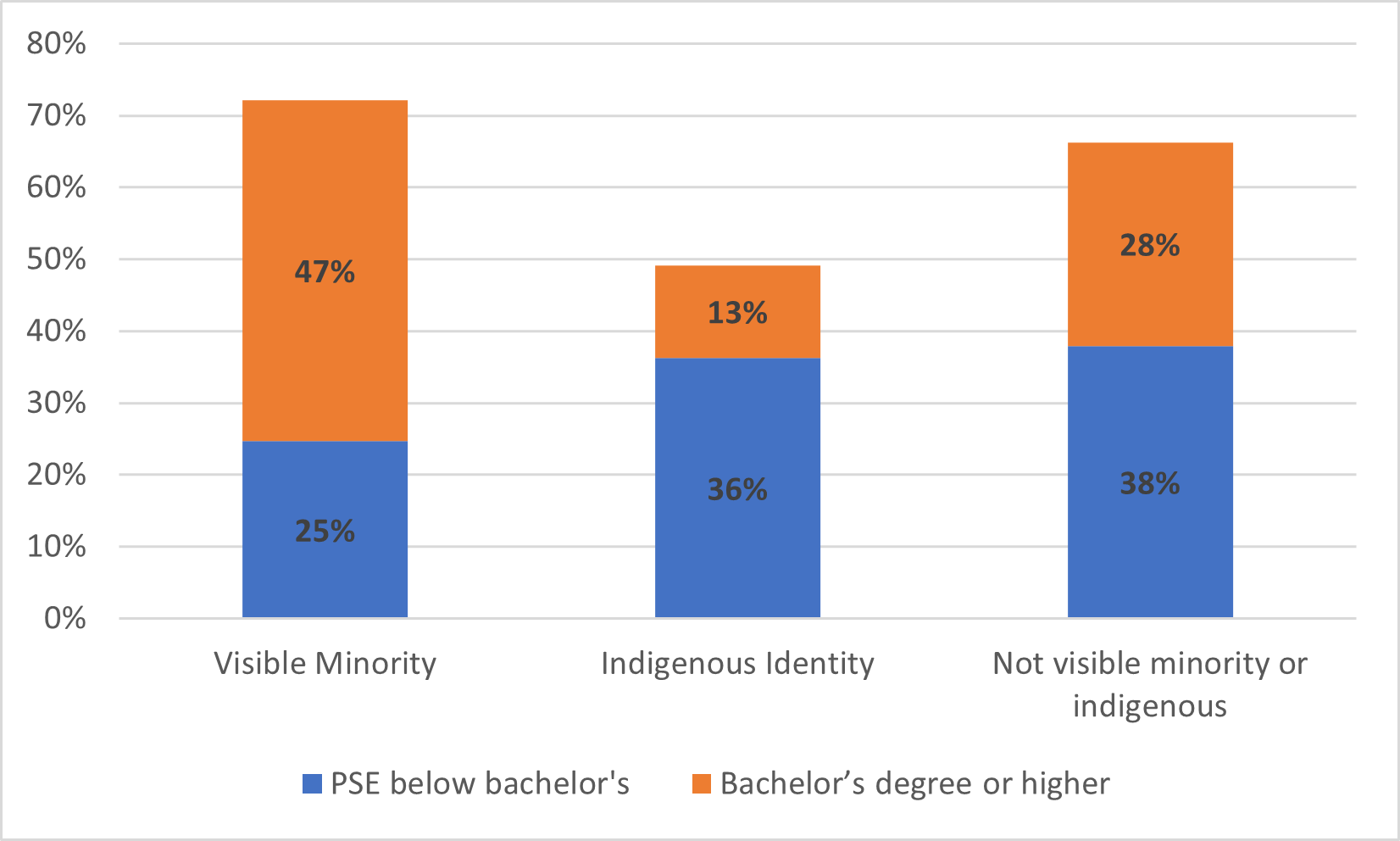
Figure 1 shows the attainment rates of the population aged 25-64, by visible minority status and Indigenous identity.    What it shows is that there are some quite fascinating differences in attainment rates across different segments of the population.   Individuals who self-declare as visible minorities are somewhat less likely than other Canadian to have a PSE credential below the bachelor’s level but substantially more likely to have a degree at the bachelor’s level or above.  Those reporting Indigenous identity, meanwhile, have college credentials at higher levels similar to those of non-visible minority/non-Indigenous Canadians, but university attainment rates substantially  lower than those of other Canadians.  White Canadians have higher college attainment rates than visible minorities, but substantially lower university attainment rates. 

Figure 1: Post-Secondary Education Attainment by Level, Visible Minority Status and Indigenous Identity, Canadians Aged 25-64, Census 2021

Stacked bars showing that visible minorities have the highest rate of bachelor degree or above attainment.

This is, by the way, quite different from the situation in basically any other developed country except perhaps Australia and New Zealand; in most other countries with large scale immigration, visible minority populations tend to have much lower levels of education that the mainstream population.

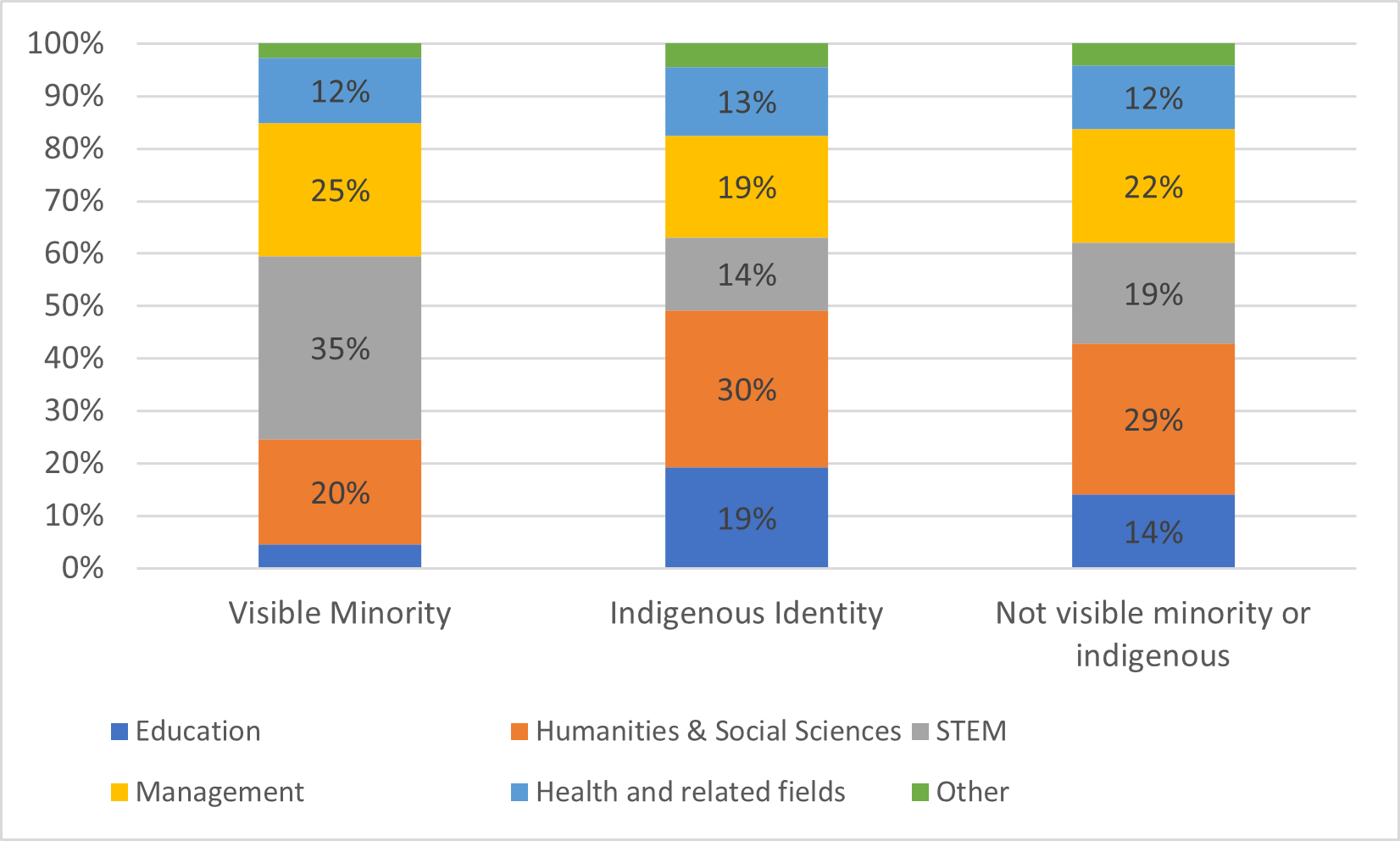
One of the interesting things about this census is that it permits analysis not just by level of education but also by field of study.  Figure 2 runs the same analysis as figure 1, only examining the distribution of undergraduate degrees.  Again, we see some interesting distributions by visible minority/Indigenous identity.  The proportions of Canadians of various backgrounds who are in the fields of health and business are relatively consistent, but there are huge differences in the areas of education, social sciences/humanities and STEM.  For those with Indigenous identities, 45% of all degrees are in education, humanities and social sciences, while only 14% of all degrees are in STEM; among visible minorities (who, recall, are more than 3 times as likely to have a degree as those with Indigenous identity), it is 25% in education, humanities and social sciences and 35% in STEM.

Figure 2: Distribution of Degrees by Broad Field, Visible Minority Status and Indigenous Identity, Canadians Aged 25-64, Census 2021

Stacked bar charts showing percentage of people with education, humanities, SETM, management, health, or Other degrees

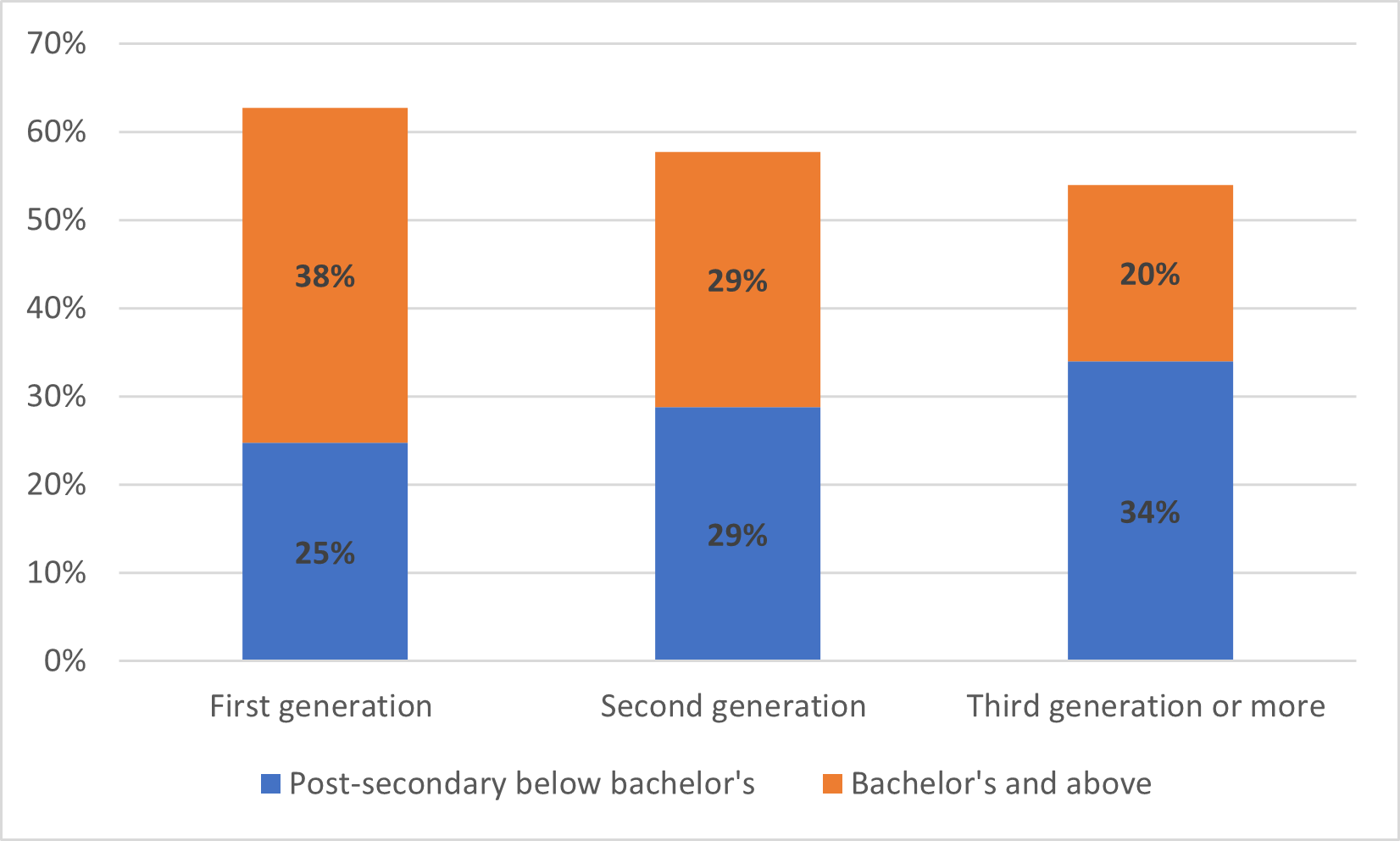
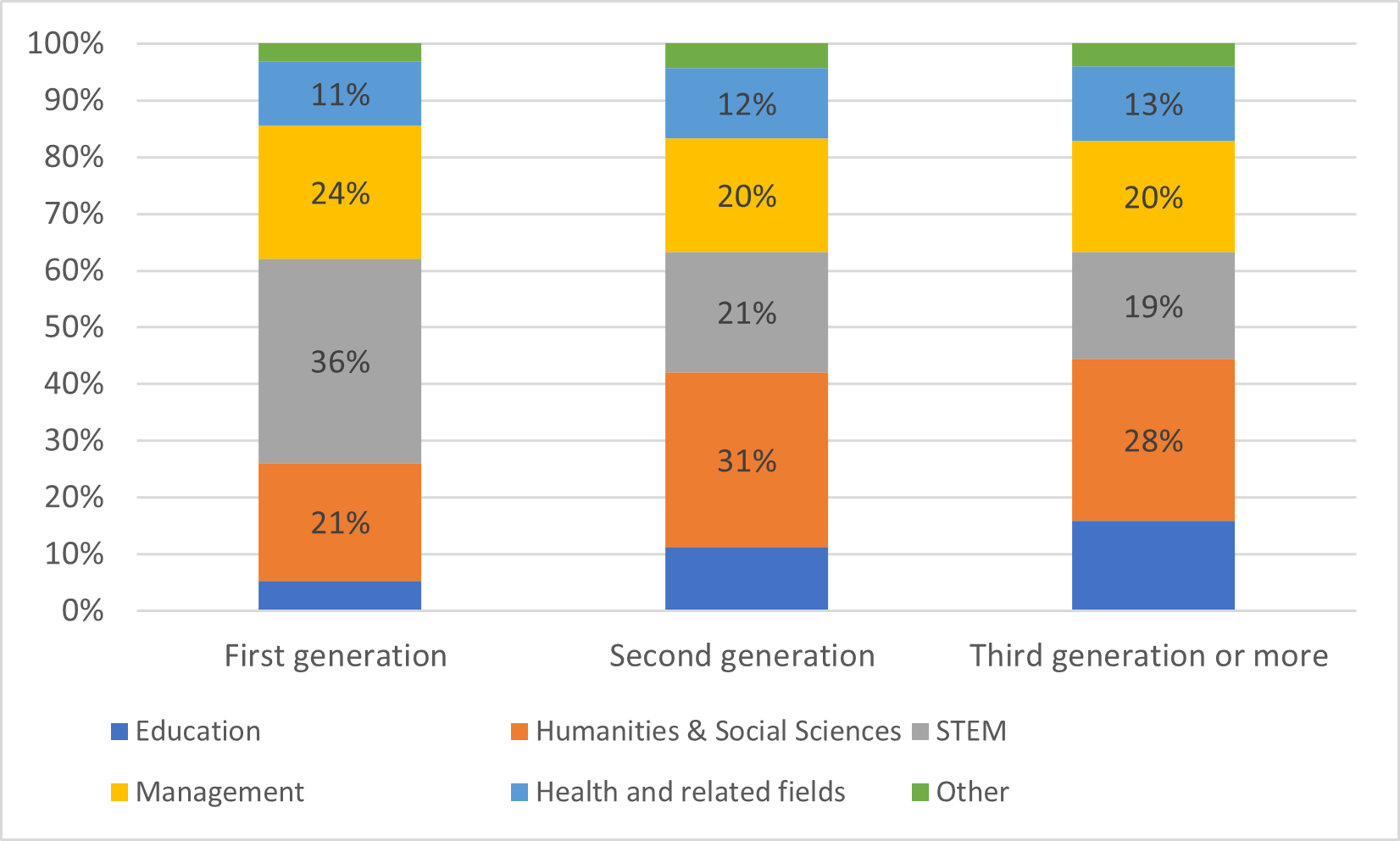
We can run the same kind of analyses by immigration status.  In figures 3 and 4, we repeat the analysis in figures 1 and 2, only by immigration status.  Statistics Canada divides Canadians into “first generation” (basically, individuals born outside Canada), “second generation” (at least one parent born outside Canada) and “third generation or more” (both parents born in Canada).  That second category is – if you ask me – a heck of a hodge-podge, so focus on the difference between first and third generations. 

Figure 3: Post-Secondary Education Attainment by Level and Immigration Generation, Canadians Aged 25-64, Census 2021

Stacked bars showing that "Third generation" people have the lowest percentage of bachelor attainments.

Figure 4: Distribution of Degrees by Broad Field and by Immigration Generation, Canadians Aged 25-64 Census 2021

Stacked bars showing that "Third generation" people have more humanities and social science degrees and "first generation" people have more STEM degrees.

There’s an old (American) cliche about how the first generation of immigrant families works hard in menial jobs to make sure their kids get ahead, the second generation works hard to get into professional schools and attract great wealth while the third generation goes to art school.  By the looks of it, Canada’s points-based immigration system allows us to skip that first generation thus bringing immigrants into humanities and arts programs that much faster.

Source: A First Look At 2021 Education Census Data

Csernyik: Canada’s overly educated work force is nothing to be proud of

Of note. Valid points on the imbalance, most of the labour pressures are in trades and service jobs:

Several months after receiving my second bachelor’s degree, I found myself working behind an espresso machine once again. When I graduated from high school in 2004, postsecondary education was presented as the ticket to high salaries and trappings of middle-class life such as home ownership.

Instead, my generation graduated from university into a global recession, followed by rising home and living costs and the global COVID-19 pandemic. The conventional wisdom was thrown on its head. Today, with the exception of certain professions, higher education guarantees little to workers.

This week, Statistics Canada released 2021 census results that show our nation has the G7′s most educated work force, with 57.5 per cent of Canadians aged 25 to 64 possessing college or university credentials. The number of workers with a bachelor’s degree or higher has increased by nearly one-fifth since the 2016 census, largely due to highly-credentialed recent immigrants.

While Statscan acknowledges some of this education may be underused, the milestone is presented as a feat worth celebrating. But in our current economic climate, especially when some industries suffer from outsized vacancies – the spinoff effects felt broadly by Canadians – it feels like a vanity metric.

Statscan notes this level of educated workers helps Canada meet labour market needs today and will do so in the future, and that it’s “essential to maintaining our standard of living as a country.” But shortfalls in certain job categories – including those that don’t require postsecondary education – are impacting that standard of living in tangible ways.

Reduced business hours and slower service due to a lack of staff in retail and food service businesses have been problems since the pandemic started, and show no sign of waning. Accommodation and food services, one of the leading job vacancy categories, continues to struggle to fill positions despite help wanted signs blanketing communities across the country.

This is also true in industries such as construction, which lack enough skilled tradespeople to fill roles and are necessary for building new housing and infrastructure. Working-age holders of apprenticeship certificates in fields such as repair technologies and construction and mechanical trades have “stagnated or fallen,” according to Statscan’s findings.

It’s notable that low-wage customer service work and skilled trades, despite their importance to our economy, are still given short shrift in political and public discussion. This leads to little advancement on critical issues such as wages, which can explain, at least in part, why these positions are tough to fill now. But these positions are frequently – and incorrectly – seen as roles people only do if they haven’t gone to university, as though they are jobs of last resort.

Slightly less than 25 per cent of minimum-wage employees had a postsecondary diploma or higher in 1998, but by 2018 that was slightly more than one in three. Having worked in these roles with postsecondary credentials, I’ve been one of these people and have worked with many others. Critically, some of the new immigrants contributing to this mismatch are underemployed – including in minimum-wage jobs. Statscan even acknowledges “the educational qualifications of some foreign-educated workers being underused.”

My first-hand experience has also shown me how little attention is paid to working conditions, wages and other concerns of sub-white-collar-workers in Canada. Yet people not wanting these jobs is often categorized as a failure on the part of workers, rather than a systemic one.

It feels like an offshoot of the credentialism that has been rampant in North American society for years. This has led to headline-making grade inflation in high schools, which has students entering postsecondary programs with puffed-up marks. Then, once at university, there’s a mismatch between classes and programs available and what’s needed in the work force.

Skills gaps are high in all industries – an average of 56.1 per cent of employees are not proficient enough to do their job, according to Statscan. But the gaps surge to nearly 80 per cent in accommodation and food services, and 67.8 per cent in retail trade, two categories that employ millions of Canadians, but which are often left out of the skills and training discussion in favour of more white-collar pursuits such as computer science.

For many workers in this country, the earnings power education is supposed to create isn’t the case. That’s why attention should be turned to what can be done in fields such as retail, food services and skilled trades in order to fill the positions that help keep our country running. This involves everything from living wages, to housing affordability initiatives – so workers can afford to live in the communities where they work – to shedding societal stigmas about these careers.

As COVID-19 recedes, there’s an opportunity to review our perspective on credentialism and, more critically, a need. Metrics such as being the most educated work force look good on paper. But as labour shortages disrupt day-to-day Canadian life, those metrics feel hollow and, at worst, like a distraction from finding solutions for increasing employment in industries that don’t get enough thoughtful care and consideration from policy makers and the public.

Let’s get these sorted out instead of throwing our caps in the air.

Rob Csernyik is a freelance journalist who is writing a book about minimum-wage work.

Source: Canada’s overly educated work force is nothing to be proud of

McWhorter: Harvard, Herschel Walker and ‘Tokenism’

Valid observations on tokenism:

We are at a moment in which tokenism is on trial. This is true both in terms of the Supreme Court’s consideration of affirmative action in higher education and in terms of the candidacy of the former running back and political airhead Herschel Walker, who will become a U.S. senator from Georgia if he wins his runoff against Senator Raphael Warnock next Tuesday.

Remember how common the term “token Black” once was? Back in the day — the phrase really took off in the 1960s — tokenism was considered a prime example of racism. The hipper television shows would offer story lines in which Black people were put into jobs for which they were transparently unqualified just so the company could show a little color.

I learned the term “token” in 1975 at the age of 9. An episode of the Black sitcom “Good Times” had the teenager Thelma recruited by an elite private school sorority solely because she was Black. A white sorority sister visited the household to chat Thelma up. But after Thelma’s father saw through the ruse, the white woman dismissively referred to Black people as “B’s.” My mother told me that Thelma was being used as a “token Black.” She liked me to know about such things.

It was normal that a Black mom would teach her kid such things back then. But you don’t hear the terms “token Black” and “tokenism” as much as you used to. (Yes, “South Park” had a character named Token — now spelled Tolkien — as late as the 1990s. But part of the joke was how antique the term had already become.) The term has a whiff of the ’70s about it, and it went out of fashion because, frankly, today’s left cherishes a form of tokenism.

Our theoretically enlightened idea these days is that using skin color as a major, and often decisive, factor in job hiring and school admissions is to be on the side of the angels. We euphemize this as being about the value of diverseness and people’s life experiences. This happened when we — by which I mean specifically but not exclusively Black people — shifted from demanding that we be allowed to show our best to demanding that the standards be changed for us.

I witnessed signs of that transition when racial preferences in admissions were banned at the University of California in the late 1990s. I was a new professor at U.C. Berkeley at the time, and at first, I opposed the ban as well, out of a sense that to be a proper Black person is to embrace affirmative action with no real questions. I’m not as reflexively contrarian as many suppose.

There was a massive attempt at pushback against the ban among faculty members and administrators, and I attended many meetings of this kind. I’ll never forget venturing during one of them that if the idea was that even middle-class Black students should be admitted despite lower grades and test scores, then we needed to explain clearly why, rather than simply making speeches about inclusiveness and openness and diversity as if the issues of grades and test scores were irrelevant.

I was naïve back then. I thought that people fighting the ban actually had such explanations. I didn’t realize that I had done the equivalent of blowing on a sousaphone in the middle of a bar mitzvah. There was an awkward silence. Then a guy of a certain age with a history of political activism said that in the 1960s and ’70s he was, make no mistake, staunchly against tokenism. And then he added … nothing. He went straight back to rhetoric about resegregation, laced with the fiction that racial preferences at Berkeley were going mostly to poor kids from inner-city neighborhoods. It was one of many demonstrations I was to see of a tacit notion that for Black kids, it’s wrong to measure excellence with just grades and scores because, well … they contribute to diversity?

When the Supreme Court outlaws affirmative action in higher education admissions, as it almost certainly will, it will eliminate a decades-long program of tokenism. I’ve written that I support socioeconomic preferences and that I understand why racial ones were necessary for a generation or so. But for those who have a hard time getting past the idea that it’s eternally unfair to subject nonwhite students to equal competition unless they are from Asia, I suggest a mental exercise: Whenever you think or talk about racial preferences, substitute “racial tokenism.”

At the same time, Republicans, despite generally deriding affirmative action and tokenism as leftist sins, are reveling in tokenism in supporting Walker’s run for Senate and are actually pretending to take him seriously. But to revile lowering standards on the basis of race requires reviling Walker’s very candidacy; to have an instinctive revulsion against tokenism requires the same.

There’s no point in my listing Walker’s copious ethical lapses. Terrible people can occasionally be good leaders. With him, the principal issue is his utter lack of qualification for the office. Walker in the Senate would be like Buddy Hackett in the United Nations. It is true that Republicans have also offered some less than admirably qualified white people for high office. But George W. Bush was one thing, with his “working hard to put food on your family.” Walker’s smilingly sheepish third-grade nonsense in response to even basic questions about the issues of the day is another.

And it matters that Walker would have been much, much less likely to be encouraged to run for senator in, say, Colorado. In Georgia, it was the clear intent that he would peel Black votes from his Black rival, Warnock. Walker’s color was central to his elevation. A swivel-tongued galoot who was white would not likely have been chosen as the Republicans’ answer to Warnock.

But if Bush, like Walker and others, implies a questioning of standards — here, the idea that a high-placed politician be decently informed — is that so very different from those on the left questioning why we concern ourselves overly with grades and test scores in determining college admissions?

Yes, there are times when one needs to question the rules regarding traditional qualifications. But the Georgia runoff isn’t one of them. The last thing Black people — who are often assumed to be less smart — need is for anyone to insist that Walker is a legitimate candidate because, say, Representative Marjorie Taylor Greene isn’t the most curious or coherent sort, either.

White Republicans have elevated a Black man to a position for which he is cartoonishly unfit. They have done so in spite of, rather than because of, the content not only of his character but also of his mind. Walker is essentially being treated the way Thelma was in that “Good Times” episode almost 50 years ago.

The past was better in some ways. The prevalence of the term “token Black” from the 1960s to the ’80s was one of them. And I promise — although I shouldn’t have to — that this does not mean I think Black America was better off in 1960.

But when Black students submitting dossiers of a certain level are all but guaranteed admission to elite schools despite the fact that the same dossiers from white or Asian students would barely get them a sniff, they are being treated, in a way, like Walker. The left sings of life experience and diversity, while the right crows about authenticity and connection. I hear all of them, intentionally or not, thinking about “the B’s.”

Source: Harvard, Herschel Walker and ‘Tokenism’

Khan: The downfall of Quebec’s Bill 21 could come thanks to women

We will see:

The notwithstanding clause of the Canadian Charter is no longer an obscure legal term. Thanks to Ontario Premier Doug Ford’s recent use of Section 33 to prevent job action by education workers – he has invoked the clause, or threatened to do so, three times in four years – ordinary Canadians now know that their basic human rights can be suspended at any time. We aren’t talking about emergency measures here, nor are we discussing reasonable limits through democratic mechanisms; ours is the only constitutional democracy that potentially allows for the gutting of basic rights in the name of what a parliamentary majority deems a matter of governance.

Who could have foreseen the consequences of this clause?

Well, Canadian women, for one.

When the Charter was being drafted, women demanded equality rights – but they were derided at committee hearings for doing so. In 1980, Senator Harry Hays derisively countered by suggesting special rights for babies and children, since “all you girls will be out working and we’re not going to have anybody to look after them.” A year later, more than 1,300 women descended on Parliament Hill to assert equality rights in the Constitution, by affirming Section 15 on general equality and proposing Section 28, on gender equality rights.

Initially, the notwithstanding clause could have been used on Section 28, too. But women fought for its exclusion, having had the foresight to ensure that gender equality rights could not be denied by the potential whims of future governments. We owe them a great deal.

And yet, today, we see the Constitution’s notwithstanding clause leading to disproportionate damage to Muslim women in Quebec.

François Legault’s government has pre-emptively used the notwithstanding clause twice since 2019, to ensure the passage of two bills. One of them, Bill 21, bans some public-sector workers from wearing religious symbols, but lawyers have provided evidence at the Quebec Court of Appeal – which heard a legal challenge to the bill this month – that only Muslim women who wear the hijab have lost their jobs as a result of it.

Indeed, Quebec’s religious minorities have felt increased alienation and despair in recent years, according to the Association for Canadian Studies. Its survey found that the situation is particularly dire for Muslim women: 73 per cent of them said they’ve felt less safe in public since 2019, while 83 per cent said their confidence in their children’s future has worsened.

The Quebec government touted Bill 21 as a “feminist” law, but it has only reinforced prejudices, and given license to bigots. I know this firsthand: During a visit to Montreal, I was berated by a middle-aged francophone Uber driver for wearing the hijab. At the end of the ride, he asked me not to file a complaint. (Of course, I did the opposite.)

This all illustrates Bill 21′s egregious violation of Section 28 of the Charter – namely, that the law disproportionately affects women, and thus violates gender equality. Since the notwithstanding clause cannot override Section 28, Bill 21 could be seen by the courts as invalid – an argument that University of New Brunswick law professor Kerri Froc raised years ago, and is now gaining traction.

Quebec Muslim women are not wilting. They have protested alongside allies who believe in a Quebec where all individuals can thrive. Take, for example, Institut F, a Montreal-based organization that seeks to ensure Muslim women’s personal agency. Its programs provide resources so that each woman knows that she belongs, her voice matters and she is a valued member of society – even if the Quebec government thinks otherwise. At a recent Institut event, I met talented Muslim women in STEM fields such as artificial intelligence, biotechnology and data science – talent that Quebec needs to remain economically competitive. Yet, many of those women expressed doubts about thriving in a society that overtly discriminates against religious minorities.

Something may have to give on this front, too. The labour shortage is so acute in Quebec that the town of Hérouxville – infamous for issuing a code of conduct for immigrants warning them not to stone or burn women alive – is now actively courting newcomers. Today, neighbouring towns are helping migrants find halal food. Economic reality will force the realization that attracting workers means making all feel welcome – not just a select few.

Bill 21’s damage has been done – abetted by the notwithstanding clause. The women who fought to exclude Section 28 from the clause knew its dangers. As Canadians, we must continue that fight to guarantee basic rights for all, be they religious and linguistic minorities in Quebec, education workers in Ontario, or anyone threatened by the notwithstanding clause.

Source: The downfall of Quebec’s Bill 21 could come thanks to women

Barbaud: Abolissons l’écriture « inclusive »

Overwrought worries on inclusive language, even if excesses occur. Language usage evolves, and French is no exception. Remember in my high school days when debate was over he/she rather than just he:

La récente publication sur le Web des Lignes directrices de l’écriture inclusive par le Bureau de la traduction du gouvernement fédéral donne à lire un document comportant plusieurs dizaines de pages d’instructions et se revendiquant de six grands principes « qui devraient guider l’application des différents procédés d’écriture inclusive ». Ne nous y trompons pas : le ton est directif, à preuve l’emploi répété de l’infinitif injonctif, par exemple, « Respecter les préférences des personnes concernées ». L’objectif inavoué est le reformatage en profondeur de la culture et de la conscience collectives de la population francophone du Canada, entre autres, pour qu’elle se plie aux exigences des minorités qui désormais nous gouvernent. Une acculturation à l’envers de la majorité, en quelque sorte.

Or surtout, n’allez pas croire que l’écriture inclusive se veut une réforme de l’orthographe. Celle-ci est souhaitable, sans être vraiment nécessaire, mais celle-là est une véritable manipulation des esprits. Autant la féminisation des noms de métier et des titres, par exemple, s’avère conforme à nos valeurs d’égalité et de démocratie, autant l’intrusion de la diversité dans le code écrit relève d’une démarche totalitaire qui vous enjoint de communiquer pour qu’une « personne se sente respectée ». Mais de quoi je me mêle ? J’ai le droit de respecter qui je veux et je ne suis pas responsable de la sensibilité des autres. J’en suis le seul juge et je l’assume.
 
À cette offensive idéologique du multiculturalisme canadien se joint le volumineux document contenant les directives, plus nuancées, faut-il admettre, de l’Office québécois de la langue française. Celui-ci s’articule en quatre volets : rédaction épicène, formulation neutre, rédaction non binaire et écriture inclusive. Le moindre qu’on puisse dire, c’est que ces organismes officiels mettent le paquet pour parvenir à leurs fins. Au lieu de simplifier l’enseignement du français et de le rendre plus attrayant, ces documents gouvernementaux sont « toxiques » parce qu’ils ne feront qu’empoisonner la vie des enseignants et de nos élèves en rendant cette matière scolaire encore plus rébarbative qu’on le dit.

Au fond, ces deux entreprises ne font que perpétuer le même esprit de normativité que celui qui était dévolu à l’Académie française, fondée en 1634 et si décriée par certains (et certaines, cela va de soi) « réformistes » d’aujourd’hui. La différence de contexte est pourtant énorme. Au début du XVIIe siècle, la langue française du pouvoir royal visait à rallier la diversité dialectale de la France en la dotant d’une langue commune qui n’existait toujours pas malgré l’ordonnance de Villers-Cotterêts proclamée presque cent ans plus tôt par François Ier en 1539. De nos jours, la diversité constitutionnelle fait peser l’anathème de la discrimination sur l’individu qui écrit dans une langue française traditionnelle enfin devenue commune depuis deux cents ans. Il ne s’agit plus de politique linguistique, mais de religion.

En effet, l’écriture traditionnelle en langue française serait devenue discriminatoire en vertu de la croyance religieuse qui définit « la nouvelle culture de l’offense » faite au prochain, comme l’écrit si bien Salman Rushdie. Le masculin est une offense au féminin. Le genre est une offense à la non-binarité. Son accord par défaut est une offense à la diversité. L’épicène est la rédemption de toutes les dénominations. L’offense présumée est ainsi devenue le fonds de commerce de la bigoterie communautariste anglo-américaine qui déferle sur le monde entier, et non pas seulement occidental, grâce à l’argent des églises évangélique, baptiste, catholique, pentecôtiste, méthodiste, et sectes affiliées, dont le zèle apostolique fournit le terreau nécessaire à la diffusion de l’islamisme radical et mortifère soutenu par les pétrodollars des monarchies musulmanes.

Il s’agit ni plus ni moins que d’enfoncer à travers la gorge des ignorants les pratiques d’écriture de la bienséance diversitaire. Le stratagème est vieux comme le monde : se servir du pouvoir pour culpabiliser quiconque déroge aux normes que ce pouvoir édicte en matière de langue, de langage, de communication et de grammaire. Aussi l’écriture inclusive adopte-t-elle le procès d’intention pour fondement de sa mise en oeuvre. Une plaie « censurielle », comme au temps de l’affaire Calas rendue célèbre par Voltaire. […]

Ne pas écrire selon les nouvelles normes de la bienséance linguistique fera de vous un être qui adhère à « toute forme de discrimination fondée sur le sexe, le genre, l’orientation sexuelle, la race, l’origine ethnique, les handicaps », y compris « tout autre facteur identitaire ». La langue française définissant l’identité d’un francophone, écrire en langue française traditionnelle, c’est-à-dire non conforme à l’écriture inclusive, fait de vous par défaut un délinquant ou une délinquante « normatif.ve ».

Bref, ne pas écrire en écriture inclusive vous relègue dans le camp du racisme si vous dérogez au « Principe 4 : Faire des choix représentatifs de la diversité ». Voilà comment s’y prend l’idéologie diversitaire pour formater l’esprit du scripteur (ou de la scriptrice, cela va de soi) idéal.e (faut-il préciser ?). Écrire selon les règles traditionnelles laisse donc entendre que vous ne respectez pas votre destinataire, comme si vous ne connaissiez rien d’autre que Twitter, Facebook, Snapchat ou TikTok.

Source: Abolissons l’écriture « inclusive »

Diversity Initiatives Are Failing the U.S. Muslim Community

Interesting new term for me, “crisis diversity:”

Over the past decade, the Muslim community has become included in diversity initiatives in the United States. Hollywood is finally producing shows that feature Muslim characters, such as Hulu’s Ramy, Netflix’s Mo, and Disney+’s Ms. Marvel. Universities are adjusting dining hall hours to accommodate Muslim students who fast during Ramadan, and they are increasing the number of reflection spaces on campus to facilitate Muslim ritual prayer. Nike launched its Pro Hijab, a headscarf for Muslim women athletes, and Olympic medalist Ibtihaj Muhammad became its model. Muhammad also served as the inspiration for the first Muslim Barbie doll.

These initiatives enhance our sense of belonging as Muslims in the U.S.—but they are not enough to actually challenge Islamophobia.

How did Muslims come to be included in diversity plans in the U.S.? My research shows that this happened in the wake of crises, or moments that made it clear that Islamophobia was a problem. Diversity initiatives born out of crisis can produce important social change, but responding to a momentary flare up as opposed to longstanding structural inequality limits the extent of possible change. Social change requires addressing the root of the problem primarily located in a history of U.S. foreign policies that dehumanize Muslims.

Islamophobia, itself, is far from new. Scholars trace forms of it as far back as the 7th century, with the emergence of Islam as a religion. But the term found new popularity in the late 20th century. Many point to the 1997 report published by the Runnymede Trust in the UK as the first influential use of the word Islamophobia, since it was the first to highlight it as a social problem. But the term did not enter the U.S. lexicon until about a decade after 9/11.

Muslims have long been constructed as threats to U.S. national security, but this intensified after 9/11. Think of the USA PATRIOT Act, Special Registration, U.S.-led wars in Afghanistan and Iraq, and the Abu Ghraib prison scandal as prime examples of this.

But in the 2010’s, as the nation grappled with a history of racism and inequality, a new rubric of “diversity, equity, and inclusion” created an opening for Muslims to be seen as a beleaguered minority. Muslims became included in conceptions of diversity and social justice through a series of crises, such as the 2010 “ground zero mosque” controversy, the establishment of the Islamophobia Industry, and Donald Trump’s 2015 announcement to ban Muslims from entering the U.S.

These moments led to widespread recognition that Muslims are demonized and targets of individual hate and repressive state policies. This phenomenon is a prime example of crisis diversity—where a precipitating event leads to the recognition of racism or discrimination and an ensuing flurry of concerted action.

Crisis diversity produces a domino effect of responses: The general public becomes aware of a long-standing problem (Islamophobia); people of that particular identity group (Muslims and experts on Islam) are called upon to urgently educate the public and advise leaders on how to make changes; media conglomerates, corporations, universities, and other organizations respond by issuing statements or embarking on new diversity initiatives. The crisis moment then passes, and little attention is paid to the issue until the next crisis emerges, restarting the cycle.

Crisis diversity is not solely a response to Islamophobia. One need only look at how the police killing of George Floyd in the spring of 2020 led to nationwide protests, reigniting public debate about police brutality and putting anti-Black racism firmly on the agenda of the criminal justice system, as well as universities and a wide array of corporations and industries. That same year, the football team the Washington Redskins was finally renamed the Washington Commanders after decades of refusing to change the name, despite protests from American Indian communities. NASCAR finally banned use of the Confederate flag, and Quaker Oats finally retired its brand based on the Aunt Jemima racial stereotype. At the same time, the number of Black people killed by police has not decreased.

In similar, yet distinct ways, Islamophobia is discovered anew each time an instance of it manages to capture public attention. How much social change is accomplished through these crises-responses is varied and debatable.

For Muslims, crisis gave us Mo and Ms. Marvel. It gave us prayer rooms on college campuses. It gave us Rashida Tlaib and Ilhan Omar, the first Muslim women in Congress. These progress markers are an important start; however, the crisis-response approach is limiting. While Hollywood sticks it to Trump by finally including Muslims in roles that have nothing to do with terrorism, it does so without acknowledging how the industry itself has demonized Muslims for over a century.

Perpetrators of hate crimes against Muslims are given life sentences, without addressing how the same criminal justice system subjects Muslims to surveillance, deportation, and detention, that fuel hate crime violence. Racial and religious stereotypes are also used to criminalize Muslim men. Prosecutors used Adnan Syed’s identity as Pakistani and Muslim to argue that his religion and culture influenced him to murder his 18-year-old girlfriend, Hae Min Lee, and be prone to violence. In Sept. 2022, after spending over two decades of a life-in-prison sentence for murder, robbery, kidnapping, and false imprisonment, the charges were dropped, and Syed was released.

Crisis diversity focuses our attention on only the most overt, public, and often seemingly sudden expressions of racism, obscuring its longevity and reach well beyond crisis moments. In doing so, it obscures the enduring causes of Islamophobia, rooted in national security policies that demonize Muslims.

Real change requires understanding and approaching the problem as part of longstanding practices that will not evaporate with quick fixes during momentary crises. It requires a paradigm shift in our understanding of the problem and its magnitude. If leaders in Hollywood, corporations, universities, and the government consistently considered the long history of inequality in the U.S. when devising solutions (rather than responding to a momentary crisis), a more just and inclusive future would be possible.

Alsultany is an Associate Professor of American Studies and Ethnicity at USC’s Dornsife College and the author of Broken: The Failed Promise of Muslim Inclusion

Source: Diversity Initiatives Are Failing the U.S. Muslim Community

Racial discrimination in mortgage lending has declined sharply in America

Of note. For those worried about AI, an illustration of where it can reduce discrimination:

“Atlanta’s black neighbourhoods are under attack.” So wrote the editors of the Atlanta Journal-Constitution in May of 1988 upon the release of “The Colour of Money”, a series of articles documenting racial disparities in mortgage lending in Georgia’s most populous city. The Pulitzer Prize-winning investigation, which analysed $6bn-worth of home loans made over six years, found that Atlanta banks made five times as many loans to white neighbourhoods as black ones, and rejected black applicants four times as often. The reaction was swift. Demonstrators marched through bank lobbies, the naacp urged black residents to withdraw their bank deposits and the Justice Department launched an investigation into discriminatory lending practices. Listen to this story.

Much has changed in the 35 years since “The Colour of Money”, and yet racial disparities in mortgage lending remain. Data reported under the Home Mortgage Disclosure Act (hmda) show that 15% of black applicants were denied conventional mortgage loans in 2021, compared with just 6% of white applicants, a ratio of more than two-to-one. Black homeowners seeking to refinance their existing loans were rejected 24% of the time, compared with 12% of the time for whites. Some lenders have been singled out. A recent analysis by Bloomberg News found that Wells Fargo, a bank, approved less than half of refinancing applications filed by black homeowners in 2020, compared with nearly three-quarters of those filed by white customers. 

To many Americans, such wide discrepancies in lending are proof of discrimination. A survey conducted in 2020 by the Pew Research Centre, a think-tank, found that 49% of American adults—and 86% of African-Americans—believe that black people are treated less fairly than white people when applying for a mortgage. But bankers have long argued that imbalances in mortgage approval rates reflect underlying differences in creditworthiness, not racial bias. Indeed African-Americans fare significantly worse than whites on several key lending criteria. Credit scores of black borrowers, for example, are about 8% lower than those of white borrowers. Their debt-to-income levels, meanwhile, are about 10% higher. Black borrowers have much higher loan delinquency rates, too. 

For decades the conventional wisdom was that both economic factors and discrimination played a role in lending patterns. A seminal study by economists at the Federal Reserve Bank of Boston, published in the American Economic Review in 1996, analysed nearly 3,000 loan applications submitted to Boston-area lenders in 1990. The researchers found that credit histories, debt-to-income ratios, loan-to-value ratios, and other strictly economic factors explained more than half of the difference in denial rates between black and white applicants. But race mattered, too. Even after accounting for their creditworthiness, black mortgage applicants were rejected about 1.8 times as often as whites. 

But new research by economists at the Federal Reserve Board suggests that such discrimination is less widespread than it was 30 years ago.* Using a dataset of nearly 9m loan applications submitted in 2018 and 2019, the authors found that 17% of black applicants were turned down, compared with 8% of white applicants. But after controlling for the results of automated underwriting systems, which reflect the underwriting guidelines of government-sponsored entities like Fannie Mae and Freddie Mac, and cannot take race into account, this gap was cut in half. After other relevant risk characteristics such as credit scores were controlled for, this figure fell to less than two points—a result that the authors describe as “significant progress”. 

What explains the improvement? Laurie Goodman of the Urban Institute, a think-tank, says that the decline of manual underwriting is one factor. “I’m sure automated underwriting, where very little is done manually, has made a difference because it leaves less discretion.” Stricter enforcement of the Fair Housing Act and the Equal Credit Opportunity Act, which prohibit discrimination in lending on the basis of race, is another. Last year the Justice Department launched an effort to crack down on “redlining” by financial institutions—the practice of denying credit to particular neighbourhoods. Since then the department has reported four lawsuits and settlements worth a combined $38m. 

Experts point out that although mortgage underwriting systems are becoming less biased, the data fed into them may still reflect historical discrimination. These data can be improved, says Ms Goodman. “If the issue is credit scores, let’s figure out how to make credit scores better and more reflective of people’s true creditworthiness.” Overall, though, the picture is one of progress. “I think it’s fair to say that there’s still some discrimination, but it’s not very common,” says John Yinger, an economics professor at Syracuse University. ■

Source: Racial discrimination in mortgage lending has declined sharply in America

New group with Beijing links to promote friendly candidates in Canadian elections

So it continues:

On the face of it, the fledgling organization’s goals seem innocuous enough — to encourage Chinese-Canadians to run for elected office and vote in elections. The Chinese Council for Western Ontario Elections says it wants to be an “incubator” for candidates who support the community’s interests and educate newcomers about Canadian democracy.

But the council’s links to groups that are closely aligned with the Chinese government — and possibly to a Chinese police station here — are raising concerns amid growing debate about Beijing’s alleged interference in Canadian politics.The council — launched at a formal event in Mississauga on Sunday — is headed by businessman Guo BaoZhang.

Guo is also executive president of the Canada Toronto Fuqing Business Association, named after a city in China’s Fujian province. Its own website says it was set up under the guidance of the United Front Work Department (UFWD) — a branch of the Chinese Communist Party (CCP) whose mission is in part to extend Beijing’s influence worldwide.

The association is also named as the owner of units in a Markham, Ont., commercial building that media in China say is the site of one of three Fujian “police service stations” in the province. The same address is listed on the association website as its own location. The RCMP has said it’s investigating the stations, amid fears they could be used to intimidate Chinese expatriates here.

Two of the Fuqing group’s three honorary leaders are Weng Guoning and Wei Chengyi, the current president and honorary chair of the Confederation of Toronto Chinese Canadian Organizations (CTCCO), a group that has long worked with the city’s Chinese consulate to promote Beijing’s positions on contentious issues.

The CTCCO’s Weng is also featured in multiple photographs of the election council’s launch event on Sunday and gave a speech at the ceremony. Someone by his name is listed as a director of another, related elections group.

There’s no indication the council will break any law, but Chinese-Canadian critics of the CCP say the connections are clear, and worrying.

“They are by and large an extension of the apparatus of Beijing,” alleged Karen Woods, founder of the independent Canadian Chinese Political Affairs Committee. “I definitely think this is an area where our security agencies or the police should pay close attention.”

Woods once worked for a lobby firm that represented China’s Toronto consulate, before growing disenchanted with Beijing. Her association touts itself as being independent of China and opposed to foreign interference in elections.

“This really is like an ideological invasion,” said Jonathan Fon, a Toronto paralegal and outspoken critic of the Chinese government, about the new group. “I think that undermines our national security, our social security.”Guo could not be reached for comment by deadline Thursday.

But according to a Chinese-language news report on Sunday’s gathering, the council’s head said its goal was simply to “introduce Canadian democracy to the Chinese community, to help Chinese Canadians better understand Canadian elections, participate in the democratic process, and participate actively in elections.”

“We support candidates of any race, as long as they advocate democratic equality, oppose racial discrimination and support multiculturalism,” Guo is quoted as saying. “We are willing to share our network resources with them to help them gain recognition and support from Chinese voters.”The council was launched as China’s alleged interference in Canadian politics becomes a burning topic on Parliament Hill, with opposition MPs grilling the Liberals on the issue repeatedly recently.

Some of the attention was prompted by a Global News report that said the Canadian Security Intelligence Service had briefed the Prime Minister’s Office in January about a Chinese program that gave money to 11 sympathetic candidates in the 2019 election, using a member of the Ontario legislature and community groups as go-betweens.

Prime Minister Justin Trudeau has denied he received such a briefing and says outside experts have concluded the last two elections unfolded fairly, but accused Beijing of playing “aggressive games” with Canada and other democracies. And he reportedly raised interference in a brief meeting with Chinese President Xi Jinping on the sidelines of the G20 meeting in Bali. China rejects suggestions it has intruded in any way.

The Western Ontario election council was registered as a federal non-profit corporation earlier this year. It appears to be an offshoot of the Chinese Council for Canadian Elections, which was registered in 2019. An individual with the same name as CTCCO president Weng is listed as one of that group’s three directors. Another of the three has the same family name and address.

A Chinese-language mission statement by the council obtained and translated by Fon says the group will abide by this country’s laws and constitution

The council will “support incubating Chinese ethnic candidates to participate in the election,” says the statement, adding that it would also back candidates of other ethnicities “who are friendly to the Chinese community” and promise “political views beneficial to the Chinese community after being elected.”

The United Front Work Department that provided “guidance” to Guo’s Fuqing business group was greatly expanded under Xi’s leadership. While it reportedly works closely with diaspora groups to promote China’s interests on issues like Tibet, the Muslim Uyghur minority and Taiwan, it also has an eye on politics in foreign countries.

A leaked handbook for United Front cadres even touted the fact that the number of politicians of Chinese descent elected in Toronto had almost doubled between 2003 and 2006, and urged officials to “work with” them.

The CTCCO, meanwhile, has been a reliable ally of the Chinese government. It ihas defended Beijing’s crackdown on democracy protesters in Hong Kong, while working with the local consulate to promote Beijing’s stance on Tibet, try to bring its Confucius Institute to Toronto schools and celebrate the 70th anniversary of the People’s Republic. Beijing’s Overseas Chinese Affairs Office praised the group on its website.

Honorary chairman Wei himself shook hands with Xi at a 2019 event in Beijing. The CTCCO website includes a profile of president Weng by the “propaganda department and the United Front Work Department of the Fuqing Municipal Party Committee.”

With those sorts of connections, it’s hard not to be wary of the new election council, said Cheuk Kwan of the Toronto Association for Democracy in China.

“I’m highly suspicious,” he said. “I would not be surprised if the Chinese consulate or Chinese government is heavily involved.”

Source: New group with Beijing links to promote friendly candidates in Canadian elections

Douglas Todd: Ethnic politics is already a science in the U.S. It’s on the way in Canada

It already is well entrenched at the federal and provincial levels and candidate nominations and members of legislatures and electoral strategies indicate. Todd’s points are based on municipal elections, where the general absence of parties and more locally-based and less sophisticated data analysis prevails:

In the U.S. polls are run constantly into the political preferences of voters based on ethnicity, in addition to gender, age, religion and other demographics.

Race-based politics has long been established in multi-ethnic cities like Chicago, New York and Miami. American pundits have also analyzed how religion and ethnicity combine, particularly since 1960 when 80 per cent of Catholics of European descent voted for John F. Kennedy.

With people of Hispanic, Black and Asian origins now accounting for more than 80 million Americans, politicians are not the only ones who find it valuable to keep up with scientific polling.

Polls generally show two thirds of Hispanic Americans vote Democrat, while one third lean Republican. Only one in 10 Black voters are Republican and just 26 per cent of Asian-Americans. About one third of people of European descent cast ballots for Democrats, and just over half go Republican.

Canadians are more shy about how ethnicity connects to politics. We don’t often learn about surveys that probe how minority groups tend to think about political issues.

When I’ve asked Canadian politicians if their party conducts private polling on ethnicity, they all say, of course they do: Race-based strategies are crucial to any campaign. But no party has ever handed me their internal data.

Political scientist Shinder Purewal of Kwantlen Polytechnic University has had a similar experience. “I’ve spoken to a number of pollsters and they’re very reluctant to give ethnic numbers, while they’ll give numbers in general.”

One recent exception to this hands-off Canadian approach was a poll by YouGov, which revealed that Indo Canadians lean liberal-left. More than 38 per cent of respondents said last year they would cast a vote for the Liberals — twice the number that planned to go with the Conservatives.

This fall, a Leger poll for Postmedia detailed how ethnic groups would affect October’s tide-shifting elections in the cities of Vancouver and Surrey.

Understanding the hopes and fears of ethnic groups can be a big political deal. In the city of Vancouver, 44 per of the population is of European descent, 20 per cent is of Chinese descent and 14 per cent are of South Asian descent. Indo Canadians are the largest group in Surrey, at 38 per cent compared to 33 per cent who are of European descent.

The Leger poll found the eventual winner in Vancouver, Ken Sim, who highlighted how he would be the city’s first Chinese Canadian mayor, appealed to 21 per cent of those of European ancestry, 15 per cent of South Asian voters and 35 per cent of those with Chinese roots.

Meanwhile, defeated mayor Kennedy Stewart — who was the last of an amazing streak of seven Vancouver mayors in a row of Scottish ancestry — appealed to 12 per cent of European-descent voters, 21 per cent of Indo Canadians and only five per cent of those of Chinese background.

Surrey was a different scenario. There, the three mayoral candidates who received the most votes are of European ancestry: Brenda Locke, Doug McCallum and Gordie Hogg. McCallum, the incumbent, did best in the districts that are overwhelmingly Punjabi, Purewal said.

“That tells you that people are actually paying attention to what politicians have to say, what they stand for,” Purewal said. “Many don’t care what (ethnic) flock you’re from.”

In Vancouver, what issues drew voters to Sim?

Housing affordability came out the top worry when Leger’s respondents named their top three issues: But that concern ran equally across ethnic lines. 

Property taxes and spending were Vancouver residents’ third biggest issue, particularly since council had sharply increased both under Stewart’s guidance. Sim promised to be fiscally prudent, which would be important to ethnic Chinese voters, 36 per cent of whom cited taxation as a leading issue compared to 26 per cent overall.

Policing, public safety and crime was the fourth big issue. And Sim’s promise to hire 100 more police officers would have also played well with Chinese Canadian voters, 30 per cent of whom worried about crime compared to 25 per cent in general.

Sim also played down themes that Stewart and his council had pushed hardest — such as climate change, and especially social justice, equity and First Nations reconciliation. These were of low concern to all voters, particularly to those of Chinese background.

Such trends suggest to Purewal that, even while Sim often cited the scourge of anti-Asian racism and campaigned strongly through Chinese-language media outlets, he and his ABC party didn’t win simply because he was Chinese Canadian.

“I would say the vast majority voted for him because they agreed with his plan.”

What of Surrey, B.C.’s second largest city? South Asians in Surrey, many of whom are foreign-born, were significantly more likely to rank housing affordability as a top worry, at 56 per compared to 38 per cent of people descended from Europeans. And Indo Canadians were the least likely to zero in on homelessness.

Even though the Leger poll initially suggested Surrey mayoral candidate Sukh Dhaliwal was the favourite of South Asians, the support did not carry the day for him. Locke and McCallum, who came in a close second, were able to draw votes from both South Asians and those of European descent.

A similar lesson about the value of cross-ethnic appeal can be taken from growing Richmond, B.C.’s fourth most-populous city.

Mayor Malcolm Brodie has been winning elections there for 21 years, despite people of European ancestry now being only 20 per cent of the population, down to 40,000 from 68,000 in 2001. Purewal said Brodie has cultivated the loyalty of a solid portion of the 113,000 Richmond residents of Chinese origin.

Sometimes race-based politics can burst into controversy, as it did this fall in Los Angeles, where a national furor erupted after top Latino politicians were caught in a secret recording making crude, racist remarks about Black rivals and voters. Similar things can happen in Canada.

But for the most part, U.S. and Canadian politicians don’t appear to take advantage of ethnic-based data to manufacture wedge issues: They simply see ethnic differences, as well as similarities, as fundamental factors to understand.

Let’s hope most North Americans politicians try to balance their desire to appeal to voters from specific ethnic groups with a larger commitment to social harmony.
Source: Douglas Todd: Ethnic politics is already a science in the U.S. It’s on the way in Canada