Lederman: To create a better future, students need an education about race

Indeed, even if it will not result in change for some:

At his sentencing hearing on Wednesday, the teenager who murdered 10 people at a Buffalo supermarket last year acknowledged that he had killed them because they were Black. He believed in the Great Replacement Theory – a racist conspiracy theory that falsely argues that the white race is threatened, and that liberal elites (Jews, in particular) are bringing in immigrants to replace white Americans.

“Looking back now, I can’t believe I actually did it,” he said. “I believed what I read online and acted out of hate.”

It’s impossible to know if this specific person was salvageable – but imagine what role a real education in Black history might play in the life of vulnerable young Americans like him. There are many – a frightening many – other potential bigoted autodidacts reading the stuff he was reading online.

How might their reception of this garbage be influenced by a proper education about the Black experience and the role racism has played and continues to play in society?

And yet, in some states, schools influenced (or forced) by right-wing groups and opportunistic politicians are having to shirk their responsibilities to properly educate their students about race. Some say this is out of a (wrongheaded) fear that white children might feel personal shame and responsibility. Or maybe it’s just plain ignorance; perhaps they actually believe that there is no longer racism operating in society.

But of course systemic racism is at play in the United States. Just ask the descendants of generations of slaves upon whose tortured backs many rich, white Americans built their wealth. Just ask the architects and victims of policies that segregated schools, buses, water fountains and lunch counters, or the laws that denied Black people the vote.

Just ask the family of George Floyd. Or the family of Tyre Nichols, a victim of Black police officers invested in what has been described as a systemically racist institution.

Why shouldn’t American students learn about the racism that has infected their country? It is, after all, the truth.

In the wake of the racial reckoning emerging from the 2020 police killing of Mr. Floyd, the once-obscure concept of critical race theory has become a flashpoint. CRT, which emerged out of the Civil Rights movement, argues that racism is embedded in the U.S. legal system, policies and power structures. But it became a favourite target for far-right blabbermouths and then-president Donald Trump. Its meaning has been twisted and obscured in hysterical campaigns in several states, including Florida. There, Gov. Ron DeSantis signed into law the Individual Freedom Act, more commonly known as the Stop W.O.K.E. (Wrongs to Our Kids and Employees) Act, to combat CRT’s “state-sanctioned racism.” (George Orwell must be rolling his eyes in his grave.) Speaking to the state’s board of education last year, Mr. DeSantis said: “the woke class wants to teach kids to hate each other, rather than teaching them how to read.” He called CRT “nonsense ideology.”

This rhetoric is itself nonsense. The kids are still learning to read, of course – even if their options are being limited by other scary developments in Florida schools, such as book bans.

Last November, a federal judge temporarily blocked enforcement of some of the provisions of the law. “The First Amendment does not permit the State of Florida to muzzle its university professors, impose its own orthodoxy of viewpoints, and cast us all into the dark,” Judge Mark Walker wrote in his conclusion.

Then in January, Mr. DeSantis banned a new Advanced Placement course on African-American studies from Florida high schools. The multidisciplinary course, currently in a two-year national pilot program, teaches literature, the arts, politics and history – including the origins of the African diaspora, enslavement and resistance.

Thank goodness there are still some grown-ups in charge. In New Jersey, Gov. Phil Murphy has announced that his state will expand AP African-American studies. “Black history is American history,” Mr. Murphy said Wednesday.

In Canada, Black History Month gives schools the opportunity to teach Black history and contemporary contributions – lessons that should be happening all year. Schools are also now – finally – teaching about this country’s Indigenous history, embracing the fact that to achieve reconciliation, there must be truth: an understanding of the racist policies that targeted Indigenous people and continue to reverberate.

This is not shaming. It’s explaining.

Teaching about race is not indoctrination; it is education. And if the schools won’t do it, there are all sorts of nefarious websites and sketchy media platforms that are happy to fill in the gap with their brand of brainwashing.

Misinformation has never been so accessible – and so dangerous. Knowledge is power, and public educators have an obligation to their students: to teach them to be critical thinkers, to teach them the honest history of their land, and to have faith that the kids will understand what to do with this information – contribute to a better society, for all.

Source: To create a better future, students need an education about race

CSIS documents reveal Chinese strategy to influence 2021 election

Not a good take on the government’s (lack of) response and the naiveté of some:

China employed a sophisticated strategy to disrupt Canada’s democracy in the 2021 federal election campaign as Chinese diplomats and their proxies backed the re-election of Justin Trudeau’s Liberals – but only to another minority government – and worked to defeat Conservative politicians considered to be unfriendly to Beijing.

The full extent of the Chinese interference operation is laid bare in both secret and top-secret Canadian Security Intelligence Service documents viewed by The Globe and Mail that cover the period before and after the September, 2021, election that returned the Liberals to office.

The CSIS reports were shared among senior government officials and Canada’s Five Eyes intelligence allies of the United States, Britain, Australia and New Zealand. Some of this intelligence was also shared with French and German spy services.

Over the past decade, China, under President Xi Jinping, has adopted a more aggressive foreign policy as it seeks to expand its political, economic and military influence around the world.

MPs on the Commons Procedure and House Affairs committee are already looking into allegations that China interfered in the 2019 election campaign to support 11 candidates, most of them Liberal, in the Greater Toronto Area (GTA).

Drawn from a series of CSIS intelligence-gathering operations, the documents illustrate how an orchestrated machine was operating in Canada with two primary aims: to ensure that a minority Liberal government was returned in 2021, and that certain Conservative candidates identified by China were defeated.

The documents say the Chinese Communist Party leadership in Beijing was “pressuring its consulates to create strategies to leverage politically [active] Chinese community members and associations within Canadian society.” Beijing uses Canadian organizations to advocate on their behalf “while obfuscating links to the People’s Republic of China.”

The classified reports viewed by The Globe reveal that China’s former consul-general in Vancouver, Tong Xiaoling, boasted in 2021 about how she helped defeat two Conservative MPs.

But despite being seen by China as the best leader for Canada, Beijing also wanted to keep Mr. Trudeau’s power in check – with a second Liberal minority in Parliament as the ideal outcome.

In early July, 2021 – eight weeks before election day – one consular official at an unnamed Chinese diplomatic mission in Canada said Beijing “likes it when the parties in Parliament are fighting with each other, whereas if there is a majority, the party in power can easily implement policies that do not favour the PRC.”

While the Chinese diplomat expressed unhappiness that the Liberals had recently become critical of China, the official added that the party is better than the alternatives. Canada-China relations hit their lowest point since the 1989 Tiananmen Square massacre after December, 2018, when Beijing locked up two Canadians in apparent retaliation for Ottawa’s arrest of a Chinese Huawei executive on an extradition request from the United States.

Most important, the intelligence reports show that Beijing was determined that the Conservatives did not win. China employed disinformation campaigns and proxies connected to Chinese-Canadian organizations in Vancouver and the GTA, which have large mainland Chinese immigrant communities, to voice opposition to the Conservatives and favour the Trudeau Liberals.

The CSIS documents reveal that Chinese diplomats and their proxies, including some members of the Chinese-language media, were instructed to press home that the Conservative Party was too critical of China and that, if elected, it would follow the lead of former U.S. president Donald Trump and ban Chinese students from certain universities or education programs.

“This will threaten the future of the voters’ children, as it will limit their education opportunities,” the CSIS report quoted the Chinese consulate official as saying. The official added: “The Liberal Party of Canada is becoming the only party that the PRC can support.”

CSIS also explained how Chinese diplomats conduct foreign interference operations in support of political candidates and elected officials. Tactics include undeclared cash donations to political campaigns or having business owners hire international Chinese students and “assign them to volunteer in electoral campaigns on a full-time basis.”

Sympathetic donors are also encouraged to provide campaign contributions to candidates favoured by China – donations for which they receive a tax credit from the federal government. Then, the CSIS report from Dec. 20, 2021 says, political campaigns quietly, and illegally, return part of the contribution – “the difference between the original donation and the government’s refund” – back to the donors.

A key part of their interference operation is to influence vulnerable Chinese immigrants in Canada. The intelligence reports quote an unnamed Chinese consulate official as saying it’s “easy to influence Chinese immigrants to agree with the PRC’s stance.”

China wants to build acceptance abroad for its claims on Taiwan, a self-ruled island that it considers a breakaway province and still reserves the right to annex by force. And it seeks to play down its conduct in Xinjiang, where the office of former UN Human Rights commissioner Michelle Bachelet last year said China has committed “serious human-rights violations” in the region, which may amount to crimes against humanity.

Similarly it wants to generate support for a draconian 2020 national-security law to silence opposition and dissent in Hong Kong, a former British colony that Beijing had once promised would be allowed to retain Western-style civil liberties for 50 years.

Beijing also seeks to quell foreign support for Tibet, a region China invaded and annexed more than 70 years ago, and to discourage opposition to Beijing’s militarization of the South China Sea and sweeping maritime claims in the region.

A month after the September, 2021, vote, CSIS reported that it was “well-known within the Chinese-Canadian community of British Columbia” that Ms. Tong, then the Vancouver consul-general, “wanted the Liberal Party to win the 2021 election,” one of the reports said.

CSIS noted that Ms. Tong, who returned to China in July, 2022, and former consul Wang Jin made “discreet and subtle efforts” to encourage members of Chinese-Canadian organizations to rally votes for the Liberals and defeat Conservative candidates.

CSIS said Mr. Wang has direct ties to the Chinese Communist Party’s United Front Work Department (UFWD), a vast organization that uses mostly covert and often manipulative operations to influence overseas ethnic Chinese communities and foreign governments. CSIS said Mr. Wang served as an intermediary between the UFWD and Chinese-Canadian community leaders in British Columbia.

In early November, 2021, CSIS reported, Ms. Tong discussed the defeat of a Vancouver-area Conservative, whom she described as a “vocal distractor” of the Chinese government. A national-security source said the MP was Kenny Chiu. The Globe and Mail is not identifying the source, who risks prosecution under the Security of Information Act.

The source said Mr. Chiu was targeted in retaliation for his criticism of China’s crackdown in Hong Kong and his 2021 private member’s bill aiming to establish a registry of foreign agents, an effort inspired by similar Australian legislation to combat foreign interference. The United States has a long-standing registry; Canada is still studying the matter.

Mr. Chiu, who was elected to represent Steveston–Richmond East in 2019, lost the 2021 federal election to Liberal candidate Parm Bains and is widely believed to be a victim of a Beijing-led online disinformation campaign.

According to CSIS, Ms. Tong talked about China’s efforts to influence mainland Chinese-Canadian voters against the Conservative Party. She said Mr. Chiu’s loss proved “their strategy and tactics were good, and contributed to achieving their goals while still adhering to the local political customs in a clever way.”

In mid-November, CSIS reported that an unnamed Chinese consular official said the loss of Mr. Chiu and fellow Conservative MP Alice Wong substantiated the growing electoral influence of mainland Chinese-Canadians.

Former federal Conservative leader Erin O’Toole has alleged that foreign interference by China in the 2021 election campaign, using disinformation, cost the party eight or nine seats. The Liberals won 160 seats compared with 119 for the Conservatives, 32 for the Bloc Québécois and 25 for the NDP, while the Greens picked up two seats.

While the Conservative Party’s overall share of the popular vote increased slightly in the election, the party lost a number of ridings with significant Chinese-Canadian populations. These included the defeat of incumbents such as Mr. Chiu, Richmond Centre MP Ms. Wong and Markham–Unionville’s Bob Saroya.

However, the Security and Intelligence Threats to Elections (SITE) Task Force set up by the Trudeau government to monitor threats to federal elections never issued any public warning about foreign interference during the 2019 or 2021 campaigns.

Mr. Trudeau has said it found no meddling, telling the Commons in November of last year that the task force “determined that the integrity of our elections was not compromised in 2019 or 2021.” He also told reporters that “Canadians can be reassured that our election integrity held” in the two elections.

The Globe has reported that the Prime Minister received a national-security briefing last fall in which he was told China’s consulate in Toronto had targeted 11 candidates in the 2019 federal election. CSIS Director David Vigneault told Mr. Trudeau that there was no indication that China’s interference efforts had helped elect any of them, despite the consulate’s attempts to promote the campaigns on social media and in Chinese-language media outlets.

Nine Liberal and two Conservative candidates were favoured by Beijing, according to the national-security source. The source said the two Conservative candidates were viewed as friends of China.

Source: CSIS documents reveal Chinese strategy to influence 2021 election

Bouchard: La lutte contre la discrimination II – Pour une politique québécoise

Always worth reading. Of course, équilibre, like beauty, is often in the eye of the beholder. And interculturalism, like multiculturalism, also has variants ranging from status quo to the more woke and activist:

Il presse pour la Coalition avenir Québec (CAQ) de mettre en oeuvre une politique énergique de lutte contre la discrimination, une politique alignée sur les grands objectifs à atteindre et qui s’inspire des principes en vigueur, mais les traduit et les applique à notre façon. On devrait viser une approche originale qui s’accorde avec notre tempérament, nos traditions, notre culture, tout en nous affranchissant de la dépendance fédérale et de son moralisme intolérant.

Notre histoire offre plusieurs exemples de formules collectives novatrices que nous avons mises au point, parfois à l’encontre des voies convenues. Pensons à la façon dont, à partir des années 1960, nous avons conjugué l’essor de l’entreprise privée avec l’État partenaire, d’où a résulté une forme originale de capitalisme. Pensons aussi à l’adoption, durant les décennies qui ont suivi, de pratiques économiques néolibérales conjointement avec l’expansion du filet social (seulement pour la fin des années 1990, époque triomphante du néolibéralisme : assurance médicaments, garderies, congés parentaux, logement social). Nous avons également mis au point un modèle de gouvernance qui fait largement appel à la concertation générale sous la forme de sommets. Sur ces trois plans, le Québec a fait bande à part en Amérique.

Parallèlement, le syndicalisme grossissait ses rangs, la taille de l’État se maintenait, le chômage déclinait, l’économie sociale continuait son essor, la pauvreté et les inégalités diminuaient.

On trouve un phénomène similaire dans l’ouverture de la culture québécoise à la mondialisation, une manoeuvre audacieuse pour une culture inquiète de son avenir. Le Québec y a trouvé une voie pour démontrer sa créativité et exporter ses productions culturelles à travers la planète.

L’exemple le plus éloquent, peut-être, réside dans la façon dont nous avons étroitement conjugué un nationalisme fervent avec une philosophie libérale et des politiques progressistes. Peu de nations y sont arrivées. Aux yeux de nombreux Européens, ce genre de mariage est impossible.

Je peux en témoigner. À l’occasion de conférences en Europe, notamment en France, je faisais état de ce que nous avions réalisé. Le public manifestait un profond scepticisme. Dans la plupart des esprits, le nationalisme, c’était les horreurs des deux guerres mondiales : le racisme, la xénophobie, le génocide et la guerre (c’est une formule que le président Mitterrand affectionnait : « le nationalisme, c’est la guerre »). Puisque notre exemple ne convainquait pas, j’évoquais aussi les nationalismes écossais, finlandais, néo-zélandais… Rien à faire.

En matière d’intégration et de relations entre majorité et minorités, l’interculturalisme relève du même esprit : une formule qui bouscule certains tabous, prône la solidarité, les rapprochements et les interactions entre cultures. En se fondant sur une quête d’équilibre, d’équité, de pragmatisme, elle s’applique à raccorder des impératifs concurrents tout en laissant une grande autonomie aux acteurs sociaux. Pourtant, aucun de nos gouvernements n’a voulu jusqu’ici mettre cette formule à l’essai alors qu’entre-temps, le multiculturalisme canadien gagne rapidement du terrain à Montréal (voir La métropole contre la nation ? de David Carpentier, 2022).

La lutte contre la discrimination appelle un effort de même nature : poursuivre en matière d’équité et de protection des droits les mêmes objectifs, les mêmes valeurs, mais en suivant nos voies. Cependant, il faudrait d’abord dégager le terrain de certains obstacles, notamment l’aversion de M. Legault pour la notion de racisme systémique, coupable apparemment de faire passer tous les Québécois pour des racistes, ce qui n’est évidemment pas le cas.

Si l’expression choque au point de freiner le combat contre le racisme, il n’y a qu’à la contourner. Parlons d’une forme spécifique de discrimination qu’on pourrait qualifier de banalisée, au sens que, souvent inconsciente, elle est incrustée dans les mentalités, les stéréotypes, les coutumes, les pratiques courantes, d’où découle une forme d’institutionnalisation de facto.

Rappelons-nous qu’autrefois, le dimanche était un jour de congé réservé au culte. Mais il s’agissait du culte chrétien, sans égard pour les autres. C’était aussi l’époque où les femmes étaient tenues pour faibles, émotives, inaptes à exercer diverses responsabilités. De nombreux Noirs et musulmans sont présentement soumis à un traitement analogue. Et tout récemment, nous avons appris de la bouche de nos gouvernants que les immigrants sont réfractaires à nos valeurs, rejettent le français, refusent de travailler et menacent la cohésion sociale… C’est sur de telles bases que se construit la discrimination banalisée.

Un autre obstacle réside dans une conception radicale du racisme systémique (ou banalisé). Ici, le danger est de provoquer dans la population des effets dissuasifs similaires aux excès du nouveau multiculturalisme. Il ne s’agit nullement de diluer la notion de racisme ou d’édulcorer les politiques destinées à le contrer. Il s’agit simplement de ne pas susciter des résistances pour de mauvaises raisons.

En somme, oui pour les valeurs EDI (équité, diversité, inclusion), bien sûr, et pour les objectifs de développement durable de l’ONU, mais modelés et appliqués à notre manière. Ce serait le bon moment pour une offensive gouvernementale dont la première étape consisterait à inventorier les réflexions et les propositions déjà mises en avant chez nous pour en extraire les prémisses d’un modèle québécois. Un exemple : agir contre la discrimination en aval, certes, mais plus encore en amont, comme l’a suggéré Patrick Moreau dans Le Devoir du 7 février.

C’est une tâche qui demandera un effort collectif, incluant celui des administrations universitaires dont certaines se font très conciliantes avec les diktats du multiculturalisme afin de conserver les subventions fédérales. La mise en garde adressée récemment par la ministre Pascale Déry dans Le Devoir du 17 janvier était donc bienvenue, tout comme l’objectif d’« équilibre » qu’elle préconise.

Source: La lutte contre la discrimination II – Pour une politique québécoise

B.C. Liberal MLA the latest politician with mixed messaging for non-English media

Warning to all:
British Columbia Liberal leader Kevin Falcon says he supports supervised drug injection sites, but when member of the legislature Teresa Wat spoke to the audience of a Mandarin news show last week, she had a different message.
Wat, speaking on Phoenix TV’s Daily Topic Show, said “we are very opposed to so-called safe injection sites,” remarks she later said “accidentally misrepresented” her party’s position.

Source: B.C. Liberal MLA the latest politician with mixed messaging for non-English media

Reaction to Conservative support for the notwithstanding clause

From the right (Ivison) to the left (Raj):

Most MPs come to Ottawa with good intentions, resolving to follow their conscience to make life better for their communities. Often though, they find that their conscience is not going in the same direction as their party. A decade ago, I remember Indo-Canadian Conservative MP Tim Uppal sending me a set of head scarves for my western Quebec soccer team, to wear in a solidarity protest against the Quebec Soccer Federation’s turban ban. Today, Uppal says he opposes Quebec’s Bill 21, the law that bans some public servants in the province from wearing religious symbols such as turbans to work.

Yet, earlier this week, he and the rest of the Conservative party voted in favour of a Bloc Québécois motion that called on the House of Commons to remind the government that it is solely up to Quebec and the provinces to decide on the use of the notwithstanding clause.

This is the same clause that was invoked by Francois Legault’s Quebec government pre-emptively to shield it from court challenges — which was prescient because the Quebec Superior Court judged last year that Bill 21 violates religious freedom but is beyond the reach of the judiciary. A panel of judges at the Quebec Court of Appeal is now weighing whether the bill disproportionately discriminates against Muslim women who wear the hijab (even the notwithstanding clause does not protect legislation that discriminates on the basis of gender).

I wrote to Uppal and said I was surprised at the party’s position on the use of notwithstanding. “I understand it’s popular in Quebec but we both know it’s blatant discrimination,” I said.

In reply, Uppal said that the motion was about the ability of the provinces to use the notwithstanding clause as guaranteed in the Constitution. “We are not interested in getting into a drawn-out constitutional battle. There are more important issues to focus on,” he said. It would be mildly amusing to watch political parties make age-old mistakes for the first time, if the consequences weren’t so serious. The Conservative party’s discomfort at siding with the Bloc, in pursuit of soft nationalist votes, risks alienating ethnic voters.

It is reminiscent of Justin Trudeau’s indiscretion early in his leadershipwhen he said he favoured keeping existing representation in the Senate because it was to Quebec’s advantage — a statement that did not go down well in other parts of the country where he was trying to build support. It may once have been possible to simultaneously pander to different groups on opposite sides of the same issue, but it is no longer. We have the internet now.

Uppal has been trying to reassure the World Sikh Organization that he and his party remain opposed to Quebec’s secularism law. He has said the Liberals are trying to spin a narrative that the Conservatives explicitly support the pre-emptive use of the clause.

Who knows why anyone might believe that line, except for the fact that it is demonstrably true.

The Bloc’s motion is not abstract — it relates directly to the pre-emptive use of Section 33 of the Constitution by the Legault government in its secularism and language legislation.

Sikh groups have, correctly, asserted that this erodes the Charter and suspends human rights. Uppal claims that the notwithstanding provision is a longstanding part of the Charter, which is true, but he cannot ignore that this vote empowers Legault and endorses his position. I know the arguments in favour of use of notwithstanding — and support them to a point. Stephen Harper’s former deputy chief of staff, Howard Anglin, made an impassioned argument in support of Section 33 recently, arguing that judges violated the “1982 bargain” by egregiously overreaching in their judgments. “Judges make poor gods,” he said. “Call me a stickler for democracy but I prefer the people wielding ultimate power in any society to be accountable, and, in a pinch, removable.”

He’s right. But until recently, the clause was used when politicians wanted to correct what they believed was judicial excess. Now it is being invoked (by Quebec and Ontario) at the beginning of the process to camouflage unjust laws. Federal justice minister David Lametti says that such use “guts Canadian democracy and means the Charter doesn’t exist” — a bold statement that commits his government to act.

Trudeau said in late January that Lametti is looking to refer the use of Section 33 to the Supreme Court, pending the ruling from the Quebec Court of Appeal on the religious symbols case. The prime minister’s intervention provoked a choleric reaction from Legault, who says it is up to the Quebec National Assembly to decide the laws that govern the province.

The premier argues the Canadian Charter is part of the Constitution Act that Quebec didn’t sign — an argument that ignores Quebec’s own charter, adopted unanimously by the province’s legislature in 1975, which is clear that every person has the right to full and equal recognition of his or her human rights, without distinction, exclusion or preference based on race, gender or religion. “Discrimination exists where such a distinction, exclusion or preference has the effect of nullifying or impacting such rights,” it says. Legault has been discriminating against the allophones and anglophones that constitute 20 per cent of Quebec’s population because it is popular with the francophone majority, who have been persuaded by their government that the French language and Quebec culture are threatened.

The federal government has little option but to oppose such blatant injustice, but in doing so the country’s unity will likely be tested. If Lametti asks the Supreme Court to impose restrictions on the use of Section 33, it could prove explosive. The court may refuse to hear the case on the grounds of conflict of interest — Section 33 was designed to limit the power of the courts. If the top court’s anglo majority does overturn the law, it could be the casus belli the separatists have been waiting for and could send Canada hurtling toward another referendum.

In their defence, the Conservatives might argue that western premiers don’t want restrictions placed on a notwithstanding clause that has been used by Alberta and Saskatchewan.

But the real reason Conservatives voted for a Bloc motion — never a smart or admirable thing — is to pander for votes in Quebec.

They may get them, but the cost could be their integrity and the trust of ethnic communities who could lose confidence in Poilievre’s party as a protector of minority rights.

Conservative MPs might want to refresh their memories on the thoughts of the philosophical founder of their movement, Edmund Burke, on the subject of natural law and individual rights. “The liberty of no one man, no body of men, and no number of men, can find means to trespass on the liberty of any person, or any description of persons, in society. This kind of liberty is indeed but another name for justice; ascertained by wise laws and secured by well-constructed institutions.”

Source: In Quebec, the Tories can choose principles or pandering. Not both

Conservative Leader Pierre Poilievre’s Quebec lieutenant made a shocking declaration this week that went unnoticed in English Canada, telling reporters that Conservatives “of course” agree with the provinces’ pre-emptive use of the notwithstanding clause.

On Tuesday, Quebec MP Pierre Paul-Hus said the party “might not necessarily” contest Quebec’s Bill 21 at the Supreme Court — reversing Poilievre’s previous stance. Then, Paul-Hus added, “Is the use of the notwithstanding clause in a pre-emptive manner, as the provinces have used it — are Conservatives in agreement with that?”

“Bien oui,” he said, meaning, “Of course” — or, literally, “Well, yes.”

That might be news to some of the Conservative MPs who vocally opposed Bill 21, a discriminatory law that bars those wearing religious symbols from holding certain public-sector jobs.

But perhaps they shouldn’t be surprised.

This week, they all sided with the sovereigntist Bloc Québécois and voted to tell Ottawa — the Liberals and any future federal government — to butt out of the notwithstanding clause debate. (Only Manitoba’s Candice Bergen, Nova Scotia’s Rick Perkins and Ontario’s Alex Ruff, who represents Bruce-Grey-Owen Sound, didn’t show up for the vote, and only the Liberals and NDP opposed.)

The motion proposed by the Bloc read: “That the House remind the government that it is solely up to Quebec and the provinces to decide on the use of the notwithstanding clause.”

The notwithstanding clause was a compromise that allowed prime minister Pierre Elliott Trudeau to enshrine the Canadian Charter of Rights and Freedoms into the Constitution. It gives legislatures the right to override some Charter rights for a renewable period of five years. Several politicians around the table at the time felt the political cost of using the clause would dampen the temptation to use it.

But that thinking has drastically shifted. In 2019, Quebec’s government introduced Bill 21 to popular support. Knowing the legislation was discriminatory, Premier François Legault pre-emptively invoked the notwithstanding clause to protect it from court scrutiny. The clause was pre-emptively used again last year by Quebec when it passed Bill 96, legislation that limits the rights of anglophones in the province and curbs the use of other minority languages.

Then, last fall, Ontario Premier Doug Ford attempted to pre-emptively invoke the clause, too — this time to stop educational support workers from striking.

Widespread public opposition and the unions’ collective action forced Ford to back down, but not before Ottawa spent days contemplating how it should respond. Should it ask the Supreme Court if the provinces had the right to use the clause pre-emptively? Within Prime Minister Justin Trudeau’s office, staff argued the power of disallowance — a constitutional provision that gives the federal government the right to disallow provincial laws — was outdated (it hasn’t been used since 1943), but they searched for creative ways to send a message that Ottawa wasn’t happy and that it believed the notwithstanding clause needed parameters around it.

At the time, and again this week, Justice Minister David Lametti argued the pre-emptive use of the notwithstanding clause was robbing the courts of having their say.

“It was always meant to be a last resort, in the context of constitutional negotiations,” he said. “It’s a grave matter when we use a law to breach people’s rights in Canada (and) the use of the notwithstanding clause must be an exception.”

The Bloc, unsurprisingly, doesn’t want the federal government telling Quebec what it can and can’t do.

But it is more than noteworthy that the Tories agree — regardless of whether Paul-Hus was making up party policy on the fly or if he had Poilievre’s benediction.

The vote Monday suggests several things.

First, we can expect that as prime minister, Poilievre would sit back and allow any province to pass discriminatory laws using the notwithstanding clause. This is what the Bloc motion called for. This is what Conservative MPs supported.

Second, Poilievre is aggressively courting nationalist voters in Quebec, embracing the same playbook that failed for Erin O’Toole and Andrew Scheer, and his position on Bill 21 may be shifting again. During the French-language Conservative leadership debate last May, Poilievre said he “would not reverse the federal decision” to fight both Bill 21 and 96 at the Supreme Court. But if the Liberals are no longer in office when these laws reach the country’s top court, can Poilievre be counted on to defend minority rights? Monday’s vote suggests not.

Lastly, the Conservative MPs who vehemently opposed Bill 21, who argued against O’Toole’s non-intervention policy and paved the way for his ouster and Poilievre’s leadership, acted disingenuously. Opposing Bill 21, believing that pre-emptive use of the clause should be limited, or that the federal government should fight the bill at the Supreme Court, meant voting against this motion.

Several MPs I spoke with said they believed they were simply reaffirming what the Constitution states, making a statement of fact.

It clearly was about much more than that.

Either you believe in something, or you don’t.

Source: Would Pierre Poilievre’s Tories let provinces strip us of our rights? ‘Of course,’ one of his MPs says

Conservatives clarify opposition to Bill 21 following vote for notwithstanding clause

Not sure that they will be able to appease all the various groups, whether community or regional, with this approach of trying to have it both ways:

The federal Conservatives are trying to reassure the World Sikh Organization of Canada that the party remains opposed to Quebec’s secularism law after its MPs voted in support of a provision the province used to make it into law.

On Monday, the Conservatives voted en masse in favour of a Bloc Québécois motion recognizing that provinces have a “legitimate right” to use the notwithstanding clause, including pre-emptively.

In Tuesday’s letter to Balpreet Singh, a spokesman for the Sikh association, deputy Conservative leader Tim Uppal said the Liberals are trying to spin a narrative that the Conservatives explicitly support the “pre-emptive use” of the clause.

The clause is a provision in the Charter of Rights and Freedoms that allows provincial and federal governments to pass laws that circumvent parts of the Charter for a period of up to five years.

When the clause is invoked pre-emptively, it effectively prevents anyone from launching a legal challenge in court.

“We’re talking about the suspension of human rights and the erosion of the charter,” Singh said. “And that’s a huge hit. Not just for minorities, but for all Canadians.”

The Sikh organization is among groups vocally opposed to Quebec’s secularism law, which bans some public servants in positions of authority from wearing religious symbols such as turbans at work.

Premier Francois Legault’s government invoked the notwithstanding clause to usher in the law, as well as Bill 96, which reforms provincial language laws.

In 2021, the Ontario government used the notwithstanding clause to restore parts of the Election Finances Act. It also invoked the clause last year to impose a new contract on education workers, but quickly backed down from the measure.

In his letter, Uppal says the notwithstanding provision is a “long-standing part” of the Charter of Rights and Freedoms and the ability of provinces to use it is “the legal reality.”

He goes on to say Trudeau’s government has “not made any attempts to change it,” despite having been in power since 2015.

“Since Bill 21 was introduced in March of 2019, the Liberal government has taken no action in the courts to oppose it,” Uppal said.

Uppal says that Conservative Leader Pierre Poilievre has been clear he is against the Quebec law, and while he respects the province’s ability to pass its own legislation, he hopes it is repealed.

Singh said Tuesday that he appreciates the clarification, but is disappointed with the Conservatives choosing to vote for a motion that appears to be “empowering” provinces to use the clause.

“You can’t say that they can use the notwithstanding clause willy-nilly,” he suggested, while also arguing against Bill 21.

Source: Conservatives clarify opposition to Bill 21 following vote for notwithstanding clause

Former Calgary mayor Naheed Nenshi urges politicians to stand up for Amira Elghawaby

Of note:

Former Calgary mayor Naheed Nenshi addressed concerns about Islamophobia in Canada to the Senate Committee on Human Rights virtually on Monday afternoon.

During his presentation, the former mayor urged politicians to stand up for Amira Elghawaby, Canada’s first special representative on combating Islamophobia.

Elghawaby has been mired in controversy since being appointed to the role due to a 2019 opinion column about Quebec’s religious symbols law — widely known as Bill 21 — that she co-authored. She has since apologized.

Nenshi, who has been a vocal critic of Bill 21, says he’s been “extraordinarily vexed” in the last few weeks about the lack of political response to the situation.

“The fact that the special representative has been browbeaten, has been harangued, has been lectured to, has been forced to take meetings with people who are not interested in listening to her but are interested in using her to score political points — to me, really highlights a very serious problem in our country,” said Nenshi in his presentation.

He points to moves the Alberta government has made in effort to deter vandalism of faith institutions, but says that only goes so far. Policymakers also need to stand up for those being impacted by hate, he says.

“I thought that it would be important to make a statement in the corridors of power in Ottawa, in the institutional framework of government to say, ‘Guys … as policymakers, you actually have to be able to have a little more courage,'” said Nenshi on CBC Calgary News at 6.

“We talk about it as though it’s about courage or bravery to stand up for people, but it’s really not. It’s the easiest thing in the world to do, and it is actually just about doing the right thing.”

Recommendations to government

In the meeting, Nenshi was asked to list three recommendations the committee should make to the government to address Islamophobia.

Source: Former Calgary mayor Naheed Nenshi urges politicians to stand up for Amira Elghawaby

Irwin Cotler: To combat antisemitism, we must first agree how to define it

While I am a great fan of Cotler’s contribution, his advocacy for the IHRA definition needs to be nuanced as it can and is sometimes being used to discourage criticism of Israeli government policies. Given the Netanyahu government’s various actions (judicial reform, settlements, citizenship revocation), Israel will come in for more criticism that cannot and should not be deemed antisemitic – but some may do so invoking the definition.

Personally, I was surprised that Cotler in not among the signatories to Statement by Canadian jurists on proposed transformation of Israel’s legal system:

We are presently experiencing a resurgence in global antisemitism — the oldest, longest, most enduring and virulent of hatreds. Indeed, since my appointment as Canada’s special envoy for preserving Holocaust remembrance and combating antisemitism in November 2020, I have witnessed the increasing mainstreaming, normalization and legitimation of antisemitism in the political, popular, campus, and media and entertainment cultures.

In order to combat this concerning surge in antisemitism, we must begin by defining it. Because antisemitism knows no borders, it is important that Canadian institutions at all levels embrace the same definition, in order to facilitate collective efforts to combat it.

Significantly, in 2022, Canadian governments and institutions continued to embrace the most authoritative, comprehensive and representative definition of antisemitism that exists today ­— the International Holocaust Remembrance Alliance (IHRA) Working Definition of Antisemitism.

The provinces of Alberta, Manitoba and Saskatchewan all officially adopted the definition in 2022, as well as the City of Vancouver. The Government of British Columbia has also expressed support for the use of the definition in B.C. These governments join Ontario, Quebec and New Brunswick, as well as the Government of Canada, which all previously adopted the definition.

The IHRA definition is the result of a 15-year-long democratic decision-making process involving intergovernmental bodies, governments, parliaments, scholars and civil society leaders. Holocaust survivor and Nobel Peace Prize laureate Elie Wiesel was a leading inspiration for the definition and a key initiator of a process in which I had the privilege of participating as a parliamentarian and minister of justice, and which ultimately led to its approval by the IHRA — a 35-country intergovernmental body — in 2016.

As Canadians, we can be proud of the distinct Canadian connection to this process of adoption. The IHRA definition is anchored and drawn from the 2010 Ottawa Protocol on Combating Antisemitism, which was endorsed by every major Canadian political party and unanimously adopted by Parliament.

It is also inspired by the equality rights and anti-discrimination provisions in the Canadian Charter of Rights and Freedoms, reflecting, as Ahmed Shaheed, the United Nation’s special rapporteur on freedom of religion or belief, put it, “The human-rights lens through which antisemitism should be viewed.”

It likewise offers an explanation of the different manifestations of antisemitism that exist today. Traditional antisemitism is the discrimination against, assault upon and denial of the rights of Jews to live as equal members in whatever society they inhabit. The new antisemitism is the discrimination against, assault upon and denial of the rights of Jews and the State of Israel to live as an equal member among the family of nations. What is common to each form of antisemitism, traditional and new, is discrimination.

The IHRA definition provides examples of both forms of antisemitism. The examples addressing older forms include stereotypes of Jews as controlling the media, world governments and the economy. Examples of newer forms include denying the Jewish people their right to self-determination and holding Jews collectively responsible for the actions of the State of Israel.

These latter examples have provoked some opposition, with opponents alleging that the IHRA definition will stifle criticism of the actions of the Israeli government, as well as advocacy for Palestinian human rights. This claim is as misleading as it is unfounded.

In fact, distinguishing between what is and what is not antisemitic enhances and promotes free expression and peaceful dialogue. In particular, the IHRA definition explicitly states that “criticism of Israel similar to that levelled against any other country cannot be regarded as antisemitic.”

Accordingly, the definition serves to protect speech that is critical of Israeli policy — which I have myself engaged in — so long as it does not cross the delineated boundaries into antisemitism. Conversely, using this definition, genuine antisemitism, such as those examples listed above, can be defined and recognized.

The IHRA definition therefore sets the parameters for a healthy, democratic, tolerant debate and dialogue. It fosters non-hateful communication, and prevents both actual instances of antisemitism as well as unjust labelling of antisemitism. In doing so, it aligns with Canadian values of equality, diversity and human rights.

My hope for 2023 is that the Canadian jurisdictions that have not yet adopted the IHRA definition of antisemitism will do so, and that the ones that have adopted it begin to implement and use it. The IHRA definition is an indispensable resource in helping to identify, recognize and define antisemitism, and adopting it is the critical first step towards Canada’s collective effort to combat the rising tide of antisemitism.

National Post

Irwin Cotler is Canada’s special envoy for preserving Holocaust remembrance and combating antisemitism and a former minister of justice and attorney general of Canada.

Source: Irwin Cotler: To combat antisemitism, we must first agree how to define it

Khan: Expanding immigration will not erase racism in Canadian society

This is a somewhat silly header. After all, would cutting immigration erase racism?

More substantially, Khan’s commentary lacks historical perspectives, as there has been progress since the elimination of racial preferences in the 1960s. International comparisons with other OECD members provide a more balanced assessment, where Canada is one of the stronger countries in its integration outcomes. Public opinion research, particularly that of immigrant and minority populations, tends to portray that most are reasonably satisfied with their life in Canada, with relative few differences with the non-minority groups.

Of course, Canada far from perfect but to only focus on the shortcomings without acknowledging progress or comparing Canada with other countries reads more like a rant than measured analysis. To use an Australian term, this narrative is that of a “black armband” where everything is negative.

Of for a Canadian term, this is a woke version of Polievre’s “everything is broken.”

That being said, immigration should not just be a numbers game “the more the merrier” as I have and continue to argue:

In its latest immigration plan, the federal government says it hopes to welcome almost 1.5 million new permanent residents between 2023 and 2025, up from approximately one million in the immigration targets for 2020-22. The economic benefits of increased immigration aside, there remains a major elephant in the room that Canada is still not ready to address – racism and discrimination against “visible minorities” – code for non-white immigrants.

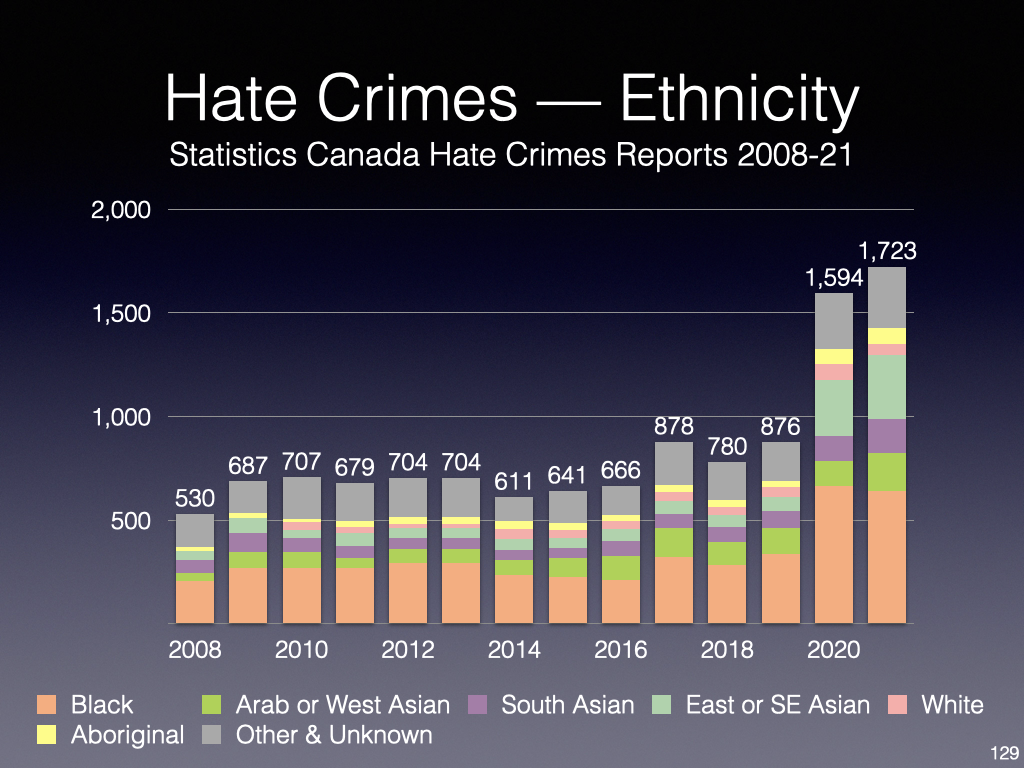
While recent surveys claim that public opinion in Canada is more in favour of immigration than ever, recent practices suggest otherwise. Examples include heightened surveillance of select immigrant populations, intense scrutiny of some of their financial resources and discrimination against migrant workers. There have also been incidences of hate crimes against members of immigrant groups. The government must address the issue of racism in immigration policy with a series of broad measures. Otherwise, if left unaddressed, these incidences have the potential to work against Canada’s intentions to continually increase immigration levels and grow its economy.

This is the key failing of the government’s plans on immigration, past and present. Although the latest plan does discuss anti-racism measures much more than previous versions, it is strictly in the context of Immigration, Refugees and Citizenship Canada’s own organizational strategy. Unfortunately, it does not address the real issue – that racism is not just organizational, it is endemic in Canadian society.

A national immigration plan cannot succeed in the long term if it does not acknowledge or address racism and discrimination in society. This is important because eight out of the top 10 source countries for immigrants to Canada, accounting for almost 70 per cent of annual intake, are non-white countries from the Global South.

This disconnect is becoming blatantly obvious in many ways. For instance, it is impossible to view the increase in immigration numbers without looking at the impact of regressive laws and policies such as Bill 96 in Quebec on new immigrants.

Racism affects not only our social connections with immigrants, but also our economic dependence on them. Canada’s approach to immigration has been to view migrants as a source of labour. That approach is bound to create tensions in the long term.

Immigrants may help with Canada’s labour shortages and aging demographics. But if the environment toward them is socially hostile, the chances of them gaining economic ground decrease substantially. In that case, Canada will no longer be a desired destination for people wanting to migrate. Or they will leave because the living conditions are toxic.

This hostility is on display in how Canada refers to immigrants in an official capacity. Immigrants are numerical “targets” to achieve in a given timeframe. International students are deemed the “ideal immigrants,” a common racist stereotype. Canada should not attract students based on how much labour or revenue they can provide in the long term – or because many students themselves use this as an opportunity to gain Canadian permanent residency – but rather how education can enrich their futures. Immigration levels are about “breaking records,” as numbers are increased based on labour shortages rather than the capacity to absorb new people from different parts of the world.

Phrases used by the government to justify rising numbers, such as “filling labour shortages, creating jobs, and driving economic growth,” perpetuate stereotypes of immigrants. The term “visible minority,” or the politically correct “racialized newcomers,” indicates a continued “othering” of immigrants. Semantics hide the racist notion that immigrants are only as useful as their revenue-generating skills. Everything else is their own problem.

This approach to reducing immigrants to labels and economic tools completely ignores the existence and reality of racism as a social and economic hurdle for immigrants. Canada sees new immigrants as a way to fill labour shortages, but the statistics tell a different story. New immigrants are far behind their Canadian-born counterparts in finding employment. Yet, the push to increase immigration levels to record highs continues without anyone talking to employers about immigrants’ inability to find work. This may only increase unemployment rates amongst racialized groups.

Racism also applies to our policies toward refugees and asylum seekers. Recent cases have shown how authorities continue to treat refugees from Afghanistan differently compared with those from Ukraine. If Canada is choosing to discriminate among seriously at-risk populations such as refugees fleeing war and death based on – it can be assumed – their race or religion, this itself proves the point that racism is more than just an organizational issue. It is endemic in our society.

For instance, Canada’s recent appointment of a representative to combat the rise in Islamophobia in this country reflects the federal government’s concern that violence and racism toward racialized communities is becoming normalized. But it ignores longstanding racism against the original inhabitants of this country.

Indigenous communities continue to be oppressed, and the arrival of immigrants, many of them unaware of Canada’s dark colonial past, only adds to Indigenous communities’ distrust of settlers.

Among racialized communities in Canada, Black and Asian Canadians also continue to experience some of the highest levels of discrimination.

If Canada truly wants its millions of new immigrants to be able to contribute to the country, it must address racism and discrimination as broad societal issues. We need a holistic policy approach, not one that is piecemeal.

To do this, the thinking around immigration needs to evolve and specifically address the following in policy and practice:

First, there is a need to change the language around immigration to Canada. This starts with changing how Ottawa frames immigration and immigrants as a labour supply issue. Immigration is a human right and not a numbers game. It must work for both the migrant and the host country.

Second, immigration is never purely economic. Regular immigrants also attempt to escape conflict, discrimination and political instability in their home countries. This is important to remember when assessing admissibility and the potential of each immigrant beyond just their economic capabilities.

Third, anti-racism efforts must be incorporated into the philosophy of services provided to immigrants including settlement services, employment, housing, education and health. This will require different federal, provincial and territorial departments to work in tandem with each other, not in silos.

Last, any immigration plan must also come with a strategy that socially protects the rising number of immigrants rather than just economically compensates them. Addressing racism and race relations must be important elements when designing immigration policy in a country that calls itself multicultural.

Immigration cannot just be about achieving targets and numbers. It is not an assembly line opportunity. Ultimately, we are dealing with individuals and families who also have hopes and expectations of Canada. Undermining these expectations through racial discrimination is the last thing anyone seeking to start a new life in a new country needs.

Source: Expanding immigration will not erase racism in Canadian society

Goldberg: The Censoring of an Iranian American Artist

Here we go again…. I’m much more concerned about the physical health and safety of the brave women and men who have been risking all to protest against the mandatory dress code for women and the general repressive nature of the Iranian regime:

The work of the Iranian American artist Taravat Talepasand is cheeky, erotic and defiantly anticlerical. One painting in her new midcareer survey, “Taravat,” incorporates Iranian bank notes whose images of Ayatollah Ruhollah Khomeini have been dosed with LSD. A graphite drawing, titled “Blasphemy X,” depicts a veiled woman giving the finger while lifting her robe to reveal high heels and a flash of underwear. There are sculptures of women in niqab face coverings with enormous exposed breasts. On a gallery wall, “Woman, Life, Freedom,” the slogan of Iran’s recent nationwide protests against the morality police, is written in neon in English and Persian.

When “Taravat” opened late last month at Macalester College, a left-leaning school in St. Paul, Minn., with a focus on internationalism, some Muslim students felt it made a mockery of modest Islamic dress, and thus of them. They expressed their outrage, and this month Macalester responded by temporarily closing Talepasand’s show, and then, apparently unaware of the irony, surrounding the gallery windows with black curtains.

Those curtains astonished Talepasand, an assistant professor of art practice at Portland State University. “To literally veil a ‘Woman, Life, Freedom’ exhibition?” she exclaimed to me.

The uproar over “Taravat” was directly connected to a recent controversy at Hamline University, a few minutes’ drive away from Macalester, where an adjunct art history professor named Erika López Prater was fired for showing a 14th-century painting of Muhammad in an art history class. In late January, Macalester — where, as it happens, Prater now teaches — hosted a discussion between faculty and students, most of them Muslim, to address issues raised by the Hamline incident. There, some students described being upset by “Taravat.”

“I invited them to share what emotions they were holding in their bodies,” one faculty member wrote in an email, part of which was shared with Talepasand. “They named ‘undervalued, frustrated, surprised, disrespected, ignored, and it felt like hit after hit.’”

Ultimately, Macalester handled the student complaints better than Hamline did. No one was fired, and after being closed for a few days, “Taravat” reopened. But the administration’s response was still distinctly apologetic, demonstrating the anxious philistinism that can result when bureaucratic cowardice meets maximalist ideas about safety.

In a message to campus, the provost, Lisa Anderson-Levy, said that Macalester understands “that pieces in the exhibition have caused harm to members of our Muslim community.” The black curtains came down, but they were replaced with purple construction paper on the gallery’s glass entrance and frosted glass panels on its mezzanine windows, protecting passers-by from “unintentional or nonconsensual viewing,” in the words of the administration. A content warning is affixed to the door. Next to it, some students put up a yellow sign asking potential visitors to show solidarity with them by not going in.

“There’s a lot of nuance and complexity in these kinds of situations,” Anderson-Levy said in a statement when I reached out to talk. “We believe that taking time to slow down and listen carefully to the diverse perspectives across our campus community allowed us to create space for conversation and learning.”

At least some students seemed to be learning to approach contentious art cautiously. A senior sociology major who’d visited the gallery with their sculpture class when Talepasand was still assembling the exhibition told me they were thinking of returning to see what had changed. But they worried that could be an act of entitlement, and felt the need to reflect “on my place as a white person” who is “not affected by the harms as much as others.”

Some readers might object to dwelling on one instance of misguided sensitivity at one small college when the country is in the midst of a nationwide frenzy of right-wing book bans, public school speech restrictions, and wild attempts to curtail drag performances. But I think this moment, when we’re facing down a wave of censorship inspired by religious fervor, is a good time to quash the notion that people have a right to be shielded from discomfiting art. If progressive ideas can be harnessed to censor feminist work because it offends religious sensibilities, perhaps those ideas bear rethinking.

In her excellent 2021 book “On Freedom,” the poet and critic Maggie Nelson described how, in the 20th century, the avant-garde imagined its audience as numb, repressed and in need of being shocked awake. The 21st-century model, by contrast, “presumes the audience to be damaged, in need of healing, aid, and protection.”

There is value in this approach. Mary Gaitskill recently published a captivating essay about two writing classes that she taught 25 years apart. Each included a menacing male student obsessed with sadistic violence against women. In 1997, the guy was named Don, and Gaitskill was struck by how enthusiastically his female classmates seemed to respond to his imagined scenes of torture and murder. It is only toward the end of the semester, after another student’s outburst, that the young women express their fear of Don. Until then, surrounded by a culture that valorized shock and darkness, they demonstrated a “seemingly bizarre forbearance” that blunted their authentic reactions.

“But these days that breed of forbearance is looking like an indulgence that we cannot afford,” Gaitskill writes. “These days, niceness is looking pretty damn good; these days, the darkness is just too overwhelming.” In her 2022 class, she writes, almost half the class had spent time in mental institutions. Relentless demands for safety can simply be a sign of how vulnerable people feel.

Still, to automatically give in to those demands is to suffocate the arts. This becomes especially clear when you see how easily the language of trauma and harm can serve reactionary ends. Just last week, The Philadelphia Inquirer reported on a school district in New Jersey that removed Toni Morrison’s “The Bluest Eye,” a frequent target of conservative censorship, from the freshman honors curriculum. A parent had complained that exposure to the book’s “graphic images of sexual violence” could be “emotionally traumatizing.” This, said Talepasand, “is where the far left and the far right look very similar.”

I’m not naïve enough to believe that if the left rediscovered a passionate commitment to free speech, the right would give up its furious campaign against what it calls wokeness. But I do think that if the left is to mount a convincing response to what has become a wholesale assault on intellectual liberty and free expression, it needs to be able to defend challenging and provocative work. Art need not defer to religion. If that’s no longer obvious we’ve gone astray.

Source: The Censoring of an Iranian American Artist