Colby Cosh: Ontario math case is mirror-image racism disguised as racial sensitivity

Of note:

The Canadian Constitution Foundation announced in a press release on Thursday that it has been granted intervenor status in an appeal, approved a year ago but not yet scheduled, that will concern Ontario’s famous racist math test for teacher candidates. In 2018, as you might recall, the Ontario government, concerned about sluggish student math performance, introduced a new math proficiency test (MPT) that teachers would have to pass before being admitted to the profession.

The test was based on the kinds of questions that students in grades 3, 6 and 9 would themselves be expected to answer in a classroom, and it was checked closely for explicit indications of racial bias and sensitivity. Nevertheless, in both trials of the MPT and the first year it was given officially (2021), some groups of test-takers — notably candidates self-described as being of African, Caribbean and Indigenous descent — didn’t score quite as well as the white ones.

Yes, friends, it’s one of those “disparate impact” issues that is constantly raising the political temperature in the United States, but that we haven’t yet fought about much here. This is the struggle that has a chance of spreading the American race-panic infection when the Ontario Court of Appeal and perhaps the Supreme Court get around to hashing it out.

In late 2021, a hastily assembled “Teacher Candidates’ Council” brought an application for judicial review of the MPT on the grounds that it violated Section 15 of the Charter of Rights and Freedoms, which forbids the state from racial discrimination. A panel of the Divisional Court, wielding novel Supreme Court doctrine on “disparate impact” cases, ruled that the MPT was discriminatory and struck down the statutory requirement for teachers to pass it.

The Divisional Court’s ruling is a truly dismal, laborious document: it exhibits a logic that the legal commentator Leonid Sirota has described as “Bonkerstown.” Section 15 says that the law cannot engage in “discrimination based on race,” and nothing in or about the test does that — except, well, that it’s a test. The court comments in the decision, as a matter of uncontested and universally recognized fact, that “Black and Latinx teacher candidates are much more likely to fail standardized teacher tests than their White peers,” and that standardized tests, perhaps by their very nature, “are biased against almost all vulnerable classes of potential teachers other than women.

Does this mean that any kind of state-administered proficiency test yielding a “disparate impact” is thereby outlawed? The ruling “disparate impact” case, Fraser v. Canada, dates only from the fall of 2020, and was written by, you guessed it, the now-retired Justice Rosalie Abella. Abella’s disparate impact doctrine, summarized helpfully at paragraph 57 of the Divisional Court ruling, says that the legislature’s intentions in writing a law are irrelevant, and that there is no need for a court to demonstrate or show how a law causes a disparate impact on racial groups. If there is any difference at all in the between-group outcomes of a law, Sec. 15 is activated.

This essentially throws disparate-impact questions in the hands of the classic Oakes test. In a given case, is there a sufficiently urgent and compelling reason for Sec. 15 to be violated? The Divisional Court agreed that the MPT was a way of addressing a “pressing and substantial objective” — improving the dismal math education in Ontario. The government’s choice to adopt the test was proportionate and rational: there is some evidence that teachers who do better on math tests themselves get better results from students. This takes us to the question of “minimal impairment,” which is the hurdle at which the MPT fell.

The Divisional Court panel acknowledged that high deference to lawmakers is required when it comes to “complex social problem(s) with many potential solutions.” As often happens, this high-flown language was a warning sign that the court wasn’t going to defer at all. The panel acknowledged that the government did what it could to mitigate the disparate effect of the test, screening it for biases and letting teacher candidates take it as often as they needed to. But the government did have alternatives to imposing the MPT at the end of teacher education. It could have added, and did consider adding, more math requirements and math courses to bachelor of education programs themselves.

The government was reluctant to do this, and preferred to have an MPT, because altering bachelor of education requirements would involve the province poking its nose into higher education and treading on the independence of universities. Moreover, there’s no real indication that this approach would necessarily be any better for education students who are bad at math exams. But simply because the MPT had been tried, and shown to yield disparate outcomes, the existence of a hypothetical alternative was enough to engage the “minimal impairment” part of the Oakes analysis in the eyes of the Divisional Court judges.

In short, you can’t say you minimally impaired the rights of racial minorities if there was anything else you could have done to uphold a training standard or a proficiency requirement. Nobody needs me to hector them about the grotesque nature of this chain of reasoning — which involves deciding that there are groups inherently bound not to cut the mustard on tests of their capability, and reading the Charter of Rights in a way that protects them from those tests. Most of you will see this as mirror-image racism disguised as racial sensitivity, and that’s just what it is.

Source: Colby Cosh: Ontario math case is mirror-image racism disguised as racial sensitivity

Omidvar, Browder and Silver: Canada should honour Mahsa Amini’s memory by sanctioning her killers

Of note:

September 16 marks the first anniversary of the murder of Mahsa Amini in Iran. Those who killed her should be sanctioned by Canada.

Brutally beaten to death by Iranian authorities for not abiding by their strict restrictions against women’s autonomy and dress, Ms. Amini’s murder sparked global outrage and solidarity with the women of Iran.

Iranian women continue their brave campaign for freedom, unveiling themselves as acts of peaceful protest, knowing full well they may share the fate of Ms. Amini for doing so. Imagine their reaction when they learn that their torturers are visiting family in Toronto and vacationing in Vancouver.

In one of his first acts as Minister of Immigration, Refugees and Citizenship, Marc Miller rightly recognized and redressed this injustice, banning Iran’s former health minister, a major rights violator, from his frequent visits to Canada. But this lets the bigger fish off the hook.

Ebrahim Raisi used to be called The Hanging Judge from his time personally overseeing executions of political prisoners. Mr. Raisi’s cruelty followed him into Iran’s presidency, where he is now crucial to the brutal crackdown against women. Canada’s allies have already sanctioned him for his crimes, making Canada a curious outlier.

Similarly, Iran’s Supreme Council of the Cultural Revolution was recently sanctioned by the U.S. and U.K. for designing the regime’s anti-women laws and demanding their violent enforcement. The fact that its leaders can visit Canada at their leisure is an affront to the dignity and equality of Canadians, and sends the wrong message to Iranians.

Canada should instead be communicating solidarity and extending support for Iranians through its sanctions systems. The new law on asset repurposing, which was first proposed by World Refugee and Migration Council members Allan Rock and Lloyd Axworthy and advanced by us in Parliament, is perfectly suited to address the situation.

Seizing assets is the natural next step after freezing them, and Iranian victims are the obvious beneficiaries. For those struggling to rebuild their lives in Canada after losing limbs or loved ones to the torturers in Tehran, it would be poetic justice for them to receive the proceeds of assets their persecutors have hidden away in Canada.

We support the Atlantic Council Strategic Litigation Project’s proposal for Canada to create a fund for Canadian-Iranian victims, which would facilitate community involvement from coast to coast in the decision-making process. With a broad and inclusive board of directors cutting across the Iranian diaspora in Canada, the fund would ensure transparency and grassroots engagement in the distribution of seized assets for medical, material and psychosocial support to victims.

This fund will also draw out all those Iranian-Canadians with credible evidence of crimes perpetrated against them or their loved ones. This would allow Canada to document and build cases toward prospective prosecutions. In the same way Ukrainian refugees are being interviewed by the RCMP regarding Russian crimes, and Iraqis and Syrians about the Islamic State, Canada should be gathering evidence from Iranian victims in the country.

Sanctions and asset seizures are powerful forms of accountability and restitution, but prosecution should not be forgotten. Those Iranian rights abusers enjoying the freedoms in Canada that they deprive their compatriots of at home should be the ones sitting in prison. Even if they are not in Canada, or a perpetrator cannot be identified, the evidence gathered from victims could be used in other trials that might take place around the world.

Canada played a crucial role in setting up the continuing United Nations Independent International Fact-Finding Mission on Iran, which would benefit from the support of evidence gathered by Canadian investigators. Canada also leads the annual UN General Assembly resolution on Iran, which receives overwhelming support from around the world every year in calling out the crimes of the regime in Iran and expressing solidarity with its victims. When the General Assembly meets next week, Canada can use this global diplomatic platform to strengthen sanctions co-ordination and implementation, and build further global support for strengthening investigations of perpetrators.

For all the innocent women whose lives and liberties they have taken away, Canada can secure justice and send a global message that its borders, banks and businesses are closed to Iran regime criminals. We must honour Mahsa Amini’s memory, and the courage of Iranian women, in sanctioning or jailing their abusers. This important moment of commemorating her murder must not only be an act of remembrance, but a reminder that we must act.

Ratna Omidvar is an independent senator from Ontario who first proposed Canada’s asset repurposing laws in Parliament. Bill Browder is the head of the Global Magnitsky Justice Campaign. Brandon Silver is an international human rights lawyer and director of policy and projects at the Raoul Wallenberg Centre for Human Rights.

Source: Canada should honour Mahsa Amini’s memory by sanctioning her killers

Brian Dijkema: Who left the barbarians in charge of our books?

Uncomfortable parallels between book banning by the right and left:

Today, the CBC broke a story that showed how the Peel District School Board is culling books that fail to meet “equity-based” criteria for books in school libraries. Among the books that are thrown away, according to reporter Natasha Fatah, is Anne Frank’s diary. While they are not quite going so far as to host a bonfire to burn the books in school parking lots, the end result is pretty much the same. The board is not giving the books away, they are literally throwing them into the landfill to moulder. What an absolute abomination.

This practice is not just some random “woke” librarian on a rampage either. It is being done in response to a directive from the Ministry of Education, whose current minister is Stephen Lecce, a conservative. It comes from straight from the top.

The policy is the mirror image of the “anti-woke” book policy of the conservative governor of Florida, Ron DeSantis. A list of books removed from Florida public school libraries shows plenty of books that are terrible and that really shouldn’t be on the shelves, but also plenty that are not just okay, but genuinely endearing and in line with the tradition of living books. Why should a sweet, rhythmic, story about a Thai mom trying to quiet the animals so her baby can sleep be put out of a school library? I can’t tell you. Arguably, the Peel Board’s practice is even worse, as it simply removed any book published before 2008.

While the policy has since been countermanded by Lecce’s office, these types of policies—one aimed at removing “woke” books and another one aimed at “non-inclusive” books are, sadly, a metaphor for the state of public education these days. The words that best describe this policy are brutal and barbaric.

By this I don’t mean that school administrators are clothed in fur and looking for blood (though, judging from other goings-on in the Peel board, you can be forgiven for this assumption). They are a clear attempt to cut off students from a living tradition of reflection on the beauty and complications of human life, in favour of a simplistic, ideological vision. The dearly departed Australian poet Les Murray describes the situation better in three lines than I could in three pages:

Politics and Art

Brutal policy,
like inferior art, knows
whose fault it all is.

This is the mentality shaping both the Left’s and the Right’s vision for educating our kids. Is this what you want for your kids? It’s not what I want for mine.

This is not to say that libraries shouldn’t make choices about what to put on their shelves. Those choices are both a practical and pedagogical reality and will depend in part on the type of person you are trying to form. Perhaps it’s time to give up the pretense that forming our kids is something a system that self-articulately takes a pass on deeper questions of meaning and formation can do. Given the fact that two ostensibly “conservative” premiers have given North America two perfectly opposite, but equally brutal, policies on the literature that will shape our children’s imaginations, perhaps it’s time to find a new lens for evaluating education.

And that lens, I should add, cannot simply be the technocratic one that our governments prefer. The culling of books based on ideological differences on sex or race or what have you is nothing compared to the culling of real, living, books that have been taking place in our libraries for years in the name of value-free technological “progress.” In many libraries—both public and school—books that would have once sparked flames of imagination in life in young children have been replaced by Chromebooks and electronic learning games or other bits of metal and silicon that are, literally, planned for obsolescence rather than for posterity. The beautiful, “eye on the object” look of children reading has been replaced by catatonic faces more often found in front of slot machines in a casino.

The fact that the minister’s office issued a directive without offering clear criteria by which a book would be deemed to be “inclusive, culturally responsive, relevant, and reflective of students” (or even a definition of what it means by these extremely vague terms) is an abrogation of duty. A read of the audit reports produced by Peel indicates that this technocratic mindset is the greater concern for those of us concerned with education as something intended to shape humans, rather than technically proficient machines. It cloaks terms and actions that have significant import for the formation of children in administrative bureaucratese and is executed almost entirely by staff who are accountable to no one in particular, and certainly not Ontarian parents.

Whether it’s ridding shelves of books like the Diary of Anne Frank in Ontario under Lecce, or Brother Eagle, Sister Sky under DeSantis, policies like this are another step in the alienation of children from the complexities of history and humanity. Even if this all is, as my friend Michael Demoor suggests, simply a case of bureaucratic stupidity brought on by the hugeness of the school boards (a view that is plausible, but which doesn’t deal with the very real and clearly articulated ideological nature of Ontario’s common school system, nor its increased centralization over the last few decades), it’s a stretch to say that this is a healthy way the system should be working. Overreach and bluntness of this sort are, as they say, a feature, not a bug, of systems where education is controlled by a bureaucratic state and massive, largely unaccountable, school boards.

Perhaps this might give all of us—regardless of which colour you vote for in a given election—some pause, and a desire for something better.

A month or so ago I was corresponding with the ever-so-gifted Mary Harrington about her recent book (reviewed here in The Hub) and mentioned that I appreciated how many of the concerns she raised in the book fit into an old-school “left-wing” model of politics. Her reply was enlightening. She said, “I don’t have a problem with being recognised as a leftist in some respects; it’s true, and besides I’m not sure the terms really apply anymore, as the split these days is more human vs posthuman.”

This, I think, is precisely where we need to be on education. Another word for brutal is inhumane. Both the Left and the Right are acting like barbarians and pushing a vision of education that is destroying our shared past and the reflections of human beings trying to make sense of the world. It has to stop. It’s time for a more humane, human-scale, vision of education. But to achieve that, humanists—of all political persuasions—will need to unite.

Source: Brian Dijkema: Who left the barbarians in charge of our books?

Nicolas: Quand on «débat» de toi

Interesting parallel between the Charte des valeurs québécoises, and the tensions it provoked for visible minorities, and the current discourse around trans and non-binary and how this high profile debate adversely affects teenagers. And the irony, or symmetry, having the same minister, Bernard Drainville, responsible for both:

Ça aura fait dix ans, le 10 septembre dernier, que le projet de « Charte des valeurs québécoises » fut présenté à l’Assemblée nationale. La nouvelle avait eu l’effet d’une bombe dans mon cercle d’amis. Nous avions vingt et quelques années, notre expérience en mobilisation politique et sociale allait bien au-delà de notre âge, et nous étions déterminés à défendre l’idée d’un Québec « ouvert » ou « inclusif ».

En moins de deux semaines, nous avions cherché l’appui de regroupements juifs, musulmans et sikhs, puis rassemblé 5000 personnes au centre-ville de Montréal pour une manifestation où nous scandions notamment que « le Québec n’est pas la France, vive la différence ». Charles Taylor, déjà d’âge vénérable, avait escaladé devant nous la boîte de notre pick-up de location pour prononcer un discours passionné dont la force était directement puisée dans l’énergie de la révolte. Pour moi, qui n’avais vu l’homme que dans son rôle de « sage » aux audiences télévisées de la fameuse commission sur les accommodements raisonnables, l’image était saisissante.

Le poids de l’actualité était, bien sûr, le plus lourdement porté par les minorités religieuses, les femmes musulmanes, en particulier. Ce qui était plus difficile à prévoir, c’est que bien des alliés allaient aussi recevoir le projet de loi comme une attaque personnelle. Certains ont vu dans la « Charte » une attaque à leur conception des valeurs québécoises ou aux droits et libertés, de manière plus générale. D’autres ont vu un coup de couteau dans leur rêve d’un Québec indépendant et le signe d’un virage vers un nationalisme qui n’allait jamais pouvoir toucher le Québec dans toute sa diversité, ni même la génération montante.

Le sentiment de peur, lui, était ressenti avec le plus d’acuité par mes amis qui, comme moi, sont des enfants d’immigrants. Certains appartenaient à des minorités religieuses, d’autres non. Parce qu’« autre » aux yeux de la majorité, on se disait tous qu’un gouvernement qui s’attaquait ainsi aux droits d’un groupe minoritaire pouvait s’attaquer à n’importe quel autre groupe demain, dont le nôtre. Ce raisonnement était rarement explicite, et même pas toujours conscient. C’est moins par les mots que par nos comportements, l’urgence d’agir et les émotions partagées qu’on constatait qu’on se sentait tous un peu dans le même bateau.

Déjà, au début de l’automne 2013, mes tripes me criaient que ce « débat » allait mal finir. Comme fille de la banlieue de Québec, je connaissais trop bien comment les discours médiatiques affectent rapidement notre quotidien. Enfant, j’avais pu sentir les regards se tourner vers moi les matins où, quand j’entrais dans l’autobus, André Arthur vociférait contre les Noirs ou les immigrants dans la radio du chauffeur. Ados, mon frère et moi avions été agressés verbalement par des clients à quelques reprises dans nos emplois d’étudiants, alors que politiciens, animateurs de radio et autres chroniqueurs pompaient quasi quotidiennement les gens contre les « minorités qui exagèrent » en plein coeur de la « crise des accommodements raisonnables ».

La plupart ne voyaient la « Charte des valeurs » que pour ce qu’elle était explicitement, c’est-à-dire un projet de loi proposant des idées précises pouvant être adoptées ou non au terme d’un débat. Quand on comprend, ou qu’on a subi directement le pouvoir des mots dans une société, on voit d’abord la « Charte » comme un désinhibiteur de parole, qui prend par ailleurs la forme d’un projet de loi.

Le texte de la « Charte » n’est jamais devenu loi, mais un certain type de discours sur les minorités s’est répandu comme une traînée de poudre dans l’espace public québécois à partir de 2013. Il y a dix ans, les plus sensibles pouvaient déjà comprendre que le moment allait transformer, au moins pour une génération, ce qui était dicible et audible en politique québécoise.

Ce que j’écris sera difficile à recevoir pour plusieurs lecteurs. Je vois venir d’ici les « avec des gens comme elle, on ne pourrait plus débattre, on ne pourrait plus rien dire ! ». Bien sûr, là n’est pas mon propos. Ce genre de réactions est le plus souvent nourri par une insistance sur les intentions — des gens qui proposent certaines idées politiques ou tiennent certains discours dans l’espace public — et un refus de se pencher sérieusement aussi sur les conséquences des mots, leurs effets, leur pouvoir.

Il me semble que si on veut être en mesure de faire un exercice de réflexion honnête sur un événement politique aussi marquant que le fameux débat sur la « Charte », on ne peut pas faire semblant que la circulation des idées dans l’espace public n’a pas aussi un effet direct sur le sentiment de sécurité, au quotidien, des Québécois dont on décide de « débattre ».

Le hasard fait que l’homme qui avait déposé le projet de « Charte des valeurs » en 2013 est aujourd’hui toujours ministre, et que cette fois, il est en train de trouver comment réagir à ceux qui voudraient qu’on fasse des enfants trans et non binaires un objet de débat national.

M. Drainville, et tous les acteurs de la classe politique et médiatique concernés, laissons de côté nos différends une minute. Je vous invite à imaginer ces enfants et ces ados, déjà vulnérables pour un ensemble de raisons, entrer dans l’autobus au moment où l’on « débat » du pour et du contre de leur existence et de leurs droits à la radio, et à voir les regards se tourner vers eux. Je vous intime de bien vouloir vous mettre dans leur peau. Tentez de votre mieux de comprendre l’impact de chacun de vos mots sur leurs interactions sociales quotidiennes. Interrogez-vous sur la place qu’ils auront la certitude d’avoir, ou non, dans la société québécoise. Dites maintenant ce que vous avez à dire comme si ces jeunes étaient directement en face de vous. Parce que, croyez-moi, ils vous écoutent.

Anthropologue, Emilie Nicolas est chroniqueuse au Devoir et à Libération. Elle anime le balado Détours pour Canadaland.

Source: Quand on «débat» de toi

Palestinian politicians lash out at renowned academics who denounced president’s antisemitic remarks

Sigh:

Palestinian politicians on Wednesday raged against dozens of Palestinian academics who had criticized President Mahmoud Abbas’ recent remarks on the Holocaust that drew widespread accusations of antisemitism.

They lambasted the open letter signed earlier this week by over a hundred Palestinian academics, activists and artists based around the world as “the statement of shame.”

The well-respected writers and thinkers had released the letter after footage surfaced that showed Abbas asserting European Jews were persecuted by Hitler because of what he described as their “social functions” and predatory lending practices, rather than their religion or ethnicity.

“Their statement is consistent with the Zionist narrative and its signatories give credence to the enemies of the Palestinian people,” said the secular nationalist Fatah party that runs the Palestinian Authority.

Fatah officials called the signatories “mouthpieces for the occupation” and “extremely dangerous.”

In the open letter, the legions of Palestinian academics, most of whom live in the United States and Europe, condemned Abbas’ comments as “morally and politically reprehensible.”

“We adamantly reject any attempt to diminish, misrepresent, or justify antisemitism, Nazi crimes against humanity or historical revisionism vis-à-vis the Holocaust,” the letter added. A few of the signatories are based in east Jerusalem and the occupied West Bank.

In Geneva on Wednesday, Deborah Lipstadt, the U.S. special envoy to monitor and combat antisemitism, blasted Abbas’ comments as “overtly antisemitic” and distorting of the Holocaust. She said the open letter from the Palestinian academics was “stronger almost than what I had to say.”

“There’s no question about it: These kind of statements must stop, because they do nothing to advance peace, and worse than that, they spread anti-Semitism,” Lipstadt told The Associated Press outside an event on antisemitism attended by dozens of diplomats on the sidelines of a session of the Human Rights Council.

The chorus of indignation among Palestinian leaders over the letter casts light on a controversy that for decades has plagued the Palestinian relationship with the Holocaust. The Nazi genocide, which killed nearly 6 million Jews and millions of others, sent European Jews pouring into the Holy Land.

Israel was established in 1948 as a safe haven for Jews in the wake of the Holocaust, and remembering the Holocaust and honoring its victims remains a powerful part of the country’s national identity.

But the war surrounding Israel’s establishment displaced hundreds of thousands of Palestinians, who fled or were forced from their homes in what the Palestinians call the “nakba,” or catastrophe. Many Palestinians are loathe to focus on the atrocities of the Holocaust for fear of undercutting their own national cause.

“It doesn’t serve our political interest to keep bringing up the Holocaust,” said Mkhaimer Abusaada, a political scientist at Al-Azhar University in Gaza City. “We are suffering from occupation and settlement expansion and fascist Israeli polices. That is what we should be stressing.”

But frequent Holocaust distortion and denial among Palestinians has only drawn further scrutiny to the tensions surrounding their relationship to the Holocaust. That unease may have started with Al-Husseini, the World War II-era grand mufti of Jerusalem and a Palestinian Arab nationalist. He was an enthusiastic Nazi supporter who helped recruit Bosnian Muslims to their side, and whose antisemitism was well-documented.

More recently, Abbas has repeatedly incited various international uproars with speeches denounced as antisemitic Holocaust denial. In 2018, he repeated a claim about usury and Ashkenazi Jews similar to the one he made in his speech to Fatah members last month. Last year, he accused Israel of committing “50 Holocausts” against Palestinians.

For Israel, Abbas’ record has fueled accusations that he is not to be trusted as a partner in peace negotiations to end the decadeslong conflict. Through decades of failed peace talks, Abbas has led the Palestinian Authority, the semiautonomous body that began administering parts of the occupied West Bank after the Oslo peace process of the 1990s.

Abbas has kept a tight grip on power for the last 17 years and his security forces have been accused of harshly cracking down on dissent. His authority has become deeply unpopular over its reviled security alliance with Israel and its failure to hold democratic elections.

The open letter signed by Palestinian academics this week also touched on what it described as the authority’s “increasingly authoritarian and draconian rule” and said Abbas had “forfeited any claim to represent the Palestinian people.”

Source: Palestinian politicians lash out at renowned academics who denounced president’s antisemitic remarks – Yahoo! Voices

Breguet: It’s time to reduce immigration

But will they? Despite all the signals on possible changes, any pivot may be too hard a political reversal for the government and its NDP partner to make.

But Breguet makes a convincing case, as it is the only short-term measure that can show seriousness on housing and other related files.

And I continue to believe that given these issues affect immigrants and non-immigrants alike, this may be less of a third rail then appears:

How could the Trudeau government interject new political life into itself? It could switch its position on immigration. I’m not talking about going PPC or [Quebec Premier Francois] Legault, but a significant pivot from ongoing increase to the country’s immigration in-take target and its general “century initiative” rhetoric.

This isn’t such a far-fetched idea. We’ve seen recent glimpses when government raised the prospect of a possible cap on the number of international students, a group that has ballooned massively in recent years to reach 900k recently, and is believed, at least by some, to put significant pressure on rents and housing prices. 

While the Liberals have, at times, given the impression that they don’t take the housing crisis seriously and are inclined to double down on satisfying their increasingly mortgage-free boomer base, we must also recognize that the Liberal Party of Canada has historically been remarkably good at adapting and pivoting when needed. They read the room much better than the Conservatives and New Democrats. 

So, if they decide to get more serious on the housing file, they’ll need to confront the fact they can’t build enough (or, more precisely, incentivize provinces and cities to build) to make a meaningful difference on prices before 2025. They could however pivot on immigration and have results quickly. 

It might start with reducing the number of international students. But the government’s track record on immigration and built-in strengths could enable it to go further by reducing the number of permanent residents (including points-based immigrants and refugees) without the risk of people questioning its commitment to immigration and diversity. 

It’s hard to know how much such a policy pivot would affect housing demand and in turn prices but it may not matter per se. Politics, of course, is ultimately about optics. The government would look like it’s trying to get to the root of the housing crisis. The Conservatives, by contrast, appear afraid of their own shadows with anything related to immigration. 

The prime minister might therefore gamble that his name and decades of good-faith support for immigration and multiculturalism would allow him to pivot without alienating voters from cultural and visible minorities—something that the Conservatives likely cannot afford, especially after the 2015 election. The Liberals in short may have the political maneuverability to counterintuitively run to the right of the Conservatives on immigration. 

Polls have shown people are ready to support a reduction in immigration levels. A well-crafted message centered on helping the housing market could succeed and take this topic away from Poilievre who currently enjoyed a de facto monopoly on it in the past couple of years. 

Bryan Breguet, Too Close to Call founder and pollster

Source: It’s time to reduce immigration

Bayard Rustin Challenged Progressive Orthodoxies

Of interest, a progressive who challenged progressive orthodoxies:

Bayard Rustin, a trusted adviser to Martin Luther King Jr. and chief organizer of the 1963 March on Washington, was a towering figure in the fight for racial equality. Remarkably for a man of his generation and public standing, he was also openly gay. When Mr. Rustin died in 1987, obituaries downplayed or elided this fact. Emblematic of this erasure was this paper, which made only passing mention of his homosexuality and obliquely described Mr. Rustin’s longtime partner as his “administrative assistant and adopted son.”

In the decade since President Barack Obama awarded him a posthumous Presidential Medal of Freedom, the country’s highest civilian honor, there has been a welcome resurgence of popular interest in Mr. Rustin’s extraordinary life. He was frequentlyinvoked in commemorations of the march’s 60th anniversary last month and will be the subject of a feature film produced by Barack and Michelle Obama’s company that will come out later this year.

Whereas remembrances of Mr. Rustin once evaded the issue of his sexual orientation, today, in accordance with our growing acceptance of gay people and awareness of the discrimination they have faced, such tributes are likely to center it. This past June, for instance, the PBS NewsHour aired a segment for Pride Month titled “The story of Bayard Rustin, openly gay leader in the civil rights movement.” Other representative encomiums celebrate the “gay socialist pacifist who planned the 1963 March on Washington”and “the gay black pacifist at the heart of the March on Washington.”

Mr. Rustin is today often extolled as an avatar of “intersectionality,” a theoretical framework popular among progressives that emphasizes the role that identities play in compounding oppression against individuals from marginalized groups. While it’s admirable that Mr. Rustin is being recognized for something he never denied (according to one associate, he “never knew there was a closet to go into”), these tributes studiously ignore another aspect of his life: how, throughout his later career, Mr. Rustin repeatedly challenged progressive orthodoxies.

Mr. Rustin, who was characterized by The Times in 1969 as “A Strategist Without a Movement” and, upon his death, an “Analyst Without Power Base,” would most likely find himself no less politically homeless were he alive today. A universalist who believed that “there is no possibility for black people making progress if we emphasize only race,” he would bristle at the current penchant for identity politics. An integrationist who scoffed at how“Stokely Carmichael can come back to the United States and demand (and receive) $2,500 a lecture for telling white people how they stink,” he would shake his head at an estimated $3.4 billion diversity, equity and inclusion industry that often prioritizes making individual white people feel guilty for the crimes of their ancestors while ignoring the growing class divide. A pragmatist who noted, “There is a strong moralistic strain in the civil rights movement which would remind us that power corrupts, forgetting that the absence of power also corrupts,” he would have no patience for social justice activists unwilling to compromise. And a committed Zionist — supportive of the state but likely critical of its government — he would abhor the Black Lives Matter stance on Israel and the recent spate of antisemitic outbursts by Black celebrities. Mr. Rustin’s resistance to party dogma is a neglected part of his legacy worth celebrating, an intellectual fearlessness liberals need to rediscover.

The origin of Mr. Rustin’s estrangement from the progressive consensus began with his belief that once federal civil rights legislation was achieved, the American left would need to turn its attention from racial discrimination to the much more pervasive problem of economic inequality. Four months after the march, Mr. Rustin was invited to deliver a speech at Howard University to the Student Nonviolent Coordinating Committee. According to the Times account, Mr. Rustin “said that the civil rights movement had gone as far as it could with its original approach and that the time had come to broaden the movement, which, he said, faces the danger of degenerating into a sterile sectarianism.” To avoid this fate, he argued, it must “include all depressed and underprivileged minority groups if their own movement is to make another leap forward.” Deriding direct-action protest tactics as mere “gimmicks,” Mr. Rustin counseled the young activists that “Heroism and ability to go to jail should not be substituted for an overall social reform program … that will not only help the Negroes but one that will help all Americans.”

Mr. Rustin expanded upon this analysis in a seminal 1965 Commentary magazine essay, “From Protest to Politics.” Published after the passage of the Civil Rights Act and several months before the signing into law of the Voting Rights Act, Mr. Rustin argued that the main barrier to Black advancement in the United States would soon no longer be racism but poverty. “At issue, after all, is not civil rights, strictly speaking,” he wrote, “but social and economic conditions” that transcended race. The problems facing Black America, therefore, needed to be seen as the “result of the total society’s failure to meet not only the Negro’s needs, but human needs generally.” A stalwart social democrat, Mr. Rustin argued that meeting these needs required a coalition of “Negroes, trade unionists, liberals, and religious groups” to push the Democratic Party to the left on economic issues.

Sectarian appeals based solely on race — whether from white segregationists or Black nationalists — threatened this aim. In May 1966, the moderate integrationist John Lewis was ousted from the chairmanship of SNCC by the Black Power radical Stokely Carmichael. Mr. Rustin responded with another Commentary essay, “‘Black Power’ and Coalition Politics.” Black Power, he wrote, was “simultaneously utopian and reactionary” as it “would give priority to the issue of race precisely at a time when the fundamental questions facing the Negro and American society alike are economic and social.” At a time when the Democratic Party is losing the support of working-class Americans of all races, this component of Mr. Rustin’s legacy is as important as ever.

Committed to a political program that would improve the lives of the poor and working class regardless of their skin color, Mr. Rustin opposed racial preferences . In 1969, he called a proposal for slavery reparations “preposterous,” elaborating that “if my great-grandfather picked cotton for 50 years, then he may deserve some money, but he’s dead and gone and nobody owes me anything.” Worse than a point of personal pride was the way in which the call for reparations divided the multiracial working class. As a “purely racial demand,” Mr. Rustin contended, “its effect must be to isolate blacks from the white poor with whom they have common economic interests.”

Testifying before Congress in 1974 against affirmative action, Mr. Rustin said: “Everyone knows racial discrimination still exists. But the high rate of black unemployment and the reversal of hard-won economic gains is not the result of discrimination,” but of the same, general economic conditions that affected the white unemployed. Contrary to contemporary “antiracism” advocates who claim that the existence of racial disparities necessarily constitutes evidence of racism, Mr. Rustin asserted, “That blacks are underrepresented in a particular profession does not by itself constitute racial discrimination.”

Another major source of tension between Mr. Rustin and the progressive left concerned American foreign policy. Briefly a member of the Young Communist League in the 1930s, Mr. Rustin followed the path of many a disillusioned ex-Communist by becoming a staunch anti-Communist. Although an early opponent of American military involvement in Vietnam, Mr. Rustin could not, as he wrote in 1967, “go along with those who favor immediate U.S. withdrawal, or who absolve Hanoi and the Vietcong from all guilt. A military takeover by those forces would impose a totalitarian regime on South Vietnam and there is no doubt in my mind that the regime would wipe out independent democratic elements in the country.”

In his role as chairman of Social Democrats, USA, the more hawkish faction to emerge from a split within the Socialist Party of America over the Vietnam War, Mr. Rustin was an outspoken critic of the Soviet Union and international Communism. He declined to endorse Democratic Senator George McGovern’s antiwar presidential candidacy in 1972 and joined other hawks in forming the Coalition for a Democratic Majority, an initiative to oppose the Democratic Party’s leftward lurch, becoming its vice chair. In the 1976 Democratic presidential primary, Mr. Rustin supported Senator Scoop Jackson of Washington, whose decades-long career combined strong support for civil rights and social welfarism at home with robust anti-Communism abroad.

Mr. Rustin’s evolution from absolute pacifist (epitomized by the two years he spent in a federal penitentiary during World War II as a conscientious objector) to Cold War liberal dismayed many of his allies on the left, who accused him of betraying the principles of Gandhian nonviolence he had brought to the civil rights movement. But Mr. Rustin’s transformation was born of long deliberation and genuine conviction; according to one biographer, Mr. Rustin repeatedly said that if he had been aware of the Holocaust during World War II, he most likely would not have become a conscientious objector.

If Mr. Rustin’s erstwhile comrades considered him a sellout, so too was he disillusioned with a political camp that posited a moral equivalence between the United States and its Soviet adversary. “Whereas I used to believe that pacifism had a political value, I no longer believe that,” Mr. Rustin stated flatly in 1983. “It is ridiculous, in my view, to talk only about peace. There is something which is more valuable to people than peace. And that is freedom.”

Yet another source of antagonism between Mr. Rustin and the left was his outspoken opposition to antisemitism within the Black community and fervent support for the state of Israel. “So far as Negroes are concerned,” he wrote in 1967, responding to an eruption of antisemitic statements by radical Black activists, “one of the more unprofitable strategies we could ever adopt is now to join in history’s oldest and most shameful witch hunt, antisemitism.” The following year, in an address to the Anti-Defamation League, Mr. Rustin condemned “young Negroes spouting material directly from ‘Mein Kampf.’” In 1975, as the United Nations General Assembly was preparing its infamous resolution condemning Zionism as a “form of racism,” Mr. Rustin assembled a group of African American luminaries including A. Philip Randolph, Arthur Ashe and Ralph Ellison into the Black Americans to Support Israel Committee (BASIC). “Since Israel is a democratic state surrounded by essentially undemocratic states which have sworn her destruction, those interested in democracy everywhere must support Israel’s existence,” he declared.

A descendant of slaves who was himself a victim of brutally violent racism, Mr. Rustin never let his country’s many sins overshadow his belief in its capacity for positive change. His patriotism was unfashionable among progressives while he was alive and is even more exceptional today. “I have seen much suffering in this country,” he said. “Yet despite all this, I can confidently assert that I would prefer to be a black in America than a Jew in Moscow, a Chinese in Peking, or a black in Uganda, yesterday or today.”

For his heresies against progressive dogma, Mr. Rustin was derided as a “neoconservative.” (Indeed, he was one of the first political figures to be branded with this epithet, coined as a term of abuse for members of the Social Democrats, USA by their more left-wing rivals.) But while Mr. Rustin may have taken part in various neoconservative initiatives and counted individual neoconservatives as friends and allies, he was not himself an adherent of this ideological persuasion. Unlike most of the thinkers and activists associated with neoconservatism, Mr. Rustin never abandoned his social democratic convictions, nor did he endorse Ronald Reagan. On the contrary, he wrote that “insensitivity and lack of compassion increasingly are becoming the hallmarks of the Reagan administration’s domestic program” and stated that the Black poor “have been victimized by years of Reaganism.”

Mr. Rustin’s life offers a sterling example of moral courage and personal integrity. Resisting the temptations of tribalism, standing up for one’s beliefs even when it angers one’s “side,” advocating on behalf of the least among us — Mr. Rustin embodied these virtues to an uncommon degree. And undergirding it all was a bedrock belief in our common humanity. Asked to contribute to an anthology of Black gay men the year before his death, Mr. Rustin respectfully declined. “My activism did not spring from my being gay, or for that matter, from my being black,” he wrote.

Rather it is rooted, fundamentally, in my Quaker upbringing and the values that were instilled in me by my grandparents who reared me. Those values are based on the concept of a single human family and the belief that all members of that family are equal. Adhering to those values has meant making a stand against injustice, to the best of my ability, whenever and wherever it occurs.

I am heartened to see a new generation of Americans belatedly acquaint themselves with Bayard Rustin’s life and work. If we truly wish to honor his remarkable legacy, we should begin by recognizing him as he would have wanted: for his ideas, not his identity.
Source: Bayard Rustin Challenged Progressive Orthodoxies

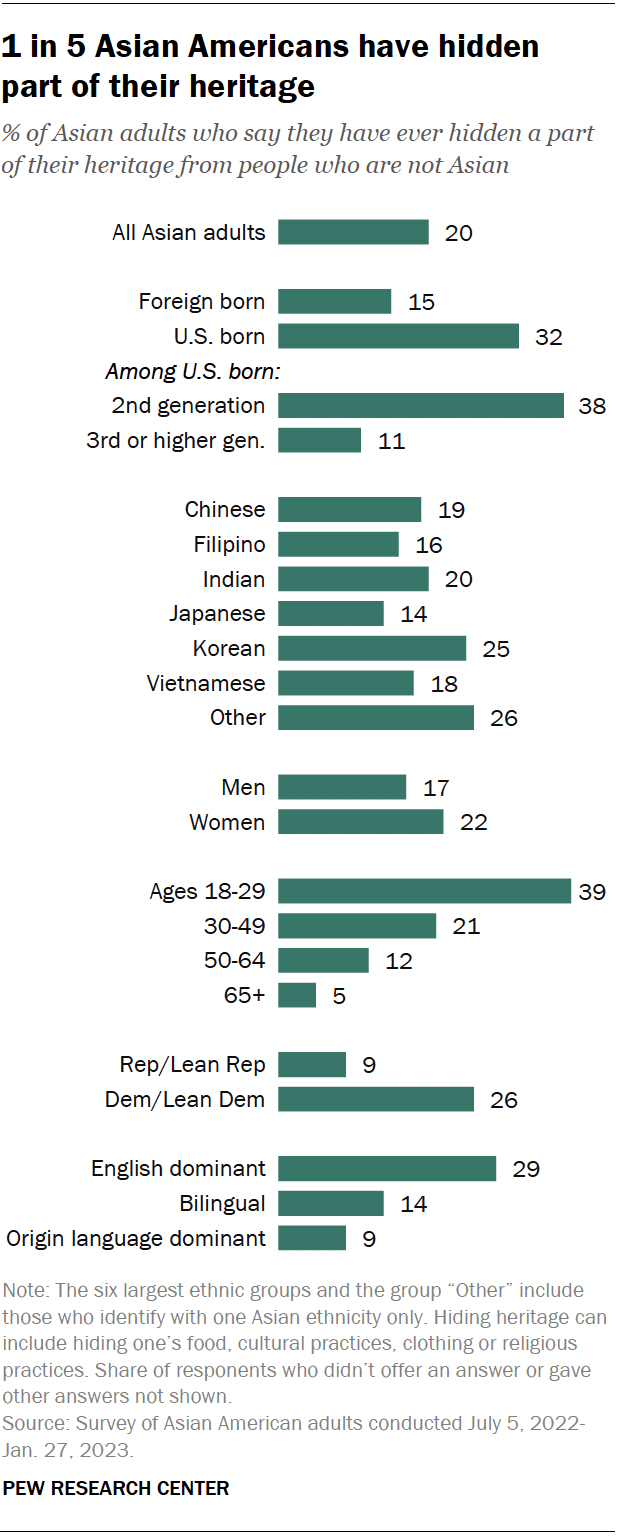
Among Asian Americans, U.S.-born children of immigrants are most likely to have hidden part of their heritage

Noteworthy. Also of interest is that it sharply declines in the third or higher generations, along with being highest in the second generation, where many of the integration and identity struggles are:

One-in-five Asian American adults say they have hidden a part of their heritage – cultural customs, food, clothing or religious practices – from non-Asians at some point in their lives. Fear of ridicule and a desire to fit in are common reasons they give for doing this, according to a Pew Research Center survey of Asian adults in the United States conducted from July 2022 to January 2023.

How we did this

A bar chart showing that 1 in 5 Asian Americans have hidden
part of their heritage.

Birthplace and immigrant roots play a role in who is most likely to hide their heritage: 32% of U.S.-born Asian adults have done this, compared with 15% of immigrants. Among those born in the U.S., second-generation Asian adults (in other words, those with at least one immigrant parent) are more likely than third- or higher-generation Asian Americans (those with U.S.-born parents) to have hidden their culture from non-Asians (38% vs. 11%).

Second-generation Asian Americans make up 34% of the U.S. Asian population, at approximately 7.9 million people, according to a Center analysis of the 2022 Current Population Survey. The majority of this group (66%) is under age 30. And according to our survey, they also primarily speak English.

Aside from generational differences, here are other survey findings about who is most likely to have hidden their heritage from non-Asians:

  • Korean Americans are more likely than some other Asian origin groups to say they have hidden part of their heritage. One-in-four Korean adults (25%) say they have done this, compared with smaller shares of Chinese (19%), Vietnamese (18%), Filipino (16%) and Japanese (14%) adults.
  • Asian Americans ages 18 to 29 are about twice as likely as older Asian adults to have hidden their culture. About 39% of Asian adults under 30 have hidden their culture, food, religion or clothing from non-Asians. About one-in-five Asians ages 30 to 49 (21%) have done this, as have 12% of Asians 50 to 64 and 5% of those 65 and older.
  • Asian adults who are Democrats or lean Democratic are much more likely than those who identify with or lean toward the Republican Party to have hidden their identity. Among Asian adults, 29% of Democrats have hidden their culture from others, compared with 9% of Republicans.
  • Asian Americans who primarily speak English are more likely than those who primarily speak the language of their Asian origin country to have hidden part of their heritage. Some 29% of English-dominant Asian adults have hidden their heritage, versus 14% of those who are bilingual and 9% who primarily speak their Asian origin language.

Why some Asian Americans hide their heritage

Asian Americans who said they have hidden part of their heritage also shared why they did so. Some of the most common reasons were a feeling of embarrassment or a lack of understanding from others.

However, different immigrant generations also cited various other reasons for hiding their culture:

  • Many recent Asian immigrants said they have tried to fit into the U.S. and fear that others may judge them negatively for sharing their heritage.
  • U.S.-born Asian Americans with immigrant parents often said they hid their heritage when they were growing up to fit into a predominantly White society. Some in this generation mentioned wanting to avoid reinforcing stereotypes about Asians.
  • Some multiracial Asian Americans and those with more distant immigrant roots (third generation or higher) said they had at times hidden their heritage to pass as White.

What U.S.-born Asian Americans say about growing up in the U.S.

In 2021, the Center conducted 17 focus groups in which Asian Americans born in the U.S. answered questions about their experiences growing up. Some second-generation Asian Americans shared distinct examples of hiding their heritage and having to balance their family’s cultural practices with the culture of broader American society:

“[It] was kind of that stigma when you were little, a teen, or you were younger that [you] don’t want to speak Chinese … because people would think that you’re a FOB [fresh off the boat] or an immigrant.” – Early 30s man with Chinese immigrant parents

“I remember in elementary school, I don’t even know what my mom brought me, [but] it was some Taiwanese dish. I guess it just had a more pungent smell to it. The kids would just be like, ‘Oh, what is that smell? You guys smell that?’ I would just cover my lid and be like, ‘Okay, I’m not going to eat my lunch.’” – Early 20s woman with Taiwanese immigrant parents

“[I] used to roll as Asian/Hispanic because I was too scared of my identity to say I was Pakistani. I remember 2011 or 2012, when [U.S. special operations forces] killed [al-Qaida leader Osama] bin Laden in Pakistan, after that happened, I was like, ‘Yeah, I’m definitely not saying I’m Pakistani,’ because people were coming up to me and they’re like, ‘Oh my God, they killed your uncle. They found him in your homeland.’” – Early 20s man with Pakistani immigrant parents

Alongside these struggles, many second-generation Asian Americans talked about being proud of their cultural background and wanting to share it with non-Asians:

“[W]hen I go to Cambodia and speak the language, it’s like connecting with an old friend … or meeting somebody from my past because so many of those ideas of what love is, of what it is to be part of a community, and even to live by example comes from having that language still alive within me.” –Early 30s man with Cambodian immigrant parents

“[T]here are going to be ups and downs. Definitely one of the downs is being labeled by other people for our differences. But one of our ups is that we have culture and language that we can always rely on; we have some diversity in customs and cultures that we could go back to. And if people are willing to experience these new differences, we can definitely pass it on and spread awareness of different cultures.” –Early 20s man with Korean immigrant parents

Source: Among Asian Americans, U.S.-born children of immigrants are most likely to have hidden part of their heritage

Sun Editorial: ‘Jihadi Jack’ is not Canada’s problem

Agree. UK “offloaded” him to Canada despite him having born and raised in the UK and never having spent any time, or significant time, in Canada. Feel for the parents but not a reason to provide consular and other support:

Once again, pressure is being brought on the federal government to provide consular assistance to Canadians in Syrian prison camps.

Canadians are being held in camps run by Kurdish forces that reclaimed the area from the terrorist group Islamic State of Iraq and the Levant (ISIL) — a military organization that seeks to establish an Islamic caliphate in Iraq and Syria.
A recent Canadian Press story recounted the visit of a four-person “civil society” delegation, including a senator, to the camp to discuss the repatriation to Canada of some of those held there. The report omitted vital details about one of the men mentioned, Jack Letts.At 18, Letts left his home in the U.K. to join the terror group ISIS. Dubbed “Jihadi Jack” by the British media, Letts gets his Canadian citizenship through his father, John Letts. It’s unclear how much time — if any — his son has actually spent in this country. Jack was born and educated in the U.K. and that country has revoked his citizenship. As a signatory to the Convention on the Reduction of Statelessness, Canada can’t deprive a person of citizenship if it renders them stateless. So the U.K.’s pre-emptive action in revoking Letts’ citizenship has dumped the whole mess into our laps.

In 2019, then Public Safety Minister Ralph Goodale said, “Canada is disappointed that the United Kingdom has taken this unilateral action to off-load their responsibilities.” He told the CBC, “We have no obligation to facilitate his travel from his present circumstances, and we have no intention of facilitating that travel.”

This country should hold fast to that sentiment. It’s true Letts was young when he made the bad decision to join ISIS. His parents are exhausting every avenue in an attempt to return their son to them, as most parents would. Nevertheless, his presence in this country would be an insult to all those who honour the principles of freedom and democracy and those who have come here to escape terror.

Canadian citizenship is not a flag of convenience. It’s a badge of honour, hard won by those who fought and died for our rights and freedoms. Jack Letts does not in any way embody those values.

Source: EDITORIAL: ‘Jihadi Jack’ is not Canada’s problem

John Ivison: Who really killed Canadian moderation?

Thoughtful analysis:

I’ve been immersed in Winston Churchill’s My Early Years, a ripping yarn that sees the future wartime leader take part in a cavalry charge at the battle of Omdurman in Sudan and escape captivity during the Boer War in the late 1890s.

As gripping as the incredible Boy’s Own adventures are his accounts of the fin-de-siecle British Empire — which, when he is writing in 1928, he described as a “vanished age.”

Ages always vanish, of course, usually because of traumatic cataclysms like wars or pandemics.

In our own time, COVID seems to have been the catalyst for a new age of discontent, accelerating anxieties that were already percolating, and taking with it the classical liberal consensus that dominated the postwar world.

It is paradoxical that a prime minister who ventured the thought that Canada is stronger because of its differences, rather than in spite of them, is now presiding over a political landscape dominated as never before by ill-will and alienation.

Politics in this country may never have been exactly civil — it’s been said the best explanation for the good old days is a bad memory. But the respect and a broad policy consensus that undeniably existed has been replaced by loathing and partisan hostility. Illiberalism is the dominant strain on both the left and the right.

There is empirical evidence that Canada is a meaner country than it was a few short years ago.

Police-reported hate crimes have soared 72 per cent from 2019 to 2021. The homicide rate has risen steadily to its highest level in 30 years. Meanwhile, social trust has plummeted. Only a third of adults now agree that most people can be trusted.

The political system is a direct casualty of that disillusionment. A recent study by the Public Policy Forum into the rise of polarization, appropriately called Far and Widening, said only 50 per cent of the respondents it polled believe voting is the best way to enact change. One person in six said that only taking power from “global elites” would effect real change.

It used to be the case that most people could agree on what many consider to be “Canada’s advantage” — an immigration policy that has attracted the best and brightest from around the world.

Yet that too is breaking down, in large part because of careless, incoherent federal government policy.

Last week, a video on social media featured a long lineup of what appeared to be Southeast Asian students queuing to apply for jobs at a Food Basics supermarket in Hamilton, Ont. The comments in response to the video suggested that a nativist backlash to Liberal immigration policy is in full swing.

The government has overseen an explosion in international students coming to Canada — 900,000 this year alone — many of whom are using education as a back door to citizenship.

By paying tuition fees of around $25,000, students can come to Canada, study part-time at a private college, work legally in low-wage jobs and stay in the country for years after graduating. Coupled with a Liberal plan to boost the number of permanent residents to 500,000 by 2025 — double the number from a decade earlier — it is clear that there has been a massive increase in low-skilled immigration that threatens to put pressure on wages at the bottom end of the labour market.

The lobby group Colleges and Institutes Canada, whose members are the main beneficiaries of the huge influx in tuition fees, acknowledged as much when it said in a statement that the cap on international students being contemplated by Ottawa could “exacerbate current labour shortages.” A reminder: this is a program for international students, not temporary foreign workers.

As many economists have noted, such high numbers of newcomers have the happy corollary for the government of boosting GDP — immigration is likely to account for the total output increases of 1.5 per cent in 2023 and 2024.

But those gains will mask a cumulative decrease in output per person and add to the housing crisis. In short, Canadians will be worse off under this policy and resistance to similar levels of immigration will surely follow.

The Liberals have to accept a disproportionate share of the blame for the state we’re in because they have been in government for nearly eight years.

But the conditions for a more bitter politics were already ripe in 2015. After the Second World War, average real wages doubled in roughly 30 years. In the subsequent half-century they have been relatively stagnant. Poll after poll has shown the majority of Canadians think the next generation will have a lower standard of living than their parents did — an economic backdrop against which it is hard to generate optimism.

The advent of social media that prioritizes provocative content has helped erode the common ground most Canadians shared in the postwar world.

Politicians have found that what former Conservative leader Erin O’Toole called “performance politics” works for them: ramping up the rhetoric and demonizing their opponents in order to get noticed. MPs not viewed as being sufficiently combative are considered suspect by their colleagues and partisan constituents.

O’Toole’s successor, Pierre Poilievre, has fine-tuned the cartoonish manipulation of the outrage machine that is X (formerly Twitter), combining bombastic rhetoric and an indifference to truth. Impressively, in one recent tweet, he managed to malign the trifecta of Conservative scourges — the prime minister, the CBC and the World Economic Forum — in under 140 characters.

As Justin Ling, author of the PPF report on polarization, noted, political parties used to be big tents, a microcosm of the country at large, but they now more closely resemble special interest groups.

The pandemic only accelerated that division of Canadians into two tribes, when a material minority emerged who were vocal in their belief that governing elites had lost their connection to the people they are meant to serve. That gave birth to the truckers’ convoy protest that blockaded downtown Ottawa last year. It is a significant indication of widespread disillusionment that one poll suggested a majority of 18- to 34-year-olds sympathized with the protest against vaccine mandates, even if they didn’t agree with the blockade.

Justin Trudeau did little to reconcile alienated voters by calling a snap election and using vaccine status as a wedge issue. He even referred to his opponents as “often anti-science, often misogynistic, often racist” and wondered if they should be tolerated.

For a leader who is quick to blame those who disagree with him of engaging in “the politics of fear and division,” it revealed his own tendency toward intolerance.

His critics contend that Trudeau has been on a quest to transform Canada into something more closely resembling his own progressive leanings — and of portraying those who oppose him as uninformed, irresponsible or motivated by unworthy goals.

Moderation and the modest compromises that characterized much of Canadian political history have been jettisoned in favour of lofty goals that often come with unintended consequences, such as the immigration targets. It is telling that the debate around the cabinet table apparently was not whether 500,000 newcomers was too many, but rather whether that number was ambitious enough.

In the current fervid political environment, it is unrealistic to expect a politician to emerge who will appeal for calmer heads to prevail, like the medieval knight in the middle of melee in the Far Side cartoon: “Hey, c’mon. Hold it! Hold it! Or someone’s gonna get hurt.”

Voters are in a vitriolic mood. Appealing to their better angels is likely to leave any politician feeling like Winston Churchill after his first abortive venture into politics, “deflated as a bottle of champagne when it has been half-emptied and left uncorked for a night.”

Source: John Ivison: Who really killed Canadian moderation?