Shielding Israel from criticism is not part of US strategy for combating anti-Semitism

Of note (on the IHRA and other definitions):

Supporters of Israel advocating for the controversial International Holocaust Remembrance Alliance (IHRA) definition of anti-Semitism have suffered a major blow in their ongoing effort to shield the apartheid state from criticism, following the release of a strategy document by the White House detailing its plan to combat the rise of anti-Jewish racism. Since at least 2016, anti-Palestinian groups have been clamouring to place the IHRA at the heart and centre of regulatory frameworks, which critics say is designed to police free speech on Israel and Palestine.

Yesterday, the US President Joe Biden had his say on the issue and the outcome is far from what advocates of the IHRA had been calling for. Instead of adopting the IHRA as the only definition of anti-Semitism, which hundreds of pro-Israel groups had been advocating for during consultation, its status has been demoted as one of the definitions of anti-Jewish racism alongside others that “serve as valuable tools to raise awareness and increase understanding of anti-Semitism.”

The White House’s strategy for combatting anti-Semitism refers to IHRA as “most prominent” but also “non-legally binding working definition” alongside other definitions it “welcomes and appreciates”. The US Administration also cites the non-controversial “Nexus Document” as a valid definition of anti-Semitism. Unlike the IHRA, the Nexus Document does not conflate criticism of Israel with anti-Semitism. Interestingly, the IHRA is only mentioned once in the report, alongside other less controversial definitions of anti-Semitism, that do not mention Israel.

Noticeably, the White House did offer its own definition of anti-Semitism: “Anti-Semitism is a stereotypical and negative perception of Jews, which may be expressed as hatred of Jews” said the strategy document, without mentioning Israel once. “It is prejudice, bias, hostility, discrimination or violence against Jews for being Jews or Jewish institutions or property for being Jewish or perceived as Jewish. Anti-Semitism can manifest as a form of racial, religious, national origin, and/or ethnic discrimination, bias, or hatred; or, a combination thereof. However, anti-Semitism is not simply a form of prejudice or hate. It is also a pernicious conspiracy theory that often features myths about Jewish power and control.”

To the disappointed of pro-Israel groups, the White House’s definition does not mention the apartheid state once. Seven of the eleven examples of anti-Semitism in the IHRA conflate criticism of Israel with ant-Jewish racism. Because of this fact, opponents of the IHRA have warned that instead of focusing on how to keep Jews safe, the so called “working definition” is fixated on shielding Israel from accountability. The Biden administration seems to be implicitly sympathetic to this view. With no mention of Israel in the White House’s own definition of anti-Semitism, there is no other way to interpret the position of the Biden administration other than to view it as a snub to advocates of the IHRA. Having campaigned hard and long to make sure that the IHRA was at the heart and centre of the White House’s strategy to combat anti-Semitism, it was mentioned once and only in passing.

The Biden administration’s strategy represents “the most comprehensive and ambitious US government effort to counter anti-Semitism in American history”. To develop this strategy, the White House held listening sessions with more than 1,000 diverse stakeholders across the Jewish community and beyond. These sessions have included Jews from diverse backgrounds and all denominations. The White House also met with Special Envoys who combat anti-Semitism around the globe to learn from their best practices. Bipartisan leaders in Congress and from across civil society, the private sector, technology companies, civil rights leaders, Muslim, Christian and other faith groups, students and educators and countless others were engaged during “listening sessions”.

A bitter row had ensued during the consultation period over the status of the IHRA. Though there is said to have existed a broad consensus that anti-Semitism in America is a crucial problem and must be addressed, some Jewish organisations tried to undermine this effort, according to Hadar Susskind, the President and CEO of Americans for Peace Now. By insisting on the prioritisation of the IHRA above all other issues, Susskind claimed that a number of American Jewish organisations had prioritised shielding Israel from criticism over combatting anti-Semitism.

“Rather than support this far-reaching  plan to truly combat anti-Semitism, there are those in our community who, instead, insist that this plan should be about the IHRA definition, and only the IHRA definition,” said Susskind on twitter, while revealing details of the polarisation in the Jewish community over the IHRA. “Why are some insisting that the IHRA definition is so unique that it alone is worthy of inclusion in this effort?” Susskind asked. “Why do those same people insist that the Nexus definition and the Jerusalem Declaration on Anti-Semitism are so unacceptable as tools to combat anti-Semitism?”

Explaining the difference, Susskind said that “the IHRA definition and only the IHRA definition has been weaponised by the Israeli government and those who defend its worst policies and actions”. He mentioned how the IHRA definition has been used repeatedly to define anti-Zionism as anti-Semitism and “honed into a weapon to shut down criticism of Israeli policy and discourse on Israel-Palestine.”

J Street, another liberal pro-Israel advocacy group, which had urged the Biden administration not to incorporate the IHRA in its strategy, also welcomed the report. “Importantly, the strategy avoids exclusively codifying any one specific, sweeping definition of anti-Semitism as the sole standard for use in enforcing domestic law and policy, recognising that such an approach could do more harm than good” said J Street. “While some voices have pushed the White House to give the full force of US law to the IHRA Working Definition of Anti-Semitism and its accompanying examples, the Biden Administration rightly cites this definition as just one of a range of illustrative and useful tools in understanding and combating anti-Semitism.”

J Street went on to add that it was supported by many other advocates in the Jewish community – including the definition’s original author, Kenneth Stern – in warning that the IHRA and examples of anti-Jewish racism cited in the definition have been used to focus attention disproportionately on criticism of Israel and advocacy of Palestinian rights.

In refusing to endorse the IHRA as the only definition of anti-Semitism, President Biden has shown that a genuine effort to combat the rise of anti-Jewish racism cannot have a document shielding Israel from accountability at the heart and centre of its strategy.

Source: Shielding Israel from criticism is not part of US strategy for combating anti-Semitism
Canadians celebrate Citizenship Week [while IRCC undermines value through oath changes and dated citizenship guide]

The irony. The government tables a Gazette Notice proposing to all for self-affirmation of the oath rather than with fellow Canadians. The government promised to revise Discover Canada in 2016 (three or four ministers ago). And then it spouts this verbiage. Sad:

Becoming a Canadian citizen is a momentous occasion that marks the final step in the immigration journey. Every year, we celebrate Citizenship Week, a chance to celebrate new citizens and all that it means to be Canadian—our diversity, our history and our culture.

Today, the Honourable Sean Fraser, Minister of Immigration, Refugees and Citizenship, launched Citizenship Week, which runs from May 22 to 28, 2023. He will mark the occasion by attending citizenship ceremonies from coast to coast in Halifax, Nova Scotia, and Vancouver, British Columbia. Across the country, Canada will welcome thousands of new Canadians.

Citizenship ceremonies are an emotional and meaningful experience for all those who have a chance to participate. They provide an opportunity to witness new Canadians reach this proud milestone and reflect on the significance of citizenship, the rights it affords, and the responsibilities it bears. Citizenship is a commitment to Canada and all Canadians.

Everyone in Canada is invited to celebrate Citizenship Week by attending citizenship ceremoniestaking place this week across the country. Canadians can join the livestream from Halifax on May 24 or attend a ceremony that is open to the public in person.

As part of our efforts to modernize our services, Immigration, Refugees and Citizenship Canada (IRCC) has made great strides when it comes to citizenship through online testing, virtual citizenship ceremonies, and an online application tracker that helps clients stay up to date on their files.

Canada is proud to have exceeded its citizenship goals this past year, with nearly 364,000 new Canadian citizens. We have already welcomed 85,000 new Canadians in the first three months of this year, and look forward to welcoming thousands more in the months ahead.

Source: Canadians celebrate Citizenship Week

5 takeaways from AP’s series on health disparities impacting Black Americans

Of note:

The Associated Press spent a year examining how racial health disparities have harmed generations of Black Americans. 

From birth to death, Black Americans fare worse in measures of health compared to their white counterparts. They have higher rates of infant and maternal mortality, higher incidence of asthma during childhood, more difficulty treating mental illness as teens, and higher rates of high blood pressure, Alzheimer’s disease and other illness as adults. 

Here are the key takeaways from each story:

WHY ARE BLACK BABIES AND MOTHERS MORE LIKELY TO DIE?

Black women have the highest maternal mortality rate in the United States — 69.9 per 100,000 live births for 2021, almost three times the rate for white women, according to the Centers for Disease Control and Prevention. The 2021 rate was a significant increase from the prior year.

Black babies are also more likely to die, and also far more likely to be born prematurely, setting the stage for health issues that could follow them through their lives. In 2020, there were 364,487 preterm births in the nation, about 1 in 10. Preterm birth rates were highest for Black infants, 14.2%, between 2018 and 2020. 

Multiple factors contribute to these disparities, according to the CDC and advocacy organizations, such as underlying health conditions. But more doctors and experts have pointed to the role of structural racism that has created inequitable access to health care, implicit bias and discriminatory care. Poor health care or outcomes for Black mothers in turn can create issues for their babies, putting them at risk for future health problems down the road.

WHY DO MORE BLACK KIDS HAVE ASTHMA?

Black children are more likely to have asthma and to be exposed to certain triggers, like mold and air pollution. Their asthma often is more severe and less likely to be controlled. About 4 million kids in the U.S. have asthma. The percentage of Black children with asthma is far higher than white kids; more than 12% of Black kids nationwide suffer from the disease, compared with 5% of white children. 

Some of the high rates of asthma among Black children are tied to genetics — family histories of allergies, and frequent respiratory infections. But much of the disparity lies in the same racist factors that afflict Black peoples’ health from birth to death.

With asthma, especially for kids, where you live makes all the difference. And where you live often depends on your race. Black Americans are more at risk of living in homes with asthma triggers, like cockroaches, dust mites, mold and rodents. Research also shows that air pollution can worsen asthma.

Across America, nearly 4 in 10 Black children live in areas with poor environmental and health conditions compared to 1 in 10 white children. Factories spew nitrogen oxide and particulate matter. Idling trucks and freeway traffic kick up noxious fumes and dust.

The disparities are built into a housing system shaped by the longstanding effects of slavery and Jim Crow-era laws. Many of the communities that have substandard housing today or are located near toxic sites are the same as those that were segregated and redlined decades ago.

HOW DOES RACISM AFFECT BLACK TEENS’ MENTAL HEALTH?

About 50% of Black youth experience moderate to severe symptoms of depression, and about 18% said they were exposed to racial trauma often or very often in their life.

The drivers of the mental health crisis for Black children begin early and persist through a lifetime. Black children’s first encounters with racism can start before they are even in school, and Black teenagers report experiencing an average of five instances of racial discrimination per day. Young Black students are often perceived as less innocent and older than their age, leading to disproportionately harsher discipline in schools.

Black adolescents are far less likely than their white peers to seek and find mental health care. In part, that’s because Black families often distrust the medical system after generations of mistreatment — from lack of access to care to being subjected to racist practices and experimentation. 

The country also has a shortage of providers who understand the roles that racial identity and racism play in shaping young Black people’s mental health. Research and health surveillance data point to a growing mental health crisis among Black youth over decades. Between 1991 and 2019, Black adolescents had the highest increase among any other group in prevalence of suicide attempts — a rise of nearly 80%.

WHAT ROLE HAS HIGH BLOOD PRESSURE PLAYED IN COVID DEATHS OF BLACK AMERICANS?

High blood pressure has played a major role in COVID deaths, and especially in the COVID deaths of Black people. Together, they have created a deadly combination: While it is listed as a contributing factor in 15.5% of the deaths of white COVID sufferers, the figure for Black victims is 21.4% — the highest of any racial group.

About 56% of Black adults have high blood pressure, compared to 48% of white people. Three in four African Americans are likely to develop the disorder by age 55.

While only 32% of white adults with high blood pressure have their condition under control with medication, the figure for Black Americans is even lower — 25%.

And it’s likely to get worse: By 2060, the number of Americans battling cardiovascular disease is expected to drastically increase. High blood pressure rates alone are projected to rise 27.2%, or from roughly 127.8 million to 162.5 million Americans.

Among white people, the prevalence of cardiovascular risk factors and disease is projected to decrease over time. Yet significant increases are projected among people of color, especially Black and Latino Americans.

Like many conditions, genetics do play a part. Experts also blame poor diets, high cholesterol, obesity and smoking — risk factors that often exist at higher rates in Black communities. Also, in recent years, more academics and doctors have called attention to structural inequities that have an outsized impact. Black neighborhoods are more likely to experience a lack of access to healthy foods or be inundated with fast food options.

WHY DO SO MANY BLACK PEOPLE DEVELOP ALZHEIMER’S DISEASE?

Black Americans are more likely than white people to develop Alzheimer’s. About 14% of Black Americans over the age of 65 have Alzheimer’s, compared with 10% of white Americans, according to the Centers for Disease Control and Prevention. Experts believe the rates could be even higher.

Health conditions like cardiovascular disease and diabetes experienced in earlier stages of life are known risk factors — both of which are more common among Black and Latino populations. Depression, high blood pressure, obesity and chronic stress are also risk factors. The CDC also acknowledges the impact of “higher rates of poverty, and greater exposure to adversity and discrimination” as risk factors.

Across the board, Black people are also unlikely to receive the health care that white people do — including necessary medication to treat Alzheimer’s and dementia-related disorders. A preliminary study released this year by Mount Sinai researchers found that Black people are less likely to receive dementia-related medications than white people.

Black and Latino populations are expected to rise in coming years, and so are the number of their cases of Alzheimer’s and related disorders. Cases among Black Americans are projected to increase four times over today’s estimates and Latino Americans could increase seven times, according to the CDC.

Some advocates estimate that by 2030, nearly 40% of all Americans living with Alzheimer’s could be Black or Latino. But the projected rise in cases isn’t just tied to population growth.

While evidence exists that certain genetic risk factors could differ by race and be a driver, the large disparities among racial groups can’t be explained just by genetics, experts say.

And the sheer trauma of experiencing racism is also believed to be a contributing factor.

Source: 5 takeaways from AP’s series on health disparities impacting Black Americans

ICYMI: How well is the government meeting its diversity targets? An intersectionality analysis

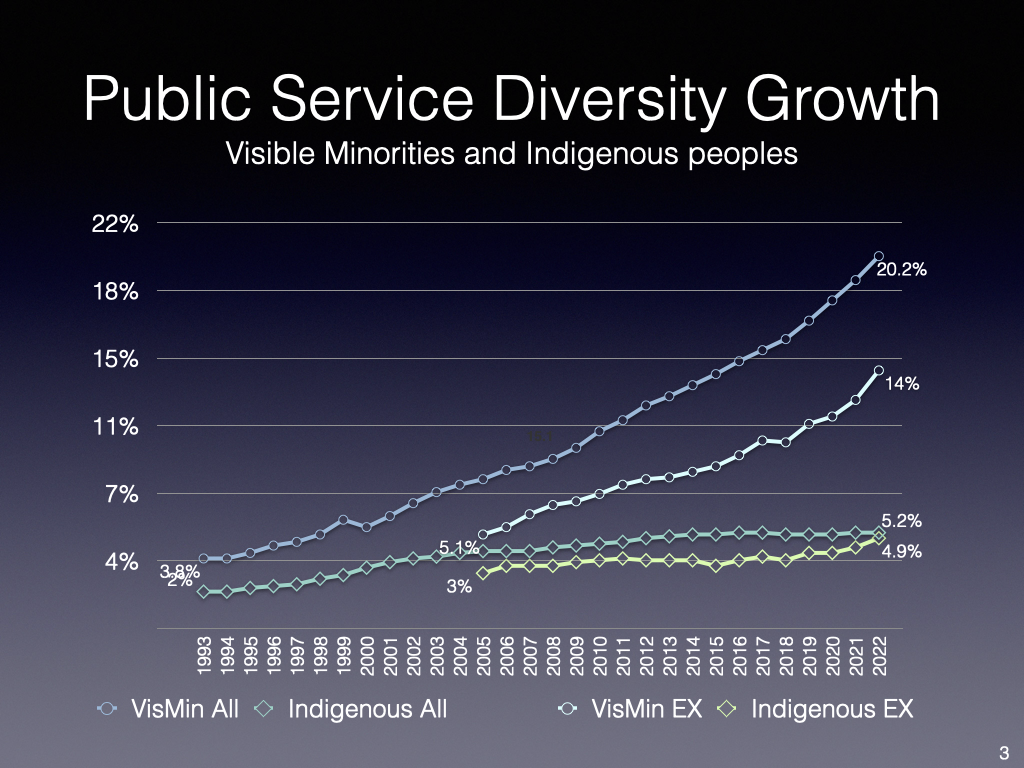
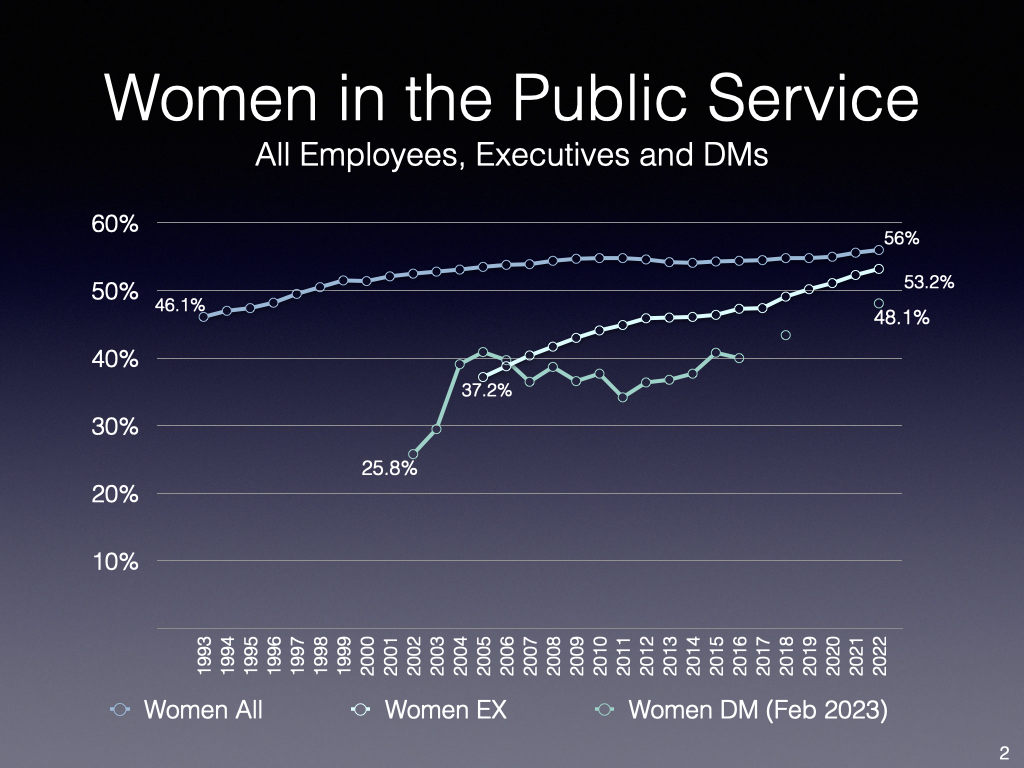
As you know, I have been looking for some time at how the diversity within the public service continues to evolve. The overall trend over the years demonstrates that the original policy objectives of improved diversity are being met but arguably too slowly for some.

For the past six years, TBS has provided disaggregated data for the various equity groups. In 2022, TBS also provided gender breakdowns within the disaggregated data. Following up on a suggestion from a member of Black Lives Matter, I looked at hiring, separation and promotion rates for visible minority and Indigenous groups, showing that visible minority representation is growing faster than non-visible minority, not indigenous, with a more mixed picture for Indigenous public servants.

When originally published by National Newswatch and subsequently posted on LinkedIn, the analysis received a range of commentary, ranging from this who appreciated the data and analyis to those who contested it. The latter ranged from those genuinely interested in discussing the approach I took while raising valid points (I learned more about disproportionately analysis), to those, “activists on a pension,” as we sometimes called them while working in the multiculturalism branch at Canadian Heritage.

The latter appeared to have not read the article or understood that I had used the same disproportionality approach to assess the differences between hiring, separation and promotion rates, highlighting the improvements over the past six years, particularly but not exclusively, for Black public servants. Media needs to be more careful in citing individual examples without this broader context (e.g., Sandra Griffith-Bonaparte has worked 22 years for the government. She’s never gotten a promotion):

Blogging break for a few weeks

Black Class Action Secretariat expressing sharp disapproval of new Canadian Heritage hire for multiculturalism, anti-racism

Suspect this is driven as much by the need to keep the organization and its issues in the public spotlight as substantive concerns. Not a political appointee unlike Amira Elghawaby, the special representative on combatting Islamophobia:

An organization working to eliminate systemic discrimination in Canada’s public service is concerned about a new hire for the Department of Canadian Heritage’s acting director general of multiculturalism and anti-racism.

Melanie Mohammed, a former leadership member at the Canadian Human Rights Commission (CHRC), took on the job at Canadian Heritage in April.

The Black Class Action Secretariat (BCAS) is expressing sharp disapproval of the decision to appoint Mohammed to the role, as the CHRC was recently found to have discriminated against its Black and racialized employees.

Mohammed’s hiring came less than a month after Treasury Board made a ruling that the CHRC, the mandate of which is to deal with complaints of discrimination, had itself breached the “no discrimination” clause of a collective agreement between the Treasury Board and the Association of Justice Counsel, the bargaining agent for approximately 2,600 lawyers employed by the government.

BCAS executive director Nicholas Marcus Thompson said last month that the appointment of Mohammed, who was the CHRC’s chief of staff, is “disturbing” and “reckless” as it sends a message to Canadians that there is no accountability or consequence for discrimination.

“If the government has moved an employee from an organization that was deemed to be discriminatory to now an even bigger organization to address anti-racism, it’s not only hypocritical, but it’s a farce,” Thompson said. “There’s zero credibility in this type of leadership.”

The role of the director general of multiculturalism and anti-racism is not only to provide funding to organizations led by Black and racialized people but to address racism and hate through federal multiculturalism and anti-racism strategies, including Canada’s Anti-Racism Strategy and the Federal Anti-Racism Secretariat.

“Employees report being harassed and facing retaliation from Ms. Mohammed after speaking up,” a statement from BCAS stated. “Therefore, it is completely unacceptable for the Government of Canada to appoint this individual as Director General of anti-racism for the entire government.”

This newspaper reached out to Mohammed, who declined to comment on the matter via her lawyer.

Dominique Collin, a spokesperson for Canadian Heritage, said in an email statement last month that the department was taking BCAS’ statement “very seriously” and was looking into the organization’s concerns.

“We remain committed to improving the experiences of Black public servants, but while progress is being made, we know there is still more to do to make our workplaces inclusive and equitable for all equity-seeking employees,” Collin said.

Canadian Heritage confirmed Monday that Mohammed remains in the position.

Thompson added last month that he’d like to see the prime minister take ownership of the issue, and re-affirmed his concern about the lack of accountability within the government in an address to the Senate last week regarding anti-Black racism, sexism and systemic discrimination in the CHRC.

“We have this vicious cycle within the federal public service where there’s no accountability, wrongdoers are often either transferred when it comes to discrimination or promoted,” Thompson told the Senate.

In its statement, BCAS called on the government to rescind Mohammed’s appointment and issue an apology. The group also urged the feds to appoint someone with no connection to CHRC’s leadership and who has demonstrated “an understanding of systemic anti-Black racism.”

BCAS said the appointment also speaks to the “urgent need” to transfer the Federal Anti-Racism Secretariat to the Privy Council Office in order for it to have independence and power to implement its mandate.

The organization also called for Mohammed’s appointment to the Federal Executive Leadership Development Program to be revoked and said it would like to see the government mandate that senior Canadian Heritage executives undergo anti-Black racism training and meet with Black employees and address their concerns within the department.

“This appointment is completely counter to the government’s promise and commitment to create a diverse and inclusive workspace that is free from discrimination and harassment,” Thompson said.

Source: Black Class Action Secretariat expressing sharp disapproval of new Canadian Heritage hire for multiculturalism, anti-racism

How Trump’s Anti-Immigrant Rhetoric Crushed Crowdfunding for Minority Entrepreneurs

Another interesting study. Words matter:

What does fearmongering about immigration have to do with crowdfunding new ideas on Kickstarter?

For Black, Asian, and Hispanic entrepreneurs, such rhetoric can undermine fundraising efforts, making it even less likely that new ideas will come to fruition, argues Harvard Business School Professor William Kerr. In a new paper, Kerr and his collaborators shed light on how discrimination affects fundraising, and ways crowdfunding sites, entrepreneurs, and investors can take action.

Minority business founders already typically face a fundraising disadvantage compared to their white counterparts, but that gap triples during periods of high public anxiety over immigration in the United States.

“WHEN THERE IS THE GREATEST ANXIETY, WE SEE THIS FUNDING SHORTFALL.”

Banks have historically rejected loan applications from Black, Asian, and Hispanic small-business owners at higher rates than for whites, according to Federal Reserve data, potentially driving some to alternative sources of capital, like Kickstarter and other crowdfunding sites. The pullback in support noted in Kerr’s research is national in scope, taking place in cities like Seattle and New York, with reputations as progressive bastions, as well as in more conservative-leaning locales.

“When there is the greatest anxiety, we see this funding shortfall,” says Kerr, the D’Arbeloff Professor of Business Administration. He cowrote the paper with John (Jianqui) Bai, an associate professor of finance at Northeastern University, and Chi Wan and Alptug Yorulmaz, associate professor and graduate research assistant, respectively, at UMass Boston.

Measuring fear during the Trump era

The paper looks closely at two different sets of data. The first is the Migration Fear Index, which counts the number of newspaper articles that include at least two terms associated with the debate over immigration, such as “migrant, asylum, refugee,” and “human trafficking,” as well as “anxiety, panic, bomb, crime, terror, worry, concern,” and “violent.”

Kerr and collaborators then compared the quarterly fluctuations of the Migration Fear Index from 2009 to 2021 to efforts by minority entrepreneurs to raise money on Kickstarter, which has raised $7.3 billion for popular projects such as opening restaurants and publishing comic books.

“YOU CAN COMPARE QUARTERS WITHIN THE SAME YEAR AND FIND THE CONNECTION BETWEEN THE HOSTILE RHETORIC AND GREATER DIFFICULTY IN FUNDRAISING FOR MINORITY CREATORS.”

The fear index surged when former President Donald Trump, with a barrage of anti-immigrant rhetoric, launched his first campaign in 2015, and continued speaking disparagingly of immigrants through his first year in office. Overall, minority entrepreneurs were less likely to meet their fundraising goals during periods like this of high anxiety over immigration, the study finds.

“You can compare quarters within the same year and find the connection between the hostile rhetoric and greater difficulty in fundraising for minority creators. You can also follow individual minority creators over time and see ups and downs in their rates of success,” Kerr says.

Certain groups feel it more

The heaviest impact was felt by groups that found themselves the most frequent targets of hostile rhetoric.

Hispanic entrepreneurs or creators suffered the sharpest pullback in support from financial backers on Kickstarter during the 2016 election cycle, while Chinese ethnic creators in the US faced a harder time meeting their financing goals during “episodes of Asian hate,” including Trump’s use of the phrase “Chinese virus” to describe COVID-19.

By contrast, while Black entrepreneurs had lower success rates overall in raising money, support did not fluctuate as dramatically with the ups and downs of the Migration Fear Index.

The paper finds that even during periods of low anxiety, minority creators are 2.4 percent less likely to achieve their fundraising goals on Kickstarter. But during periods of higher anxiety, minorities experience an 8.2 percent lower success rate.

Where and why it’s happening

Meanwhile, Kerr and his co-authors considered—then knocked down— several different theories for the decline in support, including the idea that funding support from minority communities may be pulling back during times of heightened tension around immigration or that creators might be posting different types of projects.

Rather, the evidence points to another hypothesis, that spikes in anxiety over immigration trigger a broader, nationwide retraction of support among backers of Kickstarter projects. Most backers are white, the study contends.

The decline in support for minority creators during increases in the Migration Fear Index are most pronounced in conservative counties. But Kerr and collaborators “also find sizable impacts in very liberal counties,” according to the paper.

“A majority of financial backers for typical Kickstarter campaigns live more than 50 miles away from the creator they support, tending to reside in big cities like Seattle and New York,” the researchers note.

Drawing lessons from the data

The report builds upon previous research on “systemic racial bias in entrepreneurial finance,” illustrating a “more direct” connection between shifts in public attitudes and struggles experienced by minority creators in raising money for new ventures, Kerr and his co-authors write.

Still, the study does not have data on potential backers who looked at pitches by minority entrepreneurs, only to take a pass on their proposals. That, in turn, made it hard to draw any conclusions on whether these decisions by white backers were driven by conscious racism, unconscious racism, or a combination of the two, according to Kerr.

However, there might be ways for Kickstarter and similar platforms to offset or at least mitigate some of these tendencies and trends.

Minority entrepreneurs are less likely to have projects promoted as “staff picks” on Kickstarter during period of hostile rhetoric, which is not the case normally. That is likely driven by the algorithms used, which tend to pick up on momentum, Kerr says.

Given this research, platform operators could keep an eye out for this trend and look at ways of compensating for it in the algorithm, Kerr explains.

“One of the hopes for crowd funding is that it will democratize access to capital from those previously excluded,” the authors write. “Prior work has shown that discrimination still exists on crowd-funding sites … we take a step further in understanding how minority creators can suffer acute funding shortfalls in moments when anxiety over immigration is high.”

Source: How Trump’s Anti-Immigrant Rhetoric Crushed Crowdfunding for …

Les experts avec un accent sont jugés moins crédibles

Interesting study:

Les accents étrangers influencent grandement l’opinion qu’on se fait des nouveaux arrivants et des experts, suggèrent les résultats d’une nouvelle étude. Le fait d’avoir un accent et d’être issu d’une minorité visible « entrave » la possibilité d’être perçu comme légitime, digne de confiance ou même crédible.

Cette étude confirme ainsi d’autres études au Québec sur les barrières à l’emploi et sur la « glottophobie », une forme de discrimination linguistique qui inclut l’accent. Il est déjà connu que la couleur de peau, la religion ou le genre des experts influencent l’opinion qu’on s’en fait. Cette fois, « le point de départ est la discrimination basée sur l’accent », précise le professeur Antoine Bilodeau. Il a notamment mené cette enquête avec son équipe de l’Université Concordia et en présentera les conclusions au congrès de l’Acfas cette semaine.

« On connaît bien le concept de minorité visible, mais beaucoup moins les minorités audibles », affirme ce spécialiste en science politique et en intégration des immigrants. Les résultats actuels montrent que le fait d’avoir un accent étranger, combiné ou non avec le fait d’être racisé, « entrave la possibilité » d’être perçu comme un expert légitime, digne de confiance et même crédible.

Les chercheurs ont demandé à 1200 personnes dans chacune des provinces d’évaluer la crédibilité d’un expert à partir d’une photo et d’un enregistrement audio. L’effet de l’accent est indéniable dans tous les cas de figure soumis au sondage, mais il n’est pas le même au Québec qu’en Ontario.

Chaque répondant au sondage ne voyait qu’une vignette, soit un homme blanc ou noir, puis entendait cette personne parler une seule fois des changements climatiques et de la taxe sur le carbone. Au Québec, cette voix avait soit un accent québécois, ou un accent de type Europe de l’Est ou encore de l’Afrique de l’Ouest (du Togo). En Ontario, c’était plutôt un accent anglophone assez neutre, puis les mêmes accents étrangers.

Ni la « provenance » de l’accent, ni le but de l’évaluation, n’étaient révélés au répondant, précise M. Bilodeau, « puisqu’on voulait que les gens interprètent eux-mêmes cet accent ». On demandait ensuite de juger la crédibilité de l’expert sous plusieurs angles : l’éloquence de son message, sa compétence et son professionnalisme. « Est-il convaincant ? Est-il digne de confiance ? », exemplifie aussi le professeur

Dépend de la conception du « nous »

Au Québec, l’effet de l’accent étranger était plus grand pour la personne non racisée. En Ontario, il était plus « punitif » chez l’expert racisé. « C’est peut-être là, la spécificité québécoise : la langue est tellement centrale que dès qu’on voit une personne blanche on s’attend à ce qu’elle ait le même accent », avance M. Bilodeau.

Il existe ainsi un « effet de surprise » qui contredit cette attente et affecte négativement la perception. Inversement, l’expert racisé avec un accent québécois est celui qui obtient le score le plus haut en termes de crédibilité.

Une minorité visible qui a ou adopte l’accent local est en quelque sorte « récompensée », selon ces résultats. « C’est comme si le fait qu’il ait un accent de la majorité [québécoise] venait désamorcer une anticipation de distance. Ça rapproche tout à coup le répondant de l’expert en train de parler », propose comme hypothèse le chercheur.

« Est-ce que c’est suffisant de parler français, ou faut-il le parler de la “bonne manière” pour faire vraiment partie du groupe ? », réfléchit M. Bilodeau.

L’étude allait justement plus loin pour mieux comprendre la réaction des répondants, selon leur propre conception de ce qui forme leur groupe d’appartenance. Il y avait ainsi une série de questions sur les critères importants pour être un « vrai Québécois » ou un « vrai Ontarien » : doit-on être né dans la province, avoir passé la majorité de sa vie dans la province, être blanc, être chrétien, se sentir Québécois ou Ontarien, respecter les lois, etc.

Ceux qui avaient une conception qui exclut davantage de gens sont réagissaient aussi le plus fortement à l’accent chez l’expert blanc au Québec.

Une forme trop socialement acceptable

« L’accent, on n’y pense pas ou on en parle moins », abonde en ce sens Victor Armony, professeur de sociologie à l’UQAM. Dans une étude qu’il a menée à l’Observatoire sur les inégalités raciales au Québec, l’accent figure pourtant au deuxième rang des raisons de discrimination citées par les répondants.

« Je partais d’une sorte d’énigme », décrit-il. Chez plusieurs populations, il persiste des écarts importants de revenus ou de postes pour les mêmes qualifications, même si elles ne sont pas des cibles « directes ou ouvertes » de racisme.

Il donne l’exemple des Latino-Américains : « Il y a parfois des préjugés favorables envers les latinos. On nous trouve chaleureux, on apporte une cuisine, une musique, la joie de vivre, etc. L’autre côté de la médaille : on n’est pas toujours pris au sérieux au niveau intellectuel ou professionnel », explique le chercheur.

Une personne qualifiée, avec un diplôme, « qui fait des efforts considérables pour parler français » et reçue sans hostilité préalable peut tout de même être dévalorisée en raison de son accent.

« C’est l’accent qui fait en sorte que le message devient irrecevable, moins intéressant et parfois laissé de côté », résume-t-il. Arrivé d’Argentine il y a plus de 30 ans, M. Armony l’a lui-même vécu. « C’est le regard moqueur, impatient, méprisant de l’autre qui finit par avoir un impact sur l’assurance, sur l’estime de soi ou dans le goût de s’exposer devant les autres même quand j’ai quelque chose à dire. Alors on finit par se taire et rester à sa place », explique l’homme.

La discrimination linguistique, notamment basée sur l’accent, aussi appelée « glottophobie » est plus insidieuse. « Socialement, la glottophobie n’est pas reconnue comme une discrimination. Alors elle peut servir de prétexte ou d’écran pour cacher une autre forme de discrimination socialement inacceptée », décrit quant à lui le sociologue Christian Bergeron.

À l’instar d’Antoine Bilodeau, mais dans un domaine différent, il note lui aussi une attitude différente selon la perception de soi-même : « Plus un locuteur pense détenir la norme, c’est-à-dire la bonne manière de s’exprimer en français, plus il a tendance à rejeter les autres manières de s’exprimer et parfois même à discriminerl’autre », dit ce professeur à l’Université d’Ottawa.

Plus sournoise ou moins affichée, elle peut néanmoins devenir une barrière réelle à l’emploi, rappelle M. Armony. « On va invoquer par exemple l’idée qu’on a besoin d’une personne qui a “un français parfait”, mais alors on confond la grammaire et la qualité du français du point de vue de l’accent », rapporte-t-il.

La Charte des droits et libertés de la personne du Québec ne nomme pas explicitement l’accent, mais plutôt la langue. Il est toutefois interdit de traiter différemment une personne ou d’avoir des comportements offensants et répétés à son égard en raison de son accent, indique la Commission des droits de la personne et de la jeunesse du Québec.

La France est allée plus loin en 2020, en adoptant une loi qui punit la discrimination fondée sur l’accent avec des peines allant jusqu’à trois ans d’emprisonnement et à 45 000 euros d’amende. « Les minorités “audibles” sont les grandes oubliées du contrat social fondé sur l’égalité », avait alors déclaré l’instigateur du projet de loi, le député Christophe Euzet, lui-même d’une région de France connue pour ses sonorités différentes de celles de Paris.

Source: Les experts avec un accent sont jugés moins crédibles

Schools survey: Non-German students more likely to ‘sit next to a …

Interesting study:

A study on children’s attitudes toward their classmates resulted in some surprising, and other not so surprising, findings.

Based on surveys of ninth-grade children (aged 14 to 15) in Germany, research led by Zsófia Boda at the University of Essex and Georg Lorenz from Leipzig University has found that classes that are ethnically diverse are more welcoming of refugee students.

That’s the unsurprising part.

What it also revealed, however, was that students who were born in Germany to German-born parents were the most likely to reject their refugee classmates, and the least likely to refer to them as friends.

Would you sit next to a refugee?

The study is based on the results of a national survey of 6,390 children in Germany in 2018, which asked the students who their friends were and who they would not want to sit next to in class. Most of the refugee students involved in the survey came from Syria and Afghanistan — the two main countries of origin of people seeking protection in Germany.

The results, published this week in the journal Nature Human Behaviour, showed that the refugee children had fewer friends and experienced more rejection than their non-refugee peers.

But in a more mixed or ‘high-diversity’ classroom, it was much less likely for a child to say they would not want to share a desk with a refugee or asylum seeker, and more likely that they would name a refugee student as a friend.

The research found that there are two processes at work here: In a classroom with a high proportion of ‘non-German’ children, you are more likely to get people who are accepting of other non-Germans, the researchers explained. But also, ethnic majority (i.e. second-generation German) students are less inclined to reject refugee peers if they are surrounded by diversity.

The study suggests that this finding – that more diversity does not lead to greater rejection by the ethnic majority group – is an important one, because it challenges critical views of multiculturalism.

A large proportion – about half – of refugees and migrants in Germany are under the age of 18.

These young people need more than just access to education. Having positive and supportive relationships with others their own age in turn leads to them achieving better grades at school and results in overall better health and wellbeing for minority students.

The study suggests that if you take these away, the educational success and psychological adjustment of refugee adolescents will likely be put at risk.

Barriers to acceptance

So what is it that is stopping students from accepting their refugee peers?

There are several possible reasons, the researchers behind the study say. One is language, which is often said to be a major barrier to integration. Traumatic experiences can also make it hard for young refugees to adjust.

Other explanations for refugees having lower levels of social integration or acceptance in the classroom include the fact that they are likely to have joined the class later when friendships between other students have already formed. There is also the dynamics of friendship groups, which often grow and develop between people of the same ethnic group.

Moreover, the study also points out that social integration is not a one-sided process: “[T]he attitudes and behaviors of peers [is] crucial,” it notes.

What should policy makers do with these findings which, taken at face value, seem to suggest that refugee students should attend schools that are already ethnically diverse?

If they were to take this approach, it might jeopardize refugee students’ language development, which usually benefits from having a high proportion of majority-ethnic children in the classroom.

Steering refugee children into diverse schools could also lead to segregation instead of integration, and that would not help in promoting positive attitudes between German and non-German students, the study suggests.

There are some concrete steps that could “mitigate the negative consequences of prejudice,” according to the researchers. They recommend that teachers and principals are made aware of the challenges and that they support integration by, among other things, encouraging cooperation and showing support for mixing ethnic groups.

With global forced migration having become a ‘megatrend,’ Boda and Lorenz argue promoting the social integration of refugees, including adolescents, will remain crucially important for the refugees themselves. According to them, it will also reduce negative attitudes and prejudice towards immigrants — a problem which is widespread in Western societies.

Source: Schools survey: Non-German students more likely to ‘sit next to a …

More Islamic lessons in Swiss schools? – SWI swissinfo.ch

Of note:

With a “Salam aleikum”, teacher Nimetullah Veseli greets the pupils of year four in the Kirchacker school building. Veseli stands in front of the six boys and six girls in the classroom in Neuhausen, Schaffhausen. Wearing jeans and a white shirt, he explains the Islamic religious teachings.

Imam Nimetullah Veseli gives confession-oriented Islamic lessons at the public school. Confession-oriented means that the children learn about their own religion, in contrast to the inter-faith lessons in most primary school.

Normally, these confession-oriented Islamic lessons take place in mosques. It is an exception that it is offered in a public school. Only ten Swiss schools offer such lessons.

Religious education with quality control

A recent study by the universities of Lucerne and Fribourg corroborates the advantages of this type of teaching: “The school is a neutral place,” says study director Hansjörg Schmid. This also means that children from different Muslim backgrounds receive lessons together.

In addition, more emphasis is placed on instructive elements of its study at the school. “The Islamic teachers are obliged to present their concepts to the school,” says Schmid. “This makes quality control possible.”

The director of the Swiss Centre for Islam and Society at the University of Fribourg, together with three other researchers, has examined all the Islamic instructions offered at schools. The study shows that once the lessons are up and running, the feedback is very positive. Generally the criticism and resistance comes beforehand.

Expand the programme – but how?

The study also shows that the lessons availability are strongly dependent on individuals. Most of the proposals came about as a result of initiatives by imams or Muslim religious teachers. “More stability would be important,” says study director Hansjörg Schmid.

The classes in Kreuzlingen could be a model for future programmes. There, various mosque associations, an interreligious working group and the local parishes have jointly set up Islamic instruction, and an association has taken over the sponsorship.

The study recommends expanding confession-oriented Islamic instruction in public schools. But who will pay for it? At present, the programme is supported by voluntary work as well as parental contributions or subsidies from mosque associations.

Broad-based teachings with trained teachers are lacking. In addition, there is another hurdle as in most cantons, teaching requires recognition under public law.

“Salam aleikum” in chorus

If a comparable religious education as that of the Christian national churches is to be developed, the Muslim communities would first have to be recognised. This is a lengthy process.

But Hansjörg Schmid says, “A lot is possible at the level of pilot trials.” He therefore advises trying out as much as possible at a low-threshold level – as in Neuhausen. There, Imam Nimetullah Veseli ends the lesson with “Salam aleikum”: “What does that mean?” he wants to know from the fourth graders. “Peace be with you and with you,” they answer in chorus.

Source: More Islamic lessons in Swiss schools? – SWI swissinfo.ch