How to tell when criticism of Israel is actually anti-Semitism – The Washington Post

A narrower and more focussed definition than the one adopted by IHRA (Working Definition of Antisemitism) and a number of governments:

So how can you tell the difference between anti-Semitism and anti-Zionism? Here are five useful markers.

Seeing Jews as insidious influencers behind the scenes of world events

On the left and the right, anti-Semitism often manifests in a nefarious belief in a worldwide Jewish conspiracy that wields outsize power. On the right, it’s “globalists” and “elites” who manipulate events. On the left, it’s “Zionists.” The terms may differ, but the fundamental conspiracy theory is the same. For example, after news broke that a private investigative firm made up of former Mossad officers had been digging up dirt on Obama administration officials who helped broker the U.S. nuclear deal with Iran, Columbia University professor Hamid Dabashi tweeted, “Every dirty treacherous ugly and pernicious act happening in the world just wait for a few days and the ugly name of ‘Israel’ will [pop up].” This language parallels the last ad of Donald Trump’s 2016 campaign, which flashed pictures of George Soros, Lloyd Blankfein and Janet Yellen while warning of a “global power structure” that had damaged the U.S. economy. In another case, when professor Steven Salaita was denied a tenured position at the University of Illinois after a series of anti-Israel tweets, he wrote: “Support for Israel . . . exists in sites of authority, often an omnipresent but invisible accoutrement to swivel chairs, mineral water, and mahogany tables.”

Also in this category is the theory, popular on the left, that Israeli trainers are to blame for racism and violence against people of color by U.S. police. (Durham, N.C., for instance, recently barred its police department from partnering with the Israeli police or military for training, citing this notion.) This includes insinuationsthat American Jewish organizations that help send U.S. police officers to Israel for counterterrorism training should be held responsible for the shootings of unarmed people of color. American police have used violence against marginalized people since long before Israel existed. White people have never needed Jews to teach them how to brutalize people of color on American soil. There are reasonable questions to ask about the content of training programs in Israel, but the suggestion — absent supporting evidence — that Jews bear guilt for U.S. police killings merely updates the old anti-Semitic trope that falsely accused Jews of managing the global slave trade .

Using the word “Zionist” as code for “Jew” or “Israeli”

“Zionism” denotes a movement, forged in the late 19th century and evolving ever since, for the existence of a modern Jewish state in the land of Israel. A Zionist, as I define myself, supports one or more of the many variations on this vision, which differ wildly in their political, religious and cultural emphases.

Critics of Israel sometimes use “Zionist” to assert a global power structure without specifically calling out Jews as its masterminds. After Salaita, the Illinois professor, also lost a position at the American University of Beirut, he wrote, “I was shocked that Zionist pressure could succeed in the Arab World.” The Nation of Islam’s Final Call newspaper asserts that “Zionist pressure ” will not stop Louis Farrakhan from continuing his anti-Semitic pronouncements, which have included calling Jews the “synagogue of Satan.”

The “Zionist” label attempts to reduce a state full of living, breathing humans to a simplistic political notion. It’s common for Palestinians and their supporters to refer to “Zionist occupation forces” instead of the “Israeli army,” or to the “Zionist entity” instead of “Israel.” At a demonstration I walked by this past week, protesters held signs mourning 70 years of “Israel,” in quotes.

One may disagree with the decision of the United Nations to recognize Israel decades ago, wish that the state had never come to be or aspire to the establishment of a binational state in its place without necessarily stepping into anti-Semitism. But refusing to call Israel or Israelis by their internationally accepted names denies the very existence of the state and its people’s identities. These coy linguistic tricks are as unacceptable as the right-wing penchant for denying the existence of Palestinians and Palestinian identity.

Denying Jewish history

As a means of rejecting the legitimacy of Israel, some stoop to asserting that Jews have no national history there — that they are, in other words, nothing more than European colonizers. For instance, the website Middle East Monitor referred recently to the “alleged Temple” in ancient Jerusalem (the ruins are still there). Palestinian President Mahmoud Abbas, likewise, resurrected the old canard that today’s Jews descend from Khazar converts in arecent and much-criticized speech.

The Jewish connection to Israel goes back millennia. After their expulsion by the Romans in 70 A.D., Jews continued to pray for a return to the land and to observe four fast days each year to mourn the exile. Zionism’s revolution came not in creating a new connection between Jews and the land of Israel, but in suggesting that a return to the land could be achieved through modern political means, rather than by waiting for the messiah.

Some critics also reduce Judaism to religion, in the mold of Western Christianity, rather than acknowledging our more complex sense of ourselves as a people with a history and an ancestral land, as well as religious and cultural practices. This includes dismissing Zionism as “white supremacy,” as the Chicago Dyke March did last year when its organizers argued that Zionism had no place in an anti-racist movement and that it “represents an ideology that uses legacies of Jewish struggle to justify violence.” Statements like these ignore the fact that, unlike most white people here and elsewhere, Jews have been subject to racially based discrimination — and that more than half of Israeli Jews are not Ashkenazi, meaning their families did not come from Europe.

Finally, disregard for Jewish history may take the form of using Nazi imagery to depict Israel or its army. This tactic cynically manipulates the greatest modern trauma of Jewish history to attack us, while minimizing the genocide of 6 million Jews. Israel may be violating its human rights obligations, but is not carrying out a Nazi-style extermination operation.

Dismissing the humanity of Israelis

In a conversation about terrorist attacks by Palestinians, one young activist told me, “I can’t judge how other people carry out their liberation movements.” Such lack of concern for Israeli lives is evident in failures to condemn rocket attacks against civilians, in the rejection of the term “terrorist” for anyone who acts against Israelis and in statements blaming Israelis for their own deaths. A movement motivated by concern for human rights requires caring about the dignity, well-being, concerns and self-determination of all people.

This means opposing the military occupation of the Palestinians, with its attending violence, as well as rejecting terrorism or rocket fire against Israelis. Human Rights Watch, which right-leaning groups often accuse of being anti-Israel, has modeled such an approach by regularly condemning Hamas for launching rockets at Israeli civilians. This approach also means standing with Israeli human rights leaders, who increasingly find themselves the targets of dangerous incitement by the country’s political leaders.

Assuming that the Israeli government speaks for all Jews

Rabbis who speak at rallies on domestic issues (the Trump travel ban, police killings, etc.) regularly tell me that audience members shout at them, “What about Palestine?” An explicit disavowal of a connection to Israel shouldn’t be a prerequisite for Jewish involvement in broader social justice issues, as has become the norm on college campuses and in many progressive spaces.

Imagine assuming that all Americans support President Trump’s policies, or asking Americans to expressly disown their own country before engaging in any international human rights campaigns. Reasonable people may disagree about Israeli policy, about nationalism or about whether the solution to the conflict should involve one state or two. But Jews who care about Israel — many of whom revile Netanyahu and his politics — should not be excluded from progressive spaces based on their answers to such questions.

Jews, along with other groups, must fight for human rights, in the United States and abroad. This work means insisting that Israel, like other countries, live up to its human rights commitments. The case can be made without bigotry and hate speech.

via How to tell when criticism of Israel is actually anti-Semitism – The Washington Post

Canadian government comes to the defence of Nazi SS and Nazi collaborators but why?

Good question:

In late April more than 50 members of the U.S. Congress condemned the government of Ukraine’s ongoing efforts to glorify “Nazi collaborators.”

The letter, signed by both Republicans and Democrats, outlined concerns about ongoing ceremonies to glorify leaders of the Ukrainian Insurgent Army as well as 14th SS Galizien Division (aka 1stGalician/Galizien or the 1st Ukrainian Division). “It’s particularly troubling that much of the Nazi glorification in Ukraine is government-supported,” noted the letter to U.S. Deputy Secretary of State John Sullivan. The letter was initiated by Democratic Reps. Ro Khanna of California and David Cicilline of Rhode Island.

Contrast that to how the Canadian government handled a related issue last year when the Russian Embassy in Ottawa tweeted out that, “There are monumets (sic) to Nazi collaborators in Canada and nobody is doing anything about it.”

A monument in Oakville commemorates those who served with the 14th SS Galizien Division. Another monument in Edmonton honors Roman Shukhevych, the leader of the Ukrainian Insurgent Army.

As my Postmedia colleague Marie-Danielle Smith discovered, the Russian tweet sent bureaucrats at Global Affairs Canada into overdrive as they tried to defend the SS unit and Ukrainian Nazi collaborators. Documents she received through the Access to Information law show government officials were under a lot of pressure from the “Centre” (the Privy Council Office and the Prime Minister’s Office) to counter the news about the monuments to Nazi collaborators. The bureaucrats came up with a strategy. The would label the tweet as “disinformation” and they came up with a plan to spread the word to the news media as part of their efforts to defend Ukraine’s Nazi collaborators.

Now as I have written before, the Russians are more than happy to try to embarrass the Canadian government, which has steadfastly stood behind the Ukrainian government in the ongoing conflict in the region. Suggesting that Canada allows monuments to Nazi collaborators seems to fit that bill.

But in this case the Russian tweets aren’t “fake news” or “disinformation.” They are accurate.

As those members of the U.S. Congress have pointed out, the Ukrainians who served in the SS Galizien Division were indeed Nazi collaborators.

So too was Roman Shukhevych.

Before going to the Ukrainian Insurgent Army, Shukhevych was commander of the Ukrainian battalion called Nachtigall. The men of Nachtigall rounded up Jews in Lviv in June 1941, massacring men, women and children. The Simon Wiesenthal Center estimates that the Nachtigall Battalion, along with their German military counterparts, managed to murder around 4,000 Jews in Lviv. Other historians put the estimate at around 6,000.

Shukhevych was later assigned to a new unit whose role in Germany’s war, according to one Holocaust expert, was “fighting partisans and killing Jews.” Shukhevych later turned against the Nazis.

Then there is the SS Galizien Division. They were eager Nazi collaborators. Some 80,000 Ukrainians volunteered to join the SS but only those who could meet the strict requirements were selected.

The SS used some of its most seasoned killers to oversee the development of its new division. SS Gen. Jurgen Stroop, who would later be executed as a war criminal for his brutal destruction of the Jews in the Warsaw Ghetto, was brought on as an advisor.

Other commanders of the division were all versed in the murder of Jews throughout occupied territories in eastern Europe. “Many of the Ukrainian officers, like SS- Haupsturmfuhrer Michael Brygidryr, had previously served in SS Schuma battalions, routinely used to kill partisans, burn down villages and, when the opportunity arose, murder Jews,” wrote award-winning author Christopher Hale in his 2011 ground-breaking book, Hitler’s Foreign Executioners.

SS Galizien Division was used by the Nazis in a variety of operations, one of the most controversial being the 1944 destruction of the village of Huta Pieniacka. Huta Pieniacka was considered a “Polish” village that just months before had been the shelter for several hundred Jews, Hale noted. The SS units surrounded the village. Men, women and children, who had taken refuge in the village church, were taken outside in groups and murdered. Kids were executed in front of their parents, their heads smashed against tree trunks, one witness testified. Others were burned alive in houses. Around 850 people were murdered.

Some Ukrainians dispute that the SS Galizien Division took part in the killings or they argue that only small elements from the unit – and under Nazi command – were involved.

A Ukrainian military board heard testimony in 1944 that members of the Galizien Division did take part in the attack. But that action was justified, the board was told since the inhabitants of Huta Pieniacka had been killing Ukrainian peasants. “By the way, the Jews were hiding in the village,” a Ukrainian officer added in his testimony describing the destruction of the village inhabitants.

Some Ukrainians see Shukhevych and SS Galizien Division members as heroes. They argue that those individuals served the Nazis because they saw them as liberators from the Russians. Their ultimate goal was an independent Ukraine.

But to claim that these individuals were not Nazi collaborators is something else. They served Hitler.

In May 1944, SS leader Heinrich Himmler addressed the Ukrainian SS recruits in a speech.  “Your homeland has become more beautiful since you have lost – on our initiative, I must say – the residents who were so often a dirty blemish on Galicia’s good name – namely the Jews,” said Himmler. “I know that if I ordered you to liquidate the Poles, I would be giving you permission to do what you are eager to do anyway.”

Himmler speech was greeted with cheers from the Ukrainian recruits.

Equally disturbing are the details contained in the book, The Holocaust Chronicle, published in 2003 and written by 7 top scholars in the field of Holocaust studies. They noted that Ukrainian SS were also sent to help kill Jews during the Warsaw Ghetto uprising. The Chronicle published a photo of two of Ukrainian SS members standing over the bodies of Jews murdered during that uprising. See the photo below:

But this issue of Ukrainian collaboration with the Nazis is not new. Since 1986 the Nazi-hunters with The Simon Wiesenthal Center have warned about efforts from those in Ukraine and in the Ukrainian community in Canada who want to deny involvement of the SS Galizien Division with the Nazis.

The Latvian government is also trying to use the “fake news” label to whitewash the reality of Latvian collaboration with the Nazis.

My colleague Scott Taylor has recently written several articles about the Latvian Legion (15th Waffen Grenadier Division of the SS (1st Latvian) et al) and Latvian killers like war criminal Herberts Cukurs as well as the members of the Arajs Kommando, who murdered an estimated 26,000 Jews.

According to Karlis Eihenbaums, Latvia’s Ambassador to Canada, Taylor is spreading “fake news” and “disinformation.” Eihenbaums has also tried to smear Taylor by suggesting that he is under the “influence” of the Russian government.

Taylor’s research into the Latvian SS Legion and the Latvian murderers of Jewish men, women and children is solid.  It is a well-documented historical fact that many of the killers from the Arajs Kommando went to the Latvian Legion. These Latvians served Hitler. No number of claims of “fake news” can change that fact.

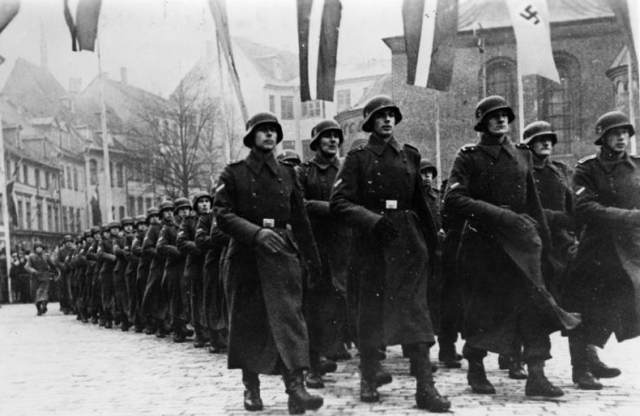
Photo below shows Latvian SS:

The controversy over the Latvian Legion and the annual parade held in Riga to celebrate these Nazi collaborators is well known and has been going on for two decades, long before the term “fake news” was even coined. In 1998 the parade caused a storm of protests around the world, particularly in Israel, where Holocaust survivors couldn’t understand Latvia’s desire to celebrate such ruthless killers. German Chancellor Helmut Kohl and French President Jacques Chirac were among those that year to protest the Latvian parade. The Times of Israel reported on this year’s Latvian SS parade in Riga, which took place mid-March.

So much for “fake news.” Did Helmut Kohl and Jacques Chirac spread “disinformation” when they denounced the SS parade in Latvia? Of course not.

This whole issue isn’t about “fake news” or Russian “disinformation.” It is about nations trying to whitewash their Nazi collaboration and rewrite history, while attacking journalists who don’t want to let that happen.

It is a positive development that members of the U.S. Congress could see through these efforts to glorify members of the SS. They are speaking out.

But in Canada, the federal government is more than happy to play along with defending Himmler’s SS divisions and Nazi collaborators.

What would our soldiers who fought during the Second World War to help rid the world of this scourge think about that?

Source: Canadian government comes to the defence of Nazi SS and Nazi collaborators but why?

Hungarian PM Accused George Soros of Fueling Anti-Semitism, MTI Reports – Bloomberg

Might be time for former PM Harper to reconsider his congratulatory message in his capacity as head of the International Democrat Union (IDU):

Hungarian Prime Minister Viktor Orban accused George Soros, the Jewish billionaire philanthropist who survived Nazi persecution, of fomenting anti-Semitism by helping immigrants come to Europe, MTI state news service reported.

Soros and his Open Society Foundations, which funds dozens of NGOs in Hungary, “bear responsibility for the increase in anti-Semitism in Europe,” Orban said in a letter to Ronald S. Lauder, the president of the World Jewish Congress, MTI reported Friday. Soros, 87, who eventually emigrated to the U.S. after World War II, said last year that Orban used Nazi-era propaganda methods to try to discredit him in a national billboard campaign.

Orban has built a border fence to keep immigrants out in a vow to protect Hungary from people he’s called “Muslim invaders.” In the letter, he said immigrants to Europe included those whose “political and religious views markedly increased the sense of insecurity in Jewish communities.”

Orban won a fourth term as prime minister last month and has become a ringleader for anti-immigrant populist forces in Europe. Open Society Foundations said this week that it was moving its staff from Budapest to Berlin, citing a government crackdown on NGOs.

via Hungarian PM Accused George Soros of Fueling Anti-Semitism, MTI Reports – Bloomberg

Nazi Salutes and Fascist Chic Put Ukraine’s Jews on Edge

Worth noting:

At the Bingo nightclub, a few hundred Ukrainian music fans were celebrating the anniversary of their favorite very white ultra-nationalist metal band, Sokyra Peruna. Some were teens, some looked like they were in their 40s. They were dressed up and tatted up with Nazi symbols, pagan spirit designs and emblems from the ongoing war in eastern Ukraine.

Some fans brought their children along. Smoke wafted over the stage, guitars rocked, and dozens of right hands straitened up in Hitler salutes as the band’s leader, Arseny Klimachev, roared out neo-Nazi lines he’s made famous in Ukraine’s capital: “Heroes of my race! Heroes of your race!”

The fans will tell you these rants and symbols, banned in Ukraine by law, are really just fashion statements, a part of their sub-culture. But the Jewish population of Ukraine, estimated to be more than 200,000, is more than uneasy about such demonstrations. To them, Hitler’s fans are not just lovers of heavy metal music, but one more manifestation of a hostile, increasingly powerful movement.

For decades both Russians and Ukrainians referred to their enemies as “fascists,” and caricatured enemies as Hitler. During Moscow’s conflict with Tbilisi in 2007 and 2008 Russian propagandists painted Hitler-style mustaches on the face of Georgian President Mikheil Saakashvili. Today millions of Ukrainians refer to Russian President Vladimir Putin as to “Putler”–you can even buy souvenir toilet paper that says that. But if Putin is as bad as Hitler, what are Ukrainian Hitler fans thinking?

Meanwhile, Kremlin officials insist that the pro-European Maidan movement was “fascist,” and that Ukraine is now ruled by neo-Nazi government. And, as if to confirm the Moscow line, dozens of far-right movements, groups, bands use Nazi symbols and praise Hitler’s violence against Bolsheviks, “the occupants of Ukraine.”

Just a few days before the 73d anniversary of the Allied victory over Nazism in World War II, Ukraine saw a march of ultra-nationalists who proclaimed that Odessa should be cleansed of Jews. At the rally, the head of the Right Sector in Odessa, Tatiana Soikina, said: “We are sure that we can put things in order, so Ukraine will belong to Ukrainians and not to Yids, not to oligarchs, glory to Ukraine!”

The march took place several days after the U.S. Congress sent a letter to the State Department describing the  “unacceptable” situation with anti-Semitism in here (PDF). It noted that Ukraine was “glorifying Nazi collaborators and made it a criminal offense to deny their ‘heroism.’” Among those Nazi collaborators the American members of congress cited Stepan Bandera, Roman Shukhevych, and the Organization of Ukrainian Nationalists (OUN) for killing Jews and Poles in the years from 1941 to 1945.

In fact, all those historical figures mentioned in the letter are seen by many in Ukraine as heroes, even though today Ukraine gets more support from Washington than ever.
Washington is selling Javelin anti-tank systems to Kiev to reenforce the Ukrainian army in the war against Russia-backed rebels in Donbas. The four-year-long conflict has taken more than 10,000 Ukrainian lives.

Far-right activists insist that every single anti-Semitic action has the Kremlin’s agents behind it, while representatives of the Jewish community want to see the conspicuous fans of Hitler put in jail.

“Anti-Semitism is rapidly growing all over Ukraine: Holocaust memorials are vandalized every week, while the opposition say President Petro Poroshenkois ‘a Jew,’ when they want to say that the president is bad,” says Eduard Dolinsky, the head of Ukraine’s Jewish Committee.

Dolinsky, a prominent public figure in Ukraine, monitors incidents of anti-Semitism. The Jewish Committee has demanded that the government and law enforcement agencies push for punishment of those professing Nazi ideology, but so far there has been none.

Dolinsky says he is upset that both Russian propaganda and some Ukrainian media outlets use his name and voice for political agendas as each tries to put the fascist brand on the other. “Our main intention at the Jewish Committee is not to allow history to repeat itself. Today in public opinion Jews seem to be to blame for political failures, just as it happened in Germany in 1930s,” Dolinsky told The Daily Beast.

Earlier this month, the deputy director of Lviv school Number 100, Mariana Batyuk, was fired after posting photographs of herself and her school students lined up and saluting, “Heil Hitler.” The teacher also posted Hitler’s portrait on her Facebook page with a caption: “He was a great man, whatever you say.”

A Ukrainian nationalist, Sergei Parkhomenko from the “Anti-Putin Information Front” insists that real Ukrainian patriots could not attack Jews. “Both Odessa activists and the Lviv teacher and those who vandalized Holocaust memorials must have been paid by either the Kremlin’s agents or those who want to discredit Ukraine,” Parkhomenko told The Daily Beast.

Far-right militia units recently marching across Kiev and promising to bring “order” to Ukraine sounded threatening, and not many people wanted to get in the way of muscled-up guys with black masks covering their faces.

“The other day I was invited to a round table at a TV show to debate with far-right politicians, I had the opportunity to bring two people with me, but all my friends were too scared to go,” Dolinsky told The Daily Beast.

Reporters of the Zaborona media (translates as “banned” media) group of Ukrainian journalists covering forbidden, censored and sensitive news, took photographs of young men slamming during the concert, pushing each other, showing off Nazi and Ku Klux Klan symbols tattooed on their naked torsos.

One of the fans went from one corner of the club to another unfurling his big Nazi flag. Anna Belous, a Zaborona reporter, told The Daily Beast.

“It is stupid to blame everything on the Kremlin. Officials should admit that we do actually have guys using Nazi symbols in Ukraine,” Yekaterina Sergatskova, the founder of the Zaborona project, told us. “Every year  thousands of people with far-right views participate in Povstanets festival, this is not a news.”

Last week President Petro Poroshenko condemned the increasing anti-Semitism as “unacceptable” in a post on his Facebook page. But the dance goes on.

Source: Nazi Salutes and Fascist Chic Put Ukraine’s Jews on Edge

ICYMI: After a massive refugee influx, Germany is confronting an imported anti-Semitism

Good balanced overview:

Bullied students. Crude rap lyrics. An ugly confrontation on an upmarket city street.

In another country – one less attuned to the horrors wrought by anti-Semitism – evidence that the scourge is once again growing might have been ignored.

But this is Germany, a nation that nearly annihilated an entire continent’s Jewish population. And after a series of high-profile incidents, the country isn’t waiting to sound the alarm on a pattern of rising hatred toward Jews.

In recent days, demonstrators have filled the streets, a first-ever national coordinator to combat anti-Semitism has taken up his post, and officials from Chancellor Angela Merkel on down have spoken out.

Germany is also doing something difficult for a country that sees itself as the open and tolerant antidote to the prejudice-driven murder machine it once was: acknowledging that the problem’s resurgence has been fueled not only by the far right, whose views have increasingly infiltrated the mainstream, but also in significant part by Muslims, including refugees.

“The nature of anti-Semitism in Germany is definitely changing,” said Sergey Lagodinsky, a member of the assembly of the Jewish community in Berlin. “We’re having a lot more violent, everyday confrontations that come through incidents with immigrants.”

That’s not an easy admission in Germany, where Merkel led the push three years ago to open the country to more than a million asylum seekers – many of them Muslims fleeing conflict. At the time, the move was widely seen, at least in part, as a grand gesture of atonement for the worst crimes of German history.

Since then, Merkel has rallied the nation around the slogan “We can do it,” brushing away suggestions that Germany will suffer for its generosity.

But she’s also been forced to concede the link between the new arrivals and creeping anti-Semitism. This month, she told an Israeli broadcaster that Germany was confronting “a new phenomenon” as refugees “bring another form of anti-Semitism into the country.”

That’s something critics have warned of for years, given that many of those who arrived in Germany came from nations where anti-Semitism is widespread, including Syria, Iraq and Afghanistan. But officials, analysts and Jewish and Muslim leaders all say Germany has been slow to recognize the risks.

“The cultural dimension that is linked with the influx was always underestimated,” said Felix Klein, who started work this month as the federal government’s point person for combating anti-Semitism. “Now we have to deal with it.”

The first step, Klein said, is to understand the scale. But the data is surprisingly limited, and what is available has been called into question.

Police statistics, for instance, show that about 90 percent of the anti-Semitic cases nationwide are believed to have been carried out by followers of the far right – traditionally the bastion of prejudice toward Jews in Germany.

But government officials and Jewish leaders doubt that figure, citing a default designation of “far right” when the perpetrator isn’t known. The government also has no reliable means of tracking anti-Semitism that falls below the level of the criminal – something Klein said he’s determined to change.

A survey of victims of anti-Semitism commissioned last year by the German Parliament concluded that Muslims were most often identified as the perpetrators. A separate study found comparatively high levels of anti-Semitic thinking among refugees with a Middle Eastern or North African background.

The number of reported anti-Semitic incidents in Germany has remained fairly steady over the past decade, at around 1,500 every year, although researchers think the actual numbers are much higher, said Uffa Jensen, a professor at the Technical University of Berlin. One recent survey found that 70 percent of Jews said they would not report an anti-Semitic incident because they feared the consequences.

Even if the overall numbers are relatively stable, the behavior behind the data has changed, said Josef Schuster, head of the Central Council of Jews in Germany.

“The incidents are more aggressive, more pronounced, and directly affect Jewish people with insults or attacks,” Schuster said.

German schoolchildren have reported the word “Jew” being thrown around as a taunt on the playground. Some have said they have been threatened with death.

“There are incidents that go so far that kids have to leave their schools because it’s no longer possible to stay. I can’t remember that happening in the past,” Schuster said.

Beyond the bullying, two high-profile instances of anti-Semitism have spawned outrage in recent weeks.

A German rap duo won the top honor at the country’s most prestigious music awards this month for an album that included lyrics boasting of bodies “more defined than those of Auschwitz inmates” and threatening to “make another Holocaust.” Amid a backlash, the awards program was terminated.

Meanwhile, cellphone video footage emerged of an assailant shouting anti-Semitic slurs and whipping a belt against a man wearing a kippa, or Jewish prayer cap. Police arrested a 19-year-old Syrian refugee in connection with the assault, which took place in the trendy Berlin neighborhood of Prenzlauer Berg.

“When I watched the video, I looked into his eyes. I don’t understand how a young man can be so filled with hate,” said Sigmount Königsberg, anti-Semitism commissioner for the Jewish community of Berlin.

Königsberg deals with hundreds of incidents each year and said a substantial majority of the cases involve an alleged Muslim perpetrator.

Far-right assailants are less common, he said. But that makes sense, if only for geographic reasons: Germany’s Muslim and Jewish communities are both concentrated in big cities, such as Berlin. Far-right supporters are more likely to live in the countryside.

The German far right has been emboldened lately, winning seats in Parliament last fall – the first time that’s happened since the 1950s. Authorities say elements of the far right have grown more vocal in their anti-Semitism. But they have been even louder in denouncing Muslims, capitalizing on resentment toward Merkel’s decision to let in the refugees.

Ironically, far-right politicians have used concerns about anti-Semitism to make their case against the refugees – a logic that many Jewish leaders reject.

“The world doesn’t revolve around Jews. If people are dying in Syria, you can’t let them die because you may face more anti-Semitism in a couple years,” said Lagodinsky, the member of the Berlin Jewish assembly.

Rather than bar refugees, Lagodinsky said, the solution starts with being more honest in talking about the problem – something he said mainstream German society is often afraid to do for fear of targeting a Muslim minority population that already feels under siege.

Aiman Mazyek, for one, welcomes the conversation. The president of the Central Council of Muslims in Germany emphasized that it’s only a small minority of Muslims who are taking part in anti-Semitic acts. But he said there is no doubt that some newcomers – and some who have been here far longer – have failed to integrate into a society that has put “Never Again” at its core.

“If people come here and want to integrate, they need to understand the DNA of the country. And part of that DNA is the legacy of the Holocaust,” he said.

Mazyek said it will take effort to educate people who may have grown up in countries where anti-Semitic rhetoric is rampant and others who may have been raised in Germany but who nonetheless feel drawn into “the unresolved conflicts of the Middle East.”

But he said there is also reason for optimism.

“Many of them came from countries where there was dictatorship, where they weren’t free. There’s the potential there for much more empathy when they visit a concentration camp,” he said.

Josh Spinner, an American-born, Berlin-based rabbi, said Germany also needs to keep its problems with anti-Semitism in perspective.

“There’s nowhere in Europe where there isn’t a sense of unease” among Jews, said Spinner, who is also chief executive of the Ronald S. Lauder Foundation, an education-focused philanthropic group.

German unease was reflected vividly this past week in a Berlin protest that drew about 2,000 people, who came wearing prayer caps. They listened as speakers warned of a rising threat and insisted that the country would not tolerate a return to its anti-Semitic past.

But Spinner said Germany still has it better than most places on the continent – in part because its past has taught it to be vigilant and aggressive in responding to signs of hatred.

Spinner said that he has walked Berlin’s streets wearing a kippa for years without any serious problems and that he will continue to do so. Warnings that Germany would become inhospitable for Jews after taking in so many refugees have, for the most part, not come to pass.

“Relative to the perceived threat, not much has happened,” Spinner said. “And that’s a relief.”

Source: After a massive refugee influx, Germany is confronting an imported anti-Semitism

Holocaust row: Abbas accused of anti-Semitism – BBC News

Not helpful:

Remarks by Palestinian leader Mahmoud Abbas about the Holocaust have been condemned as anti-Semitic by Israeli politicians and rights activists.

Mr Abbas told a meeting in the West Bank the Nazi mass murder of European Jews was the result of their financial activities, not anti-Semitism.

He described their “social function” as “usury and banking and such”.

Israeli Prime Minister Benjamin Netanyahu’s spokesman said the remarks were “anti-Semitic and pathetic”.

Michael Oren, Israel’s deputy minister for diplomacy, remarked in a tweet: “Mahmoud Abbas says money-lending Jews provoked Holocaust… Now there’s a peace partner.”

In New York, the Anti-Defamation League condemned Mr Abbas’s “anti-Semitic assertions”.

In its attempt to annihilate the Jews of Europe during World War Two, Nazi Germany murdered some six million of them, building death camps to expedite the mass slaughter.

Driven by fanatical nationalism, the Nazis regarded Jews as a threat to Germany’s “racial purity”.

What did Abbas say exactly?
He was addressing a rare meeting of the Palestinian National Council, the legislative body of the Palestine Liberation Organisation (PLO), in the West Bank town of Ramallah on Monday.

It was a rare meeting of the PLO’s legislative body

Carried live on Palestinian TV, the 90-minute speech in Arabic included a section on the Palestinian leader’s view of the history of European Jewry, based on what he said were books by “Jewish Zionist authors”.

Jews in eastern and western Europe, he said, had been periodically subjected to massacres over the centuries, culminating in the Holocaust.

“But why did this used to happen?” he asked. “They say, ‘It is because we are Jews.’ I will bring you three Jews, with three books who say that enmity towards Jews was not because of their religious identity but because of their social function.

“This is a different issue. So the Jewish question that was widespread throughout Europe was not against their religion but against their social function which relates to usury [unscrupulous money-lending] and banking and such.”

Mr Abbas also denied that Ashkenazi Jews – Jews from Germany and north-eastern Europe – were actually Semitic, saying, “They have no relation to Semitic people.” Ashkenazi Jews make up one of Israel’s biggest communities, giving the state a long line of prime ministers, including Mr Netanyahu.

It is not the first time the Palestinian leader’s views on the Holocaust have caused offence.

A student dissertation he wrote in the early 1980s argued there had been a “secret relationship between Nazism and Zionism” before the war, and appeared to question the death toll of six million.

He later played down allegations of Holocaust denial, saying in 2003: “The Holocaust was a terrible, unforgivable crime against the Jewish nation, a crime against humanity that cannot be accepted by humankind.”

How did the Anti-Defamation League respond?

Jonathan Greenblatt, chief executive officer of the ADL, which campaigns to “stop the defamation of the Jewish people”, dismissed the Palestinian leader’s “ahistorical and pseudo-academic assertions”.

“The Palestinian President’s latest diatribe reflects once again the depth and persistency of the anti-Semitic attitudes he harbors,” he said in a statement.

“With public speeches like these, it is not surprising that under Abbas’ leadership, the Palestinian Authority has failed to renounce and combat Palestinian anti-Semitic incitement, including narratives that Jews are to blame for the Holocaust and other anti-Semitic persecution, and which deny or diminish the millennial Jewish presence in and connection to the Land of Israel.”

via Holocaust row: Abbas accused of anti-Semitism – BBC News

My friend and Mid-East expert Arun recently posted on the Arte film, Israel-Palestine: one land, twice promised, link here, noting the balance and comprehensiveness of this two hour doc.

Articles on racism and discrimination that caught my eye

In terms of articles focussing on racism and discrimination, there was a mix of anecdote-based reports on the presence and impact of visible minorities (Immigration minister says he was target of racial profiling, calls on Liberals to fight racism, ‘We’re not immune’ on the Hill: Sen. Bernard launches Senate debate on anti-Black racism) and evidence (Indigenous, Black children over-represented in foster care and group homes, inquiry says, Experiences of violent victimization and discrimination reported by minority populations in Canada, 2014 – General Social Survey which I look forward to reviewing the data in more detail).

Commentary in favour of the anti-racism consults included Brittany Andrew-Amofah: Keep expectations high for antiracism consultations on the need to ensure meaningful results (some of which Budget 2018 addressed):

The plan to undertake these consultations deserves and requires scrutiny, but not because it may be designed to search for a racism that doesn’t exist (a possibility suggested by Globe and Mail Ottawa bureau chief Robert Fife during a CPAC interview). We should be scrutinizing the consultations to make sure that meaningful outcomes are actually achieved. We should expect to see, just to name a few examples, a ban on police carding on the federal level; targeted funding to fight Islamophobia and other forms of hate; tougher sentences for hate crimes; increased investments in housing, health and social programs; an accelerated plan for safe drinking water on all reserves; and stronger independent police oversight bodies for the RCMP and the Canada Border Services Agency.

The timing of these consultations is also significant. With a federal election coming in 2019, a tour to study systemic racism could be used as a ploy to engage and garner support from racialized and Indigenous communities, with no intention on acting on the information shared. The Liberals are lucky that much of the research has already been done, but that means we must set high expectations for policy changes following the consultations. If real change does not result, the time spent in consultations will be wasted and another opportunity will be missed.

The contrary argument that greater political power of African Americans is ineffective in improving outcomes is made here (Williams: Black political power means zilch), essentially ignoring the impact that political power had in reducing some institutional barriers and systemic racism:

Jason Riley, a fellow at the Manhattan Institute, tells how this surge in political power has had little beneficial impact on the black community.

In a PragerU video, “Blacks in Power Don’t Empower Blacks“, Riley says the conventional wisdom was based on the notion that only black politicians could understand and address the challenges facing blacks. Therefore, electing more black city councilors, mayors, representatives and senators was deemed critical.

…Riley says that the black experience in the U.S. has been very different from that of other racial groups. Blacks were enslaved. After emancipation, they faced legal and extralegal discrimination and oppression. But none of those difficulties undermines the proposition that human capital, in the forms of skills and education, is far more important than political capital.

Riley adds that the formula for prosperity is the same across the human spectrum. Traditional values — such as marriage, stable families, education and hard work — are immeasurably more important than the color of your mayor, police chief, representatives, senators and president.

As Riley argues in his new book — “False Black Power?” — the major barrier to black progress today is not racial discrimination. The challenge for blacks is to better position themselves to take advantage of existing opportunities, and that involves addressing the anti-social, self-defeating behaviors and habits and attitudes endemic to the black underclass.

As always, lots of antisemitism-related news, most notably France (‘Ethnic purging’: French stars and dignitaries condemn antisemitism), and the subsequent response by French Muslims (Accused of new anti-Semitism, French Muslims speak out) and Germany, where Rappers defend lyrics deemed anti-Semitic amid award backlash prompting Daniel Barenboim [to] return German music award in anti-Semitism row with the inevitable (?) result that Germany scraps music prize over antisemitism before ‘kippa march’).  As a show of public support, Germans of all faiths [participate] in ‘wear a kippa march’ against anti-Semitism. 

Some refreshing honesty from the former Anti Defamation League Director Abe Foxman (Former ADL Director: Trump has opened the ‘sewers’ of antisemitism.

John Ibbitson provides a thoughtful examination of the Canadian situation:

“The numbers stayed very high and are even up,” he said in an interview. “They’re not up as dramatically as they were last year, but they are higher than they were last year.”

An even bigger worry: While the lesser offence of harassment was the cause of the increase in 2016, in 2017 “the numbers of both violence and vandalism are up. The vandalism number is up quite significantly. It’s a serious proportional increase.”

But Ira Robinson, director of the Concordia University Institute for Canadian Jewish Studies, isn’t so sure. His book A History of Antisemitism in Canada, which was published in 2015, concluded that anti-Semitic activity in this country had greatly declined in recent decades. He continues to monitor the situation, and believes there has been no significant increase, despite what B’nai Brith says.

“In terms of the type of stuff that I see, it’s very much the same,” he reports. “There is very little new under the sun.”

Twenty-first-century anti-Semitism is in part a by-product of both right-wing and left-wing populism. Both groups detest globalization, which they blame for lost jobs at home. From there, it is only a small, noxious step to conjure a globalist Jewish conspiracy.

“The negative impacts of globalization are often laid at the feet of Jews and this global Zionist conspiracy,” said Barbara Perry, a sociologist at the University of Ontario Institute of Technology who specializes in hate crimes. “… It’s scarily similar from the left and the right, in that respect.”

Unfortunately, some Muslims harbour anti-Jewish thoughts, an import from their home countries. More often, though, Muslims and Jewish people are equally victims of racial hatred.

There is even an anti-Semitic variant that claims “Jewish privilege” contributes to systemic racism − though there is evidence that anonymous propaganda to that effect comes from the right, disguised as being from the left.

Anti-Semitism sometimes wears the mantle of anti-Zionism. But while criticism of the Israeli government’s treatment of Palestinians is entirely legitimate, the hate-filled rants that often accompany the BDS (boycott, divestment, sanction) movement, which depicts Israel as an apartheid state, are anti-Semitism cloaked in righteousness.

Too often, tensions between Israelis and Palestinians in the Middle East produce anti-Zionist screeds in Canada that can result in attacks on Jewish people. “Local, national and global effects come into play,” Prof. Perry observed.

If the rise of populism coincides with, and might contribute to, rising anti-Semitism, then the absence of a populist wave in Canada is encouraging. But this country is not immune from such waves. Mayor Rob Ford in Toronto begat Ontario Progressive Conservative Leader Doug Ford, his brother, who could well become a populist premier − although I am not suggesting in any way that Mr. Ford harbours racist sentiments of any kind.

But anti-Semitism can just as easily be found on university campuses as at right-wing rallies. It is present on the fringes of social democracy as well as conservatism. Elizabeth May has struggled to expunge it from the Green Party.

These are not harmonious times. Hatred of Jewish people is on the rise. It may be on the rise in Canada as well.

Vigilance.

Source: John Ibbitson: Could anti-Semitism be on the rise in Canada

Lastly,  J.K. Rowling Gave A Master Class In Identifying Anti-Semitism And It Was Magical:

“Most UK Jews in my timeline are currently having to field this kind of crap, so perhaps some of us non-Jews should start shouldering the burden,” she said. “Antisemites think this is a clever argument, so tell us, do: were atheist Jews exempted from wearing the yellow star? #antisemitism.”

Rowling’s head-smacking was almost audible as she sorted through responses to that tweet, including one that said arguing against anti-Semitism was “culturally insensitive” to Muslims.

“When you only understand bigotry in terms of ‘pick a team’ and get a mind-boggling response,” she said.

She also reacted with impatience — attaching a GIF of an exasperated Hugh Laurie — when someone argued that Arabs can’t be anti-Semitic because they are Semites. “The ‘Arabs are semitic too’ hot takes have arrived,” she said.

Split hairs. Debate etymology,” she said in a tweet attached to a definition of anti-Semitism as “hostility to or prejudice against Jews.” “Gloss over the abuse of your fellow citizens by attacking the actions of another country’s government. Would your response to any other form of racism or bigotry be to squirm, deflect or justify?”

The shame of antisemitism on the left has a long, malign history: Philip Spencer

Good historical context:

So, we’re back to the “Jewish Question”? The current antisemitism crisis on the left has not come out of nowhere. Instead, it has its roots in a tradition on the left itself, which, at best, has always had difficulty in responding swiftly to antisemitism and, at worst, excused or condoned, even promoted it. It is not, of course, the only tradition on the left, but unless we understand this history, we won’t get very far in resolving today’s crisis.

We need, above all, to think about why some on the left have always seen Jews as a problem and why they have helped the idea of a “Jewish Question” to re-emerge with such potency. At root is the thought that if antisemitism exists, it must have something to do with how Jews supposedly behave. That supposed behaviour may be described in different ways – sometimes it has an economic character, sometimes a social one, sometimes a political one. But what is common is the idea that Jews are to blame for antisemitism and that to protest against them is understandable, or even necessary.

This first became a serious problem on the left in the late 19th century, as antisemitism first became a political force in the modern world. Some on the left flirted with the response that there might be something progressive about antisemitism: that it was a kind of anti-capitalism, however crude, which could be harnessed to the socialist cause. They also thought that philosemitism was more of a problem, because it supposedly encouraged Jews to make too much of (or even fabricate) antisemitism and to resist assimilation. One criticism of this approach at the time was to call it the “socialism of fools”, a problematic formulation because it suggested that antisemitism was still some kind of socialism.

As antisemitism was radicalised by the Nazis – it no longer being enough to exclude Jews when they should be wiped off the face of the Earth – this way of thinking made it difficult for too many on the left to prioritise solidarity with Jews. Neither the Social Democrats nor the Communists in Germany made opposition to antisemitism a major issue, nor did the Resistance across Europe. The fear was that to highlight the fight against antisemitism would alienate potential supporters. This is not to ignore some wonderful examples of solidarity, though the repeated invocations of Cable Street can give a misleading picture. The Communist party soon switched to loyally supporting the Hitler-Stalin pact, which effectively delivered large numbers of Jews up to the Nazis.

When the Soviet Union was finally forced to fight the Nazis, the suffering of Jews was deliberately and repeatedly downplayed. But after the war, things got much worse. The Soviet Union not only suppressed knowledge of what had been done to Jews but launched its own vicious antisemitic project, one that would have culminated in another genocide had Stalin not died.

This campaign matters because it was around this time that some key elements of today’s antisemitism on the left were first formulated. The charge laid against Jews then was that they were cosmopolitans and Zionists. This may seem like a bizarre contradiction: how can one, after all, be both a cosmopolitan and a Zionist? But what connected them is the idea that Jews are a problem, that as cosmopolitans they are more loyal to each other across national borders and, as Zionists, are loyal to another, foreign state. The charge of cosmopolitanism is heard less frequently these days, though one finds echoes of it in the idea that Jews are responsible for the evils of globalisation. The charge of Zionism, though, has now become absolutely central to today’s version of the “Jewish Question”. What began as a Stalinist cry was taken up in some on the New Left, which helped shape the world view of Jeremy Corbyn and many of his supporters.

For both Stalinists and that part of the New Left, Zionism is a racist ideology that pits the interests of Jews against the interests of everyone else. Furthermore, the state of Israel is an integral part of the western imperialist power structure that exploits and oppresses the rest of the world and the Palestinians in particular, whose land Jews have plundered and colonised and whom they keep in a state of permanent subjugation.

The Soviet Union formulated its approach within the context of the cold war, when it often appeared to support anti-colonial, national liberation struggles, although only for strategic reasons. Those on the left who (rightly if often too uncritically) supported those struggles, especially in Vietnam, where the Americans were so clearly the enemy, slipped fatally, however, into embracing this anti-Zionism into their world view, even though the Israel-Palestine conflict had such clearly different roots.

At the same time, they found it unbearable to acknowledge what was glaringly obvious – that the establishment of the state of Israel was profoundly connected to the Holocaust, which had changed everything for Jews. To integrate anti-Zionism into an anti-imperialist, anti-western, anti-American world view therefore also meant either denying or (better) reinterpreting the Holocaust. Holocaust denial is not an accidental feature of today’s antisemitism, but it is more common to downplay what happened to Jews as Jews. So the Holocaust has to be thought about only in universal terms, as only one genocide among many and one that supposedly excludes the others. (Actually, of course, it is the other way around: thinking about the Holocaust helps people think about other genocides.) Indeed, some have gone further. Not content with accusing Israel of being like apartheid South Africa, it is supposedly guilty of genocide itself… against the Palestinians.

If such purported behaviour makes people antisemitic, it is understandable and part of a fundamentally progressive view of the world, which can be harnessed to the cause. We are back then to where we started, with Jews as the problem, only with this difference: what was previously attributed to Jews inside nation states is now attributed to the Jewish state on the international stage.

There has always been, though, another tradition on the left, which has never accepted the very idea of a “Jewish Question”. What it understands is that there is a question of antisemitism; that Jews are not responsible for antisemitism but antisemites are; that Jews are not a problem but antisemites are. Antisemitism is not something that should be excused or condoned. It has to be fought wherever it shows its face, even – and sadly now more than ever – when that face is on the left.

Jeremy Corbyn concedes Labour has failed to address antisemitism problem | The Guardian

Certain blindness to have let this issue fester for so long:

Jeremy Corbyn has issued his strongest condemnation of antisemitism so far as he came under intense pressure from his own backbenchers and the wider Jewish community over his failure to tackle antisemitism in the Labour party.

He was forced to step up his response during the day after an extraordinary open letter was published on Sunday night by the Board of Deputies of British Jews and the Jewish Leadership Council (JLC), accusing him of “siding with antisemites” and calling for supporters to stage a show of solidarity outside parliament as the parliamentary Labour party held its weekly meeting on Monday evening.

At the PLP meeting, backbenchers denied there was any kind of coup attempt. Wes Streeting MP, often a critic of Corbyn’s, said: “No one’s calling for a leadership election. We just want leadership.”

The pressure from backbench MPs began building on Friday when Luciana Berger challenged Corbyn over supportive comments he posted to the artist behind an antisemitic mural. It came to a head on Monday morning when John Mann, chair of the all-party antisemitism group, tweeted that the Labour party “ceases to have a reason for existence if it cannot stand up against discrimination and racism”. He said the party was “rotten to the core”.

His criticism was backed by the veteran former minister Dame Margaret Hodge, who said Corbyn had allowed himself to become “the poster boy of antisemites everywhere”.

As hundreds gathered at Westminster, including dozens of Labour MPs and peers, and a small group of rival demonstrators from Jewish Votes for Labour, Corbyn issued a “sincere apology” that acknowledged that his previous responses had been inadequate.

“I recognise that antisemitism has surfaced within the Labour party, and has too often been dismissed as simply a matter of a few bad apples,” he said on Twitter.

“This has caused pain and hurt to Jewish members of our party and to the wider Jewish community in Britain. I am sincerely sorry for the pain which has been caused, and pledge to redouble my efforts to bring this anxiety to an end.”

Corbyn’s previous apology merely recognised that there were “pockets” of antisemitism in the party. That was rejected as inadequate by Jonathan Goldstein of the JLC, who said the Labour leader had become a figurehead for antisemitism.

Speaking at the solidarity protest outside parliament, the former Labour MP Gillian Merron, who is now chief executive of the Board of Deputies, said Corbyn had only made concessions because he had been forced into it by their actions.

“People here are angry and sad,” she said. “Nobody dreamt they would be in this position. The Jewish community has had enough and we are joined in that feeling by many many people inside and out of the Labour party.”

Later, Louise Ellman, who is a former chair of the Jewish Labour Movement, told BBC Newsnight it was “unprecedented” that the mainstream Jewish community had to take to the streets to protest at antisemitism in a mainstream political party.

In the second letter, Corbyn expressly apologised for failing to study the content of the antisemitic mural in the East End of London before posting supportive comments to its artist.

Jewish leaders claimed in their letter, released on Sunday night, that the controversy proved the Labour leader “cannot seriously contemplate antisemitism, because he is so ideologically fixed within a far-left worldview that is instinctively hostile to mainstream Jewish communities”.

Countering the charge, Corbyn says in his letter: “While the forms of antisemitism expressed on the far right of politics are easily detectable, such as Holocaust denial, there needs to be a deeper understanding of what constitutes antisemitism in the labour movement. Sometimes this evil takes familiar forms – the east London mural which has caused such understandable controversy is an example.

“The idea of Jewish bankers and capitalists exploiting the workers of the world is an old antisemitic conspiracy theory … I am sorry for not having studied the content of the mural more closely before wrongly questioning its removal in 2012.”

In a much more nuanced recognition of the forms that antisemitism can take, the letter also accepts that anti-Zionism and antisemitism have become conflated.

“Criticism of Israel, particularly in relation to the continuing dispossession of the Palestinian people, cannot be avoided. Nevertheless, comparing Israel or the actions of Israeli governments to the Nazis… and using abusive phraseology about supporters of Israel such as ‘Zio’ all constitute aspects of contemporary antisemitism.”

He also promises that the party will implement in full the “overdue” recommendations of the Chakrabarti report,which was published nearly two years ago.

Andy McDonald, the shadow transport minister, insisted that action would be taken. He pledged to speed up the “far too slow” complaints process. He was unable to say how many complaints had been successfully dealt with.

via Jeremy Corbyn concedes Labour has failed to address antisemitism problem | Politics | The Guardian

A related article on the extent of antisemitism in the UK (CST report):

The Community Security Trust (CST), a charity that works with Jewish community organisations and police forces, recorded 1,382 anti-Semitic incidents in 2017 – the highest total ever.

Of these, 145 incidents were classed as “assaults” – up from 108 the year before. But the most common type of incident was “verbal abuse directed at random Jewish people in public” – being shouted at in the street.

Meanwhile, almost one in five incidents involved the use of social media.

One tweet sent to a Jewish charity appeared to show a rollercoaster above a concentration camp. Another social media user posted messages saying “Hitler was right”.

The CST said there had been three incidents involving damage to, or desecration of, a Jewish cemetery; eight involving stones or bricks being thrown; and eight involving eggs being thrown at property.

The charity also cited improvements in the reporting of anti-Semitic incidents – but said it believed there was still “significant under-reporting”.

Anti-Semitism incidents chart

Earlier this month, the former Chief Rabbi Lord Sacks told the Jewish News newspaper: “Any political party has to adopt a zero-tolerance to anti-Semitism. If they fail to do so, they are a danger not only to themselves but to the country and all inhabitants.”

Lord Sacks has previously said that anti-Semitism is an ancient hatred and a contemporary warning sign that community relations within a culture are endangered.

It is why the Jewish community is inviting members of other faiths, and of none, to join in the chorus: “Enough is Enough.”

Source: http://www.bbc.com/news/uk-43542305

Anti-Semitism in Germany: Are immigrants unfairly portrayed in the media? | DW

Good nuanced exploration of the issues and discussions:

There’s hardly a more explosive issue in Germany than the question of anti-Semitism among Muslim immigrant communities and in particularly the more than 1 million migrants and refugees who have arrived in the country since 2015. On Friday the director of the Simon Wiesenthal Center in Los Angeles, Meyer H. May, told a German newspaper that such anti-Semitism was spreading like a “tumor” in Germany.

May is by no means the first Jewish leader to make this claim, but is the situation really that bad? To better understand the issue, I went to a day of discussions, hosted by an initiative to inform journalists about migration issues, with experts, social workers, refugees and a member of a Jewish sports club in Berlin.

Empirical figures on the phenomenon are hard to come by. Definitions of what qualifies as anti-Semitism vary wildly, and it’s often difficult to tell whether anti-Semitic acts that are criminal in Germany — for example, painting a swastika on a synagogue wall — are committed by Muslims, right-wing extremists, or individuals or groups motivated by some other form of anti-Jewish aggression.

What struck me most was the skittishness of people charged with combating Muslim anti-Semitism, particularly in Berlin’s schools, with regard to their description of it as a Muslim problem. The experts were at pains to counter the idea that Germany had “imported” a “new” anti-Semitism. Hostility to Jews was a wider social phenomenon, they argued, and by no means were all Muslims anti-Semitic.

Fighting anti-Semitism in times of right-wing populism

Sina Arnold, the co-author of one of the few academic studies on the phenomenon, characterized the anti-Semitism she found among refugees she interviewed as “fragmentary.” Anti-Jewish stereotypes were common, she says, but it was extremely rare for refugees to view the entire world through the lens of anti-Semitism.

“What we’ve seen is that with the migrants of the past few years, people have entered the country who have anti-Semitic attitudes — as do some people who are already here,” Arnold told DW. “Not all of the migrants, but many of them. Many of them come from countries like Syria, in which an anti-Zionism that bordered on anti-Semitism was part of state ideology.”

Arnold was quick to add that attempts to combat such attitudes should not “tar-brush” Muslims with racist stereotypes and that the sort of anti-Semitism found among migrants and refugees is not new to Germany. Equating Islam with anti-Semitism is a tactic used by the far-right populist Alternative for Germany (AfD) party.

But surely the situation Germany currently faces is new, I thought, if only because this is the first time Germany has taken in over a million largely Muslim new arrivals in such a brief span of time. That fact alone means that measures to prevent anti-Semitism need to be tailored to this specific new audience.

“Prevention efforts always have to be targeted at groups,” said historian and rabbi Andreas Nachama. “For instance it makes a big difference if you’re talking to 20- or 60-year-olds. It makes no sense to put everyone in the same boat. We’ve had a different input in the past few years.”

Prevention or political correctness?

Don’t point fingers. Try to teach people to embrace multicultural values instead of teaching them not to embrace anti-Semitism. Those are two of the guiding principles of the Kreuzberg Initiative against Anti-Semitism, or KIGA, named after the heavily Muslim Berlin district where it is located. The group trains teachers, conducts workshops in schools and contributes to the political-education “welcome classes” refugees receive after arriving in Germany.

KIGA co-founder Aycan Demirel defines one of its main purposes as trying to prevent the radicalization of Muslim youths. At the same time, he warns against overreacting, telling the story of a school that was so alarmed at a very young Muslim boy using the word “Jew” as an insult that a series of authorities that led all the way up to public prosecutors were called in to consult on the case.

When it comes to understanding prevention and education methods, it’s very difficult for journalists to form their own opinions. Schools confronted with anti-Semitism incidents are understandably publicity-shy, and it would require a raft of parental consent forms for KIGA to take a reporter along with them to witness their work with schoolkids, who are still minors. Much of the fight against anti-Jewish hatred takes place away from the eyes of the fourth estate.

Hostility and hope

The conflict between Israelis and Palestinians complicates relations between Muslims and Jews in Berlin

It is impossible to quantify the level of anti-Jewish sentiment among Berlin Muslims, but it’s clear that there is hostility. At the same time, hatred is by no means the only response in what is a very heterogeneous community. Those two conclusions were born out by the other participants at the open day.

Evgeni Abramovych, from the Jewish sporting club TuS Makkabi Berlin, described football matches with heavily Muslim teams as being far more aggressive than with other opponents. Racist insults and spitting, he said, were not infrequent occurrences. On the other hand, Abramovych also told of Muslim clubs that had approached TuS Makkabi to play friendlies in a gesture of solidarity.

Sandy — a 25-year-old refugee from Syria who came to Germany in 2014 and who teaches in welcome classes for more recent arrivals — acknowledged that some of her compatriots did hold anti-Semitic views. But she also said that she had never encountered such attitudes in her interactions with new Muslim arrivals as part of the KIGA Discover Diversity program.

Sandy and her fellow Syrian refugee Samer both speak German and use their participation in KIGA projects to learn more about their new country and pursue their interest in politics, which began back in their homeland.

via Anti-Semitism in Germany: Are immigrants unfairly portrayed in the media? | Germany| News and in-depth reporting from Berlin and beyond | DW | 24.03.2018