Holocaust Museum Director Faces Rising Anti-Semitism – The Forward

Good, thoughtful interview:

Sara Bloomfield joined the United States Holocaust Memorial Museum in its early stages, years before the project turned into one of the nation’s most visited landmarks on the National Mall in Washington.

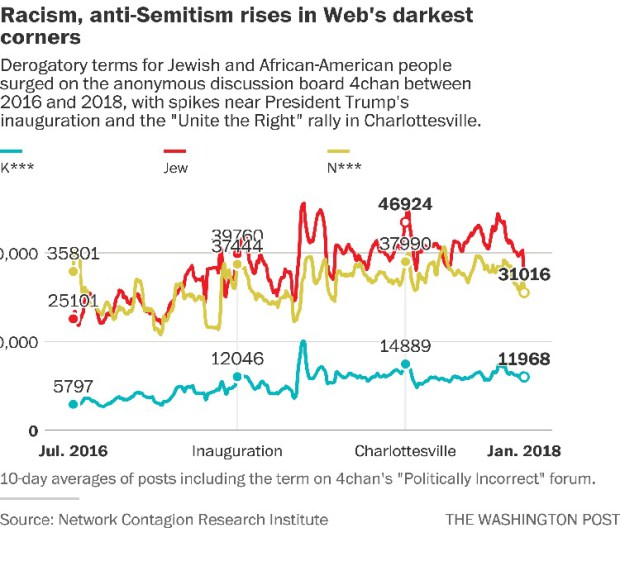
Now, after serving as director of the museum for 18 years, Bloomfield, 67, is tasked with leading the institution during a time when anti-Semitism is on the rise in America, and when political forces are slow to condemn manifestations of racism.

In the past year, the Holocaust museum has found itself stepping into the debate over the response to white supremacist marches and speaking out against acts of vandalism directed at Jewish institutions. At the same time, it has entered another political minefield after issuing, and then retracting, a report critical of the Obama administration’s response to the Syrian civil war.

Bloomfield talked with the Forward’s Nathan Guttman about these developments and how the Holocaust museum has responded.

Nathan Guttman: How do you see the responsibility of the Holocaust museum in light of the wave of anti-Semitism America is experiencing?

Sara Bloomfield: There’s no doubt we’re experiencing a resurgence of anti-Semitism in the United States and in Europe and in the Middle East. The most important thing we can do right now is to get our message about Holocaust education to an even broader audience and reach people that we’ve never reached before, whether they are in the United States, Europe or the Middle East. We want people to look, not just at the fact that the Holocaust happened, but what made it possible. And obviously anti-Semitism is key to that. Another important lesson we as Holocaust educators have here is not only about what happens when anti-Semitism goes unchecked — obviously the Holocaust being the ultimate example of that — but also Holocaust history teaches that the hatred started with the Jews, but it did not end with the Jews. That’s a very important lesson for all societies in all times, but obviously we’re experiencing a unique moment in American and world history right now.

Does the fact that young Americans were marching in the streets of Charlottesville, Virginia, chanting “Jews will not replace us” indicate a failure of the Holocaust education system?

Anti-Semitism has been appropriately called “the longest hatred.” That it never really goes away, that it will always be around, that it’s a very convenient explanation. If you look at Nazism, the Jews became the simple answer to complex questions. They were the perfect scapegoat to their problems. I think Jews will always serve that role, unfortunately. Anti-Semitism never goes away, because it serves this useful function in times of great fear and huge dislocation and change. So, I’m not optimistic that anti-Semitism will ever be eliminated; I think it’s an ineradicable disease. I don’t think the Holocaust museum alone can end this problem, but I think we’re an important institution that must contribute to the addressing of it. I think we must always be vigilant.

It’s very shocking. I don’t want to minimize what we’re seeing, but for us, Charlottesville wasn’t only shocking, it was a moment to educate the public on the historical significance of what happened in Charlottesville. They were chanting “Blood and soil”; I don’t think many well-meaning Americans understood what that meant. But if you study Holocaust history you understand exactly what that means. It was an opportunity for us — what do they call it? A teachable moment.

Has your work become more difficult, given the questions of anti-Semitism and Holocaust denial that became intertwined in the political debate?

I’ve been at the museum 31 years and a lot has changed in America, and my observation is that the Holocaust transcends partisan issues. Everybody recognizes that it is a moment of utter failure in human history that we must all learn from, and I think that’s why there’s a Holocaust museum on the National Mall, because people believed that this was such an unprecedented event in Western civilization, it happened in a country that was highly educated and had a democratic constitution, and yet, look what happened there. So this is a lesson, certainly about what happened to the Jews of Europe, but this is also a lesson for humanity that is timeless. We were timeless when we opened 25 years ago, we’re very timeless today and I believe we will be timeless in 25 years, because I always say “The world always changes, but human nature never does.”

Do you feel constricted by politics when speaking out about Charlottesville, about anti-Semitism in the political campaign?

There is no place in American society for neo-Nazism, absolutely no place in this society, and we’ve said so after Charlottesville, and we also issued a second statement because within 48 hours after Charlottesville, the Holocaust memorial in Boston was vandalized. There was a trend and we were concerned about that trend. We don’t issue a lot of statements, we’re very careful and judicious because we realize we’re a memorial for the victims and we want to use that voice very, very carefully, and I’m not sure I remember a time when we issued two statements so closely, but we felt that at that moment we had to speak out twice.

We’re educators, we’re not advocates. We believe that education is the important way to get people to understand the consequences of unchecked anti-Semitism, of what Nazism really wants, what are the historical roots.

Another political issue the museum found itself involved in was the report about the Syrian civil war. What is the lesson you have drawn from this experience?

Our goal was to generate a constructive conversation on the Syrian catastrophe. It became clear to me early on that we really missed the mark on achieving this goal because our study was conceived to be politicized, it was insensitive to the victims. I deeply regret that. So the minute I saw it was clear we are not achieving our goal, I said we have to take the study down and we have to reassess it and we’re in a reassessment process. We had a miss here and we have to look at what went wrong with our process; we need to engage more stakeholders internally and externally, but I’m very committed we will learn from this experience. We are not going to be deterred from our work on Syria. We have an exhibit opening in November and we will move forward.

I think about Elie Wiesel and his vision for the museum, which was to try to do for victims today what was not done for the Jews of Europe, and we won’t be complacent in that, we will continue to work on it. I feel badly that we missed the mark on this, but we will not let it deter us, and we will learn from it.

via Holocaust Museum Director Faces Rising Anti-Semitism – The Forward

Holocaust-denying prof reinstated at University of Lethbridge – The Canadian Jewish News

Questionable decision but appears that investigation ongoing (B’nai Brith appears to have been overly political in their initial reaction compared to CIJA):

The University of Lethbridge has reinstated a professor who had been suspended more than one year ago for questioning the Holocaust and suggesting there was a Zionist connection to the 9/11 terrorist attacks.

Anthony Hall, a tenured professor in the university’s globalization studies program, was reinstated following a hearing before a labour arbitrator.

Published reports stated that the university’s board of governors and the faculty association issued a joint statement saying that issues concerning Hall’s activities will be addressed in a faculty handbook.

Contacted by The CJN, the faculty association stated that, “It’s a personnel matter and its confidential.”

Hall was originally suspended in October 2016 over his Holocaust denial and conspiracy theories. At the time, the university issued a statement saying, “From the findings of that assessment, the board has decided to proceed with a complaint to the Alberta Human Rights Commission against Dr. Hall for publishing statements, alone and in collaboration with others, that could be considered hateful, contemptuous and discriminatory.”

The faculty association contested the suspension and, following a court decision in September, an arbitrator was appointed and a hearing was held earlier this month.

B’nai Brith Canada slammed Hall’s reinstatement and blamed the government of Alberta for passing legislation that brought faculty under the province’s labour-relations laws.

“Premier (Rachel) Notley and her government bear direct responsibility for placing a discredited conspiracy theorist back in a university classroom,” said Michael Mostyn, CEO of B’nai Brith Canada. “We repeatedly warned the government of the likely outcome of its actions, but they sadly chose to ignore our warnings and expose Alberta university students to anti-Semitism and discrimination instead.

“Despite this setback, we expect the University of Lethbridge to continue fighting anti-Semitism on campus, and to do whatever it takes to ensure that Hall has no podium for his unhinged anti-Semitic nonsense.”

In an email cited in a news release by the Centre for Israel and Jewish Affairs (CIJA), Premier Notley stated, “There is no question that the views of this individual are repulsive, offensive and not reflective of Alberta. Our classrooms are a place for freedom of speech and expression but that does not mean individuals get to stand at the head of the class and spread lies and conspiracy theories. I am terribly disappointed to learn that this individual has been reinstated, but let me be clear that legislation that our government introduced did not give him his job back. I can confirm that this individual is now under investigation by a committee at the university.”

For its part, CIJA stated that Hall’s reinstatement was “a direct result of an agreement between Hall, the faculty association and the university. We have also confirmed that Hall will not be teaching or interacting with students. He is continuing to be investigated by the university and his future is far from certain.”

via Holocaust-denying prof reinstated at University of Lethbridge – The Canadian Jewish News

George Soros decries Hungary’s Orban for anti-Semitic attacks

Speaks for itself:

Hungarian-born billionaire George Soros is denouncing a propaganda campaign waged against him by the government in his native country.

Soros, whose political views are in stark contrast to Budapest’s ruling Fidesz party, said Monday he had been targeted by an administration “stoking anti-Muslim sentiment and employing anti-Semitic tropes reminiscent of the 1930s.”

In a statement published on his website, Soros also rejected seven statements in a “national consultation” orchestrated by Prime Minister Viktor Orban’s government, which claimed he wanted to settle at least 1 million migrants a year in Europe and pay them each thousands of euros.

The Hungarian prime minister has often vilified the Jewish-born investor, whose ideals are squarely at odds with Orban’s view that European culture is under an existential threat from migration and multiculturalism. Orban has previously described Western liberalism as “spiritual suicide” for Central Europeans.

‘Lies and distortions’

Orban launched a nationwide television and billboard advertising campaign in July accusing Soros of devising Europe’s refugee crisis. Critics of Orban’s drive to condemn the 87-year-old investor said posters were not dissimilar to the anti-Semitic imagery of the 1930s, which portrayed Jews as political manipulators.

Meanwhile, the Fidesz party sent out 8 million letters to Hungarian citizens last month, attempting to provide further detail about Soros’ alleged political agenda.

Soros responded publicly for the first time Monday and said attacks from Hungary’s government contained “lies and distortions” that were designed to create an “outside enemy.”

via George Soros decries Hungary’s Orban for anti-Semitic attacks

Austria accepted its Holocaust guilt. So why is its far right on the rise? | Jewish Telegraphic Agency

Good long read:

When it comes to the Holocaust, Austria has made a lot of progress assuming responsibility.

In recent years, Austrian officials have consistently acknowledged their country’s support of Adolf Hitler, an Austria native, and his war of annihilation against Jews. In the early 2000s, the government dropped the claim that the country was mostly a victim of German Nazism, citing “the special responsibility imposed on Austria by its recent history.” Instead, teaching about the Holocaust has become mandatory, with visits to former death camps and teacher training in Israel.

The government has paid nearly $1 billion since 2005 in compensation to Holocaust victims, and since 2012, Holocaust memorial projects have popped up at an unprecedented rate. They include the opening of a learning center at the Mauthausen former death camp, a monument for Vienna’s deported Jews and an international exposition, commissioned by the national railway firm, on its own role in murdering some 65,000 Austrian Jews.

Yet in spite of this increased sensitivity, nationalism still has a firm grip on Austrian society: The far-right Freedom Party, which was founded in 1956 by a former Nazi SS officer, is on the rise. In last month’s national elections, the party garnered 26 percent of the vote with a platform that included denouncing “forced multiculturalism, globalization and mass immigration.

As a natural ally of the center-right People’s Party, which won the most votes, the Freedom Party is poised to enter Austria’s government for the second time — it was part of the governing coalition in 2000.

Amid the ascendancy of far-right populism across Europe, its revival in Austria is seen as particularly alarming, as it suggests a failure by society to learn from its recent history. After all, if a country that does nearly everything “right” when it comes to Holocaust education can fail to inoculate itself to the kind of hatred that makes genocide possible, what hope is there for other countries in the region, such as Hungary and Poland, which face rising nationalism amid complicated reckonings with their own Holocaust legacies?

Experts on Austria say the rise of its xenophobic far right is connected to fears over Muslim immigration, as well as a perceived need to protect the nation’s sovereignty from an increasingly interventionist European Union. But it’s also connected to the Austrian government, which deflected its guilt for decades and failed to purge Nazi supporters from positions of influence.

Unlike neighboring Germany, Austria did not have an organized, judicial denazification effort in the aftermath of World War II — in fact, no one has been convicted of Nazi war crimes in Austria in more than 35 years.

“In Germany, and quite a few of the countries that were under Nazi occupation, many people involved in Nazism were convicted or at least not permitted to be civil servants, teachers, police officers, etc.,” said Tina Walzer, a Vienna historian. “But this has never happened in Austria and we are witnessing the results of this crucial difference.”

This has entrenched populist ideas in a way that has seemed resistant to increased Holocaust awareness.

“When you look at the population as a whole, you don’t feel there has really been a change,” said Milli Segal, founder of the newly opened For the Child museum in Vienna honoring the young Holocaust refugees who fled to Britain through an arrangement known as the Kindertransport.

“Well, there’s change, but in very, very small steps,” she added after a pause. “It makes you feel voiceless.”

Many in Austria share Segal’s feeling of powerlessness over the Freedom Party’s recent successes. Its strong showing last month follows an even greater electoral feat in last year’s presidential elections in which the party’s candidate, Norbert Hofer, won 49.7 percent in the first round of voting. Hofer lost in the second round to the left-leaning candidate Alexander Van der Bellen, 53 percent to 46 percent.

The close election indicates that far-right populism is a “ticking political bomb,” warned Barbara Wesel, a senior Europe correspondent for Germany’s Deutsche Welle broadcaster.

The Freedom Party, for its part, rejects claims that it plays on Nazi and other racist sympathies. Party leader Heinz-Christian Strache has vowed to kick out members caught engaging in racist rhetoric, and has indeed done so to a former lawmaker who supported online the assertion that “Zionist money-Jews worldwide are the problem.”

The Jewish Community in Vienna considers the Freedom Party a racist entity, according to Oskar Deutsch, the community leader, who has called on Chancellor-elect Sebastian Kurz to prevent the Freedom Party from reaching power.

“It’s a facade,” Deutsch told JTA of Strache’s statements against anti-Semitism and racism. “Despite this talk, they position themselves as the go-to address for people with Nazi sympathies.”

A case in point: On Nov. 9, when the outgoing chancellor, Christian Kern, spoke in parliament to commemorate the 79th anniversary of Kristallnacht — a series of pogroms that the Nazis carried out in Germany and Austria — the Freedom Party’s lawmakers were the only ones who demonstratively did not applaud.

“These subtle signs are how they signal and excite their supporters,” Segal said. “If the Freedom Party will be part of the government, it will become difficult to commemorate the Holocaust in the same dignified way that we have now in Austria.”

The dissonance between Austria’s Holocaust commemoration efforts and the far-right’s popularity can be unsettling.

On Oct. 19, for example, a Vienna city official inaugurated a Holocaust memorial installation outside the Herminengasse subway station, near an alley in which the Nazis imprisoned hundreds of Jews during the war. From there they were taken to be deported as non-Jewish locals watched from their balconies. The inauguration ceremonies were held during election season; nearby hung a giant poster of a smiling Strache bearing the slogan “Fairness.”

Does the party’s recent success suggest that such commemoration projects are ultimately failing to make a difference politically?

“You might say so,” Deutsch said. “But the Jewish community will not remain silent.”

To Efraim Zuroff, a hunter of Nazis and historian for the Simon Wiesenthal Center who is based in Israel, the success of the far right in Austria reflects how Holocaust commemoration projects in urban areas hardly reach people who live in smaller towns — the Freedom Party base.

“Holocaust education, which only recently really began developing in Austria, happens there in pockets — in the big cities, in the artists’ scene,” he said. “It has big visibility but isn’t penetrating the way it has in Germany, where the effort was much more robust.”

Zuroff said this has a lot to do with Austria’s failure to prosecute Nazis.

“Holocaust education efforts in Austria are having limited impact because they are done in two voices,” he said. “There was a belated admission of guilt by politicians. But the judiciary, whose work sends a much stronger message in society, was a total failure.”

To some activists against racism, the Freedom Party’s rise is motivation to invest even greater efforts in Holocaust commemoration.

The far-right’s success in Austria “only strengthens our resolve,” said Brigitte Prinzgau, an artist who designed the newly inaugurated Aspang Railway Station Memorial, near where 47,035 Austrian Jews were dispatched from Vienna to death camps. “Now educators and artists will make even more monuments confronting fascism and xenophobic populism.”

via Austria accepted its Holocaust guilt. So why is its far right on the rise? | Jewish Telegraphic Agency

B’nai Brith Canada condemns rash of pro-Nazi postering in B.C.

Another disturbing incident:

B’nai Brith Canada has condemned the actions of whoever put up anti-Semitic posters and chalkboard drawings at the University of British Columbia over the Remembrance Day weekend in Vancouver.

On Nov. 11, the student newspaper called the Ubyssey reported that the entrances to the War Memorial Gym were plastered with posters glorifying Nazi Germany.

One poster touts Nazi soldiers as the “true heroes of WW2” and offers links to hateful websites. Another bore a swastika and described Nazism as “anti-degenerate.”

The posters were found Saturday, the same day the school hosted Remembrance Day ceremonies.

Philip Steenkamp, vice-president of external relations for the University of B.C. — said campus security took down the posters as soon as they were made aware of them, and that the university takes incidents of hate and racism very seriously.

Two days earlier, on the anniversary of Kristallnacht or the “night of broken glass” on Nov. 9, 1938 in Germany — the night violence broke out against Jews which resulted in thousands of businesses and synagogues trashed and looted — a chalk drawing was found in the UBC forestry building with a “Heil Hitler” message.

RCMP investigated both incidents, but could not find any suspects, said UBC RCMP Const. Kevin Ray.

“Once again, we see anti-Semitism and neo-Nazism raising their ugly heads at a B.C. university,” said Michael Mostyn, chief executive officer of B’nai Brith Canada.

A neo-Nazi poster put up at the University of British Columbia just before Remembrance Day. (The Ubyssey)

“These disturbing incidents constitute a threat to Jewish students and other minorities on campus, as well as an unforgivable insult to Canadian veterans who made the ultimate sacrifice to defeat Nazi tyranny.”

Earlier in November, posters targeting Jews were found at the University of Victoria.

Publicity around the removal of those posters was followed by a “tidal wave” of hateful comments on social media, according to anti-racism activists, who fear the far-right rallies seen this summer in Charlottesville, Va. — which saw similar posters plastered around many U.S. universities — may be emboldening racists in Canada.

via B’nai Brith Canada condemns rash of pro-Nazi postering in B.C. – British Columbia – CBC News

U.S. Congress split over whether criticizing Israel constitutes antiSemitism – Haaretz.com

Expect we would have similar divisions if there were hearings on an antisemitism definition, and how it applies to criticism of Israel and Israeli policies:

A U.S. House of Representatives committee heard tough exchanges between proponents and opponents of a bill that would codify a definition of anti-Semitism that incorporates a controversial component addressing attacks on Israel.

The nine witnesses appearing Tuesday at a meeting of the House Judiciary Committee were split: Five among those said the proposed addition to federal anti-discrimination statutes is a necessary means of stemming anti-Semitism on campuses, and four who argued it infringes on speech freedoms. The law if enacted would apply to Title VI of the 1964 Civil Rights Act, which addresses institutions — including universities — that receive federal funding.

The witnesses at times directly addressed one another, violating congressional protocol. Barbs were exchanged, with each side questioning the bona fides of the other in defining anti-Semitism. In a bizarre twist, the coauthors of the language that the bill would codify argued opposing viewpoints.

Lawmakers — who also bickered at times — marveled at the Jewish family food fight they were witnessing.

“It’s like throwing a ball and having a scrum and seeing who wins,” Rep. Doug Collins, R-Ga., said.

At issue is the Anti-Semitism Awareness Act — a version also is under consideration in the Senate — which would codify the State Department’s definition of the phenomenon, which is used by diplomats to identify the problem and report on it.

Top officials of the Anti-Defamation League, the American Jewish Committee, the Simon Wiesenthal Center and Christians United for Israel advocated for the proposed statute, as did Paul Clement, a former U.S. Solicitor General. Opposing were two Jewish studies professors, the director of PEN America –  a speech freedom umbrella, and the head of an outfit that combats anti-Semitism.

Representing the American Jewish Committee, which backs the bill, was Rabbi Andy Baker, the AJC’s director of International Jewish Affairs. Ken Stern, who in 2004 when both he and Baker were employed by AJC  drafted the language in question,  now directs the Justus & Karin Rosenberg Foundation, which combats anti-Semitism. Stern opposes codifying the language into law, although he still endorses the language for its intended use, as a means for diplomats to identify anti-Semitism.

The language, in its current State Department formulation, includes a section that defines as anti-Semitism language that “demonizes” Israel. It breaks down the term “demonizes” as: “Using the symbols and images associated with classic anti-Semitism to characterize Israel or Israelis, drawing comparisons of contemporary Israeli policy to that of the Nazis, blaming Israel for all inter-religious or political tensions.”

In his testimony, Stern said that the tough standards he would apply in assessing whether a speech at the United Nations by Iran’s president was anti-Semitic should not devolve onto college freshmen. He said it would be especially cruel to young Jews still testing their boundaries within the community.

“Whether or not you can be an 18-year-old anti-Zionist and within the (Jewish) community is not a debate Congress should decide,” he said.
Proponents said that the bill would not inhibit speech because the definition would only be applied when assessing whether a Title VI-banned act — violence or a bid to shut off speech — was anti-Semitic, and not to anti-Semitic speech in and of itself.

“It wouldn’t raise First Amendment problems, it would only be triggered by harassment,” said Clement.

That, Stern said, was “disingenuous” — a federal statute would naturally inhibit speech. “When you prioritize a certain definition it has the weight of having Congress behind it,” he said.

Barry Trachtenberg, a Jewish studies professor at Wake Forest University in North Carolina, seemed to accuse proponents of the legislation of bad faith. “They are part of a persistent campaign to thwart scholarship, debate, and activism critical of Israel,” he said.

The Simon Wiesenthal Center’s Rabbi Abraham Cooper and the ADL’s Jonathan Greenblatt fired shots at Trachtenberg, and at Pamela Nadell, the president of the Association for Jewish Studies, saying that academics were not in the trenches. Cooper chided the committee for inviting them. “It’s like inviting people from the Flat Earth Society to a hearing about NASA,” he said. Greenblatt mocked them as being ensconced in an ivory tower.

Cooper seemed visibly uncomfortable, crowded next to Trachtenberg at the witness table, who kept staring at him. Cooper kept emphasizing that the Jewish leadership in its entirety backed the bill, seeming to sideline Stern’s organizational affiliation. At one point Cooper’s insistence that the entire Jewish community backed the bill drew a correction from Rep. Jerry Nadler, D-N.Y., who produced a letter from J Street U, the liberal Middle Eastern lobby’s campus affiliate, opposing the bill.

via U.S. Congress split over whether criticizing Israel constitutes anti-Semitism – U.S. News – Haaretz.com

Anti-Semitism’s Rise Gives The Forward New Resolve – The New York Times

Interesting account of how Trump and the rise of the extreme right and antisemitism has given new life to an old publication (as in the case of the NYTimes and Washington Post):

The Forward has chronicled the experiences of Jews in the United States for 120 years. Initially published as a Yiddish-language lifeline for those who fled hatred and strife in Europe, in recent years it had to work harder to stay relevant to a community now largely assimilated, finding new stories to tell about transgender rabbis, the challenges of interfaith marriage and even the “secret Jewish history of The Who.”

Then came 2016, and a sudden clarification of its mission that would be strikingly familiar to the publication’s founders: covering the rise of public displays of anti-Semitism.

“There’s something different happening now,” Jane Eisner, The Forward’s editor in chief, said in a recent interview in her office, where a photo of the publication’s founder, Abraham Cahan, peered from the wall. “And here I’m speaking not just as a journalist, but as a close observer of the American Jewish scene. I feel it’s my responsibility as a writer and editor to illuminate that for people.”

Since the summer of 2016, about a year before The Forward went from being a weekly newspaper to a monthly magazine, it has beefed up its coverage of the so-called alt-right; assigned a reporter to go to white nationalist rallies like the one in Charlottesville, Va., in August, which featured chants like “Jews will not replace us”; and pursued more investigative reporting.

The latter effort led to The Forward’s report in March that claimed that Sebastian Gorka, a national security spokesman for the Trump administration until resigning in August, was a member of Vitezi Rend, a Hungarian nationalist group with a history of Nazi collaboration. The coverage has helped give The Forward a more than 60 percent lift in both donations and web traffic over the last year, according to Rachel Fishman Feddersen, the publisher and chief executive of The Forward, and Michael Sarid, the chief development officer.

“They bring what no one else can sell, and they can bring it and bring it, day after day,” said Ken Doctor, a news industry analyst. “They delve into things that are really in the background for others.”

According to the Anti-Defamation League, there was a 34 percent increase in anti-Semitic incidents in 2016 compared with the year before, and an 86 percent increase in the first quarter of 2017.

The Forward’s staff has firsthand experience. Ms. Eisner said the threats directed toward the staff during the presidential race — often through emails or social media — had invoked Holocaust imagery like gas chambers and included images of the anti-Semitic meme Pepe the Frog.

“These are not creative people,” said Dan Friedman, the executive editor.

Still, “to some staff members, it was a little terrifying,” Ms. Eisner said at the publication’s Financial District headquarters, several blocks from The Forward’s birthplace on the Lower East Side.

The threats were serious enough that Ms. Feddersen decided to add more security measures, including a third door that requires an ID to pass through before reaching the office. When threats are made, The Forward now has a set process on how to report them to the police and the F.B.I.; the whole staff has gone through emergency drills.

“We really took it seriously, and it wasn’t fun,” Ms. Feddersen said. “It was not why anybody gets into this business. But that comes with the job, so we kind of have to do it.”

It was especially jarring for The Forward’s roughly 25-person editorial staff of mostly young journalists, for whom anti-Semitism in the United States had been something on the fringes that could be easily ignored — a generation that, in Ms. Eisner’s words, “grew up in Obama’s America” and took inclusion as a given. But it can be jarring even for Ms. Eisner, 61, who recalled recently walking by a church around the corner from her home on the Upper West Side that rents space to a synagogue, and seeing swastikas drawn on it.

“I’m written about on neo-Nazi blogs. David Duke talks about me on his Twitter feed,” said Sam Kestenbaum, a reporter who focuses on anti-Semitism and the alt-right, the far-right fringe movement that advocates a range of racist positions. “I knew that individuals received email threats, and certainly I did.”

When he tried to interview Andrew Anglin, the founder of the neo-Nazi website Daily Stormer, Mr. Kestenbaum was told, “I don’t talk to Jews on the phone.” Mr. Kestenbaum emailed Mr. Anglin questions instead.

Mr. Kestenbaum has also written about the white nationalist Richard B. Spencer and tracked a group of Jews who embraced white nationalism.

The Forward also has Ari Feldman and Larry Cohler-Esses, a senior investigative reporter, who wrote the article about Mr. Gorka and recently examined how President Trump’s father was once arrested at a Ku Klux Klan rally. Mr. Feldman’s coverage has included reports about viral moments like students at an all-girls Catholic school who posted on social media about playing swastika beer pong and an analysis of how the line between alt-right and neo-Nazi has thinned.

“What I’m sensing now is the commitment to doing the work,” Ms. Eisner said.

Which was certainly the focus when it came to covering the Charlottesville rally, an event that, in another year, The Forward may not have sent a reporter to.

“We wanted to get what happened across anecdotally but also contextualize it in terms of our experience and, most obviously, the experience of the Holocaust,” Mr. Friedman said.

In addition to articles on the rally and its fallout, there were stories on Jews who were observing the Sabbath during the riot, and on Charlottesville’s Jewish mayor. Nathan Guttman, The Forward’s Washington-based reporter, also wrote a first-person account of what it had been like to cover the rally.

Why we need a parliamentary motion to fight Islamophobia: Farber and Sucharov

Very good column by Bernie Farber and Mira Sucharov:

There are times when one community within the Canadian mosaic experiences particular trauma such that succor is in order. Today, that community is Canadian Muslims. MP Iqra Khalid knew this when she proposed M-103, a private member’s motion designed to fight Islamophobia. Now, the parliamentary hearings flowing from M-103’s recommendations provide all Canadians with an opportunity to stand up to Islamophobia.

No one understands this situation better than Canadian Jews. There was a time in this country where Jews were unwelcome, seen as swarthy crooks and objects of suspicion. Attitudes softened somewhat after it became clear that such bigotry — through shameful episodes like the banning of the M.S. St. Louis — had led Canada to be complicit in the Nazi genocide of six million Jewish men, women and children.

But discrimination against Jews in Canada continued. Until the Canadian Jewish Congress challenged it in court in the early 1950s, Jews were often barred from purchasing land. Employers discriminated against applicants with Jewish-sounding names. Some resorts and country clubs kept their doors closed to Jews, and Jewish doctors were banned from practicing in some hospitals. And into the 1960s, there were strict quotas placed on the number of Jews allowed into universities.

While anti-semitism remains a scourge worldwide, in Canada it now hovers along the edges of society. Not so Islamophobia which is, unfortunately, front and centre.

With the horrific mosque attack in Quebec City last January, Canadian Muslims now have the tragic distinction of being the only people in the country’s history to have been gunned down in their house of worship. Incredibly, in the weeks following, anti-Islam protests took place across downtown Toronto. And two months after the massacre, a protestor ripped up and stomped on a Koran at a Peel District school board meeting.

And then there are the quiet prejudicial attitudes. A 2017 poll revealed that only 4 per cent of Canadians would find it “unacceptable” for their son or daughter to marry a Christian. That number jumps to 32 per cent when the hypothetical betrothed is Muslim.

M-103 follows in the tradition of supporting particular targeted groups as needed. But that support has sometimes come decades too late. In fact, it wasn’t until 2015 that a parliamentary motion was passed unanimously decrying anti-semitism. What’s more, unlike the anti-semitism motion, the text of M-103 is fully inclusive. Not only does it condemn Islamophobia, it points to the need to oppose “all forms of systemic racism and religious discrimination.”

Yet critics of the motion continue to air doubts that opposing Islamophobia is worthy of Canada’s attention. In a briefing note to the parliamentary committee tasked with reviewing the motion’s recommendations, retired Canadian Forces major Russ Cooper has expressed concern that the motion will trample free speech.

Similarly, Jay Cameron of the Justice Centre for Constitutional Freedoms warns that if “M-103 is legislatively codified, the unconstitutional infringement of freedom of thought, belief, expression and religion is inevitable.”

And Father Raymond De Sousa told the hearing that “to focus on one religion alone, as M-103 suggests, would be unwise.”

All these arguments are red herrings. M-103 does nothing to change the Criminal Code. Canada’s strong speech protections remain in place. And neither does M-103 restrict anti-bigotry to one religion. Its language, as we’ve stressed above, is fully inclusive.

As Canadian Jews we understand the need for memory. With the legacy of Jewish suffering, it has become an article of faith to commemorate persecution. What we’re seeing here, sadly, is that when it comes to oppression of Canadian Muslims, there are too many attempts by too many Canadians to forget. M-103 is an attempt to resist this collective amnesia.

When it comes to Islamophobia, we fear that too many of the testimonies at the hearings to date, coupled with the many Canadians who said they would have voted against the motion, reveal the scope of the very problem the critics are claiming does not exist.

Source: Why we need a parliamentary motion to fight Islamophobia | Toronto Star

Sheema Khan’s on the limitations of the Runnymede Trust definition and the strengths of its framework:

For the past few weeks, the House of Commons Heritage Committee has been holding public consultations regarding Motion M-103.

Appearing before the Committee at the outset, M-103 sponsor Liberal MP Iqra Khalid emphasized the need for a comprehensive study of Canadians affected by racism and religious discrimination. She spoke eloquently about the painful experiences of individuals affected by prejudice and hatred, and the need for a systematic analysis of data (as required by M-103) to combat forces that are corroding our social fabric.

These are laudable goals that should be supported by all Canadians.

However, an uproar ensued when M-103 was initially tabled, because of the inclusion of the term “Islamophobia” in the motion. There were concerns about the imposition of Sharia Law, a chill on free speech, and special protection granted to Islam. Ms. Khalid received a torrent of hate mail, including death threats. Some argued that the reaction itself was proof of widespread Islamophobia.

And yet, as the Committee has heard, no one really has a handle on the term. Many definitions exist, with widely differing breadths and scopes. Ms. Khalid’s definition: “the irrational fear of Islam and/or Muslims that leads to discrimination” is the most succinct. However, this needs to be balanced by the right to criticize and question.

The term gained currency following the 1997 report on British Muslims, entitled “Islamophobia: A Challenge for Us All” issued by the Runnymede Trust, a respected British think-tank. In it, Islamophobia was defined as “unfounded hostility towards Islam, and therefore fear or dislike of all or most Muslims.”

The report, however, went further, by equating Islamophobia with “closed views” on Islam in eight different categories. These include Islam seen as monolithic; the “other” with no commonality with Western culture; inferior (i.e. barbaric, irrational and sexist); an enemy; and a deceitful ideology bent on political/military domination. Such closed views reject any criticism of the West by Islam, defend discrimination of Muslims, and see Islamophobia as natural. For good measure, “open views” include seeing Islam as diverse with internal debates; having shared values with other faiths; a faith worthy of respect; and a partner in the solution of shared problems.

Such a binary categorization of opinions of Islam is problematic, and was recently recognized as such by the editor of the report. However, since the term is here to stay, the Heritage Committee should devise a precise definition.

Questions and criticism about Islam are not Islamophobia. In fact, Muslims themselves engage in robust debates about modernity and Islamic practice. The cruel irony is that such debates are banned in countries that need it most.

The Heritage Committee must be careful to define Islamophobia, lest it chill the free exchange of opinions. For example, a recent online survey found that 88 per cent of Canadians believe Muslims should be treated no differently than their fellow Canadians, while 72 per cent are worried that hatred and fear of Canadian Muslims is on the rise.

Yet 56 per cent believe that “Islam suppresses women’s rights.” Are they Islamophobic? Of course not. They are entitled to their opinion. Such a critical view is understandable, given discriminatory gender practices in some Muslim cultures. Furthermore, subordination of women is often justified by theology. We need to be able to have frank discussions without the fear of being branded an “Islamophobe.”

A balance must be found between protection of free speech and protection from bigotry and hatred.

In spite of its clumsy definition of Islamophobia, The Runnymede report provides an excellent framework for identifying its deleterious effects in four areas: exclusion (from politics, employment, management); violence; discrimination (in employment and provision of services); and prejudice (in media and conversation).

In fact, this framework can be applied to comprehensive data collection and analysis for all types of racism and discrimination – which just happens to be the stated goal of the Committee.

Source: We must define Islamophobia by what it truly is – The Globe and Mail

Government hastily removes Holocaust plaque that doesn’t mention Jewish people 

Oops. That should have been caught at the bureaucratic and political levels. Quick corrective action, however.

Any plaque should emphasize the devastating impact on Jews but at the same time should mention that other groups were affected. The US Holocaust Museum notes: “During the era of the Holocaust, German authorities also targeted other groups because of their perceived “racial inferiority”: Roma (Gypsies), the disabled, and some of the Slavic peoples (Poles, Russians, and others). Other groups were persecuted on political, ideological, and behavioral grounds, among them Communists, Socialists, Jehovah’s Witnesses, and homosexuals.”

Having visited the Memorial this week, amidst all the scuffle regarding the plaque, it seems no one has read the interpretative panels which, IMO, are excellent both overall as well as having the appropriate emphasis on the impact on Jews as well as other communities:

The federal government has removed a plaque inaugurating Ottawa’s new Holocaust memorial that failed to mention anti-Semitism or Jewish people.

Conservative MP David Sweet raised the issue in question period on Tuesday, asking if Prime Minister Justin Trudeau would be correcting this “profoundly obvious omission.

“If we are going to stamp out hatred toward Jews, it is important to get history right,” said Sweet.

The plaque originally commemorated the “millions of men, women and children murdered during the Holocaust” and the survivors who made it to Canada “after one of the darkest chapters in history.”

Heritage Minister Melanie Joly said the plaque has been taken down and will be “replaced with language that reflects the horrors experienced by the Jewish people.”

The monument was inaugurated last Wednesday. Canada had been the only allied power from the Second World War that did not have a national Holocaust monument.

A similar mistake was made by U.S. President Donald Trump earlier this year, although the Liberals’ quick reversal is in contrast to Trump’s response. Administration spokesperson Hope Hicks told CNNthat Jews and anti-Semitism weren’t mentioned in a White House statement for International Holocaust Remembrance Day because “despite what the media reports, we are an incredibly inclusive group and we took into account all of those who suffered.”

After opening the monument, the Liberals are also expected to apologize for the Canadian government’s 1939 decision to turn away a boat holding 900 Jews seeking asylum from Germany, according to the Canadian Press.

The ship was turned away from Cuba and the United States before a group of Canadians tried to convince then-prime minister Mackenize King’s government to let it dock in Halifax.

About 500 of the ship’s passengers ended up back in Germany, half of whom did not survive the Holocaust.

Source: Government hastily removes Holocaust plaque that doesn’t mention Jewish people | National Post

Quantifying antisemitic attitudes in Britain: the ‘elastic’ view of antisemitism | British Politics and Policy at LSE

I have quoted the entirety of  Daniel Staetsky’s post on antisemitism, and the nuances and different degrees of intensity. While he applies this analysis to antisemitism, the same approach can, and should, I believe, be applied to other forms racism, bias and prejudice:

Surveys of attitudes towards Jews have repeatedly shown that antisemitism in the UK remains relatively low when compared to other European countries. The last decade alone has seen at least 15 such surveys, all of which tell us that antisemitic attitudes in the UK are rather low in prevalence (around 10% of adults can be characterised as antisemitic) and that the trend in attitudes is stable.

Yet we know from the previous surveys of Jewish population that nearly 50% of British Jews perceive antisemitism to be a problem in the UK. How does one explain this dissonance? To begin to answer this question we propose a novel concept of an ‘elastic’ view of antisemitism. We develop this concept on the back of a large survey of antisemitic attitudes in Britain, conducted in the late 2016 and early 2017 by the Institute for Jewish Policy Research.

In line with the previous surveys of attitudes towards religious groups, we found that an unfavourable opinion of Jews is, distinctly, a minority position in Britain. In response to the question ‘Please tell me if you have a very favourable, somewhat favourable, somewhat unfavourable or very unfavourable opinion of’ [ Jews , Muslims, Hindus, Christians], 2.4% said that they have very unfavourable opinion of Jews, 3% have somewhat unfavourable opinion, and together these groups comprise 5.4%.

Further, we found that an unfavourable opinion of any religious group is distinctly a minority position in Britain. The most favourably seen group is Christians, perhaps unsurprisingly so, given the Christian heritage on Britain. The least favourably-seen group is Muslims: about 15% declared that they have strongly unfavourable or somewhat unfavourable opinion of this group. Jews and Hindus feature in-between.

We experimented with different response possibilities to the favourability question in order to test the sensitivity of our findings to the way the question is asked. Typically, survey questions include some ‘opt-out’ possibilities which could be used by people without strong opinions, people who have difficulty responding, and people who are not eager to reveal their true feelings. This led us to the decision to split the sample into two sub-samples, with half of our respondents being asked exactly the same question as before but with fewer opt-out options. A certain degree of sensitivity was revealed. Still, we found that only 2.4% of the population hold very unfavourable opinions towards Jews and 10.2% – somewhat unfavourable, together comprising 12.6%, raising the probability of Jewish encounter with unfavourable opinions from 1 in 20 (as a 5.4% level of unfavourability would suggest) to about 1 in 8.

Figure 1 casts the findings obtained so far in a graphic form and introduces the concept of an ‘elastic’ view of antisemitism that will pave the way-eventually- to understanding Jewish anxieties. The circle represents the population of Great Britain.

The proportion holding a favourable or neutral opinion of Jews is very dominant numerically – about 87%. The proportions holding unfavourable opinion are in warm colours:

  • 1)  2.4%: hard core negativity towards Jews (in strong red), a level repeatedly seen irrespective of the type of response schedule used;
  • 2)  3.0%: softer negativity (dark pink), a level of ‘somewhat’ unfavourable opinion obtained when many opt-out options were available, and
  • 3)  additional 7.2%: best thought of as latent negativity (light pink)-expressed only under a less ‘generous’ response schedule, in terms of response options available.

At the core of an ‘elastic’ view is the notion that one cannot measure the prevalence of antisemitism using just one number. All three figures appearing in Figure 1 are meaningful in their own right. The power of these figures is their capacity to capture the different intensities of negativity towards Jews. From the Jewish point of view, Jews come in contact with the entire spectrum of negativity towards them, and more often than not, they will have an imperfect knowledge about which part of the spectrum any given antisemitic view arises. It can arise from the segment holding a very weak and hesitant form of negativity towards Jews. However, there is only so much that a given Jew can do in the course of regular social interaction to clarify this.

An ‘elastic’ can be developed further. Attitudes in general, and anti-Jewish attitudes in particular, are not limited to simple emotional characterisations. In practice, we also offered our respondents a selection of specific negative statements about Jews. All of the statements have been known to resonate with Jews as antisemitic from previous surveys. Ideas around excessive and sinister ‘Jewish power’, ‘Jewish exclusivity’, ‘Jewish wealth’ and ‘Jewish exploitation’ (of other people-for economic or political gain) are the most common antisemitic ideas, but they are not widely prevalent among the British. In their strong form they are held by about 2% of the population, in their weaker form-by additional 10% or so. The most offensive and extreme forms of Holocaust denial are especially rare.

At the next step we collated these results into a single index of antisemitism, where each respondent who agrees strongly or somewhat with any of the negative views receives a score of 1 in relation to that particular view. We then sum across the responses to different questions and obtain a total score for this individual. The maximal number of antisemitic attitudes that one can hold is eight, which would effectively mean that an individual holds both an unfavourable view of Jews and endorses all specific antisemitic statements (seven in number, in this context). The minimal is one – which signals endorsement of just one attitude.

The distribution of this new variable-which we call the Antisemitism Index is set in Figure 2.

Note that:

  • 70% of British population did not endorse a single antisemitic attitude.
  • Holding 6-8 antisemitic attitudes is very low in prevalence, affecting about 2% of the population. This figure is remarkably similar to the levels of hardcore antisemitism captured by the favourability question (2.4%).
  • About 15% of British adults hold two or more antisemitic attitudes to some degree at least. Beyond this boundary are a further 15% who either strongly agree with, or tend to agree with just one such attitude. Accounting for all groups endorsing at least one attitude brings the total prevalence of antisemitic attitudes, at different intensities, to 30%.

How is this 30% best understood? Categorically, 30% does not represent the proportion of antisemites in society. Only a small proportion of them can be called antisemitic in a political sense of this word. What it represents instead is the level of diffusion of antisemitic ideas and attitudes, and the extent to which these ideas permeate society. With this we make a shift from counting antisemites to quantifying antisemitism, which may appear subtle, but it is very important for a proper understanding of Jewish anxieties.

This analysis suggests that while strong antisemitism is a marginal position in British society, antisemitic ideas are not. These ideas can be held with and without open dislike of Jews, and they are present to some extent in one third of Britons. In day-to-day life, the frequency of Jewish people’s encounters with antisemitism is determined not necessarily by the small minority of hardcore antisemites, but rather by much more widely diffused elements of attitudes that Jews commonly consider to be antisemitic. Thinly scattered and weakly held antisemitic attitudes matter, because they are more prevalent than strong attitudes, so the probability of an encounter is higher.

To sum up the most important lesson from the elastic view – the hardcore prejudice towards Jews is rare, but encountering some degree of prejudice is much more common, and, as a result, that kind of prejudice is more visible and more impactful when Jewish lives are concerned. In many instances, those expressing such views may not even realise that a particular comment or remark might be experienced by Jews as offensive or upsetting, but they can impact significantly on the perceptions, sense of comfort and safety, and, ultimately, the quality of life for Jews in Great Britain.

_____

Note: you can read the full report on which the above draws here.

Source: Quantifying antisemitic attitudes in Britain: the ‘elastic’ view of antisemitism | British Politics and Policy at LSE