Steven Vertovec in conversation with Dan Hiebert

Nice short and informative interview:

Our Founding Director Prof. Steven Vertovec in conversation with Dan Hiebert, Professor Emeritus of Geography at the University of British Columbia, on the world of migration from a policy perspective.

Source: Steven Vertovec in conversation with Dan Hiebert

Oreopoulous and Skuterud: Once the envy of the world, Canada’s immigration system now lies dismantled

Another good sophisticated critique of current immigration policy:

…Labour market earnings are our best indicator of the value of workers’ skills to the economy. Studies of earnings reveal that not all skills are valued equally and not all schools are equally good at attracting and producing skills. Yet in screening applicants, our current immigrant selection system ignores the schools, fields of study and academic grades of applicants.

We’re completely ignoring the lessons of history. 2001 saw the introduction of a new Immigration Act that doubled down on the human capital model of economic immigration. Canada’s annual immigration rate was kept at a steady and predictable 0.8 per cent of the population, mandatory premigration language testing and credential assessment were introduced, and a new selection system regularly selected applicants with the highest predicted future earnings.

The result? After decades of deteriorating immigrant earnings, research from Statistics Canada and a separate study by the Parliamentary Budget Officer shows unambiguous improvement in the average earnings of new immigrants up to 2019.

Why are we now undoing everything we learned?

Philip Oreopoulous is Distinguished Professor in Economics of Education Policy at the University of Toronto and a research associate at the National Bureau of Economic Research.

Mikal Skuterud is a professor in economics at University of Waterloo, director of Canadian Labour Economics Forum and the Rogers Phillips Scholar of Social Policy at the C.D. Howe Institute.

Source: Once the envy of the world, Canada’s immigration system now lies dismantled

Keller: What Liberals and Conservatives can learn from the French and British elections

Keller continues his legitimate critique:

…Housing unaffordability is partly the result of an unprecedented and unplanned jump in non-permanent immigration, far above anything Canada has ever seen, and far above Liberal immigration plans. It was a case of severe government incompetence, and it’s still unclear to what extent the Trudeau administration is actually addressing the mess, as opposed to crafting a comms strategy to fuzzy it. Statistics Canada’s latest estimate of the non-permanent population is 2.8 million, up from less than two million a year ago.

Closing the gap between housing supply and housing demand, by greatly increasing housing supply, will take a long time. It calls for hundreds of thousands more construction workers and hundreds of billions more dollars. It risks bringing other economic distortions. In contrast, closing the gap by reducing population growth can be done quickly.

The Liberals may or may not need a new leader. They won’t win on fear. They can’t win by pitching more of the same. They definitely need a better record to run on.

Source: What Liberals and Conservatives can learn from the French and British elections

Meggs: Changing Course on Immigration

Good long assessment by Meggs:

…So what can we expect as a result of these multiple announcements designed to convince us that the Liberals can bring order to the immigration system and get numbers under control?

I tend to agree with Tony Keller, who pointed out in an opinion piece in the Globe and Mail following the March 21 press conference that the target of 5 per cent of the population for temporary residents, if accomplished, would bring us back, in three years, to where we were in July 2023. Keller concluded, “What Miller served up should not be consumed without first adding many large grains of extra-coarse salt.” Henry Lotin, a research economist in this field, agrees that “given our immigration and entry laws, these targets will be almost impossible to achieve, certainly not by 2027.”

If we don’t notice much of a change by election time in 2025, whose fault will it be?

Miller provided the government’s answer in his March statement, identifying the culprits as well as the circumstances which were beyond the government’s control. Of course, there’s the pandemic: “Provinces and businesses needed us to bring more workers.” Also, “The chronic underfunding of post-secondary education and unscrupulous actors looking to profit off of vulnerable individuals – among others – led to exponential growth.” Not to be ignored, international conflicts are responsible: “Unprecedented levels of conflicts, economic and political upheaval, human rights abuses and climate change” left the government with no choice but to use temporary public policies to respond to these crises.

This government started out blindly inspired by Century Initiative siren calls that a bigger population is better for the economy and will set Canada up on the international scene, confident that Canadians would embrace the idea. Ignoring its own Advisory Council recommendations regarding highly skilled immigration, it responded willingly to “needs” expressed by the business community by providing cheap labour from foreign students and low-wage foreign workers and families. It has encouraged and accepted more applications than it can process for all types of visas and permits.

Instead of optimizing its permanent immigration system to respond more effectively to a rapidly evolving context, the government used temporary permits to entice people to the country, creating a vast class of residents who live here for years in precarious situations leading to exploitation and abuse by criminals, recruitment agencies, employers and landlords.

Had they known what was happening, Canadians would never have agreed to this kind of immigration structure. Have we really gotten to the point where our political system precludes, on issues as critical as how we welcome people into our society, a common political will to engage in a serious social dialogue for the benefit of all?

Source: Changing Course on Immigration

Yukonomist: The future of the Yukon’s low-wage immigration program

Good analysis of how one jurisdiction is focussing its Provincial Nominee Program on the lower skilled and paid:

Last month’s pause in the Yukon Nominee Program highlights a classic trade-off.

On one hand, the Yukon government wants to help Yukon businesses import workers to fill labour shortages. Without fresh workers, businesses would have to jack up wages — digging sharply into profits — to lure workers away from government or other employers. Some businesses would have to shrink or close.

On the other hand, the government also wants to help Yukon workers get higher wages as housing and food prices spiral.

The Yukon Nominee Program brings fresh labour to the Yukon as follows. The feds tell the Yukon they will give us so many spots for foreign workers to come to the Yukon under certain conditions. The Yukon government then takes applications from local employers.

This year we get 430 spots. Remarkably, that’s about seven times more than Ontario on a per-resident basis.

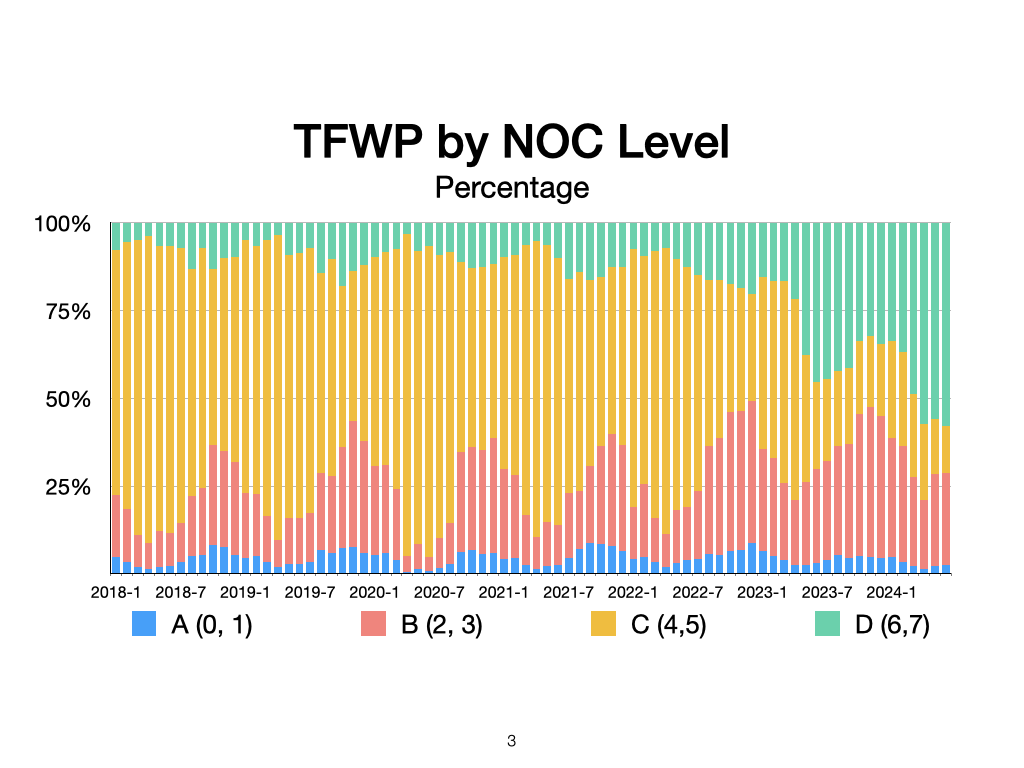
There are four streams: critical impact workers, skilled workers, Express Entry and Yukon Community Program. There are complicated rules categorizing workers and eligibility. For example, “skilled workers” requires the job to be in National Occupation Classification category TEER 0-3; bakers are an example. “Critical impact workers” are in categories TEER 4-5, such as landscapers and retail sales people.

There are also wage restrictions, but they are limited. Employers must pay at least the Yukon minimum wage, and the job’s annual income must exceed Statistics Canada’s Low Income Cut Off. For a single person in 2022, this was $20,333 per year.

The program hit the news recently when the premier put a pause on accepting new applications from employers in Whitehorse, since the territory has already received 590 applications for this year’s 430 spots.

The Yukon government will prioritize existing applications in four waves: work permit holders with approaching expirations, visitor visa holders already in Canada, work permit holders with expirations within a year and workers outside Canada.

An economist would note that these criteria have nothing to do with economic value. A skilled mining engineer in India who would make big bucks and pay lots of taxes would be at the bottom of the list.

Where you stand on all this depends, as the cliché says, on where you sit.

Suppose you own a labour-intensive small business. In this case, the nominee program is critical to keeping wage costs down and finding staff to keep the operation humming. Otherwise, with our labour shortage, wages might have to rise dramatically to attract Canadians already working to leave other jobs and come work for you.

This would eat into profits, and probably require closing some unprofitable locations.

At the other end of the spectrum, workers do not want to be competing with imported labour in the job market.

If you are neither an owner nor a low-wage worker, you probably enjoy the lower prices that low-wage workers enable at shops and restaurants.

In the old days, before left-versus-right economic issues were overshadowed in our politics by culture war conflicts, you might have expected all of this to be a big political issue pitting unions and social justice groups against chambers of commerce.

However, we have a centre-left government in the Yukon, backed by the NDP, running the nominee program. It seems strange to write this, but if a Martian political economist beamed down they would say there appears to be a broad political consensus in the Yukon behind importing hundreds of low-wage workers each year to keep wages at the bottom end of the wage spectrum lower than they would be otherwise, even during a housing shortage.

One reason for this is that the nominee program was overshadowed for many years by Canada’s traditional immigration program. This “points-based” system has broad support and has served the country well. In this system, foreign applicants earn points based on their youth, education, job experience and language skills. It serves to admit immigrants who can contribute quickly and substantially to the economy, even though there are ongoing issues with immigrants getting their skills recognized here.

The use of the nominee program for workers at or just above the minimum-wage level contradicts this logic. People used to talk about it as a temporary fix for episodic labour shortages, but now it is an ongoing feature of our labour market.

Some economists debating Canada’s poor productivity performance have hypothesized that such programs — by boosting the supply of low-wage workers — have disincentivized business investment in labour-saving technology.

I have seen this framed best by Harald Eia, the Norwegian equivalent of comedian-pundit John Oliver. In his segment “Rich and Equal,” Eia compares car washes in Norway and the United States. In Florida, he says, your car is washed by a team of people who are not paid very much. In Norway, you don’t see a human as you tap your card and drive through an automated car wash.

Union agreements cover much more of the economy in Norway than in Canada. Eia says these tend to have high minimum-wage floors, and have for years been pushing Norwegian employers to invest in automation.

Despite this, Norway currently has a lower unemployment rate than the Yukon.

Meanwhile, Germany has made a major revamp of its immigration policy to attract more skilled workers. If your job pays at least $60,300 (Canadian), then a wide range of occupations such as nurses, tech workers, teachers and engineers can be fast tracked. This also applies to recent university graduates who have a job offer above that amount.

If the Yukon Nominee Program switched to this system, the impact would be dramatic. Tax revenues would go up as higher-paid immigrants paid more income tax. Wages would rise at the lower end of the scale, forcing business owners to raise their prices and close some locations.

That kind of change would be too shocking to do all at once. But the Yukon government could raise the floor wages for the program and prioritize applications by economic contribution rather than freezing out nurses and engineers stuck in the government’s low-priority bucket for the rest of the year.

Keith Halliday is a Yukon economist and the winner of the 2022 Canadian Community Newspaper Award for Outstanding Columnist. His most recent book Moonshadows, a Yukon-noir thriller, is available in Yukon bookstores.

Souùrce: Yukonomist: The future of the Yukon’s low-wage immigration program

Alicia Planincic: We know the one thing Canada could be doing to select better economic immigrants. So why aren’t we doing it? 

Some useful ideas but all ranking systems are imperfect predictors of success. And wages only work for two-step immigration as numbers from other countries are not easy to compare. And there are risks in changing criteria and priorities too quickly without sound evidence and data:

…Candidates receive CRS points for things like language abilities, number of years of schooling, and whether they have a sibling in Canada. But factors like what their degree was in, or where they got it from, are not reflected. Meanwhile, the biggest limitation of the points system is that it ignores labour market information. It therefore tells us little about how valuable someone’s skills are to the Canadian economy.

To go back to hockey analogies, this way of assigning CRS points is like ranking players based on the number of games they have played in the NHL, whether they have a brother in the league, and whether they speak French—while neglecting things like how many points they tend to get every year. The evaluation would not be meaningless, but it’s easy to see how some of the best players wouldn’t be ranked at the top.

To improve the CRS, Canada needs to better capture the value of the skills a candidate brings. As it turns out, the best-known way to do so is pretty simple: have the points system reflect their current earnings.

Why is that? Wages reflect both the needs of the economy (demand) and the relative availability of labour (supply). Generally speaking, if demand for a certain occupation or skillset is strong, or few are willing or able to do this work, wages will be high.

There are other ways to improve the CRS, too.

One is to remove the variables that don’t influence an individual’s economic potential. These factors not only muddy the ranking of candidates but also can unfairly bias certain people or groups. For instance, individuals can earn points for having a sibling in Canada even though the math shows this has no direct impact on economic success. Family in Canada may be a legitimate reason to consider someone for immigration, but is not an economic one, and it is being used in the economic stream. At the same time, favouring people who already have family in Canada puts individuals from smaller countries, or those with less immigration to Canada, at a disadvantage.

Another way to improve the CRS is to regularly refine it as new and better information—including the type and quality of skill (e.g., field of study, program of education) most highly valued—becomes available and can be incorporated. The CRS cannot reflect the economy of 50 years ago. It has to be the latest and greatest of today.

The recruitment of skilled talent globally is big, exciting, and holds much potential. But Canada should not lose sight of the power of the points system, nor the talent that is in plain sight. Before marketing the country to individuals around the world, Canada should do more to select the best among those who have already put their name in the hat—to support greater prosperity for all.

Alicia Planincic is the Economist & Manager of Policy at the Business Council of Alberta. She regularly provides insight and analysis on the Canadian economy, public finances, labour markets, equity and social mobility, and public policy.

Source: Alicia Planincic: We know the one thing Canada could be doing to select better economic immigrants. So why aren’t we doing it?

Artificial Intelligence and Immigration Implications

More directed at legal and immigration firms than governments but nevertheless interesting. Predictive technology, if fed with the right assumptions and data, could be a very useful tool for governments as they often appear flat-footed and late with respect to impacts and change:

According to the International Monetary Fund, almost 40% of global employment will be impacted by artificial intelligence.

The field of immigration is no exception, and several countries are already implementing or planning to implement artificial intelligence (AI) into their immigration systems to obtain benefits such as increased productivity by their staff members, enhanced security measures and streamlined recruitment of foreign nationals.

This blog discusses recent and forthcoming examples of AI in immigration systems; ways for companies and governments to prepare for the AI revolution and adapt it for their uses; and addresses some of the challenges and concerns surrounding the use of AI in immigration.

Some recent examples of AI being utilized in immigration systems include:

  • In the United Arab Emirates, the Dubai airport launched an iris scanner to confirm identity, allowing travelers entering the country to move rapidly through passport control while still maintaining security precautions.
  • Portugal uses AI tools to validate the authenticity of documents submitted with an online citizenship application.
  • The government of Brazil is planning to utilize AI to analyze residence permit applications for employment, to reduce bureaucracy and speed up processing times.
  • France is expected to begin using AI to uncover and trace document fraud on the ANEF (Digital Administration for Foreigners in France) portal.

How can companies and governments prepare for AI and adapt it for their purposes?

  • Ensure compliance with standards in the region they are operating. Across the world, countries and regions are taking different approaches towards regulating AI and affected employers should be aware and revise their business practices if they are subject to these new rules. For example, the European Union is set to become the world’s leading tech regulator when the Artificial Intelligence Act goes into effect; the law will implement regulations on AI in phases, with the first phase banning prohibited AI systems that pose “unacceptable risks”.
  • Adopt specific AI visas to attract talent. Many governments recognize the transformative nature of AI and the critical need to attract individuals specialized in AI practices to transform industries and boost productivity.
    • The United States is considering changes to the J-1 exchange visitor program that could enhance opportunities for AI talent. The U.S. government is also reviewing existing immigration pathways, including the EB-1, EB-2, O-1 and International Entrepreneur Parole Program, to clarify and modernize these pathways for experts in AI.
    • Australia launched a Mobility Arrangement for Talented Early-Professionals Scheme, which provides 3,000 places for Indian national early professionals in several fields, including AI.
  • Utilize predictive technology to understand how migration management affects their companies. AI is being used for migration management, allowing the public and private sectors to pool information that can be used to predict migration flows, leading to more informed decisions and policy-making.
  • Implement upskilling and reskilling initiatives. The private sector should include AI upskilling initiatives as part of their workers’ regular assignments. This is particularly important as, according to the Harvard Business Review, “the half-life of [tech] skills is now less than five years, and in some tech fields it’s as low as two and a half years.” Constantly hiring new talent for emerging AI technology would result in a revolving door at a company, creating a loss of institutional knowledge, productivity, and revenue. By adopting upskilling and reskilling initiatives to keep up with the latest AI technology, employers build employee loyalty.

What challenges and concerns should companies and governments be aware of when utilizing AI or immigration systems built with AI?

  • Confidentiality of information. Governments and the private sector alike collect highly sensitive data essential to immigration procedures, such as biometrics and passports. With the AI transfer of information into systems, employers and government officials must ensure that these systems comply with data privacy laws, contain adequate cyber security precautions, and will not be used to harm the individual.
  • National security issues. Governments want to ensure that information they store on private sector AI platforms is only shared with select partners and does not end up with adversaries that could potentially use this information for nefarious reasons.
  • Translation issues. AI has already proven to be somewhat unreliable when used for translation purposes, due to the nuances of written and spoken languages. Although it may be cheaper and faster to utilize AI for this purpose, translation errors may lead to undesirable outcomes, such as denied visa applications. Employers and government individuals should be extremely circumspect in determining when and what type of AI translation technology they employ.
  • Divide in uptake of AI by countries. To effectively utilize AI, companies and governments must operate in countries with a suitable information and communication technology infrastructure. Developing countries, which may not have this infrastructure or individuals with the skill set to operate such infrastructure, may be slower adopters of AI technology. As a result, if AI is needed for productivity, companies may end up reshoring jobs originally outsourced to these developing countries, causing greater disparities among countries.

Due to the ever-changing nature of AI technology, companies should reach out to their immigration professionals for guidance in navigating the complex landscape at the intersection of these two fields.

Source: Artificial Intelligence and Immigration Implications

How our immigration policies failed Black Americans

Every now and then, similar articles appear on Black Americans and immigration:

This year marks a milestone in Black American history. It’s the 50th anniversary of Congresswoman Barbara Jordan’s televised speech to the nation regarding the impeachment of President Richard Nixon.

Widely considered one of the best American political speeches of the 20th century, it catapulted Jordan – the first Southern Black woman elected to Congress – to national prominence.

But there’s another element of Jordan’s story that’s notoriously undercovered: her opposition to immigration policies that have failed Black Americans for centuries – and continue to hinder their ability to build wealth today.

With slavery abolished after the Civil War, Black Americans began accruing real wealth. After emancipation, the white-black wealth gap narrowed from 23-to-1 in 1870 to 11-to-1 in 1900. While still suffering from discrimination, Black Americans took on paying jobs, became business owners, and even purchased land.

Then the Progressive Era’s immigration boom began in earnest. Between 1900 and 1915, more than 15 million immigrants arrived at U.S. shores – destabilizing labor markets and particularly hurting Black workers.

Numerous Black civil rights and labor leaders, including A. Philip Randolph, endorsed efforts to slash immigration rates. Randolph correctly pointed out that excessive immigration “over-floods the labor market, resulting in lowering the standard of living.”

Congress ultimately listened and passed the Immigration Act of 1924 – which curtailed foreign migration. By dramatically tightening the labor market, the law helped shrink the earnings gap between Black men and white men by nearly 60% between 1940 and 1980.

It’s simple supply and demand. When there are fewer workers available, employers have to raise wages and provide better benefits to attract them.

The 1924 law certainly had flaws. It gave preference to prospective immigrants based on their country of origin, and strongly favored northern Europeans. Ultimately, the law’s discriminatory nature led Congress to repeal it in 1965.

But lawmakers threw the baby out with the bathwater. Instead of creating a nondiscriminatory immigration system that protected American workers from cheap foreign labor, the reforms of the 1960s re-started mass migration. Black Americans have been paying a steep price ever since.

As Harvard economist George Borjas has shown, Black Americans are particularly disadvantaged by lax immigration policies because immigrants compete directly with Black workers for blue-collar jobs. Each “10-percent immigrant-induced increase in the supply of a particular skill group reduced the Black wage by 4.0 percent, lowered the employment rate of Black men by 3.5 percentage points, and increased the incarceration rate of Blacks by almost a full percentage point,” he and his colleagues concluded.

Of course, Black Americans aren’t the only ones harmed. Journalist David Leonhardt recently chronicled how American workers of all races have seen their wages decline thanks to the renewed tide of immigration that began in the 1960s.

He also elevates the forgotten perspective of Barbara Jordan.

Jordan chaired the U.S. Commission on Immigration Reform, a bipartisan panel of experts tasked by President Clinton with offering immigration reform recommendations. The commission recommended that the United States pare down immigration to 550,000 people per year and eliminate low-skilled immigration altogether. Clinton initially endorsed the commission’s recommendations, but business lobbyists ultimately convinced Congress to not move forward with the reforms.

Since the Jordan Commission, too many policymakers have defended a system that imports millions of predominantly low-skilled immigrants, both legal and illegal, who depress wages for Black Americans.

Reducing immigration, just as Congress did a century ago, would give Black families a fair shot at the American dream.

Andre Barnes is HBCU Engagement Director for NumbersUSA. This piece originally appeared in the Houston Chronicle.

Source: How our immigration policies failed Black Americans

Immigrants back regularization for undocumented people

More accurate header would be “immigrant organizations” as unclear, absent good polling, the degree to which immigrants themselves, who have gone through the hoops, would support. And the usual arguments in favour of impact on overall GDP, not the more important GDP per capita.

Sense of impending panic over a likely conservative government with their “the time is now” reference:

As leaders of immigrant and diaspora organizations across Canada, we want to address recent statements from Immigration Minister Marc Miller about the supposed lack of consensus on the regularization of undocumented people. This hesitancy ignores the moral and economic imperatives at stake. Canada has a responsibility to offer protection and stability to those who have long contributed to our society from the shadows. Contrary to concerns expressed by some about “queue jumping,” many Canadians—especially within immigrant communities—support regularization. Here’s why.

A matter of justice and solidarity

Many immigrants—like other Canadian citizens—personally know non-status people. Undocumented people are our friends, partners, neighbours, family, and coworkers. They care for our children, build our homes, and deliver our food. Their lack of status makes them vulnerable to exploitation, from unfair wages to denial of health care.

Many have fled war, persecution, or severe economic hardship, only to face a precarious existence due to barriers to legal status. Immigrant communities overwhelmingly support regularization because we understand these hardships, and empathize with those trapped by the unforgiving web of the immigration system.

Understanding the path to becoming undocumented

It’s crucial to dispel the myth that undocumented immigrants are “queue jumpers.” Becoming undocumented is not a choice but often a consequence of an opaque and unfair immigration system. Many arrived legally as refugees or migrant workers, but faced insurmountable obstacles in renewing their status or obtaining permanent residency.

Immigrants know—through personal experience or those of our parents and grandparents—that access to permanent residency is fraught with high fees, long waits, and complex requirements that many cannot meet. Thousands fall through the cracks not because they are trying to subvert the system, but because the system fails to provide fair options. When immigrants see undocumented people, they know it could be them. Regularization is not about rewarding lawbreakers; it’s about rectifying systemic failings that leave many vulnerable and uncertain.

Regularization: a pathway, not a shortcut

The idea that regularizing undocumented people amounts to “jumping the queue” is a misconception. Regularization does not mean granting immediate permanent residency without scrutiny. It means allowing individuals to apply for permanent resident status, subject to the same assessments as any other applicant. This would place them in the queue where they belong, acknowledging their long-term contributions and connections to Canada.

Regularization programs can ensure fairness and integrity, offering a transparent process where individuals must meet specific criteria, such as proving residence in Canada. This is not about creating shortcuts but about integrating those already part of our communities into the legal framework, enabling them to contribute more fully to society.

Economic and social benefits

Regularizing undocumented immigrants is not just a humanitarian gesture; it’s an economic boon. These individuals are already contributing significantly to our economy, often in sectors facing severe shortages. By bringing them out of the shadows, we can enhance their wages, productivity, purchasing power, and tax contributions. According to research done on France applied to Canada, regularization would grow the economy by more than $28-billion, and as Miller said, that’s more than the economic growth from multiple oil and gas pipelines. This growth will fund public infrastructure and services, which will result in improving the working and living conditions of all Canadians including recent immigrants.

Regularization promotes social cohesion and stability, and reduces exploitative labour practices. When people live without fear of deportation, they are more likely to invest in their communities, seek education for their children, and pursue opportunities. This leads to stronger, more integrated communities where everyone has a stake in our collective success. Undocumented people already live here, regularization is about including them in the family of rights.

The time is now

Canada has welcomed diverse communities of newcomers over the years. This has strengthened us. We cannot let fears and misconceptions dictate policies that leave hundreds of thousands in a perpetual state of limbo and fear. The decision to regularize undocumented immigrants aligns with our values of fairness, compassion, and inclusivity. The time for change is now. Immigrants are ready to support this initiative.

Debbie Douglas is executive director of OCASI – Ontario Council of Agencies Serving Immigrants. Amy Go is president of Chinese Canadian National Council for Social Justice. Samina Sami is executive director of COSTI Immigrant Services. Samya Hasan is executive director of Council of Agencies Serving South Asians. This is the shared opinion of multiple immigrant groups we are in touch with in the country.

Source: Immigrants back regularization for undocumented people

Canadian Dream? High housing costs has two-in-five recent immigrants saying they may leave their province (or Canada)

Another sign that the value proposition for immigrants to Canada is weakening. How many will act on this deception remains unclear:

Canada’s immigration levels have reached record highs in recent years, but as more immigrants seek the Canadian dream from abroad, many who have arrived in recent years have discovered less of a dream and more of a nightmare.

New data from the non-profit Angus Reid Institute finds recent trends that have seen Canadians concentrating in Albertamoving south, or beyond Canada and the U.S., potentially increasing in coming years. Most likely among those to consider further relocation are recent arrivals. Consider that while three-in-10 Canadians (28%) say they’re giving serious consideration to leaving their province of residence due to housing affordability, this number rises to 39 per cent for those who have lived in the country for less than a decade.

Canada’s newcomers tend to be urbanites with skills to quickly engage in the economy, and housing affordability challenges in these urban spaces is perhaps compounding their uncertainty. In Toronto and Vancouver, the long-term risk would be one of losing the workforce required to keep the city cores humming. In Downtown Toronto, 44 per cent say they consider leaving, with 22 per cent saying this is a strong current consideration. Similar numbers also say this in the surrounding 905 area code. In Metro Vancouver, one-in-three (33%) aren’t sure if that region is a long-term home.  

More Key Findings:

  • Two-in-five renters (38%) are considering moving away from their province, compared to 28 per cent of homeowners with a mortgage and 16 per cent of homeowners without one.
  • The most common destination for those who consider relocating is another province in Canada. Nearly half say this (45%) with Alberta the top choice (18%). That said, one-quarter say they would leave for another country beyond the U.S. (27%) and 15 per cent would head south to that latter nation.
  • Alberta is the primary potential beneficiary of emigrants from B.C., with 35 per cent saying they would travel one province east if they were to leave. In Ontario, the largest group say they would move abroad beyond the U.S. (26%), while Alberta ties for second (17%) with Canada’s southern neighbor (17%).

Source: Canadian Dream? High housing costs has two-in-five recent immigrants saying they may leave their province (or Canada)