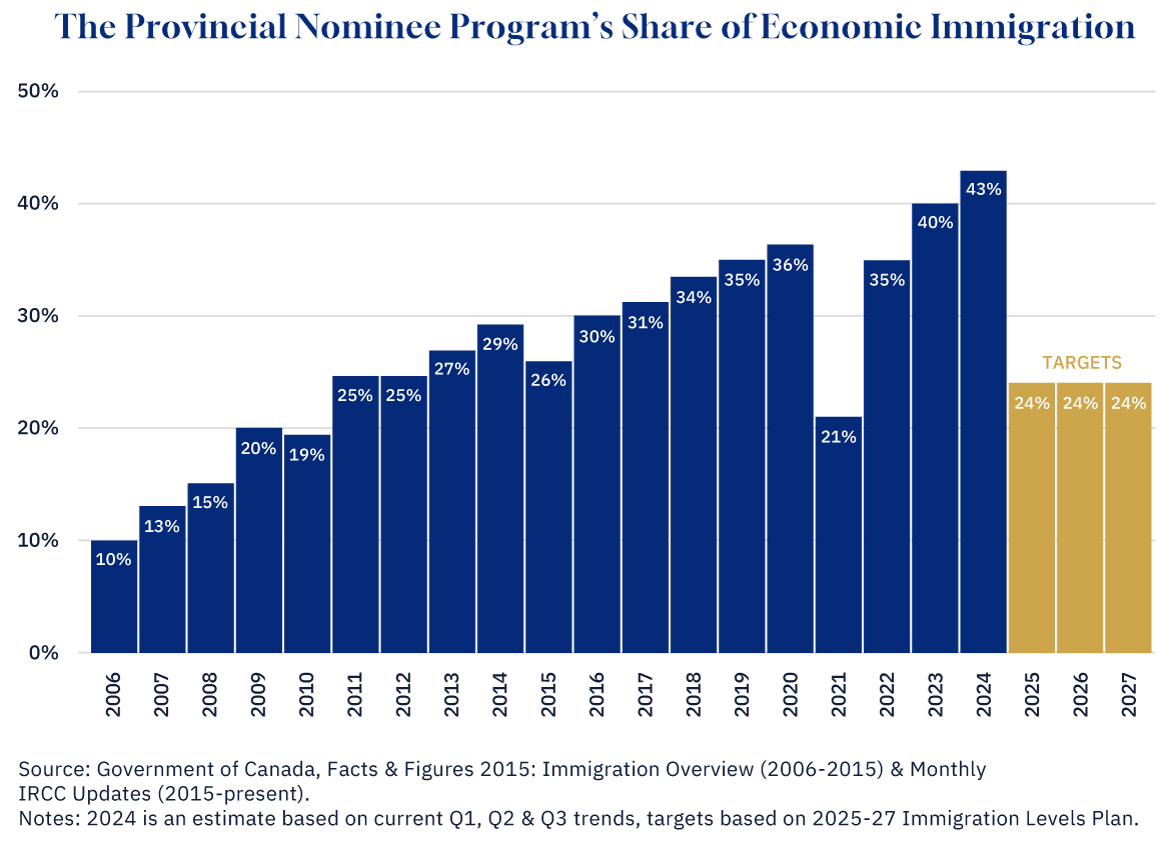
Good points but implementation always a challenge. Merging IMP and TFWP would be a challenge given their differences but a reexamination of these differences and their justifications would be a worthy initiative along with more explicit recognition of the blurring between temporary and permanent migration:
…At a news conference on October 24, Prime Minister Justin Trudeau said changes will allow “our communities, our infrastructures” time to catch up to population growth.
In that context, governments need to develop joint actions to help break down administrative silos and improve coordination. A case in point concerns international students. Although governments have taken some steps, individually, other issues require a more concerted approach (including between provincial governments and postsecondary institutions).
Consideration should begiven to the merging of the two existing federal temporary worker programs within Immigration, Citizenship and Refugees Canada. The department name could be modified to reflect any change, and acknowledge explicitly the blurring of boundaries between permanent and temporary migration.
Migrants trying to boost their chances for permanent residence by securing an employer’s sponsorship could soon lose the advantage as Ottawa is looking to crack down on fraudulent job offers for immigration purposes.
In a meeting with the Star’s editorial board, Immigration Minister Marc Miller said he is weighing removing the extra points permanent residence applicants could earn through a positive labour market impact assessment (LMIA) submitted by an employer.
Under the current system that awards points based as applicants’ attributes such as educational achievements and work experience, a job offer sanctioned by Employment and Social Development through the labour market assessment is worth 50 bonus points in an increasingly competitive candidate pool.
“There’s a value to LMIA but it can’t be $70,000 on the black market or the grey market,” Miller said Wednesday. “Not prejudicing people that have bona fide LMIAs, but it’s a balancing act. I think it’s safe to say I’m seriously considering it.”…
This analysis was prompted by questions regarding the projected numbers of departures with no methodology mentioned, and the suspicion, subsequently confirmed, that it was based on the false assumption that all temporary residents would leave upon expiry of their visa
—
When IRCC released its annual immigration plan last month, eyebrows were raised over the plan’s prediction of large outflows of temporary residents upon expiry of their visas. The Parliamentary Budget Office noted that “there is significant risk to the demographic projection presented in the Government’s new immigration plan—particularly to the projected outflow of non-permanent residents.” The plan included a table covering projected outflows without indicating the methodology and assumptions behind the table. Subsequently, IRCC has confirmed that the calculations assumed that all temporary residents would leave when their visa expired, save for those who transitioned to permanent residency.
This assumption is just wrong as many temporary residents may well remain in Canada and appears aimed at misleading the public. For illustrative purposes, I revised the plan table to include four assumptions: 100 percent of temporary residents leave (the plan’s assumption), and three alternatives where 80, 75 and 70 percent leave. Should 60 percent or less leave, there would not be any net reduction in the temporary resident population.
The overly precise nature of the numbers—down to individual persons—highlights that the government adapted a purely mathematical approach in its estimates. In the case of permanent resident levels, the government more sensibly uses ranges rather than precise numbers which reflect more accurately operational realities. While politically difficult to admit that some non permanent residents will remain, by not doing so the government attracts more scepticism regarding its plans.
Moreover, as Canada does not track outflows systematically, we will not have accurate data on how many actually leave. The government should explore coordination of flight and CBSA data to obtain better anonymized information on outflows and those who overstay their visa.
In short, while inclusion of temporary residents in the annual immigration plan is both overdue and welcome, a more serious approach is needed that better reflects the reality and challenges.
Immigration Minister Marc Miller says Canada should not have to shoulder the United States’ problems with border issues – and vice versa – adding that the U.S. needs to talk with Ottawa and work together if it wants issues affecting both countries addressed properly.
Last week, Tom Homan, U.S. president-elect Donald Trump’s choice as border czar, said the security of the northern border with Canada will be a priority for the incoming administration, along with deporting millions of undocumented migrants. He called on the Canadian government to enforce its ownimmigration laws to stop people, including alleged terrorists, from slipping across the border illegally into the U.S.
Mr. Miller said in an interview that he is planning to meet Mr. Homan for talks about security on the shared border. Fears about waves of migrants trying to cross illegally into Canada to escape deportation have been raised by Bloc Québécois MPs.
“The basic point is this: The U.S.’s problems shouldn’t be Canada’s to shoulder, and Canada’s problems shouldn’t be the U.S.’s to shoulder.That is an alignment of interests that does coalesce around the border and how it’s properly administered,” he said.
“If the U.S. wants to affect anything in its national interest that affects Canada, if it wants it done in a way that we agree with or properly done, it’s going to need to talk to us and work with us,” he added.
Mr. Miller’s remarks followed the third meeting of a cabinet committee on Canada-U.S. relations, reconstituted after the re-election of Mr. Trump.
Not that profound but nevertheless illustrative of some of possible impacts:
This may impact U.S. companies and U.S. institutions of higher education most.
For U.S. companies, this change has an upside and a downside. Those that cannot obtain enough H-1B visas to hire the number of foreign nationals they require will no longer have the convenient option of sending employees to Canada to work remotely. On the other hand, foreign nationals who have planned to leave the United States for better immigration prospects in Canada, may now want to try to stay in the United States. If they do, U.S. companies will have a larger talent pool to draw from, and this may cause them to expand their visa sponsorship policies, and if the Trump Administration doesn’t take steps to narrow the eligibility for H-1B visas, experience higher retention rates and less upward pressure on salaries.
As for institutions of higher education in the United States, international students who were deciding to go to Canada instead of U.S. colleges and graduate schools, due in part to the belief that post-graduation job prospects might be better there, may be rethinking their plans. Tuition from foreign students has long been essential to the budgets of colleges and universities and the number of foreign nationals coming to the United States for school has been declining. If Canada is not an option, then more applications from foreign nationals may go to U.S. schools.
For more than a decade, foreign nationals have found it difficult to obtain H-1B visas and “green cards” in the U.S. due to the limited number of slots available and the restrictive policies of the first Trump Administration. Throughout this time, highly skilled foreign nationals and international students were choosing to move to Canada from the United States on their own to obtain work authorization and permanent residence more quickly. International students who couldn’t obtain H-1B sponsorship due to unsuccessful H-1B lottery registrations have often left for Canada. This has been a boon to the Canadian economy. Now, the tide has turned, and this may be advantageous for the United States economy if the high-skilled workers and international students choose the United States over other countries.
Sarah P. Caze is an Associate in the White Plains, New York, office of Jackson Lewis P.C. Her practice focuses on representing employers in workplace law matters, including preventive advice and counseling.
This is really good data based journalism. Far more sophisticated than I did when looking at ethnic media in the 2019 election. Definitely for the data nerds but others could benefit from knowing how they did it:
…Canada, as every schoolchild learns, has thousands of kilometres of undefended border. There are places where people cross officially, at roads and airports. Some people think of these border crossings as gates. But they are not gates. They are revolving doors. A lot of people go through them, in both directions, every year.
When digesting the economic data, it becomes obvious that the flow of people out of the country is following the flow of money. People want better incomes, better prospects. It seems like stating the obvious, but sometimes the obvious must be stated. The ones leaving Canada for the U.S. are the ones in a position to do so: the ones with globally marketable skills, independent incomes or inherited wealth, who can easily start anew elsewhere. And the ones who have decent incomes are usually the ones who have the brains as well. Canada is losing its best and brightest. Instead of easing, Canada’s brain drain is almost certain to intensify. Whoever holds office in Ottawa over the next decade will be hearing about it; let’s hope they do something about it.
On Harvard University’s Economic Complexity Index – a measure of an economy’s productive capacity – Romania jumped from 39th in the world in 2000 to 19th, just behind France. Canada is facing ever-greater competition from nations on the rebound just as it enters the second decade of serious economic deterioration.
Political leaders often tout Canada as a land of immigrants. In 2021, more than 8.3 million people, or 23 percent of the population, were immigrants, the highest proportion since Confederation. Never mentioned is that there could be as many as 5 million Canadians living abroad – one-eighth of the Canadian population. The inflated but often-insincere rhetoric about immigration, emanating from Liberal and NDP politicians in Ottawa and from much of mainstream media, has simply ignored the whole question of outflow from Canada, of how we have lost so many of our best and brightest – and, without major economic, fiscal and governance reforms, will keep right on doing so….
Making the mistake, of course, is more serious than the timing of admitting that the government made the mistake in the first place:
…Mr. Trudeau spent a portion of the video shifting blame onto business lobbies screaming for foreign workers to reduce labour shortages – with a clip of Mr. Ford doing the same – and “bad actors” and colleges charging rich fees to booming numbers of foreign students. All that’s true, but it was the federal government’s job to control the numbers, and they didn’t. But Mr. Trudeau now concedes that.
Mr. Arnold said he wouldn’t advise the Prime Minister to make a speech about 10 mistakes. But this is a specific case.
“There’s a place for a politician to admit they haven’t gotten things right,” he said. “Because then it makes the solution feel like real change.”
Mr. Arnold noted that’s not the kind of thing the Liberals will put into their television ad campaigns. This is an attempt to shield against damage.
But the Liberals want voters to hear about it. The video includes news clips emphasizing what a big course change the government has just made on immigration – playing it up, not down. Mr. Trudeau needs Canadians to know about it, even if it means admitting a mistake.
Would be nice if CBC would indicate in the article who carried out the survey but the findings make intuitive sense and largely track other surveys on the general questions (checked, online survey by Probe Research, no margin of error cannot be assigned):
Canadians are feeling increasingly uneasy about immigration and its role in generating “economic strain,” according to a new survey conducted by the Canadian Museum for Human Rights.
Among other things, the survey found that many Canadians believe too much attention is being focused on newcomers and refugees, and that asylum seekers receive too many benefits.
The survey landed two weeks after Ottawa announced dramatic changes to its projected immigration numbers. On Sunday, Prime Minister Justin Trudeau also said in an online video that he should have acted more quickly to address problems with the immigration system.
The survey heard from 2,500 Canadians in both 2023 and 2024. This year, it found that a majority — 56 per cent — said they believe refugees and asylum seekers “receive too many benefits.” The report calls that a “significant increase” over the 49 per cent who said the same thing in 2023.
The survey also reported a “significant decrease” in the number of Canadians who believe immigration makes the country better — from 52 per cent in 2023 down to 44 per cent this year.
The 2024 survey also found that 41 per cent of Canadians believe there’s “too much attention focused on the rights of newcomers.”
“Among responses received in open-ended inquiries, there was a notable increase between 2023 and 2024 in sentiments that correlate immigration with economic strain in Canada,” the report said.
The CEO of the Canadian Museum for Human Rights, Isha Khan, told CBC News that “perceptions” about immigration are changing and the matter needs more study.
“That’s a point we really need to dig into,” Khan said. “We need to understand where those perceptions are coming from and how they impact our collective work.”
While just 11 per cent of respondents cited access to affordable housing as a top human rights issue, nearly 60 per cent said that right to housing had weakened over the last decade.
The report said that two in three respondents reported feeling optimistic about protecting human rights in Canada, particularly Indigenous rights and gender equity. Just one in three felt the same about human rights abroad….
Focus on where we have a shared interest in irregular cross border arrivals:
…Rather than focusing solely on the northward flow of migrants into Canada, however, the federal government should be thinking hard about how to stop the southward flow into America which is much higher. After all, that’s what has grabbed the attention of the incoming U.S. border czar, Tom Homan, who happens to be from upstate New York, near the Ontario border.
He called the Canada-U.S. border an “extreme national security vulnerability,” predicting “tough conversations” with Ottawa. “There has to be an understanding from Canada that they can’t be a gateway to terrorists coming into the United States.”
While Canadians obsess about the notorious Roxham Road path into Canada, it turns out that borders are in the eye of the beholder — and very much a two-way street.
Ford and Trudeau are right to turn their minds to Trump. But the test of their tactics isn’t how persuasive-sounding they seem when speaking to Canadians, but how effective they are in winning over the Americans in difficult negotiations ahead.
So far, both are following their re-election playbooks. But both will be judged by Canadian voters on how they play their hands with the Americans, not how they sound on the domestic campaign trail.