Le rêve brisé de candidats à l’immigration – change in selection process

Understandable reaction, given retroactivity and that the fees will apparently not be reimbursed:

Rétroactives, les nouvelles règles du ministère de l’Immigration pour sélectionner les travailleurs qualifiés affecteront près de 30 000 dossiers, a appris Le Devoir. Dans le lot, les demandeurs qui ne se qualifieront plus en vertu de la nouvelle pondération de la grille de sélection seront rejetés, sans le remboursement des quelque 1000 dollars payés pour déposer une demande.

« C’est une façon inhumaine de traiter les gens. Ce n’est pas la première fois que le MIDI [ministère de l’Immigration, de la Diversité et de l’Inclusion] utilise cette tactique et qu’il change les règles du jeu. C’est désolant », s’est indigné Jean-Sébastien Boudreault, président de l’Association québécoise des avocats et des avocates en droit de l’immigration (AQAADI). « Ce qui est encore plus troublant et alarmant, c’est que ces gens-là se qualifiaient, ont payé des sommes importantes et ne seront pas remboursés. Ils se voient voler. »

Photo: David Afriat Le DevoirLa ministre de l’Immigration, Kathleen Weill

Sur des forums d’échanges, certains aspirants immigrants crient à la fraude. « Je trouve ça assez honteux de faire ça rétroactivement. Certains vont se retrouver en dessous du seuil et leur rêve et leur argent partiront en fumée… », peut-on lire sur Immigrer.com. « Difficile à avaler. Notre rêve du Québec s’éloigne. On était déjà juste… Alors avec ça… », écrit un Français ayant déposé une demande. « Il risque d’y avoir une ribambelle de rejets à la suite de la mise en place de cette grille. »

Pour l’heure, il est toutefois impossible de dire combien de demandes seront rejetées, faute d’un nombre suffisant de points. Mais selon Jean-Sébastien Boudreault, le ministère profite largement de cette situation. Si 10 000 demandes sont rejetées, le gouvernement aura encaissé « 10 millions sur le dos des immigrants, rien qu’en changeant les règles du jeu », déplore-t-il. L’avocat estime que ces dernières années, le ministère a refusé des « quantités astronomiques » de dossiers. « Ce sont des milliers de dossiers rejetés par année. Des gens voient leur dossier fermé pour des détails ou des changements de règles, dit-il. Ils n’ont aucun recours. »

Nouvelles règles

Ce qui choque tant les candidats à l’immigration dans ce changement de pointage, c’est qu’ils ont déposé et payé leur demande en ayant préalablement mesuré leurs chances d’être sélectionnés grâce à un formulaire d’« évaluation préliminaire » en ligne qui leur permet de calculer leurs points. Ensuite, le travailleur qualifié doit débourser 773 $ et 166 $ pour chaque membre de sa famille, conjoint(e) ou enfant. L’obtention du Certificat de sélection du Québec (CSQ) prend six mois au minimum, parfois plusieurs années.

En vertu des nouvelles règles en vigueur depuis mercredi, qui s’appliquent rétroactivement à toutes les demandes qui étaient en attente de traitement, le système de pointage a été ajusté pour donner plus de points à des personnes parlant le français. En revanche, on attribue moins de points dans certains domaines de formation et plus aucun point pour les candidats ayant un diplôme secondaire professionnel ou un diplôme postsecondaire technique et à ceux détenant une formation dans un domaine recherché au Québec.

Source: Le rêve brisé de candidats à l’immigration | Le Devoir
How America’s Idea Of Illegal Immigration Doesn’t Always Match Reality : NPR

A very good analysis with sound data that provide context to US immigration debates and policies:

When you think of illegal immigration in the U.S., do you picture a border crosser or a visa overstayer? A family or a single person? A farmworker or a waiter?

People living in the U.S. without legal status are frequently invoked in American politics — especially in recent months. But the conversation is often short on facts about the millions of people who fall into this category.

There are, however, outdated beliefs: A Pew Research Center survey in 2015 found that very few Americans are aware of recent changes in immigration patterns.

Here’s a look at the actual statistics about people living in the U.S. illegally.

We should note that there are a few caveats about this data. Different research groups use different methodologies, and in some cases, they rely on estimates. We’ve included links to all our data sources so you can read about their methods in more detail.

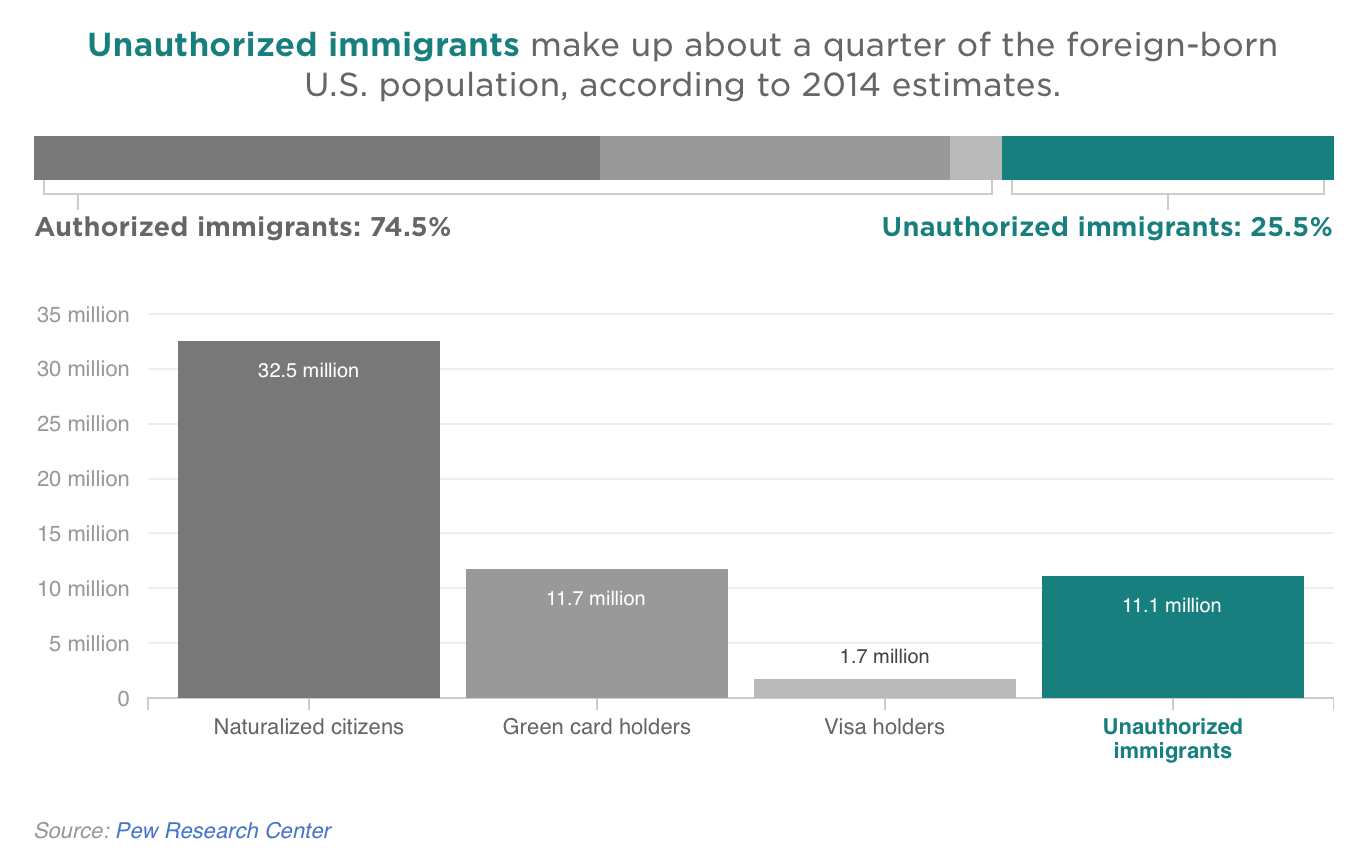
About 11 million people live in the U.S. without authorization

There are far more naturalized citizens than unauthorized immigrants in the U.S., and slightly more green card holders, according to the Pew Research Center.

The total number of people living in the country illegally — about 11 million — has made headlines recently, because immigration advocates suggest that under the Trump administration’s immigration enforcement policies, almost all of them could be targeted for deportation. (More than 700,000 “DREAMers” — immigrants who were brought into the U.S. illegally or overstayed their visas as children — are still temporarily protected from deportation through the Deferred Action for Childhood Arrivals, or DACA, program.)

Longtime residents outnumber new arrivals

A large majority of those people currently living in the U.S. illegally have been here for a decade or longer, which is a major shift from the situation at the turn of the millennium.

About two-thirds of unauthorized immigrants have lived in the U.S. for 10 years or more, Pew says. Only 14 percent arrived within the past five years.

In the late 1990s, the number of new arrivals was far higher, and the share of longtime residents far lower.

Mexicans make up a dominant — but declining — share of this population

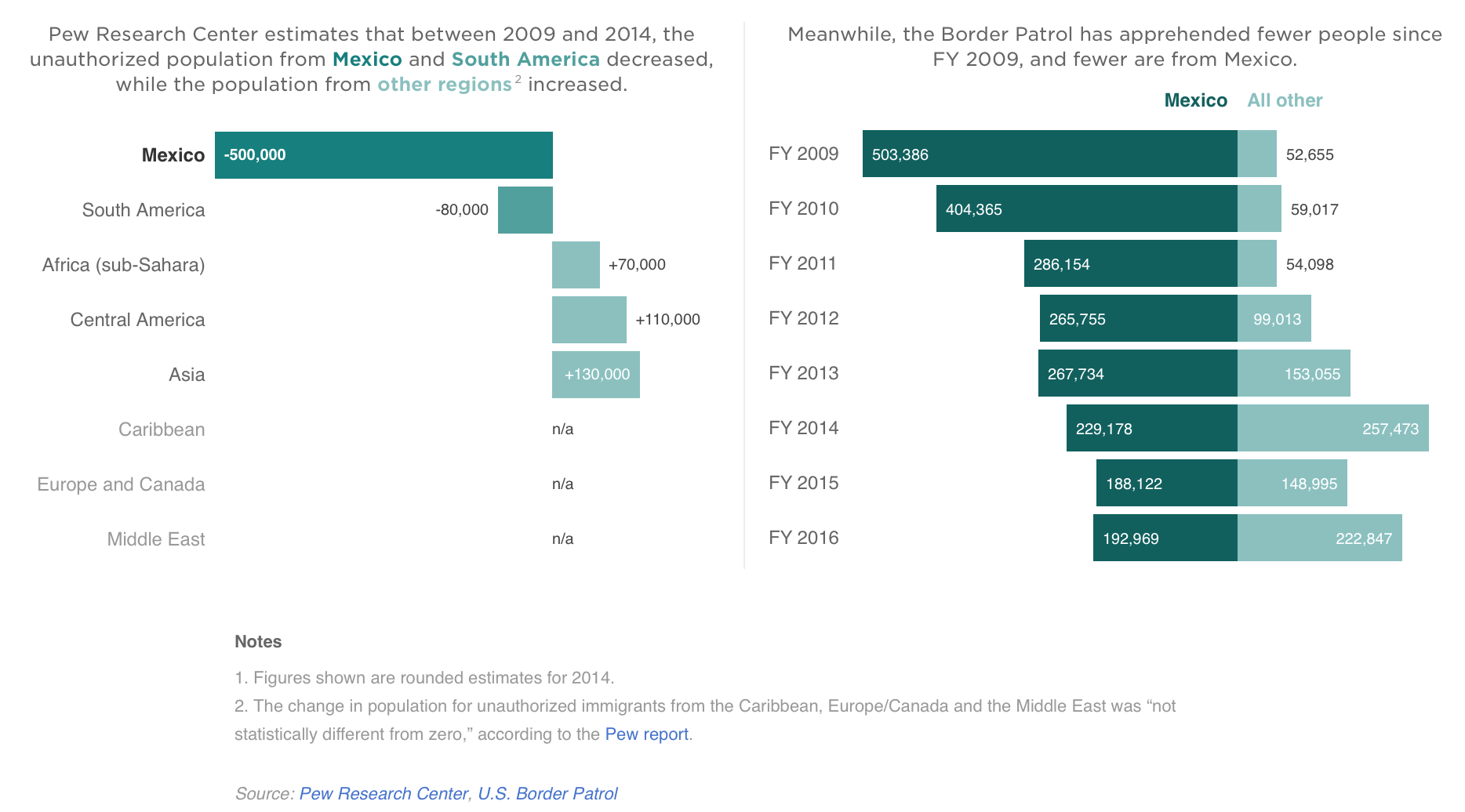
Mexico is “the leading nation of origin for U.S. unauthorized immigrants,” Pew writes, but the share of immigrants from Mexico is also declining.

That is to say, Mexican immigrants are a shrinking majority of the population living in the country through illegal immigration.

Of people living in the U.S. illegally, more than half are from Mexico. The population from that one country far outnumbers the population from entire continents. But there are fewer people of Mexican origin living in the U.S. now than there were a decade ago.

You can see the trend lines clearly if you look just at people arriving in the U.S. illegally, instead of the millions who live here. The percentage arriving from Mexico has dropped markedly, while more immigrants are coming from Africa, Central America and Asia.

The reasons for the shifting immigration patterns are complex. For Central American immigrants, conflicts in their home countries certainly play a role. The Migration Policy Institute suggests that there might be similar reasons for increased migration from Asia and Africa.

Source: How America’s Idea Of Illegal Immigration Doesn’t Always Match Reality : The Two-Way : NPR

Canada’s last lines of defence against populism: Geddes and Gilmore contrasting views

Two contrasting views on the risks of populism in Canada, starting with the stronger one IMO by John Geddes:

If the Canadian election map makes taking an anti-immigrant line a losing proposition, and the Canadian way of choosing party leaders makes it hard for a populist outsider to win, there’s still the possibility that the Conservatives might try to activate the economic side of populism.

Even there, though, the formula behind Trump and Brexit doesn’t look like a natural fit in Canada. Trump blended his anti-immigrant rhetoric with promises to scrap or overhaul free-trade agreements. The Brexit forces linked discomfort with foreigners to resentment of the EU free-trading order. But in Canada, liberalized trade enjoys broad buy-in—particularly on the political right, and notably in the Conservatives’ resource-exporting western strongholds.

So echoing Trump and the Brexiters in railing against unfair foreign competition is a non-starter for Canadian Conservatives. That leaves, perhaps, finding a way to give voice to the anxieties of that broad swath of Canadians who, as Graves portrays them, fear that the middle class is shrinking and that opportunities for their children and grandchildren are dwindling.

But the Tories would find themselves playing catch-up with the Liberals when it comes to tailoring a populist message for those worried voters. Trudeau has been arguing since 2014 that failure to push income growth down from high-earners to middle-class families would eventually prompt a dangerous backlash. His answer, or at least part of it, came in last year’s budget, in the forms of a modest middle-income tax cut, an upper-income tax hike and a significant boost in federal payments to parents.

Is more policy in the same vein coming in next month’s 2017 budget? In a significant recent speech in Germany, at Hamburg’s annual St. Matthew’s Day Banquet, Trudeau strongly suggested he isn’t done trying salve that middle-class sense of grievance. “With the pace of globalization and technological change,” he said, “there is a very real fear out there that our kids will be worse off than we are.”

Adopting his own version of the populist line, Trudeau took direct aim at corporations that post record profits but somehow can’t afford to offer job security to their workers. “Increasing inequality has made citizens distrust their governments, distrust their employers,” he added. “It turns into ‘us vs. them.’ ”

From the sounds of his Hamburg speech, Trudeau doesn’t intend to leave the next Conservative leader any easy opening to outdo him when it comes to giving voice to the disquiet of Canadians who believe the economic order is stacked against their families. It remains to be seen what additional policies the Liberals unveil in the upcoming budget to back up that rhetoric.

If Trudeau fails to deliver, a right-leaning populist might seize the chance to try to fill the vacuum. Overall, though, the prospects for a right-of-centre populist movement in Canada look dim, even though opinion in Canada, according to pollsters like Graves and academics like Donnelly, contains plenty of the same mix of fear and pessimism that fuelled Trump and Brexit.

There’s no shortage of Canadians who, if they’d heard Ted Falk wishing God’s blessing for Donald Trump, might well have said, “Amen.” But if they’re hoping that Trump-style populism will slip across the border and succeed in Canadian politics, they’re likely to discover that Canada’s welcoming reputation has its limits.

Less convincing, in my view, is Scott Gilmore’s, who views the increased number of foreign-born as a risk, in contrast to Geddes who notes the political importance of that demographic, particularly in the battle ground suburban ridings needed to win:

Which brings us to Canada. Will we see a similar rise in populism here? When I sat down to write this column, my instinctive answer was “no.” I agreed with many of the arguments made by my colleague John Geddes, who sees systemic and political barriers to Canadian populism. My thinking was that the apparent growth in global populism is because we are focused on Trump and starting to pay attention. But where I could find data, it didn’t support my conclusion. One study from Harvard, for example, found that support for populist parties on both the left and the right has grown undeniably and steadily since the 1960s, doubling its support since then.

But it was another study completed late last year by a group of academics from the U.S., Europe and Japan that left me especially troubled. They looked at a dozen European countries to see if there was a correlation between the relative size of the immigrant population and the support for right-wing populist movements. The researchers found that there was a direct connection, and that support grew at an increasing rate as the size of the immigrant population grew. And what is more, their data suggested there was a “tipping point” in western societies: when immigrants comprised 22 per cent of the population, support for anti-immigrant parties approached a political majority. If a country takes in too many immigrants, a populist backlash may be unavoidable.

In Canada, our foreign-born population is already at 20 per cent and growing. This is far higher than in the United States and (except for Luxembourg and Switzerland, where there are large numbers of itinerant professional residents like bankers) it is far higher than in any other European nation. And it’s getting bigger. Statistics Canada just released a report that projected Canada’s immigrant population will increase to between 26 per cent and 30 per cent within two decades. This puts Canada well beyond the theoretical 22 per cent threshold in the European study.

It makes sense that countries become unstable with too many foreigners. I have first-hand experience in places like Pakistan and Timor Leste, where sudden massive influxes of refugees can pull a country apart at the seams. But is it possible that even when immigrants arrive gradually and they are integrated successfully, it can still destabilize a country? Perhaps a populist backlash is inevitable in Western democracies when the immigrant population grows to a certain size.

This is not because the newcomers bring crime or undermine our democratic institutions (they do neither), but because the native citizens, whether they are Canadians or Austrians or Americans, instinctively feel threatened by newcomers. Perhaps the experiences add up—new faces on TV, new clothes in the street, new music on the radio—until the average person reaches a tipping point and pushes back. After all, a fear of strangers is wired into our brains, an instinct that kept us alive in our tribal past.

If this is true, it upends a lot of assumptions that this country is built on regarding multiculturalism, pluralism and immigration. Canada may be facing larger global forces, tectonic shifts which are are not felt until it’s too late and a populist earthquake shatters our carefully built house of peace, order and good government.

Some permanent residents of Canada can be barred from U.S. under Trump order

Too early to tell, but stories will emerge about the extent whether the waiver is being consistently applied or not (and important that Canada is appears to be the only country to have obtained such a waiver):

Permanent residents of Canada with citizenship from any of six Muslim-majority countries can be denied entry to the United States under the new version of U.S. President Donald Trump’s travel ban.

After Trump issued the first version of the 90-day ban in January, federal Immigration Minister Ahmed Hussen said he had been assured by the White House that permanent residents could go to the U.S. as usual. But the language of the second version is not nearly so straightforward.

The revised ban, signed by Trump on Monday, explicitly says that a “landed immigrant” from Canada needs to apply for a “waiver” that “may” be granted, on a “case-by-case basis,” at the discretion of a consular officer or another official from U.S. Customs and Border Protection.

It is not yet clear how strict or generous the U.S. government will be in giving such waivers to people applying at consulates in Canadian cities — or whether there will be any consistent policy at all.

“Canada will work with its counterparts in the United States to clarify the impacts of this order on Canadian citizens and Canadian temporary and permanent residents,” a spokesperson for the immigration ministry said Monday.

Public Safety Minister Ralph Goodale told reporters Monday that the waiver requirement “would not substantially change the process” for permanent residents from the six countries, since they already had to apply for a visa to enter the U.S. A top Canadian immigration lawyer, though, said other kinds of waivers often take much longer to obtain than visas.

Waivers for Canadians with criminal records, for example, currently take about six months to process, said lawyer Lorne Waldman. While the U.S. might create a faster process for this new kind of waiver, he said, the existing process is the best guide for now.

Trump’s order says waivers “could” be granted. The general requirement: “the foreign national has demonstrated to the officer’s satisfaction that denying entry during the suspension period would cause undue hardship, and that his or her entry would not pose a threat to national security and would be in the national interest.”

Despite the waiver requirement, Canada is still getting privileged treatment in the new order. There is no explicit waiver provision allowing entry by permanent residents of Australia or the United Kingdom.

The new order bans all refugees for 120 days and visitors from Syria, Sudan, Iran, Somalia, Libya and Yemen for 90 days. It does not affect dual citizens of Canada and the affected countries, such as Iranian-Canadians and Syrian-Canadians, who are still allowed to travel to the U.S. with their Canadian passports.

The revised ban was immediately blasted by civil liberties and human rights groups as bigoted and unconstitutional; the American Civil Liberties Union called it “Muslim Ban 2.” But it represents a major concession from a president who had mocked a “so-called judge” for putting it on hold, then defiantly promised in a tweet to “SEE YOU IN COURT” after he lost on appeal.

“The president has capitulated on numerous key provisions that we contested in court about a month ago,” Washington state attorney general Bob Ferguson, who challenged the original order, told reporters. “It bears pointing out that the administration, since that tweet, has done everything in its power to avoid seeing anyone in court when it comes to the original executive order.”

The new order is an attempt to impose a ban that can be seen to satisfy Trump’s campaign promises — first a “total and complete shutdown” on Muslim entry, then something he called “extreme vetting” — while also withstanding scrutiny from federal judges. Legal analysts said it has a much better chance in court than the vague and hastily imposed order of a month ago.

Unlike the original order, which took effect without any warning, this one is being introduced with a 10-day grace period — though Trump had defended the rapid introduction of the original order by saying that, “If the ban were announced with a one week notice, the ‘bad’ would rush into our country during that week.”

The new order excludes Iraq, whose inclusion in the first order was especially controversial because it harmed military interpreters and others risking their lives to work with the U.S. military. While the initial order singled out Syrian refugees for an indefinite ban, the revised version subjects them to the same four-month ban as other refugees.

Attempting to weaken the case that the policy amounts to anti-Muslim discrimination, the new order eliminates special treatment for refugees who are religious minorities in their home countries, a provision widely seen to be aimed at Christians.

Source: Some permanent residents of Canada can be barred from U.S. under Trump order | Toronto Star

Trump’s administration will be making it harder to get H-1B visas starting in April – Recode

Great opportunity for Canada:

United States Immigration and Customs Services has announced that, starting in April, it will no longer offer its 15-day “premium processing” program for applicants of H-1B visas.

H-1B visas allow employers to temporarily hire non-U.S. born workers to take highly skilled positions at U.S. companies. These visas are frequently used at large technology companies to bring top engineering talent to their U.S. offices. The U.S. only allows 85,000 people per year to enter the country on H-1B visas.

The announcement means that new H-1B visa applications could take months to process. With premium processing, U.S. immigration services offered a 15-day expedited service for a $1,225 filing fee, but come April that will no longer be an option.

“I’ve seen these applications take anywhere from 8-12 months,” said Tahmina Watson, a Seattle-based immigration lawyer, in an interview. “Even though the advertised processing time is four months, I’ve never seen anything take four months.”

This will not only affect new workers coming to the country on the H-1B program, but those who already hold an H-1B visa and are changing jobs within the country too, says Watson, like if an engineer who had an H-1B visa with Microsoft is taking a new position at Google, for example.

The suspension of the premium processing may last up to six months, according to the USICS website.

USICS says that it’s suspending premium processing in order to catch up on “long-pending petitions” — which the agency says has been difficult because of the large number of H-1B applications and requests for premium processing it receives.

Google, Apple, Amazon, Facebook and many other tech companies condemned Trump’s immigration and refugee ban that was issued by executive order in January, which blocked people from seven primarily Muslim countries from entering the U.S.

Dozens of companies, mostly in technology, signed onto a brief that claimed the ban inflicted “substantial harm on U.S. companies.”

Although that executive order was suspended after review from a panel of federal judges, Trump says his administration is working on a new version of the immigration ban.

Growing number of migrants renouncing Canadian immigrant status | Vancouver Sun

Solid rationale for many of these permanent residents doing so, but does beg the broader question of how this benefits Canada, beyond more pressure on the housing market and increased school and university enrolment.

To give context, the total number of Permanent Residents for the period 2006-15 is:

  • India: 323,785
  • China: 290,933
  • South Korea: 53,785

Thousands of permanent residents are renouncing their opportunity to immigrate to Canada — for reasons ranging from a dislike of the cold to a desire to avoid Canadian taxes.

More than 21,000 people with permanent resident cards who had the opportunity to become Canadian citizens have turned their back on the quest in the past two years. The highest number of  “renunciations” are from citizens of China, India and South Korea.

People who renounce their permanent resident status no longer have to prove they’re spending significant time in Canada when they cross the borders or fly into an airport, say immigration lawyers in Vancouver.

Nor do Canadian immigration process dropouts have to give up the passport of their homelands, where many continue to work or run businesses. And they are not expected to declare their foreign assets to Canada Revenue Agency.

“Renunciations are growing in number and will likely remain high,” says an internal report from Canada’s immigration office in Shanghai, China, the largest source country for immigrants to B.C.

“Many people are renouncing five years after landing (in Canada), rather than renewing their permanent cards, as they are working in China and do not meet residency requirements,” says the internal report, published in the Vancouver newsletter Lexbase.

“Their children often remain in Canada to complete school and to begin their careers.”

According to three Vancouver immigration lawyers, many people who renounce their permanent resident cards continue to return to gateway cities such as Vancouver and Toronto to visit their families as temporary visitors, especially on the increasingly popular 10-year visas.

“They were getting picked off at Vancouver airport for failure to meet residency requirements. This way they can avoid that problem and still come here,” said B.C. immigration lawyer Sam Hyman, noting the strong majority of migrants to Metro Vancouver are from Asia.

People with permanent resident status in Canada are required to spend two years out of every five in the country.

Vancouver immigration lawyer Jeffrey Lowe said many people who renounce their permanent status are breadwinners who cannot meet Canada’s two-year-residency requirement because they hold down jobs elsewhere, typically earning more money in their homeland than they believe they could in Canada.

A large number of these are so-called astronaut parents, who work offshore while their spouses and school-attending children remain in Canada, usually in urban centres, and own residential property, say the immigration lawyers.
The rapid rise in renunciations began in 2015 after then-immigration minister Chris Alexander, of the Conservatives, changed the rules to make it easier to voluntarily withdraw from the immigration process.

In the two years up to September of 2016, Citizenship and Immigration Canada figures show there were 5,407 renunciations by citizens of China, 2,431 by citizens of India, 1,681 by South Koreans, 1,416 by Britons and 1,129 by Taiwanese.

“A lot of people with permanent resident status have wanted to get their family and wealth transferred into Canada,” said Hyman.

“Some have bought multiple properties. By renouncing their permanent resident status they can stay below the radar and avoid Canadian taxes,” he said.

“They can visit Canada whenever they want on a 10-year visa. Why would they want anything else?”

Another reason foreigners renounce the Canadian immigration process, according to Hyman, is so family breadwinners won’t have to give up their passport and citizenship privileges in economically vibrant homelands like China and South Korea.

China and India do not allow their citizens to hold two passports, and South Korea only in rare cases.

Lowe says he expects renunciations to jump even more since the federal government in November began requiring a new customs document for some travellers, called ETA, or electronic travel authorization.

Foreign nationals from certain countries can’t obtain an ETA if they are a permanent resident or if they are non-compliant with the terms of their residency card, Lowe said. As a result they’re not allowed to board a plane to come to Canada.

Given that problem, Lowe said many would-be immigrants choose to renounce their residency status and instead simply apply for temporary visas to Canada.

Richard Kurland, author of the Lexbase newsletter, said it’s become common for breadwinners to bring their entire family to B.C. as permanent residents and then to decide “either it’s too cold or there’s no way I’m going to file an income tax return and report my global interests and property and pay taxes in Canada on that. I’m returning to my country of origin.”

In many cases, Kurland said, just the spouse and children who physically stay in Canada for five years end up being the ones who become Canadian citizens.

Source: Growing number of migrants renouncing Canadian immigrant status | Vancouver Sun

Cabinet to map out scenarios for dealing with border-crossers

As expected, work taking place behind the scenes:

Federal cabinet ministers are set for an in-depth discussion of the practical and political pressures being placed on the Liberal government by a rising number of asylum seekers in Canada.

Border security, RCMP and immigration officials have been running scenarios to prepare for the possibility that a relative winter trickle of crossings into Canada could turn into a spring flood.

The results of their table-top exercises will help form options being put before cabinet Tuesday, The Canadian Press has learned.

Officials are also studying links between distinct groups of border-crossers that might belie the common notion they’re all being pushed into Canada by the volatile U.S. political climate.

Two government officials confirmed to The Canadian Press that many of the people coming into Quebec hold American visas issued at the U.S. Embassy in Riyadh, Saudi Arabia.

Interviews revealed the visas were obtained to use the U.S. as a transit point to get to Canada and claim asylum — plans set in motion long before the U.S. election in November, the officials said, neither of whom were authorized to publicly discuss the issue.

USA-IMMIGRATION/CANADA-BORDER

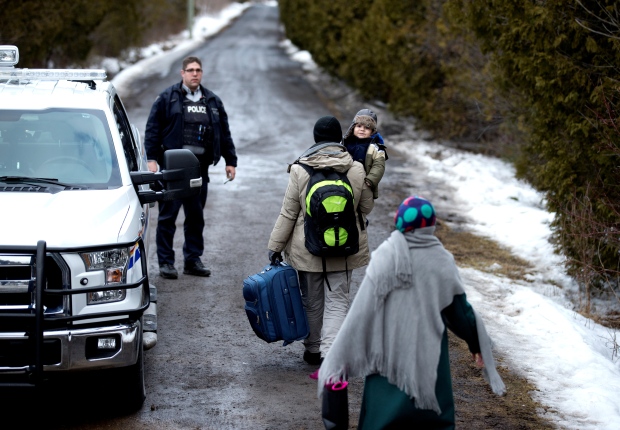
An RCMP officer carries a child from a family that said they were from Yemen after they crossed the U.S.-Canada border into Hemmingford, Que., on Sunday. (Christinne Muschi/Reuters)

But it is the pictures of RCMP officers hoisting small children above snow-covered fields along the Canada-U.S. frontier that have drawn global attention and placed political pressure on the Trudeau government from all sides.

The Opposition Conservatives are demanding a crackdown, and want those crossing illegally charged with crimes, something the government notes cannot happen until asylum claims are heard.

‘We are the endpoint’

The fact those claims are being fed into a clogged system has others urging the Liberals to put more resources into the refugee-determination process and the agencies that support newcomers.

“We are the endpoint,” said Chris Friesen, director of settlement services for the Immigrant Services Society of British Columbia.

The Immigration and Refugee Board reported in its last quarterly financial document that in the first nine months of 2016-17, there was a 40-per-cent increase in new claims compared to the same period the previous year.

Statistics provided to The Canadian Press show claim levels generally began rising in Canada before U.S. President Donald Trump took office.

Refugees crossing into Quebec

A family claiming to be from Turkey are met by a RCMP officer after they cross the U.S.-Canada border into Hemmingford, Que. (Christinne Muschi/Reuters)

In fact, the increase seems to have begun just as Prime Minister Justin Trudeau took power.

In October 2015, the month of the last federal election, 1,519 claims were lodged in Canada. The next month, when the Trudeau Liberals took office, there were 1,647 and — with the exception of two months in 2016 — they have been rising since.

Trump is pushing people into Canada, but the Trudeau government’s repeated messaging on welcoming diversity and immigration is a pretty strong pull factor, Friesen said. “We are now the beacon of hope for desperate refugees.”

In B.C., there has been a 60-per-cent increase in the number of refugee claimants in the last 12 months compared to the previous one-year period. Most are Iraqi Kurds and Afghans, and there were also 18 undocumented Latin Americans from Guatemala, Honduras and Venezuela who recently crossed the Canada-U.S. border, immigration agencies said.

The number of Mexican claimants is also starting to rise in B.C., following the end of a requirement for Mexican citizens to have a visa to enter Canada. During the last three months, there were 29 refugee claimants from Mexico, the agencies reported, compared to 30 who arrived between December 2015 and November 2016.

The Immigration and Refugee board is already adjusting to deal with the bigger numbers, but cabinet will consider giving it more resources.

Spotlight on Safe Third Country Agreement

Ministers will also consider whether there is room to alter the Safe Third Country Agreement between Canada and the U.S. The agreement says a refugee claimant must apply for asylum in whichever of the two countries they arrive first — unless they qualify for an exception.

It is being singled out as the reason people are avoiding official border stations and crossing into Canada illegally, and there are calls for Ottawa to suspend the agreement.

Source: Cabinet to map out scenarios for dealing with border-crossers – Canada – CBC News

Liberals look at making skilled immigrant loans pilot project permanent

Always good to see some of the better initiatives of the previous government continued by the current government:

A pilot Conservative project to loan money to help skilled immigrants land jobs in their field could be revived as a permanent program under the Liberal government.

One of the biggest barriers for newly arrived doctors, dentists, engineers and high-tech professionals is coming up with the cash to pay for the required licensing fees, exams and training upgrades.

Proponents say micro loans speed up the process and pay off big time for the federal treasury, yet they can’t keep up with a demand that will likely grow with the Liberal government’s plan to welcome more economic immigrants to the country in 2017.

Jean-Bruno Villeneuve, spokesperson for Patty Hajdu, the minister of employment, workforce development and labour, said a three-year pilot that was launched in 2011 under the Conservatives demonstrated that loans sped up the credential recognition process, led to a 47-per-cent increase in full-time employment and eased reliance on government income assistance.

“We were very pleased with the results of the pilot, and we’re working hard on a framework for a more permanent policy,” he told CBC News.

A spokesperson for Finance Minister Bill Morneau would not say if a new foreign credentials loan program would be included in this year’s budget.

“Can’t tip our hand here either way,” the official said. “Stay tuned.”

The Conservative government earmarked $35 million over five years to make the Foreign Credential Recognition Loans program permanent in the 2015 budget, but it was never implemented due to the election. Then-prime minister Stephen Harper had also promised to more than double that figure during the 2015 campaign by adding an extra $40 million over five years.

Herb Emery, a labour market economist at the University of New Brunswick, said loans to help immigrants overcome the up-front financial hurdle have a big net payoff in federal revenue.

‘Huge’ impact on federal treasury

“When these immigrants are taken out of low-skill jobs and converted into high-paying ones, the impact on the federal treasury is huge,” he said. “They recoup any costs they put into it in the first year alone, and from then on it’s basically pure profit for the treasury.”

Emery said immigrants often have no access to credit or bank loans — what he calls a “pervasive market failure.” That leaves newcomers unemployed or working in low-paid jobs just scraping to get by.

Man hunts job board

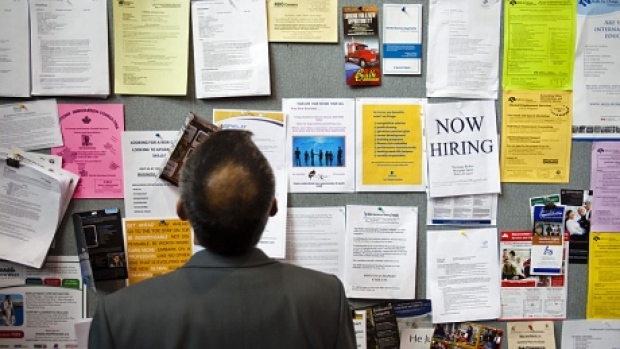
Many skilled immigrants wind up unemployed or working in low-paying jobs because of the financial barrier to earning their foreign recognition credentials. (CBC)

“We’re doing a horrible job in that we bring very high human capital individuals to Canada, then we throw away their potential by not letting them work in what they are trained and educated to do,” he said.

There are several programs in Canada offering micro loans between $5,000 and $15,000, with some receiving operating funding contributions from the federal government and the provinces.

One of the programs Emery has reviewed favourably is the Calgary-based Immigrant Access Fund (IAF), which grants loans to immigrants across the country. Dianne Fehr, vice-president of stakeholder relations, said it needs millions more in federal funding to keep up with a growing demand.

“It’s a very clear way to support immigrants toward labour market integration,” she said.

Source: Liberals look at making skilled immigrant loans pilot project permanent – Politics – CBC News

Un Néerlandais arrivé au Canada en 1958 expulsé lundi | Actualités

Have not seen this story in the English language press but it is a good example of the impact of the previous government’s efforts to deport those guilty of violent crime.

But someone who arrived at the age of 8 months who has lived all his life in Canada? At that point, doesn’t Canada “own” him, notwithstanding his lack of citizenship?:

Len Van Heest, un Néerlandais de 59 ans arrivé au Canada quand il était bébé, va être expulsé lundi vers les Pays-Bas, un pays dont il ne parle pas la langue, a décidé vendredi la justice au terme de neuf ans de procédures.

Arrivé avec ses parents en 1958 à l’âge de 8 mois, Len Van Heest « n’a jamais obtenu la nationalité canadienne » et a été diagnostiqué bipolaire à l’âge de 16 ans, selon les attendus du jugement d’expulsion du tribunal fédéral de Vancouver, en Colombie-Britannique.

Alcoolique et dépendant aux stupéfiants, il est poursuivi à partir du milieu des années 70 et jusqu’en 2013 pour une quarantaine de délits. Il assure qu’ils ont été commis pour la plupart dans « la phase maniaque de la maladie », selon le tribunal.

Depuis un durcissement de la législation par le précédent gouvernement conservateur, un ressortissant étranger condamné à plus de six mois de prison est passible d’une expulsion du Canada. La précédente loi ouvrait à une possible expulsion au-delà d’une condamnation de deux ans de prison.

Len Van Heest avait engagé plusieurs recours contre son expulsion dont la première décision remonte au 2 janvier 2008. Le corps médical avait permis de surseoir à son expulsion au motif que les troubles psychologiques pouvaient le pousser au suicide en l’envoyant dans un environnement totalement inconnu.

Le Néerlandais avançait également que sa santé mentale nécessitait des traitements auxquels il n’aurait pas accès aux Pays-Bas, faute de ressources financières sur place d’autant qu’il ne parlait pas la langue.

Domicilié à Courtenay, à 200 km au nord de Victoria, sur l’île de Vancouver, Len Van Heest voulait également rester auprès de sa mère âgée de 81 ans.

« J’ai payé ma dette envers la société […] et maintenant c’est une condamnation à perpétuité », avait-il déclaré fin février à la télévision locale Chek News.

Dans ses attendus, le juge Paul Crampton a reconnu que Len Van Heest « peut souffrir d’un inconvénient et d’une difficulté à s’installer aux Pays-Bas » plus importante que toute autre personne expulsée du Canada.

Néanmoins, le juge a estimé que l’individu n’avait pas pris les mesures préalables nécessaires « pour minimiser cet inconvénient et cette difficulté ».

En conséquence, Len Van Heest doit être expulsé le lundi 6 mars, conclut le juge dans ses attendus de 15 pages.

Women-only English program in Metro Vancouver hopes to expand

Good initiative:

A unique English program for immigrants and refugees in Metro Vancouver is hoping to expand after finding success with women-only classes where participants can also bring their children.

The focus is not just on language, said teacher Diana Jeffries, but also on supporting mental health.

“So learning the language through taking care of yourself … making connections through community, through working together in this classroom.”

Unlike federally funded language programs like Language Instruction for Newcomers to Canada (LINC), there are no eligibility requirements or tests to join the Pacific Immigrant Resources Society’s community English classes for refugee women.

“We’re different in that we’re trauma informed, that we allow young children in the classroom, we don’t have the same kind of assessment processes the LINC has,” said program director Amea Wilbur.

“We are specific to women and also we can be a lot more responsive in terms of curriculum.”

The program is open to refugees and immigrants from any country.

Farzana Fakrhi said the flexible atmosphere is the main reason she’s able to attend the classes in Burnaby.

“It’s very helpful — especially for the women who have small kids. They have daycare for the small babies, which the other classes didn’t have it.”

Some federally funded classes do provide child minding for children, but they usually have to be 18 months or older.

Community english classes

The female-only language program in Metro Vancouver allows women to bring their children to class. (Bal Brach/CBC)

Outreach worker Zarmina Ali said some of the women have never stepped foot in a classroom before arriving in Canada.

“This program is very important for them because most people haven’t been at school in their life — this is the first time they come to school and they enjoy it so much.”

Sharing stories of loss

Jeffries said the supportive environment in the class has given students the confidence to share their stories of loss and struggle.

“[They talk about] the era of the Taliban and wearing burkas,” she said.

“And experiences of great loss, family members, of even children. They carry around a huge weight of their past but [they are] just looking to Canada as an opportunity for a better future for themselves and their children.”

Wilbur created the program after witnessing a gap in services for newcomers.

Source: Women-only English program in Metro Vancouver hopes to expand – British Columbia – CBC News