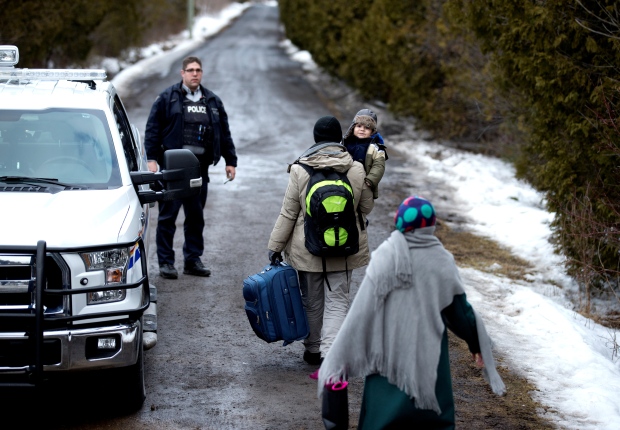
Canadians have different attitudes on immigrants versus refugees: poll

Two contrasting polls released: the annual IRCC tracking survey and a SOM poll of attitudes in Quebec  (methodologies and questions vary).

Canada-wide results show 52 percent believe the current levels are about right, down from 58 percent a year earlier. The Quebec poll asks this question differently, showing 55 percent are opposed to an increase in immigration levels while 36 percent support an increase.

Starting with the tracking survey:

A newly released federal survey on attitudes towards immigration suggests Canadians are somewhat more enthusiastic about accepting economic migrants than they are about refugees.

While 52 per cent of those polled in the Immigration Department’s annual tracking study felt the right number of immigrants were coming to Canada, 23 per cent thought it was too high.

Meanwhile, 40 per cent felt the right number of refugees was being admitted and 30 per cent thought that figure was too high.

The 2016 survey was done long before immigration and refugee policy became a centrepiece of the U.S. presidential campaign and the eventual new administration of Donald Trump, and before the question of what values immigrants to Canada ought to hold became a centrepiece of Conservative leadership politics here.

So while the data might not reflect how attitudes have shifted since those developments, it’s telling for what it was probing for in the first place, suggested Jack Jedwab, the executive vice president of the Association for Canadian Studies and co-chairman of an upcoming conference on integration and immigration.

“I think what the government is trying to get at is the issue of the extent to which people are more preoccupied by the increase in refugees that’s happening in a lot other places in the world,” he said.

While the survey did suggest some differences in viewpoints on refugees versus other classes of immigrants, Jedwab said they aren’t substantial.

“Right now, we’re seeing globally an effort on the part of elected officials to try to make those distinctions – refugees bad, economic migrants good, that’s the distinction that’s being made in the States to some extent,” he said.

“And I don’t think, based on what we’re seeing now in this poll, that we’re seeing that idea take effect here.”

Pollsters were in field between August 11 to 31, 2016, asking 1,598 Canadians for their opinions on immigration. The survey has a margin of error of 2.45 per cent, 19 times out of 20.

The survey was done ahead of the release of the immigration levels plan, published in October, and also before the federal government received a report from its economic advisory council that would recommend a massive increase in the number of immigrants to Canada, from what had been about 260,000 a year to 450,000.

The survey did probe Canadians’ appetite for an increase. Respondents were asked to what extent they’d support boosting levels of economic immigration by 100,000 people over the next five years and 42 per cent exhibited some level of support for the idea. If the number ratcheted up further to 200,000 over five years, support fell to 38 per cent.

The Liberals eventually nixed any major increase, going instead with a modest uptake in admissions to around 300,000.

While the survey is done annually, not all the questions are repeated each year, making it difficult to compare attitudes over time unless the questions are exactly the same.

There was some crossover between this year and last year’s study.

Fifty-two per cent of those polled in 2016 thought the government is accepting the right number of immigrants, down from 58 per cent of those polled in 2015.

Meanwhile, about 46 per cent of those polled in 2016 felt that refugees have a positive impact on the Canadian economy, up from the 41 per cent who felt that way in the survey done last year.

Source: Canadians have different attitudes on immigrants versus refugees: poll – The Globe and Mail

The Quebec poll:

Une majorité de Québécois est défavorable à l’idée d’accueillir davantage d’immigrants au Canada à la suite des mesures anti-immigration du président américain Donald Trump.

Un sondage SOM publié mercredi par Cogeco Nouvelles précise que 55 % des répondants croient que le Canada ne devrait pas accueillir davantage d’immigrants à la suite des mesures anti-immigration du président américain.

En revanche, 36 % des gens approuvent l’idée d’en accueillir davantage, alors que 9 % se disent indécis.

Les catégories de personnes qui sont les plus favorables à l’idée d’accueillir davantage d’immigrants à la suite des mesures adoptées par l’administration Trump sont les 18-24 ans, dans une proportion de 55 %, ceux qui ont une langue maternelle autre que le français, dans une proportion de 49 %, et ceux qui ont une scolarité de niveau universitaire, dans une proportion de 49 %.

De même, 75 % des personnes interrogées se disent d’accord avec l’idée de resserrer la surveillance aux frontières pour empêcher l’arrivée d’immigrants illégaux.

Les personnes ayant le français comme langue maternelle sont encore plus nombreuses à le penser, soit 79 %.

Seulement 19 % s’opposent à l’idée.

De plus, moins du tiers des Québécois interrogés jugent que le premier ministre du Canada, Justin Trudeau, gère correctement le dossier de l’arrivée au pays des immigrants illégaux, soit 29 % d’entre eux.

La majorité des Québécois dit non à plus de migrants, selon un sondage

Canada’s Immigration System, Lauded by Trump, Is More Complex Than Advertised – The New York Times

Following Trump’s ‘shout-out’ to Canada’s (and Australia’s) immigration system, more coverage in US media:

Canada’s merit-based immigration system received a loving mention by President Trump this week in his speech to Congress. Mr. Trump, who has railed against illegal immigration and talked tough about tightening borders, said adopting that kind of system would cost American taxpayers less and help increase wages for poor workers.

But in Canada, immigration is not just about selecting newcomers based on their skills. It is part of a system that promotes both the economy and the country’s multicultural society, which has arguably become as much a part of Canadian identity as hockey. And it is largely seen as a way to increase immigration, not reduce it.

“Canadians are more likely than citizens of any other industrial country to think immigration is essential to the economy and the future of the country,” said Jeffrey Reitz, a professor of ethnic and immigration studies at the University of Toronto.

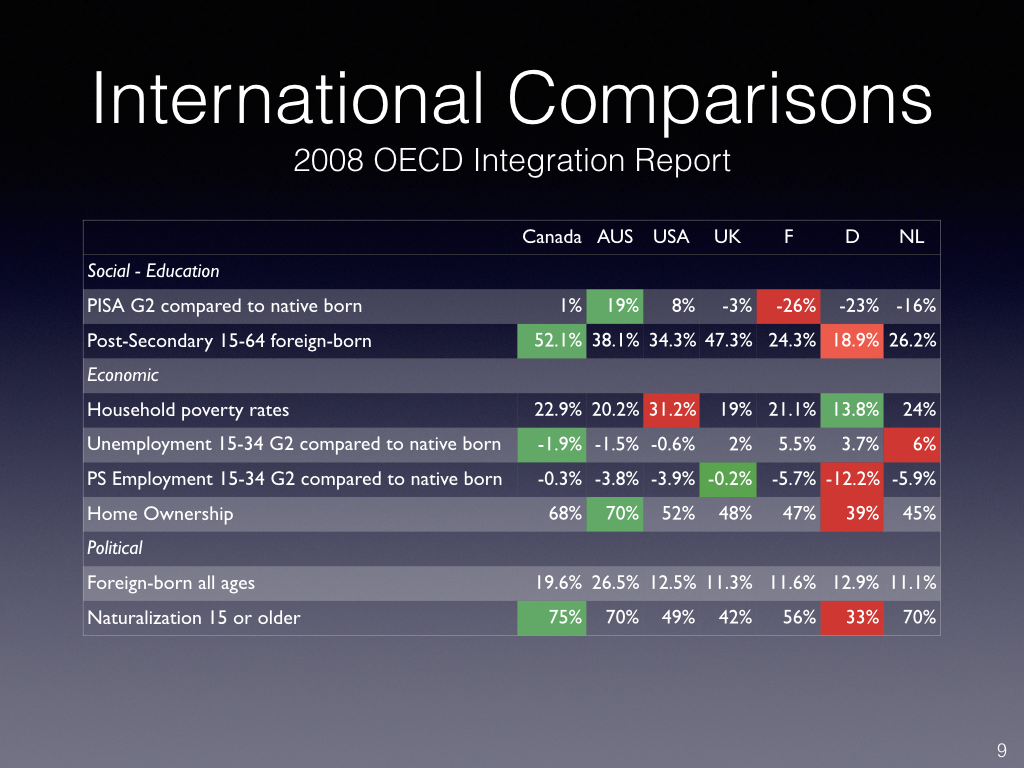
Canada, a country of 35 million, aims to take in 300,000 immigrants this year — 0.85 percent of its population, compared with the United States’ 0.3 percent — and polls show Canadians are happy with this. In fact, the finance minister’s advisory council on economic growth wants 150,000 more.

Part of that enthusiasm is the country’s recognition that, with an aging population, immigration is essential to economic growth. Add to that Canada’s geography — a long border with the prosperous United States to the south and the Arctic to the north — and illegal immigration is less of an issue.

And finally, Canadians have a wholehearted belief in the merit-based immigration system, which creates a positive feedback loop.

“The advantage of our system is the people who come in — everyone agrees they’ve passed some sort of merit system,” said Ravi Pendakur, a professor of public and international affairs at the University of Ottawa. “The Canadian population in particular is more willing to buy into immigration. They can see it’s managed, and that’s an advantage.”

The program does have its drawbacks. It has become enormously complex, ever-morphing and a source of huge backlogs.

Created in 1967, the merit-based system was seen as a way to select immigrants based on their “human capital” and not simply their country of origin, as had been the tradition. The idea was to bring in immigrants, regardless of where they were born, with vetted qualities that would make them the most successful at integrating into the Canadian economy.

Candidates received points for their level of education, ability to speak one or both of the country’s official languages, work experience, age, a job offer and what immigration officials called adaptability, which meant they came with family or had family here.

Initially, this system was the smallest of three streams of immigrants. People reuniting with their families and refugees were the other two. But increasingly, Canadian leaders have favored these “economic immigrants” to the point that this year, the government projects they will make up 57.5 percent of newcomers.

….“I teach this stuff and I find it confusing,” said Prof. Audrey Macklin, director of the University of Toronto’s Center for Criminology and Sociolegal Studies. “It’s inherently confusing, plus it keeps changing.”

Still, the principle remains: The immigrants coming in under this system are well educated, literate in the local language and have great credentials.

Not surprisingly, studies have shown that economic immigrants, arriving with more education and language skills, land higher-paying jobs with greater potential for raises. Their children also have higher college graduation rates.

“If America changes toward our system, the Apples and Microsofts and Googles will be very happy,” said Robert Vineberg, a retired regional director general of immigration. “But the vegetable growers in California will not be so happy.”

Mr. Vineberg offered government immigration statistics from 2015 as an example. That year, Canada identified 66,360 newcomers as economic immigrants for their occupational skills.

Around 36,300 were categorized in the top two classes, meaning they were fluent in one national language and had a college degree. Most would have been recruited for a specific job, Mr. Vineberg said: for instance, vice president of a company or administrator of a hospital. Another 22,700 were picked for a job in skilled trades, like an industrial electrician. They needed the language skills to read a blueprint and follow complicated directions, and at least some postsecondary training and certification in their trade.

Only 2,177 were brought in as laborers, and even they would have been chosen for specific positions, most likely in a hard-to-fill job or a remote location — for instance, a Japanese-speaking hotel receptionist in Yellowknife, Northwest Territories, Mr. Vineberg said.

His example, however, illuminates the contradiction at the center of the immigration system.

In 2015, almost 272,000 people were granted entry, and only a quarter were picked for their merit. Most of those counted in the economic class were family members, chosen not for their human capital — although many might also be educated and intend to work — but their blood ties.

“The statistics convey the impression that Canada chooses most people based on economic criteria, and perhaps policy makers think this reassures Canadians that immigration serves Canada’s economic interests,” Professor Macklin said. “In reality, most people still enter on the basis of kinship. The idea that this can be easily or significantly altered is a bit of a fantasy.”

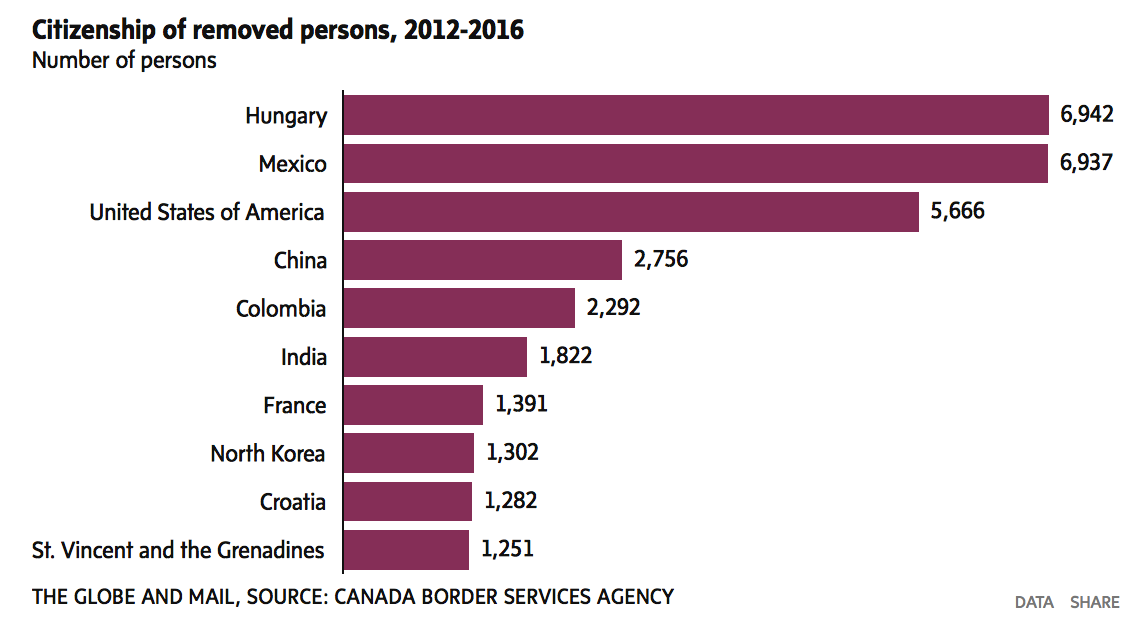
The other distinctive aspect of Canada’s immigration policy is what the country does not face: a tidal wave of migrants. Surrounded on three sides by enormous and frigid oceans, Canada has few people sneaking in. Even the increasing number of asylum seekers illegally crossing the border from the United States in recent years is comparatively small.

“It’s easier to be relaxed about immigration when your only land border is a huge wall with the United States,” Professor Reitz said.

Canadian immigration website crash started hours before Trump victory, documents show

Well, that destroys one of the smug Canadian narratives!

An immigration website that was supposedly overwhelmed by Americans wanting to flee to Canada because of a Trump presidency was more likely brought down by foreigners scrambling to get a basic travel document before a deadline.

CBC News has learned that the website for Immigration, Refugees and Citizenship Canada was already in trouble hours before Donald Trump’s victory became clear on Nov. 8, the day of the U.S. presidential election.

That’s because foreign travellers faced a Nov. 10 deadline to obtain so-called “electronic travel authorizations” online before they could fly into Canada. They apparently flooded the website before that deadline to pay $7 online for electronic delivery of the mandatory travel documents, known as eTAs.

Immigration and Citizenship Canada website

Technicians took more than 32 hours on Nov. 8-9, 2016 to fix Canada’s immigration website, which was flooded with applications from travelers looking for transit documents before a key deadline.

The rush seemed to catch Canada’s immigration officials off guard. By about 2 p.m. ET on Nov. 8 — even as Americans were still casting their ballots — the high volume of eTA traffic left the main website “degraded” with “temporary outages.”

Technicians with Shared Services Canada were alerted to the problem, but didn’t act immediately. It eventually took more than 32 hours to repair the website, by doubling the number of servers to six and increasing the processing capacity. The fix came less than two hours before the Nov.10 eTA deadline, likely frustrating eTA applicants for more than a day.

CBC News obtained internal reports and emails, through the Access to Information Act. They undermine the official version that the website “started to experience difficulties” only at 11 p.m. ET, when Trump’s victory had become clear.

“It looks like the eTA is starting to experience significant volumes a few days earlier than planned,” said a Shared Services Canada official, in an email written before any U.S. polling stations had even closed.

“The surge to the site seems to have happened sooner than planned,” she repeated in a later email.

Although Shared Services Canada technicians were officially told about the web troubles at about 2 p.m. on Nov. 8, they did little to resolve the problems that afternoon.

Source: Canadian immigration website crash started hours before Trump victory, documents show – Politics – CBC News

Trump may praise Canada’s immigration model, but he would never adopt it: Ibbitson

Good analysis by John Ibbitson:

Although Donald Trump praised Canada’s immigration system in his speech to Congress on Tuesday night, he does not understand that system. To emulate the Canadian model, Mr. Trump would have to transform not only U.S. immigration, but his own thinking.

“Nations around the world – like Canada, Australia and many others – have a merit-based immigration system,” Mr. Trump observed in his address. “It is a basic principle that those seeking to enter a country ought to be able to support themselves financially.”

This is correct, as far as it goes, which is not very far. Yes, this country employs a points system that recruits immigrants based on their ability to integrate into the Canadian economy.

But if Mr. Trump truly wished to adapt the Canadian immigration ethos, he would have to embrace concepts he currently rejects. First and foremost, he would have to fling open the doors.

The United States brings in about one million legal permanent residents each year, about a third of one per cent of its population. Canada will bring in 300,000 immigrants this year, just under nine-tenths of one per cent of this country’s population. So to make the U.S. immigration system more Canadian, Congress and the Trump administration would need to almost triple the current annual intake, to around 2.8 million new arrivals a year.

That increased intake, if the Canadian way became the American way, would include 280,000 refugees. While most immigrants to Canada are either economic class or family class, about 10 per cent are refugees, brought in on humanitarian grounds. The United States typically brings in about 70,000 refugees a year, a quarter of the Canadian equivalent, and Mr. Trump wants to ban refugees entirely. That’s really not very Canadian of him.

The President believes immigrants should be self-supporting, and indeed they should. But the most successful immigrants to Canada often do not have the professional degrees or fat bank accounts Mr. Trump no doubt has in mind. As my colleague David Parkinson reported, Canada seeks immigrants not only for the professions and knowledge industries, but in the skilled trades and other blue-collar sectors.

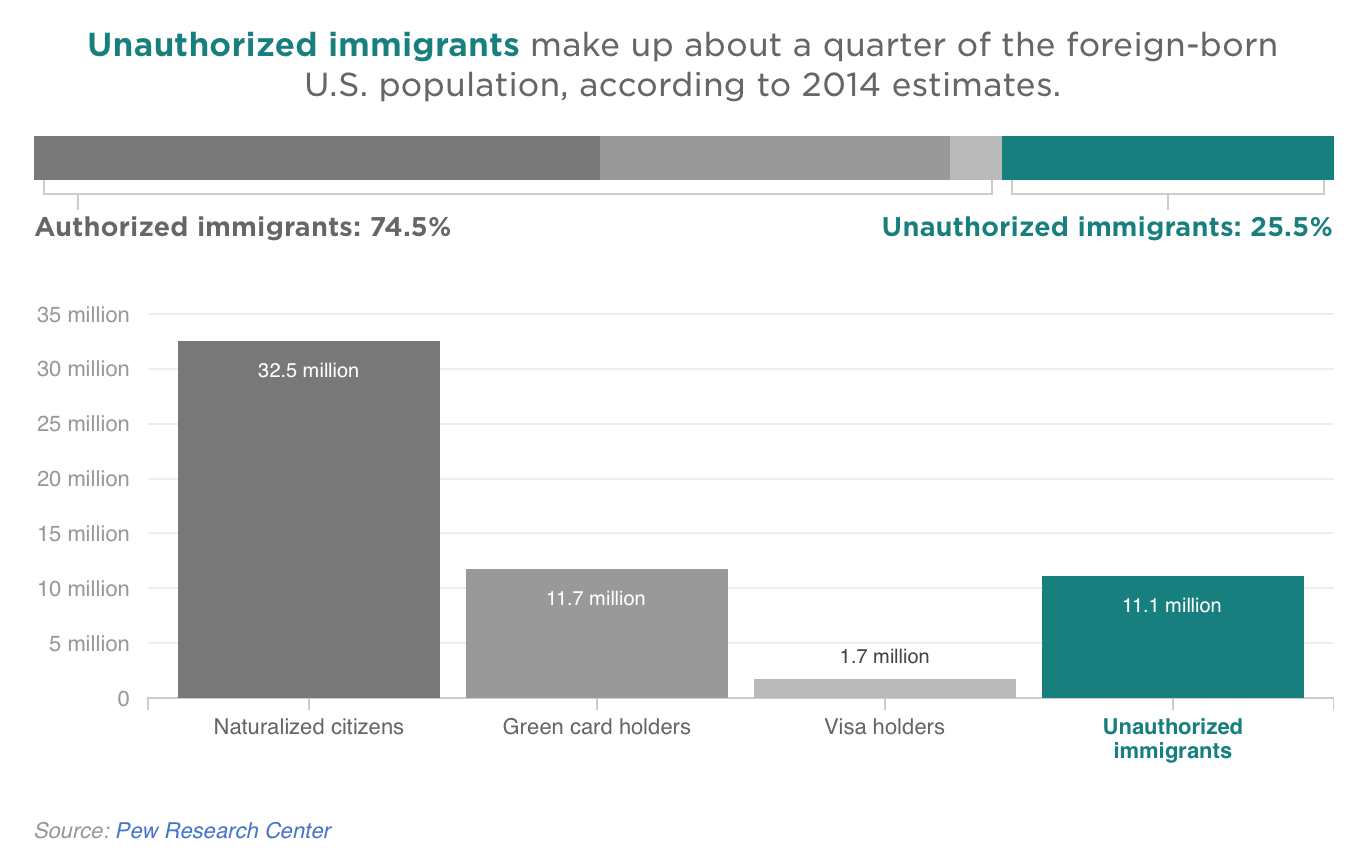
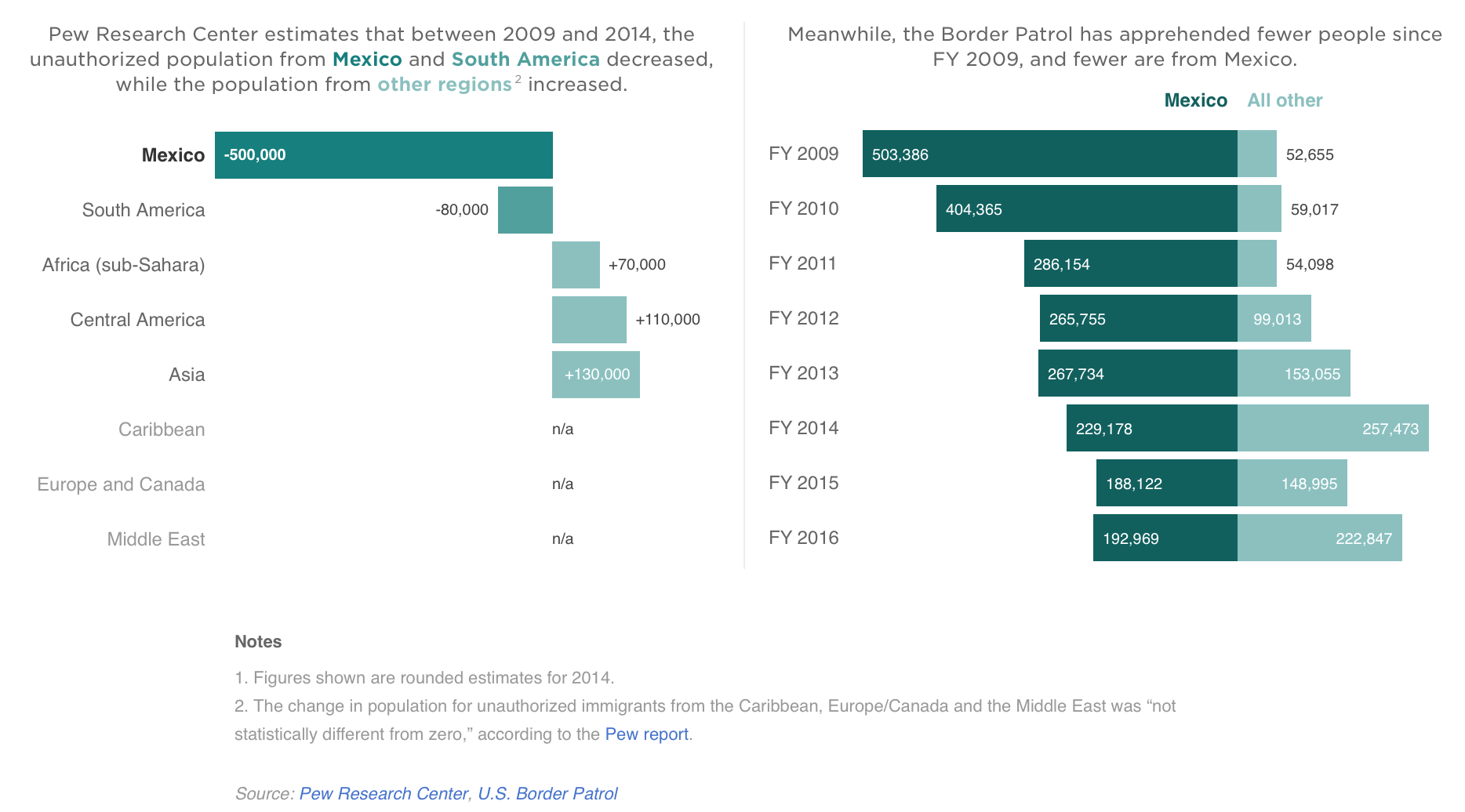
Those sorts of jobs in the United States are often filled by illegal Latino workers. To emulate the Canadian system, the United States would have to convert the stream of illegal immigrants from Mexico into a legal stream. Mr. Trump is trying, instead, to choke off the flow altogether.

The President would have to welcome Muslim immigrants. The Canadian system is blind to ethnicity or religion. Muslims are as welcome as any others, provided they meet the criteria. Mr. Trump, in contrast, wants to ban the citizens of seven majority-Muslim countries from entering the United States in any circumstances.

Most important of all, Mr. Trump would have to embrace multiculturalism: the celebration of diversity within a united society. Such a concept would be alien to the President and his supporters.

Immigration is the key to prosperity and growth for any advanced country. Both the United States and Canada have a fertility rate below the replacement rate of 2.1 children per mother. (The United States is at 1.9 and Canada is at 1.6.) Efforts to increase fertility rates in Europe and in Quebec have mostly failed. (You cannot bribe a couple to have a child; it is insulting even to try.) Immigrants are the best – indeed, the only – way to keep an economy filled with young workers paying the taxes needed to sustain the growing ranks of the retired.

But Mr. Trump, however much he might praise the Canadian model, will never adopt it. That sort of openness to the world just is not in his nature.

Source: Trump may praise Canada’s immigration model, but he would never adopt it – The Globe and Mail

Canada should welcome America’s ‘dreamers’ – Bloemraad and Omidvar

Good advocacy piece by Senator Omidvar and Irene Bloemraad of University of California:

The U.S. public is sympathetic to their plight. Most Americans favour legalizing undocumented residents. Multiple attempts have been made to pass a DREAM (Development, Relief and Education for Alien Minors) Act that would open a road to citizenship. But Congress has repeatedly failed to pass the bill, leaving only the coinage of “dreamers” to refer to those it would have helped. There is no chance of new DREAM Act legislation in the near future.

As a stopgap measure, the administration of former president Barack Obama introduced the Deferred Action for Childhood Arrivals (DACA) program. Under DACA, undocumented young people received work authorization for two years and were shielded from deportation. The program was open to those who arrived in the United States before the age of 16, had no police record, were in high school, had graduated from high school, or had been honourably discharged from the U.S. military. To date, about 750,000 people have become “DACAmented.”

These are precisely the people who Canada looks for in its immigration program. The economic advisory council to Prime Minister Justin Trudeau recommended Canada focus a growing immigration strategy on business talent and international students. The DACA kids are young, with a lifetime of economic contribution in front of them. They are fluent in English, went to U.S. schools, have North American work experience – often in companies that can be found on either side of the Canada-U.S. border – and some have university degrees. To get DACA status, they had to be screened for security threats and criminal background, making them a pre-vetted group.

These young people hold incredible promise for Canada. They are exceptional people. It is not easy to go to college or university when you are undocumented. But within the flagship University of California public system, hundreds of dreamers are pursing higher education in degrees ranging from math to sociology.

In 2014, Sergio Garcia became the first undocumented lawyer certified to the California bar. That same year, Jirayut Latthivongskorn became the first undocumented medical student enrolled in the University of California, San Francisco. For each of these dramatic against-all-odds success stories, there are thousands of other ordinary immigrant kids who just want the security of citizenship, a good job and a stable home.

Unfortunately, their American dreams have never appeared more remote. Mr. Trump campaigned on an explicit “America First” message. Since taking office, he has advanced plans to build a wall on the U.S.-Mexico border and sought to temporarily halt refugee admissions. The White House has not yet made an explicit statement on the DACA program but, at best, the program will end. At worst, the government will use the information collected from those who applied to begin mass deportations.

Canada is already seeing the arrival of asylum seekers from the United States. If DACA is ended, a flood of new arrivals is possible. Canada cannot take all of these young people, but a targeted program of 10,000-30,000 would allow Canada to select the very best matches with Canadian society and the economy.

As immigrants to Canada, they could be a special addition to economic-stream migrants, or fall under a new program akin to that for international university students.

Offering a Canadian dream to DACA recipients might also be positive for foreign relations. Mr. Trump faces a problem in how to deal with the country’s undocumented population. Deporting millions would be politically, logistically and socially impossible, but rendering their lives difficult is a distinct possibility.

Canada has long benefited from the flow of people educated and raised in the United States, who left for a variety of reasons. Today, the United States is among the top-10 source countries of permanent residents. Looking further back, an estimated 40,000 draft dodgers fled conscription during the Vietnam War, representing what the Immigration Department called “the largest, best-educated group this country ever received.” Dreamers could be a close second.

Source: Canada should welcome America’s ‘dreamers’ – The Globe and Mail

A quarter of Canadians want Trump-style travel ban, poll shows – Politics – CBC News

While I do not find these results all that surprising (but the headline could have been written “75 percent don’t want”) rather than focusing on the negative.

Angus Reid polling tends to be more negative on these issues than Environics and Ekos .

This does however reinforce the need for the government to be attentive to these concerns, even if they are more part of the Conservative than Liberal base (as some of the CPC leadership campaign strategies and opposition to M-103 indicate):

A significant minority of Canadians say Canada’s 2017 refugee target of 40,000 is too high and one in four Canadians wants the Liberal government to impose its own Trump-style travel ban.

Those are just two of the findings in a new Angus Reid poll that looked at Canadian’s attitudes towards the federal government’s handling of refugees.

Overall, 47 per cent of Canadians surveyed said Canada is taking in the right number of refugees. But 11 per cent say 40,000 is too low and Canada should take in more, while 41 per cent say the 2017 target is too high and that we should not be taking in anymore refugees.

Shachi Kurl, executive director of Angus Reid, told CBC News that “41 per cent is not the majority voice but it is a significant segment of the population that is actually saying our targets for 2017 are too high and that, I think, adds to a level of anxiety for those folks.”

“Certainly in terms of that ‘too many, too few’ debate, a lot more people think it’s too many than too few,” she said.

The survey also asked Canadians about the federal government’s decision not to alter its own immigration policy to match that of U.S. President Donald Trump’s after he rolled out his travel ban.

Some 57 per cent of Canadians said the federal government made the right call in not following Trump down the rabbit hole, while 18 per cent said Prime Minister Justin Trudeau’s government should have chose to take in more refugees.

But the number that is perhaps the most interesting is that 25 per cent of Canadians say Canada should have adopted its own temporary travel ban similar to the U.S. policy.

“We tend to, when we are looking a numbers, look at the majority view, but the fact that one in four Canadians are of the mind that we should be looking to our own travel ban is significant and is part of a red flag that is starting to emerge in terms of refugee policy,” said Kurl.

Working hard to fit in

When it comes to whether the government did a good job of resettling refugees, 61 per cent said they either strongly (12 per cent) or moderately (49 per cent) agree that it had. But some 39 per cent of people either moderately (22 per cent) or strongly (17 per cent) disagreed.

Kurl said those surveyed are also split over how well refugees are integrating into Canadian society, and how enthusiastically Canadians are welcoming new arrivals.

A slim majority of (54 per cent) say refugees do not make enough of an effort to fit into mainstream society, while 46 per cent say that they do try hard to fit in.

When the responses are broken down across age groups, it’s revealed that the younger the person, the more likely they are to say that refugees are working hard to fit into Canadian society.

For example, 62 per cent of those in the 18-24 age range say refugees are making enough of an effort to fit in, but in the 25-34 age range that drops to 47 per cent.

There is a slight spike among 35-44 year olds where 54 per cent of those asked said refugees are working hard to fit in, but for those who are 45 and older, only one in four said the same thing.

Source: A quarter of Canadians want Trump-style travel ban, poll shows – Politics – CBC News

Michelle Rempel demands more from politics—on both the left and right

Impressive and thoughtful speech delivered at a McGill Institute for the Study of Canada event regarding immigration and Canadian exceptionalism:

During the 2015 campaign, I thought all political parties, my party included, acted shamefully on the issue of immigration, because we used the Syrian refugee crisis as a political wedge in a political campaign, and that was wrong. The response to the Syrian refugee crisis became a campaign issue of one-upmanship on numbers, rather than talking about people as human beings. “Who’s going to bring in more?” When the question should have been: “How do we do it in a way that achieves social license in the country in an expeditious way that shows compassion and addresses the situation, and how do we support the integration of people when we come to Canada, such that we build social license for more refugees in the future, and ensure that refugees that come to Canada have a better experience here than where they came from?” That is not a politically sexy conversation, because it’s easier to say, “I’m going to bring in 25,000 and you’re going to bring 15, ergo you’re racist and I’m more awesome.” Not helpful. Also not helpful is to frame the issue of gender isolation in new Canadian women in the term of a tip line.

And what happened out of all that? Where we are today is we had a parliamentary study that looked at the response to the Syrian refugee initiative, and we had Syrian refugees come in front of a parliamentary committee and said: “I’m in a hotel room that’s infected by bed bugs, and my wife can’t go out and learn English because she’s got five kids. How are we going to have any hope to do anything well here?”

It’s not an adequate response to say, “It’s a nation-building project and the provinces are responsible for it,” when I have a school board come to parliamentary committee and say, “We’ve absorbed in our one city the equivalent of a full elementary school of refugees this year, they have needs that we need to address and need to be compassionate to because they’ve been in a war zone for years and their education has been disrupted, and we received no new funding for it. So in a political campaign for any political stripe to say it’s fully costed when there is no plan … not helpful. Not exceptional.

The thought that populist rhetoric can’t happen in Canada is shocking. The reality is that there has been a narrative that has arisen where you have groups of people who feel that their voices aren’t being heard, and it’s easy through 140 characters and short visual soundbites and memes to say it’s someone else’s fault. And in Canada, that’s still here. But the reality is there’s no “them” and “us” anymore. That’s not how the globe operates. We are so interconnected, be it through trade, or simply the reality of understanding our humanity through Twitter, through YouTube. You can see the destruction in Aleppo. To have that narrative be used in political discourse is disgusting and wrong, and oversimplified.

We all have to demand better. Demanding better for someone who’s a centrist like myself has been a very unpopular position. Because it means there’s no real home for me as a politician on some days. But it’s where we all need to be. There’s many other examples of how Canada in public policy has sort of politicized the system—they might not be as firecracker or high-profile as the barbaric cultural practices tip line. It’s things like lifting a visa requirement on a country without a formal review for some unquantified economic benefit. It’s policy around immigration that is politically motivated that is unquantifed and unsubstantiated—and both parties are guilty of this—that diminishes the public confidence that immigration is a good thing, and we are unexceptional in that, especially in Parliament.

Why should we all be listening to these sorts of things with an open mind? It’s because if we don’t do that, I’m really deeply concerned as a legislator about the peace of humanity right now, and that’s not hyperbole. When I see nationalist parties rise and gain seats in European Parliament, we should be very concerned. When I see the level of nationalist rhetoric that is acceptable among people that are pretty educated and smart people, that’s cause for concern. When I see protectionism and the thickening of borders as a populist public policy response in a globalized economy, we should all be concerned.

The way forward is to ensure we have a public policy dialogue that is not alt-right or far-left. It has to be in the middle and we have to focus not on values, but on programming and outcomes that enable what we vision exceptionalism to be. Things like: where is the smart conversation around the burqa? Where’s that safe space? I don’t wear one—women who wear one, where’s their voice on this? And why don’t we talk about the fact there are equally as many other religious groups who use dress as a control for women? So rather than judging them and shaming them, how do we reach out to them, and give them hope? The fact that we can’t even talk about that—I find as a politician, for me as a camera, even saying that is a risk. I’ve done something terribly egregious, by bringing up both sides of that argument. But if we can’t have this argument, how can we ever reduce issues like Islamophobia? The fact that we can’t have a discussion because we’re so polarized is why we need to acknowledge that we’re not exceptional.

You, as the thought leaders on this? It can’t be 140 characters “You’re a racist; you’re a socialist. You’re conservative; you’re Liberal. Your party sucked; your party sucked.” Come on. If we are truly exceptional, we have to show the world we’re better than that. And I’ll be honest with you, after 18 months of banging my head in both my own party and in the House of Commons against the Liberals, you’ve got to help me out too.

Where we are as a country, for us to be having a conference on how exceptional we are and how much better we are than the United States and we’re welcome to refugees is such a disservice to the fact that we’ve got a long way to go.

For all of you, from the bottom of my heart: let’s try to be smarter about this. And let’s demand better from our leaders.

Source: Michelle Rempel demands more from politics—on both the left and right

Michael J. Donnelly and Peter Loewen: Canadians’ feelings about immigration are mixed at best

Interesting new study by political scientists and Peter Loewen, reinforcing in part some of the conclusions of the earlier Angus Reid poll (CBC-Angus Reid poll: Canadians want minorities to do more to ‘fit in’) and subject to some of the same critiques (Angus Reid’s survey actually shows high level of support for our diverse society: CardozoHow Angus Reid, CBC got it wrong about multiculturalism: Jedwab).

That being said, their policy conclusions – our political system reduces the risk, politicians and others should avoid pandering or cultivating xenophobic attitudes – are sound:

Our core conclusion:? Canadian attitudes are not exceptionally pro-immigrant or racially enlightened. Instead, Canadian society contains the potential for the same kinds of hate that we see elsewhere.

One question we asked was whether respondents would support, oppose, or neither support nor oppose cutting off all immigration to Canada. Not surprisingly, only 19 per cent of respondents supported such a step. However, only 46 per cent expressed opposition, with the rest on the fence. How does this compare to our southern neighbours? In 2010, the same question was asked of the American public. There, a similar 42 per cent expressed opposition. When asked about allowing immigrants from poor countries, the Canadian public answered more positively than 9 and less positively than 11 European countries where the same question was asked in 2014 and 2015. In other words, Canadian attitudes are normal for a developed country. Canada is not exceptional on that score.

The study, a project of the McGill Institute for the Study of Canada (MISC), also found that while attitudes among Canadians towards refugees and immigrants range largely from positive to benign, those views are not necessarily strongly held.

Study author Michael Donnelly, a political science professor at the University of Toronto, concludes that, as a result, there is potential for intolerant, anti-immigrant, and anti-refugee sentiment to increase.

None of this means that Canadian politics will inevitably go the way of populist rhetoric and action. Canadian institutions and — especially — Canadian leaders have the ability to guide politics, to maintain the norms of non-racism and to pursue policies of inclusion and cooperation. Attitudes do not lead inexorably to policies or even to politics. As two of the three largest Canadian political parties choose new leaders, those party elites and activists who have a say in the process have a duty to avoid the mistakes of the U.S. Republican Party. There, a fractured elite and the use of primary elections meant that Donald Trump could use racist demagoguery to capture the leadership of a party that contains many for whom such rhetoric was not attractive. That, in turn, meant that when the normal processes of partisanship and retrospective voting took over in the general election, he had a roughly 50/50 chance of capturing the presidency.

To see if this could happen in Canada, we asked respondents who expressed support for one of the four largest parties to choose between hypothetical candidates for leadership, based only on their names, ages, province of residence and positions on the CPP, immigration and refugees. What we found is, in some ways encouraging, but contains hints of danger for the Canadian model of openness and multiculturalism. We saw no evidence of discrimination against candidates with Indian or Francophone names, and no evidence of discrimination against female names. However, among none of the parties was there clear evidence of an electoral benefit to more open immigration or refugee policies. Indeed, among Conservatives, accepting zero Syrian refugees is a “winning” strategy, and among NDP partisans, a candidate that called for increasing economic immigration appears to suffer a large electoral penalty.

We do not write this to encourage candidates to pursue such policies in their respective leadership contests. After all, public surveys offer little insight into the opinions of the small slice of Canadians who will select leaders in both parties. Rather we offer this as evidence of two claims. First, Canadian institutions of leader selection may lead to better, less divisive leaders. Second, politicians and those selecting them have a responsibility to avoid xenophobic pandering and to reinforce the norms of behavior that have allowed the Canadian model, for all its faults, to create the open, exciting and peaceful society we enjoy.

Source: Michael J. Donnelly and Peter Loewen: Canadians’ feelings about immigration are mixed at best | National Post

Another poll from Pew provides a slightly different picture:

Most Canadians don’t care where residents are born, but they do care about whether they speak English or French.

A global study of national identity by Pew Research has discovered that Canadians are among the least inclined to think place of birth defines whether someone is an authentic citizen.

Only 21 per cent of Canadians said place of birth is important. That compares to 32 per cent of those in the U.S. and more than 50 per cent of the population in Greece and Japan who believe birthplace is crucial to national identity.

The Pew Research study was done in the wake of growing concerns in the U.S. and Europe about globalization, high migration rates and protectionism, factors that have contributed to the rise of Donald Trump and immigration-skeptic parties.

pew-graph-identity-place-of-birth

Canada under the Liberals has gone a different direction, with Prime Minister Justin Trudeau talking about this being the world’s “first post-national country.”

Even though Canadians did not emphasize place of birth in the Pew poll, they did care about whether residents can speak English or French, the official languages.

Three in five Canadians agreed that “being able to speak our national language(s) is very important for being truly Canadian.”

Canadians’ language expectations, however, were still quite a bit lower than they are the Netherlands, the United Kingdom, Germany, Japan and the U.S. (See chart below.)

In Canada, one out of five people do not have English or French as their mother tongue.

Source: ‘True’ Canadians don’t need to be born here, but language matters: Poll

FBI Reports Show Terror Suspects Coming From Canada While Trump Stares at Mexico – The Daily Beast

Expect this story and data to have some legs in the current political context (has in the past, and is always an ongoing challenge with our American neighbours):

Donald Trump keeps talking about the threat from the U.S.-Mexico border. But he may be looking in the wrong direction. FBI reports reviewed by The Daily Beast reveal that far more suspected terrorists try to enter the country from the northern border with Canada than from the south.

Seven FBI Terrorist Screening Center “monthly domestic encounter reports” dating from April 2014 to August 2016 detail the number, type, and location of encounters with known or suspected terrorists across the United States. The encounters are based on information in various watchlist databases. In all seven reports, the numbers of encounters at land border crossings were higher in northern states than southern.

“We are looking the wrong direction,” said a senior DHS official familiar with the data. “Not to say that Mexico isn’t a problem, but the real bad guys aren’t coming from there—at least not yet.”

On Monday, press secretary Sean Spicer told reporters he would not disclose evidence behind the President’s claims that jihadis are “pouring” into the country. “I’m not going to get into specific information that the president has,” he said.

The FBI reports obtained by The Daily Beast provide data on known or suspected terrorists attempting to enter the country, or who are already in the United States.

These reports show hundreds of watchlisted passengers encountered on domestic flights—meaning they are already in the country—and a smaller percentage crossing the border over land.

Those encounters are reported back to the FBI’s Terrorist Screening Center and used to compile the monthly domestic encounter overview reports, which are classified “Law Enforcement Sensitive.”

Newly installed Department of Homeland Security Secretary John Kelly traveled to Texas last week to survey the border in the Rio Grande Valley with local law enforcement. He is scheduled to testify Tuesday morning at a House Homeland Security Committee hearing on threats to the southern border.

But the FBI data shows concerns about terrorists crossing into the U.S. from Canada may be a more immediate concern, or is at least worthy of considerable attention, according to border and congressional officials.

Source: FBI Reports Show Terror Suspects Coming From Canada While Trump Stares at Mexico – The Daily Beast

The Data That Turned the World Upside Down – Motherboard

While much of this is alarming and disturbing – particularly voter suppression – I would love to see some psychometrics complement conventional polling with respect to immigration issues to test different ways of posing questions:

But to what extent did psychometric methods influence the outcome of the election? When asked, Cambridge Analytica was unwilling to provide any proof of the effectiveness of its campaign. And it is quite possible that the question is impossible to answer.

And yet there are clues: There is the fact of the surprising rise of Ted Cruz during the primaries. Also there was an increased number of voters in rural areas. There was the decline in the number of African-American early votes. The fact that Trump spent so little money may also be explained by the effectiveness of personality-based advertising. As does the fact that he invested far more in digital than TV campaigning compared to Hillary Clinton. Facebook proved to be the ultimate weapon and the best election campaigner, as Nix explained, and as comments by several core Trump campaigners demonstrate.

Many voices have claimed that the statisticians lost the election because their predictions were so off the mark. But what if statisticians in fact helped win the election—but only those who were using the new method? It is an irony of history that Trump, who often grumbled about scientific research, used a highly scientific approach in his campaign.

Another big winner is Cambridge Analytica. Its board member Steve Bannon, former executive chair of the right-wing online newspaper Breitbart News, has been appointed as Donald Trump’s senior counselor and chief strategist. Whilst Cambridge Analytica is not willing to comment on alleged ongoing talks with UK Prime Minister Theresa May, Alexander Nix claims that he is building up his client base worldwide, and that he has received inquiries from Switzerland, Germany, and Australia. His company is currently touring European conferences showcasing their success in the United States. This year three core countries of the EU are facing elections with resurgent populist parties: France, Holland and Germany. The electoral successes come at an opportune time, as the company is readying for a push into commercial advertising.

Kosinski has observed all of this from his office at Stanford. Following the US election, the university is in turmoil. Kosinski is responding to developments with the sharpest weapon available to a researcher: a scientific analysis. Together with his research colleague Sandra Matz, he has conducted a series of tests, which will soon be published. The initial results are alarming: The study shows the effectiveness of personality targeting by showing that marketers can attract up to 63 percent more clicks and up to 1,400 more conversions in real-life advertising campaigns on Facebook when matching products and marketing messages to consumers’ personality characteristics. They further demonstrate the scalability of personality targeting by showing that the majority of Facebook Pages promoting products or brands are affected by personality and that large numbers of consumers can be accurately targeted based on a single Facebook Page.

In a statement after the German publication of this article, a Cambridge Analytica spokesperson said, “Cambridge Analytica does not use data from Facebook. It has had no dealings with Dr. Michal Kosinski. It does not subcontract research. It does not use the same methodology. Psychographics was hardly used at all. Cambridge Analytica did not engage in efforts to discourage any Americans from casting their vote in the presidential election. Its efforts were solely directed towards increasing the number of voters in the election.”

The world has been turned upside down. Great Britain is leaving the EU, Donald Trump is president of the United States of America. And in Stanford, Kosinski, who wanted to warn against the danger of using psychological targeting in a political setting, is once again receiving accusatory emails. “No,” says Kosinski, quietly and shaking his head. “This is not my fault. I did not build the bomb. I only showed that it exists.”

Source: The Data That Turned the World Upside Down – Motherboard