How Netflix’s Immigration Nation shows the true horror of Ice agents

One of the better articles on the Netflix series, a must see:

The initial main draw of Immigration Nation, the six-part documentary series on immigration enforcement under Trump released on Netflix this month, was that US authorities did not want you to see it. After viewing a final cut, US Immigration and Customs Enforcement (Ice), which had allowed the film-makers, Christina Clusiau and Shaul Schwarz, to embed with agents for over two years, attempted to intimidate the production team into delaying the release. The agency threatened Clusiau and Schwarz with lawsuits, according to a New York Times report, and to use the “full weight” of the federal government to block publication of certain Ice scenes usually invisible to the American public.

It didn’t work, and watching the six-hour series, it is clear why the agency did not want the footage to become public. Immigration Nation, more than any other documentary of the Trump administration’s immigration crackdown, allows Ice agents and officials to explain their perspective. And thus more than any other documentary, Immigration Nation reveals how a government agency upholds and perpetuates evil. Two-plus years of Cops-style embedment doesn’t glorify Ice agents, but instead reveals the agency to be populated by, in some cases, callous people who gloat over arrests; more often, affable people fulfilling their small part of the contract as directed, with the compartmentalization it requires.

StatCan/IRCC Study: Selecting economic immigrants from among temporary foreign workers and labour market outcomes by admission programs

Another insightful data-based analysis by StatCan and IRCC, showing the importance of Canadian work experience from being former temporary foreign workers:

Canada selects economic immigrants through various programs, including the Federal Skilled Worker Program (FSWP), the Provincial Nominee Program (PNP) and the Canadian Experience Class (CEC).

Previous research has shown that the last two groups fare better in the labour market than the first one, at least in the initial years after immigration. The difference stems largely from the fact that proportionately more economic immigrants selected from the PNP and the CEC were former temporary foreign workers, according to the first study released today.

The study, titled ‘Two-step immigration selection: Why did immigrant labour market outcomes vary by admission programs?,’ shows that from 2009 to 2016, about two-thirds of immigrants selected from the PNP and essentially all immigrants selected from the CEC were former temporary foreign workers, i.e. had employment earnings in Canada before obtaining their permanent residence.

In contrast, about one-quarter of their counterparts selected from the FSWP were former temporary foreign workers.

Since having worked in Canada before obtaining one’s permanent residence is associated with higher employment incidences and earnings, the fact that a relatively high proportion of immigrants selected from the PNP and the CEC worked in Canada in the past explains to a large extent their better labour market outcomes.

For example, 93% of immigrants selected from the PNP and 95% of immigrants selected from the CEC found employment in the first full year after obtaining permanent residency. The corresponding percentage for their FSWP counterparts was substantially lower, at 80%.

The study shows that the greater propensity to have worked in Canada in the past accounts for about 40% of the 13-percentage-point difference observed between immigrants selected from the PNP and the FSWP. It also accounts for about two-thirds of the 15-percentage-point difference observed between immigrants selected from the CEC and the FSWP.

The relatively high proportion of PNP and CEC immigrants who had previous work experience in Canada also explains why these groups earn more than their FSWP counterparts. It accounts for at least 94% of the earnings differences observed between these groups, on the one hand, and immigrants selected from the FSWP, on the other hand, during the first year after immigration.

Likewise, the greater propensity to have worked in Canada in the past accounts to a large extent for the differences in employment incidences and earnings observed between the three groups, five years after immigration.

The second study, titled ‘Two-step immigration selection: Skilled work experience vs. pre-arranged jobs,’ focuses on the economic immigrants who were selected under Canada’s Express Entry system in 2015 and 2016. It compares the degree to which Canadian work experience before immigration and pre-arranged employment at the time of application predict the initial labour market outcomes of these economic immigrants.

Both Canadian work experience and pre-arranged employment are key criteria underlying Canada’s Express Entry system of economic immigration selection.

The study shows that Canadian work experience appears to be a better predictor of initial labour market outcomes than pre-arranged employment.

Economic immigrants who had pre-arranged employment displayed, in the first two years after immigration, employment incidences that were similar to those of other economic immigrants selected under the Express Entry system.

In contrast, economic immigrants who had worked in Canada before immigrating and who had received relatively high annual earnings while doing so (over $50,000 in 2017 dollars) had employment incidences that were 8 percentage points higher than those of other economic immigrants without Canadian work experience.

Canadian work experience was also a stronger predictor of initial earnings after immigration than pre-arranged employment.

Even after controlling for education, among other factors, immigrants with a pre-arranged job earned 15% more than those without a pre-arranged job in the first two years after immigration. However, immigrants who had received high earnings in Canada before immigrating earned almost twice as much as those who had no Canadian work experience.”

View or download the full reports:

Two-step Immigration Selection: Why Did Immigrant Labour Market Outcomes Vary by Admission Programs?

Two-step Immigration Selection: Skilled Work Experience vs. Pre-arranged Jobs


Wealthy turn anti-immigrant when their riches are threatened

Interesting psychological study, with the fear of loss (absolute or relative) being the motivator (association/correlation, not necessarily causation):

Anti-immigration sentiment rises when affluent people fear losing their wealth, a psychological study has found.

The University of Queensland’s Professor Jolanda Jetten said harsh attitudes towards immigrants were found in times of economic downturn and relative deprivation—and also in prosperous times.

“Affluent people who fear losing in the short or long term experience collective angst about their group’s future vitality and wealth status,” she said.

“Our research found this fuels negative attitudes toward immigrants and minorities. Even though may have a lot, their fear of falling is associated with opposition to immigration.”

Professor Jetten said the research turned accepted wisdom on its head, showing that society’s most economically vulnerable were not always the most supportive of anti-immigration calls.

“In explaining the rise of right-wing populism, many have pointed to the 2008 Global Financial Crisis as the root cause of rising anti-immigrant sentiments,” she said.

“Experts had long believed that economic downturns triggered perceptions of relative deprivation and chances of civil conflict. Moreover, , so the argument typically goes, increase fear and frustration among poor working-class voters. These dynamics are typically referenced when discussing Trump’s victory in the 2016 US presidential elections, and the success of populist parties like One Nation in Australia. The assumption that economic crises combined with individual relative deprivation provide for populism, dominate many of the discussions on the origins of right-wing populism and anti-immigrant sentiments more generally.”

But the new research highlighted wealthier people who might be attracted to such populist parties, said Professor Jetten from the UQ School of Psychology.

“It seems that if you have a lot of money, you feel you have a lot to lose and the fear of falling makes you feel vulnerable and concerned about the future,” she said.

The research team, including Dr. Frank Mols and Dr. Nik Steffens, found an association between opposition to immigration and fear of losing wealth, individually or collectively, across four studies involving a total of more than 1000 people.

“In the laboratory, when we made people feel wealthy they were more opposed to immigration when they were made to feel that they might lose some of their wealth in the future than the group who felt their wealth was secure,” Professor Jetten said.

“In a study among Australian participants we found the their own financial future, or that of Australia’s, will be worse than the present, was associated with more opposition to immigration. The results may help us to explain why support for political parties with anti-immigrant messages sometimes comes from the wealthiest in society. This is important at a time when populist parties and leaders with strong anti-immigrant stances are a force to be reckoned with in many countries.”

Source: Wealthy turn anti-immigrant when their riches are threatened

Le PLQ et QS dénoncent un programme de régularisation discriminatoire

Appropriate criticism over the narrowness of the program;

Le Parti libéral du Québec et Québec solidairejugent trop sévères les conditions d’admission au Programme spécial visant à faciliter l’octroi de la résidence permanente aux demandeurs d’asile qui, au plus fort de la crise sanitaire, suaient sang et eau dans les résidences pour personnes âgées assaillies par la COVID-19.

« On circonscrit l’accès à la mesure à un secteur [la santé], et à l’intérieur du secteur, même si tout le monde a eu un risque [de contracter le coronavirus], on circonscrit encore plus… Ça, ça ne serait pas discriminatoire ? » a demandé l’élu libéral Gaétan Barrette en commission parlementaire lundi.

Le Programme spécial des demandeurs d’asile en période de COVID-19 (PSDAPC) s’adresse aux « anges gardiens » qui étaient « sur la ligne de front » à prodiguer des « soins directs à la population pendant la pandémie », a expliqué la ministre de l’Immigration, Nadine Girault. « Ceux qui ont pris le plus de risque », a-t-elle résumé.

Le PLQ et QS se sont tour à tour désolés de voir les autres travailleurs du secteur de la santé — les préposés à l’entretien des résidences pour aînés frappés de plein fouet par le coronavirus, par exemple — laissés en plan par le PSDAPC. Un « vrai, vrai, vrai geste d’humanité » serait de « remercier […] tous les gens qui ont pris un risque ». « Que je sois préposé à l’entretien ménager ou gardien de sécurité, quand le virus je l’attrape, puis que je meure, c’est moi qui suis mort, c’est ma famille qui pâtit. C’est ça un risque », a souligné M. Barrette.

On circonscrit l’accès à la mesure à un secteur [la santé], et à l’intérieur du secteur, même si tout le monde a eu un risque [de contracter le coronavirus], on circonscrit encore plus…

« On a envoyé au combat […] une armée de gens sans arme », a-t-il ajouté, tout en rappelant l’absence d’équipements de protection individuelle en quantité suffisante dans les milieux de vie pour personnes âgées après l’arrivée de la COVID-19 en sol québécois.

L’ex-ministre de la Santé soupçonne le gouvernement caquiste d’avoir « mis un frein » à la volonté du gouvernement fédéral de régulariser les employés du réseau de la santé en situation de précarité afin de respecter les seuils d’immigrationqu’il s’est fixés.

Le député solidaire Andrés Fontecilla a suggéré lundi d’accroître la portée du Programme spécial afin que les préposés à l’entretien, les agents de sécurité, les travailleurs agricoles, les travailleurs d’abattoirs ou d’entrepôts en situation de précarité puissent aussi s’y inscrire.

La ministre de l’Immigration, Nadine Girault, a dit être en paix avec sa décision de permettre seulement aux demandeurs d’asile ayant prodigué des soins directs à des patients — dont des préposées aux bénéficiaires et des aides-infirmières — de s’inscrire au PSDAPC, ce qui leur permettra de s’établir au Québec. « Ce n’était pas un programme discriminatoire. C’était un programme pour remercier les gens qu’on voulait remercier chez les “anges gardiens” qui ont pris soin de nos gens. C’est tout simplement ça », a-t-elle fait valoir.

Puis, elle a cédé, sans avertissement, la parole au nouveau sous-ministre de l’Immigration, Benoit Dagenais. Béant de surprise, le haut fonctionnaire s’est mis à la tâche d’énumérer les 10 orientations de la Planification pluriannuelle de l’immigration 2020-2022 léguée par l’ex-ministre Simon Jolin-Barrette.

Il a par la suite mentionné que le Plan d’immigration du Québec 2021 sera établi à la lumière de la situation économique du Québec, qui a été fragilisée par l’arrivée du coronavirus en sol québécois le printemps dernier. « La crise sanitaire, évidemment, on va la prendre en considération », a souligné M. Dagenais.

De son côté, Mme Girault a indiqué qu’« il n’y aura pas de baisse des seuils d’immigration ».

Lutte contre le racisme

Le PLQ a aussi jeté le doute sur la volonté du gouvernement de lutter contre le racisme au Québec, lundi, après que Mme Girault eut refusé net de nommer les groupes rencontrés jusqu’à aujourd’hui par le Groupe d’action contre le racisme (GACR), dont elle assure la coprésidence.

Le « groupe des sept » élus de la Coalition avenir Québec, qui a été mis sur pied au lendemain de la mort de l’Afro-Américain George Floyd sous le genou d’un policier de Minneapolis, doit présenter une série d’actions visant à faire reculer le racisme au cours de l’automne.

« C’est malheureux et c’est décevant de ne pas avoir l’information », a dit la députée libérale Jennifer Maccarone, tout en invitant le GACR à solliciter sans délai l’avis de la Ligue des Noirs, du Congrès maghrébin au Québec, de la Ligue des droits et libertés…

Source: Le PLQ et QS dénoncent un programme de régularisation discriminatoire

Ralentissement économique: Québec ne réduira pas les seuils d’immigration

Small step in their overall more restrictive immigration policies in ruling out further decreases to their already announced lower levels:

Le gouvernement Legault poursuivra l’augmentation du nombre d’immigrants admis annuellement, malgré la hausse du taux de chômage et le ralentissement économique causé par la COVID-19.

«Il n’y aura pas de baisse des seuils d’immigration dans les cartons pour les prochaines années», a déclaré la ministre de l’Immigration, Nadine Girault, au premier jour de l’étude des crédits à l’Assemblée nationale lundi.

«C’est évident qu’avec la COVID, on a eu moins d’immigrants qui sont rentrés, les frontières étaient fermées, a souligné Mme Girault. Mais ça n’a pas affecté les seuils d’immigration et ça n’affectera pas les seuils d’immigration pour les prochaines années.»

La ministre répondait aux préoccupations du député solidaire Andrés Fontecilla, qui s’inquiétait d’un retour à la baisse, comme ce fut le cas au début du mandat du gouvernement caquiste. Le nombre d’immigrants admis était alors passé de 51 118 à 40 546 et doit maintenant remonter graduellement au seuil original d’ici 2022.

Le 14 avril dernier, le premier ministre François Legault avait évoqué la possibilité d’accepter moins de nouveaux arrivants si la pandémie devait mener à une hausse importante du taux de chômage. «On n’est pas rendus là, mais effectivement, c’est quelque chose qu’on va regarder, avait-il déclaré dans les premières semaines de la pandémie. Je pense qu’il faut tout revoir puis, entre autres, le nombre d’immigrants avec le taux de chômage élevé qu’on va avoir dans les prochains mois. On pourrait effectivement réduire le nombre.» Au mois de juillet, le taux de chômage atteignait 10,7% au Québec.

Mais la ministre Girualt fait valoir que, même si le Québec ne sera plus en situation de plein emploi, «on va avoir quand même des gros manques au niveau de certains secteurs d’emploi».

D’autres «anges gardiens» à risque

Toutefois, c’est l’entente avec Ottawa pour permettre aux demandeurs d’asile du réseau de la santé de régulariser leur statut qui a surtout retenu l’attention du PLQ et de QS durant l’audience de quatre heures. Les deux partis d’opposition reprochent à Québec d’avoir restreint l’accès au programme uniquement à ceux qui ont donné des soins directement aux patients entre le 13 mars et le 14 août, et ce, sur une période d’au moins 120 heures.

«Je suis persuadé que les gens comprennent que ce qu’on fait, c’est parce qu’on voulait s’occuper et prendre soin de nos anges gardiens qui, eux, ont pris soin de nos gens», a martelé la ministre Girault.

Mais le critique libéral Gaétan Barrette fait valoir que le risque est le même de contracter le virus pour tous les employés d’un établissement de santé. «Que je sois préposé à l’entretien ménager ou gardien de sécurité, quand j’attrape le virus et que je meurs, c’est moi qui suis mort et ma famille qui en pâtit», a-t-il souligné.

Source: https://www.journaldequebec.com/2020/08/17/ralentissement-economique-quebec-ne-reduira-pas-les-seuils-dimmigration

Does COVID-19 mean the age of global migration is over?

Good overview of one of the more significant papers on immigration post-COVID by Alain Gamien that policy makers need to consider and reflect upon:

Is the age of migration coming to an end?

For decades, easy air travel, globalization and international competition for talent in some sectors have made the growing movement of people around the world seem unstoppable.

Until now.

With the pandemic leading to less demand for skilled labour, a smaller aging population to support, and a proliferation of travel restrictions, the future of human migration looks pretty grim post-COVID-19.

“We have had the migration boom, now we are heading into the bust,” said Alan Gamlen, a human geographer at Monash University in Australia and author of a new paper about the outlook of migration, Migration and mobility after the 2020 pandemic: The end of an age?

If Canada’s immigration numbers between April and June — the first full quarter under the influence of the pandemic — are any indication of what is to come, things don’t bode well.

According to a new study to be released later this week by the Association for Canadian Studies, the number of permanent residents admitted to Canada dropped by 64 per cent to 34,260 in the second quarter of 2020, compared to 94,275 during the same period last year.

Those who came under the skilled economic class fell a whopping 52 per cent to 24,805 from 51,665; the family class is down 78 per cent to 5,990 from 27,080; and resettled refugees and protected persons declined by 83 per cent to just 2,685 from 14,570.

While much of that is due to border closures, experts say it’s not immediately clear if the downward trend will be totally reversed once travel restrictions are eased.

In his paper, released in August as part of the International Organization for Migration’s “think series,” Gamlen posed ten key questions that guide future migration and mobility trends.

The No. 1 question on the list is whether countries will need less labour migration.

Unemployment has skyrocketed during the pandemic. With corporate borrowing at a historic high, Gamlen said many companies now lack the revenue to service debt and are either folding or cutting staff.

The net result will be a reduction in demand for migrant labour, with a large pool of unemployed domestic workers and mounting political pressure to hire them over migrant workers.

“It is hard to find grounds for much optimism regarding the short- to medium-term outlook,” Gamlen told the Star.

“We will continue to see dependence on migrant labour in certain sectors of the economy, particularly at the high and low ends of the skills spectrum. This is because some sectors involve work that native workers can’t or won’t do, and because innovation will remain a key driver of prosperity.”

Further complicating the forecast is the uneven death toll COVID-19 has taken on the elderly population, a group that’s particularly vulnerable to the virus as seen in the death rates around the world.

“If high mortality rates persist until a vaccine can be mass produced, the overall death toll could amount to a significant portion of the elderly cohort,” said Gamlen, a long-standing research associate at Oxford University’s Centre on Migration, Policy and Society.

“If the pandemic devastates a specific generation, it will affect long-term dependency ratios and dynamics of demographic transition. It could reduce the proportion of dependent elderly people in the population and the financial cost of aged care, while generating a boom of babies conceived in lockdown.”

Places where people can move freely to another country by choice will likely see a decline in those rates as they put their migration plan on hold, but the traditional labour-sending countries in the developing world will see a “buildup” of people longing to leave their homelands, said Gamlen.

“The interaction of these changing flows from different places will, I think, lead to a period of unstable, non-linear changes in migration patterns,” he argued.

“The overall volume will decrease, but flows might be less predictable — like when you turn the kitchen tap halfway off, and the water starts spraying out sideways instead of flowing nicely down into the sink.”

Gamlen said it’s inevitable that the numbers of people crossing borders, especially on a permanent and long-term basis, will fall further before they bounce back — if they ever do.

“A huge amount depends on how governments manage all this. They will have a lot of control over when and how borders start to reopen and their choices in this regard will affect both the recovery timeline from the pandemic and from the economic crisis,” he said.

“Opening too early could reignite the spread of the virus. Opening too late could stifle growth and lead to a new era of closed-shop nationalism — which has ended very badly in the past.”

In its immigration study, the Association for Canadian Studies polled 1,531 Canadians between July 31 and August 2 about their attitude to immigration. Forty-six per cent of respondents still believed immigration would have a very positive or somewhat positive impact on Canada while 26 per cent of people held the opposite view.

Given the pandemic, 36 per cent of the respondents said Ottawa should prioritize the admission of those with family members in Canada, followed by refugees (16%), temporary foreign workers (12%), skilled immigrants (8%) and international students (7%).

Jack Jedwab, the academic association’s president, said whether the pandemic will mark the end of migration depends on how long the contagion lasts.

“Canadians seem comfortable with the reduced numbers and are still positive about the impact of immigration and committed to immigration as a strategy for medium to long term economic growth,” Jedwab said.

“But it is not clear when the medium term will occur. The contagion does not provide us with a time frame. There will be a need to reassess the needs regarding immigration given the economic uncertainty and what the changing circumstances call for.”

Source: https://www.thestar.com/news/gta/2020/08/17/does-covid-19-mean-the-age-of-global-migration-is-over.html

‘Why not us?’: Asylum seekers on COVID-19 front lines demand permanent residency

All too predictable, the understandable debates over who’s in and who’s out, which happens with respect to most government programs, whether immigration or other:

Doll Jean Frejus Nguessan Bi says he couldn’t sleep at all last night.

The asylum seeker from Ivory Coast works as a security guard in hospitals and long-term care homes in the Montreal area, where he watched many of his colleagues stop coming in as deaths linked to COVID-19 began to mount this spring.

But while Nguessan Bi kept working, he said he found out Friday that he would be excluded from a new government program to fast-track the permanent residency applications of some asylum seekers working on the front lines during the pandemic.

“Why (not) us? We who gave our hearts and our love… Why are we abandoned?” he said in an interview at a protest camp across the street from Prime Minister Justin Trudeau’s Montreal riding office Saturday. “What did we do to deserve this?”

Ottawa announced Friday that asylum seekers working in specific jobs in the health-care sector would be eligible for permanent residency without first having to wait for their asylum claims to be accepted, as is typically the process.

Immigration Minister Marco Mendicino said the move came in response to public demand for so-called “Guardian Angels” — many in Quebec — to be recognized for their work.

“They demonstrated a uniquely Canadian quality in that they were looking out for others and so that is why is today is so special,” Mendicino said in an interview Friday afternoon.

But asylum seekers and their supporters say Ottawa’s plan excludes thousands of workers without permanent status in Canada who have laboured on the front lines during the pandemic, often at great personal risk to themselves and their families.

That includes security guards and janitorial staff, factory workers, and farm labourers, among others.

“I have friends who worked with me in security that abandoned (their posts) because they were afraid of getting infected. But I stayed,” said Nguessan Bi.

He said he wants Trudeau and Quebec Premier Francois Legault to do something to help asylum seekers who are not eligible for the new program.

Several dozen people rallied in front of Trudeau’s office on Saturday to demand permanent residency for all asylum seekers.

“It’s an act of recognition. They deserve status,” Joseph Clormeus, a member of Debout pour la dignite, a Montreal advocacy group that organized the rally, told the crowd.

Anite Presume, a Haitian asylum seeker who came to Quebec in August 2017 from the United States, was among the protesters.

She works in a medication factory, and said she kept working during the pandemic despite the risks.

“To take the bus, we were all stressed, but we still went to work because it was essential. They needed medication for the hospitals,” she said in an interview.

She said she has not received a response yet to her application for asylum in Canada, and lives under a cloud of uncertainty and stress about her future.

“It’s a feeling of rejection,” Presume said, about not being included in Ottawa’s regularization program. “They rejected us as if we did nothing.”

To apply for residency under the new program, applicants must have claimed asylum in Canada prior to March 13 and have spent no less than 120 hours working as an orderly, nurse or another designated occupation between the date of their claim and Aug. 14.

They must also demonstrate they have six months of experience in the profession before they can receive permanent residency and have until the end of August 2021 to meet that requirement.

The program was the result of negotiations between the federal government and Quebec, who have had a strained relationship on the question of immigration, and in particular the asylum claimants, in recent years.

Public support has been building for asylum seekers’ demand for permanent residency after it was revealed that refugee claimants were among those toiling in Quebec’s long-term care facilities, which were hard-hit by COVID-19.

Source: ‘Why not us?’: Asylum seekers on COVID-19 front lines demand permanent residency

COVID-19 Impact on Immigration to Canada: June 2020 update

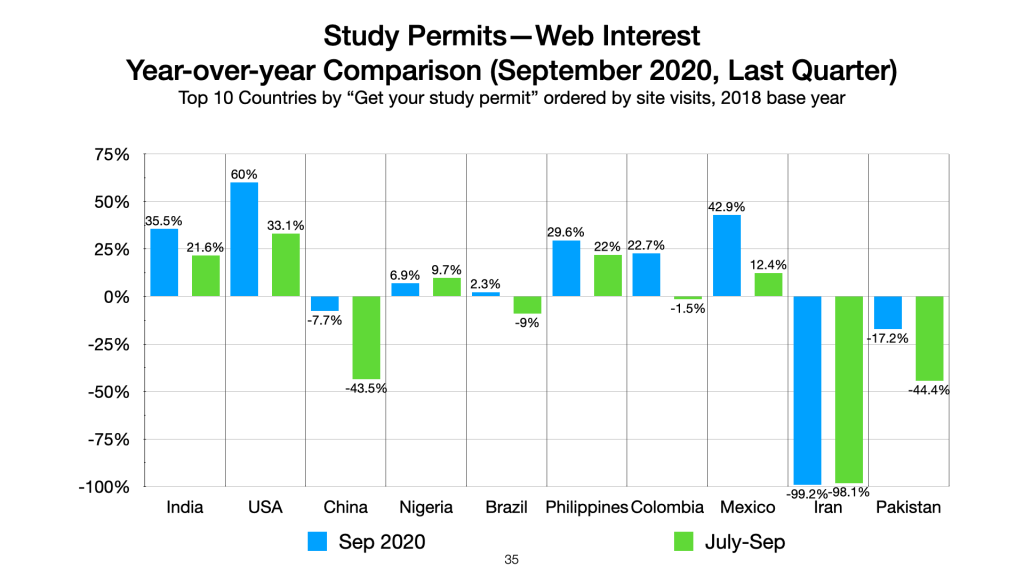
The deck examines the impact of COVID-19 on immigration to Canada: Permanent Residents, Temporary Workers, Students, Citizenship and Visitor Visas updated with June data and web data for key programs.
Key observations:
  • Immigration continued bounce back compared to May and overall quarter save for TRs
  • PRs: From 10,950 in May to 19,180. June Year-over-year decline: Greater gap between Economic only -22.6% compared to Family -69.0%, Refugees -80.2%
  • Provincial Nominee Program: Increase from 2,970 in May to 4,940. June Year-over-year decline smaller than May: -30.9%
  • TR to PRs transition: Increase from 5,820 in May to 12,955. Year-over-year increase of 39.8% (i.e., those already in Canada)
  • TRs/IMP: Ongoing decline from 15,700 in May to 13,950. June Year-over-year decline: Agreements -51.0%, Canadian Interests -46.3%
  • TRs/TFWP: Stable— 9,365 in May compared to 9,200. June Year-over-year decline: Caregivers -64.5%, Agriculture -8.9%, Other LMIA -50.1%
  • Students: Decline from 30,785 in May to 16,000. June Year-over-year decrease: 32.8%
  • Citizenship: Increase from virtually none in May (53) to 1,656. June Year-over-year decrease: 92.0%.(2019 monthly average was about 20,000)
  • Visitor Visas: Complete shutdown. China authorizations declined faster and sharper
  • IRCC Website interest (July, Work and study permits, settlement services and citizenship) broadly reflect these trends)

Quebec farms facing lost profits and rotting harvests due to migrant worker shortage

A further reminder of our dependence of foreign seasonal agriculture workers:

Nineteen-year-old Florence Lachapelle was among hundreds of Quebecers who tried their hand at planting seeds and harvesting produce this summer, replacing migrant workers who were unable to leave their countries because of the COVID-19 pandemic.

And while Lachapelle spent long days working the fields on Francois D’Aoust’s farm in Havelock, Que., too few other Quebecers took up the call to help the province’s struggling agricultural industry.

Despite a recruiting drive by the provincial government in April, the lack of labour this season has forced farmers to cut production or leave food rotting in the fields.

Unfortunately for Lachapelle, she fell ill with mononucleosis after two months and returned home to Montreal. She said the work was very demanding with so few migrant workers available.

“They’re professionals and we’re simply not,” Lachapelle said in a recent interview.

D’Aoust said he hired a handful of people to work alongside Lachapelle, who were out of work in other sectors such as communications, film and the restaurant industry. But once their opportunities returned, he said, they left for their better-paying jobs.

“Not a lot of people are used to (physical) work all day,” D’Aoust said in a recent interview. “It’s just not the kind of work that we do. It’s rare that people are in shape and can (work) all day in the field.

“People that are farmers, themselves, in their country, surely they are at an advantage.”

D’Aoust and his wife, Melina Plante, have hired the same four Guatemalan seasonal workers year after year. But this year the farmhands were stuck at home at the beginning of Quebec’s farming season due to travel restrictions their country imposed to limit the spread of COVID-19.

He said it takes inexperienced Quebecers up to three times as long to do farm work compared to a migrant worker. That meant he had to pay locals to do less work, eating into his profits.

D’Aoust slashed production at his farm, Les Bontes de la Vallee, by 60 per cent this year because he and his wife figured they would only have migrant workers later in the harvest season.

Two Guatemalan workers eventually made it on D’Aoust and Plante’s farm — but the financial damage to the business was done. “What we hope is to pass through this difficult period without too much loss and start again next year,” he said. “We just want to stay alive.”

For Michel Ricard, who owns 60 hectares of farmland in Saint-Alexis-de-Montcalm, about 60 kilometres north of Montreal, he said he’s going to lose a lot money and food this year because migrant workers from Mexico and Guatemala haven’t been able to arrive.

By the end of August, Ricard said he expects to lose approximately $100,000 dollars worth of cucumbers because he has no one to pick them.

Experienced foreign workers are “essential for the future, for me, and for the majority of growers of vegetables,” he said in a recent interview.

“The people from Guatemala are able to work from 6 a.m. to 6 p.m. It’s not a problem. Sometimes I need to stop them because they want to continue, but sometimes I say ‘that’s enough for today.'”

Local workers haven’t been much help to him, he said. Ricard had his daughter post a message on Facebook to reach out to prospective farmhands, but he said only eight came through for him.

“It was impossible,” Ricard said.

The Union des producteurs agricoles, which represents about 42,000 Quebec farmers, says there are close to 2,000 fewer migrant workers on Quebec farms than usual. Despite the UPA’s efforts to lure Quebec workers through a recruiting drive, just under 1,400 were assigned to Quebec farms this year.

“It didn’t replace, really, the foreign workers,” UPA President Marcel Groleau said in a recent interview. “It helped on some issues … but those workers are not trained and can’t really replace the foreign workers that are trained and have experience on farms.”

Farmers such as D’Aoust and Ricard say migrant farmhands are willing to work longer hours, even for minimal pay.

Groleau said the federal government’s emergency response benefit, which offers up to $2,000 a month to many people who have lost jobs, has encouraged Quebecers to stay away from the gruelling field work.

“When you can get two thousand dollars a month sitting at home,” Groleau said, “it’s not really interesting to go on a farm and work a little bit for minimum wage.”

Source: Quebec farms facing lost profits and rotting harvests due to migrant worker shortage

Conservative Party can lead on anti-racism policy—a blueprint

Apart from some of the usual partisan sniping regarding other parties (undermines their arguments), some useful and practical policy suggestions:

It can be argued that two topics leading discussions in 2020 are COVID-19 and racism, particularly anti-Black racism. While these discussions around anti-Black racism have been loudest in the U.S, Canada has not escaped the calls to address the systemic issues that exist here.

In a recent interview with the Globe and Mail, former prime minister Brian Mulroney discussed the need for Canadian political leaders to rethink current practices to address the economic damage of COVID-19 and the prevalence of systemic racism, especially Canada’s treatment of Indigenous people. His recommendations prioritize strong economic and social policies including a dramatic increase in immigration.

It is unfortunate conservative values do not first come to mind when reflecting upon best practices to address systemic racism.

The Association of Black Conservatives believe that a Conservative Party anti-racism framework which includes bold economic and social policies is achievable. In order to address systemic racism, we must discuss the Conservative Party’s policies on immigration, the economy, education, cultural outreach and data collection.

The Conservative Party can no longer afford to have its immigration policies defined by opponents who are able to paint an inaccurate picture of the party’s stance on immigration. While the Harper era increased the length of time required to become a Canadian citizen, Jason Kenney, Canada’s longest serving immigration minister, welcomed the highest number of permanent residents under any minister.

Increasingly, immigrants have come to Canada as skilled economic migrants. In developing an immigration policy, the Conservative Party should look at legislation which does away with employers’ ability to request “Canadian experience” as this discriminates against immigrants. We have heard first-hand stories from newcomers facing difficulties gaining professional employment due to the Canadian experience requirement, and would encourage collecting more formal data on this.

In addition, there must be a discussion on Foreign Credential Recognition (FCR) for newcomers. The Conference Board of Canada estimates that $17 billion could be generated in the Canadian economy if newcomers could work in their respective fields of interest and/or study. Easing these systemic barriers will have positive results for Canada. Various provinces have taken steps to address this.

Most recently, Alberta passed Bill 11, the Fair Registration Practices Act, which will not only speed up the process for getting credentials recognized, but also ensure registration practices are transparent, objective and fair. Policies like this should be replicated at the national level.

Left-leaning parties respond to what they perceive as the core concerns(immigration and social issues) of visible minority communities with symbolism.

This is illustrated by Alberta NDP MLA David Shepherd when he was asked about what initiatives the Alberta NDP undertook to address police carding. He responded by acknowledging they did not take the necessary steps to address carding however, they “worked to empower these communities and to lift them up, to include them in the $25-a-day daycare, to make sure they had the opportunity to access grants, to make sure that they had the opportunity to sit with us and tell us what they needed”.

In response to the anti-racism protests of 2020, Prime Minister Justin Trudeau bowed a knee but offered no substantive actions to address the issues. This is in contrast to Alberta, where Justice Minister Doug Schweitzer committed to speed up the review and modernization of the Police Act and address the lingering issues of systemic racism, such as carding.

In reality, racialized communities are just as concerned with economic issues as other Canadians. The backbone of the Black and other visible minority communities in Canada is small business especially in industries like professional, retail and food services. As such, the Conservative Party needs to contemplate small business funding programs that target visible minority communities.

Education is an important topic for all Canadians. About one-third of the population lives with children at home, this is the same for minority groups. A 2016 Statistics Canada survey on education and labour market integration of Black youth in Canada found that among Black youth aged 15 to 25, 94 per cent of them wanted to achieve higher education, but their optimism about what they were expected to achieve dropped to 60 per cent. Contributing factors include socioeconomic status (21 per cent of Black adults are low-income compared to 12 per cent of the rest of the population), lack of representation of Black teachers, and negative attitudes and perceptions of Black students.

For example, in Ontario, this has led to students being discouraged and streamed into “applied” fields when they could easily excel in the “academic” streams. This practice of streaming has heavily disadvantaged Black students. The Conservative government of Ontario recently announced it would end this systemic discriminatory practice. Decisions of this nature will go a long way in opening opportunities for minority communities. In addition, we should look at developing matching grants and scholarships to further reduce barriers and provide greater access to continued education for racialized students.

Representation matters. We can no longer hide under the guise of “identity politics” or the idea that “targets are quotas” and hence, bad. The Conservative Party needs a meaningful and deliberate policy on multiculturalism. The Association of Black Conservatives is one such effort towards encouraging multiculturalism and ethnic outreach; this is a model that should be welcomed and replicated within other minority communities by the party.

The party needs to actively commit to targets to achieve equity, diversity and inclusion starting with party membership, party staff, candidates, political staff and board appointees. There is an argument that doing this means quotas, but this argument falsely assumes that qualified or competent visible minorities candidates do not exist. Not only is this false, but multiple studies, such as a 2020 study by Zuhra Abawi and Ardavan Eizadaridad of Niagara University and Wilfred Laurier University, respectively, have shown that there is a range of biases in hiring practices for racialized candidates, including being far less likely to be called for an interview, compared to their non-visible minority counterparts who have equivalent qualifications and experience. The party needs to adopt policies that are intentional about diversity.

Lastly, Conservatives value evidence-based decision making. Therefore, let’s advocate for better data to inform our policies. Data collection is an important step in being able to identify and address an issue.

Take COVID-19 for example. The Centers for Disease Control  noted “long-standing systemic health and social inequities have put many people from racial and ethnic minority groups at increased risk of getting sick and dying from COVID-19“. Currently, Canada has not collected race-based data for COVID-19, regardless of repeated calls to do so. We’ve recently learned, thanks to the data from the City of Toronto, that 83 per cent of COVID cases in the city are racialized people.

Most Canadians may know that Canadian immigration laws prior to 1962 included racial and other discriminatory provisions. However, most may not know that  it was John Diefenbaker, a Conservative prime minister, who introduced the Bill of Rights in 1960 and thereafter Order-in-Council PC 1962-86, which eliminated all racial discrimination from Canadian immigration laws and instead replaced it with the skilled-based points system which continues until this day.

Conservatives can continue to lead on the issue of anti-racism over the symbolism of left-leaning parties by instituting meaningful policies that empower communities.

Akolisa Ufodike is the chair of the National Council of the Association of Black Conservatives, and Susanna Ally is a board member. Louis Butt is a recent University of Toronto graduate in history and political science. 

Source: Conservative Party can lead on anti-racism policy—a blueprint