How Angela Merkel’s great migrant gamble paid off

Good long read:

Five years ago, as more and more refugees crossed into Europe, Germany’s chancellor proclaimed, ‘We’ll manage this.’ Critics said it was her great mistake – but she has been proved right

Mohammad Hallak found the key to unlock the mysteries of his new homeland when he realised you could switch the subtitles on your Netflix account to German. The 21-year-old Syrian from Aleppo jotted down words he didn’t know, increased his vocabulary and quickly became fluent. Last year, he passed his end of high school exams with a grade of 1.5, the top mark in his year group.

Five years to the month after arriving in Germany as an unaccompanied minor, Hallak is now in his third term studying computer science at the Westphalian University of Applied Sciences and harbours an aspiration to become an IT entrepreneur. “Germany was always my goal”, he says, in the mumbled sing-song of the Ruhr valley dialect. “I’ve always had a funny feeling that I belong here.”

Hallak, an exceptionally motivated student with high social aptitude, is not representative of all the 1.7 million people who applied for asylum in Germany between 2015 and 2019, making it the country with the fifth highest population of refugees in the world. Some of those with whom he trekked through Turkey and across the Mediterranean, he says, haven’t picked up more than a few words and “just chill”.

But Hallak is not a complete outlier either. More than 10,000 people who arrived in Germany as refugees since 2015 have mastered the language sufficiently to enrol at a German university. More than half of those who came are in work and pay taxes. Among refugee children and teenagers, more than 80% say they have a strong sense of belonging to their German schools and feel liked by their peers.

Success stories like Hallak’s partially redeem the optimism expressed by Angela Merkel in a sentence she spoke five years ago this week, at the peak of one of the most tumultuous years in recent European history – a sentence that nearly cost her her job and that she herself has partially retreated from.

As Coronavirus Reappears in Italy, Migrants Become a Target for Politicians

The phrase “Patriotism is the last refuge of the scoundrel” comes to mind:

As the summer vacation season draws to a close in Italy, a flare-up of Covid-19 cases is fueling a surge in anti-immigrant sentiment, even though the government says that migrants are just a small part of the problem.

Sicily’s president, Nello Musumeci, ordered the closure of all migrant centers on the island last weekend, saying it was impossible to prevent the spread of the illness at the facilities. And although a court blocked him, saying that he did not have the authority to close them, his order underlined the challenges Italy faces as right-wing politicians seek to rekindle a polarizing debate about immigration in a country hit hard by the pandemic.

In Pozzallo, a town in southern Sicily that has the highest rate of infection among newly arrived migrants, Roberto Ammatuna, the center-left mayor, has found himself trying to balance fears of a coronavirus influx with an obligation to rescue migrants in distress at sea.

“Our citizens need to feel safe and protected, because we are here in the front lines of Europe,” he said in an interview in his office overlooking the turquoise waters of the Mediterranean. “No one wants migrants who are sick with Covid,” but, he said, “we can’t stop rescuing people at sea.”

In one week in August, 73 migrants tested positive out of about 200 quarantined in Pozzallo. About 11,700 migrants have reached Sicily since June, and 3 percent either tested positive upon arrival or during the quarantine period that the Italian authorities imposed inside shelters.

But Franco Locatelli, the president of Italy’s Superior Health Council, a government advisory body, said migrants’ role in bringing Covid-19 back to Italy was “minimal.”

In the first two weeks of August, around 25 percent of new infections registered in the country were imported from abroad, according to Italy’s National Health Institute. Over half of those were Italians who had traveled abroad, and many others were foreigners who already lived in Italy and were returning to the country.

Less than 5 percent of the total were new immigrants, according to Italy’s Health Ministry.

Swiss researchers gear up for crunch immigration vote, fearing return to scientific exile

Of note:

Swiss voters go to the polls in a month to decide whether to cap free movement of citizens from the EU, in a referendum seen as a crunch test of the country’s ties with the 27-member bloc.

The vote, were it to succeed, would violate bilateral accords that enhance Swiss access to the EU’s single market, and directly threaten researchers access to the next science programme, Horizon Europe.

“I’m a bit worried about the vote,” said Gian-Luca Bona, CEO of the Swiss Federal Laboratories for Materials Science and Technology. “This is extremely important for our economy. The special circumstances of COVID-19 mean there are many irrational things happening. There are a lot of emotions around at the moment.”

Bona leads a lab of 1,000 scientists, made up of 60 different nationalities. He fears a repeat of 2014, when a slim majority of Swiss voters backed a similar motion that sought to restore limits on immigration. The EU responded by cutting off full Swiss membership to Horizon 2020, the current research programme. What followed was an almost three-year scramble for Switzerland to regain full access.

Now, in what is essentially a repeat of the 2014 vote, Bona fears the country could be thrust back into scientific exile.

“Infections are growing slowly but steadily,” he said. “The real impact on the economy from COVID-19 could start to show this fall; a second wave could aggravate things. We could see chapter 11-style closures of businesses.”

“The discussion that could follow, around prioritising the Swiss citizens, is the dangerous part in this referendum. I hope rational thinking determines what we do next.”

While not unusual for Switzerland, where plebiscites on specific questions are common, for Brussels, the vote raises the prospect of yet another embarrassing national referendum on the EU.

The threat of being blocked from the full €94.1 billion Horizon programme, which starts next year, is a source of major disquiet for Swiss academics.

After the 2014 experience, they’re fully alive to the danger. On Thursday, a collection of top scientific organisations, including the ETH Board, the Swiss National Science Foundation and Innosuisse, the Swiss Innovation Agency, jointly called for voters to reject the proposal.

“It’s rather open for me, what’s going to happen in this vote,” said Tilman Esslinger, who leads the quantum optics group at ETH Zurich.

“There’s a very special set of circumstances – coronavirus, severe economic challenges. This can amplify in one or the other direction. The world has changed. People probably don’t even know themselves yet how they’ll vote. People have other things on their mind now, like how they will get their kids back into schools safely. They might not be thinking of politics,” Esslinger said.

Political analysts, however, say the initiative faces many obstacles.

“Plenty of things are now running against it. Because of coronavirus, it doesn’t have the monopoly of attention or debate,” says Oscar Mazzoleni, political scientist at the University of Lausanne.

The Swiss will be voting on five separate subjects on September 27, including the purchase of new military airplanes, the length of paternity leave and the right to hunt wolves and other animals.

Support for the Swiss People’s Party, which put the immigration vote on the agenda, is lower than it was six years’ ago, Mazzoleni noted.

The build-up to the vote is short, too, in comparison to the months-long campaigning seen in 2014.

The reaction to the government’s handling of coronavirus is generally positive, meaning the public may not view the upcoming vote as a weapon to punish politicians.

“They delivered the money; they supported the economy during the pandemic. And it’s too early to see the impact of the virus on the economy anyway. The real crisis is still in the future,” Mazzoleni said.

Politicians fear success for the immigration vote would wreck their hopes of putting relations with Brussels on a new footing.

Like the UK, Switzerland is in its own difficult negotiation with the EU, being asked to endorse a new treaty that would require it to routinely adopt single market rules.

The EU views this as merely updating and simplifying the Swiss arrangement, which spans a complex web of more than 120 bilateral deals. But the new treaty also includes demands that the Swiss soften rules protecting wages, the highest in Europe, from cross-border competition by EU workers on temporary assignments. Critics say the treaty infringes Swiss sovereignty.

The country’s relationship with the EU is the “hidden dimension” of the immigration vote, Mazzoleni said

“We’re in a no-man’s land, from a diplomatic point of view, with the EU right now. Brussels is much more focused on the UK. So the future relationship is not part of the referendum debate at the moment,” he said.

More support for immigration

For Nenad Stojanović, professor of political science at the University of Geneva, “The chances are quite high that the initiative will not be accepted. Many people outside Switzerland, who don’t fully understand our tradition of direct democracy, simply presume that people would accept something like this. In the Swiss context, this claim is not supported by the facts,” he said.

There have been seven similar popular initiatives to curb immigration since 1970, said Stojanović. “With one exception, the 2014 vote, the others failed. And this was during all kinds of periods, good economies and bad,” he said.

If anything, Stojanović expects the experience of coronavirus will have strengthened peoples’ perception of foreigners, who account for almost a quarter of the Swiss population.

“The pandemic has shown that without foreign workers, the whole health system would have collapsed,” he said.

Source: Swiss researchers gear up for crunch immigration vote, fearing return to scientific exile

Canada needs to walk the talk on migrant rights

COVID-19 has exposed a number of the long-standing issues, particularly with respect to agriculture workers:

If you drive around the farming communities of Southern Ontario, you’ll see workers in the fields toiling under the hot sun. Their exhausting work puts food on Canadian tables. It also puts food on tables in Mexico, Jamaica and across the Caribbean. These front line workers ensure we don’t go hungry, particularly during the pandemic; they are critical to our food security.

Almost all migrant workers arriving in Canada were tested and confirmed to be free of COVID-19. Through no fault of their own, hundreds have contracted the virus through community transmission after they arrived, and three have died. The virus spread quickly because of their cramped living quarters and inadequate working areas.

Canada has been a leader in establishing international standards on migration, but our country’s treatment of migrant workers runs counter to its international commitments and threatens to damage its global reputation.

In 2018, Canada endorsed the Global Compact for Safe, Orderly and Regular Migration at the United Nations. The Global Compact is a framework of principles, objectives and actions to strengthen migration standards and protect the rights of migrants. It applies to both sending and receiving countries, and by endorsing it, Canada made a commitment to implementing those standards.

Over two years of negotiations, Canada was recognized as a leader by the UN. Canada identified and proposed concrete solutions to global migration challenges. It worked closely with civil society organizations and built partnerships that crossed the world. Canada was regularly asked by the Global Compact organizers to mediate with countries that were backpedalling on migration issues and to assist in garnering international commitment for the compact’s implementation.

Canada’s accomplishments are doubly impressive given the rise of populist movements around the world. In the U.K., the Brexit side won in part because of a campaign against migration, and in the United States, President Donald Trump ran on an anti-migration platform, subsequently pulling out of the Global Compact. Globally, anti-migrant sentiment has been growing. Even in Canada, a misinformation campaign claimed the compact would impinge on sovereignty and encourage mass migration.

Now COVID-19 has put a spotlight on Canada’s own policies. The outbreaks among farm workers have exposed the pre-existing weaknesses in how we treat these migrants.

For decades, Canada’s migrant worker programs have been plagued with vulnerabilities to abuse, exploitation, workplace injuries and deplorable living conditions. This vulnerability is particularly true for those on work permits tied to only one employer. Migrant workers risk losing their jobs and livelihoods if they raise complaints.

Implementing the Global Compact can help Canada do better.

The compact’s underlying, non-negotiable principle is respect for human rights, including labour rights. It also promotes partnerships among governments, employers and migrant worker organizations. It stresses that policies should “not create, exacerbate or unintentionally increase vulnerabilities.” Following the premise of the compact means that including migrant workers as partners is an important first step. For example, working directly with migrants early in the pandemic to understand why they feared COVID-19 tests could have reduced the number of outbreaks.

In adopting the compact, states committed “to adapt options and pathways for regular migration in a manner that facilitates labour mobility and decent work.” In order to do so, one action outlined in the compact is to provide “flexible, convertible and non-discriminatory visa and permit options.” In line with the compact, Canada’s migrant worker programs should move from providing migrants with employer-specific visas to open or occupation-specific visas or even permanent residency.

Not tying workers to one employer reduces the risk of exploitation and abuse. Furthermore, not fearing reprisals, migrants may more often report violations and access services, thus recognizing their rights. Canada moved toward open visas with last year’s regulatory change allowing migrant workers at risk of workplace abuse to apply for an open visa, usually for one year. However, the onus is still on the migrant worker in a vulnerable situation.

Migration, and specifically the impact of COVID-19 on migrant workers, is a global story as much as it is a national one. What we do at home affects how we are seen elsewhere. Recently, Foreign Affairs Minister François-Philippe Champagne noted that Canada would “continue to play a leadership role and continue to defend and promote our values and principles around the world.” If Canada is committed to a global leadership role, it must improve its own standards before advocating to others the importance of principles and values.

By truly improving migration standards at home and acting on the international commitments it has made to protect the most vulnerable, Canada will build healthier communities and stronger economies – at home and abroad.

Source: https://www.theglobeandmail.com/opinion/article-canada-needs-to-walk-the-talk-on-migrant-rights/

Australia: ‘Depressed, anxious, bored, frustrated’: Christmas Island detainees struggle with isolation

Speaks for itself:

More than 30 people transferred to a remote immigration detention facility on Christmas Island have little access to internet and are struggling to contact their families.

The controversial North West Point detention centre on Christmas Island was reopened in August to relieve pressure on the onshore detention network, which had been nearing capacity.

At least 31 people have so far been transferred to the facility. The Australian Border Force declined to confirm the current detainee population on Tuesday.

One of the detainees is Les Reilly, who was transferred to Christmas Island from the Yongah Hill detention centre outside Perth in early August.

He said there were four computers with no video-calling software at the Christmas Island facility, but “you’re lucky if one works at a time”.

Fact Check And Review Of Trump Immigration Policy

Good summary:

At the Republican National Convention, Donald Trump and his supporters have given the impression that Trump administration policy, while tough on illegal immigration, has been welcoming to legal immigrants, people trying to become American citizens and refugees fleeing government persecution. Below is a review of Trump administration policies on legal immigration from 2017 to the present.

Legal Immigration Cut in Half, Most Categories Blocked: By 2021, Donald Trump will have reduced legal immigration by 49% since becoming president – without any change in U.S. immigration law, according to a National Foundation for American Policy analysis. An April presidential proclamation blocked the entry of legal immigrants to the United States in almost all categories.

Reducing legal immigration most harms refugees, employers and Americans who want to live with their spouses, parents or children, but it also affects the country’s future labor force and economic growth: “Average annual labor force growth, a key component of the nation’s economic growth, will be approximately 59% lower as a result of the administration’s immigration policies, if the policies continue,” according to the National Foundation for American Policy.

The Most Highly Skilled Foreign-Born Blocked or Denied at High Rates: The denial rate on new H-1B petitions for high-skilled foreign nationals has increased from 6% in FY 2015 to 30% in FY 2020. A June 2020 presidential proclamation suspended the entry of foreign nationals on H-1B and L-1 (intracompany transferees) visas.

As reported in August, “Today, even the most highly skilled individuals in the world cannot enter America under the Trump administration’s immigration policy. Reports from attorneys and a statement from the State Department confirm that U.S. consular officers in Europe are denying O-1 visas for individuals with ‘extraordinary ability’ based on a health pretext.”

Refugees and Asylum Seekers, including from Venezuela, Denied:At least one speaker at the convention discussed the protection Americans once offered Cuban refugees and spoke sympathetically about the victims of Venezuela’s socialist government. For FY 2020, the Trump administration established an annual ceiling for refugees 84% lower than the final year of the Obama administration (from 110,000 down to 18,000). As of July 17, 2020, only 7,848 refugees have arrived in the United States in FY 2020.

As of December 2019, 24,451 Venezuelans were in U.S. immigration court facing removal, an increase of 277%, from 6,492 in September 2018, reports the Syracuse University Transactional Records Access Clearinghouse (TRAC). “Rather than make things easier for fleeing Venezuelans, the Trump administration has tightened asylum standards,” according to Miami New Times reporter Manuel Madrid, who writes that many Venezuelans consider being deported to Venezuela to be a death sentence.

Despite pleas from religious leaders, the administration has not designated Venezuelans for Temporary Protected Status and has continued to deport people back to Venezuela. Immigration and Customs Enforcement (ICE)removed more than 900 people to Venezuela between 2017 and 2019. In FY 2016, the last full year of the Obama administration, 182 Venezuelans were removed, compared to 327 in FY 2019 under the Trump administration, an 80% increase.

Asylum seekers from Cuba and Venezuela (and Central America) who try to enter the United States and apply for asylum would be unlikely to obtain a hearing under current administration policies at the U.S. border. New asylum regulations also make it difficult for those fleeing persecution to be approved if they receive a hearing.

A Significant Increase in Denials for Military Naturalizations: The denial rate for military naturalizations increased from 7% in FY 2016 to 17% in FY 2019, a 143% increase in the denial rate, according to a National Foundation for American Policy analysis. Due to policy decisions, between FY 2016 and FY 2019 the number of immigrants in the military who naturalized dropped by 54%, from 8,606 in FY 2016 to 3,987 in FY 2019.

On August 25, 2020, the same day a naturalization ceremony was held at the White House, a federal court ruled against the Trump administration’s efforts to make it more difficult for active-duty service members to become American citizens. “A federal court today ruled that the Trump administration’s policy of depriving military service members of an expedited path to citizenship is unlawful,” reported the American Civil Liberties Union (ACLU). “The ruling comes in a lawsuit, Samma v. U.S. Department of Defense, filed by the ACLU on behalf of eight non-citizen U.S. service members who represent a class of thousands in uniform.”

Naturalization Slowed and Ceremonies Stopped for Many Applicants: The five people who received naturalization at the White House on August 25, 2020, were fortunate. Over 100,000 immigrants have been waiting to become U.S. citizens due to administration policies. In March, in response to the coronavirus pandemic, U.S. Citizenship and Immigration Services (USCIS) closed offices and for months would not provide alternative methods for completing the citizenship process, such as administering oaths virtually or incorporating social distancing in naturalization ceremonies.

While naturalization ceremonies slowly came back, it is likely many immigrants will not be citizens in time to vote in the November election, due, in part, to long delays in processing. (See also this report from Boundless, which has estimated as many as 300,000 immigrants may not gain citizenship before November.)

On August 3, 2020, the administration significantly increased the fees for immigrants to become American citizens, increasing the cost of the application (N-400) to become a U.S. citizen by more than 80%, from $640 to $1,160 (for online filings, although a separate $85 biometrics fee would be eliminated).

Some have wondered about the Trump campaign’s motivations for presenting a picture of its immigration policies that differs from the policies the administration implemented over the past three and a half years. The Washington Post’s Fact Checker Glenn Kessler asked, “Hmm, wouldn’t a speech by Stephen Miller at this point better reflect the president’s immigration policies in the past three years than this naturalization ceremony?” Washington Post columnist Catherine Rampell replied, “Exactly. If Trump’s (anti-)immigration agenda is so great, why not defend it on the merits? Why misrepresent what it actually does, by pretending Trump welcomes political refugees and newly-naturalized immigrants?”

Source: Fact Check And Review Of Trump Immigration Policy

Nesrine Malik: British hypocrisy is to blame for the deadly plight of migrants

Of note:

It is often argued that once it became clear that the Sandy Hook elementary school shooting wasn’t going to tip the United States towards adopting national gun control laws, that was the moment the gun control argument was lost for good. The equivalent moment, as far as British and European attitudes towards refugees and asylum seekers is concerned, was when the body of Alan Kurdi washed up on the shores of Turkey, almost five years ago.

Despite the global grief, the front pages, the renderings of Kurdi’s little body in paintings, his elevation into a symbol of a world that had lost its way, nothing happened. In fact, EU migration policies became even harsher. Last week, the British public was again moved when the body of a Sudanese migrant, Abdulfatah Hamdallah, was found on French shores, drowned after trying to make it to Britain. In the same time frame, another more fortunate migrant made it safely to Kent, and was immediately assaulted.

This duality lies at the heart of our attitudes towards migrants, asylum seekers and refugees: an outpouring of grief one minute, a political pummelling the next. We like to think of ourselves as kind, and touched by the tragedy of specific cases, but we do nothing beyond expressing sympathy. We are horrified by the treatment of Windrush victims, but not the hostile environment and the policies that led to the scandal. We are haunted by the desperation of people who take treacherous and fatal journeys to the UK, but many of us are complicit in their fate by voting for politicians who pledge to make those routes “unviable”.

Source: British hypocrisy is to blame for the deadly plight of migrants

Immigration fraud in Canada, foreign workers should be cautious

Yet another instance:

When the video call ended, Rami Al-Americani felt confident he would get the job.

The four people who had interviewed him for a position at a Montreal-based construction company had asked him detailed questions, but Al-Americani owned and operated an engineering consulting firm in Lebanon. He knew he could do the work.

The address for Montreal Construction Group corresponds to a non-existent lot that would be in the middle of René-Lévesque Blvd., near Place Ville Marie. Workers in the area say they have never heard of the company. It isn’t real.A Montreal Gazette investigation has confirmed that the firm is part of a network of ghost companies concealing an elaborate immigration scam. Those who orchestrate the network use the prospect of living and working in Montreal, and in Canada, as a lure to target educated workers in the Middle East, gaining their trust with a lengthy application period before requesting money to pay for the immigration process.

The scam is convincing. The network operates under the guise of three interlinked companies: a recruitment agency, a construction firm and an immigration consultant firm. Multiple people act out different roles, from human resource representatives to hiring managers. The jobs they offer and the companies they purport to run are not real. They have websites that mimic those of real firms and use the stolen identities of real immigration consultants to assure victims of their legitimacy.

Those who fall victim to the scam have little recourse. The network exists largely in a jurisdictional vacuum online. Even when regulators do catch on, the network just shuts down and restarts under a new name.

“It’s a big network,” Al-Americani said. “It’s amazing that they took the time to do a fake website and some of them act as the recruitment, the other ones act as the company people, operations, HR. Another part acts as the immigration consultants.”

A chance for a job in Canada

For Al-Americani, it began in October 2019, when a woman who said her name was Mellissa Luke called him. She worked for a company called Nova Recruiters, based in Ottawa, she said, and wondered if he was interested in an opportunity to work in Canada. She sent along forms and arranged an interview with Montreal Construction Group.

The application process was thorough, Al-Americani recalled. He did several interviews, including one video call with four people.

“The people who interviewed me are people who understand construction,” he said. “I was interviewed by a so-called senior guy in operations and people who understand the terminology that we used in construction, who understand projects, so they prepared for it and they seemed professional.”

Between the initial phone call and the time Al-Americani was hired, a few weeks had passed. He filled out human-resources forms and Montreal Construction Group transferred him to Canada Immigration Hub, their approved immigration consultant, ostensibly based in Alberta. A man reached out. He said his name was Craig Jackson and that he was a certified immigration consultant. He sent along forms and asked for payment.

It worked. Al-Americani was hopeful about the move to Canada. He had researched the country and was tempted by the prospect of a good education for his children. The process was going to be expensive — Al-Americani knew that. He paid.

The money, $1,000 as an initial fee, was wired to a U.S. bank, which bothered Al-Americani. When he caught on to the scam, he seethed at the thought that someone could go to such lengths to prey on his family’s hopes of moving to Canada.

Others who have fallen — or nearly fallen — for the scam report noticing red flags, but sometimes ignoring them, blinded by the prospect of a new life abroad.

Eslam Emara, a Saudi man with 10 years of experience in transportation and logistics, caught on to the fraudsters. He was skeptical at every turn. He asked for proof of identity, scrutinized the companies’ websites, asked around on online forums and noticed holes in the Montreal Construction Group facade.

When the man calling himself Jackson asked for money, Emara said no. “That’s the time I had to say to them, ‘That’s bulls—. I’m not buying.’ ”

But it hurt him. A little part of him had been holding out hope, despite the red flags.

“It seems ridiculous, because I knew that it’s a fraud, but I was just dreaming on,” he said in a recent interview from Riyadh, uttering a laugh, then a sigh. He had hoped to immigrate to Canada with his wife and child. “It was one of our dreams to do something like this, so they gave us much disappointment.”

A convincing online network

The fake companies’ websites present a facade that at first is convincing to those targeted by the scammers.

But the slick sites don’t stand up to scrutiny. The Nova Recruiters site lists jobs that don’t exist. The Montreal Construction Group site is an exact imitation of a site belonging to a New Zealand company. It lists projects ostensibly completed by Montreal Construction Group that were completed by other firms. And the Canada Immigration Hub website features testimonials from satisfied clients — who aren’t real.

Raghib, from Saudi Arabia, says on the site: “No matter how easy or straightforward Canadian immigration process might look like, it isn’t easy at all. … After getting in touch with CIH, things were different and much better.”Surender, from Bangalore, says: “These people explained to me how studying in Canada can help me with my career and eventually getting a permanent residency.”

But the photo for Surender is really a stock image, available online, titled “Portrait of a middle-aged Indian with folded hands.” The photo of Raghib is another stock image: “Horizontal portrait of young smiling Arab man.”

Perhaps the most convincing tactic used by Canada Immigration Hub is the name of the person they use to contact their potential victims: Craig Jackson.

An identity stolen with impunity

Craig Jackson is a real immigration consultant, registered with the Immigration Consultants of Canada Regulatory Council (ICCRC), a non-profit organization that has been mandated by the federal government to regulate immigration advising services. But he does not work for Canada Immigration Hub. The fraudsters used his identity to gain their victims’ trust.

The real Craig Jackson said he began receiving emails in late 2019 and early 2020 from people who were being strung along by Montreal Construction Group, signalling that his name was being used as part of an elaborate fraud.

“My initial reaction was of outrage and anger, followed by wonder,” Jackson said. “(I) was curious as to why they targeted my identity.”

The ICCRC had advised him to report the fraud to the Canadian Anti-Fraud Centre (CAFC) — so he did.Al-Americani also reported the fraud. He emailed the Canadian embassy in Beirut, but received a generic response. Emara said he was considering reporting the scam to Saudi police.

But the international nature of the scam hinders law enforcement efforts.

Jeff Thomson, a senior RCMP intelligence analyst at the CAFC, said well-trained, resourceful groups are likely behind the Montreal Construction Group fraud.

“People ask, ‘Who’s behind this stuff?’ It’s organized crime at the end of the day,” Thomson said. “When you look at the level of organization involved — the multiple countries where the money is going, the websites — the sophistication, the steps they set up to run the scams.”

The CAFC has received multiple complaints about Montreal Construction Group, but Canadian authorities lack the ability to investigate and prosecute those behind the fraud, in part because there is little connecting the perpetrators to Canada.

“What we see with a lot of these things is oftentimes the fraudsters use Canadian government entities or business names … but none of the money ends up coming here,” Thomson said. “They’re just using Canadian entities because people want to come to Canada for our reputation.”

Though the Montreal Construction Group fraudsters — and others like them — often avoid prosecution, Canadian authorities can make it more expensive for them to do business by targeting their websites and bank accounts.

But immigration fraud is rampant. It keeps the authorities busy, and shutting down websites and bank accounts only delays the scammers. They tend to crop back up.An Immigration, Refugees and Citizenship Canada spokesperson said in a statement that the government had earmarked $51 million to improve enforcement and public awareness of immigration fraud and establish systems to better crack down on fraudulent immigration consultants.

“The government of Canada takes any kind of citizenship or immigration fraud seriously,” the statement reads. “Immigration, Refugees and Citizenship Canada urges clients to use the official departmental website to obtain information about its programs in order to avoid becoming victims of fraud.”

An ICCRC spokesperson said the agency could not investigate the activity of those who had impersonated Jackson, because the perpetrators were not real immigration consultants. But he said the organization was aware of the situation: “We’ve been looking into the matter and are working with enforcement authorities to combat these schemes.” He also said criminal fraud of the kind displayed by the Montreal Construction Group scams is rare, but that the ICCRC is slated to soon become a new body that would have more power to prevent such fraud.

A hidden network

It is unclear who is behind the fraud, but banking information from an account associated with the fraud points to a man named Nabeel Ahmed, ostensibly living in Wichita, Kan. Phone records also link the listed number for Montreal Construction Group — a Montreal landline — to a man named Nabeel Ahmed.

In 2012, Windsor police arrested a man they said was a prolific fraudster named Nabeel Ahmed, who had a criminal history of committing identity and credit card fraud. He was convicted on fraud-related charges and was sentenced to 10 months in prison.
The Montreal Gazette could not confirm that the Nabeel Ahmed convicted in Windsor is the same person linked to the fraud-connected bank account and the Montreal landline. Attempts to reach Nabeel Ahmed were unsuccessful.

One of the fake company websites — the Nova Recruiters site — is listed as registered to someone in Ontario, suggesting the fraudsters may have some physical connection to Canada, but besides that, little is known about their physical location.

A game of whack-a-mole

Even if authorities succeed in shutting down Montreal Construction Group’s website, or if enough people catch on to the scam, those behind it may well restart the scam under a new company.

A Montreal Gazette analysis has found that an eerily similar fraud network operated in the spring of 2019 — before the Montreal Construction Group scam. The earlier scam offered victims employment on Canada’s West Coast instead of in Montreal, but the similarities between the operations suggest that those who run the Montreal Construction Group scheme have experience rebuilding their network when officials begin to catch on to them.

The earlier scam used the same methods as Montreal Construction Group, and much of the language the fraudsters use in emails from both the old and the new scam is identical.

Instead of Montreal Construction Group, the earlier scam used Richmond Construction Group. Instead of Nova Recruiters, the earlier scam used Oakville Recruiters. Instead of Canada Immigration Hub, the earlier scam used Canada Shores.
Instead of Craig Jackson, the fraudsters impersonated Gregory Batt, another registered immigration consultant.

The real Gregory Batt said he began receiving emails and phone calls in late April 2019 from people asking him when they would receive their permanent residence. “All the guys who contacted me were well educated and articulate, mostly engineers,” he said. “I told all the folks who contacted me that they had been cheated, that Canada Shores was a fake company.”

Ahmed Rashed, an experienced purchase manager from Saudi Arabia who nearly fell for the Richmond Construction Group scam, said the organization and co-ordination astounded him. He was close to paying an initial $1,000 fee to immigrate to Canada, but had a friend in Vancouver check the address of Richmond Construction Group. There was no company.

“I deal with the internet all the time and I was about to fall for this,” Rashed said. “You know why they chose Canada? They chose Canada because they know everybody likes Canada. … That will help them to fool more people. This is because Canada has a good reputation.”

Dreaming of Canada

While wrapped up in the scam, victims spend weeks — sometimes more than a month — planning to move their families, their lives, to a new country.

For Al-Americani, the loss of the $1,000 he paid is secondary to the pain of having his immigration hopes dashed.

“For a month and a half we were living this dream of going to Montreal and having this new life,” he said, “and having our kids become Canadians and ourselves becoming Canadians.”

When he came to the realization that the company was a lie — that there was no job offer, no prospect of working in Canada — Al-Americani was crushed. “We felt really bad about it,” he said. “For like two, three weeks we were depressed.”

The scam also tends to leave its victims distrustful of immigration processes. But Al-Americani is still holding out hope. He said his family has recently begun once more to mull over the idea of coming to Canada.

“You know, it’s been a few days since it’s passed through my head to do the process a second time,” he said. “I think we’re going to do it.”

No one answers the phones at any of the fake companies and, as of publication, their websites are still active.

Source:  Immigration fraud in Canada, foreign workers should be cautious

WES Survey: Are Intentions to Immigrate to Canada Changing in the Face of COVID-19?

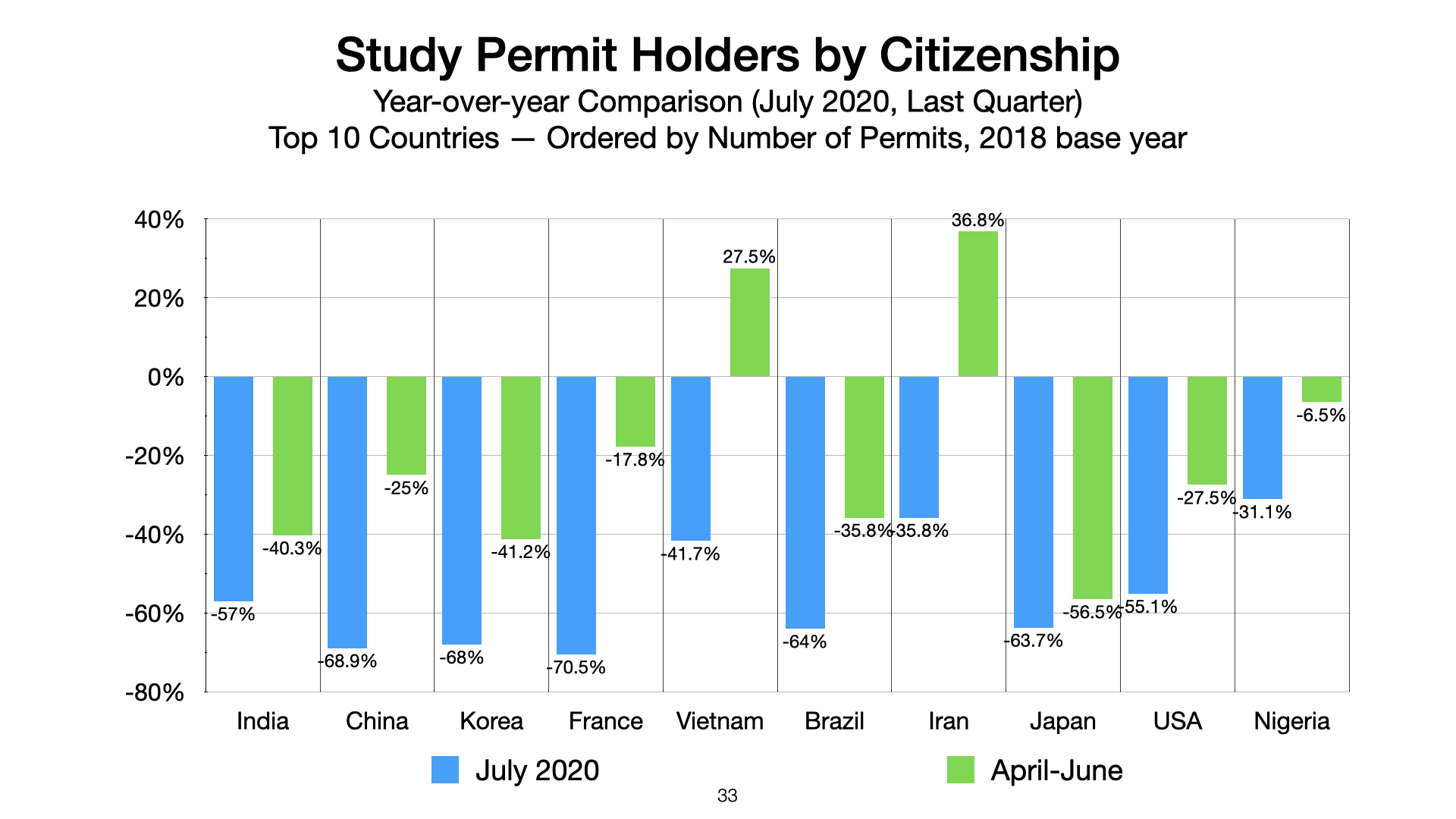
The second survey, showing increased interest in immigrating to Canada. Like all surveys, it is a snapshot, and interest doesn’t necessarily translate into action. The chart above highlights the year-over-year change in study permit holders for the 10 top source countries. As this quarter – July to September – is the historic peak, August numbers will be particularly important to assessing the impact:

What impact will COVID-19 and the resulting global economic recession have on prospective immigrants’ interest in moving to Canada? Recent research from World Education Services (WES) shows how these twin crises have affected the intentions of aspiring immigrants, shedding some light on this question.

Fully 45 percent of respondents to a June 2020 survey reported that COVID-19 had increased their interest in immigrating to Canada, up from 38 percent in a similar survey in April. The survey will be sent out again in late August.

As a designated provider of the educational credential assessments required for those invited to apply to immigrate to Canada under one of the country’s economic immigration categories, WES is uniquely positioned to gauge the intentions and motivations of aspiring immigrants. Each week, WES interacts with thousands of prospective immigrants who apply for an educational credential assessment. This work gives us ready access to a pool of prospective immigrants who, by completing our surveys, can provide insight into their aspirations. What we’ve learned in these surveys may prove helpful to Canada’s immigration advocates, policy makers, and employers as they plan for a successful economic recovery.

INTEREST IN IMMIGRATING TO CANADA IS INCREASING AS A RESULT OF THE PANDEMIC

Despite COVID-19’s severe disruptions to international mobility and the global economy, both surveys reveal that the pandemic has increased interest in immigrating to Canada among a high and rising percentage of immigrant hopefuls, as noted above. Far fewer—just 5 percent in April and 6 percent in June—reported that the pandemic had decreased their interest in immigrating to Canada.

Are Intentions to Immigrate to Canada Changing in the Face of COVID-19? Image 1: Bar chart showing the impact of COVID-19 on the interest of prospective immigrants in immigrating to Canada

Image 1: Prospective Immigrants: Impact of COVID-19 on Interest in Immigrating to Canada

Respondents also reported that they were reconsidering their immigration plans and timelines in response to the pandemic. In June, around a third (32 percent) reported that they were considering delaying their immigration to Canada, a slight decline from the percentage in April (35 percent). A smaller proportion—11 percent of respondents in June, up from 7 percent in April—said they would consider immigrating to a country other than Canada.

Are Intentions to Immigrate to Canada Changing in the Face of COVID-19? Image 2: Bar chart showing the likelihood of prospective immigrants to consider certain immigration-related actions

Image 2: Likelihood of Considering the Following Actions Related to Immigration

ECONOMIC CONDITIONS IN CANADA AND ABROAD MAY BE DRIVING INTEREST

The relative resilience of Canada’s economy may be driving some of the interest in immigrating. While the surveys found that COVID-19-related economic concerns were widespread among immigrant hopefuls, our research also revealed that many respondents expected the economic impact in Canada to be less extreme than in their home country. The difference in expectations has grown greater over time. In April, 81 percent expected a negative impact on economic conditions in their home country, while fewer, 68 percent, expected a negative impact on conditions in Canada. In June, that expectation remained roughly the same for the respondents’ home country (80 percent), but by then only 58 percent expected a negative impact in Canada.

Similarly, by June, 57 percent of respondents expected a negative impact on jobs in their occupation or sector in their home country, up considerably from 47 percent in April. Far fewer—43 percent in June, up from 41 percent in April—expected a negative impact on jobs in their sector in Canada. This overall expectation of a less negative impact in Canada in terms of both overall economic conditions and the availability of sector-specific jobs may help to explain why by June nearly half of the respondents were more interested in immigrating to Canada as a result of COVID-19.

Are Intentions to Immigrate to Canada Changing in the Face of COVID-19? Image 3: Bar chart showing the prospective immigrants' expectations of the negative impact of COVID-19 on economic conditions in Canada and their home countries

Image 3: Negative Impact Expected

IMMIGRANTS WILL PLAY A VITAL ROLE IN CANADA’S RECOVERY

Canada’s continued attractiveness to those looking to settle there is good news for the country. Newcomers will play a critical role in the nation’s recovery. Despite high unemployment rates brought on by the pandemic, Canada still faces long-term talent shortages due to high rates of retirement and a shrinking pool of individuals entering the workforce each year. In the coming years, studies projecting workforce composition and growth estimate that immigrants will make up 100 percent of the net growth of the country’s labour force. Newcomers will be vitalboth to reenergizing and sustaining Canada’s post-pandemic economic recovery.

APPENDIX

Are Intentions to Immigrate to Canada Changing in the Face of COVID-19? Image 4: Table displaying survey metrics

Image 4: Survey Metrics

RBC report says immigration slowdown due to COVID-19 threatens Canadian economy

Not much new, but still a reckoning for Canada. The charts below show the year over year for immigrants (economic, family and refugees) as well as the subset coming under the various Provincial Nominee Programs, along with the top 10 countries:

A slowdown of immigration to Canada due to the COVID-19 pandemic threatens to derail a major source of economic and labour force growth, according to a report from the Royal Bank of Canada.

The shortfall jeopardizes the ability of the country to find employees needed in sectors such as health and elder care as the baby boom generation moves into retirement over the next few years, the report says.

It calls on the federal government to find new ways to encourage more immigrants to move to Canada.

“Canada does rely on having large numbers of people coming to the country to fuel growth and, if we see these large declines, one concern could be that people may decide maybe they don’t want to come to Canada anymore,” said report author Andrew Agopsowicz, a senior economist for RBC who studies labour trends.

“I think it’s really important for Canada to ensure the process is clear and that we still put out this attitude that we are open and we want people from the rest of the world to come to our country.”

Canada added 34,000 permanent residents in the second quarter, down 67 per cent from the same period last year, the RBC study said.

Meanwhile, new permanent residency applications to Canada were down 80 per cent and just over 10,000 new study permits were processed, down from 107,000 a year earlier.

Despite a recent recovery in the pace of immigration, the bank expects to see only 70 per cent of the originally targeted 341,000 new permanent residents at the end of the year, a decline of about 100,000 people.

The shortfall is particularly bad news for elder care as labour shortages have gotten worse in the wake of the pandemic’s deadly sweep through the country’s nursing homes, said Dr. Samir Sinha, director of health policy research at the National Institute on Ageing at Ryerson University and director of geriatrics at Mount Sinai Hospital.

“We’ve been having a huge struggle finding workers and retaining workers in this sector for years … and we were only keeping it afloat by often recruiting immigrants who are willing to take on these jobs that we as Canadians didn’t want to do,” he said.

“The fact it’s low paid and not valued also speaks to one of the reasons it’s been incredibly hard retaining (staff).”

Sinha said higher wages are needed not only to recruit Canadian-born workers but also to keep ambitious immigrants on the job longer.

Canada’s ability to attract immigrants with meaningful work as the economy struggles to rebound from the pandemic may be difficult.

A Statistics Canada report published Thursday finds that recent immigrants were harder hit by pandemic-related job losses, with 17 per cent becoming unemployed from March to April compared with 13.5 per cent of workers who are Canadian-born or immigrants who have been in Canada more than 10 years.

The percentage was higher, almost 20 per cent, for recent female immigrants.

The difference is significant, said Statistics Canada analyst Feng Hou, adding it is attributed mostly to recent immigrants having less work experience and earning lower wages.

“From past experience, when immigrants come during hard times, they tend to have a hard time finding jobs,” he said, adding there’s no data as yet to tell if that will happen in the current environment.

Travel restrictions that began in March and continue today make it difficult for people to physically come to Canada, Agopsowicz said.

At the same time, the lockdowns in the early days of the pandemic slowed processing of applications in Canada and prevented potential immigrants from accessing programs to ease application in their home countries.

An unknown is whether the COVID-19 virus, which hits senior citizens hardest, will have a dampening affect on the desire of foreigners to come to Canada and leave behind their vulnerable elderly relatives, Agopsowicz said.

“There’s a lot of uncertainty, I think, when people arrive already during normal times, so I think people are starting to work through what that means,” he said.

“This may be somewhat of a lost year (but) is this going to be easy to recover from next year in terms of bringing increased numbers back?”

Only about 20 per cent of new permanent residents are former students or temporary workers, he pointed out, suggesting Ottawa could do more to try to convince those people to permanently reside in Canada to bolster numbers.

Source: RBC report says immigration slowdown due to COVID-19 threatens Canadian economy