Fact Checkers Say Trump Built A Wall Of False Claims On Immigration

Good summary:

Washington Post fact checkers Glenn Kessler, Salvador Rizzo and Meg Kelly write in their book that Donald Trump has made more false or misleading statements about immigration than any other issue. According to the authors, that is saying something. The book, Donald Trump and His Assault on Truth: The President’s Falsehoods, Misleading Claims and Flat-Out Lies, contains numerous examples of Donald Trump’s statements on immigration and represents a valuable resource.

Immigration Tops in Washington Post Database: “Immigration is the top category of false and misleading claims in our Trump database, accounting for 15% of the total 16,241 statements we fact checked in the first three years of Trump’s presidency,” according to the authors.

That comes to an incredible 2,400 or more false and misleading claims by Donald Trump on immigration, with more than 200 additional such statements since the book was published. Trump has repeated many of the false claims on immigration dozens of times, the authors conclude. Below is a sample of Trump’s statements.

Mexico Will (Not) Pay For the Wall: Kessler, Rizzo and Kelly list Trump’s claim that Mexico is paying for the border wall first in the book. During the 2016 presidential campaign and later, Trump asserted Mexico would pay for the wall. “Mexico’s paying for the wall. You know that. You’ll see that. It’s all worked out. Mexico’s paying,” Trump said at a rally on January 14, 2020.

“Spoiler alert: Mexico has not paid for the wall. Nor is there any suggestion that it will,” the authors note. “The current barrier construction is being paid for with billions of dollars appropriated by Congress for the defense budget and raided by Trump over congressional opposition.” (Emphasis added.)

Family Separation: Trump blamed the separation of children from their parents at the border on the Democrats. “I hate children being taken away. The Democrats have to change their law. That’s their law,” said Trump on June 15, 2018.

“Trump’s family separations in 2018 caused a national uproar,” according  to Kessler, Rizzo and Kelly. “U.S. immigration officials separated thousands of Central American migrant children from their parents, sending the kids off to shelters or relatives while their parents were prosecuted and put on track to be deported. The Trump administration’s messaging seemed at times Orwellian. Top government officials claimed there was no family-separation policy. The president falsely asserted that existing laws were forcing his hand. But the real reason for the separations was Trump’s own zero-tolerance policy.”

At the presidential debate on October 22, 2020, Donald Trump tried to blame the Obama administration for the family separation policies that Trump advocated for and encouraged. “Mr. Trump’s ‘zero tolerance’ policy was a deliberate act of family separation, meant to deter migrants from trying to enter the United States,” reported Zolan Kanno-Youngs in the New York Times after the debate. “It directed prosecutors to file criminal charges against everyone who crossed the border without authorization, including parents, who were then separated from their children when they were taken into custody.”

Immigrants and Crime: “The Democrats are really looking at something that is very dangerous for our country. . . .They want to have illegal immigrants pouring into our country, bringing with them crime, tremendous amounts of crime,” said Trump on December 6, 2017.

In the book, Kessler, Rizzo and Kelly cite academic research that shows immigrants do not increase the crime rate: “‘Far from immigration increasing crime rates, studies demonstrate that immigrants and immigration are associated inversely with crime,’ the National Academy of Sciences study concluded. ‘Immigrants are less likely than the native-born to commit crimes, and neighborhoods with greater concentrations of immigrants have much lower rates of crime and violence than comparable non-immigrant neighborhoods.’”

False Claims About Refugees: “Every Democrat running for president wants to open the floodgates to unlimited refugees from all around the world, overwhelming your communities and putting our national security at grave risk,” said Trump.

The authors labeled this claim by Trump as false. “Refugees do not overwhelm communities because U.S. officials usually place them in different parts of the country,” they note. “There is no evidence that refugees, many of them women and children, endanger national security. Trump often makes false claims associating immigrants with crime. No leading Democrat running for president voiced support for unlimited refugee admissions, though Joe Biden and Sen. Elizabeth Warren favored raising the annual cap from 18,000, where Trump said it after a clampdown in 2019, to more than 100,000.”

Trump Fabrications About the Diversity Visa Lottery: “Trump consistently mischaracterizes the Diversity Immigrant Visa Program, claiming absurdly that foreign countries raffle off green cards granting legal residence in the United States,” the authors write. “In fact, a computer program managed by a State Department office in Williamsburg, Ky., randomly selects up to 50,000 immigrant visa applications per year – out of nearly 15 million in 2017 from countries with low rates of immigration.”

Trump stopped all Diversity Visa applicants from entering the United States in FY 2020 by including them in an April 2020 proclamation.

Trump Attacks on Family Immigration: “The president also invents faux facts,” according to Kessler, Rizzo and Kelly. “Over and over, Trump claimed that the Uzbekistan-born man who in 2017 was accused of killing 8 people with a pickup truck in New York had brought two dozen relatives to the United States through so-called chain migration. The actual number is zero.”

The book raises an important question: If Donald Trump’s immigration policies were actually popular and good for the country, why have journalists found he has lied or misstated facts about immigration and his policies thousands of times?
@DouglasTodd Nine million people have scooped up Canada’s 10-year visas. Some abuse them

More anecdotal than evidence-based regarding the extent of the abuse. It would be relatively straightforward to request a dataset from IRCC that would provide the basis for answering the issues raised in the article:

  • people relinquishing permanent residency by country and immigration category;
  • those being sponsored for permanent residency; and,
  • those requesting asylum status.

Canada has given out more than nine million 10-year visitor visas since the program began, with by far the largest bulk of recipients coming from China and India, followed by people from Brazil and Mexico.

The super-popular multiple-entry visas are generally a benefit to Canada’s economy, say immigration lawyers. But they caution the 10-year, multiple-entry visas can be abused by “shadow investors” to avoid paying property and income taxes in Canada — and as a dubious means by which to claim asylum.

Source: Douglas Todd: Nine million people have scooped up Canada’s 10-year visas. Some abuse them

‘It’s a racist system’: Some couples say Canada’s visa system is cruelly extending their COVID-19 separations

Visa requirements by their very nature discriminate between those more likely to overstay and those not:

Still in pain after delivering her first child, Kaitlyn Hebb asked her mother in the birthing room to video-call her husband in Egypt, so he could meet their newborn son.

It’s the closest the new mother from Bridgewater, N.S., could come to sharing the moment with Alaa Ali, who has been kept out of Canada while waiting for his stalled spousal sponsorship application to be processed in the middle of a pandemic.

“Alaa is never going to get this moment back. He’s never going to be in pictures. He couldn’t be here to help me. He couldn’t be here to hold our baby. I felt guilty,” said Hebb, a registered nurse, who married Ali in 2018 after the couple met online two years earlier.

The coronavirus pandemic has exposed a practice entrenched in Canada’s immigration system that critics say is discriminatory against some travellers — the majority of whom are from the developing world — who need a valid visa to come into this country.

Due to COVID-19, Ottawa has imposed tight border restrictions against foreign nationals. But two weeks ago, it relaxed the measures to let in unmarried but committed partners of Canadians, as well as international students and those with a dying family member here.

However, one is out of luck if the foreign partner, even married, as Ali is to Hebb, is from a country that needs a visa — a barrier that travellers from visa-exempted countries don’t face.

“Alaa is being discriminated against because of the country he’s from,” said Hebb, whose husband was refused a visitor visa and has yet to hold their now-six-month-old son, Enzo.

“People are saying, ‘It’s like that for everyone. It’s the pandemic. Wait your turn and we need to keep people safe.’ But they don’t realize it has been that way before the pandemic.”

Advocates say couples’ married status can actually work against their chances of getting a visitor visa.

Chantal Dube is a spokesperson for Spousal Sponsorship Advocates, a 5,000-member advocacy group that has been lobbying for family reunifications during COVID-19. She said officials almost always refuse to grant a visitor’s visa if they don’t believe that the applicant’s stay in Canada will be temporary. Those being sponsored by their Canadian spouses are viewed to have the intent to overstay, she said.

The majority of the advocacy group’s members have a spouse from a visa-required country. A survey it conducted in September found only five per cent — or 29 of the 553 respondents — have had their foreign spouses’ visitor visas approved.

“As we are watching all these other spouses and partners and extended family members being granted permission to come to Canada, we have members of our group who can’t even come for the birth of their children. It’s very difficult to wrap our head around it,” said Dube.

“How’s that fair and compassionate? That’s a misstep for our government. It’s important to investigate a possibility of systemic discrimination going on.”

Dube is from Sault Ste. Marie, Ont., and her husband, Arvind Singh Grewal, is from India. With their spousal sponsorship application in the system since last October, he has not applied for a visitor visa, for just this reason.

“Why would we put our spousal sponsorship applications at risk by overstepping the boundaries of the time limit put on the temporary visas?” asked Dube, whose members will stage a national virtual protest Saturday.

Opposition NDP immigration critic Jenny Kwan said officials often “robotically” refuse applicants, citing their lack of travel history and assets in their home country.

“We have dealt with cases where people are still rejected on this ground even if they have had travel history without incident,” Kwan said.

“It’s as if the travel history for individuals in developing countries is somehow less valid than those in developed countries. It is as if there is some unspoken rule that the standards to obtain a travel visa for those from developing countries are much higher.”

Deanna McConnell of Perth, Ont., said her Haitian husband, Jean Bernard Valeus, has had his visitor visa applications refused twice because immigration officials were not convinced he would leave Canada after his stay.

That was on top of a refusal of their first spousal sponsorship in 2018 because officials didn’t believe it was a genuine marriage. A new sponsorship application was submitted in February 2019 and a decision is pending.

“Our lives are on hold with no recourse. On Feb. 14, 2021, we will be married for four years. That is less than three months away. We are at the mercy of the system,” said McConnell, who met Valeus while visiting her cousin in Haiti in 2011.

“Why is this so difficult?”

Joelle Bruneau of Val-David, Que., was so sick and tired of the separation from her husband, Erick Pineda in Honduras, that she and their 20-month-old daughter, Estrella, flew down to see him as soon as his country’s border reopened in August.

He has twice been refused a visitor visa during Bruneau’s pregnancy and twice after the girl’s birth. Meanwhile, Bruneau said the parents of her friend were allowed to visit Canada from France during the pandemic.

“This is totally unfair. It’s a racist system we live in. All the people from privileged systems can come and enjoy their time with their families. Erick is from a developing country. The process is so much harder for him,” said Bruneau, who met Pineda while vacationing in 2018.

“All the moments Canada Immigration has stolen from us, we will never have it back,” added Bruneau, whose spousal sponsorship has been in the queue since January 2019.

In response to a growing immigration backlog, the federal government in September announced a plan to assign 66 per cent more staff to process spousal sponsorship applications. It aims to accelerate, prioritize and finalize some 6,000 applications each month from October until December.

“We understand that the last few months have not been easy for those who are far from their loved ones in these difficult times. This is why we are accelerating the approval of spousal applications as much as possible,” said Immigration Minister Marco Mendicino.

Spousal Sponsorship Advocates says it’s great to see the government invest in addressing the backlog but what their members immediately need is a visitor visa for their loved ones to be with them in Canada now.

Source: ‘It’s a racist system’: Some couples say Canada’s visa system is cruelly extending their COVID-19 separations

Where are the immigrants in Canada’s policy debates?

Good commentary by Keith Banting:

COVID-19 is the great revealer. It has revealed yawning gaps in Canada’s current patchwork of social programs, which manifestly failed to cope with the crisis. Emergency measures such as the Canada Emergency Response Benefit (CERB) and wage subsidies had to be rushed into place simply to keep individuals, families and the economy afloat.

Other fatal limitations soon appeared. Lax regulation of long-term care facilities had tragic consequences for thousands of vulnerable elderly, a crisis which required the emergency deployment of military health personnel in our two largest provinces. More broadly, the pandemic shone a harsh light on inequality in Canada. Many ‘essential’ workers had to travel to work for low pay in infectious workplaces, while the professional middle class worked from the safety of their homes, with little if any hit to their incomes.

These burdens were not shared equally across Canada’s diverse society. The economic and health impacts were greatest in the case of women, recent immigrants, racialized minorities, and members of the First Nations. An analysis by Statistics Canada documents the economic hit. Poverty rates were already high among recent immigrants and racialized communities before the pandemic, but the gaps grew during the crisis, with recent immigrants and racialized communities among the hardest hit. Poverty rates increased most in the South Asian, Chinese, Black, Korean, Arab, Latin American and West Asians communities.

With emergency programs set to wind down, Canadians are engaged in an intense debate over how to ‘build back better’ by improving our social programs. The agenda is larger and more complex than at any time in recent memory.

Income security programs are front and centre. There is pressure to expand eligibility for Employment Insurance to include contingent workers and more of the self-employed. Additional options range from incremental change, such as expanding the existing Canada Workers Benefit, to radical change, such as the introduction of some form of Basic Income.

Other reformers prefer to tackle precarious work, not through income transfers, but through market-shaping policies. Too many workers are in low paying jobs that lack any guarantee of sufficient hours, job security, or sick leave. From this perspective, Canada needs tougher labour market policies, including higher minimum wages and stronger worker rights, to ensure all jobs pay a living wage that can support a dignified life.

Beyond the world of incomes and wages, the social policy agenda extends to the improvement of core services, such as an expansion of childcare and a much stronger long-term care sector. In addition, stronger protections for temporary foreign workers, especially in the agricultural sector, are clearly essential.

Income security, market protections, stronger services: This is a huge agenda.

Canada needs tougher labour market policies, including higher minimum wages and stronger worker rights

Immigrant groups, however, have an ambiguous place in this great debate. With many recent immigrants and racialized minorities working in precarious, low-wage, unsafe jobs, their interests are deeply affected by the political struggle. Many of them would benefit the options on the table. Despite this, the politics of race and immigrant integration are unlikely to play a distinctive, energizing role in the political struggle. The issues are being framed around generic or ‘universal’ workers and their needs. This is the standard way of thinking about social policy in Canada.

The 2015 election provides an earlier example. The Liberal Party promised to raise taxes on high-income earners, cut taxes for the middle class and significantly expand child benefits, which help low-income families most. Strikingly, there was virtually no mention of race and racial minorities during the election debates. Rather, the Liberals presented their package designed to help “the middle-class and those working hard to join it.” Many racial minority families with children, including newly arrived Syrian refugee families, were significant beneficiaries when the new Liberal government significantly expanded child benefits. But racial inequality was not part of the politics that drove policy expansion.

Admittedly, there may be benefits in this generic framing. In the United States and Europe, many commentators argue that ethnic and racial diversity erodes a sense of community, weakens feelings of trust in fellow citizens, and fragments coalitions that might otherwise support social programs. They fear that members of the majority public might be reluctant to support social programs that give money to ‘strangers’ who are not part of ‘us’.

So far, such corrosive politics have been muted in Canada. Nevertheless, one cannot help but wonder whether the politics of diversity might bring added energy to social policy struggles. The Black Lives Matter movement is bringing much needed pressure on the justice system. But it is not part of the social policy debate. This framing of social policy, with its limited acknowledgement of the diversity of those whose interests are at stake, is a little unsettling, a sign perhaps that Canada is not fully comfortable in its own social reality.

Source: Where are the immigrants in Canada’s policy debates?

Germany: Coronavirus an extra burden for immigrants

Common pattern in most countries:

The German federal government commissioner for integration, Annette Widmann-Mauz, highlighted the plight of asylum seekers and people with immigration backgrounds during the coronavirus pandemic and the related economic crisis in a statement on Sunday.

“They often work in industries which are particularly affected by the economic consequences of the pandemic, such as retail, logistics or the hospitality sector,” she said, on the eve of the 12th integration summit which shines a light on the effects of the pandemic on immigrants.

At the same time as work conditions are becoming more difficult, the number of opportunities for integration are also shrinking.

The national integration action plan took on a digital offensive offering online integration courses, language teaching and consultations over social networks. The focus is on supporting women to enter and integrate into the job market.

“We mustn’t lose any time on integration, in spite of coronavirus,” Widmann-Mauz said.

A joint effort on integration policy

The integration summit, which began in 2006, will see around 130 representatives from immigrant organizations, religious communities, the economy, politics and sports come together over video conference to discuss the current topics regarding integration policy.

The government’s vice-spokeswoman, Martina Fietz, announced in advance of the summit, that those taking part “will discuss answers to the important question of how we can also strengthen integration in times of coronavirus, as many people with an immigration background are particularly hard hit.”

German Chancellor Angela Merkel will lead the discussion which will also look at the possibility of recognizing foreign professional and educational qualifications, as well as the promotion of early childhood education.

The first summit took place 14 years ago following a national debate about violence in schools. Teachers from a school in Berlin triggered the founding of the summit through a protest letter they wrote.

Source: Germany: Coronavirus an extra burden for immigrants

Foreign students start gradual return — along with their much-missed tuition

Will continue to watch application and admission statistics to assess the return:

Canada will begin allowing international students into the country on Tuesday, but it may take weeks before they arrive in significant numbers.

Travel restrictions are being lifted on Oct. 20, allowing foreign students to enter Canada if their post-secondary institutions’ COVID-19-readiness plans are approved by a provincial or territorial government. Universities, colleges and language schools are required to have a plan to quarantine students for 14 days.

Since March, international travel restrictions have limited entry into Canada for most non-essential travellers.

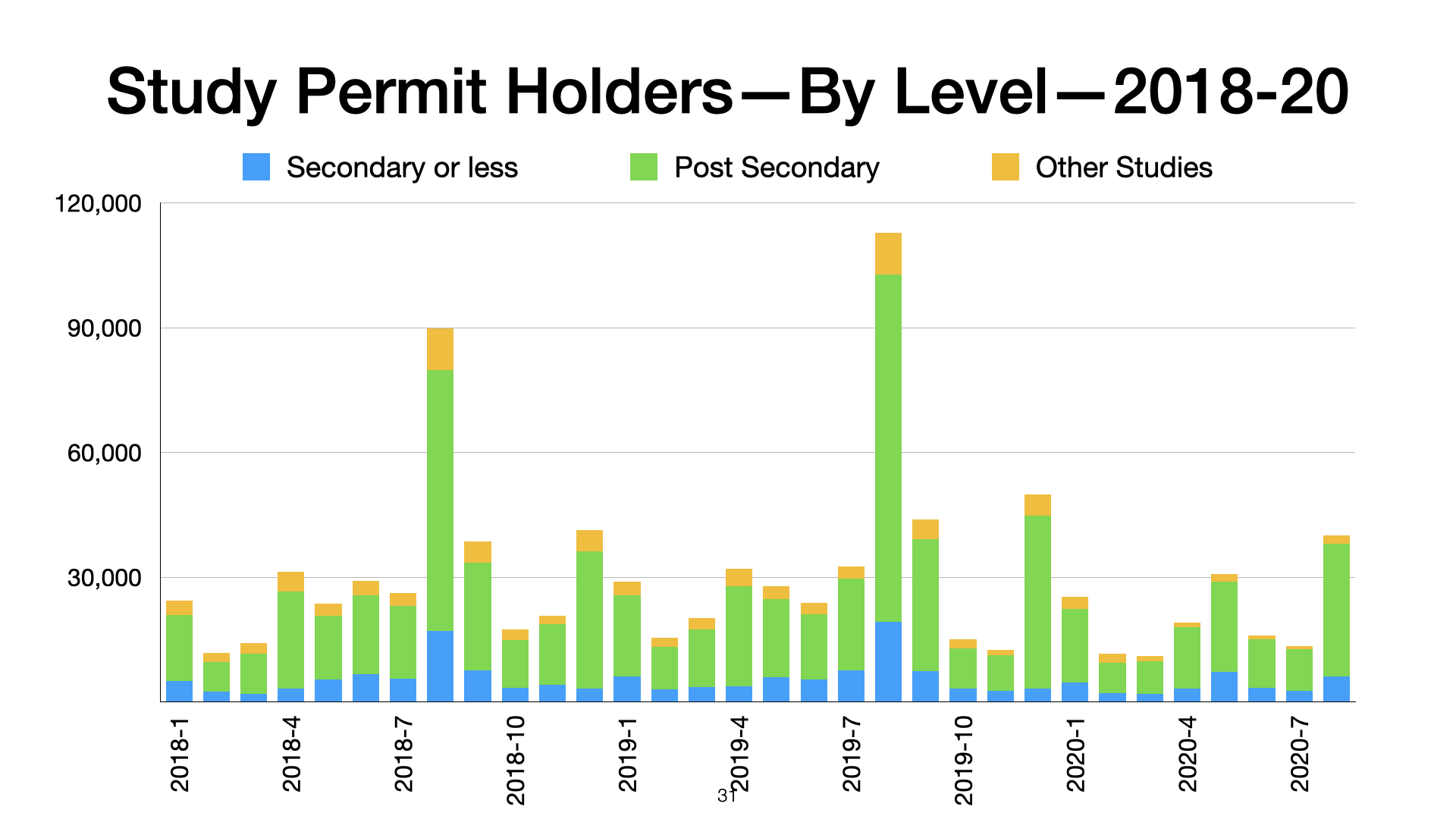
The return of foreign students is a relief for Canada’s post-secondary schools, with universities potentially losing as much as $3.4 billion this year, due mainly to the drop in international students, Statistics Canada reported earlier this month.

Tuition fees paid by foreign students have become an ever-bigger source of revenue for universities. The average tuition paid by an international student this year is $32,041, almost five times what a Canadian student pays. And the number of foreign students in Canada has tripled in 12 years to more than 640,000, generating roughly $22 billion a year in economic activity in Canada, according to federal estimates.

“This could be in the billions of dollars of loss this year alone,” said Denise Amyot, president and CEO of Colleges and Institutes Canada, which represents 135 post-secondary institutions.

Amyot said the return of international students will benefit rural colleges, in particular, where there are seldom enough domestic students to fill classes. Foreign students are also important because many decide to settle in Canada and are often trained for occupations that are short of workers, she said.

“Those are potential immigrants for our country,” Amyot said. “If they know the language, they have studied here, and they have Canadian experience, they make really well-prepared Canadians.”

With the fall semester well underway, Immigration, Refugees and Citizenship Canada (IRCC) spokesperson Shannon Ker told iPolitics that amendments to travel restrictions that kick in Tuesday “should result in a gradual movement of international students to Canada.”

Many foreign students are arranging to arrive before the winter semester starts in January, said Bryn de Chastelain, chair of the Canadian Alliance of Student Associations.

“I’m not sure if we’ll see a huge influx starting tomorrow, but I think, over the next few months, we will start to see kind of a slow trickle begin to pick up,” de Chastelain said.

Ker said it’s too hard to guess how many students will arrive in the weeks ahead, but it would depend on how many decide to study online from their home countries and the number of institutions that have their readiness plans approved. But a spokesperson for Ontario’s Ministry of Colleges and Universities says it has given 12 publicly funded schools the green light so far.

IRCC has yet to publish the list of schools — known formally as “designated learning institutions” — whose plans have been approved, although its website says it will be available by Oct. 20.

Students arriving in Canada must undergo the same screening and quarantine as any other traveller.

But the students’ arrival may be delayed because Canadian visa-application offices abroad are short-staffed due to the pandemic, Amyot said. That includes those in India, where most foreign students attending Canadians colleges and institutes come from.

International students require two stages of permits in order to study in Canada. Stage 2 includes biometrics, a medical exam, and a criminal background check that often require physically going to a visa office.

“That will become a barrier, because they need those biometrics to travel to Canada,” Amyot said.

The IRCC’s Ker said that, since March 15, more than 121,000 study permits have been issued, of which 10,000 are initial study permits and 111,000 are study permit extensions. In most cases, applicants approved for an initial study permit are abroad, whereas applicants approved for a study permit extension are already in Canada.

According to de Chastelain, foreign students have received “next-to-no financial support” from Ottawa during the pandemic. He said the federal government should help students struggling financially, and cover some expenses for digital technology as most classes move online. One idea de Chastelain proposes is reallocating unspent funds from the $9-billion student-aid package announced in April.

Despite the pandemic, most international and out-of-province students still prefer to live near the schools they’re attending, he said.

Source: Foreign students start gradual return — along with their much-missed tuition

The Long History of Blaming Immigrants in Times of Sickness

Useful reminder of history as the Smithsonian collects items from the current pandemic for future generations:

On a chilly morning in February, about a thousand Chinese immigrants, Chinese Americans and others filled the streets of San Francisco’s historic Chinatown. They marched down Grant Avenue led by a bright red banner emblazoned with the words “Fight the Virus, NOT the People,” followed by Chinese text encouraging global collaboration to fight Covid-19 and condemning discrimination. Other signs carried by the crowd read: “Time For Science, Not Rumors” and “Reject Fear and Racism.”

They were responding to incidents of bias and reported significant drops in revenue in Chinatown and other local Asian American-owned businesses, even at a time when the city had not yet experienced any Covid-19 cases. The rally banner is soon to join the collections of the Smithsonian’s National Museum of American History for the story it tells of America’s history of associating its immigrants with disease.

“There have been long-standing messages about disease being particularly something that Chinese immigrants, Chinese spaces incubate, that Chinese people spread, either because of their unsanitary living conditions or especially the weird, exotic food that Asians allegedly eat,” says Erika Lee, director of the Immigration History Research Center at the University of Minnesota.

How this phenomenon continues now during the Covid-19 pandemic was recently the subject of a curatorial colloquium called “Fear and Scapegoating during a Pandemic.” The online discussion kicked off Pandemic Perspectives: Stories Through Collections, a twice-monthly online panel discussion organized by the curators and historians at the museum. The series invites audience participation in the examination of objects and images from the collections, using them as a jumping off point for discussions on various aspects of life during the pandemic. Upcoming sessions will focus on such topics as voting, masks, comfort food, essential workers and the race for a vaccine.

“[Fear and scapegoating are] something that emerged right at the beginning of the pandemic, and it’s one of the most pervasive, stubborn kind of myths and prejudices that have emerged,” says Alexandra Lord, medical historian at the museum and the discussion’s moderator. “So we thought it was really important to start by talking about this topic in particular.”

While the virus had only just reached American shores—the day of the San Francisco rally saw America’s first Covid-19 related death in Washington—many Chinese Americans already saw how such terminology as “China virus” intensifiedan existing anti-Chinese sentiment that would bubble to the forefront of the country’s social conscience.

“We didn’t really shut down as a society until mid-March, yet we see how early Chinese Americans are feeling the impact of the virus, partly because of the history, partly because they are connected transnationally to families and communities in China, but also because the xenophobia that has risen out of Covid-19 was already global before we really experienced the pandemic ourselves,” says Lee, a panelist at the colloquium.

One object discussed was an illustration from the May 26, 1882 issue of the San Francisco Illustrated Wasp, published just weeks after the Chinese Exclusion Act passed. Depicting three ghoulish figures called malarium, smallpox and leprosy and with one holding a sash that says “Chinatown,” the artist’s intent was clear: to suggest that the places Chinese people inhabit spawn disease.

View the pre-recorded seminar: “Fear and Scapegoating During the Pandemic”

On the cover of an 1899 issue of another mainstream magazine, Judge, U.S. President William McKinley is depicted bathing a Filipino native baby in the “waters of civilization.” In the background, two figures dressing themselves in clothes made from the Puerto Rican flag have presumably just been freshly washed with the same “brush of education” that McKinley holds in his hand. Published during the Spanish-American War just after the U.S. colonized the Philippines and Puerto Rico, the illustration vividly visualizes the racist ideas of the period, according to Theodore Gonzalves, a curator at the museum who specializes in Asian American and performing arts history.

“One thing that we’re seeing in these images is this idea that it’s not just policy that shapes our ideas about immigration, but also, our concept of health, both at a policy level and in terms of medical inspections and also at a cultural level in the stories we tell about race,” said panelist Natalia Molina, a professor of American Studies and Ethnicity at the University of Southern California.

The popular narratives about race have often been tied to differences in physical health and intelligence, as Molina noted after an audience member asked about the role of eugenics in shaping these stories. Lee pointed to the Ku Klux Klan and its reliance on myths of physical and mental disparities between races as a method of enforcing racial segregation and white supremacy, to maintain an “America for Americans.”

In another context, purported differences in physical constitution encouraged agricultural and railroad construction employers to hire Mexicans. Molina explained that people in the United States believed Mexicans to be biologically different: their bodies, it was said, could withstand 110-degree Fahrenheit heat better and produce more work in the fields. But when the Great Depression rolled around, those same workers became economic scapegoats, and characterized as immigrants who were taking jobs away from native-born Americans. During this period, racist notions created the medical myth that portrayed Mexican workers as more susceptible to diseases like tuberculosis and led to charges that they would burden the nation’s healthcare system.

“It doesn’t begin with ethnic and racial minorities,” Gonzalves emphasized. “If we go back to the 1790 Naturalization Act, we have to think about how that was a law that equated citizenship with free white persons of good moral character. . . we have to think about who was really identifying and obsessed with identities. It’s clearly the founders themselves. . . . Of course it’s going to be an obsession, because [America was founded] on stolen land and everything follows from that. So we are following in the great tradition of America, which is to be obsessed with these questions of identity.”

The museum’s curators are collecting items that document the Covid-19 pandemic in the U.S., and are asking the public to help decide what objects or images will represent this time to future generations. “It’s so important to be documenting the impact of Covid especially on immigrant and refugee communities,” Lee said, noting that these populations of people are disproportionately working in occupations and industries that put them at greater health and economic risk. “As Dr. Molina pointed out, they are essential workers, but they are not treated as essential. . . . And we need to be collecting their stories.”

Source: The Long History of Blaming Immigrants in Times of Sickness

Federal government asks court to keep Canada-U.S. pact to prevent ‘influx of refugee claimants’

Expected:

Canada would face “an influx of refugee claimants” and other “ripple effects” in the absence of a bilateral pact that stops would-be asylum seekers from making a claim here via the U.S., the federal government is warning.

This country will suffer “irreparable harm,” especially amid a global pandemic, if the Federal Court of Appeal does not suspend an earlier lower-court order that struck down the Safe Third Country Agreement, Ottawa argues.

In July, the Federal Court ruled the accord unconstitutional because the United States routinely detained asylum seekers in poor conditions. It gave Ottawa six months — until Jan. 22 — to fix the policy and make sure it complies with the Canadian Charter of Rights and Freedoms before the pact becomes invalid.

On Friday, the appeal court will hear a motion by the federal government to extend the deadline until a full appeal can be heard on a later date.

“An influx of refugee claimants will impair the sustainability of the systems that support refugee claimants while their claims are pending. Provincial and municipal governments are struggling to provide housing and social services,” the government says in its submissions.

“This unpredictability is significantly heightened by the global pandemic. Should the reopening of the border between Canada and the USA coincide with the end of the suspension period, a surge of asylum claims at the border is anticipated.”

Critics have argued the U.S. asylum system is cruel and inhumane, especially since President Donald Trump came into power in 2016 on an anti-immigrant agenda, building a wall to shut out illegal immigrants from the south and separating migrant children from their families. These critics said the Canadian government’s request should be dismissed because infringements of refugees’ rights outweigh any alleged public interest in maintaining the status quo.

“While the court gave Parliament six months to remedy the law, the government has squandered that opportunity in favour of an appeal,” said Justin Mohammed of Amnesty International Canada, one of three litigants who launched and won the constitutional challenge.

“We are hopeful that the Federal Court of Appeal will affirm the deadline, so that no refugee protection claimant will be handed over by Canada to face the horrors of U.S. immigration detention past January 2021.”

Under the bilateral agreement, Canada and the U.S. each recognize the other country as a safe place to seek protection. It lets Canada turn back potential refugees who arrive at land ports of entry along the Canada-U.S. border, on the basis that they should pursue their claims in U.S., the country where they first arrived.

In its submissions, the federal government says the agreement, in place since 2004, is in line with international refugee law to ensure claimants have access to a fair asylum process in an “orderly and efficient manner.” There are exemptions and mechanisms in place to avoid returning would-be asylum seekers to risks and danger.

While the U.S. asylum detention system may be unacceptable, it says the Canadian charter does not apply to foreign laws and processes.

“Failure to grant this stay will result in irreparable harm to the public interest, the functioning of the border, the sustainability of the Canadian asylum system and the services and resources that support claimants in Canada,” the government says.

According to Ottawa, all levels of governments are already struggling to provide services to the 56,515 asylum seekers who skirted the safe third country restrictions by crossing “irregularly” into Canada between official land ports of entry from 2017 to 2019.

“An additional influx would further strain those already stretched systems and resources,” the government cautions, adding that the surge will create further “negative ripple effects and backlogs” in the overall immigration and refugee protection scheme.

“There is a strong public interest in affording Canada control of its borders to regulate the flow of persons and goods and to ensure the orderly processing of claims between Canada and the USA.”

However, the respondents, also including the Canadian Council for Refugees and the Canadian Council of Churches, argued that the lower court’s finding is already “tantamount” to a determination that the Canada-U.S. agreement is not in the public interest.

They said the government’s assertions of irreparable harm to the asylum system and services for claimants in Canada are based not on evidence but on a series of speculative claims by officials at the immigration department and Public Safety Canada.

The pandemic has actually made the conditions worse for asylum seekers, they argue. As of Oct. 6, the U.S. Immigration and Customs Enforcement reported 6,387 confirmed COVID-19 cases in custody, including eight COVID-19-related deaths of detainees.

“The appellants’ suggestion that COVID-19 makes it more difficult to predict ‘asylum intake volumes’ is misleading. While the pandemic is unprecedented, its effect on ‘asylum intake volumes’ is clear: it is dramatically suppressing the number of new refugee claims,” said the respondents in their submissions.

“It is simply harder and more dangerous to travel during the pandemic, and travel to Canada is far more restricted.”

The NDP’s immigration critic Jenny Kwan agrees.

“By appealing the court ruling, the federal Liberals are saying they’d rather let people seeking the safety of asylum here in Canada suffer under Donald Trump’s rules, than stand up for human rights and Canadian values,” said Kwan, who is also the MP for Vancouver East.

“Instead of accepting the court’s ruling and terminating the agreement, they have chosen to double down on turning back asylum seekers to a country that has a policy of separating children from their parents without any way of reuniting them,” she added. “It’s a heartless and shameful act. It’s un-Canadian.”

Source: Federal government asks court to keep Canada-U.S. pact to prevent ‘influx of refugee claimants’

Des milliers de dossiers de résidence permanente dans les limbes

Interesting. From monthly data I have been looking at, does not appear to be radically different to elsewhere in Canada unless I am missing something:

Déjà stressés par des délais de traitement qui n’en finissent plus de s’allonger, des milliers d’immigrants en attente d’une résidence permanente depuis parfois plus d’un an s’inquiètent de n’avoir reçu aucun accusé de réception des autorités fédérales. Dénonçant un « manque de transparence », ces travailleurs vivant au Québec craignent maintenant que leur dossier ne soitperdu ou ne croupisse quelque part dans leur enveloppe au centre de traitement situé en Nouvelle-Écosse.

« On voudrait juste avoir la confirmation que notre dossier a été reçu et qu’il n’y a pas d’éléments manquants », explique Valentine Clary, qui réside depuis sept ans à Montréal et qui a déposé une demande de résidence permanente avec son conjoint il y a plus de 15 mois.

Ne mettant généralement pas plus de deux ou trois mois à arriver, l’accusé de réception est une preuve écrite qu’un dossier a été vérifié et qu’il contient tous les documents et les signatures exigés pour être mis dans la pile et être traité par Immigration, Réfugiés et Citoyenneté Canada (IRCC). C’est aussi une preuve précieuse qui permet de demander une couverture à laRAMQ ou de maintenir en vigueur un Certificat de sélection du Québec (CSQ), en cas d’expiration.

Mme Clary a très peur de retourner malgré elle à la case départ. « J’ai peur de me faire renvoyer mon dossier parce qu’il manque quelque chose et de ne plus avoir aucun recours pour continuer à rester ici », explique cette Française d’origine, qui travaille dans le domaine de l’intelligence artificielle. « Ce n’est pas une question de délai. Personnellement, ça ne me dérangerait pas que le traitement prenne encore quatre ans, du moment que je sais que mon dossier va être étudié et ne me sera pas renvoyé. »

Des milliers de vies en suspens

Avec d’autres de ses compatriotes dans la même situation qu’elle, Valentine Clary administre un groupe Facebook de plus de 1500 personnes qui réclament toutes cet accusé de réception. Mais elles seraient beaucoup plus nombreuses en réalité.

Surtout originaires de pays francophones, comme la France, ces personnes, qui sont au Québec depuis plusieurs années, œuvrent comme ingénieurs, architectes ou dans d’autres professions qualifiées et ont toutes postulé à la résidence permanente par l’entremise du Programme des travailleurs qualifiés sélectionnés par le Québec.

Pour ces gens, tous ces dossiers demeurés sans réponse sont autant de projets de vie en suspens. « Ce que nous demande IRCC en ce moment, c’est de mettre nos vies sur pause », déplore Amandine Lafitte, une Française arrivée au Québec il y a six ans avec son conjoint. Le couple, qui avait prévu de se marier auprès de ses proches en 2021, a maintenant mis ce projet en veilleuse. Leur couverture de RAMQ l’est aussi. Et impossible de sortir du pays. « Mon dossier a été déposé il y a déjà 15 mois et, depuis, je n’ai aucune preuve qu’il va être traité », dit-elle, en craignant que son dossier ne lui revienne avec la mention « incomplet » après l’expiration de son CSQ.

Élodie Boonefaes estime aussi sa vie « bloquée » par ce silence radio d’IRCC. « Si, pour une démarche quelconque, on me demande de justifier que j’ai fait une demande de résidence permanente, je ne peux pas », dit-elle. Elle craint que son dossier ne lui revienne avec la mention « incomplet » après l’expiration de son CSQ, ce qui lui ferait perdre ce dernier.

Pour Louise Mazauric, une architecte qui vit depuis sept ans au Québec, le gouvernement fédéral pourrait faire preuve d’un peu plus d’égards. « J’aimerais au moins une confirmation que je suis “dans la boucle” et que je n’ai pas dépensé tout cet argent pourrien », dit la jeune femme d’origine française qui n’a pas reçu d’accusé de réception pour son dossier déposé il y a un an.

Une raison politique ?

Les membres du groupe Facebook à qui Le Devoir a parlé n’ont pourtant pas ménagé leurs efforts pour savoir où en était leur dossier : courriels et appels répétés à IRCC, demandesd’accès à l’information, appels aux cabinets des ministres de l’Immigration ou à leurs députés au provincial et au fédéral. Au mieux, certains immigrants ont obtenu un numéro « XEP », qui signifie qu’IRCC a bien reçu leurenveloppe, mais cela n’est pas une garantie que le dossier a été vérifié.

Pourquoi cette absence d’accusé de réception pour les travailleurs qualifiés sélectionnés par le Québec qui demandent la résidence permanente ? Et combien de dossiers dorment toujours dans leur enveloppe ? IRCC n’a pas répondu aux questions du Devoir dans les délais impartis.

L’Association québécoise des avocats et avocates en droit de l’immigration (AQAADI) a quant à elle fait ses propres démarches auprès des hauts fonctionnaires d’Immigration Canada, mais n’a réussi qu’à obtenir le nombre de demandes qui sont en traitement, soit 27 000. Un chiffre énorme selon David Chalk, un avocat en immigration impliqué dans l’AQAADI. « Honnêtement, j’étais si étonné de ce nombre que j’ai dû demander s’il s’agissait bel et bien de « dossiers » et non de « personnes » [visées par ces dossiers]. »

Selon lui, le gouvernement provincial de la Coalition avenir Québec ayant diminué ses quotas de 20 %, le gouvernement fédéral aurait rapidement atteint les cibles à l’été 2019 et cessé de traiter de nouveaux dossiers. « Donc tous les dossiers arrivés après juillet 2019 sont restés dans leur enveloppe et n’ont pas été traités. Les gens n’ont donc pas pu obtenir d’accusé de réception », affirme-t-il. Cette information n’a pu être corroborée auprès des deux ministères de l’Immigration, mais plusieurs membres du groupe Facebook disent avoir reçu des explications similaires de la part de leurs députés fédéraux.

La faute de la COVID-19

Le traitement aurait quelque peurepris, mais la pandémie nuirait auprocessus. La COVID-19 a toutefoisle dos large, estime Me Chalk, qui ne croit pas à cette excuse désormais donnée par IRCC pour expliquer les délais et l’absence d’accusés de réception. Les cas actifs se comptent sur les doigts d’une main en Nouvelle-Écosse, rappelle-t-il.

Il exhorte le gouvernement fédéral à s’engager à ne pas retourner les dossiers incomplets qu’il finira par ouvrir, mais demande qu’il octroie plutôt un délai pour fournir les pièces manquantes. Ainsi, les gens ne perdraient pas leur place dans la file. « Il ne faudrait pas que les gens en attente d’un accusé de réception subissent les conséquences de la lenteur du traitement en Nouvelle-Écosse »,dit-il. « Au lieu de traiter les demandes de résidence permanente venant de l’étranger, il faudrait donner la priorité à celles provenant de gens qui sont déjà au Québec. »

Source: Des milliers de dossiers de résidence permanente dans les limbes

Where Donald Trump’s Politics of Cruelty Will Lead

Powerful essay:

My father was a Mexican citizen until the day he died. He lived here in the U.S. on a green card. A former military man and federal agent under several Mexican presidents, he remained patriotic and deeply conservative. Though he had been chased out of his beloved Mexico City by the toxic whims of a presidential strongman, he stayed loyal.

He loved Dwight Eisenhower and Richard Nixon. He joked that if he were an American citizen, he would have tried to vote for Nixon twice in 1968. He used to boast that Nixon was the first Latin American–style president America had ever elected. My father was a law-and-order man—once a cop, always a cop. He might have fallen for Donald Trump if he’d lived long enough. But Trump would have talked him out of it in his first televised anti-Mexican rant. At least I think that’s what would have happened.

During 2020’s apocalyptic summer, photographs circulated of immigrant farmworkers toiling in fields amid walls of smoke and fire as California burned around them. The pictures have visceral impact—they are frightening yet beautiful. But their effect on me was epiphanic: Here were perfect metaphors for the harvest of nearly four years of recklessly vicious rhetoric and policies, of Immigration and Customs Enforcement raids and cruel family separations, of toxic propaganda and the relentless boondoggle of the border wall. Here was the theater burning down as the hypnotist kept working the mic, like Jim Jones calling us all into the delirious excitement of sheer nihilism. The Book of Revelation for Suckers.

Source: Where Donald Trump’s Politics of Cruelty Will Lead