U.S. election results one factor that could impact immigration to Canada next year

Will likely be more analysis and commentary once the results are known and how that affects or not the forthcoming immigration levels plan:

After four years of Canada positioning itself as a more welcoming destination than the U.S. for new immigrants, the upcoming presidential election could change that dynamic.

But as the Liberal government prepares to lay out its immigration targets for the coming year, the domestic discourse on the issue appears to be changing as well.

A new poll by Leger and the Association for Canadian Studies suggests Canadians are feeling skittish about any planned increases to immigration next year, after months of low numbers of new arrivals due to the COVID-19 pandemic.

Fifty-two per cent of those polled this week say they want the levels to stay low for the next 12 months, a figure that can be pegged to the pandemic, said Jack Jedwab, the president of the Association for Canadian Studies.

“When health authorities are telling you that one of the principal causes of the virus is migration — they’re not saying international migration, just people moving in general — and they are telling you not to go abroad, you’re going to conclude to some degree that immigration carries a risk right now,” said Jedwab.

The survey polled 1,523 Canadians between Oct. 23 and Oct. 25. It cannot be assigned a margin of error because online surveys are not truly random.

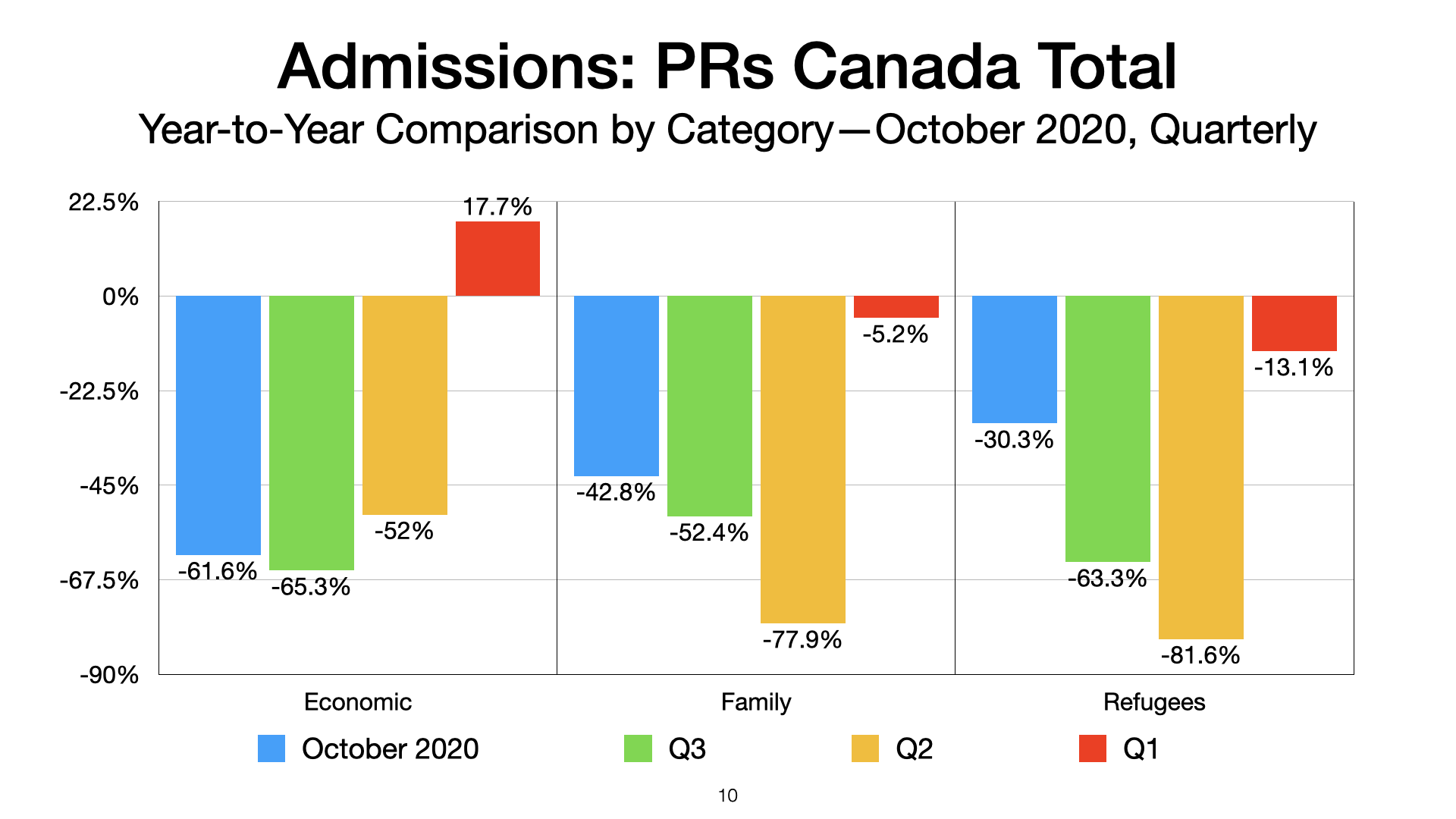
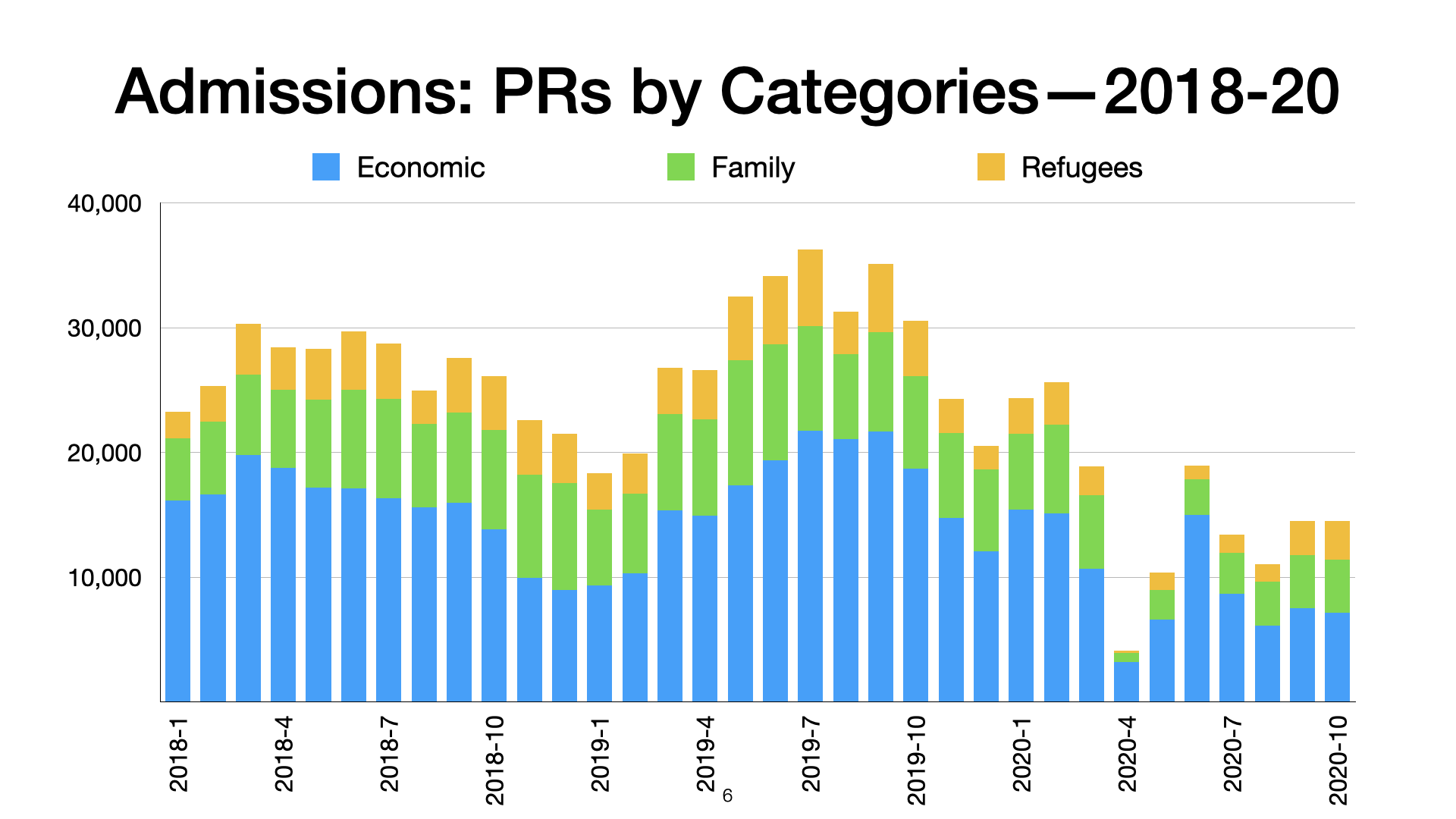
Border closures, civil servants working from home, flight cancellations and vanished job opportunities have all had an impact on the immigration system: estimates suggest that as of August, immigration levels were down 43.5 per cent versus last year and the government’s plan to welcome 341,000 newcomers in 2020 is out the window.

While the Liberal government has maintained a pro-immigration stance throughout and has begun easing restrictions on who is allowed into Canada, what the Liberals think immigration overall could look like next year will be clearer later this week.

Despite some Americans’ “If Trump wins, I’m moving to Canada” line, the U.S. election might not affect the total numbers for new arrivals.

But it could affect the demographics of who arrives.

Upon assuming the presidency in 2017, Donald Trump immediately moved to impose restrictions on immigration, and Canada’s messaging immediately went in the other direction.

The most public response was Prime Minister Justin Trudeau’s #WelcomeRefugees tweet, posted after Trump’s first changes were announced.

Meanwhile, Trump’s travel bans on certain countries, crackdowns on temporary visas issued to citizens of others, and efforts to make it harder for highly skilled workers to get visas would go on to have a trickle-up-to-Canada effect.

How so became tragically clear earlier this year when Ukraine International Airlines Flight PS752 was shot down just after taking off from Tehran.

Upwards of 130 people on the flight were headed to Canada. With Iran on the U.S. blacklist, the Iranian diaspora in Canada had swelled.

The tech sector as well began actively promoting Canada as a place to move as the U.S. made it harder for skilled workers to get visas.

A study earlier this year by the international real estate company CBRE concluded that Toronto had seen the biggest growth in technology jobs in the last five years, outpacing hot spots like Seattle and San Francisco.

Should Democratic presidential nominee Joe Biden win the election, it’s expected that U.S. immigration policy will shift, said Andrew Griffiths, a former director general of citizenship and multiculturalism at the Immigration Department.

How far is hard to know: Trump made a lot of changes, he said.

“It’s going to take a major effort to go through them one by one and make changes and there may not be political will to reverse them all,” he said.

But there is one area where there could be a quick change.

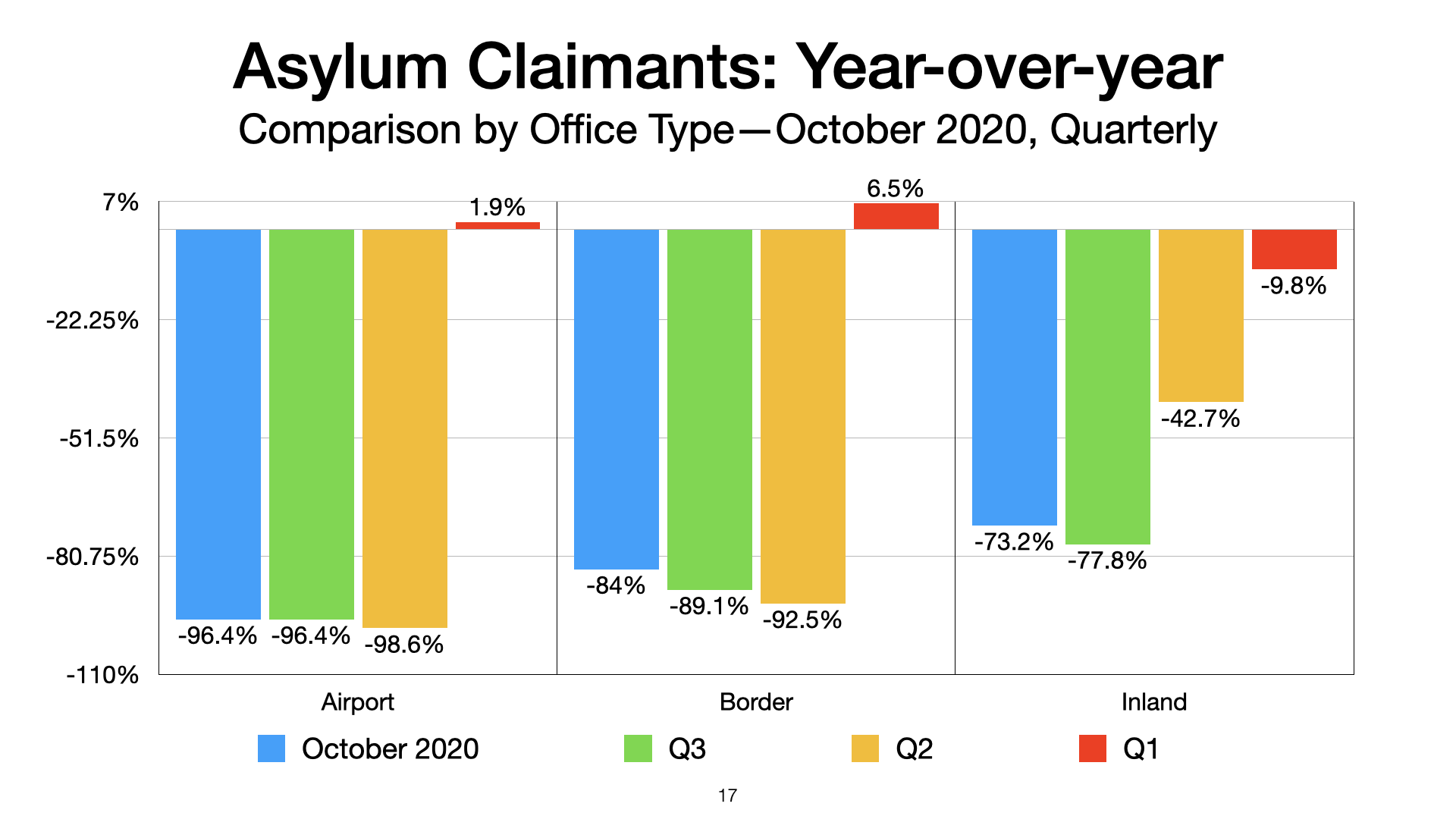
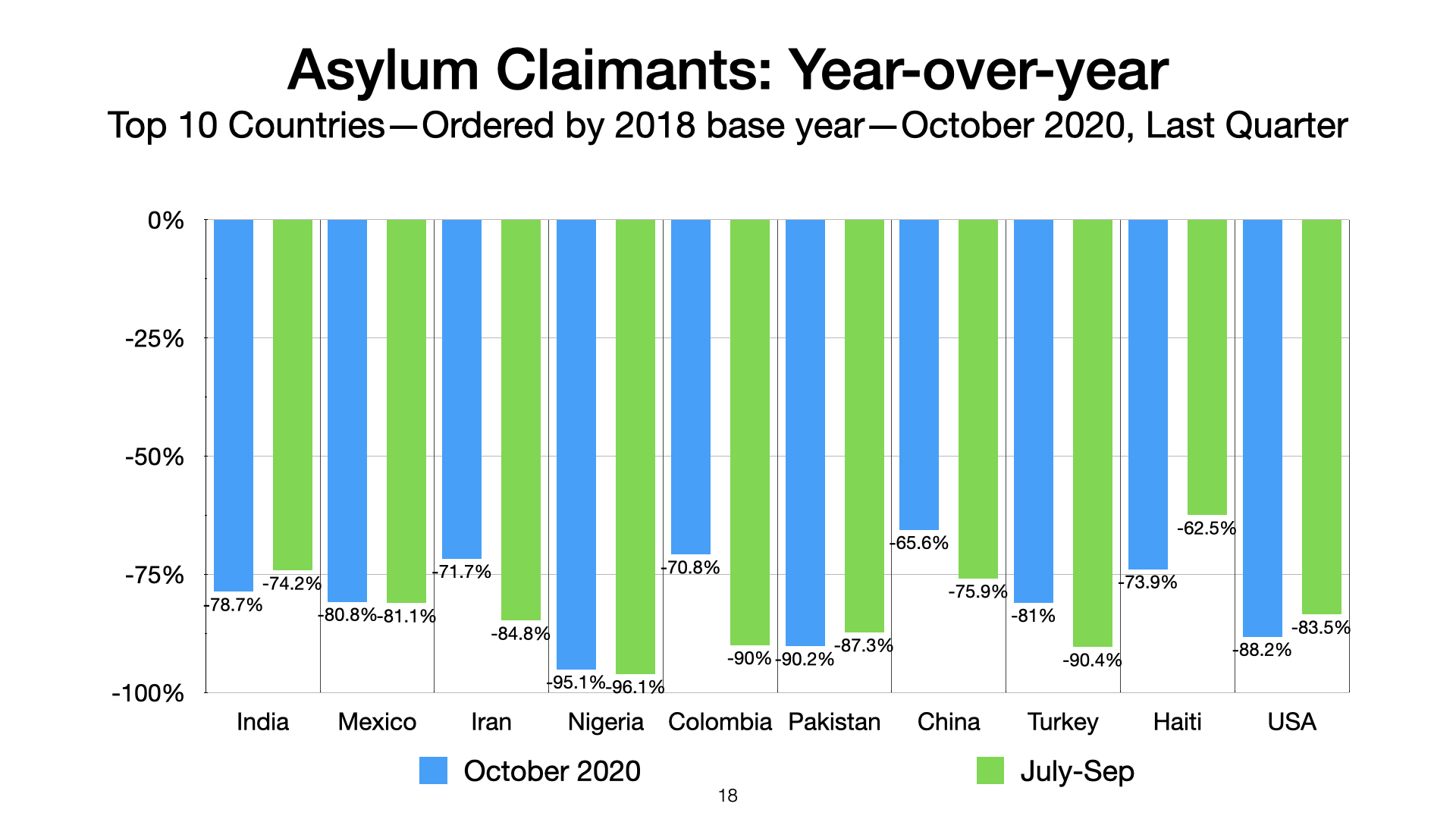
Since 2017, nearly 60,000 people have crossed into Canada from the U.S. at unofficial border points to seek asylum in Canada.

The reason is the Safe Third Country Agreement, which doesn’t allow for asylum claims at land border points, on the grounds that both countries are safe, and someone must ask for refugee status in the first safe country he or she reaches.

Canada has been trying to renegotiate, and if there’s a change in power, the dynamics of those talks could shift as well.

On the other hand, points out Griffiths, it could also result in the number of people seeking to cross into Canada that way declining markedly. One “push factor” sending asylum-claimants north has been a U.S. crackdown on visa renewals by people from certain countries.

The political dynamic in the U.S. will always have a strong and vocal anti-immigrant component that doesn’t exist at the same level in Canada, Griffith said.

If Trump loses, the more “outrageous” aspects of his approach might disappear, he said.

“A Biden administration would reduce the strength of the Canadian advantage that we had in all our messaging, but it won’t completely eliminate it.”

Source: U.S. election results one factor that could impact immigration to Canada next year

John Oliver on Trump immigration policies: ‘Truly disciplined about being truly evil’

One of Oliver’s best:

Over seven seasons, Last Week Tonight has covered numerous aspects of the byzantine US immigration system, from immigration courts, to border patrols, to the Trump administration’s disastrous “zero tolerance” family separation policy. And on Sunday, host John Oliver turned to a narrow slice of America’s legal immigration network: asylum, or the legal process by which people who flee persecution apply to stay in the United States.

Trump has repeatedly denigrated asylum seekers and discredited the process as a scam, although “as you’ve probably guessed”, Oliver said, “the asylum process isn’t a simple recitation of magic words by which all manner of fraudulent claims are let through, nor is it responsible for, as Trump’s official White House website calls it, the ‘biggest loophole to gain entry into our great country’”.

Asylum seekers are like Berta, a woman featured in the Netflix documentary Immigration Nation, who fled Honduras after MS-13 gang members threatened to light her on fire and force her 12-year-old granddaughter into marriage. Berta turned herself into US authorities at the border as she claimed asylum, only to be separated from her granddaughter and held indefinitely in a US detention center.

“That is ridiculous – if you asked the cops for help and responded by throwing you into detention, you’d be absolutely furious,” said Oliver of Berta’s case. “You’d probably also be black, but let’s try to take this one systemic social crisis at a time.”

Berta’s story is not a one-off, Oliver continued, because the Trump administration’s attack on asylum has been “focused, dedicated and deeply resourceful. And I know that those aren’t adjectives you’re used to associating with this administration, but in this one area, they’ve been truly disciplined about being truly evil.”

Typically, Oliver explained, asylum seekers turn themselves into authorities at the border for a “credible fear” screening, and are allowed to stay in the US pending a date in immigration courts. Even before Trump, less than half of those requests were granted; claimants often don’t have a lawyer, and the bar for asylum is high, as you have to prove persecution on the basis of race, religion, nationality, membership in a particular social group or political opinion – criteria the Trump administration has applied narrowly.

Canada should stay the course on immigration

The immigration industry perspective. The overall demographic arguments for staying the course need to take into account that previous recessions and downturns have generally impacted short and longer term economic integration, the expected medium-term impact of COVID-19 on hospitality, travel and retail sectors, along with the longer-term impact of AI and automation on labour force needs.

Will see degree to which it is reflected in the forthcoming immigration plan:

Canada will soon make a major announcement that will shape its economic trajectory for years to come.

By Friday, immigration minister Marco Mendicino will unveil Canada’s new Immigration Levels Plan which will detail the number of newcomers the country seeks to welcome in 2021.

This announcement is usually standard fare.

Since the late-1980s, Liberal and Conservative governments alike have gradually increased Canada’s newcomer intake. The rationale is simple. Newcomers help offset the negative economic and fiscal impacts created by Canada’s aging population and low birth rate.

Nothing about 2020, however, has been standard fare.

The coronavirus pandemic will result in Canada falling well short of the 341,000 newcomer target it had set for 2020.

Intuitively, one may think it no longer makes sense to target a comparable level of immigration next year. Borders have been shut to contain the virus. Canada has a weaker economy and high unemployment.

But reducing the target due to COVID-19 would be a mistake for the following reasons.

The pandemic has not changed the need to welcome newcomers to replenish the over 9 million baby boomers who will be of retirement age by 2030. Our birth rate is too low to replenish the boomers and there is talk that economic uncertainty caused by the pandemic may induce a baby bust.

We will need to rely more on technological advances to meet our future workforce needs but we still need talented Canadians and immigrants to support advances in technology. In addition, Canada’s economy can only grow so much in the absence of the labour force growth that was being fueled by immigration prior to the pandemic.

A case can be made that higher immigration is now even more important.

Economic activity will weaken even further if we have a baby bust.

Government debt is rising to keep the economy afloat during the pandemic, but future generations will eventually need to service the debt.

Hence, welcoming more immigrants will be vital to supporting the growth we will need to turn our post-COVID economic and fiscal fortunes around.

One may legitimately argue that it is unwise to welcome more immigrants during a period of high unemployment.

The rebuttal for this argument is that immigration stimulates job creation in the short run as newcomers spend money to get themselves established in Canada.

Job creation will accelerate once the pandemic is over. We need to begin preparing for the post-COVID economic recovery now. Prior to the pandemic, Canada enjoyed some of its lowest unemployment rates ever in part due to its aging population and low birth rate. We will eventually return to relatively low unemployment and we will need immigrants to fill vacancies.

A new study by Mendicino’s immigration department shows that immigrants who have recently arrived to Canada as skilled workers are performing superbly in the labour market. Given we are attracting the best of the best, we should not be too concerned about the ability of these immigrants to eventually land on their feet in Canada.

Finally, protecting the health and safety of Canadians remains the top priority. We should rest assured this will remain so irrespective of the target that Mendicino announces by Friday. The target does not necessarily mean Canada will welcome this number of newcomers next year if the pandemic lingers. Rather, Canada can enumerate its immigration target but only enable the Canadians of tomorrow to physically enter the country when public health experts deem that this can be achieved safely.

Immigration was important to Canada’s economic prosperity prior to COVID-19 and is set to play an even larger role in our economic and fiscal health after the pandemic. The Canadian government would be wise to stay the course on immigration. The best decision would be to announce immigration targets for 2021 and beyond that are in line with the level of newcomer admissions Canada targeted before the pandemic.

Source: Canada should stay the course on immigration

More agricultural workers should become permanent residents

Naomi Alboim and Karen Cohl make the case. It would have been helpful to have the breakdown between those who are seasonal (growing and harvesting season) and those who are not (e.g., meat packing plants).

Will see if any moves in this direction in the forthcoming immigration plan:

The COVID-19 pandemic has underscored the essential nature of agricultural work in Canada and our reliance on migrant workers to get the job done. Despite restrictions on travel to Canada, work permits continue to be issued for agricultural workers because of the indispensable role they play in ensuring Canadian food security.

The pandemic has also highlighted the vulnerabilities and insecure status of these temporary workers. Inspections of their housing and working conditions have been inadequate in the face of COVID-19, exposing workers to the tragic spread of this deadly virus.

In 2019, temporary foreign workers accounted for 20 percent of employment in the agricultural sector. This amounts to approximately 55,000 jobs in farming, food and fish processing. The majority come to Canada from Mexico and Caribbean countries for up to eight months under the Seasonal Agricultural Workers Program, a longstanding program created in 1966. Others come for up to two years under the Temporary Foreign Worker Agricultural Stream. People with other types of work permits may also choose to work in the agricultural sector, as do undocumented workers, who are the most vulnerable of all.

Shifting to more permanent residency

We propose a major policy shift in which more agricultural workers will be selected as permanent residents. This removes much of the vulnerability associated with temporary status. Workers would have full rights in Canada, with the exception of voting, and would not feel compelled to tolerate unsafe conditions in order to avoid deportation.

An agricultural workforce comprised mostly of permanent residents also makes sense because much of the work – such as animal production, food product processing and manufacturing, greenhouse, nursery, floriculture and mushroom production – takes place on a year-round basis. And it would help employers to maintain a stable workforce without the need for annual expenditures on recruitment, Labour Market Impact Assessments, transportation and training.

An important additional benefit is that families would come to Canada together, aiding integration into their new communities. This would avoid the social isolation and outsider status experienced by many temporary agricultural workers, mostly men, who have to leave their families behind. By selecting experienced and committed agricultural workers to work in welcoming, supportive, rural communities, immigrant families would be motivated to build their futures there, strengthening the vibrancy and viability of communities facing population decline.

Canada’s current economic immigration programs primarily allow only highly skilled people and their spouses and dependants to arrive as permanent residents, which has not included agricultural workers. Canada’s new Agri-Food Pilot and some provincial nominee programs offer a pathway to permanent residency for individuals with relevant work experience and a non-seasonal job offer from a Canadian employer, but the language and education standards are too high for many migrant agricultural workers to meet.

One promising option that we recommend is to build an agricultural stream into the Municipal Nominee Program. This is a new program under development by the Government of Canada where communities can sponsor permanent economic immigrants. Temporary agricultural workers already in Canada are a logical place to start for potential nominees because they have demonstrable skills and work experience, and many may welcome the opportunity to become permanent residents.

A wider search could be undertaken in countries with a significant agricultural base to identify clusters of additional nominees abroad. These workers would come as permanent residents from the start.

Refugees with agricultural experience are another potential source of municipal nominees. This has the added benefit of providing durable solutions for refugees identified by the United Nations Refugee Agency, over and above the levels selected through Canada’s humanitarian refugee resettlement stream. And it is consistent with Canada’s commitment as a signatory to the Global Compact on Refugees. In the compact, participating states agree to provide labour mobility opportunities for refugees with skills that they need.

In designing a mechanism to identify refugees under an agricultural stream of the Municipal Nominee Program, Canada can learn from the Economic Mobility Pathways Project. That project selects highly skilled refugees as permanent residents through provincial nominee and other economic immigration programs.

Ideally, clusters of refugee families with agricultural backgrounds will be selected for the new Municipal Nominee Program, preferably from the same world area. This would improve the integration and retention of families in rural areas, along with providing economies of scale for the provision of targeted settlement services. The selection process will need to involve three levels of government, employers, civil society organizations abroad and in Canada and the UN Refugee Agency.

A bottom-up, community-wide approach should be employed. Employers and the rural municipality identify needs for agricultural workers and population growth. Stakeholders develop and implement plans to welcome and support clusters of nominees and their families. Additional support will likely be necessary for people who come as refugees.

Fortunately, there is growing experience in offering specialized settlement support, for example through the Atlantic Immigration Pilot and the new Rural and Northern Immigration Pilot. Ideally, supports should also be available for temporary foreign agricultural workers who need to know their rights, including how to apply for permanent residency.

An agricultural stream under the municipal program would be meaningful, but it should not be viewed as the sole pathway to permanent residency. We recommend that other ways be explored by reviewing and modifying the criteria of existing programs and pilot projects under the economic and other immigration classes.

Protecting temporary workers

Even if permanent residency becomes more accessible, Canada will need some temporary foreign workers, especially for truly seasonal work and some may prefer a more temporary situation. Changes are urgently needed to better protect these workers as well.

As an example, the employer-specific permits received under the Seasonal Agricultural Workers Program and the Temporary Foreign Worker Agricultural Stream make workers vulnerable. Their status in Canada is dependent on working for the employer who brought them here, leaving them open to potential exploitation, abuse and dangerous work environments with no real recourse. Complaints are rare because of their fear of being fired and deported. We recommend a move to sector-specific permits that allow people to work for any employer within the agricultural sector.

Additional problems arise due to the lack of sufficient accountability and coordination. Multiple federal, provincial and municipal government departments and agencies are involved in different aspects of these programs. And each jurisdiction establishes its own standards and enforcement policies, with little in the way of national standards, coordination or overall accountability.

We propose that the federal government lead a consultative process with provinces, municipal bodies, employers and workers. The purpose would be to develop national standards for health and safety, housing and employment, to establish clear roles and responsibilities and to improve coordination among government bodies for temporary agricultural workers.

Another issue relates to the Labour Market Impact Assessments employers must obtain from the federal government before being allowed to hire a temporary worker from abroad. These assessments include assurances by employers that there are no local residents available to do the job but include little to demonstrate safe conditions and fair compensation for foreign workers. We recommend that national standards be incorporated into these assessments.

Finally, as the recent pandemic has dramatically reminded us, rigorous inspections of worker conditions are essential to ensure safety and fair treatment. Unfortunately, inspections are rarely done proactively without advance notice to the employer. They are often conducted by telephone and may not occur at all in the absence of a formal complaint. Gaps can occur due to different parts and levels of government being responsible for different issues. We recommend the creation of a strategic, coordinated inspection process that would involve collaboration among all relevant departments. The focus would be on proactive monitoring and ensuring compliance with national standards and related requirements of all levels of government.

An opportune time for action

The federal speech from the throne of September 2020 recognizes the value of both migrant and Canadian workers’ contribution to Canada’s food security: “The Canadian and migrant workers who produce, harvest, and process our food – from people picking fruit to packing seafood – have done an outstanding job getting good food on people’s plates. They deserve the government’s full support and protection.”

This level of commitment, along with the government’s objectives for immigration, the economy and rural communities, sets the stage for moving to better protect temporary foreign agricultural workers and to offer more permanent residency options for the people who do this fundamentally important work.

Source: More agricultural workers should become permanent residents

Canada urged to offer safe haven to Hongkongers

Needed:

Conservative Party Leader Erin O’Toole is calling on the Canadian government to urgently adopt special measures that provide a safe haven for Hong Kong residents facing persecution under a harsh national security law imposed by China on the former British colony.

Mr. O’Toole said Canada must also be prepared to support the 300,000 Canadians living in Hong Kong. This would include evacuation assistance if it becomes necessary for Canadian citizens to flee the Asian financial hub as Chinese security forces continue their crackdown on civil rights.

Special immigration and refugee measures are also needed to provide a “lifeboat” for non-Canadian Hongkongers who are being harassed by Chinese security forces and Hong Kong police, he said in an interview with The Globe and Mail.

“We have to have special provisions,” Mr. O’Toole said. “There is a need for us to provide a refugee route for pro-democracy activists who are now living in a police state and cannot access the process of satisfying the requirements, when dealing with Canadian consular services, to use Express Entry or any other way they can visit Canada.”

It’s been more than three months since Beijing enacted the Law of the People’s Republic of China on Safeguarding National Security, which criminalizes opposition and dissent in Hong Kong. Western countries including Canada have accused the Chinese government of breaking a treaty with Britain that pledged to leave human and civil rights in Hong Kong untouched for 50 years after the former British colony was handed over to China in 1997.

This new law spells trouble for the multitude of Hongkongers who have opposed Beijing’s efforts to erode rights in the Asian city, including the more than 7,000 charged in connection with past protests or those under surveillance by Hong Kong police.

Canada’s arm’s-length Immigration and Refugee Board recently granted asylum to two Hong Kong activists, as The Globe first reported, but their case was unusual in that they came to Canada in late 2019, and neither face charges back home for taking part in pro-democracy protests. More than 45 other activists who arrived before the coronavirus pandemic have also applied to be accepted as refugees.

Mr. O’Toole’s call for immediate action to help Hongkongers comes days after the House of Commons committee on citizenship and immigration voted unanimously to investigate measures to provide a haven for them.

NDP immigration critic Jenny Kwan, who put forward the motion, said the Trudeau government is doing nothing, and Hongkongers are growing desperate.

“It’s been all talk and no action,” she said. “The Liberals always find the right words to say but they never follow up with action.”

There are several hundred thousand Canadians of Hong Kong origin living in Canada and 300,000 Canadian citizens living there now.

Mr. O’Toole said action is needed especially after China’s ambassador to Canada, Cong Peiwu, recently warned Ottawa against granting asylum to pro-democracy dissidents from Hong Kong. Mr. Cong said last week that such action could jeopardize the “health and safety” of 300,000 Canadians living there.

“I have actually met a few people in Canada who cannot return to Hong Kong because they fear for their lives, and knowing what we know about the situation there, I think we have to offer them safe haven,” Mr. O’Toole said.

One problem facing Hongkongers trying to flee now is pandemic travel restrictions that prevent them from boarding an aircraft bound for Canada. Before COVID-19, they could travel to Canada as a tourist and ask for asylum upon arrival – but not any more. They are fearful of declaring their intention to seek asylum while in Hong Kong, where they could be monitored, or are being watched by police, or already face charges for pro-democracy demonstrations.

Another option is for them to apply as economic immigrants through Ottawa’s Express Entry program, but that is a difficult route. Express Entry is for high-talent immigrants and it also requires a certificate from Hong Kong’s police, who are under the thumb of Beijing’s Ministry of Security.

The NDP’s Ms. Kwan hopes Ottawa could set up a system similar to that established by successive governments to help persecuted gay Iranians and Chechens reach Canada. Such a process would allow designate non-governmental organizations to play a role in helping arrange documents for Hongkongers’ passage out of the Asian city, perhaps via a third country.

She also recommends that Ottawa loosen family reunification rules so that a greater number of family relations in Canada could easily sponsor arrivals from Hong Kong. It’s harder for Canadians to sponsor relatives to immigrate to Canada if they are not a spouse, partner or children.

Canadian supporters of Hong Kong dissidents say the problem with using programs such as Express Entry is that applicants from Hong Kong do not generate sufficient points to merit acceptance.

Robert Falconer, a research associate at the University of Calgary School of Public Policy and an external adviser to Alliance Canada Hong Kong, said there could be a solution. If Canada is concerned about China seeing it grant asylum to many dissidents from Hong Kong, and would prefer to bring them in as economic migrants, he said, perhaps there could be a special code that applicants can add to their Express Entry applications. The code would artificially raise the point total so they can be accepted.

Mr. Falconer said groups such as Alliance Canada Hong Kong could be empowered to distribute these codes to dissidents in Hong Kong.

“For all appearance, they would come in as economic-stream immigrants,” he said.

Source: https://www.theglobeandmail.com/politics/article-canada-urged-to-offer-safe-haven-to-hongkongers/

Fact Checkers Say Trump Built A Wall Of False Claims On Immigration

Good summary:

Washington Post fact checkers Glenn Kessler, Salvador Rizzo and Meg Kelly write in their book that Donald Trump has made more false or misleading statements about immigration than any other issue. According to the authors, that is saying something. The book, Donald Trump and His Assault on Truth: The President’s Falsehoods, Misleading Claims and Flat-Out Lies, contains numerous examples of Donald Trump’s statements on immigration and represents a valuable resource.

Immigration Tops in Washington Post Database: “Immigration is the top category of false and misleading claims in our Trump database, accounting for 15% of the total 16,241 statements we fact checked in the first three years of Trump’s presidency,” according to the authors.

That comes to an incredible 2,400 or more false and misleading claims by Donald Trump on immigration, with more than 200 additional such statements since the book was published. Trump has repeated many of the false claims on immigration dozens of times, the authors conclude. Below is a sample of Trump’s statements.

Mexico Will (Not) Pay For the Wall: Kessler, Rizzo and Kelly list Trump’s claim that Mexico is paying for the border wall first in the book. During the 2016 presidential campaign and later, Trump asserted Mexico would pay for the wall. “Mexico’s paying for the wall. You know that. You’ll see that. It’s all worked out. Mexico’s paying,” Trump said at a rally on January 14, 2020.

Spoiler alert: Mexico has not paid for the wall. Nor is there any suggestion that it will,” the authors note. “The current barrier construction is being paid for with billions of dollars appropriated by Congress for the defense budget and raided by Trump over congressional opposition.” (Emphasis added.)

Family Separation: Trump blamed the separation of children from their parents at the border on the Democrats. “I hate children being taken away. The Democrats have to change their law. That’s their law,” said Trump on June 15, 2018.

“Trump’s family separations in 2018 caused a national uproar,” according  to Kessler, Rizzo and Kelly. “U.S. immigration officials separated thousands of Central American migrant children from their parents, sending the kids off to shelters or relatives while their parents were prosecuted and put on track to be deported. The Trump administration’s messaging seemed at times Orwellian. Top government officials claimed there was no family-separation policy. The president falsely asserted that existing laws were forcing his hand. But the real reason for the separations was Trump’s own zero-tolerance policy.”

At the presidential debate on October 22, 2020, Donald Trump tried to blame the Obama administration for the family separation policies that Trump advocated for and encouraged. “Mr. Trump’s ‘zero tolerance’ policy was a deliberate act of family separation, meant to deter migrants from trying to enter the United States,” reported Zolan Kanno-Youngs in the New York Times after the debate. “It directed prosecutors to file criminal charges against everyone who crossed the border without authorization, including parents, who were then separated from their children when they were taken into custody.”

Immigrants and Crime: “The Democrats are really looking at something that is very dangerous for our country. . . .They want to have illegal immigrants pouring into our country, bringing with them crime, tremendous amounts of crime,” said Trump on December 6, 2017.

In the book, Kessler, Rizzo and Kelly cite academic research that shows immigrants do not increase the crime rate: “‘Far from immigration increasing crime rates, studies demonstrate that immigrants and immigration are associated inversely with crime,’ the National Academy of Sciences study concluded. ‘Immigrants are less likely than the native-born to commit crimes, and neighborhoods with greater concentrations of immigrants have much lower rates of crime and violence than comparable non-immigrant neighborhoods.’”

False Claims About Refugees: “Every Democrat running for president wants to open the floodgates to unlimited refugees from all around the world, overwhelming your communities and putting our national security at grave risk,” said Trump.

The authors labeled this claim by Trump as false. “Refugees do not overwhelm communities because U.S. officials usually place them in different parts of the country,” they note. “There is no evidence that refugees, many of them women and children, endanger national security. Trump often makes false claims associating immigrants with crime. No leading Democrat running for president voiced support for unlimited refugee admissions, though Joe Biden and Sen. Elizabeth Warren favored raising the annual cap from 18,000, where Trump said it after a clampdown in 2019, to more than 100,000.”

Trump Fabrications About the Diversity Visa Lottery: “Trump consistently mischaracterizes the Diversity Immigrant Visa Program, claiming absurdly that foreign countries raffle off green cards granting legal residence in the United States,” the authors write. “In fact, a computer program managed by a State Department office in Williamsburg, Ky., randomly selects up to 50,000 immigrant visa applications per year – out of nearly 15 million in 2017 from countries with low rates of immigration.”

Trump stopped all Diversity Visa applicants from entering the United States in FY 2020 by including them in an April 2020 proclamation.

Trump Attacks on Family Immigration: “The president also invents faux facts,” according to Kessler, Rizzo and Kelly. “Over and over, Trump claimed that the Uzbekistan-born man who in 2017 was accused of killing 8 people with a pickup truck in New York had brought two dozen relatives to the United States through so-called chain migration. The actual number is zero.”

The book raises an important question: If Donald Trump’s immigration policies were actually popular and good for the country, why have journalists found he has lied or misstated facts about immigration and his policies thousands of times?

@DouglasTodd Nine million people have scooped up Canada’s 10-year visas. Some abuse them

More anecdotal than evidence-based regarding the extent of the abuse. It would be relatively straightforward to request a dataset from IRCC that would provide the basis for answering the issues raised in the article:

  • people relinquishing permanent residency by country and immigration category;
  • those being sponsored for permanent residency; and,
  • those requesting asylum status.

Canada has given out more than nine million 10-year visitor visas since the program began, with by far the largest bulk of recipients coming from China and India, followed by people from Brazil and Mexico.

The super-popular multiple-entry visas are generally a benefit to Canada’s economy, say immigration lawyers. But they caution the 10-year, multiple-entry visas can be abused by “shadow investors” to avoid paying property and income taxes in Canada — and as a dubious means by which to claim asylum.

Source: Douglas Todd: Nine million people have scooped up Canada’s 10-year visas. Some abuse them

‘It’s a racist system’: Some couples say Canada’s visa system is cruelly extending their COVID-19 separations

Visa requirements by their very nature discriminate between those more likely to overstay and those not:

Still in pain after delivering her first child, Kaitlyn Hebb asked her mother in the birthing room to video-call her husband in Egypt, so he could meet their newborn son.

It’s the closest the new mother from Bridgewater, N.S., could come to sharing the moment with Alaa Ali, who has been kept out of Canada while waiting for his stalled spousal sponsorship application to be processed in the middle of a pandemic.

“Alaa is never going to get this moment back. He’s never going to be in pictures. He couldn’t be here to help me. He couldn’t be here to hold our baby. I felt guilty,” said Hebb, a registered nurse, who married Ali in 2018 after the couple met online two years earlier.

The coronavirus pandemic has exposed a practice entrenched in Canada’s immigration system that critics say is discriminatory against some travellers — the majority of whom are from the developing world — who need a valid visa to come into this country.

Due to COVID-19, Ottawa has imposed tight border restrictions against foreign nationals. But two weeks ago, it relaxed the measures to let in unmarried but committed partners of Canadians, as well as international students and those with a dying family member here.

However, one is out of luck if the foreign partner, even married, as Ali is to Hebb, is from a country that needs a visa — a barrier that travellers from visa-exempted countries don’t face.

“Alaa is being discriminated against because of the country he’s from,” said Hebb, whose husband was refused a visitor visa and has yet to hold their now-six-month-old son, Enzo.

“People are saying, ‘It’s like that for everyone. It’s the pandemic. Wait your turn and we need to keep people safe.’ But they don’t realize it has been that way before the pandemic.”

Advocates say couples’ married status can actually work against their chances of getting a visitor visa.

Chantal Dube is a spokesperson for Spousal Sponsorship Advocates, a 5,000-member advocacy group that has been lobbying for family reunifications during COVID-19. She said officials almost always refuse to grant a visitor’s visa if they don’t believe that the applicant’s stay in Canada will be temporary. Those being sponsored by their Canadian spouses are viewed to have the intent to overstay, she said.

The majority of the advocacy group’s members have a spouse from a visa-required country. A survey it conducted in September found only five per cent — or 29 of the 553 respondents — have had their foreign spouses’ visitor visas approved.

“As we are watching all these other spouses and partners and extended family members being granted permission to come to Canada, we have members of our group who can’t even come for the birth of their children. It’s very difficult to wrap our head around it,” said Dube.

“How’s that fair and compassionate? That’s a misstep for our government. It’s important to investigate a possibility of systemic discrimination going on.”

Dube is from Sault Ste. Marie, Ont., and her husband, Arvind Singh Grewal, is from India. With their spousal sponsorship application in the system since last October, he has not applied for a visitor visa, for just this reason.

“Why would we put our spousal sponsorship applications at risk by overstepping the boundaries of the time limit put on the temporary visas?” asked Dube, whose members will stage a national virtual protest Saturday.

Opposition NDP immigration critic Jenny Kwan said officials often “robotically” refuse applicants, citing their lack of travel history and assets in their home country.

“We have dealt with cases where people are still rejected on this ground even if they have had travel history without incident,” Kwan said.

“It’s as if the travel history for individuals in developing countries is somehow less valid than those in developed countries. It is as if there is some unspoken rule that the standards to obtain a travel visa for those from developing countries are much higher.”

Deanna McConnell of Perth, Ont., said her Haitian husband, Jean Bernard Valeus, has had his visitor visa applications refused twice because immigration officials were not convinced he would leave Canada after his stay.

That was on top of a refusal of their first spousal sponsorship in 2018 because officials didn’t believe it was a genuine marriage. A new sponsorship application was submitted in February 2019 and a decision is pending.

“Our lives are on hold with no recourse. On Feb. 14, 2021, we will be married for four years. That is less than three months away. We are at the mercy of the system,” said McConnell, who met Valeus while visiting her cousin in Haiti in 2011.

“Why is this so difficult?”

Joelle Bruneau of Val-David, Que., was so sick and tired of the separation from her husband, Erick Pineda in Honduras, that she and their 20-month-old daughter, Estrella, flew down to see him as soon as his country’s border reopened in August.

He has twice been refused a visitor visa during Bruneau’s pregnancy and twice after the girl’s birth. Meanwhile, Bruneau said the parents of her friend were allowed to visit Canada from France during the pandemic.

“This is totally unfair. It’s a racist system we live in. All the people from privileged systems can come and enjoy their time with their families. Erick is from a developing country. The process is so much harder for him,” said Bruneau, who met Pineda while vacationing in 2018.

“All the moments Canada Immigration has stolen from us, we will never have it back,” added Bruneau, whose spousal sponsorship has been in the queue since January 2019.

In response to a growing immigration backlog, the federal government in September announced a plan to assign 66 per cent more staff to process spousal sponsorship applications. It aims to accelerate, prioritize and finalize some 6,000 applications each month from October until December.

“We understand that the last few months have not been easy for those who are far from their loved ones in these difficult times. This is why we are accelerating the approval of spousal applications as much as possible,” said Immigration Minister Marco Mendicino.

Spousal Sponsorship Advocates says it’s great to see the government invest in addressing the backlog but what their members immediately need is a visitor visa for their loved ones to be with them in Canada now.

Source: ‘It’s a racist system’: Some couples say Canada’s visa system is cruelly extending their COVID-19 separations

Where are the immigrants in Canada’s policy debates?

Good commentary by Keith Banting:

COVID-19 is the great revealer. It has revealed yawning gaps in Canada’s current patchwork of social programs, which manifestly failed to cope with the crisis. Emergency measures such as the Canada Emergency Response Benefit (CERB) and wage subsidies had to be rushed into place simply to keep individuals, families and the economy afloat.

Other fatal limitations soon appeared. Lax regulation of long-term care facilities had tragic consequences for thousands of vulnerable elderly, a crisis which required the emergency deployment of military health personnel in our two largest provinces. More broadly, the pandemic shone a harsh light on inequality in Canada. Many ‘essential’ workers had to travel to work for low pay in infectious workplaces, while the professional middle class worked from the safety of their homes, with little if any hit to their incomes.

These burdens were not shared equally across Canada’s diverse society. The economic and health impacts were greatest in the case of women, recent immigrants, racialized minorities, and members of the First Nations. An analysis by Statistics Canada documents the economic hit. Poverty rates were already high among recent immigrants and racialized communities before the pandemic, but the gaps grew during the crisis, with recent immigrants and racialized communities among the hardest hit. Poverty rates increased most in the South Asian, Chinese, Black, Korean, Arab, Latin American and West Asians communities.

With emergency programs set to wind down, Canadians are engaged in an intense debate over how to ‘build back better’ by improving our social programs. The agenda is larger and more complex than at any time in recent memory.

Income security programs are front and centre. There is pressure to expand eligibility for Employment Insurance to include contingent workers and more of the self-employed. Additional options range from incremental change, such as expanding the existing Canada Workers Benefit, to radical change, such as the introduction of some form of Basic Income.

Other reformers prefer to tackle precarious work, not through income transfers, but through market-shaping policies. Too many workers are in low paying jobs that lack any guarantee of sufficient hours, job security, or sick leave. From this perspective, Canada needs tougher labour market policies, including higher minimum wages and stronger worker rights, to ensure all jobs pay a living wage that can support a dignified life.

Beyond the world of incomes and wages, the social policy agenda extends to the improvement of core services, such as an expansion of childcare and a much stronger long-term care sector. In addition, stronger protections for temporary foreign workers, especially in the agricultural sector, are clearly essential.

Income security, market protections, stronger services: This is a huge agenda.

Canada needs tougher labour market policies, including higher minimum wages and stronger worker rights

Immigrant groups, however, have an ambiguous place in this great debate. With many recent immigrants and racialized minorities working in precarious, low-wage, unsafe jobs, their interests are deeply affected by the political struggle. Many of them would benefit the options on the table. Despite this, the politics of race and immigrant integration are unlikely to play a distinctive, energizing role in the political struggle. The issues are being framed around generic or ‘universal’ workers and their needs. This is the standard way of thinking about social policy in Canada.

The 2015 election provides an earlier example. The Liberal Party promised to raise taxes on high-income earners, cut taxes for the middle class and significantly expand child benefits, which help low-income families most. Strikingly, there was virtually no mention of race and racial minorities during the election debates. Rather, the Liberals presented their package designed to help “the middle-class and those working hard to join it.” Many racial minority families with children, including newly arrived Syrian refugee families, were significant beneficiaries when the new Liberal government significantly expanded child benefits. But racial inequality was not part of the politics that drove policy expansion.

Admittedly, there may be benefits in this generic framing. In the United States and Europe, many commentators argue that ethnic and racial diversity erodes a sense of community, weakens feelings of trust in fellow citizens, and fragments coalitions that might otherwise support social programs. They fear that members of the majority public might be reluctant to support social programs that give money to ‘strangers’ who are not part of ‘us’.

So far, such corrosive politics have been muted in Canada. Nevertheless, one cannot help but wonder whether the politics of diversity might bring added energy to social policy struggles. The Black Lives Matter movement is bringing much needed pressure on the justice system. But it is not part of the social policy debate. This framing of social policy, with its limited acknowledgement of the diversity of those whose interests are at stake, is a little unsettling, a sign perhaps that Canada is not fully comfortable in its own social reality.

Source: Where are the immigrants in Canada’s policy debates?

Germany: Coronavirus an extra burden for immigrants

Common pattern in most countries:

The German federal government commissioner for integration, Annette Widmann-Mauz, highlighted the plight of asylum seekers and people with immigration backgrounds during the coronavirus pandemic and the related economic crisis in a statement on Sunday.

“They often work in industries which are particularly affected by the economic consequences of the pandemic, such as retail, logistics or the hospitality sector,” she said, on the eve of the 12th integration summit which shines a light on the effects of the pandemic on immigrants.

At the same time as work conditions are becoming more difficult, the number of opportunities for integration are also shrinking.

The national integration action plan took on a digital offensive offering online integration courses, language teaching and consultations over social networks. The focus is on supporting women to enter and integrate into the job market.

“We mustn’t lose any time on integration, in spite of coronavirus,” Widmann-Mauz said.

A joint effort on integration policy

The integration summit, which began in 2006, will see around 130 representatives from immigrant organizations, religious communities, the economy, politics and sports come together over video conference to discuss the current topics regarding integration policy.

The government’s vice-spokeswoman, Martina Fietz, announced in advance of the summit, that those taking part “will discuss answers to the important question of how we can also strengthen integration in times of coronavirus, as many people with an immigration background are particularly hard hit.”

German Chancellor Angela Merkel will lead the discussion which will also look at the possibility of recognizing foreign professional and educational qualifications, as well as the promotion of early childhood education.

The first summit took place 14 years ago following a national debate about violence in schools. Teachers from a school in Berlin triggered the founding of the summit through a protest letter they wrote.

Source: Germany: Coronavirus an extra burden for immigrants