Dutrisac: De grandes ambitions postnationales [Immigration and Quebec]

Regarding the medium and longer-term impact of increased immigration in the rest of Canada in contrast to relatively static numbers for Quebec, along with some of the fallacies that characterize the government’s reliance on high immigration levels to strengthen the economy and address an aging population.

Le gouvernement Trudeau voudrait bien que le Québec hausse ses seuils d’immigration pour qu’ils se rapprochent des cibles canadiennes, puisqu’Ottawa compte accueillir un nombre record d’immigrants au cours des prochaines années.


Dans une entrevue accordée au Devoir mercredi, le nouveau ministre fédéral de l’Immigration, des Réfugiés et de la Citoyenneté, Sean Fraser, a voulu encourager le Québec à augmenter le nombre d’immigrants qu’il reçoit. « Je crois que le Québec est conscient du besoin de recourir à l’immigration pour s’assurer que les entreprises trouvent des travailleurs », a-t-il déclaré.

Juste avant l’arrivée des libéraux de Justin Trudeau au pouvoir, en 2015, le nombre d’immigrants admis au Canada, sous le gouvernement Harper, variait entre 250 000 et 260 000 par an. En 2019, avant la pandémie, ce nombre était passé à 341 000. Après une chute à 184 000 immigrants en 2020 en raison de la pandémie, les seuils repartent à la hausse pour atteindre 401 000 cette année, 411 000 en 2022 et 421 000 en 2023. Ces derniers chiffres tiennent compte d’un certain rattrapage, mais l’intention, c’est de devenir le gouvernement canadien le plus ambitieux de tous les temps en matière d’immigration, comme l’a signalé le ministre Fraser.

Au Canada anglais, l’organisme Century Initiative tente de convaincre le gouvernement Trudeau d’admettre graduellement de plus en plus d’immigrants pour atteindre les 500 000 en 2026, avec comme objectif ultime de faire passer la population canadienne de 38,5 millions à 100 millions en 2100. Le Canada serait plus fort et aurait plus d’influence sur le plan mondial, avance ce groupe de pression, les Canadiens seraient plus riches, les coffres de l’État seraient mieux garnis, les pénuries de main-d’œuvre ne seraient qu’un mauvais souvenir et le vieillissement de la population serait stoppé.

Ces représentants de l’intelligentsia canadienne-anglaise ne sont pas les seuls à croire que l’admission débridée d’immigrants contribuera à accroître la richesse du pays et à réduire le vieillissement de la population. C’est le discours que tient généralement le milieu des affaires.

Or, comme l’ont montré les chercheurs Parisa Mahboubi et Bill Robson, de l’Institut C.D. Howe, cités par l’économiste Pierre Fortin, l’effet de l’immigration sur le vieillissement de la population est marginal. C’est plutôt la participation accrue des travailleurs de 60 ans et plus, comme au Japon, par exemple, qui est le moyen le plus susceptible de réduire les effets du vieillissement sur le marché du travail et les finances publiques.

À Ottawa, on n’hésite pas à lier l’immigration à un accroissement de la richesse du pays. À cet égard, il ne faut pas oublier que ce n’est pas la grosseur de la tarte qui importe, mais bien la grosseur de la part qui revient à chacun. Autrement dit, c’est le produit intérieur brut (PIB) par habitant dont il faut se soucier. Ainsi, les Néerlandais, dont le pays accueille relativement peu d’immigrants, sont plus riches que les Allemands, qui en ont admis davantage. Il n’y a pas de corrélation.

Quant à l’idée qu’une forte immigration soulagerait les pénuries de main-d’œuvre, c’est « un pur sophisme », nous dit Pierre Fortin. L’immigration accroît le bassin de main-d’œuvre, mais aussi le nombre de consommateurs de biens et de services du commerce et de services publics. Certes, une sélection précise des immigrants peut aider à pourvoir des postes de travailleurs qualifiés en forte demande. Mais augmenter tous azimuts les seuils d’immigration comme le gouvernement Trudeau l’envisage peut accroître le chômage chez les nouveaux arrivants.

La question de la pénurie de logements commence sérieusement à se poser. Comme les immigrants s’établissent en majorité dans les grands centres urbains, une pression intenable s’exerce sur le marché immobilier, comme on peut le constater à Toronto, à Vancouver et, dans une moindre mesure, à Montréal.

C’est sans compter la situation bien particulière du Québec. La politique d’immigration du gouvernement Trudeau fait fi du poids démographique du seul État à majorité francophone de la fédération. S’il fallait suivre le rythme imposé par Ottawa, qui plus est sans qu’il y ait eu de débat, ce n’est pas 50 000 immigrants par an que le Québec devrait accueillir, mais bien 95 000 et davantage, une impossibilité. Déjà, il n’y a pas suffisamment d’immigrants qui choisissent de vivre en français au Québec. Dans le reste du Canada, ce n’est pas un enjeu : tous les nouveaux arrivants, quelle que soit leur langue maternelle, finissent par parler anglais et vivre en anglais. Y compris les francophones, d’ailleurs.

Cette politique d’immigration, poussée par un élan multiculturaliste et postnational, ne convient pas au Québec, qui ne pourra plus très longtemps se contenter de demi-pouvoirs en matière d’immigration.

Source: https://www.ledevoir.com/opinion/editoriaux/653859/ottawa-et-l-immigration-de-grandes-ambitions-postnationales?utm_source=infolettre-2021-12-11&utm_medium=email&utm_campaign=infolettre-quotidienne

Syrian refugees who now call Canada home look to help Afghan newcomers

Nice:

The living room at Zoheir and Nadia Darrouba’s home is a hive of activity in the late afternoon – their older children, just back from school, are taking turns carrying around their baby brother as their parents look on.

It’s a simple scene but one that makes Zoheir Darrouba feel at home in the mid-size Ontario city the Syrian refugee family of eight has now put down roots in.

“We have settled here. We cannot live outside Peterborough,” he says. “It’s a good and quiet city. There are not problems here … People are helpful and nice.”

The family is among nearly 46,000 Syrian refugees who were resettled in Canada under a program introduced by the Liberal government in 2015. The first flight carrying Syrian refugees landed in Toronto on Dec. 10, 2015, exactly six years ago.

The Darroubas, who made their way to Canada under the resettlement program in November 2016, used to live in Idlib, in northwest Syria, one of the first regions where local uprisings escalated into widespread violence. The family lived for a period of time in Lebanon before finding themselves settling in Peterborough.

Now, as they consider themselves firmly established locals, the family is looking to help Afghan refugees who’ve started arriving in the city following the Taliban’s takeover of Kabul earlier this year, although the pandemic has made that effort a bit more complicated.

“There are several (Afghan) families here … They are in quarantine, unlike before,” said Darrouba, who wants to offer support because he knows first-hand how hard starting over in a new country can be.

“When we came here, we didn’t know anyone here. If someone showed up to visit us, we would feel it’s great support.”

Darrouba currently works as a driver delivering COVID-19 PCR test samples for local pharmacies in Peterborough to a lab in east Toronto.

The family’s five older children, ranging in age from eight to 16, are all doing well at school, their father says, while their mother is staying home to care for her two-month-old.

Nadia Darrouba says she’s content with her Canadian home.

“In my first days in Canada, I used to look at the snow from the window and cry thinking when the winter will be over,” she recalled. “We are very comfortable now. My children grow up here. They don’t know Syria.”

Two of her daughters, who are blind, say they’re well-supported at school and feel set up for success.

“If I compare where I was and where I’m now, it’s a huge achievement … I used to speak English but it wasn’t so good. Now my English is a lot better … My grades are very good,” said Aya Darrouba.

The 16-year-old, like her father, said she feels drawn to helping Afghan refugees who are now beginning a new chapter, just as her family did.

She volunteers with a local settlement agency that’s helping Afghan refugees and, since the pandemic has made it challenging to meet in person, recently helped it make a video offering advice to the newcomers.

“I just tried to make them feel at home,” she said of the video. “I told them your first days in Canada will be difficult but you will get used to the country.”

The federal government has committed to resettling 40,000 Afghan refugees, with 3,625 now in Canada, including about 80 in Peterborough, according to government data.

Marwa Khobie, executive director at the Syrian Canadian Foundation, said Syrian refugees are well placed to help the Afghan refugees who started arriving in Canada in the last few months.

Her organization, which is based in Mississauga, Ont., launched a campaign this week to raise money for Afghan newcomers and connect them with 100 Syrian refugees.

“Now that Afghan refugees have arrived, it was kind of a way to refresh our memories and remember what we went through five years ago,” she said.

“Many Syrian newcomers were actually asking and telling us: ‘How can we support Afghan refugees? What can we do? How can we meet them?'”

Her organization has partnered with four other groups that are supporting Afghan refugees to provide opportunities for now-settled Syrian refugees to help the newcomers in the Greater Toronto Area, she said.

Khobie said the campaign, called From Syria to Afghanistan, will also have a positive impact on Syrian refugees.

Sharing their success stories, remembering what they went through – this is a way to empower Syrian newcomers and Afghan refugees at the same time,” she said.

“For Afghan refugees, we want them to feel welcomed here in Canada, a sense of belonging, knowing that they’re not alone in the community, and everybody is willing to support in every way possible.”

Source: Syrian refugees who now call Canada home look to help Afghan newcomers

Le ministre fédéral attend le «go» de Québec pour accueillir plus d’immigrants

Of interest:

Il considère que son gouvernement est le plus ambitieux de tous les temps en matière d’immigration, et n’attend qu’une hausse des cibles du Québec pour y faire venir plus de nouveaux arrivants. Le nouveau ministre fédéral de l’Immigration, Sean Fraser, a partagé avec Le Devoir sa vision de ce qu’il compte faire avec le système d’immigration canadien.

Délais colossaux, accumulation de dossiers non traités, qualité des services décriée, règles changeantes : le ministère fédéral de l’Immigration, des Réfugiés et de la Citoyenneté (IRCC) a été l’un des plus critiqués depuis le début de la pandémie. C’est pourtant l’une des fiertés du gouvernement Trudeau, dit M. Fraser, qui convient que « faire croître le système au rythme et à l’envergure que nous souhaitons va créer certains défis ».

Jeune député de 37 ans, ministre depuis octobre, il a grandi dans une communauté rurale de la Nouvelle-Écosse, où le dépeuplement n’a pu être freiné que par un apport de nouveaux arrivants dont les familles regarnissent peu à peu les écoles. « L’immigration va toucher tous les aspects de la vie telle que nous la connaissons ici au Canada, pour tout avenir prévisible. »

Il y a rarement eu autant d’emplois disponibles dans notre histoire, note-t-il à propos de la pénurie de main-d’œuvre. Pour se remettre économiquement de ces derniers mois difficiles, sa solution est donc de miser sur davantage d’immigration.

Hausse des cibles québécoises

Qu’en est-il pour le Québec ? « Je crois que le Québec est conscient du besoin de recourir à l’immigration pour s’assurer que les entreprises trouvent des travailleurs », expose le nouveau responsable du dossier à Ottawa.

Le Québec a diminué ses cibles d’immigration depuis 2019, au moment où Ottawa ambitionne d’accueillir un nombre record de 1,2 million d’immigrants d’ici 2023. La province est en rattrapage après la diminution des arrivées en 2020 à cause de la pandémie, mais accueille quand même moins que sa part démographique.

Sean Fraser se garde de critiquer la province, mais formule quelques encouragements à faire plus. « S’ils veulent augmenter ce nombre, croyez-moi, je suis plus que prêt à collaborer avec eux », dit M. Fraser, qui rappelle que c’est la province qui transmet ses cibles au gouvernement fédéral.

Le ministre Fraser s’apprête justement à rencontrer, jeudi, son homologue québécois, le ministre Jean Boulet, avec lequel il se dit prêt à discuter de « n’importe laquelle de ses priorités ».

Depuis son arrivée au pouvoir, le gouvernement de François Legault a énoncé à plusieurs reprises sa volonté de « rapatrier » la totalité du programme des travailleurs étrangers temporaires. Pour le ministre fédéral, les rôles seront « toujours partagés », mais il garde la possibilité pour Québec de « signaler les candidats prioritaires » pour les postes temporaires.

Réfugiés afghans

Autre dossier chaud dont hérite le ministre Fraser : l’accueil de 40 000 réfugiés afghans, une promesse électorale des libéraux déjà entachée de retards.

Actuellement, à peine 10 % des réfugiés promis sont bel et bien arrivés au Canada. « Aujourd’hui, c’est 4700 [réfugiés afghans arrivés]. D’ici la fin de la semaine, il y en aura 520 de plus », précise-t-il, en disant croire que le programme prendra sa vitesse de croisière.

Pas question, selon lui, de comparer l’opération afghane à celle de réinstallation des réfugiés syriens en 2015. « Nous n’avons pas de présence en Afghanistan », a rappelé le ministre, en évoquant la difficulté de composer avec les talibans. « Ils n’ont aucune expertise en logistique et en déplacement de personnes, ils ne savent pas comment gérer un aéroport de manière professionnelle, l’infrastructure sur le terrain n’est tout simplement pas là. »

Les 25 000 réfugiés syriens réinstallés par un gouvernement libéral précédent étaient pour la plupart dans des camps administrés par les Nations unies. Cette fois, « l’un des principaux goulots d’étranglement est la capacité de nos partenaires sur le terrain à référer des réfugiés ».

Une machine mal huilée ?

Toutes catégories confondues, 1,8 million de dossiers seraient toujours en attente de traitement, selon IRCC. Au Québec, environ 50 000 personnes attendent leur résidence permanente, et les délais sont de trois ans en moyenne, soit bien plus longs qu’ailleurs au Canada.

Ce problème de délais a été exacerbé par la pandémie, avance Sean Fraser. L’une des solutions est le virage numérique du système, qui traite encore des dossiers sur papier à l’heure actuelle. Il souhaite également embaucher encore plus de personnel pour traiter les dossiers.

« Mais on ne fait pas pivoter un navire de 90 degrés en 10 secondes », insiste le ministre. « Vous devez le prendre centimètre par centimètre et vous déplacer aussi rapidement que possible, de manière à maintenir la capacité de fonctionnement du système. »

Immigration francophone

Encore faut-il que le pays réussisse à faire venir des immigrants francophones. Plus de 75 000 d’entre eux auraient été nécessaires pour maintenir le poids des francophones hors du Québec, a récemment souligné le commissaire aux langues officielles.

Plusieurs politiciens québécois ont aussi vu une « discrimination » dans la hausse du taux de refus de permis des étudiants africains francophones, comme Le Devoir l’a révélé.

« Ce n’est certainement pas une décision délibérée de réduire l’immigration francophone, mais il est clair que nous avons un problème sur lequel nous devons travailler », concède le ministre Fraser. Avec l’énergie du nouveau venu dans ces dossiers, il dit cependant y voir « une opportunité » : les étudiants étrangers s’intègrent bien, tant sur les plans linguistique que professionnel, mentionne-t-il.

Une autre avenue pour augmenter cette immigration est de se tourner vers des bassins de réfugiés francophones, dit M. Fraser.

Le nouveau ministre refuse de brosser un portrait pessimiste du système d’immigration canadien. Il défend les critères « objectifs » utilisés pour juger les candidats à l’immigration, mais il convient que ceux-ci engendrent « un résultat systémique » envers les ressortissants des pays les plus pauvres. Il faut donc aller au-delà de ce résultat, dit-il, sans compromettre la protection du système en place.

« Il n’y a pas, à travers le monde, de pénurie de gens qui veulent devenir Canadiens, et nous restons une destination de choix », conclut-il.

Source: Le ministre fédéral attend le «go» de Québec pour accueillir plus d’immigrants

U.S. Trade And Immigration Policies Toward China Have Backfired

Of note, impact on visa restrictions on Chinese students and researchers:

When small children start playing chess they make one common mistake—they forget the other side gets to a make a move. That analogy describes U.S. policy toward China in three areas: trade, semiconductors and immigration. In all three areas, U.S. policies described by supporters as “tough” have backfired.

Innovation and International Students: Is it a good idea to let the FBI and members of the National Security Council develop innovation policies for the U.S. economy? Whether it’s a good idea or not, that is what’s happened when it comes to students, professors and researchers from China.

On May 29, 2020, Donald Trump issued presidential proclamation 10043 (PP10043) on the “Suspension of Entry as Nonimmigrants of Certain Students and Researchers from the People’s Republic of China (PRC).” The proclamation led the State Department to deny and revoke many visas for Chinese graduate students and researchers

At its core, the proclamation denies a visa to someone who studied at a particular university on a proscribed list, even if no negative information exists on the individual. The proclamation sweeps up many people who show no evidence of bad intent. Picture an American young person denied a visa to study in a foreign country because he or she attended MIT and professors at MIT have received Pentagon funds or U.S. government research grants.

At least hundreds and possibly thousands of Chinese graduate students and researchers have been refused visas under the proclamation. Exact figures are unavailable because the State Department has not been forthcoming in releasing information despite many requests. Official figures would understate the proclamation’s impact because individuals who believe they will be denied visas would not even apply.

In a June 2020 interview conducted soon after the proclamation took effect, Jeffrey Gorsky, former Chief of the Legal Advisory Opinion section of the Visa Office in the State Department and an advisor to the National Foundation for American Policy, predicted the current impact. “There is already a longstanding program in place to vet potential students based on concerns over the transfer of sensitive technologies,” he said. “This proclamation will exclude persons from the United States based on past or minor associations with PRC entities even if the individuals pass the interagency clearance process. America will lose out on a valuable talent pool and the financial and scientific contributions these students make to U.S. universities and the United States.”

The policy is costly to the United States. Every 1,000 Ph.D.’s blocked in a year from U.S. universities costs an estimated $210 billion in the expected value of patents produced at universities over 10 years and nearly $1 billion in lost tuition over a decade, according to an analysisfrom the National Foundation for American Policy. That does not include other economic costs, such as the loss of highly productive scientists and engineers prevented from working in the U.S. economy or patents and innovations produced outside university settings. Approximately 75% of graduate students in computer science and electrical engineering at U.S. universities are international students, primarily from China and India.

As with trade, the Biden administration has continued the questionable policies on Chinese graduate students started by the Trump administration. A China expert on the current National Security Council staff has written favorably of the restrictions on international students from China. Immigration policy people who favor restrictions on international students, such as Trump adviser Stephen Miller, understood the proclamation would keep out many Chinese students. It’s not clear people with expertise on China understand enough about how visa policies are implemented to appreciate the significant negative impact of these policies on U.S. innovation.

Two recent reports question FBI investigations of Chinese-born professors at U.S. universities that have resulted in few successful criminal prosecutions.

“There is insufficient evidence that academic/economic espionage by Chinese nationals is a widespread problem at U.S. universities,” writes Rory Truex, an assistant professor at Princeton University, in a 2021 paper. “After 20 months of ongoing investigations in 2019 and 2020, the ‘China Initiative’—a Department of Justice (DOJ) effort—had brought formal charges at only ten U.S. universities or research institutions, and only three cases involved any evidence of espionage, theft, or transfer of intellectual property. Given that there are about 107,000 Chinese citizens in STEM [fields] at U.S. universities at the graduate level or above, current DOJ charges imply a criminality rate in this population of .0000934, less than 1/10,000.” (Formal charges are not convictions, and DOJ has dropped several cases.)

A recent investigation by the MIT Technology Review found the Department of Justice’s China Initiative investigations have devolved primarily into finding disclosure and paperwork violations. “The initiative’s focus increasingly has moved away from economic espionage and hacking cases to ‘research integrity’ issues, such as failures to fully disclose foreign affiliations on forms.”

The MIT Technology Review concluded: “Our reporting and analysis showed that the climate of fear created by the prosecutions has already pushed some talented scientists to leave the United States and made it more difficult for others to enter or stay, endangering America’s ability to attract new talent in science and technology from China and around the world.” A former U.S. attorney who helped create DOJ’s China Initiative during the Trump administration agreed with the MIT Technology Review critique.

The Thousand Talents recruitment program started by China’s government in 2008 encourages Chinese scientists overseas to return to China and, more generally, for talented Chinese-born scientists to work in China rather than the United States. It would seem current U.S. policies have backfired and support the long-term goals of the Chinese Communist Party to bring talent back to China.

Source: U.S. Trade And Immigration Policies Toward China Have Backfired

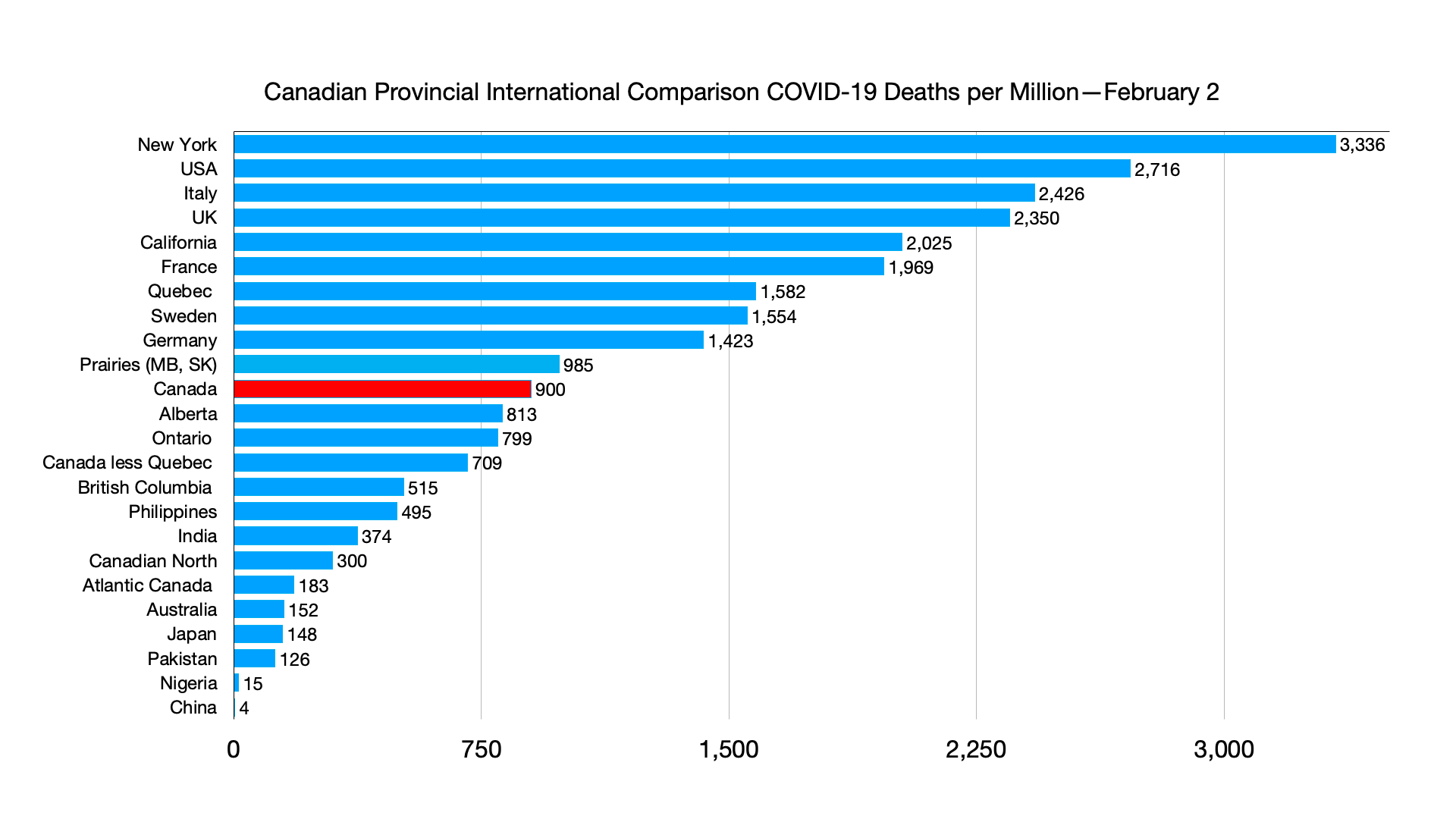
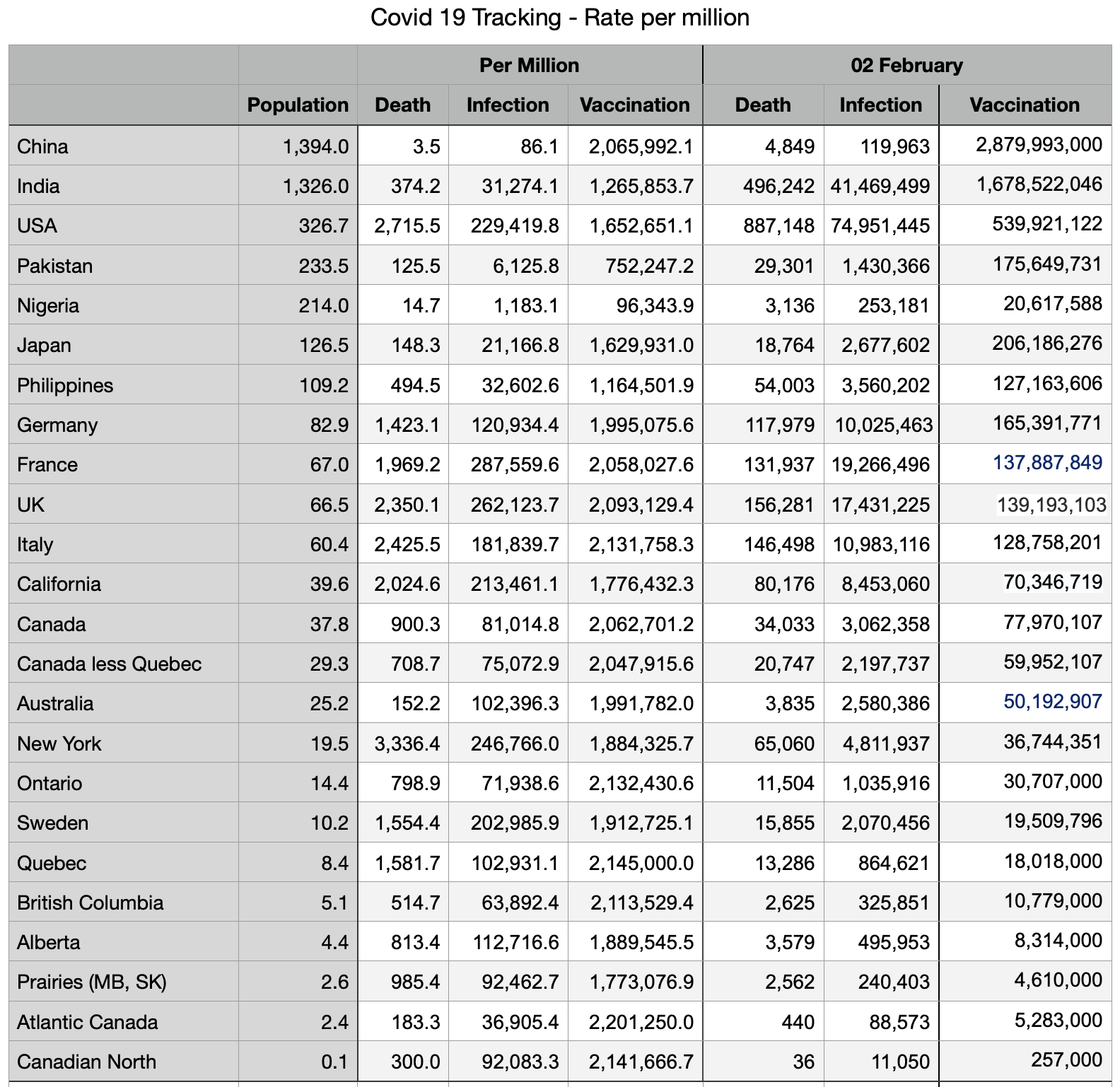
#COVID-19: Comparing provinces with other countries 8 December Update

The latest charts, compiled 8 December. Too early to assess the impact of omicron.

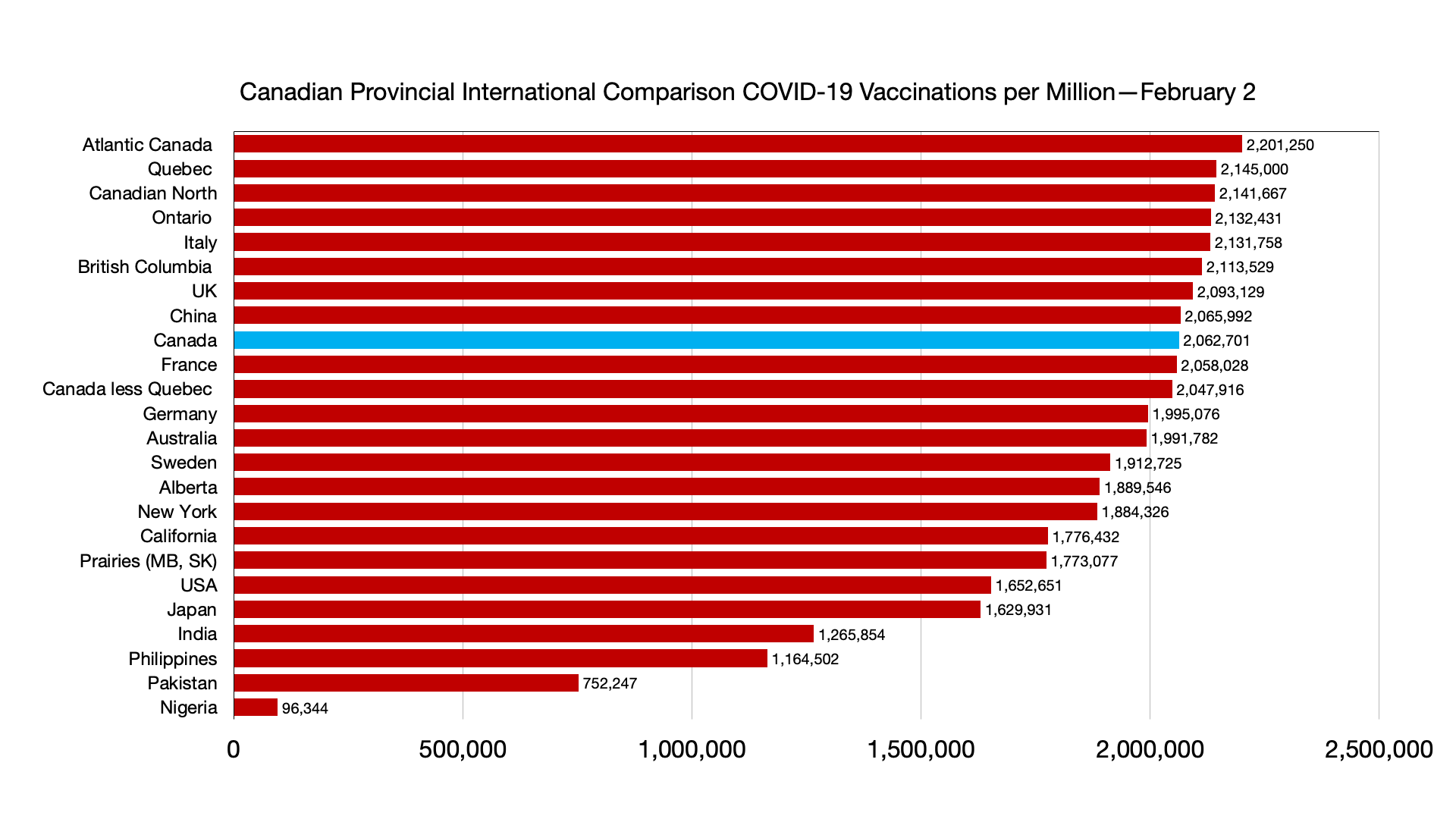
Canadians fully vaccinated 77.5 percent, compared to Japan 77.4 percent, UK 69.7 percent and USA 60.8 percent.

Vaccinations: Minor shifts: Ontario ahead of Italy and Quebec, Sweden ahead of Alberta, Australia, New York and Japan. China fully vaccinated 79.5 percent, India 35.6 percent, Nigeria 1.9 percent, Pakistan 24.5 percent, Philippines 35.8 percent.

Trendline Charts:

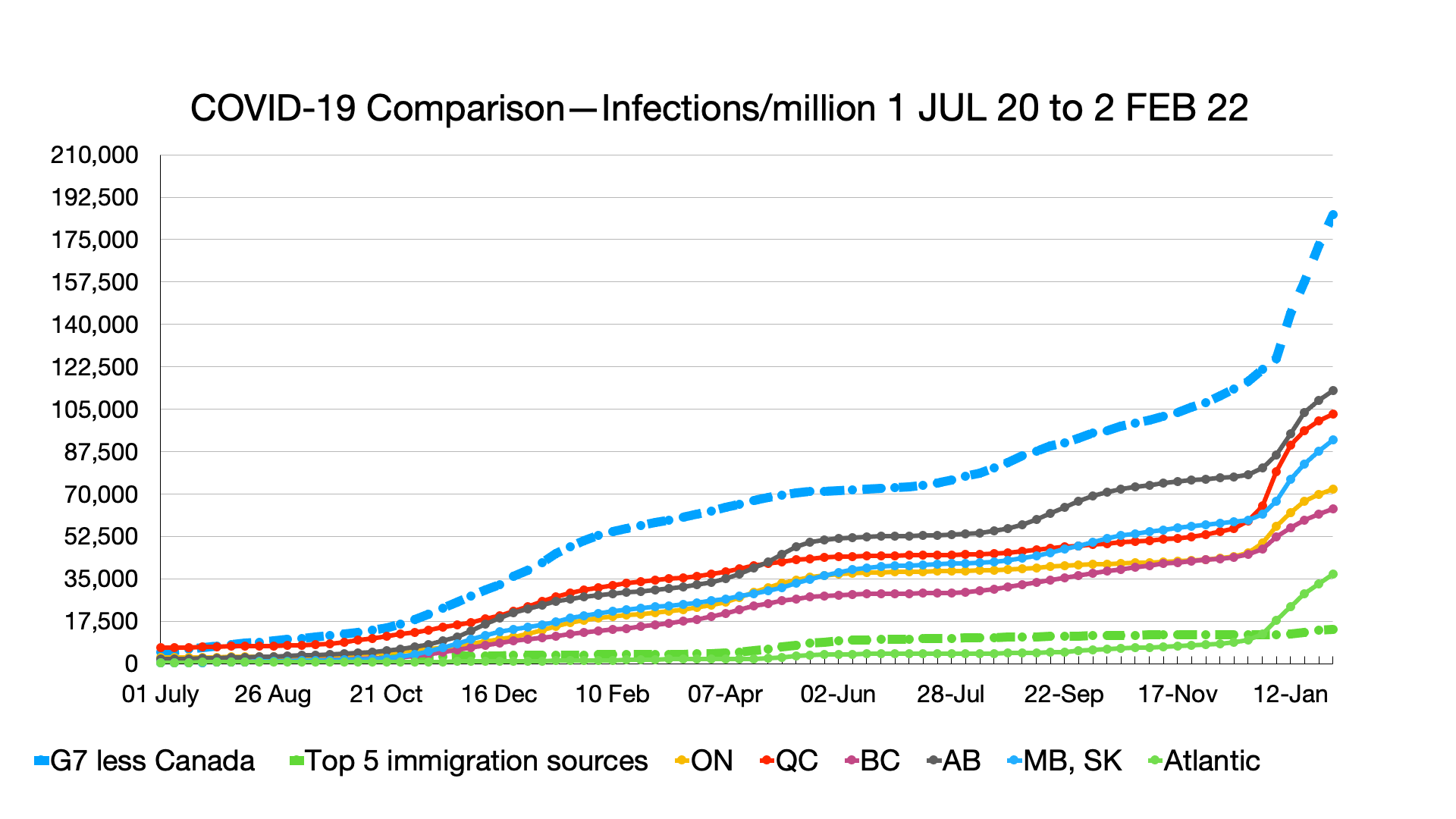
Infections: Recent trends of increased infections in Europe continues. Canadian provincial trends showing minimal change from last week, with Quebec uptick noticeable.

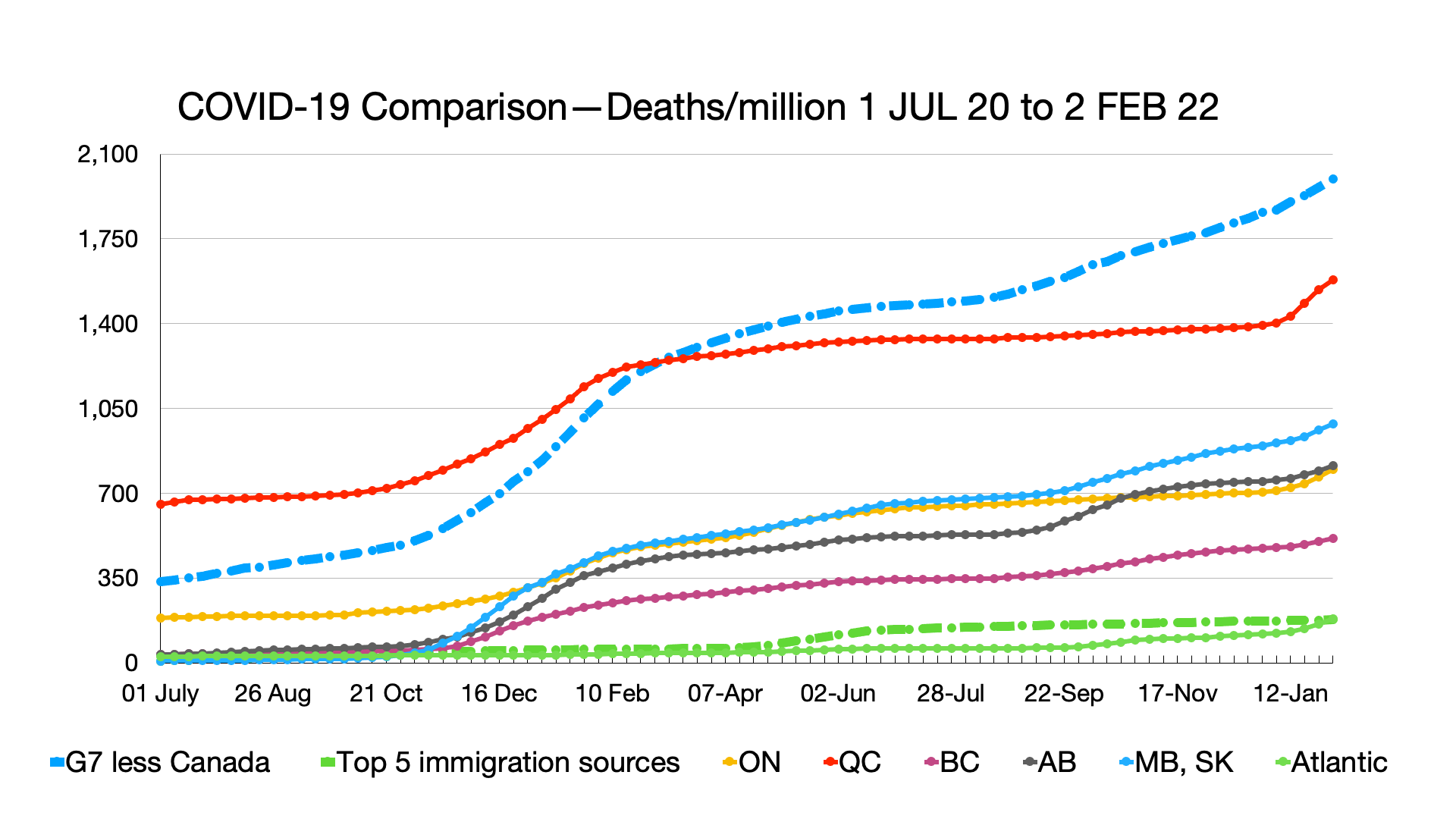
Deaths: G7 less Canada (driven mainly by USA) continue to increase, Alberta has flattened while Manitoba and Saskatchewan are still increasing more than other provinces.

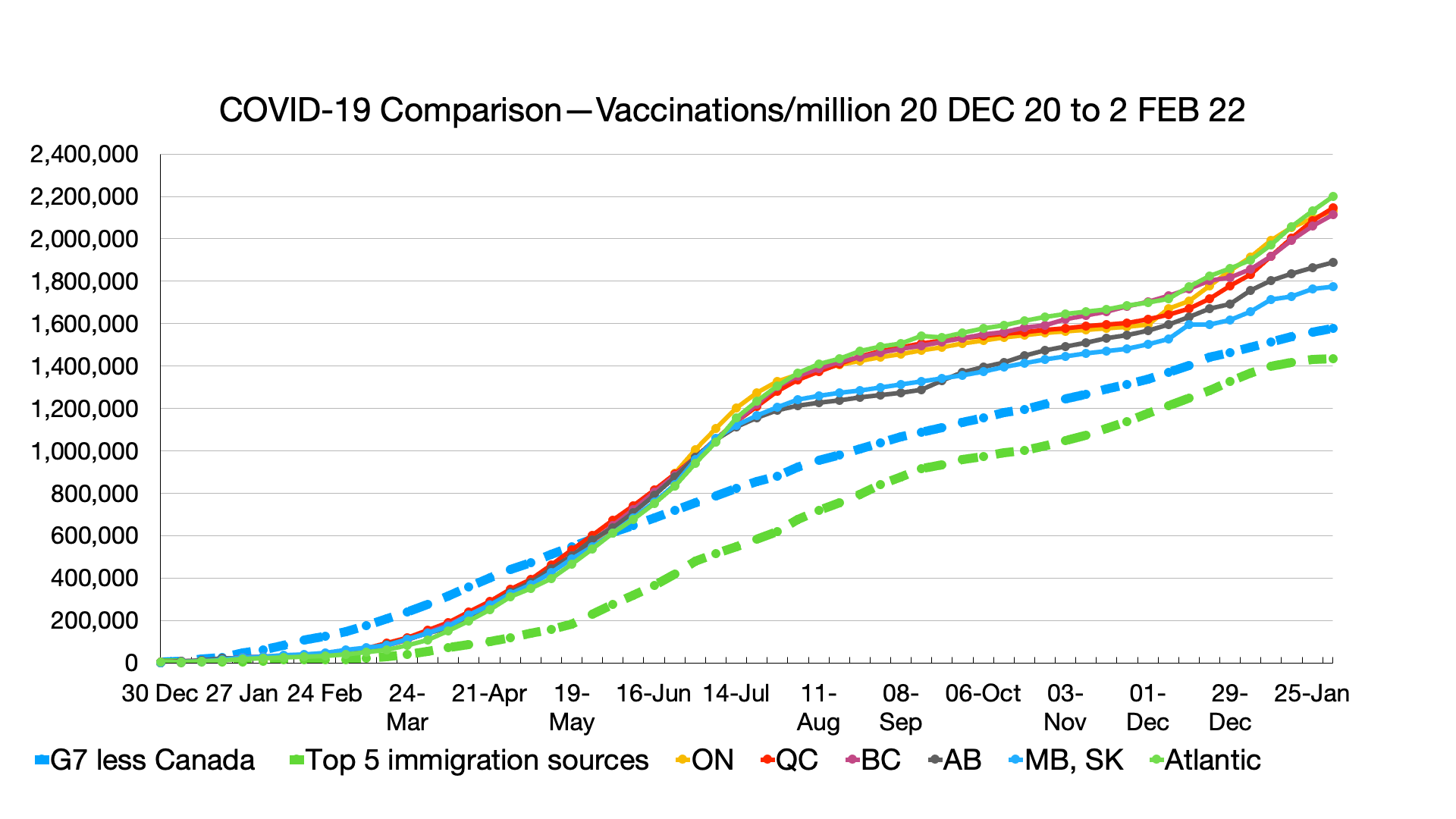
Vaccinations: Ongoing convergence among provinces and G7 less Canada and narrowing gap with immigration source countries given China, and to a lessor extent, India, Pakistan and the Philippines which continue to increase vaccinations. Nigeria remains a laggard.

Weekly

Infections: France now ahead of Sweden.

Deaths: No relative change

Useful analysis of vaccine equity and other challenges for many developing countries:

While vaccine inequity among African countries has played a major role in the continent’s low COVID-19 vaccination rate, experts say capacity and logistical challenges, along with vaccine hesitancy, is also creating significant challenges.

“I’ve seen a number of articles say it’s just vaccine inequity — and that’s wrong. It’s not just vaccine inequity,” said Dr. Ron Whelan, who heads health insurer Discovery’s COVID-19 task team in South Africa.

“[It’s] one part supply, one part health-system capacity and the third part is the hesitancy component,” he said.

“It is a multi-factorial problem that’s got to be solved.”

Dr. Saad B. Omer, an epidemiologist and director of the Yale Institute for Global Health, agrees it’s a more nuanced explanation than just blaming vaccine inequity for low vaccination rates across the continent.

“We expect people to land the plane with a few doses at the airport, do a photo op, [and] people to run to the airport to get their jabs. That’s never happened,” he said.

While about 76 per cent of Canada’s total population is fully vaccinated, on the African continent — home to 1.3 billion people — it’s only about 7.5 per cent, according to Our World in Data.

Delivery expected to ramp up

In October, a report by the People’s Vaccine Alliance — a coalition which advocates for equitable and sustainable use of vaccines, and includes Oxfam, ActionAid and Amnesty International — found that only one in seven COVID-19 vaccine doses promised to low-income countries were actually delivered.

However, vaccine shipments have been on the rise over the past three months and are expected to ramp up in coming weeks and over the new year, according to the World Health Organization.

Yet despite the increases in vaccine supply, experts suggest inoculation efforts in Africa could still face hurdles.

About 40 per cent of vaccines that have arrived on the continent so far have not been used, according to data from the Tony Blair Institute for Global Change, a policy think-tank.

Some countries have been forced to destroy thousands of doses of donated vaccines from their stockpiles. Namibia, for example, announced on Monday that it had to destroy 150,000 expired doses.

“It is highly regrettable that we are forced to destroy in excess of 150,000 vaccines, which have reached expiry date, because those who are eligible are refusing to be vaccinated,” Namibia President Hage Geingob is reported to have told a news conference on Monday.

According to the Washington Post, Malawi, Mozambique, Namibia, South Africa and Zimbabwe have all asked drugmaker Pfizer in the last several months to pause vaccine shipments because of challenges with uptake.

Vaccination rates vary widely across Africa and many experts are quick to note that vaccine hesitancy is not unique to the continent; it has been an issue in other parts of the globe, including the U.S and Europe. Child vaccination campaigns for various diseases, meanwhile, have been quite successful in Africa.

“Africa is, in many instances, a well-established vaccine culture overall, ” Whelan said.

But Dr. Matshidiso Moeti, the WHO regional director for Africa, recently told the New York Times that “there’s no doubt that vaccine hesitancy is a factor in the rollout of vaccines.”

News or rumours of potential side effects, she said, “gets picked out and talked about, and some people become afraid.”

1 in 4 health workers vaccinated

Additionally, only one in four of Africa’s health-care workers has been fully vaccinated against COVID-19, according to WHO. That compares to 80 per cent of health workers vaccinated in 22 mostly high-income countries.

Many of Africa’s health-care workers, including those working in rural communities, still have “concerns over vaccine safety and adverse side effects,” Moeti recently told reporters.

Capacity has also been a major issue for many African countries, specifically their health systems’ ability to absorb and distribute vaccines, particularly in rural areas, where health resources are scarce.

“We need significant capacity to deliver those vaccines,” Whelan said.

‘Weak supply chains’

That includes the need for strengthened supply chains and temperature-controlled cold chains required to store Pfizer doses, Whelan said, together with infrastructure to actually track and deliver vaccines to hospitals, clinics and other vaccination sites.

“Many of the countries have weak supply chains, particularly weak cold chain infrastructure. And the cold chain infrastructure is not well set up for the Pfizer vaccine in particular,” he said.

Some countries, including South Sudan and Congo, have had to send some vaccines back because they could not distribute them in time.

Often, Whelan said, that’s the result of issues with health-system capacity, storage capacity and administration capacity.

But reliable capacity also cannot be built without reliable access to doses, said Omer.

“When you are the head of a public health agency or a health minister in a country, you want not only doses, but also predictability in doses,” he said.

Instead, he said, many government officials “don’t know what kind of doses are coming and when they are coming.”

“Often what would happen is that [some African countries] would receive a call saying that, ‘We have doses that we are sending your way, with a month’s expiration left. Please distribute.’ That’s an obviously challenging thing for any country,” said Omer.

Last month, African Vaccine Acquisition Trust (AVAT), the Africa Centres for Disease Control and Prevention (Africa CDC) and COVAX put out a joint statement, calling the majority of vaccination donations to date “ad hoc” and “provided with little notice and short shelf lives.”

“This has made it extremely challenging for countries to plan vaccination campaigns and increase absorptive capacity,” the statement said.

“Countries need predictable and reliable supply. Having to plan at short notice and ensure uptake of doses with short shelf lives exponentially magnifies the logistical burden on health systems that are already stretched.”

According to a recent WHO statement, since last February, Africa has received 330 million doses from the COVAX program, the African Vaccine Acquisition Task Team and bilateral agreements.

Of those, more than 80 per cent have been delivered since August alone.

And so, as vaccine supply picks up, it said, “addressing uptake bottlenecks and accelerating rollout become more critical.”

Source: Vaccine inequity only partially to blame for Africa’s low vaccination rates, experts say

Québec va aider les immigrants qui tenteront de faire reconnaître leurs compétences

Good initiative:

Québec va soutenir financièrement les immigrants qui ont besoin de suivre une formation de soutien pour faire reconnaître leurs compétences professionnelles. L’aide pourrait atteindre jusqu’à 500 $ par semaine pour les professionnels qui suivent la formation à temps plein.

Le ministre du Travail, Jean Boulet, en a fait l’annonce, mardi, lors du dévoilement d’un nouveau plan de 130 millions de dollars sur deux ans pour accélérer et faciliter la reconnaissance des compétences des immigrants.

Avec ce plan, les professionnels immigrants seront mieux accompagnés « de la sélection jusqu’à l’intégration » dans la reconnaissance de leurs compétences, affirme le ministre.

M. Boulet a donné l’exemple d’une infirmière qui voudrait faire reconnaître ses compétences. « Elle va bénéficier de formations d’appoint beaucoup plus flexibles. Il va y en avoir beaucoup plus. Elle va aussi bénéficier d’une aide financière de 500 $ par semaine. Elle va aussi profiter d’avoir un permis restrictif qui pourrait lui permettre de faire son travail sous certaines conditions ou de faire un travail qui est connexe à sa formation. »

Présente au côté du ministre, Gyslaine Desrosiers, présidente du Conseil interprofessionnel du Québec, a mentionné que le taux de décrochage était de 34 % parmi les immigrants souhaitant faire reconnaître leurs compétences. « Collectivement, on peut et on doit faire mieux. »

Pénurie de main-d’œuvre

Le plan fait partie d’une offensive de plus 2,9 milliards de dollars pour contrer la pénurie de main-d’œuvre, annoncée dans la mise à jour économique de novembre. Québec espère « former, requalifier et attirer » près de 170 000 travailleurs dans cinq secteurs ciblés : la santé et les services sociaux, l’éducation, les services de garde éducatifs à l’enfance, le génie et les technologies de l’information ainsi que la construction.

La décision de se concentrer sur les services essentiels et les secteurs « stratégiques » a fait des mécontents parmi les entreprises qui se sentent oubliées par cette intervention.

Dans le plan de reconnaissance des compétences, 12 métiers sont identifiés dans les services essentiels et les secteurs « stratégiques » comme le génie et la construction. « On va y aller selon nos besoins, a défendu M. Boulet en conférence de presse. Faut établir des priorités. »

« Ça ne veut pas dire que les autres sont exclus, nuance-t-il. On va considérer en fonction des besoins et de la société et du marché de l’emploi. »

Dans les secteurs visés, il y a environ 5000 personnes qui font chaque année des demandes de reconnaissance de leurs compétences.

Le Conseil du patronat satisfait

Au Conseil du patronat du Québec (CPQ), on estime que le plan répond à plusieurs besoins exprimés par le milieu des affaires. « Pour les entreprises, l’annonce d’aujourd’hui permettra une intégration en emploi plus rapide et adaptée aux compétences des candidats, commente Karl Blackburn, son président et chef de la direction, dans un courriel. La collaboration étroite des ordres professionnels, du gouvernement et des milieux de l’emploi est de la musique à nos oreilles. »

L’enjeu de la compétence des immigrants est soulevé depuis plusieurs années, mais le ministre Boulet a l’impression que le plan qu’il propose sera le bon. « Je pense qu’on ne peut pas manquer notre coup. »

« Oui, ça fait longtemps qu’on en discute, mais on a maintenant un plan qui est global, qui est compréhensif, qui est cohérent, qui est issu d’une concertation. Tout le monde tire dans la même direction », ajoute-t-il.

Source: Québec va aider les immigrants qui tenteront de faire reconnaître leurs compétences

Longitudinal Immigration Database: Immigrants’ income trajectories during the initial years since admission

Usual useful analysis by StatsCan, in particular the highlighting of how two-step immigration is resulting in stronger economic outcomes for the economic class:

The COVID-19 pandemic has impacted the lives of Canadian immigrants in many ways. To assess these impacts, it is important to know where Canadian immigrants stood economically right before the outbreak of the pandemic. Based on the latest available data from the 2020 Longitudinal Immigration Database (IMDB), the present article serves this goal by focusing on immigrant wages in recent years, including 2019. This will provide a baseline for comparison once data for 2020 are available.

Immigrants admitted to Canada in 2018 had a median wage of $31,900 in 2019. This was 4.2% higher than the median entry wage of immigrants admitted in 2017 ($30,600). In fact, immigrants admitted in 2018 had the highest median entry wage, reported one year after admission, among all immigrants admitted since 1981. Despite that, their median wage was still 17.8% lower than the 2019 median wage of the total Canadian population ($38,800).

Compared with those admitted in 2017, immigrants admitted in 2018 experienced median entry wage increases in all provinces, except Alberta, and Newfoundland and Labrador. A closer look by immigration category and pre-admission experience sheds light on differences among various groups of immigrants admitted in 2018, compared with their counterparts admitted in 2017 as well as the Canadian population in corresponding years.

Median wage of economic immigrant principal applicants surpasses that of the Canadian population one year after admission 

Principal applicants of economic categories are selected for their ability to be integrated into the Canadian labour market and to contribute to the economy. Most of them have post-secondary education and knowledge of at least one official language. Immigrants admitted under those categories in 2018 had a median wage of $43,600 in 2019, 12.4% higher than the Canadian median wage in the same year ($38,800) and 3.8% higher than the median entry wage of their counterparts admitted in 2017 ($42,000).

While the median wage of economic principal applicants surpassed that of the Canadian population one year after admission, those of all other immigrants were still less than the Canadian median wage.

The median entry wage of economic immigrant dependents admitted in 2018, spouses included, was $27,600. While lower than the 2019 Canadian median wage, this number was 7.0% higher than that of their counterparts admitted in 2017 ($25,800).

There was no change in the median entry wage between family sponsored immigrants admitted in 2017 and 2018 ($24,500). The median entry wage of refugees ($19,200) was the lowest among immigrants admitted in 2018, though it was 2.7% higher compared with that of their counterparts admitted in 2017 ($18,700).

Economic principal applicants are selected on the basis of their education, specific skills and work experience. The vast majority (96.1%) of immigrant taxfilers admitted under this category in 2018 had completed some post-secondary education at the time of their admission. Economic principal applicants are also more likely to have pre-admission experience in Canada. Among those admitted under this category in 2018, almost two-thirds (64.5%) of them had pre-admission experience in Canada, in contrast with their counterparts admitted as refugees (33.3%), through family sponsorship (32.7%), or as dependents of economic immigrants (32.6%).

Pre-admission experience in Canada, particularly work-related, plays an important role in lifting immigrants’ wages, as it provides a pathway for immigrants to acquire language skills and knowledge of the Canadian labour market. Immigrant taxfilers having both study and work permits prior to immigration obtained the highest median wage one year after admission, both for those admitted in 2017 ($44,900) and in 2018 ($44,600). Immigrants only having work permits prior to immigration obtained the second highest median wage one year after admission ($39,900 for those admitted in 2017 and $39,300 for the 2018 admission cohort). Immigrants admitted with pre-admission work-related experience in 2017 and 2018 already had median wages higher than those of the Canadian population in 2018 ($38,200) and 2019 ($38,800), respectively.

Immigrants without pre-admission experience had lower median entry wages than immigrants with Canadian work experience prior to their admission. Their median entry wage was $23,100 for those admitted in 2017 and $25,700 for those admitted in 2018.

Among immigrants with pre-admission experience in Canada, those with study permits only prior to admission had the lowest median entry wages in 2018 ($14,400) and 2019 ($15,100). However, this group of immigrants is on average younger than their counterparts in all other groups, and therefore has a strong potential to increase their earnings as their careers unfold in the Canadian labour market. Furthermore, they are also more likely to have part-time jobs; information about whether or not their employment was full-time, full-year is unavailable.

Chart 1  
Median entry wage of immigrants admitted in 2017 and 2018, by pre-admission experience

Chart 1: Median entry wage of immigrants admitted in 2017 and 2018, by pre-admission experience

Median wages increase over time with different outcomes for men and women according to their immigration category

When tracking changes over time, a focus on immigrant men and women admitted at age 18 or older in 2009 shows that median wages increased across all immigration categories and for both men and women from 2010 to 2019. However, such increases benefited immigrant men and women differently.

Both economic principal applicant men and women admitted in 2009 had median wages far above those of their counterparts in all other categories throughout the 10-year period. The median wage of men nearly doubled, from $32,500 in 2010 to $62,300 in 2019, with an average annual increase rate of 10.2%. The median wage of their woman counterparts nearly doubled as well, from $24,500 to $44,900 over the same period, with an average 9.3% annual increase. Among economic principal applicants, women’s median wage started lower than men’s and men’s median wage increased faster than women’s. As a result, the median wage gap widened between men and women over time in favour of men.

The opposite pattern is observed among all other immigration categories. Although women’s median wage was even lower than men’s within each of those categories, it increased faster than men’s. During the 10-year observational period, men’s median wage increased among economic dependents, refugees, and family sponsored immigrants with average annual increase rates of 11.9%, 10.2% and 10.0%, respectively. The average annual rates of increase for women were 15.4%, 14.4% and 13.1%, respectively, for economic dependents, refugees and family sponsored immigrants. With women’s higher increase rates of their median wages, the median wage gap narrowed between men and women within each of those immigration categories over time in favour of women.

Chart 2  
Median wage of immigrant men admitted in 2009 by immigration category, 2010 to 2019 

Chart 2: Median wage of immigrant men admitted in 2009 by immigration category, 2010 to 2019

Chart 3  
Median wage of immigrant women admitted in 2009 by immigration category, 2010 to 2019

Chart 3: Median wage of immigrant women admitted in 2009 by immigration category, 2010 to 2019

Pay ratio of immigrant women versus men increases over time for all immigration categories except economic principal applicants

Pay disparity between women and men is an important social, economic, and political issue. As immigration aims to respond to Canada’s need for labour supply, the gender parity and successful settlement of women in the labour market is key to achieving Canada’s objectives. To measure the median gender pay ratio, the median annual wages, salaries and commissions of women were divided by the median annual wages, salaries and commissions of men.

From 2010 to 2019, the gender pay ratio for Canadians increased from 67.9% to 72.6%. Among immigrants admitted as adults in 2009, the gender pay ratio followed a similar pattern: 65.5% in 2010 compared with 69.6% in 2019. The gender pay ratio, however, differed by immigration category during this period.

The increasing gender pay ratio was seen in all immigration categories, except economic principal applicants. From 2010 to 2019, the gender pay ratio increased from 57.2% to 65.5% among family sponsored immigrants, from 65.4% to 75.1% among dependents of economic immigrants, and from 63.5% to 75.9% among refugees.

For economic principal applicants, however, the gender pay ratio slightly decreased from 75.4% in 2010 to 72.1% in 2019. Further analysis would be required to understand the reasons behind this trend.

Chart 4  
Median pay ratio of immigrant women versus men admitted in 2009 by immigration category, 2010 to 2019

Chart 4: Median pay ratio of immigrant women versus men admitted in 2009 by immigration category, 2010 to 2019

Within immigration categories, the wage gap between women and men decreased overtime, except for economic principal applicants. Although the median wage of economic principal applicant women increased greatly over time, their man counterparts had a larger increase, resulting in a widening of the median wage gap between immigrant women and men.

This article is the first part of a two-part series about recent immigrants’ outcomes using data from the Longitudinal Immigration Database. The second part will discuss immigrants’ mobility.

Source: https://www150.statcan.gc.ca/n1/daily-quotidien/211206/dq211206b-eng.htm?CMP=mstatcan

Canada’s health and settlement systems are failing newcomers. It’s time for a new system of care

More theoretical than practical given the fragmentation within and between sectors an the jurisdictional issues:

Last year, the federal government announced its intention to welcome over 1.2 million immigrants to Canada by the end of 2023. The truth is, however, that our care systems are not ready to adequately support those newcomers upon arrival — and here’s why.

Right now, Canada’s health care system and settlement services have operated in silos and are funded by different levels of government. This is creating large gaps in services, with newcomers falling right through them. The fact is many newcomers come to Canada in better health than the rest of the population. Yet, their health and wellness tend to rapidly decline during and after settlement. Some reasons for this could be due to not having secure housing, access to health care, and/or enough to eat. 

So, what is a solution to these problems? Two words: Integrated care.

Integrated care connects newcomers with a seamless suite of co-ordinated and holistic health and settlement services, including mental health care, employment services and access to food security. Existing integrated care programs offered by health agencies and community organizations, like WoodGreen Community Services’ Inter-Professional Care Program, offer solid proof that integrated care can improve systems of care for newcomers, predominantly in two ways. 

Firstly, integrated care can improve the efficiency, cost-effectiveness and sustainability of care systems by breaking down silos between health, settlement and other services. 

As a people-centred approach, integrated care organizes services around the needs and perspectives of newcomers. This improves continuity of care and allows newcomers to gain timely access to the services they need through any door, without the burden of system navigation. Integrated care also reduces the risk for duplication of work and may minimize high-cost services, such as hospital admissions, by diverting clients away from the emergency room and encouraging a shift to preventative care.

The second main (and particularly timely) benefit of integrated care is that it helps service providers feel less burned out.

Burnout is prevalent among care professionals, a factor which has been proven time and again throughout the course of this pandemic, and which is often linked to reduced patient satisfaction and health outcomes. Statistics Canada reported that, in early 2021, the health-care sector saw one of the largest annual increase in job vacancies compared to other sectors, with a particular increase in job postings for nurses.

By building and co-ordinating relationships and support between providers, integrated care has been found to combat burnout and improve job satisfaction and well-being.

To be clear, integrated care in Canada is not a new thing. The challenge is that an integrated approach to health care and settlement services is not being implemented at a scale that can successfully settle Canada’s incoming and recently settled migrants.

Policy-makers, in collaboration with settlement providers, community agencies, health-care organizations, and other stakeholders, can help to address this issue by:

  • Improving access to stable resources for settlement service providers and physicians to effectively implement integrated care;
  • Offering newcomers of all statuses access to services, including individuals with insecure legal status and people who have been in Canada for years; and
  • Requiring race-based and sociodemographic data collection to ensure organizations have the information they need to track health equity outcomes and evaluate program performance, among other recommendations.

If Canada hopes to achieve a successful and resilient COVID-19 recovery (where newcomers can contribute to the economy while maintaining their own socio-economic well-being), we must commit to better integrating our health and settlement care systems to ensure that newcomers don’t just come here to live — but to thrive.

Source: https://www.thestar.com/opinion/contributors/2021/12/03/canadas-health-and-settlement-systems-are-failing-newcomers-its-time-for-a-new-system-of-care.html?source=newsletter&utm_content=a02&utm_source=ts_nl&utm_medium=email&utm_email=A02AB30AB014E9AB29974E92EB3BFDCD&utm_campaign=top_90291

Curry: Sorry, lawyers, that ship has sailed [re consultants]

Of note:

As a full-time Regulated Canadian Immigration Consultant and part-time journalist/opinion writer, I have been following New Canadian Media’s stories regarding immigration lawyers vs. immigration consultants with interest.

Writer Fabian Dawson’s Nov. 26 article quoted a spokesperson for the Canadian Immigration Lawyers Association (CILA), who attempted to make the argument that immigration consultants should work under the supervision of lawyers. 

I have to point out to lawyer Barbara Jo Caruso, that with legislation passed by the federal government creating the College of Immigration and Citizenship Consultants (CICC), that ship has sailed. It is so far out to sea, in fact, that it should not even be on lawyers’ radars. The battle is over, and lawyers did not get what they wanted.

The follow-up article by Dawson and Fernando Arce on Dec.1 did a good job explaining the role of the new College and quoting both its CEO, John Murray, as well as the Canadian Association of Professional Immigration Consultants(CAPIC) CEO, Dory Jade. The headline, “‘We are not subordinate to lawyers,’ say immigration consultants,” sums it up nicely.

Here’s my take:

More education?

Lawyers trumpet the fact that they went to law school. How many courses on immigration did they take? 

A lawyer in North Bay told me she took no courses on immigration in law school. That’s why she enlisted my assistance with a family court case with an immigration component. Of course, lawyers specializing in immigration law have taken courses — but how many?

I took seven with the University of British Columbia. With the new College, all new Regulated Canadian Immigration Consultants (RCIC) will have to graduate from the Queen’s University program operated by its School of Law or from the University of Montreal for French-speaking RCICs.

Prior to my UBC experience, I was the executive director for eight years of the North Bay & District Multicultural Centre, an immigrant settlement agency, which also has an office in Timmins. I chaired the board of directors for three years after that. Back in the 1990s, I was chair of the board of a previous immigrant settlement agency for six years.

Yet, my immigration background is not as fulsome as that of many of my 9,500 RCIC colleagues.

I am the only RCIC practicing in North Bay, Ontario. There are no immigration lawyers in North Bay, and I have clients here who abandoned high-priced Toronto lawyers because they were not getting their calls returned or they felt they were being gouged.

In general, lawyers charge more than RCICs for the same service, and that’s why clients come to us. 

I have a BA from Carleton University and an MA from Central Michigan in addition to my year-long certificate from UBC. Sometimes, I feel uneducated compared to many of my colleagues, some of whom have MBAs, PhDs, or were Chartered Accountants in their previous lives. Many previously worked with Immigration, Refugees and Citizenship Canada (IRCC).

‘Get over it’

Ms. Caruso says lawyers have to keep up with changes in immigration law and case law. So do RCICs.

I also subscribe to Lexbase, a monthly newsletter compiled by Vancouver lawyer Richard Kurland, that keeps us current. I read The Globe and Mail daily plus many other media sources, such as New Canadian Media. I read Andrew Griffith’s daily immigration blog. He is a former director-general with IRCC. His blog posts arrive while I am eating my breakfast.

I read the daily forum of emails by RCICs, operated by CAPIC, which is an invaluable source of information on cases and technical tips to survive the wonky online world of IRCC and its portals.

I have the third edition, and the second edition as well, of the excellent text by lawyers Chantal Desloges and Cathryn Sawicki — Canadian Immigration and Refugee Law, A Practitioner’s Handbook, published in 2021. 

I have current bound copies of the Immigration and Refugee Protection Act and the Immigration and Refugee Protection Regulations.

Our regulatory body, the College, requires that we take 16 hours of approved professional development sessions each year. I chalk up more hours than that, as do most of my colleagues.

All this is to say to lawyers: we don’t need you looking over our shoulders. The federal government has decided that isn’t going to happen, so get over it.

No one is listening

Ms. Caruso says the new College is just a name change. It’s far more than that, as Jade pointed out in the follow-up article. A major change is that it now has the power to go after unlicensed consultants, also known as ‘ghost consultants’, who plague the industry. These people are the vermin of our industry and operate mainly in foreign countries.

I have had my own experience with them. A scam outfit calling itself “Burlington Associates” with a phony website and Edmonton address stole my full name and RCIC identifier number and used it on their website, claiming I was an immigration lawyer working for them. 

I received two phone calls from overseas skilled technical people who had lost thousands of dollars in the scam. They both had phony job interviews on a video app and were promised jobs that never materialized in Vancouver.

Since I called them out on my website, pointing out that the operation is a scam, I have had no further calls. Prior to that, I contacted the RCMP, Canada Border Services, and our former regulatory body — all to no avail. 

When I alerted others on the CAPIC forum about what happened to me, I was surprised to hear the many respondents who said it has happened to them too. 

The lawyers I have named in this article understand there is lots of immigration work to go around and RCICs are no threat to their livelihoods. They know RCICs cannot represent clients in court and they have that field to themselves.

The vocal minority of lawyers apparently wants to continue their fight. But no one is listening.

Source: https://newcanadianmedia.ca/sorry-lawyers-that-ship-has-sailed/?utm_source=NCM+-+General+Audience&utm_campaign=429b3e3fdf-EMAIL_CAMPAIGN_2021_11_26_06_42_COPY_01&utm_medium=email&utm_term=0_8748041f15-429b3e3fdf-181639253

Tories break ranks on immigration to demand safe routes to UK for asylum seekers

Potentially significant:

Senior Tories have demanded a radical overhaul of the asylum system to allow migrants to claim refuge at UK embassies anywhere in the world – rather than having to travel to the UK – in a bid to cut the numbers attempting dangerous Channel crossings.

Ex-cabinet members David Davis and Andrew Mitchell are among those calling for the change, which marks a stark challenge to the punitive approach taken by Boris Johnson and Priti Patel, who are demanding tighter controls on French beaches and are threatening to “push back” small boats at sea.

Mr Davis, the former shadow home secretary and Brexit secretary, and Mr Mitchell, the former international development secretary, also poured scorn on the home secretary’s plan to take on powers through her Nationality and Borders Bill to send migrants arriving in the UK to camps in third countries overseas for processing – something that has already been ruled out by Albania after it was named as a potential destination.

Writing for The Independent, Pauline Latham, a Conservative member of the Commons International Development Committee, said that allowing migrants to claim asylum at embassies abroad was “the only viable alternative to the tragedy of deaths in the Channel and the chaos of our current approach”.

Twenty-seven migrants, including three children and a pregnant woman, drowned off the coast of France in November when their boat sank, marking the single biggest loss of life of the crisis so far.

The Home Office is opposing an opposition amendment to the borders bill, due for debate in the House of Commons this week, which would allow migrants to seek “humanitarian visas” in France, allowing them to be transported safely across the Channel to claim asylum.

Source: Tories break ranks on immigration to demand safe routes to UK for asylum seekers