Even though not a great believe in the value of investor immigration, still notable these restrictions under USMCA:
Foreign investors investing in the United States today are being stymied by a U.S. immigration border policy that is preventing them from looking after their businesses in the country. The policy is particularly aggravating to Canadian investors, but is also a problem for other foreign investors that are not visa exempt, that is, from countries where the applicant must apply for a B-1/B-2 visitor’s visa to come to the USA. The relevant rule could be easily changed by U.S. Customs and Border Protection (USCBP) through a policy directive. The question is what useful purpose does the current policy serve if it is needlessly interfering with foreign investments in the United States?
The Problem
The problem has arisen largely due to the Covid-19 pandemic. Foreign investor appointments for E-2 treaty investor visas under the USMCA, formerly the NAFTA free trade agreement, are taking an inordinate period of time to schedule. Indeed, at one point, consular officials in the past were even unable to say how long it would take to get interviews for E-2 visas. This left foreign investors having to come to the U.S. in some other way until they could finally get their E-2 visas. While applying for a change from visitor to E-2 status inside the U.S. is a possibility, some time ago the Consul General at the Toronto Consulate advised U.S. attorneys to avoid that option, implying such applications are likely to be denied. It appears that U.S. officials saw resorting to a change from business visitor to E-2 status inside the U.S. as playing the system because processing of E-2 visas are normally in the purview of U.S. Consulates abroad. So the only reasonable way has been to enter the U.S. as business visitors.
The key snag is the limitation in the amount of time that E-2 investors are allowed to stay in the U.S. in visitor status. Current border policy is to grant a maximum of six months. Indeed, the policy is to refuse entry to business visitors who have already been physically present in the U.S. for six months in any year.
Unwritten Policy Rule
In a previous Forbes article I described the rule as follows:
“For Canadians, one of the issues that often arises is whether the visitor has already spent more than 183 days in a year in the USA. U.S. Customs and Border Protection (USCBP) officers have been enforcing what Ira Kurzban, the Dean of American immigration attorneys and author of the authoritative book Kurzban’s Immigration Law Sources, diplomatically calls an “unwritten rule” that visitors may not spend more than 183 days in any year in the USA. Written or not, the USCBP custom at the U.S.-Canada border is to prevent visitors from entering in most cases when it is determined that the visitor has already accumulated 183 days of U.S. physical presence in the last year.
The rationale for the rule comes from the way USCBP officers assess visitors coming to the U.S. As a general rule, such officers consider the following elements in making a decision about allowing a visitor to enter the U.S. Firstly, is the applicant a security threat? Secondly, is the applicant a criminal? Thirdly, is the applicant working illegally in the U.S.? Finally, is the applicant really living in the United States permanently but only saying he is visiting? A convenient way of implementing the policy considerations raised by such thinking is to prohibit visitors from entering the U.S. for more than 183 years in any year. After all, how many people can live without earning income for six months or more?”
Serious Hardships
Until visa wait times at the U.S. consulate in Canada are reduced to reasonable levels, however, this rule is imposing serious hardships on E-2 investors. To qualify for E-2 visas, investors have to make more than a marginal commitment of their funds into the United States. Usually this takes the form of a purchase of a business, a hotel for example. Sometimes it takes the form of a start-up where the investor hires employees or commences offering products or services. Whatever the form taken, foreign investors want to be able to be where their money is to be on top of what is going on.
What is needed is for the USCBP to realign its policy with the needs of investors and with the processing times of the U.S. consulates abroad, including the ones in Canada. At the present time, scheduling interviews at U.S. consulates in Canada for E-2 visas for example, are taking at least eight months or more. Applying the current USCBP 180-day policy means that Canadian investors can be shut out of the United States for at least two months or more while awaiting approvals. Clearly these investors need to be granted more than six months time in the U.S. under these circumstances. In the normal course of events the USCBP has the authority to grant business visitors up to one year’s time on an entry. So why not grant these investors such approvals?
A False Alternative
It is true that such investors can apply to extend their visitor’s status for another six months from inside the U.S. But that is a needless extra hardship that is fraught with uncertainty and possible unpleasant future consequences while the investor awaits a ruling. Why put the investors in that position?
What E-2 Visitors Can Do
While business visitors are constrained in what they can do while being in the United States, still such a visitor is at least entitled, “to examine or monitor potential qualifying investments” so as to be ready to apply for an E-2 visa. True, the investor must behave as a business visitor and is “precluded from performing productive labor or from participating in the hands-on management of the business.” Still, there is a list of things such a visitor can do. For example, a business visitor can observe the conduct of business, negotiate contracts, undertake study incidental to the purpose of the stay, consult with clients or business associates, participate in conventions, conferences, or seminars, make phone calls, give employees instructions, take clients to their cars and even engage in commercial transactions outside of gainful employment. The key is no “hands-on-work” and no salary being paid. This can all work if handled properly.
Being Reasonable For A Change
Assuming the USCBP officers applied a more reasonable time frame policy for business visitors dealing with E-2 investments by matching visiting times with likely consular processing times of E-2 visa application, and assuming officers were reasonable in how they viewed what these investors are doing while complying with their periods of authorized stay, these headaches could be avoided and a more reasonable business-friendly environment could be created for E-2 investors.
Key trends from December IRCC operational data, which reflect in part a normal seasonal decline:
Overall, comparing 2021 with 2018 data, most immigration programs have largely recovered from the steep impact of COVID travel and other restrictions, with the exceptions of the Provincial Nominee Program, asylum claimants, citizenship and visitor visas.
As trumpeted by the Minister, the number of permanent resident admissions slightly exceeded the 2021 target: 403,540, compared to 401,000. Compared to 2018, admissions have increased by 26 percent.
As seen throughout the year, this is largely due to two-step immigration by temporary residents, largely from the International Mobility Program and the Post-Graduate Work Program. The percentage of the economic class increased to 63 percent, up from 58 percent.
While on a monthly basis, permanent residency applications increased, compared to 2018, applications declined by 43 percent. This likely reflects recognition by potential applicants of large backlogs and two-step immigration.
Temporary Residents – IMP: While on a monthly basis, IMP declined in December, compared to 2018, numbers increased by 35 percent.
Temporary Residents – TFWP: While December numbers remained stable, compared to 2018, numbers increased by 24 percent, with the greatest increase in LMIA.
Students: Study permit applications increased slightly in December while study permits issued almost tripled. Compared to 2018, applications increased by 64 percent, and permits issued by 27 percent.
Asylum Claimants: The number of asylum claimants continued to increase in December, mainly due to the reopening of Roxham Road. Compared to 2018, the number of claimants decreased by 55 percent.
Citizenship: The citizenship program continues to recover with traditional numbers of new citizens on a monthly basis. Compared to 2018, the number of new citizens declined by 38 percent..
Visitor Visas: While on a monthly basis, the number of visitor visas issued continues to approach traditional levels. However, compared 2018, the number of visas has decreased by 82 percent.
Many Americans want a more “merit‐based” legal immigration system, and the country most commonly associated with this framework is Canada. Former‐Attorney General Jeff Sessions, for example, characterized U.S. immigrants as largely “illiterate”, with “no skills”, and argued that America “should be like Canada” on immigration, evaluating them on their skills. But while Canada does favor economic‐based paths to residence, it still admits far more non‐college educated immigrant workers than the United States does as a proportion of its population—and it is planning to let in even more in the coming years.
According to Canada’s statistics, 244,800 non‐college‐educated immigrants over the age of 25 in the labor force entered Canada from 2015 to 2019, 0.65 percent of the Canadian population. During the same period, 729,797 immigrants with the same characteristics entered the United States, 0.22 percent of the U.S. population (Figure 1). In other words, Canada saw nearly three times more entries into its labor force from lower‐skilled workers than the United States did in recent years on a per capita basis. This disparity would be greater if illegal immigrants were excluded from the calculation.
Despite admitting far more non‐college‐educated immigrant workers, Canada also admitted nearly 5 times as many immigrant workers with bachelor’s degrees and 4 times as many immigrant workers with advanced degrees as the United States did from 2015 to 2019 on a per capita basis. This means that overall, Canada admitted nearly 4 times more immigrant workers into its labor force than the United States did from 2015 to 2019. Note that the Canadian share of lesser‐educated workers would be even higher if they were not also admitting so many higher skilled immigrants.
While it is true that Canada admits a much larger share of immigrants through economic channels than the United States does, it also makes it easier for them to qualify based on jobs where a college education is not required. It also admits as a share of its population more immigrants based on family ties and humanitarian grounds than the United States. Canada has just announced its largest ever legal immigration targets for the next several years, which will increase the rate of admission for both skilled and lesser‐skilled workers.
While college‐educated immigrants offer the United States the greatest productivity boost, the fact that a majority of job growth will come from jobs not requiring a bachelor’s degree provides a strong basis for the United States to increase both skilled and lesser‐skilled immigration in tandem.
Of note. Would really be helpful to have more in-depth analysis of the factors that underlie these differences, rather than just the differences:
Les établissements postsecondaires francophones et bilingues de l’Ontario peinent à recruter des étudiants étrangers. Leur taux de refus de permis d’études auprès d’Immigration Canada est de loin supérieur à ceux observés dans les collèges et universités anglophones, a constaté Le Devoir.
Des directions francophones disent devoir travailler beaucoup plus fort que leurs collègues anglophones pour pouvoir atteindre leur cible de recrutement. Les deux seuls collèges de langue française de l’Ontario ont vu respectivement 67 % et 73 % des demandes de permis d’études de leurs futurs étudiants être refusées en 2021, d’après des données fournies par Immigration, Réfugiés et Citoyenneté Canada (IRCC). Il s’agit d’une amélioration par rapport à 2020, où la moyenne pour les deux s’élevait à 79 %. Dans les 22 collèges anglophones répertoriés dans la base de données d’IRCC, ce sont en moyenne 40 % des demandes qui ont été refusées en 2021 et 50 % en 2020.
L’écart est similaire entre les universités francophones et bilingues d’un côté, et celles anglophones de l’autre. À l’Université de Hearst, au nord de la province, par exemple, 72 % des demandes de permis d’études pour étudiants étrangers ont été déclinées en 2021 et 86 % l’année précédente. Quelque 85 % des demandes l’ont été au cours des deux dernières années à l’Université Laurentienne. À Thunder Bay, à l’Université Lakehead, la plus grande du nord de l’Ontario, un établissement anglophone, la situation est tout autre : en 2021, seulement 28 % des demandes de permis d’études ont été refusées.
Bululu Kabatakaka, le directeur des programmes postsecondaires et de l’intégration au collège Boréal, ne comprend pas ce qui cause cet écart. « Est-ce qu’il y a un biais inconscient par rapport aux pays francophones ? » se demande-t-il. Le Devoir révélait en novembre qu’Ottawa refusait de plus en plus d’étudiants de l’Afrique francophone.
Le dirigeant estime qu’il doit travailler considérablement plus fort que ses collègues pour atteindre ses cibles. « Quand nos collègues [d’autres collèges] travaillent 35 heures, nous, on travaille 150 heures », dit-il.
Le même phénomène se produit au collège La Cité d’Ottawa et à l’Université de Hearst. Le recteur de l’université, Luc Bussières, critique le gaspillage associé aux taux de refus élevés : des ressources sont dépensées inutilement pour le recrutement, et des rêves d’étudiants sont gâchés, dit-il. « Ça rendrait notre travail plus efficace si on avait un meilleur taux, explique le recteur. Si on veut 100 personnes, il faut faire 500 offres. »
« Nous devons généralement faire de 15 à 20 offres aux candidats pour que 10 étudiants acceptent notre offre et que 3 de ces étudiants obtiennent un permis d’études », raconte pour sa part Pascale Montminy, directrice des communications de La Cité. En 2021, 67 % des demandes de permis d’études au collège ont été refusées. À quelques kilomètres à l’ouest du centre-ville d’Ottawa, au collège Algonquin, qui est anglophone, le taux tombe à 40 %.
Problème difficile à régler
Ce type de problème dure depuis environ quinze ans, estime Martin Normand, directeur de la recherche stratégique et des relations internationales à l’Association des collèges et universités de la francophonie canadienne (ACUFC). « Les établissements interpellent IRCC et ses prédécesseurs pour demander des explications et des modifications, ou à tout le moins plus de transparence », fait savoir le directeur.
Le gouvernement fédéral souhaite depuis 2003 que les immigrants francophones représentent 4,4 % des nouveaux arrivants à l’extérieur du Québec. L’échéancier pour atteindre la cible avait d’abord été fixé à 2008, mais il a ensuite été reporté de 15 ans. Pourtant, Martin Normand remarque que les agents du ministère « reprochent souvent aux étudiants leur intention de rester au Canada à la fin de leurs études », explique le directeur de l’association. L’intention de faire une demande de résidence permanente après les études constitue un motif de refus pour les permis d’études, soutient-il. Le directeur était du groupe de témoins qui ont récemment critiqué l’approche d’Ottawa, qu’ils estiment contradictoire, devant le Comité permanent de la citoyenneté et de l’immigration.
Selon IRCC, même s’il existe une possibilité pour un étudiant étranger d’éventuellement devenir un résident permanent, chaque demandeur de permis doit convaincre l’agent d’immigration qu’il a l’intention de respecter ses obligations à titre de résident temporaire. Ainsi, chaque demandeur « doit être capable et désireux de quitter le Canada à la fin de sa période de séjour autorisé », explique Julie Lafortune, porte-parole du ministère, par courriel.
L’exercice d’analyse des établissements en ce qui concerne les motifs de refus est encore plus compliqué du fait du manque d’accès aux données. Lorsque contactées par Le Devoir au sujet des taux de refus, des directions ont dit ne jamais les avoir vues. « C’est un peu une boîte noire », lance Luc Bussières, recteur de l’Université de Hearst, qui compte entre 250 et 300 étudiants.
De l’université au collège
Les étudiants détenant un diplôme universitaire dans leur pays natal seraient aussi désavantagés s’ils souhaitent retourner aux études dans un programme collégial en Ontario, estime Bululu Kabatakaka. Dans sa campagne de recrutement, le Collège Boréal évoque la pénurie de main-d’œuvre dans la province, qui touche certains secteurs couverts par ses programmes, mais si des candidats étudiants tentent de répondre à ce besoin, ils se voient bloquer par IRCC, affirme M. Kabatakaka.
Il s’agirait plutôt de juger de la « bonne foi » des demandeurs, fait valoir IRCC. La demande d’une personne détenant déjà un diplôme universitaire pour suivre des études dans un domaine non connexe « ne pourrait peut‑être pas convaincre l’agent qu’il est un étudiant de bonne foi », cite comme exemple la porte-parole Julie Lafortune.
« Il faut que les agents comprennent bien les besoins des communautés francophones en matière d’immigration et de main-d’œuvre », affirme de son côté Martin Normand, de l’ACUFC.
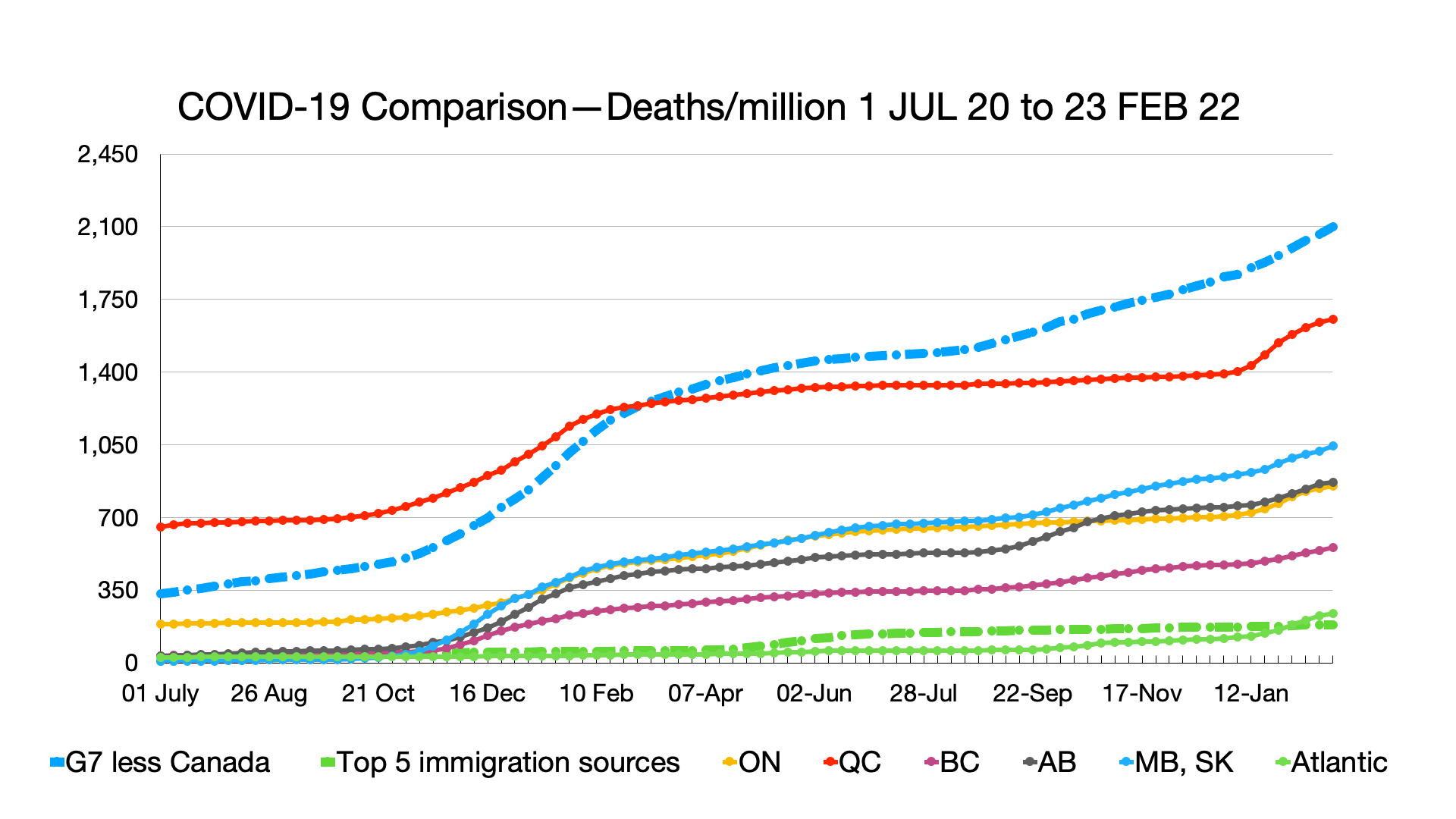
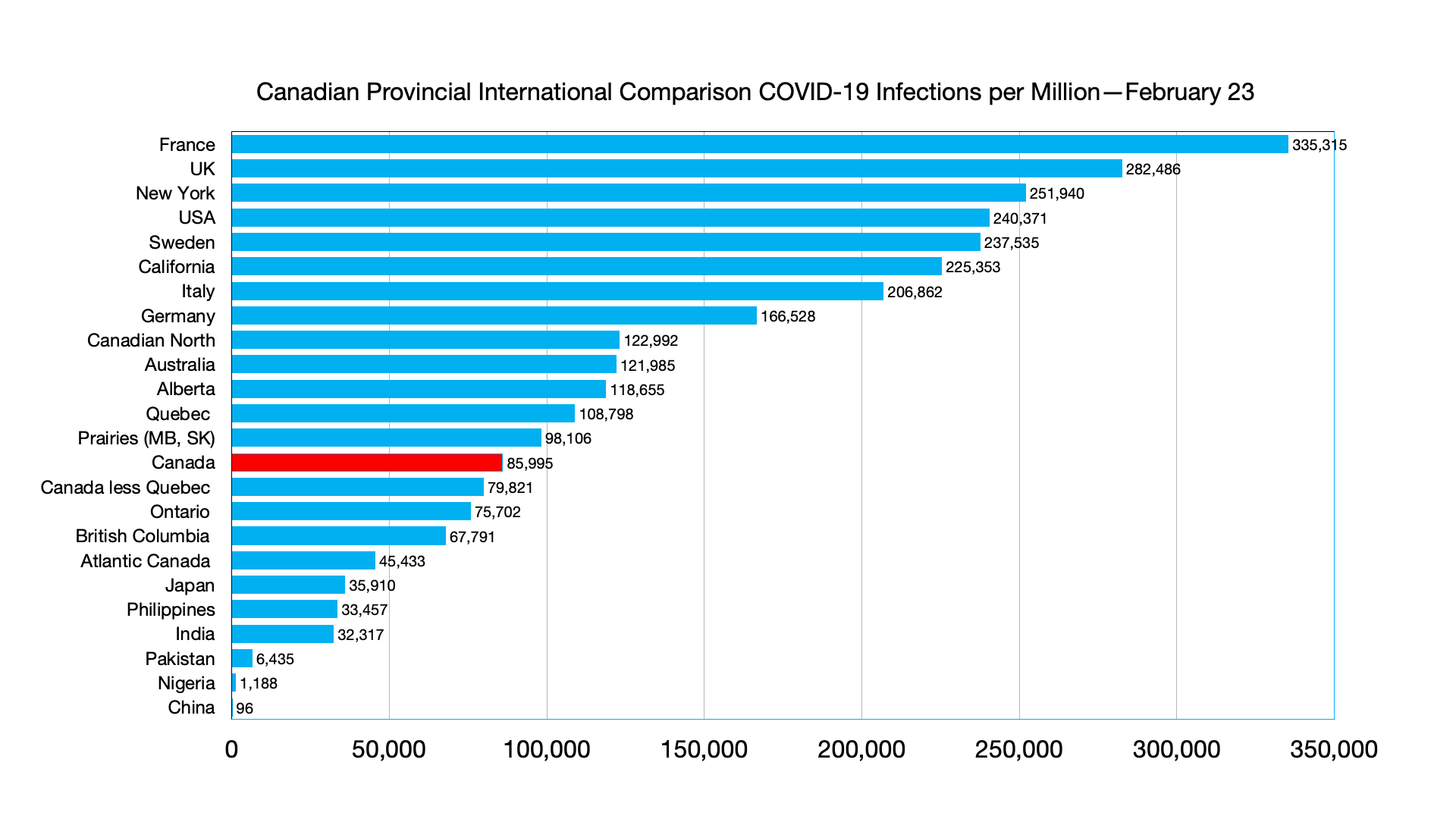
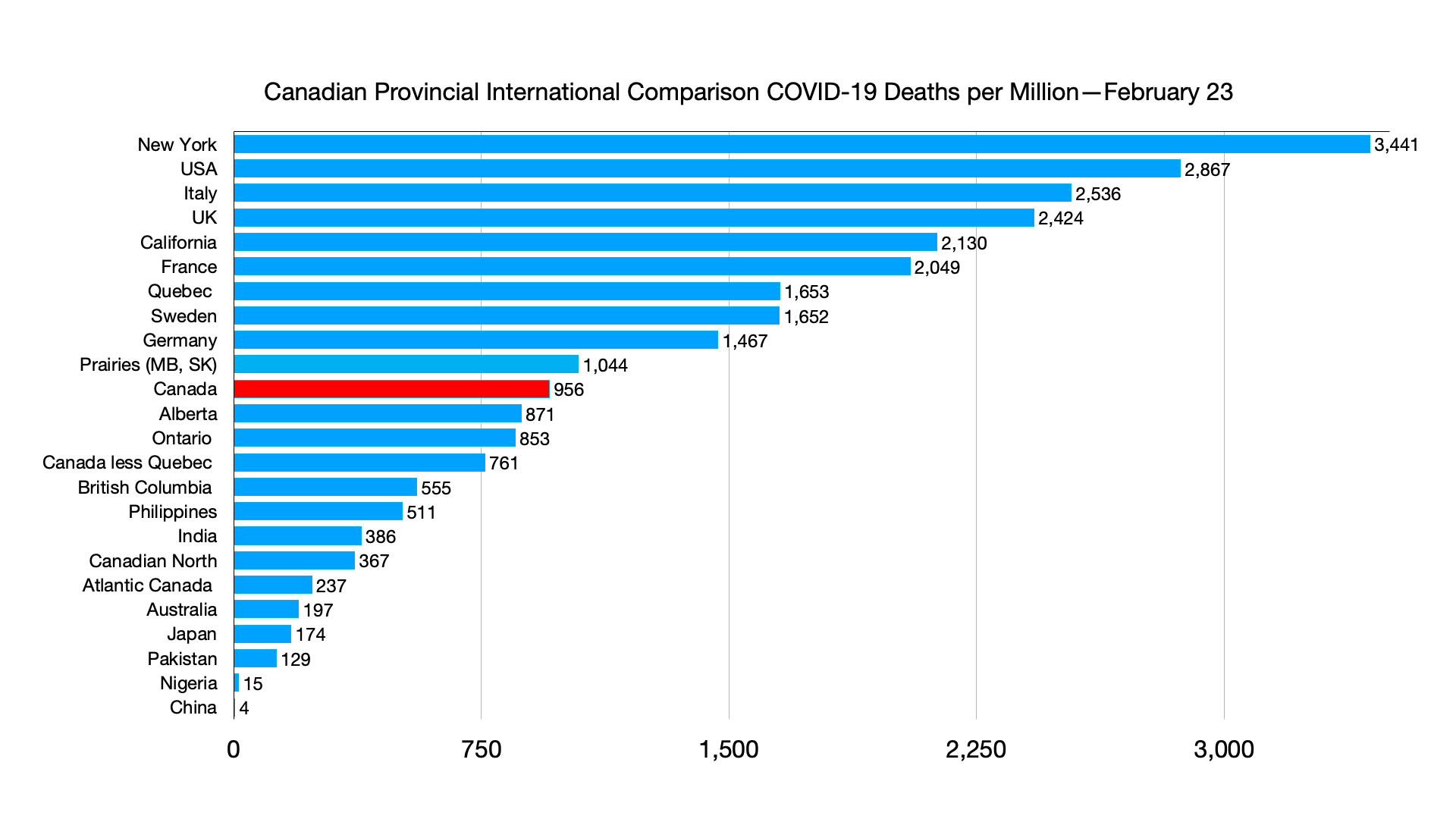
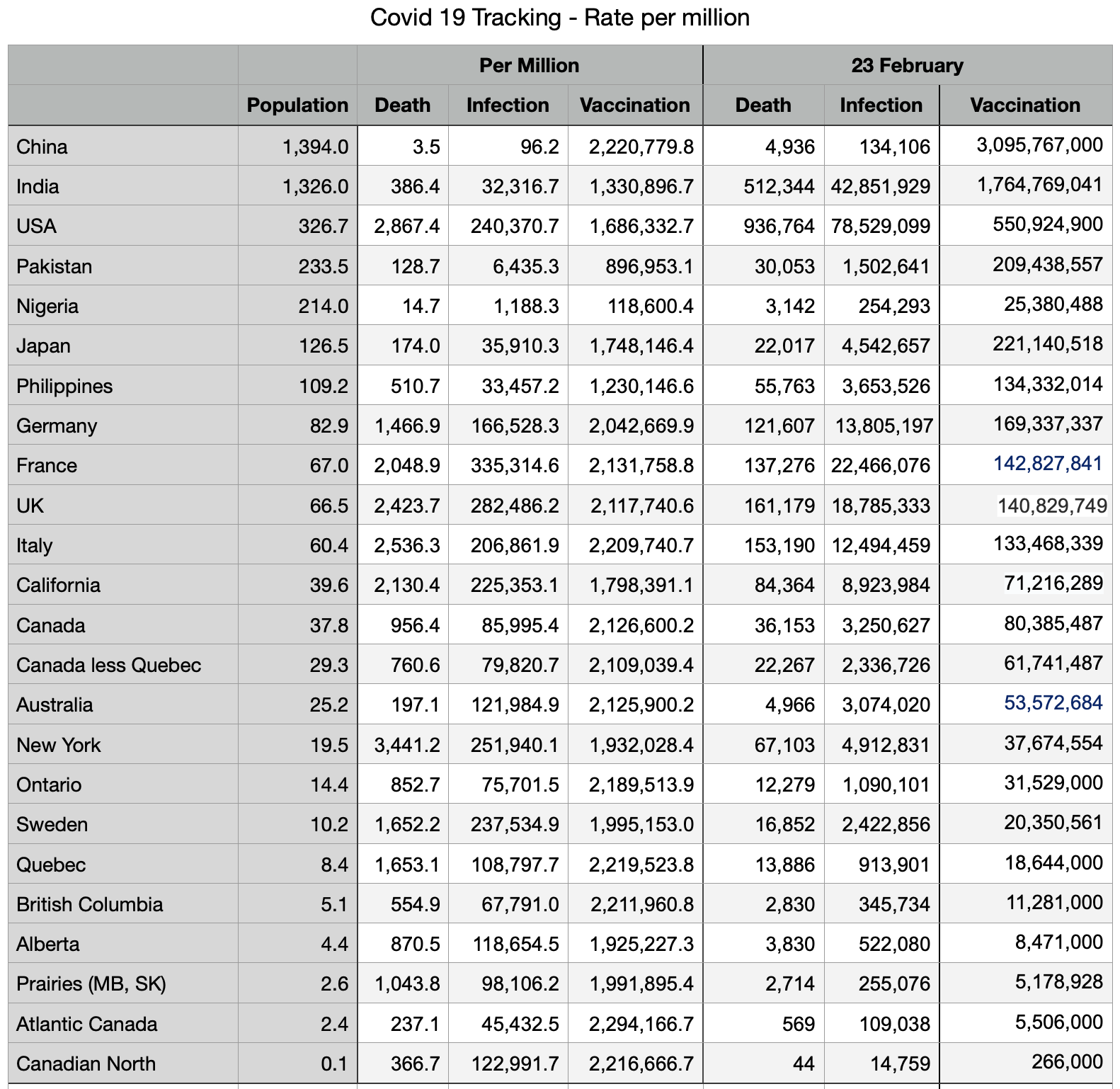
Overall decline in infections and deaths as omicron wave passes.
Vaccinations: Some minor shifts but convergence among provinces and countries. Canadians fully vaccinated 81.9 percent, compared to Japan 79.3 percent, UK 73.2 percent and USA 65.5 percent.
Immigration source countries are also converging: China fully vaccinated 87.9 percent (numbers have not budged over past four weeks), India 55.9 percent, Nigeria 3.8 percent (significant increase from very low base), Pakistan 44.4 percent, Philippines 57.9 percent.
Trendline Charts:
Infections: Ongoing signs of omicron and other variants plateauing.
Deaths: Quebec continues to plateau.
Vaccinations: No major change but Alberta and Prairies continue to be laggards compared to other provinces given resistance among residents and political considerations. Jump in Prairies reflects delayed Saskatchewan reporting (weekly, rather than daily, and Globe updates less frequently).
Weekly
Infections: Canadian North and Australia ahead of Alberta, Japan ahead of Philippines and India.
Deaths: No relative change. Of note, Chinese deaths were unchanged from September 22, 2021 until 9 February, 2022, unique among all countries and, frankly, hard to believe (infections were also relatively flat, from 107,789 to 121,629 during the same period).
While some of his analysis overstates or incorrectly assesses (e.g., looking at declining French maternal language use while not recognizing that the vast majority of allophones have a working knowledge of French, thanks in no small part to Law 101), the overall points regarding the declining importance of Quebec in the federation is valid, as are some of his critiques of the federal government’s ongoing increase in immigration levels (need some more critical perspectives in English Canada):
Le ministre fédéral unilingue anglophone de l’Immigration, Sean Fraser, publiait, juste à temps pour la Saint-Valentin, le plan d’immigration du gouvernement de Justin Trudeau pour 2022-2024. Ce plan est de hausser, encore une fois, les volumes d’immigration, qui passeront de 184 606 personnes en 2020 à 431 000 nouveaux résidents permanents en 2022 et à 451 000 en 2024.
Ottawa souhaite admettre 1,33 million de nouveaux immigrants permanents en seulement trois ans. Il s’agit d’une hausse de 80 % par rapport aux seuils d’immigration qui avaient cours avant la prise du pouvoir par le Parti libéral du Canada en 2015. Au prorata de la population, le Canada est déjà l’un des pays occidentaux qui accueillent le plus d’immigrants.
Immigration temporaire
Et ces chiffres ne valent que pour les immigrants permanents, soit ceux qui obtiennent la résidence permanente. Parallèlement à cette hausse constante et soutenue de l’immigration permanente, nous assistons à une hausse vertigineuse de l’immigration temporaire, c’est-à-dire du nombre de personnes accueillies au Canada avec un permis d’études ou de travail temporaire. Le nombre de travailleurs étrangers détenteurs d’un permis de travail temporaire est passé de 66 600 en 2000 à 429 000 en 2018, soit une augmentation de 544 % en 18 ans. Ces travailleurs temporaires obtiennent de plus en plus, à terme, leur résidence permanente (à hauteur de 50 %). L’immigration « temporaire » est donc souvent de l’immigration permanente déguisée. À ces travailleurs temporaires il faut ajouter les étudiants étrangers, dont le nombre augmente exponentiellement ; en 2020, nous en étions à 530 540 étudiants étrangers au Canada. Si on combine ces deux catégories temporaires, il y avait, au 1er janvier 2020, 1,3 million d’immigrants temporaires au Canada.
Pour estimer le volume global et l’incidence de la migration, il faut additionner les permanents aux temporaires. Aux 431 000 immigrants permanents en 2022 il faut donc ajouter environ 1,3 million d’immigrants temporaires, ce qui donne le chiffre de 1,73 million d’immigrants pour 2022, soit environ 4,7 % de la population totale du Canada.
Conséquences pour le Québec
L’arrivée d’un aussi grand nombre d’immigrants en si peu de temps a plusieurs conséquences néfastes pour le Québec. L’immigration est d’abord la cause directe du recul accéléré du français auquel on assiste depuis 15 ans. Mais elle a aussi pour effet d’exacerber la crise du logement, la hausse du volume d’immigration étant directement responsable de la hausse débridée du prix de l’immobilier au Canada. La crise du logement, bien sûr, frappe d’abord les plus pauvres, ce qui inclut souvent les nouveaux arrivants.
Mais cela ne semble pas émouvoir outre mesure le Parti libéral.
En faisant de l’immigration temporaire la voie d’accès royale vers la résidence permanente depuis 2014, Ottawa a modifié unilatéralement le système d’immigration et a dépouillé le Québec d’une bonne partie de ses pouvoirs en immigration. Pourquoi ? Parce que le Québec n’a aucun pouvoir de sélection sur l’immigration temporaire, de plus en plus importante numériquement parlant, et qui relève strictement d’Ottawa. Le pouvoir de sélection des immigrants a ainsi glissé, indirectement, de Québec vers Ottawa.
À cela, il faut ajouter la discrimination exercée par Ottawa contre les immigrants francophones qui souhaitent s’installer au Québec ou y étudier en français. Le ministère fédéral de l’Immigration sabote activement, de façon volontaire ou non, les efforts du Québec pour attirer des francophones.
Un piège parfait
Les premiers chiffres publiés du recensement 2021 indiquent que le poids relatif du Québec au Canada a baissé pour un 11e recensement d’affilée, passant de 28,9 % en 1966 en 23 % en 2021. Avec la hausse des seuils, la baisse de ce poids va s’accélérer. Pour le contrecarrer, Québec devrait accepter environ 103 730 immigrants permanents par année à partir de 2024, soit plus du double des seuils actuels, seuils qui sont déjà en train de conduire à l’effondrement du français dans toute la grande région de Montréal.
Pour le Québec français, la question de l’immigration est donc un piège parfait ; pile, il perd ; face, le Canada gagne. L’avenir réservé au Québec dans le Canada, c’est la noyade démographique.
En 2017, Statistique Canada a publié une étude de projections démolinguistiques, qui annonçait un effondrement du poids démographique des francophones au Québec à l’horizon de 2036. La proportion de francophones au Québec passerait, selon ces projections, de 78,9 % en 2011 à 69 % en 2036, une chute de 9,9 points. Il s’agit d’un effondrement sans précédent dans toute l’histoire du Québec.
Cette projection de 69 % était calculée avec un scénario « immigration forte » qui correspondait, grosso modo, à 350 000 immigrants permanents par année au Canada. Or, la hausse des niveaux d’immigration à 451 000 signifie que le chiffre de 69 %, loin d’être un « plancher », est maintenant un « plafond » ; la proportion réelle des francophones au Québec en 2036 sera très certainement en dessous de ce chiffre.
Cela sera vrai même si le Québec ne hausse pas son seuil d’immigrants permanents actuel de 50 000 par année (note : le Québec n’a pas ce pouvoir et doit suivre les seuils fédéraux selon l’Entente Canada-Québec). Pourquoi ? Parce que le Québec n’a aucun contrôle sur la migration interprovinciale. Le solde de cette migration est devenu positif en 2020 pour la première fois depuis 1961. Il est probable que l’anglicisation accélérée de la grande région de Montréal fait que de nombreux Canadiens peuvent maintenant y vivre en anglais comme s’ils étaient à Toronto, et ce, à moindre coût. À Montréal, le fait français ressemble de plus en plus à un résidu historique appelé à se dissoudre dans le grand tout canadien. Le projet de loi 96, qui évite soigneusement toute mesure structurante, ne changera rien à cet état de fait.
Le portrait global qui se dégage est celui-ci : si Ottawa avait un plan méthodique, systématique, afin de liquider une fois pour toutes le Québec français, ce plan ressemblerait probablement à ce que l’on voit se dérouler sous nos yeux.
Il va falloir que le gouvernement du Québec se réveille. Et vite.
A group of immigrant investors have filed a lawsuit claiming the Biden administration is unlawfully refusing to process their applications for visas and green cards after Congress allowed a major visa program they participated in to lapse.
More than a dozen plaintiffs in a complaint filed in Seattle federal court on Thursday said that while a program earmarking EB-5 visas for investors who pool money has expired, federal law still requires U.S. Citizenship and Immigration Service and the Department of State to process their applications, which were filed before the expiration.
The EB-5 program allows foreign citizens who invest $1 million in a U.S. business – or $500,000 in economically depressed areas – and create at least 10 jobs to qualify for visas and green cards.
The plaintiffs, who are citizens of Canada, Russia, India and other countries, applied to participate in the EB-5 Regional Center program, which reserves thousands of visas each year for investors who pool their money into large economic development projects.
Authorization for the program, which was first created in 1992, expired in June without action from Congress and its future is still in limbo. USCIS in December said it would not process visa and green card applications tied to the program until it is renewed.
But in Thursday’s complaint, the plaintiffs said the expiration of the program only meant that the government no longer had to grant a preference to applicants involved in the Regional Center program. The federal Immigration and Nationality Act still requires USCIS to process their EB-5 applications and set aside visas for them if they qualify, the plaintiffs said.
Jon Wasden of Wasden Banias, a lawyer for the plaintiffs, said that a decision in the plaintiffs’ favor could ultimately spur USCIS to process thousands of other pending applications.
USCIS and the Department of State did not immediately respond to requests for comment.
The case is Bajaj v. Blinken, U.S. District Court for the Western District of Washington, No. 2:22-cv-00189.
Of note, along with the ongoing trend of a relative decline compared to other Canadian provinces. Not clear that having more powers for Quebec would change that unless a Quebec government decides to match Canadian immigration targets:
Si on fait exception de 2020, année marquée par les sévères restrictions liées à la pandémie, le gouvernement Trudeau vole de record en record en matière d’immigration. Cette semaine, le ministre de l’Immigration, des Réfugiés et de la Citoyenneté, Sean Fraser, a dévoilé de nouvelles cibles qui placent le Canada au sommet des pays — et de loin — quant au nombre d’immigrants qu’ils accueillent.
Au cours de son premier mandat, le gouvernement Trudeau a fait passer le seuil de 280 000 immigrants du gouvernement Harper à quelque 350 000. L’an dernier, Ottawa a voulu effectuer un rattrapage en raison des contraintes touchant les déplacements internationaux et des ratés administratifs qui ont contribué à réduire à 186 606 le nombre d’immigrants admis en 2020 au lieu des 341 000 prévu ; il a donc porté ce nombre à 400 000 en 2021.
Cet objectif de 400 000 et plus, c’est maintenant le nouveau plancher canadien en matière d’immigration. Dans son rapport annuel de 2021 présenté cette semaine au Parlement, le ministre Fraser a établi les seuils à 431 000 pour 2022, 447 000 pour 2023 et 451 000 pour 2024. C’est grosso modo 20 000 à 30 000 de plus que les niveaux avancés dans le rapport annuel précédent.
Si on se réfère à la cible élevée plutôt que moyenne, telle qu’inscrite dans le rapport pour 2024, soit 475 000 immigrants, nous sommes tout près de la recommandation de l’organisme canadien-anglais Century Initiative, qui entend convaincre le gouvernement Trudeau de hausser à 500 000 le seuil d’immigration pour 2026. L’objectif, c’est de faire passer la population canadienne de 37 millions à 100 millions en 2100.
Tandis que le ministre pousse à la hausse le nombre de dossiers à traiter, sa machine administrative ne suit pas. On ne sait d’ailleurs pas sur quelle planète Sean Fraser vit quand il écrit dans son rapport : « Heureusement, le Ministère a su s’adapter aux immenses pressions exercées par la pandémie. » La réalité, c’est qu’au Québec, son ministère est dysfonctionnel.
Les délais pour obtenir le statut de résident permanent, c’est-à-dire devenir un immigrant reçu en bonne et due forme après avoir été sélectionné par Québec, ont encore augmenté, pour atteindre en moyenne 28 mois.
En raison de problèmes administratifs, Ottawa n’arrive même pas à remplir les objectifs d’immigration que lui transmet le gouvernement du Québec. Le ministère de l’Immigration, de la Francisation et de l’Intégration a demandé qu’un rattrapage soit effectué en 2021 pour combler les retards engendrés par la pandémie, soit un total de 18 000 nouveaux résidents permanents de plus. Manquent à l’appel 15 000 d’entre eux.
Qui plus est, sur les 48 600 détenteurs d’un certificat de sélection du Québec toujours en attente de leur résidence permanente, 25 000 résident au Québec et occupent un emploi. Le ministre Jean Boulet a demandé à son homologue fédéral d’accorder la priorité à ces demandeurs. Mais Ottawa se montre réticent. Si on tient compte de toutes les catégories de nouveaux arrivants, ce sont 90 000 personnes qui sont en attente, selon les données obtenues par Radio-Canada auprès d’Immigration, Réfugiés et Citoyenneté Canada.
C’est deux poids, deux mesures, car les délais imposés au Québec sont beaucoup plus importants que dans le reste du Canada. Par ailleurs, les autorités fédérales exercent une discrimination à l’endroit des étudiants étrangers en provenance de l’Afrique francophone qui souhaitent étudier au Québec : le taux de refus de ces étudiants pourtant admis dans nos cégeps et nos universités est beaucoup plus élevé que celui des étudiants étrangers anglophones.
Mais plus grave encore, c’est que le Canada, avec sa politique d’immigration extrêmement vigoureuse, est en train de larguer le Québec. On voudrait diminuer rapidement son poids démographique — et celui du Québec français — au sein du Canada qu’on n’agirait pas autrement. En clair, le reste du Canada, toutes proportions gardées, accueille deux fois plus d’immigrants que le Québec. Si l’on voulait résister à cette érosion démographique, ce ne sont pas 53 000 immigrants qu’il faudrait admettre, mais près de 120 000 l’an prochain et davantage les années suivantes.
Dans ce contexte, il est clair que l’entente Canada-Québec sur l’immigration, signée en 1991 par les ministres Gagnon-Tremblay et McDougall, ne tient plus, du moins dans son esprit. Cette entente prévoyait que le Canada consulte le Québec pour établir ses seuils d’immigration, ce qu’il ne fait plus. En outre, les seuils canadiens devaient permettre au Québec de recevoir un pourcentage d’immigrants égal à celui de sa population. Ce n’est plus possible.
Cette évolution du Canada postnational constitue une menace pour la nation québécoise. Il est temps — et c’est un minimum — que le Québec obtienne tous les pouvoirs en matière d’immigration.
Not realistic and discriminatory (but not surprising), unfortunately):
The Quebec government is moving ahead with a controversial part of its proposed language bill, which will require all government officials to communicate with new immigrants exclusively in French, six months after their arrival — with no exceptions for refugees and asylum seekers.
The article of Bill 96, which was introduced at the National Assembly last May, was recently approved by the legislative committee studying the bill, amid criticism from opposition Liberal and Québec Solidaire MNAs. The bill is expected to become law this spring but still faces detailed study in committee.
Some organizations, opposition members and even the union representing public servants tried to persuade the government to soften the rule, to no avail.
“For newly arriving immigrants, the basic principle of the law is clear: as of Day 1, it’s exclusively in French,” said Simon Jolin-Barrette, justice minister and minister responsible for the French language.
There are exemptions in the law, which allow communication in a language other than French, “where health, public safety or the principles of natural justice so require” such as getting health care.
As well, the bill allows for a six-month grace period for “particular situations that require the use of a language other than French with new immigrants” according to Élisabeth Gosselin, spokesperson for Jolin-Barrette.
The bill says after that six-month period has lapsed, communication must be in French.
“Currently, the government communicates with immigrants who have requested it, sometimes for years, or for their whole lifetime, in a language other than French, which does not foster integration,” Gosselin said.
Learning French in 6 months
Community organizations working with newly arrived immigrants have been calling on the government to extend the six-month grace period.
“We all agree that the government cannot respond to immigrants in every language. But we have to give them time to learn French,” said Élodie Combes, member of the Table de concertation des organismes au service des personnes réfugiées et immigrantes (TCRI), a working group that represents community organizations working with immigrants.
Combes believes that the bill may actually hinder the integration of immigrants, by making it more difficult for them to get government services.
“It’s as if we’re telling them to retreat into their lingustic minority, that the government is not there for them, because they aren’t francophone enough,” she said.
Garine Papazian-Zohrabian, an associate professor in educational psychology at the Université de Montréal who researches French-language training for immigrants, says the six-month hard cap will be most harmful for refugees and asylum seekers, who are arriving in a vulnerable state.
“Members of this population are already disoriented, arriving in Quebec. They can been burdened by a difficult past and face cultural challenges. They’re not ready to learn a new language, like French, right after their arrival,” said Papazian-Zohrabian.
“You might as well say that we don’t accept refugees or immigrants, rather than place so many obstacles in front of them,” she added.
Opposition slams ‘excessive’ measures in bill
The union representing 40,000 Quebec civil servants, the Syndicat de la fonction publique et parapublique du Québec (SFPQ), is also in favour of extending the six-month grace period.
In its submission to the committee examining the bill, the union suggested the delay could be extended to two years, to allow new immigrants more time to adapt.
Ruba Ghazal, Québec Solidaire MNA for the Mercier riding in Montreal, proposed a grace period of three years, saying that Jolin-Barrette is “totally disconnected from the reality of newly arrived immigrants.”
“The minister makes no distinction between a refugee and an economic class immigrant,” she said. “These people need more kindness and understanding.”
Jolin-Barrette dismissed the idea of extending the grace period, saying six months was a “reasonable” period.
Ghazal said while the bill takes a harsh stand with newly arrived immigrants, it contains a clause that allows the government to continue to communicate in languages other than French with people who immigrated to Quebec in the past.
“There are a lot of incoherences,” she said.
Gaétan Barrette, Liberal MNA for La Pinière, used a baseball metaphor to describe the position in which the government is putting newly arrived immigrants.
“When they arrive, they’ll already have two balls and two strikes against them,” Barrette said. “We’re not giving them a chance to succeed.”
Barrette said while his party is in favour of measures to improve the use of French, he called Jolin-Barrette’s attitude “unpleasant” and said the government should take into account that many people arriving in the province have lived through “traumatic situations.”
Barrette also cited long wait times for French-language training as an additional barrier.
“In the Montreal region, the delay is maybe two months,” he said. “That leaves immigrants with only four months to learn French.”
WHAT HAPPENED TO ROSA still haunts Maria Hinojosa. Rosa, an undocumented immigrant from Mexico, agreed to appear on camera for “Immigrant Nation, Divided Country,” a 2004 CNN documentary helmed by Hinojosa, a veteran journalist. Soon after the program aired, immigration agents arrested Rosa, her boyfriend, and her children.
Hinojosa had taken care not to show where Rosa lived or worked. She later discovered, however, that despite her efforts to protect Rosa’s anonymity, she had missed one small detail: the license plate of a car belonging to Rosa’s boyfriend had appeared, unblurred, in the background of a shot. Hinojosa reasoned that agents must have used the license plate to track Rosa down.
“I realized,” Hinojosa said in a recent interview, “that the worst could absolutely happen.”
The risks facing undocumented immigrants have only intensified in the years since—particularly during the presidency of Donald Trump, whose anti-immigrant rhetoric and policies vilified Mexicans, Africans, and Muslims, among others. How journalists work with their immigrant sources is critical to reducing those risks, even in a hyper-competitive climate where ambitious stories drive public attention.
Miriam Jordan, a lead immigration reporter for the New York Times, revealed in 2018 that President Trump employed undocumented workers at his private properties. Jordan’s story focused on Victorina Morales, an undocumented immigrant who worked at Trump’s golf club in Bedminster, New Jersey. She also quoted Sandra Diaz, who had been undocumented when she worked there, but was a legal resident at the time of the story. Both Morales and Diaz agreed to be identified by their full name—a step Jordan, in an email, said was “essential to the credibility of the piece”—and also to be photographed. Morales told Jordan that Trump’s hateful comments, along with verbal abuse from a supervisor, compelled her to speak out. Jordan later noted the rarity of Morales’s decision:
“In all my years reporting on immigration, I had rarely encountered undocumented workers willing to risk their livelihood — and deportation — to speak out against their employers.”
After the story came out, Morales made numerous media appearances; she also applied for asylum and received a work permit. Eighteen months later, she learned that her asylum case had been referred by US Citizenship and Immigration Services to a court for removal proceedings, where a judge would review her status. (In a follow-up, Jordan reported that Morales would be able to remain in the country while her case was mired in a years’ long backlog.)
In 2020, a selection of immigration reporters told CJR and Migratory Notes that, under the Trump administration, they felt more inclined to grant anonymity to undocumented sources, and to take greater care to explore the consequences of a story with them. Though the administration has changed, the stakes haven’t: polarizing politics have stalled efforts at immigration reform, and some of Trump’s most harmful policies remain in effect under President Biden. Against this backdrop, migrants coming to the border, asylum seekers awaiting court hearings, and those with temporary protections, such as Deferred Action for Childhood Arrivals, have little incentive to identify themselves on the record.
Anonymity is routinely provided to government officials who are “not authorized to speak publicly”—a practice intended to facilitate reporting without costing an official their job or livelihood. Yet, as an industry, journalism has not widely embraced anonymous sourcing in its coverage of undocumented immigrants.
Journalists who cover undocumented people must be aware that their approaches to stories—including the decisions to name sources and subjects and show images of them —can carry a range of unintended, adverse consequences. With this in mind, Define American created a toolkit on anonymous sourcing, to advise journalists on their responsibilities when working with immigrant sources and, we hope, to help them mitigate risk.
The “Quoting Immigrants” toolkit provides numerous recommendations for ensuring credible coverage across a range of media while also granting partial or even full anonymity; they include a hierarchy of attribution, recommendations for independently verifying a source’s identity, and examples of personal details to consider avoiding. The toolkit honors longstanding journalistic principles of credibility and authenticity, but also spells out the potential consequences for undocumented immigrants who are identified in news reports. Crucially, the toolkit reminds reporters that it’s OK to back off, move on, and not jeopardize or traumatize a source at risk or perpetuate trauma—a subject that Define American explored in a recent research report on the mental health toll on sources in the Dreamer movement.
Throughout the toolkit, several reporters who’ve covered immigration draw on their own experience to offer guidance. “Just understand that these are human beings and you might need to make accommodations,” Camilo Montoya-Galvez, an immigration reporter for CBS News, told us. “They are doing us a favor by talking to us.”
Armando Tonatiuh Torres-García, an immigration reporter for ABC News, cautioned reporters to consider the safety of minors: “If they were in a detention center, just because they are separated from their parents, that does not give you the right to film them as if they were adults.”
Hinojosa now hosts LatinoUSA, a radio program produced by Futuro Media Group, a multimedia organization she founded. When she interviews immigrants now, Hinojosa says she often uses only first names. When migrants readily agree to be identified by their full names, she thinks of her experience with Rosa, and fully considers her options. She wants to expose injustice for asylum seekers, but not if she endangers them.
“My role as a journalist is to get the story in their voice,” Hinojosa said. “And to do no harm.”