Saunders: Canada is now dependent on the ‘illegal’ workers in our midst. They deserve better

Frustrating that we do not have better numbers than the numbers thrown around by advocates. That being said, paths to regularization are better than being underground:

You may not notice that the crew drywalling your house are visitors from Russia on tourist visas that expired a couple months ago. You don’t ask, and your contractor doesn’t, because their work is good, and drywallers are so hard to find these days.

You may not notice that the brilliant young Indian developer you hired to rework your company’s customer-service platform is a graduate student whose visa does not actually allow her to work. It’s impossible to find anyone else with that talent in this economy.

We may not often notice, but undocumented immigrants – also known by the inaccurate U.S. term “illegals” – have become increasingly integral to our economy, and to our working lives, over the past two years.

First, there were the pandemic border closings and restrictions; then, there were the supply chain crises caused by pandemic labour immobility. Together, these have created gaping labour shortages, causing industries and governments to search desperately for skilled workers wherever they can find them.

Ontario, for example, recently asked Ottawa to double the number of skilled immigrants it usually receives; the province currently has more than 300,000 unfilled positions, mainly in health care, food services, manufacturing and construction. A lot of those are essential to the survival of their enterprises, and a good number of them – although accurate counts are hard to get – are being filled by the undocumented.

In other countries, the pandemic has forced governments to be more honest about their dependency on workers without papers. Ireland, for example, recently launched a plan that, when it comes into effect next week, will grant legal residency to tens of thousands of undocumented workers and ex-students who have been living there for at least four years (or three, if they have children). Irish officials say most have been employed throughout that period. (Ireland is also asking the United States to do the same for undocumented Irish immigrants working there.)

That follows Portugal, which granted temporary regularization to 223,000 undocumented migrants in 2020 and 2021; Spain, which gave legal residency to undocumented agricultural workers and granted work permits to foreigners aged 18 to 21 who were unable legally to work; and Italy, the first country to recognize the legal-worker shortage when, in spring of 2020, it granted a right to legal residency to foreign workers in agriculture, domestic service and care work.

Other countries, forced to acknowledge their economic dependence on people who aren’t permitted to be in the country, have had political campaigns to make them legal residents. Australia, whose border-quarantine program reduced pandemic deaths but prevented seasonal workers from entering, acknowledged hundreds of thousands of crucial workers were undocumented (or had become undocumented because they couldn’t leave when visas expired). It dealt with the problem partly the way Canada did: It met annual immigration targets by drawing on hundreds of thousands of people who were already in the country, giving them permanent residency. That still left a lot of workers with ambiguous papers.

Relying on undocumented workers isn’t just inhumane (they’re more likely to be exploited) and fiscally unwise (they’re less likely to pay taxes). It can also be deadly. That’s what health officials have warned in Brazil, where there are possibly millions of undocumented workers, mainly from the countries of the Andes, whose clandestine existence means they’re unlikely to enter a health clinic to get vaccinated. There’s a big campaign to regularize them in order to prevent further disease spread in what is already the world’s most COVID-19 infected country.

Countries such as Canada and the U.S. have been slower to recognize the pandemic-era role of the undocumented, in good part because of news media and political myths that portray the typical “illegal” as someone who paid a smuggler to sneak them across the border at night. In reality, the overwhelming majority, around the world, are people who entered the country legally at an airport and have overstayed their visa or have one that doesn’t permit work.

In Canada, the issue is rarely mentioned in polite society. But it’s well known in government. Prime Minister Justin Trudeau recently used a mandate letter to instruct his new Immigration Minister, Sean Fraser, to “explore ways of regularizing status for undocumented workers who are contributing to Canadian communities.”

It’s a typically Canadian way of facing a problem – quietly, slowly and long after other countries have successfully dealt with it. We ought to find a better way – at the very least for the sake of our many neighbours who make our lives better while living in fear and insecurity.

Source: https://www.theglobeandmail.com/opinion/article-canada-is-now-dependent-on-the-illegal-workers-in-our-midst-they/

Australia: Early signs of international student numbers rebounding

Of note:

Australia’s position in the international higher education market weakened significantly while our border was closed over the past two years. But recent demand and application data suggest our position may be strengthening since the border re-opening was announced in November. 

More than 43,000 international students have arrived in Australia since 1 December.

The Australian share of demand from international students has recovered from a low of 16.22% in October 2021 to 19.68% in January 2022, despite rising COVID-19 case numbers driven by the Omicron variant. The real-time aggregated search data come from students researching their international study options on IDP’s digital platform. It’s a dataset of more than 100 million site visits a year.

This improving trend is also seen in student applications data. The largest intake for Australia is usually in semester one. There were concerns that northern hemisphere countries would gain from pandemic uncertainties this summer. 

These early signs of recovery are encouraging. However, we cannot confidently predict at this point the impact of this summer’s Omicron wave on enrolments. IDP survey data were showing Australia had a relatively strong reputation as a COVID-safe destination. 

What will it take to sustain the recovery?

Sustained market recovery is a longer-term project. To be globally competitive, universities should focus on creating a world-class student experience. Some changes may take time to build and communicate to the market. 

Strengthening skilled migration pathways for international students will also improve Australia’s market position.

The recently released Australian Strategy for International Education identifies the creation of a world-class student experience as a priority. It recommends universities work to create social connections between international students, domestic students and local communities. It also recommends they improve the classroom experience. 

There is evidence to support this approach. It would help address international students’ concerns about experiences of loneliness, racism and harassment for their political views.  

The Australian Productivity Commission’s 2020 report on its inquiry into mental health highlighted concerns for international students’ mental health. A 2021 QS survey of international studentssuggests COVID-19 added to these concerns due to increased social isolation and difficulties in accessing mental health services. 

In 2022, universities can act to improve the social integration and well-being of international students. Actions should cover COVID safety, welcoming and connecting new and returning students and re-engaging local communities on international education. This builds a platform for longer-term change.

Omicron presents challenges for the sector as semester one enrolments are finalised. Policy uncertainty and acrimonious public debate put at risk Australia’s reputation as a COVID-safe destination. 

Universities can act to ensure travel pathways and campuses are COVID-safe and meet the public health challenges of Omicron. Clear and timely communication is needed to reassure prospective students and their families.

Universities are putting in place programmes to welcome international students and support their social integration and well-being. The cohort of returning students requires specific attention as they reconnect to campus life. Some have been stranded outside Australia for up to two years, leaving them socially and educationally isolated. 

Local communities must be considered too

During the pandemic international students have been noticeably absent from local communities. Many, including tourism and hospitality operators, will welcome them back. 

But universities should not assume that welcome will be uniform. Anecdotally, some domestic students and their families are raising concerns about the impact of international education on the quality of the domestic student experience. 

Universities should act on these community concerns. This will help to rebuild the brand of international education over the longer term. 

In its road map to recovery, the Strategy for International Education recommends a stronger focus on domestic skills shortages. However, it is silent on issues relating to the policy settings that underpinned skilled migration for international graduates.

Students take into account opportunities for post-study work rights when deciding their destination of study. Research published in 2019 reported international graduates were ambivalent about the rights granted by temporary graduate visas. However, many still saw this visa class as a pathway to skilled migration. 

As Australia emerges into the post-COVID economy, key sectors face significant skill shortages. There is a strong case for the Australian government to revisit post-study work rights. Any policy changes would need to consider local political and community concerns. 

The aim should be stronger outcomes for the economy from a more competitive international higher education sector and great outcomes for local economies and communities through targeted post-study migration rights. 

The latest international higher education data are encouraging. But universities and government have more work to do to ensure recovery is sustained.

The author acknowledges the contribution of Andrew Wharton of IDP Connect to this article.

Ian Anderson. Palawa is deputy vice-chancellor (student and university experience) at the Australian National University

Source: https://www.universityworldnews.com/post-nl.php?story=20220125081813147

Applicants to Canada’s skilled-worker immigration program will soon face 36-month wait times, documents reveal

Yet another article on the delays in the federal skilled worker program, reflecting in part the government focus on meeting its target of 401,000 by giving priority to those already in Canada (TR2PR):

Kartikay Sharma has a master’s degree in civil engineering and works as a researcher in building energy efficiency — knowledge and skills that are highly sought after in Canada these days.

In fact, Canada had selected and invited the Indian man to apply for permanent residence back in December 2020.

Yet more than a year after that offer, the 27-year-old is still waiting for Canada to complete his application and let him into the country.

Sharma is among thousands of skilled immigration applicants overseas whose lives and plans are in limbo, as Canada has halted the federal skilled immigration program since then in order to prioritize applicants already in Canada and to address Afghan refugee resettlement.

“Whenever anyone is talking about backlog, no one is talking about backlog for federal skilled applicants overseas,” Sharma told the Star. “As all of us are awaiting our permanent resident visa, we face huge uncertainties.”

Canada’s skilled worker program, introduced in 1967, was the first in the world to recruit the best and brightest immigrants as permanent residents through an objective system awarding points to candidates points based on their age, language proficiency, education achievements and job experience.

Despite updates through the years, it has been a signature economic immigration program that brings in people based on their general skills, knowledge and experience, in order to fill Canada’s labour market needs.

According to an Immigration Department internal memo, processing time for skilled applicants is already at 20.4 months — more than three times the six-month target — and that’s expected to climb to 36 months this year.

Anyone interested in becoming a skilled immigrant to Canada must put their names in a pool; Canada normally makes regular draws from the pool and those who meet the threshold scores in each draw will be invited to apply. However, the number of skilled immigration candidates was forecast to grow to 207,000 by last December and, said the memo, the backlog must be reduced by half before any new invitations are issued.

Source: Applicants to Canada’s skilled-worker immigration program will soon face 36-month wait times, documents reveal

House Adds ‘Game-Changing’ Visas For Immigrant Startups And Ph.D.s

Significant if it passes and a measure that will reduce some of the advantages for Canadian immigration that were generated by the Trump administration’s restrictive policies:

The House Rules Committee has added a significant element missing from a Senate innovation bill—visas for people who will produce innovations. House Democrats addressed that oversight by adding two potentially game-changing measures for immigrant entrepreneurs and immigrants with Ph.D.s in STEM (science, technology, engineering and math) fields. If these measures become law, their impact could be far-reaching. (See sections 80301 to 80305 in the bill.)

Immigrant Startup Visa: The lack of a startup visa costs America talent, according to the National Security Commission on Artificial Intelligence. In its final report, the commission members said the absence of a startup visa places the United States at a disadvantage compared to other nations like Canada in retaining and attracting foreign-born entrepreneurs. Many innovations are realized through entrepreneurship, and, according to a 2018 National Foundation for American Policy (NFAP) analysis, more than half of the billion-dollar startups in the United States had at least one immigrant founder. The list included some of America’s most innovative companies, such as SpaceX, Stripe and Moderna.

On January 25, 2022, the House Rules Committee added Rep. Zoe Lofgren’s (D-CA) LIKE Act to the nearly 3,000-page America COMPETES Act (H.R. 4521). The bill creates a temporary visa for foreign-born entrepreneurs who qualify and, according to a summary, “Allows the founder to apply for and receive lawful permanent residence if the start-up entity meets certain additional benchmarks.”

An individual qualifies for a new temporary W visa for an initial three years if:

“(1) the alien possesses an ownership interest of not less than 10% in a start-up entity;

“(2) the alien will play a central and active role in the management or operations of the start-up entity;

“(3) the alien possesses the knowledge, skills, or experience to substantially assist the start-up entity with the growth and success of its business; and

“(4) during the 18-month period preceding the filing of the petition, the start-up entity received at least $250,000 in qualifying investments from one or more qualified investors; or at least $100,000 in qualifying government awards or grants.”

The bill allows for an extension of the W (temporary) status for an additional three years if the individual possesses at least a 5% ownership stake, will continue to play a “central and active role” in management or operations, has received at least $500,000 in “additional qualifying investments,” created “at least 5 qualified jobs” or “generated not less than $500,000 in annual revenue in the United States and averaged 20% in annual revenue growth.”

An entrepreneur in W status may adjust status to lawful permanent residence without being placed in a green card backlog (i.e., they are exempt from the numerical limit) if the individual has maintained W status, ownership interest in the startup and an active and central role in the company, and the startup has “created at least 10 qualified jobs and . . . has received not less than $1.25 million in qualifying investments . . . or generated not less than $1 million in annual revenue in the U.S. in the two-year period preceding the filing of the petition.”

The startup visa’s impact could be significant. The measure could create approximately 1 to 3 million jobs over a decade, depending on factors that include how government agencies administer the provision, according to an NFAP estimate of an earlier Lofgren startup visa bill.

“The National Venture Capital Association (NVCA) is excited to see the America COMPETES Act include a startup visa,” said Jeff Farrah of NVCA. “Immigrant entrepreneurs have created some of the most iconic American companies. But our immigration laws make it too hard for foreign-born entrepreneurs to launch new, high-growth companies in the U.S. A startup visa would provide a dedicated visa category that will allow the world’s best entrepreneurs to create the next generation of great companies that will ensure the United States remains the global leader in technology and innovation.” (See a startup visa coalition letter here.)

A Green Card Exemption For Ph.D.s: Another significant provision added to the House bill would exempt from annual green card limits individuals with Ph.D.s in STEM fields. That would allow U.S. employers to gain a significant competitive edge by offering the chance at permanent residence to outstanding researchers from around the world, including those early in their careers and engaging in cutting-edge work.

Under the bill, individuals can gain permanent residence without being placed in a green card backlog (or be subject to per-country limits) if they “have earned a doctoral degree in a program of study involving science, technology, engineering, or mathematics—from a qualified United States research institution; or from a foreign institution if such degree is the equivalent to a degree issued by a qualified United States research institution; and are seeking admission to engage in work in the United States in a field related to such degree.”

Analyzing a similar provision, an estimated 10,000 people a year could benefit from a measure limited to Ph.D.s in STEM fields from U.S. universities. However, since this new provision also allows for Ph.D.s from foreign universities, the annual number of potential beneficiaries could be higher. Moreover, the bill uses a broader definition of STEM.

The bill states, “The term ‘program of study involving science, technology, engineering, or mathematics’ means a field included in the Department of Education’s Classification of Instructional Programs taxonomy within the summary groups of agricultural sciences, natural resources and conservation, computer and information sciences and support services, engineering, biological and biomedical sciences, mathematics and statistics, military technologies, physical sciences, or medical residency and fellowship programs, or the summary group subsets of accounting and related services and taxation.”

The broader definition of STEM will carry several benefits. “The bill also expands the definition of STEM in sensible directions that include highly skilled and productive individuals in important industries,” noted Alex Nowrastesh of the Cato Institute. Attorney Greg Siskind said, “Including physicians who do residency and fellowships in the U.S. also has the added benefit of dramatically helping health care in the U.S. since MDs are one of the most backlogged occupations for green cards.”

An indirect benefit of the provision will be to help individuals waiting many years in employment-based green card backlogs even if they do not have a Ph.D. That is because individuals with Ph.D.s who previously would have used a green card number would now be exempt from the numerical limits.

“It is increasingly important that the U.S. be able to recruit foreign-trained Ph.D.s,” said Mark Regets, a senior fellow at the National Foundation for American Policy. “Not only do they link us to research being done abroad, but they are an increasing proportion of the total doctorate-level STEM talent in the world. It is not just China that has increased Ph.D. production, but many European and other developed countries as well.”

Postdoctoral researchers work at U.S. universities after completing their Ph.D.s and play a significant role in research in the United States. Approximately 56% of postdocs at U.S. universities are on temporary visas, with many in biological sciences, medical sciences and engineering. A large number of PhD.s with foreign degrees assist in research and development. The new measure would allow many more an opportunity to stay and contribute in the United States.

A great example of someone who could have benefited from a special green card provision for Ph.D.s is Katalin Karikó. She is credited with producing the underlying research breakthrough that made messenger RNA possible for vaccine use. That discovery likely already has saved hundreds of thousands of lives. Karikó earned her Ph.D. in Hungary and toiled for years in the United States, first as a postdoctoral researcher, before her work became recognized as life-saving.

The House is expected to vote on the bill as soon as next week. The legislation, including the new immigration provisions, would need to be reconciled with (and pass) the Senate and signed by the president to become law.

Helping America and its companies better compete for talent through startup visas and a clear path to U.S. permanent residence for the world’s top researchers might help a bill on innovation live up to its name.

Source: House Adds ‘Game-Changing’ Visas For Immigrant Startups And Ph.D.s

Des anges gardiens du Québec s’impatientent

Does seem to be a bit slower than elsewhere in Canada:

Plus d’un an après l’ouverture du programme spécial de régularisation, de nombreux demandeurs d’asile ayant travaillé au Québec dans le milieu de la santé durant la première vague de la pandémie s’impatientent devant la lenteur à obtenir leur résidence permanente. Sur 2275 dossiers (représentant 4535 personnes) déposés depuis le début du processus, à peine 28 % ont été finalisés, selon les plus récentes données fournies par Immigration Canada au Devoir. La plupart des dossiers (69 %) ont été approuvés, mais sont dans le camp du gouvernement fédéral, à la dernière étape du processus.

« Ça fait plus d’un an. C’est très long », déclare la directrice de la Maison d’Haïti, Marjorie Villefranche. « Ça bloque à divers niveaux. » Elle souligne que les demandeurs d’asile québécois, souvent appelés les « anges gardiens », doivent d’abord passer l’étape de l’obtention d’un Certificat de sélection du Québec (CSQ), ce qui peut expliquer les délais plus longs. « Ça double le temps pour avoir les papiers », dit-elle. « Quand on regarde ce qui se passe dans les autres provinces, plus de gens ont obtenu leurs papiers. »

En effet, en Ontario, la province où le programme a été le plus populaire, environ 40 % des 3385 dossiers soumis (représentant 8110 personnes) ont été finalisés. La grande majorité d’entre eux demeurent en attente d’un dénouement. Dans l’ensemble du Canada, 5930 dossiers ont été déposés, et 2050 (35 %) ont abouti à une résidence permanente. Au regard des dossiers ayant reçu une « approbation de principe », cette proportion est toutefois d’environ 50 %.

Établi au Québec, Doris Bissakonou attend toujours sa résidence permanente, après avoir postulé au programme des anges gardiens en mars 2021. Originaire de la Centrafrique, le jeune homme de 23 ans a demandé l’asile en février 2020, tout juste avant que la pandémie ne frappe. « J’ai travaillé comme préposé aux bénéficiaires, sur la première ligne. J’ai prêté main-forte pendant que d’autres étaient chez eux. J’ai travaillé dur, souvent seul sur mon étage », a-t-il raconté.

Jugé admissible au programme, M. Bissakonou a complété l’étape de la sélection du Québec en moins de deux mois et a ensuite soumis son dossier au gouvernement fédéral pour l’étape finale de la résidence permanente. Mais selon ses dires, son dossier aurait été suspendu à la fin de l’été, et il n’a plus de nouvelles depuis. « Je n’ai aucun retour, et mon permis d’étude est expiré », souligne le jeune homme qui s’estime « bloqué ».

Retard généralisé

Selon Martin Savard, du Centre social d’aide aux immigrants (CSAI), il y a un retard généralisé dans toutes les catégories de demandes d’immigration, y compris pour les permis d’étude et la réunification familiale. « La COVID a causé un gros retard, et personne n’y échappe », constate-t-il. Il souligne que l’accueil des réfugiés afghans depuis la fin de l’été dernier a également contribué à retarder le processus.

« Pour les anges gardiens, c’est toujours trop long, car ça fait plusieurs mois qu’ils attendent. Pendant ce temps, ils continuent de se trouver dans une situation vulnérable », note M. Savard. En plus de mettre fin à l’angoisse, la résidence permanente permettra à ces personnes de retourner aux études à moindres coûts, pour terminer l’école secondaire ou pour se spécialiser dans un domaine. « Elles n’auront plus à demander le renouvellement de leur permis de travail. Ça va simplifier leur vie », ajoute-t-il.

Si l’étape du CSQ est terminée dans la majorité des cas, plusieurs anges gardiens attendent toujours d’être régularisés par le gouvernement fédéral. « Quand on regarde nos dossiers, je dirais que c’est 50-50 entre ceux qui le sont et ceux qui ne le sont pas. »

Au cabinet du ministre de l’Immigration Sean Fraser, on aimerait que le traitement soit plus rapide, mais on indique que les délais seraient dans la norme par rapport à d’autres programmes en immigration. Certains demandeurs d’asile peuvent avoir fourni des dossiers incomplets ou ne pas avoir été capables de fournir les preuves qu’ils sont admissibles au programme. Selon l’attachée de presse, Émilie Simard, les délais de traitement varient aussi en fonction « de la facilité avec laquelle nous pouvons vérifier les renseignements, du temps nécessaire au demandeur pour répondre […] et d’autres facteurs ».

Des retards aussi au Québec ?

Selon le ministère de l’Immigration, de la Francisation et de l’Intégration (MIFI), le délai moyen de traitement du CSQ était d’environ un mois et demi (35 jours ouvrables) en date du 17 décembre dernier, un délai jugé raisonnable par les organismes et demandeurs d’asile.

Certaines personnes attendent toutefois depuis plusieurs mois ce précieux document pour postuler à l’étape finale du programme. C’est le cas de Naomi Kakenza, préposée aux bénéficiaires dans un CHSLD sur la Rive-Sud de la région de Montréal, qui attend depuis cinq mois son CSQ et celui de ses trois enfants. « À chaque fois que j’appelais, on me di[sai]t qu’il n’y a rien qui manqu[ait], mais que le dossier n’a pas encore été traité », soutient cette mère de famille d’origine congolaise. À la mi-janvier, le MIFI l’aurait informée qu’il avait été finalisé. Mais elle demeure prudente. « J’attends de l’avoir. »

Mme Kakenza dit ressentir une certaine frustration à voir que de nombreux collègues ont déjà leur carte de résident en poche. D’autant qu’elle a été l’une des premières à postuler au programme en janvier 2021, soit un mois après son ouverture officielle. « Je n’ai rien dans ce pays, ici. J’ai seulement le permis de travail et je travaille comme un robot sans repos depuis le début », dit cette mère de famille monoparentale qui dit avoir toujours travaillé depuis qu’elle a demandé l’asile au Canada en janvier 2018. « Je dois faire des quarts doubles presque tous les jours pour pouvoir me loger et nourrir mes enfants. »

Sans commenter les cas particuliers, le MIFI reconnaît que plusieurs demandes font actuellement l’objet « d’un délai d’examen plus long », parce qu’elles « ont nécessité un examen plus approfondi » ou ont requis « un complément d’information ».

Source: https://www.ledevoir.com/societe/665463/immigration-des-anges-gardiens-du-quebec-s-impatientent?utm_source=infolettre-2022-01-27&utm_medium=email&utm_campaign=infolettre-quotidienne

Semotiuk: Foreign Investors Need Help From America’s EB-5 Immigrant Program

Funny op-ed that reads more as Semotiuk’s brief for a client than broader policy arguments. And not convinced of the overall economic benefits claimed for the program but understand the frustration of  applicants caught by operational changes during the pandemic:

Marcos Bertola is a U.S. EB-5 Regional Center foreign immigrant investor whose green card is in limbo because the Regional Center program shut down while his application was in process. He is one of over 30,000 such committed investors whose I-526 immigration petitions are stuck. At least $15 billion in capital investment and almost 500,000 American jobs are caught up in this logjam according to IIUSA, Invest in the USA.

Better Understanding Needed

“I believe the lack of sympathy from Congress towards what investors are going through with the lapse of the Regional Center program is due at large to people not realizing who they are,” said Bertola. He added, “Investors are seen as millionaires who can afford to wait another year so that the delay won´t affect their lives. But in our case, and that of many EB-5 investors we know of, we are just middle-class families investing our savings in the American economy to give a better education for our children and because we believe in the excellence of the American institutions to such a degree that we want to be part of it.”

Bertola describes how the process started for his family, “The decision to immigrate to the US started when my daughter was finishing high school and decided to become a nurse. Researching on how she could study in the US we learned that EB-5 seemed an opportunity for us to be with her as a family. My wife who is a researcher graduated with a Master´s Degree at one of the most prestigious universities in Latin America was thrilled with the idea of being able become a doctor in the US.”

Bertola filed his EB-5 investor petition in 2016, when adjudication times were expected to be around 14 months. It took three years for it to be approved, yet he was glad and expected things to run faster after that. The next step in their immigration journey was to get approval from the National Visa Center to get their immigrant interviews at the U.S. Consulate abroad. He and his wife even bought a house in the US in 2019 in Orlando, Florida expecting everything would work out. That house has been empty ever since, creating a financial burden of paying for two households, with property taxes, insurance, HOA, etc., in addition to their expenses overseas.

Consulates Closing Didn’t Help

Bertola indicates, “Our documents were filed at the National Visa Center on March 2020, but due to the pandemic, Consulates worldwide closed that month. When they resumed immigration interviews one year later, there was a 4-tier priority to determine which immigration petitions should be interviewed first and EB5 cases were last on the list.”

The Bertola oddessy continued, “Our interview was finally scheduled, with the assistance of a Florida Senator´s office, for July 30th, 2021 after the sunset of the Regional Center Program. A week after the interview, we got an email from the Consulate saying that everything was good on our end, and they were waiting for the reboot of the program to issue our visas. We were in the incredible situation of having all steps of our petition approved, including the Consulate interview, but unable to get our visas due to the lapse. Our passports are still with the Consulate since then.”

Psychological Toll

This wait has also put an immense psychological burden on his children. “My daughter who was on her 3rd year as a nursing student has just decided she can no longer wait to go. My wife could be graduated in the biomedical field and working in healthcare in the U.S. by now if not for this reauthorization lapse. Our lives have been put on hold for many years in the expectation of moving to the U.S., but every time a deadline seems close, a disappointment comes and uncertainty grows,” Bertola says. He adds, “Those years of professional development and achievements are being robbed from us, especially my children who are starting their careers. Our personal belongings are in a warehouse for more than a year, ready to be shipped, and we spend our time searching the internet for news about the reauthorization which never comes.”

No Sense Of Urgency

The way Bertola sees it, “There is no sense of urgency in Congress towards the reauthorization, and investors are being used as hostages in the negotiations.” A grandfathering bill, such as FIFPA (Foreign Investors Fairness Protection Act) could easily solve this problem, but according to Bertola it lacks political awareness. “It´s a damaging situation for the reputation of the program and could bring as consequence the loss of millions of dollars and thousands of jobs if the investors start to sue to get their investment back. Nobody wins, but we investors are the weakest link,” says Bertola.

“Right now, our best hope is to have our voices and personal stories heard. I have a dream of moving to America as a legal immigrant and to become an American citizen in the future, but that dream is being denied for thousands of investors who did nothing wrong but were caught in the political turmoil of these past years,” concludes Bertola.

Grandfathering Legislation Needed

Dealing with this problem, Kurt Reuss a securities broker and founder of EB5 Marketplace, recently wrote, “Existing EB-5 regional center investors are stuck in limbo right now as their applications remain frozen due to the lapse of the Regional Center Program. The U.S. government has an obligation to live up to its end of the bargain: adjudication of the petitions of investors who invested and filed in good faith. To do otherwise, would be just plain wrong and would negatively impact our immigration reputation.”

According to Reuss, who advocates an end to the Regional Center program in favor of the EB-5 direct investment option, “Simple grandfathering legislation can protect those investors who filed their petition when the program was authorized. Take care of past regional center investors who acted in good faith and end the program with that.”

Whether or not the Regional Center program is renewed, it is clear that it is time to help the foreign investors caught in the fray.

Source: Foreign Investors Need Help From America’s EB-5 Immigrant Program

Express Entry: The case for resuming invitations to FSWP and CEC candidates

Good assessment by Kareem El-Assal:

It is in Canada’s policy interests to resume Express Entry invitations to FSWP and CEC candidates in short order.

Upon its launch in 2015, Express Entry sought to invite the highest scoring candidates to apply for permanent residence. Its dynamic nature sought to end backlogs since IRCC only needs to process the applications of those it invited rather than processing every application it receives. Unfortunately, IRCC has departed from inviting the highest scoring candidates and backlogs have grown due to it shifting its resources to prioritizing permanent residence applications submitted within Canada as well as the processing of Afghan refugee applications.

Back in 2015, IRCC argued that using the Comprehensive Ranking System (CRS)to score and rank candidates was the best way to identify new immigrants most likely to successfully integrate into Canada’s economy. The CRS was informed by many decades of Statistics Canada research and hence is meant to be a scientific way of selecting the Canadians of tomorrow. Thus, it is in Canada’s best interests to use the CRS as the main determinant for Express Entry invitations. One may even argue a stronger case can be made to stick with the CRS now, during an economically turbulent period, since Statistics Canada research also shows immigrants who land during a recession have weaker economic outcomes throughout their careers in Canada than those who land during stronger economic times.

An argument to stick to the CRS can also be made on grounds of fairness. Between 2015 and the end of 2020, IRCC had been overwhelmingly issuing Express Entry invitations based on CRS score but departed from this approach in January 2021 without warning. Many candidates entered the Express Entry pool after taking steps to maximize their CRS score or have taken steps since entering the pool to improve their CRS score. Such efforts have gone for naught through no fault of their own due to IRCC shifting the goalposts on them with no advanced notice (IRCC remains quiet on its Express Entry plans for 2022).

The growth in the Express Entry backlog was avoidable since IRCC made the deliberate choice to expedite CEC application processing while holding off on processing FSWP and other applications. In the second half of 2021 it was processing about 14,000 CEC applications per month and just 600 FSWP applications monthly.

The backlog of FSWP and other applications of skilled workers abroad is proving costly since it is resulting in weaker population, labour force and economic growth. Canada’s population growth is the weakest since 1915/16 and the country is currently grappling with the highest job vacancy rate on record with nearly 1 million jobs currently unfilled. Crucial industries across the Canadian economy from health care, to transportation, to agri-food, and many others are in dire need of more workers. It goes without saying then, it is in Canada’s economic interests for IRCC to get the application processing of skilled workers abroad back on track so they can soon arrive to alleviate the labour shortages that are slowing the country’s economic recovery.

Finally, the pause in CEC draws since September is also concerning from both economic and fairness perspectives. CEC candidates tend to work for Canadian employers and are able to remain with them indefinitely after getting permanent residence via Express Entry. Many CEC candidates risk losing their legal status due to the absence of Express Entry invitations which may force them to leave the country. This would result in less economic activity in Canada and contribute to additional labour shortages and pressure for Canadian employers. From a fairness point of view, it would not be right to also shift the goalposts on such individuals with no advanced notice, and ask them to leave the country, after they have spent years contributing to Canada’s economy and society.

Source: Express Entry: The case for resuming invitations to FSWP and CEC candidates

#COVID-19: Comparing provinces with other countries 26 January Update

Steep rise of infections remains the main story, along with resulting increases in hospitalizations and ICUs.

Vaccinations: Some minor shifts but general convergence among provinces and countries. Canadians fully vaccinated 79.5 percent, compared to Japan 78.9 percent, UK 72.2 percent and USA 64.2 percent.

Immigration source countries are also converging: China fully vaccinated 87.6 percent, India 50.4 percent, Nigeria 2.6 percent (the outlier), Pakistan 37 percent, Philippines 53 percent.

Trendline Charts:

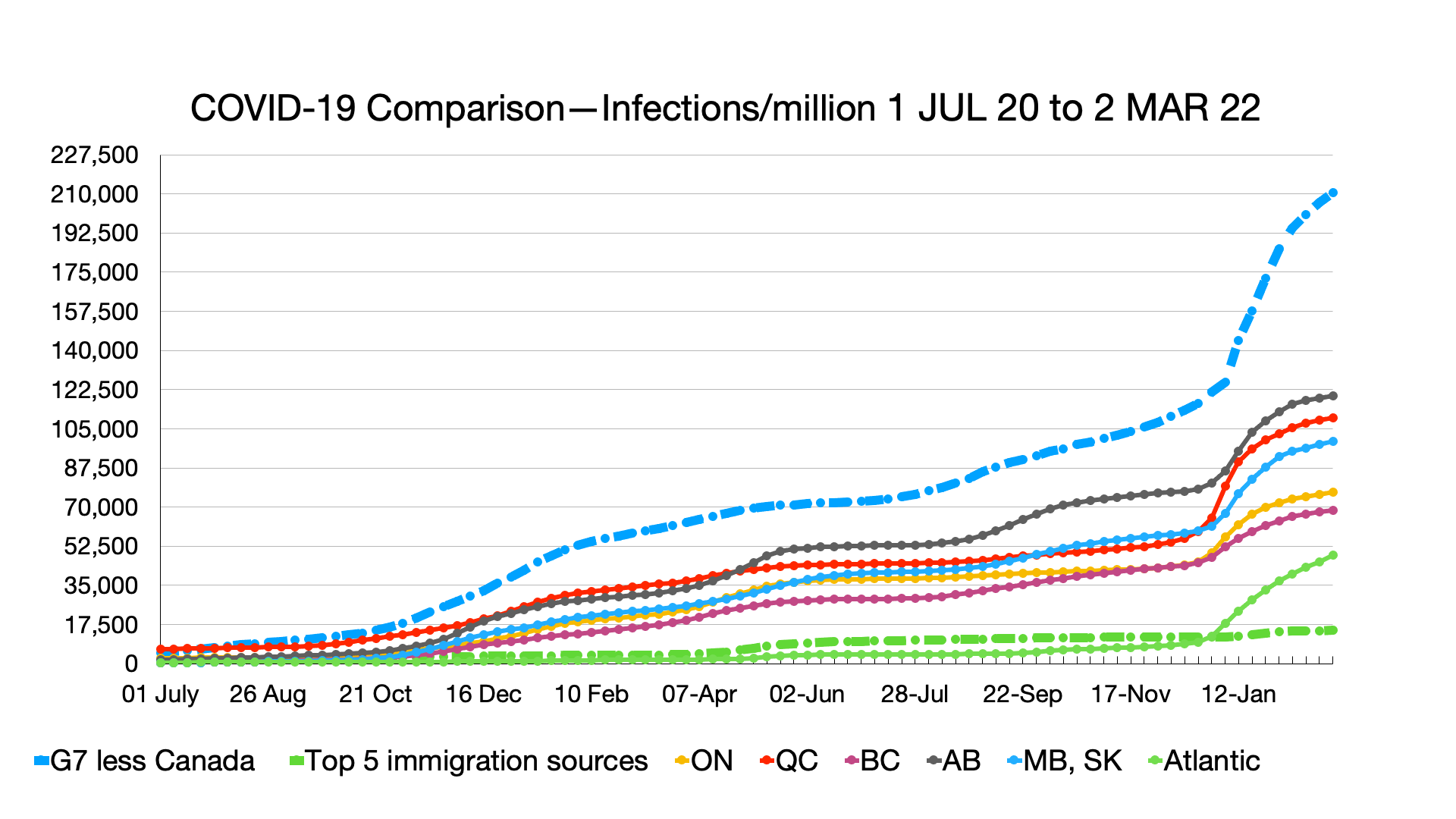
Infections: Effects of Omicron seen in steep curve in all G7 countries and provinces. No such effect in immigration source countries.

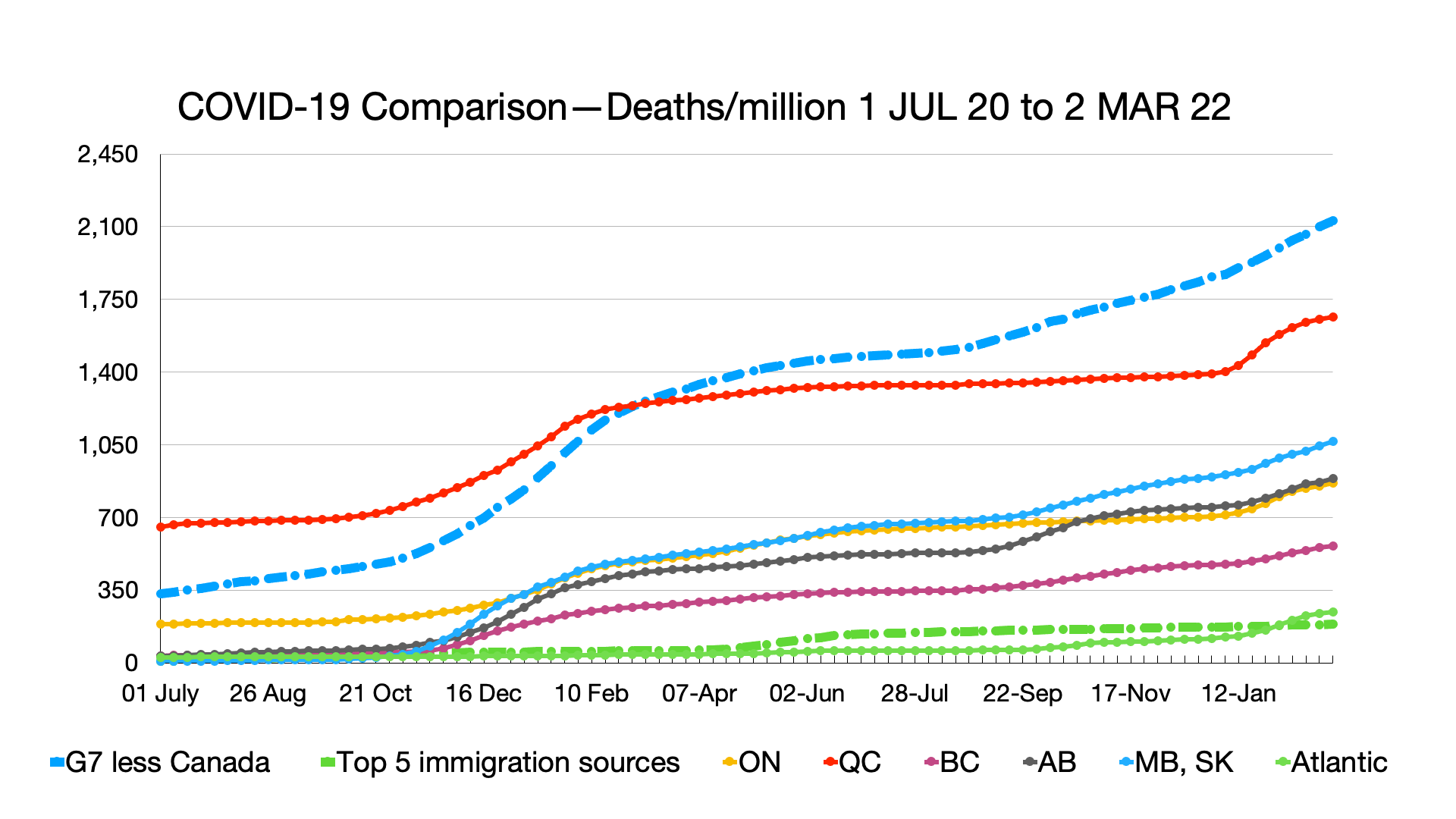
Deaths: No relative changes but Quebec uptick highly visible.

Vaccinations: Ongoing convergence among most provinces. Gap between G7 less Canada continues to grow despite overall convergence, with narrowing gap with immigration source countries save for Nigeria.

Weekly

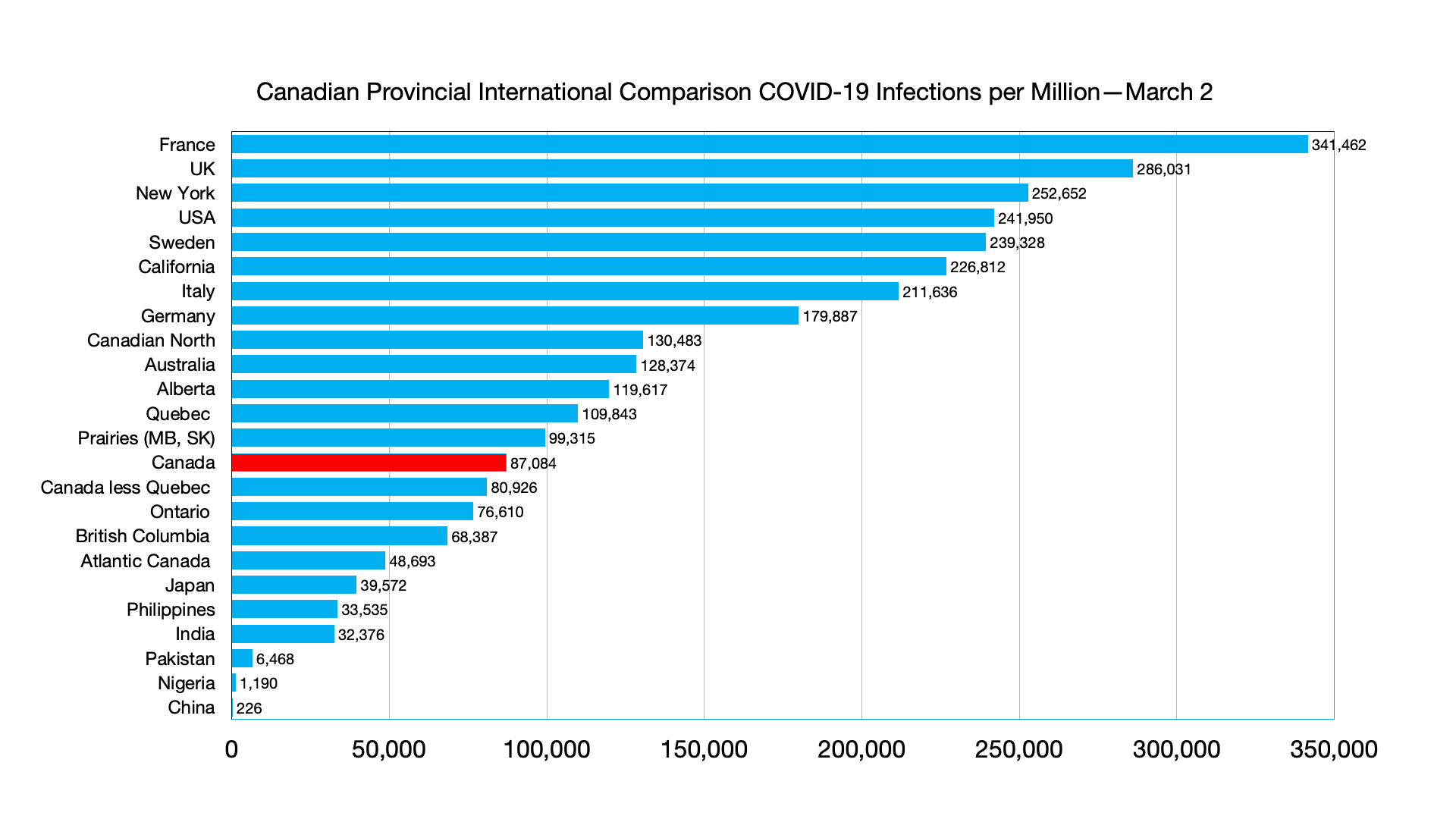
Infections: France ahead of New York and UK, Australia ahead of Prairies, Atlantic Canada ahead of Philippines. 

Deaths: Quebec ahead of Sweden, Atlantic Canada ahead of Japan, Australia ahead of Pakistan.

John Ivison: Liberals thwart badly needed skilled immigrants with mendacious political meddling

Header overly strong but substance important:

In a recent article in Foreign Policy, Parag Khanna of globalization experts FutureMap predicted that the Great Lockdown will be followed by the Great Migration, as the best and brightest move to exploit opportunities and fill labour shortages.

It would seem an inopportune time for the government of Canada to stop accepting applications from highly skilled workers from overseas. Yet that is exactly what the Liberals have done.

As my colleague Ryan Tumilty reported on Saturday, the high-skilled worker stream is backlogged, so despite nationwide labour shortages, the government is pausing new invitations because the department can’t process them.

The reason why Immigration, Refugees and Citizenship Canada is so backed up are entirely political.

For a variety of reasons, not least of which is that more immigration means more economic growth, the Liberals have committed to bringing in more than 400,000 permanent residents a year for the next three years.

Canada’s growth rate has been tepid in recent years, even with high levels of immigration. Absent the new arrivals, we’d be going backwards, as is clear from real GDP per capita data (in 2015, it was $51,158 per person; in 2020, it was $50,510, in constant 2012 dollars).

High levels of immigration are integral to the Liberal economic plan.

Yet those targets looked untenable during the pandemic, as international travel was suspended. Ottawa worked around the problem by granting permanent residency to thousands of temporary residents who were already employed or studying in Canada – the so-called Canada Experience Class.

The subsequent torrent of applications from students and temporary workers in Canada, coupled with the commitment to double the number of refugees coming from Afghanistan to 40,000, has resulted in bureaucratic resources becoming swamped. IRCC now has around 1.8 million applicants in a queue which is growing by about 20,000 every couple of months.

Part of the solution, according to an internal memo, is to cut the 110,500 skilled workers in the government’s target for next year by about half. The government says that there are still 76,000 skilled workers in the queue, so 2022 numbers won’t be affected. “The pause is temporary,” said a spokesperson for new immigration minister, Sean Fraser, who added that the government provided $85 million in new money to increase processing capacity.

But with around half of all businesses claiming to be experiencing labour shortages, the government has decided to meet its numerical targets, rather than focus where the needs are most pressing.

This is political meddling at its most mendacious. The government was able to boast about breaking the all-time immigration record in 2021, yet a quarter of those people were already here.

On refugees, no-one disagrees that Canada owes a duty of care to many people in Afghanistan but doubling the number of refugees from 20,000 to 40,000 will take two years to honour.

Andrew Griffith, a former director general at IRCC and author of a book on citizenship and immigration policy, said that the political choice to meet numerical targets, by allowing temporary residents to become permanent residents, meant that all other classes of immigrants became a lower priority. “It was a trade-off and, personally, I’m not convinced it was the right trade-off to make,” he said.

Griffith said the department would have warned the minister about the consequences of “bringing in the bodies” on the capacity constraints of other immigration streams. That advice appears to have been ignored.

The Liberals have so far stuck within the bounds that have traditionally governed Canada’s immigration policy, and which have ensured it has support in virtually all parties.

Immigration programs that are fair and economically-driven will continue to have widespread public support. People appreciate that we need new taxpayers to spread the burden of paying for an aging population.

In 2021, 58 percent of new immigrants were drawn from economic class programs; 26 percent from family class; and 16 percent from refugee and humanitarian class.

But the 2023 numbers may look quite different, if the number of high-skilled workers drops off dramatically and the number of refugees rises.

It has been a hallmark of this government that it has not been very effective at implementing policies, often because it is too focused on communications, and not enough on making things happen after they’ve been announced. This reflects a prime minister, who, in the words of one of his own senior members of staff, it “much more about: ‘what’s new?’”.

“He’s good at getting people super-excited, setting bold visions. But it creates real challenges in execution,” the staffer said.

This is a classic example. The “1 percent of population” immigration target probably got the inner circle “super-excited”, as, no doubt, did the 40,000 Afghan refugee promise.

But it may well be that there are consequences to those decisions which will see Canada miss out on tens of thousands of the globe’s most able engineers, heavy duty mechanics, plumbers, computer programmers, carpenters and database analysts.

Source: John Ivison: Liberals thwart badly needed skilled immigrants with mendacious political meddling

And, slightly different take, from Matthew Claxton:

What with COVID-19, and winter storms bearing down, and two days left until Christmas, it’s fair to say that few of us were paying attention to Canadian immigration policy on Dec. 23.

Which is a shame, because an announcement from the Department of Immigration, Refugees, and Citizenship showed that we’ve had a quiet revolution in how Canada accepts new permanent residents.

The government announced that 2021 was a record year for the arrival of new permanent residents – in total, 401,000 people had “landed” as permanent residents. Permanent residency is a major step towards Canadian citizenship, and it’s a massive driver of our population growth.

But in that announcement was a confirmation of something that Immigration has mentioned a few times in passing during the pandemic.

More than half of the folks who officially “landed” as permanent residents were already here.

“As we continue to struggle with the pandemic, we made the most of the talent already within our borders,” the announcement said. “The majority of these new permanent residents were already in Canada on temporary status.”

Yep. We increased our population of permanent residents by moving a bunch of people from one column in a government ledger to the other!

A significant number of permanent residents have always come from the ranks of temporary residents. In 2019, 74,586 of the 341,180 new permanent residents were already here on temporary status. But that’s just 21 per cent of the total number of new permanent residents, not more than 50 per cent!

In 2020, massive disruptions in travel due to the pandemic caused immigration rates to plummet just as the federal Liberal pledge to ramp up immigration levels was supposed to be coming into effect.

In the first year of the pandemic Canada admitted just 184,500 new permanent residents barely more than half the number from the year before.

I don’t actually have any particular objection to this change as policy. Making it easier to transition from being a temporary resident to a permanent one seems only just and fair, to me. If you’re good enough to work here or go to school here, surely you’re good enough to stay.

But the federal government didn’t make this change because they wanted to change the mix of people coming to Canada and becoming permanent residents. It wasn’t based on the idea that allowing increasing temporary residents to become permanent would be good for them, or good for Canada’s economy or culture.

It was done to hit an arbitrary number. The government had pledged to bring in more than 400,000 new permanent residents. Never mind how many were already here, some of them for years.

It doesn’t speak well that the government would see people, most of whom are future Canadian citizens, as mere numbers, a target that needed to be hit to meet an arbitrary goal.

Source: Painful Truth: Liberals hit artificial milestone on immigration – Aldergrove Star

More migrants seek asylum through reopened Canadian border

Highest level ever since 2017. Will likely become political issue again:

Whenever a bus arrives at the Greyhound station in Plattsburgh, New York, a small band of taxi drivers waits to drive passengers on a half-hour trip to a snowy, dead-end dirt road.

There, at the border with Canada, refugees pile out of taxis or vans several times a day, and Royal Canadian Mounted Police officers warn that they will be arrested for illegal entry if they cross, which they do. Most are soon released to pursue asylum, living and working freely while awaiting a decision.

“We have the hopes of everyone — be successful and have a change of life,” Alejandro Cortez, a 25-year-old Colombian man, said as he exited a taxi last week at the end of Roxham Road in Champlain, New York. The town of about 6,000 is directly across the border from Saint-Bernard-de-Lacolle, Quebec.

Cortez joins a renewed stream of migrants seeking refuge in Canada after a 20-month ban on asylum requests designed to prevent the spread of COVID-19. Families are once again lugging suitcases and carrying children across a remote, snow-covered ditch to the border.

Canada’s decision to lift the ban on Nov. 21 stands in marked contrast to the approach in the United States, where the Centers for Disease Control and Prevention has extended indefinitely a similar restriction on the border with Mexico that will enter its third year in March.

On Wednesday, a Justice Department attorney vigorously defended the ban against sharp questioning from federal appeals court judges about the scientific basis for such a far-reaching move against asylum.

The U.S. expelled migrants nearly 1.5 million times from March 2020 through November under what is known as Title 42 authority, named for a 1944 public health law that the Trump and Biden administrations have used to deny migrants a chance to seek asylum on grounds that it will curb the spread of the coronavirus. That accounts for about two of three arrests or expulsions at the border, most involving single adults and some families. Unaccompanied children have been exempt under President Joe Biden.

Fully vaccinated travelers have been able to enter the U.S. and Canada since November, but Canada went a step farther by reinstating a path to asylum.

Cortez arrived in the United States on a tourist visa five months ago. He said he couldn’t go back to Colombia because of violence and the disappearance of thousands of young men.

“All of that hurts a lot,” he said. “We have to run from our country.”

Asylum-seekers on the Canadian border began appearing at Roxham Road around the time Trump became president. How it became the favored place to cross into Canada isn’t clear, but the migrants are taking advantage of a quirk in a 2002 agreement between the U.S. and Canada that says people seeking asylum must apply in the first country they arrive in.

Migrants who go to an official crossing — like the one where Interstate 87 ends just east of Roxham Road — are returned to the United States and told to apply there. But those who arrive in Canada at a location other than a port of entry, like Roxham Road, are allowed to stay and request protection.

Nearly 60,000 people sought asylum after illegally crossing the border into Canada from February 2017 through September, many at Roxham Road, about 30 miles (50 kilometers) south of Montreal, Canadian government statistics show.

Of those, more than 45,000 claims have been finalized, with almost 24,300 approved, or almost 54%. Another 17,000 claims were rejected while over 14,000 are still pending. Other claims were abandoned or withdrawn.

In December, the number of asylum-seekers at the border in Quebec jumped to nearly 2,800. That’s up from 832 in November and 96 in October, according to the statistics.

Canada lifted the asylum ban with little fanfare or public backlash, perhaps because the numbers are small compared with people crossing into the U.S. from Mexico.

Biden’s decision to keep the Trump-era ban in place has come under scathing criticism from the United Nations refugee agency, legal scholars and advocates.

Under the ban, people from Mexico, Guatemala, Honduras and El Salvador, are bounced back to Mexico before being afforded rights under U.S. and international law to seek asylum. People from other countries are flown home without a chance at asylum.

Scientific arguments for Title 42 have met with skepticism from the start.

The Associated Press reported in 2020 that Vice President Mike Pence called CDC Director Dr. Robert Redfield in March of that year and told him to use the agency’s special legal authority to slash the number of asylum-seekers allowed into the country.

Pence made the request after a top agency doctor who oversees such orders refused to comply with the directive, saying there was no valid public health reason to issue it.

Dr. Anne Schuchat, the second-highest CDC official when she departed in May, told a congressional panel last year that “the bulk of the evidence at that time did not support this policy proposal.”

On Wednesday, Justice Department attorney Sharon Swingle insisted the ban is based on scientific expertise and prevents disease at crowded Border Patrol holding facilities. Facing persistent questioning from judges on a three-member panel in Washington, she acknowledged there were no affidavits in court records to explain the order’s scientific foundation.

Within hours of the November change by the Canadian government, immigrants started arriving in large numbers at Roxham Road, said Janet McFetridge, of Plattsburg Cares, a group that provides hats, mittens and scarves to people crossing the border in the dead of winter. She said people are eager to cross while they can.

“There definitely is a fear that it’s going to close suddenly,” she said while waiting on Roxham Road for the next group of migrants.

A Canadian officer said in French to a woman and her traveling companion, who was carrying a baby, that it was illegal to enter Canada there.

“If you cross here, you will be arrested,” he said.

“Yes, it’s not a problem. It’s not a problem,” the woman said as her companion started to pull a suitcase across the border.

Source: More migrants seek asylum through reopened Canadian border