How Canada uses personal information collected at the border on immigration applications

Useful overview. Entry/Exit will improve data collection (e.g., visa overstays) and allow for simplification and better client service (e.g., automatic completion of citizenship application residency information):

Since February 2019, the Entry/Exit Program has allowed the Canadian border to collect basic traveller information and share it with Immigration, Refugees and Citizenship Canada (IRCC).

IRCC uses the information to verify residency requirements for applications for permanent residence, work permits, study permits, and Canadian citizenshipapplications. Some programs require applicants to be in Canada for a certain number of days. For example, in order to apply for citizenship, permanent residents need to have been physically present in Canada for 1,095 days out of the five years prior to the date of their application.

With the Entry/Exit Program, IRCC can inquire about traveller information from the Canadian Border Services Agency (CBSA) via the Global Case Management System (GCMS), which is the system IRCC uses to process immigration applications.

What information is available

For now, the Entry/Exit program is only open to travellers to come to Canada by land and air. It is not yet available for marine and rail travel to Canada. The information that IRCC can access through the Entry/Exit program includes:

  • given and family names
  • aliases
  • date of birth
  • gender
  • country of birth
  • country of citizenship
  • passport details
  • date of entry/exit

CBSA stores the information in the GCMS, which IRCC can use as needed to administer the Immigration and Refugee Protection Act (IRPA), the Citizenship Act, and the Canadian Passport Order.

How IRCC uses Entry/Exit data

According to the government website, IRCC can use Entry/Exit data to:

  • verify residency requirements in support of applications for grants of citizenship (CIT) or permanent resident cards;
  • verify if a temporary residence applicant may have previously overstayed their allowable period of admission in Canada;
  • assist in an investigation of an individual’s entitlement to a Canadian travel document;
  • verify that sponsors are residing in Canada;
  • verify the residency of spouses and partners under the spouse or common-law partner in Canada class;
  • verify whether or not a refugee claimant entered Canada using their travel documents; and
  • support investigations of possible fraud in relation to immigration, citizenship, and passport/travel document programs.

IRCC does not need client consent in order to query traveller entry and exit information. They are allowed to access the information if it is relevant to an IRCC officer’s decision in relation to a specific program. Only IRCC roles that make decisions on applications can access Entry/Exit information in the GCMA.

IRCC officers are not allowed to disclose entry and exit information unless it is necessary to administer the IRPA and is covered under an information-sharing agreement. Any disclosure not covered under a memorandum of understanding or other information-sharing agreement must be governed by CBSA.

As CBSA is the owner of the data, all authorized CBSA employees have access to it.

Travellers can request a copy of their personal travel history through an access to information request under the Privacy Act. To request a correction, travellers can contact the CBSA.

Temporary residence applications

IRCC can request Entry/Exit information for the following application types:

The Entry/Exit data can be used to check whether a foreign national has previously exceeded their authorized period of stay in Canada. The government calls this “overstay monitoring.” It begins when a traveller enters Canada and ends upon their exit. If the applicant has overstayed their visit, an “overstay indicator” will appear as a checked box in the GCMS once queried.

IRCC expects overstay indicators for temporary residents will begin appearing in Entry/Exit search results in November 2022, once a sufficient number of air carriers are on-boarded.

Permanent residence applications

Entry/Exit information is available to IRCC for the following permanent residence application types:

The data can be used to outline the periods of time spent in and outside Canada, and will allow IRCC to see if residence has been maintained. In addition to residency requirements, IRCC may make an Entry/Exit query to investigate misrepresentation, or revocation of Canadian documents.

For family sponsorship applications, Entry/Exit data can be used to determine if a sponsor is residing in Canada.

Citizenship applications

Exit/Exit data can be used in citizenship applications to:

  • verify compliance with physical presence requirements for grants of citizenship;

  • assist in the verification of other requirements, such as, flagging of potential loss of permanent resident status, the need for applicants to submit foreign police certificates, or misrepresentation;

  • verify compliance with physical presence requirements for resumption of citizenship; and

  • assist in cases of revocation of Canadian citizenship.

Source: How Canada uses personal information collected at the border on immigration applications

Amid Slowdown, Immigration Is Driving U.S. Population Growth

Of note:

Overall, 2021 will go down as the year with the slowest population growth in U.S. history.

New census data shows why: Both components of growth — gains from immigration, and the number of births in excess of the number of deaths — have fallen sharply in recent years. In 2021, the rate of population growth fell to an unprecedented 0.1 percent.

Yet within these sluggish figures a new pattern is emerging. Immigration, even at reduced levels, is for the first time making up a majority of population growth.

In part this is because Americans are dying at higher rates and having fewer babies, trends accelerated during the coronavirus pandemic. But it’s also because there are signs that immigration is picking up again.

Even after four years of stringent controls on immigration imposed under former President Donald J. Trump, the overall share of Americans born in other countries is not only rising, but coming close to levels last seen in the late 19th century.

The numbers are not nearly what they once were. The latest report, from the Census Bureau’s population estimates program, showed a net gain of 244,000 new residents from immigration in 2021 — a far cry from the middle of the previous decade, when the bureau regularly attributed annual gains of one million or more to immigration.

Yet that drop-off pales in comparison to the slowdown in what demographers call “natural increase,” the excess of births over deaths. In 2021, that figure was 148,000, or one-tenth the gain that was normal a decade ago, and smaller than international migration for the first time ever.

As of December, immigrants represented 14.1 percent of the U.S. population, matching the peak of the decades-long immigration boom that began in the 1960s and approaching the record 14.8 percent seen in 1890, shortly before large numbers of Europeans began disembarking from vessels at Ellis Island.

The foreign-born population is increasingly concentrated among middle-age groups, with a large number of immigrants having lived in the United States for many years. About 1 in 5 Americans between the ages of 40 and 64 was born overseas. And two-thirds of foreign-born residents have been in the country more than a decade, the census data shows.

In that respect, the country’s demographics reflect the long-term effects of the huge levels of immigration it experienced during the 1970s and 1980s.

“We get so used to being around people who have been here for decades and navigate American society seamlessly that we almost forget they’re immigrants,” said Tomás Jiménez, a Stanford professor who researches immigration and assimilation.

The recent slowdown in immigration was an apparent result not only of the tougher immigration policies, but also measures taken in response to the Covid-19 health crisis. In the early months of 2020, the government sealed the borders with Mexico and Canada and limited international entries by air. The closure of U.S. consular offices around the globe derailed visa processing.

But the data suggests that tougher restrictions on the border may not have been the biggest factor in the slowdown. Many immigrants decided to leave the country. During the first years of Mr. Trump’s administration, the number of immigrants coming into the country held steady, while the number leaving increased, figures show.

Some data suggests that the pace of immigration has picked up lately. U.S. Customs and Border Protection reported a surge in enforcement activity last year, and the Census Bureau’s monthly employment survey also detected an uptick in foreign-born respondents in late 2021.

The economic and political circumstances that compel people to leave their home countries have persisted, and demand for foreign workers of all skill levels remains brisk.

The newcomers since President Biden took office come from all over the globe, as the government has lifted the cap on refugees, welcomed thousands of families seeking asylum on the southwestern border and reopened the door to foreign workers on temporary visas.

Among them is Jeff Quetho, 28, of Haiti, who crossed the border with his 3-year-old son, hoping to build a more stable life; Param Kulkarni, 34, an Indian scientist who specializes in mental health technology and artificial intelligence, who recently settled in New York; and Feroza Darabi, 22, of Afghanistan, who arrived in Phoenix with her 13-year-old nephew, Ali.

“I am happy to be somewhere safe,” Ms. Darabi said recently during a break from an English class for refugees at Friendly House in Glendale, Az.

Ms. Darabi hopes she will be joined one day soon by family members who were unable to scramble onto the plane she and her nephew boarded out of Kabul. “What I want most now is to have my family next to me,” she said.

If immigration returns to even its relatively modest prepandemic pace, it is possible the share of Americans born overseas could reach the record 14.8 percent from 1890.

The current labor shortage has heightened calls for foreign workers, in fields as varied as restaurant service and nursing, to help fill vacancies.

“The pandemic offers a little taste of what we may be facing if demand is robust and we don’t have workers,” said Pia Orrenius, a senior economist who studies immigration at the Federal Reserve Bank of Dallas. “We will see price and wage inflation, and growth will be choked off.”

“Immigration is not going to make this problem go away, but it certainly could help,” Ms. Orrenius said.

If immigration had continued at a prepandemic pace, the economy would have two million additional foreign-born workers in occupations such as manual labor and computer science, according to a recent study by economists at the University of California, Davis.

While the pandemic is seen as contributing to the slowdown in new immigration, it may have also helped prop up the number of foreign-born residents since that number depends not just on how many immigrants arrive but also how many leave. Virus travel restrictions made it harder for immigrants to enter the United States, but they also made it less likely they would depart, said Jeffrey Passel, a senior demographer at the Pew Research Center.

“During the pandemic, you couldn’t leave the country basically,” he said.

Some of the growth in the foreign-born population is related to a surge of migrants at the southwestern border that has been going on, to varying degrees, since 2014. But it is almost impossible to know the full extent. Not only is there no reliable accounting of how many people are entering the country illegally, it is not clear how many of them are being quickly expelled.

https://datawrapper.dwcdn.net/zFsnv/9/

The decline in birthrate that has resulted in foreign-born people becoming an ever-larger share of the population is part of a worldwide demographic pattern. Historically, nations see a drop in birthrates as they become more prosperous, a trend that can undermine that prosperity.

When low fertility is coupled with low mortality, the result is a bulging population of seniors and relatively fewer workers to sustain them, a scenario faced by Japan and many European countries that then saw their economies shrink.

The movement of the baby boom generation out of the labor force amid a plummeting birthrate has put into sharper relief the need to reverse the decline in new immigration. This will be crucial, analysts say, despite the large numbers of immigrants already living in the country — soon those here legally will be drawing more from Social Security and Medicare.

The immigrants already here may provide part of the solution. Foreign-born residents typically account for a disproportionate share of all births because recent immigrant women are more likely than others to be in their prime childbearing years and to have more children.

Lower immigration from Mexico, traditionally the biggest source of new immigrants, has contributed to falling U.S. birthrates overall.

But it will take bold political moves to harness the economic benefits of the existing foreign-born population. Already, an estimated 11 million of them are undocumented, meaning they can work only as part of the underground economy. Mr. Biden took office with a pledge to legalize them but has failed to win bipartisan support for such a move in Congress.

He took steps to jump-start legal immigration, rescinding a proclamation by his predecessor banning the entry of foreigners on work visas.

Last month, his administration unveiled policies to attract international students and to extend the time that foreign graduates in science and technical fields can remain in the country to work, from one year to three years.

In December, the government announced that 20,000 seasonal guest worker visas would be added to the allotment of 33,000 for the winter to assist employers in landscaping, construction and hospitality, desperately in need of workers.

Yet Mr. Biden’s Republican opponents have consistently resisted large increases in new immigration, and the question of how the country moves forward is likely to be debated as campaigning picks up steam for this year’s congressional elections.

Source: Amid Slowdown, Immigration Is Driving U.S. Population Growth

How America’s talent wars are reshaping business

In Canada, by contrast, immigration is relied upon to meet labour force requirements. One of the consequences, unforeseen or not, was reduced pressure to improve productivity and innovation:

Dcl logistics, like so many American firms, had a problem last year. Its business, fulfilling orders of goods sold online, faced surging demand. But competition for warehouse workers was fierce, wages were rising and staff turnover was high. So dcl made two changes. It bought robots to pick items off shelves and place them in boxes. And it reduced its reliance on part-time workers by hiring more full-time staff. “What we save in having temp employees, we lose in productivity,” explains Dave Tu, dcl’s president. Full-time payroll has doubled in the past year, to 280.Listen to this story

As American companies enter another year of uncertainty, the workforce has become bosses’ principal concern. Chief executives cite worker shortages as the greatest threat to their businesses in 2022, according to a survey by the Conference Board, a research organisation. On January 28th the Labour Department reported that firms had spent 4% more on wages and benefits in the fourth quarter, year on year, a rise not seen in 20 years. Paycheques of everyone from McDonald’s burger-flippers to Citi group bankers are growing fatter. This goes some way to explaining why profit margins in the s&p 500 index of large companies, which have defied gravity in the pandemic, are starting to decline. On February 2nd Meta spooked investors by reporting a dip in profits, due in part to a rise in employee-related costs as it moves from Facebook and its sister social networks into the virtual-reality metaverse.

At the same time, firms of all sizes and sectors are testing new ways to recruit, train and deploy staff. Some of these strategies will be temporary. Others may reshape American business.

The current jobs market looks extra ordinary by historical standards. December saw 10.9m job openings, up by more than 60% from December 2019. Just six workers were available for every ten open jobs (see chart 1). Predictably, many seem comfortable abandoning old positions to seek better ones. This is evident among those who clean bedsheets and stock shelves, as well as those building spreadsheets and selling stocks. In November 4.5m workers quit their jobs, a record. Even if rising wages and an ebbing pandemic lure some of them back to work, the fight for staff may endure.

For decades American firms slurped from a deepening pool of labour, as more women entered the workforce and globalisation greatly expanded the ranks of potential hires. That expansion has now mostly run its course, says Andrew Schwedel of Bain, a consultancy. Simultaneously, other trends have conspired to make the labour pool shallower than it might have been. Men continue to slump out of the job market: the share of men aged 25 to 54 either working or looking for work was 88% at the end of last year, down from 97% in the 1950s. Immigration, which plunged during Donald Trump’s nativist presidency, has sunk further, to less than a quarter of the level in 2016. And covid-19 may have prompted more than 2.4m baby boomers into early retirement, according to the Federal Reserve Bank of St Louis.

These trends will not reverse quickly. Boomers won’t sprint back to work en masse. With Republicans hostile to outsiders and Democrats squabbling over visas for skilled ones, a surge in immigration looks unlikely. Some men have returned to the workforce since the depths of the covid recession in 2020, but the male participation rate has plateaued below pre-pandemic levels. A tight labour market may persist.

But base pay is rising, too. Bank of America says it will raise its minimum wage to $25 by 2025. In September Walmart, America’s largest private employer, set its minimum wage at $12 an hour, below many states’ requirement of $13-14 but well above the federal minimum wage of $7.25. Amazon has lifted average wages in its warehouses to $18. The average hourly wage for production and nonsupervisory employees in December was 5.8% above the level a year earlier; compared with a 4.7% jump for all private-sector workers. Firms face pressure to lift them higher still. High inflation ensured that only workers in leisure and hospitality saw a real increase in hourly pay last year (see chart 2).

Raising compensation may not, on its own, be sufficient for companies to overcome the labour squeeze, however. This is where the other strategies come in, starting with changes to recruitment. To deal with the fact that, for some types of job, there simply are not enough qualified candidates to fill vacancies, many businesses are loosening hiring criteria previously deemed a prerequisite.

The share of job postings that list “no experience required” more than doubled from January 2020 to September 2021, reckons Burning Glass, an analytics firm. Easing rigid preconditions may be sensible, even without a labour shortage. A four-year degree, argues Joseph Fuller of Harvard Business School, is an unreliable guarantor of a worker’s worth. The Business Roundtable and the us Chamber of Commerce, two business groups, have urged companies to ease requirements that job applicants have a four-year university degree, advising them to value workers’ skills instead.

Another way to deal with a shortage of qualified staff is for firms to impart the qualifications themselves. In September, the most recent month for which Burning Glass has data, the share of job postings that offer training was more than 30% higher than in January 2020. New providers of training are proliferating, from university-run “bootcamps” to short-term programmes by specialists such as General Assembly and big employers themselves. Employers in Buffalo have hired General Assembly to run data-training schemes for local workers who are broadly able but who lack specific tech skills. Google, a technology giant, says it will consider workers who earn its online certificate in data analytics, for example, to be equivalent to a worker with a four-year degree.

Besides revamping recruitment and training, companies are modifying how their workers work. Some positions are objectively bad, with low pay, unpredictable scheduling and little opportunity for growth. Zeynep Ton of the mit Sloan School of Management contends that making low-wage jobs more appealing improves retention and productivity, which supports profits in the long term. As interesting as Walmart’s pay increases, she argues, are the retail behemoth’s management changes. Last year it said that two-thirds of the more than 565,000 hourly workers in its stores would work full time, up from about half in 2016. They would have predictable schedules week to week and more structured mentorship. Other companies may take note. Many of the complaints raised by labour organisers at Starbucks and Amazon have as much to do with safety and stress on the job as they do wages or benefits.

Companies that cannot find enough workers are trying to do with fewer of them. Sometimes that means trimming services. Many hotel chains, including Hilton, have made daily housekeeping optional. “We’ve been very thoughtful and cautious about what positions we fill,” Darren Woods, boss of ExxonMobil, told the oil giant’s investors on February 1st.

Increasingly, this also involves investments in automation. Orders of robots last year surpassed the pre-pandemic high in both volume and value, according to the Association for Advancing Automation. ups, a shipping firm, is boosting productivity with more automated bagging and labelling; new electronic tags will eliminate millions of manual scans each day.

New business models are pushing things along. Consider McEntire Produce in Columbia, South Carolina. Each year more than 45,000 tonnes of sliced lettuce, tomatoes and onions move through its factory. Workers pack them in bags, place bags in boxes and stack boxes on pallets destined for fast-food restaurants. McEntire has raised wages, but staff turnover remains high. Even as worker costs have climbed, the upfront expense of automation has sunk. So the firm plans to install new robots to box and stack. It will lease these from a new company called Formic, which offers robots at an hourly rate that is less than half the cost of a McEntire worker doing the same job. By 2025 McEntire wants to automate 60% of its volume, with robots handling the back-breaking work and workers performing tasks that require more skill. One new position, introduced in the past year, looks permanent: a manager whose sole job is to listen to and support staff so they do not quit. 

Both workers and employers are adapting. For the most part, they are doing so outside the construct of collective bargaining. Despite a flurry of activity—Starbucks baristas in Buffalo and Amazon workers in Alabama will hold union votes in February—unions remain weak. Last year 10.3% of American workers were unionised, matching the record low of 2019. Within the private sector, the unionisation rate is just 6.1%. Strikes and pickets will be a headache for some bosses. But it is quits that could cause them sleepless nights.

Pay as they go

Companies’ most straightforward tactic to deal with worker shortages is to raise pay. If firms are to part with cash, they prefer the inducements to be one-off rather than recurring and sticky, as with higher wages. That explains a proliferation of fat bonuses. Before the Christmas rush Amazon began offering workers a $3,000 sign-on sweetener. Compensation for lawyers at America’s top 50 firms rose by 16.5% last year, in part thanks to bonuses, according to a survey by Citigroup and Hildebrandt, a consultancy. In January Bank of America said it would give staff $1bn in restricted stock, which vests over time.

Source: How America’s talent wars are reshaping business

Immigration Critics Wrong: Fewer Visas Did Not Help U.S. Workers

Useful analysis of this natural experiment given US government policies remained largely unchanged:

The number of new foreign-born workers in the United States declined because of the Covid-19 pandemic, but U.S. workers were not better off, according to new research. That refutes a long-held anti-immigration argument and addresses a concern raised by some labor unions. Worker shortages, partly a result of restrictive immigration policies and made worse by the pandemic, have contributed to empty shelves in supermarkets, shorter hours in restaurants and elsewhere, and an inability for many companies to fill jobs and grow in the United States.

The research focused on H-1B visas for high-skilled foreign nationals, H-2B visas for nonagricultural seasonal workers, and J-1 visas for summer work travel. The focus is timely because some labor unions have argued against the Biden administration increasing by 20,000 the number of H-2B visas, even though such visas help reduce illegal entry and prevent at least some of the dangerous border crossings that cause hundreds of deaths annually, such as the recent drowning of a 7-year-old girl from Venezuela in the Rio Grande.

“The Covid-19 pandemic resulted in a sharp drop in international migration to the United States, but there is no evidence the entry of fewer foreign workers on temporary visas improved outcomes for U.S. workers,” concluded Madeline Zavodny, an economics professor at the University of North Florida and a former economist at the Federal Reserve Bank of Atlanta, in a new report for the National Foundation for American Policy (NFAP).

“The research examined labor markets where more temporary foreign workers were employed prior to the pandemic and found the drop in H-2B program admissions did not boost labor market opportunities for U.S. workers but rather, if anything, worsened them,” writes Zavodny. “The results also do not indicate gains for similar U.S. workers in labor markets that had relied more on the H-1B and J-1 visa programs. There is no evidence of improved labor market opportunities for U.S. workers in the leisure and hospitality sector during the summer months as a result of the virtual shutdown of the J-1 Summer Work Travel program.

“There is also no evidence of faster employment growth or lower unemployment rates for college graduate U.S. natives as a result of decreased admissions via the H-1B program. Instead, labor markets that had been more reliant on temporary foreign workers via the H-1B program before the pandemic appeared to have had more unfilled jobs during the pandemic. The large drop in new temporary foreign workers via the H-1B program thus does not appear to have led to better labor market outcomes for the U.S. natives who might compete with those workers for jobs.”

Among the findings of the report are new estimates that show the number of working-age migrants from abroad has declined:

·       “The U.S. received some 630,000 fewer working-age international migrants between mid-March 2020 and mid-March 2021 than at its peak during the corresponding period in 2014-2015, a drop of over 75% in inflows.

·       “Even if new arrivals in 2019-2021 had maintained just the average annual pace over 2010-2019, the U.S. would have received almost 600,000 more working-age international migrants than it actually did during that two-year period.

·       “The decrease in working-age international migrants was similar for migrants who had at least a bachelor’s degree and those who had at most a high school diploma, both down 75% in 2020-2021 from their peak year-to-year inflow during the previous decade.

·       “The number of J-1 exchange visitor visas issued plummeted from about 350,000 per fiscal year to about 100,000 in FY 2020 and a similar level in fiscal year (FY) 2021. The drop in the Summer Work Travel (SWT) program within that visa category was even more precipitous, falling from over 100,000 annually to under 5,000 in FY 2020.

·       “The number of H-1B specialty occupations visas issued fell from almost 190,000 in FY 2019 to about 125,000 in FY 2020 and under 62,000 in FY 2021.

·       “The number of H-2B non-agricultural worker visas issued fell by almost half in FY 2020 before returning to near its pre-pandemic level in FY 2021.”

Zavodny notes it is tempting to argue that some of the increase in labor market opportunities for workers is due to reduced international migration. “The analysis here gives little reason to believe any gains for U.S. workers are linked to lower admission of temporary foreign workers,” writes Zavodny. “The ongoing shortages of workers in many labor markets reflect U.S. employers’ need for additional workers from both domestic sources and abroad. The research also examines data on job postings and the results point to jobs, particularly highly skilled jobs, going unfilled when temporary foreign workers were unable to enter the country. The decrease in new temporary foreign workers in the U.S. as a result of the pandemic thus does not appear to have led to better labor market outcomes for U.S. natives but rather to jobs left unfilled.”

Immigration critics have insisted that fewer legal visas would translate into gains for U.S. workers. The Covid-19 pandemic created a natural experiment to test that proposition and found it to be untrue. The results show a simplistic, zero-sum argument that restricting the size of the labor force benefits U.S. workers is incorrect. Such an argument fails to take into account many factors, including the role played by capital and entrepreneurs in a market economy. Instead, imposing visa restrictions and having fewer available workers reduce economic growth and make it more difficult for businesses to expand and deliver products and services to Americans.

Source: Immigration Critics Wrong: Fewer Visas Did Not Help U.S. Workers

They paid big money up front to immigrate to Quebec — but face wait times of more than seven years

Sometimes the focus on individual stories misses the broader picture of the Quebec investor immigrant program being a backdoor to immigrants seeking to live in Toronto or Vancouver (How over 46,000 wealthy immigrants took a back door into Vancouver and Toronto’s housing markets).

One of the better decisions of the previous government was to cancel the business immigrant program given the evaluation showed that “their economic performance and extent to which BIs [business immigrants] had economically established is low compared to other economic classes considered.” Census data largely confirms the limited economic benefits and earnings of investor immigrants:

Pakistani entrepreneur Nazakat Nawaz had the money, so the process of moving to Quebec as an investor to start a new life in Canada seemed straightforward.

The province wanted net assets of $1.2 million, two years of management experience and a five-year, interest-free investment of $800,000 entrusted with the province. That was in 2016.

It took 18 months for Nawaz to be screened and issued a Certificat de Selection du Quebec by the Quebec government so he could be referred to the federal immigration department to complete the processing of his family’s permanent-residence application.

Today, after investing hundreds of thousands of dollars and years of time in the process, the 45-year-old, his wife and their four children are still waiting in the United Arab Emirates, waiting.

“For the immigration department, it’s no problem to wait for a few years, but, for us, it’s our lives at stake,” says Nawaz, who has been running his own computer business since 2004.

His application was submitted to the federal immigration department in October 2018. His plan was to open an autobody shop in Quebec.

“Canada kept taking new immigration applications. If they didn’t have the processing capacity, why did they keep accepting new ones? It’s all because they’re greedy for more money. Just take our money and throw our applications in cold storage.”

The federal immigration department has been plagued by backlogs since the pandemic hit in March 2020, with global travel restrictions limiting the admission of newcomers and lockdowns hampering the processing of immigration applications here and abroad.

Like other provincial immigration programs for investor and entrepreneurs that vet and nominate their own applicants, those looking to migrate to Quebec must go through the same two-step process: Get a nomination from the province, then go through another round of screening and processing by the federal government to obtain permanent residence.

But Quebec-bound investors are facing a particularly long queue at both the provincial and federal levels.

The current processing time for the Quebec investor immigration program now stands at 65 months just at the federal end, up from 43 months in 2017. (The wait is six months for online applications and 25 months for paper applications in other parts of Canada.)

As of Jan. 23, there were some 14,000 people in the queue who had been referred by the Quebec government, most of them in the investor stream.

On the provincial front, the processing time has also crept up over the same period — from 21 months to 28 months, with a backlog of 1,075 applications in the system — compared to anywhere between four weeks and six months in other provinces, according to their websites.

In Quebec, that means the whole process adds up to a combined 93 months — more than seven years.

“Quebec sets its own annual immigration thresholds, and we receive more applications than the number of spaces that Quebec has allocated for the Quebec Business Class program,” said federal immigration department spokesperson Rémi Larivière.

“The number of applications that we process cannot exceed the number of spaces that Quebec has allocated for this program.”

After coming into power in late 2018, the Coalition Avenir Québec or CAQ reduced the province’s annual immigration intake by 20 per cent to 40,000. It set an annual quota of 3,400 for its business immigration program, which covers the entrepreneur, investor and self-employed streams.

It’s not known how much the delay to the processing applications is a result of the province’s reduced intake or COVID-related disruption with its federal counterparts. However, after failing to meet even its lower target during the pandemic, the Quebec government this year has raised it aims and wants to admit 52,500 new permanent residents, including 4,000 to 4,300 under its business immigration program.

According to federal officials, the overall backlog for the Quebec business immigration category has actually decreased in the past five years.

Due to the pandemic travel restrictions, at the request of the province, federal officials have prioritized the processing of applicants from Quebec who were already in Canada in order to maximize admissions to meet Quebec’s target. That hurts the business class applicants: “More than 95 per cent of applicants in the Quebec business class reside abroad,” said Larivière.

Alain Ayache, a spokesperson with Quebec’s Ministry of Immigration, Frenchisation and Integration, said the province’s admission targets are determined based on its immigration objectives and integration capacity to meet its “socioeconomic needs.”

“These targets were established to reduce the waiting periods for the applicants, more specifically by reducing the number of applications to the federal government waiting for permanent residence,” Ayache said.

Applicants under the Quebec investor program, meanwhile, are left confused and frustrated.

Before submitting a permanent-resident application to the federal immigration department, Nazwaz, like other applicants accepted by Quebec at the time, was required to deposit $800,000 for the five-year investment, either directly in cash or financed by paying a non-refundable fee — about $230,000 — to a designated financial institution. (The five-year term investment requirement has since been raised to $1,200,000.)

“We contacted the Quebec government and they said the federal government is responsible for processing and delays. When we contacted the federal government, they said Quebec gave them a quota to process applications,” said Nawaz.

“All I can say is they have ruined our lives. Everybody got their share of money and we are left with empty promises.”

Anup Kishin Gandhi was 45 when he applied under the Quebec program in 2018. A year later, he was selected and issued the selection certificate from the province. He immediately applied to the federal immigration for permanent residence.

“The stress is that when we started the process, I was 45 and I was expecting to settle by 50 and start my business, but today, I have no idea where my file is,” said Gandhi, now 49, who is from India but works in Abu Dhabi as a vice-president in human resources for a French energy company.

“Any delay is going to make it difficult for me (at my age) to start a business and to sustain. It would require a minimum four to five years to build a successful business. If I start something at 55, it’s near impossible.”

Gandhi said he has lived all his life in the United Arab Emirates but his family’s status there hinges on his job and they would have to leave and return to India if he is ever no longer employed there.

“I wanted my children not to have similar situations. Accordingly we all decided to immigrate to Canada, where there is security, safety and equal opportunities,” said Gandhi, whose 17-year-old twin boys, Maaluv and Mankush, have been studying French and were hoping to study medicine at McGill University.

Naween Verma said he applied to the same program in Quebec in 2015 and came to Canada for an interview two years later. After making his deposit, he got the selection certificate for his family and applied to the federal government in September 2017.

“Both governments are playing the blame game. Quebec already got our money and now they don’t care about us. The federal government thinks we gave money to Quebec, not them, so we are not a priority,” said the 50-year-old man, who runs a company in New Delhi that helps build infrastructure like bridges, roads and industrial buildings.

“We have already contributed so much money in the Canadian economy even before we get to go to the country. We don’t know what the future holds for us.”

Another Indian applicant, Preet Mann, 53, has paid $10,000 to hire a consultant to help with the application and another $15,000 just for the application fee under the Quebec investor stream. He has also sent his 21-year-old son to study in Montreal as an international student in preparing for settlement in the province.

The family was approved and issued the selection certificate from Quebec in 2017. By the end of that year, the federal immigration department confirmed the receipt of their application, which has been stalled since.

“We cannot deny that the global pandemic has disrupted the immigration system to some extent, but we had applied in 2017, surely a delay of more than four years cannot be attributed to the pandemic alone,” said Mann, who is the head of the marine department of a Japanese oil and gas company.

“The ever increasing processing times are creating havoc for cases like ours. We have given Canada our very hard earned money and there is no turning back for us now.”

Source: They paid big money up front to immigrate to Quebec — but face wait times of more than seven years

Canada’s decision to land over 400,000 immigrants in 2021 has come at a cost

Good analysis and reasonable recommendations by Kareem Al-Assal:

Consequences of the 401,000 newcomer target

On the flip side, IRCC has recognized the decision to pursue 401,000 landings in 2021 has resulted in negative consequences. Regrettably, these consequences could have been avoided had the Canadian government chosen to pursue a more sustainable immigration policy last year

The purpose of increasing the immigration target was primarily to promote population, labour force, and economic growth, while also continuing to reunite families and help refugees. Given that some 60 per cent of new immigrants fall under the economic class, it is safe to say Canada’s main immigration objective is economic in nature.

And yet ironically, the Canadian government’s goal last year undermined its own objective of supporting the economy via immigration. It decided to focus on transitioning more people from within Canada to permanent residence. Prior to the pandemic, about 30 per cent of new economic class permanent residents transitioned from within Canada, while 70 per cent arrived from abroad. Last year, this was reversed, as 70 per cent of new economic class landings came from within Canada, while 30 per cent came from abroad.

A first consequence of this decision is the reduced flow of new immigrants from abroad is contributing to weaker population, labour force, and economic growth. Canada’s population growth is the weakest since 1915/16. Prior to the pandemic, Canada’s population was growing by over one per cent per year which was the highest rate among highly developed countries. Some 80 per cent of annual population growth was thanks to immigrants moving to Canada.

Reducing the share of new economic class immigrants coming from abroad last year has also hurt the labour market. Immigrants were comprising 80 per cent or more of Canada’s new workers each year. The limited foreign arrivals is contributing to the highest job vacancy rate in Canadian history, with nearly 1 million jobs currently unfilled.

Pursuing the target has also led to IRCC reducing its selection standards. When it launched Express Entry in 2015, IRCC said the new Comprehensive Ranking System (CRS) was a scientific way of selecting candidates best positioned to succeed in the labour market.

Prior to the pandemic, a candidate needed a CRS score of around 470 to be invited to apply for permanent residence. Last year, however, IRCC brought the score down to as low as 75, so it could get more in-Canada candidates to count towards its 401,000 admissions target. In other words, the Canadian government felt it was more important to achieve this target than to use the own evidence-based criteria it has set to evaluate an Express Entry candidate’s suitability to succeed in our economy.

This is not to say that those with lower CRS scores are unable to contribute to Canada. History shows that immigrants of all socio-economic backgrounds do make overwhelmingly positive contributions. But rather, this observation is meant to point out the disconnect in the Canadian government’s immigration policy.

It remains to be seen how well those who gained permanent residence via Express Entry with a lower CRS score will do in the labour market. Chances are they will do just fine, but IRCC and Statistics Canada research strongly suggests candidates with higher human capital end up with higher earnings and better overall labour market outcomes. If this holds true, IRCC will have given up the opportunity to select higher-potential immigration candidates in exchange for breaking Canada’s annual admissions record.

IRCC concedes that the focus on the target has made backlogs even worse. The department now sits on a backlog featuring 1.8 million people, up from 1.5 million in July 2021. This is because IRCC focused on processing in-Canada applications while existing and new applications were given less priority since they would not count towards the 401,000 admissions goal. Unfortunately, this is creating a vicious cycle.

The backlog will continue to slow the arrival of economic class immigrants from abroad, further stalling labour force and economic growth. In addition, family reunification and refugee resettlement processing will also remain slower.

As noted, IRCC and Immigration Minister Sean Fraser came out on January 31 to do some damage control by acknowledging the scale of the backlog problem and outlining the steps being taken to get processing times back to IRCC’s service standards.

This is a positive step but there are other things the government can do in the meantime to get the immigration system back on track.

Suggestions to get the immigration system back on track

It would be beneficial for IRCC to communicate to the public its strategy to tackle the backlogs. Applicants have a right to know where they stand and when they can expect decisions to be made on their files. It would be better for IRCC to be transparent and honest about the actual length of time it is taking to process a given application stream as opposed to the current approach of applicants being left in the dark for much of the process.

IRCC also needs to sustain its processing capacity at a high level throughout the year. Its processing capacity understandably fell immediately following the pandemic. However it was not until June 2021 that it began to finalize permanent residence applications at a much higher rate and they eventually managed to finalize over 500,000 in total last year.

According to IRCC, sustaining this level will see it get through its entire permanent residence inventory by the end of this year. IRCC should keep up this pace beyond 2022 so that all applicants see their files processed in a timely manner.

IRCC should also resume Express Entry invitations to Federal Skilled Worker Program (FSWP) and Canadian Experience Class (CEC) candidates immediately for a variety of reasons.

First, Express Entry is crucial to Canada’s economic recovery and alleviating current labour shortages.

Second, given its current Express Entry inventory, IRCC should be able to reduce processing times for new Express Entry applications by the second half of the year, and hence issuing Invitations to Apply (ITA) now would not create significant additional pressure for the department since they will be in better position to process such applications in a timely manner once they are submitted (applicants have up to 60 days from when they receive an ITA to submit a completed permanent residence application).

Third, the rationale for pausing FSWP invitations (travel restrictions) has not existed since Canada lifted travel restrictions on all Confirmation of Permanent Residence (COPR) holders in June 2021. It is also worth noting IRCC has been processing work permitstudy permit, and temporary resident visa applications of those abroad over the past year, so there is little justification for the slow pace of FSWP application processing.

Fourth, resuming draws would help to restore Canada’s global competitive standing. The pause in FSWP draws over the past year has caused global talent to consider their immigration options elsewhere.

Fifth, a sustained pause in draws will see thousands of CEC candidates lose their status in Canada and the absence of a solution by IRCC will force such individuals to leave Canada.

This leads to a final suggestion: IRCC should introduce another temporary public policy to allow those in Canada seeking to remain as a permanent resident to extend their temporary status in an easier way. For example, it can offer a one-time work permit extension to all CEC candidates residing in Canada that have been affected by the pause in Express Entry invitations to them since September 2021.

IRCC did something similar last year when it offered a one-time 18 month work permit extension to Post-Graduation Work Permit (PGWP) holders so they would have more time to obtain permanent residence. Among the benefits of this approach is it would give Canadian employers sustained access to such work permit holders and would mitigate the labour market risks of seeing tens of thousands of workers having to leave Canada due to the expiry of their work permit status.

The Canadian government can not undo the past, but what they can do is think creatively to come up with solutions to the negative consequences that have occurred due to their pursuit of over 400,000 immigrant landings in 2021. Coming up with effective solutions will be to everyone’s benefit and would be another major reason to commend IRCC.

Source: Canada’s decision to land over 400,000 immigrants in 2021 has come at a cost

#COVID-19: Comparing provinces with other countries 2 February Update

While infections appear to have plateaued, lagging indicators such as hospitalizations, ICU use, and deaths have not for the most part.

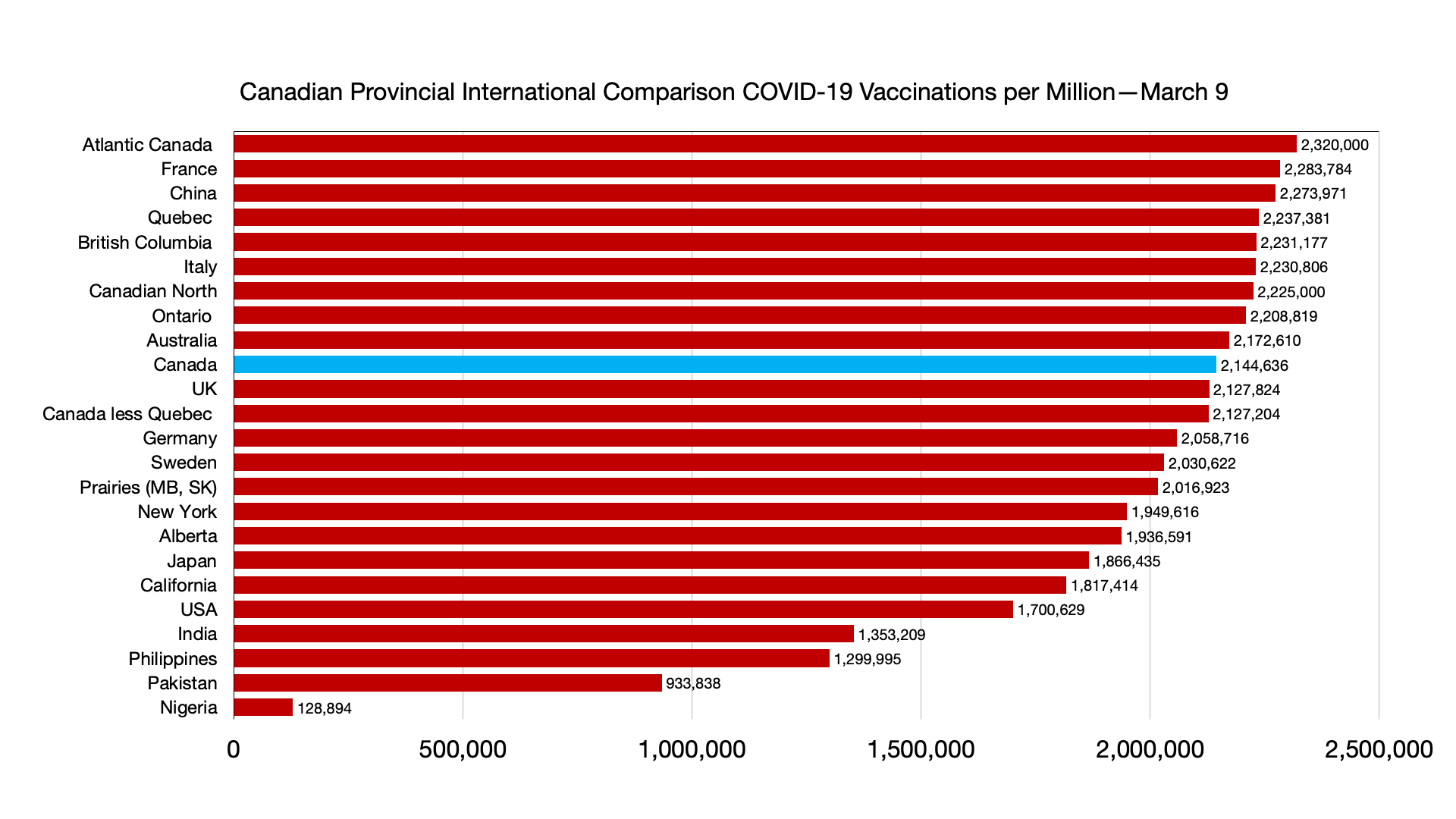
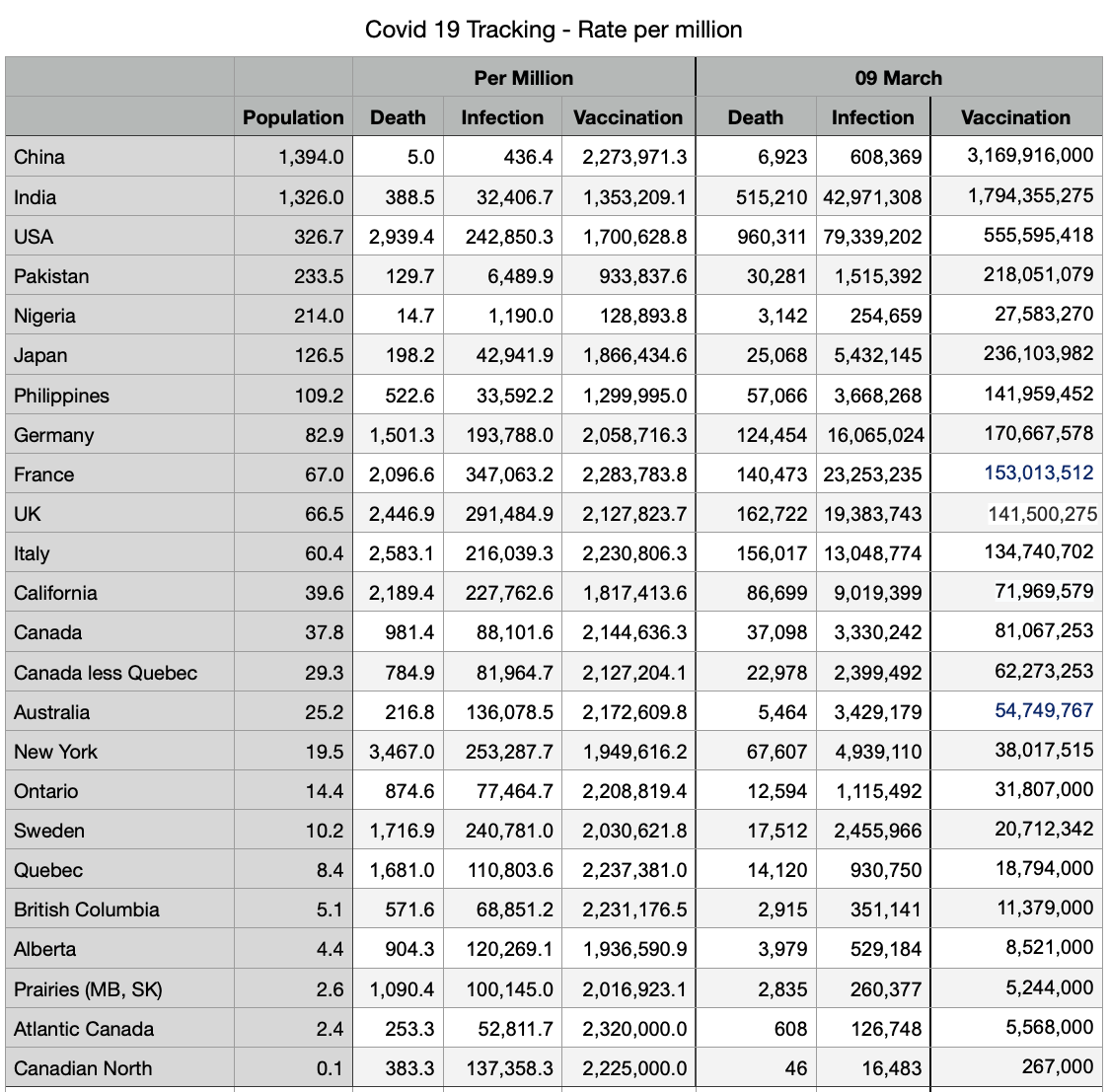
Vaccinations: Some minor shifts but general convergence among provinces and countries. Canadians fully vaccinated 80.3 percent, compared to Japan 79 percent, UK 72.5 percent and USA 64.6 percent.

Immigration source countries are also converging: China fully vaccinated 87.8 percent (numbers have not budged over past two weeks), India 52.3 percent, Nigeria 2.7 percent (the outlier), Pakistan 38.1 percent, Philippines 54.7 percent.

Trendline Charts:

Infections: Moving towards a possible plateauing in most Canadian provinces, G7 less Canada still rising more steeply than Canada.

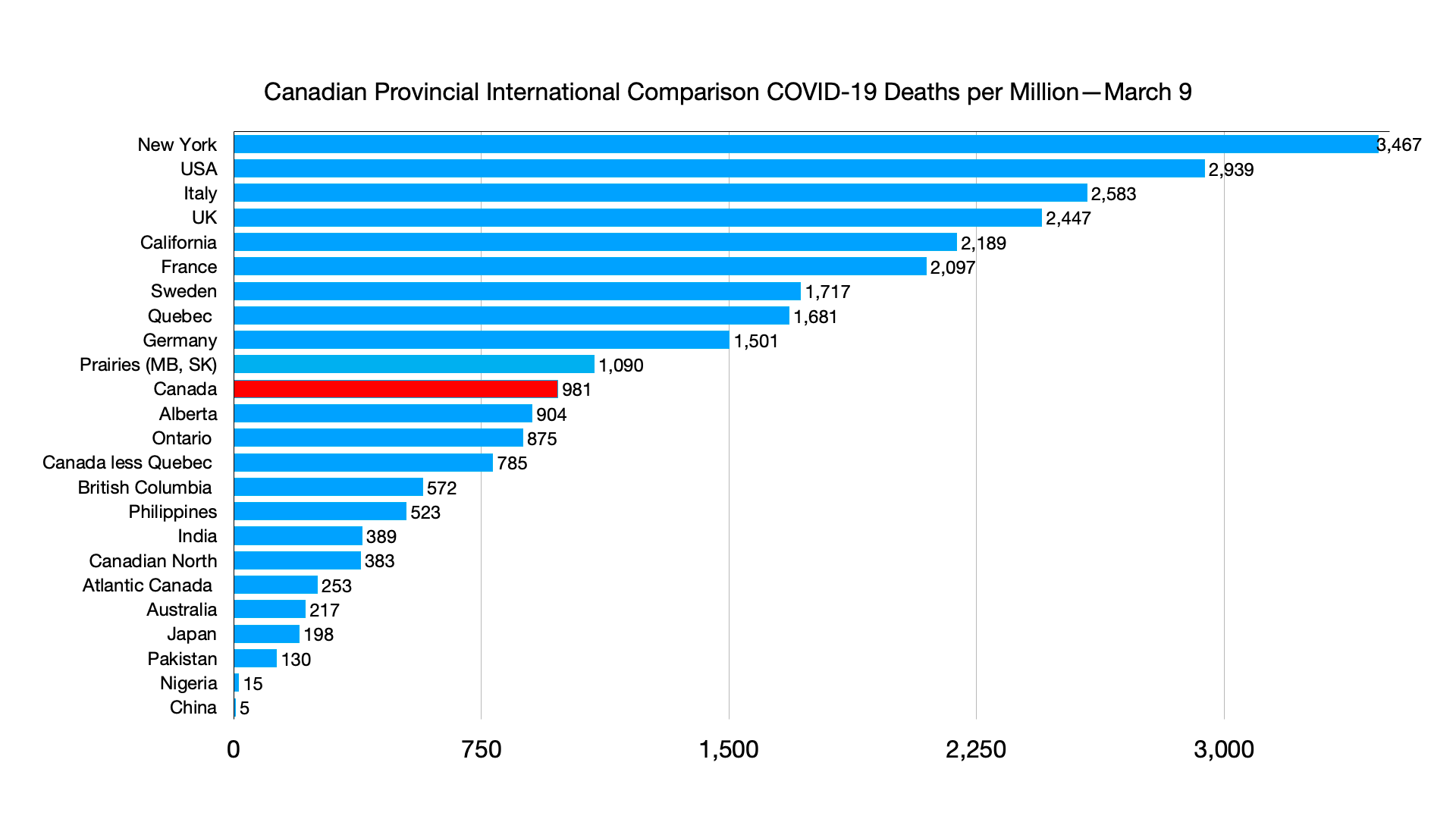
Deaths: No relative changes but Quebec uptick remains highly visible.

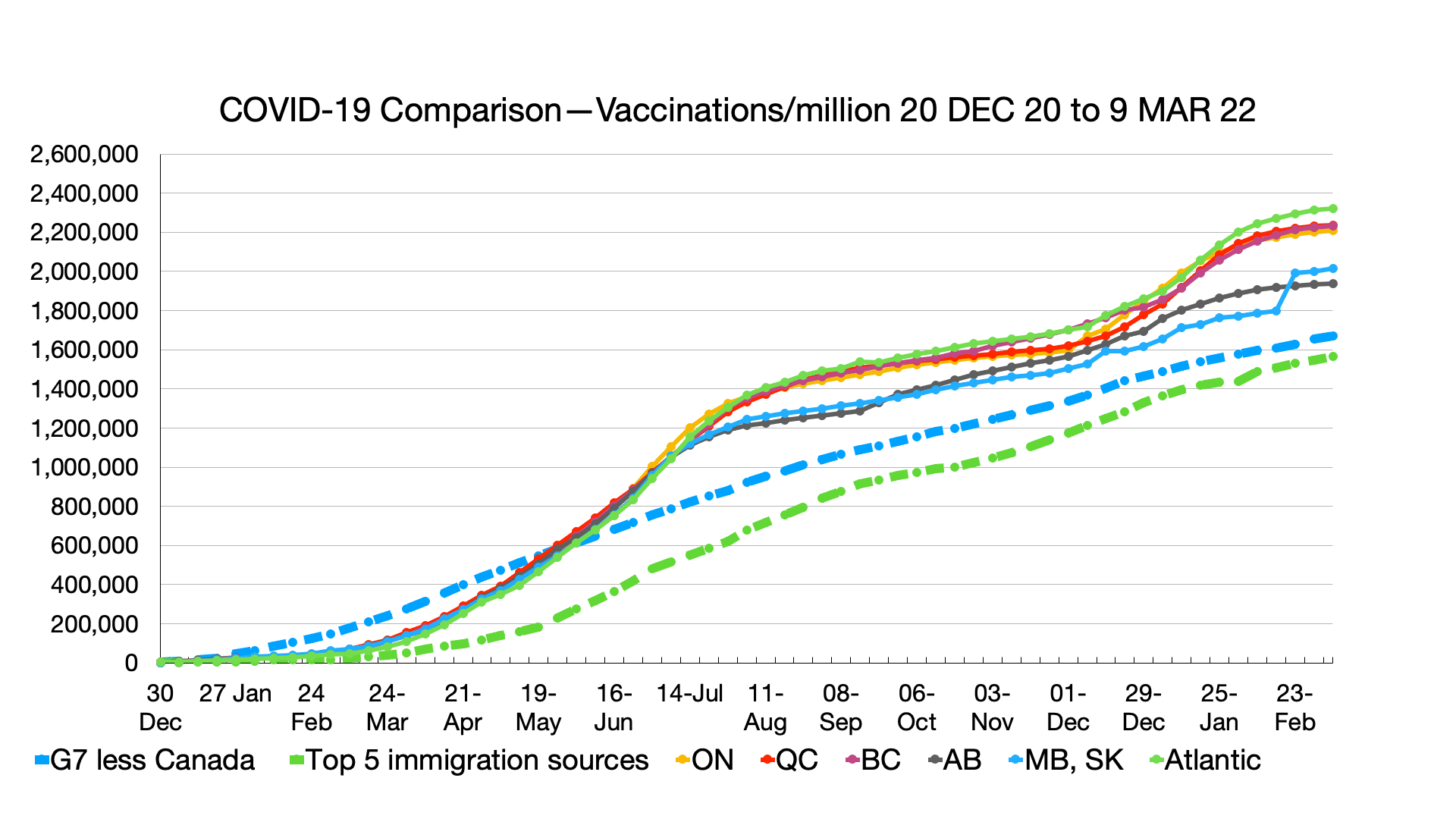
Vaccinations: No major change but Alberta and Prairies continue to be laggards compared to other provinces.

Weekly

Infections: UK ahead of USA, New York and California, Germany ahead of Alberta, Canadian North ahead of Canada.

Deaths: Australia ahead of Japan.

Canada squanders economic, social benefits by keeping out new Canadians’ relatives

More an opinion piece than factual reporting. Would be useful if Canada would have overstay data comparable to other countries like the USA:

Canada is losing manifold economic and social benefits and going against its own values when it denies visitor visas and study permits to family members of new Canadians. Denials are rooted in belief that visitors with family ties in Canada are more likely to overstay their visas, but while no data exists to back up this claim, why should that even be a concern?

In the last century, Canada has earned a great reputation for accepting a large number of immigrants and valuing multiculturalism. Immigrants are a great boost for the economy. In fact, Canada’s current plans to accept 411,000 immigrants in 2022 and 421,000 in 2023 were touted by former Minister of Immigration, Refugees and Citizenship Canada (IRCC) Marco Mendicino as a way to help the Canadian economy recover from COVID-19.

Such framing emphasizes how immigrants benefit our economy not just by filling labour force shortages and paying taxes, but also by significantly increasing employment creation.

Despite this warm welcome, new Canadians often face hurdles when their family members wish to come to visit. When applying for a visa, relatives of new Canadians frequently receive the following response: “I am not satisfied that you will leave Canada at the end of your stay as a temporary resident, as stipulated in paragraph 179(b) of the IRPR [Immigration and Refugee Protection Regulations], based on your family ties in Canada and in your country of residence.”

The first three thoughts that come to mind when I encounter a sentence like this are: Do people with family ties stay and those without them return? Is this a favourable decision for the Canadian economy or even the IRCC’s plan? Do officers denying visas consider the repercussions of such a decision?

For this article, I spoke with 11 new Canadians whose family members had gotten multiple denials because of their ties to Canada. These dismissals have affected each of them in various ways.

Many said they felt guilty, believing that rather than being of assistance, they were obstructing their families’ dreams. This is especially true for those whose siblings had education or job opportunities but were turned down because of their familial ties.

Some of the people I spoke to said their family members, particularly their parents, felt Canada could reject their submission multiple times. This resulted in either familial issues or a sour relationship.

Source: Canada squanders economic, social benefits by keeping out new Canadians’ relatives

Roads blocked during anti-illegal immigration protest in northern Chile

Of note:

The northern Chilean city of Iquique was the scene of roadblocks, store closures and a truck drivers’ strike on Monday, with protesters demanding action to address rising crime and an illegal immigration crisis in that region.

Trucks and other heavy equipment were used to block multiple roads leading into and out of the city and prevent workers from reaching the airport, according to different local reports.

The airport suspended operations early Monday and urged passengers to contact their airline for updates on the status of their flights.

“Retail establishments and the duty-free zone decided not to open, while different social leaders decided to join in the protest. The call (for change) is quite big at this time,” Mayor Mauricio Soria said.

Monday’s actions come after hundreds of people demonstrated Sunday in different parts of the far-northern Tarapaca region – home to Iquique and more than 1,800 kilometers (1,120 miles) north of Santiago – against the presence of undocumented migrants.

During that gathering, some protesters broke up tent structures used by foreigners and held up xenophobic signs.

Similar incidents occurred in September, when a mob of demonstrators burned tents and the belongings of Venezuela migrants who had been using a public square in Iquique as a makeshift nighttime shelter.

Those actions were roundly condemned by authorities and non-governmental organizations.

The Chilean Altiplano (high plain) is the main route of choice for undocumented migrants, despite severe health risks related to that region’s big temperature swings and high elevation.

After a surge in illegal border crossings in February 2021, the crisis worsened further in October when hundreds of mostly Venezuelan migrants fleeing economic crisis in their homeland occupied public squares and avenues, an influx that led the Chilean government to announce the construction of several shelters to mitigate the crisis.

The Office of the United Nations High Commissioner for Refugees said in December that nearly 500 Venezuelan refugees and migrants, including children, cross daily from Bolivia to Chile via irregular border crossings and arrive at their destination “after several days without eating and (suffering from) dehydration, hypothermia and altitude sickness.”

At least two people have died so far this year while trying to cross the border, while at least 23 have perished since migrants began arriving in large numbers in February 2021.

Around 1.4 million migrants live in Chile, equivalent to more than 7 percent of the population. Venezuelans make up the largest portion of the foreign-born population, followed by Peruvians, Haitians and Colombians.

Source: Roads blocked during anti-illegal immigration protest in northern Chile

Falconer and Damian Smith: Asylum-seeker smuggling is a symptom, not a root cause

Good arguments in favour of a managed approach to asylum seekers (as Canada largely has with even Roxham Road given how the government processes claims). On the other hand, just as “cracking down” incentivises more crossings between official points of entry, so does having “unofficial” points of entry like Roxham Road, with the important and real difference that they are known and identified, and have to go through the official process.

So the hard part is ensuring a quick, efficient and fair efficient determination process that is subject to enforcement, without the endless appeal processes that undermine confidence among Canadians:

Earlier this month, the Patels – a family of four from India – died of cold exposure trying to walk south through the Canada-U.S. border, near Emerson, Man.

But rather than look at how policies incentivize such irregular migration and produce such tragedies, Canadian politicians and news media have been quick to parrot rhetoric from other rich countries, speculating about the responsibility of criminal smugglers and wider networks of nefarious actors. “It is so tragic to see a family perish like this, victims of human traffickers, misinformation and people who have taken advantage of their desire to build a better world,” Prime Minister Justin Trudeau said.

Just three months earlier, the U.K.’s Interior Minister blamed smugglers for the death of 31 peoplewhen a boat capsized in the English Channel, and vowed to pass laws to make it illegal to claim asylum. And the U.S., which for decades has forced irregular migrants to make deadly desert crossings, has criminalized humanitarian groups as smugglers.

But while the Florida man arrested in the Patels’ case allegedly sought to profit from their desperation, he did not cause it.

What the political rhetoric around irregular migration misses is that human smuggling is a symptom of the friction between the desire to migrate or find protection, and the absence of safe and legal pathways to do so. Prohibition in the face of high demand only fosters illicit markets, and “cracking down” on small-time criminals addresses symptoms, not the causes.

The number of U.S. green cards offered every year has been capped at 675,000 since 1991, resulting in an average wait time of 7.5 years for eligible immigrants. But it varies by country; for an Indian professional, wait times to enter the U.S. can reach up to 50 years. Roughly 14 per cent of potential applicants will die of old age before receiving a green card.

The U.S. has taken an even more restrictive approach to asylum. The Biden administration has continued a series of Trump era policies to expel asylum seekers without a hearing, or force them to remain in Mexico until it is heard. That led the backlog to surpass 1.6 million last December, pushing wait times to more than five years.

While Canadian immigration quotas are larger per capita – 421,000 for 2022 – the federal government has taken a similar approach to asylum. The majority of asylum seekers are recognized as refugees; they differ from resettled refugees, such as those from Afghanistan and Syria, only by the manner in which they arrived. Nevertheless, they are often unfairly assailed as “queue jumpers” or “bogus refugees,” or accused of “asylum shopping.” These accusations miss the entire point of why people migrate.

Since 2004, Canada and the U.S. have returned asylum seekers to each other under a Safe Third Country Agreement (STCA), which applies only to official ports of entry, leading to what is often called a “loophole” in the agreement. In fact, governmental discussions in 2001 recognized that sealing the border would mean more smuggling and a larger undocumented population.

Many asylum seekers have crossed between border points to avoid being returned to the U.S., where they would likely face imprisonment and deportation. The route the Patels were using developed precisely because the STCA incentivized irregular crossings.

In 2017, Canada established an informal humanitarian corridor at Roxham Road, but from March, 2020, to November 2021, it turned back almost every asylum seeker on public health grounds. Inland claims increased significantly. Most will be from people on visas, but many have been forced to bypass new restrictions through clandestine crossings.

Canada has stated that it is now in the process of “modernizing” the STCA. While details are murky, it will likely mean expanding measures to turn back asylum seekers. This is particularly troubling with the Supreme Court of Canada set to rule on the agreement’s constitutionality.

Because a reformed STCA would limit asylum access, rather than affect demand, there will only be more clandestine journeys, more organized smuggling and more dangerous modes of border crossings. Enforcing an expanded STCA will also require massive expenditures to surveil and police the border, resulting in more incarceration, a larger undocumented population, and corruption among border guards. Securitization is a self-fulfilling policy.

Canada is at a crossroads. It can choose hard line policies to the benefit of the Canadian security establishment and create more smugglers, even as its politicians heap blame on them when tragedy strikes. Or it can choose to manage the border by investing in a timelier, fairer asylum system and rethinking how it responds to demand for migration.

Robert Falconer is a research associate at the University of Calgary’s School of Public Policy. Craig Damian Smith is a senior research associate at the Canada Excellence Research Chair in Migration & Integration program at Ryerson University.

Source: https://www.theglobeandmail.com/opinion/article-asylum-seeker-smuggling-is-a-symptom-not-a-root-cause/