More Canadians prefer status quo on immigration: poll

Of note. Will be interesting to see if the further increase in the 2022-24 immigration plan results in any change, most surveys don’t include the number of immigrants although I remember one which did which highlighted some concerns with the actual higher numbers:

In 2020, the ramifications of the COVID-19 pandemic on immigration to Canada were not particularly clear.

With universities moving to virtual classes, there was little incentive for international students to secure loans and pack their bags. Economic uncertainties at home also made hiring workers from abroad more complicated.

Last year, the federal government set an aspiration of welcoming 400,000 immigrants to Canada. In December, it was announced that the goal had been reached. Ottawa touted the benefits of immigration, particularly in the area of health care, where professionals who were not born in Canada amount to 25% of the workforce.

Other countries around the world have struggled to explain how immigration works over the past few years. Canada has not been immune to these problems, even if the issue is not as polarizing as it has been in the United States and parts of Europe.

It is also clear that COVID-19 exacerbated some unjustified feelings of animosity. A survey Research Co. conducted on behalf of BC’s Office of the Human Rights Commissioner (BCOHRC) found that 9% British Columbians have directly experienced hate incidents since the start of the pandemic, a proportion that rises to 15% among residents of East Asian descent.

Research Co. and Glacier Media recently reviewed the feelings of Canadians on immigration, and some views are stable. More than half of Canadians (54%, unchanged since a similar survey conducted in December 2020) think immigration is having a mostly positive effect in Canada, while just over one in four (26%, down four points) consider the effect as mostly negative and about one in five (19%, up three points) are undecided.

While majorities of Canadians of all ages concur on the positive effect of immigration, there are some regional differences. Ontario is ahead of all provinces at 58%, followed by Quebec and Alberta (each at 56%), Atlantic Canada (54%) and British Columbia (51%). The situation in Saskatchewan and Manitoba is strikingly different, with practically the same proportion of residents looking at immigration either positively (40%) or negatively (39%).

Canadians who voted for the Liberal Party and the New Democratic Party (NDP) in the 2021 federal election are also more likely to regard immigration in a favourable light (69% and 60% respectively) than those who cast ballots for Conservative Party candidates (46%).

There is some movement when Canadians are asked about the number of immigrants that are allowed to settle in the country each year. About two in five (39%, down four points) think immigration levels should remain the same, while the same proportions would prefer to increase them (25%, up eight points) or decrease them (25%, down seven points).

A seven-point drop in the proportion of Canadians who call for lower immigration levels is noteworthy, even if we continue to see larger numbers for the status quo. Once again, not every province feels the same way. Quebecers are particularly adamant on allowing more immigrants into Canada (36%), followed by Atlantic Canadians (26%). In Saskatchewan and Manitoba, more than a third (35%) want the number to be reduced.

There was no change in two other statements that we test every time we ask Canadians about this issue. Three in four Canadians (75%, unchanged) believe that the hard work and talent of immigrants makes Canada better. However, while almost half of supporters of the New Democrats (49%) and Liberals (46%) “strongly agree” with this statement, only 28% of Conservatives concur.

Finally, almost two-thirds of Canadians (65%, also unchanged) think immigrants should only be allowed in Canada if they adopt Canadian values. Four groups have particularly strong feelings about this dictum: men (70%), Canadians aged 55 and over (77%), Quebecers (72%) and Conservative voters in 2021 (80%).

On the economic front, Canada is going through a time of mixed signals. Canadians are increasingly worried about inflation but expect the economy to do better in the future. The national unemployment rate is 6%, making the argument of immigrants taking away domestic jobs moot.

Still, it is important to recognize that the divide on the immigration file is mostly ideological. Conservative Party voters are significantly more likely than other Canadians to say that immigration has a negative effect, to call for a decrease in the number of immigrants allowed into Canada and to demand that newcomers adopt Canadian values.

As a new leadership race gets underway, Canada’s official opposition party runs the risk of overreacting on immigration, in a similar fashion to the way its provincial cousins in Alberta and Saskatchewan have recently misread public sentiment about the pandemic. Conservative voters in Canada may be more reticent about immigration, but not in numbers that suggest that the ruinous positions of other centre-right parties around the world should be emulated.

Source: More Canadians prefer status quo on immigration: poll

The Quiet Flight of Muslims From France

Of interest. Haven’t found any comparable data for Canada but will check the 2021 census data when it comes out (which will have religious affiliation data):

France’s wounded psyche is the invisible character in every one of Sabri Louatah’s novels and the hit television series he wrote. He speaks of his “sensual, physical, visceral love” for the French language and of his attachment to his hometown in southeastern France, bathed in its distinctive light. He closely monitors the campaign for the upcoming presidential elections.

But Mr. Louatah does all of that from Philadelphia, the city that he began considering home after the 2015 attacks in France by Islamist extremists, which killed scores of people and deeply traumatized the country. As sentiments hardened against all French Muslims, he no longer felt safe there. One day, he was spat on and called, “Dirty Arab.”

“It’s really the 2015 attacks that made me leave because I understood they were not going to forgive us,” said Mr. Louatah, 38, the grandson of Muslim immigrants from Algeria. “When you live in a big Democratic city on the East Coast, you’re more at peace than in Paris, where you’re deep in the cauldron.”

Ahead of elections in April, President Emmanuel Macron’s top three rivals — who are expected to account for nearly 50 percent of the vote, according to polls — are all running anti-immigrant campaigns that fan fears of a nation facing a civilizational threat by invading non-Europeans. The issue is top of their agenda, even though France’s actual immigration lags behind that of most other European countries.

The problem barely discussed is emigration. For years, France has lost highly educated professionals seeking greater dynamism and opportunity elsewhere. But among them, according to academic researchers, is a growing number of French Muslims who say that discrimination was a strong push factor and that they felt compelled to leave by a glass ceiling of prejudice, nagging questions about their security and a feeling of not belonging.

The outflow has gone unremarked upon by politicians and the news media even as researchers say it shows France’s failure to provide a path for advancement for even the most successful of its largest minority group, a “brain drain” of those who could have served as models of integration.

“These people end up contributing to the economy of Canada or Britain,” said Olivier Esteves, a professor at the University of Lille’s center on political science, public law and sociology, which surveyed 900 French Muslim émigrés and conducted in-depth interviews with 130 of them. “France is really shooting itself in the foot.”

French Muslims, estimated at 10 percent of the population, occupy a strangely outsize place in the campaign — even if their actual voices are seldom heard. It is not only an indication of the lingering wounds inflicted by the attacks of 2015 and 2016, which killed hundreds, but also of France’s long struggle over identity issues and its unresolved relationship with its former colonies.

Source: The Quiet Flight of Muslims From France

This initiative is opening doors for hundreds of Ontario’s internationally-educated nurses

On a more positive note, progress on pathways for internationally-educated nurses:

When Champ Noval came to Canada from the Philippines in 2012 he thought that the country that gave him permanent resident status because he was a nurse would enable him to continue in his profession.

Instead, he found himself cleaning toilets and waging a five-year battle — which he eventually won — to get licensed as a registered nurse with the College of Nurses of Ontario.

“I thought it was going to be faster, easier,” said Noval about getting licensed by the college, “and I just have to complete a couple of requirements, just like what other countries are doing. But it was completely different.”

Now, hospitals like Sunnybrook, where Noval works, are offering paid clinical placements to internationally-educated nurses that could give hundreds of foreign-trained nurses the credentials they need to get licensed.

The placements are part of the Supervised Practice Experience Partnership, a partnership between the College of Nurses of Ontario, Public Health and approved partners like Sunnybrook.

As of Jan. 28, more than 800 applicants, and 57 employers, were approved to participate in the program, according to the college. More than 30 of the applicants are willing to relocate to rural or northern hospitals, which can have trouble recruiting nurses.

Often, internationally-educated nurses, or IENs, come to Canada expecting to work in their profession but fall short of getting licensed because they don’t meet all of the standards set by the college, which was created to ensure safe nursing practice in Ontario.

The new partnership is for nurses who have met all of the college’s requirements for licensure, but are missing recent evidence of practice or language qualifications.

Part of the problem for many applicants is the length of time it can take to get assessed by the college, which can stretch to years.

In 2020, more than 14,600 IENs were pursuing licensing by the college, according to a report by the Office of the Fairness Commissioner. There were another 5,000 or so IENs who were inactive and hadn’t been in touch with the college for the past year.

The college says that in the last five years the number of internationally educated nurses that it has registered, or licensed, has increased, from 1,456 in 2017 to 3,235 last year.

While waiting to be assessed, an applicant often gets another job working in a field outside nursing and stays in it to support their families, as was the case, said Norval, with many of his friends.

Or the college takes so long to process an application that aspects of it, such as recent evidence of practice, or language competency tests, expire past the time frame set by the college.

When an IEN falls short of meeting the college’s requirements, going back to school to upgrade is not only expensive, but time-consuming.

Before this new program, school was the only way to get a clinical placement to meet the college’s requirement for recent hours of practice. And placements through schools are unpaid.

“There are a lot of nurses that I know that were excellent nurses back at home and just don’t do it anymore,” said Noval, who is a registered nurse and mentors IENs at Sunnybrook.

The hospital plans to do more than just offer the clinical placements. Sunnybrook says it is creating a career path for IENs, many of whom are already working in hospitals, hidden in plain sight in nonnursing roles such as PSWs or bed sitters, a paid role for employees who monitor patients with illnesses such as dementia.

The hospital wants to identify IENs who are employees, as well as hire more, in unregulated roles such as observers or patient support providers and help put them on a career path. For IENs who are already enrolled in an academic program or working on their language proficiency, the hospital is using funding from the Ministry of Health to offer paid placements in clinical teams in unregulated roles.

Since promoting the career pathway on its website, the hospital has had “an overwhelming response of people that are reaching out because they want guidance on how they can move along and how they can remove the barriers,” said Tracey DasGupta, Sunnybrook’s director of interprofessional practice.

“As a health-care system, knowing that we’ve got so many people that are skilled that could contribute to a system that’s in such need, our responsibility is to help people do that,” said DasGupta. “So we have to work together as a system to help know where these individuals are, provide clear direction, provide them with opportunities, but also employment opportunities because financial considerations are an important barrier.”

Many foreign-trained nurses have to navigate the system on their own.

Noval was working as a registered nurse in the Philippines, which requires a three-year diploma, before he came to Canada in 2012. He also taught and worked in research.

Once here, he registered with the College of Nurses of Ontario and was told he could write the exam to become a registered practical nurse, which requires a diploma in Ontario, and that he would have to go back to school to get a Bachelor of Science in nursing degree if he wanted to become a registered nurse.

Noval began working as a registered practical nurse and appealed the college’s decision. In the meantime, Noval started a bridging program for RPNs who want to become RNs, while working three jobs.

Just a couple of weeks before he graduated in 2017 he heard back about the appeal — the college told him he did indeed have the qualifications to become an RN and could write the exam.

At “that time, for you to get your licence, was an uphill battle with the College of Nurses of Ontario,” said Noval.

The situation was similar for Chandra Kafle, who came to Canada in 2012 from Nepal with five years of nursing education, including a three year diploma and another two years to get her Bachelor of Science in nursing. She had worked as a nurse for eight years before she came here to do her master’s degree.

Instead, the college told her she couldn’t write the NCLEX, the nursing exam for registered nurses, because she didn’t have all of the qualifications.

“Even just with a diploma, other nurses in Nepal who went to the U.S. were able to write the NCLEX exam,” said Kafle. “So I was hoping that I would be able to write (it) within a year or so. But it took so long for them to decide. It took more than three years just to say that no, your education is not enough.”

The college told her she would have to go back to school to get her degree.

“I felt deflated. I felt demotivated,” said Kafle. “But I had to keep going … I didn’t want to go (back) until I achieved something,” she said. “I felt like I lost my identity as a nurse and I wanted to regain that identity.”

Like Noval, Kafle wrote the exam to become a registered practical nurse and eventually started working part-time at Sunnybrook. She went to York to get her Bachelor of Science in nursing degree so that she could become an RN. She says she knew a number of foreign-trained nurses who remained as PSWs because they had to support their family.

Kafle now works as an RN in Sunnybrook’s cardiac intensive care unit and is pursuing her master’s degree.

She said of her journey, “I was a full-time student, part-time employee and my daughter was three, four years old at the time. So I had a tough time.”

Source: This initiative is opening doors for hundreds of Ontario’s internationally-educated nurses

Sweden: Academics protest against ‘fatal’ changes to Aliens Act

Seems counterproductive to make it harder for highly-skilled PhDs to transition to permanent residency:

Changes to the Aliens Act in Sweden, which impose onerous self-sufficiency requirements on international doctoral students and researchers and require them to leave the country to apply for Swedish residence permits for family members – even those born in Sweden – have been denounced by academic stakeholders.

The legislation was enacted after a heated discussion in parliament in June 2021.

Online magazine Universitetsläraren has identified several researchers that have had to travel as far afield as Asia to apply for visas to travel with their families to neighbouring countries such as Denmark or Germany. “With the COVID situation the travel can be very lengthy,” said researchers who did not want to disclose their identity.

Disruption

Erik Kvist, who is international coordinator at Lund University, said he and colleagues have been involved in similar cases where families have been uprooted from their work in Sweden to travel abroad, a process that can create problems at their workplaces and disrupts their lives.

Kvist said that in these cases the parents of the children are in Sweden on a valid residence permit. 

“The expulsion [out of the country] of a lone baby [without a permit] would be morally unacceptable, lead to great personal suffering and I am questioning how his can be related to the UN Convention on the Rights of the Child and the right to private and family life according to the European Convention on Human Rights,” Kvist said.

“The contention that one should make an application before the newborn baby came to Sweden is an unjust demand when the child is born in Sweden,” he said.

According to the press officer for the Swedish Migration Agency, Annica Dahlqvist, no exemptions to the rules will be offered.

Pil Maria Saugmann, Swedish National Union of Students (SFS) representative and chairperson of the Doctoral Students’ Committee at SFS, told University World News that roughly 20% of doctoral students in Sweden are affected by the new legislation. “But it is maybe also important to mention that the issue digs deeper and affects post-docs and other early career researchers as well,” she said.

The legislation’s impact goes beyond having to travel outside the country to apply for permit applications.

Financial self-sufficiency

Since 2014, international doctoral students have been able to secure permanent residency after four years of doctoral studies. However, last year’s changes – introduced without a transition period – also make it necessary for international students and researchers to show they are financially self-sufficient, in other words, have a job, for a period of time, a period interpreted by the Swedish Migration Agency to be at least 18 months.

petition by the Swedish Association of University Teachers and Researchers (SULF), the Swedish National Union of Students’ Doctoral Students’ Committee (SFS-DK) and trade union Fackförbundet ST calling for a reversal of the legislation, notes that doctoral students and other early career researchers are very rarely offered such long-term contracts, whether employed by universities, private companies or the state. 

At the same time, those who hold a PhD degree are rarely unemployed and, if they are unemployed, it is usually only for a short time. 

“While the demand for their skills and expertise is high, their chances of being given a long-term contract are low during the first few years after graduation. The new permanent residency rules will create additional hurdles in their pursuit of long-term career development in Sweden. Hence, the new rules will also create a lose-lose situation for Sweden as a knowledge-based nation,” the petition, signed by almost 5,000 people, states.

‘Fatal consequences’

Adding her voice to criticisms of the legislation, Astrid Söderbergh Widding, president of Stockholm University, wrote in her blog on 23 September 2021 that the consequences of changes in the Aliens Act “risk becoming fatal for international doctoral students and junior researchers” and “threaten Sweden’s position as a prominent knowledge nation”.

She said the Swedish Migration Agency’s insistence on fixed-term employment for at least 18 months meant that doctoral students “can no longer count on completing their doctoral education in Sweden under reasonable conditions, while those with a newly earned doctor’s degree no longer have the opportunity to secure a multi-year post-doc or equivalent with the help of ‘bridge funding’ after the completion of their PhD”.

She called on parliament to introduce an exemption for doctoral students and junior researchers from the requirement to be financially self-sufficient in the narrow sense defined by the agency, saying: “All of Sweden’s higher education institutions agree.”

Speaking to University World News on behalf of the European Migration Network, migration expert Bernd Parusel said that for some time the main focus of migration policy in Sweden has been to limit the immigration of people seeking asylum and their family members. 

“It seems that this restrictive approach in Swedish migration policy has spilled over and affected other groups as well, even those that Sweden wants to attract and retain,” he said.

The call for changes to the new legislation continues, with the establishment of a Facebook page, “Intl PhD students in Sweden call for changes in permanent residency law”, which has so far attracted 2,300 members. 

SULF is also keeping the issue alive by arranging webinars on the topic and has set up a webpage hosting question-and-answer sessions and other information.

Source: Academics protest against ‘fatal’ changes to Aliens Act

New Zealand: Immigration ‘reset’ could link migrant numbers to building consents, and tightly limit migration

Always interesting to see how other immigrant-based societies adapt and change policies, generally from a much more restrictive approach compared to Canada:

A Government immigration “reset” aims to make it harder for migrant workers to find jobs, and could see immigration policy linked to building consent numbers.

The Ministry of Business Innovation and Employment (MBIE) is conducting discussions behind the scenes to prepare industry for a big shock after the border opens.

Based on documents seen by Stuff and discussions with some who have been involved in the stakeholder forums, the scheme will allow accredited employers in selected industries with sector agreements to bring in a quota of temporary lower-paid workers.

It may also be harder for skilled migrants who move to New Zealand to bring their partners and family members across with them, and those who come over may have to satisfy separate skills and labour requirements.

IntoNZ Immigration adviser Katy Armstrong says she also understands a “green list” of specific occupations will also be exempt from the reset restrictions.

“That will be what some people in the country will love because they will think it’s great that Government steps in and uber-controls, but it’s a delicate balance isn’t it?

“Because employers also need the freedom to get the right people to do their jobs and I think they’re going to be constrained.”Those industries without sector agreements will have to recruit lower-cost temporary workers who are on open work student visas or working holiday visas.

However, it will be much easier for businesses across the board to hire migrants for highly skilled, highly paid roles.

An MBIE document accompanying the discussions says a key outcome of the changes will be to: “restrict the set of jobs that potential migrants and their families can pursue to work in NZ”

“Some businesses, sectors and regions will find it tougher to adapt.

“Sectors that use large numbers of migrants to fill low-paid, low-skilled roles such as tourism, hospitality and retail.

“Businesses in regions where there are thinner labour markets such as tourism and primary sector businesses in places like Queenstown.”

One of the core aims of the reset is to encourage greater productivity, but Sense Partners economist, Shamubeel Eaqub, says blocking low-skilled migrants, and making it easier for businesses to hire highly-skilled, highly paid migrants from overseas, might actually discourage the creation of a more highly skilled workforce domestically.

“Essentially what we’re saying is that there are these highly paid, highly skilled jobs that are available, but they will be filled by migrants.

“But if you couldn’t do that what would the business do? They would probably train up somebody who was close enough, they might create career pathways, training pathways, scholarships.

“If you are always going to bail-out businesses that need highly skilled people, how are you going to create pathways to become highly skilled in New Zealand?”

The number of work visas issued will be linked to residency places, and residency places will be linked to a measure of the “absorptive capacity” of the economy.

Officials are allegedly exploring measures to better measure this link, including linking residency places to long-term trends around building consents, or the infrastructure deficit.

Some officials are also allegedly warning stakeholders that residency criteria will be tightened too. Presently people who apply for residency need to meet a points-threshold.

After the reset Immigration officers may continue counting points beyond this threshold, and prioritise applications with higher scores. They are also allegedly exploring introducing distinctions like whether a person’s university degree was obtained from a university with a higher international ranking than a New Zealand university (a measure which could benefit European and North American university graduates).

The proposals look set to attract fire from both ends of the political spectrum, with National MP Erica Stanford criticising the approach as the Government “picking winners”, and the Green Party MP Ricardo Menendez March saying it is “a way to sneak in a population policy which would be led by companies”.

March also worries the big role employers will play within the scheme will lead to a large power imbalance between migrants and employers.

With such tight restrictions he argues it may also prove difficult for migrants to switch between employers and jobs.

Eaqub says this is a concern of his too, and it could be difficult for migrant workers to escape an exploitative employer, because they might not have the freedom to take on a different occupation under the proposed system.

Immigration Minister Kris Faafoi was presented with a detailed list of the alleged ideas under discussion, but said they “do not accurately reflect the choices under consideration”, and declined a request for an interview.

He said an announcement around the Immigration reset would be made in the coming weeks.

Sources have told Stuff Finance Minister Grant Robertson is another important force pushing for the changes, however, he too has declined to comment.

March says giving businesses and industries a quota of migrants, that they lobby for, is effectively “devolving these important nation-impacting decisions” to private companies.

“Any move towards have a population policy deserves to have a very fulsome discussion that should be Treaty-led.”

However, it is understood no single population target will underpin the immigration reset, because of fears it could be labelled a “population policy”.

Eaqub sees the lack of a population target as a big weakness within these proposals. Many of the ideas appeared to be about limiting immigration, but equally the country could face issues with a lower than expected rate of population growth too.

A population target could help the country correct for an underwhelming level of population growth, while the current proposals were more about limiting the inflow of skilled migrants.

“Whether or not you’re going to have 10 million people in 50 years time, or you’re going to have 4 million people, actually matters a lot.

“Without that population policy, it’s quite hard to know what kind of capacity we should have as a country.”

However, Eaqub says the alleged immigration changes would represent a real change, because prior to the pandemic New Zealand businesses had access to a range of different migrants, but under the new changes the range of businesses and occupations would be more tightly controlled by the Government.

“What we will have is a bunch of industries, rightly or wrongly, who will have access to workers, and others won’t.

“I don’t know how much faith you have in the skills list that Immigration has used in the last decade or so, but most of the evidence from people in the industry I speak to is the skills list is not accurate, it’s quite dated.

“There’s a real risk that a centrally planned approach will have that issue.”

Stanford says she is worried about a policy that picks favoured industries as winners, and singles out others as being unable to access migrant labour.

“They’re going to a much more highly restricted approach at a time when there is a worldwide labour shortage where we’re competing against other countries in the world for the top talent, and yet we’re making it more difficult.

“If we need people like truck drivers, for example. Well truck drivers won’t have degrees, and if they do, they may not be from a great university, but do we care?”

The Government’s immigration reset has been a magnet for controversy since it as announced, and the Government has provided few details about what it might entail.

Immigration Minister Kris Faafoi was unable to attend the announcement and his fill-in, Stuart Nash, struggled to answer detailed questions about the proposal on day one.

Then announcements around temporary visas, like working holiday visas, filtered through, which appeared to contradict the overall thrust of the policy.

Now, the “Immigration Reset” has been rebranded as an “Immigration Rebalance”.

NZ Initiative chief economist Eric Crampton says one of the problems with the “reset”, or “rebalance”, is that it is targeting a problem that doesn’t exist.

He argues New Zealand has a housing and infrastructure problem, not an immigration one.

“You’re not running out of new cars or used cars because migrants are taking them all. You’re not out of haircuts at barbers’ shops because immigrants have taken up all the haircuts.

“There is nothing else where you’re seeing ‘oh my God the migrants took all these things’.

“It’s just pressure in housing, because we’ve got infrastructure supply that’s been heavily constrained, because the financing of it is a mess, and local councils don’t have abilities to keep up with that.”

Crampton says the root of this problem lies not immigration, but in the supply of zoned land for housing. He points to cities like Atlanta, in the United States, which has maintained a stable level of housing affordability despite high levels of population growth.

To keep house prices down Crampton argues councils need to zone much more land for apartments, townhouses, and other residential dwellings, than they need.

Crampton says making immigration contingent on housing consents, or similar measures, could actually lead to councils zoning less land for housing.

If lower than expected immigration levels are fed into back into future population growth estimates, then councils would have even more reason not to consent more land for housing.

Eaqub also questions the link between population growth and housing affordability. Population growth has been very low over the last two years, yet the number of building consents issued have reached historically high levels – something you might not expect with forecasts of lower population growth.

He believes things like the number of houses being built relative to population are much more based on the political appetite for investment in infrastructure.

“I think all the evidence on housing is that it doesn’t matter if it’s high [population growth] or low, we just suck at building houses.”

Source: Immigration ‘reset’ could link migrant numbers to building consents, and tightly limit migration

Young Hong Kong dissidents were told Canada welcomed them. Why can’t they get visas?

Of note:

It wasn’t an inherently risky choice — he just heeded calls on social media to attend a public gathering to mark a student’s death at the height of anti-government protests. 

However, it was a decision that may have wrecked his future in Canada.

Clad in all black, he ventured out to join the event but as soon as he and four friends got off the bus in Hong Kong’s Central District, police stopped them. Authorities found a laser pointer in his backpack and charged him in 2019 with possession of a weapon with the intent to assault.

After serving seven months in a youth rehab centre in Lantau Island, the 20-year-old was released last June and planned to start his undergraduate study in Toronto, where he finished high school as an international student.

However, more than five months since he applied for a student visa and submitted thousands of pages of translated legal documents, the Hong Konger is still waiting for a decision from the Canadian visa post in the former British colony, now part of China.

Pro-democracy advocates in Canada say they have started to see visa-seekers from Hong Kong whose applications — a first step to access asylum in this country — have been stalled or refused, despite Ottawa’s public commitment to ease their passage here in light of the alarming human-rights situation there.

“These youngsters have been charged and imprisoned for wearing a mask or carrying laser pointers during demonstrations … arrested and convicted with trumped-up charges. To us, they’re political prisoners,” said Winnie Ng, chair of the Toronto Association for Democracy in China.

“The Canadian government had stated quite clearly that protest is a right and that convictions of these offences will not be a ground for inadmissibility to Canada.”

In 2020, after a new national security law took effect in Hong Kong, Ottawa announced a string of new initiatives to welcome students and youth to “quickly” come to Canada on work and study permits as well as introduced new pathways for them to stay here permanently.

Marco Mendicino, then Canada’s immigration minister, expressed deep concerns about the imposition of the new law in Hong Kong, which critics say has reduced judicial autonomy and restricted freedoms for dissent. 

“Taking part in peaceful protests is not considered an offence in Canada. As such, arrests or convictions outside of Canada for taking part in peaceful protests are not grounds for inadmissibility to Canada,” Mendicino told a parliamentary committee meeting then.

“No one will be disqualified from making a legitimate asylum claim in Canada by virtue alone of having been charged under the new national security law, and neither will they be hindered in any way from availing themselves under any other immigration route.”SKIP ADVERTISEMENT

Calling himself a supporter for “peace, reason and non-violence,” the young man who was found guilty of possession of a weapon by carrying the laser pen said he is disappointed that Canada hasn’t followed through its commitment.

“We have translated all the legal documents into English and explained to the visa officers the circumstances of the arrest and conviction,” said the man, who studied for three years in high school in Toronto and returned to Hong Kong for the summer in 2019.

“We were told to bring a torch light or laser point to commemorate the death of a protester who died two days earlier. And police called the laser pointer a weapon. But there was no confrontation or violence.”

According to the immigration department, at least 10 Hong Kong residents have been refused a visa on criminal grounds to date under the special measures — but many have successfully taken advantage of those initiatives for a shot to settle in Canada.

By the end of last year, 668 Hong Kong nationals who have studied or worked in Canada had been granted permanent residence, 7,950 others issued a three-year open work permits and 7,786 visitors, students and work-permit holders had their temporary status extended.

However, it’s the applications that are stalled or refused on “protest-related” criminality that advocates are concerned about.

Data collected by Toronto Association for Democracy in China showed Hong Kong police charged 2,605 people in the 2019 pro-democracy protest movement. The top charges were rioting, conspiracy with the intent to cause riot, face covering, unlawful assembly and possession of offensive weapons and items with the intent to destroy or damage property.

One of those arrested and convicted of facial covering was Ken, a 23-year-old university graduate, who took part in a protest against police violence in late 2019. He was acquitted of one count of rioting but was sentenced to a two-month jail term for violating the anti-mask law.

He said he wore the gas mask for self-protection because police had previously used tear gas and pepper spray on protesters. As a result of the prosecution, he said he and his family became targets of cyberbullying and he was shunned by potential employers for his association with the political movement.

“I didn’t see a future for myself in Hong Kong. We were harassed online and I didn’t feel safe there. I just wanted to start a new chapter in life,” said Ken, who fled Hong Kong to an undisclosed country after his application to travel to Canada was recently refused.

“How can you seek political asylum in Canada if you can’t even get into the country? I understand Canadian officials need to feel safe about someone coming to their country and they do need to screen out criminals. I’m just disappointed that they don’t take a more lenient, humanitarian approach in handling our cases.”

Toronto immigration lawyer Barbara Jackman said immigration officials can deem someone criminally inadmissible if they assess and find Canadian equivalency of the offences. However, an officer also has the discretion to look to the facts behind the case.

“It all depends on how they’re going to look at them in terms of whether China has overreacted and is actually prosecuting lawful dissent and protest,” said Jackman, who is involved in both the young Hong Kongers’ cases.

“The Canadian government has announced all these programs for Hong Kong residents. They are all parts of the news releases and bulletins that they come up with. It’s an expression of the government’s views on the matter. Visa officers are supposed to take it into account.”

The immigration department could not comment on the two specific cases but said inadmissibility decisions are made on a case-by-case basis.

“Security screening and the overall complexity of a case are some factors that can result in higher processing times. Other factors include delays associated with requests for additional information from the applicant, and how easily information can be verified and whether the application is complete,” said department spokesperson Jeffrey MacDonald.

Source: Young Hong Kong dissidents were told Canada welcomed them. Why can’t they get visas?

Swedish tweets about immigration reveal new insights into polarization dynamics

Would love to see some comparative analysis with Canada, USA and other countries:

A computational analysis of more than 1 million Tweets from Swedish speakers has found little evidence for significant polarization within this network on the topic of immigration—even after Sweden’s 2015 refugee crisis. Elizaveta Kopacheva and Victoria Yantseva of Linnaeus University, Sweden, present these findings in the open-access journal PLOS ONE on February 9, 2022.

Social media platforms can enable grassroots activism and expose people to new ideas, but they can also create echo chambers and cause group . However, most research into polarization caused by social media has focused on political party support or membership, while neglecting a wider selection of social issues, such as immigration.

To broaden understanding, Kopacheva and Yantseva studied a network of Swedish speakers who discussed immigration on Twitter from 2012 to 2019. The research team applied analytical tools known as and natural-language processing to almost 1,200,000 tweets in order to explore the dynamics of interactions between active users in the network, and to quantify polarization in their sentiments regarding immigration.

This analysis revealed the development of different discussion communities within the network over time. However, despite immigration being thought of as a controversial topic, the researchers did not find significant evidence for polarization between users in the network and communities.

Moreover, polarization dynamics did not change significantly in the wake of the 2015 refugee crises, when an unprecedented number of asylum seekers came to Sweden, and the government struggled to adequately accommodate them. However, the researchers did note a shift in sentiment after the 2015 crisis, with users’ tweets becoming more negative in tone and a declining proportion of tweets having a neutral tone.

The authors discuss potential mechanisms that could underlie their findings and outline possible next steps. For instance, future research could incorporate more information on Twitter users’ behavior and consider less-active users, or it could examine the potential impact of Twitter’s 2017 expansion of the maximum-allowed length of each .

Overall, the researchers say, their findings could help clarify the potential role could play in reducing radicalization and right-wing populism.

The authors add: “We detected no permanent changes in the levels of polarization that could be directly attributed to the crisis, which applies both to the and community levels. Still, we saw a moderate but long-lasting shift towards a more negative tonality of users’ messages after the crisis and a declining share of neutral tweets.”

Source: Swedish tweets about immigration reveal new insights into polarization dynamics

Over 800,000 Indians have renounced their citizenship since 2016, US top choice

Of note, Canada and Australia after USA:

More than 800,000 Indians have renounced their citizenship to become citizens of other countries, while India granted citizenship to nearly 5,000 foreigners in the last five years.

According to the Indian government’s data, nearly 610,000 Indians became foreign citizens in the five years to December 2021.

The data shows that 42% of the more than six lakh Indians who renounced their citizenship did it to become US citizens, according to a report by The Times of India.

In the first nine months of 2021, more than 50,000 Indians acquired US citizenship.

After the US. Canada was the most favoured country of Indians who renounced their Indian citizenship. As a result, 91,000 Indians became Canadian citizens between 2017 and 2021.

86,933 Indians gave up their Indian citizenship to become Australian citizens, followed by England (66,193) and Italy (23,490). 83,191 Indians have acquired citizenship in one of the 86 other countries worldwide.

The Indian government says 4,844 foreigners were granted Indian citizenship in the last five years.

On Tuesday, India’s Minister of State, Home Affairs, Nityanand Rai, told Lok Sabha that as many as 4,844 foreigners had been granted Indian citizenship under the Citizenship Act 1955 since 2016.

The minister informed that most foreigners (1,773) received Indian citizenship in 2021. As many as 639 foreigners became Indian citizens in 2020, 987 in 2019, 628 in 2018 and 817 in 2017.

People from Pakistan (2,405) were at the top of the table acquiring Indian citizenship between 2016 and 2019, followed by Afghans (431), Bangladeshi (132), Sri Lankans (92) and the US (80).

Union Home Minister of State Rai responded to a question about the total number of foreigners granted Indian citizenship by the Central government during the last five years to clarify reasons for taking it.

“The citizenship to eligible foreigners is granted by registration under section 5, by neutralization under section 6 or by incorporation of territory under section 7 of the Citizenship Act, 1955,” he said in a written reply.

Also, 10,635 applications were pending with the Ministry of Home Affairs as of December 2021. Most of these applications are from Pakistan (7,306), followed by Afghanistan (1,152).

Source: Over 800,000 Indians have renounced their citizenship since 2016, US top choice

U.K. Immigration Bill Threatens Millions Of Ethnic Minority Britons’ #Citizenship Rights

More on the implications of the draft legislation:

A bill to dramatically reform the U.K.’s immigration system is currently under consideration in the country’s parliament. Within the bill is a clause that could cause the grave deprivation of the citizenship rights of minority-ethnic Britons.

The Nationality and Borders Bill was introduced by Home Secretary Priti Patel, who is responsible for immigration in the U.K. Commonly referred to as the ‘anti-refugee’ bill, it has generated considerable controversy among immigration lawyers, experts and activists for its sweeping changes to the immigration rules, many of which would make the process of seeking asylum in the U.K. considerably more difficult and dangerous.

Less well known than the asylum part of the bill, however, is a clause that would give the Home Office greater powers to strip Britons of their citizenship, without warning or notice. The Home Office does already have the power to remove citizenship, for a variety of reasons, and has done so several hundred times in the last few decades.

Perhaps most well known of these are the cases of U.K.-born Shamima Begum and Jack Letts. Both were stripped of their British citizenship after travelling to Syria, allegedly to join ISIS. British law, as well as multiple international human rights conventions, prohibit rendering someone stateless. This was not an issue in Letts’ case, as he already possessed Canadian citizenship through his father, and therefore would not be made stateless by losing his British citizenship.

Begum’s case was more complicated, however. Born in the U.K. to Bangladeshi parents, Begum had only British citizenship. Nonetheless, the U.K. government argued she could gain Bangladeshi citizenship through her parents, despite Bangladesh’s assertion that she did not have Bangladeshi citizenship, would be denied it if she applied, and would be refused entry into the country.

In effect Begum was vulnerable to being made stateless simply because she had an identifiable minority ethnic background. This episode revealed that people born to first-, second-, or even third-generation immigrants do not enjoy the same security of citizenship as those with longer roots in the country. Such a situation in essence creates two classes of citizenship. People with ethnic minority backgrounds can be stripped of their citizenship under the auspices of maybe being eligible for citizenship elsewhere, while white ethnic Britons’ citizenship rights remain intact.

Clause 9 of the new Nationality and Borders bill aggravates this situation by making the process opaque to those who are affected by it. It would give the government the right to strip Britons of their citizenship without giving them notice. This means someone may become stateless without even knowing it, and miss the opportunity to appeal their deprivation.

There are around six million people in the U.K. with an ethnic minority background that could, should the Nationality and Borders Bill become law, be rendered stateless without their even knowing it.

“I received my British citizenship last summer, after almost 14 years of being an asylum seeker & refugee” wrote one prominent refugee advocate on Twitter. “But now due to the (Nationality and Borders Bill) I am not safe, the Home Secretary can revoke & take it away at her discretion.”

A plethora of legal experts, NGOs, activists and campaign groups have urged the government to drop Clause 9. They argue that without notification or knowledge that they need to appeal a citizenship deprivation, millions of ethnic minority Britons could be made stateless under the spurious claim that they may be eligible for another citizenship elsewhere.

“(Clause 9) is a very damaging piece of legislation which I hope, as the bill goes through its various stages, will be eliminated” said Alf Dubs, a member of the U.K.’s House of Lords and former child refugee while speaking with IMIX. “We cannot allow people to be made stateless. Surely citizenship is our right and not a privilege, and that’s something we have to defend very firmly.”

An official petition on the government website to remove the clause received over 300,000 signatures, well past the threshold where the government is obliged to respond. The response, however, was steadfast.

“This clause is (…) necessary to avoid the situation where we could never deprive a person of their British citizenship just because it is not practicable, or not possible, to communicate with them” reads the Home Office reply. “Preserving the ability to make decisions in this way is vitally important to preserve the integrity of the U.K. immigration system and to protect the security of the U.K. from those who would wish to do us harm.”

The Home Office asserts Clause 9 will not affect a person’s right to appeal their citizenship deprivation. There is, however, a contradiction inherent in that statement, neatly summed up by Dan Sohege, a specialist in international refugee law:

“How exactly can someone appeal the removal of their citizenship if they don’t know that their citizenship has been removed?”

Source: U.K. Immigration Bill Threatens Millions Of Ethnic Minority Britons’ Citizenship Rights

#COVID-19: Comparing provinces with other countries 9 February Update

It will be interesting to see the effects of the decisions by Alberta and Saskatchewan to relax or end restrictions over the next few weeks will in terms of infections, deaths and hospitalizations. Probably not as disastrous as “best summer ever” but likely not with consequences.

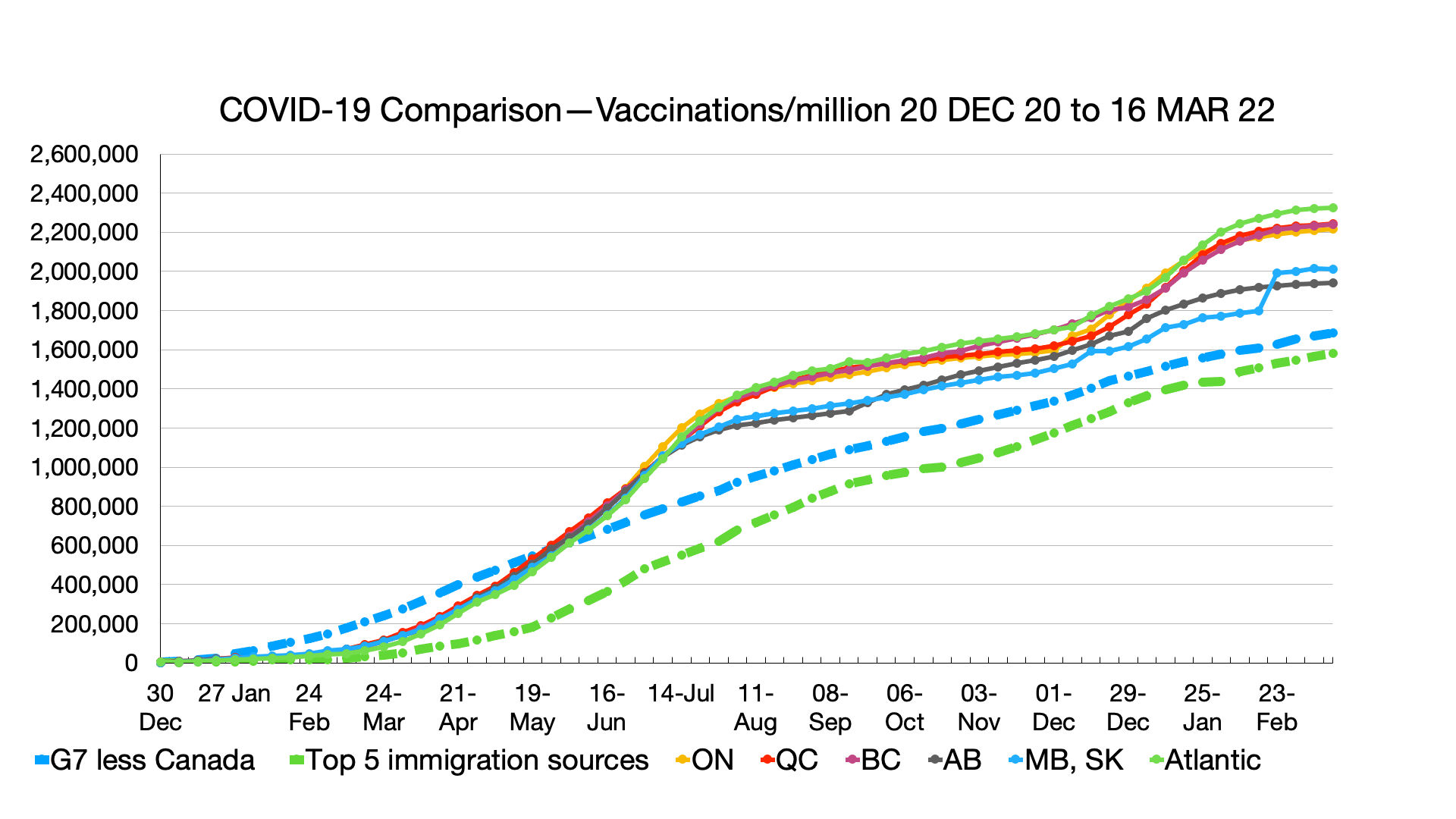
Vaccinations: Some minor shifts but general convergence among provinces and countries. Canadians fully vaccinated 81 percent, compared to Japan 79.1 percent, UK 72.7 percent and USA 64.9 percent.

Immigration source countries are also converging: China fully vaccinated 87.9 percent (numbers have not budged over past two weeks), India 53.9 percent, Nigeria 2.7 percent (the outlier, unchanged), Pakistan 40.6 percent, Philippines 55.6 percent.

Trendline Charts:

Infections: Signs of omicron and other variants plateauing.

Deaths: Quebec uptick appears to be plateauing.

Vaccinations: No major change but Alberta and Prairies continue to be laggards compared to other provinces. Ironic given they are among the first to relax and end restrictions.

Weekly

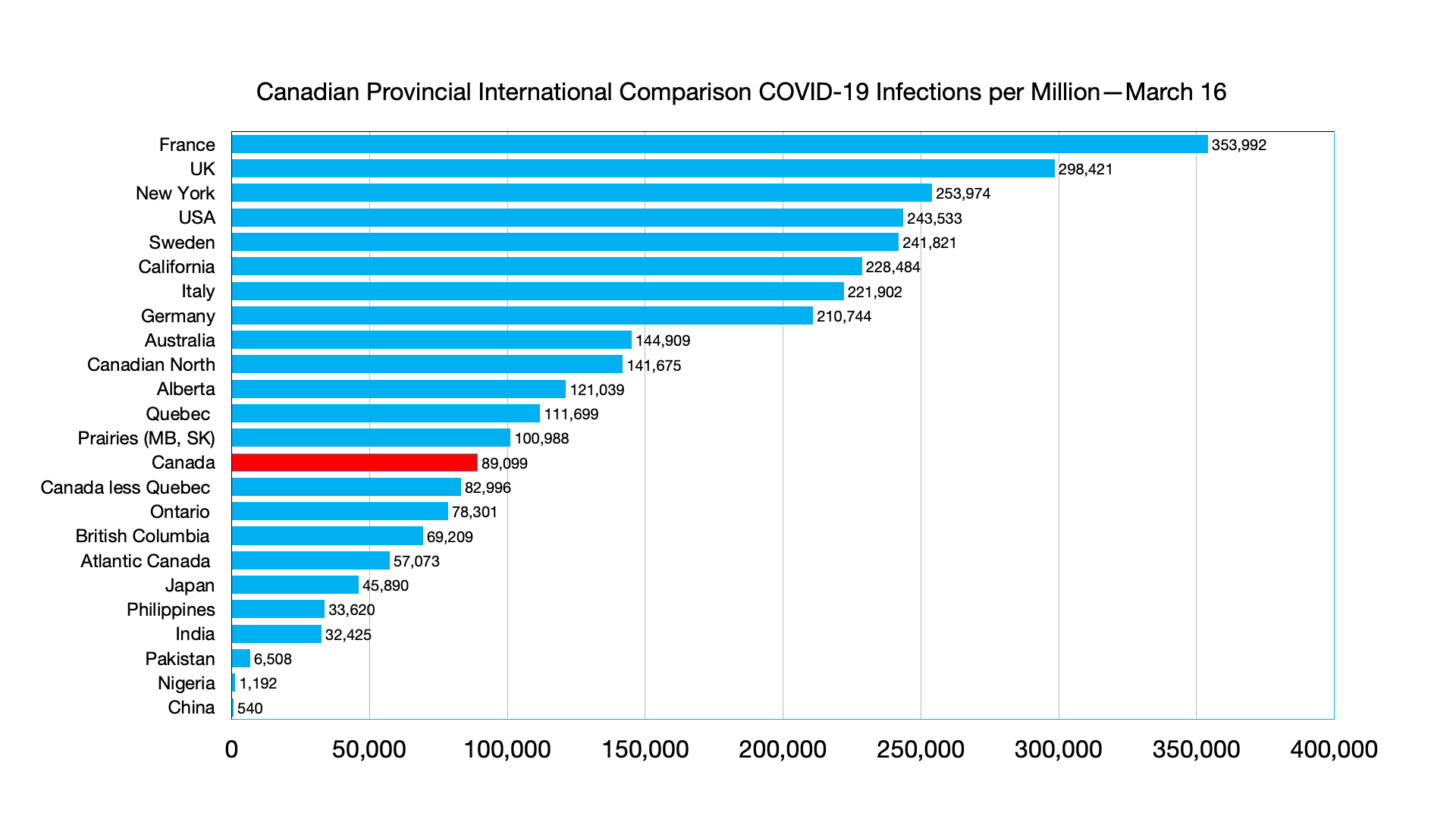
Infections: Sweden ahead of California, Australia ahead of Quebec, Canadian North ahead of Prairies.

Deaths: No relative change.