Closing Roxham Road border crossing will not stop arrival of asylum seekers: Trudeau 

For the record:

Closing an unofficial border crossing in southern Quebec will not slow the arrival of asylum seekers, Prime Minister Justin Trudeau said Thursday.

“If we close Roxham Road, people will cross elsewhere,” he told reporters in Ottawa. “We have an enormous border, and we’re not going to start arming or putting fences on it.”

On Wednesday, Quebec Premier Francois Legault called for Trudeau to close the makeshift crossing south of Montreal, saying that the province doesn’t have the capacity to care for migrants as they wait for their refugee claims to be processed.

Trudeau said intercepting irregular migrants at Roxham Road, where an RCMP post has been set up, allows Canadian authorities to conduct security verifications and to ensure that migrants are not “lost and illegal inside Canada.”

Negotiations are ongoing with the United States, Trudeau said, to change the Safe Third Country Agreement, which has led to the irregular crossings.

Under that agreement, which has been in place since 2004, asylum seekers who enter the U.S. must claim refugee status there and can be turned back if they attempt to enter Canada through an official border crossing to make a refugee claim. However, asylum seekers who cross the border irregularly can make a refugee claim once they are in Canada.

Discussions with the U.S. to change the agreement are “advancing well,” Trudeau said, but he added that the subject is delicate for the Americans, because they are worried about the impact any changes could have on the country’s border with Mexico.

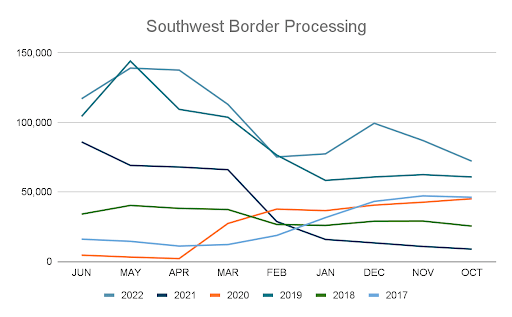
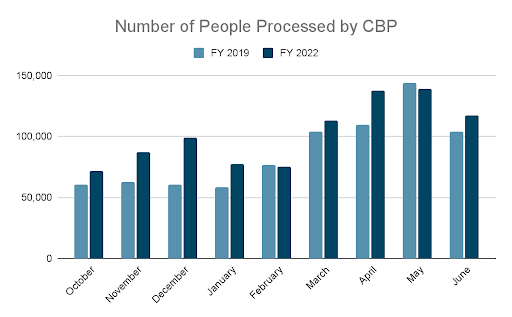
The RCMP have intercepted 7,013 asylum seekers who have crossed irregularly into Quebec from the United States since the beginning of the year, according to data from Immigration, Refugees and Citizenship Canada. In 2019, more than 16,000 asylum seekers were intercepted by the RCMP after crossing irregularly into Quebec.

Source: Closing Roxham Road border crossing will not stop arrival of asylum seekers: Trudeau 

CPC leadership debate: immigration levels consensus

Current high levels not an issue with no substantive differences between the candidates and little substantive discussion given debate format:

Asked about “the right number” of immigrants to bring into Canada in light of about 400,000 landing in the country in 2021, Aitchison, Brown and Poilievre framed the question as a workforce issue and called for more immigration. [Charest noted issue was integration more than levels]

Brown said Canada has a skilled labour shortage and it is not meeting the need.

“We need to unleash the Canadian economic potential through immigration,” he added.

Aitchison, while also calling for more, said whether the number of immigrants Canada settles is 400,000 or more, the country needs a targeted approach.

Source: https://edmontonjournal.com/news/local-news/cpc-leadership-candidates-play-tight-game-in-edmonton-debate

There were roughly three issues on which all six candidates agreed:

  • Oil and gas development (and pipelines) is good
  • Canada’s historically high rate of immigration (roughly 400,000 new Canadians per year) is good.
  • Boosting defence spending to two per cent of GDP is good

Source: https://nationalpost.com/news/canada/one-of-them-really-likes-amy-winehouse-the-parts-you-may-have-missed-at-the-conservative-leadership-debate

New research finds that preference for remaining is key to successful immigration: Turkish immigration in Germany study

Of interest:

New research finds that policies granting permanent residency to immigrants conditional on acquiring host country skills—like language—are most likely to generate higher fiscal contributions to the host country through income taxes. In fact, immigrants with a preference for remaining in the host country develop social contacts and other specific skills that allow them to find better paid jobs and stay for a longer time.

As immigration worldwide increases, host countries are faced with crucial policy decisions aimed at maximizing immigrants’ economic contributions. Designing the right policies requires understanding exactly how immigrants make their decision to migrate and return to their country of origin. Bocconi University, Milan, professors Jérôme Adda and Joseph-Simon Goerlach, with co-author Christian Dustmann (University College London), in a forthcoming article in The Review of Economic Studies, develop and estimate a that provides key insights into the decision-making process of immigrants. They find that immigrants’ expectations for the length of their stay and their location preferences can explain their decisions to invest in career improving skills, their acceptance of lower-paying jobs compared to natives, and how they respond to immigration policies on the duration and possibility of permanent residence.

While previous research focused only on productivity differences between immigrants to explain their career profiles, the authors argue that location preferences could be crucial in determining how much immigrants invest in acquiring skills that consequently impact their career profiles. For instance, an who prefers the host country and intends to stay permanently may invest more in learning the local language, familiarizing themselves with the local labor market, and developing social contacts and other host country-specific skills. Alternatively, a migrant with a location for their original country may not invest in these skills as they are likely undervalued back there. The authors model this preference and estimate the impact of location preferences and planned migration duration using data from surveys of Turkish immigrants in Germany over three decades, starting from 1961.

Indeed they find that immigrants who remain are higher-skilled due to their conscious investment in host-country skills. Their model is also able to explain why immigrants may be more willing to accept low-paid jobs compared to natives. They argue that immigrants from countries that have a lower price level and who want to return home would face higher effective wages since their wage allows them to consume more at home over their lifetime. Knowing this may encourage temporary migrants to accept lower-paid jobs.

The authors also use their model to compare three different types of prevalent today that grant permanent residency after 5 years either conditional on:

  1. An earning threshold (like the UK);
  2. Acquiring host-specific skills such as language (like in some countries of the EU);
  3. Granted randomly with 30% probability.

The authors find that scheme 1 selects for high productivity migrants and scheme 2 for those with a high preference for the host country.

Assuming a population of 25-year-olds migrating to Germany in 1970 as an example to estimate on, the earning threshold rule would generate an annual per capita increase in tax payments by €782 compared to if the policy wasn’t there. The host-specific skills rule would generate an average annual tax gain of €789 and fewer tax losses due to fewer individuals leaving the host country. The random lottery instead leads to a decrease in average annual taxes by €633 since the expected returns to investing in host country skills are reduced due to the scheme’s reliance on random chance. Furthermore, schemes 1 and 3, due to the barriers they pose to seeking permanent residency, reduce total immigration by about 26% whereas the host-specific skills rule does so by around 3%.

Thus, the authors show how these schemes could have differential impacts when one accounts for not only immigrants’ productivities but also their location preference / expected duration of stay. As the recent Ukrainian refugee crisis shows, such considerations are crucial for both the host countries’ goals as well as the lives and decisions of the arriving immigrants and their integration and acceptance in societies.

Source: New research finds that preference for remaining is key to successful immigration

Le conflit Québec-Ottawa au sujet du chemin Roxham se poursuit

Not surprising. More comprehensive article than in English press:

Justin Trudeau n’a pas mordu, mercredi, aux demandes renouvelées de Québec, qui réclame la fermeture du passage frontalier du chemin Roxham. La situation est pourtant insoutenable, selon le gouvernement de François Legault.

Québec prévoit qu’au rythme actuel, plus de 35 000 demandeurs d’asile se présenteront à ce point de la frontière canado-américaine cette année. C’est beaucoup trop, soutient le gouvernement Legault, qui a appelé mercredi le fédéral, pour une deuxième fois en moins de cinq mois, à « arrêter ce flux quotidien ».

« On veut que [les passages] se fassent de manière ordonnée, régulière et légale. On est rendus à un stade où on excède nos capacités », a indiqué le ministre québécois de l’Immigration, Jean Boulet, à l’Assemblée nationale.

L’élu de la CAQ évalue la capacité d’hébergement du Québec à 1150 demandeurs. « On y est, ou à peu près », a-t-il dit en mêlée de presse. Et, avec l’été, le gouvernement Legault ne s’attend pas à voir le flux de migrants diminuer. « Il y a une augmentation actuellement », a souligné le premier ministre mercredi.

« [Roxham], c’est une passoire ; c’est reconnu à l’échelle internationale, a déploré le ministre Boulet. Ça ne peut pas continuer comme ça. »

Nouvel accord en immigration ?

À Ottawa, le gouvernement de Justin Trudeau n’a pas voulu s’engager, mercredi, à barrer la route aux migrants qui se présentent au sud de la Montérégie.

Il assure que les négociations avec les États-Unis en vue de la signature d’une nouvelle entente en immigration vont bon train. « Je sais qu’il y a des progrès avec les ressources qu’on a mises sur ce point [de passage] particulier à la frontière », a précisé en point de presse le ministre fédéral de la Sécurité publique et ex-ministre de l’Immigration, Marco Mendicino. Il assure que le chemin Roxham est « un dossier qui est très important » pour son gouvernement, et dit qu’il « collabore toujours avec le gouvernement Legault ».

Son collègue de l’Immigration, Sean Fraser, a répété que le gouvernement devait « respecter les droits des demandeurs d’asile » et suivre « des normes légales » quant à leur accueil.

En chœur, les quatre principaux partis à l’Assemblée nationale ont exigé qu’Ottawa revoie l’Entente sur les tiers pays sûrs, l’accord qui régit la traversée des demandeurs d’asile au Canada.

Entré en vigueur en 2004, le pacte autorise le Canada, dans les faits, à refuser toute demande d’asile effectuée à un poste officiel à la frontière canado-américaine sous prétexte que les États-Unis sont un pays « sûr ». Ne pouvant donc pas passer par les postes douaniers qui parsèment la plus longue frontière terrestre du monde, les migrants ont historiquement été refoulés vers des points de passage irrégulier comme celui du chemin Roxham, ce qui concentre donc leur arrivée au Québec.

Jean Boulet veut voir le gouvernement fédéral à la table de négociation avec les États-Unis au plus vite afin qu’ils revoient cette entente. Or, jusqu’ici, Ottawa s’est traîné les pieds, a-t-il avancé mercredi. « Cette entente-là, ou on la met de côté, ou on la redéfinit, ou on la modernise. Et à cet égard-là, Ottawa a énormément de travail à faire », a-t-il affirmé.

Des appuis à la position caquiste

En exigeant la fin des demandes d’asile au chemin Roxham, la CAQ rejoint les arguments du Parti québécois (PQ), qui insiste depuis le début de la semaine pour que soit réglée la situation dans ce coin de la Montérégie. « Qu’on encourage les passages illégaux seulement au Québec et que ça atteigne des dizaines et des dizaines de milliers d’entrées par année, c’est de faire porter au Québec un fardeau administratif […] qui n’a aucune logique », a clamé le chef péquiste, Paul St-Pierre Plamondon, en matinée.

Le Bloc québécois a entrepris de transposer les demandes du gouvernement québécois à Ottawa. Le parti d’Yves-François Blanchet a déposé une motion devant le Parlement, mercredi, pour demander au gouvernement qu’il suspende cette entente avec les États-Unis « et qu’elle réclame le passage des migrants par les voies régulières partout au Canada et, conséquemment, la fermeture du chemin Roxham ».

La motion a été battue, faute d’obtenir l’unanimité.

« La capacité d’accueil responsable de l’État québécois a des limites dont il faut tenir compte — sauf si on veut, en effet, faire déborder la capacité québécoise en [matière] d’accueil, d’intégration et de francisation », a expliqué le chef bloquiste, Yves-François Blanchet.

Le Parti conservateur du Canada a aussicritiqué l’approche du gouvernement libéral, jugée trop laxiste. « Si nous voulons limiter l’arrivée de toutes ces drogues et armes illégales, nous avons besoin d’investir plus dans nos points d’entrée et de sécuriser le chemin Roxham », a déclaré la députée conservatrice manitobaine Raquel Dancho.

Des bémols

Pour le Parti libéral du Québec, la position défendue par le gouvernement caquiste, le PQ et le Bloc a quelque chose d’« inhumain ». « La moindre des choses, ici, c’est à mon avis de démontrer une certaine humanité face à des personnes qui sont démunies », a soutenu le député libéral Carlos Leitão.

Québec solidaire craint pour sa part qu’une fermeture unilatérale du chemin Roxham ne fasse que mettre en danger les quelques dizaines de milliers de demandeurs d’asile qui se présenteront à la frontière québécoise cette année. « Ça [déplace] le problème vers des endroits inconnus, ça [fera] encore davantage de demandeurs d’asile qui vont traverser n’importe où, sans aucun contrôle », a signalé le porte-parole du parti en matière d’immigration, Andrés Fontecilla.

Québec n’en est pas à sa première sortie pour demander la fermeture de ce passage frontalier. En décembre, le ministre Boulet était passé par Twitter pour dénoncer la menace que poseraient les arrivées par ce point sur le système de santé québécois. L’élu s’était partiellement rétracté dans les jours suivants, et avait admis que « la qualité humaine » de son message n’était « pas optimale ».

Plus de 10 600 demandeurs d’asile se sont présentés au chemin Roxham depuis le début de l’année, selon les données du ministère de l’Immigration, de la Francisation et de l’Intégration.

Source: Le conflit Québec-Ottawa au sujet du chemin Roxham se poursuit

Globe article:

Quebec is asking the federal government to close a popular, unofficial border crossing south of Montreal because the province can’t handle the number of asylum seekers entering the country, but refugee advocates are rejecting Quebec’s claims.

More than 100 refugee claimants are entering Quebec every day from the United States through a rural path called Roxham Road, Premier François Legault told reporters Wednesday.

“It’s unacceptable,” Legault said at the legislature. “It’s impossible because we don’t have the capacity.”

The federal government takes 14 months to study an asylum claim and in the meantime, Quebec has to house and care for would-be refugees and school their children, the premier said.

“We cannot afford to give services,” Legault said, adding that if the current pace continues, Quebec will not have adequate housing for 36,000 new arrivals.

Refugee advocates, however, say they don’t accept the premier’s claim.

“What is Quebec’s capacity for compassion? For justice? It’s maybe not unlimited, but the capacity is there,” Paul Clarke, interim executive director of Action Réfugiés Montréal, said Wednesday in an interview.

Clarke, whose group sponsors and offers services to refugees, said that while it can be difficult for asylum seekers to find shelter in Montreal, he doesn’t think the situation is any better in other Canadian cities.

Quebec needs people, advocate says

Janet Dench, executive director of the Canadian Council for Refugees, said that during the pandemic, many people who had crossed the border at Roxham Road found work in Quebec’s long-term care homes.

“We not only have the capacity, but we also have the need, in fact, for more people,” she said in an interview Wednesday.

Part of the problem, she said, is the length of time it takes the federal government to issue work permits to asylum seekers.

“The federal government could alleviate things tremendously simply by giving work permits shortly after people arrive, so that they can get to work, and there are many jobs that they could very usefully fill,” Dench said.

The irregular border crossing at Roxham Road reopened in November after it was closed during the pandemic. Since the beginning of the year, the RCMP have intercepted 7,013 asylum seekers who have crossed irregularly into Quebec from the U.S. That number is up from 4,246 last year.

In 2019, more than 16,000 asylum seekers were intercepted by the RCMP after crossing irregularly into Quebec.

Legault said many of those who cross irregularly are ultimately not able to stay in Canada.

“You have to understand, the problem is that many of these people are not really refugees,” the premier said. “A refugee is someone who is physically at risk in their country. But the majority are not refugees; eventually, when the file is analyzed, they are refused, returned back home.”

Clarke said it’s not possible to determine which refugee claimants will be successful. “To say half of these people aren’t going to make it, well, which half, Mr. Legault?

“If he’s saying that, then he is acknowledging that people are coming to Canada and they do need protection. So how do you figure out which half?”

Under the 2004 Canada–United States Safe Third Country Agreement, refugee claimants who enter Canada outside an official port of entry must be processed in Canada and cannot be immediately returned to the U.S. Claimants who come through official entry points of entry, however, are sent back to the U.S.

Dench said closing the Roxham Road entry point would merely push people to cross at other points of entry — which would make it more difficult for the federal government to process asylum seekers.

“The reason they’re concentrated in Quebec is simply a matter of geography, because there is a large land border between the U.S. and Canada that people can cross over,” Dench said.

Federal Public Safety Minister Marco Mendicino told reporters Tuesday that a balance needs to be found.

“Resources have been provided for that particular issue at the border,” he said. “We are also in discussions with the U.S. to regulate the movements of any asylum seekers. This is part of the strategy in order to both defend the rights of refugees while at the same time protecting Quebec citizens.”

Source: Quebec asks feds to close Roxham Road, says province can’t handle influx of refugees

USA: The Value of Foreign Degrees by Source Country

Interesting analysis, broken down by country of study. Not sure if anyone has done the same for Canada but would not be surprised to see a similar pattern:

Whether assessing the education level of recent arrivals or designing a “high-skill” system for selecting future immigrants, analysts should be careful not to treat foreign degrees as equivalent to U.S. degrees. Using data from the National Survey of College Graduates, this report shows not only that foreign degrees as a whole are less valuable in the U.S. than U.S. degrees, but also that their value varies substantially depending on the specific country or region where the degrees were earned.

The findings below refer to full-time U.S. workers with at least a bachelor’s degree:

  • After controlling for a traditional set of earnings-related characteristics, foreign-educated immigrants earn 17 percent less than natives who were educated in the U.S.
  • The foreign-degree penalty is driven primarily by immigrants educated in non-Western countries.
  • Immigrants educated in Latin America (24 percent salary penalty), Eastern Europe (27 percent), China (28 percent), the Philippines (35 percent), and Africa (39 percent) all experience penalties that exceed the foreign-degree average.
  • By contrast, immigrants educated in Western Europe, Australia, and India earn roughly the same salaries as comparable U.S. natives.
  • Canadian-educated immigrants earn 20 percent more than U.S. natives.
  • Controlling for the type of entry visa that each immigrant receives does not eliminate the variation in foreign-degree value.

Source: The Value of Foreign Degrees by Source Country

NZ Government ‘rebalances’ immigration settings to attract more highly skilled migrants

Of note. Given Canada’s expansion of the Temporary Foreign Workers Program, arguably Canada is moving in the other direction:

The Government is rejigging New Zealand’s immigration systems in what it describes as a “rebalancing” away from low-skilled, low paying jobs and more towards higher skilled jobs in industries facing staff shortages.

The changes, announced Wednesday by Prime Minister Jacinda Ardern and Immigration Minister Kris Faafoi, include the introduction of a Green List of “highly skilled roles identified as being in high demand globally and in ongoing shortage in New Zealand.”

The Green List includes 44 occupations that allow eligible migrants to apply for work visas from July 4, and residence visas from September.

The occupations are mainly geared towards the construction, health care and IT industries and include roles such as civil engineers, surgeons and other medical practitioners, food technologists and software engineers.

The Green List also lists another 16 occupations which will allow migrants to enter the country on work visas and apply for residence visas after two years.

These include medical roles such as laboratory technicians, occupational therapists and registered nurses and other jobs such as secondary school teachers, electricians, mechanics and dairy farm managers.

The rules give migrants applying for jobs on either list a clear pathway to residence.

The partners of migrants in Green List occupations will also have open work rights.

The Government says the Green List is shorter and more targeted than the current skills shortage list, which it will replace.

The visa application process is also being streamlined to make it easier for employers to hire migrants for jobs on the Green List.

The application process will be entirely online, with Immigration NZ aiming to process all Green List applications within 40 days.

However migrants will still be able to apply for work visas for jobs that are not on the Green List.

In general, migrants filling non-Green List roles will need to be paid a minimum of $27.76 an hour (the median wage), which will be adjusted annually.

However there is a long list of exemptions to that rule, which will require a minimum wage of just $25 a hour, mainly in the tourism and hospitality sector.

A minimum wage of $25.39 will apply for migrants working in personal and disability care roles that do not require higher qualifications.

Work visas for these roles will be for two years, after which they can be extended provided the migrant is being paid at least the NZ median wage.

Source: Government ‘rebalances’ immigration settings to attract more highly skilled migrants

Canada is leaving some would-be immigrants waiting just to hear whether their application has been received

More accounts on backlogs, processing delays and lack of communication:

When Manmeet Kaur applied to sponsor her newlywed husband to come from India to join her in Canada, it seemed like a no-brainer to submit the application online rather than to send the paperwork by courier.

Electronic application through new government portals was supposed to be faster and keep important documents — such as wedding photos and personal identification — from getting lost in the process or mixed up with others’ files.

And so, Kaur applied last September.

As she watched applicants she had met through social media groups, and who had applied around the same time, start to get their acknowledgment of receipt, better known as their “AOR,” the Brampton woman says, she expected that immigration officials would soon open her e-application and that her day would come.

She says she got nervous when others who had applied months after her were getting their AOR, which is only issued once a thorough check by officials ensures an application is complete — with no missing forms, documents and signatures. That’s when an applicant receives a file number and the actual processing starts.

“Many of the September applicants have gotten their passport requests and decisions made in January and February. While we’re still waiting for our AORs, some already have their spouses with them. Now January and February applicants are getting their AORs, too,” said Kaur, 27, a medical lab technician, who last saw her husband in India in July.

“The people who applied first should get processed first. I completely understand each file is different and some take longer than others. But we are talking about just checking if an application is complete or not. It should make no difference. Now, we’re lagging further and further behind.”

Few other federal services have seen so much disruption as the immigration system during the pandemic, with the operation grinding to a halt; staff working remotely with antiquated infrastructure; and travel restricted for newcomers abroad due to border closures.

Source: Canada is leaving some would-be immigrants waiting just to hear whether their application has been received

Douglas Todd: Why Canadian wages never seem to go up

Good summary of concerns regarding low GDP per capita growth:
There is a startling admission buried in Chart #28 of the budget released this month by Canada’s Liberal government.
The chart in Finance Minister Chrystia Freeland’s budget quietly acknowledges a forecast by the OECD, a club of mostly wealthy nations, that Canada will likely come in dead last in the next four decades in regard to GDP growth per capita.The downplayed chart, one tiny aspect of the 304-page document, serves as a warning that individual Canadians, compared to the citizens of 39 other economically advanced countries, will in the next decades likely suffer the lowest real growth in their wages.

Freeland puts the blame for tepid wages almost entirely on Canadian businesses, which she claims “have not invested at the same rate as their U.S. counterparts.” The finance minister then boasts that Ottawa’s policies on housing and immigration will “strengthen the middle class and leave no one behind.”

But more than a few people suggest they are doing the opposite. Why, when the country’s GDP is expanding, have individual Canadians not been getting ahead? Why is their wage growth projected to lag so far behind citizens of other nations? And why are millennials taking the brunt of it?

The OECD predicts Canadians will experience the lowest growth in real wages out of 40 advanced economies. A downplayed version of this chart appeared in the Liberal budget. (Source: OECD / B.C. Business Council)

David Williams, policy analyst for the Business Council of B.C., is helping ring the national alarm bells.

“Past generations of young Canadians entering the workforce could look forward to favourable tailwinds lifting real incomes during their working lives. That’s no longer the case,” he said.

“If the OECD’s long-range projections prove correct, young people entering the workforce today will not feel much of a tailwind at all. Rather, they face a long period of stagnating average real incomes that will last most of their working lives.”

Ottawa’s economic strategy is based on several “shaky pillars,” which include using “record immigration levels to turbo-charge population growth and housing demand in major cities,” Williams said.

“The political class appears to have lost interest in efforts to raise workers’ productivity and real wage growth through higher business investment per worker.”

Toronto-based analyst Stephen Punwasi says Canada is on its way to becoming the “next Greece,” referring to the way Greeks’ personal incomes tanked more than almost anywhere else after 2009 because of the housing-mortgage-ignited recession.

“Canada has embraced cheap growth by way of residential investment and debt,” Punwasi says. Canada has been putting too much emphasis on home construction, he said, as well as on printing money at a faster rate than almost any other country.

Nowhere in Canada, or even in much of the world, does the economy rely on housing as much as it does in B.C., which has a lower GDP per capita than Alberta and Saskatchewan. Almost 30 per cent of B.C.’s overall economy is tied up in real estate and construction. But the housing sector struggles to grow the economy, or wages, like other industries, which are more able to innovate and export.

The Liberals’ commitment to record immigration targets focuses mostly “on the benefits immigrants provide to older Canadians,” Punwasi said, including in the form of “strong housing demand and tax revenues.”But he cautions that Ottawa’s policies often exploit newcomers, who end up coming to the country unaware of flat wages, especially for the young adults who make up the bulk of immigrants, foreign students and temporary workers.

Donald Wright, the freshly retired head of B.C.’s provincial civil service, notes discouragingly that six out of 10 Canadians recently toll Nanos pollsters they expect their standard of living to worsen.

“Isn’t it time we took Canadians standard of living seriously?” Wright asks in presentations to groups of Canadian Senators and to the Canadian Association of Business Economists.

In addition to Wright’s concern about Ottawa’s inability to promote technological advancement and productivity, he joins Punwasi in worrying that policymakers are over-relying on population growth and cheap labour. It’s not helping the middle classes, he says.

“It’s time for some nuance on immigration policy,” says Wright, who was B.C. Premier John Horgan’s deputy minister. While remaining pro-immigration, Wright hopes for a more thoughtful debate about immigration in Canada, otherwise anti-immigration populists could come to dominate, as they have in other countries.

As it is, Prime Minister Justin Trudeau’s economic plan relies on increasingly record-high immigration counts — of 432,000 in 2022, 447,000 in 2023, and 451,000 in 2024. That compares to 250,000 when the Liberals were first elected.These targets, far higher than those in the U.S. or almost anywhere else, will impact economic equity in Canada, Wright says. “The evidence is very strong that the demographic group most adversely affected by higher immigration is the previous cohort of immigrants.”

That’s in part because the largest group of immigrants is disproportionately those between 25 and 40 years old, which is the same cohort as the already large baby-boom echo, also known as millennials.

An increase in immigration at this time amplifies the challenges millennials are having, particularly in the housing market, Wright says. “So, even if there is a valid argument for raising immigration levels, this is being done approximately 10 years prematurely.”

What makes it all the more unsettling is that the corporate-backed organizations pushing Ottawa to hike immigration targets, such as The Century Initiative and the Conference Board of Canada, have acknowledged that higher immigration leads to lower GDP per capita.

“So why,” Wright asks, “has it become the core of the federal government’s economic ‘strategy’?”

Source: Douglas Todd: Why Canadian wages never seem to go up

The Reckoning: International Student Enrolment

Another possible indicator that housing may prove to be the canary in the coal mine with respect to current high levels of immigration, with Alex Usher’s take on international students:

I am calling it now: Canadian post-secondary institutions are very close to the end of the road on international student number growth.  It’s not because demand is going to dry up or anything like that.  There is still room for hundreds of thousands more international students if we wanted them, and probably demand to match as well.  It is simply that too many institutions have become too greedy, and they are imposing intolerable externalities on their surrounding communities.  A backlash is building.

I want to be clear about what’s not going to drive the backlash.  First, it’s not going to be about foreign students “taking spots from deserving Canadian students”.  This is a talking point in some places, but there are no post-secondary institutes and only a very few faculties nationally where one can genuinely point to domestic student numbers falling for any reasons other than demographics.  The spaces being taken up by international students are all spaces that exist only because international students are there, paying full freight for them.  The counter-factual to spots taken up by international students is – given current government funding practices – no spots at all, not spots taken up by domestic students.

Nor is it going to be from all those recent stories in outlets like The Walrus, the Toronto Starthe Globe and Mail etc.  about the exploitation faced by international students in the local labour market, about the incredible hardship many endure since tuition fees here are sometimes many times their parents annual income back in their home country (which, in these stories, is usually India, most often Punjab).  Clearly, we all decided in that very passive-aggressive Canadian way of ours – which is to say, we never had a discussion and agreed to a thing, we all went around self-interestedly and created a situation, then called it a consensus – that we were OK with creating a new class of immigrants who could evade the whole points-based immigration system simply by coming to Canada, paying some money to support our post-secondary system and gutting it out in low-wage jobs for a few years.   Exploitation?  Maybe.  But many ethnic groups who have immigrated to Canada over the past 150-odd years followed similar, gruelling, dues-paying periods in their history, so not many people are too fussed about it.  

No, the blowback is going to be about housing, and the way that some institutions have been packing in students without regard to local housing supply, which contributes to the steep rise in housing costs not just for international students but for all renters and first-time home buyers.  I discussed this a few weeks ago in the context of some new reports from my colleague Mike Moffatt at the Institute for Smart Prosperity: we are letting in hundreds of thousands of students, and not building any new housing.  Combined with a variety of other factors that are taking low-income housing off the market, it does not take a degree in economics to realize that there will be a shortage of spaces for anyone looking for low-rent housing.  This is, in effect, an externality that institutions are imposing on their neighbours: universities and colleges gain from tuitions, while local tenants are effectively paying a tax through higher housing costs.  

I suppose one could argue that the pros of having a thriving post-secondary institution in the neighbourhood outweighs the cons of these kinds of externalities, and on aggregate that’s true.  But rents aren’t paid on aggregate: they are paid by a very specific sector of the population – one which has a large overlap with the most vulnerable sector.  It is becoming an issue that politicians are hearing on doorsteps when they talk to voters.  In some communities, politicians are starting to relay those concerns to university and college leaders.  

Now, you might ask why opprobrium would rain on universities and colleges when they are far from the only culprits here. Long-term NIMBY-ism run amok leading to a catastrophic failure to build, the financialization of the housing market, the accumulated 30-year impact of the federal government leaving the affordable housing market and provinces failing to pick up the baton: there are indeed all sorts of supply-side issues that we can and should worry about at least as much as educational institutions juicing demand.  

But here’s the difference: none of the other players in this field spend their time shouting at the top of their lungs about how much they benefit the community.  And not just in financial terms; institutions are increasingly using communications tools like the UN Sustainable Development Goals to articulate not just how research and its dissemination helps to improve the world, but also how their local community benefits directly through more concrete actions (purchasing) and co-creation of knowledge.  Colleges have always anchored their value-proposition in terms of their value to local communities, but for many universities this is a more recent shift, one accelerated by COVID but in a larger sense driven by the dawning realization that all the money and research invested in higher education (worldwide, not just in Canada) isn’t exactly leading to the paradise of economic prosperity we all thought it would 30 years ago and that alternative ways of explaining value propositions to voters are needed.

This “good neighbour” policy makes eminent sense; it’s also why the international student/rental housing policy nexus is so deadly. Some institutions – and there’s no way to put this politely – are clearly acting as “bad neighbours”.  And once they get that labelled with that tag, it’s going to be hard to shed.  There are, of course, many institutions who are doing their best to get housing efforts started in their communities – though universities in Nova Scotia seem significantly more seized of this issue than those anywhere else – but new housing takes time to come on-stream.  It can take years, decades even, given the inanities of planning and land-use in this country’s big cities.   But those international students are showing up now, and in growing numbers, year after year.   Institutions that continue to pile pressure on local housing markets by adding more students are playing with fire.

So here’s my call: the international student market is not headed for a “bust” of any kind – remember, demand is still strong – but institutions will stop growing if they wish to maintain good community relations.  That’s a big problem, because international student dollars have essentially been the sole source of increased funding in Canadian post-secondary education since about 2015, and I don’t see governments lining up to backfill.  To some extent, institutions can mitigate this by upgrading services and charging higher fees to international students, but increasingly aggressive cost-containment strategies will need to be part of the solution as well.  At some institutions at least, this will come as a shock.

But this is the path we have been on since at least 2008 when provinces stopped increasing funding in real terms, but institutions kept on increasing spending by 2% per year after inflation.  For a long time, we used international students as a get-out-of-jail free card.  No more.  The reckoning is at hand.   

Source: The Reckoning

Quebec opposition party wants non-polarized debate on immigration

While it appears that the PQ is likely to suffer further setbacks in the election, will be interesting to see if immigration becomes an issue in the election or related issues like Bill 21.

That being said, the questions they ask also apply to Canada’s immigration policies, where the impacts and externalities are not being discussed enough:

With five months to go before the provincial elections, the debate on immigration has been revived.

The Parti Québécois (PQ) is opposed to employer groups’ demand to increase the current 50,000 immigrants per year to 80,000, or even 90,000.

The sovereigntist party is calling for a “serious” discussion based on “factual and scientific” data.

PQ leader Paul St-Pierre Plamondon was reacting to the Conseil du patronat and Manufacturiers et exportateurs du Québec’s (MEQ) calls for a considerable increase in the annual immigration threshold to fill the labour shortage.

In a Canadian Press interview on Sunday, the PQ leader argued that despite the constant increases in the number of immigrants admitted to Quebec over the past 30 years, the demand for workers has nevertheless not subsided. The so-called solution has not solved the problem, he said.

What’s more, the considerable increase claimed would only increase the demand for services such as family doctors, places in public daycares (CPEs) and housing, said immigration lawyer Stéphane Handfield, who is the PQ candidate in Masson in the October elections.

“Are we doing new immigrants a favour if we don’t take these issues into account in our reception and integration capacity?” said Handfield.

SCIENCE OVER IDEOLOGY

“We want a debate based on science and not on ideology or false premises,” said St-Pierre Plamondon.

He called for caution to avoid any slippage in this debate, which has had unfortunate precedents.

“The simple fact of asking questions about raising the immigration threshold leads to innuendo about the intolerance of those who ask the questions, it creates a climate that is not serene,” said St-Pierre Plamondon.

“Historically, there has been a lot of ideology and stigmatization” on the issue of immigration, and this ends up harming “the right of Quebec to take its own direction,” said the PQ leader.

St-Pierre Plamondon criticized the suggestion that as soon as Quebec does not align itself with the Canadian federal model of admitting more and more newcomers, it is accused of being racist, even though immigration is partly within its jurisdiction.

QUESTIONS TO ASK

The PQ leader has many questions.

For example, does welcoming more immigrants create more wealth? Does it really increase the gross domestic product per capita?

“We want to study the macro-economy objectively,” he said, demanding more answers.

Handfield also wants to know what the impact of increased immigration is on the linguistic dynamics? What is the impact on the housing crisis? Does it lower the average age of the workforce?

“I’ve never seen a study that says here’s why we need 30,000 or 40,000 immigrants, or here’s how we manage to justify that number,” said Handfield. “How much does it cost to integrate each immigrant? We always hear the same thing: 80,000 immigrants per year and all the problems will be solved.”

Currently, there are no less than 240,000 vacant positions to be filled in Quebec, according to data from the Institut du Québec.

Employers’ associations are calling for a catch-up in immigration to make up for the labour scarcity and the delay caused by the closing of borders during the pandemic.

Their consensus is 80,000 per year, but MEQ president Véronique Proulx said the organization would be willing to go to 90,000, almost double the current threshold of 50,000 per year.

The Legault government has not given its official answer.

St-Pierre Plamondon reiterates that he is committed to setting the acceptable threshold for his party by the election campaign.

Source: Quebec opposition party wants non-polarized debate on immigration