CILA: “We Apologize for the Inconvenience”: A Cautionary Tale of IRCC’s Decision to Move PR Applications Online

Hopefully only teething problems but IRCC seems to have a number of them post-pandemic, not limited to digital services:

Excitement spread through our office upon learning that IRCC will resume Express Entry draws in July, after almost a one-year hiatus. In anticipation of this much-welcomed return, we made sure to review and update all our client’s profiles so that once the “we are pleased to invite you to apply for permanent residence” correspondence came in – we were ready.

After the first round of invitations, we had a few fortunate clients who had received such correspondence. We immediately began completing the eAPR’s and uploading documentation onto my authorized representative portal. For one client, however, each time we attempted to access the eAPR – we were met with a message from IRCC that their system was down as they are either updating the website or experiencing technical difficulties.

Given the frequency of portal glitches and technical issues myself and fellow immigration lawyers have experienced while using IRCC’s portal, I was not too alarmed and figured to try again later. Unfortunately, the technical issue did not resolve the following day, or even after performing the common ritual of clearing my browser history and using different search engines.

On its website, IRCC states that if you are experiencing any technical difficulties, you can submit a webform. If an application cannot be submitted online and requires accommodations, one can contact IRCC to request an alternative format. Following this advice, we submitted multiple webforms enclosing screenshots of the glitch, and requested for alternative instructions to submit the application given that Express Entry PR applications can only be submitted online.

None of our webform pleas for help and assistance received a response. Emails which were responded simply included links to IRCC’s webform. Calling the IRCC helpline is a task I would only assign as a form of punishment.

Alas – I receive an email response from the Immigration Representatives Mailbox:

“We regret to inform you that your client’s EE profile has now expired due to a technical issue with our online tools. You must create and submit a new EE profile and wait for another ITA to be issued before you can apply for permanent residence. We apologize for any inconvenience this may have caused.”

This response is alarming, as it ultimately places the burden on the applicant to deal with the consequences of a dysfunctional portal. This response does not take into account that, perhaps, there was an expiring LMIA, work permit, English test results – or that the applicant’s score may not be high enough to make the CRS cut-off on a future round.

The response is also an example that supports the concern fellow Canadian immigration lawyers have expressed with respect to the recent announcement by IRCC, whereby it will be mandatory to submit most permanent residence applications online.

The ability to submit PR applications by paper or online has been imperative, given the poorly functioning platforms and lack of timely user technical support. It is not uncommon to see the ‘rep portal is down’ email in our inbox and responses to webforms which were submitted over 30 days prior. IRCC has been made aware of these issues, but fully functional portals and timely responses to calls for help remain to be delivered.

Document upload size along with symbol size limits on IRCC’s Permanent and Temporary Residence portals have led applications to be filed on paper versus online, as the difficulties in navigating these restrictions and lack of technical support caused undue stress and delays for the immigration lawyer community and their clients – especially when there are impending deadlines.

No system is perfect, and technological issues may occur with the various tools legal practitioners have the ability to utilize these days. What is problematic, however, is the lack of support and guidance available to both immigration law practitioners as well as to unrepresented clients when dealing with IRCC’s online portals. Most of the time, inquiries are not answered, or responses to critical inquiries are significantly delayed, which has led applicants to postpone their work, studies or even miss PR submission deadlines which ultimately decide the fate of their future in Canada

There is room for improvement in how IRCC’s technical capabilities can be facilitated. For example, IRCC can provide explicit instructions on their website to those who are experiencing technical issues with submitting an application by listing a designated email address or location to which the application can be sent via courier accompanied by screenshots or explanations. A designated, live support chat or inbox for communicating errors or glitches would also be welcome, especially in time-sensitive situations.

Until IRCC can assure the public that the platforms will be fully functional and there will be ways to access timely assistance in case of technical issues, it should pause the transition of moving PR applications to be fully digitized or allow paper applications to be submitted as an alternative method in the event applicants face technical challenges with IRCC’s portals.

Source: “We Apologize for the Inconvenience”: A Cautionary Tale of IRCC’s Decision to Move PR Applications Online

Canadian banks look to newcomers as key source of client growth

Not really a new trend:

Canada is banking on newcomers to help keep the economy humming along, while banks themselves are eying the hundreds of thousands of people coming to the country every year as a key source of client growth.

Those efforts have been growing along with the number of newcomers, including more efforts to secure people as customers before they even arrive in Canada.

“We’re seeing it as a big focus across all categories of banks, not just the big banks,” said Abhishek Sinha, banking transformation leader at EY Canada.

“Whether you talk to the Big Five or you talk to the next tier after that, or even the credit union segment, newcomers and penetrating that market segment is super important.”

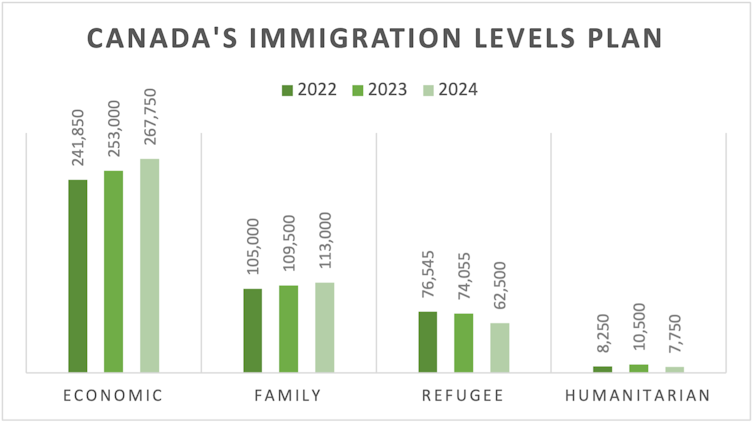
The efforts come as Canada has been welcoming record numbers of newcomers, with an aim to bring in 432,000 permanent residents this year, rising to 451,000 by 2024, while the first half of the 2010s saw the average number of newcomers sit around 260,000.

The segment, which the federal government says accounts for almost all of Canada’s labour force growth and roughly three quarters of population growth, has pushed banks to create partnerships like one recently announced between RBC and ICICI Bank, India’s largest.

“With immigration levels expected to rise to record levels, we’ve announced a collaboration agreement with ICICI Bank Canada,” said RBC chief executive Dave McKay on an analyst call in August.

Some student visa classes require students to put down cash deposits, and the program allows those to seamlessly be transferred to an RBC account in Canada. The program is starting with students but RBC wants to later expand the pipeline of account transfers to a wider field.

“As part of our agreement, ICICI Bank Canada will refer all newcomer clients to RBC over time, making it easier for them to open a bank account upon arrival,” said McKay.

The program, only the second initiative in another country for RBC after it launched a program with a separate focus on China a few years back, taps into an increasingly large source of newcomers, said Amit Brahme, head of the newcomer and cultural client segment at RBC, in an interview.

“We know that the international students segment is one of the fastest growing segments within different visa classes. So we’re really excited about the fact that we are going to be tapping into a growing segment.”

Overall, the number of international students coming to Canada more than tripled in the decade leading up to 2019, reaching 638,000. The pandemic then led to a dip in numbers with 2021 drawing about 622,000.

And while many students will only be in Canada temporarily, a growing number return as potential long-term clients. Statistics Canada says about three in 10 international students become landed immigrants within 10 years of arrival.

Other banks have also been ramping up their efforts, such as Simplii Financial last year rolling out a digital identity verification program that allows clients to open accounts before they even land in the country. Some efforts to secure clients before they come to Canada however, such as Scotiabank’s partnerships in China, go back more than a decade.

The rise of fintechs has also opened new avenues to solve old challenges for newcomers, such as using more global data and international bank partnerships to solve the challenge of credit histories, said Sinha.

“We’ve seen a few fintechs come up who are creating credit models which are based on a more holistic history of the individual than just their history in Canada, and that’s starting to get more mainstream traction.”

Efforts once people arrive in Canada also continue to evolve. Banks, such as CIBC at Toronto Pearson International, have established themselves at airports to be a first point of contact, while banks have also worked to expand and adapt their product offerings, including credit cards without a need for credit history, which is a key stumbling block for many.

At VanCity, the credit union’s efforts have included supporting financial literary courses to help both immigrants and refugees, while it also looks to help newcomers on the business side, said Gurpreet Jhaj, vice president of marketing.

“We support them with micro-financing. And we provide that with financing at favorable terms. And we look really beyond just credit history. We consider what their ambition, character determination and things like that.”

It also provides loans for newcomers to help them write exams to allow their foreign credentials to be recognized, a key barrier for many, and has also been working with the B.C. government to support arriving displaced Ukrainians.

Refugees, such as people fleeing the war in Ukraine, are set to make up about 77,000 of the wider permanent residency goals for this year, so it’s an important segment for banks while for those arriving a bank account is absolutely critical to getting established, said Effat Ghassemi, executive director of the Newcomer Centre of Peel.

“It’s like oxygen, they have to have a bank account.”

She said banks have helped out by bringing teams to the hotels where refugees are staying to help set them up with the accounts necessary to get government aid.

The biggest barrier really for newcomers is trust, said Ghassemi.

“Put yourself in their shoes, you know, they’re new, they came from war. They don’t trust anybody. They don’t trust government or banking.”

Banks are working to build up the trust factor in part by becoming general resources for clients. RBC has created hubs near cultural centres and on campuses where newcomers can get answers to all sorts of questions beyond banking such as getting a drivers’ licence or daycare, along with apps as general resources to get settled, as it works to differentiate itself in a tough market said Brahme at RBC.

“The space is extremely competitive, because newcomers are the source of new clients to majority of the organizations.”

Source: Canadian banks look to newcomers as key source of client growth

Quebec election: Immigration becomes political fodder as parties spar over ‘capacity’

More takes on the Quebec immigration election debates. Appears, however, that immigration has receded somewhat as a focus of the campaign. But the hope of the Conseil du patronat for discussions “in a calm, factual and rational way” is likely a stretch:

The head of a major employers’ group in Quebec says an election campaign is not the time to have a serious discussion about immigration.

Campaign slogans and political messages aren’t suited for rational conversations about how newcomers contribute positively to the economy, Karl Blackburn, president and CEO of the Conseil du patronat du Québec, said in a recent interview.

“And we are very much aware that these are sensitive issues, particularly around language,” Blackburn said.

But three weeks in, party leaders have not shied away from putting immigration front and centre in the Quebec campaign. The debate has so far been su

Blackburn, meanwhile, says Quebec has the capacity — and desperately needs — to accept up to 100,000 immigrants a year in order to address labour shortages that are negatively affecting the quality, price and availability of goods and services across Quebec. That number is a non-starter for Legault, whose party has a commanding lead in the polls and who wants to keep the level of immigrants at 50,000 per year — the maximum, he says, that Quebec can integrate properly and teach French.

Political scientists and economists, however, say there isn’t any research that offers definitive answers to the question of how many immigrants a society — including Quebec — can welcome.

For Pierre Fortin, professor emeritus of economics at Université du Québec à Montréal, Blackburn’s number is “wacky” and would bring “administrative chaos” to society. Increasing immigration levels to more than 80,000 a year, he said, risks creating “xenophobia and racism” toward immigrants and pushing voters into the arms of people who would drastically cut the number of newcomers to the province.

But Mireille Paquet, political science professor at Concordia University, strongly challenged that theory, adding that the research is inconclusive.

“What we know for sure,” she said, “is that what causes the backlash (against immigrants) is not, per se, the number of immigrants but feelings of insecurity in the non-immigrant population, and that feeling can be brought up by public policies, such as cutting social services … it’s something politicians can address,” she said in a recent interview.

Paquet said the idea that there is a limited “capacity to integrate” is often touted by restrictionists and people on the right as a reason to curtail immigration. The debate, she said, should not be around the rate of arrival or the number of annual immigrants, but on what the government is going to do to ease feelings of insecurity in the local population.

“It also depends on what is our expectation of integration,” she said. “What is good integration? That has changed over time, and that will continue to change.”

The debate over immigration during the election campaign has also focused on whether more newcomers would help solve the labour shortages plaguing the province. 

Parti Québécois Leader Paul St-Pierre Plamondon says it won’t, and he is promising to cut immigration to 35,000 a year and only accept people who already speak French. The Liberals’ number is 70,000 newcomers a year, and Québec solidaire says it wants to accept up to 80,000 immigrants a year in order to have enough people to help build its ambitious climate change projects.

Fortin is adamant that immigrants do not address labour shortages but could even exacerbate them. Even if a company solves its labour problems by hiring foreigners, he said, those newcomers will be looking to spend money, consume services and products, seek health care, and enrol their children in school.

That extra spending creates demand and requires more production from Quebec companies, Fortin said. “You solve a shortage in one area and it reappears in another.”

His solution, however, is not politically palatable — especially during an election campaign. The only way to solve labour shortages, he said, is to increase unemployment.

Blackburn, for his part, is calling on whichever party wins on Oct. 3 to convene a forum with stakeholders to discuss — in a calm, factual and rational way — the best way to address the labour shortages that he says are causing billions in dollars of losses to companies across the province.

“We should not see immigrants as consumers of public services,” Blackburn said. “They are here to contribute to the economic vitality of Quebec.”

Source: Quebec election: Immigration becomes political fodder as parties spar over ‘capacity’

Increase in Cuban Migration Has No Historical Precedent

Interesting and significant shift:

When it comes to immigration across the U.S.-Mexico border, media coverage tends to focus on the increasing numbers of migrants attempting to cross it. What’s missing from the conversation, however, is the changing demographics of these migrants.  

Historically, the majority of people who attempted to cross the southwestern border between border crossing stations — officially called ports of entry, or “POEs” — were Mexican nationals. This began to change in recent years, when U.S. Customs and Border Protection (CBP) began encountering  large numbers of Central American migrants also attempting the crossing. Honduras, El Salvador, and Guatemala are known as the Northern Triangle, and many migrants from these countries frequently attempted the crossings in family units. 

Beginning in 2020, however, CBP began to encounter increasing numbers of immigrants from outside Mexico and the Northern Triangle. According to CBP data, the number of migrants from countries other than these four has increased 11,000% since 2007, with the sharpest increase occurring in the past two years. Border Patrol apprehensions involving migrants from countries beyond Mexico and Central America’s Northern Triangle were 9% in fiscal year 2019, but climbed to 22% in 2021 and 40% in 2022. In fact, encounters by CBP with migrants from these “other” countries are on track to outpace encounters with migrants from Mexico and the Northern Triangle. 

Migrants from these “other” countries come from a handful of nations, including Cuba, Colombia, Nicaragua and Venezuela. Each of these countries has seen dramatic increases in encounters at the southwest border over the past two years. The rapid increase in Cuban migrants is particularly notable. 

Cubans who remain on the island face widespread poverty, inflation, power blackouts, basic supply shortages, and intense government repression following massive anti-government protests in 2021. These conditions are driving a historic increase in Cuban migration, surpassing the 1980 Mariel boatlift. CBP has reported nearly 176,000 encounters with Cuban migrants at the southwest land border since October. 

Hundreds of unaccompanied Cuban children have arrived at the U.S.-Mexico border in the past year, as more parents appear to be sending their children to safety amid deteriorating conditions in Cuba.  

Since October 2021, CBP reported 662 encounters with unaccompanied Cuban children at the southern border, compared to 32 encounters in the FY 2021 and 57 encounters in 2020, marking an increase of 1,969%. 

In the midst of these increased numbers, USCIS has restarted the Cuban Family Reunification Parole program “to provide a safe, orderly pathway to the United States for certain Cuban beneficiaries of approved family-based immigrant petitions.” 

Source: https://www.boundless.com/blog/boundless-weekly-immigration-news/

U.S. Population Growth Has Nearly Flatlined. Is That So Bad?

Well worth reading, a useful and needed counterpoint to all the fretting about demographic decline and an aging population. Canadian policy makers and others need to think more about how to manage an aging population that mainly advocating for increased immigration to slow the trend:

A Demographic Crisis.” “A Blinking Light Ahead.” “The Death of Hope.” Those are some of the dire headlines that have been written in recent years about the sluggish pace of U.S. population growth, which in 2021 fell to its lowest rate ever — just 0.1 percent.

While the pandemic played a major role in driving last year’s decline, the country’s population growth has been slowing for much of the last decade, depressed by declining fertility rates, a surge in “deaths of despair” and lower levels of legal immigration.

But is a population slowdown as much of a crisis as some have made it out to be, or could it actually bring welcome changes? Here’s a look at a longstanding demographic debate.

For a population to replenish itself in the absence of immigration, demographers estimate that there must be, on average, about 2.1 births per woman. In the United States, the fertility rate has been consistently below that level since 2007. And it’s not alone: While some countries, especially in sub-Saharan Africa, are still growing rapidly, the global average fertility rate has been falling for decades, and even China’s population, the world’s largest, may very soon reach its peak.

As a result, the United Nations now predicts that the human population will start declining by the end of the century. (Other demographers have projected an even earlier peak.) Some countries — notably Japan and South Korea, whose fertility rates are among the lowest in the world — are already shrinking.

Why are fertility rates falling? The trend is typically attributed to a combination of economic prosperity, which leads to lower infant mortality, and greater gender equality. “As women have gained more access to education and contraception, and as the anxieties associated with having children continue to intensify, more parents are delaying pregnancy and fewer babies are being born,” Damien Cave, Emma Bubola and Choe Sang-Hun reported for The Times last year. Because many of those babies then go on to have smaller families than their parents did, they added, “the drop starts to look like a rock thrown off a cliff.”

It’s a stark reversal of the demographic trends of the 1900s, during which the coincidence of high fertility rates and lengthening life spans caused the global population to nearly quadruple in size, from 1.6 billion to six billion. And for much of the 20th century, it was the specter of overpopulation, not stagnation or decline, that animated dystopian visions of the future.

Which raises a question: How much stock should we really be placing in population forecasts? As David Adam explained in Nature last year, medium-term projections are usually quite accurate, as most people who will be alive in 20 to 30 years have already been born.

But over the longer term, projections diverge and become less reliable, in part because technological and environmental shocks that could cause demographic swings are impossible to predict, as Vox’s Kelsey Piper has written: “If, for example, climate change drives currently developed countries back into poverty and drives their birthrates back up, the estimates are poorly equipped to account for that. On the other hand, if more reliable contraceptives are developed and virtually end unintended pregnancies the world over, birthrates could fall much faster than predicted.”

For many futurists, the primary challenge posed by declining population growth is economic: When people live longer and have fewer babies, the population ages, leaving fewer working-age adults to support a country’s swelling number of retirees.

“Older people are more prone to illness, and many rely on publicly funded pensions and eventually require caregiving,” Stephanie H. Murray wrote in The Atlantic in February. “Many countries, including the U.S., are already struggling to meet the needs of the rapidly growing elderly population.”

This can create a kind of national languishing, as the Times columnist Ross Douthat argued last year: “If you assume that dynamism and growth are desirable things (not everyone does, but that’s a separate debate), then for the developed world to be something more than just a rich museum, at some point it needs to stop growing ever-older, with a dwindling younger generation struggling in the shadow of societal old age.”

Aging may take a particularly heavy toll on middle-income countries. Historically, as industrialized countries have become richer, their labor force grew more rapidly than their nonworking population, providing a “demographic dividend.” But in some developing countries, including Brazil and China, fertility rates have fallen to around or below replacement level much more quickly than they did for their higher-income counterparts, and their populations now face the risk of getting old before getting rich.

A population slowdown can be a symptom of other national problems. For example, as Derek Thompson has noted in The Atlantic, while declining fertility is often a sign of female empowerment, it can also be a sign of its opposite, as suggested by the growing gap between how many children Americans say they want and how many they have. “There are many potential explanations for this gap,” Thompson wrote, “but one is that the U.S. has made caring for multiple children too expensive and cumbersome for even wealthy parents, due to a shortage of housing, the rising cost of child care, and the paucity of long-term federal support for children.”

To see how population stagnation or even decline need not spell disaster, you can look at countries where it’s already occurring, as Daniel Moss, a Bloomberg Opinion columnist covering Asian economies, did last year. Take Japan: “Despite the caricature of the country as an economic failure in the grip of terminal decline, life goes on,” he wrote. “True, growth in overall G.D.P. has been fairly anemic in past few decades, but G.D.P. per capita has held up well.” What’s more, he added, Japan’s unemployment rate is very low and has remained so throughout the pandemic (it was 2.6 percent in July).

Japan’s example lends some credence to the view of Kim Stanley Robinson, a widely acclaimed science-fiction writer, who believes that an aging population with a smaller work force could actually lead to economic prosperity. “It sounds like full employment to me,” he argued in The Washington Post last year. “The precarity and immiseration of the unemployed would disappear as everyone had access to work that gave them an income and dignity and meaning.”

The challenges of an aging population could push countries to pursue policies that improve quality of life:

  • One 2019 analysis estimated that if the European Union eliminated inequities in educational attainment and in women’s and immigrants’ labor force participation, it could cancel out more than half of the labor force decline it might otherwise experience by 2060.
  • Another way governments have responded to labor shortages caused by population aging is by investing more in the automation of work, an M.I.T. study found last year. As The Times’s John Yoon reported last month, “The prospect of a shrinking work force has put South Korea at the forefront of developing robots and artificial intelligence for the workplace.”
  • In the view of the Times columnist Paul Krugman, the biggest economic problem of an aging population isn’t increased strain on the social safety net, but rather weak investment from businesses anticipating reduced consumer demand. If that scenario comes to pass, though, “why not put the money to work for the public good?” he wrote last year. “Why not borrow cheaply and use the funds to rebuild our crumbling infrastructure, invest in the health and education of our children, and more? This would be good for our society, good for the future, and would also provide a cushion against future recessions.”

Fertility rate declines may also be making climate change easier to combat, albeit not in the way many think: As Sarah Kaplan of The Washington Post has explained, fossil fuel consumption is driven primarily by increases in affluence, not the number of people on the planet per se. So while population growth in poor countries hasn’t led to large increases in planet-warming emissions, a sudden baby boom in high-income countries like the United States almost certainly would.

For some demographers, the prospect of population stagnation or decline isn’t any more a cause for alarm than population growth was; it’s simply a change that governments will need to manage. “Rather than panicking or trying to forestall this for ourselves,” Leslie Root, a demographer and a postdoctoral scholar at the University of Colorado, Boulder, wrote in The Washington Post last year, “we should be thinking about what that transition will mean globally — both for rich countries and for poor ones that will be far more burdened by aging populations than we will.”

Source: U.S. Population Growth Has Nearly Flatlined. Is That So Bad?

Activists push Trudeau to broaden permanent-residency plan for undocumented migrants

As activists do:

As MPs return to business after the summer break, advocates are calling on Prime Minister Justin Trudeau to offer a pathway to permanent residence for the estimated 500,000 undocumented migrants in the country.

“The next Parliament must not wait. It cannot wait. The time for comprehensive, immediate and inclusive regularization is right now,” Syed Hussan of the Migrant Rights Network told a news conference on Wednesday to launch the call for actions from Ottawa.

“Half a million people in this country are undocumented because of failures of immigration policy. Finally, Mr. Trudeau now has the historic opportunity to begin to correct these wrongs and be remembered for ensuring equal rights for these members of our society. There is cross-country support for such a move.”

Since the spring, the minority Liberal government, backed by the New Democrats, has been quietly working on a so-called regularization plan for non-status migrants, many of them precariously employed with often-exploitative jobs in construction, cleaning, caregiving, food processing and agriculture.

They face a range of vulnerabilities, including poor mental and physical health caused by social isolation and abusive working conditions.

The Star has learned that the new program builds on a previous smaller-scale initiative that helped undocumented construction workers obtain permanent status in Canada, and would likely focus on workers in particular sectors.

However, advocates are urging the government to take a broader-based approach.

“We are all here to insist that absolutely each and every undocumented person should be included. No one should be left behind. Equality is equality. And there can be no exceptions. All exceptions are discrimination,” said Hussan.

The Migrant Rights Network’s campaign is endorsed by 480 civil society organizations, including Canada’s largest human rights, climate, health, legal and labour groups.

Caroline Brouillette of the Climate Action Network Canada, a coalition of 140 groups, said the climate crisis forces more and more people from their homes, and ensuring equal rights for migrants is fundamental to climate justice.

“Transforming our unequal, exploitative system into one that ensures dignity and safety for all is a key step toward addressing Canada’s climate debt,” she said. “We urge the federal government to seize this opportunity.”

Like the majority of undocumented residents who came to Canada legally, Danilo De Leon arrived in Edmonton in 2009 from the Philippines under the Temporary Foreign Worker program as a cleaner.

In 2018, he was issued an exclusion order by border enforcement agents after his work permit and temporary resident permit expired.

“We came here to work because you need workers. We are more than just workers that feed your economy. We are human beings who have the rights to live in Canada with dignity,” said the father of two, whose deportation was only recently stayed by the court. “We need a regularization program that does not discriminate.”

Advocates say more and more migrants are arriving in Canada as temporary residents, but many struggle to extend their stay to gain permanent residence.

“Most temporary permits, whether a work permit, study permits or refugee-claimant permits, are the only gateways to Canada for low-waged and racialized people. But these pathways are actually a path off a cliff,” said Hussan.

“At one point or the other, these permits expire and cannot be replaced. The only choice, which is no choice at all, is living in Canada without any status or returning to a country that you may not be able to live in, whether it’s to escape war or poverty, climate catastrophe or discrimination.”

The Migrant Rights Network recommends a moratorium on deportations and detentions, and a free and simple application process that can be easily completed without immigration advisers.

Rallies will be held this Sunday in 12 Canadian cities, including Toronto, Montreal and Vancouver to support the call for immigration justice.

Source: Activists push Trudeau to broaden permanent-residency plan for undocumented migrants

Florida flies dozens of migrants to Martha’s Vineyard

Deplorable weaponization of asylum seekers, following the lead of Texas (where the migrants originated from), not to mention the way they were reportedly lured to get on the plane:

About 50 migrants arrived by plane in Martha’s Vineyard, Mass., Wednesday on a flight paid for by Florida Gov. Ron DeSantis and that originated in San Antonio, Texas.

The migrants touched down at about 3:15 p.m. local time. Later Wednesday, a spokesperson for DeSantis sent a statement to NPR and other news outlets confirming that the migrants were transported by Florida under a state program that was funded by the legislature earlier this year. The statement reads in part: “States like Massachusetts, New York and California will better facilitate the care of these individuals who they have invited into our country by incentivizing illegal immigration.”

The Florida statement refers to two planes, but local officials at Martha’s Vineyard say there was only one.

However, a number of migrants told NPR their flight originated in San Antonio, and that they were being transported to Boston.

NPR confirmed that a plane originated in San Antonio, made a stop in Florida and then another stop in South Carolina before flying on to Martha’s Vineyard. But apart from that layover, the migrants NPR interviewed had not spent time in Florida.

The unannounced flight drew anger from Massachusetts officials.

“We have the governor of Florida … hatching a secret plot to send immigrant families like cattle on an airplane,” said state Sen. Dylan Fernandes, who represents Martha’s Vineyard. “Ship them women and children to a place they weren’t told where they were going and never alerted local officials and people on the ground here that they were coming. It is an incredibly inhumane and depraved thing to do.”

NPR was able to interview three of the migrants late Wednesday. “They (the migrants) told us they had recently crossed the border in Texas and were staying at a shelter in San Antonio,” NPR’s Joel Rose said on today’s Morning Edition.

The migrants said a woman they identified as “Perla” approached them outside the shelter and lured them into boarding the plane, saying they would be flown to Boston where they could get expedited work papers. She provided them with food. The migrants said Perla was still trying to recruit more passengers just hours before their flight.

Andres Duarte, a 30-year-old Venezuelan, said he had recently crossed the border into Texas and eventually went to a shelter in San Antonio.

“She (Perla) offered us help. Help that never arrived,” Andres said. “Now we are here. We got on the plane with a vision of the future, of making it.” He went on to explain why he boarded the plane with so little information in hand. “Look, when you have no money and someone offers help, well, it means a lot.”

In Martha’s Vineyard, the migrants are staying at a church shelter while local authorities and nonprofit organizations figure out what’s going to happen next. Lisa Del Castro, who runs a homeless shelter on the island, said resources were initially scarce.

“Everything from beds to food to clothing to toothbrushes, toothpaste, blankets, sheets. I mean, we had some of it … but we did not have the numbers that we needed.”

Most of the arrivals spoke little or no English, and Spanish-speaking high school students were pressed into service as interpreters.

Edgartown Police Chief Bruce McNamee said many of the migrants were confused.

“We have talked to a number of people who’ve asked, ‘Where am I?’ And then I was trying to explain where Martha’s Vineyard is.”

The Wednesday flight extends a tactic by Republican politicians in primarily southern states have used to send migrants to Democrat-controlled cities in the north. Republican leaders have used this step to protest the rise in illegal immigration during President Biden’s time in office, and the issue figures to be prominent in November’s midterm elections.

Martha’s Vineyard has a reputation as a destination for the progressive elite, and DeSantis has been regularly bringing up the island enclave at his press conferences. Republican governors in Texas and Arizona have also been transporting migrants from the border to northern cities at taxpayer expense.

Democrats and immigrant advocates say those governors are essentially using migrants as political pawns. But the governors say are simply calling attention to a very real problem.

The U.S. Border Patrol is on pace to record 2 million apprehensions in a fiscal year for the first time ever.

Del Castro, who runs the Martha’s Vineyard shelter where the migrants spent the night, said the group is resilient.

“There’s some really sad stories. And then some people, the only thing they were expressing is how grateful they are to be here, and to be safe, and cared for, right? And, you know, their needs are immense right now.”

NPR spoke with Yesica, a migrant who gave only her first name because of her undocumented immigration status. She said she was uncertain about her future.

“Oh, goodness. I don’t know what is going to happen to us,” Yesica said, speaking in Spanish. “The truth is I am worried. It will be whatever God wishes, no? We’re here now and there’s nothing we can do.”

“Not even,” she added, “to take a step back.”

Source: Florida flies dozens of migrants to Martha’s Vineyard

ICYMI: Australia lifts permanent immigration by 35,000 to 195,000

Of note:

The Australian government announced on Friday it will increase its permanent immigration intake by 35,000 to 195,000 in the current fiscal year as the nation grapples with skills and labor shortages.

Home Affairs Minister Clare O’Neil announced the increase for the year ending June 30, 2023, during a two-day summit of 140 representatives of governments, trade unions, businesses and industry to address skills shortages exacerbated by the pandemic.

O’Neill said Australian nurses have been working double and triple shifts for the past two years, flights were being canceled because of a lack of ground staff and fruit was being left to rot on trees because there was no one to pick it.

“Our focus is always Australian jobs first, and that’s why so much of the summit has focused on training and on the participation of women and other marginalized groups,” O’Neil said.

“But the impact of COVID has been so severe that even if we exhaust every other possibility, we will still be many thousands of workers short, at least in the short term,” she added.

O’Neil said many of the “best and brightest minds” were choosing to migrate to Canada, Germany and Britain instead of Australia.

She described Australia’s immigration program as “fiendishly complex” with more than 70 unique visa programs.

Australia would establish a panel to rebuild its immigration program in the national interest, she said.

Prime Minister Anthony Albanese announced on Thursday, the first day of the Jobs and Skills Summit, that 180,000 free places would be offed in vocational education schools next year at a cost of 1.1 billion Australian dollars ($748,000) to reduce the nation’s skills shortage.

Australia imposed some of the strictest international travel restrictions of an democratic country for 20 months early in the pandemic and gradually reopened to skilled workers from December last year.

Source: Australia lifts permanent immigration by 35,000 to 195,000

Lalande: Is #immigration at risk? Canadian attitudes could shift without proper planning

Broadening of the Century Initiative messaging to more explicitly address and mitigate externalities (as described in their scorecard), and a focus on “growing well” rather than just on demography and growth:

Welcoming and accepting successive waves of immigration has been one of Canada’s global advantages. Historically Canadians have recognized that immigration helps us innovate, grows our economy, keeps our public services solvent, develops cultural connections and business relationships with communities all over the world, and contributes to meeting our labour and skills needs – something that requires urgent attention right now.

Whatever their other points of disagreement, Canadians have welcomed immigrants and acknowledged the contributions they make to our economy and our social fabric.

While not yet at the stage it may be at in some other countries, that consensus may fraying and at risk of coming apart.   When Canadians are facing real day-to-day challenges in the forms of rising inflation and interest rates, housing unaffordability, labour shortages in healthcare and crumbling physical infrastructure, it can be difficult to see how welcoming more people in the country could help.

That unraveling is ever faster as divisive political discourse spreads and grows louder. There is deep anger we see reflected online in a rapid increase of hateful, racist and nationalistic comments.  Through my work at Century Initiative, I have experienced this vitriol directly, and I know many of you have too.

In the interest of our economic future we need to act now. Immigration is crucial to our development as a society, an economy and a nation.  We need more immigration and more supports for immigrants. We must continue to be the best country in the world in welcoming immigrants.

At the same time, we need to have an honest conversation about ensuring the benefits of immigration cascade to Canadians already living here – and mitigating any possible negative impacts of a growing population. Those discussions must be civil and focused on finding solutions.

At Century Initiative, we speak a lot about ‘growing well’. This means that not only do we need a growing population, but we need the policies, the public institutions and the physical infrastructure that will allow us to achieve sustainable population growth AND a prosperous country for all of us – old and new.

We need to make sure immigrants can contribute economically to their highest potential – by recognizing their credentials and by ensuring immigrant settlement agencies can support entrepreneurs and small businesspeople.

It also means recognizing the link between population growth and our ability to meet our health care, infrastructure and other needs. For example, with relatively low unemployment, population growth at its lowest in more than 100 years and growing demand for labour, we simply do not have the skilled workforce we need to build houses, highways and other infrastructure or staff our hospitals and other high demand jobs.

Take, for instance, our housing needs. The Canada Mortgage and Housing Corporation recently estimated restoring housing affordability, will mean building nearly six million new housing units between now and 2030. At present, we are nowhere near being able to meet that target, for a variety of reasons, including the fact that we do not have the labour required to build what needs building.

Similarly, our shortage of healthcare professionals is leading to a crisis in a pandemic-battered public healthcare system. Our strained public services – even with respect to things as simple as passports – are creaking under soaring demand.

These are grave structural problems. Immigration can help address them.  Thankfully, no prominent politician has suggested limiting or eliminating immigration.  Let’s make sure it never happens.

The Canadian immigration model is a light unto the world. It’s our secret weapon – allowing our trading and innovating nation to become home to the world’s best, brightest and most ambitious.

But it is also fragile.

If we are going to grow, we need to grow well. And growing well means fixing the structural problems which make growth painful for ordinary Canadians – so that immigration can be part of a long-term solution for sustainable public services, a growing economy, and a prosperous country.

Source: Is immigration at risk? Canadian attitudes could shift without proper planning

Fanshawe’s ‘sales pitch’ to international students misses mark: Consultant

Blaney is raising legitimate issues. In effect, we have an education immigration stream, one that has both legitimate and questionable elements:

A licensed London immigration consultant is sounding the alarm about a practice he says lures some international students to Canada thinking they will gain permanent residency and jobs, before learning they lack the language skills necessary to succeed.

“This is not about education; this is definitely about immigration for the vast majority of recruits for (international students) at Fanshawe College, that’s how it’s being sold by their agents overseas,” says Earl Blaney of the Canada Network, adding the practice occurs in other Ontario colleges as well.

Blaney says his contract with Fanshawe College was not renewed after he expressed concerns about the waiver of English language competency for international admissions from some countries such as the Philippines, where he also has an office, he said.

“The bottom line is, Fanshawe is dangling jobs and citizenship,” he said. “My concern with that is there is neither.

“There is no data to suggest Fanshawe is successfully moving students forward to either.”

Blaney said he deals with many international students, but the majority of his clients are Filipino.

While English is one of two official languages in the Southeast Asian country, he said competency in the language “is not uniform there.”

“I see students daily who come to my office who are absolutely struggling,” he said. “They are very stressed and realize (studying in Canada) is going to be way more difficult, if not impossible.

“Family fortunes have been mortgaged on this sales pitch. I think it’s worth talking about.”

Fanshawe responded  by saying all students applying to Fanshawe from countries whose official language isn’t English must pass an English proficiency test, or provide proof of having the required grade in high school English.

International students come from 119 countries and total graduate employment rates are 83.1 per cent, the college said. Fanshawe did not provide employment rates for international students only.

“It is essential that students have an adequate knowledge of written and spoken English appropriate for the program to which they have applied,” Fanshawe said in a written statement. “Applicants for whom English is a second language must submit evidence of their ability in the English language as part of the application procedure.”

International enrolment at Fanshawe College has surged by 26 per cent this fall, with 4,200 students coming from places such as India, Nepal, Nigeria, China, Colombia, South Korea and Vietnam.

Wendy Curtis, dean of international students, said last month new students are a way “to support the labour market.”

“Our domestic student population has shrunk. Based on demographics, it’s expected to return to higher levels in a couple of years,” she said.  “That’s a key reason why we’re accepting more international students than historically. We have capacity to do that.”

Under a study permit, international students can come to Canada to learn and apply for a work permit that may lead to permanent residency.

“They make great future citizens and employees,” Curtis said.

But Blaney said “at maximum, our system can absorb only 30 per cent of these international students.”

“The vast majority of expansion has come at the community college level,” he said.

“That’s because it’s affordable,” he said.

The average cost for an international student’s annual tuition is around $16,000, whereas a year at a Canadian university can be two to three times that, he said.

A recent report, entitled Course Correction:  How International students can help solve Canada’s labour crisis, delves into how Canada can do better to meet the needs of its evolving labour market.

“For many, a Canadian education may not yield the desired return on investment,” the report said.

According to the report, Canada is the third largest destination for international students, after the U.S. and Australia.

They make up 20 per cent of all students enrolled in Canadian post-secondary institutions.

Many international students may “not understand the challenges of dealing with Canada’s high cost of living, labour market, or complicated work permits system,” it said.

“Canada needs college-educated students to address labour shortages across the economy,” the report says. “But some students in short-cycle programs have a longer route to the labour market and permanent residency, and some may not have a path at all.”

Colleges Ontario declined to comment stating in an email: “We have nothing to do with the individual operation of each college.”

The Ministry of Colleges and Universities was unable to respond to a request for comment due to time constraints.

Source: Fanshawe’s ‘sales pitch’ to international students misses mark: Consultant