Political-activity audits of charities being wound down by Liberal government

Expected and welcome:

The Liberal government is winding down the political-activity audits of charities that were begun by the Harper government — but there’s no amnesty being offered to the two dozen charities already caught in the program.

Revenue Minister Diane Lebouthillier announced the reversal today, saying results so far indicate that charities have largely been following the rules restricting political activities.

“The results of the political-activities audit program have shown that the charities audited have been substantially compliant with the rules regarding their involvement in political activities,” she said in a release.

“In light of these outcomes, the program will be concluded.”

The controversial program was launched with fanfare in the 2012 Conservative budget, with funding that grew to $13.4 million and was supposed to ensnare 60 charities over five years. The program was launched as two Conservative cabinet ministers, Joe Oliver and Peter Kent, vilified environmental charities for interfering in the government’s pipeline and energy policies.

The first wave of audits hit environmental groups but later waves expanded to include poverty, human-rights and international-development charities. Critics said the audits not only were costly for poorly funded groups to defend themselves, but created an “advocacy chill” as some charities self-censored to appease auditors.

Violations not generally political

Lebouthillier said only five of the charities caught by the program were notified they would lose their charitable status — but said their violations of charity rules generally didn’t result from their political activities but from other violations the auditors discovered.

The Canada Revenue Agency never released the names of all the targeted charities, though many came forward to identify their troubles in the news media.

The announcement Wednesday is good news for six unidentified charities who had been targeted for audits that had not yet begun. But the 24 charities still in the throes of unfinished political-activity audits will continue to be scrutinized until the auditors’ work is finished.

The minister said in making that decision she was respecting the arm’s-length relationship between her office and the Charity Directorate.

“The independence of the Charity Directorate’s oversight role for charities is a fundamental principle that must be protected,” she said in a release.

“The minister of national revenue does not and will not play a role in the selection of charity audits or in the decisions relating to the outcomes of those audits.”

Source: Political-activity audits of charities being wound down by Liberal government – Politics – CBC News

Diversity of Deputy Ministers – Current Baseline

With the announcement that Janice Charente is being replaced by Michael Wernick as Clerk of the Privy Council, I thought it might be interesting to see what the baseline is before further appointments and changes take place this year.

Including the 22 deputies for departments (per GEDS), eight deputies at PCO, and the heads of CBSA, CRS, CSE, CSIS, PSC, RCMP, SSC, StatsCan and TBS (39 deputies or equivalents), generates the following results (14 women, 25 men, 1 visible minority):

Untitled.001

Will update this at the end of the year to see if any significant changes given the government’s focus on diversity and inclusion (and of course if I have missed anyone or mischaracterized anyone, happy to revise).

Kathryn May’s analysis of the appointment worth reading:

The announcement left many public servants scratching their heads as to why Trudeau replaced Charette with Wernick and asked him to help find his replacement.

It’s unclear how long Wernick will be in the job, but one of his key tasks will be studying how to select the next clerk. “The Prime Minister has asked Mr. Wernick for advice on a process to fill the position on a permanent basis,” said the press statement.

Ralph Heintzman, the University of Ottawa research professor who has long argued for an independent appointment process to pick the clerk and all deputy ministers, said the move is in line with the new approach Trudeau is taking to all appointments.

He said finding a new arm’s length process for appointing the clerk is the first step to a “renaissance” of Canada’s non-partisan public service, which many argued had become politicized as more power shifted to the Prime Minister’s Office.

Michael Wernick new Clerk of the Privy Council

Anti-Establishment MPs Shake Up Spain’s New Parliament : NPR

Diversity in the new Spanish Parliament:

A brass band marched up to the doors of Spain’s Congress, escorting a new crop of lawmakers, younger and more diverse than ever before. Many arrived by bicycle, wearing T-shirts instead of neckties and sporting ponytails and even dreadlocks. A dozen of them are in their 20s, recent college grads. The new lawmakers include Spain’s first black MP and a physicist confined to a wheelchair. Podemos has arrived. The left-wing party has transformed and unsettled Spanish politics, weaning about a fifth of parliamentary seats in last month’s election. In large part because of Podemos, this parliament has a record number of women – 40 percent.

Source: Anti-Establishment MPs Shake Up Spain’s New Parliament : NPR

Mainstreaming Multiculturalism: Implementing Diversity and Inclusion Deck

For those interested, a slightly modified version of the deck I presented to the Centre on Public Management and Policy, University of Ottawa to mid-level government executives, highlighting the key findings of my book, Multiculturalism in Canada: Evidence and Anecdote, the history and evolution of multiculturalism, and the implications and opportunities of the Government’s diversity and inclusion agenda:
Mainstreaming Multiculturalism – Implementing Diversity and Inclusion

Take pride that Parliament reflects the face of Canada – The Globe and Mail

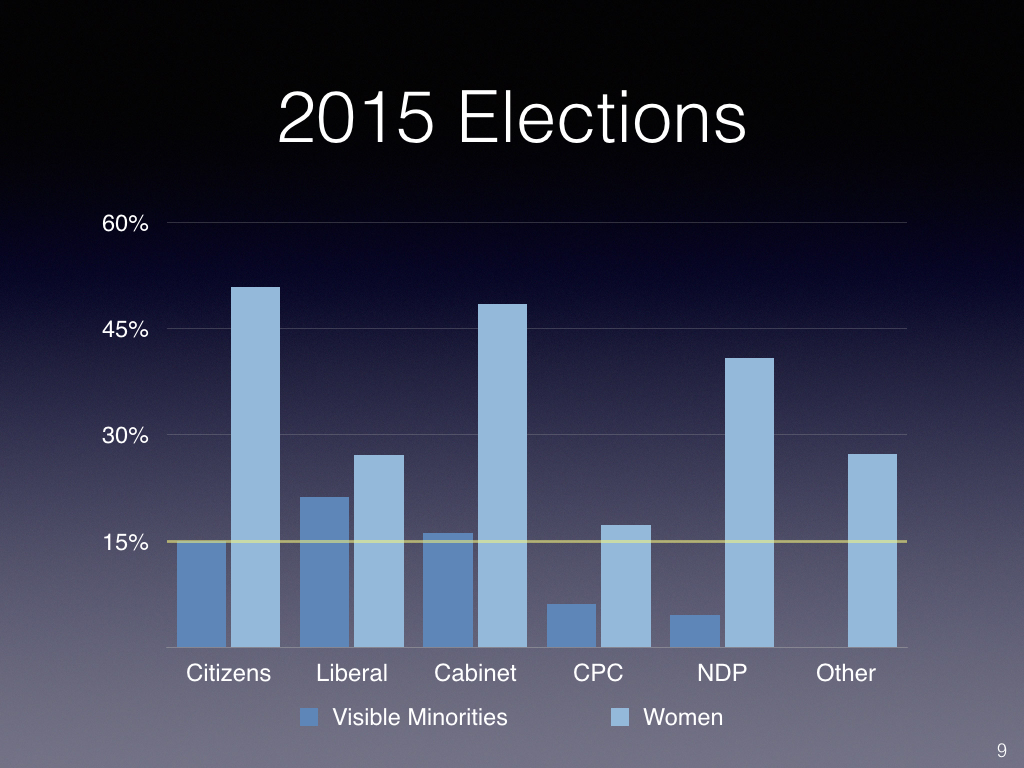
Election 2015 - VisMin and Foreign-Born MPs.002Michael Adams and my take on the composition of the new Parliament:

So what is new about the 42nd Parliament, aside from altered partisan composition and a gender-balanced cabinet? In fact, not too much, considering that the previous Parliament was quite diverse. But the Liberal government is doing more to make diversity – and an aspirational vision of an inclusive Canada – central to its agenda, and there is no doubt that some of the energy that came out against the Conservative government during the election campaign was a renunciation of tactics that pitted Canadians against each other along ethnic and religious lines.

So when it comes to the composition of the legislature itself, the 42nd Parliament is not so much a watershed as it is one more significant, if incremental, step in a long move toward a national legislature that represents the identities, experiences and perspectives of all Canadians.

Source: Take pride that Parliament reflects the face of Canada – The Globe and Mail

Examen des dépenses: Ottawa a négligé les langues minoritaires, dit un rapport

Not totally surprising that this kind of collateral damage took place given the various constraints and choices to be made:

Ottawa a négligé ses obligations en matière de langues officielles lors de l’examen des dépenses qui a mené à d’importantes coupes dans l’appareil gouvernemental.

Le commissaire aux langues officielles, Graham Fraser, signale dans un rapport publié mardi que les communautés en langue minoritaire n’ont pas systématiquement été prises en compte lors de cet exercice.

Résultat: les coupes budgétaires ont fait des «dommages collatéraux» dans les services à ces communautés.

En 2011, les troupes de Stephen Harper avaient annoncé une révision exhaustive des dépenses afin d’imposer des compressions budgétaires dans l’ensemble des ministères.

M. Fraser rappelle que le Secrétariat du Conseil du trésor du Canada, responsable de l’examen des dépenses, doit se plier à la Loi sur les langues officielles, à défaut de quoi les groupes minoritaires peuvent en pâtir.

C’est d’ailleurs ce qui s’est produit, selon lui.

«Je pense qu’on a eu suffisamment de plaintes vis-à-vis la restructuration de certaines institutions, l’élimination de certains services» pour l’affirmer, note-t-il en entrevue.

Rien n’indique que le gouvernement avait une stratégie pour s’assurer que les langues officielles soient respectées lors de la révision des dépenses. M. Fraser évoque par ailleurs une «certaine confusion» concernant qui était chargé de s’assurer que les obligations linguistiques soient respectées. Il déplore également un manque d’accès aux documents demandés par son équipe.

Source: Examen des dépenses: Ottawa a négligé les langues minoritaires, dit un rapport | Fannie Olivier | Politique canadienne

All Pearson, no Pierre: Inside Trudeau’s inner circle – The Globe and Mail

Good series of articles and profiles of the 12 in PM Trudeau’s inner circle.

Applying the usual diversity measures, two-thirds are male, and one is visible minority (13 percent).

Will be interesting, once staffing is complete in PMO and Ministerial offices, to analyze the full picture, as staffers are one of the recruiting pools for future candidates (and the Liberals had recruited more visible minority candidates than other parties (16 percent compared to 13 percent for the CPC and NDP).

Source: All Pearson, no Pierre: Inside Trudeau’s inner circle – The Globe and Mail

Canada, the country that nationalism side-swiped: Salutin | Toronto Star

Salutin on the perverse, counter-intuitive nature of Canadian nationalism:

Here’s where it starts to get paradoxical. Stephen Harper, during his reign, tried to become the voice of Canadian nationalism in the traditional, exclusivist sense. He promoted militarism, including symbols like the Highway of Heroes, and shopworn imperial imagery like the Royal Family. He promoted undercurrents of xenophobia, nativism and racism in his policies toward immigrants and especially refugees, who were despicably treated. These became overcurrents during the election, with his attacks on Muslim headgear, the “barbaric cultural practices” snitch line and revocable citizenship.

What’s fascinating is that Justin Trudeau didn’t oppose him by declaring he was anti-nationalist, as you’d have to in, say, Serbia or Hungary. He fought back as a Canadian nationalist, defining it in terms of tolerance or even, the glory of diversity — a sharp rebuttal to most contemporary nationalism. It also had weird echoes. Justin’s dad, Pierre, rejected Quebec nationalism as parochial but embraced Canadian nationalism as a way to fight it. When he ran against Tory leader Joe Clark in 1979, Trudeau père scorned Clark’s notion that Canada was just a “community of communities,” for being wishy-washy and contentless.

Yet that’s essentially what his son endorsed. Now picture Harper: beaten not only by the son of his most reviled Canadian predecessor; but by the son’s embrace of the vision of Harper’s most loathed Conservative antecedent, Joe Clark. It’s beyond Shakespearean. Who says we don’t have a colourful history?

If we’d been more successful in creating a robust, conventional Canadian nationalism, who knows — the country mightn’t have as handily beaten back the nasty nativism cultivated by Harper. It could have provided unintended grist for his mill. So the real strength of Canadian nationalism might turn out to be its relative weakness. We’re the land that nationalism side-swiped. Lucky us.

In his book, Benedict Anderson quoted Walter Benjamin’s passage on the angel of history — based on a Paul Klee print. The angel stands looking backward sadly as history’s failures and disasters pile up at his feet. So, as history’s wind blows him into the future, he can’t see, behind him, the progress that may be about to arrive. You could call it, back to the future, in a literal sense.

Behind the sunglasses: Harjit Sajjan’s rise to cabinet

Good profile on Harjit Sajjan (Canada’s new defence minister for foreign readers) – extract on immigration but long-piece worth reading:

In his early weeks as Trudeau’s defence minister, immigration figured prominently for Sajjan. His first pressing assignment was making sure the Canadian Forces contributed to the new government’s signature goal of bringing thousands of Syrian refugees to Canada quickly. Others might wonder how those Syrians will adjust, but Sajjan professes to have no doubts. “They’re going to be up and on their feet so fast—that’s how I remember it,” he says. “It’s not just about skills. It’s about the kind of people you bring in.” He sees the Syrian refugees as certain to be hard working, and their children as “the real immigration strategy.”

To hear him enthuse about the benefits of immigration for Canada, and the near certainty of newcomers achieving the Canadian dream, it’s possible to imagine that his own path might have been—those early berry-picking mornings notwithstanding—a smooth rise to success. That hasn’t been the case. Sajjan is a turban-wearing member of British Columbia’s Sikh minority, a community that has often attracted more than its share of bigotry from outside and been riven by more than its share of strife from within.

Sajjan talks of facing overt racism, particularly when he was training as a reservist in the Canadian military. As well, his entry into politics in 2014 as Liberal candidate in the Vancouver South riding revealed fault lines between Sikhs, although he says those tensions eased in 2015. He is one of four Sikhs in Trudeau’s cabinet—a remarkable contingent for a minority that represents only about 1.4 per cent of the country’s population. The others are Innovation, Science and Economic Development Minister Navdeep Bains, Infrastructure and Communities Minister Amarjeet Sohi and Small Business and Tourism Minister Bardish Chagger.

In his early weeks as Trudeau’s defence minister, immigration figured prominently for Sajjan. His first pressing assignment was making sure the Canadian Forces contributed to the new government’s signature goal of bringing thousands of Syrian refugees to Canada quickly. Others might wonder how those Syrians will adjust, but Sajjan professes to have no doubts. “They’re going to be up and on their feet so fast—that’s how I remember it,” he says. “It’s not just about skills. It’s about the kind of people you bring in.” He sees the Syrian refugees as certain to be hard working, and their children as “the real immigration strategy.”To hear him enthuse about the benefits of immigration for Canada, and the near certainty of newcomers achieving the Canadian dream, it’s possible to imagine that his own path might have been—those early berry-picking mornings notwithstanding—a smooth rise to success. That hasn’t been the case. Sajjan is a turban-wearing member of British Columbia’s Sikh minority, a community that has often attracted more than its share of bigotry from outside and been riven by more than its share of strife from within.Sajjan talks of facing overt racism, particularly when he was training as a reservist in the Canadian military. As well, his entry into politics in 2014 as Liberal candidate in the Vancouver South riding revealed fault lines between Sikhs, although he says those tensions eased in 2015. He is one of four Sikhs in Trudeau’s cabinet—a remarkable contingent for a minority that represents only about 1.4 per cent of the country’s population. The others are Innovation, Science and Economic Development Minister Navdeep Bains, Infrastructure and Communities Minister Amarjeet Sohi and Small Business and Tourism Minister Bardish Chagger.

….But given his background—from berry picking, to overcoming bigotry, to battling criminals and insurgents—Sajjan’s perspective is unique in many ways. If that first glimpse of him in a snapshot piqued our interest, it’s the layers behind the sunglasses and beneath the camouflage that make Sajjan a figure to watch as the Trudeau era unfolds.

Source: Behind the sunglasses: Harjit Sajjan’s rise to cabinet

Why a coin celebrating female suffrage glosses over uncomfortable truths

Like all such debates, the value lies in the educational and learning value about history. But the coin is a welcome change from the previous government’s removal of any women (save the Queen) on paper money:

This week, a minor fracas erupted over perceived delays in the approval of new 2016 $1 coin celebrating a landmark in female suffrage in Canada: the 100th anniversary of Manitoba women being granted the right to vote in provincial elections. Approval of the Canadian Mint’s plans were apparently stalled in Cabinet in July under the Harper government before the federal election and were finally rubber-stamped by the new Trudeau cabinet in early December. Ignored in the ado is a bigger point: that, as wonderful as a coin celebrating female suffrage is, this new shiny token can’t help but gloss over the uncomfortable truth of just how racist, sexist and hard-won that achievement was.

A more accurate “historically commemorative” recognition of female suffrage in Canada would require the Mint to issue a boxed set of at least a dozen coins reflecting vast discrepancies, provincially and federally, in who received the vote and when. That, one would hope, would finally dispel the myth that Canadian women won the right to vote federally in 1918, which is both true and false. Inuit women weren’t given the federal vote until 1950. And wasn’t until 1960 that Ottawa extended the franchise to First Nations men and women. That means any coin properly commemorating all Canadian women being able to vote federally couldn’t be issued until 2060—hardly a shining beacon of a progressive Western democracy (by comparison, Australia was the first country in the world to give women both the right to vote in federal elections and the right to be elected to parliament on a national basis in 1902; New Zealand granted women the right to vote in 1893; the United States gave all female citizens the right to vote federally and in state elections in 1920).

Far more consoling is the feel-good takeaway from a coin that will boast “WOMEN’S RIGHT TO VOTE”, in both official languages, and “1916-2016.”  Celebrations have been twinned to the release of five million commemorative coins in a few months’ time, Canadian Mint spokesperson Alexandre Reeves told Maclean’s: “Themes we choose often coincide with special commemoration plans of the government, which is certainly the case with women’s right to vote.”

Nancy Peckford, national spokesperson for Equal Voice, an Ottawa-based national multi-partisan organization dedicated to electing more women, welcomes the coin as an symbolic gesture that could usher in what she calls “an important and revealing conversation about women in this country.” The journey of women’s franchise in Canada in the provincial and territorial level is quite complex, says Peckford. “There is no one single anniversary, but 1916 was a watershed.”

In true provincial Canadian fashion, the right to vote reflects regional politics and values. That women in the Prairies were first to break provincial voting barriers (Manitoba was quickly followed by Saskatchewan and Alberta) is seen to reflect recognition of their equal involvement in settlement and homesteading. However, women in Quebec wouldn’t vote provincially until 1940—24 years later—the result of enduring opposition by legislators and prominent Catholic clergy.

Female suffrage federally provides another history lesson in perceived female status. The Wartimes Election Act of 1917 extended  the vote to women close to World War I front lines—nurses, women in the armed forces, and female relatives of military men. (Simultaneously, thousands of citizens naturalized after 1902 were disenfranchised.) The next year, all female “citizens” aged 21 and over became eligible to vote (whether or not they could vote provincially), provided they adhered to conditions set by Elections Canada: “age 21 or older, not alien-born and meet property requirements in provinces where they exist.” That firmly excluded Aboriginal peoples. (According to Elections Canada: “With the exception of veterans, The Dominion Franchise Act of 1934 explicitly disqualified First Nations persons living on reserves and Inuit people from voting in federal elections.”)

Source: Why a coin celebrating female suffrage glosses over uncomfortable truths