Good profile of the backgrounds of this group of MPs:
Nine newly-elected MPs in the 42nd Parliament, which is considered the most diverse crop of MPs in Parliament’s history, came to Canada either as refugees or fled from war-torn countries.
Out of the nine, according to research conducted by John Chenier, former editor of <em>The Lobby Monitor</em> and now editor of ARC Publications, four came to Canada as refugees from war zones or suffered persecution and five immigrated to Canada from current and past troubled zones such as the Middle East or Pakistan.
The four MPs who came to Canada as refugees are: Liberals Arif Virani (Parkdale-High Park, Ont.) from Uganda; Gary Anandasangaree (Scarborough-Rouge Park, Ont.) from Sri Lanka; Maryam Monsef (Peterborough-Kawartha, Ont.) from Afghanistan and Ahmed Hussen (York South-Weston, Ont.) from Somalia.
The five first-generation immigrants from current and past danger zones include: Liberal MP Faycal El-Khoury (Laval-Les Iles, Que.) from Lebanon; Liberal MP Iqra Khalid (Mississauga-Erin Mills, Ont.) from Pakistan; Liberal MP Salma Zahid (Scarborough Centre, Ont.) from Pakistan; Liberal MP Eva Nassif (Vimy, Que.) from Lebanon, and Conservative MP Ziad Aboultaif (Edmonton Manning, Alta.) from Lebanon.
In total, there are 40 MPs from all parties who were born outside of Canada, according to Parliament of Canada website and research conducted by <em>The Hill Times</em>. Of these, 29 are Liberal, eight are Conservatives, two are NDP, and one from the Green Party.
Good initiative and equally good debate about its utility (I had tried equally to institute the Google 20 percent time set-aside – without much success):
As part of a push in the bureaucracy to find new ways to work, Canadian Heritage is one of a dozen departments taking a page from Google and letting employees spend up to 20 per cent of their time working on temporary projects outside their usual job descriptions and the usual procedures.
Deputy minister Graham Flack said the initiative – called “micro-missions” – was developed to bring some flexibility to the rigid organization of departments.
“The theory behind micro-missions is, in government, it’s actually very difficult with our traditional HR systems to move people around,” Mr. Flack said.
Mr. Flack also chairs a committee of top bureaucrats who work on new ideas, and the group invites junior employees to join their discussions to get fresh ideas and a better view on the ground.
“We operate in a very hierarchical organization, and sometimes [we have] to give them a reality check,” said Francis Nolan-Poupart, a 27-year-old policy analyst at Employment and Social Development Canada, who sits on the committee.
But just because an idea worked for Google does not mean it will work for the government – or even for other tech companies. Konval Matin, the director of culture at Shopify in Ottawa, and Anna Lambert, the director of talent acquisition, said their company – a rising star in Canada’s tech world – tried giving employees time every week for special projects, but it just did not work.
“We realized you would get so enthralled in your day-to-day that you wouldn’t actually set aside the 20-per-cent time,” Ms. Matin said.
Marianne Hladun, an executive who leads the Public Service Alliance of Canada’s young-worker file, said the union has some concerns that projects might just add work for already stressed employees.
“In a lot of cases, people are just trying to keep their heads above water,” Ms. Hladun said. “In some departments, which I believe Canadian Heritage falls into, … people are doing special assignments but they’re not being compensated at appropriate levels. That’s a bit of a concern to us.”
Leaders at both the political and bureaucratic level have warned that many areas of the federal public service are suffering from poor workplace environments that are hampering service delivery and the mental health of the work force. In her final annual report last year as the top bureaucrat in Ottawa, Janice Charette said there was an urgent need to create a “healthy, respectful and supportive work environment.”
Donald Savoie, a professor at the Université de Moncton and a leading expert on public administration, said he thinks some of the innovative projects are just “band aids” that do not fix deeper problems affecting morale in the public service. “For a government to say, we’re going to have hackathons, or collaborative events, or spaces, that, my friend, is the easy part. The much more difficult part is redefining the role of the public service so that it would resonate.”
Shopify holds townhalls on Fridays where employees are encouraged to share what they are working on, and talk about what is going well and what is more challenging than expected – just as Canadian Heritage tried to do with its pizza lunch.
Ms. Matin of Shopify said even the executive team takes part occasionally – and the exercises have been good not just for morale, but also for productivity as workers from different teams pick up tips from each other.
“The stuff that’s really easier said than done is the trust and the autonomy,” Ms. Matin said. “Not being afraid of letting people experiment and try new things and potentially fail. But the cool thing is, let them fail, let them talk about it.”
Traditionally, the public service is not known for taking risks. Mr. Brison acknowledges the potential for failure as more public institutions and individuals are empowered to try new things and make more decisions on their own. As a political leader, he could be held responsible if something goes wrong. But he says that is part of pushing the public service to do better.
“The only way to avoid ever making any mistakes is to do nothing,” he said.
The Liberal government included in its mandate letters to all ministers a “commitment to transparent, merit-based appointments, to help ensure gender parity and that indigenous Canadians and minority groups are better reflected in positions of leadership.”To recall, the Prime Minister appointed a Cabinet with gender parity (15 each of men and women) and almost 17 per cent visible minority ministers (four Sikh and one Afghan Canadian).
Gender parity was not attained for parliamentary secretaries (12 positions out of 35 or 34 per cent) or other leadership positions such as whips and House leaders, visible minority parliamentary secretaries are over-represented (nine positions or 24 per cent) in relation to their share of the voting population (15 per cent).
Given this commitment and action, is the Liberal government also applying diversity and inclusion to its hiring of political staff? What about the official opposition?
To assess this, I looked at the Prime Minister’s Office (59 total positions and 12 senior staffers), the Leader of the Official Opposition’s office (OLO, 23 positions), and ministerial offices (senior staff defined as chief of staff, directors of communications, policy, issues and parliamentary affairs, along with press Secretaries, total number of 101 positions filled at time of writing).
Sources for the data include the regular ‘Hill Climbers’ updates in The Hill Times, other relevant press articles, and the imperfect Government Electronic Directory Services (GEDS). Gender and visible minority status were identified through names, LinkedIn profiles, biographies and photos where available.
From a gender perspective, women are under-represented at the senior level in PMO (one-third), but close to 40 per cent for all 59 PMO staffers. OLO has slightly lower representation of women (30 per cent). For minister’s offices, the percentage of chiefs of staff is slightly less than the overall per cent of close to 40 per cent who are women.
Visible minorities are consistently under-represented, save for the overall numbers in PMO (15 per cent). OLO and senior ministerial office staff all range between four to seven per cent, less than half of the percentage of visible minority Canadian citizens, with chief of staff visible minority representation slightly higher at 10 per cent.
While I have focused on gender and visible minority status, diversity includes of course other dimensions such as regional diversity (many, if not most Liberal staffers come from, or have worked in, Ontario and Toronto), sexual orientation, religion, education etc. R. Paul Wilson’s A Profile of Ministerial Policy Staff in the Government of Canada provides the best most recent analysis of the different aspects of diversity among staffers under the Conservative government October 2012 to June 2013.
Does this matter? In many ways, it does not. Gender parity in Cabinet and relatively strong Parliamentary Secretary representation set the tone for the government and Parliament.
Being a political staffer may not necessarily lead to a direct path to becoming a future MP. Staffer experience is not necessarily perceived as an asset in local riding associations or to the broader public. Staffers may be asked by the party to be its flag-bearer in unwinnable ridings. The most famous example of a staffer becoming an MP is, of course, former Prime Minister Harper, who was a staffer to Reform Party leader Preston Manning among other positions.
All three major parties were able to recruit an impressive number of visible minority candidates (women less so).
However, staffers play an important role in government (and opposition) decision-making. Having a diversity of backgrounds and experience generally helps inform decision-making.
The Liberal government’s commitment to diversity and inclusion, so well executed at the public level for both women and visible minorities, is lacking in the backrooms, particularly for visible minorities. Given the role that staffers play in preparing ministers for debates and discussions, this may impact on the degree to which the overall diversity and inclusion agenda is implemented.
Will be busy at the conferences so little blogging for the balance of the week. I will post the deck presentations I will be making on the 2015 Elections and Visible Minorities and on Citizenship: Finding the New Balance later this week.
If we look at the overall committee membership of 288 members in both the 25 House of Commons and three joint Senate-Commons committees (some MPs are members of more than one committee), only 21.2 per cent are women, significantly lower than the overall 26 per cent of women MPs.
For visible minorities, however, committee representation largely matches overall Commons representation at 14.6 per cent, just marginally under the number of visible minorities who are Canadian citizens. Indigenous peoples committee representation is less than their share of the population (3.1 compared to 4.3 per cent).
Looking at individual committees, only the Access to Information, Privacy and Ethics and Industry, Science and Technology committees have no women members. Veterans Affairs, Agriculture and Agri-Food, Environment and Sustainable Development, Fisheries and Oceans, Official Languages, National Defence, Physician-Assisted Dying have no visible minority members.
Women are predictably over-represented in Status of Women (nine out of 10 members) and visible minorities are similarly overly represented in Citizenship and Immigration (seven out of 10 members).
Interesting. Conservatives really need to come to terms with this given just how much their outreach strategy to ethnic voters collapsed in ridings with strong visible minority populations, as well, it appears, being offside mainstream Canadian values:
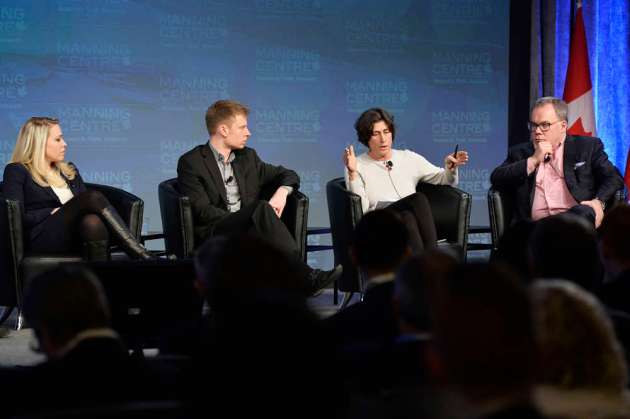
Toronto Star columnist Chantal Hébert was blunt about the mini existential crisis the conference was exposing.
“Why did Justin Trudeau win the niqab debate on an issue he should’ve lost (according) to the polls? Because his stance on the niqab debate, which is a policy stance, goes to who the Liberals are. You could set your clock on Justin Trudeau saying what he said about the niqab,” she said.
“I look at your party and the niqab, and I don’t know who think you are. If you can, explain it….There are issues that brand a party beyond tone. And before you set out, you need to decide who you are.”
Back in the other room, where Scott-Marshall was explaining the results of their survey, she spoke of a type of free association exercise where participants were asked what words came to mind when they heard Conservative.
There were some positives, but also negative descriptors in line with what Weston had heard at peoples’ doors: “Old, outdated, and mean.”
When the survey drilled down further into how Canadians felt about common terms in the political vernacular — liberal, progressive, democrat, centre, independent, left-of-centre, socialist, conservative, libertarian, radical — they got a strong negative reaction to “conservative”.
“The most common negative reaction is to the word radical, not surprising probably. Although the second most common negative reaction is actually to the term conservative.” Scott-Marshall said.
“Just over a third of Canadians, 36 per cent, say they have a negative response to the term conservative when they hear it. And only 20 per cent say they have a positive response. Something to bare in mind just in terms of maybe negative…baggage that’s being associated with the term Conservative now.”
Good overview. Overall striking that turnout rates for longer-term foreign-born citizens are virtually identical to the Canadian-born, and that the gap between more recent citizens shrunk between elections, perhaps reflecting opposition to a number of the citizenship and immigration changes made by the previous government.
Extract from the StatsCan report below:
By immigrant status, the largest increase was among immigrant Canadians with citizenship who had been in Canada for 10 years or less, as their turnout rate went up from 56% to 70%. The turnout rate for immigrant Canadians with citizenship who had been in Canada for more than 10 years increased from 71% to 76%. Among Canadian-born citizens, the rate also increased, up from 70% to 78%.
Good profile of the delivery guru, advising the Government.
Given the ambitious nature of the Government’s platform, and the likely need to make some difficult choices given fiscal and other realities, will be interesting four years hence to see what worked and what did not:
Since he left the Blair government, Barber has honed these ideas into what he calls “deliverology,” the art of ensuring governments meet their goals. He’s become a global consultant spreading the gospel of deliverology to governments as far-flung as Australia, the Punjab, the U.S. state of Maryland, and to Ontario under the province’s former Liberal premier Dalton McGuinty. When a large number of McGuinty-era Ontario staffers moved to Ottawa to work for the Trudeau Liberals, Michael Barber could not be far behind.
And so it came to pass that, during a three-day retreat for Trudeau’s cabinet in St. Andrews, N.B., in late January, Barber was in the room with the ministers for almost the entire time. Trudeau has appointed Matthew Mendelsohn, the former director of an Ontario think tank, as a senior public servant responsible for “results and delivery.” Mendelsohn’s job is modelled on the position Barber held with Blair.
Perhaps it is no surprise that Barber, the object of such ardent affection and attention from the new Trudeau crew, is equally impressed with this young Canadian government. “What they were saying was, ‘We know that often, including in the Blair case, it took a whole term for a new government to learn the disciplines of delivery and then get it right in the second term,’ ” Barber told Maclean’s. “ ‘But we want to get it right the first time.’ ”
The obstacles facing any new government are well-known. First, the usual constant barrage of unforeseen events. Second, the pressure to come up with new ideas rather than checking to see how the old plans are working out. Tony Blair was a sucker for a new idea. In his new book How to Run a Government, Barber calls Blair’s first-term administrative style “government by spasm.”
The alternative to spasm is an attempt to install a routine. A new government asks itself a series of basic questions. “One is: What are the priorities?” Barber asks. “The second is: If you succeeded in delivering a given priority, how would you know? What would success look like in 2019, at the end of this mandate?” The third question is, “How would you know at any given moment you’re making progress toward your goals?” This leads a delivery-oriented government to develop a set of indicators—usually publicly available and thus, if they’re heading in the wrong direction, acutely uncomfortable for the government. How many kilometres of roads have been paved to date, how many megatonnes of carbon went into the atmosphere, that sort of thing.
“It’s not tremendously exciting, but it’s really important, getting the priorities, the definitions of success, the trajectories, the data, the routines to monitor progress, and then the ability to solve problems as they arise,” Barber said. “Because however good you are at planning, you’re not going to get it right. The real world never works out exactly as you anticipate. So having routines to correct and adjust the plan all the time is important.”
One element that helped bring Barber and Trudeau together is a common sense that ambition should not be a bad word in government. “There are times when doing little seems to work, and underpromising and overdelivering seems a good option,” Barber said. “But that’s certainly not the analysis of the Trudeau government, and certainly not the prospectus that they put to the Canadian people during the election. They said, ‘Actually, Canada needs big change, we want to build an inclusive, diverse Canada, we want some renewal of faith in democratic institutions, we want to reduce climate change, we need a big infrastructure upgrade.’ These are big challenges.”
Good overview by Kathryn May of the demographics of the public service and recruitment challenge:
Knowing the talent pool of the public service will need to be renewed to push forward its agenda, the Liberal government is trying to figure out how to attract more young people to a sector where the average age of a new hire is pushing 40.
The rising age of new recruits was flagged for Prime Minister Justin Trudeau, who is also the minister of youth, as an “area in need of increased attention.”
According to Privy Council Office briefing documents, the average age of new hires has hit 37, and few young people are being hired. Once hired, however, people stay in the public service until they retire at about age 60.
“Sustained efforts are needed to recruit young people and to attract highly skilled professionals from other sectors, especially those with the skill sets needed for the future work of the public service,” say the briefing documents.
The average age of entry into the public service has been creeping up, rather than decreasing, as more and more jobs require university degrees. A decade ago, the average age of a new hire was 36 — 35 for women and 36 for men.
The public service is an older workforce compared with the private sector. It emerged out of the restraints of the Conservative era smaller and slightly older. Today, it is largely middle-aged, with more than 60 per cent of the employees between 35 and 54, and the largest concentration huddled between 40 and 54.
Over the past five years, the number of bureaucrats under 35 decreased and those over 50 increased. The average age is now 45, and more than half have worked in the public service between five and 14 years.
It’s an issue Treasury Board President Scott Brison quickly seized upon when he made a pitch last month at the World Economic Forum in Davos to the millennial generation — those under 35 — to work in government.
In an interview, Brison signalled he is reviewing how to tackle the problem to give millennials the “chance to make a difference in the future of the country.
“The complexity of decisions today is greater than it has ever been in the history of government or democracy, and now more than ever at any point in our history we need bright, talented people in government,” he said.
“And we also have the most talented, most educated, and most globally connected generation. So it seems pretty obvious to me that we need to find ways to bring millennials into these key decision-making roles in government.”
The public service never has a problem attracting people, especially when the economy slows. The big challenges are getting people with the right skills and keeping them. Young people tend to see the public service as a slow, rules-bound hierarchy with little tolerance for risk or creativity. It has countered with campaigns over the years, including one branding itself as the “employer of a thousand opportunities.”
But Brison said the image of the public service took a major beating under the Conservatives, which mistrusted public servants and “gratuitously took pot shots at public servants whenever they had the chance”
“They toxified relations with the public which was incredibly stupid given governments need the engagement of public servants to implement their agenda … We have a progressive agenda and need a motivated public service. We recognize the importance of renewing talent.”
Linda Duxbury, professor at Carleton University’s Sprott School of Business, said Brison has every reason to be worried. After a decade of being “beaten down by the Conservatives the word public service has a bad connotation.”
The big attraction, she said, for many workers in their 30s is not the work as much as job security, pensions and benefits — reinforcing a long-standing characterization of public servants who join for the benefits and stay for the pensions.
But Duxbury said the problem is that employees attracted by such “extrinsic motivators” don’t tend to be the entrepreneurial, creative thinkers and innovators the government wants to shake up the way work is done and services are delivered.
“I would like to see what is attracting them to the public service at age 37,” said Duxbury. “This isn’t just an age issue but who is attracted by what you have to offer, and if what you have to offer are extrinsic motivators like a good pension and benefits, those may not be the people you want.”
The Public Service Commission in its 2013-14 report noted the number and proportion of employees under age 35 had declined four years in a row, even though the number of new hires from this group increased. At last count, they represent 17 per cent of all permanent employees after peaking at 21.4 per cent in 2010.
At the same time, the number of people leaving or retiring outnumbered those coming into the public service. The commission warned this gap could have “implications for the renewal and future composition of the public service.”
By the Numbers: Composition of the Public Service
37: average age of new hires
45: average age of public servants
50.4: average age of executives
50: percentage with 5 to 14 years experience
22: percentage with 15 to 25 years experience
58: average retirement age
36: percentage of baby boomers in public service workforce
21: percentage of millennials in the public service
257,000: number of employees in public service
87: percentage of employees who are permanent or indeterminate employees
13: percentage of employees who are term, casual and student employees
55: percentage of employees who are women
42: percentage of public servants working in National Capital Region
In a Friday announcement in Toronto, Prime Minister Justin Trudeau hinted at the nature of the coming change-up in the governor general’s office.
Trudeau said the next appointment would express Canada’s diversity and referenced the answer he gave last November when he was asked why he created a cabinet with equal number of men and women.
“I suspect I might be saying ‘because it’s 2017’ when the time for that decision [on the Governor General] comes around to be explained,” he said.
“I can reassure you, I will take into account the nature of Canada and the desire of Canadians to see institutions and appointments across the government that reflect the diversity of Canada,” said Trudeau.
“We appoint people who look like Canada, who understand the extraordinary diversity of Canada and highlight the amazing fact that Canada is one of the few (places) in the world that is made stronger because of its differences.”
Trudeau commended current Gov. Gen. David Johnston on the work he’s done to represent Canada, push innovation and work on youth issues.
“He’s doing an exceptional job and I’m proud to have him as our Governor General,” said Trudeau, noting that he’ll have big shoes to fill when the time comes.