Lithuania’s citizenship referendum: what it’s about and what it needs to succeed

Of interest, given the considerations at play with respect to Russia and ethnic Russians:

Under the current restrictive rules, Lithuanians who emigrate and become citizens in other countries automatically lose their Lithuanian passports. With the Lithuanian diaspora having ballooned in recent decades, there has been growing pressure to change the constitution. The referendum on “retaining citizenship” is an attempt to do it.

No ordinary referendum

“Citizenship of the Republic of Lithuania is acquired at birth and on other grounds established by law. Except in individual cases provided for by law, no one may be a citizen of the Republic of Lithuania and of another state. The procedure for acquisition and loss of citizenship shall be determined by law,” is the current wording of Article 12 of the Constitution of the Republic of Lithuania.

It is this article that will be changed if the referendum is successful.

The proposed new wording is: “Citizenship of the Republic of Lithuania is acquired at birth and on other grounds and in accordance with the procedure laid down by a constitutional law. The constitutional law shall also determine the grounds and procedure for losing citizenship of the Republic of Lithuania.”

Since Article 12 is part of the first section of the constitution, “The State of Lithuania”, changing it requires that more than half of all eligible voters – around 1.2 million people – not only come to the polls but also say yes. The last attempt to amend the article in 2019 failed because even though the turnout was 53 percent and the “yes” vote stood at 72 percent, this was not enough (because it represented only under 40 percent of the total electorate).

Why would this time be different? The initiators have argued that the first attempt to simply lift the ban on dual citizenship may have spooked some voters. The restriction was put into place to alleviate fears that Lithuania’s sizeable Russian-speaking community (about 5 percent of the population) could get Russian citizenship. To avoid that, the current proposal includes a reference to a constitutional law.

This law, which has already been drafted, specifies which nationalities would be compatible with Lithuanian citizenship. These “friendly countries” are the members of the European Union, the European Economic Area, the Organisation for Economic Co-operation and Development (OECD) and NATO.

Meanwhile, Lithuanian citizens could not retain their citizenship if they were also nationals of Russia or Belarus, the member-states of the Eurasian Economic Union, the Collective Security Treaty Organisation, The Shanghai Cooperation Organisation, the Commonwealth of Independent States, or “any other political, military, economic or other alliances established on the basis of the former USSR”.

Will the constitutional law be passed?

This constitutional law, however, is also a target of the opponents of the amendment. They argue that if the referendum succeeds and Article 12 is amended, there is no guarantee the law will actually be passed in its current form.

A constitutional law is not part of the constitution or a constitutional amendment. It is a completely separate document drafted by the parliament and adopted with a special majority – more than half of all MPs.

The parliament would only vote on the new constitutional law after a successful referendum.

But opponents of the referendum doubt whether the special majority will be easy to achieve or that no one will try to change the law.

The initiators of the referendum, meanwhile, assure that the law will be adopted because all parliamentary parties are in agreement and have no objections to the bill. Recall, they argue, that 111 MPs voted in favour of calling the referendum and none voted against it.

The constitutional law cannot be passed before the referendum because it would simply be deemed in violation of the current constitution. However, to make sure people know what they are voting for, the law has already been registered in the Seimas and is available to all who wish to read it.

Source: Lithuania’s citizenship referendum: what it’s about and what it needs to succeed

Some cities allow noncitizens to vote in local elections. Their turnout is quite low

Of note. Not surprised. Those that argue that non-citizen voting will increase municipal vote turnout should look at this case study. Similar to those advocating for no restrictions on voting by Canadian expatriates; while the number of registered voters and votes casts doubled, the numbers were still tiny (55,000 registered) compared to an estimated expatriate adult population of less than three million:

Three cities in Vermont now allow non-U.S. citizen residents to vote in local elections.

Winooski is one of those municipalities. It just held its third local election with noncitizen voting.

“Thirteen hundred and 45 people participated in our annual city and school election,” Winooski Clerk Jenny Willingham said about March’s contests. “Eleven of those ballots cast were from our all-resident voting,” a category that includes green-card holders, refugees and asylum-seekers.

In Vermont and elsewhere, municipalities that allow noncitizen voting in local elections have seen similar low voter registration rates and turnout. Local leaders are trying to parse out why.

That’s as noncitizen voting has emerged as a national flashpoint this election year. Republicans including former President Donald Trump are pushing legislation aimed at stopping noncitizens from voting in federal elections — which is already illegal and, by all accounts, very rare.

Small numbers of ballots cast

In Winooski, getting those 11 noncitizen votes cast in March’s races took a lot of legwork for Willingham. She had the ballots printed in 12 languages and had four interpreters — speaking Burmese, Nepali, Swahili and Somali — working on Election Day.

Burlington, Vermont’s largest city, counted 62 votes by noncitizens, accounting for less than half of 1% of the nearly 15,000 total votes cast.

In Montpelier, the state’s capital, 13 noncitizens voted. There are so few noncitizen registered voters that Clerk John Odum keeps their paperwork in a half-inch blue binder.

This trend extends outside Vermont. Takoma Park, Md., legalized local noncitizen voting 30 years ago. Still, registration and turnout remain relatively low.

There are ongoing grassroots efforts in Vermont to increase voter participation among green-card holders, refugees and asylum-seekers. The League of Women Voters distributes pamphlets and holds info sessions.

The city of Burlington pays outreach workers like Jules Wetchi, an immigrant from the Democratic Republic of Congo, to connect with immigrant communities. Wetchi hosts local radio and TV shows geared at French-speaking new Americans.

“I did what they call civic education to push people to know how they should be engaged to vote, because it’s very important,” Wetchi said. “This is our second country. We are living here — we should be more engaged to the political situation.”

Fear as a barrier to voting

But Wetchi said fear is one of the barriers to the ballot box. People have told him they’re afraid they might get harassed when they vote. Others worry that voting might negatively affect their U.S. citizenship application, even if their city clerk assures them that it won’t.

Some of that fear stems from the national spotlight on this issue, which got brighter last month when Trump and House Speaker Mike Johnson pushed a measure that would add citizenship documentation requirements for voters.

Vermont Secretary of State Sarah Copeland Hanzas, a Democrat, said she understands why some Vermonters are reluctant to have their names on a list of non-U.S. citizens that’s accessible with a public records request.

“We are a nation of immigrants. So it’s wild to imagine how we got to this place where we have to worry about these things,” she said.

Winooski and Montpelier were sued by the state and national Republican parties to try to stop local noncitizen voting. The lawsuits were thrown out, but Copeland Hanzas wondered whether they added to the chilling effect.

“I’m quite certain that there are more folks who would have been eligible to vote in those local elections,” she said.

In Washington, D.C., Republicans in Congress are trying to block a law that allows noncitizens to vote in local D.C. elections. The law went into effect in January. As of April 30, there were 372 noncitizens registered in a city with around 450,000 total registered voters.

D.C. Board of Elections staff members are doing their best to keep their heads down and not let the controversy affect their work, said Executive Director Monica Holman Evans.

“I receive the quote-unquote attacks or the quote-unquote comments, commentary, opinions about it,” she said. “And I’m just very clear that I don’t take an opinion on this or any other legislation that has been passed in the District of Columbia. Our job is to enforce what’s currently in effect.”

Vermont’s local election officials also said they feel the heat from the national spotlight. They know that one slip-up, like a presidential ballot being mailed to a noncitizen, could end up on the national news.

Larger jurisdictions like D.C. have voter databases that can track noncitizen voters. Vermont doesn’t yet; the secretary of state’s office said one is in the works.

In the meantime, clerks use Excel spreadsheets and three-ring binders to track noncitizen voters. Willingham, Winooski’s clerk, keeps her noncitizen voter registrations in a manila folder in a filing cabinet next to her desk.

“I feel like I check and then I recheck just to make sure that everything is correct, that they are only voting in the elections that our charter has declared,” she said.

Despite the low turnout, the mere fact that noncitizen voting is on the books means a lot to many immigrants in Vermont. Wetchi’s mother recently made the move to Vermont from the Democratic Republic of Congo. She speaks only Swahili and a local dialect, but Wetchi said he hopes she can vote one day.

“Because her voice is very important. Her voice can change many things,” he said.

The thing is, Wetchi and his family just moved to the city of South Burlington, which doesn’t have noncitizen voting. His mom can’t vote there. But he can — he’s a full citizen. He’s even thinking about running for office one day.

Source: Some cities allow noncitizens to vote in local elections. Their turnout is quite low

Indonesia May Offer Dual Citizenship to Attract Overseas Workers, Minister Says

Of interest (Indonesia permits dual nationality for its emigrants):

Indonesia may offer dual citizenship to people of Indonesian descent to entice more skilled workers into the country, a senior cabinet minister said on Tuesday.

Indonesia does not recognise dual citizenship for adults, according to Indonesian law, as a child with two passports must choose one and renounce the other when they turn 18.

Luhut Pandjaitan, the coordinating minister for maritime affairs and investment, said the government plans to give dual citizenship to former Indonesian citizens living overseas, without offering details.

Luhut was speaking ahead of Microsoft CEO Satya Nadella, who pledged a $1.7 billion investment in Indonesia.

“We also invite diaspora Indonesia and we give them also, soon, dual citizen,” he said. “Which I think will … bring very skilful Indonesians back to Indonesia.”

Nearly 4,000 Indonesians became Singaporean citizens between 2019 to 2022, according to data from the Directorate General of Immigration.

The immigration agency did not immediately respond to a request for comment on the plans to allow for dual citizenship.

The issue of dual citizenship caused some controversy in 2016 when Indonesia’s President Joko Widodo removed Arcandra Tahar as energy and mining minister after less than a month on the job following reports he held U.S. and Indonesian passports.

Source: Indonesia May Offer Dual Citizenship to Attract Overseas Workers, Minister Says

CANADIANS ABROAD: Overview of Recent Research and Implications for Public Policy

This report, commissioned by Senator Woo, essentially argues for more services and support for Canadian expatriates. While it contains some useful comparisons of provincial health care coverage and non-coverage, as well as provincial election regulations, it is disappointingly light on measures of connection to Canada, whether passport issued to Canadians abroad (no recent public stats apparently) or non-resident taxation (less than 32,000 in 2021).

In terms of the specific recommendations below, my thoughts are as follows:

  • Always good to have better and more comprehensive data, along with academic research. For the latter, important to have range of perspectives, from this stating the case for more services (as the report does) to more critical voices.
  • On the various recommendations for centralized information for “all information relevant to the Canadian diaspora,” this understates the complexity of compiling and maintaining such a data that incorporates federal and provincial information. The argument for the need appears more theoretical than based upon public opinion research.
  • As to the needs for a strategy, hard to argue against that but the challenge, as we seen in so many areas, strategies without serious implementation are more photo ops and virtue signalling than meaningful.
  • With respect to consular service, one needs to start at first principles in terms of the obligations and limits to consular service to manage expectations and costs. In general, Canada has been generous in recent crises in terms of family members and permanent residents, even in cases of long-term expatriates with minimal to no current connection to Canada
  • More nutty are the arguments regarding healthcare coverage, mental health awareness, and the medical care at home and abroad sections, especially given the strains our healthcare system in Canada is facing. Expats planning to return to Canada are responsible for reinstating coverage and the various provincial websites are easy to find and understand. Is it really a Canadian government responsibility to help expats deal with mental health issues among diaspora communities? There is some merit in studying the impact of the return of expats to Canada on healthcare given that they have for the most part not paid Canadian and provincial taxes but the issue of Canadians seeking medical services abroad is a completely separate issue as these are paid by individuals, not taxpayers.
  • On tax policy, unclear what exactly is the issue and what are they trying to advocate. Canadian taxation is based on residence and most expats don’t pay Canadian non-resident taxes although some who maintain property in Canada do pay property tax.
  • Expat voting is a classic case where the policy arguments are divorced from reality. The report makes the specious comparison between overall voting rates between Canadian and non-residents but not the more telling on that only 55,000 non-resident voters registered, a drop in the bucket compared to the overall number of around three million adult expats. The same concerns regarding the cost of maintaining an updating a database on federal and provincial voting regulations apply. And suggesting electronic voting from abroad when we do not have it in Canada, not to mention the potential cost and security risks, even more hard to justify.
  • The last three recommendations – economic development engagement, chambers of commerce, and cultivating the diaspora – already happen to some extent in every embassy that I had worked in. No doubt, could be improved and strengthened.

Overall, the author has an overly optimistic take on the interest and willingness of long-term Canadian expatriates to advance Canadian interests. The vast majority are living their lives in their country of residence, contributing to that country’s economy and society, with relatively few highly engaged in advancing Canadian interests. Those are largely known to embassies and consulates and Canadian interest groups. Again, more could be done but given limited resources and little hard evidence to demonstrate effectiveness, the case is weak.

Source: CANADIANS ABROAD: Overview of Recent Research and Implications for Public Policy

Golden Visa Programs, Once a Boon, Lose Their Luster

Long overdue:

Faced with growing pressure to address its housing crunch, Spain said this month that it would scrap its golden visas, the latest in a wider withdrawal from the program by governments around Europe.

Half a dozen eurozone countries offered the visas at the height of Europe’s debt crisis in 2012 to help plug gaping budget deficits. Countries that needed international bailouts — Spain, Ireland, Portugal and Greece among them — were especially desperate for cash to repay creditors, and saw a path to bring in investors while reviving their moribund real estate markets.

The golden visa program brought Spain billions of euros in investments. But property prices paid by rich foreigners are well beyond the earning power of locals.

Countries reaped a windfall: Spain alone has issued 14,576 visas linked to wealthy buyers making real estate investments of more than €500,000. But the prices that they can afford are squeezing people like Dr. Barba out of a market that had already been highly inflated by the rise of Airbnb and the draw of Wall Street investors.

“Access to housing needs to be a right instead of a speculative business,” Pedro Sánchez, Spain’s prime minister, said in a speech this month as he announced the end of the country’s golden visa program. “Major cities are facing highly stressed markets, and it’s almost impossible to find decent housing for those who already live, work and pay their taxes.”

The visas make it easy for people outside the European Union to buy the right to temporary residency, sometimes without having to live in the country. Investors from China, Russia and the Middle East flocked to buy real estate through them.

In recent years, British nationals have followed suit in the wake of Brexit, snapping up homes in Greece, Portugal and Spain, joined by an increasing number of Americans looking to enjoy a lifestyle they can’t afford in major U.S. cities.

But golden visa programs are now being phased out or shut down around Europe as governments seek to undo the damage to the housing market. And after Russia’s invasion of Ukraine, E.U. officials urged governments to end them, warning they could be used for money laundering, tax evasion and even organized crime….

Source: Golden Visa Programs, Once a Boon, Lose Their Luster

Government submits proposal to Parliament on stricter requirements for acquiring Finnish citizenship

Of note:

The Government has proposed an amendment to the Citizenship Act that would extend the period of residence required for Finnish citizenship from the current five years to eight years. In addition, only time lived in Finland under a residence permit would be taken into account when calculating the period of residence. The proposal to amend the Citizenship Act was submitted to Parliament in a government session on 18 April.

One of the objectives set in the Government Programme is to tighten the requirements for acquiring Finnish citizenship and encourage immigrants to integrate into Finnish society. The reform will be implemented in stages through three legislative projects.

The first project will extend the required period of residence in Finland, which is one prerequisite for being granted citizenship based on an application. The second and third projects will tighten the requirements related to integrity and livelihood and introduce a citizenship test. The government proposals for the latter projects will be submitted to Parliament in autumn 2024 and spring 2025, respectively.

In line with the proposal now submitted to Parliament, people applying for citizenship would have to reside in Finland for eight years instead of the current five years. This way, the authorities could assess the applicants’ suitability for citizenship over a longer period of time.

The amendments would also concern applicants for international protection, who would no longer have a derogation concerning the period of residence requirement. In other words, once the amendment is in force, it will no longer be possible to derogate from the requirement on grounds of international protection. However, citizenship applications made by beneficiaries of international protection would continue to be considered urgently, with the decision on granting citizenship made no later than one year after the applicant submitted their application.

With the amendment, the residence requirement for children aged 15 or over, spouses of Finnish citizens, stateless persons and applicants meeting the language proficiency requirement would be extended to five years from the current four. The two-year residence requirement for Nordic citizens and spouses of persons working at Finnish missions abroad would remain unchanged.

Changes in determining the period of residence for asylum seekers

With the amendment, only periods of residence with a residence permit would be taken into account when determining an applicant’s period of residence. This means that the time taken to process an asylum application would no longer count towards the period of residence. For beneficiaries of international protection in Finland, the approved period of residence would begin when they are issued a residence permit.

In addition, any stays in Finland without a residence permit would no longer be taken into account, in full or in part, under any circumstances when determining the period of residence. Similarly, the applicant’s age, state of health or other comparable reason would no longer be grounds for approving a period of residence without a residence permit.

The reform would also shorten the periods of absence that could be included in the continuous period of residence. During the entire continuous period of residence, applicants could stay abroad for one year in total, and no more than three months of this period could take place during the year preceding naturalisation. The goal is to ensure that applicants receiving Finnish citizenship are actually living in Finland.

In 2022, altogether 9,509 people were granted citizenship based on an application. The extension of the residence requirement for citizenship would potentially apply to nearly 10,000 people each year.

Source: Government submits proposal to Parliament on stricter requirements for acquiring Finnish citizenship

“In Demand Yet Unprocessed: Endemic Immigration Backlogs” – Citizenship Government response

The section of the government response to CIMM’s study of backlogs, citizenship ceremonies and oath. My understanding, however, is that in practice applicants are assigned the ceremony type automatically (virtual being the default) but can request an in-person if they prefer. Last time I checked based upon public IRCC data, about 90 percent of applicants had virtual ceremonies.

And of course, IRCC’s “seeking to increase the percentage of clients that complete the Oath in-person in 2024-2025” is meaningless unless its open data operational data includes the numbers of new citizens by virtual and in-person ceremonies:

7. That IRCC make clear to all individuals that it is their choice to choose the citizenship ceremonies process best suited to their needs; and that while in-person ceremonies should be the default option, virtual ceremonies should also be allowed; and further, that any self-administered oath of citizenship be subject to robust integrity measures. Agree in Principle

The Government agrees in principle with the recommendation that the Department make it clear to clients that they may choose the citizenship ceremony format best suited to their needs, and that any self-administered oath of citizenship be subject to robust integrity measures. Canada welcomed a record number of 364,166 new citizens in 2022-2023, compared to approximately 248,000 in 2019-2020 (pre-pandemic), enabled in part by the implementation of virtual ceremonies (also called video ceremonies) and related efficiencies.

As of July 2022, IRCC resumed holding in-person ceremonies while maintaining virtual ceremonies, as a stream of service delivery that provides efficiency, timely service, and flexibility to clients as they can accommodate more clients from coast to coast to coast, including those in rural and remote regions. Clients are invited by the Department to either an in-person or virtual ceremony, based on operational considerations, but can request a change of format (e.g. from virtual ceremony to an in-person ceremony or vice-versa) and the Department makes best efforts to accommodate client preference.

Virtual ceremonies have contributed to a significant reduction in grant inventories, while modernization initiatives, such as online electronic applications for most grant of citizenship applications and electronic citizenship certificates, have reduced and continue to reduce processing times with a return to service standards projected for spring 2024.

A number of factors, including volumes of clients served and costs would be impacted if in- person ceremonies were set as the default option. Instead, the Department is seeking to increase the percentage of clients that complete the Oath in-person in 2024-2025 as well as clarify that all individuals have the opportunity to request the citizenship ceremony format that best suits their needs, subject to availability.

In addition, the Department continues work to modernize Canada’s Citizenship Program to improve client service, increase processing efficiencies and enhance program integrity. As the Citizenship Program continues to modernize, the Department will reflect on the feedback received from Canadians, and incorporate this into the assessment of options and decisions on a way forward.

Source: “In Demand Yet Unprocessed: Endemic Immigration Backlogs”

Budget 2024: Statement on Gender, Diversity, and Inclusion, varia

Definitely worth a look, for the richness of the data as well the insights into the government’s diversity and inclusion priorities and how it stitches the narrative together with political and Canadian public priorities.

Intro has the key messages:

  • “Early Learning and Child Care, which is supporting better economic outcomes for women, by making it possible for more women to participate in the workforce, while securing access to quality child care and learning, thus contributing to positive childhood development and the future well-being of children.
  • The interim Canada Dental Benefit has helped hundreds of thousands of children get the oral health care they need, and once fully implemented in 2025, the new Canadian Dental Care Plan will improve the long-term health of 9 million Canadians, who may have previously been unable to visit an oral health professional due to the cost.
  • The National Action Plan to End Gender-Based Violence provides targeted action to protect Canadians who experience or are at risk of experiencing violence because of their sex, gender, gender identity, gender expression, or perceived gender.
  • The Federal 2SLGBTQI+ Action Plan advances the rights and equality for Two-Spirit, lesbian, gay, bisexual, transgender, queer, intersex, and other sexually and gender diverse people in Canada.
  • The Implementation of the National Action Plan to End the Tragedy of Missing and Murdered Indigenous Women and Girls is providing targeted, culturally-appropriate supports to Indigenous women, girls, and 2SLGBTQQIA people, while working to address the root causes of the violence they face.

In Budget 2024, the government is making investments to close the divide between generations. For younger Canadians, the government is taking new action to reduce tax advantages that benefit the wealthy, is investing to build more homes, faster, is strengthening Canada’s social safety net, and is boosting productivity and innovation to grow an economy with better-paying opportunities.

These efforts will improve the lives of all younger Canadians, and their impacts will be greatest for lower-income and marginalized younger Canadians, who will benefit from new pathways to unlock a fair chance at building a good middle class life.

This starts with a focus on housing. Resolving Canada’s housing crisis is critical for every generation and the most vulnerable Canadians. The government is building more community housing to make rent more affordable for lower-income Canadians, including through:

  • The $618.2 million Federal Community Housing Initiative;
  • The $15 billion Affordable Housing Fund, including a $1 billion top-up in Budget 2024;
  • The $1.5 billion Co-Operative Housing Development Program; and,
  • The $4.4 billion Housing Accelerator Fund, including a $400 million top-up in

These investments provide Canadians and younger generations with opportunity ––finding an affordable home to buy or rent; having access to recreational spaces, amenities, and schools to raise families.

Having a place to call home creates a broad range of benefits. When survivors of domestic partner violence can find affordable housing, this creates a safe home base for their children to break cycles of violence and poverty. When Indigenous people can find affordable housing that meets their specific needs that means they can access culturalsupports to help heal from the legacy of colonialism. When persons with disabilities are able to find low-barrier or barrier-free housing, this enables them to utilize the entirety of their homes.

To ensure that young people and future generations benefit from continued actions for sustained and equitable prosperity for all, this budget makes key investments to guarantee access to safe and affordable housing, help Canadians have a good quality of life while dealing with rising costs, and  provide economic stability through good-paying jobs and opportunities for upskilling.”

Interestingly, no mention of the employment equity task force and its recommendations, although it is mentioned in the Budget.

Immigration aspects are limited to “continued funding for immigration and refugee legal aid” (but the Budget has significant funding for immigration and reflects the government’s pivot away from unlimited temporary workers and international students and post 2015 ending annual increases).

The Budget also has a reference to “Permit the Financial Transactions and Reports Analysis Centre of Canada (FINTRAC) to disclose financial intelligence to provincial and territorial civil forfeiture offices to support efforts to seize property linked to unlawful activity; and, Immigration, Refugees and Citizenship Canada to strengthen the integrity of Canada’s citizenship process (with little to no detail).”

No surprise, but the 2019 and 2021 election platform commitments to eliminate citizenship fees remain unmet.

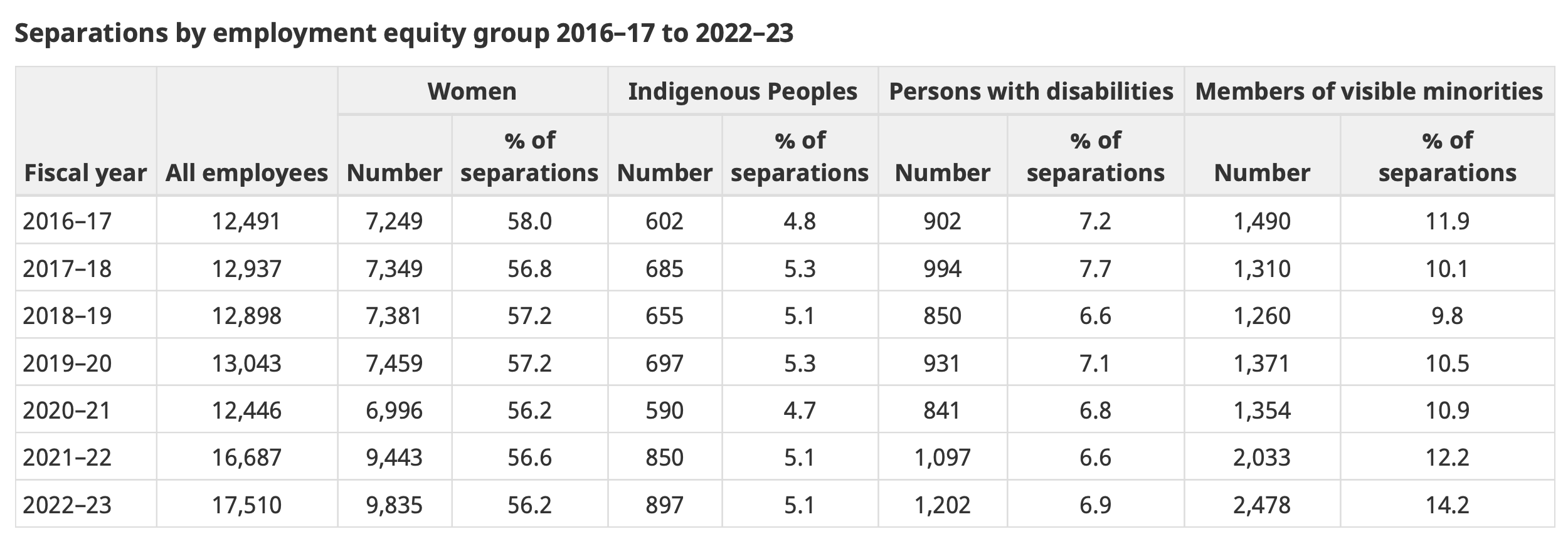
The Government’s proposed reduction in the public service by 5,000 public servants over four years (1,250 per year) is meaningless as the 2022-22 EE report shows annual separations more than 10 times that:

One thought that crossed my mind while browsing this close to 40 page document is whether this level of detail and effort would survive a change in government. Unlikely IMO, given the pressure to reduce spending and the CPC general aversion to excessive employment equity reporting and measures.

Source: Budget 2024, Statement on Gender Equality, Diversity, and Inclusion

Minister preemptively shuts down Calgary proposal to let permanent residents vote

Right call, given that Canadian citizenship has reasonable requirements (high fees perhaps excepted) and that backlogs largely eliminated:

A Calgary city council motion to extend municipal voting rights to permanent residents has been stopped in its tracks by Alberta’s municipal affairs minister.

The motion is set to be introduced by councillors Walcott, Wong, Dhaliwal, Mian, and Penner on Tuesday.

However, in a post to X on Saturday, Minister Ric McIver said he’ll “save us all some time.”

“Only citizens of Canada can vote in municipal elections. That will not be changing,” he said.

The motion calls for an amendment to the Local Authorities Election Act, which determines who has the right to vote in municipal elections. 

Because municipalities exist due to provincial legislation, the Alberta government would have to decide to amend the Local Authorities Election Act.

The councillors argued in their motion that all levels of government make decisions that affect residents’ daily lives, regardless of their citizenship status. 

“Municipalities are unique, as the only order of government that is not constitutionally defined. The opportunity to extend voting rights to more members of our local communities would represent a significant shift to ensure our local communities are representative of the people who call them home,” reads the motion.

The procedure on Tuesday is to ensure that the motion is written properly, Wong told True North in an interview. The motion will not be debated until the next regular council meeting on Apr. 30.

Wong said he is eager to hear more about the pros and cons of the motion, including its virtues and benefits, and how it aligns with federal and provincial criteria for voting eligibility

“Our responsibility as municipalities extends to all… who call our communities home, who contribute to civic life, who work here, raise families here, and use city services, should have a democratic right to vote in our municipalities,” reads the motion.

Wong said that councillors have been canvassing their constituents, both citizens and permanent residents.  

The perspectives presented have been varying. Some have said that citizenship is a vital voting criterion.

“We’ve also heard people saying, ‘We’re newcomers. We want to be able to be a citizen.’ There are reasons why it’s been delayed, whether it’s in their control or not. But they also feel that they’d like to have a voice in municipal governance because they are users of our services as well as people who pay taxes,” said Wong.

He added that one of the most pressing questions is the many different types of permanent residents there are and what would determine voting eligibility.

“The nuance of that has to be discovered by the province, and the province needs to make the system fair across the province because this is not just a Calgary-based request,” said Wong.

The Calgary councillor was not surprised at McIver’s response, he said. He added that McIver is very involved and understands Alberta and Calgary’s multiculturalism. 

“I know that he wouldn’t dismiss it just because of personal feelings about us. He would weigh the arguments presented by all municipalities,” said Wong.

“All members of council are always amenable to persuasion, and therefore nobody’s cast a vote as of yet. And I think Calgarians need to understand that.”.

True North reached out to McIver for additional comment. His office said he has nothing more to add to his previous post to X. 

Source: Minister preemptively shuts down Calgary proposal to let permanent residents vote

Le français québécois, pas pire qu’un autre

More on the controversy over tests from France vs Quebec (although not the most important issue, understand the sensitives):

Et rebelote : des internautes se moquent du parler québécois. Depuis mardi, sur X et sur TikTok, une vidéo du jeune Joël Legendre chantant à l’émission Soirée canadienne à la fin des années 1970 a été commentée par des centaines de personnes. La chanson qu’il interprète est tantôt appelée M’en revenant de Sainte-Hélène ou J’ai vu le loup, le renard, le lièvre. L’enfant d’alors mène de sa voix une foule animée, agissant comme un choeur en écho, qui bat des mains la mesure.

Dans les commentaires, certaines personnes défendent la langue bien de chez nous, pendant que d’autres la dénigrent sans gêne, allant jusqu’à nier que l’on parle vraiment français en ce coin d’Amérique du Nord. « Ma femme francophone (accent parisien parfait) rit chaque fois que les Québécois ouvrent la bouche. Ce n’est pas du français ! » écrit par exemple en anglais un utilisateur de X.

Ces réactions n’étonnent pas les linguistes à qui Le Devoir a parlé.

Si ce genre de diffusion en ligne fait rapidement boule de neige ici, c’est d’abord parce que les Québécois ont l’épiderme sensible sur la question linguistique. On a fait du progrès par rapport à notre insécurité linguistique, mais ce n’est pas fini, dit la linguiste Julie Auger. Elle cite comme exemple des personnes pour qui adopter les expressions propres aux Français est le gage d’une langue « plus correcte », quitte à embrasser leurs tics de langage. Un lecteur du Devoir suggérait notamment l’an dernier de remplacer le mot « faque » par « du coup » — ce qu’elle a trouvé « très ironique », se souvient-elle, puisque l’expression est moquée en France.

Quant à ceux qui voudraient ridiculiser la langue d’ici, leurs messages démontrent une idée préconçue et figée du français, disent ces linguistes qui s’affairent à la déconstruire.

« Pourquoi ne pas porter un autre regard sur la langue et en célébrer la diversité et l’adaptabilité ? » demande d’emblée celle qui est aussi professeure titulaire à l’Université de Montréal. « Je ne sais pas pourquoi les humains tiennent à se diviser en catégories et à dévaloriser les autres. »

Variations sur un même thème

Déjà, le français hexagonal, qu’on prend souvent pour le « bon français », est récent. « On a parlé français ici, en Nouvelle-France, avant que la France dans son entièreté parle français. » À l’époque de la colonie française, au XVIIe siècle, ce n’est qu’autour de Paris et chez la noblesse qu’on parle le français, alors que le bourguignon domine en Bourgogne et le picard à Lille, donne-t-elle en exemple.

Il n’y a donc pas de langue unitaire et immuable, au contraire. « Ce qui est considéré comme le “bon français” varie énormément dans l’Histoire. […] On peut ne pas aimer tous les changements de la langue, mais si elle ne change pas, elle meurt », dit la spécialiste. Elle a d’ailleurs participé à un ouvrage collectif intitulé Le français va très bien, merci, qui cherchait à renverser cette vision voulant que le français se meure à cause d’Internet ou de l’influence de l’anglais.

« On revient toujours à cette question. On n’aurait pas le droit de parler une variété de français qui est différent et qui reflète notre histoire ? » analyse quant à lui Wim Remysen, professeur de linguistique à l’Université de Sherbrooke. Ce sont de « vieux discours dépassés » qui font complètement abstraction du phénomène de variation d’une langue, variations qui existent dans toutes les langues à travers le monde. « On ne demanderait pas à un Américain de parler le même anglais qu’un Britannique, ce n’est pas compliqué ! » ajoute-t-il.

Déjà, au XIXe siècle, il y a eu ce genre de débat autour du French Canadian patois, note-t-il. C’est toujours cette idée qu’il y a quelque chose qui ne va pas avec le français parlé au Québec qui ressurgit, une idée qui a souvent servi à affaiblir ou à minimiser les revendications pour faire valoir nos droits linguistiques, note M. Remysen. « On a tort de vouloir stigmatiser ces particularités. Au contraire, c’est quelque chose qui fait partie de qui nous sommes. »

La langue française ferait particulièrement la belle part aux puristes, selon ces deux professeurs. « Dans le cas du français, c’est un discours particulièrement dominant parce qu’il a toujours eu une hypercentralisation de la norme », dit M. Remysen. Dans le cas de l’anglais et de l’espagnol, les anciennes colonies sont devenues plus importantes que la métropole, et « ce poids démographique a facilité un certain affranchissement ».

Une question de registres

Au moment même où le premier ministre français, Gabriel Attal, est en visite officielle au Québec et sort sa rhétorique d’apparat, les deux experts appellent aussi à cesser de comparer « des pommes avec des oranges ».

Le réflexe de croire que « les Français ont plus de vocabulaire » vient souvent du fait que l’on compare les différents registres. « On pense au français des Têtes à claques, mais il faut aussi penser au français de Céline Galipeau. On a tendance à réduire […], mais le français québécois, c’est aussi cet éventail de formes », dit Mme Auger. « Il y a toujours eu une langue familière, la langue de tous les jours, et une langue standard. C’est notamment le rôle de l’école d’amener les enfants à maîtriser le mieux possible cette variété qui donne accès à toutes les professions. »

Il est bon de pouvoir communiquer avec les francophones ailleurs en francophonie et d’avoir accès à la littérature ; l’important est donc aussi de savoir passer d’un registre à l’autre en fonction de ses besoins et de la situation, note la linguiste.

Des internautes comme Stéphane Venne ne sont pas d’accord, et ils comptent bien le faire savoir. Il a partagé son point de vue sur les réseaux sociaux en tant que « simple citoyen », mais aussi en tant qu’auteur-compositeur qui a fait de la langue son matériau artistique. Il appelait ainsi à distinguer l’accent, la « dimension acoustique », de celle de la « compétence langagière », qui comprendrait la syntaxe, le vocabulaire et l’élocution.

Pour lui, les critiques à l’égard d’un accent — qu’il soit marseillais, normand, parisien ou québécois — sont « tout à fait ridicules ». Ce qui est « plus fondamental » est la maîtrise de la langue elle-même, poursuit-il au téléphone avec Le Devoir. « Si vous avez 60 mots à votre vocabulaire et qu’une autre collectivité en a 600, il y a un déficit », croit-il. Les Québécois parlent donc mal, selon lui ? « On n’a pas des siècles de culture et d’éducation. On est une jeune collectivité française qui a de l’avenir », se défend l’artiste. « La capacité des gens ordinaires en France, le sport du langage qu’ils maîtrisent, est de loin supérieure », affirme-t-il néanmoins.

Aucune étude ne montre cependant que la variation entre la langue familière et la langue soignée soit plus grande au Québec qu’en France. « On est plutôt dans le domaine des clichés et des stéréotypes », conclut M. Remysen, qui invite à célébrer notre langue variée.

Source: Le français québécois, pas pire qu’un autre