Before the November presidential election, Ohio’s secretary of state and attorney general announced investigations into potential voter fraud that included people suspected of casting ballots even though they were not U.S. citizens.
“The right to vote is sacred,” Attorney General Dave Yost, a Republican, said in a statement at the time. “If you’re not a U.S. citizen, it’s illegal to vote -– whether you thought you were allowed to or not. You will be held accountable.”
In the end, their efforts led to just a handful of cases. Of the 621 criminal referrals for voter fraud that Secretary of State Frank LaRose sent to the attorney general, prosecutors have secured indictments against nine people for voting as noncitizens over the span of 10 years — and one was later found to have died. That total is a tiny fraction of Ohio’s 8 million registered voters and the tens of millions of ballots cast during that period.
The outcome and the stories of some of those now facing charges illustrate the gap — both in Ohio and across the United States — between the rhetoric about noncitizen voting and the reality: It’s rare, is caught and prosecuted when it does happen and does not occur as part of a coordinated scheme to throw elections.
Of note, as often happens, the narrower interests related to adoption prevail over broader policy considerations (time limit for residency test):
This bill is a response to the December 2023 decision from the Ontario Superior Court of Justice (Bjorkquist et al. v. Attorney General of Canada). This decision declared that the existing provisions in the Citizenship Act that limit citizenship by descent to the first generation born abroad, contravene the mobility and equality rights provisions in sections 6 and 15 of the Canadian Charter of Rights and Freedoms (the Charter). These provisions in the Act are thus unconstitutional and, as such, have no force or effect. The Court suspended its declaration of invalidity until December 19, 2024, to give the Government of Canada time to amend the Citizenship Act.
With consideration to the impending court deadline, on November 28, 2024, the subject matter of Bill C-71 was referred to your committee for a pre-study, with instructions to report its findings to the Senate within two weeks. Your committee therefore received limited witness testimony and did not have enough time to seek additional clarity from stakeholders and government officials on this important piece of legislation. Your committee examined the subject matter of this bill over two meetings, hearing testimony from the Honourable Marc Miller, P.C., M.P., Minister of Immigration, Refugees and Citizenship and departmental officials, in addition to six stakeholders.
Your committee heard broad support for the substantial connection test proposed by Bill C-71.
Concerns around equity and consideration of rights guaranteed by the Charter dominated much of the other limited testimony that was received. The Minister of Immigration, Refugees and Citizenship stated that, if Bill C-71 is adopted, the Citizenship Act will be in full compliance with the Charter for the first time in its history. While some stakeholders agreed that the bill addresses the exclusions of the current Act, others cautioned that inequities in recognizing citizenship may persist, including violations of Charter rights.
In particular, concerns were raised by some stakeholders about the requirements for recognizing the citizenship of the children of internationally born adoptees. Your committee heard diverging perspectives on this point and, therefore, encourages the Government of Canada to engage with relevant stakeholders to further investigate this issue and consider amendments to the bill, if required.
Your committee also acknowledges the overall complexity of the Citizenship Act and suggests that careful consideration be taken at each step of the legislative and implementation processes relevant to this bill to prevent future lost Canadians and further violation of Charter rights.
During his testimony, the Minister of Immigration, Refugees and Citizenship informed the committee that the Government of Canada is seeking an additional extension to the court deadline.
Media coverage focused on extension of court deadline:
An unknown number of people will automatically become Canadian citizens next week if the Ontario Superior Court doesn’t grant the federal government a third extension to fix the issue of “lost Canadians,” Canada argued in court Thursday.
“Lost Canadians” is a term applied to people who were born outside of the country to Canadian parents who were also born in another country. In 2009, the former Conservative government changed the law so people who were born abroad could not pass down their citizenship unless their child was born in Canada.
In late 2023, the Ontario Superior Court of Justice ruled that law is unconstitutional.The government has until Dec. 19 to amend the Citizenship Act to respond to that decision. It is now seeking its third extension, after being granted delays in June and August.
In court Thursday the government asked for the Dec. 19 deadline to be delayed three months, until March 19, 2025, to give them more time to pass legislation.
The Liberals introduced the amendments to the Citizenship Act in May but the bill only began real debate in September. It has been sidelined since then, as an ongoing battle between the Conservatives and Liberals delays most work in the House of Commons.
The new legislation stipulates that anyone who meets the criteria would be eligible for citizenship if their parents spent a cumulative three years in Canada before they were born.
Interesting take (but then again, Catholic organizations tend to support more generous immigration and related policies, unlike Evangelicals):
President-elect Donald Trump stated he plans to end birthright citizenship, which is currently guaranteed by the 14th Amendment. The pro-life movement, which is as significant a part of the GOP base as the anti-immigrant caucus, needs to step up and oppose any attempt to end the conferral of citizenship on those born in the United States.
The foundational argument of the pro-life movement is that all life is sacred, and that once you start parsing who is, and who is not, entitled to certain rights, you are halfway down a slippery moral slope. All human beings, as human beings, should enjoy the same rights as every other human being.
The relationship of abortion policy to immigration policy might seem counterintuitive. The 14th Amendment doesn’t help the pro-life cause. It refers to “All persons born or naturalized in the United States …” Pro-choice groups argue that a human being only has a right to life once it is born, but once born, the rights that are conferred on the person are sacrosanct.
Those who drafted and enacted the 14th Amendment were not addressing the moral and legal issues surrounding abortion, and they didn’t have sonograms in 1866 when members of Congress began drafting the amendment after President Andrew Johnson vetoed the Civil Rights Act that year.
The drafters of the 14th Amendment aimed to extend the equal protection of the laws to those formerly enslaved. They knew that the framers of the original Constitution had it wrong when they decreed that slaves only counted as three-fifths of a person for purposes of representation in the Congress. They knew that the founders had been wrong about slavery entirely. They knew that this diminishment of the humanity of those who had been enslaved was an affront to our nation’s foundational claims about human freedom and legal equality.
The pro-life movement has always been constructed on this deeper moral concern, that no person should have their humanity diminished, even if the movement has failed to live up to this high ideal. The source of human rights is our civilizational belief in transcendent human dignity. Virtually every religion expresses this belief in some way. Ours expresses it in terms of the imago Dei, the belief that every person is made in the image of likeness of God. Every time the pro-life movement ignores other threats to this God-given human dignity, it weakens its credibility.
“Catholic social thought starts with the dignity of each person and the whole person,” Dylan Corbett, executive director of the Hope Border Institute which advocates for immigrants, told me. “This is the bedrock of the church’s commitment to the poor, the unborn and the vulnerable, without distinction. In the coming months, the Trump administration’s targeting of our parishioners, neighbors and the essential workers in our communities simply because of immigration status will test the credibility of our moral witness.”
Kristen Day, director of Democrats for Life of America agrees. “Pro-life principles don’t end where Donald Trump’s pet projects begin,” she told me via email. “Remaining silent on the issue of birthright citizenship would betray our movement’s highest values because there is nothing pro-life about ending it. Life begins at conception, but it doesn’t end at birth.”
To be clear, even a democracy seriously engaged in working for equality will need to draw distinctions, to discriminate, between people. We all know a precocious 16- or 17-year-old who is more mature than some 20-somethings we know, but unless you are 18, you don’t get to vote. We wouldn’t want the government devising some kind of test that decides who is worthy to vote, and who isn’t, and so we set an arbitrary cutoff. That arbitrary cutoff is applied universally.
In terms of abortion policy, conception, viability and birth are the usual cutoffs, and there is an argument to be made for any of the three. Only the first coheres with Catholic teaching, and in most pluralistic democracies, the cutoff is at some point between conception and viability.
As a culture, a society and a polity, we need to learn how to think more deeply, and less arbitrarily, about where we draw such lines.
The idea that a person is a citizen of the place where he or she is born is a bulwark against any attempt to discriminate unjustly. A good way to sniff if a particular discrimination is just or unjust is to ask whether it is universal. Birthright citizenship is universal: It applies to everyone born here.
This political linkage of immigration and abortion cuts both ways. Pro-immigrant arguments would have greater moral cogency to many Americans if they were put forward by people who are committed to protecting the lives of unborn children, or at least not indifferent to the dignity of those unborn children. Given the polarization of the country, that moral linkage is not apparent to most and will be dismissed by many. Still, moral coherence eventually wins out most of the time.
At this moment in our nation’s political history, the pro-life movement should rally around the cause of defending birthright citizenship.
Permanent residents admissions: Increase January-October from 404,000 in 2023 to 413,000 in 2024 or 2.3 percent.
TR2PR (Those already in Canada): Increase January-October from 212,000 in 2023 to 219,000 in 2024 or 3.3 percent.
TRs-IMP: Decrease January-October from 757,000 in 2023 to 648,000 in 2024 or -14.5 percent.
TRs-TFWP: Decrease January-October from 172,000 in 2023 to 165,000 in 2024 or -4.0 percent.
Students: Decrease January-October from 570,000 in 2023 to 461,000 in 2024 or -19.2 percent. Post-secondary only: Decline from 431,000 to 328,000 or 23.9 percent.
Asylum Claimants: Increase January-October from 117,000 in 2023 to 149,000 in 2024 or 27.3 percent.
Citizenship: Increase January-October from 317,000 in 2023 to 329,000 in 2024 or 3.7 percent.
Visitor Visas: Decrease January-October from 1,567,000 in 2023 to 1,290,000 in 2024 or -17.7 percent.
Think this assessment largely correct. More performative but not without consequences and distracts from what the administration can and will do:
…”President-elect Trump is trying to send a message to people all over the world and also to unauthorized immigrants in the United States that he’s going to be tough on immigration,” argued Julia Gelatt, the associate director of the U.S. Immigration Policy Program at the Migration Policy Institute (MPI), a nonpartisan think tank.
“He hopes that people will choose not to make the trip to the United States and not try to enter,” she told Salon in a phone interview. “I think he also hopes that people who are living in the United States without status might opt to leave the country on their own.”
Trump has signaled an interest in repealing birthright citizenship since his first run for president, including the change in his immigration policy proposal in 2015, according to CNN. Trump insisted to Axios in 2018 that it was possible to do so through an executive order and last May, Trump released a campaign video proclaiming he would sign an executive order to roll back the right on day one of his presidency, according to NBC News.
The impact of repealing the right would be immense. A 2020 MPI and Pennsylvania State University analysis found that ending birthright citizenship for U.S. babies with two undocumented immigrant parents would lead to a 4.7 million-person increase in the population of unauthorized people by 2050, including one million children born to two parents who had been born in the U.S. themselves.
That population would skyrocket to 24 million by 2050 from 11 million at the time of the analysis’ publishing if U.S. babies with only one undocumented parent were also denied citizenship, the researchers found.
Gelatt said that such an action from the Trump administration would create a “multigenerational class of people who are excluded from full rights” and citizenship, which would restrain their ability to achieve higher earnings, support their families and contribute to the country through taxes.
“Denying people that legal status, even if they’re born in the United States, would put people in a much more legally vulnerable, economically vulnerable position,” she said.
Depending on the exact language of Trump’s proposed executive order, ending birthright citizenship could also impact U.S.-born children’s parents, added Stephen Yale-Loehr, a professor of immigration law practice at Cornell Law School. Such an order could potentially prevent officials from issuing passports, Social Security numbers or providing welfare benefits to family members of those children.
But Trump has no viable legal pathway to repealing birthright citizenship, Yale-Loehr told Salon in an email. An executive order can’t repeal an amendment, and any executive action Trump took attempting to do so would “trigger immediate litigation.”
Birthright citizenship was enshrined in the U.S. Constitution in 1868 with the ratification of the 14th Amendment, which was intended to grant citizenship and civil liberties to formerly enslaved African Americans. Contrary to what Trump told Welker, more than 30 nations, largely in the western hemisphere, provide birthright citizenship.
Amending the Constitution to upend the 14th Amendment would require a two-thirds vote in both the House and the Senate as well as ratification by three-fourths of the state legislatures. Even with slim Republican majorities in both chambers during Trump’s next term, such a proposal would be unlikely to get past either chamber.
His proposed executive order is also unlikely to withstand any legal challenges as the likelihood of the Supreme Court, despite its conservative majority, striking birthright citizenship from the Constitution is slim to none, added Hiroshi Motomura, a UCLA School of Law professor and faculty co-director of the Center for Immigration Law and policy.
“Even though people say that the court has become more conservative, this would be even further in the direction of trying to overturn the past than we’ve seen,” he told Salon in a phone interview.
Ending birthright citizenship would upend the foundation of how the nation has historically seen itself — as a country of immigrants — flying in the face of the purpose of the American Civil War and much of the United States immigration history since its founding, Motomura said. He pointed to the 1898 U.S. v. Wong Kim ArkSupreme Court decision that held that U.S.-born children of Chinese immigrants were U.S. citizens under the 14th Amendment even though their parents were, at the time, legally barred from obtaining citizenship under the Chinese Exclusion Acts.
“This is all part of the racial history of the United States. This is why this is so bedrock compared to other things that the Supreme Court is sometimes characterized for doing as being quite radical,” he explained. “This goes way beyond overruling Roe v. Wade. I think that was a radical move, but this is no comparison. This is quite a bit more of a rethinking of what the country is even about.”
Given how unlikely it is that Trump would succeed at repealing birthright citizenship, what purpose, then, could Trump’s focus on ending the right serve? Generating political value, Gelatt and Motomura argued, the former pointing to the importance of illegal immigration and the border to voters during the 2024 election.
President-elect Donald Trump’s transition team is drafting several versions of his long-promised executive order to curtail automatic citizenship for anyone born in the U.S., according to people familiar with the matter, as his aides prepare for an expanded legal fight.
Trump, who has railed against so-called birthright citizenship for years, said during his first term that he was planning an executive order that would outright ban it. Such an order was never signed, but the issue remained a focus of Trump’s immigration proposals during his re-election campaign. He has said he would tackle the issue in an executive order on day one of his second term.
Weeks before he takes office, Trump’s transition team is now considering how far to push the scope of such an order, knowing it would almost immediately be challenged in court, according to a transition official and others familiar with the matter. The eventual order is expected to focus on changing the requirements for documents issued by federal agencies that verify citizenship, such as a passport.
Through an executive order or the agency rule-making process, Trump is also expected to take steps to deter what Trump allies call “birth tourism,” in which pregnant women travel to the U.S. to have children, who receive the benefit of citizenship. One option on the table is to tighten the criteria to qualify for a tourist visa, according to people familiar with the Trump team’s thinking. Tourist visas are most often issued for a period of 10 years, though the tourist can’t stay in the U.S. on each visit for longer than six months.
Karoline Leavitt, a spokeswoman for the Trump transition, said the president-elect “will use every lever of power to deliver on his promises, and fix our broken immigration system once and for all.”
Some on the right have backed Trump’s plans and argued that birthright citizenship is a misinterpretation of the 14th amendment, which dates back to the 19th century and in part granted full citizenship to former slaves. They have also criticized birth tourism. Companies in China have attracted attention in recent years for advertising such services, and airlines in Asia even started turning away some pregnant passengers they suspected of traveling to give birth.
“Because you happen to be in this country when your child is born, is not a reason for that child to be a U.S. citizen. It’s just silly, and the reliance on it in law is utterly misplaced,” said Ken Cuccinelli, a senior fellow at the Center for Renewing America, a pro-Trump think tank, who previously served as deputy secretary of Homeland Security.
Many constitutional scholars and civil-rights groups have said a change to birthright citizenship can’t be done through executive action and would require amending the Constitution—a rare and difficult process. The most recent amendment was ratified in 1992, more than 200 years after it was first proposed.
T rump on the campaign trail this year offered more details on what executive action related to birthright citizenship could include compared with his first term, a change that some backers took as an indication that he is more willing to act on the issue.
Trump said he would sign a “day one” executive order directing federal agencies to require a child to have at least one parent be either a U.S. citizen or legal permanent resident to automatically become a U.S. citizen. It would also stop agencies from issuing passports, Social Security numbers and other welfare benefits to children who don’t meet the new requirement for citizenship, the president-elect’s campaign had said.
“My policy will choke off a major incentive for continued illegal immigration, deter more migrants from coming, and encourage many of the aliens Joe Biden has unlawfully let into our country to go back to their home countries,” Trump said in a campaign video.
But the requirement that at least one parent be a U.S. citizen or legal permanent resident would also affect children born to parents who immigrated legally through visas, excluding them from automatic citizenship.
“The new piece of it is them talking publicly about the mechanism they might try to use to operationalize this unconstitutional plan,” said Omar Jadwat, director of the American Civil Liberties Union’s Immigrants’ Rights Project. “They just can’t do that consistent with the constitution.”
“ Litigation is definitely going to follow,” he added.
The Supreme Court affirmed birthright citizenship in its 1898 ruling in U.S. v. Wong Kim Ark. But critics of automatic citizenship argue Trump’s proposed citizenship restrictions would be different from that case, which involved a child born to Chinese parents who were legal permanent residents in the U.S.
Trump’s allies say a legal fight that makes its way to the Supreme Court is the point of the executive order.
“Force the issue and see what happens,” said Mark Krikorian, executive director for the Center for Immigration Studies, a group favoring immigration restrictions that was close to Trump’s first administration. Even with the court’s conservative majority, Krikorian isn’t optimistic about Trump’s chances.
“ I think they’ll probably uphold the current interpretation of the 14th Amendment,” he said. “They’re going to want to start that court fight as soon as possible to see if they can see it through to the end before the administration ends,” he said.
While I have followed the debates and discussions regarding “lost” Canadians over the years, this was my first time testifying on the issue in the context of C-71 along with many familiar faces. My one ongoing observation is despite all the language around up to one million “lost” Canadians, the reality is that most “lost” Canadians appear not want to be found, with only about 20,000 citizenship proofs issued (2 percent) since the first fix for those who lost their citizenship.
The other general comment pertains to the government’s policy choice of not having the same time limit to meet the residency requirement as for Permanent Residents. The statement by officials that this is intended to make it easier and more flexible for applicants suggests that officials, and likely the minister, have not learned many lessons from the overly facilitative approach for Permanent Residents, international students and temporary workers, all of which the government has since rolled back.
We shall see the SOCI report in a few weeks and will see what points they took on and which ones they don’t.
The following is my take on the major points raised during Senate’s SOCI pre-study hearings on the Bill.
Connection test: 1,095 days cumulative with no time limit (C-71) vs within 5 years: My earlier article and formal submission advocating for the residency requirement to be limited to the same 5 year period as per citizenship applicants provoked discussion at the Senate’s SOCI, with a number of senators questioning the rationale for the government’s decision.
Minister Miller argued that it was unlikely that the residency requirement would be “spread over forty years” and that a longer time period still means a “fairly important connection,” citing Lebanese Canadians as an example, the “Canadians of convenience” example that was the genesis of the first generation cutoff. (Miller’s riding is about three percent Lebanese ethnic origin). The Minister also indicated concerns that the five-year limit would create another series of “lost Canadians.”
Officials further noted that the aim of C-71 was to be facilitative, citing examples of persons coming to Canada annually for summer vacations or family visits. Notably, neither the Minister nor officials addressed the operational complexities of a residency requirement with no time limit. Most witnesses and senators support a connection test.
The appropriateness of a residency-base connection test was accepted by most witnesses.
There was some discussion about whether the lack of a time limit increased the risk of “citizens of convenience,” with the Minister not believing it would (I had previously indicating more likely without a five-year limit).
The possibility of using the electoral list as a basis for a connection test was raised. Given that only about 57,000 persons living outside Canada were issued ballots, only a small fraction of those living abroad, hard to see how this would be a valid alternative.
Numbers affected and operational impact: The Minister and officials provided existing operational data but, beyond generalities, did not share any more detailed internal analysis. There are about 700 applications under the interim measures for those affected by the first generation limit. The Minister does not anticipate that “wild scenarios of hundreds and thousands” will materialize. Officials did not appear to have undertaken any analysis similar to that in my submission that provides estimated orders of magnitude. The other element of note is that the understandable focus was on the immediate cases, those born abroad and unable to transmit their citizenship. There was little to no discussion of the future operational impact and numbers when those second generation children born-abroad had children of their own also born abroad (as is the case of my grandson, who would have to meet the residency test).
Awareness and clarity: Predictable and legitimate calls for efforts to make those affected aware of the change, with officials indicating their efforts to make persons aware of the interim measures with work underway to prepare once Bill C-71 comes into force. The issue of readability of the current Act and the need for a new Act in lay language was raised, with the Minister noting his agreement in principle but not a priority in the final months of the government’s mandate.
Indian status and citizenship: That some Indigenous persons have Indian status but not citizenship and vice versa was raised, with the Minister noting “ridiculous situations” and that citizenship should be automatic but there were examples of First Nations that were not Canadian.
Adoptions: The CBA raised the issue of the difference between naturally born children, whose citizenship starts on the day of birth, in contrast to adopted children, who only obtain citizenship when the adoption is approved, recommending that the US and British approach of the effective date of adoption being the date of birth of the child. Hard for me to see any practical impact of current policy or substantive inequalities but understand importance to adoptee parents.
Similarly, I find it difficult to understand the arguments that internationally adopted children, citizens by grant under S 5.1 are being discriminated against compared to naturally born children. (If I recall correctly, the direct route under S 5.1 was a response to parents who wanted their adopted child to be treated identically to a natural-born child, and not under the Permanent Resident pathway as an immigrant. In my view, hard to have it both ways and there does not appear to be any substantive differential treatment in C-71).
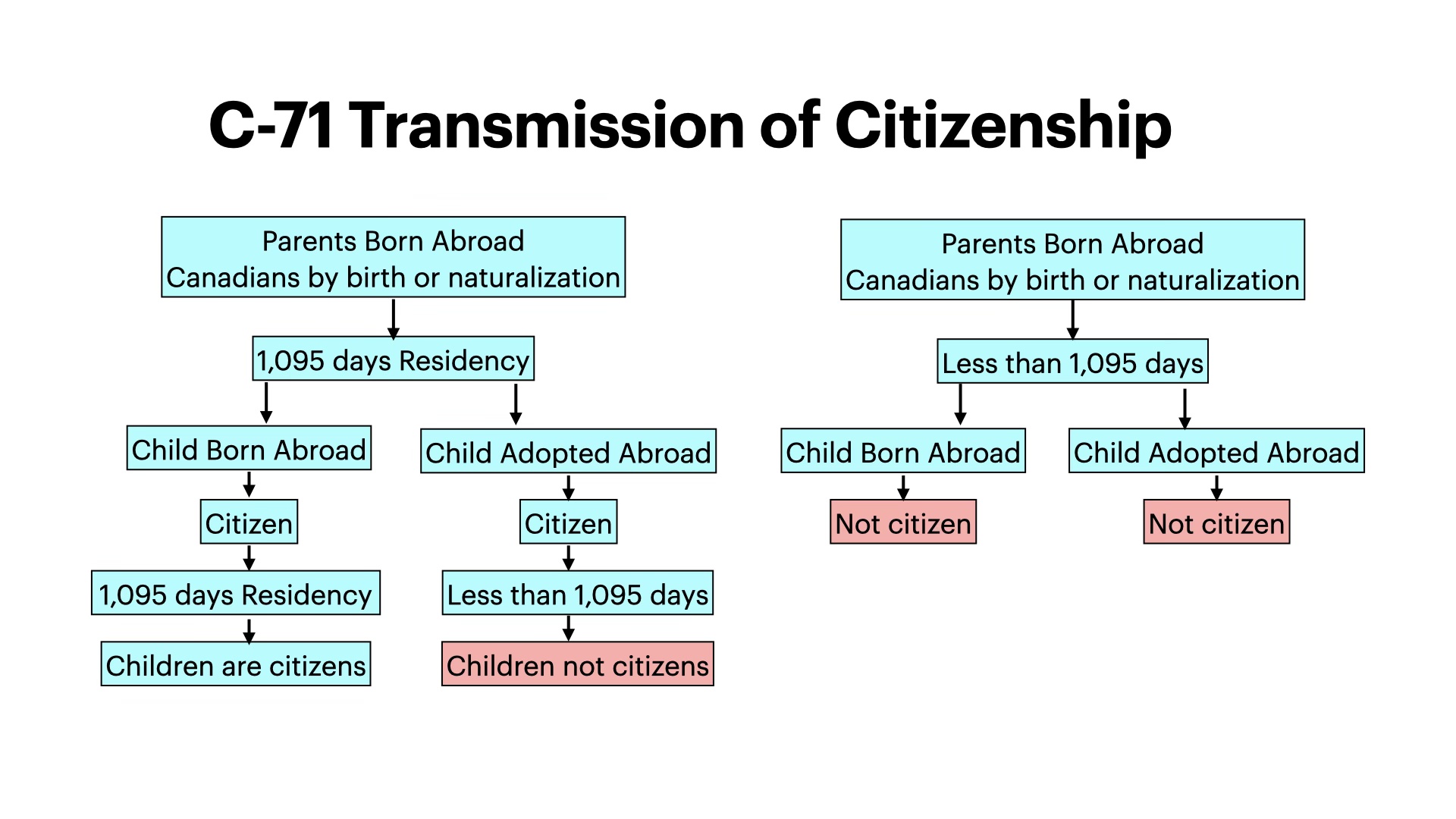
The Minister himself, noting the test applies to the parents, not the child, did not see an inequality. Officials in a clear presentation clarified that natural and adopted are treated as similarly as possible and that not requiring the connection test for international adoptions could mean that citizenship could be passed on through generations without residency in Canada.
Transcript below (preliminary): “If Bill C-71 is amended to eliminate the substantial connections test in the international context and begins to treat adopted persons as if they were naturalized citizens and not citizens by descent, as is in the case for children born abroad to Canadians, this will result in differential outcome for the two groups. Children adopted abroad by Canadians would benefit preferential treatment compared to children born abroad to Canadians, who would then be subject to different and more onerous requirements in order to pass on citizenship by descent.
If Bill C-71 were to eliminate the substantial connection requirement, again in an international adoptions context, it could mean that a child born abroad and adopted to a Canadian parent could then also adopt a child abroad and pass on citizenship despite never living in Canada. This would mean citizenship by descent could be passed down through generations of people who have never lived in Canada.”
When I worked on these issues some 14 years ago, I always found a graphic was helpful on how C-71 would work with my effort below:
Never heard birth tourism described in this manner:
There have been some interesting discussions about birthright citizenship, intensified by Donald Trump’s election a few weeks ago.
A number of people who are angry at the chaos at the border have jumped right over the normal processes and procedures which would guarantee illegal border crossings are limited, and hit right at one of the core principles of our nation, one embedded in the 14th Amendment – if you are born here, regardless of the status of your parents, you are a U.S. citizen.
The actual wording of the amendment is as follows: “All persons born or naturalized in the United States, and subject to the jurisdiction thereof, are citizens of the United States and of the state wherein they reside.”
Those who don’t like the idea that birth on American territory automatically grants you the gift of American citizenship have started to parse the words of the amendment. They are doing what gun reform activists tried to do with the 2nd Amendment, making the “right to bear arms” a collective right held by “militias,” not an individual and a personal right for each and every American citizen. That parsing, which would make every Catholic school English teacher who ever diagrammed a sentence on a blackboard proud, was roundly rejected by the Supreme Court in the Heller decision, which recognized an individual right to own a gun. That being the case, conservative attempts to dismantle well over a century of constitutional precedent is dishonest, and untenable.
Some argue the phrase “subject to the jurisdiction of” means parents of the child born in this country must be legally here in order to confer citizenship. The point they are missing, or actually one of several points, is that it is not the parents who are conveying anything but life to the child.
It is the Constitution itself that is conveying citizenship. More importantly, virtually everyone physically present in the U.S., regardless of legal status, is subject to the jurisdiction of our government. If this were not the case, we can imagine a Batman style Gotham city environment, where illegal aliens could just commit crimes and the only thing we could do if we catch them is deport them. No arrests, no jail terms, no trials and no life sentences.
Imagine if that were the case with Laken Riley’s murderer, an illegal alien who is now going to spend the rest of his life behind bars. This writer would have been happier had he been sentenced to death, but that’s another column altogether.
The idea we can simply strip people of their citizenship and thereby erase a constitutional right, merely to solve a problematic but temporary problem at the border, is anathema. I know legal scholars have differed on the integrity of birthright citizenship, but they are going to need better arguments than those proffered by anti-immigration activists in order to be able to convince even this conservative Supreme Court of their legitimacy.
I am an immigration lawyer and my bias is incorporated into my viewpoint. Thirty years of doing this work will color anyone’s perspective on the laws governing immigration policy. I understand extremely well the importance of maintaining order at the border, but stripping people born here of their birthright, one over a century old in its recognition, on specious political grounds is not going to advance that goal.
People do not come here to “have” U.S. citizen children, who frankly can only be of benefit from an immigration perspective after the child turns 21 or in a few other very limited circumstances. The immigration laws already eliminate U.S. citizen children as the basis of most waivers of inadmissibility and against deportation/removal, so this is simply an appeal to the lowest common denominator, the basest instincts of the xenophobic.
Where will we draw the line? Is being born to a citizen the only way to ensure the citizenship of the child? Is being born to a visitor who has the right to live here for a few months enough? Do you need your green card? And is this what we want, a world where your value is based on your parents’ status in the country? I don’t think that Americans are that sort of people.
So even if you do support Trump’s more draconian policies on immigration, you are not as patriotic as you think if you are in favor of making newborns criminals in their cribs.
This article was prompted by my experience under the Harper government and Minister Kenney, as a way to assist public servants likely facing a dramatic transition to a Conservative government. I hope readers find it helpful and that this will contribute to conversations regarding the likely transition:
Faced with the likelihood of a majority Conservative government in the foreseeable future, Canada’s federal public service should seriously heed the warning of Stephen Harper’s former communications director, Andrew MacDougall, that “the hangman is coming.”
Over 40 per cent of federal public servants have only worked under the Trudeau government, and after nearly a decade in power, many public servants may have internalized Liberal perspectives.
A Conservative majority would signal public desire for change, and the public service, like it or not, will have to support a different and arguably sharper ideological agenda.
While the Clerk of the Privy Council and deputy ministers will provide high-level direction along with transition briefing books, many of the challenges will affect mid-level executives. Looking back at my experience under the Harper government, as detailed in my book Policy Arrogance or Innocent Bias: Resetting Citizenship and Multiculturalism, the following lessons may be helpful.
These reflect the specific policy areas I was responsible for (citizenship and multiculturalism at the federal departments of Canadian Heritage and then Citizenship and Immigration), working under the activist and effective minister Jason Kenney, in what was arguably a less polarized political and social media environment. History seldom repeats itself, but hopefully these reflections will still provide some guidance for public servants beyond the usual transition planning….
The Senate will be starting its review of Bill C-71, the government bill replacing the first generation cut-off for citizenship transmission, by a residency test for the second generation born abroad. The Senate will conduct its review this week prior to the House of Commons given that the House is effectively shut down.
I will be testifying on December 4th.
Please find attached my written submission, arguing for a same time limit of five years to meet the 1,095 day residency requirement as is the case for permanent residents applying for citizenship, and for IRCC to prepare and share its analysis of the likely number of persons affected and the operational impacts along with associated costs. (My own analysis is included in the submission).