It is where he went to university. Where he met his wife. Where he set up his successful business.
He has stayed when so many others have fled the country’s years of unrest- determined to see the country he loves and calls home succeed.
But Mr Hage, it could be argued, is a second-class citizen in Liberia. In fact, he is not a citizen at all – prohibited from becoming a full member of Liberian society because of the colour of his skin and his family’s roots in Lebanon.
‘They will enslave us’
Liberia, on Africa’s west coast, was established as a home for freed slaves returning to the continent, escaping from unthinkable misery in the United States.
Perhaps, then, it is unsurprising that when the constitution was created, a clause was put in restricting citizenship to just those of African descent, creating “a refuge and a haven for freed men of colour”.
Hundreds of years later, Liberia’s new president, the former footballer George Weah, described the rule as “unnecessary, racist and inappropriate”.
What’s more, Mr Weah said, discriminating against races “contradicts the very definition of Liberia”, which is derived from the Latin word “liber,” meaning “free”.
The pronouncement has sent shockwaves through some parts of Liberia.
“White people will definitely enslave black Liberians,” businessman Rufus Oulagbo tells the BBC, bluntly.
He fears any move to widen citizenship away from just black people would damage Liberians’ chances to develop their own country.
In particular, he says, allowing people from other countries to own property would be dangerous.
Mr Oulagbo is not the only one to voice these fears: a new advocacy group, Citizen’s Action Against Non-Negro Citizenship and Land Ownership, has been set up to fight the president’s plans.
“Every nation has a foundation on which it was built – if you undermine that foundation, the nation will definitely crumble,” the group’s leader Fubbi Henries told the BBC.
Mr Weah, he said, “needs to focus on the right policies for Liberians”.
“Right now the prime focus is how to get our businesses on track, our agricultural and educational sectors on track, not citizenship or land ownership to non-Negroes,” he said.
It is true Mr Weah has his work cut out without changing the constitution.
Despite its wealth of natural resources, Liberia is ranked 225 out of 228 countries when it comes to average income per person, at just $900 per year for 2017.
In comparison, the US figure was $59,500, while the UK’s was $43,600.
In fact, a third of Liberia’s GDP comes from those living overseas – with some families entirely dependent on remittances from the US.
Mr Weah has been blunt in his assessment of the situation: Liberia is broke, and he is going to fix it.
After years of civil war – not to mention the devastating effect of the Ebola epidemic in 2014 – the promises are music to most Liberian ears.
But changing the law now, Mr Henries says, would be like putting a two-year-old boy – Liberians – and a 45-year-old man – outsiders – in a boxing ring and seeing if they could have a fair fight.
“He will take undue advantage over that little child,” he said. “Liberian businesses don’t have that same leverage.”
Harmony
The fear of outsiders is nothing new. The Lebanese community is used to it.
“Probably some people might take this as a threat – that foreigners are coming to take over,” Mr Hage tells the BBC from his home in Monrovia. “That’s not the case.”
At its height in the 1970s, Liberia’s Lebanese community was 17,000-strong. Now, after Liberia’s long civil war, it numbers around 3,000 – barely a drop in the ocean in a population of four million.
At one point, Lebanese families had businesses across the country. Even now, the community owns some of the country’s top hotels and businesses.
But, says Mr Hage, that should never worry their Liberian-born neighbours.
“Lebanese were all over in this country and it wasn’t any threat; and we have enjoyed living with Liberian people,” he said.
“Liberian people are fine people; and we have lived together for all these years, we have had inter-marriages. The records speak for Lebanese in this country.”
In fact, he believes that should Mr Weah’s proposal go forward, it would open the way for even more cooperation.
But on a personal note, it would mean a huge amount to him.
“I have always hoped that one day the clause would be changed.
“I celebrated my 15th birthday in Liberia, I have never regretted living in Liberia.
“I am happy not because I am not a Liberian, I am happy because President Weah is looking at the future of this country,”
Please find below the link to the Policy Options article I did with respect to citizenship and the related deck that I will present later this week at the Metropolis Conference in Calgary (hence will not be blogging for the rest of the week).
This analysis uses Census data to examine naturalization rates with respect to gender, age, education, immigration period and category, labour force status and median income.
On Wednesday the Supreme Court will hold a hearing in Frank vs. Canada, a test case on the voting rights (in federal elections) of expatriate Canadian citizens. Everybody agrees that they definitely have some. The Charter is unambiguous about assigning such a right to all Canadian citizens. The question is whether this is a right that can be temporarily withdrawn, as the law now does, from a Canadian who has been apart from Canada for some time and is outside the reach of its law and institutions.
Lower courts have already offered conflicting answers, so it is hard to be sure what the Supreme Court will do. But emotional framing is bound to weigh a great deal in the final argument. In the court of origin, the government made an argument that letting long-term expatriates vote was unfair to the poor wretches who are trapped in Canada and who have no choice but to live with its government.
This was a sort of “dilution of voting power” argument, but it had the effect of sounding like the legal arguments that used to be made against prisoner voting — arguments that were ultimately thrown out. The Supreme Court approved inmate voting in 2002; having been asked “Hang on, you’re going to let a convicted rapist have the same voice in government as his victim?”, it returned what is now the accepted answer. “Yes, that’s the nature of a right. Like it or not, rapists have ’em too.”
This involves us in some logical awkwardness, because convicts have plenty of other rights whose free exercise we forbid after due process of law. But on the other hand, prisoners are definitely stuck with the Canadian state, and with its exclusive privilege of retaliatory violence, in an even more obvious sense than free residents are. It would thus be a bit weird to make Canada’s determination to count convict votes part of an argument, by extrapolation, for expatriate voting.
Weird or not, that’s what the originating judge did. He saw these as analogous questions of personal dignity. We don’t want to devalue or question the Canadian-ness of people who have been away for many years, but who feel Canadian and insist on being Canadian.
The majority on the Ontario Court of Appeal panel that next heard Frank vs. Canada cleared its throat and said, as it were, “Whoa, let’s start over.” Those judges chose a guiding metaphor that had not been used in the original contest: the philosophically notorious “social contract.” Resident citizens have duties and obligations that expatriates don’t: obvious ones include taxes and compulsory jury service (how would expatriates like to be reeled back in for that?), but there is also the big, obvious one of “being subject to Canadian law,” the vast obsidian bulk of which applies only on Canadian soil. Moreover, we exclude non-resident citizens from social entitlements like public health insurance.
But there is nothing in the text of the Charter that requires or urges a “social contract” framing of core democratic rights. The appeal court was, as I see it, trying to find a way of dressing common sense in legal language — asking, in effect, “Hang on: we’re really going to let U.S. taxpayers with Canadian passports vote in Canadian elections?” We have seen what often happens to such “Hang on …” arguments at the Supreme level.
Until recently, no one had considered letting expatriate citizens vote as a matter of right. The whole issue cropped up because Canadian law had, from the First World War on, to devise obviously desirable provisions for voting by Canadians who are abroad in uniform and in the foreign service. Citizens who are away from Canada just because there is more money or opportunity or sunshine somewhere else are not in the same position as those who are actual living tendrils of the Canadian state. But since the law makes a distinction between mere economic expats and offshore agents of Canada, the expats have an opportunity to denounce the distinction and wriggle through the hole.
For some reason, everyone recognizes that the “expatriates have a right to express Canadian identity” argument does not quite work for provinces. A Quebecer living in B.C. is likely to have a meaningful, even essential personal connection to Quebec, but there exists no legal concept of Quebec citizenship, or at least none recognized by the federal government.
I wonder, though, whether the resident citizen’s right to vote in federal elections could be logically severed from mere geographic accident, if we are going to adopt that view of things. Shouldn’t I be allowed to vote for a member of parliament in my hometown, although I no longer know much of its concerns and circumstances in detail, and almost never visit? Bon Accord, Alta., did form my character! And I suppose I care about it! From a polite distance!
Some Canadian citizens might be able to claim a right to cast a vote in many places with which they have some prior connection — maybe even an ancestral one. The opportunities for tactical voting would be hilarious. On what grounds could this kind of frenzy be ruled out, in logic, if the emotional principles of disfranchised expatriates are admitted by the law?
Canada’s top court is set to grapple with whether long-term expats should be allowed to vote, an issue that loomed large in the last federal election in which Justin Trudeau and his Liberals took office.
Civil liberties groups, which argue current rules barring the expats from voting are unconstitutional, and Quebec, which supports the federal government’s defence of the restrictions, are among interveners in the closely watched case the Supreme Court of Canada is scheduled to hear on Wednesday.
Canadians lose the right to vote after living abroad for more than five years under rules on the books since 1993. However, it was only under the former Conservative government of Stephen Harper that Elections Canada began enforcing the laws.
Two Canadians living and working in the United States launched the case after being denied the right to vote in the 2011 election. They argue that citizenship, not residency, is the key requisite for voting.
“One way or the other, this is going to get decided and either Canadians will be enfranchised or Canadians will be disenfranchised,” Jamie Duong, one of the appellants, said from Ithaca, N.Y.
Duong and Gill Frank, an academic in Princeton, N.J., initially won their case before Ontario Superior Court in 2014 but the government appealed. In a split decision in 2015, the Ontario Court of Appeal ruled the restrictions do indeed infringe on the rights of citizens. However, the majority found the violation democratically justified because the rules preserve the “social contract” between voters and lawmakers.
In its Supreme Court filing, the government takes issue with the characterization that long-term expats were “disenfranchised” by the rules enforced under Harper. With few exceptions, no Canadians living abroad were allowed to vote before the 1993 law changes, the government says.
“The impugned provisions enfranchised non-resident citizens by allowing them to vote for the first time in Canadian history, for as long as they met the definition of being temporarily resident outside Canada,” the government states.
In their factum, Duong and Frank argue they maintain a “deep and abiding” connection to Canada even though, like many citizens in a globalized world, they have left the country for employment or educational reasons.
“There is no pressing and substantial objective to justify the legislation,” the pair argue. “Five years is an arbitrary marker, which is not rationally linked to a citizen’s connection to Canada, nor to being subject to Canadian laws.”
Another intervener, the Canadian Expat Association, said the rules have “devalued” the citizenship of those abroad.
“For expats whose identity is deeply Canadian, this expressive harm to their dignity and personhood is demeaning and harmful,” the association says.
In rebuttal, the federal government argues Parliament made a reasonable policy choice in enacting rules designed to maintain the fairness of the electoral system. Canadians living in Canada, the government maintains, are more affected by laws their elected officials enact than are expats.
During the last election, actor Donald Sutherland, Canadian business groups abroad and other expats rallied against Harper and the voting ban. The campaigning Liberals promised a review and in November 2016, the Trudeau government introduced legislation to enable Canadians abroad to vote. However, little has happened since.
Duong said expats — estimates are that more than one million of them are unable to vote — will be keeping a close eye to see what the Supreme Court decides.
“The Canadian expat community that has been supporting us and supporting the fight has been fantastic,” Duong said. “We’ve raised closed to $18,000 from 220 people around the world…that has been helping to cover court expenses.”
An example of how inheriting Canadian citizenship (first generation) leads to consular demands even in cases where a person has never lived in Canada:
John Letts, the father of a young British-Canadian man accused of belonging to ISIS and being held in a Kurdish jail in Syria, is hoping to lobby the Canadian government in person next week for help securing his son’s transfer to Canada.
Letts and his wife, Sally Lane, insist the allegations against their son Jack are false but say he has the right to answer any charges against him in a British or Canadian court.
Letts say he would have travelled to Canada long before now had he been allowed.
He and Lane have been subject to a travel ban since being charged in 2016 under British terrorism legislation for trying to send money to their son, who they say was desperate to leave ISIS-held territory in the Middle East.
On Thursday, a British judge eased the restrictions on Letts, giving him permission to travel abroad with the court’s prior approval.
“We were just given the ruling this morning, so we haven’t had really much of a chance to digest it,” Letts said in an interview after the hearing.
“But I’m hoping that next week, I’d like to think I could be in Canada having meetings with appropriate people.”
Family holds dual citizenship
Jack Letts was 18 when he left his family’s home in Oxford to travel to Jordan and then Syria in 2014.
Last spring, Kurdish militias controlling parts of northern Syria stopped him as he was trying to leave ISIS-held territory and jailed him in the town of Qamishli.
Canadian consular officials spoke with him by telephone in January. In audio recordings of the call obtained by CBC News, Jack Letts said he had tried to commit suicide and asked to be sent to Canada.
The British media have dubbed him Jihadi Jack, a label his parents say has made their ordeal all the more difficult. Public opinion in the U.K. tends not to favour allowing people suspected of fighting for ISIS to return.
The parents turned to Ottawa for help, they say, in the face of an indifferent response from the British Foreign Office. Letts, Lane and their two children, including Jack, hold dual citizenship. When asked about the Letts case in the past, U.K. authorities have said they cannot help British citizens in places where the U.K. has no consular support.
Letts, seen in Facebook photo at age 20, went to Syria and Iraq in 2014, and is now in a Kurdish jail in northern Syria. He was dubbed Jihadi Jack in British media, a label his parents feel has hurt his case. (Facebook)
Lane is optimistic that Canada will help see her son extricated from the Kurdish prison.
“I think we’re in a different time frame now,” she said. “Jack’s in detention. There’s an opportunity to get him out of detention, and those questions about what he was doing can now be answered in a trial.”
Parents could face 14 years in prison
Lane says she has been focused on how to help her son rather than on the charges laid against her in Britain, with a trial set to begin in September.
But if found guilty, she and her husband could face up to 14 years in prison, an outcome supporters say would be ludicrous for parents trying to help a child.
John Letts says living under bail conditions and being blackballed by some in the community has been an ordeal, harming the couple’s ability to make a living.
“We’ve been living like this for three and a half years, waiting under this sword of Damocles and under this view that we’re somehow terrorists and aiding and abetting ISIS, and it just makes you very angry and upset. And here’s a breakthrough.”
In his decision Thursday at the Central Criminal Court in London, known as the Old Bailey, Judge Nicholas Hilliard did not lift the travel ban on Lane.
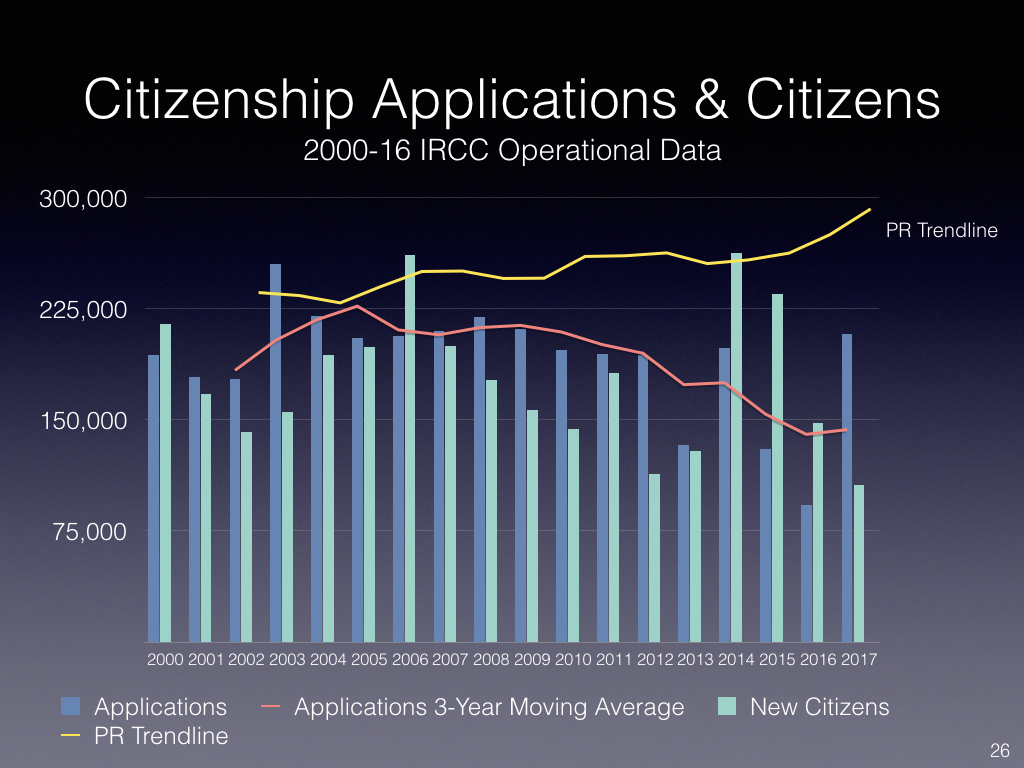
The above chart includes full 2017 citizenship IRCC operational data (preliminary).
Following the coming into force of C-6 reduced residency requirements (from 4 to 3 year minimum) and exemption from knowledge and language assessment for 55-64 year olds, there was clearly pent-up demand. From January to September, 108,001 applications were submitted (monthly average 12,000), from October to December, 99,562 (monthly average 33,187: the changes came into force on October 11).
As I have noted before, the reduced residency requirement will have a one-year impact on all applicants that will work its way through until October 2019; the 55-64 year old exemption will have an ongoing impact on a sub-set of applicants (2009-13 data showed about six percent of all applications were from this age cohort).
Given current end-to-end processing times, one should start seeing the impact of this increase mid-2019.
The 14-17 year old exemption will have a minimal impact given that this cohort will have been in the Canadian school system.
Hardly news – mentioned in Minister Hussen’s mandate letter more than a year ago.
Will, however, be interesting to see what “the very near future” means in terms of legislation actually means and whether it is stand-alone legislation or combined with other unannounced changes:
The federal government is looking at adding a commitment to Indigenous treaties in the oath that new Canadians take.
A spokesperson for immigration minister Ahmed Hussen said that while no official decision has been made, legislation to change the oath’s wording will be brought forward in “the very near future.”
The last sentence of the oath currently reads: “I will faithfully observe the laws of Canada, and fulfill my duties as a Canadian citizen.” A possible new wording would oblige new Canadians to say “I will faithfully observe the laws of Canada including Treaties with Indigenous Peoples, and fulfill my duties as a Canadian citizen.”
The idea of additional language in the oath of citizenship was included in poll questions by Forum Research Inc. The firm conducts regular surveys for the Privy Council Office.
Just under half – 49 per cent – of Canadians polled said they agreed with the proposed change. Twenty two per cent were on the fence, while 26 per cent were opposed.
The polling used a mixed sample of landline and cellphone responses. The survey has a margin of error of +/- 4.38 percentage points and a confidence level of 19 times out of 20.
Respondents only supported the change with a caveat that newcomers be adequately educated about Indigenous peoples and treaties to ensure they don’t struggle with the new wording, according to the Canadian Press.
The Canadian Press also obtained notes that showed the government intends to modify the script for those presiding over citizenship ceremonies. The changes would refer to “ceremonies on traditional territories, and include remarks on the history of Indigenous people.”
If implemented, the change would put into practice one of the Truth and Reconciliation Commission’s 94 calls to action.
Capping off the list at No. 94, the call to action in question proposes the government make the exact change to the citizenship oath’s wording that was considered in the polling.
Hussen’s mandate letter includes an order to add the acknowledgement of Indigenous treaties to the oath.
A spokesperson for Hussen also asserted the government’s commitment to make changes to the citizenship guide and to the oath of citizenship to reflect Indigenous treaties.
This isn’t the first change to the existing citizenship processes to cross Hussen’s desk. Last fall, Conservative MP Michelle Rempel sponsored a petition to “ensure that the final draft of the new citizenship guide includes the condemnation of female genital mutilation.” The petition has over 25,000 signatures.
In late January, the government committed to including a warning about FGM in the citizenship guide.
There is no word yet on the exact timeline for potential changes to the citizenship oath, although Hussen’s spokesperson said legislation will be introduced in “the very near future.”
Not surprising, someone involved in redistricting (i.e., competitive advantage):
In December, the Department of Justice requested that the Census Bureau add a question to the 2020 survey that would ask respondents to reveal whether or not they are U.S. citizens. Since ProPublica first reportedthe DOJ’s letter, civil rights groups and congressional Democrats have announced their opposition, arguing that in the midst of President Donald Trump’s immigration crackdown, the question will lead many people to opt out of the census, resulting in an inaccurate population count.
A lot is at stake. The once-a-decade population count determines how House seats are distributed and helps determine where hundreds of billions of federal dollars are spent.
But one question regarding the December letter remained unclear. The letter was signed by a career staffer in a division of the DOJ whose main function is handling budget and procurement matters. Who, observers wondered, was actually driving the policy change?
Emails obtained by ProPublica in response to a Freedom of Information Act request provide an answer: The letter was drafted by a Trump political appointee who is best known for his work defending Republican redistricting efforts around the country.
John Gore, who since last summer has been the acting head of the DOJ’s Civil Rights Division, draftedthe original letter to the Census Bureau, the emails show. In one email, Arthur Gary, the career official who signed the letter, noted that it was sent “at the request of leadership, working with John.”
Gore came to the Trump administration from the law firm Jones Day, where he was an appellate specialist best known for defending a range of Republican state redistricting plans that were attacked as racial gerrymandering by opponents. Gore, for example, helped defend a Virginia redistricting that was ultimately thrown out by a court which ruled that the legislators had focused too much on race.
The emails show Gore sending a draft of the census letter to Gary in early November under the subject line, “Close Hold: Draft Letter.” Gary signed and sent the letter the next month and then emailed a note to Gore confirming it was being mailed.
It’s not clear why Gore, who did not respond to a request for comment, didn’t sign the letter himself. The Justice Department press office also did not respond to requests for comment.
ProPublica previously reported that Gore wrote a filing changing the department’s position in litigation challenging Texas’ voter ID law. The Obama-era DOJ had pursued litigation claiming that the Texas statute intentionally discriminated against minority voters; the Trump administration then withdrew the claim. Gore wrote the filing largely by himself but asked career attorneys who’d long been involved in the case to sign it.
A decision on adding a citizenship question to the 2020 census is expected by the end of the month and will be made by Secretary of Commerce Wilbur Ross. The Census Bureau is part of the Commerce Department.
Separately, the Trump administration has taken a second step that suggests a philosophical commitment to including citizenship questions as part of the census. It selected as its first political appointee at the Census Bureau a longtime legislative aide to former Sen. David Vitter. The Louisiana Republican made headlines for years by repeatedly introducing controversial proposals for the census to ask about citizenship and immigration status.
Christopher Stanley, who left his job on Capitol Hill late last year, will take one of the Census Bureau’s three politically appointed positions, as the chief of congressional affairs. It’s not clear when Stanley will begin but a spokesman for the Commerce Department confirmed the selection to ProPublica. The position does not require confirmation by the Senate.
Stanley does not appear to have made public statements about the census. But he was Vitter’s legislative aide when the senator introduced a series of measures to change the census that elicited fierce opposition. Stanley worked as an aide to Vitter, first in the House and then in the Senate, for over 15 years, ultimately rising to be the senator’s legislative director.
Before the last census in 2010, Vitter led a legislative effort to get the bureau to add a question about citizenship. It failed. At the time Vitter criticized the system of congressional apportionment for being based on the count of all residents, not just U.S. citizens. “States that have large populations of illegals would be rewarded for that. Other states, including my home state of Louisiana, would be penalized,” he said at the time. The proposal was attacked by civil rights groups.
Vitter tried again in 2014. And in 2016, he introduced another amendment that would have required the census to ask about both citizenship and immigration status.
Since the U.S. Constitution was adopted, the full, once-a-decade census has always inquired about U.S. residents — or “free persons” as the original language put it — rather than citizens. At times in the past, the census inquired about citizenship, but last did so in 1950. The Census Bureau currently asks about citizenship on a much longer survey that goes to a small percentage of U.S. households.
Stanley did not return requests for comment.
Asked if Stanley’s selection signaled anything about the administration’s policy on the census, Department of Commerce spokesman James Rockas said: “We value Mr. Stanley’s many years of Capitol Hill experience. Legislative affairs aides implement policy, they do not decide it.”
Vitter’s stated reason for adding a citizenship question — to change congressional apportionment — contrasts with the December letter from the Department of Justice to the Census Bureau. That letter argues that more data on U.S. citizens is needed to better enforce the Voting Rights Act.
Good long read and reminder of how attitudes and processes can hamper, not foster, integration:
I first landed in England in September 2004. I took the underground from Heathrow and sat in the carriage with my luggage, face plastered to the window, as the train made its way through the late summer greenery of west London. Culture shock blended with a counterintuitive sense of ease and familiarity with a country – in fact, a whole hemisphere – that I had never visited. I had lived my entire life in Sudan, Egypt and Saudi Arabia, and had come to the UK to study for a postgraduate degree at the University of London. Over the next weeks, I found the city and its people both bewilderingly cool and enthusiastically welcoming. That duality would go on to be the central theme of my life in the UK – confusing impenetrability accompanied by a yielding accommodation.
I settled in quickly, squatting in a relative’s spare bedroom until I could make arrangements. But I had severely underestimated the expense of London and, already impoverished by the high overseas student tuition fees, I began working while I was studying, my student visa allowing for 20 hours a week. I temped in offices across London, using an A–Z to find my way around. My topography of London is still anchored in the locations of those anonymous office blocks across the city. At the end of my course I extended my student visa in order to finish my dissertation and meanwhile was offered a contract as a research assistant at an investment bank where I had been temping. I went into the interview with precisely £15 to my name. Had the position not paid by the end of the week, I would not have been able to get through the first month.
A few weeks into the job and with a little disposable income for the first time in my life, I rented a room on a Bethnal Green council estate. Standing on the balcony, looking out at east London, I remember thinking that it was a sort of Valhalla. After a year or so, in 2007, a combination of student visa extensions and a partner visa by virtue of a relationship I was in at the time meant that I was granted limited leave to remain (ie with no recourse to public funds). After five years, I would be eligible for permanent residency.
My problems with the Home Office began in 2012. What should have been a routine application for permanent residency was turned down. I don’t remember the exact wording of the letter because my concentration shattered while trying to process what my lawyer was saying. The reason seemed to be that the right to permanent–after-temporary residency had been circumscribed. The laws had changed. “We’ll need to appeal immediately,” she said. “You don’t have to leave right away.”
It is hard to describe what it feels like to confront the possibility of leaving a country in which you are settled. I had by then been living, working (in emerging markets private equity) and paying taxes in the UK for nine years and enjoyed all the natural extensions of that investment – a career, close friends, a deep attachment to the place, a whole life. It is almost as if the laws of nature change, like gravity disappears and all the things that root you to your existence lose their shape and float away. I remember thinking, “I can’t leave, I’ve just bought a sofa.” It was a ridiculous thought, but that secondhand sofa from the local flea market was the first item of furniture I had ever bought. Suddenly, it signified the folly of nesting in a country that had no intention of letting me make a home.
In January 2010 David Cameron, backed into a tough stance by the looming election, announced a “no ifs no buts” pledge to bring immigration down to the tens of thousands. Theresa May took the helm at the Home Office in May and immediately set about making as big a dent in the net migration number, then about 244,000, as possible. Despite the Liberal Democrats making an attempt to dilute some of the crueller aspects of immigration law, condemning the “Go home” billboard vans May sent through the streets of London and publicly challenging Cameron on the tens of thousands figure, immigration policies continued to harden. They culminated in the 2013 immigration bill that declared the country would become a “hostile environment” for illegal immigrants.
The resulting legislation represented a fundamental dismantling of the means by which all migrants could challenge Home Office decisions, despite around half of appeals ultimately being successful. By the time the 2015 immigration bill was introduced, the Conservatives, unfettered by coalition, introduced a host of measures that meant a hostile environment policy was surreptitiously rolled out against legal migrants as well.
Unable to tackle EU migration due to freedom of movement, the Home Office, while cutting its numbers of immigration case-workers, focused on non-EU migrants and their families, even when they were legal. “Discretion” – a word that sends chills down the spine of many a Home Office application veteran – became the governing principle. As with Nadir Farsani, a 27-year-old Saudi engineer who has lived in the UK most of his adult life and whose parents have British citizenship. He nevertheless had his student visa rejected by a case worker who decided a quirk of Arabic naming convention meant Nadir’s father’s supporting financial documents were not legitimate. Nadir was not informed nor asked to provide additional evidence and was asked to leave the country. While waiting for his application to be processed, his grandmother in Saudi Arabia fell ill and died. He could not travel to say goodbye.
Since 2010 I have experienced a constant attrition in the ranks of friends who did not have the means or the time to challenge often unfair decisions. Damned by discretion, rather than the law, they left.
The right to appeal decisions was curbed. The tier-1 visa, which had allowed for highly skilled migrants looking for a job or wishing to become self-employed, was abolished. Students’ right to work after graduation was limited and the Life in the UK test became a residency requirement. And British citizens began to be affected. In 2012 May announced rules that allowed only those British citizens earning more than £18,600 to bring their spouse to live with them in the UK. The figure is higher where visa applications are also made for children. She also made it all but impossible for people to bring their non-European elderly relatives to the UK. “Skype families” can spend years on opposite sides of the world, watching their children grow up on video.
Incentivised to reject, the Home Office grew ever more brutal and incompetent. Satbir Singh, CEO of the Joint Council for the Welfare of Immigrants, is one of many British citizens whose application for his spouse to join him in the UK was rejected. They had satisfied all the requirements, but the Home Office lost their documents. In one of JCWI’s cases, a British citizen on a zero hours contract had a nervous breakdown due to the long hours he had to work in order to satisfy the income requirement. He needed hospitalisation but refused – two weeks off would mean that his income would fall under the threshold.
The principle of reject and hope no questions are asked has given rise to instances of unfathomable cruelty. In one case, reported in February, an interviewee began hallucinating. When her rejected case went to the supreme court, the judge said, “Reading that interview, it is apparent that the claimant was very unwell at the time … She appeared to be talking to people who were not there and the interview nonetheless continued, including beyond a time when she asked whether or not she had wet herself.”
The hostile environment also began to chew up those who had lived their entire lives in the UK. Commonwealth citizens who arrived in the country decades ago have discovered that in a hardened immigration climate they are without the necessary papers. So Paulette Wilson, a 61-year-old former cook in the House of Commons, was sent to Yarl’s Wood immigration removal centre last October and taken to Heathrow for deportation to Jamaica, a country she had not visited since she was 10. A last-minute legal intervention prevented her removal, and, following media coverage in the Guardian, she was granted a residency permit.
In most cases, the speed with which the Home Office capitulates when challenged is a clear giveaway that decisions were made in the hope they would not be appealed. In my case, I appealed my residency extension and prepared a case with a litigation lawyer – only for permanent residency to be granted days before my appearance in court. There was no explanation and we had not provided, yet, any new information. My joy was followed by a nausea of fury. I had bankrupted myself trying to pay the £30,000 legal fees and lived in a constant anguish of instability, paralysed and yet tensed for action, only for the decision to be overturned because it was wrong in the first place, and because the Home Office couldn’t be bothered to fight it.
Forty per cent of cases brought before a judge on appeal are overturned. Consider that this applies only to the small number of individuals who have the means to appeal, and the scale of the wider miscarriage of justice becomes apparent. At one point, the government was proposing that the rule of “deport first, appeal later” that currently applies only to foreign national criminals be applied across the board; thankfully, this was eventually overturned by the supreme court, which declared it unfair and unlawful.
The original sin, the motivation for so much of the inhumanity being visited on applicants, is the “tens of thousands” target, an unrealistic and arbitrary number, backed by no intelligence or research. But the heart of the dysfunction throughout the past eight years isn’t that immigration laws have tightened, it is that they have become unpredictable, as new rules are introduced or scrapped. There have been 45,000 changes to immigration rules since May took over at the Home Office. Both applicants and immigration officials are navigating the system using a map whose contours and geology shift constantly. Farsani compares the process to “climbing a crumbling staircase”.
At the same time, the public tone, led by the Tory populism on immigration, became sharper and the idea that the UK had a soft-touch immigration system grew stronger. By the time the Brexit referendum campaign was under way, the national perception of the country’s immigration rules was in fantasyland. It was surreal to watch when, at the same time, I was unable to secure a residency, let alone a passport.
And the ignorance culminated in Brexit. The mainstreaming of lies was complete. A points-based system? We already have one. It’s called a tier-2 visa and to avail yourself of it you have to have sponsorship and a job offer from a UK employer, as well as sufficient funds to sustain you until your first salary. An NHS surcharge? We already have one. Every non-EU citizen who takes up a job or student position in the UK pays £150-200 before the visa is issued. They also pay national insurance, taxes that go towards the Home Office, plus high and escalating fees to process routine applications – in addition to fees paid to all the outsourced affiliated agencies that administer peripheral processes such as English tests and interviews.
Sometimes, going through that third-party machinery was like being in some dark comedy. The £150 English language test I had to book last-minute (or my naturalisation application would have been refused) took place in a lugubrious, privately run testing centre in Holborn, in London. Examinees were kept apart by a complicated, completely over-the top system. The examiner and I chatted amiably for a few minutes before she started the test. Then the frequency changed. Loudly and very slowly, she began: “Have. You. Been. To. Any. Festivals. Recently?” I said no and then she began to painfully explain what a festival was. I assured her that I knew, but just hadn’t been to any recently. She looked down at the subject notes where we had been asked to pick a topic we would like to speak about. I’d written down “Canada” as I had just arrived back in London that morning after delivering a keynote speech at a labour union event in Toronto. “Canada!” She said. “What. Can. You. Tell. Me. About. Canada?”
The really dirty secret is that the government can stop non-EU migration dead whenever it wants. Of the 170,000 non-EU migrants who came to the UK in 2016, about 90,000 were granted tier-2 employment. These are visas that we can simply stop issuing. But the economy needs the labour, something the government will not admit, instead choosing to treat applicants as people who somehow manage to come to the country against its will. If anything, the UK needs more non-EU migrants to plug skills gaps, particularly in the NHS – yet doctors offered jobs in hospitals are being blocked from coming to Britain because monthly quotas for skilled worker visas have been oversubscribed.
And, if Brexit finally goes through, into this inflexible immigration system will march three million EU citizens whose status will need to be registered and regularised. It is simply, for those of us who have been through it, a terrifying prospect. And May still doubles down, running the Home Office from Downing Street. In mid-February she overruled the Home Office in order to insist that EU citizens who arrived during a Brexit transition period would not have the automatic right to remain in the country. The move has caused alarm in the Home Office, with government sources admitting that work on a separate registration scheme had “barely begun” and “almost certainly” would not be ready in time. May then backed down.
The cavalier detachment with which these big decisions are made cannot be isolated from the general corporate cheapening of human life that has set in over the past decade. Satbir Singh sees immigration policy as indivisible from this environment. “If you look at what has happened in Britain over the last eight years,” he says, “there’s a thread of institutional degradation that runs through it all. Whether you are waiting for medical treatment, a welfare payment or an immigration decision, we are all clients, standing behind a glass window.” And we were the lucky ones. We weren’t in detention, which almost 28,000 people entered in 2016-17. We weren’t the ones being interviewed while hallucinating and wetting ourselves. We weren’t being handcuffed as we left burning buses.
And still the plight of migrants and their families doesn’t resonate with the British public as loudly as it should. I have heard the argument that no one has a right to settlement in a country that is not their country of birth many times. But other than in asylum cases or when people are joining family members, it is often the case that a life in the UK just develops organically. Sudan, where I am from, is in my bones, but the UK is where I had built a life just by virtue of the time I spent here. Via study and work, relationships and just the day-to-day of living, an investment is made in the country that you do not wish to unwind. Is that not, at its heart, what integration is? Is that not, allegedly, the Holy Grail? Satbir Singh, having won the right to bring his wife to the UK after the Home Office admitted its mistake, reflects on what is now, effectively and deliberately, an alienating process. “The first interaction you have with the state is suspicion, that you are a liar, a cheat and a fraud. This is an enormous roadblock to integration.”
In 2017, the permanent residency that was granted on appeal qualified me for British citizenship. More than a decade after that moment of pregnant possibility on a balcony in Bethnal Green, and 14 years after excitedly taking in the view of London’s parks on a train from the airport, I was making my way towards my naturalisation with leaden feet. The citizenship had been so shorn of its significance, so stripped of its essential meaning, that the ceremony felt like a formality. And when it was over it felt hollow. My relief was dulled by exhaustion and sadness that becoming the citizen of a country in which I had invested so much had been marred by an extractive, dishonest and punitive system. I now looked forward to only one thing – to never have to think about any of it again.
But the day after the ceremony I was crossing a bridge I had crossed thousands of times before, absentmindedly listening to Talking Heads’ This Must Be the Place. It was one of those cinematic London winter dusks, when the rich colours in the sky cast a benign, almost otherworldly light on the water. And I heard the lyrics – “Home is where I want to be” – for the first time. Every grain in the scene around me sharpened as a welling of belonging stung my eyes.
“They don’t want you to integrate,” Farsani had told me. “They want you to fail so they can point their fingers at you and say, ‘Look, immigrants do not integrate’.” But we do, because the country, in spite of its broken immigration system, slowly, organically, casually, naturalises you in ways that cannot be validated by a Life in the UK test, citizenship ceremony or exhaustive application dossier. But daily this natural, healthy process is being violated, via administrative incompetence and politically instructed cruelty, to fulfil a soundbite “tens of thousands” target the government cannot meet, and is too proud to jettison.
Speaks for the inherent corruption of citizenship-by-investment programs:
The Russian oligarch Oleg Deripaska has bought a Cypriot passport under a controversial scheme that allows rich investors to acquire citizenship and visa-free access to the European Union, the Guardian can reveal.
Deripaska, an aluminium magnate with connections to Donald Trump’s former campaign manager Paul Manafort, is one of hundreds of wealthy individuals who have applied for Cypriot nationality. His application was approved last year.
The revelations will revive concern about oligarchs with Kremlin connections buying EU passports. Large numbers of the Russian and Ukrainian elite featured last year in a list of hundreds of people granted Cypriot citizenship over the past four years.
The island also offered citizenship to Viktor Vekselberg, a major shareholder in the Bank of Cyprus, the country’s biggest bank, documents show. Vekselberg appears to have turned the offer down. His spokesman said he only had Russian citizenship.
Deripaska and Vekselberg appeared on another list issued by the US Treasury in January of oligarchs close to Vladimir Putin. Deripaska has denied claims that he served as a back channel between the Kremlin and the Trump campaign, as an investigation by the special counsel Robert Mueller into possible collusion continues.
The Cypriot documents seen by the Guardian and the Organised Crime and Corruption Reporting Project (OCCRP) show that Deripaska’s first attempt to become a Cypriot citizen was unsuccessful.
Cyprus has been accused of failing to vet passport candidates vigorously enough, heightening concerns in EU circles about people being able to buy EU citizenship. On this occasion, however, Deripaska was asked to resubmit his case because of a preliminary inquiry into his affairs in Belgium. The inquiry was subsequently dropped in 2016.
Cyprus’s council of ministers sent Deripaska’s case back to the island’s interior ministry, the Cypriot documents say, asking it to investigate further. The oligarch’s naturalisation bid had to be re-examined before a final decision could be made.
Deripaska’s name was made public this week when an interior ministry document listing beneficiaries of the collective investment scheme was distributed inside Cyprus’s parliament. Clerks left it in a room used by journalists, and several picked up a copy.
Leaked documents show that the Cypriot “golden visa” scheme remains a lucrative source of revenue for the island, generating at least €4.8bn (£4.3bn). Cyprus has given citizenship to 1,685 “foreign investors” since 2008 – many from the former Soviet Union, and from China, Iran and Saudi Arabia – and 1,651 members of their families.
The finance ministry has previously said it carries out stringent checks on all citizenship by investment applications, with funds required to undergo money laundering controls by a Cypriot bank. Cyprus is not the only EU country to have granted citizenship to high net-wealth Russians, it says. There is no suggestion of wrongdoing on the part of beneficiaries.
Vekselberg’s Renova group is one of Russia’s biggest conglomerates. He made a major investment in the crisis-hit Bank of Cyprus in 2014, buying almost 10% of its stock. The move at a time when the island’s economy was depressed meant he was an “exceptional case deserving of honorary naturalisation”, the documents say.
Vekselberg’s spokesman, Andrey Shtorkh, said: “Mr Vekselberg has only one citizenship, of Russian Federation and was never granted any other citizenship including Cypriot.”
Cyprus made it easier for rich foreigners to gain citizenship in September 2016. It had previously required investors to have at least €5m in domestic assets, including real estate, firms and government bonds. Applicants could also take part in a collective investment scheme by spending a minimum of €12.5m, or €2.5m per person. The ruling council reduced the eligibility threshold to €2m and ditched collective schemes.
The fresh trove of scheme beneficiaries obtained by the Guardian and the OCCRP confirms the extent to which Cyprus’s citizen-by-investment programme has become a main avenue for Russian oligarchs who wish to get a European passport.
The Portuguese MEP Ana Gomes described the visa scheme as “absolutely perverse, immoral and increasingly alarming”. The European commission launched its own inquiry last year into citizenship-by-investment programmes in the EU. The outcome is expected to be revealed later this year.
Cyprus, along with Malta, is one of the countries under scrutiny. “Cyprus is the biggest European investor in Russia and a great number of Russian nationals acquired Cypriot passports. We are all aware that there is also a big problem of recycling money. The point is that Cyprus, like other countries, is not just selling its passport. It is marketing European citizenship,” Gomes said.
Naomi Hirst, a senior campaigner at Global Witness, said EU states that sell citizenship should carry out “the sharpest of checks” on applicants.
“The source of wealth and background of these individuals should be scrutinised,” she said. “If not, then the whole of the EU could be made vulnerable to those who will use these schemes as a ‘get out of jail free card’ to move freely around Europe.”