Matthews: Can we at least put a stop to ‘birth tourism’ (USA)?

Some useful data in the commentary:

President Trump ignited a flurry of activity with his executive order attempting to stop “birthright citizenship” — the constitutional provision that all children born on U.S. soil (including the territories) automatically become U.S. citizens. Based on the first judge to rule on Trump’s EO, it appears the administration faces an uphill battle in the courts. But whatever the courts decide on birthright citizenship, Americans should at least be able to agree that the practice of “birth tourism” is an abuse of the system and should be stopped.

Birth tourism is when pregnant women from other countries enter the United States for the purpose of having their child, who under the 14th Amendment automatically becomes a U.S. citizen, usually returning home thereafter.

For example, the health policy news site Fierce Healthcare wrote in 2009, “Of late, a growing number of well-to-do Mexican mothers have been coming to the U.S. to have their babies, who automatically get American citizenship since they were born on U.S. soil.” One Arizona medical facility marketed “a ‘birth package’ offering cutting edge technology, cozy settings and the chance for mothers to grant their babies American citizenship.” The facility even posted its (2009) prices: $2,300 for a vaginal birth and $4,600 for a c-section.

While Mexican women may have been the primary offenders in the past, the Center for Immigration Studies (CIS) reported in 2020 that the list of countries has expanded to China, Taiwan, Korea, Nigeria, Turkey, Russia and Brazil. It adds that birth tourism has grown dramatically in some of the U.S. territories, where Chinese citizens can easily obtain visas to visit.

A senior policy director at Georgetown Law’s O’Neill Institute wrote in 2018, “Women from foreign countries, mainly China and Russia, are paying tens of thousands of dollars to temporarily relocate to the U.S. during their pregnancy in order to give birth in the U.S. and thereby guarantee U.S. citizenship for their child.”

The Wall Street Journal adds, “Companies in China have attracted attention in recent years for advertising such services, and airlines in Asia even started turning away some pregnant passengers they suspected of traveling to give birth.”

The federal government tried to limit birth tourism during the first Trump administration. The U.S. Department of State announced in January of 2020, “[T]he Department is amending its B nonimmigrant visa regulation to address birth tourism. Under this amended regulation, U.S. consular officers overseas will deny any B visa application from an applicant whom the consular officer has reason to believe is traveling for the primary purpose of giving birth in the United States to obtain U.S. citizenship for their child.”

It’s unclear how strictly this order has been enforced, especially given President Biden’s lax approach to immigration. But Trump wants to clamp down on the practice again by tightening the criteria to qualify for a tourist visa, the Journal reports.

How many births are we talking about? In 2020 the CIS estimated “that birth tourism results in 33,000 births to women on tourist visas annually.” While that’s a small percentage of the estimated 4.4 million child-citizens born to illegal immigrants, according to the Pew Research Center, it’s still a significant number.

To be sure, there are some key differences between birth tourism and those residing in the U.S. illegally who take advantage of birthright citizenship. Women engaging in birth tourism may be from upper-income families who enter the U.S. or its territories legally on a visa. And those returning with their child to their home country are unlikely to become a drain on taxpayers by signing up for various benefits available to children.

Then why do these women go to the trouble? Apparently, the hope is since their child is a U.S. citizen, they would receive preferential treatment in the future if or when they seek to move to the U.S. But even if one can sympathize with their goal, birth tourism is a flagrant abuse of the 14th Amendment’s birthright citizenship provision.

The courts, and ultimately the Supreme Court, will determine the merits of Trump’s executive order, but most legal scholars think ending birthright citizenship will take either legislation or a constitutional amendment.

But even if the courts uphold the 14th Amendment’s long-accepted meaning of birthright citizenship, that may not extend to birth tourism.

The Supreme Court permits exceptions and limitations to many of our constitutional rights. You have a Second Amendment right to own a gun. But the courts allow certain venues — e.g., government buildings, schools, commercial airplanes and sports facilities  — to prohibit bringing a gun on the premises.

The best solution is for Congress and the Trump administration to pass comprehensive immigration reform, which could include any limitations or restrictions Congress wants imposed on birthright citizenship. Unfortunately, comprehensive reform is unlikely until Republicans believe they have regained control of the borders. And that may take a while.

Merrill Matthews is a public policy and political analyst and the co-author of “On the Edge: America Faces the Entitlements Cliff.” 
Source: Can we at least put a stop to ‘birth tourism’?

Birth tourism rebounds close to pre-pandemic levels in B.C. as Trump takes action in U.S.

After falling precipitously during the COVID-19 pandemic, the number of births in B.C. from non-residents rebounded significantly in 2024, suggesting a resurrection of the birth tourism cottage industry, says immigration analyst Andrew Griffith.

And, said Griffith, the newly released health data, comes as U.S. President Donald Trump vows — not without controversy — to curb the practice south of the border, raising questions about a likewise response here in Canada.

“The effect on Canada of Trump’s executive order prohibiting birth tourism is unclear but may result in an incoming Conservative government to re-examine the issue,” said Griffith.

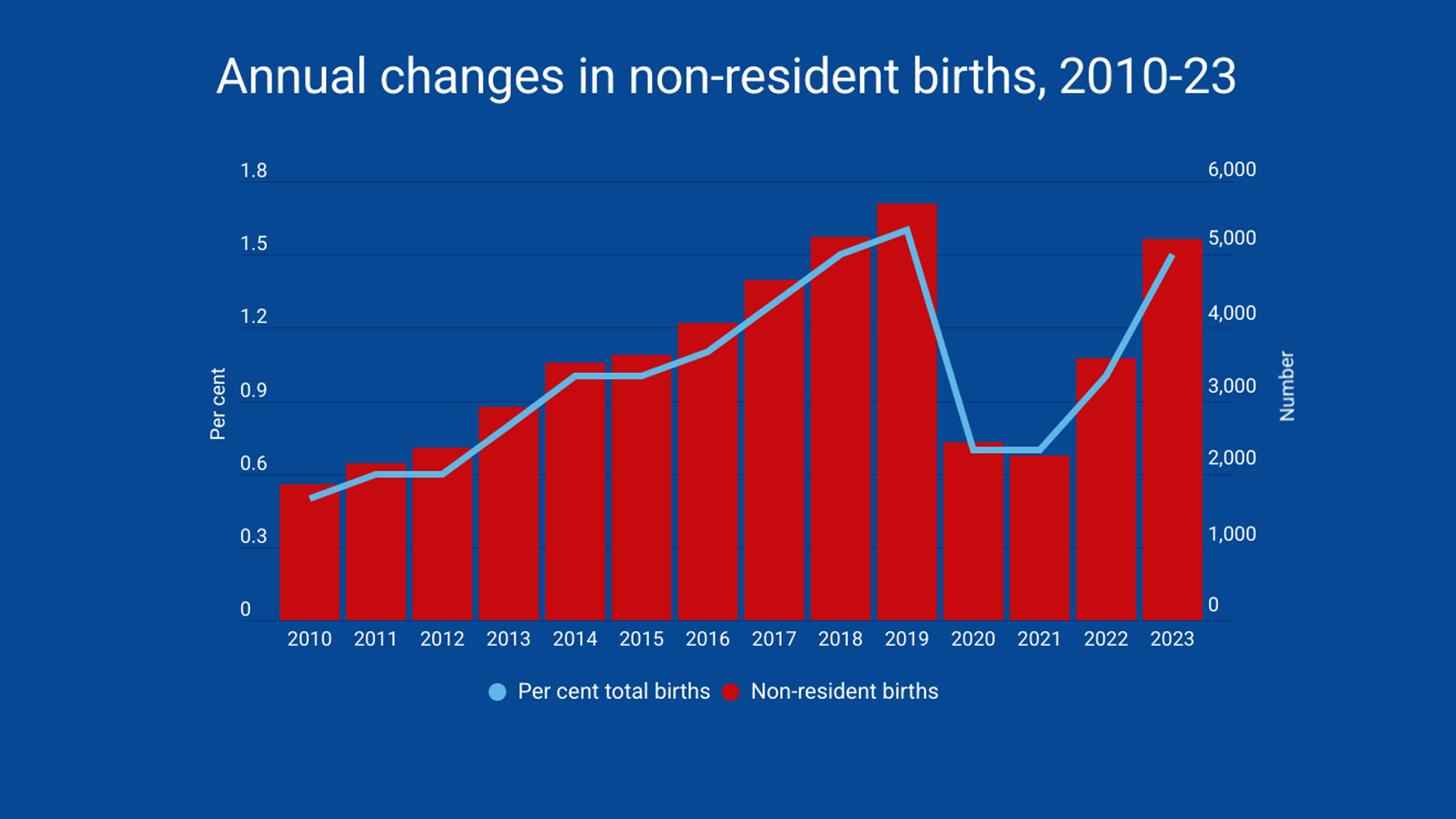
The former director general for the Citizenship and Multiculturalism branch of Citizenship and Immigration Canada released this week, via Policy Options, new annual figures on non-resident births across Canada showing 5,219 such births in 2023-24.

That is nearly as many as the record 5,698 seen in 2019-20 and more than double the short-term low of 2,245 experienced in 2021-22.

Between April 1, 2019, and March 31, 2020, 868 non-residents of Canada, excluding temporary foreign workers, refugees and international students, paid to give birth in B.C. hospitals alone.

Last year 513 such births occurred in B.C., up from an average of 152 during the two pandemic-impacted years. B.C. provides public health care (Medical Service Plan) to international students, temporary foreign workers and refugees, who do not factor into the data.

Unique to B.C. was the birth tourism industry in Richmond, as 24 per cent of all births there in 2019-20 were to non-residents on account of a burgeoning birth tourism cottage industry, such as birthing hotels run out of homes for pregnant Chinese nationals on tourist visas.

But that phenomenon appears to have disappeared.

“The decline in visitor visas granted to Chinese nationals is reflected in British Columbia’s Richmond Hospital, once the epicentre of birth tourism, declining from 24 per cent pre-pandemic and only recovered partially to sevent percent in 2023-24,” said Griffith.

Last year the top B.C. hospitals for such births were Richmond (102), Surrey Memorial (99), St.Paul’s/Mount Saint Joseph (97) and Children’s (85).

At issue is the fact birth tourism has raised ethical and practical questions around delivery of health-care services for Canadian women.

Source: Birth tourism rebounds close to pre-pandemic levels in B.C. as Trump takes action in U.S.

Birth Tourism Update: Spillover from Trump?

My latest update. Curious to see if this prompts or not discussion in Canada and whether or not a likely Conservative government decides to revisit the issue:

Birth tourism has risen to pre-pandemic levels after it dropped in half during the shutdowns of COVID-19. In the U.S., Donald Trump has set about trying to end birthright citizenship. What impact his plan might here have remains to be seen. But birth tourism is an issue the next federal government may need to re-examine….

Source: Le tourisme de naissance a doublé depuis la fin de la pandémie, Birth tourism has doubled since the pandemic lull

Birth tourism showing post-pandemic rebound in B.C.

Expands on my analysis of the data on non-resident births from CIHI, with comments by others in excerpt below:

….Since there was more significant media coverage on the matter prior to the pandemic, Griffith notes the federal government has not done anything to curb the issue, despite public debate, while B.C. Minister of Health Adrian Dix has dismissed concerns about problems such as Canadian mothers being diverted from hospitals such as Richmond.

Griffith says, “given the current and planned increases in immigration, it is highly unlikely that the government will act as the numbers are a rounding error compared to overall immigration of 500,000 by 2025.”

But to Griffith, stopping the practice is more a matter of principle.

“I still think it’s important on principle and for the value of citizenship; it’s one of those things that can irritate, with people going around the system, taking advantage of the system,” said Griffith, who believes amendments to the Citizenship Act — requiring one parent to be a citizen or permanent resident to grant the baby citizenship — are warranted.

Several polls on the topic show significant support for amendments. In 2019, Angus Reid Institute, for example, reported “two-thirds (64%) say a child born to parents who are in this country on tourist visas should not be granted Canadian citizenship, and six in ten (60%) say changes to Canada’s citizenship laws are necessary to discourage birth tourism.”

Some critics of proposed changes contend people are unfairly targeting disadvantaged foreign women.

University of Carleton associate law professor Megan Gaucher was provided $223,328 from the federal government in June 2021 to research “how constructions of foreignness undermine the longstanding assumption that formal legal citizenship is an uncontested condition for membership to the Canadian state and explore how political and public discourse around birth tourism ultimately reproduces settler-colonial imaginaries of ‘good’ familial citizens.”

Gaucher says proposed measures “risk being driven by polarizing narratives about borders and citizenship rather than by evidence.”

Griffith has contested such views, noting birth tourists are “not disadvantaged women; they are people who have money to travel here and pay all the related expenses.”

In B.C., refugees and temporary foreign workers would not be categorized as self-paying births. And figures in B.C. also do not count international students, who are covered by the province’s Medical Services Plan. Hence, the “non-resident self-pay” numbers are a more accurate depiction of the practice, Griffith notes.

Conversely, others such as Michael Juneau-Katsuya, CSIS’s former chief of the Asia-Pacific, have shared contrasting opinions on the emerging phenomenon.

Juneau-Katsuya told Glacier Media he sees birth tourism as a national security threat. He suggests the People’s Republic of China may document and monitor returning children and utilize them as agents of the communist state should they return to Canada as adults.

Still, others have expressed concerns that there may be a cumulative impact on returning citizens who may utilize Canada’s social safety nets and reap benefits of citizenship without investing time in the country. Those concerns are in addition to the added stress birth tourism places on the health-care system.

Source: Birth tourism showing post-pandemic rebound in B.C.

Birth tourism is rising again post-pandemic

My latest annual update:

The COVID-19 pandemic provided the perfect natural experiment to assess the extent of birth tourism in Canada.

Dramatic declines of 50 per cent compared with the pre-pandemic 2016-20 average occurred in 2020 and 2021 in the number of “non-resident, self-pay” births. That was followed by an overall increase of 53 per cent in 2022 compared with the 2020-21 average, although the 2022 figure is still far below the 2019 peak.

This partial return to growing numbers highlights the need for the government to make good on its 2018 commitment to get a better handle on the extent of birth tourism, and to go so far as to consider an amendment to the Citizenship Act.

Figure 1 captures the steady increase prior to the pandemic and the sharp fall thereafter. Last year’s increase to 3,575 non-resident births from the pandemic average of 2,339 occurred in all provinces.

Table 1 compares non-resident births in 2011-15 and 2016-20 with those in subsequent years.  The increase over these five-year periods contrasts with the sharp decline in 2020-21 and the sharp reversal in 2021-22, both of which were particularly notable in British Columbia. Compared to the 2019 high, the number of non-resident births has rebounded to 63 per cent of pre-pandemic levels.

There is no comparable U.S. post-pandemic data because since January 2020, the U.S. no longer issues visas “for birth tourism (travel for the primary purpose of giving birth in the United States to obtain U.S. citizenship for their child).”

Because there is no health-specific code for women travelling to Canada on visitor visas for birth tourism, the broader non-resident self-pay code is used. However, this includes international students, about half of whom are covered by provincial health plans, and other temporary residents.

Overall visitor visas in 2022 largely rebounded to pre-pandemic levels. The number of temporary workers has increased significantly. However, this varies by country.

Overall visitor visas for Chinese nationals used to be one of the major groups for birth tourism, but they have fallen dramatically. Chinese government travel-related restrictions are likely a significant factor in the reduction in Chinese birth tourists.

The percentage of non-resident births fell from 1.6 per cent of total births in 2019 to 0.7 per cent in 2020 and 2021, but it rebounded to 1.0 per cent in 2022. About 50 per cent of non-resident births are estimated to be birth tourists.

Table 2 provides a view of the impact of COVID-19 on non-resident births for the 10 hospitals in Canada with larger percentages of non-resident births. Since the dramatic fall during the pandemic, non-resident births have increased in most hospitals.

British Columbia’s Richmond Hospital was once the epicentre of birth tourism with its supportive “cottage industry” of “birth hotels.” In 2019-20, non-resident mothers made up 24 per cent of its births. But it fell sharply in this category during the pandemic and has rebounded only to four per cent in 2022. It’s now fourth in the Top 10.

The new No. 1 and No. 2 are Toronto’s Humber River Hospital, with 10.5 per cent of all births being non-residents and Montreal’s St. Mary’s with 9.4 per cent. Humber River is also the only hospital that showed an overall increase compared to pre-pandemic period.

There is a need for more hospital-level studies such as the one in Calgary that found about one-quarter of non-resident women who gave birth in the city in 2019-20 were from Nigeria. The study also estimated the cost to Alberta taxpayers.

The development of links between Canadian immigration data (e.g., immigration program and category) and Canadian Institute for Health Information (CIHI) health data on medical services should allow for greater precision about the number of women giving birth while on visitor visas and those under other temporary resident categories.

Is birth tourism about to return now that travel restrictions have been lifted?

Birth tourism in Canada dropped sharply once the pandemic began

Hospital stats show birth tourism rising in major cities

Overall, the federal government has not followed up on its 2018 commitment to “better understand the extent of this practice as well as its impacts” following the first release of the non-resident self-pay numbers and related media attention. The 2021-22 decline understandably reduced political interest and pressure in addressing the issue.

Given current and planned increases in immigration, it is highly unlikely that the government will act because the number of non-resident births is basically a rounding error compared to overall immigration of 500,000 a year by 2025.

However, as visitor visas largely reverted in 2022 to pre-pandemic levels, it is no surprise that non-resident births, including birth tourism, have increased. The government should resume work to clarify the issue. In particular, it should link immigration and health data to improve understanding of immigration and health issues, including birth tourism. As numbers of non-resident births can be expected to increase further, greater precision regarding the components of non-resident births would inform possible policy and program responses.

A 2019 Angus Reid survey found that 64 per cent of those Canadians surveyed would support a change in the law so that citizenship is not conferred on babies born here to parents on tourist visas.

Policy and operational questions remain about whether birth tourism warrants an amendment to the Citizenship Act, visa restrictions on women intending to give birth in Canada, or other administrative and regulatory measures to curtail the practice.

Visa restrictions would be difficult to administer and regional administrative and regulatory measures might encourage hospital and jurisdiction “shopping.”

So the cleanest approach would be an amendment to the Citizenship Act that would require one parent to be a citizen or permanent resident of Canada. That is the situation in Australia.

Should the Conservatives form a government after the next federal election, they may well decide to revisit the issue of birth tourism given that the Harper government pressed the issue in 2012 only to back off.

A note on methodology 

The data is from the CIHIs discharge abstract database, more specifically non-resident self-pay” category in the responsible for funding program (RFP), as well as totals for hospital deliveries.

The overall RFP data includes temporary residents on visitor visas, international students, foreign workers and visiting Canadian citizens, and permanent residents. Quebec has a slightly different coding system, but CIHI ensures its data is comparable. Data for Quebec hospitals is not provided through CIHI and thus the larger Montreal area hospitals were approached directly.

Ottawa-area hospitals were not included given the number of diplomatic families likely being a substantial portion of non-resident births. Declines in non-resident births at Trillium-Credit Valley Hospital in Mississauga, Ont., led to that hospital falling off the Top 10 list.

Health coverage for international students varies by province, but most of them are covered by provincial health plans. This is not the case in Manitoba and Ontario, as well as for some students in Quebec if their country of origin does not have a social-security agreement with Quebec. The pre-pandemic baseline is the five-year average 2016-20.

Mackenzie Healths woman and child program moved from Mackenzie Richmond Hill Hospital to Cortellucci Vaughan Hospital when it opened to the community in June 2021.

Source: Birth tourism is rising again post-pandemic

Canada should deny care to pregnant ‘birth tourists,’ doctor argues

Good article based upon the opinion piece by Dr. Barrett shared yesterday:

Should Canada deny care to ”birth tourists,” pregnant women who visit Canada with the sole purpose of delivering their babies here, thereby obtaining automatic Canadian citizenship for their newborns?

It’s a provocative, and, some say, dangerous suggestion. However, a leading expert in preterm and multiple births is arguing that Canadian hospitals and doctors should have “absolutely zero tolerance” for birth tourism, a phenomenon that is rising once again now that COVID travel restrictions have been dropped.

It’s a “sorry state of affairs” that women in Canada face wait times of 18 months or longer for treatment for pelvic pain, uncontrolled bleeding and other women’s health issues, Dr. Jon Barrett, professor and chief of the department of obstetrics and gynaecology at McMaster University wrote in an editorial in the Journal of Obstetrics and Gynaecology Canada.

“The thought that even ONE patient seeking birth tourism would potentially take either an obstetrical spot out of our allocated hospital quota, or even worse, a spot on the gynaecologic waiting list, should be enough to unite all in a position that anything that in any way facilitates this practice should be frowned upon,” Barrett wrote.

“These are non-Canadians getting access to health care, which we haven’t got enough of for our own Canadians,” he said in an interview.

When planned low-risk births go wrong, and babies end up spending weeks in intensive care, hospitals can be left with hundreds of thousands in unpaid bills. One Calgary study found that almost $700,000 was owed to Alberta Health Services over the 16-month study period.

The women themselves are also at risk, Barrett said, of being  “fleeced” by unscrupulous brokers and agencies charging hefty sums upfront for birth tourism packages that include help arranging tourist visas, flights, “maternity” or “baby hotels” and pre-and post-partum care.

And, while he declined to provide specific examples, “Tempted by large sums of money, even the best of us can be tempted into poor practice,” Barrett wrote.

The issue has triggered high emotions and debate among Canada’s baby doctors. Under Canada’s rule of jus soli, Latin for “right of soil,” citizenship is automatically conferred to those born on Canadian soil.

Birthright citizenship gives the child access to a Canadian education and health care. They can also sponsor their parents to immigrate when they turn 18.

Other developed nations require at least one parent to be a citizen, or permanent resident.

According to data collected by Andrew Griffith, a former senior federal bureaucrat in Immigration, Refugees and Citizenship Canada, “tourism” births account for about one per cent, give or take a bit, of total births in Canada. Data from the Canadian Institute for Health Information show Canada hosted 4,400 foreign births in 2019.

At a national level, the numbers aren’t huge, however they can become significant at the local level, Griffith said: In pre-COVID years, non-resident births accounted for up to 25 per cent of all births at a single hospital in Richmond, B.C., while the numbers at a handful of other popular destination hospitals in Ontario and Quebec approached five to 10 per cent of all births.

“In a system that is tight and stretched, it does become an issue at the hospital level,” Griffith said.

But birth tourism also undermines the integrity and confidence in Canada’s citizenship process, he said, “It appears like a short cut, a loophole that people are abusing in order to obtain longer-term benefit for their offspring.”

“It sends the wrong message that basically we’re not very serious in terms of how we consider citizenship and its meaningfulness and its importance to Canada,” Griffith said.

Barrett is careful to stress that birth tourism absolutely doesn’t apply to women who happen to be in Canada because of work, or study programs, or as refugees. “We must declare that people who are here for a genuine reason should have seamless access to health care,” he said.

What he opposes are the “non-urgent planned and deliberate birth tourists in our hospitals.”

Doctors can’t deny care to a woman in labour. Emergency care would always be given, he said. “Obviously you’re never going to turn somebody away.”

But doctors and hospitals could decline to provide pregnancy care before birth. “Eventually, if you create this unfriendly environment,” Barrett said, “if everybody said we are not looking after you and not facilitating this, eventually people will not come. They would realize they are not getting what they are seeking, which is optimal care.”

Some women step off the plane 37 weeks pregnant, three weeks from their due date. “That’s why my colleagues say, ‘You can’t do that. People are going to suffer,’” Barrett said. “Yes, unfortunately, people are going to suffer, because they won’t get pregnancy care, and they’ll show up at the hospital without antenatal care.”

While some women do come to Canada seeking superior medical care, “let’s be frank,” said Calgary obstetrician and gynecologist Dr. Colin Birch. “The principal motivator is jus soli.

“Sometimes its veiled under, ‘I want to get better medical care,’ but, interestingly, they fly over several countries that can give them the equivalent care to Canada to get here,” said Birch, countries that don’t offer jus soli.

Birch is co-author of the Calgary study, the first in-depth look at birth tourism in Canada. Their retrospective analysis, a look back over the data, involved 102 women who gave birth in Calgary between July 2019 and November 2020. A deposit of $15,000 was collected from each birth tourist, and held in trust by a central “triage” office to cover the cost of doctors’ fees. A deposit wasn’t collected to cover fees for hospital stays for the mom or baby; women were made aware they would be billed directly.

The average age of the woman was 32. Most came to Canada with a visitor visa, arriving, on average, 87 days before their due date. Birth tourists were most commonly from Nigeria, followed by the Middle East, China, India and Mexico. Overall, 77 per cent stated that the reason for coming to Canada was to give birth to a “Canadian baby.”

Almost a third of the women had a pre-existing medical condition. One woman needed to be admitted to the ICU after delivery for cardiac reasons, another was admitted for a high blood pressure disorder and stroke. Nine babies required a stay in the neonatal intensive care unit, including one set of twins that stayed several months. Some women skip their bills without paying.

“Every conversation about heath care is that we haven’t got money for health care,” Birch said. “Yet you’ve got unpaid bills of three-quarters of a million. It’s not chump change.”

But denying care is a dangerous and unrealistic “gut reaction” that some hospitals have already taken, Birch wrote in his counter editorial for the Journal of Obstetrics and Gynaecology Canada. “Let’s be very clear: They won’t let them through the front door, or they send them on to another hospital.”

“You cannot have zero tolerance for patients,” Birch said. “You can’t do that because that leads to maternal and fetal complications.”

The federal government could tweak the rule of “jus soli,” excluding people who just come to Canada on a temporary visitor visa to give birth, and then leave, he and others said. “You do the Australian approach, that one of the parents has to be a citizen of the country,” said Griffith, a fellow of the Environics Institute and Canadian Global Affairs Institute.

Three years ago, the United States announced it would start denying visitor visas to pregnant foreign nationals if officials believe the sole purpose was to gain American citizenship for their babies.

While some have said birth tourists are being demonized as “queue jumpers and citizenship fraudsters,” Griffith isn’t convinced birth tourism is a politically divisive issue.

“I don’t think there are very many people that really would get upset if the government sort of said, ‘We’re going to crack down on birth tourists, women who come here specifically to give birth to a child and who have no connection to Canada.’”

Source: Canada should deny care to pregnant ‘birth tourists,’ doctor argues

Barrett: Birth Tourism – An Opinion

Yet another sensible commentary by a medical professional:

Personally, one of the things that I find most enjoyable about my position as an academic chair is the collaborative discussion amongst fellow academic chairs in a monthly meeting, facilitated by the Society of Obstetricians and Gynaecologists of Canada (SOGC). Recently, we brought up the topic of birth tourism, which prompted lively discussion, passionate views and the suggestion to write this editorial. Despite different jurisdictions, approaches, and models, there was unanimity on one aspect, and that is to clearly define birth tourism; the “deliberate travel to another country with the purpose of giving birth in that country”. Birth tourism is often motivated to attain citizenship in the long term or to attain medical care that is perceived to be better than in the home country. It is important to delineate that birth tourism is NOT a birth occurring in Canada by a person who happens to be away from their country of citizenship, because of work, study, or as a refugee.

The concept of and the practice of birth tourism is complicated from the patient’s, the healthcare team’s, the facility’s, and the healthcare system’s perspectives. Birth tourism has been recognized as an issue in Canada for some time, but became less prevalent during the COVID-19 pandemic with travel restrictions in place for international travel. Now, as we struggle because our health human resources are in crisis and our systems are struggling in every province and territory, the issue of birth tourism and its impact on our healthcare providers, our patients, our hospitals, and our healthcare systems is a matter of concern once again.

In my personal opinion, Canadian hospitals and physicians should have absolutely zero tolerance for birth tourism, declining to accept these patients into care while concurrently ensuring that patients in Canada for other legitimate reasons, who tend to be underserved, are able to receive unrestricted healthcare without imposing undue financial burden or stress.

In my previous life as a busy clinician, I remember the frustration when the leadership team of a hospital essentially declined to provide services to any patient without provincial insurance coverage, unless they were a refugee, a student, or were in Canada for another work-related reason. Of course, patients presenting as emergencies would be treated without hesitation. In retrospect, despite enjoying the direct re-imbursement that this practice facilitates, I realize now that the leadership team were correct.

They are correct because the facilitation of birth tourism causes everyone to suffer. Mostly, of course, our patient, Canadians, or those here in our country as refugees or here to work or to study.

I do not have to provide any annotated references for the sorry state of affairs in our hospitals in which we currently do not have the resources to provide an acceptable level for those requiring obstetrical and gynaecologic services. Waiting time for uro-gynaecological service is more than 18 months in most of our centres. The thought that even ONE patient seeking birth tourism would potentially take either an obstetrical spot out of our allocated hospital quota, or even worse, a spot on the gynaecologic waiting list, should be enough to unite all in a position that anything that in any way facilitates this practice should be frowned upon.

But that is not the only reason; our hospitals suffer too. A recent publication points to the fact that routinely, hospitals are left with significant shortfalls when a planned low-risk birth goes wrong and babies spend months in the intensive care unit. More specifically, the birth tourist had planned to spend CAD 10 000 for the birth of a baby – not $300 000 caring for the baby when things go wrong.

Finally, the patients may also suffer. There are many reports of people being fleeced by unethical individuals who have charged them large sums of money up-front to facilitate this industry. Finally, although I will not provide specific examples, we the healthcare providers may suffer too. Tempted by large sums of money, even the best of us can be tempted into poor practice.

In my opinion, we must firmly champion the provision of care to patients who are in Canada for work or study or as refugees without demanding excessive payments from them. We must not tempt ourselves to take advantage of the vulnerable or the unlucky. Instead we should unite in a firm stand against birth tourism by refusing to accept the non-urgent planned and deliberate birth tourists in our hospitals, rather than devising elaborate flow diagrams and/or fee schedules that facilitate and may in reality encourage the process.

Our country, our healthcare providers, and our system deserve this.

John F.R. Barrett, Department of Obstetrics and Gynecology, McMaster University

Source: Birth Tourism – An Opinion

New Canadian babies born via birth tourism less than one per cent of all births

More on birth tourism based upon the Alberta study, Canadian doctors say birth tourism is on the rise. It could hurt the health care system, with data from Guelph (not a centre).

Reference to Richmond only refers to 2022, rather than pre-pandemic years when Richmond General was the epicentre of birth tourism in Canada, with almost one-quarter being birth tourism, supported by a cottage industry of birth tourism hostels:

“Birth tourists being specifically people who are coming in specifically to have a birth then go back to their original country,” said Colin Birch, a Calgary obstetrician gynecologist.

They probably come to give birth for the advantage of birthright citizenship for future gains whether it be for themselves or their family, said Birch. “There are still immense advantages of living in a place like Canada,” he said.

“Is it a big problem? Well if you look at the numbers, absolutely not. It’s small.”

“Is it big enough to be a problem? I actually think it is,” he said.

FROM OUR ARCHIVES: Birth Tourism: Rhetoric Ahead of Evidence [my opinion has changed since writing this in 2014]

Reason being Canada is in a healthcare crunch, “every bed is sacred,” said Birch.

As a healthcare system we are suffering from a capacity point of view and the expectation is to do more with less, he said.

“Canada is not really set up because of its socialized healthcare system for private pay patients and the demands that come with private pay patients,” said Birch.

The expectations from paying patients to patients covered by provincial health care are different.

“Not saying their care is different. Care is care,” he said. 

Health care is expensive and when it comes to neonatal care it is astronomical if a baby needs to be in the ICU, he said. 

The unpaid bills of the hospitals are massive, he said.

Calgary has taken a different approach to hospital bills associated with birth tourism. Birch confirmed the Calgary system requires a $15,000 deposit.

“It’s a very honest and upfront system,” said Birch. “It doesn’t pay the hospital fees no. It’s a deposit which pays basically physician fees.”

From the deposit what doesn’t get spent goes back to the patient, he said.

“We wanted to discourage the practice because it was becoming a bigger burden in Calgary,” said Birch. “The potential problem with that is the patients will then start moving to practitioners who are outside the city limits.”

It isn’t a perfect process but it’s an attempt to implement some sort of order, he said.

Prior to the deposit process birth tourism had impacts on the capacity of the hospital and ability at times to care for Canadian patients, he said.

Canada and the U.S. are the only countries in the G7 to offer birthright citizenship according to canadianimmigrationexperts.ca.

“What we need to debunk is the idea that all people who are not insured are not necessarily birth tourists,” said Birch.

“There’s a large undocumented population in the country,” he said. They are contributing members of society but are not documented, Birch said.

He wanted to make it clear undocumented folks who are uninsured are not birth tourists.

Birth tourism is not just a medical issue but a social issue that should be addressed, he said.

In the fiscal year of 2021 to 2022 Guelph General Hospital had a total of 1,707 deliveries, 11 were people from out of country. This breaks down to 0.6 per cent of deliveries were out of country.

Between April 2022 to February 2023 there were 1,543 deliveries and 18 were people from out of country who gave birth at the GGH. This is 1.2 per cent of the deliveries were out of country. 

At the other end of Canada in Vancouver much of the same occurred at Richmond Hospital, in 2022 there were 22 nonresident deliveries. This number accounts for 1.5 per cent of the total deliveries at the hospital.

“All maternity patients coming to Richmond get the care they require to deliver their child safely. Care is always triaged according to the safety of the mother and baby – it is never delayed based on residency,” stated in an email from Vancouver Coastal Health (VCH).

VCH also said it does not support marketing of maternity tourism. Births from nonresidents have not led to disruptions of maternity services, said in the email.

“VCH will never deny urgent and emergent care based on ability to pay or where a patient is from, but we do expect to be compensated as we are accountable to B.C. residents for hospital and health care services. We are committed to collecting compensation from non-residents who use our medical services,” said in the email.

Source: New Canadian babies born via birth tourism less than one per cent of all births

ICYMI: Insight Grant 2021 Birth Tourism and #Citizenship – Activist or Academic?

Some background of possible interest to this grant.

My initial 2018 analysis (Hospital Stats Show Birth Tourism Rising in Major Cities) provoked rebuttals from Jamie Lieu and Megan Gaucher.

While part of their arguments concerned my interpretation of the data (largely addressed given the sharp drop in visitor visas covered in my Birth Tourism in Canada Dropped Sharply Once the Pandemic Began), the bulk of their arguments were on policy grounds where we disagree.

Ironically, we had submitted a joint-proposal in 2019 for funding research looking at the policy issues, but were unsuccessful. It has now been successfully resurrected with the original researchers but without my “contrarian” presence and thus may well lack balance given the common perspective of the researchers.

Their concern that “proposed measures risk being driven by polarizing narratives about borders and citizenship rather than by evidence” is somewhat ironic as they contest the best evidence that we have regarding the likely numbers of birth tourists.

As a whole, the proposal reinforces critiques of universities and academics not having a diversity of views and perspectives in their work:

Birth tourist is a term used for non-resident mothers (NRMs) who come to Canada with the sole purpose of giving birth so that their child has a claim to Canadian birthright citizenship.

“They are accused of undermining Canada’s jus soli citizenship laws and subsequently labelled ‘queue jumpers’ and ‘system cheaters,’” says Megan Gaucher. “While both completely legal and statistically low, birth tourism continues to be identified by political parties as an issue in need of remedy.”

Gaucher, an associate professor in the Department of Law and Legal Studies, has been awarded a five-year $223,328 SSHRC Insight grant for the project, “Mapping the Discursive and Institutional Landscape of ‘Birth Tourism’ and its Perceived Attack on Canadian Birthright Citizenship.”

“Proposed measures have focused almost exclusively on refusing automatic citizenship to children born on Canadian soil unless one of the parents is a Canadian citizen or permanent resident,” says Gaucher. “Calls for legislative action however, remain reliant on an incomplete picture of the prevalence of and motivations for engaging in birth tourism, the socio-legal structures that facilitate it and the implications current political and public discourse present for NRMs.”

The project will provide the first comprehensive mapping of the state of birth tourism in Canada. Gaucher — along with team members Jamie Chai Yun Liew (University of Ottawa), Y.Y. Chen (University of Ottawa) and Amanda Cheong (University of British Columbia) — will conduct interviews with NRMs and their family members, birth tourism industry insiders, health care practitioners, government officials and local residents.

These interviews will be complemented by an analysis of pre-existing government data, Parliamentary Hansard, birth tourism promotional materials and media coverage from mainstream and ethnic media. “Current conversations about birth tourism tend to rely on data from health facilities,” says Gaucher. “Our project will bring together experts in political science, law, health and sociology to critically interrogate how multiple socio-legal spaces are used to both criminalize and restrict access to NRMs and their future children.”

This study will explore how constructions of foreignness undermine the longstanding assumption that formal legal citizenship is an uncontested condition for membership to the Canadian state and explore how political and public discourse around birth tourism ultimately reproduces settler-colonial imaginaries of “good” familial citizens.

“As debate around birth tourism in Canada and the appropriate policy responses continue to unfold against a backdrop of knowledge gaps, proposed measures risk being driven by polarizing narratives about borders and citizenship rather than by evidence,” she says.

Source: Friday, June 18, 2021 in Department of Law and Legal Studies, News, Research
Share: Twitter, Facebook

How to Get Hassle-Free Canadian Birthright Citizenship

The latest example I have seen of marketing birth tourism services in Canada:

Getting Canadian citizenship for children brings many benefits. From avoiding international tuition fees when a child gets to university age, to easing immigration concerns, Canadian birthright can be advantageous. The opportunity to live and work in the Canadian economy is also something that could be an ideal solution once children reach adulthood and want to make the most of their skills. Accessing one of the world’s most advanced healthcare systems when needed will also provide sound peace of mind.

Despite the benefits of doing so, many people are put off attempting to get Canadian birthright citizenship for their children for fear of acting illegally, or just because of bureaucratic red tape involved. The reality is that with the right help, it is completely legal to do so, and experts can navigate the process on an individual’s behalf.

“Birthright Citizenship Canada are experts in our field, and we do everything we can to make the process as smooth as possible”, a spokesman for the Concord, ON-based childbirth support organization commented. “By commissioning us to work on your family’s project you will know that everything is taken care of. This includes the paperwork, travel arrangements to and from Canada, and all the legal and medical help that will be required along the way”.

“One of the main aspects that discourages people from seeking to obtain birthright citizenship for their children is the processes involved. Obtaining documents such as temporary residence visas can be a daunting prospect for people not familiar with Canadian procedures. Our team are skilled in such matters, and can allow you to concentrate on enjoying your new arrival.”

The Canadian Citizenship Act made it legal to get citizenship for a baby born in Canada to foreign parents. In fact in simple terms, the act states that citizenship is available to all children born within the country. Even still, the perception of complexity and bureaucracy discourages many people.

“To ease peoples’ concerns about complexity and legalities, we combine everything into ‘birth packages’. These bundle in everything from transport and accommodation arrangements to healthcare and paperwork. Our experts handle multiple files on a daily basis. As a result, they know how to get things done, and where the potential bottlenecks are. Not only that, but they take the time to communicate with the customer at every step of the way.”

Birthright Citizenship Canada’s role involves being the go-between to navigate different stakeholders from the start of the process. Only when the family leaves the country again with a Canadian citizenship passport does the project conclude.

“Our job is all about removing pain points and hassle”, the spokesman continued. “We even do our best to save our customers some money where we possibly can. For example, we advise people to have pre-natal testing carried out prior to traveling to Canada. Doing this in their country of origin is almost always cheaper, and this way it is already organized before touching down in Canada. We also have different packages available depending on peoples’ budgets and requirements.”

About Birthright Citizenship Canada

Birthright Citizenship Canada are experts in childbirth support. The Toronto-based consultants specialize in obtaining citizenship for non-residents’ children born on Canadian territory. By offering packaged services covering legal, medical and administrative requirements, Birthright Citizenship Canada aim to take the stress and hassle out of the process. This allows people to focus on the birth of their child.

Media Contact
Company Name: Birthright Citizenship Canada
Contact Person: Media Relations
Email: Send Email
Phone: +1-647-646-5437
Address:7250 Keele Street, Unit 425
City: Toronto
State: Ontario L4K 1Z8
Country: Canada
Website: https://birthrightcanada.com/

Source: How to Get Hassle-Free Canadian Birthright Citizenship