‘Birth tourism’ articles in Vancouver press

Two articles on my recent release of the 2019-20 CIHI non-resident self-pay birth statistics (Birth Tourism: Non-resident births 2019-20 numbers show steady increase).

Starting with Douglas Todd of the Vancouver Sun:

The number of women coming to Canada to give birth, which automatically bestows citizenship on the baby, is expanding much faster in British Columbia than the rest of the country.

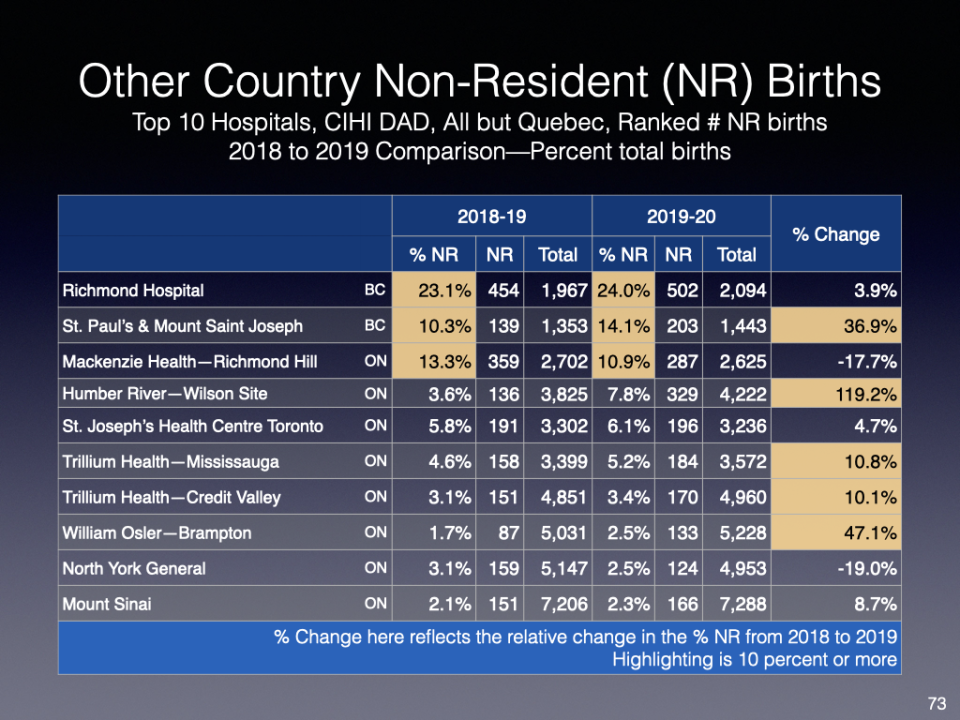
Richmond Hospital is the centre of the trend, often called “birth tourism.” New data released this week shows one out of four births in the past year at the hospital in the Vancouver suburb, which features many illicit “birth hotels” advertising their services in Asia, were to foreign nationals.

St. Paul’s Hospital and Mount St. Joseph’s Hospital, both in Vancouver, are also fast turning into hubs for birth citizenship, with the two hospitals experiencing a 38 per cent rise in births by non-resident women, one in seven of the total.Virtually no country outside North and South America provides citizenship to babies solely because they’re born on their soil.The newly released figures show there were 4,400 births in Canada in the past year to non-resident mothers, an overall hike of seven per cent. Ontario doctors still preside over the most non-resident births, 3,109, with one hospital in Toronto, Humber River, having a sudden jump of more than 119 per cent.But Ontario’s volume of privately funded procedures has not risen nearly as fast as in B.C., which had a total of 868 non-resident births. That’s a six-fold increase from 2010.

Source: Canadian Institute for Health Information/Andrew Griffith

The new data, compiled by Andrew Griffith, a former senior director of the federal Immigration Department, comes from the Canadian Institute for Health Information, which captures billing information directly from hospitals up until the end of March. It doesn’t include births in Quebec.

Birth tourism has recently been strongly condemned by Richmond Mayor Malcolm Brodie, Liberal MLA Jas Johal (Richmond-Queensborough), former Liberal MP Joe Peschisolido (Richmond East), the head of Doctors of B.C. and others.

Prime Minister Justin Trudeau’s government, which controls immigration policy, has been silent on the matter. Former Conservative party Leader Andrew Scheer said in 2018 he would end birth tourism. NDP leader Jagmeet Singh has accused those who raise the issue of being guilty of “division and hate.”

In February, Richmond council sent letters to Immigration Minister Marco Mendicino, to leading B.C. politicians and to Vancouver Coastal Health. Council called for “permanent changes to immigration laws which would end automatic Canadian citizenship being bestowed on babies born in Canada to non-resident parents who are not citizens of Canada.”Last week, Mendicino’s department finally responded, saying the minister is aware “of the increase in births by non-residents in Canada” and promised to “monitor” it.“All levels of government are trying to pass the buck” on birth tourism, said Au. He acknowledged Richmond was itself failing to combat the dozens of shadowy birth hotels and agents in the city, which help women give birth in Canada for fees in the tens of thousands of dollars.Ads aimed at women in China who want to have babies in Canada tout luxurious accommodation, birthright citizenship in the “world’s most livable country,” 12 years of free public education, university fees just 10 per cent of those paid by foreign students, free health care and eventual family reunification for the parents of the baby who obtains the passport.Au said Richmond officials could be cracking down on underground birth-tourism operations because they don’t have proper business licences. But council and staff, he said, haven’t yet come up with an effective way to do so.

Au is also suspicious that hospital administrators and the few doctors who perform full-fee deliveries for foreign mothers are not countering the problem for financial reasons. “We don’t want our hospitals dependent on this income.”

Source: Canadian Institute for Health Information/Andrew Griffith

In a piece on his website, Multicultural Meanderings, Griffith says figures provided by the Canadian Institute for Health Information show all “non-resident births” in Canada, which includes women who give birth while here as foreign students or temporary workers. Griffith estimates about 50 per cent of the total are full-blown “birth tourists.”

After Griffith wrote a 2018 piece on the subject for Policy Options, three female academics responded by saying those who want to end birthright citizenship are “demonizing pregnant migrant women,“ “encouraging violence against stateless people” and “fuelling discrimination.”

Nevertheless, the academics supported Griffith’s call for better data. He lamented this week, however, that the federal departments that previously promised to link health care and immigration data to monitor non-resident births have “stalled.”

David Chen, the former Pro Vancouver mayoral candidate, has publicly expressed concern about birth tourism. He said Thursday that granting citizenship to anyone born on Canadian soil “poses problems on several fronts.”

As a child of immigrants, Chen, who is now a vice-chair of Vancouver’s NPA party, said it “shortchanges those who went through proper channels only to see people with much more disposable cash jump the line and have an easier route to Canadian citizenship.”

Australia, Britain, New Zealand, France, Germany and South Africa have all, in relatively recent times, altered their citizenship laws to discourage birth tourism. More than 150 nations do not permit it.

While recognizing the issue is complicated, Au, a nine-year member of council, said he believes he understands the views of most Richmond residents, where the fast-changing population is now 53 per cent ethnic Chinese, 24 per cent white, seven per cent South Asian and seven per cent Filipino.“Ethnic Chinese feel the same as everyone else in Richmond,” he said. “They’re concerned.”

Source: Douglas Todd: ‘Birth tourism’ jumps 22 per cent in B.C.

Graeme Wood in Business intelligence for BC:

It was another record year for birth tourism in B.C., according to new data released by health officials.

The province saw a 21.9% spike in non-resident births between April 1, 2019 and March 31, 2020, as 868 non-residents of Canada – the vast majority of whom are understood to be Chinese nationals on tourist visas – paid to give birth in local hospitals in order to garner automatic citizenship for their newborns. The prior year, 712 non-residents gave birth in B.C.

“Vancouver area hospitals continue to have the largest percentages of non-resident births, with an active cottage industry supporting women coming to give birth from China,” said researcher Andrew Griffiths, who first reported the new annual data from the Canadian Institute for Health Information.

The epicentre of the budding industry is Richmond, where an annual record of 502 births to non-residents took place, up from 458 in the year to March 2019 and 474 in the year to March 2018.

Those 502 newborns represent 24% of the 2,094 total newborns at Richmond General Hospital. That is the highest total and share of non-resident births at a hospital across Canada. Meanwhile, Vancouver’s St.Paul’s Hospital is second in the nation, with 14.1% of all births being to non-residents. There, 203 babies were born to non-residents.

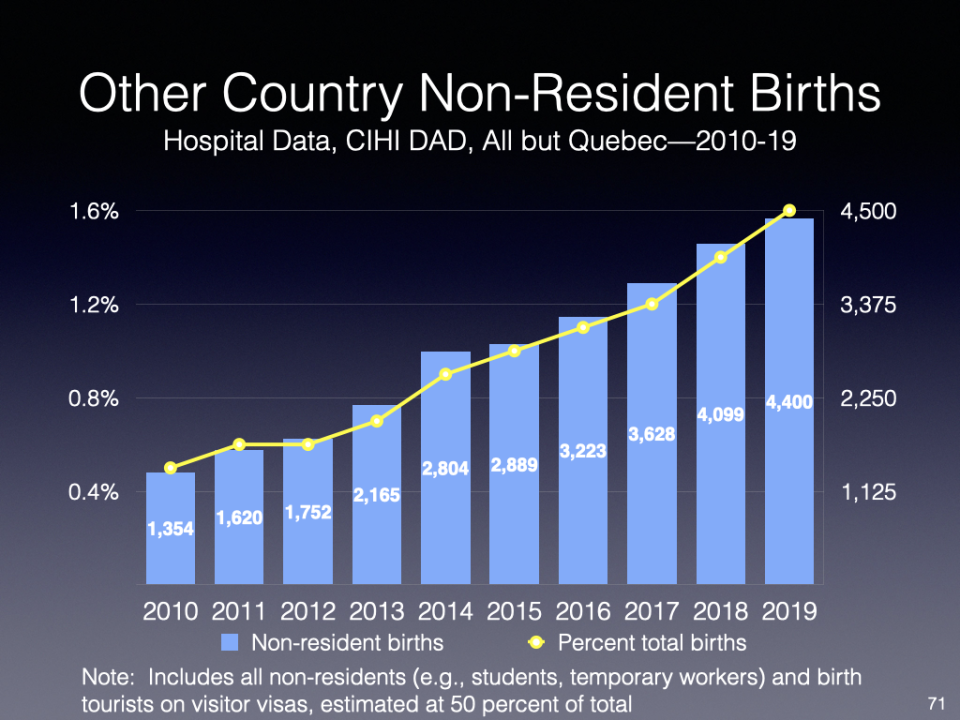
Non-resident births also peaked across Canada, with CIHI reporting 4,400 newborns to non-residents in 2019/2020, up 7.3% from the previous year’s total of 4,099, excluding Quebec.

B.C. figures do not include international students, who are enrolled in the public healthcare system. As such, Griffiths said B.C.’s figures are a more accurate indication of birth tourism (those non-residents who fly to Canada for the explicit purpose of obtaining citizenship for their newborns).

Griffiths, a former director general of the Citizenship and Multiculturalism Branch, Department of Citizenship and Immigration, said he estimates about half of the non-resident births outside of B.C. to be tied to parents on tourist visas. However there is no reportable data along those lines, as a federal review of the issue, first announced in November 2018, appears stalled.

“Hopefully, the work to link healthcare and immigration data will resume shortly, not only to provide more accurate numbers with respect to birth tourism but to improve our understanding of healthcare and immigrants more generally,” said Griffiths.

1

Non-resident births by hospital, 2018-2019 and 2019-2020. Figure by Andrew Griffiths

Glacier Media requested information on non-resident births tied to patients on tourist visas but Vancouver Coastal Health Authority said such data does not exist and the task to obtain it from paperwork would be too onerous – although such data is what the federal government stated it would acquire in its review.

Canada is one of two Western countries, along with the United States, to offer birthright citizenship – a concept also known as jus soli – meaning babies born to two foreign nationals on tourist visas are granted automatic citizenship.

It remains unclear exactly what the federal government is doing to enact policies to curb the practice. To date, no enforcement measures have been announced, unlike in the U.S., which has convicted “baby house” operators of money laundering and fraud in 2019.

The U.S. State Department further cracked down on birth tourism in January, with a new rule that “travel to the United States with the primary purpose of obtaining U.S. citizenship for a child by giving birth in the United States is an impermissible basis” for a tourist visa.

The lack of action to address birth tourism, which is widely perceived by the public as an abuse of Canada’s immigration system, has frustrated Richmond community activist Kerry Starchuk, who has documented dozens of “baby houses” in the Vancouver suburb offering accommodation and doula services for Chinese nationals, who typically arrive three to four months prior to giving birth on a six-month or extended tourist visa.

“It’s a joke. It’s so blatant you can see it. They’re advertising this in China,” said Starchuk.

In a written response to Starchuk, dated July 8, 2020, Immigration, Refugees and Citizenship Canada (IRCC) said it was “aware of the increase in births by non-residents in Canada.”

IRCC said, “While statistics indicate that birth tourism is not widespread, IRCC is researching the extent of this practice, including how many of the non-residents are short term visitors.”

Birth tourism is technically legal in Canada, in so much that nothing bars a pregnant woman from entering Canada to give birth, so long as they are honest with border agents.

“Providing false information or documents when dealing with IRCC is considered misrepresentation and has immigration consequences.  However, non-residents giving birth in Canada is not considered fraud under the Citizenship Act,” stated IRCC.

“Additionally, under the Immigration and Refugee Protection Act, a persons are not inadmissible nor can they be denied a visa solely on the grounds that they are pregnant or that they may give birth in Canada,” wrote IRCC.

Starchuk said the federal Liberal government has dragged its feet on the matter.

“I’m not interested in writing any more letters. I want action,” she said.

2

Non-resident births in Canada by year. Figure by Andrew Griffiths

Richmond Conservative Members of Parliament Kenny Chiu and Alice Wong have proposed a hybrid jus soli policy that would bar those on tourist visas from obtaining citizenship for their newborns. Newborns of non-resident international students, for instance, would continue to obtain citizenship under their proposal.

Griffiths said birth tourism businesses in Richmond are at a stand still with COVID-19 flight restrictions and visitor visas from China down 72.2% between January and March, and down 99.79% by June.

A poll from Research Co. in February, 2019 showed almost three in four (73%) believe it is time to end automatic citizenship for people born in Canada (adopting rules used by most Western countries). An Angus Reid poll in March, 2019 showed 60% of Canadians want the law changed.

Immigration Minister Marco E.L. Mendicino declined to be interviewed on this matter.

Source: Record-setting year for birth tourism in B.C. prior to pandemic

Birth Tourism: Non-resident births 2019-20 numbers show steady increase

The 2019-20 numbers, obtained from the Canadian Institute for Health Information (CIHI) for all provinces save Quebec, show an overall increase of about 7 percent compared to the previous year, with British Columbia showing an increase of more than 20 percent.

Quebec does not authorize CIHI to release their comparable data, unfortunately.

As non-resident numbers are a broader measure than those on visitor visas coming to give birth (e.g., students, temporary workers), my estimate is that about 50 percent are likely birth tourists.

It appears that the efforts underway by IRCC, CIHI and Statistics Canada to link healthcare and immigration data, that would allow identification of those on visitor visas from other non-residents, has stalled given shifting priorities due to COVID-19.

So these numbers remain the best we have.

Vancouver area hospitals (Richmond General: 24 percent, St. Pauls and Mount St. Joseph: 14.1 percent) continue to have the largest percentages of non-resident births, with an active cottage industry supporting women coming to give birth from China. While awareness of COVID-19 in China was greater and earlier than elsewhere, with a corresponding decrease in visitor visas issued and air travel, this did not impact non-resident births, likely given that plans were set.

2020 numbers, of course, are expected to reveal a sharp decline reflecting travel restrictions, particularly with respect to birth tourists on visitor visas.

Hopefully, the work to link healthcare and immigration data will resume shortly, not only to provide more accurate numbers with respect to birth tourism but to improve our understanding of healthcare and immigrants more generally.

My original article on how non-resident birth data provides a better indication of birth tourists, which provoked the government commitment for the aforementioned study, can be found here An analysis of hospital financial data shows that birth tourism is rising, and not just in British Columbia. Two of the critiques are: Revoking birthright citizenship would affect everyone and Birth tourism and the demonizing of pregnant migrant women.

Citizenship - Slide Gallery 2018.071Citizenship - Slide Gallery 2018.072Citizenship - Slide Gallery 2018.073

Richmond’s birth tourism hubs untouchable: MLA

Seems like more virtue signalling here rather than seriously arguing what the provincial government could do from a regulatory perspective (but non a high priority during COVID-19):

There’s not much that can be done when it comes to businesses linked to birth tourism, according to Richmond-Queensborough MLA Jas Johal – particularly if those companies have all their paperwork in place.

“The fact that they have a business licence means they’re not breaking the law,” said Johal. “I don’t think the city can do much about that. And even the provincial government couldn’t do much about that beyond discouraging this practice.”

A maternity and baby store, located at 8171 Ackroyd Road, is listed as the Canadian address for a China-based company, which is dedicated to helping pregnant women give birth overseas.

The store also operates a confinement centre, according to the website of parent company Mei Ya Jia Bao – translated by the Richmond News – established in Richmond in 2015.

That parent company, which lists its headquarters in Beijing, also operates Canada World Overseas Investment Consulting Inc., and Colombian International Travel Ltd., which provide travel and visa application services.

Incorporation certificates for all three companies, issued by the provincial government, are posted on Mei Ya Jia Bao’s website. Meanwhile, the website and service agreements are only in Chinese.

The website states the company has successfully helped more than 6,000 families in China travel to Canada to give birth, and offers service packages that include visa applications and confinement centre care.

After the families arrive in Canada, the website states they will make appointments with Chinese-Canadian doctors in Richmond.

Costs for giving birth are listed to be, at minimum, $60,000 to $70,000, and the website also states that living expenses in Canada will run into hundreds of thousands of dollars for a three month stay.

In a video posted by Mei Ja Jia Bao to Youku, a Chinese website similar to YouTube, a man introduces Richmond Hospital. The video also shows BC Womens Hospital and landmarks from around Vancouver.

Mei Ya Jia Bao is far from the only company to set up shop in Richmond – for example, Beijing-based Leading Baby states its Canadian branch is on Westminster Highway.

“My office did find advertising on websites in China promoting birth tourism in Richmond,” said Johal. “The fact that they set up businesses, an office here, is concerning enough.

“But the advertising and promotion of birth tourism is continuing here, so the federal government has to, at the end of the day, deal with this loophole.”

A video produced by Mei Ja Bao Er, another company, gives a short tour of Richmond Hospital’s maternity ward, while in a third company’s video a couple recounts their experience giving birth in Canada. Both videos, advertising to families in China, were also posted on Youku.

The fact that there are companies promoting their business on the web shows that nothing has been done to slow down, and ultimately stop, the practice, said Johal.

The loophole in the tourist visa system, he said, needs to be tackled at the federal level – and can be done via an administrative, rather than constitutional, change.

“It can be an administrative change, which basically states that if you come to this country on a tourist visa – which these people do – to have your child here, the child should not automatically be granted Canadian citizenship,” said Johal.

Once the message gets out that the practice is not accepted by the Canadian government, Johal said he guarantees it will slow down.

During the 2018-19 fiscal year, 23.1 per cent all babies born at Richmond Hospital had non-resident parents, or 458 out of a total 1,980 newborns, according to Vancouver Coastal Health (VCH) data. In the 2014-15 year, babies born to non-resident parents accounted for 15.3 per cent of all babies born at the hospital.

And while the businesses, such as the one on Ackroyd Road, are legal, the provincial government could help discourage the practice by increasing the costs to have a child in B.C., said Johal.

It’s not known whether foreign nationals are giving birth at Richmond Hospital during the COVID-19 pandemic or how many have given birth so far this fiscal year, as VCH doesn’t have interim data or data on homebirths outside of its acute settings, according to a spokesperson.

It’s also not known how many families may have arrived in Canada before borders around the world were closed.

For Johal, that lack of information is a “challenge,” coupled with the lack of information on how the companies operate, how many mothers they help bring to Canada at any one time, or their health and safety standards.

“The fact that we have this business, and many businesses like this set up here, and it’s just a black hole when it comes to information is concerning,” said Johal, “and even more so during this period of COVID-19.”

Source: richmond-news.com/news/richmond-…

‘Anchor babies’: the ‘ludicrous’ immigration myth that treats people as pawns

A different situation than that normally captured by the term “birth tourists” without the abuse implied by those visiting only to give birth for the purposes of obtaining citizenship for their child:

Daira García wakes up at 5.50am. She takes out her dog, then tries to eat some breakfast before boarding the bus that gets her to school by 7.26 in the morning.

After class, she heads back home, where her parents, Silvia and Jorge, watch Noticiero and sip mate (she sometimes tries the drink as well but admits she’s never quite gotten used to it). They eat something, talk. When Daira goes off to finish her homework, she forgoes the desk in her room to curl up in her parents’ bed.

“It’s more comfy,” she quips.

Daira, 17, has a fairly standard routine for an American teenager: school, homework, family time. But unlike most kids, the schedule she’s come to rely on each day could easily be disrupted at any point.

Silvia and Jorge traveled from Argentina to the United States as 2001 became 2002, and with a new year came their new life in an unknown country. Daira’s big brother was just an infant then; now a college student, he doesn’t even really remember the place where he was born. And yet he’s only shielded from deportation because of Deferred Action for Childhood Arrivals (Daca), an Obama-era program the Trump administration has been trying to end for years. Silvia and Jorge, meanwhile, have no protection and could be picked up by agents from Immigration and Customs Enforcement (Ice) at any time.

Daira begins to cry just thinking about it.

“We’ve never had a plan for it if it happened,” Silvia says in Spanish. “Maybe we don’t give much thought to that because we think it’s healthier.”

An estimated 4.1 million US-citizen children lived with at least one undocumented parent in recent years, according to the Migration Policy Institute. They’re kids who anti-immigrant groups disparage as “anchor babies”, a derogatory term that insinuates these children are little more than pawns used by their immigrant parents to get a foothold in the US and eventually become citizens themselves.

Source: ‘Anchor babies’: the ‘ludicrous’ immigration myth that treats people as pawns

Birth Tourism: Considering the Enhanced Drivers Licence Approach

When the then Conservative government considered limiting birthright citizenship to those born to Canadian citizens or permanent residents in 2011-12, two options were considered: the federal government citizenship certificates to those entitled or incorporating citizenship information in birth certificates.

The latter option was preferred given the prevalence of birth certificates for identification purposes. My earlier article outlines the opposition to this proposed change (What the previous government learned about birth tourism).

This somewhat in-the-weeds piece looks at the earlier successful experience the federal government had with respect to the incorporation of citizenship information in drivers licenses in Ontario, British Columbia, Manitoba and Quebec (which later ended issuing Enhanced Drivers Licences given low demand), and what lessons that might have should a future government decide on curtailing birthright citizenship to children born to citizens and permanent residents..

What intrigued me in researching the matter was that the EDL experience did not appear to inform the subsequent birth tourism consultation and policy processes, even if it was the same group, my former team at IRCC, that was responsible for both.

The other interesting aspect was that governments over-estimated the demand for EDLs and thus provincial governments are essentially subsidizing their EDL programs and yet only Quebec cancelled their program.

Birth Tourism – The Enhanced Drivers License Example

IRCC Minister commends Richmond council for tackling birth tourism

No signalling of change or new studies or initiatives as expected (need to await the results of the IRCC, CIHI, StatsCan analysis of those non-resident self-pay on visitor visas compared to other temporary residents):

Marco Mendicino, the Minister of Immigration, Refugees and Citizenship, told the Richmond News the federal government wants to “weed out” abuses of the immigration system, but he added the principle of “jus soli” – birthright citizenship – has served Canada well.

Birthright citizenship has been in existence in Canada since 1947 and it is also a common practise in other countries, like the U.S. and some Commonwealth countries, Mendicino pointed out.

“There are families who do come to Canada and do avail themselves of this principle and they’re able to bestow upon their children Canadian citizenship as a result of this principle – along with that a number of rights and privileges,” he said, adding “it’s a principle that has absolutely served the country well.”

But Richmond has become known as the “epicentre” of birth tourism, attracting people who come to give birth here in order to secure Canadian citizenship for their baby. In the past year, 23 per cent of babies born at Richmond Hospital were born to non-residents.

Several businesses advertise – exclusively in the Chinese language – for birth tourism services, saying they will provide accommodations for pregnant women and help with after-care and paperwork.

Richmond council passed a motion on Monday to push the minister to end automatic citizenship for babies born to non-residents.

Mendicino said he “commends” the mayor and council of Richmond for having a discussion about the birth tourism and he will reflect on the motion that was passed. The issue needs to be monitored and tracked “very closely,” he said.

“I think we should express some gratitude to the City of Richmond and the council for examining the issue and advocating what the issues are within the context of the concern,” he said. “It’s more about determining and finding where the abuses are within the system rather than getting rid of the principle.”

Mendicino said the federal government is taking “concrete steps” to strengthen the oversight of immigration consultants “to really hold accountable any individuals who are trying to backdoor or take advantage of the system.”

He added the federal government wants to work with provincial partners and municipalities like Richmond to “weed out any abuse of our immigration system.”

There was a level of frustration at Richmond council on Monday – directed somewhat at Vancouver Coastal Health, the provincial government and the federal government – as councillors debated the merits and wording of a letter to push the federal minister of immigration to tackle birth tourism.

Voting against the motion were Couns. Alexa Loo, Kelly Greene and Michael Wolfe.

While Greene said she’s 100 per cent against birth tourism, she felt the motion was worded so that it could cause “disproportionate harm” to “vulnerable people such as refugees and stateless people.”

She said the harm would be exclusively to people of colour and she didn’t want to see at-risk people further marginalized.

“The motion should be to stop birth tourism,” Greene said. “It’s not – it asks to stop birthright citizenship for a broad swath of people.”

Coun. Bill McNulty said he sees birth tourism in his neighbourhood and called on senior governments to take action.

“I think this is an issue that really has put us in a vulnerable position – the two levels of government are totally out of touch with what’s happening in the communities,” McNulty said.

He also suggested the city needs to push Vancouver Coastal Health into action, considering 66 per cent of non-resident births in B.C. take place at Richmond Hospital.

Au echoed the sentiment that VCH should look into the issue, saying the health authority is “not willing to touch this.”

However, VCH spokesperson Catherine Loiacono pointed out this is a federal issue and health care professionals have a duty to provide care to anyone who needs it.
“Care is always triaged according to the safety of the mother and baby – mothers needing immediate care are seen first,” she added.

Nursing baseline staffing is based on patient volumes – not on census data. A staffing review in 2019 found that Richmond Hospital is staffed “appropriately” for patient safety and quality care, Loiacono said. Because the nature of giving birth is unpredictable, if there are increased numbers of patients, more resources are brought in, she added.

Source: Minister commends Richmond council for tackling birth tourism

Richmond council asks feds to ban birth tourism

More from the epicentre. Good that they are also looking at possible local approaches:

Richmond city council wants the new federal minister of immigration to tackle the problem of birth tourism.

A motion by Coun. Carol Day to write to Marco Mendicino, the Minister of Immigration, Refugees and Citizenship, urging him to end birthright citizenship for non-Canadians was supported by almost all of council at Monday’s committee meeting.

In the meantime, city staff are fining birth tourism operators on any illegal activity they may be running – but because there is no business license for birth tourism, they can’t be shut down for advertising birth tourism services, explained Cecelia Achiam, general manager of community safety.

“We do not regulate something that we could not approve, so birth tourism is not something that we could regulate at this point,” Achiam said.

This was challenged by the mayor, Malcolm Brodie, however, at the meeting, and he asked staff to find out whether it is possible to shut them down based on the fact they are an illegal business.

“If they’re doing something that’s unlicensed and not allowed, you’re telling me you can’t do anything about it – surely it’s operating a business without a license,” Brodie said.

Currently, staff will fine any activity advertised by birth tourism services if they don’t have a license, explained Achiam, for example, if they advertise tutoring services, the city can fine them if they don’t have a business license for tutoring – or if they advertise food services and airport pickup/dropoff services without the correct licenses.

The motion passed by council was to write to the new minister to ask for “immediate permanent changes” to end automatic citizenship for babies born in Canada to non-resident, non-Canadian parents.

Greene pointed out that staffing at Richmond Hospital is based on census data, but this would not take into account the quarter of the total number of births that are to non-residents.

“We’re definitely seeing service impacts – I’ve personally been impacted,” Greene said.

Of the countries that have birthright citizenship, North America is a desirable destination, she said, but this is something the “ultra-rich” only can do.

“It feels really unfair and it doesn’t feel right to shop for your citizenship,” Greene said.

Greene also criticized MLA Jas Johal for praising the U.S. government move to ban pregnant women from getting tourist visas, something Greene called “policing women” by profiling them if they’re pregnant when applying for a tourist visa.

The U.S. State Department put in rules more than a week ago that banned women who were pregnant fromgetting tourist visas to the U.S.

Greene called this a “horrifying violation of human rights.”

She said she wants the letter to reflect that Richmond wants to end a practise where “people essentially buy their citizenship so that we’re never ever in a situation where we’re policing women’s bodies.”

Greene also called for an amendment that talked about changes not affecting vulnerable and stateless people but this didn’t pass.

Coun. Bill McNulty said the accommodation rules need to be revisited, because birth tourist stays don’t fall under short-term rentals, rather the provincially regulated long-term rentals.

“I think there are many loopholes to be closed and I think the city can close some of them within our community,” he said.

This was reiterated by Coun. Harold Steves who suggested long-term rentals for birth tourism are actually turning homes into hotels.

McNulty also suggested sending the letter to all MPs in Canada since it’s a federal issue.

“If you want something to be done at the federal level … I think we have to let everybody know,” he said.

Greene was the only councillor who voted against the motion.

Mendicino did not return repeated requests from the Richmond News for an interview.

Why Canada should end our unfair birth-tourism policies: Gary Mason

The latest commentary:

Last week, the U.S. State Department began enforcing new rules limiting the travel of women coming to the country for the primary reason of giving birth.

This is a response to President Donald Trump’s long-pledged promise to end the policy, which bestows automatic American citizenship on newborns. So-called birth tourism is also seen as a backdoor way of making it easier for the child’s parents to one day become U.S. citizens themselves.

Of course, this is not a phenomenon unique to the U.S. We have been experiencing the same issue here, and now B.C. politicians are worried that Mr. Trump’s new enforcement measures will mean an even greater number of foreigners will turn to Canada as an ever-accommodating alternative.

The city of Richmond, B.C., just outside of Vancouver, has become a prime destination, especially for visitors from China. An unsavoury industry has built up around the facilitation of those wanting to come here to give birth. These outfits offer a one-stop shopping experience, which includes a “guarantee” that pregnant women will get through customs with the proper paperwork. These women, and anyone travelling with them, are coached on what to say when interviewed by border agents.

In their advertisements, these companies outline a long list of benefits of giving birth in Canada including the fact the country provides free education before university, free health care and, that once the child reaches the age of 18, he or she can apply to sponsor their parents to immigrate to the country. The advantages to instant citizenship go on and on. All interested parties need is the tens of thousands of dollars that these shysters are charging.

“We’ve basically put a price on Canadian citizenship,” said Jas Johal, a provincial Liberal MLA from Richmond. “These individuals are paying $80,000 so their child is guaranteed a Canadian passport.

“This is an elite, global, moneyed class that has found a loophole and are working the system. These are not your typical hard-working immigrants who built this country.”

Recent numbers tell the story: Between April 1, 2018, and Feb. 7, 2019, there were 389 births to non-resident mothers at Richmond Hospital. The year before, there were 474 and the year before that, 383. “It’s a stark reminder that our hospital has turned into a passport mill,” Mr. Johal told me.

According to an investigation conducted for the Canadian Global Affairs Institute, a non-partisan research group, a few years ago, there were 3,223 births by non-residents in Canadian hospitals in 2016 – excluding Quebec. In 2018, the number had jumped to more than 4,000.

The head of Doctors of BC, Kathleen Ross, has spoken out about the issue, saying the practice is straining resources. Some hospitals have been put in a difficult situation in which they have no choice but to deliver the child of a foreign patient even when coverage for the procedure is in doubt. Some doctors have ended up being short-changed for their services.

Some people have suggested that the uproar over birth tourism is overblown, that the numbers aren’t overwhelming. Of course, that misses the point entirely. Whether it’s one person or 4,000, people shouldn’t be able to effectively buy citizenship in this country, shouldn’t be able to scam their way in front of those who have been waiting to get citizenship legally.

Federal politicians Liberal MP Joe Peschisolido and Conservative MP Alice Wong, who both represent ridings in Richmond, have tabled petitions in the House of Commons calling for action. So far, the federal Liberals have been reluctant to do much about the matter.

Mr. Johal believes the crackdown by the Trump administration is only going to make the situation here even more acute. He thinks the solution is simple: Enact a law that says anybody who comes to Canada on a tourist visa and gives birth, will not automatically be eligible for Canadian citizenship.

The federal Conservatives have proposed legislation that eliminates birthright citizenship unless one of the parents of the child born here is a Canadian citizen or a permanent resident. They’ve also suggested stricter visa requirements, in the first place, for people coming in from other countries in late stages of pregnancy.

Those proposals don’t seem radical to me. Nor do they seem racist or nativist. This is not about blocking foreigners from coming to Canada, or restricting immigrants from building a new life here. This is about fairness, plain and simple.

Several countries have changed their citizenship laws to end the practice of birth tourism, including Britain, New Zealand, France and Germany. It’s long past time that we, too, put an end to a practice that is both deceitful and unscrupulous.

Source: Why Canada should end our unfair birth-tourism policies

The risk of oversimplifying the birth tourism debate

My latest take on recent birth tourism debates (excerpt):

Did the CBC Fifth Estate really demonize pregnant migrant women in its investigative report into the number of non-resident births in Canada? That is the argument made by Megan Gaucher and Lindsay Larios, writing recently in Policy Options. A letter of complaint was also submitted about the report to the CBC Ombudsperson by 30 organizations, including groups representing migrant workers. Is discussion of birth tourism essentially a form of xenophobia given its focus on visible-minority foreigners? Or are the underlying concerns of the critics less about birth tourism and more about gaps in healthcare coverage for temporary residents?

Source: The risk of oversimplifying the birth tourism debate

Is Trump admitting defeat with his new U.S. visa rules?

Likely, a narrower administrative approach that will nevertheless be subject to legal challenges. But this analysis, essentially arguing that the measure is more virtue signalling to his base, given some of the implementation issues covered in earlier posts, is likely correct:

Last week, the State Department released regulations effective Jan. 24 that make it more difficult for pregnant women to get tourist visas to visit the United States. It’s part of the Trump administration’s attack on “birth tourism,” a term that implies that some women visit just to give birth to a U.S. citizen child. The changes attempt to do an end run around the 14th Amendment, which says that anyone born on U.S. soil is a citizen.

Throughout immigration history — both in the United States and in other countries — pregnant women’s motives have been scrutinized. This new regulation may be an acknowledgment that the Trump administration can’t get rid of birthright citizenship as easily as it may wish.

What’s the change?

The regulations instruct U.S. Embassy personnel around the world to explicitly deny applications for what are called B1/B2 visas (a temporary visa for business and tourism) for birth tourism. The provisions don’t apply to tourists from the 39 (mostly European) countries covered by the visa waiver program, which allows citizens of these countries to visit the United States without a visa.

Here’s the wording:

“This rule establishes that travel to the United States with the primary purpose of obtaining US citizenship for a child by giving birth in the United States is an impermissible basis for the issuance of a B nonimmigrant visa.”

(Department of State, Public notice 10930, pages 1-2)

While there are exemptions for women traveling to the United States for medical treatment, applicants must prove that treatment is necessary and that they can pay for it.

Birthright citizenship around the world

More than 30 countries around the world have some kind of birthright citizenship. But the terms vary widely. While some countries like the United States offer citizenship unconditionally to anyone born on their soil (with narrow exceptions for the children of diplomats), others condition citizenship on such factors as how long the parent or parents have lived in the country or their immigration status; where the child will live; or some combination of those.

At least one country that used to grant birthright citizenship, Ireland, repealed it by referendum in 2004 because many people thought that pregnant foreign women were using a child’s birth on Irish soil to secure residency and circumvent Irish asylum laws. Gender and women’s studies professor Eithne Lubehéld‘s book “Pregnant on Arrival: Making the Immigrant Illegal” observes that the Irish drew inspiration and information from U.S. debates about birth tourism.

In the United States, birthright citizenship dates to Reconstruction

The 14th Amendment states: “All persons born or naturalized in the United States and subject to the jurisdiction thereof, are citizens of the United States and the States wherein they reside.” The Amendment, ratified in 1868 during Reconstruction, clarified the citizenship status of free black Americans and overturned the 1857 Supreme Court case Dred Scott v. Sanford that stated that black people could not be citizens.

While the amendment was being debated, some members of Congress worried that birthright citizenship would enable the Chinese to become citizens. But concern for children born to European immigrants overrode the anti-Asian prejudice. The Supreme Court clarified that the birthright citizenship clause covers children born to immigrants — not just formerly enslaved and free African Americans — in U.S. v. Wong Kim Ark (1898), writing:

“To hold that the Fourteenth Amendment of the Constitution excludes from citizenship the children, born in the United States, of citizens or subjects of other countries would be to deny citizenship to thousands of persons of English, Scotch, Irish, German, or other European parentage who have always been considered and treated as citizens of the United States.”

U.S. v. Wong Kim Ark (1898)

Historically, the United States has scrutinized pregnant immigrant women — sometimes excluding or deporting them — under the provisions “likely to become a public charge” and “moral turpitude,” dating back to the early 20th century. The public-charge regulation grew from fear that pregnant immigrant women would use public resources like hospitals, burdening American communities both economically and socially. Moral turpitude was supposed to exclude immigrants who had committed certain crimes or offenses — although it has never been clear which ones, exactly, would get someone excluded or deported. Consular officers sometimes used theseagainst women and others who violate social norms, such as unwed pregnant women or single women traveling alone.

In his recent book “Almost Citizens: Puerto Rico, the U.S. Constitution, and U.S. Empire,” legal scholar Sam Erman wrote that in the early 20th century, the commissioner of immigration told Ellis Island immigration inspectors to aggressively enforce the public-charge provisions. Under these instructions, Erman writes, “Ellis Island policy dictated that women who were pregnant and not married had to be held for additional investigation.”

Rutgers student Alyzette Consoli wrote about Minnie Langford, a pregnant black woman traveling from Nova Scotia to New York City in 1920. When she was hospitalized at Bellevue because of pregnancy complications, immigration officials were notified and she was deported. Consoli noted, “It was common practice at this time to exclude a woman on the basis of being ‘Likely to become a Public Charge’ (LPC) when they were actually being targeted for moral turpitude offenses.”

What does all this mean for the Trump administration’s new regulations?

Consular officers already enjoy wide discretion in granting and denying visas, and they do not have to explain their denials. An applicant has no right to appeal, and the decision is not subject to judicial review.

President Trump has often railed against the United States’ generous birthright citizenship policy. In a 2018 interview with Axios, he stated, “We’re the only country in the world where a person comes in and has a baby, and the baby is essentially a citizen of the United States … with all of those benefits. … It’s ridiculous. It’s ridiculous. And it has to end.”

Changing the regulations may be the administration’s concession to those who insist that the only way to get rid of birthright citizenship would be by amending the Constitution, even though Trump has argued that a law or an executive order would be enough.